




Abstract
Health websites are important sources of information for consumers. In choosing websites, trust in websites largely determines which website to access and how to best utilize the information. Thus, it is critical to understand why consumers trust certain websites and distrust others. A systematic literature review was conducted with the goal of identifying the antecedents of trust in health information websites. After four rounds of screening process, 20 articles between 2000 and 2013 were harvested. Factors that determine trust are classified into individual difference antecedents, website-related antecedents, and consumer-to-website interaction-related antecedents. The most frequently studied antecedents were socio-demographics, information quality, appearance, and perceived reputation of the website. Each antecedent of trust are discussed in detail and future research directions are proposed.
Introduction
Health websites are a popular destination for consumers searching for health-related information. Consumers are able to search, understand, and gauge information that fits their specific needs. 1 Such information facilitates health-related decision-making, 2 increases communication with the provider, 3 and fosters the tendency to search for more health information. 4
Health websites have yet to earn the full confidence of its consumers. The underlying uncertainty, risk, and potential exploitation associated with online resources mitigate the benefits of the aforementioned advantages. 5 For instance, unless the information is well protected, the openness of the Internet becomes the threat itself. Also, the inherent risks (e.g. cookies, virus) attached to the technological nature of the Internet are another vulnerable component. 6 The critical issue for consumers is that they are unaware of these technological and institutional risks surrounding health websites. Instead, the predominant evidence suggests that consumers judge whether to use the site based on the three following reasons: (1) how the basic system operates, (2) how the website is layered with quality information, and (3) how the service quality meets their specific demands.7,8 Even in this case, there is still the possibility of risk to the consumer such as making hasty decisions based on “faulty” health information. Trust acts as a mechanism to counter concerns about uncertainty and risk.
Trust is a psychological state comprising the intention to accept vulnerability based upon positive expectations of the intentions or behavior of another under conditions of risk and interdependence. 9 The condition of risk is a critical component of trust because an individual evaluates the vulnerability and uncertainty of whether the trusted party intends to and will act appropriately. 10 Stated somewhat differently, trust would not be required if risk is no longer part of the equation, and people behave with complete certainty regarding one’s intention. Additional theoretical work on trust can be found in the psychology, marketing, and management literature.11–13
Scholars have recognized the importance of trust in the online health context since the Internet has become a viable source for health information.1,14 Unsurprisingly, relying on online health information is ultimately based on the consumers’ trust in the website itself. 15 Once consumers trust the health website, they naturally would seek more health-related information, such as policy and lifestyle news, and additional information on health care providers.3,16,17 Other studies reveal that if consumers trust drug-related information from websites, the likelihood that consumers communicate with doctors, talk with others about drugs, and seek more information about drugs increases.18,19
Trust, however, does not come from thin air. Based on what various literatures suggest, consumers base their judgments on several factors. For instance, Hong 20 provided empirical support that the presence of features which highlight information such as statistics, references, and testimonials had a positive influence on whether consumers trust health websites. On the other hand, structural features of the website such as navigation menus and images did not influence the outcome. Conversely, Rains and Karmikel 21 claimed that structural design was indeed relevant, whereas information features were not. Both articles do, however, suggest that professional appearance of a health website—showcasing information and structural designs—ultimately induces trust from consumers.
Overall, a plethora of studies have explored the antecedents of consumer trust in health websites. The primary objective of this review article is to assemble and report all the antecedents of trust adopted by researchers. This practice is necessary because we do not completely understand the relationship between trust and its antecedents. Antecedents of trust are organized into three categories: individual difference antecedents, website-related antecedents, and consumer-to-website interaction-related antecedents. In sum, the synthesis of the findings would indicate what has been accomplished and directions for future research. This study aims to address this gap.
Methods
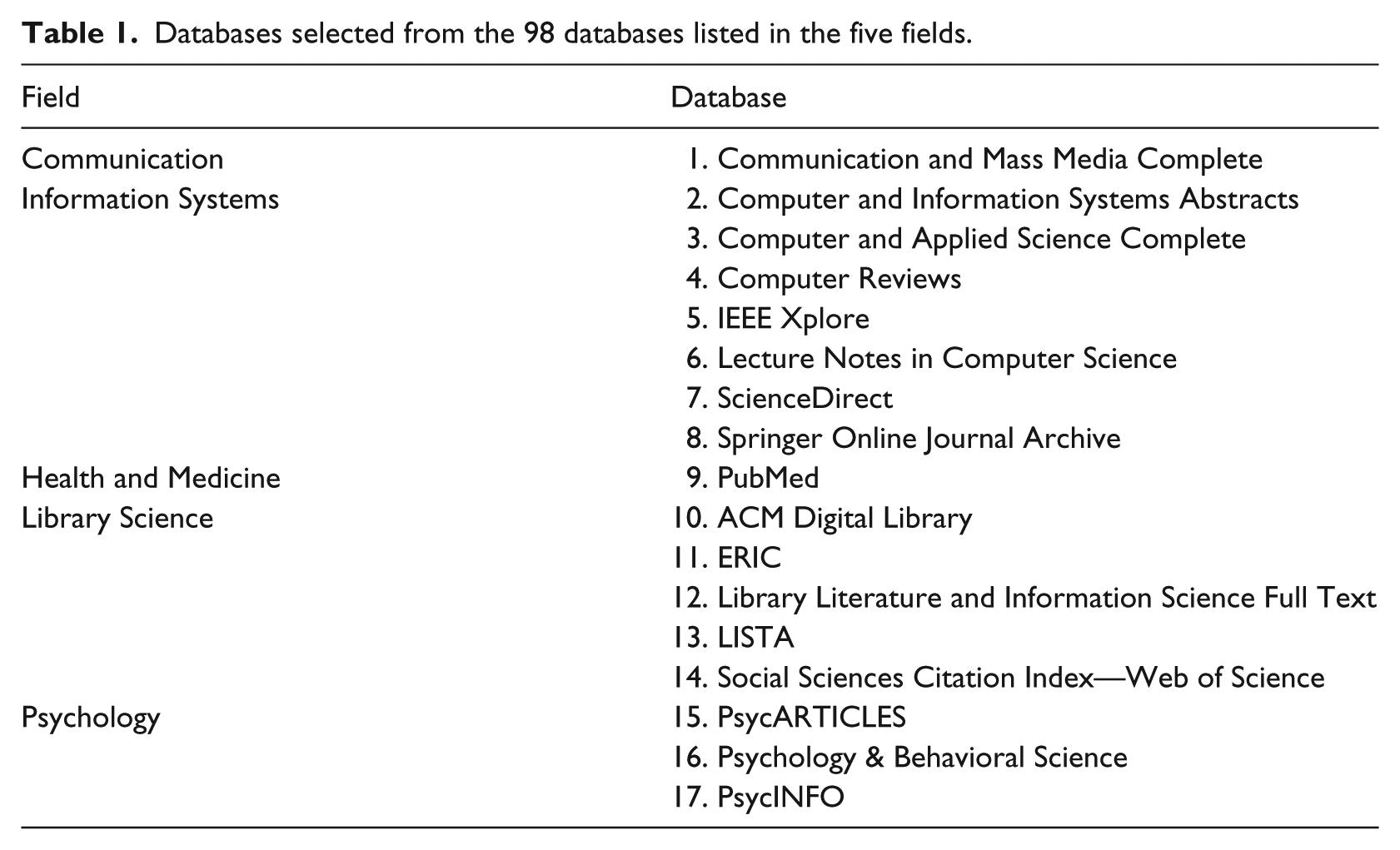
A systematic review was conducted whereby studies selected for inclusion in this review were appraised using a tool used by Xie et al. 22 An iterative process conducted from September to November 2013, helped identify relevant search articles for the sample. The first round involved narrowing down the appropriate database. Databases available at the University of Texas at Austin were used to conduct the search queries. The five fields relevant to this topic were targeted-communication, information systems, health and medicine, library science, and psychology. From the 98 available databases, inclusion/exclusion criteria to select the appropriate database possessed the following logic: 22 (1) databases that contained peer-reviewed research articles were included, while databases limited to containing encyclopedia, doctoral dissertations or master theses, magazines, book reviews, news articles, or videos were excluded; (2) databases that allowed searching within keywords, abstracts, or full text were included; (3) databases that allowed English language were included; and (4) databases related to the five fields were included. The first round of selection yielded a total of 17 databases, as listed in Table 1.
Databases selected from the 98 databases listed in the five fields.
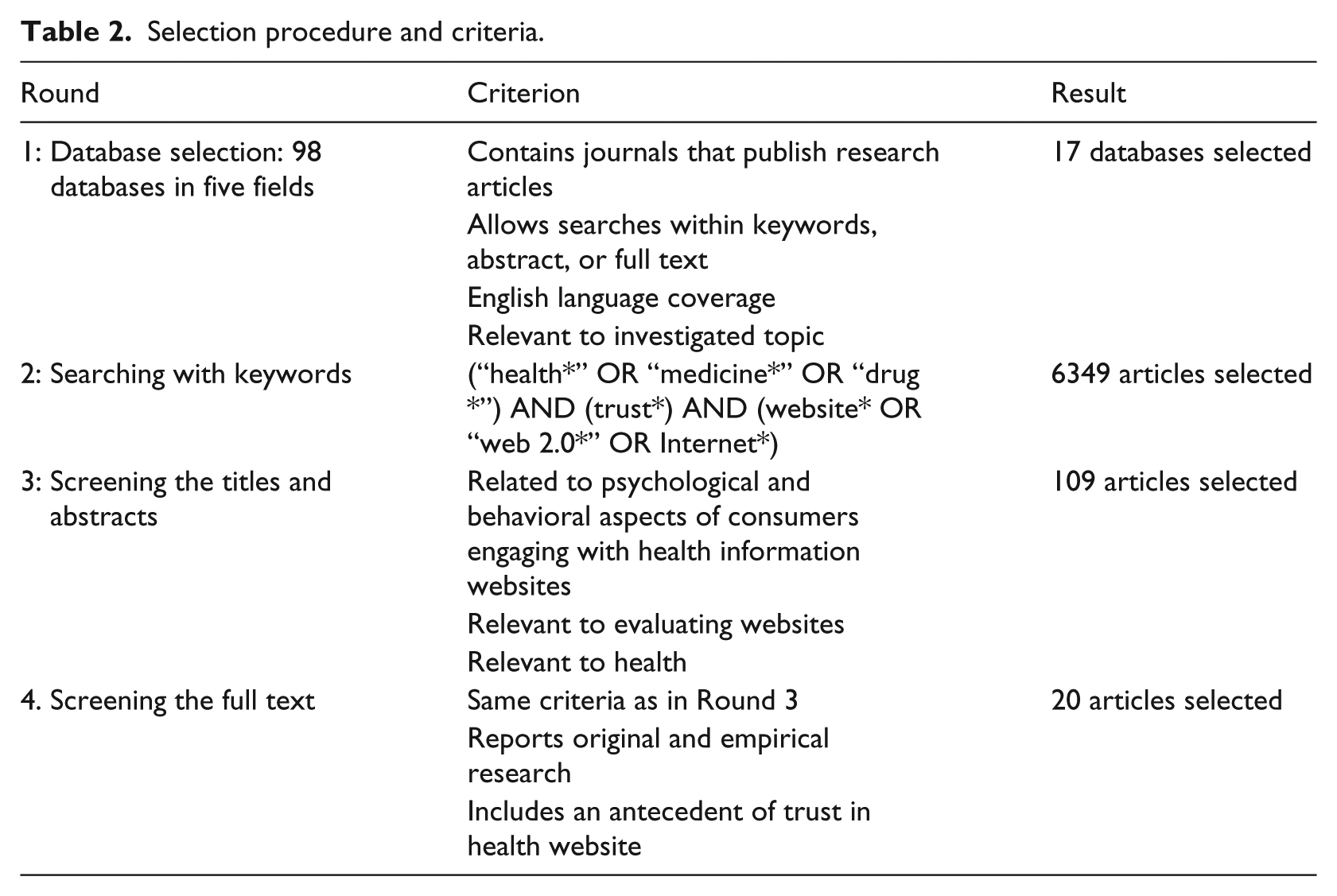
The second round involved keyword searching. From September to November 2013, the following combination of search terms was used to identify articles from 17 databases: (“health*” OR “medicine*” OR “drug *”) AND (trust*) AND (website* OR “web 2.0*” OR Internet*). A comprehensive search including these terms was conducted on each database to retrieve as many articles as possible. No restrictions on types of the study to be included with the exception that the papers had to be in English. This round of selection resulted in a total of 6349 articles.
The third round included screening the titles and abstracts. The title and abstract of each of the 6349 articles were examined to determine whether the nature of trust and health information website were within the scope of this review article. The following inclusion/exclusion criteria were used in this selection round: (1) articles must be related to psychological and behavioral aspects of consumers (or patients) that view health information websites. Therefore, articles with a focus on different samples (e.g. physicians or nurses) were excluded. (2) Articles must be relevant to evaluating websites. Articles that focus on offline environments were excluded. (3) Articles must be health-related. For instance, those related to other areas such as e-retailing, e-government, and e-banking were excluded. This round of selection resulted in a total of 109 articles that met these criteria.
The fourth round was screening the full text. A close examination of the full texts of these 109 articles determined the factor behind their inclusion in the third round. Additional inclusion/exclusion criteria were applied in fourth round: (1) for instance, whether the article type was an original and empirical research (quantitative and qualitative). In other words, other article types (e.g. review articles) were excluded. (2) Articles had to include an antecedent of trust in health websites, thereby excluding articles with a passing mention of trust. (3) Articles that focused on trust in online health information, instead of trust in health websites, were excluded since the focal point of these papers is different in that the objectives are to evaluate solely the “information.” (4) To include more articles, papers focusing on evaluating website credibility, a dimension of trust, 23 were retained. For this round, a total of 20 articles (15 quantitative and 5 qualitative) were harvested as the final sample. Table 2 contains the selection procedures, criteria, and search results.
Selection procedure and criteria.
Results
This search yielded 20 articles—all published between 2000 and 2013. Table 3 presents the summary of the empirical studies with information containing the author(s), publication venue, objective of study, methodology, analysis tool, and the identified antecedents of trust. Three articles used patients, and 17 articles used consumers as their sample. The total number of antecedents was 70, with an average of 3.5 antecedents per articles. Among the quantitative articles, 30 out of 47 antecedents showed significant relationships with respect to trust in health websites. The most frequently studied antecedents were socio-demographics, information quality, appearance, and perceived reputation of the website.
Included studies.
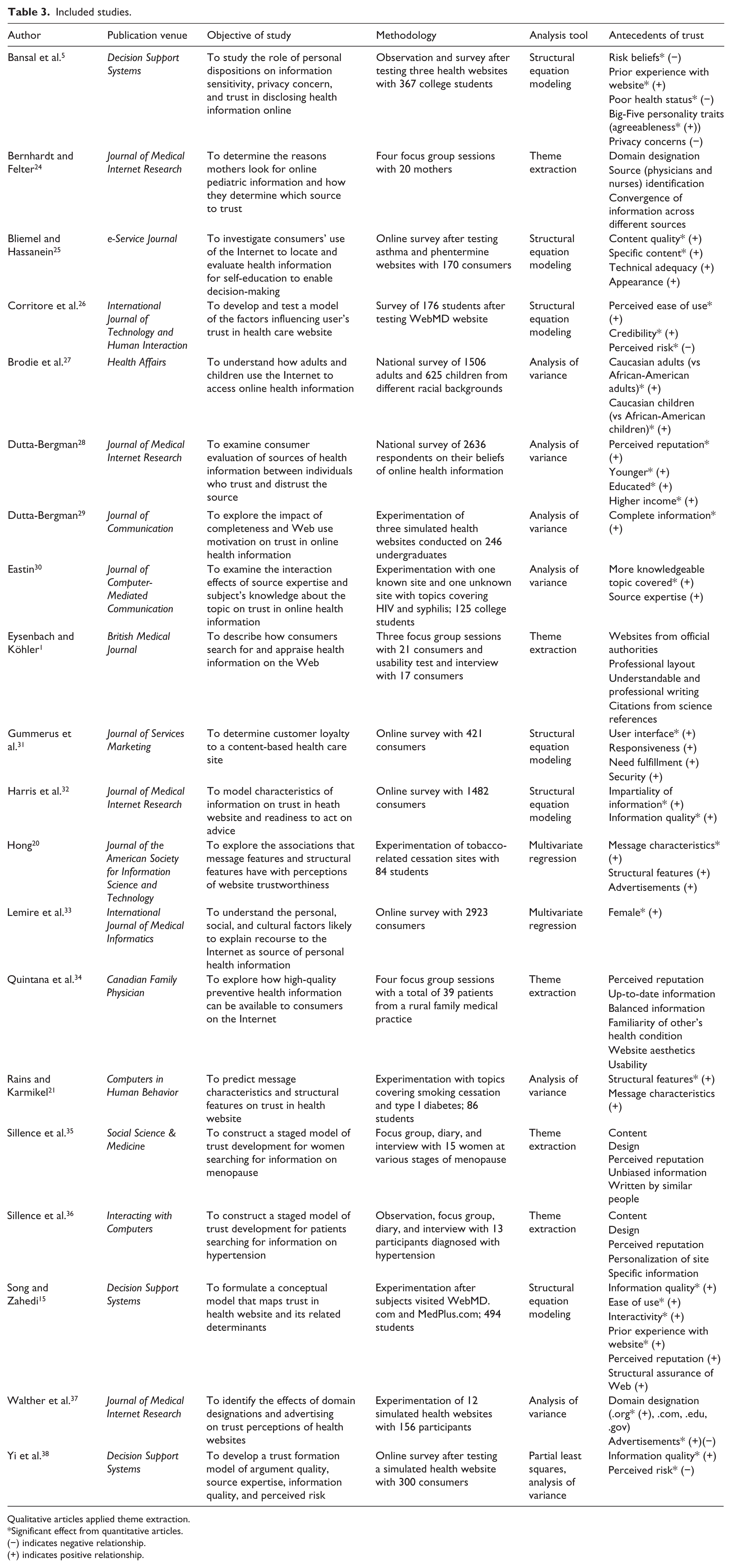
Qualitative articles applied theme extraction.
Significant effect from quantitative articles.
indicates negative relationship.
indicates positive relationship.
This review organizes the antecedents of trust into three categories: individual difference antecedents, website-related antecedents, and consumer-to-website interaction-related antecedents. This categorization technique is also found in review articles that organize the antecedents of trust.39,40 This classification is based on the notion that a health information website is a conduit for interaction among the consumer, source, message, channel, and receiver characteristics.
Individual difference antecedents
Socio-demographics
Overall, younger consumers tended to trust health websites, including sources operated by a personal doctor, medical university, federal government, and local community. 28 Moreover, consumers who were educated and had higher income levels trusted online health sites compared to those with less education and lower income levels. 28 However, it must be noted that Dutta-Bergman’s 28 study did not include a reference class; therefore, it was not possible to compare different groups. One study included gender and found that females placed significantly more trust in health websites. 33 A study, which included race as a factor, showed that Caucasian adults and Caucasian children in comparison to their respective African-American counterparts were more likely to trust health websites. 27
Personality
As part of the post hoc analysis, Bansal et al. 5 included the Big-Five model, encompassing extraversion, agreeableness, neuroticism, conscientiousness, and intellect, to predict their influence on trust related to health websites. According to the results, higher levels of agreeableness were associated with increased levels of trust, whereas other personality traits did not show a significant relationship with trust. Agreeableness is characterized by having positive beliefs toward other parties and appreciating their values and convictions. 41 When individuals have respect for others, they also believe that others show respect to them. Hence, a trustworthy relationship exists between parties. Interestingly, while agreeableness was positively related to trust, it was also positively associated with perceived risk. It could be reasoned that those who tend to show traits of agreeableness could be more trusting and aware of risk.
Health status
The manner in which consumers view their health is considered an important element in studies.42,43 It has been suggested that good health status yields higher internal locus of control and greater social trust.44,45 Empirical evidence has shown that those who believe that they are in “good” health condition tended to trust health websites. 5 The authors suggested that consumers with poor health status would rely on information provided by their health care professional instead of trusting information available from websites.
Health literacy
Knowledge about a health topic was an important antecedent to the credibility of the website. 30 According to the experiment results, students were more likely to believe information from an online source if the topic covered HIV, a relatively well-known topic, rather than syphilis, an unknown topic.
Website-related antecedents
Information quality
Information quality is characterized by features that are related to accuracy, timeliness, completeness, relevance, and consistency. 46 Research has generally supported the idea that information quality was an effective predictor of trust in online health sources. For instance, consumers preferred information that was complete, understandable, professional, unbiased, and up-to-date.1,15,20,25,29,30,32,35,36,38 When consumers perceived the website to contain these specific characteristics, the tendency was to trust these websites. Empirical results from Yi et al. 38 in their partial least squares model indicated that quality of information strongly influenced trust in online sources. Moreover, the convergence of information across different online and offline sources had a positive influence on trust in health websites.24,32 Bernhardt and Felter 24 contended that mothers would trust a health website if the information appeared many times in many places; otherwise, the website is not providing valid information since “no one else is corroborating.”
Song and Zahedi 15 measured information quality as a multidimensional construct containing understandability, relevance, usefulness, reliability, and adequacy that maps into online trust. In addition, trust is measured in terms of separate dimensions formed by ability, benevolence, and integrity. Results demonstrated that the dimensions of information quality had a significant positive effect on each dimension of trust. The strength of the influence was greater for ability and integrity compared to benevolence.
Contrary to prior articles, the study from Rains and Karmikel 21 indicated that information characteristics such as statistics, information currency, information reference, author information, testimonials, and quotations did not influence trust in health websites. Their results actually suggested that consumers trusted health websites with high-quality structural features, such as ease of navigability, response time, and the design of website. Rains and Karmikel 21 reasoned that information characteristics are not directly associated with trusting the website, but they do play a role in broader attitudes about the health topic.
Ease-of-use
Ease-of-use is one of the important constructs within the Technology Acceptance Model. 47 A website viewed as easily operable and useful is likely to be accepted and continued to be used by consumers. 6 On the other hand, lack of ease-of-use may indicate that users have difficulty navigating the website due to poor organization of the site, poor design or information overload, making it likely for users to abandon the website. In the study by Song and Zahedi, 15 they experimented with two relatively well-known health websites—WebMD.com and MedPlus.com—to show that ease-of-use significantly influenced online trust. Similarly, Corritore et al. 26 showed that a user’s trust in websites is influenced by the perception of the website’s ease-of-use. Corritore et al. 26 also included credibility as a separate construct that differentiates from trust, and the model demonstrated that ease-of-use had a direct effect on trust, as well as an indirect effect on trust through credibility.
Appearance
There were spurious findings related to design aspects having an impact on trust in health websites. For instance, professional layouts, images, advertisements, physical addresses, and navigation menus had an important effect on online trust.21,24,37 Walther et al. 37 investigated the effects of top-level domains and advertisements on health website trustworthiness by manipulating 12 mock-up health websites. The study revealed that .org is favored over .com, .edu, and .gov. However, when introducing advertisements to test the interaction with domain names, advertisements had deleterious effects on the trustworthiness of the sites with .org domain, but positive effects on sites with .com or .edu domains. The article by Bernhardt and Felter, 24 which reported a study on mothers seeking pediatric information, provided evidence that they trusted websites if they included the source’s name and picture. Quoting one of the subjects, “I think for me, psychologically, I like to see a person’s face, see what they look like, just because it helps me to decide if I trust them or not.” Similarly, Rains and Karmikel 21 noted that features such as the inclusion of a navigation menu or images may reinforce the idea that the entity operating the website is professional, which in turn increased their trust toward the website.
In contrast, others have argued that design quality do not have an effect on trust in the website.29,32 In the study by Sillence et al.,35,36 only a small portion of patients believed that design was a critical issue. The majority of the patients considered the content to be more important. Bliemel and Hassanein 25 also provided evidence that website appearance and technical adequacy did not have a significant effect on trust in health websites, showing instead that these factors adequacy had a positive influence on satisfaction with the health website.
System quality
Quality of user interface relates to factors such as usability, adaptability, functionality, and flexibility.48,49 The interface aspect forms a critical component in the online environment; thus, system quality has emerged to contain dimensions with respect to download delay, navigation, response time, and error-free interaction. 50 A study by Gummerus et al. 31 revealed that quality of user interface had a positive impact on trust. Perceptions of a health website were quickly formed based on the qualities portrayed by an online health source after consumers browsed the page, which, in turn, influenced the decision to trust the health website. A study by Quintana et al. 34 showed evidence that a website that was easy to navigate increased the patients’ engagement with the source.
Consumer-to-website interaction-related antecedents
Prior experience with using health information websites
A consumer with prior experience using health information websites is more likely to have low perceptions of risk and a favorable impression of previously visited health website, thereby increasing the likelihood of trusting health-related websites. According to Song and Zahedi, 15 prior experience had a strong positive effect websites. However, following the logic of Aiken and Bousch, 51 those with novice- and intermediate-levels of experience using health information websites tend to trust them. However, those with high levels of experience using health information websites do not tend to trust them because of their past exposure to discovering “questionable” information.
Perceived reputation
In the qualitative studies by Sillence et al.,35,36 all patients tended to trust online information sources operated by reputable organizations such as the government. Other studies have shown that websites run by personal doctors, followed by medical universities and federal government were the most trusted sources to obtain health information.1,28 Similarly, results from a focus group study favored advocacy group and well-known medical institution websites as trustworthy online destinations. 34 Furthermore, it was revealed that the least trusted online health source was insurance companies 28 and e-commerce websites handling health information issues. 24
Perceived risk
Perceived risk refers to the subjective belief of suffering a loss. 52 The belief is set when consumers have perceptions of uncertainty about the consequences of taking action because of the possibility that the entities involved are taking advantage of the situation. 10 Results from Yi et al., 38 which had 300 online users test a simulated health website, showed that perceived risk had a modest negative relationship to trust in health websites. On a study conducted on 367 students testing three health websites, risk beliefs about submitting health information on the Internet had a negative impact on trusting the health website. 5
Familiarity
Familiarity is an understanding based on previous interactions and experiences with another party. 53 Even though the information may be provided by an unqualified source, studies have shown that patients preferred certain health information written by people experiencing similar health issues.34,35 Sillence et al. 35 claimed that familiarity with others’ health condition increased trust in the health website.
Discussion
In this study, we have presented a systematic review of published literature that investigated antecedents of trust in health information websites. Empirical studies have used different antecedents to gauge the levels of trust placed on a health website. It has been shown that the development of online trust can be influenced by individual difference factors, website-related factors, and consumer-to-website interaction-related factors. Among the antecedents of trust, researchers have frequently employed socio-demographics, information quality, design, and perceived reputation of the website.
The review of empirical studies revealed that information quality is consistently perceived as an important criterion for trust in as health information website. Perhaps the underlying logic of frequently investigating this antecedent is because of poor health information quality currently displayed on the Web.54,55 For instance, Ahmed et al. 54 reviewed 43 concussion-related websites in terms of their authoritativeness, complementarity, privacy, attribution, justifiability, transparency, financial disclosure, and advertising policy and detected that 70 percent of the sites have information quality issues. Therefore, it is not surprising that when consumers search for information from health websites, they trust sites that contain “high-quality” health information.
This review showed that empirical studies on antecedents of trust could have contradictory results. For instance, while one study showed that using images to increase perceptions of professionalism increases trust in health websites, 24 a different study did not support this relationship. 35 As suggested by Beldad et al., 40 disparities in results imply that the effects of some online trustworthiness cues on trust formation do not transcend contextual differences and are therefore relative and could depend on the context of subjects involved in evaluating health websites.
This review will be useful as a building block for those involved in developing and managing health information websites. Knowing the different antecedents of online trust would help professionals develop a better sense of what triggers consumers to trust the information layered in the health website. Additionally, researchers in the health informatics community can benefit from this review by acknowledging what antecedents of trust have been tested and what alternative antecedents could be possibly employed. Extending the antecedents of trust from the e-commerce literature into the online health context could provide a basis for recommendations for a possible research agenda. This is based on the fact that fewer studies are conducted in the health context compared to the sizable number of similar studies in the e-commerce context. For instance, scholars could focus on different factors such as propensity to trust, 56 Internet experience, 57 privacy, 58 perceived usefulness, 6 offline presence of the website entity, 59 and perceived size of the entity. 60
Despite its importance, studies have not focused on the influence of privacy on trust formation with respect to health websites. 61 Online risks such as the possible loss of privacy when engaging with health websites could have an important relationship with online trust. Thus, including privacy as a measure through perceived privacy, privacy concerns, privacy statements, third-party seals-in models that aim at determining online trust determinants would result in a more exhaustive theoretical framework of trust in health information websites. As evidence, privacy concerns have been pointed out as a significant factor for customers to distrust e-commerce websites. 62 Lauer and Deng 58 revealed that introducing privacy policies in the website resulted in higher perceptions of the website’s trustworthiness. Moreover, the presence of third-party seals (e.g. HONcode, Doctor Trusted™, TrustE, BBB) is used as an institutional mechanism to show that the website is reliable and honest, and this enables the consumer to trust and eliminate risks inherent in the interaction between the consumer and the website. 63
Finally, articles identified within this study have captured trust at a single moment in time. However, trust by nature is supposed to be a dynamic process which can be built, maintained, and decline over time. 9 Thus, a longitudinal study on evaluating trust in health website could be the next logical step for future research. Overall, based on reviewing the empirical findings, it can be said that trust research in the online health context has yet to reach its peak.
Footnotes
Acknowledgements
The author would like to thank Dr. Bo Xie for the comments. The author also wishes to thank his wife Hye In Jeong for providing intellectual support throughout the production and completion of this study.
Declaration of Conflicting Interests
The author(s) declared no potential conflicts of interest with respect to the research, authorship, and/or publication of this article.
Funding
The author(s) received no financial support for the research, authorship, and/or publication of this article.