




Abstract
The application of artificial intelligence (AI) not only yields in advantages for healthcare but raises several ethical questions. Extant research on ethical considerations of AI in digital health is quite sparse and a holistic overview is lacking. A systematic literature review searching across 853 peer-reviewed journals and conferences yielded in 50 relevant articles categorized in five major ethical principles: beneficence, non-maleficence, autonomy, justice, and explicability. The ethical landscape of AI in digital health is portrayed including a snapshot guiding future development. The status quo highlights potential areas with little empirical but required research. Less explored areas with remaining ethical questions are validated and guide scholars’ efforts by outlining an overview of addressed ethical principles and intensity of studies including correlations. Practitioners understand novel questions AI raises eventually leading to properly regulated implementations and further comprehend that society is on its way from supporting technologies to autonomous decision-making systems.
Introduction
“A robot may not injure a human being or, through inaction, allow a human being to come to harm.” The first of the Three Laws of Robotics expressed in 1942 by the science fiction author Isaac Asimov 1 is certainly known by many of us from various cinema and television films about robots and their artificial intelligent behavior. Despite the age of these laws, their relevance seems more present than ever if we consider current developments in the area of artificial intelligence (AI) in digital health as systems are used in various medical disciplines.
There is an ongoing excitement towards AI, 2 and both researchers and practitioners equally focus on related concepts. Although early studies can be traced back to the 1950s, 3 there is still no widely accepted definition of the term AI. 4 AI can generally be seen as “the ability of a machine to perform cognitive functions that we associate with human minds, such as perceiving, reasoning, learning, interacting with the environment, problem solving, decision-making, and even demonstrating creativity.” 5 The application of AI within healthcare yields numerous benefits for hospitals and patients. For instance, AI is being used for assisting medical specialists within the diagnostic process and deriving proper treatment strategies6–8 as well as managing health-related information provided by patients during a self-anamnesis. 9
The major aim of AI in digital health lies in generating advantages for involved individuals and organizations. AI is capable of collecting, processing and analyzing health-related information more quickly10,11 and provide decision support for multiple stakeholders within healthcare, that is, patients, doctors, or hospitals. 12 However, the recent AI developments and applications in digital health come along with certain issues. Above all, recent literature poses various ethical questions which have not been considered sufficiently, especially how to prevent inequitable usage13,14 or provide fair information practices. 15 There are no unified legal regulations, even though multiple governments are involved.16–19 The rapid development of AI 4 hinders to regulate new advancement in a timely manner and further, there is currently no consensus on what an AI is allowed to decide, nor is there social acceptance for AI decisions.
Among others, AI poses uncertainties regarding bias, discrimination, autonomies, control, opacity, rational concerns, or dystopias.20,21 Moreover, it is rather indistinct when AI should be used as decision-support system that assists medical specialists with specific tasks, for example, within the diagnostic process.7,8 An advancement could be the application of AI as decision-making tool which takes over responsibilities of individuals and derives conclusions on its own. In this case, it has not yet been defined who actually is responsible for decisions in the event of an error. If, for example, a patient dies in a hospital due to an AI-based decision or recommendation, who is then liable for any compensation payments? Or, to reverse the example, what happens if a clinician does not follow a recommendation of an AI which leads to death?
The examples provide evidence that ethical concerns and the application of AI in digital health are closely linked to each other. Research on ethical considerations is no longer a mere part of science fiction, but a real-world concern affecting healthcare as AI is already used in digital health.22,23 Medical practitioners are still at the beginning of understanding ethical implications related to AI as well as the extent to which systems can be applied to generate improvements within digital health, always keeping the overall outcome for patients in mind. We argue that this research is of great interest to scholars and practitioners alike as its relevance will increase even further. There is thus an urgent demand to provide an overview of ethical research approaches regarding AI in digital health to understand the intricacy of this emerging topic. 24 To address these pressing issues, our study is guided by the following research question:
Which ethical considerations on artificial intelligence in digital health are currently being studied, and what are the pertinent future research directions? A systematic literature review (SLR) suits as starting point to provide an overview on ethical considerations in the context of AI within digital health and identifies which aspects have not yet been adequately covered in existing literature. We therefore explicitly focused on research articles that deal with ethical questions regarding the application of AI for digital health purposes. Our objective is to portray the ethical landscape of AI in digital health and provide a snapshot to guide future development. We present a review of the status quo based on the existing literature and scientific findings that highlight potential research areas where little empirical research has been carried out. This paper structures our understanding of ethical challenges that have been researched in the context of AI as component of digital health. Researchers will find the overview of ethical considerations beneficial for validating less explored areas in which ethical issues still remain unanswered. To guide scholars’ efforts, we outline an overview of which ethical principles are addressed by recent research and highlight the intensity of the studies reviewed including their correlated areas. Practitioners will be able to assess which ethical aspects are relevant when applying AI and what novel questions AI, unlike other technologies, raises.
Related work
Research on ethical considerations and related consequences is primarily concerned with three types 25 : First, the moral development of future physicians throughout their medical training.26,27 Second, the evaluation of ethical values of medical students and differentiations in their professions .28,29 Third, the evaluation of certain ethical principles.26,30 However, ethical considerations are becoming more eminent and profound in digital health due to increasing capabilities and application of AI.31,32
Martinez-Martin and Kreitmair 33 investigated ethical issues for digital psychotherapy apps and discovered that lack of adequate regulation, especially regarding safety and privacy, is a major concern. They discuss that appropriate regulatory oversight is needed for the safety and protection of data. Research is also concerned with AI as potential backbox since the results of underlying algorithms, that is, neural networks or deep learning approaches, are not always comprehensible. 34 Park et al. 35 examined transparency regarding data, test data, and results of AI algorithms. The results show that clarifying any bias or errors in the data prior the application is crucial. The authors argue that transparency is a key ethical issue for AI in healthcare. This goes in line with a recent study of Reddy et al. 36 who developed a governance model for the application of AI in healthcare. The study identified transparency of AI for decision making as one of four essential elements connected to ethical considerations. Besides transparency, fairness, trustworthiness, and accountability are additional components that need to be considered before integrating AI in digital health.
Alongside the model of Reddy et al., other frameworks have emerged in recent years to categorize ethical concerns. For example, Recht et al. 37 developed the FAT (fairness, accountability, and transparency) paradigm for the integration of AI into clinical practice. They argue that most ethical concerns with AI in healthcare can be classified in one of the three groups. Moreover, countries and organizations have also realized that ethical frameworks must be created due to the increasing spread of AI. The European Union established a high-level expert group on AI in 2019 and developed the “European Ethics Guidelines for Trustworthy AI.” 16 Trustworthy AI should follow three guidelines: (1) lawful, complying laws and regulation, (2) ethical, obeying ethical principles and values, and (3) robust, not causing any harm. Furthermore, the guideline defines various key requirements, that is, technical robustness and safety or societal and environmental well-being. Besides the European Union, the World Health Organization is currently working on reviewing existing ethics principles to derive recommendation on how to assure ethical use of AI,38,39 and even the Australian government seeks to develop an ethics framework. 17
Despite the growing numbers of frameworks, guidelines, principles, or paradigms, there is no uniform ethical strategy to apply AI in digital health. 40 However, existing frameworks frequently cover similar circumstances. We therefore follow a more holistic approach and use the framework of good AI society as proposed by Floridi et al. 41 as theoretical lens. The authors created a “synthesis of existing sets of principles produced by various reputable, multi-stakeholder organizations and initiatives.” 41 They assessed various documents, for example, the asilomar AI principles, 42 the Montreal declaration for responsible 43 AI or the five overarching principles for an AI code, 44 which yielded in 47 principles. Floridi et al. identified a high degree of overlaps compared to the four core principles of bioethics, 45 that is, beneficence, non-maleficence, autonomy, and justice. Combined, they form the core of modern bioethics discussion, 46 determining an optimal course of action in healthcare but fit ethical challenges posed by AI. 41 Beneficence generally describes that healthcare specialists should act in a way that the patient benefits from it. Thus, AI needs to foster the well-being of living beings.41,43 Non-maleficence aims at avoiding any harm, for example, to patients or physicians. In the context of AI, negative consequences must be avoided, for example, misuse regarding privacy or security. 41 Autonomy respects the capabilities of individuals to make independent decisions. AI therefore needs to be designed to endorse this demand. 41 Justice describes that every patient should be treated similar. AI can thus be applied to correct previous non-justice decisions, that is, unfair discrimination. 41 Despite significant overlaps and suitability for AI, the four core principles are not exhaustive. 41 The authors thus added a fifth principle explicability incorporating intelligibility and accountability which defines the “need to understand and hold to account the decision-making processes of AI.” 41
Research approach
For providing an overview on ethical considerations, that is, which attempts scholars have been undertaken, we executed as SLR to identify relevant articles and examine them according to the ethical framework for AI. Since we were interested in providing a holistic picture, we decided to start our literature search within the information systems (IS) discipline. We argue that IS, as interdisciplinary community addressing dynamic and evolving sociotechnical challenges, must promote further research guiding medical specialists with ethical considerations on AI in digital health. Our SLR is depicted in Figure 1. SLR procedure.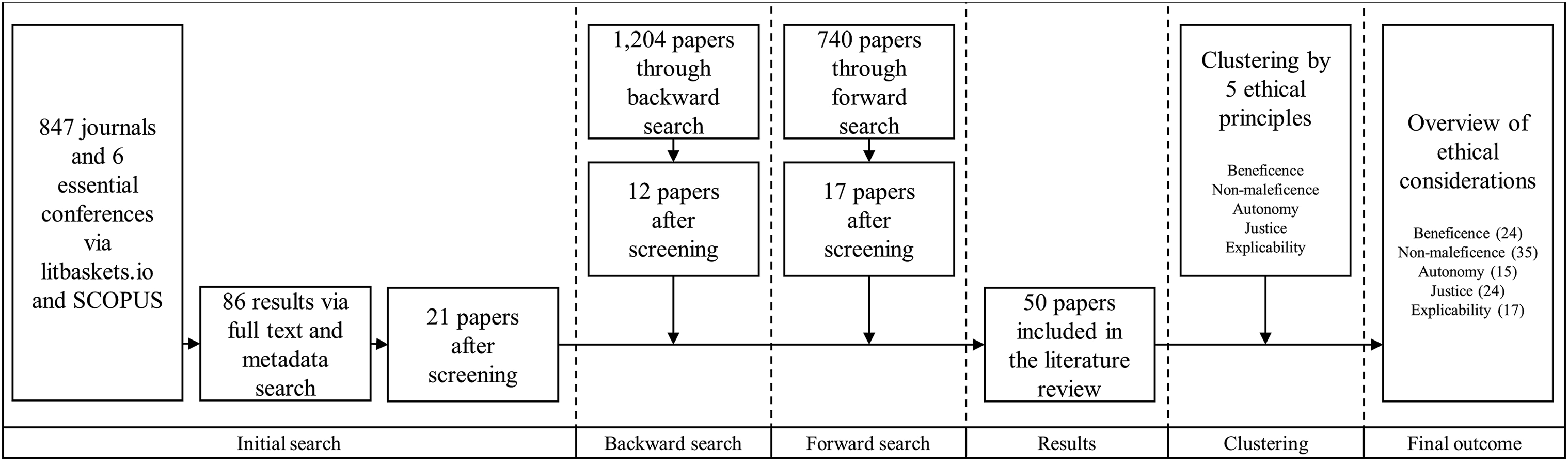
Generally, an SLR is a structured approach to determine recent knowledge about a specific topic, which benefits from the disclosure to potential theoretical aspects. 47 SLRs assist scholars in highlighting their contribution to theory and practice by searching for relevant literature within scientific databases using dedicated keywords. 47 Our research can be classified as descriptive approach since we examined existing knowledge describing the current circumstances based on scientific facts and further transferring it to an emerging topic. 48 Leaning on Bem, who suggested a “coherent conceptual structuring,” 49 we analyzed the literature according to the five categories (beneficence, non-maleficence, autonomy, justice, and explicability) within the ethical framework for AI. This classification assisted us to interpret the results in a more holistic way.
Following the literature review approach provided by vom Brocke et al.,50,51 we defined our search scope relying on the taxonomy of literature reviews. 52 The literature search was performed using litbaskets.io, an IT artefact developed to assist scholars in retrieving relevant literature from the most recognized databases within the IS discipline. 53 Litbaskets.io converts the given search string to be used by Scopus’s advanced search via ISSN numbers of selected outlets, thus providing the possibility to search across indexed scientific sources. 53 Scholars can further apply different filters and restrictions, that is, selecting specific outlets or limiting by a year, to narrow down the search results based on certain criteria. 53
Since we aimed at obtaining a comprehensive overview of the current research on ethics in the context of AI and digital health, we deliberately selected the largest filter containing 847 outlets (for a full list of the included outlets, please see https://www.litbaskets.io/). Furthermore, we did not limit our search starting with a specific year. Since litbaskets.io is focusing on journals but does not provide the option to include conferences, we extended the literature search by selecting the elementary IS conferences manually via Scopus. Our SLR acknowledged peer-reviewed articles only. Less relevant sources, for example, editorials or commentaries, were excluded. We performed full text and metadata search to avoid the possibility of overlooking relevant publications as metadata of articles is not equally indexed by Scopus. The final query used for the SLR looks as follows:
(AI or “artificial intelligence” or “chatbot*” or “chat-bot*” or “conversational agent*” or “digital assistant*” or “virtual assistant*” or “personal assistant*” or “virtual agent*” or “ai-based system*”) AND (health or healthcare or “digital health” or “hospital*” or medicine or medical) AND (“ethic*” or “moral*”).
For obtaining thorough results and providing an overview on the current state of research, we carried out several exemplary literature searches prior the execution of our SLR. Our final search string covers three major areas: First, since there are various systems that are using AI and frequently examined in current research, we linked the most common ones, that is, “chatbot,” “chat-bot,” “conversational agent,” “digital assistant,” “virtual assistant,” “personal assistant,” “virtual agent,” and “ai-based system.” Second, we used various terms for the topic area of digital health, that is, “health,” “healthcare,” “hospital,” “medicine,” and “medical.” Third, we applied the terms “ethic” and “moral” to cover ethical and moral issue in the context of our research which are used interchangeably. 54 Parentheses nest clauses or group phrases within the search string. Separate statements are linked by Boolean expressions, quotation marks specify terms which must appear next to each other, and wildcards (e.g., “*”) cover different spellings or the plural of expressions.
Once the initial search was conducted, we carefully read the title, abstract and keywords of each publication to validate its relevance according to our research question. Since we wanted to provide an overview on the current state of research, we focused on articles which are largely concerned with ethical aspects. We excluded articles, for example, if they only dealt with technical implementations of AI within the realm of healthcare. Next, we categorized the articles according to the five principles on ethics within the theoretical framework. Since a basic search is not able to provide a comprehensive review, and we were also interested in retrieving relevant literature outside the IS discipline, we further conducted a backward search. We therefore collected every reference of the bibliographies of each identified article. Comparable to the initial search, we included references to other conference and journal publications and excluded non-scientific sources, such as web pages or business reports. To identify relevant literature according to our research question, we followed the equal procedure as performed within the initial search: Reading the title, keywords and abstract, and categorizing the articles according to the theoretical framework. The final step of our SLR was the forward search. To identify even further literature, we considered every paper, which was found during the initial and backward search, that has been cited by other research after its initial publication. Yet again, we read title, abstract, and keywords and performed the categorization process as outlined above.
Results and analysis
In total, we screened 2,106 articles of which 50 are relevant with respect to our research question. The execution of the SLR resulted in 21 relevant results within the initial search (of 86), 12 via backward search (of 1,204) and, finally, 17 relevant publications were identified through the forward search (of 2,106). We analyzed the publications according to their distribution of year, their outlet and, as outlined above, their distribution by their ethical principle. We thereby provide an overview on ethical concerns related to the application of AI in digital health. We further show in which area extensive research has been undertaken and where little or less research was conducted yet but seems promising for future studies.
Distribution of articles by year and outlet
No articles were found by our SLR before the year 2000. It is noteworthy that there are only few or even no publications up until 2016. But from 2018 onward, the number of publications has risen considerably with 14 in 2018, 16 in 2019, and already 11 in this year. If we consider 2020, the work at hand presents only the first 9 months. It can be assumed that the total number of publications might be similar to the 2019, if not greater. However, the undeniable trend of ethical concerns in the context of AI within digital health, represented by the rapid increase in publications over the past 3 years, symbolizes the salience and legitimacy of this research area. Figure 2 provides the distribution by years. Total number of articles per year.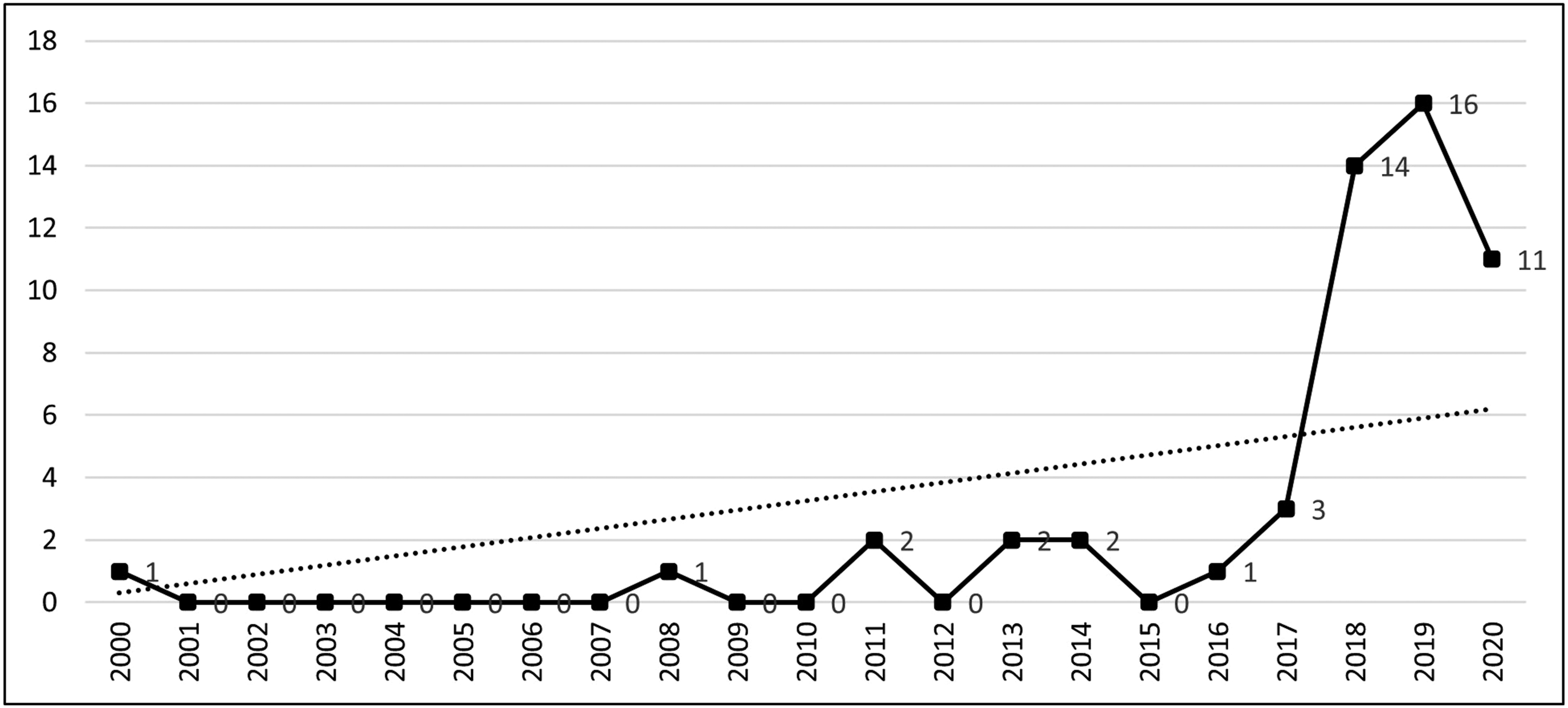
From the total of 50 articles, 44 have been published in journals (88%) and only 6 (12%) in conference proceedings. Almost all articles were published in different outlets. Only three outlets published more than one article: Journal of Medical Internet Research (6;12%), Bulletin of the World Health Organization (2;4%) and Proceedings of the AAMAS Workshop on Intelligent Conversation Agents in Home and Geriatric Care Applications (2;4%). This finding is surely related to the rapid increase of publications in recent years and indicates that ethical aspects, in the context of AI in digital health, are addressed from various research streams.
Distribution of articles by ethical principle
Relevant articles found in the SLR assigned to the five theoretical foundations.

(1) Beneficence; (2) Non-maleficence; (3) Autonomy; (4) Justice; and (5) Explicability.
The papers as retrieved by our literature search deal with a variety of different approaches and diverse ethical viewpoints in the context of AI in digital health. A majority of the research tries to develop models, frameworks, guidelines, or principles31,36,41 to use them for various purposes in healthcare or suggest that they shall be used in practice but without providing clinical evidence or proof of their validity. Occasionally, new categories or names for ethical constructs are created, for example, “trustworthiness,”36,59 but without really differing from the four core principles commonly used in bioethics (or the additional fifth category that we also used to categorize our results). Furthermore, ethical aspects in the context of AI in healthcare are being studied in a wide range of research areas, for example, technical implementations, 96 the use of robotic systems in operating theaters, 95 care robots fort the elderly 93 or in the area of caregivers and geriatric patients. 69
Discussion
Recent development in the field of AI in digital health come along with certain ethical issue. There are challenges regarding bias, discrimination, opacity, rational concerns, or dystopias. 20 In addition, there are various questions that try to answer in what way AI is allowed to interact or intervene or if systems should be decision-supporting or decision-making. Even though AI is frequently being used in digital health,24,97 ethical considerations have only recently started to move into researchers’ attention.
Our results reveal that there has been an enormous increase in publications from 2018 onwards. This could be related to the fact that AI is increasingly being applied within digital health. Recent research provides evidence that AI assists physicians in the diagnostic process,98,99 improves collaboration among healthcare workers100–102 and further aids patients in their course of disease.103,104 Besides, technology which is needed for implementing AI-based systems improved and simultaneously became more affordable. 105 However, the development of a supporting technology is usually in the foreground, ethical considerations are frequently considered after systems are already in use. This may be the reason why ethics research on AI in digital health only recently begun although systems are already used for various productive purposes.
Exemplary future research questions for each ethical principle.
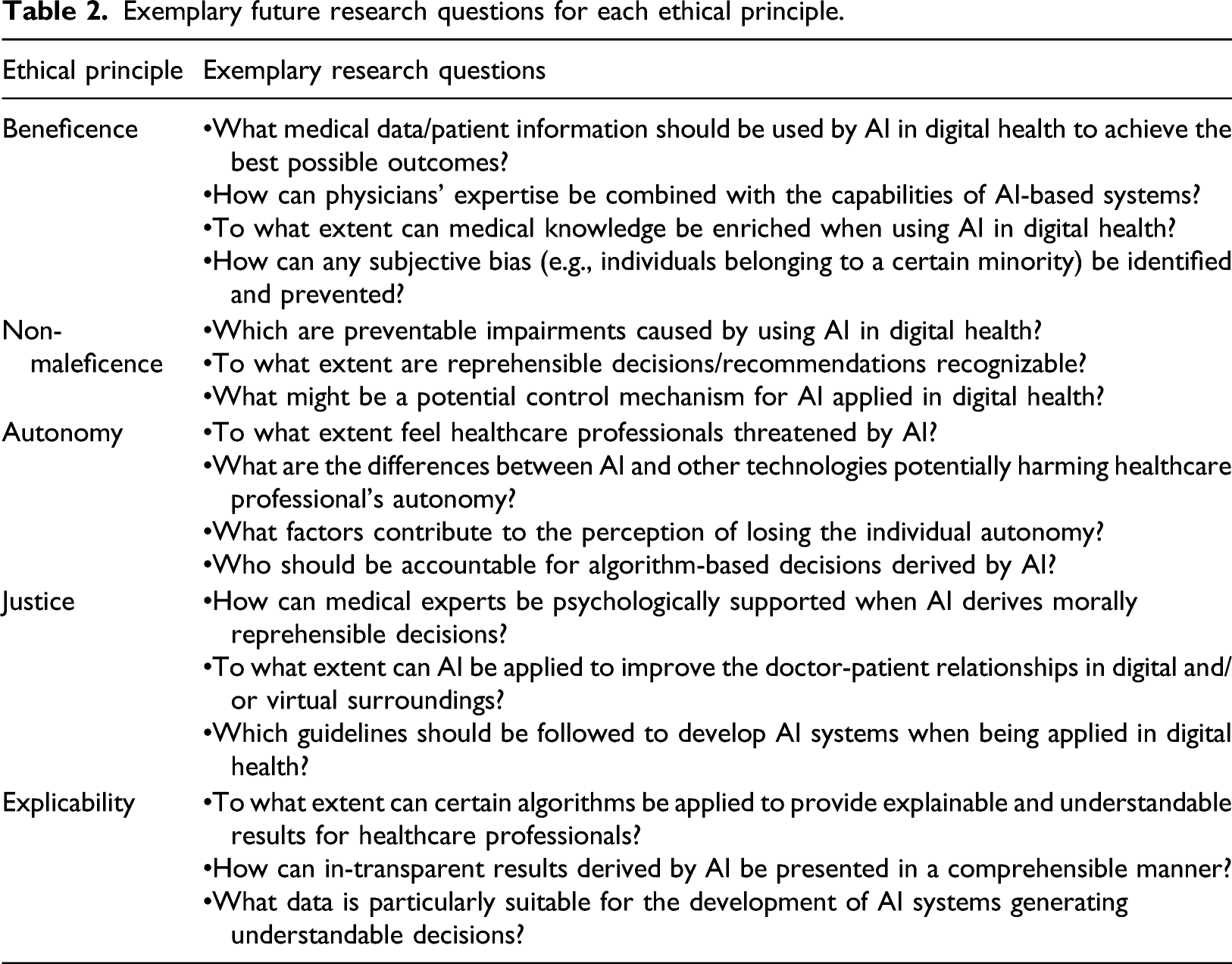
While we provide an overview of current ethical research on AI in digital health, this research is not free of limitations. We linked the most common notations for systems using AI in our search term, that is, conversational agent, digital assistant, and virtual assistant. However, we did not use technical terms such as machine learning, neural network, or deep learning. Even though this helped us to focus on relevant literature and excluded technical implementations, we may have missed the retrieval of studies dealing with ethical consideration of AI in digital health. Furthermore, there are many different types and applications of AI in digital health, for example, decision-support system7,8 or virtual assistants. 114 Thus, ethical considerations might alter and need to be addressed separately. 69
Besides the exemplary research questions, future scientific endeavors should provide a more granular picture of ethical considerations considering the specific type of system and area of application. Differences might arise between decision-support or decision-making tools depending on whether a healthcare specialist must approve a decision made by an AI. Distinctions might also be needed depending on the type of interaction. For example, systems can be addressed via a text- or speech-based input.110–112 Furthermore, there are also variations as to who or where an AI supports. Systems today assist in specific health-related processes like diagnostics including the anamnesis,9,113 helping patients to cope with their disease103,104 or improve collaboration among healthcare employees.100–102,112 Moreover, researchers should address issues related to retraceability, explainability, and causability contributing to the trustworthiness of AI. 116 Long-term and thorough trust in AI is only achievable if generated outcomes are retraceable, hence replicable in case an incident happens.
Conclusions
In this article, we illustrated ethical consideration of AI in digital health in current academic research. We presented our findings from the SLR, in which we classified the relevant literature according to the five principles on ethics: beneficence, non-maleficence, autonomy, justice, and explicability. The results are helpful for practitioners as well as for scholars from a variety of research disciplines. The main theoretical contribution of this paper lies in providing an overview of the status quo covering ethical considerations on AI in digital health. The review is beneficial for validating less explored areas in which ethical issues still remain less researched or even unexplored. By highlighting the intensity of studies, we seek to assist researchers’ effort for future studies in the field of AI in digital health. On a practical level, practitioners understand what ethical aspects are relevant when using AI for health-related purposes, which might result in properly regulated implementations. The application of AI is beneficial for digital health, but a few things must be considered in advance, that is, how transportable results are achievable, how far AI is allowed to be integrated in processes, and to what extent humans can be held accountable.
Footnotes
Declaration of conflicting interests
The author(s) declared no potential conflicts of interest with respect to the research, authorship, and/or publication of this article.
