




Abstract
Previously, behavioural scientists seeking to create Internet-based behaviour change interventions have had to rely on computer scientists to actually develop and modify web interventions. The LifeGuide software was designed to enable behavioural researchers to develop and adapt Internet-based behavioural interventions themselves. This article reports a qualitative case study of users’ experiences and perceptions of the LifeGuide software. The aim was to explore users’ experiences and their perceptions of the benefits and limitations of this approach to intervention development. Twenty LifeGuide users took part in semi-structured interviews and one provided feedback via email. Thematic analysis identified three overarching themes: ‘Recognising LifeGuide’s potential’, ‘I’m not a programmer’ and ‘Knowledge sharing – the future of LifeGuide’. Users valued LifeGuide’s potential to allow them to flexibly develop and modify interventions at little cost. However, users noted that their lack of programming experience meant that they needed to learn new skills for using the software, and they varied in the extent to which they felt able to develop interventions without any input from programmers. Respondents saw the potential of using the LifeGuide Community Website to share technical support and examples of intervention components to support their use of LifeGuide.
Keywords
LifeGuide is a free, newly developed, open-source software that enables behavioural scientists to create and easily modify online interventions for behaviour change. This article presents a qualitative case study of users’ i experiences of using LifeGuide. The aim of this study was to gain and disseminate an understanding of how people experience and interact with this developing software, understand what its potential and limitations may be for users and hence what direction it might take in the future, and to guide practitioners wishing to develop their own Internet-based behavioural interventions in the future.
Background: developing Internet-based behaviour change interventions
The Internet provides a unique means of solving difficulties in providing care and services for people in traditional settings, including reducing costs (for both service users and providers), increasing convenience, reaching hidden and stigmatised groups and enabling intervention users to have an element of control over their care. 1 Online interventions can also help to reduce the problems associated with accessing services due to geographical location, long waiting lists or shortages in appropriately trained staff. Furthermore, online interventions can be easily tailored or personalised to the patients’ individual situation or needs and can provide motivational support through various means (discussion boards, email communication with professionals or automated and personalised text or email messages).2,3 As a result, health researchers have begun to explore the feasibility of providing behaviour change interventions using the Internet.
Traditional online intervention development requires extensive interactions between multidisciplinary team members (behavioural scientists and computer programmers) who usually need to communicate effectively to produce the finished product. 4 Typically, this involves the content development by a team of behavioural scientists and then the website development by a team of computer programmers. Achieving a shared understanding and a common language can be problematic.5–7 In addition, separation of the production and piloting of content from website construction tends to limit the extent to which the intervention can be modified,4,8 as it complicates the process of iteratively piloting the web intervention with potential intervention users and using the feedback to rapidly make further modifications (e.g. adding, removing and changing intervention components to tailor them for different contexts).
LifeGuide software
At the University of Southampton, we have developed the LifeGuide software. To our knowledge, this is the first open-source tool specifically designed to allow behavioural scientists with little or no programming experience to flexibly create and modify Internet-based behaviour change interventions. LifeGuide was developed using a co-development and co-deployment model between behavioural scientists (health psychologists) and computer programmers to ensure that the resulting software served the needs and purposes of its target users (i.e. those developing interventions). 9
The LifeGuide software is an integrated package consisting of the following three parts:
The authoring tool and logic commands
The researcher uses the authoring tool to create the individual pages of the online intervention. This includes creating the content of the intervention (including text, images, audio files and videos), adding interactive questions to collect information from intervention users for tailoring advice and writing the logic commands that control the presentation of web pages and all other intervention functions. The look and feel of the website can be changed using a flexible drag and drop interface to alter background, layout and colour, while a template function is available to allow users to create a standardised design. Logic commands can be used for a wide range of functions, including giving tailored feedback to intervention users, randomising them into groups, scoring questionnaire items, charting progress over time, allowing intervention users to monitor each other’s progress and sending automated emails or text messages.
Help materials including wiki pages and demo interventions have been developed to aid researchers with writing the logic commands. These help materials and details of all the features available in LifeGuide can be found on the LifeGuide Community Website (http://www.lifeguideonline.org).
Intervention manager
Once an intervention has been tested (e.g. on the Virtual Research Environment (VRE), see the following description) and finalised, it can be uploaded onto the LifeGuide server (or hosted on the researcher’s own server) to be used by participants through the intervention manager. The intervention manager enables all the information that an intervention user enters into the pages of a web intervention to be stored securely and then downloaded and exported for data analysis. Researchers also can track participant usage of individual intervention pages including the length of time spent on each page. This intervention manager has been designed to work specifically with interventions developed using the LifeGuide authoring tool and therefore cannot be used to run other non-LifeGuide websites.
VRE
VREs are defined by JISC as a set of online tools and technologies that ‘help researchers from all disciplines to work collaboratively by managing the increasingly complex range of tasks involved in carrying out research’. 10 They are growing in importance as research is increasingly carried out with larger, geographically dispersed teams. 11 Through a co-design process, the LifeGuide VRE (which we have called the LifeGuide Community Website) was designed to allow researchers to collaborate in Internet intervention research and share intervention components, research data and expertise. In particular, the aim of the LifeGuide Community Website was to bring together a community of LifeGuide researchers and to provide social and technical supports and aid collaboration, supervision and dissemination of LifeGuide projects. Thus, consistent with recommendations from the VRE Collaborative Landscape study, 12 the LifeGuide Community Website allows researchers to communicate with a community of LifeGuide users (which in June 2012 had nearly 900 registered users); access LifeGuide resources, including the authoring tool, the help materials and tutorials and provide a platform to greatly facilitate research collaboration by allowing a dispersed team of users to comment on and discuss individual interventions on a page-by-page basis, test interventions and communicate with other researchers or members of the support team through an online discussion board. The LifeGuide VRE also includes an intervention manager so that researchers can upload their interventions for testing and piloting and share them with members of the research team and with the wider community of intervention researchers.
Current study
Online intervention development is a novel experience for many behavioural scientists, and therefore, it is important to capture user’s experiences of the LifeGuide software in order to understand its potential and limitations and determine its acceptability and suitability for future users. Therefore, the aim of the study was to use qualitative methodology to obtain researchers’ perspectives and experiences of using the software for the development of behavioural interventions. A secondary aim was to use the data collected from early users to inform the software development, as part of the co-design process.
Method
This was a qualitative case study of the LifeGuide software and accompanying VRE. A qualitative case study involves collecting information from different sources (e.g. field notes, project documents and interviews) to obtain a picture of the product or case under investigation. 13 The data therefore consist of semi-structured interviews with existing LifeGuide users and participant observation of the use of the software. This was a longitudinal study carried out over 18 months alongside the development of the software and the VRE.
Procedure
During the first 6 months, the first author (a psychologist with no computer science training) became familiar with LifeGuide using the authoring tool to assist on intervention studies, inputting to co-design meetings relating to new functionality and identifying user requirements and attending meetings and workshops to gain an understanding of user experience. During this period, field notes about day-to-day observations were taken. At this time, other researchers within the same research group were also using the software to develop and trial Internet-based behaviour change interventions. Later, external users who had been introduced to LifeGuide through international conferences and workshops began to use the beta software for their own interventions. As more experience of using the software was gained, the first author became involved in writing the LifeGuide help materials and took on a support role for new users as a way of continuing to gain insight into their perspective on the software as it was developing.
During the study period (July 2009 to December 2010), all researchers with either first-hand experience of using LifeGuide or who were heavily involved in the management of LifeGuide projects were contacted to take part in a semi-structured face-to-face interview exploring their experiences of the software. All consented to take part (although two were conducted by telephone and one submitted responses by email) except one because of geographical boundaries and other work commitments.
Participants
The study reports data from 21 individuals (four males, age range from early 20s to some in their 50s). Participants consisted of LifeGuide users at varying stages of their research career (including one undergraduate student, two postgraduate students, early career researchers and four senior research staff involved in the management of LifeGuide projects). All were health or social psychologists except one who was a professor of medicine. LifeGuide projects that these researchers had been working on included pilot interventions for the self-management of cold and flu symptoms 14 and the promotion of hygiene behaviour to reduce transmission of pandemic flu. 15 Other studies included online interventions for smoking cessation, weight loss, self-management of stomach and bowel problems, medication adherence and reducing general practitioners’ antibiotic prescribing in four European countries. Other studies using LifeGuide include an exploration of stereotype threat and a training site for health trainers involved in smoking cessation.
Eight participants were external users, while the rest worked at the University of Southampton. Southampton researchers worked within a shared ‘LifeGuide research office’ or supervised those who did. Due to the longitudinal nature of the study, participants were interviewed at different stages of the LifeGuide project lifetime. Therefore, seven participants can be described as ‘early users’ as at the time of interview LifeGuide was yet to go through its first release, and at this point, there were no help materials for using the software. Quotes are not attributed to users with specific characteristics to maintain confidentiality.
Analysis
The data were analysed using Braun and Clarke’s 16 approach to thematic analysis. Interviews were conducted and analysed by the first author, and themes were iteratively discussed and refined with L.Y., an expert in qualitative methods with a strong background in Internet-based behaviour change interventions. Briefly, the first step of analysis involved the researcher immersing herself in the data by re-reading the transcripts and the field notes made during participant observation. Second, open codes were generated by identifying and labelling particular features and concepts within the data that were considered important to researchers. Comments made about specific functional problems with early versions of the software were not included in the analysis as these were corrected in later releases. All relevant codes were then pulled together into overarching themes. These themes were then reviewed and discussed with L.Y. to ensure that they corresponded to the original transcripts. The final part of the analysis involved putting the themes together into a coherent narrative that effectively detailed users’ experiences. This is presented in the following.
Results
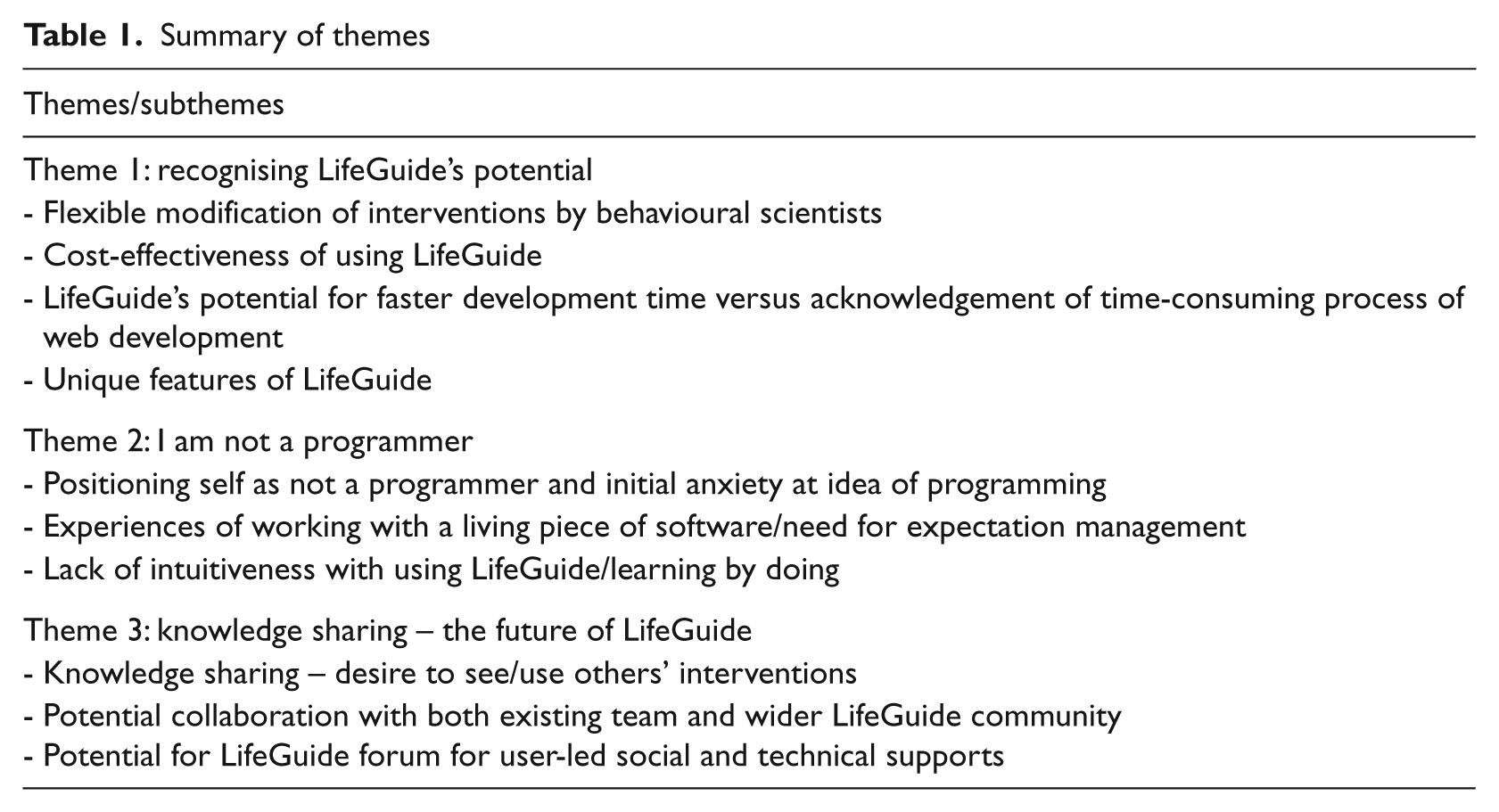
Data analysis of field notes and interview transcripts yielded three overarching themes relating to the experiences of using the LifeGuide software (see Table 1). These three themes will now be discussed in detail, with illustrative quotes from participants.
Summary of themes
Theme 1: recognising LifeGuide’s potential
Researchers could see the potential of LifeGuide as a successful tool for developing and delivering online interventions. Those participants who had past experience working with programmers in earlier phases of intervention development described the previous difficulties in communicating their requirements as a result of not having a shared language. These difficulties were diminished when using LifeGuide, and one key advantage described by a number of researchers was the ability to develop the intervention themselves. This inevitably meant that they had greater control over their intervention and did not have to rely on others:
[ … ] the phrase ‘the world’s your oyster’ springs to mind [ … ] it can do lots of different things … off you go. [ … ] you could sit at home and in your bedroom and make an intervention that could be rolled out to a million pound randomised control trial without having to have a team of web specialists doing it for you. (P11) Yeah, generally just being able to – even though you’re not really good at computing, being able to do something specifically, rather than having to ask someone and say, oh, sorry, you know computing, but I need this done, so can you please do this. And you have to keep bugging them, saying no, no, this isn’t right or this is wrong and they have to edit; so having like cut out the middle guy, you can do it yourself. So that’s really, really helpful. (P19)
This autonomous way of working on Internet-based behaviour change interventions had a lot of potential for these LifeGuide users, not least because of the flexibility it afforded. Researchers could flexibly make changes during intervention development as a result of feedback from piloting to make the finished product more user-friendly and acceptable to target users. Furthermore, successful intervention components could be reused and modified in future projects without having to ‘reinvent the wheel’:
[ … ] once you run trials, you might decide to change [it], so we have, I think, a bit more control over that side of it than we would do if we just had programmers develop a site for us where often you have to get them to do the changes and alterations for you. (P16) I’m all for collaborating, so I hope that actually teams can come together so that everybody can use each other’s experience and that we don’t keep on reinventing the wheel … because the whole point of this is, ultimately, patient benefit. (P14)
Participants who had previous experience of working with programmers on interventions in the past recognised the time-saving aspect of being able to programme the intervention themselves.
Another perceived advantage of using LifeGuide was that it is free to use and this opened up intervention research to those who would not normally have the funds to do it. This was a particularly pertinent theme for the student projects being conducted, as the following quote exemplifies, but was also a common remark made by potential users at conferences and workshops:
I probably wouldn’t have been able to make a website and if I did, it probably would have been a really rubbish one or would have taken a lot of my funding. (P10)
Users valued the convenience of being able to simply upload interventions to dedicated LifeGuide servers either because they had problems trying to use their own server or because they were unfamiliar with the process of hosting on a server. They also welcomed LifeGuide’s ability to offer users’ unique features that they could not get from other software programmes. Features that users liked included the ability to easily move objects using simple copy and paste functions or by dragging to a required position, the flexible way in which they could provide end users with instant feedback and send them to specific pages tailored to their responses and the fact that LifeGuide can randomise participants:
Online survey tools like WebMonkey – I notice they can’t randomise like LifeGuide can (email communication, external user 1)
When talking about LifeGuide’s potential, some users also pointed out the limitations of using it for intervention development and the need for realistic expectations, and these are discussed in more detail in the next theme. Users also noted that intervention development in general is a time-consuming process, requiring time for designing the intervention, writing intervention content, planning the flow of pages, translating paper documents into web format, the actual creation of pages and logic writing, testing and piloting. Many users had not anticipated how much time this process required. In contrast, participants who had previous experience of working with programmers on interventions in the past recognised the time-saving aspect of being able to programme the intervention themselves:
I mean, we got through quite a lot of pages, you know, like … when it was working well, we got through quite a lot of pages very quickly [ … ] it is very easy to change the text, you know, compared to when I’m using the [other] website. [With the other website] eventually it was taking so long [for us] to say, look, there’s spelling mistakes here, here and here or that sentence isn’t quite right and people have complained about that … and then the developers had to go through all the pages and [ … ] change it. I think that’s probably the main advantage I can see. (P3)
Theme 2: ‘I’m not a programmer’
Developing interventions using LifeGuide requires researchers to first build intervention pages and then write logic commands to enable the intervention do something. Observations and interview data showed that some researchers positioned themselves as ‘not a programmer’ (P4) or as not having experience of web development. This is an important theme to consider since LifeGuide is designed as software that requires little or no programming experience:
I can’t programme … I’ve never been a programmer and although the terms we’re using are easier, the concept of programming is still part of LifeGuide. (P1) I think it was a bit stressful as well again because you … you’re not [a] programmer. (P13)
A number of participants described an initial fear of using LifeGuide because of their lack of any previous experience. However, once they had a chance to use it, most found that it was easier than they first thought. Some even described ‘enjoying’ their experiences and found the problem-solving nature of writing logic a rewarding experience:
I was surprised how easy and user friendly it was because I initially thought, oh God, web design, I’ve no experience in this, but it just felt logical and … familiar and … so I was pleasantly surprised at how easy it was to start creating pages and stuff like that. (P12) It’s … it’s … generally, really, really, really enjoying it because it makes you feel like – cause it’s a lot easier to use than I was expecting. (P20)
Users described a situation of ‘learning as we go along’, and in this sense, learning about LifeGuide was a case of ‘doing’. A number of users also recommended that new users ‘just give it a try’ (P15) or ‘just have a play around with it’ (P12), highlighting the need to get hands-on experience as a way of ‘get[ting] a feel for it’. Learning by doing enabled users to get an understanding of what could be done in LifeGuide and to get used to the problem-solving nature of writing logic, and once they had experience of using a logic command, they could easily reuse it later in the intervention. Users often described a process of trying out different things and seeing if they worked, and from this, they could learn from their experience:
And just … not being scared of logic and I think, even if I don’t know how to write something, I’ll always have a go – it never normally works – ‘cause you kind of know basic terms so you can try and throw something together and sometimes it works, sometimes it doesn’t. (P10)
A small number of users, who had been working on very large and complex interventions, suggested that in complex cases, expertise from a programmer is needed. This was because LifeGuide requires researchers to learn new skills to use the logic commands, and some could find it difficult in highly tailored interventions when many different commands needed to be used together:
You don’t need to be a programmer, but you can just be a psychologist in a way … so I think the strength is that LifeGuide allows you to create that without being a programmer. Even though from my own experience, you need a programmer, to take care of the situation in an intervention like ours. (P13)
Working with a living piece of software
The design of the LifeGuide project meant that researchers were using the software as it was being developed to enable them to feed into the design of new features and functions. Early users of the software described a frustrating experience as a result of using very basic software with limited functionality, no help manual and the common experience of inexplicable bugs. This was particularly difficult as the interventions they were developing had their own deadlines that needed to be met. Furthermore, with no programming experience, it could be difficult for new users to determine whether the problems that they were having were attributable to a bug in the system or a user mistake:
So when you’re trying to use it and you keep finding mistakes in it or it’s not working the way you want it to work, it could be a bug or … something really simple but if you’re not experienced in using it, it’s difficult to know how to move forward with that and solve the problem without asking someone that’s more of an expert on it. (P15)
Over time, however, these bugs diminished, and although users could still experience the occasional problem, this did not make the software unusable and users recognised that these were things that could be ‘ironed out’:
[ … ] I think the main weakness is, perhaps, while it’s still in development, it still goes wrong, but that obviously is just a product of it still being in development. But, yeah, it can go wrong and it does, from time to time, get bugs but not – I must say – not very often and from talking to people that used LifeGuide very early on, it is … you know, a hundred times better than it was when it was first developed. (P10) LifeGuide has become better over time, bugs are constantly fixed and new tools are always emerging. (P21)
Users recognised the need to acknowledge that they were working with a living or beta application so that they could factor this into their day-to-day use of the tool, highlighting the importance of managing researchers’ expectations of the software:
[T]he weaknesses are things I think can be ironed out, it’s just – it does feel like a new project … therefore there are certain things which are there because they’re indicative of it being new, i.e., perhaps not tested yet [ … ] that’s almost something you need to bear in mind when you’re using it so you don’t get annoyed. (P11) I think for me … if there’s an acknowledgement that they’re all working on a … beta product and it isn’t all bells and whistles, then I think that, for me, would be so much better because at least then, if you’re having a day when you’re frustrated and suddenly you’re getting held back from something, you don’t have this feeling of it being … oh, it’s dead easy to use. (P8)
If a problem was encountered, users were able to use their experience of the software and the available help materials to exhaust all possibilities before concluding that the problem was beyond their expertise and was a bug that required a programmer to fix:
It’s the interaction between you and the problem. So if something doesn’t work as you expect, then, firstly you try and do something else and it still doesn’t work, then you work through all the things that you’ve learned to check for from previous mistakes … and if it still doesn’t work, you start to get to the point of ‘is this beyond me?’ (P11)
Intuitiveness of LifeGuide
Although, as mentioned earlier, users described a process of learning by doing, this is not to say that using LifeGuide is intuitive, or that users can just pick it up and ‘wing it’ (P19). Many researchers compared their experiences to familiar applications and often expressed a desire for familiar interfaces to make their experience easier. Whereas people are used to the format of common computer applications (such as Microsoft programmes), the interactions created using LifeGuide are unfamiliar, and therefore, aspects of LifeGuide (especially the logic) need to be learned. In relation to this, a number of researchers described a need to get into a certain ‘headspace’, particularly when using the logic commands:
You do need – you need to get into the headspace of what it is, it isn’t a package like any other Windows, Microsoft packages, it’s something different and new, and so there’s obvious things that you will know and understand, like copy and paste, but you kind of have to approach it as something new that you’ve got to learn. (P2)
In contrast, others felt that many of the familiar features were already there:
So that was all quite straightforward really. I thought it was quite similar to syntax files on SPSS. So, yeah, it was … it was … overall, I’d say it was a positive experience, like I’d recommend it to someone else who wanted to do an intervention online. (P18)
Some early users, who were using the software before any formal help materials were released, expressed a desire for formal training in using the software. All the early users expressed the need for a researcher manual or logic dictionary as without this they would need to rely on the expertise and knowledge of the LifeGuide creators. Furthermore, participants expressed a desire to be able to see examples of other people’s logic:
Yes, for me it was the lack of the guide, because I think without any guidance it wasn’t quite as intuitive as perhaps I would have liked, but as soon as you got it and were given an idea of where – you know, how it’s constructed, then it was fine. (P5)
As a result of these requirements, the LifeGuide team produced a help manual outlining the key logic commands for intervention development. This was accompanied by short demo interventions, allowing new users to see the logic in action. Later, users (including external users who did not have face-to-face access to the LifeGuide team) successfully used the manual to develop their online interventions, with a number of users only needing to contact a member of the LifeGuide team to request hosting their intervention on the LifeGuide servers. It was clear that for these users, the manual was a key piece of technical support:
I relied heavily on the manual to help me to use that and it was – the manual, it was very clear. (P20) LifeGuide instructions, yeah. So this was really helpful, it had quite a lot of detail, it didn’t have everything in it … but I suppose, you know, you can’t have everything in it and that’s why it’s good to have the forum and stuff. (P18)
As participant 18 notes, a forum provides a further way to share suggestions for the creative use of logic that could not already be found in the help materials. This focus on sharing and user-led support is the topic of the final theme.
Theme 3: knowledge sharing – the future of LifeGuide
Participants commonly expressed a wish to see other people’s logic as a way of getting ideas for their own interventions and helping them with their own logic writing. Current users described how they easily used logic that the LifeGuide team had given them throughout their intervention by copying and pasting the same function wherever it was needed and just changing the relevant object names that it referred to. They used the logic found in the demo interventions on the VRE in the same way, employing it as an exemplar that they could take and use in their own intervention:
I think it really helps if you’ve an example which you can refer to and then just change the page names and the interactions; it makes it a lot easier, rather than just doing it from scratch. (P4) Yeah, I mean it would be great if you could actually get to look at other people’s stuff ‘cause it would give you ideas of what you could do. (P2)
Although users found this extremely useful, they also stated that they wanted further examples of more complex, real-life examples of the logic. This would allow them to see a number of different complex logic commands interacting within the same intervention rather than the short tutorial versions that only showed one or two logic commands. It would also allow them to get ideas for the look and feel of their intervention. As LifeGuide is still in its infancy, there are currently not yet many larger, more complex examples of interventions available for users to view, and many researchers expressed a wish for more people to make their intervention logic available for all to see:
I guess if other people made their interventions into demos, you could look at their logic and if there is something you really wanted to do but you just didn’t think xxx and they’ve actually done it, it would be good to look at theirs and look at their logic and know how to do it. But, at the moment, no-one’s really had – shared that. I know you’ve got demos of randomisations and things like that which I will be using in time and no-one’s really put up a real complex intervention where you can look at the logic. And I guess that’s because they’re still doing studies on it and they don’t really want to make it public to everyone while they’re doing controlled studies. (P10)
Collaboration
The VRE offers researchers a place for collaboration both within their research team and with other research teams. As a result of early requirements obtained from interviews, the LifeGuide team developed a commenting function on the VRE that enables researchers to view and comment on each page of an intervention. Many researchers noted how useful this was:
And I think, at the end of that, on a positive thing and about LifeGuide, I certainly found that, because we were able to put it on to the VRE and people could look at the pages as they were developed and give feedback, specific to individual pages, that was – we feel, useful rather than it just being a big A4 document going out with a load of text. I did find that useful. (P8)
However, not all members of research teams used this function, some choosing instead to send emails to the intervention author, perhaps because this was a method that they were used to:
Well some people said I will just email you comments so maybe there’s a slight reluctance of some people to comment on the system, I’m not sure why. I certainly got that twice, even after saying you can just click the button and comment. (P11)
The VRE also has potential for collaboration between research teams by sharing intervention components and pooling data sets. However, researchers highlighted some barriers to this:
On one hand one should be open to getting feedback from a much wider group of people but, on the other hand, one could be reluctant to put yourself out there with something that other people look at – other people in field look at and go, oh my God, what were you thinking, that stuff is shite, so … yeah. So I guess … yeah, I’m not sure, actually, about … yeah, so it is, for me, sharing or not sharing things is a lot about the confidence in, you know … whether it’s adequate, what you’ve done. And actually, maybe also, I think I might be more inclined to share things at a later stage, when you’re already running trials, for example, rather than earlier, because you would be worried that somebody else could pick up what you’ve done and publish before you do … which, I mean, if we were all nice it wouldn’t matter but it does matter, cause publication matters. (P20)
Potential for LifeGuide forum
Current users discussed the potential for the LifeGuide community forum to be a way of sharing user-led support for intervention development, which was felt to be essential for both social and technical supports. In particular, external users who did not have a LifeGuide programmer on hand and did not expect personal support greatly valued the support that they have received from the LifeGuide team through the forum and over email: ‘there is an excellent support provided by [e]mail’ (P21). One external user who used the forum for support stated:
I got a lot of support from you and from the other people and it was quick, as well, the support, which was really, really good. [ … ] [member of LifeGuide team] sorted out a way of doing that for us, using the time as a … unique identifier for each participant, which was really helpful and then he wrote the logic, actually, for how that came up. (P18)
It was recognised that such a level of support could not always be provided by a small research team but users expressed the hope that in time such sharing could be done by other users:
And I don’t know how – how many people use it but I imagine if it becomes really massively popular [ … ] don’t know if you’ll be able to provide that sort of support, but it was really useful. I suppose [other] users can provide the support, can’t they. (P18)
However, the success of the LifeGuide forum depends on its usage, and many people commented on its current limited use and subsequent lack of ‘community’ feel. Furthermore, some participants spoke about barriers to its use that linked to individual preferences for privacy and anonymity:
I have looked at the forum – I must say I’m one of those people that doesn’t like to comment on forums because I think I’ll say something and then they’ll be like – oh, why has she said that or she sounds weird, or something, but I know I really should … write something on there and just … I always say, yeah, I’m going to write something today and then, like – I’ll do it tomorrow. And it’s the same on Facebook, I go on Facebook but I very rarely, ever, write anything, anywhere and I think that’s just a personality thing. (P10) I’m fairly extrovert at it so, for me, it’s not really a problem putting stuff up that everyone else can read; I don’t really care that much, but I can imagine maybe some people would. But for me, it’s fine. (P18)
Discussion
The aim of the current study was to explore the experiences of those who had used the LifeGuide software in order to identify its possibilities and limitations and to provide guidance for researchers considering to use LifeGuide for their own Internet-based behaviour change intervention studies. Researchers in this study highlighted the advantages of using LifeGuide including its flexibility, cost-effectiveness and capacity to reduce the need to duplicate intervention components. Similar to the experiences of others,5–7 a number of participants described the previous difficulties when working with a programming team before using LifeGuide. In contrast, a strength of LifeGuide was that participants could create the interventions themselves.
The flexibility of the LifeGuide software also has a number of benefits for testing and usability purposes, enabling an iterative process of intervention development and piloting with intervention users using the actual web pages. This is particularly important for health interventions as, in line with government initiatives, 17 it allows patients to play an active role in shaping the intervention and thus ensures that the resulting intervention is patient-friendly and acceptable to its users. Furthermore, the commenting function available through the LifeGuide Community Website means easy communication between members of widely dispersed research teams, allowing iterative modifications before the website is even trialled by intervention users.
In keeping with the tradition of co-design and co-deployment, behavioural scientists were encouraged to begin using the software during its very early stages of development to enable them to feed back the requirements for further feature development. As participants commented, it can be difficult to get a feel for intervention development and the components required when building successful online interventions without getting hands-on experience and learning by doing. However, this approach inevitably led to experiences of frustration as a result of inexplicable bugs, tight intervention deadlines and a lack of help resources to allow users to successfully rectify any problems they encountered. In future, qualitative think-aloud piloting with users as they use prototypes of software to complete set tasks could be a useful method of detecting and correcting software deficits and identifying user requirements at an earlier stage.
Participants’ positioning of themselves as not programmers is an interesting observation and highlights that although LifeGuide is designed to allow non-programmers to develop Internet-based behaviour change interventions, the concept of programming is very much at the forefront of user’s experience. This is because the language used to write interventions and the concepts used in this process (a logic file and error messages) align with the principles of computer programming, albeit at a much simpler level than traditional computer programming languages. As a result, LifeGuide requires users to learn new skills that may not be intuitive to those without a computer science background. Rather than being a deterrent or barrier to using LifeGuide, learning these new skills was reported by a number of participants as an enjoyable experience. Many also described how their anxieties regarding their abilities to develop Internet-based behaviour change interventions quickly dissipated once they had begun using the software. Nonetheless, behavioural researchers without a high level of computer self-efficacy, particularly those looking to develop complex interventions (requiring more integrated logic), may benefit from having some support from a computer scientist.
More recent users in our sample reported successful intervention development using the detailed help files, user support and demo interventions as guidance. Virtually, all LifeGuide users expressed interest in using examples of other people’s logic to help with their own study, which is a technique commonly used in end user computing, enabling researchers to modify the existing programmes instead of starting from scratch. 8 Participants in the current study also acknowledged the potential of the LifeGuide forum for discussing experiences and resolving any difficulties. As more people continue to use the software and share their interventions on the VRE, new users may be able to learn from these experiences to inform their own intervention design, something that is currently missing in web-based intervention research. 18
Some respondents reported using the VRE discussion forum as a way of receiving helpful technical support. However, many of them described a lack of ‘community feel’ within the forum. A community is defined as a ‘group of people with a shared interest, purpose or goal, who get to know each other better over time’ (p. 28). 19 Successful online communities require on-going reciprocal interaction from a sufficient number of people. 20 Furthermore, social interaction within an online community is influenced by the community’s purpose, the goals and roles of the individuals within the community and the community’s policies. 21 For example, a community member may have different goals (e.g. finding information and advice or building social connections), or a community developer may or may not state clear purposes or policies for the community.
Common reasons for not posting to an online forum can include the belief that simply reading others’ posts is enough for achieving primary goals of obtaining information or a lack of confidence in voicing views. 22 Indeed, some members of the current study discussed personality factors (i.e. extraversion) that fed into their preferences for posting or lurking (reading but not posting) on the website, including fears that they would write something weird. Furthermore, as the aim of the LifeGuide forum is one of providing information, it can be assumed that many visitors will not feel the need to post as their information needs are likely to be met through other means (e.g. previous postings, the LifeGuide help files or wiki pages). Finally, the ‘community feel’ of the LifeGuide forum may improve over time as more people begin to use the software and share their experiences.
Methodological limitations
One limitation to the study was the authors’ experience of being participant users and developers of the software, which may have implications for the level of critical distance in the reporting of findings. To attempt to counteract this risk, reflexive notes were kept throughout the study and data were discussed during LifeGuide team meetings. Furthermore, it could be argued that such level of participation may help get closer to the lived experience of using LifeGuide.
Conclusion
The LifeGuide software offers behavioural researchers a flexible, independent and cost-effective way of developing and modifying Internet-based behaviour change interventions. Nonetheless, developing online interventions requires behavioural researchers to learn new skills that they may not find intuitive. As participants in the present study highlight, new users are encouraged to try out the LifeGuide software to better understand the skills involved and to help manage their expectations of what they may be able to do. Furthermore, support from computer scientists may be needed for those with limited computer self-efficacy or those whose interventions require complex logic commands. As other VRE projects have found, 12 the need for support for some users poses potential sustainability problems in the absence of funding to provide this support. Possible solutions include commercial models whereby a small charge is made to provide support for users who need it and exploitation of the open-source ethos by encouraging current and future LifeGuide users to share their experiences, expertise and their intervention logic within the LifeGuide community.
In summary, LifeGuide achieved its purpose of providing free software that can be used by behavioural research to create and modify simple behavioural interventions, reducing the need for costly and time-consuming programming resources. Nonetheless, for some users wishing to develop complex interventions or who have low self-efficacy for the programming aspects of LifeGuide (after trying the software), some programming support may be required.
Footnotes
Funding
This study was supported by JISC.