



Abstract
Background
Pain is a significant risk factor for depression among older adults. While prior studies suggest that internet media may improve mental well-being, it remains unclear whether such media can reduce pain-related depression.
Objectives
This five-year longitudinal study explores the potential moderating effect of internet media on the relationship between pain and depression among older adults.
Methods
Participants were sourced from 2018, 2020, and 2023 waves of the China Longitudinal Aging Social Survey, and this study utilized 3240 “person-year” observations from 1080 respondents. An individual fixed effects model was employed. The presence of pain, depression (measured by the CES-D scale), and media preference (measured by comparing internet and traditional media use frequency) were assessed. Subgroup heterogeneity was also explored.
Results
The findings revealed that media preference significantly moderated the relationship between pain and depression among older adults (β = −0.725, p < .01). Compared with traditional media, internet media was more effective in alleviating depression in individuals experiencing pain. The engagement breadth of internet media also exhibited a buffering effect. Heterogeneity analysis further illustrated that the beneficial effects of internet media were more pronounced among older adults who were less educated (β = −0.865, p < .01) and retired (β = −0.887, p < .01).
Conclusion
This study enhances the understanding of the theoretical and practical aspects of internet media's moderating role in depression among older adults. It also highlights heterogeneous effects in vulnerable subpopulations. The findings offer insights for developing non-pharmacological interventions to address depression associated with pain, contributing to promoting mental health in the aging population.
Highlights
Pain is a significant risk factor for depression among older adults.
Media preference is introduced as a novel moderator in the pain–depression relationship among older adults, moving beyond prior research focused only on direct media–health links.
Older adults who are less educated and retired benefit more from the moderating effects of internet media use.
Internet media can serve as a non-pharmacological intervention to enhance protective benefits for older adults living with pain.
Introduction
Depression is one of the most common mental illnesses among older adults. According to the World Health Organization (WHO), depression is expected to be among the top three diseases threatening people's health worldwide. 1 Late adulthood represents the peak period for depression, with a 2.8-fold higher prevalence rate compared to the general population. 2 The prevalence of depression among older adults has reached 40.6% 3 and is continuing to rise due to the trend of population aging. Suffering from depression has a negative impact on the health and well-being of older adults, including higher rates of chronic diseases and their comorbidities, which will result in their compromised physical and mental status, accelerating cognitive impairment and reduced social interaction.4,5 Given these profound effects, it is extremely urgent to formulate intervention strategies to reduce the prevalence rate of depression among older adults.
Depression arises from the interaction of multiple factors, including individual functional ability, the social and physical environment and the availability of healthcare resources. 2 Specifically, suboptimal physical health, such as pain, is one of the important risk factors. Previous research has suggested that pain may increase psychological distress among older adults both directly and indirectly, such as by restricting daily activities and weakening family and social engagement.6–8 Given these findings, there is an urgent need for effective intervention measures to reduce depression among older adults experiencing physical pain.
With the rapid development of information technology, the internet has provided new possibilities for promoting physical and mental health among older adults. By the end of 2024, the internet penetration rate among Chinese individuals aged 60 and above had reached 52.5%, with 156 million using mobile phones to access the internet. 9 The internet is increasingly integrated into the daily lives of older adults. Existing research indicates that older internet users perform significantly better than non-users in terms of physical, mental, and subjective health, and that internet use also plays an important role in reducing health disparities. 10 It provides older adults with timely and efficient access to information, enriches their spiritual and cultural lives, improves subjective well-being, supports mental health, and enhances the overall quality of life.11,12
Among various internet applications, internet media stands out as the most widely adopted, frequently used, and broadly accessible form. It serves as a primary channel for information, communication, and entertainment. 13 The impact of internet media on the health of older adults has received particular attention. Existing research has found that browsing health and pandemic-related information can enhance older adults’ willingness to engage in disease prevention behaviors. 14 The use of internet-based social media can strengthen social bonds with family and friends and significantly reduce feelings of loneliness. It also provides compensatory emotional support that enhances subjective well-being. 15 Notably, internet media has shown particular effectiveness in alleviating depression. Compared to traditional media, it has a stronger direct effect on reducing depression and anxiety among older adults. 16 These findings highlight the potential of internet media as a non-pharmaceutical intervention for promoting the health of older adults, especially their mental well-being.
In summary, existing research has confirmed that pain is one of the key factors influencing depression among older adults, 17 and that the internet may have positive effects on their mental health. This raises the research question: can internet media serve as a “digital soother” by effectively moderating the relationship between pain and depressive symptoms? This study focuses on the older population in China and draws on a five-year longitudinal dataset from the China Longitudinal Aging Social Survey (CLASS), with data collected in 2018, 2020, and 2023. It investigates the relationship between pain and depression among older adults, explores the moderating role of internet media in this relationship, and examines potential heterogeneity across different subgroups. This study contributes to a deeper understanding of the role played by internet media among older adults and provides insights for developing non-pharmacological interventions to support active and healthy aging.
Literature review and hypothesis
Pain and depression
Older adults exhibit an extremely high prevalence of mental illnesses. 18 The causes of geriatric depression involve multiple determinants. Pain, as a physiological suboptimal health problem, has frequently been linked to depression in western samples. 1 Epidemiological research in the United States 19 has evidenced pain as a predictor of depression, and pointed out that it increases the risk of depression by causing or intensifying psychological pressure. This finding was also verified in the Netherlands, which demonstrated a significant longitudinal relationship between pain and depression. 20 In recent years, longitudinal studies on aging in Europe have further revealed the association between pain and depression among middle-aged and older adults. Specifically, baseline pain intensity can predict higher levels of depressive symptoms at follow-up, and there might exist a certain degree of bidirectional influence between them.21,22 In contrast, comparable long-term data in China are scarce.
Chronic pain can lead to musculoskeletal and joint diseases, which adversely affect daily activities and mental health, thereby increasing the risk of mental disorders such as depression. 23 Emerging evidence continues to uncover the complex mechanisms underlying this relationship. Studies have suggested that specific pain types and neurobiological changes involving neural signaling pathways may contribute to depression, mainly based on clinical patients and animal experiments.8,24,25 Despite these findings, evidence from non-Western contexts remains limited, particularly regarding studies involving general community-dwelling older adults rather than clinical samples of pain patients.
Internet media and its health benefits
Internet media are conceptualized as a media form that is structurally and functionally distinct from traditional mass media. In this study, internet media are conceptualized at the level of media form and communication mode. Empirically, this media form is experienced through internet-based services that enable news access, social interaction, information exchange, and entertainment within a digitally networked environment. Internet media are commonly characterized by digitalization, multimedia integration, hyper-textuality, and interactivity. 13 These characteristics differentiate internet media from traditional mass media (such as newspapers, magazines, radio, and television), which are predominantly one-way and based on passive information reception. Consistent with foundational scholarship on new media, this study emphasizes differences in media form and communication mode, particularly the interactive and participatory structure of internet media.
Existing research has extensively demonstrated that engagement with internet media can enhance both physical and mental health among older adults. In terms of physical health, internet media serve as accessible and efficient channel for health information acquisition and telemedicine services, thereby supporting older adults in managing their health more effectively. 26 The impact of internet media is even more prominent in the domain of mental health. The daily use of internet media can effectively relieve negative emotions, 27 and frequent media use is associated with better psychological well-being and quality of life. 28 In particular, the use of internet-based social media has been recognized for its positive impacts on mental health, especially depressive symptoms.
Research on how internet media alleviates depressive symptoms has focused on two main dimensions. On the one hand, studies from the general perspective of internet use have consistently identified a negative association between usage frequency and depressive symptoms. Analysis of data from 87,559 older adults across 23 countries shows that internet use is significantly associated with reduced depressive symptoms. 29 Older adults who use the internet report lower levels of depression than non-users, 30 and higher usage frequency is linked to reduced loneliness and improved overall psychological well-being. 31 On the other hand, growing attention has been given to specific forms of internet media use and their potential role in reducing depression. Participation in online social interactions significantly lowers the risk of clinical depression among older adults, 32 and higher frequency of WeChat (an instant messaging app) use is negatively associated with the incidence of depressive symptoms. 33 Notably, recent longitudinal studies have begun to clarify the relationship between internet media and depression among older adults. An analysis 34 utilizing five global aging panel datasets suggested that experiencing internet exclusion was associated with a higher risk of depression among older adults. A study 35 conducted in the United States based on the NHATS dataset reached similar conclusions, indicating that insufficient digital engagement might exert adverse effects on older adults’ mental health over an extended period.
Individual heterogeneity of the effects of internet media use on mental health
Although internet media use has been shown to have positive effects on the mental health of older adults, these effects vary significantly across different social groups. In terms of educational background, internet media use helps narrow the physical and mental health disparities between older adults with different levels of education. 36 Among individuals with lower educational attainment, internet use is more strongly associated with reductions in depressive symptoms. 37 Regarding occupational and life status, older adults of advanced age benefit more from internet use, with a significant alleviation of depression, 38 suggesting that current social role of older adults (e.g., whether they are retired) may influence the relationship between media use motivation and psychological outcomes. In addition, among older adults lacking intergenerational emotional support or living with chronic illness, internet use is associated with greater improvements in mental health. 39 These findings collectively suggest that, in the absence of adequate real-life social support, internet media may serve multiple functions including emotional regulation, social compensation, and information acquisition.
Research hypotheses
Given these gaps, it remains uncertain whether the relationship between pain and depression observed in previous studies can be directly generalized to the current study population of Chinese older adults. Therefore, we examine Hypothesis 1: In this sample of Chinese older adults, there is a positive association between pain status and depression.
Furthermore, empirical studies have identified that internet media play a positive role in improving mental health among older adults, particularly in alleviating depressive symptoms. However, most existing studies have examined the internet use or media preference as an independent variable, with limited attention to its potential moderating role in more complex health pathways, especially in the association between physical pain and depression. Accordingly, we propose Hypothesis 2: Media preference has a moderating effect on the relationship between pain and depression among older adults (Figure 1). The relationship is weaker among older adults who prefer internet media over traditional media.

Proposed research model: the moderating effect of media preference.
Regarding individual heterogeneity, it should be noted that existing research primarily relies on general indicators of internet use and rarely differentiates the specific roles of different types of internet media in influencing mental health. We propose the following hypotheses to examine how the moderating effect varies across subgroups. Hypothesis 3: The moderating effect of media preference is more pronounced among less-educated older adults than their better-educated counterparts. Hypothesis 4: The moderating effect of media preference is more pronounced among the retired than their counterparts who are still working.
Additionally, the cumulative impact of the engagement breadth of internet media may also have a moderating effect. Thus, we propose Hypothesis 5: Among the respondents with an internet media preference, the moderating effect increases as the engagement breadth of internet media increases.
Based on the individual fixed effects model, this study analyzes the moderating effects of internet media on the relationship between pain and depression among older adults. The data sources, variable definitions, and analysis models are as follows.
Data
The data were sourced from three waves of the China Longitudinal Aging Social Survey (CLASS) conducted in 2018, 2020, and 2023. CLASS employed a stratified multi-stage probability sampling method and covered Chinese citizens aged 60 and above in both urban and rural areas across 28 provincial regions of China. To examine changes among the respondents across the three survey waves during the five years, this study excluded non-longitudinal samples and newly added respondents in 2020 and 2023, focusing on individuals who participated in all three waves. As home internet access was a prerequisite for older adults to acquire internet usage experience, we excluded respondents whose households lacked internet access in all three survey waves. Furthermore, respondents who reported never using either internet or traditional media across all three waves were also excluded. Samples with missing or refused responses to relevant questions were also excluded. Ultimately, a final sample consisted of 1080 valid participants was obtained, resulting in 3240 “person-year” observations across the three survey waves (Figure 2).

Flowchart of the study sample inclusion process.
Dependent variable
The degree of depression was assessed using the nine-item Center for Epidemiological Studies Depression Scale (CES-D), an internationally recognized instrument for evaluating mental health, reliable and valid for detecting non-psychotic mental disorders among Chinese older adults. 40 Respondents were instructed to self-report the frequency of depressive symptoms, such as low mood and loss of interest, over the past week. Each item was rated on a 3-point scale (1 = “did not occur,” 3 = “occurred frequently”), with total scores ranging from 9 to 27. Higher scores indicated more severe depressive symptoms. The nine-item CES-D showed good reliability (Cronbach's α = 0.704), consistent with previous studies using shortened versions of the depression scale in Chinese older populations. 41 The longitudinal measurement invariance was confirmed by the negligible changes in fit indices (ΔCFI = 0.001, ΔRMSEA = 0.004), supporting the comparability of depression scores across the 2018, 2020, and 2023 waves.
Existing research indicates that digital non-pharmacological interventions such as the internet-based cognitive behavioral therapy can benefit mental health outcomes through multiple pathways, with enduring effects.42–44 Moreover, depression is not a transient emotional fluctuation but a persistent and recurrent long-term symptom.45–47 Based on this, the research examined the effects of relevant mechanisms over long timescales by measuring changes in depressive symptoms.
Independent variable
Pain was utilized as the core independent variable. Binary responses (yes = 1, no = 0) were derived from the question: “Did you experience physical pain in the past month?” Focusing on the past month was sufficient to assess the persistence of pain while minimizing the risk of recall bias that might arise from an excessively long recall period. 48
Moderating variable
Media preference was employed as a primary moderating variable. A dichotomous variable was constructed by comparing the frequencies of internet media use and traditional media use. Specifically, older adult respondents were asked two questions: Q1 (about traditional media): “What was your frequency of use of the following four media: newspapers, magazines, radio, and television in the past three months?” Q2 (about internet media): “What was your frequency of use of the following media: the internet media (including mobile internet media access) in the past three months?” Responses to both questions were measured on a Likert-like 5-point scale (1 = “never,” 5 = “always”).
Based on these responses, media preference among the older adults was determined. The measurement method was as follows: the maximum frequency of use among the four traditional media in Q1 was used as the overall frequency of use for traditional media, capturing dominant traditional media habit and avoiding the dilution effect inherent in mean-based calculations. 49 This value was then compared with the frequency of internet media use. Respondents whose frequency of internet media use was greater than or equal to that for traditional media were categorized as “internet media preference” (assigned with a value of 1), while those whose frequency of internet media use was lower were categorized as the “traditional media preference” (assigned with a value of 0). Cases of equal use of internet and traditional media were categorized to “internet media preference” because the majority of the Chinese older adults were used to traditional media, but still unfamiliar with digital access. Based on the Theory of the Niche, when a new medium achieves usage parity with an incumbent medium, it signifies that the new medium has successfully competed for the user's time and attention resources.50,51 The equal use could already point to a strong preference for internet media. Notably, media preference in this study is operationalized as a behavioral preference (or revealed preference) rather than a psychological or motivational one, grounded in Revealed Preference Theory 52 and time allocation frameworks (Becker, 1965). 53
Additionally, engagement breadth of internet media was considered as another moderating variable. The engagement breadth analysis focused on respondents with an internet media preference, as the cumulative effects of diverse online activities are theoretically meaningful only when internet media constitute the dominant media form in daily life. Respondents were asked whether they were using a range of common internet media services during the past week, including news and articles (e.g., Toutiao), short/long video and music (e.g., Douyin/TikTok, iQiyi), instant messaging (e.g., WeChat and video calling). The number of these services was defined as the engagement breadth of internet media (ranging from 1 to 3).
Covariates
Since the individual fixed effects model automatically controlled variables that did not change over time for individuals (e.g., gender and educational attainment), this study focused on controlling key individual variables that might change over time. These variables included age, marital status (whether married), retirement status (whether retired), place of residence (urban or rural), living arrangement (living alone or with others), and health-related behaviors (specifically, smoking status).
Analysis models
This study employed the individual fixed effects model to examine the moderating role of media preference in the relationship between pain and depression, as well as to assess the heterogeneity of the moderating effect. Given the highly selective nature of internet media usage, systematic differences existed between older adult individuals who used internet media and those who did not. Consequently, endogeneity arose between media preference and depressive symptoms among the older adults, which could not be adequately addressed using a standard regression model. By focusing on within-individual variations over time, the individual fixed effects model eliminated the influence of time-invariant unobserved confounding variables. Specifically, it compared the changes in depressive symptoms before and after changes in media preference in this study. This approach mitigate endogeneity arising from time-invariant unobserved confounding variables by replacing the inter-group average differences present in conventional regression models with intra-individual changes. 54 To further address potential time-varying factors, we incorporated several time-varying covariates including health transitions, cognitive decline, and socioeconomic shifts into our sensitivity analyses.
First, we analyzed the relationship between pain and depression. The specific model settings were as follows:

Subsequently, the moderating effect of media preference on the relationship between pain and depression was analyzed. The specific model was set as follows:

Additionally, engagement breadth of internet media was considered as another moderating variable. The analysis focuses on respondents with internet media preference. The specific model was set as follows:

All statistical analyses were conducted using the Stata 18 Software.
Descriptive statistics
The results of descriptive statistics were presented in Table 1. Approximately 40% of the respondents reported experiencing pain in each wave of the survey. The average CES-D scores across the three waves ranged from 14.22 to 14.68, suggesting that a considerable proportion of respondents experienced mild to severe depressive symptoms. Notably, the percentage of respondents who used internet media more frequently or equally compared to traditional media increased from 46.20% in 2018 to 66.30% in 2023, indicating a declining digital divide and a growing engagement with internet media among older adults in China over the past few years.
Descriptive statistics.

Descriptive statistics.
Differences in depression and pain among the groups with different media preferences.

There were significant changes in the media preferences of the respondents across waves. Compared with 499 respondents who preferred internet media in 2018, this number had increased to 716 by 2023, representing a growth of 43.49%. It is evident that the within-individual variation is relatively large, which further validates the rationality of the individual fixed-effects model. Additionally, the relative shares of different internet media types remained remarkably consistent. As shown in Supplemental Table 1, the category with the highest degree of fluctuation (short/long video and music) showed an average change in usage share of only 1.70% between waves. This confirmed that the digital landscape for the surveyed older adults has not undergone significant changes, and thus the comparability of the data across waves is not significantly impacted.
Model 1 and Model 2 were estimated using the individual fixed effects models (Table 3). In Model 1, we examined the relationship between pain and depression, and the result indicated that older adults’ pain status was significantly positively correlated with depression (β=1.341, p < .001), thus Hypothesis 1 was supported. In Model 2, we added the interaction term between pain and media preference to examine the potential moderating effect. The interaction term showed a significant effect (β = −0.725, p < .01), which confirmed that the use of internet media negatively moderated the relationship between pain and depression, thus Hypothesis 2 was supported. In practical terms, this means that internet media preference offsets approximately more than half (0.725 units/1.341 units) of the pain-induced increase in depressive symptoms. Figure 3 showed the marginal effects in this relationship.

Marginal effects of pain on depression by media preference.
Individual fixed effects regression analysis results

Note: Standard errors in parentheses.
** p < .01, *** p < .001.
We further investigated the cumulative impact of engagement breadth of internet media. Among the respondents with internet media preference, the buffering effect against pain-related depression becomes increasingly robust as the engagement breadth of internet media increases from 1 to 3 types (p < .01). The result is shown in Supplemental Table 2.
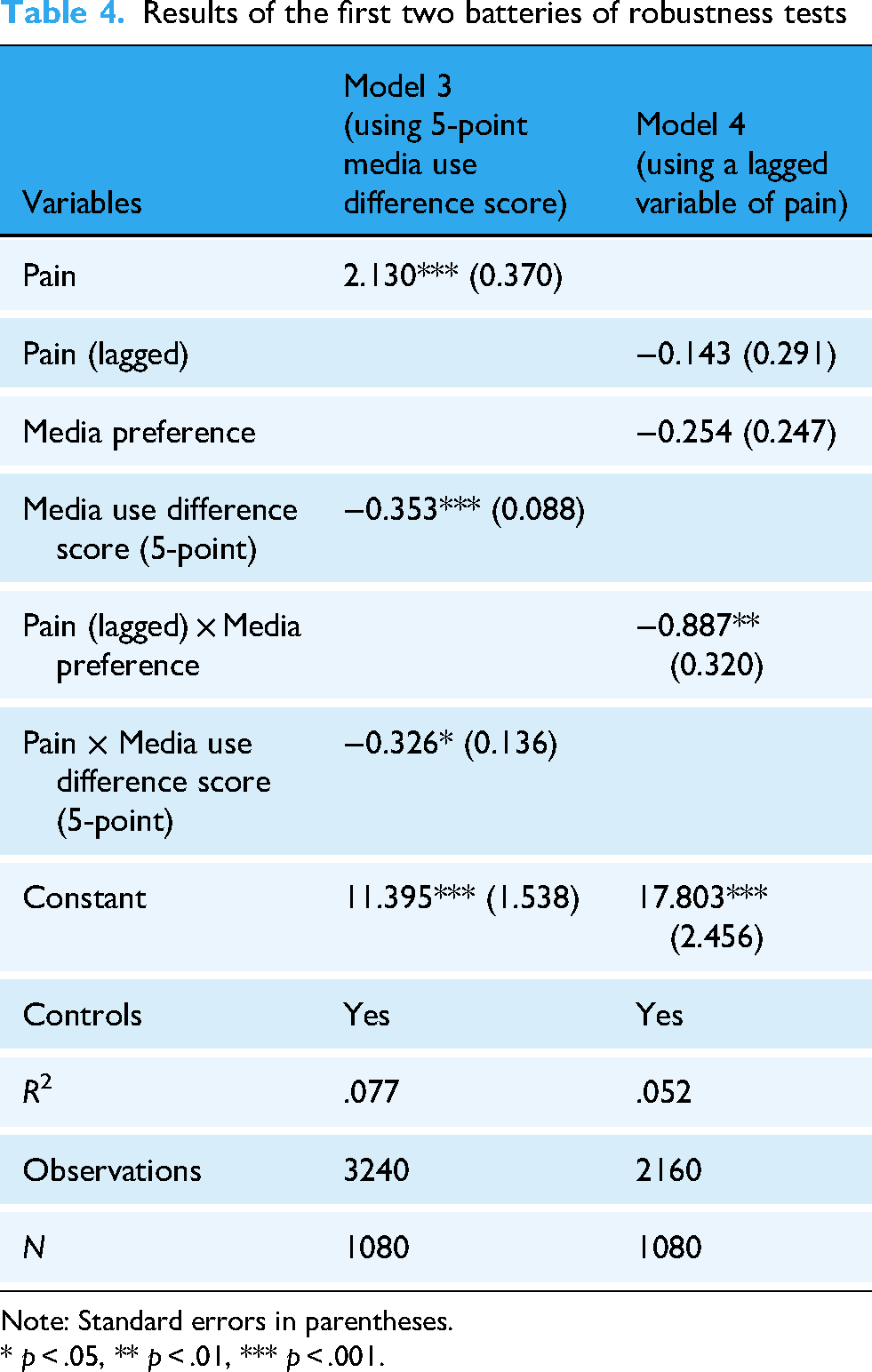
We conducted four batteries of robustness tests to verify the findings. Table 4 presented the results of the first two robustness tests.
Results of the first two batteries of robustness tests
Results of the first two batteries of robustness tests
Note: Standard errors in parentheses.
* p < .05, ** p < .01, *** p < .001.
The first battery of robustness tests employed a different evaluation of media preferences. We used a 5-point continuous variable instead of the dichotomous variable above. Specifically, we compared the frequency of use (1 to 5 Likert-like scale) between the two types of media. If internet media use was 2 points or more higher than traditional media use, we assigned a score of 2. If internet media was 1 point higher than the traditional media, we noted the difference as 1. In the opposite case which traditional media was higher, we similarly noted the difference as −2 or −1. Equal frequencies were noted as 0, and this was also an examination of the scenario where equal frequencies were considered to indicate no preference. The results showed that the moderating effects remained robust (β = -0.326, p < .05) (Model 3).
In the second battery of robustness tests, we employed a lagged variable of the pain status, i.e., we used the pain status in last wave to predict the depression in the current wave. The results showed that when using the lagged variable of the pain status, the moderating effects remained robust (β = -0.887, p < .01) (Model 4). This provided no significant evidence for the potential endogeneity of this moderating effect.
Additionally, we employed two sets of robustness checks to address potential time-varying confounding bias. We first incorporated three key time-varying variables into the model: cognitive ability, changes in health status, and digital literacy. Due to missing responses in these specific items, the sample size was reduced to 777 individuals (2331 person-year observations). Despite this reduction, the results remained highly consistent with our primary findings. Subsequently, we addressed the potential socioeconomic shifts via income quintiles instead of retirement status. Although this further reduced the sample to 592 individuals (1776 person-year observations), the core findings remained robust. This suggested that socioeconomic shifts do not alter the fundamental relationship identified in our study. The measurements and results are shown in Supplemental Table 3.
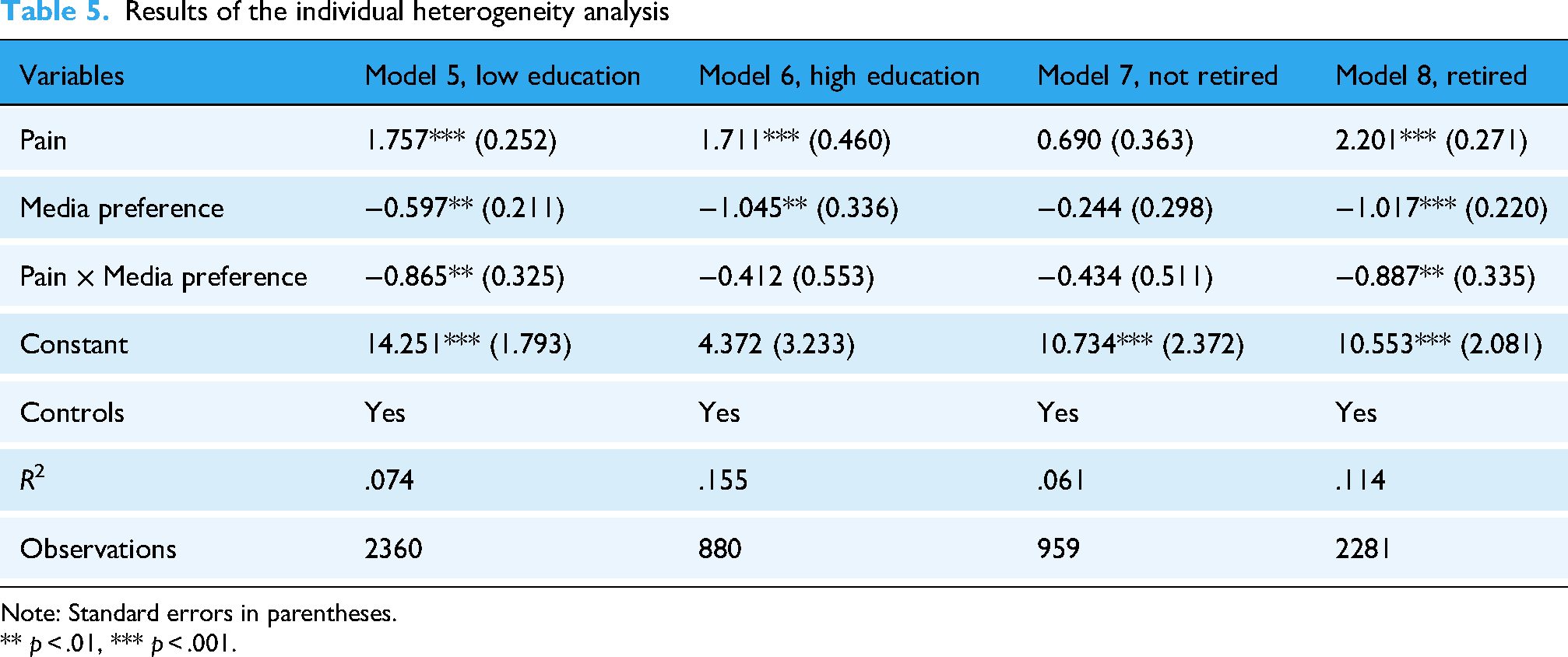
This study examined two types of individual heterogeneity, as presented in Table 5. Drawing on the conceptual framework developed during the literature review, we first explored heterogeneity based on the education level of older adults. The results indicated that the moderating effect of media preference was significant among older adults with relatively low levels of education (junior high school or below) (β = −0.865, p < .01), whereas this effect was not statistically significant among those with higher education (p > 0.05). The relationship also demonstrated heterogeneity when analyzed by retirement status. Specifically, the moderating effect of media preference was significant only for retired older adults (β = −0.887, p < .01), while no significant effect was observed among those who had not yet retired (p > 0.05). Figures 4 and 5 showed the marginal effects with heterogeneity.
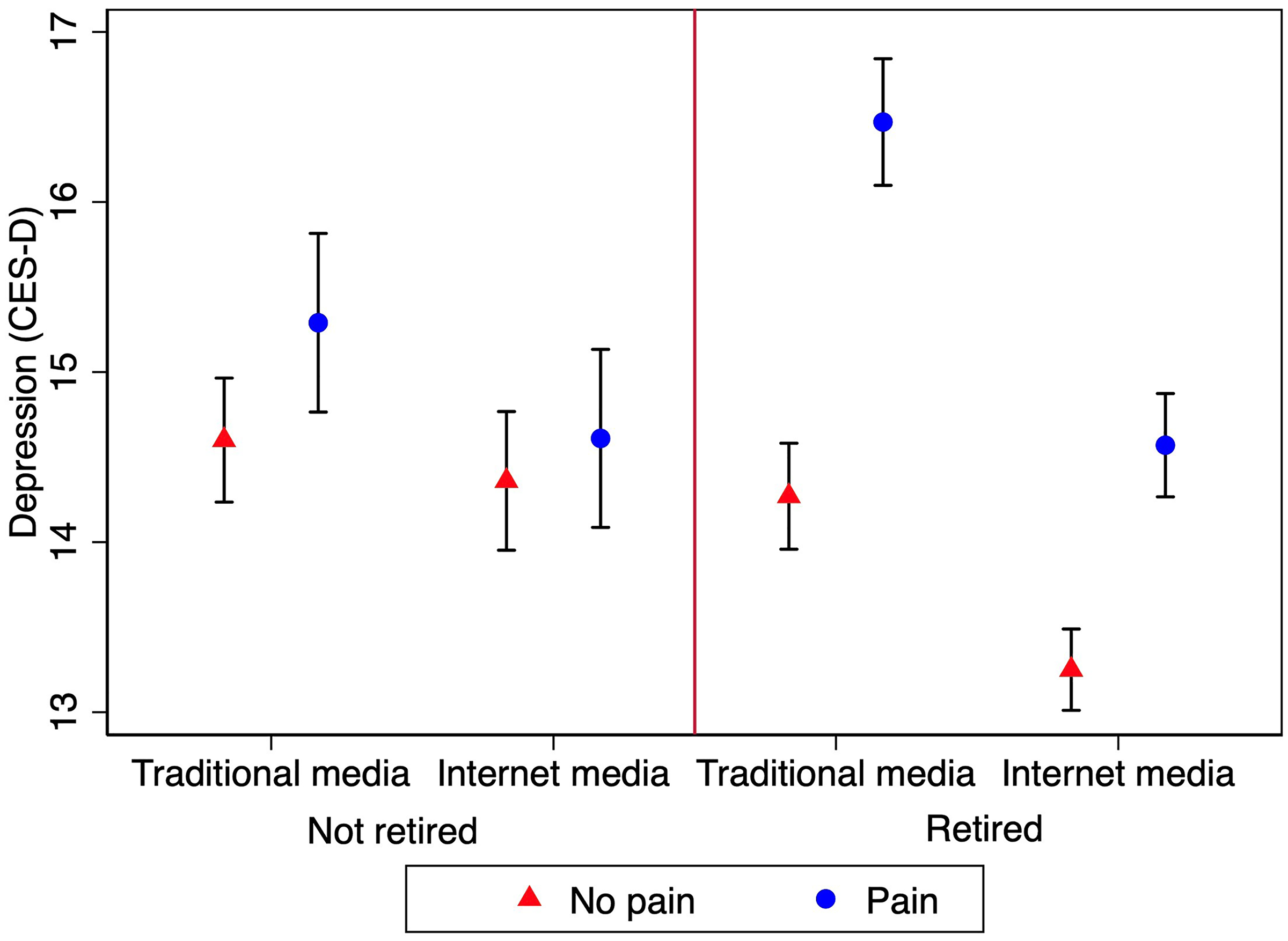
Marginal effects of pain on depression by media preference over retirement status. Error bars indicate the 95% confidence interval (95% CI).

Marginal effects of pain on depression by media preference over education level. Error bars indicate the 95% confidence interval (95% CI).
Results of the individual heterogeneity analysis
Note: Standard errors in parentheses.
** p < .01, *** p < .001.
In summary, the findings suggested that older adults who were less educated and retired were more likely to benefit from the moderating effects of internet media use.
The moderating effect of internet media use
The findings of this five-year longitudinal study indicated that there was a positive correlation between pain and depression, which has been consistent with previous studies.23,24 Confirming this association is critical for detecting pain early and paying prompt attention to the mental health of older adults.
Existing research has offered evidence demonstrating the positive association between internet media use and mental health among older adults. 55 This study further revealed that media preference significantly moderated the relationship between pain and depression in older adults. Compared to traditional media, using internet media more effectively alleviated depression among older adults with pain. This may be related to the digitalization, hypertext and strong interaction of internet media. 13 The widespread use of intelligent devices has made it easier for older adults to have access to internet media. 56 Theoretically, older adults with pain-related mobility limitations may utilize internet media to stay connected with the outside world, such as maintaining contact with family and friends, 32 acquiring health information and telemedicine support, 26 and participating in digital leisure activities. 57 These activities could potentially divert their attention from pain, offering a possible pathway to reduce subsequent depression. As the individual fixed effects model captures changes in the level of internet media use, this study highlights the potential of internet media use as a non-pharmacological intervention.
Additionally, the results regarding the engagement breadth of internet media reveal a cumulative buffering mechanism. The protection against pain-related depression strengthens as digital engagement increases from one to three types. This suggests that a diverse use of internet media enhances psychological resilience more effectively than single-faceted usage habits. Individuals can simultaneously benefit from information, distraction, and social connection, thereby creating a more effective overall buffer. 58
Heterogeneity across groups
The heterogeneity analysis revealed several new findings. First, the moderating effect of internet media use on the relationship between pain and depression was statistically significant among older adults with lower levels of education, but this effect was not significant among those with higher levels of education. This may be due to the fact that, for older adults with lower educational backgrounds, the internet serves as a crucial channel for exploring the world and engaging in social interaction. 37 In particular, the recent rise of short video platforms, with their user-friendly interfaces, intuitive operation, and easy access, has greatly facilitated participation in internet media among this group. 59 As a result, older adults are able to alleviate depression caused by physical discomfort at a relatively low cost. In contrast, older adults with higher educational backgrounds tend to have richer social capital, 60 and thus have access to a wider range of resources and coping strategies when dealing with depressive symptoms in individuals experiencing pain. Consequently, the moderating effect is not significant for this group.
Second, the heterogeneity analysis showed that the moderating effect of internet media use was significant among retired older adults, while it was not significant among those who had not yet retired. A possible explanation is that maintaining social connections is vital for older adults’ mental health, and social isolation is often associated with a higher risk of depression. 61 After retirement, older adults lose workplace-based social networks and have substantially more free time, which has led them to establish new social connections through internet media, thereby making internet-based social interaction an important alternative. 62 This is further supported by existing research, which has indicated that social interaction is a key channel through which internet use affects the mental health of older adults. 63 For those who have not retired, however, they are still in an active stage of real-world social engagement that more effectively meets their emotional and psychological needs. 64 Therefore, the effect is not significant among this group.
Strengths and implications
This study extends prior research on the association between pain and depression among older adults by highlighting the moderating effect of internet media, contributing to both theoretical research and practice related to older adults’ health.
First, this research sheds new light on the relationship between pain and depression. Current research has mainly focused on the direct effects of internet media use on health outcomes. Based on three waves of the five-year longitudinal study, we introduced media preference as a moderating variable in understanding the relationship between pain and depression. These results highlight the potential of internet media use as a non-pharmacological intervention, expanding the theoretical framework of existing research.
Second, the heterogeneity analysis showed that the moderating effect was more significant among older adults with lower educational backgrounds and those who were retired. This finding suggests that target policies can be developed to reduce obstacles to internet media use among older adults. For instance, older adults with lower levels of education and retirees can receive digital literacy training in internet media use. Meanwhile, internet companies can be encouraged to develop applications with more age-friendly interfaces and intuitive functions. This collaborative effort enables digitally disadvantaged older adults to benefit from internet media.
Limitations and future directions
This study has several limitations. Since we excluded respondents who had never had an internet connection throughout the three waves of the survey, the findings may only be applicable to older adults who have possibility of being digitally connected. Moreover, this study did not assess whether older adults were addicted to the internet or possessed the digital literacy to distinguish false information online, 65 despite the fact that these negative impacts might also be related to the risk of depression in older adults. Future studies could address this issue by refining these measurements, such as developing multidimensional and more detailed scales in specialized surveys, and investigating whether the overuse of internet media and misinformation can exacerbate depression among older adults with pain. While our individual fixed-effects approach controlled for stable individual traits, some time-varying factors still need to be taken into account. Our sensitivity analyses included time-varying controls including health transitions, cognitive decline, and socioeconomic shifts. However, some other factors like evolving depressive trajectories still require future studies. To maintain a clear research focus on the internet-traditional media comparison, we did not analyze the specific roles of media content types. Future research could build upon our findings by examining the heterogeneous moderating effects of specific content types.
Conclusions
This study explored a novel pathway by investigating the moderating role of media preference in the relationship between pain and depression among older adults. The results reveal that internet media use significantly alleviates depression caused by pain, demonstrating the significance of non-pharmacological interventions in mental health. The engagement breadth of internet media also exhibited a buffering effect. The heterogeneity analysis further illustrates that the impact of internet media use varies among older groups, especially with a stronger moderating effect on less educated and retired older adults. These findings provide crucial experience and insights for developing intervention strategies aimed at promoting healthy aging in China and in other countries with similar contexts. With the increasing adoption of information technology among older adults, internet media has introduced new opportunities to improve their health and well-being. Future efforts should focus on developing effective policies that guide older adults in fully utilizing the benefits of internet media, enhancing their physical and mental health, and promoting active and healthy aging.
Note: This is the second revised version of the manuscript, which has already addressed feedback from two rounds of peer review.
Supplemental Material
sj-docx-1-dhj-10.1177_20552076261431413 - Supplemental material for Internet media and depression in older adults experiencing pain: Evidence from a five-year longitudinal study (2018–2023)
Supplemental material, sj-docx-1-dhj-10.1177_20552076261431413 for Internet media and depression in older adults experiencing pain: Evidence from a five-year longitudinal study (2018–2023) by Fan Bai, Yiwei Liao, Junzhuo Tang, Shichao Du, Weining Ning and Chunyu Wang in DIGITAL HEALTH
Footnotes
Abbreviations
Acknowledgments
The authors acknowledge the support from the Institute of Gerontology and the National Survey Research Center at Renmin University of China for providing the CLASS data.

Ethical approval
The data used in this manuscript were from a large national social survey (CLASS). All the participants provided written consent prior to their participation in the survey, and the research was approved by the Academic Committee of the School of Statistics of Renmin University of China (L20250106).
Author contributions
Conceptualization: FB (lead), CW (equal), and SD (equal). Data curation: CW (lead) and JT (supporting). Formal analysis: CW (lead), FB (equal), YL (equal), and SD (supporting). Funding acquisition: CW. Investigation: FB (lead) and YL (equal). Methodology: CW (lead) and SD (equal). Project administration: FB. Resources: CW. Supervision: CW (lead), SD (equal), and WN (equal). Validation: YL (lead) and JT (supporting). Visualization: CW (lead) and SD (equal). Writing–original draft: FB (lead), YL (equal), and CW (equal). Writing–review and editing: CW (lead), WN (equal), and SD (equal).
Guarantor
Chunyu Wang.
Funding
The authors disclosed receipt of the following financial support for the research, authorship, and/or publication of this article: This work was supported by the National Natural Science Foundation of China (Grant Number 52308010). The funding bodies did not influence this paper in any way prior to circulation.
Declaration of conflicting interests
The authors declared no potential conflicts of interest with respect to the research, authorship, and/or publication of this article.
Data availability
Supplemental material
Supplemental material for this article is available online.
References
Supplementary Material
Please find the following supplemental material available below.
For Open Access articles published under a Creative Commons License, all supplemental material carries the same license as the article it is associated with.
For non-Open Access articles published, all supplemental material carries a non-exclusive license, and permission requests for re-use of supplemental material or any part of supplemental material shall be sent directly to the copyright owner as specified in the copyright notice associated with the article.
