




Abstract
This study aimed to investigate how users perceive the different elements of an internet based smoking cessation intervention and to see if the program meet needs and expectations of people in a smoking cessation process. Nine semi-structured interviews were conducted in February 2010. Participants were recruited via the homepage of the smoking cessation program Dit Digitale Stopprogram (Your Digital Quit Program) operated by the Danish Cancer Society. The main result was that participants established a relationship to the program which influenced their smoking cessation process. Participants perceived the program as caring and found it supportive. However, the program also created feelings of frustration, disappointment and anger. Some participants in the last phase of cessation experienced text messages from the program as smoking cues. The study concluded that individual interpretations of the different elements in an Internet-based smoking cessation intervention can have both positive and negative impact on the smoking cessation process of participants.
Keywords
Introduction
Digital media is becoming an increasing part of everyday life. Many people have access to cell phones and Internet, making these platforms highly relevant in public health interventions. Smoking is the lifestyle factor with the greatest impact on death rates causing more than 14,000 deaths annually in Denmark. Combining the digital media with effective smoking cessationmethods adds promising prospects to future tobacco control.
A growing body of literature demonstrates that Internet-based smoking cessation interventions (IBSCIs) can be both effective and efficient in helping smokers quit.1–3 There is, however, substantial variation in quit rates 4 and limited documentation on which elements of IBSCI are essential for helping members to obtain cessation. The background for the promising quit rates has not been fully investigated. Studies have identified the 24–7 availability 5 of Internet forums, 6 interactive elements, 1 video testimonies, 3 mixture of digital media 7 and the possibility of tailoring the intervention 8 as important factors.
There is, however, limited documentation on the social and psychological mechanisms involved in the interaction between program and participants.4,9 This lack of knowledge of underlying mechanisms may account for some of the variation in outcomes obtained by various smoking cessation interventions.4,8,9 Few studies have approached this gap in the literature. Stoddard et al. 10 investigated usability in an IBSCI using a user-centric approach to quantify the extent to which participants understood and perceived the program. The study found that performance and customer satisfaction influenced the usability of a smoking cessation web page. Dijkstra investigated the mechanisms of tailored messages in an IBSCI and found the effect of tailoring to be completely mediated by individual evaluation. The conclusion was that tailoring can be more effective than nontailored information if evaluated positively by participants. 11
Only two studies have investigated an IBSCI qualitatively. In a study from 2005, Burri et al. 6 investigated the blog in an IBSCI by analyzing posted messages. They found that social group mechanism existed in the digital setting and that participants formed informal groups without clear hierarchy or leadership roles. In another study, Frisby et al. 5 conducted a qualitative investigation to identify participants’ reasons and methods for attending smoking cessation intervention on the Internet. The study showed that smokers prefer online interventions because they are tailored, convenient, interactive, timely and anonymous.
The intervention
In 2010, the Danish Cancer Society launched a fully automated smoking cessation intervention called Dit Digitale Stopprogram (DDSP)—in English, Your Digital Quit Program. The program is free of cost for the user and anyone can take part. The program is not promoted intensively but is being spread through networks such as general practitioners and relevant web pages. In April 2011, the program had 2462 participants of which 60 percent were women. Participants spend on average 6 min using DDSP every time they visit the program’s home page. The program uses Internet, e-mail and text messages to communicate with participants. The main platform is an individual web page, including “My page,” “Profile,” “My quit plan,” “Exercises,” “Blog,” “Videos,” “Urgent assistance” and a “Library” (shown in Figure 1). The target group for the intervention is adultsready to begin a serious smoking cessation attempt using digital assistance. DDSP is developed on the basis of a comprehensive literature review conducted in 2009 collecting “best practice” within the field of IBSCI. The program builds on a number of relevant theories, including Appreciative Inquiry (gain framing/positive imagining), 12 The Transtheoretical Model/Stages of Change and Processes of Change (consciousness raising/helping relationships/stimulus control/goal setting), 13 Social Cognitive Theory (modeling/behavioral journalism), 14 Self Regulation Theory (coping planning/if then statements) 15 and Wisconsin Inventory of Smoking Dependence Motives (smoking profiles). 16
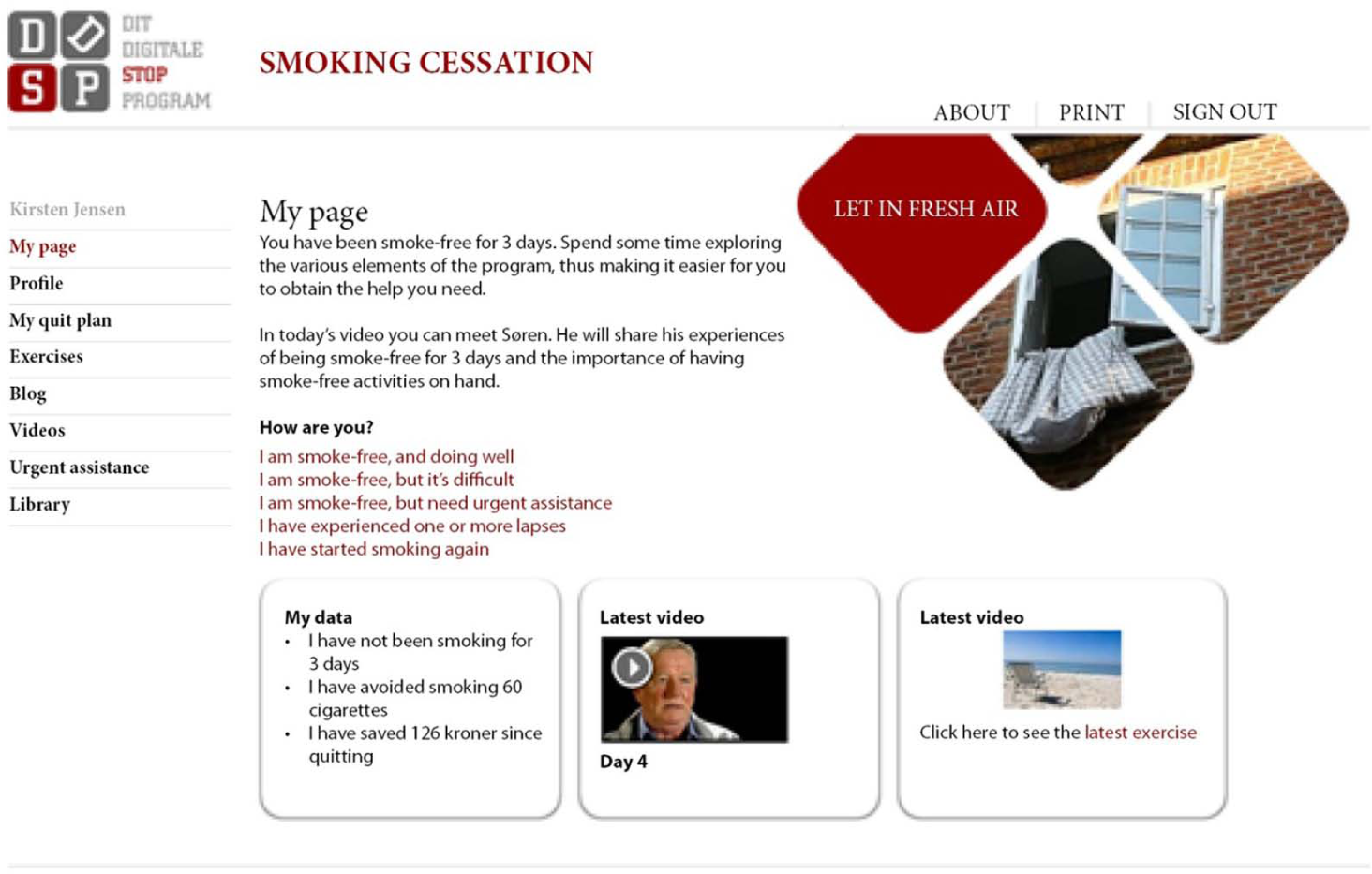
“My page” in DDSP translated into English.
Tailoring and tunneling is used to address users individually according to individual needs and at different stages of quitting. The program tailors its communication by using individual data, including participants’ name, smoking profile, amount of money saved or preferred coping mechanisms. In addition, tailoring is applied in the tunnel design of the intervention, meaning that participants are exposed to different elements of the program according to their placement on a timeline. The amount of communication according to time is approximately bell shaped: slowly intensifying communication up until first quit day and offering the most intensive communication in the first 4 weeks of cessation (shown in Figure 2). Participants are followed up until 1 year after quitting.
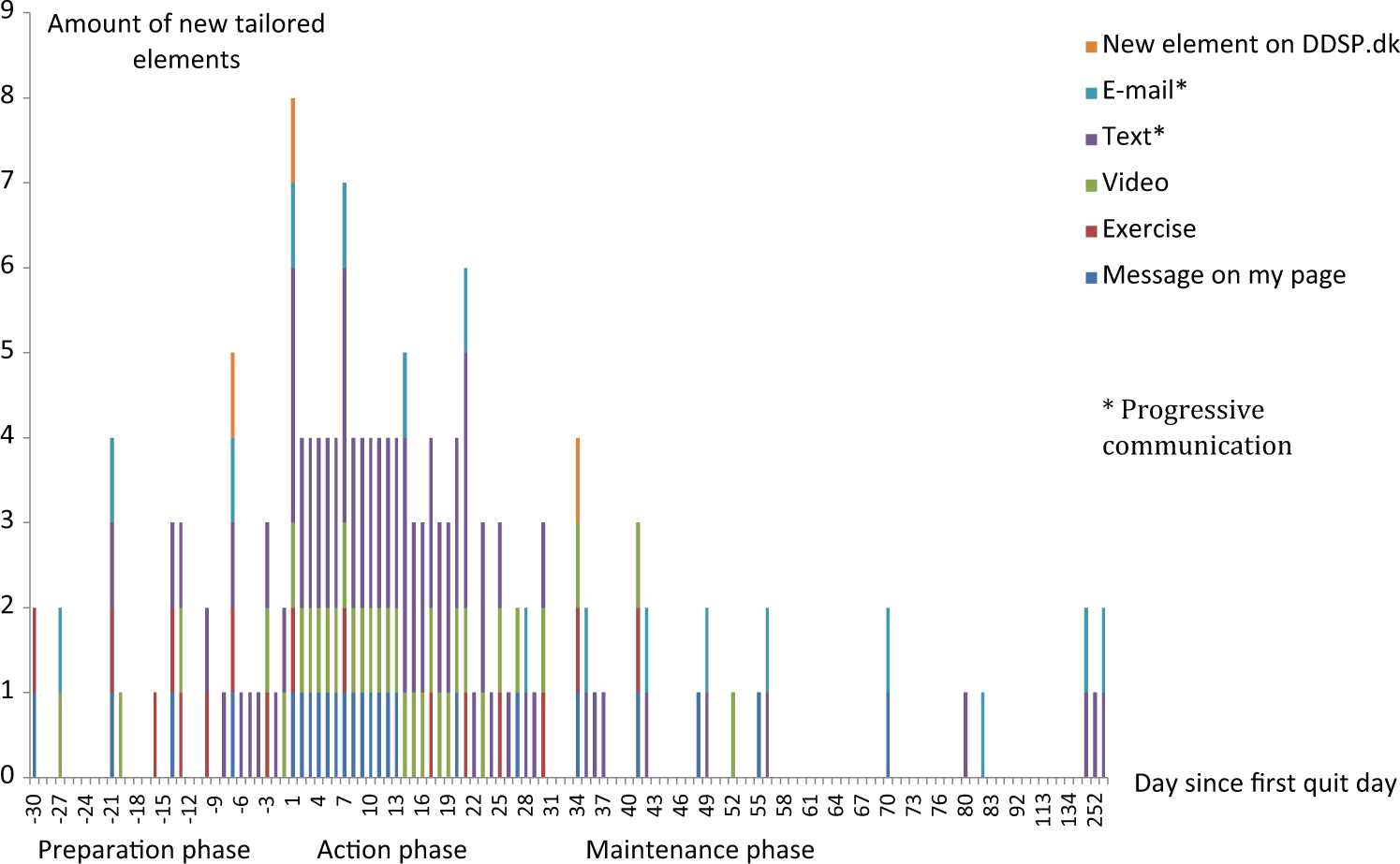
Flow of communication in DDSP.
Figure 1 demonstrates how the program uses both passive communication (participants have to actively seek information) such as videos, exercises and new elements on the home page and progressive communication (information given without participants taking action) such as e-mails and text messages also referred to in literature as “push messages.” 17
The aim of this study was to investigate how users perceive the different elements of an IBSCI and to see whether the program meets needs and expectations of people in a smoking cessation process. No previous studies have to our knowledge investigated the relation between an IBSCI and its participants from a user perspective.
Methods
Procedure
Nine participants were recruited via the DDSP website and participated in individual semistructured interviews conducted by an experienced interviewer in February 2011. As recruitment took place via the website, all users who visited the site were able to view the invitation and sign up for participation in the study. The interview took place at the Danish Cancer Society or a participant’s home. All interviews lasted 45–60 min. Participants were informed that participation was unpaid, voluntary and confidential and that the purpose of interviewing was to detect features of DDSP that could be improved, allowing both negative and positive perceptions to be expressed. The interviews were complemented by visual stimuli showing images from the website. The addressed themes were smoking history, flow and personalization of the program and perception of single elements divided into “My page,” “Profile,” “My quit plan,” “Practices,” “Blog,” “Videos,” “Urgent assistance,” “Library,” text messages and e-mails. After each interview, the interview guide was adjusted if necessary. The interviews were transcribed using Nvivo 9. According to Danish legislation, the study did not need ethical approval.
Participants
The study included all users of DDSP who responded to the invitation. The informants group consisted of men (n = 3) and women (n = 6) aged 23–60 years. Two had been smoking occasionally between 0 and 40 cigarettes per day, and seven had been smoking more than 15 cigarettes per day. The informants represented both people who quit within the previous week of the interview and well-established quitters who had been enrolled in the program for up to 124 days. All informants had visited the website more than 3 times and were all ex-smokers when the interview took place—some had, however, experienced a lapse.
Analyses of data
A coding system was developed according to themes found in the interviews. Coding categories were constructed using Grounded Theory; when new statements occurred, new categories were established. 18 Themes of particular interest were chosen for further in-depth analysis and discussion. Categories were discussed and adjusted by the first author (C.L.B.) and second author (P.D.) before and during the coding process. However, C.L.B. conducted all the coding. The coding focused on describing the nature of the relationship between the individual informant and DDSP. In addition, we looked for divergence between needs and expectations of the informant and the program.
Madeleine Akrich’s theory of scripting was used as an analytic approach to discuss the data. The theory is a part of the area within science and technology studies named Actor-Network Theory and investigates how developers of digital interventions incorporate assumptions of the user into the technology. These assumptions are “inscribed” in digital elements as a collection of feelings, acts and interpretations anticipated when user meets technology. 19 Previous studies have shown the theory of scripting suitable for investigating interactions between health technology and its users. 20
In this article, we investigate DDSP as a script. The script includes “all elements of the program that the user is exposed to during the process of quitting and all the assumptions build into these elements.” The tailoring in DDSP is reflected in the core idea of scripting: it builds on the assumption that developers of an intervention are able to predict what users need at a given time and how they act on and interpret a given element. A successful tailoring means that the script corresponds to user’s actual needs. The nature of the relation between the scripting in DDSP and users of the program is described in this article.
Results
The results are divided into sections according to main findings. First, we describe the basic factors for the relationship, then describe how the relationship begins, then examine its nature while informants are highly focused on cessation and, finally, describe the process of ending the relationship.
Adding human qualities to the program
The interviews clearly showed that adding human qualities and projecting human intentions into the program were crucial for the program’s influence:
Once you register in this sort of program, you automatically feel guilt if it collapses. You grow a relationship to the program and I would be ashamed if I lapsed.
This phase demonstrates how one participant prevented a lapse from becoming a relapse by registering her daily smoking status. She described how she afterward found herself receiving forgiveness from the program after experiencing a lapse:
I really love registering every day that “I’m doing fine and that I’m not smoking.” In some way I’m trying to make up in this forgiveness-process I went through after lapsing.
This example demonstrated how human qualities were added to the program in order to obtain a special feeling—in this case, the feeling of forgiveness. The program became an actor to whom this participant confessed her sins and received forgiveness. In this case, the script succeeded in creating a feeling of social support as the participant projected feelings of care and support into the actions she conducted with the program.
Establishing a relation
Enrolling in DDSP transformed a participant’s mental wish to quit into a concrete plan of executing it in real life. The participant became obligated to the program:
I was held responsible. Quitting is usually about making a promise to yourself. Sometimes it’s hard to keep this promise and then it’s great to have this program. Then I haven’t only given a promise to myself—I also gave it to The Cancer Society.
The quote demonstrates how the program added a feeling of someone following the participants during their quit attempt. The first period after setting a quit date was characterized by the informants slowly getting familiar with DDSP:
I was surprised because it is a very lovely program to visit. I slowly found myself drawn to this universe where there is a particular amount of time until you quit. I was told to do all sorts of things and I received all these text messages.
The personal-relevant content slowly drew the participant into a universe that prepared them for the task on hand. The atmosphere was described as inclusive and nonjudgmental. For instance, one participant said:
The atmosphere in the program means that you are not alienated as a smoker. You need a safe haven where you are allowed to be a smoker who just wants to quit.
The fact that participation was limited to smokers determined to quit created a feeling of solidarity.
Intensive support and care
It is inscribed in DDSP that different people need different help according to their placement in the cessation process. Once the participants reached their quit day, DDSP intensified its progressive communication. Participants also started visiting the website more frequently:
It is in the beginning you need support but usually no one cares after 8-14 day. I visited the webpage all the time in the start because here you receive all the things you need and all the support you want.
The continuous attention from DDSP was seen as an advantage when attention weakened from elsewhere. The program was seen as a universe where smoking cessation was taken seriously, corresponding to participants’ perception of smoking being the absolute center of attention during the first period. A reason for this agreement between participants’ needs and the DDSP script may be found in the understanding and supportive tone of the messages. For example, a comment read:
I got enormously self-centered and occupied by the feeling of “Wow—I am really doing this.” At that point the text messages were fantastic, because they contain exactly those feelings.
The first period was perceived as demanding for most participants who expressed unlimited need for attention from DDSP. Expectations regarding receiving attention and the program’s ability to make communications relevant for the individual participant did in this case correspond to the program’s script.
Withdrawal and craving
The program reduces the amount of communication after 3 weeks of cessation, an act that was perceived differently by informants. Some experienced less need to be supported and accepted the lowering contact as a part of the process. In contrast, some missed the daily contact and experienced feelings of anger and disappointment toward the program:
The program doesn’t provide that much now. I wish it gave more. I miss the care even though I know it’s just a machine. It’s okay that it weakens but it almost disappears. I would be nice if you where told something like “We still think of you”
This quote illustrates how the program is unable to fulfill the needs of a participant resulting in a disagreement between the script and the participant’s expectation toward attention. The consequence of this frustration was for some informants a wish to stop using DDSP.
Periods that were characterized by less craving toward smoking did not always correspond to less contact to DDSP, as some informants found themselves drawn to elements of the program. For instance, one participant felt a need to watch the videos even at times when thoughts of smoking were not present:
I could sometimes feel a hunger towards watching the videos. I just had to get up and see it; it was running in the back of my mind.
This quote showed that the urge toward certain elements of the program could encourage a visit to DDSP. The relationship between the program and the participant became so strong that it diverged from its original intent: to be a part of a smoking cessation process. In this case, the scripting failed to support the cessation process in a positive way.
Communication becomes craving cues
The interviews suggested that the program could trigger negative feelings when continuously reminding the participants of their previous habit:
Sometimes I got quite irritated. It is irritating to be reminded that you quit smoking if you forgot about it. At last I cancelled the text messages, mostly because they kept reminding me.
For some participants, reminders from the program were directly related to experiencing a higher risk of lapse:
In the time after quitting I hadn’t thought about smoking, but then a text message came. Thank God there wasn’t a shop around—then I would have bought a package.
In these examples, messages from DDSP reminded participants of smoking, and the script thereby fostered feelings that created the opposite effect than intended.
In sum, the relation was expressed verbally and changed over time. Positive phrases about the program were “compelling,” “supportive,” “cozy” and “including.” The emotions it fostered were described as “a hunger,” “a lust” and “something alluring.” If the program fell short of supporting participants, verbalization changed character to negative expressions such as “missing,” “minding your self,” “being on your own” and a feeling of “things being different.” For those who experienced a lapse, feelings of “shame,” “guilt,” “letting down” and doing “something stupid” rose and gave the participant a need to obtain “forgiveness” from the program and a feeling of “having to compensate.” The quotes indicated that text messages were interpreted differently according to their placement in time; while being seen as supportive when participants were thinking of smoking, they could have a negative impact once participants experienced less attention on smoking. It simply reduced successful communication to a question of timing.
Discussion and conclusion
To our knowledge, this article is the first to examine the relationship between an IBSCI and its participants using a qualitative approach. This study demonstrated interviewing as a valuable tool for identifying social and psychological mechanisms in the interaction and demonstrated the theory of scripting as being suitable for analyzing these mechanisms.
The main finding was that participants of DDSP were able to establish a relationship with the program. The nature of the relationship was found to influence participants’ feelings, perceptions and actions during their quit attempt. The premise for influence by DDSP was that its content was perceived as recognizable, personal and relevant for the individual user. The relationship was established through participants’ projection of human qualities to the program. In addition, we found that progressive contact from an IBSCI can be interpreted both positively and negatively according to the agreement between the script and individual needs of the participants.
This knowledge is important as a growing body of literature has found the number of visits to an IBSCI to be positively correlated to cessation outcomes.2,21,22 It can be assumed that a positive relationship with the program will make participants visit the website more frequently and thereby increase the chances of succeeding in quitting.23,24
What makes the relationship?
The relationship between DDSP and its user is shown to be crucial for how the program influences the participants and their process of quitting. The interpretation of the script is important as the technology is attributed with human characteristics such as the ability to forgive, support, help, concern, desert and fail. It is participants’ ability to make these attributions that enables the program to influence behavior. Dijkstra supports this finding as his study identified individual cognitive evaluation as a mediating factor on how to perceive elements of a digital program. 11
Some factors seem to be particularly important in the relationship between the program and participant. First, tailoring of the program gives participants relevant and personal information at different stages of the quitting process. The tailoring that lies in the tunneling design of the intervention provides participants with a sense of “flowing” with the program and progressing in cessation. The study hereby supports previous findings of tailored and tunneled communication as an effective method in establishing a relationship with participants. 24
Next, the program offers a universe that exclusively embraced the process of quitting, which for most participants has few counterparts. The program is perceived as consistent in its conviction that a participant is able to follow through the wish of quitting. Most ex-smokers have been through numerous quitting attempts, which might have influenced their own and the belief of others in their succeeding.
Digital dilemmas in IBSCIs
This study showed that perception of an IBSCI can be considerably different from what is scripted when developing the program and, as a consequence, can end up having the exact opposite effect than planned. Therefore, some dilemmas in using digital media in smoking cessation interventions must be discussed.
First, some participants in the last phase of cessation experience “text messages as smoking cues creating craving toward cigarettes.” Previous studies have found a connection between visual exposure of smoking-related objects in a digital setting and craving, 25 but this study indicates that smoking cues are not only limited to visual objects but can also emerge simply from text messages reminding of an ongoing cessation process.
A second drawback is that expectations of particular content could make “contact with the program driven by a desire to be digitally stimulated” rather than by smoking-related reasons. This finding questions what previously has been seen as an advance: the 24–7 availability of the digital programs. 5 Event-based interventions such as group therapy focus the participant’s attention for a short period of time, whereas the digital interventions allow constant focus. As this finding indicates, the constant availability and the attractive elements may focus the mind on the quitting process more than necessary.
Third, lack of communication when needed creates “negative feelings of frustration, disappointment and anger toward the program.” Attitudes toward treatment have previously been found to influence participants’ disposition to obtain help using a digital smoking cessation program. 22 In a study from 2008, Strecher et al. 8 suggested that communication is not only about “how you say it” and “who says it,” but also about “what you say.” 8 This study adds the question of “when you say it” to the list and thereby places timing of communication as a fourth factor to consider when designing IBSCI.
So far, the focus has primarily been positive toward use of new technologies, suggesting that they will optimize the effect of digital assistance in health promotion.17,26,27 This study, however, brings attention to some of the disadvantages in using technology as a medium for behavior change. The technology is unable to adapt to individual emotional fluctuations resulting in discrepancy between script and user needs. Emotional fluctuations are a well-known part of a smoking cessation process and people who quit often go back and forth between the different phases of cessation. 15 This means that the program has to be highly flexible. It was further found that digital stimulus can potentially create craving, indicating that the opportunity of unlimited communication in the new media must be introduced with caution. Given the fast growth of health-related applications for smart phones, the opportunity for on-demand assistance is received positively by consumers, 26 but so far, no studies have investigated the potential drawback of using these media in IBSCI.
Several solutions can be taken into consideration when dealing with the dilemmas presented. Studies show that integration of elements from face-to-face therapy or telephone counseling optimizes the effect of digital interventions28,29 and suggests that we need to incorporate actual humans. As an alternative we could “humanize” the technology by making scripts more flexible and sensitive to individual differences. A way to do this could be to tailor the communication continually throughout the intervention. In a study from 2005, Strecher and colleagues investigated a telephone-based cessation counseling program to test whether interventions should be tailored based on intake data or continually throughout the intervention period. The study, however, showed no improvement effect of the continual tailoring. 30 A second solution could be a looser scripting of the intervention that offered less progressive communication and placing the user in charge of making contact with the program and thereby creating the script themselves as the process went along.
Limitations and strengths
There are some limitations of this study. First, the study was conducted among participants who used the program and further agreed to express their opinion about it. This means that we had no representation from non users. Consequently, it is not possible to conclude to what extent the opinions expressed in this article are representative of users of an IBSCI. Second, we are unable to show exactly how the relationship influences real-life behavior change. However, given previous research, it can be assumed that negative feelings and exposure of smoking cues can influence quit rates.22,25
Despite these limitations, this study has a number of strengths. The results presented in this article suggest trends in how to perceive the program. The aim was not to quantify participants’ perceptions but to describe how an IBSCI can be perceived and how an IBSCI can establish a relationship with its users. This study offers a unique insight into this relationship and makes a relevant contribution to existing literature in the field. Furthermore, the result of this study provides a starting point to future research examining the relationship between digital smoking cessation interventions and their participants.
Conclusion
This study demonstrated that interviewing and the theory of scripting are valuable tools for identifying mechanisms in the interaction between an IBSCI and its participants. The main finding was that participants established a relationship with the program that influenced their smoking cessation process. The ability to project feelings onto the technology was crucial for the establishment of the relation.
This study draws attention to the difficulties of creating a script that corresponds to participants’ needs. The knowledge gained is relevant not only for smoking cessation but also in relation to other health-related behaviors, which can benefit from using digital interventions as a tool for health promotion. Further studies are needed to advance the understanding of how IBSCIs work from a consumer perspective.
Footnotes
Funding
This research received no specific grant from any funding agency in the public, commercial, or not-for-profit sectors.