




Abstract
Researchers in robotics have been increasingly focusing on robots as a means of supporting older people with cognitive impairment at home. The aim of this study is to explore the elderly’s needs and preferences towards having an assistive robot in the home. In order to ensure the appropriateness of this technology, 30 subjects aged 60 and older with memory complaints were recruited from the Memory Clinic of the Broca Hospital. We conducted an interview-administered questionnaire that included questions about their needs and preferences concerning robot functions and modes of action. The subjects reported a desire to retain their capacity to manage their daily activities, to maintain good health and to stimulate their memory. Regarding robot functions, the cognitive stimulation programme earned the highest proportion of positive responses, followed by the safeguarding functions, fall detection and the automatic help call.
Introduction
France, like other European countries, is facing demographic changes due to longer lifespans and lower fertility rates. The number of old and very old (80 years and more) people is increasing. While many older people will remain healthy and productive, overall, this segment of the population is subject to physical and cognitive impairment which is related to or associated with ageing.
Despite cognitive and/or physical impairment, ageing-in-place is desired by the elderly. This desire is so great that many may still choose to remain at home even if they are aware that they may be at risk for accidents. 1 Information and communication technologies (ICTs) can be used in a number of ways to improve the living experience and quality of life of people within their home environment and beyond by supporting the ongoing needs of a person during their normal day-to-day activities, providing access to information on how to manage a specific medical problem or ensuring a preventive measure. 2, 3 For example, assistive robots have been proposed to support the elderly to live independently at home and they could have a positive impact on an older adult’s life.
According to Broekens et al., robot research in eldercare concerns two kind of assistive robots: rehabilitation robots and social robots. 4 The assistive robots for rehabilitation emphasize physical assistive technology while assistive social robots concern systems that can be perceived as social entities with communication capacities. Furthermore, among assistive social robots in eldercare, we can distinguish two categories: (1) pet-like companionship robots whose main function is to enhance health and psychological wellbeing; (2) service-type robots whose main function is to support daily activities related to independent living.
Recent research has increasingly focused on service-type assistive social robots to support the elderly. The rationale for the development of this kind of robot is that the aged population experience different degrees of cognitive decline or impairment (ranging from age-associated cognitive decline 5 through mild cognitive impairment 6 to dementia 7 ) which might lead to difficulties in performing daily activities and in some cases to a loss of autonomy. The Nursebot project initially aimed at developing mobile robotic assistants which can accomplish various personal tasks for the elderly living in their homes, particularly those with mild cognitive impairment. 8 Care-O-bot is designed to navigate autonomously and safely in an indoor environment, communicate with or guide elderly people and assist them in their home. 9 The Robocare project, in which a robot is developed as a part of an intelligent assistive environment, aimed at preserving safety and providing suggestions to assist the elder’s scheduled activities. 10
In spite of the increasing interest in developing this kind of technology for supporting the elderly in their home environment, there are few studies dealing directly with the needs of the elderly and what they want assistive robots to do. However, it is important to carefully assess individual needs and preferences and to match these to the robot in order to enable greater acceptance. 11
At Broca Hospital we participated in the QuoVADis project, the goal of which is to develop an assistive robot for supporting the cognitively impaired elderly at home. The aim of this study is to explore the elderly’s needs and preferences in relation to having an assistive robot in the home.
Methods
Population
Thirty subjects with subjective memory complaints attending the Memory Clinic of the Broca Hospital were recruited. They gave oral consent to participate in the QuoVADis project. It was explained to them that the goal of the present study was to investigate the feasibilty of using an assistive robot to support the elderly at home. Then, they were invited to respond to an interview-based questionnaire with a reserch member.
The study was submitted to an ethics review committee before being conducted.
Questionnaire
An interview-based questionnaire was developed in order to assess the needs and preferences of the elderly towards having an assistive robot in the home. In this questionnaire, socio-demographic data were collected. Other items concerned three domains: needs and preferences in relation to robot use, the functionalities of the robot and the modes of the robot’s action.
As to needs in relation to robot use, four areas of need, subdivided into more specific themes, were selected according to a literature review concerning unmet needs in relation to ICT-based services. 12 The following themes are included in the questionnaire:
Need for general and personalized information for family members of the elderly; information on cognitive impairments in order to cope with them.
Need for support with regard to cognitive impairment symptoms; compensating for difficulties such as memory problems in daily life activities.
Need for social contact and company for the person with cognitive impairments; ways to stay connected with family, friends and social environment.
Need for health monitoring and perceived safety; need to be cared for and to feel safe.
Other items with regard to the functions of the robot were also developed according to a literature review. 12–14 The following domains were identified and were addressed by the questionnaire:
Cognitive prosthesis: daily activities, cueing/stimulation, medicine and appointment reminder, electronic agenda for planning and time management.
Safeguarding: detecting emergencies (fall detection, panic attack detection, sadness and apathy detection, abnormal sound and noise detection and motion sensors).
Social interaction: an internet-based videoconferencing system with family, friends and health professionals.
Support with regard to cognitive impairment symptoms: cognitive stimulation programme, picture and music storage, oral advice for daily activities and educative programmes for family members and caregivers.
Telemedicine: automatic call for assistance in the case of an emergency.
In addition, issues regarding the robot’s modes of action were addressed: modes of alert signals, the ability to switch off the robot, the possibility for the robot to set up a night watch, the ability for the robot to go everywhere in the apartment (even in the bedroom), the ability for health professionals to control the robot remotely, and the possibility for the person to wear a bracelet or a medallion help button in order to be detected by the robot.
The body of the questionnaire was composed of closed-ended questions (yes or no questions and multiple choice questions).
Results
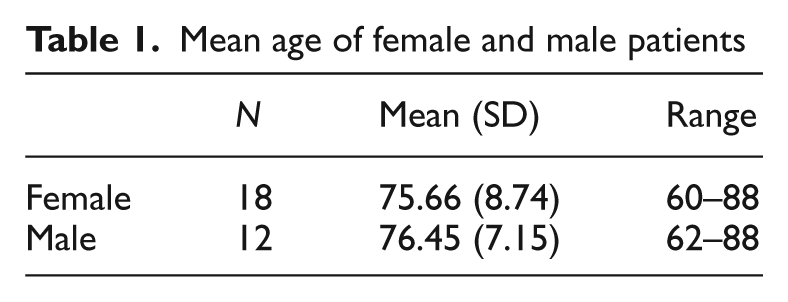
Table 1 shows the age (mean and range) of the people interviewed.
Mean age of female and male patients
Regarding educational background, 33.3 per cent of respondents had a college-level education or above, 46.7 per cent had high school education and 20 per cent had a grade school or lower education. A majority of the subjects (60%) did not live alone; most lived with a family member. As to the frequency of contact with their family members, 70 per cent of participants had daily contact (by phone or face-to-face), 23.3 per cent reported contact once or twice a week and 6.7 per cent had familial contact several times a month.
Essential needs
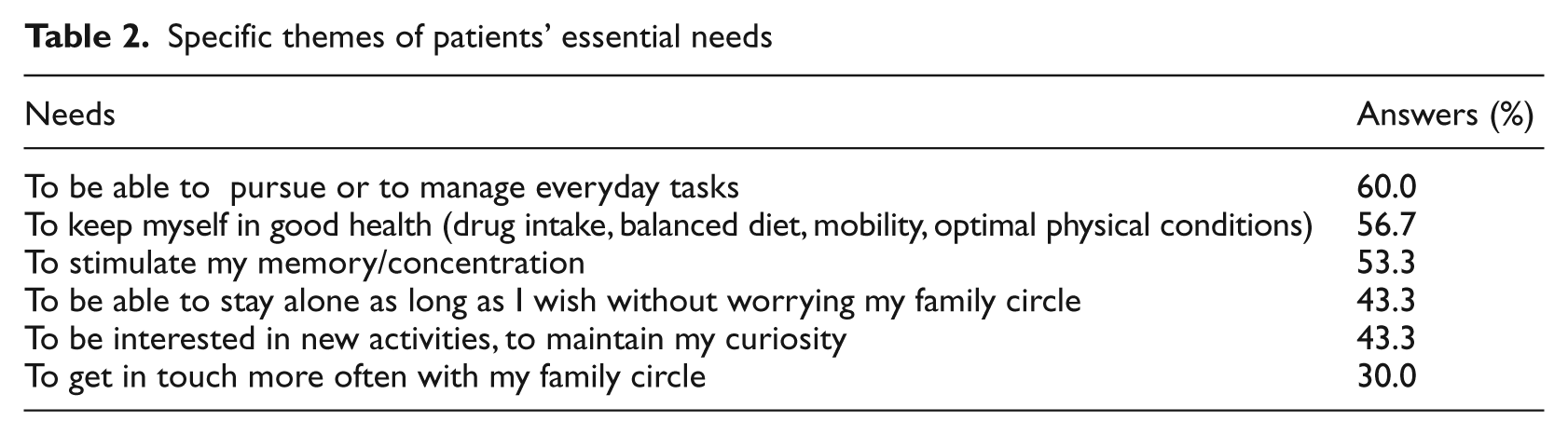
A majority of the participants interviewed expressed the need to keep the capacity to manage their daily activities, to maintain good health (treatment adherence, balanced diet and optimal physical condition) and to stimulate their memory (Table 2).
Specific themes of patients’ essential needs
Robot functions
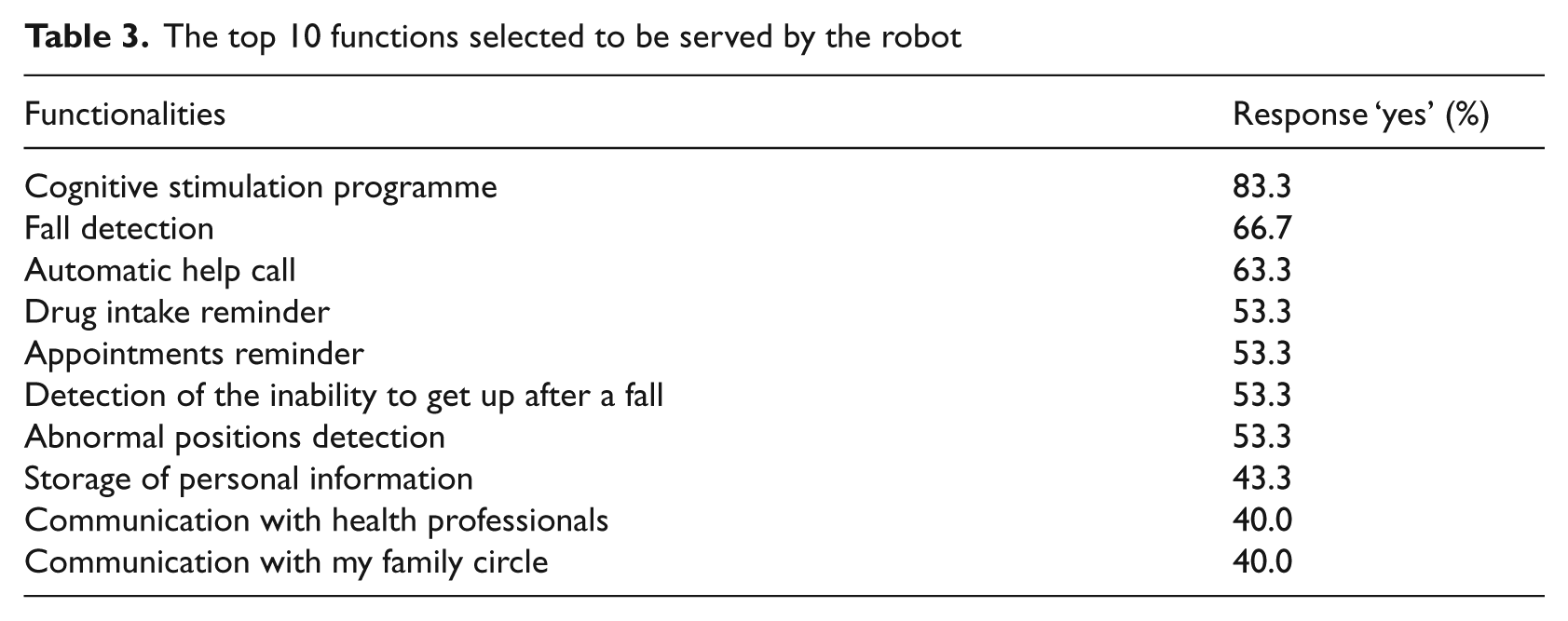
Regarding robot functions, the cognitive stimulation programme earned the highest proportion of positive responses, followed by the safeguarding functions, such as fall detection and the automatic help call. After those primary functions, the respondents were further interested in the drug intake and appointment reminder, detection of abnormal physical position and detection of the inability to get up after a fall. On the other hand, they were opposed to the sadness and apathy detection function. Also, most of the respondents were not in favour of communicating with family members via web-based conferences or receiving advice about daily activities (Table 3).
The top 10 functions selected to be served by the robot
Modes of action of the robot
The best way to inform the elderly of a programmed event would be a sound signal (46.7%). Opinions were divided with respect to the robot following a person into their bedroom: 43.3 per cent were in favour of it, 36.6 per cent were opposed to it and 20 per cent responded ‘I don’t know.’
Most patients (56.7%) would not feel uneasy about wearing a bracelet or a medallion help button (in order to be detected in emergency situations). In case of emergency, family members would be informed first (66.7%) and then the emergency rescue service (50%). In order to have better control of the robot, 63.3 per cent of patients would like a professional to be able to remotely control the robot. Opinions were divided as to the possibility for the robot to set up a night watch: 43.3 per cent were in favour of it while 40 per cent were opposed to it. Finally, a majority of the participants (66.7%) found it desirable to have the option to switch off the robot.
Discussion
Needs
In our study, the needs were not clearly identified by the subjects. In the interviews, many subjects said that they did not consider themselves in need of help because they did not think they had overwhelming impairments. However, they conceded that they might be more in need at a later date if their cognitive impairment increased. This finding is to some extent corroborated by the study of Demiris et al. using focus groups to investigate perceived needs and preferences for smart home sensor technologies. 15 In their study, many subjects found smart home technology useful only for residents with greater levels of frailty than themselves. In addition, some reported that their functional and physical status was such that there was no need for monitoring at the time.
However, the main needs expressed were: management of daily activities, maintenance of good health (treatment adherence, balanced diet, optimal physical condition and good mobility) and stimulation of memory. Our findings confirm previous results in the literature. In her survey, Barrett found that one of the needs identified by the elderly and by disabled older people is getting more practical support with everyday tasks. 16 This finding has important implications for formal sources of practical support to older people at home.
Robot functions
The robot function most desired by patients was the cognitive stimulation programme, which might most efficiently meet the needs of those with cognitive impairments. It has been suggested that computerized training programmes can be used with older people to achieve long-term improvement in some important aspects of fluid intelligence and to prevent and treat cognitive deficits. 17
When cognitive deficits interfere with everyday functioning, external memory aids are useful compensatory and supportive strategies. In contrast to internal memory aids that require effortful cognitive processing, external aids that exist in the physical environment are considered memory prostheses. 18 Thus the robot, serving as a cognitive prosthesis (drug intake reminder and appointments reminder) that can help the elder compensate for his or her impairment, is welcomed by the subjects.
Additionally, the subjects were in favour of the safeguarding systems – falls detection, automatic help call and abnormal positions detection – provided by the robot. These systems would ensure the safety and wellbeing of the elderly. This finding is in line with some studies. Cesta et al. found a positive reaction by elderly individuals towards a proactive robot intervening in the case of an emergency. 19 Vincent et al. reported positive outcomes for older adults of a telesurveillance service staffed by nurses, in terms of quality of life, life habits, satisfaction with the service and technology, and caregivers’ burden. 20 Even for the telesurveillance services staffed by non-health-professional personnel, it has been reported that those services were effective in improving the general quality of life of the elderly, as well as in improving various outcomes such as anxiety, the feeling of being safe at home and the perception of a positive effect on health. 21 In addition, telesurveillance services have been shown to have a positive effect on elders’ functional independence and autonomy in the activities of daily living. 21, 22 On the other hand, the subjects were opposed to sadness and apathy detection by the robot. They might want to protect themselves from unwanted access to their personal information (i.e. unwanted admission of others to their personal spaces or areas). 23 Ideally, older people want a sense of safety while simultaneously preserving their privacy, a concept defined by Rössler as the freedom to escape being observed or accessed when desired. 23
The majority of respondents were not in favour of communicating with family members via web-based conferences. They reported that they were accustomed to using the telephone as a means of communication with relatives. Older people tend to depend on routines and prefer to use technologies that they know well and to which they have already adapted. However, web-based conferences seemed to enable the frail elderly to live independently and offered support to their informal caregivers. Savolainen et al. reported that this kind of communication system reduces the sense of loneliness and isolation of the elderly. 24 In addition, this system allows older people to develop contacts with health professionals and social workers.
Modes of action of the robot
Most subjects did not feel uneasy about wearing a bracelet or medallion help button. Many old people benefit from emergency response systems such as a transmitter worn on a pendant, which gives them a sense of security. A majority seemed to be familiar with the utilisation of this kind of product. Nevertheless, wearing it on one’s body may be perceived as physically and psychologically obtrusive. In other words, it might be perceived as uncomfortable and could symbolize a growing dependence, which is stigmatizing.
The respondents were in favour of the potential to switch off the robot as the continuous activity of the robot could be perceived as obtrusive to personal routines.
The subjects did not always agree with the fact that the robot had access to all living space, including the bedroom. This seemed to violate their privacy. The issue of privacy within ambient assisted living has been addressed by some authors. 15, 25
Conclusion
This study had some limitations. First, our sample was not representative because the subjects recruited were volunteers who might have been more open to this kind of technology. Second, they did not have the opportunity to express their needs spontaneously because we suggested a list of needs to which they had to respond. Therefore, they might have had needs other than those that we proposed. However, our study contributes to gain some knowledge about the elderly’s needs and preferences toward an assistive robot in the home.
According to our findings, most of the elderly consider the ability to pursue or to manage everyday tasks as of the utmost important. As to the functionalities of the robot, it must provide not only daily activity support but also cognitive stimulation, and must serve as a telesurveillance system that increases the sense of safety and security in case of emergency.
It is important to involve the end users in the conception of the robot in order to meet their needs. The challenge is for engineers and health professionals to understand each other and collaborate closely. The introduction of a robot in the home must not merely be the next product of a technology push. If the product is not adapted appropriately for older users, it is likely these individuals will leave it aside. Moreover, frail older people are more vulnerable to the negative effects of unsuitable technology, another important factor to be considered.
These results will be further augmented by data collected from focus groups, a component of our continued research in this area.
Footnotes
Acknowledgements
This work was carried out as part of QuoVADis project, funded by ANR-07-CNSA-Tecsan.