




Abstract
Dear Editor,
Retrosternal goiter is most often defined as a thyroid gland with >50% of its mass within the mediastinum. 1 Surgery for symptomatic disease or malignancy is the treatment of choice, usually via the transcervical approach due to lower rates of complications. 2 The risk of complications is, however, higher with retrosternal goiters than with cervical goiters. 3 Such risks include the higher rate of permanent hypoparathyroidism and permanent recurrent laryngeal nerve injury, 4 post-op bleeding, 3 and incomplete excision of the retrosternal goiter.
Mixed reality (MR) technology combines virtual and augmented reality and has been applied in various surgical procedures to improve anatomy visualization and dissection accuracy. 5 The HoloLens2 is a head-worn, optically see-through MR display. 6 It projects three-dimensional (3D) reconstructed scan images as a hologram on the surgical field. The user can scroll between multiple cuts by using touch-free gestures, maintaining sterility of the gloved hands. As the user moves around, the computed tomography (CT) reconstruction stays anchored and can be viewed from different angles. In testing at the authors unit, when used for port placement in other operations, the accuracy is within 10 to 20 mm.
The authors describe here a 57-year-old female patient who underwent elective total thyroidectomy for a retrosternal goiter complicated by extrinsic airway compression. A pre-operative CT scan of the neck and thorax (Fig. 1A) revealed a large multinodular goiter with antero-posterior compression and rightward displacement of the trachea. There was retrosternal extension until the aortic arch. The patient underwent surgery after 1 year of conservative management, because she developed increasing breathlessness from the goiter.
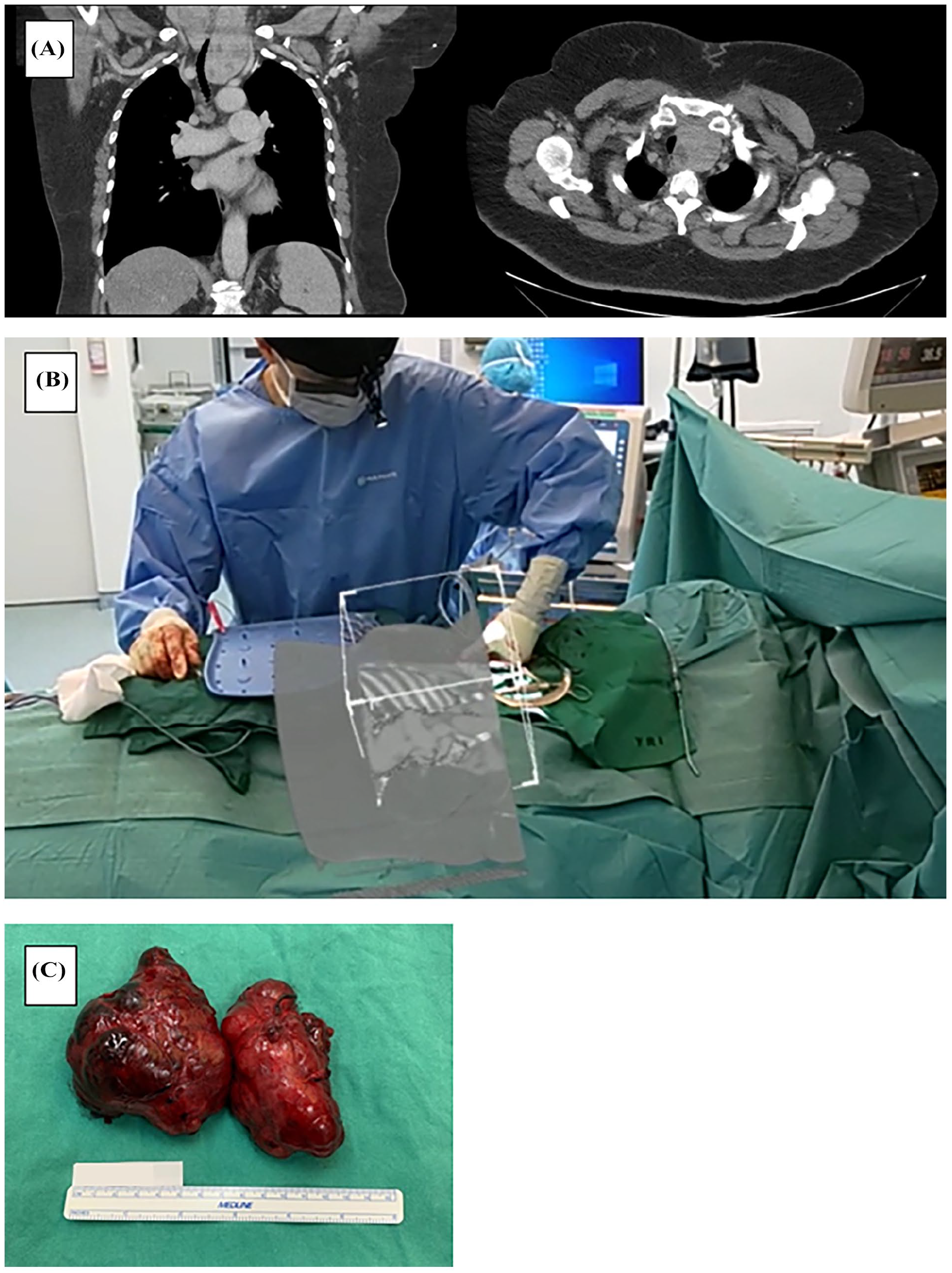
(A) Pre-operative CT scan of the neck and thorax demonstrating retrosternal extension of the goiter to the level of the aortic arch and extrinsic tracheal compression, (B) intra-operative assessment of the retrosternal goiter with aid of the HoloLens MR projection, and (C) clinical photograph of thyroidectomy specimen.
Pre-operative CT images of the neck and thorax with 0.6 mm cuts were obtained and loaded onto the HoloLens directly. The HoloLens was able to be set up in roughly 5–10 min. The sternum and clavicles were used as anchoring landmarks. The HoloLens was used from the beginning of the resection to visualize goiter location. Intra-operatively, the multinodular goiter’s right lobe measured 10 × 8 cm, while the left lobe measured 11 × 5 cm. A transcervical approach was adopted, and routine capsular dissection was performed for bilateral thyroid lobes with preservation of the parathyroid glands and intra-operative nerve monitoring of the recurrent laryngeal nerves.
Next, the retrosternal extension of the goiter was evaluated with the aid of the HoloLens MR technology (Fig. 1B). Clinical assessment with palpation to determine the inferior-most extent of the thyroid gland was aided with visualization on MR. Dissection of the retrosternal goiter was performed within the upper mediastinum, and the extent of surgical dissection was re-evaluated using MR to ensure adequacy. The dissected goiter is pictured in Fig. 1C. Post-operatively, the patient had an uneventful recovery. There were no complications, including hypocalcemia, hypoparathyroidism, tracheomalacia, or neck hematoma. Final histopathology confirmed a multinodular goiter with no malignancy or dysplasia.
At present, there is a paucity of research on the use of HoloLens in thyroid surgery. The authors postulate that utilization of this novel technique may reduce the rate of incomplete dissection and surgical complications for large multinodular goiters with retrosternal extension. Other potential uses in endocrine surgery could include oncological resection of locally advanced cancer, neck exploration with lymphadenectomy, and intra-operative localization of parathyroid glands including ectopic intra-thoracic glands, making use of reconstructed single photon emission computed tomography (SPECT) scans or four-dimensional (4D) CT scans. Further improvement in MR technology could include better image auto-registration to landmarks and image segmentation to reduce visual clutter.
The use of HoloLens in large retrosternal goiters is a novel technique to aid surgeons in applying information from CT scans intra-operatively. The authors propose that the use of HoloLens helps to reduce the complications and thus the morbidity and mortality of such surgeries.
Footnotes
Author contributions
E.K.F.L. was responsible for literature review, writing, and paper revision.
A.C. was responsible for literature review, writing, and paper revision.
J.W.K.L. was responsible for literature review, paper revision, critique, and quality assessment.
Y.G. was responsible for paper revision, critique, and quality assessment.
K.Y.N. was responsible for the formulation of the article, paper revision, critique, and quality assessment.
Declaration of conflicting interests
The author(s) declared no potential conflicts of interest with respect to the research, authorship, and/or publication of this article.
Funding
The author(s) received no financial support for the research, authorship, and/or publication of this article.
Ethics approval and consent to participate
This case report did not require ethics board approval. All participants have given informed consent for participation.
Clinical trial registration statement
N/A.
Consent for publication
All authors and participants have given informed consent for publication. The patient provided informed consent for publication of the study. All authors consent to being named in the manuscript.
