



Abstract
Introduction
Substance use and/or mental health problems are complex phenomena, where psychological and physiological processes intertwine with social processes such as exclusion, discrimination, and loss of relations (Davidson, 2021) and demand support and help beyond a traditional focus on symptom reduction. Peer support is defined as “a process whereby individuals with lived experiences of a particular phenomenon provide support to others by explicitly drawing on their experience of this situation” (Miler et al., 2020). Solomon (2004) assigns peer support in different categories, ranging from voluntary to formal welfare work; self-help groups, internet support groups, peer-delivered services, peer-run or operated services, peer partnerships, and peer employees (Solomon, 2004). Peer support is recommended in guidelines for mental health and substance use services, both internationally and nationally (Cooper et al., 2024; Directorate of Health, 2014). The existing literature is based on different types of knowledge that build on each other. For example, a review of quantitative literature, nine RCTs, and one non-randomized study, demonstrated positive outcomes for the individuals receiving support in reducing symptoms or substance use (Peck et al., 2022). However, as Gillard (2019) and Akerblom and Ness (2023) argued, effectiveness on symptoms is only one aspect, and highlights that peers represent a mutuality and has a more “learning and growing together” kind of approach, opposing the medical approach. Furthermore, Vigdal et al. (2022) presented a review of qualitative research on social recovery in substance use, where they highlight the qualities behind positive self-change, mainly supportive communities. Akerblom and Ness (2023) found in their review of how peer workers’ competencies are utilized that co-production and co-creation are potential processes where peers could contribute more. Watson (2017) identified in her review of qualitative data of mechanisms underpinning peer support, five mechanisms, (1) the use of lived experience, (2) love labor, meaning that peers are more emotionally invested, (3) the Peer Support Worker (PSW)'s “liminal” position, (4) the provision of strengths focused, social and practical support, and (5) the helper role, as positive for the PSW. The existing literature is positive towards peer support, however, as Whish, Huckle, and Mason (2022) reported in their review many studies may have a self-selecting sample which may paint an overly positive picture.
The peer role comes with the possibility of being stuck in between, or being formatted into the professional customs (Miler, 2020; Watson, 2017). Watson (2017) further found, supported by several studies, that being in a peer role provided fuel to their own recovery in addition to support others and add value to the services (Akerblom & Ness, 2023; Cooper et al., 2024; Miler et al., 2020; Wall et al., 2022).
A common concern about peer support workers is the ambiguity and lack of clarity of the role (Cooper et al., 2024).
Peer support is closely related to recovery-oriented practice. Recovery as an approach emerged from the civil rights movement and the fight to equally participate in society (Ørjasæter & Almvik, 2022). In the field of substance use and mental health problems, recovery and peer support has gained momentum in many countries over the last decade, focusing on personal goals, well-being, co-creation, and recourses as opposed to the traditional medical approach, or clinical recovery (Akerblom & Ness, 2023; Hare-Duke et al., 2019; Kourgiantakis et al., 2022). Recovery-oriented practices are recommended through guidelines for community services both internationally (WHO, 2013/2020) and in Norway (Directorate of Health, 2012; NOU, 2023, p. 4, 2023). Beyond the personal aspect, the understanding of recovery has developed with increased emphasis on the social and societal aspects, such as connecting with others and being part of society (Oute Hansen, 2017; Tew, 2011; Topor, Bøe, & Larsen, 2022).
The existing literature highlights that additional research is required about specific interventions, the mechanisms of how peer support is beneficial, and how peer competence is utilized (Akerblom & Ness, 2023; Stefancic et al., 2019; Ogundipe et al., 2020). One specific intervention, the co-created and manual-based peer-led course “Recovery is up to you” (RiUTY), has demonstrated continuity in the Netherlands. The course indicated a positive effect on study participants’ recovery process and motivation and demonstrated feasibility as a suitable intervention (van Gestel-Timmermans et al., 2012; van Gestel-Timmermans, 2011; van Gestel-Timmermans & Brouwers, 2014).
In this study, we will investigate participants’ experiences of the course translated and implemented into a Norwegian setting and ask: How can we interpret the experiences of participating and completing the peer-led course ‘Recovery is up to you’, from the position of course leaders, course leaders with experience as former course attendees and course attendees?
Theoretical framework
Perspectives that incorporate social integration and participation are of vital importance in theorizing processes of recovery (Karlsson & Borg, 2022; Topor et al., 2022). One theory that adds to the theorizing of social inclusion, participation, connectedness, and meaning is mattering (Prilleltensky & Prilleltensky, 2021). In this study, we will use the theory of mattering in analyzing recovery processes involving peers, to make sense of participants’ experiences with the course.
The theory of mattering was introduced in psychology literature in the 1980s (Rosenberg & McCullough, 1981; Schlossberg, 1989) to understand and promote involvement and community for students in higher education. The theory has developed over time, underpinning research within community health services and well-being (Flett, 2022; Prilleltensky, 2014, 2020; Prilleltensky & Prilleltensky, 2021; Scarpa et al., 2022; von Heimburg, Langas, & Ytterhus, 2021; Zeeb & Joffe, 2021). To our knowledge, except for Bahl et al.'s (2023) study on the elderly and substance use problems, few studies use the theory of mattering within the field of substance use and/or mental health services. […] for many people, the struggle for mattering and thriving is what makes life worth living. (Prilleltensky, 2014, p. 151).
Figure 1 illustrates the mattering wheel, where the different elements influence each other (Prilleltensky & Prilleltensky, 2021). The wheel demonstrates that feeling valued and adding value, in the four arenas of self, relationships, work (paid labor and other meaningful activity), and community is of importance (Prilleltensky & Prilleltensky, 2021). The four arenas affect each other, and the two main processes, adding and giving value, affect each other. In other words, the whole mattering wheel is interconnected (Prilleltensky & Prilleltensky, 2021). For example, adding value to others via relations also induces feeling valued for the self (Prilleltensky & Prilleltensky, 2021) which is relevant in the context of peer support, and between peers with similar experiences.
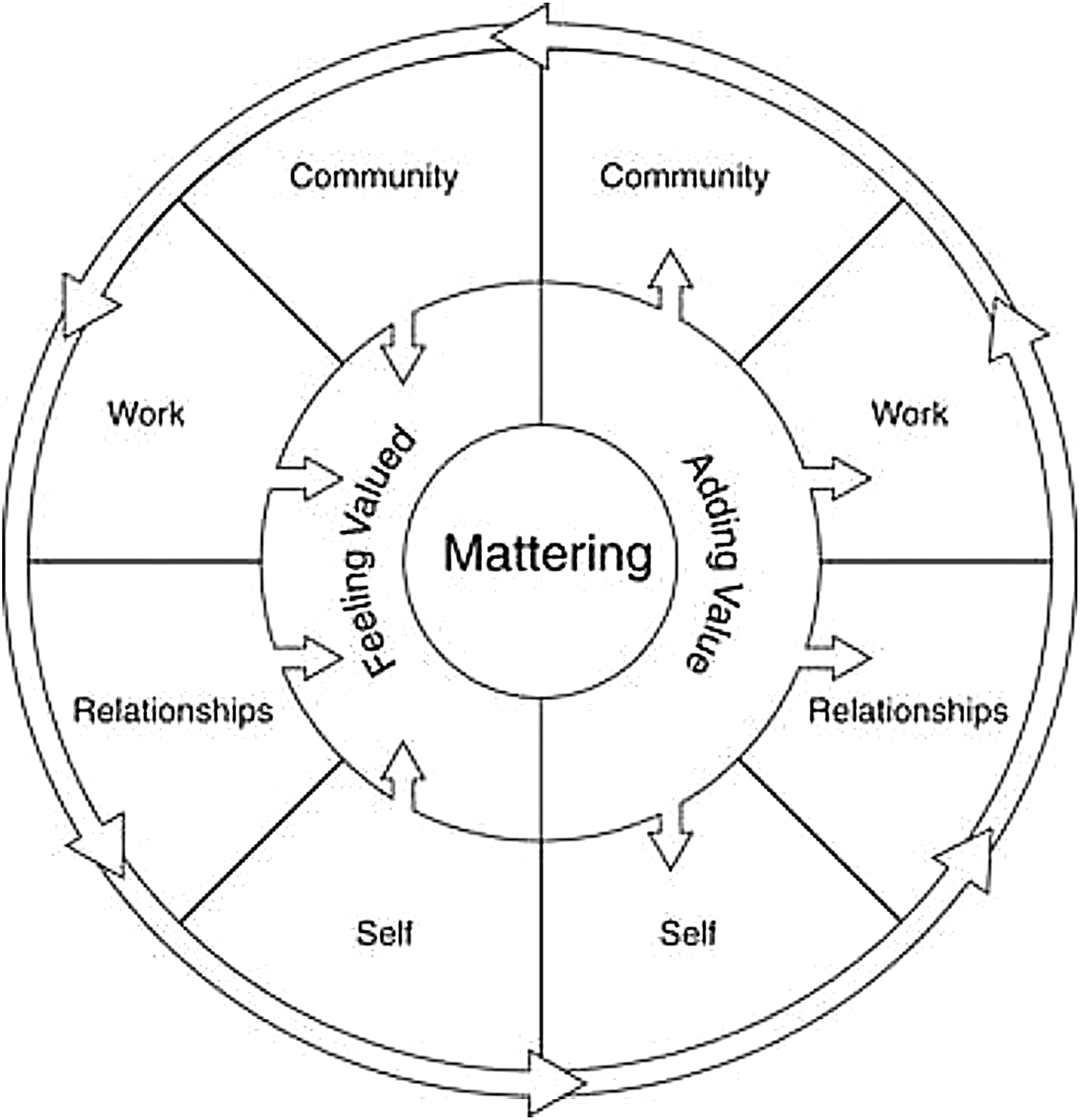
The mattering wheel (Prilleltensky, 2020; Prilleltensky & Prilleltensky, 2021).
Materials and method
This article is one part of a project where the overall goal is to examine the translation, implementation, and experiences of the course (Kvia et al., submitted). In collaboration with researchers from Tranzo Scientific Centre 1 in the Netherlands, the course material (workbook and course leader book) and research material (interview guides) were made available and translated into Norwegian. The group that developed and studied the course was affiliated with Tranzo.
The course consisted of 12 weekly 2-h sessions and followed a strict course manual (Smits & Kusenuh, 1997/2009, 2017a, 2017b). Each session featured a specific theme, covering identity, setting goals, and empowerment, and facilitated different forms of tasks, discussions, and reflections using a workbook (van Gestel-Timmermans et al., 2010). The course manual also outlined a peer course-leader agenda with guidelines on how to be a course leader, while at the same time urging course leaders to use their experiences and personality traits to make decisions along the way.
As stated in the course manual, the course leaders had experienced mental health and/or substance use problems and their role in the course sessions was to participate on the same level as the course attendees. An element of the course method was also to recruit new course leaders among the course attendees. Throughout the project period, slightly over half of those enrolling completed the course (Kvia et al., submitted).
Context
In the Norwegian version, the course title was translated and rephrased to something similar to “Recovery—my process.” We considered the phrase “up to you” implied putting too much disclaiming against individuals with needs. We believe the new title better reflects the current course, as the services have evolved since the 1990s with less individual focus.
The first author was involved in the process of transferring the course from the Netherlands to Norway as part of a public sector PhD scheme. Public PhD is a funding scheme through the Norwegian Research Council. The intention is to prompt employees in the public sector to do research on the organization where they are employed to ensure directly relevant research for the services (Norwegian Research Council, 2024). In this case, the implementation of the course “RiUTY” was planned in the municipality at the time the PhD was in the planning phases, which provided the opportunity for a suitable research project. That included organizing the training of Norwegian course leaders, involvement in the translation of course material and research material, and organizing the course sessions. Through the PhD project, there was a close collaboration with academics outside the municipality in designing the implementation research. The first authors’ research position in the organization and involvement in the progress of the project could contribute to an unintentional positive attitude towards the impact of the course. Based on descriptions from Zulfikar (2014) and Merton (1972), my position is both “insider” and “outsider.” An “insider” as employed in the services, but an “outsider” as researcher and not participating in the course sessions. As an “insider,” employed in the services and familiar with the practice field, my preunderstanding includes a positive attitude toward utilizing peer competence. My preunderstanding also includes an interest in providing a diverse set of interventions since there is no “one-size-fits-all” in helping people with complex issues. The position in the project could also give possible professional benefits both in the research and as employed in the municipality (Stray, 2022). However, the Norwegian welfare services are fully public/governmental which means that there were no direct financial benefits at stake.
The first nine peer course leaders were trained by experienced course leaders from the Netherlands when the course was introduced in Norway in 2017. Five of them moved on as course leaders. Subsequent course leaders were trained by completing the course, assisting as course leaders and then becoming independent course leaders. During the period from the introduction of the course through the training from Dutch course leaders, a total of 20 individuals, including the initial nine, received training to become course leaders. As of the end of 2022, four of them were still active course leaders. Some course leaders moved on to ordinary labor, others relapsed, and some withdrew from being course leaders. Ten courses were completed in the project period from 2017 to 2022.
For the first round of courses, course applicants were recruited in different ways; course leaders asked persons they knew, and some were referred by relevant services. After a few course rounds, information about the course spread both informally and systematically and was available in relevant places (NA/AA meetings, mental health groups, and treatment institutions and community services). Registration for the course was open to everyone, leading to the inclusion of some course attendees who had not previously received any other treatment or follow-up services. The assignment of course applicants was based on a feasibility evaluation by the peer course leaders through an individual conversation (Smits & Kusenuh, 1997/2009, 2017a, 2017b), with a focus on capability and aspiration to participate. The course leaders attempted to form diverse groups regarding background for attending, age, and gender.
Study participants
The 20 study participants can be divided into three groups: course attendees, course leaders with attendee experience, and course leaders without attendee experience (Table 1). Five of the study participants were course leaders from the start (one participated both in a focus group and an individual interview). Seven were course leaders after attending the course first, and eight were course attendees completing the course. All study participants are given fictional names.
The first author presented in person an invitation to participate in the study at eight of the 10 courses, where course attendees and course leaders were requested to make contact if interested. The request was forwarded to course attendees by the course leaders in the two courses where the first author was not present. The requests were followed up through contact with the course leaders via email or phone.
Study participants.
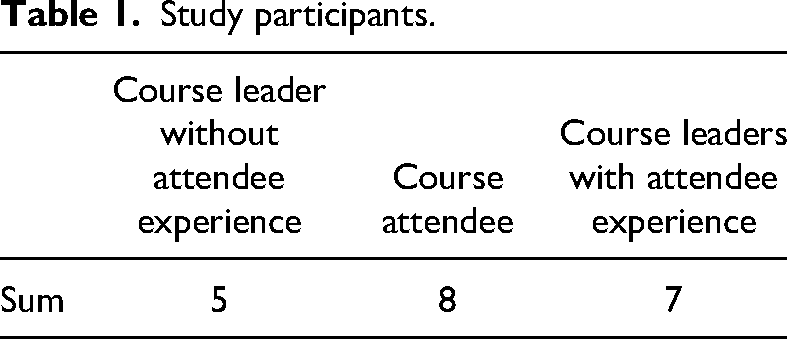
By including course attendees and course leaders with and without course attendee experience, we got encounters from three different positions, the relations between them, and how the roles changed. In total, 16 individual interviews and two group interviews were conducted. The study participants were from their mid-20s to mid-50s and represented a gender balance. The gender aspect could be interesting to research further but was not the scope of this study. The group interviews were conducted with the first group of course leaders by the authors of this article in the start phase of implementing the course (2017), to depict their reflections about the course. Due to Covid-19, we had to conduct the subsequent interviews with course leaders individually. Course attendees were interviewed individually. The main interview guide was the same for course leaders and course attendees, with slight variations in the phrasing and follow-up questions depending on their roles and depending on their answers. The individual interviews were conducted throughout 2020/2021 by the first author and lasted between 20 and 90 min. Three of the individual interviews had to be conducted via phone.
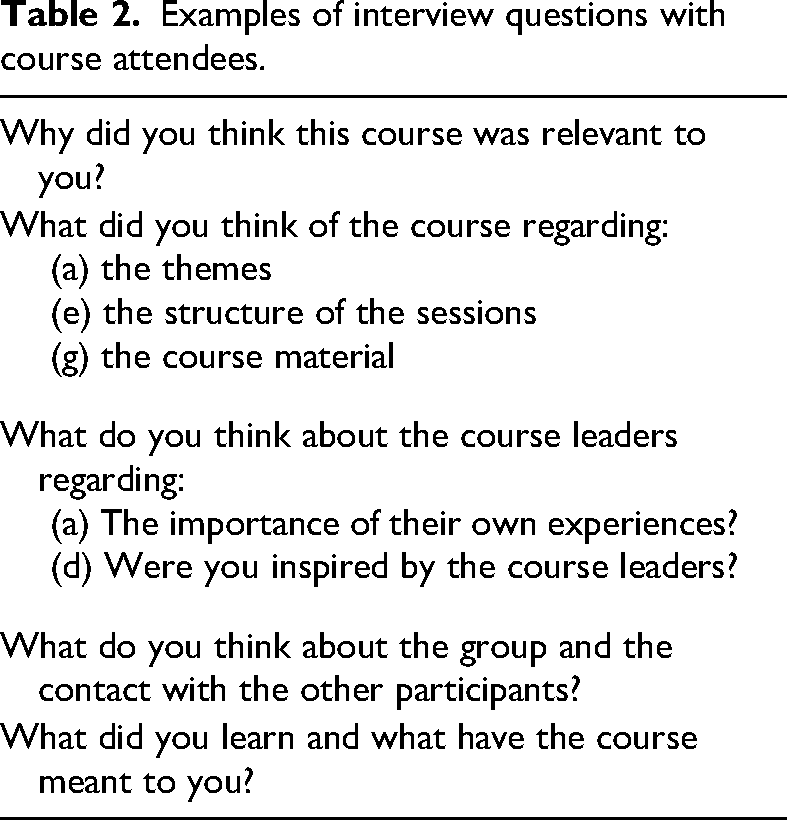
The questions, see Table 2, concentrated on elements of their experiences of the course's relevance, and if so, why. Some of the questions will be further addressed in another article.
Examples of interview questions with course attendees.
Analysis
The interview data were recorded and transcribed verbatim consecutively by the first author using NVivo Version 12, and the recordings were deleted.
The analysis of the data was conducted using Tjora's (2021) stepwise deductive induction (SDI) method consisting of seven steps from raw data to concepts. After collecting data and transcribing the data verbatim, the first author started inductively with the transcribed documents and created empirical close codes. This third step allowed a closeness to the empirical data, avoiding jumping to conclusions. The empirical close codes were then organized into code groups. This fourth step was repeated by all three authors in collaboration until the main themes emerged while conferring the empirical data. Subsequently, we examined empirical findings in light of relevant theories and perspectives, creating a more conceptual understanding (steps 5 and 6). In light of the mattering theory, we then went deductively backwards through the steps, testing the theory against the evolved concepts such as fellowship and mutuality, and the empirical data.
All three authors were involved in drafting and critically revising the article. All authors approve of the content.
Ethics
The project has been recommended by the Norwegian Centre for Research Data (No. 569342). The Regional Committee for Medical and Health Research Ethics concluded that it was outside their mandate. The participants in this project were treated with respect, their rights were ensured, and risks and benefits were assessed in relation to each other according to the Guidelines for Research Ethics in the Social Sciences and the Humanities (The National Research Ethics Committee, 2021). All participants gave oral and written informed consent to participate in the study.
As the participants in this study are participating because of their experiences of mental health and/or substance use problems, there were procedures in place for providing help and support if necessary.
Funding
This project has been funded by the Research Council of Norway and Sandnes Municipality through the “public-sector PhD-Scheme” (OFFPHD).
Results/findings
The participants described participating in the course as a valuable and meaningful experience. The following concepts outline potential mechanisms: (1) “sharing with equals,” experiencing fellowship with like-minded people, and processing shame and accessing hope and (2) being a “step in the process” through rebuilding that framework and preparing for life beyond the course.
Sharing with equals
Through the interviews, the value of sharing experiences with equals was highlighted. The participants expressed sharing as a two-fold process of both sharing themselves and others sharing with them, giving the participants a feeling of being understood by others through acknowledgments and mutuality. The participants described how they were allowed to contribute to each other's process and their mutual understanding. There is much humility in that, I think. To be allowed to and to know that we all do it for each other. It is a very beautiful thing to be allowed to contribute to others’ processes and to let others contribute to yours. There is much humility in that, and love. Kind of unconditional love. (Ingrid, course attendee).
Fellowship with like-minded people
All the study participants emphasized that the fellowship created through sharing experiences with each other was essential. […] that main essence in it, I think is the fellowship with like-minded people. Just that setting has a therapeutic effect like nothing else. (Tristan, course leader) […] it became a very strong connection because we could associate with each other and see parallels. And the feelings are the same no matter which kind of addiction you have, or if you participate with your mental health background. It's not exactly the same, but similar struggles. And we have dealt with it in different ways. (Ingrid, course attendee)
Some participants stated that the reciprocity and mutuality between course leaders and course attendees could not be achieved if professionals (without similar lived experiences) were course leaders. One participant estimated that professionals could understand and be helpful up until 95%, but this course was about the last helpful 5%, that only people with similar lived experiences could provide. Some participants expressed that they would not attend the course if it were held by for example social workers or nurses because of their lack of experience, and that the peer-support meant almost everything. Yes, I think that [peer course leaders] mean almost everything. And it helps that the course leaders have their own experiences of substance use, ruined their lives and things like that. It helps. Because then others can open up, in a way. (Kenneth, course attendee)
For some, the strong and safe group connection established was also a challenge, and one-course leader expressed ambivalence with boundaries when she was contacted outside the course setting.
Processing shame and accessing hope
According to the study participants’ accounts, the fellowship also represented an arena where they could process their feelings of shame.
Many participants described the feeling of living on the outside of society and not fully participating in the community, and the feeling of shame was ingrained in their perception of themselves. This unfavorable view of themselves contributed to the experience of being stuck in negative processes. As course attendee Kim expressed, “[…] what happened to people is, kind of, you … feel shame. And the shame can, kind of, sabotage your protection.”
Casper and Mathilda expressed that over time, feeling shame and negative thoughts about themselves turned into self-inflicted shame and self-hate. Some of what I learned … or became aware of … was that I inflict much more shame on myself than others do. (Mathilda, Course attendee) […] Like … most of us drug users have been … not especially fond of ourselves. And it has become worse and worse, and, in the end, you start to hate yourself […]. (Casper, course attendee)
According to Prilleltensky and Prilleltensky (2021), in the arena of self, such feelings of shame as explained by Mathilda and Casper can hinder the experience of mattering. Flett (2022) describes shame and self-hate as the opposite of mattering, which can escalate feelings of exclusion, devaluation, self-stigma, and generally a marginalized lifestyle. To prevent the escalation of such negative feelings, processing shame through experiencing mattering through adding value and feeling valued seemed to be vital for empowering the participants and spurring their recovery process.
Participants expressed how processes, which we understand as the opposite of devaluing, were happening in the course. The experience of processing shame through sharing experiences contributed to less judgment and thus more room for hope. There is a lot of shame. I felt that I didn’t have to endorse that feeling in the group, because we had something together. Something mutual. There was something there that was harmless, kind of. For me, that was motivating. And gave me hope. (Mathilda, Course attendee)
Several of the participants expressed a feeling of hope from engaging in the course sessions and experiencing a room where they were free from feeling shame. The course sessions, peers, and the mutuality, provided a setting where the shame disappeared and left room for hope to enter instead. I think it simply gives you more hope. It illustrates that there is a future. And that there is help both in the public services and friends, family and people you can talk to. (Jacob, course attendee first, course leader afterwards)
A step in the process
The participants expressed that the “RiUTY” course could potentially be an arena to develop skills and pursue steps in an individual recovery process. The synergy effects of sharing and feeling support from others were expressed through what could be interpreted as increased self-esteem and empowerment to actively improve their situation.
Rebuilding that framework
One metaphor the participants used to describe the process of recovery was “rebuilding” the life and the framework around you. From having been in a position where the framework was dissolving, participants started rebuilding and finding themselves again. Because when a person has trouble in whatever way, you kind of lose the framework around you. The foundation kind of dissolves. If you are lucky, you have some framework and guidelines from childhood. So, rebuilding that framework, and it needs to be solid because it is supposed to hold you, right? (Camilla, course attendee first, course leader afterwards)
In light of Prilleltensky and Prilleltensky (2021), we understand rebuilding the framework as (re)discovering and deciding who you want to be. When experiencing a transition, the potential for feeling vulnerable and marginal increases according to Schlossberg (1989), which is why the safe setting the course promoted is crucial for the rebuilding.
A process such as rebuilding and finding oneself again was a demanding endeavor that took time and required patience. Exercises and tasks in the course were said to contribute, for example through working on setting goals and speaking up for oneself. By having been through the course as both course attendee and course leader for several rounds, Camilla expressed “[…] on each course, I learn a lot. I’m developing myself too. So it's helping towards self-help.”
Although the course leaders had already put much time and effort into their own recovery, they continued to strive for meaning-making through the course and beyond the course setting, as Prilleltensky (2014) demonstrates is relevant for human beings in general.
Preparing for life beyond the course
In line with the procedures, new course leaders were recruited from course attendees through training “on the job” as course leader assistants. The process of taking steps via becoming a course leader was expressed as important by several participants. Finding it challenging, developing, and feeling that their contributions were valued were rewarding experiences for them. As Jacob, a course attendee first, then course leader expressed it, “Since I thought it seemed a bit terrifying, I volunteered. To push myself a bit. Basically, learn about myself.” Tristian, a course leader corroborated through expressing the feeling of acknowledgment “So, I would say, it [the course] is of importance, and to be acknowledged, and given responsibility and seen for having something to contribute with.”
Casper explained that attending the course provided appropriate training, and he got employed as a peer in a nearby service. He described that through the course, he found that it was easier to open up when helping others and that it was really helpful for him to help others. He powerfully expressed that as soon as it was for someone else, there were no limits to what he could do. It's more challenging privately. But at work, I do it to help others, I can say things that I don’t dare to say privately. It is really helpful to help others. It's easier because you’re not doing it for yourself. […] But as soon as I am a caregiver, there are no limits to what I do to help others. There is a barricade that disappears. I may not see the point in opening up if it is just for me. If there is another purpose in opening up it is easier. (Casper, course attendee)
Despite a general acceptance in the services that the competence that peers add was relevant, the need for awareness of how peer competence was utilized was also highlighted. I think that this peer support role, as it has now become in the services, is kind of undefined. It is a bit like; “everyone should have peer support workers because it's so smart.” But how do the services use them? So, I think a course like this, and sessions like this contribute to defining our role. (Arthur, Course leader)
Discussion
The “RiUTY” course is highlighted as a contribution to the recovery process by those who participated and completed it. However, those who did not complete it may have other opinions. The course seems to initiate and support helpful processes. By this, our study supports the significance of peer support, as reported in previous studies (King & Simmons, 2022; Peck et al., 2022; Wall et al., 2022), and directs our attention to the mechanisms at play that prompt peer support. The participants emphasize sharing with their peers as a key factor contributing to the utility of the course. There are accounts describing the core experience of “being allowed to contribute to others” and “to let others contribute to yours,” across roles as course attendee and course leader. In light of Prilleltensky's theory of mattering, which links the essential factors for human thriving and well-being, the dual process of “adding” and “giving” value, it appears that the course is facilitating the potential for these processes to occur. Participants are using strong expressions like “humility” and “unconditional love” to describe their experiences. It appears possible both to address the feeling of shame the participants report and to develop hope for the future processes that are essential when rebuilding lives and being in recovery.
These findings emphasize mattering as an interesting theory of change in the field of recovery from substance use and mental health problems, that points to the potential in facilitating and supporting practices of equality and reciprocity.
Through the lens of mattering, the findings in this study further illuminate the four components of the mattering wheel, self, relationships, work, and community. The results point to how fellowship within the course had a significant impact on self-perception. In turn, the findings underline how the course played a crucial role in fostering a sense of responsibility in one's work and, consequently, led to integration within the community.
We-culture
The results of our study highlight the significance of sharing with equals as an important driver for wanted life changes, regardless of whether their role is course leader or course attendee. In the course sessions, they stand side by side, drawing strength from their authentic understanding of each other's similar experiences, in a fellowship of like-minded people. The importance of reciprocity in fueling the recovery process found in the results of this study also aligns with von Heimburg & Ness, 2021 emphasis on relational welfare, relations as the base for promoting health and well-being.
Our study demonstrates that when people meet others with similar challenges, they experience trust and equality, a sense of fellowship, reciprocity, motivation, and a we-culture occurs (Prilleltensky & Prilleltensky, 2021). However, participants in this study have completed the course which means we can assume they have a positive mindset. Andersen, Waldemar, and Kirkegaard (2023) demonstrated in their study of dropout from Recovery Colleges that people quit because of external, relational, and course-related issues. We can expect similar reasons for dropout from “RiUTY,” which indicates that those individuals did not experience the we-culture, but that remains unknown.
The course in this study are exclusively peer-led, within a community service setting. That differs from many other recovery-oriented approaches within the same setting, where professionals are involved to a larger degree. Stefancic et al. (2019) explored shared experiences between peer specialists and individuals seeking help in peer-delivered services and affirmed the significance of shared understanding. Their findings demonstrated that experiences are not necessarily articulated but implicitly promote trust and understanding. It is relevant to discuss to what extent it was vital for the course attendees that the course was exclusively peer-led. Kirkegaard and Andersen (2022) explained that peers have a genuine understanding of each other's experiences. Participants in this study described how such “equality” could not be achieved in the same way if professionals were directly involved. However, there are examples showing that similar mechanisms can occur in other types of services, where both peers and professionals work together on equal terms in co-creating processes (Eriksen et al., 2013; Selbekk et al., 2023). On the one hand, we can argue, that it is important to provide services that are exclusively peer-led to utilize the potential of peer support. At the same time, it is crucial to explore how the potential in reciprocity and mattering-promoting processes can be brought into play in different situations in broader community settings including different kinds of citizens and professionals. This adds to the suggestion from Ness et al, (2022) of creating social environments where recovery can be supported, such as courses and activities. However, Watson (2017) demonstrates in her review of mechanisms in peer support, that awareness of the role is crucial. Her findings show that peers are more inclined to be emotionally bound and establish strong connections, which can be helpful but also lead to self-blame and too much involvement.
Shame and hope
Our findings illustrate that negative feelings, such as shame, feed into the mattering wheel, especially in the relationship domains, in vicious circles (Prilleltensky & Prilleltensky, 2021). Natland and Celik (2015) associated shame with the term “damaged individual identity” which involves experiences of dehumanization and feelings of unworthiness. Furthermore, Zhu et al. (2020) explained that shame is often hidden and expected to be a private matter. However, our findings demonstrate that the participants could talk about shame in the course groups of like-minded people. The identity (re)formation or rebuilding processes of self and relationships that occur in the course sessions enable participants to shift their self-perception from feeling shame towards feeling hope. This can be conceptualized with Prilleltensky and Prilleltensky's (2021) description of progressing from a vicious cycle to a virtuous cycle in the mattering wheel. By this, our study demonstrates the double edge in mattering, as experiencing mattering can be highly protective, while the experience of not mattering can be detrimental, especially for individuals who have been marginalized (Flett, 2022). Hope is emphasized as a crucial factor in the recovery process (Honey et al., 2023; Leamy et al., 2011; Sælør et al., 2020), and our study underpins the emphasis on hope. The findings are also coherent with the results from a quantitative sub-study investigating the same course in the Norwegian context (Kvia et al., in review). Sælør et al. (2020) showed in their study of professionals in the field of mental health and substance use services, that hope is vital but still receives little attention. Korsbek and Petersen (2016) add that compared to interventions provided by professionals, peer support and sharing with equals can provide a greater sense of hope, in line with other research that underscores the significance of believing that recovery is possible (Sælør & Bank, 2021; Watson, 2017).
Anti-stigma work in mixed groups – Substance use and mental health problems
The course groups consist of people with mixed backgrounds regarding mental health and substance use problems. The findings suggest that the commonalities are more present than the differences, and the participants manage to create a we-culture across substance use and mental health problems. In our study, course attendees embraced mixed groups, contrary to our expectations and initial remarks in the implementation process. This may link to what Watson (2017) explains as powerful mechanisms that counteract the traditional non-disclosure culture and facilitate openness and reciprocity, possibly reducing stigma. Although the services in mental health and substance use fields were developed separately, they share a history of prejudice and discrimination against individuals seeking help, resulting in accounts of hopelessness (Gagne, White, & Anthony, 2007). Experiences of “being unvalued” exist across difficult experiences and people find fellowship through similarities in the experiences of “being unvalued” (Prilleltensky & Prilleltensky, 2021). Furthermore, the fields now also align in their approach to anti-stigma, inclusion, and facilitation of hope, in which peers play a vital role (Gagne et al., 2018).
A step in the process
Our research findings demonstrate that the course can serve as a platform where the peer role effectively showcases its potential by contributing to virtuous cycles. Individuals who offer peer support often find that their lives become more meaningful, and their sense of identity, or self, is reinforced through their role as peers (Holmboe & Seistrup, 2021; Scannell, 2021; Wall et al., 2022). By assuming the role of a course leader, individuals enhance both the work and community elements of the mattering wheel. The position of giving value to others can enhance the experience of mattering for the self (Flett, 2022).
Furthermore, the course serves as a platform for crucial steps in the recovery process. Simply enrolling in the course represents a significant milestone for many and is a step towards increased participation in society. Attending the course can serve as a training area for the work domain of the mattering wheel, offering course attendees the opportunity to progress towards becoming course leaders and, subsequently, acquiring skills and knowledge that extend beyond the course setting. Such a process of progression involves learning and training in adding and giving value, with the potential to assume roles of increased responsibility. As Quinn, Bromage & Rowe, 2020 explain, being useful to others, or adding value to use Prilleltensky's term, can contribute to enhancing mental health, especially when loneliness is a factor.
However, our study does not provide insights into the processes after participating in the course, and we do not have detailed knowledge of potential relapses or decreases in health or other relevant factors. Some of the course leaders have withdrawn because of relapse, and several course attendees left without completing the course (Kvia et al., in review).
Individuals serving as peers within the services can also contribute to promoting a recovery-oriented approach in the services in which they operate (Chisholm & Petrakis, 2023). Additionally, they can enhance the capacity to comprehend the requirements of service users (Akerblom & Ness, 2023), thereby contributing to add value to the societal/community part of the mattering wheel. The course can contribute to the increased recognition of peers in the services through utilizing their competence, lessening the stigma, and contributing in a broader societal manner. However, being a peer employed in the services can be challenging as the role is often vague (Kydland & Biringer, 2022) and experiences of difficulties with boundaries have been reported (Potter, 2021). Our findings demonstrate that the course can be a potentially meaningful task in the peer role.
Conclusion
Potential life-changing processes were facilitated through fellowship and mutuality in the course groups. The peer aspect was especially reported as significant, due to the mutual understanding that provided a feeling of fellowship and mattering through adding value and feeling valued via mutual contributions, which Bahl et al. (2023) concur is generally of importance to people's quality of life. The course is manual-based and uncomplicated to execute, and a possible way for community services to facilitate a we-culture and the reciprocal processes in the mattering wheel (Prilleltensky & Prilleltensky, 2021) by offering the course. Our study adds to the existing research as a relevant intervention to utilize peer support in community services, and can potentially be extracted to other community services, especially in Norway, but also in other countries. Furthermore, our study represents the first research conducted on the course outside the Netherlands. To validate these findings, further investigation into the course's application in other communities and over extended time periods is warranted. The use of the concept of mattering needs more research according to Flett (2022), to which this study is one contribution.
Limitations
Our study represents a limited number of participants within a specific geographical area. Only individuals who successfully completed the course were included in the interviews. The course leaders who participated may feel obligated to “defend” and support the course, potentially influencing a positive attitude towards the course and peer support. There is no documentation in this study on why some people dropped out. Andersen et al. (2023) found in their study of drop out from Recovery College that external drivers, for example, transport, relational drivers such as stigmatization and intimidation, and course-related drivers such as the content were aspects that influenced drop out. It would be reasonable to assume that the same drivers may have influenced drop-out from the course in this study. The participant group in this study, people who struggle with mental health and or substance use is traditionally hard to reach, especially those who dropped out (Bradway et al., 2022), potentially resulting in a lack of critical voices in our data. However, this study aimed to capture the experiences of those who successfully completed the course, and knowledge about drop out could be an interesting topic for further research.
The first author was employed in the municipality that was responsible for the project of introducing the course and involved in administration and practicalities of the transfer. The level of involvement can prompt bias and thus possible influencing the results. However, the involvement in the practicalities of the course arose from the research, not the other way around.
Footnotes
Declaration of conflicting interests
The author(s) declared no potential conflicts of interest with respect to the research, authorship, and/or publication of this article.
Funding
The author(s) disclosed receipt of the following financial support for the research, authorship, and/or publication of this article: This project has been funded by the Research Council of Norway and Sandnes Municipality through the “public-sector PhD-Scheme” (OFFPHD). Norges Forskningsråd (grant number 290727).
