




Abstract
Citizenship is considered intertwined with recovery, and may be a useful perspective for advancing quality of life among marginalised groups. Yet, matters of citizenship among persons with co-occurring substance use and mental health problems are underrepresented both in research and practice.
Keywords
Being included as a citizen with equitable opportunities for participation in the community is important for all members of society. Citizenship may have implications for matters of health and quality of life (Tew et al., 2012). In different societies or communities, some citizens may be included, while others may experience social exclusion and restricted citizenship (Lister, 2007). Citizenship can refer to the relationship between a citizen and the state, as well as the relationship between citizens (Lister, 2007). There are different contending views on citizenship. Normative perspectives argue that accessing or achieving citizenship requires the effort and responsibility of the individual person (Vandekinderen et al., 2012). By contrast, relational and inclusive perspectives emphasise the role of the respective society or community in securing inclusion (Lister, 2007; Vandekinderen et al., 2012). In line with relational and inclusive perspectives, citizenship can refer to a perceived sense of belonging in the community through access to essential rights and resources (Rowe et al., 2001).
In the context of substance use and mental health, numerous accounts of experiences of marginalisation and social exclusion suggest that persons with substance use or mental health problems are not afforded full citizenship (e.g., Blank et al., 2016; Hamer et al., 2014; Mezzina et al., 2006; Rowe et al., 2001; Vervliet et al., 2019). In recent years, there has been an increasing emphasis on the potential relevance of citizenship for recovery, highlighted by scholars in the United States and Canada (e.g., Pelletier et al., 2015; Pelletier et al., 2020; Rowe & Davidson, 2016; Rowe & Pelletier, 2012), and in Europe (e.g., Mezzina et al., 2006; Vandekinderen et al., 2012; Vervliet et al., 2019). It has been suggested that citizenship and recovery are intersecting concepts, and that citizenship may provide a foundation for the recovery process (Pelletier et al., 2015; Rowe & Davidson, 2016). This indicates the particular relevance of assessing and addressing issues of citizenship among persons with substance use and mental health problems. However, citizenship frameworks and perspectives are seldom applied when approaching substance use and mental health problems in research and practice, despite their relevance for the field (Rowe & Davidson, 2016).
While working on a Norwegian research project with emphasis on recovery and related issues among persons with co-occurring substance use and mental health problems (co-occurring problems), we developed an interest in utilising a measure of citizenship. We were unable to identify any existing Norwegian measure on this issue, but became familiar with a relevant measure developed in the United States, namely the Citizenship Measure, developed by Rowe and colleagues (2012). We thus initiated a process of translating this measure of citizenship to Norwegian, in order to be able to measure and address matters of citizenship among persons with co-occurring problems.
Aims
The aims of the study were: To translate and adapt the Citizenship Measure from English to Norwegian. To assess the internal consistency and convergent validity of the Norwegian translation of the Citizenship Measure.
Methods
The Citizenship Measure
To develop a self-report measure of citizenship, Rowe and colleagues (2012) at the Yale Program for Recovery and Community Health used a community-based participatory research approach, based on subjective experiences of what citizenship is and what matters in gaining full citizenship. In the initial stages of the measure development, concept mapping was applied with participants who had experienced different life disruptions, such as homelessness or substance use problems, or no specified life disruption, to develop statements on what citizenship entailed for them (Rowe et al., 2012). Analyses of the statements resulted in the identification of seven domains of citizenship, with 45 items grouped across the following seven domains: “Connectedness” (11 items, e.g., “You are connected to others”), “Government and infrastructure” (four items, e.g., “You would have access to public assistance if needed”), “Caring for others” (four items, e.g., “You take care of family, friends, children, or pets”), “Civil rights” (seven items, e.g., “You have or could have access to adequate housing”), “Legal rights” (five items, e.g., “You have access to adequate healthcare”), “Choice” (nine items, e.g., “Your personal decisions and choices are respected”), and “Participation” (five items, e.g., “You participate in social and recreational activities”). A five-point Likert-scale ranging from 1 (“not at all/never”) to 5 (“very often/always”) was employed. The construct validity and internal consistency of the measure have been tested in a study in the United States with participants with substance use and/or mental health problems (O’Connell et al., 2017). The measure has also been translated to and validated in French, for use in a Canadian context (Pelletier et al., 2015). The measure is considered to be psychometrically sound (O’Connell et al., 2017; Pelletier et al., 2015), to interrelate with measures of recovery (Pelletier et al., 2015), and may have relevance across different countries and contexts.
Translation and adaptation of the Citizenship Measure to a Norwegian context
The first author contacted Rowe to establish a collaboration with the Norwegian research team. To translate and adapt the Citizenship Measure from English to Norwegian, a set of principles with recommendations for the translation and adaptation of measures was used to guide the process (Wild et al., 2005). The steps include forward translation, reconciliation, back translation, and cognitive debriefing (Wild et al., 2005).
Conducting a forward translation entails attempts to translate a measure from its original language into a chosen language (Wild et al., 2005). During the forward translation, a minimum of two independent translations should be developed, preferably by native speakers. It is also paramount that the meanings and conceptual foundations of the key concepts are clarified (Wild et al., 2005). In the current study, three researchers in public health science and mental health nursing, who are native speakers of Norwegian, participated in the forward translation. We spent time independently immersed in the original Citizenship Measure to naively develop an understanding of each item, followed by attempts to translate the meaning and core of each item into Norwegian. In this process, three initial forward translations were produced to ensure accuracy, and reduce any ambiguity and possible biases on the conceptual or item level.
Two reconciliation meetings were arranged after developing the initial forward translations, where the group discussed the three translations, aiming to develop one coherent forward translation (Wild et al., 2005). We sought to identify possible issues, difficulties and disagreements, and decide on which formulations should be kept or modified. At this stage, the three forward translations were merged into one forward translation. Furthermore, a translation of the scale for scoring responses was also developed. Following reconciliation, the final forward translation is back translated into the original language of the measure, in order to check the quality of the translation, and to identify whether different words and phrases require literal or more conceptual adjustments (Wild et al., 2005).
To develop a back translation of the reconciled Norwegian translation, the finalised forward translation was back translated by a professional translation agency. The original English measure was unknown to the back translator. To compare the original measure and the Norwegian Citizenship Measure, the back translation was reviewed. We discussed the back translation with Rowe and a Norwegian researcher on social inclusion among young adults with co-occurring problems (e.g., Semb et al., 2016; Semb et al., 2019) in order to obtain consensus.
Cognitive debriefing allows for the coherence and clarity of a translated measure to be assessed with members of its intended target group (Wild et al., 2005). In this study, cognitive debriefing sessions were carried out with the objective to test, collect feedback on and evaluate how well the Norwegian Citizenship Measure worked with persons with co-occurring problems. The first author arranged a cognitive debriefing session with a representative from a service user organisation, as well as a session with a resident in municipal supported housing. A third cognitive debriefing session was held with researchers, staff and residents in supported housing in a group setting. During these three meetings, copies of the forward translation of the Citizenship Measure were handed out, read individually and then reviewed in tandem. Different aspects of the forward translation were discussed in an unstructured manner, covering the relevance of the items and the measure in its entirety for the target group, the content and wording of different items, and so forth. The intent of these sessions was to openly reflect on and discuss whether the topics and items illuminated in the Citizenship Measure appeared relevant for persons with co-occurring problems in a Norwegian context. The first author made notes of all the feedback provided in the cognitive debriefing sessions. The feedback from the cognitive debriefing was finally reviewed and integrated by the translators, resulting in a final translated and adapted measure. After conducting the study, the research team discussed challenges experienced during the study, in order to inform recommendations for further research and development of the measure. See Table 1 for an excerpt of the forward and back translation procedure.
Illustration of the translation and adaptation of the Citizenship Measure.
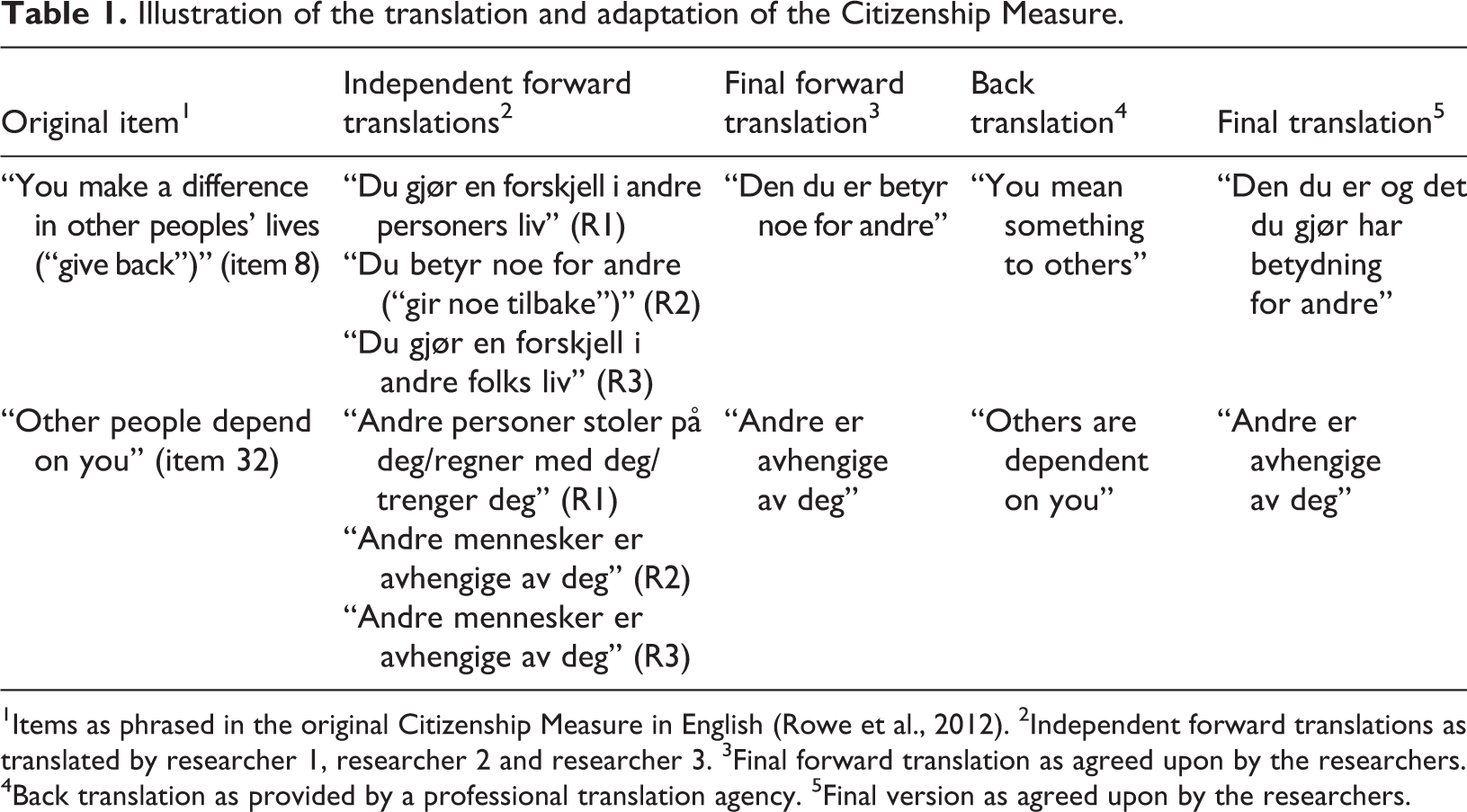
1Items as phrased in the original Citizenship Measure in English (Rowe et al., 2012). 2Independent forward translations as translated by researcher 1, researcher 2 and researcher 3. 3Final forward translation as agreed upon by the researchers. 4Back translation as provided by a professional translation agency. 5Final version as agreed upon by the researchers.
Sample
A convenience sample of 104 persons (76 men, 28 women) with co-occurring problems was recruited in order to assess the measurement properties of the translated Citizenship Measure. The participants were recruited among residents from a total of 21 supported housing sites located across six cities in Norway. The recruited residents all had experience with co-occurring problems, lived at a supported housing site with staff availability, and had rental agreements based on the Norwegian Tenancy Act. Eighty-two of the participants were above the age of 40 years. Eighty-two participants had social security benefits as their main source of income. Seventy-nine participants had resided in their current housing for more than a year, and the most common previous housing situations were residing in one’s own housing, being without stable housing or living in supported housing. For further details, see Nesse et al. (2020).
Statistical analysis
Descriptive statistics with means, standard deviations and 95% confidence intervals were calculated for all single items, as well as for each of the seven citizenship domains. To assess the internal consistency of the domains, we calculated the Cronbach’s alphas for all items within each domain and examined correlations between the seven domains. An exploratory factor analysis (principal component analysis) was conducted to investigate the factor structure and check how the factors in the Norwegian version resembled the structure in the original version. We used varimax rotation, determined the number of factors based on the scree plot, and suppressed factor loadings below 0.4. To assess convergent validity, we examined correlations between the seven citizenship domains with the five domains of a measure of recovery also used in the study, namely the Recovery Assessment Scale – Revised (Biringer & Tjoflåt, 2018; Corrigan et al., 1999; Giffort et al., 1995). The recovery domains were “Personal confidence and hope”, “Willingness to ask for help”, “Goal and success orientation”, “Reliance on others”, and “Not dominated by symptoms”, with responses scored on a five-point Likert-scale from 1 (“strongly disagree”) to 5 (“strongly agree”) (Corrigan et al., 1999). The data were analysed using SPSS, version 26.
Ethical considerations
Study participants received written and verbal information about the study, and signed informed consent prior to participating. Participants were informed that participation was voluntary and that their consent could be withdrawn at any time. The study was notified to and recommended by the Norwegian Centre for Research Data (NSD) (Case No. 54661).
Results
Translation and adaptation
Out of the 45 items in the Citizenship Measure, we had some difficulty translating 15 of the items in a manner that was culturally and linguistically meaningful. In order to resolve the identified issues and to ensure that the translated items were close to the core content and intent of each original item, we contacted Rowe for advice.
In the reconciliation process, a core issue that was addressed concerned the translation of the word “community”. Six items used the term community (e.g., item 6, “You have responsibilities to others in the community”, and item 28, “You can influence your community or local government”), which does not translate directly to Norwegian. In this process we leaned on a discussion of how to translate the word “community” to Norwegian, described in the report Well-being på norsk (Well-being in Norwegian) developed by The Norwegian Directorate of Health (Carlquist, 2015). In this report, Carlquist (2015) suggested that there are two ways of understanding “community” in Norwegian: either as a broad and general relational category, “fellesskap” (“togetherness” or “fellowship”), or as a more narrowly defined entity, “nærmiljø”/“lokalsamfunn” (“local community”/“local society”). According to Rowe, the original Citizenship Measure was developed with an emphasis on the latter definition, and this conceptual foundation was therefore highlighted during the translation and adaptation. As there are several ways to translate community understood as an entity into Norwegian, we reviewed the items to reflect the nuances to be found within the different statements. For some items, words such as “nærmiljø” (“local community”, e.g., item 15) or “lokalmiljø” (“local environment”, e.g., item 33) were thought to be appropriate by the forward translators, while in other items, “lokalsamfunn” (“local society”, e.g., item 30) seemed more fitting. “Local environment” was considered suitable in referring to the most immediate local community, such as the neighbourhood, while “local society” was thought to be more fitting in referring to the wider local community.
Another main challenge encountered in the reconciliation concerned the “double-edged” statements (e.g., item 6, “You have or would be given second chances” and item 23, “You have or could have access to adequate and affordable housing”). Five items were double-edged in the sense of referring both to present as well as past tenses, or to present and future tenses. Furthermore, some items were double-edged in the sense of including more than one object (e.g., item 12, “You have the right to refuse mental or medical healthcare”). Overall, the quest was to find a way to phrase these items so that they had good flow and were meaningful in Norwegian. We also wanted to ensure that the items were straight-forward, as their double-edged nature could involve misunderstandings or complicate the completion of individual items. We attempted to resolve this issue through discussion and through seeking external input, and to revise the items accordingly.
In addition to these two broad categories of challenges, we discussed issues pertaining to particular items. One such issue concerned item 23, which was originally phrased “You have or would have access to adequate and affordable housing”. We found this phrase challenging to translate due to possible discrepancies in what would be considered an adequate or affordable housing situation depending on contextual factors and subjective interpretations. In line with the feedback received when reviewing the translation, we decided to emphasise the person’s access to housing that they deemed suitable for themselves. Another example of issues that were discussed was item 32, “Other people depend on you”. In the discussions, the need to highlight whether others can “count on you” (“regne med deg”) or depend on you (“er avhengige av deg”) was emphasised, as this refers to having the experience of being of value to others, of being needed and depended on.
Furthermore, the relevance of item 40, “You and your family have choices in education”, was discussed, as this item was regarded as potentially less relevant and meaningful in a Norwegian context, where education is public and free for all. In the United States, however, access to opportunities for education may differ more between different groups of citizens. Another issue which may or may not be as relevant in a Norwegian context is item 36, “You have the right to defend yourself and others”. The right to defend oneself is substantially emphasised in the United States, where, for instance, the right to have access to firearms is viewed as important. In Norway, access to firearms is highly regulated and restricted.
We finally worked on adapting the provided examples of services (e.g., item 5, “You would have access to public assistance, if needed (disability, unemployment, natural disaster relief, SSI…)” to better suit the services available and relevant in Norway. We added examples which we assessed were of importance in a Norwegian context, with the target group in mind. Similar adjustments were made for items such as item 8, “You make a difference in other peoples’ lives (give back)”, as giving back is not a commonly used expression in Norwegian. Instead, we emphasised being of importance for others, through one’s actions and ways of being.
The back translation that was produced was highly similar to the original measure, but with certain areas of concern. The back translation was thus reviewed by Rowe. Item 6, “You have been given or would be given second chances” was back translated into “You have been given, or may get, new opportunities”. This interpretation failed to capture the meaning of the item, as it was intended to assess the opportunity to get “second chances” if having made wrong choices or had difficulty dealing with something in the past. However, the Norwegian formulation was considered to reflect the original intent adequately. The same issue arose for item 37, “You have privacy”, which was back translated into “You have a private life”. This back translation referred more to having an “inner life” and being introspective, than to having the privacy and space to withdraw and be alone or with loved ones. However, the Norwegian translation more closely corresponded with the original intent of “privacy”, and the issue was thus considered resolved. Apart from a few items which required discussion before being resolved, the general feedback was that the back translation was in line with the original Citizenship Measure.
In the cognitive debriefing sessions, some participants expressed concern regarding the large number of items. The measure was perceived to be quite comprehensive, and possibly a bit demanding to use with the target group. As such, the utility of developing a short version was discussed. Furthermore, participants expressed concern regarding the so-called double-edged questions, as these were somewhat difficult to interpret. In addition, several group members reported that it could be problematic to include item 16, “You have or would receive fair treatment within the legal system”. The item was understood to refer to previous experiences or the possibility of future encounters with the legal system, and this issue was considered sensitive by participants in the cognitive debriefing sessions.
Despite some concern about the length of the measure, we decided to use the full version of the Citizenship Measure in our study, as it was considered important to illuminate all aspects of citizenship covered in the original measure. Additionally, it was considered important to assess the internal consistency and convergent validity of the full measure in order to allow for cross-cultural comparison. With the feedback regarding the item “You have or would receive fair treatment within the legal system” in mind, we chose to exclude this statement from the questionnaires used in our research project, although it is included in the final version of the measure.
Following this initial study using the Norwegian translation of the Citizenship Measure, we consider our translation of the response scale not optimal due to poor coherence with the wording of specific items. During the data collection for the study, several participants commented on this issue. This seems to be partially due to the translators failing to pick up on a linguistic nuance in the original measure, where the original response scale is formulated so that its options can refer to the extent (e.g., “a lot”) as well as the frequency (“very often”) of an experience. In our translation, however, we translated the response scale so that it merely referred to the frequencies of experiences. Similarly to the original measure, we used translated descriptions for only three of five response categories, in accordance with how the response scale in the original measure was designed (1 = “not at all/never”, 3 = “sometimes” and 5 = “a lot/very often”). However, the lack of labelling for response categories 2 and 4 could cause confusion, potentially resulting in less nuanced reporting. See Table 2 for all original items in English, the Norwegian translations of these items, and the corresponding domains.
The Citizenship Measure in English and Norwegian.*
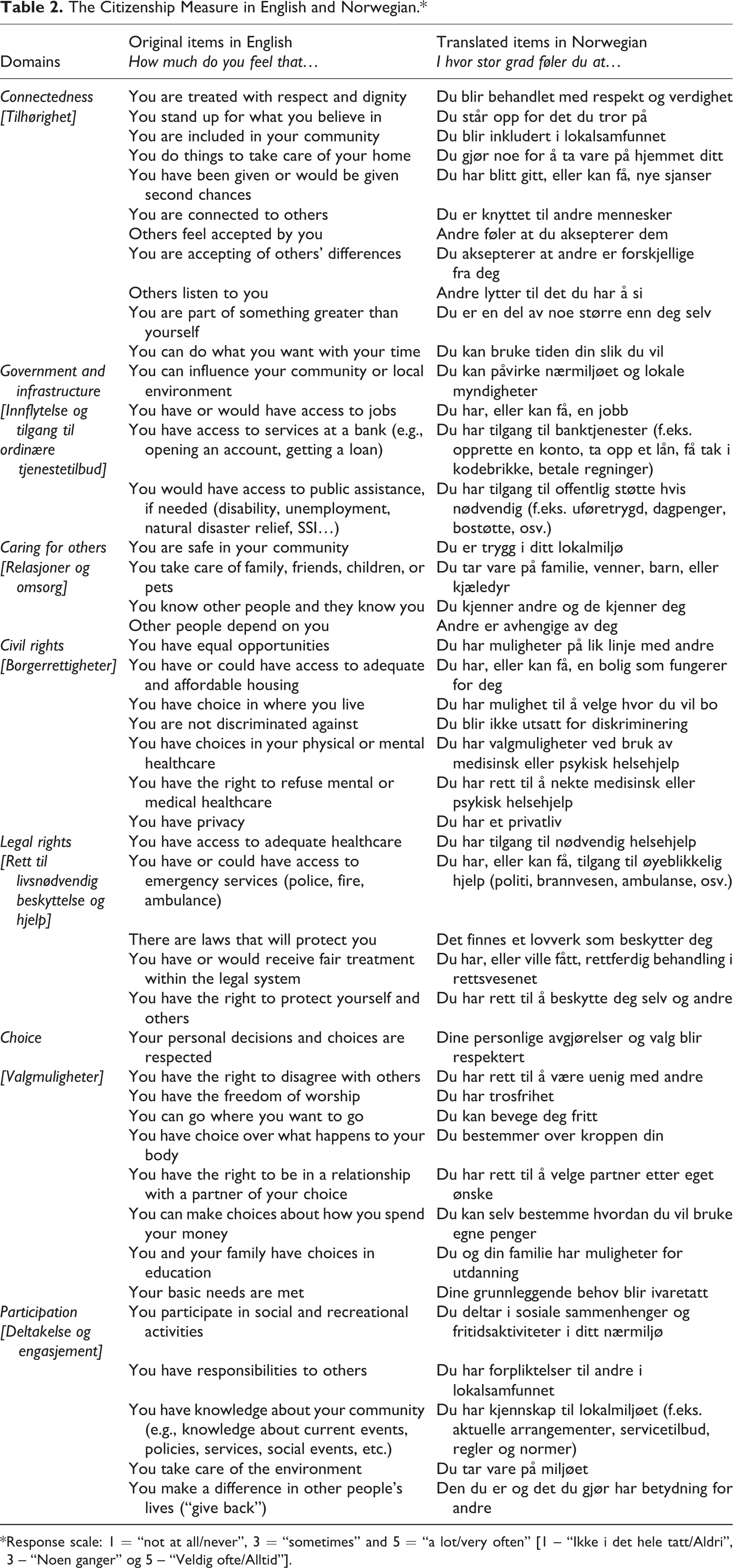
* Response scale: 1 = “not at all/never”, 3 = “sometimes” and 5 = “a lot/very often” [1 – “Ikke i det hele tatt/Aldri”, 3 – “Noen ganger” og 5 – “Veldig ofte/Alltid”].
Measurement properties
The highest scores on the domain level were provided for “Legal rights”, and for “Choice” (see Table 3). The sample of residents in supported housing scored lowest for the domains “Government and infrastructure” and “Civil rights”. The internal consistency for the entire measure was high (α = 0.94). The internal consistencies for the different domains were the following: “Connectedness” (α = 0.83), “Government and infrastructure” (α = 0.57), “Caring for others” (α = 0.63), “Civil rights” (α = 0.74), “Legal rights” (α = 0.64), “Choice” (α = 0.84), and “Participation” (α = 0.75). Furthermore, all citizenship domains were significantly positively correlated (see Table 4). The strongest correlations were found between “Connectedness”, “Civil rights”, “Legal rights” and “Choice”.
Descriptive statistics of Citizenship Measure1 * scores among residents with co-occurring problems (N = 104).
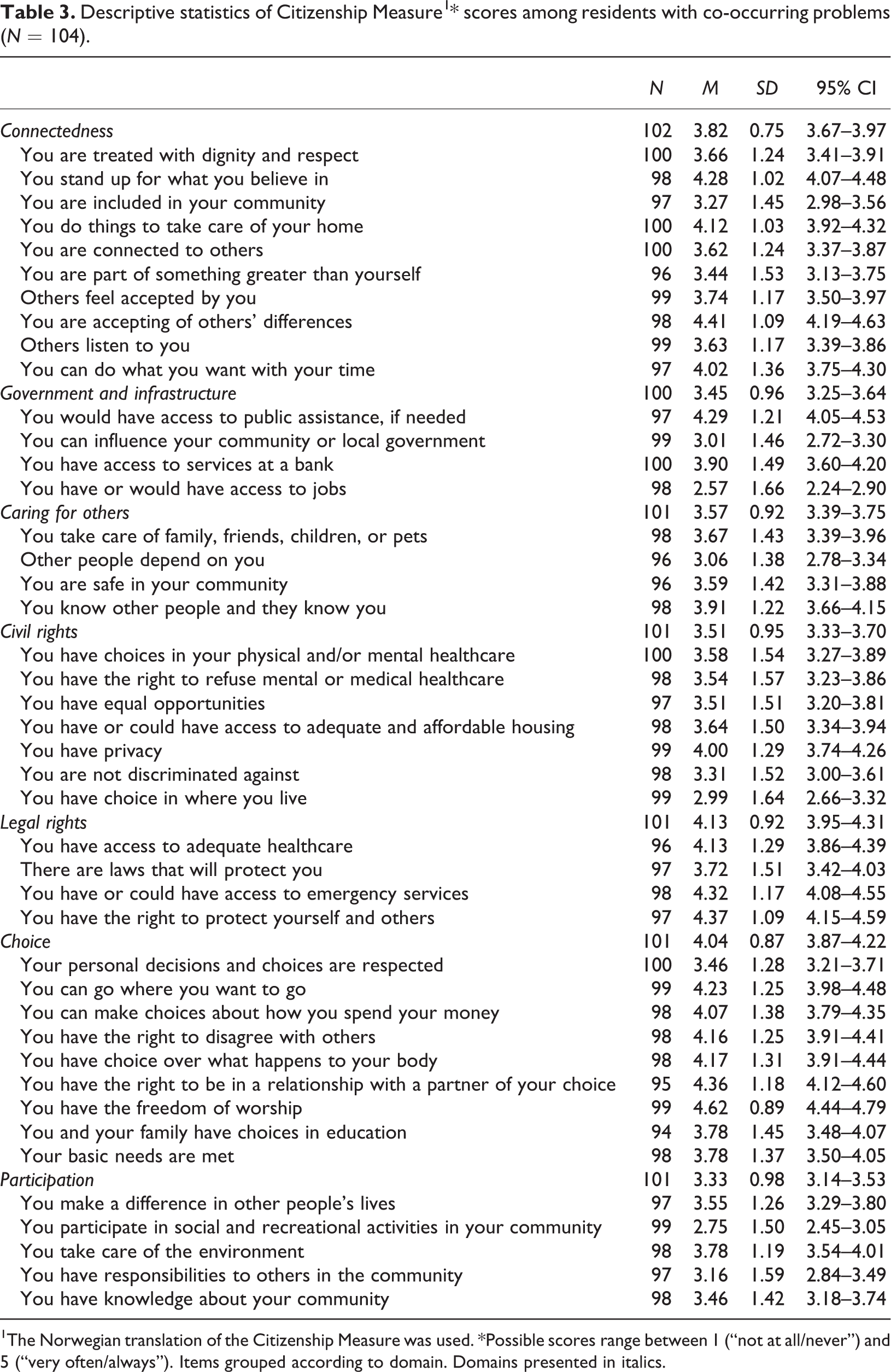
1The Norwegian translation of the Citizenship Measure was used. *Possible scores range between 1 (“not at all/never”) and 5 (“very often/always”). Items grouped according to domain. Domains presented in italics.
Correlations between citizenship and recovery domains among residents with co-occurring problems (N = 104).
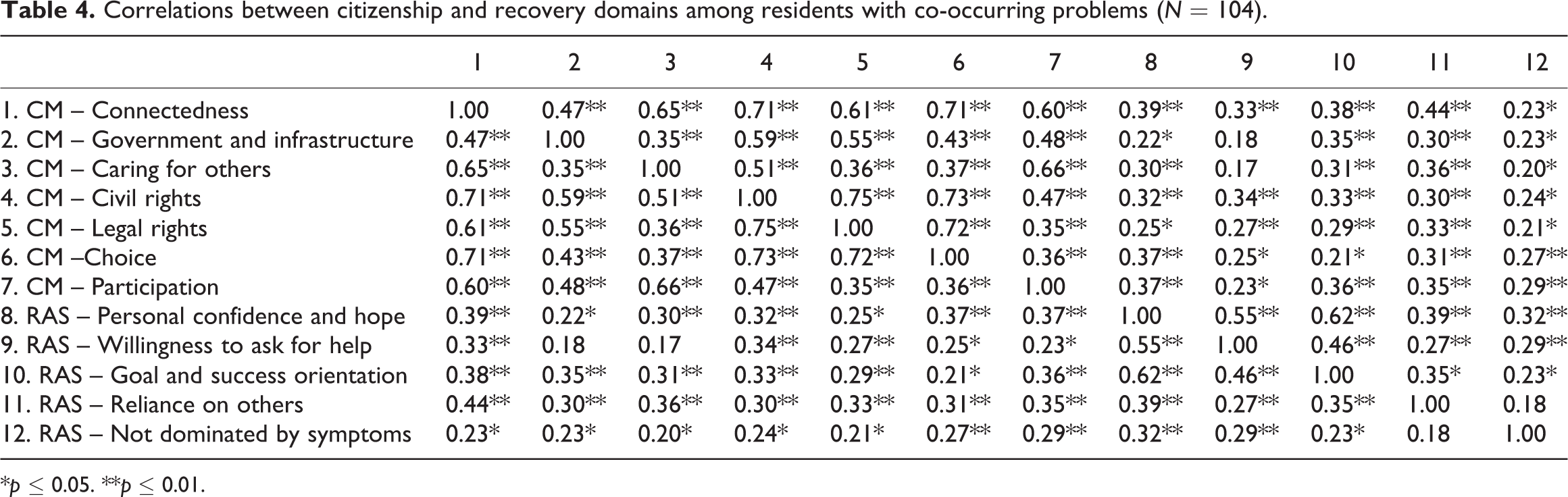
*p ≤ 0.05. **p ≤ 0.01.
The principal component analysis revealed two factors. A total of 18 items loaded on the first factor, which explained 31.5% of the variance, with factor loadings between 0.30 and 0.81. These were items 3, 4, 7, 10, 12, 18, 19, 21, 23, 25, 27, 29, 31, 33, 36, 37, 39 and 41, primarily from the original domains “Civil rights”, “Legal rights” and “Choice”. In total, 10 items loaded on the second factor, explaining 8.8% of the variance, with factor loadings between 0.41 and 0.77. These were items 2, 8, 17, 22, 24, 27, 32, 33, 35, and 38, mainly from the original domains “Connectedness”, “Caring for others” and “Participation”. Two items, “You are treated with respect and dignity” (item 27) and “You are safe in your community” (item 33), loaded on both factors. The remaining 16 items did not load on any of the two extracted factors.
As for the convergent validity of the measure, the different domains of the Citizenship Measure were significantly positively correlated with the majority of the domains in the Recovery Assessment Scale – Revised (see Table 4). The exceptions were the lack of significant correlations between the citizenship domains “Government and infrastructure” and “Caring for others”, and the recovery domain “Willingness to ask for help”. The strongest correlations were found between the citizenship domains “Connectedness”, “Choice” and “Participation”, and the recovery domains “Personal confidence and hope”, “Goal and success orientation” and “Reliance on others”.
Discussion
The scores on the domain level indicate that persons with co-occurring problems in Norway to a higher degree experience that their legal rights and opportunities to make choices are secured, despite more limited possibilities for exercising civil rights, influencing local political processes and accessing infrastructure. Furthermore, as the correlations between domains show, civil rights, legal rights, connectedness and choice appear to be particularly important aspects of citizenship. The particular value of connectedness and choice has been highlighted in recent research (Ogundipe et al., 2020), thus suggesting that these issues are central aspects of citizenship within the target group. The scores for each respective domain largely correspond to the scores found in a study from the United States, with slightly higher scores in the present study, except for in regard to civil rights and participation, where the Norwegian sample scores lower (O’Connell et al., 2017). This may partially be due to contextual differences between Norway and the United States in terms of access to rights and resources (Pettersen & Nesse, 2020). In some respects the Norwegian welfare state may more readily provide its citizens with essential rights and resources, such as access to public support and healthcare, while in other respects, citizens in the United States may be better supported, for instance through a greater emphasis on involvement in the local community and voluntary organisations (Pettersen & Nesse, 2020). Overall, however, the citizenship framework developed by Rowe and colleagues (2012) appears transferrable to a Norwegian context, albeit with some limitations.
The high internal consistency between citizenship domains, and the correlations between different domains, suggest that the Norwegian translation of the Citizenship Measure is reliable. The Cronbach’s alphas for the Norwegian measure correspond with those reported for the original measure by O’Connell et al. (2017), and can be considered adequate (Pallant, 2013). The high overall alpha level, however, suggests that the number of items may be reduced without compromising the integrity of the measure (Pallant, 2013). In this study, we only detected two factors while performing the factor analysis (Abdi & Williams, 2010). The first factor largely consisted of items derived from the original domains concerning civil rights, legal rights and choice. The second factor primarily consisted of items from the original domains regarding connectedness, caring for others and participation. The two factors appear to tap into two different aspects of citizenship: citizenship as access to rights and resources, on the one hand, and as social and relational, on the other. In contrast, the original Citizenship Measure consists of seven domains (O’Connell et al., 2017), and the French translation of the Citizenship Measure, employed in Canada, allowed for the extraction of five factors (Pelletier et al., 2015). There are multiple plausible reasons for this difference. Persons with co-occurring problems in Norway who are assigned to municipal supported housing experience significant health challenges and impoverished living conditions (Norwegian Ministries, 2014). As such, there may be less nuance in response patterns for this group in regard to questions measuring citizenship than would be the case for other populations. Alternatively, perhaps citizenship is understood somewhat differently in a Norwegian context, thus resulting in a different factor structure. It may also be that the full 45-item measure is experienced as too comprehensive, resulting in the tendency to provide similar responses across different domains. Finally, the formatting of the scale used in this initial study with the Norwegian translated Citizenship Measure may have been a contributor to the lack of nuance in response patterns.
Given the identification of the two factors and the high Cronbach’s alpha for the measure in its entirety, it is possible that it would be beneficial to simplify and adapt the measure in Norwegian into a short version consisting of fewer items. This has been done in a study on the experiences of supporting citizenship among practitioners in community services in the United States, resulting in a 12-item brief version (Ponce et al., 2016). It may be useful to use a brief version in clinical settings. The measure in full may, however, work well as an initial self- or other-administered assessment of citizenship. If seeking to develop a short version, this should be done in dialogue with the creators of the original measure (Rowe et al., 2012). The present study indicates that two dimensions are of particular importance in this regard; namely formal citizenship, including rights, resources and the opportunity to choose, as well as relational citizenship, through connectedness, relationships and participation.
The positive correlations between the different citizenship domains and the domains of the Recovery Assessment Scale – Revised (Biringer & Tjoflåt, 2018; Corrigan et al., 1999; Giffort et al., 1995) support the assumption that citizenship and recovery are interrelated constructs, with citizenship being a possible basis for recovery (Pelletier et al., 2015; Rowe & Davidson, 2016). The relationship between citizenship and recovery has been referred to as “recovering citizenship” (Rowe & Davidson, 2016) and “civic-recovery” (Pelletier et al., 2015). The strength of the correlations overall, however, indicates that citizenship is somewhat different from recovery, thus demonstrating the convergent validity of the measure (Strauss & Smith, 2009). The relationships between the citizenship domains concerning connectedness, choice and participation, and the recovery issues of personal confidence and hope, goal and success orientation, and reliance on others, were the strongest in this study. It may be that the aspects of citizenship that pertain to autonomy and relationships with others are especially important in regard to personal recovery (Tew et al., 2012). More socially oriented measures of recovery may be more intertwined with citizenship.
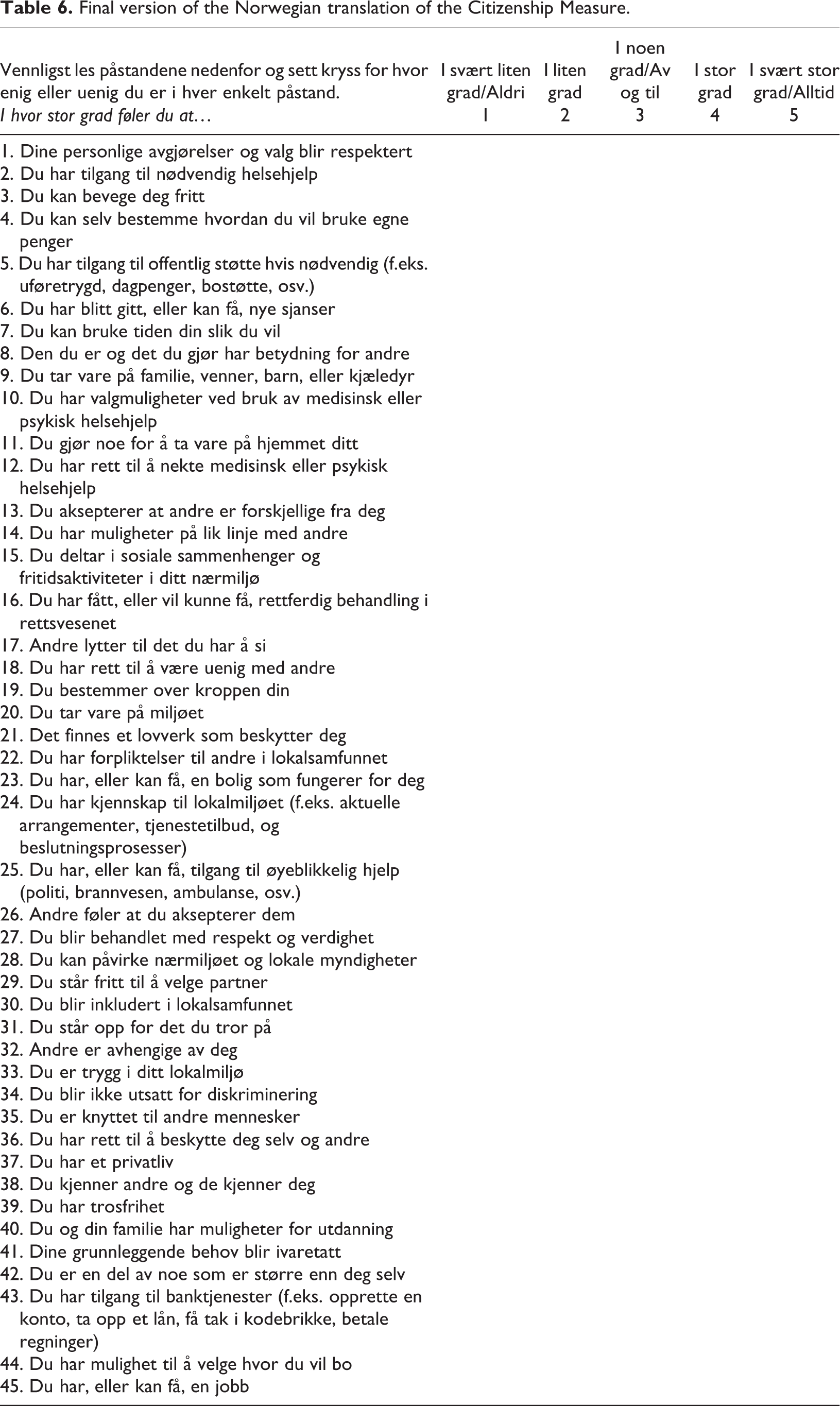
We recommend that researchers or practitioners who want to use the Norwegian translation, or develop it further, stay mindful of linguistic and cultural nuances. Concepts such as “community” require careful consideration in order to secure accurate representation. Moreover, some items and issues may be less applicable to the Norwegian context. Below we provide an overview of the items grouped by domain (see Table 5), and the outline of a proposed final version of the Norwegian translation of the Citizenship Measure (see Table 6).
Overview of items grouped according to domain.*
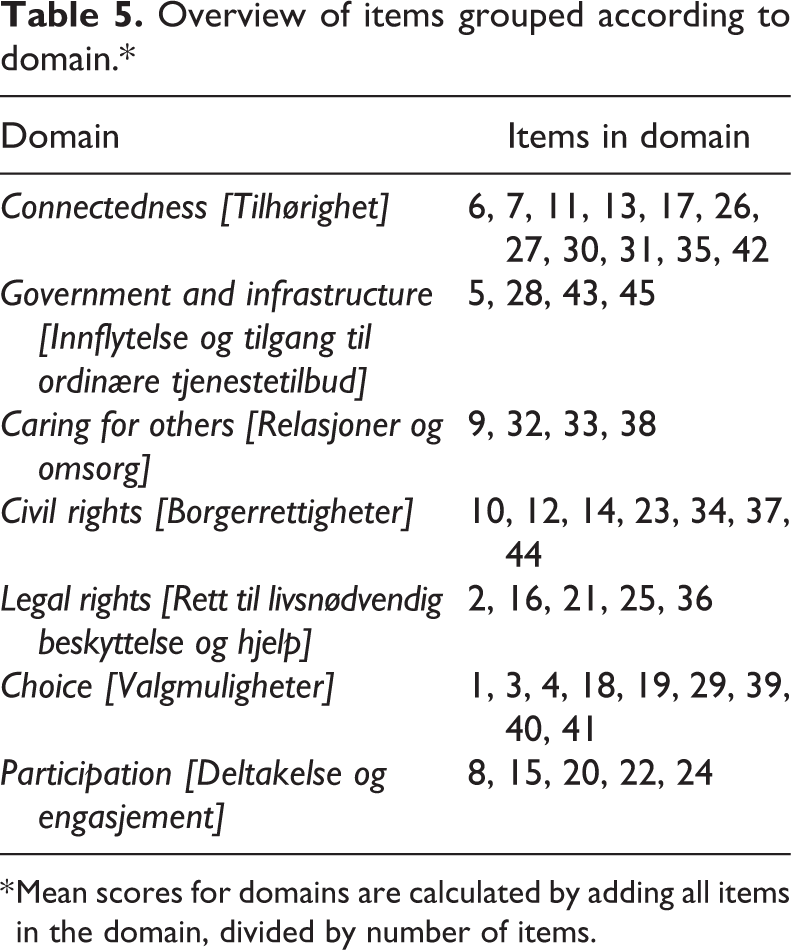
* Mean scores for domains are calculated by adding all items in the domain, divided by number of items.
Final version of the Norwegian translation of the Citizenship Measure.
Conclusions and implications for practice and further research
The Norwegian translation of the Citizenship Measure displays adequate internal consistency and convergent validity. It can be a useful tool in assessing citizenship among persons with co-occurring problems, and can be used to implement efforts to strengthen citizenship in this target group. It may, however, be useful to develop a short version of the measure using item-reduction techniques, while ensuring that the most culturally relevant domains of citizenship are covered. In the context of co-occurring problems in Norway, rights and resources may be of particular relevance, along with relational citizenship. Further research should evaluate the psychometric properties of the Norwegian translated measure with other target groups in the landscape of substance use and mental health. Assessments of the test–retest reliability of the measure would also be key. To further assess its convergent validity, future studies should examine the relationship between the Citizenship Measure and other measures of related constructs, such as social recovery and recovery capital.
Footnotes
Acknowledgments
This article stems from the research project “From double trouble to dual recovery: Increasing recovery-oriented rehabilitation and quality of life through collaborative partnership”. The project is funded by the Research Council of Norway from 2018 to 2021 (Project No. 269858). It is based at the Center for Mental Health and Substance Abuse, University of South-Eastern Norway (USN), in collaboration with the Norwegian University of Life Sciences (NMBU), and staff and users of the Mental Health and Substance Abuse Services of the Municipality of Oslo serving Grünerløkka district. We thank participants and staff members at all study sites and the participants in the cognitive debriefing sessions for their contributions. We are grateful to Randi Semb for her input during the translation process, and to Geir Aamodt for his assistance with the statistical analyses.
Declaration of conflicting interests
The authors declared no potential conflicts of interest with respect to the research, authorship, and/or publication of this article.
Funding
The authors disclosed receipt of the following financial support for the research, authorship, and/or publication of this article: This article stems from the research project “From double trouble to dual recovery: Increasing recovery-oriented rehabilitation and quality of life through collaborative partnership”. The project is funded by the Research Council of Norway from 2018 to 2021 (Project No. 269858).
