




Abstract
Cline and Fay (1990) introduced the term helicopter parenting (HP) to describe parents’ overinvolvement in their children’s lives, especially when their children are college aged (LeMoyne & Buchanan, 2011). This type of parenting includes an inappropriate level of involvement in children’s lives and general assistance given to children that could hinder the children’s physical and psychological development (Segrin et al., 2015), restrict their ability to develop an adequate sense of independence, self-sufficiency, and resilience in the face of challenges (Grolnick & Seal, 2008), and decrease self-efficacy for learning (Ganaprakasam et al., 2018). Moreover, it has been shown that mothers show a higher level of HP than fathers (Pistella et al., 2020; Schiffrin et al., 2019; van Ingen et al., 2015). Helicopter parenting can also influence young adults’ choices regarding alcohol, drug abuse, and sexual relationships (Hofer & Moore, 2011). A recent work by Srivastav and Mathur (2020) highlights how HP can have serious implications for mental health in terms of negative consequences on the psychological, cognitive and behavioural development of both children and adolescents.
Moreover, alcohol use and abuse is a widespread problem and major risk factor for death and disability among adolescents (Mokdad et al., 2016; Sharmin et al., 2017). While research has demonstrated that the influence of peers plays a central role during adolescence (van Ingen et al., 2015), some dimensions of parenting have also been associated with at-risk behaviours during this developmental stage (Marshall, 2014; Montgomery et al., 2008; van Ingen et al., 2015; Windle et al., 2008). In particular, research has underscored that both an excessively intrusive and overinvolved parental style (Jackson, 2002; Roche et al., 2011) and a lenient parental style (characterised by, e.g., low parental monitoring and greater permissiveness of children’s alcohol use) are associated with adolescents’ higher likelihood of alcohol use and abuse (Becoña et al., 2013; Laghi et al., 2009; Sharmin et al., 2017).
The literature on parental monitoring (i.e., close supervision of children’s friends and activities) demonstrates that this behaviour is consistently linked to alcohol use among adolescents, with higher levels of monitoring protecting against alcohol use and lower levels of monitoring elevating use (Blustein et al., 2015; Habib at al., 2010; Jackson & Schulenberg, 2013; Stice et al., 1993). The relation between HP and alcohol use seems more complex than the association between parental monitoring and alcohol use, as no studies have found a direct effect of HP on alcohol use in young adults (Moilanen & Manuel, 2019). In Cui et al.’s (2019) study of college women, for instance, no associations were found between alcohol use and either paternal or maternal HP. Similarly, Nelson et al. (2015) found no association between maternal or paternal HP and at-risk behaviours. One possible explanation for the lack of (or non-significant) relation between these variables could be that the relation between them is non-linear.
The current study
Drawing on our knowledge of parental monitoring, it could reasonably be hypothesised that lower levels of HP may be associated with higher levels of alcohol use in adolescents. At the same time, it could be hypothesised that higher levels of HP might increase adolescents’ alcohol use, as prior research has found that, when parents gain information about their children using invasive monitoring methods (e.g., coercion), adolescents demonstrate increased aggression and at-risk behaviours (Pettit et al., 2001; Soenens et al., 2006). Again, the literature shows that parenting characterised by overinvolvement/overprotection is associated with alcohol use and abuse in adolescents (Moilanen & Manuel, 2019; Volk et al., 1989).
Research has also considered other socio-demographic and personal characteristics that may be associated with alcohol use and abuse. For example, Hughes et al. (2016) found a gender difference, with males demonstrating higher rates of alcohol use and abuse than females due to socially constructed roles, responsibilities, attitudes, behavioural norms, and relative power (Laghi et al., 2009). Research has also shown that countries or cultures with the greatest disparity in gender roles have the largest differences in alcohol use between genders (Wilsnack et al., 2000).
In addition, the transitions into and out of adolescence represent times of significant social and emotional change, during which the transitioning adolescents may use a variety of substances. For example, early adolescence is often a time of substance experimentation, and it is common and acceptable for older adolescents to use and abuse substances – especially alcohol (Alati et al., 2014; Jackson, 2002; Musher-Eizenman et al., 2003). Even socio-economic status (SES) has been found to be a key variable in predicting alcohol use in adolescence: studies have shown that people with higher SES tend to drink more frequently, while those with lower SES tend to drink larger amounts (Arellano et al., 1998; Huckle et al., 2010). Finally, religious involvement has been demonstrated to be inversely associated with risky substance-related behaviours (Hodge et al., 2001; Ritt-Olson et al., 2004) and with alcohol use among adolescents (Walker et al., 2007).
To our knowledge, no previous studies have investigated the non-linear relationship between HP and alcohol use. Thus, in line with the empirical research described above, the aim of the current study was to explore the relationship between HP and alcohol use in a sample of Italian adolescents. In particular, in line with previous research on parental monitoring and alcohol use (Blustein et al., 2015; Habib at al., 2010; Jackson & Schulenberg, 2013; Stice et al., 1993), we hypothesised that the lack of significant correlations between HP and alcohol use in the literature might be explained by a non-linear relation, such as a quadratic or an exponential relation. Therefore, we also aimed to contribute to our understanding of adolescent alcohol use by identifying demographic and social factors that might decrease or increase adolescents’ risk of alcohol use, such as gender, age, SES, and religiosity.
Method
Participants and procedure
Data were collected from 402 Italian adolescents, including 169 males (42%) and 233 females (58%). Participants’ ages ranged from 14 to 19 years (M males = 17.17, SD = 1.67; M females = 17.22, SD = 1.67). Males and females did not differ significantly in age, t(400) = –0.28, p = 0.78. Almost 2% of male adolescents and 4% of female youth reported a below-average SES, whereas 50% and 48% reported an average SES (see Table 1 for descriptive statistics).
Descriptive statistics.
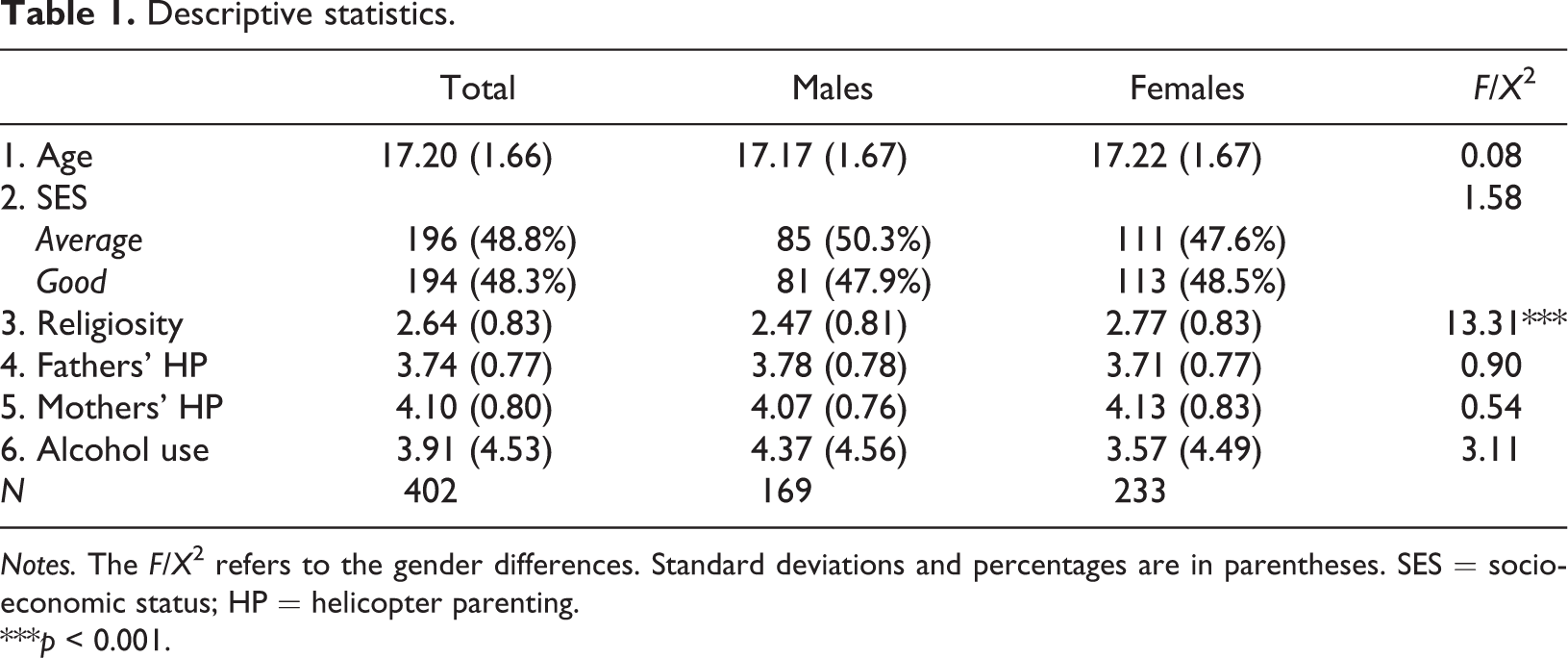
Notes. The F/X 2 refers to the gender differences. Standard deviations and percentages are in parentheses. SES = socio-economic status; HP = helicopter parenting.
***p < 0.001.
Participants were recruited through self-administered computer-based questionnaires and were approached using the snowballing technique. Specifically, participants were recruited using advertising and direct contacts, and they were asked to identify other potential recruits. To join the study, participants were required to be adolescents (aged 14–19 years), to have both parents still alive, and to be Italian citizens. Participation in the study was voluntary and anonymous, and all respondents answered the same questionnaire on an individual basis. Participation was obtained through an informed consent procedure that required written consent from participants and their parents. A total of 97% of the distributed questionnaires were completely filled in. The research protocol was reviewed and approved by the Ethics Commission of the Department of Developmental and Social Psychology, Sapienza University of Rome, Italy.
Instruments
Identifying information
Participants completed an identifying form to provide socio-demographic data relating to gender (0 = male, 1 = female), age, and SES (0 = poor, 2 = good). Religious involvement was measured in response to the questions: (a) “How important is religion for you?” (b) Have you received a religious education?” and (c) “How much do you try to stick to the precepts of your religion?” Participants indicated their response to each item using a five-point Likert scale ranging from 1 (not at all) to 5 (very much). A mean score of all items relating to religious involvement was calculated, with higher scores indicating greater levels of religiosity. Cronbach’s alpha was 0.84.
Helicopter parenting
The Helicopter Parenting Instrument (HPI; Odenweller et al., 2014; Italian validation by Pistella et al., 2020) is a 15-item scale used to measure subjects’ perception of parental involvement. Example items include: “My parent supervised my every move growing up” and “My parent often stepped in to solve life problems for me”. Responses are provided on a Likert scale ranging from 1 (completely disagree) to 7 (completely agree). Results are calculated in a single dimension, with higher scores indicating higher levels of HP. In the current study, each participant completed this scale twice – once per parent. Cronbach’s alpha was 0.70 for mothers and 0.68 for fathers. Confirmatory factor analysis (CFA) showed that the one-factor model presented a reasonably high goodness of fit for maternal HP (χ2 [14] = 38.09, p < 0.001; SRMR = 0.04; RMSEA = 0.06 [90% CI 0.04, 0.09]; CFI = 0.97; NNFI = 0.96) and paternal HP (χ2 [14] = 57.85, p < 0.001; SRMR = 0.05; RMSEA = 0.08 [90% CI 0.06, 0.11]; CFI = 0.93; NNFI = 0.90).
Alcohol use
The Alcohol Use Disorders Identification Test (AUDIT; Hodgson & Alwyn, 2002) was used to identify participants at risk of alcohol use. The scale’s 10 items are divided into three categories: (a) three items that investigate the risk of alcohol use (i.e., “How many alcoholic drinks do you usually consume in one day?”; (b) three items that relate to addictive symptoms (i.e., “During the past year, how many times have you felt the need to drink a drink in the morning after an evening of high alcohol use?”); and (c) four items concerning the use of alcohol in harmful quantities (i.e., “How many times over the past year did you feel guilty or did you feel remorse for drinking too much?”). A total score lower than 8 indicates “no alcohol problem”; a total score between 8 and 11 indicates “alcohol abuse behaviour”; and a total score higher than 11 indicates “alcohol addiction”. In line with previous research (Hodgson et al., 2002), the current study calculated the results in a single dimension, with higher scores indicating higher alcohol use. Cronbach’s alpha for this measure was 0.83.
Data analysis
Data were analysed using the Statistical Package for the Social Sciences (SPSS), version 25, and LISREL 8.8. CFA was performed to determine whether the HPI items measured subjects’ perception of parent involvement. A t-test for paired samples was used to compare fathers’ and mothers’ mean HP. In addition, a hierarchical multiple regression model was used to test the relationship between HP and alcohol use. First, correlation analyses were performed to identify associations between HP and alcohol use. Again, to examine whether a significant linear effect was present, a multiple regression analysis on alcohol use was conducted, using HP as a predictor. Finally, quadratic and exponential models were tested using hierarchical multiple regression analyses, adding to the previous linear regression model the interaction term between fathers’ and mothers’ HP (Step 2) and the quadratic or exponential factors of fathers’ HP (Step 3) and mothers’ HP (Step 4).
All continuous variables were standardised prior to analysis. The model included covariates to adjust for potential confounding by gender, age, SES, and religiosity, because the aim of the study was to examine the effect of HP on alcohol use, regardless of the effects of these variables. Additionally, the sample size was adequate for the regression analysis; exceeding the most conservative recommendation of 30 participants per independent variable (Porte, 2010).
Results
Correlational analyses showed a non-significant association between alcohol use and mothers’ HP and a significant correlation with fathers’ HP; the effect size of both correlations was low (–0.05 and –0.12, respectively). Significant associations were found between alcohol use and age, r = –0.30, p < 0.001, and between alcohol use and religiosity, r = –0.23, p < 0.001, suggesting that older age and greater religiosity were associated with lower levels of alcohol use. As expected, a positive correlation was found between fathers’ and mothers’ HP, r = 0.61, p < 0.001. However, a paired t-test showed a statistically significant difference between mothers’ and fathers’ HP. In particular, mothers were perceived as demonstrating significantly more HP than fathers, t(401) = 10.59, p < 0.001. Given this difference and because the literature reports that the influence of mothers on child development tends to be higher than that of fathers, these variables were considered separately, and no single HP measure was created (Table 2).
Correlations among variables.
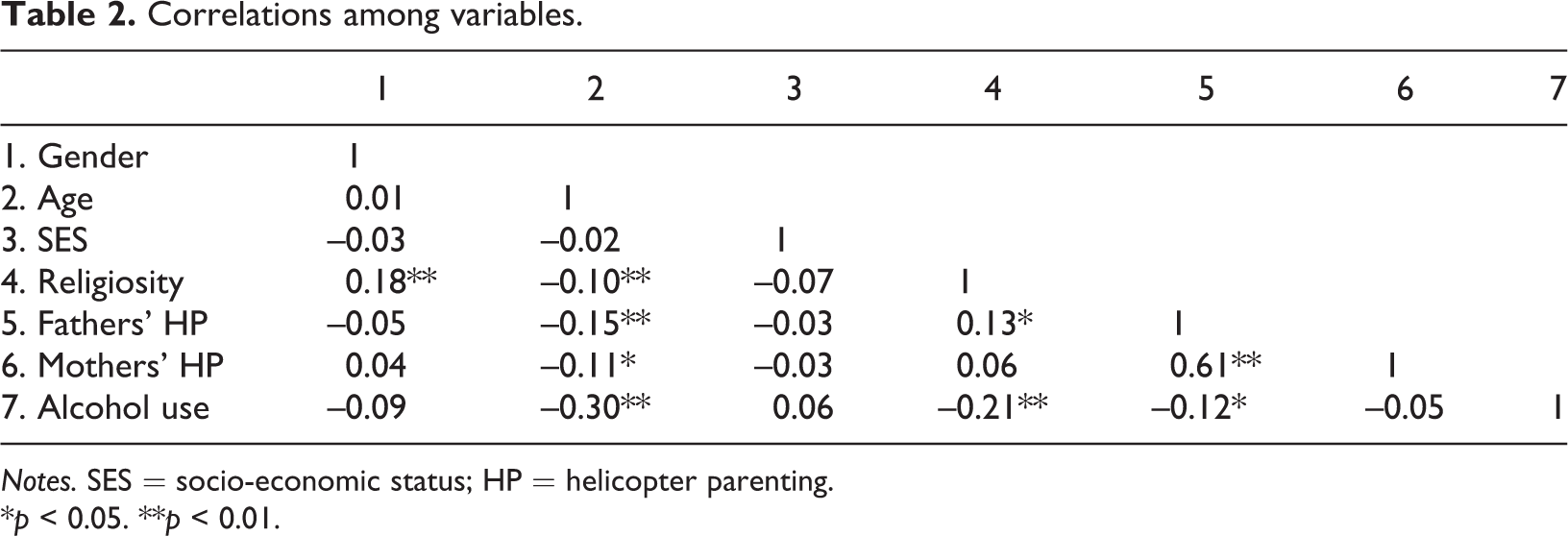
Notes. SES = socio-economic status; HP = helicopter parenting.
*p < 0.05. **p < 0.01.
Moreover, to analyse the relationship between HP and alcohol use, the linear model was tested and adjusted for gender, age, SES, and religiosity. Although the overall linear model was significant, explaining a significant proportion of variance, R 2 = 0.13, F(6, 395) = 10.35, p ≤ 0.001, fathers’ HP, B = –0.10, SE = 0.06, p = 0.11, and mothers’ HP, B = 0.05, SE = 0.06, p = 0.42, were revealed to have a non-significant effect on alcohol use.
Therefore, the quadratic model was tested. First, the interaction term (father’s HP × mother’s HP) was added in the second step. The results showed no significant interaction effect, B = 0.01, SE = 0.04, p = 0.83. Next, a quadratic term for father’s HP was included in the third step and another for mother’s HP was included in the last step. The model became significant only when the quadratic factor for mother’s HP was added, R 2 = 0.15, ΔF = 5.82, p = 0.02; it was not significant when the quadratic factor for father’s HP was included, R 2 = 0.13, ΔF = 0.07, p = 0.79. Thus, in the last step, the mother’s HP quadratic factor showed a significant effect, B = 0.11, SE = 0.05, ΔR 2 = 0.02, p = 0.02, whereas the linear factor of father’s and mother’s HP remained non-significant (see Table 3 for more details).
Finally, the exponential model was tested, adding the interaction term (father’s HP × mother’s HP) and the exponential factors (instead of the quadratic factors) for both father’s and mother’s HP. The model was not significant when the exponential factors for father’s HP, R 2 = 0.13, ΔF = 0.15, p = 0.70, and mother’s HP, R 2 = 0.14, ΔF = 1.49, p = 0.22, were added. Again, in the last step, the linear factors showed a non-significant effect for both father’s HP, B = –0.02, SE = 0.04, p = 0.54, and mother’s HP, B = 0.05, SE = 0.04, p = 0.22. Indeed, the exponential factors explained a marginally significant proportion of variance ΔR 2 < 0.01.
Results of hierarchical multiple regression model.
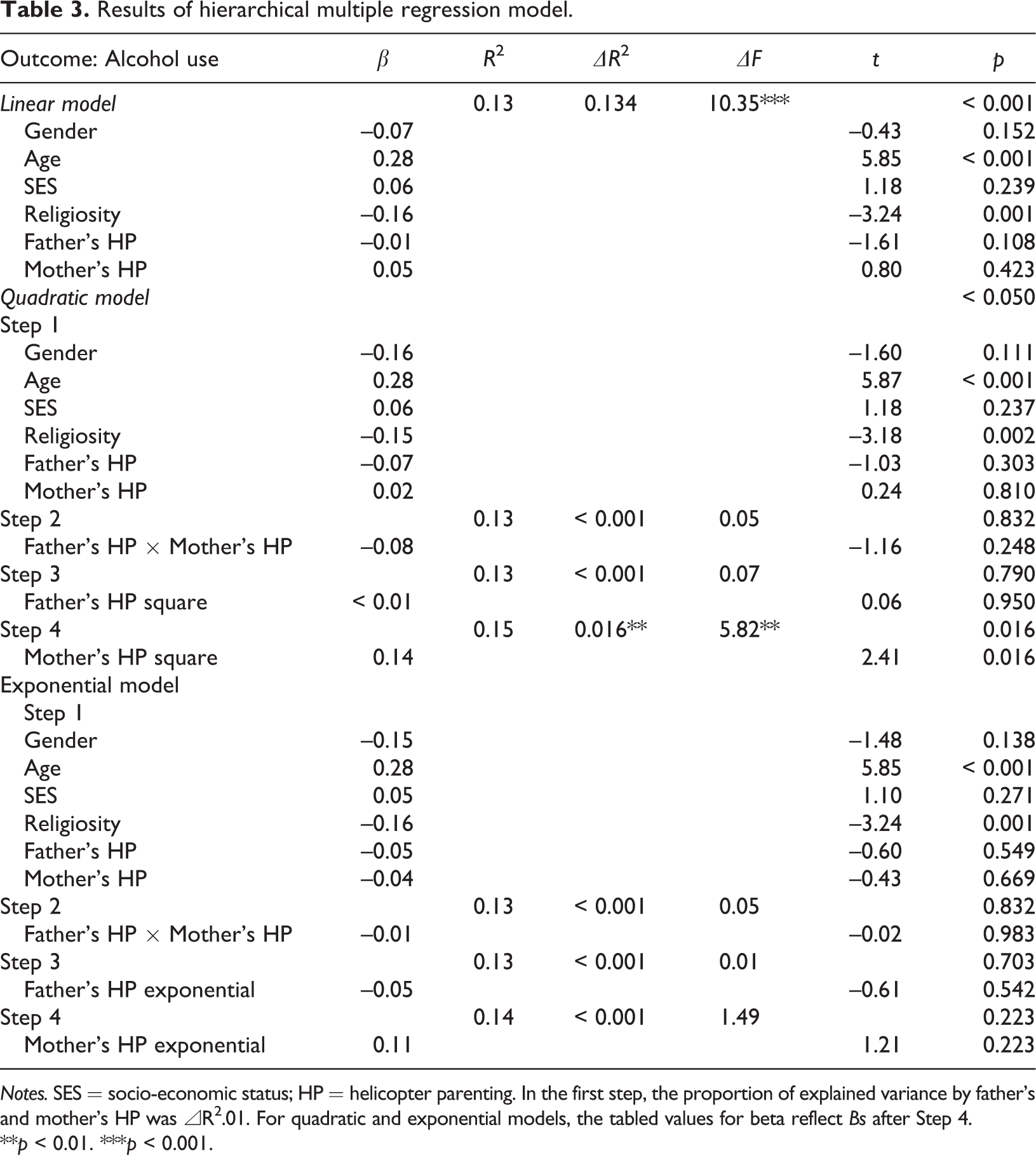
Notes. SES = socio-economic status; HP = helicopter parenting. In the first step, the proportion of explained variance by father’s and mother’s HP was ⊿R2.01. For quadratic and exponential models, the tabled values for beta reflect Bs after Step 4.
**p < 0.01. ***p < 0.001.
In conclusion, the quadratic model seemed to provide the best explanation for the relationship between HP and alcohol use (Figure 1). Moreover, in all three models (linear, quadratic, and exponential), age and religiosity were significant, showing that higher levels of alcohol use were more likely to relate to lower religiosity and older age. However, these findings were beyond the scope of the research and must be addressed in future studies.
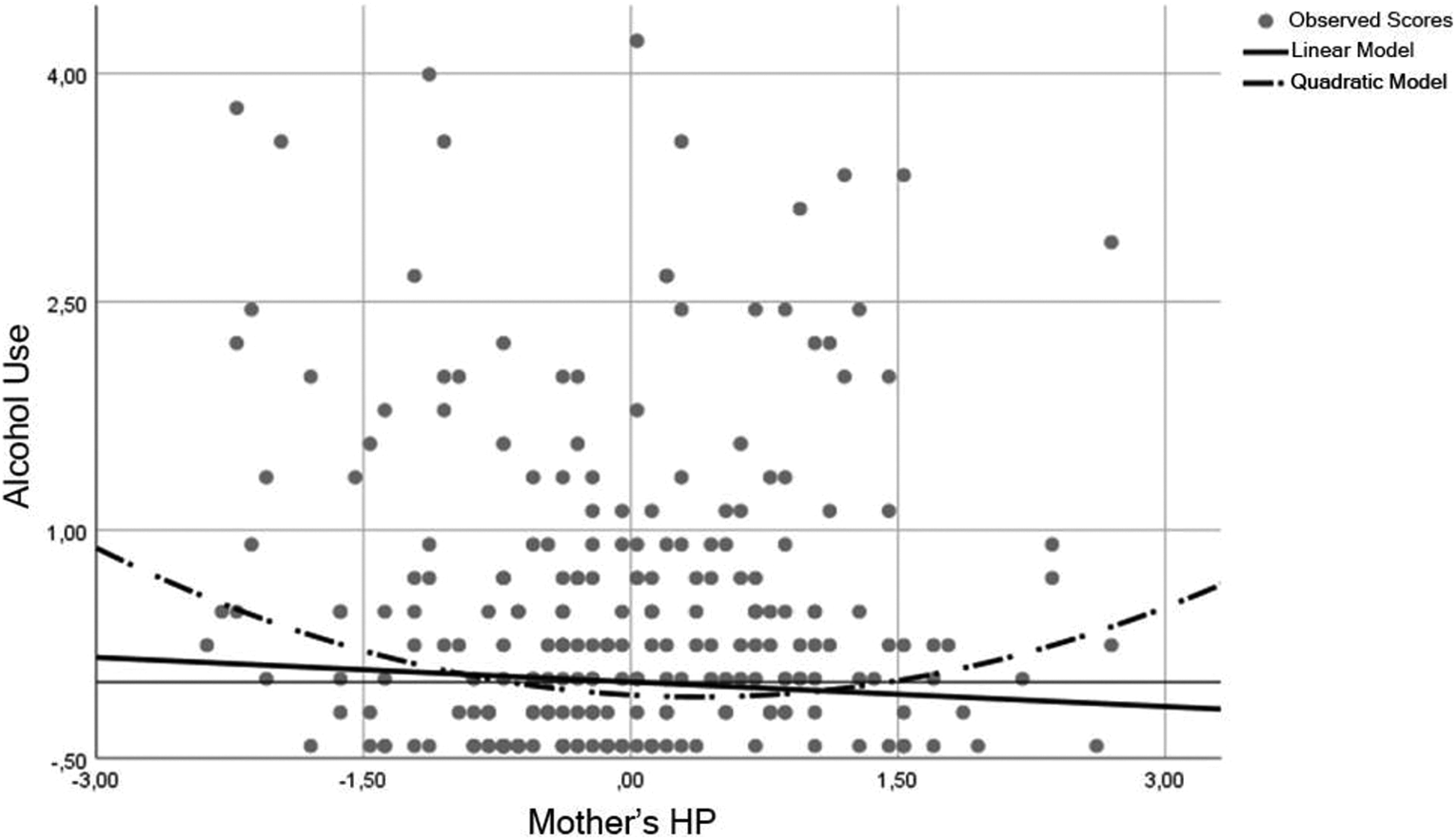
Scatterplot with graphic representations of linear and quadratic models.
Discussion
The aim of the current study was to investigate the relation between HP and alcohol use in a sample of adolescents. The results suggested that HP was not related to alcohol use in a linear fashion. Although this finding is consistent with prior research showing a non-linear relation between parental monitoring and alcohol use (Blustein et al., 2015; Habib at al., 2010; Jackson & Schulenberg, 2013; Stice et al., 1993), to our knowledge, no previous studies have investigated the quadratic/exponential relation between HP and alcohol use.
Specifically, the analyses revealed a quadratic relation between HP and alcohol use: participants with a more intrusive mother and those with a less intrusive mother reported higher levels of alcohol use than did participants with mothers who were reported to demonstrate an average level of HP. These results were obtained after controlling for participants’ gender, age, SES, and religiosity. An exponential model was also tested, with the findings compared to those of the quadratic model; the latter showed more robust results.
This study contributes the first evidence that adolescents with mothers demonstrating higher or lower levels of HP demonstrate significantly higher levels of alcohol use. Thus, mothers’ HP seems to influence risky alcohol-related behaviour in adolescents. The difference in parental gender found in this research may be due to the fact that, while both parents are important for adolescents’ development, mothers tend to be more influential than fathers (Hair et al., 2008; Jiménez-Iglesias & Moreno, 2015; Pistella et al., 2020). Research (Simons & Conger, 2007) has shown that a disengaged parenting style in mothers is more dangerous for adolescents’ well-being than a disengaged parenting style in fathers, probably because maternal affection, adolescent–mother communication (Morrow, 2004), and the quality of the maternal relationship (Trzcinski & Holst, 2008) are central determinants for adolescents’ well-being (Cheng & Furnham, 2004). Moreover, previous studies have found different levels between mothers’ and fathers’ HP (Pistella et al., 2020; Schiffrin et al., 2019; van Ingen et al., 2015), showing that adolescents perceive that mothers display higher levels of HP behaviours than fathers.
On the one hand, the results suggest that an average level of parental involvement in mothers seems to prevent adolescents from developing inordinate alcohol use patterns. This range of involvement could likely be considered characteristic of an authoritative parenting style, which is widely accepted as a predictor of the most optimal outcomes in children (Baumrind, 1991; Cerezo et al., 2018; Osorio & González-Cámara, 2016). For example, parental monitoring and the tracking of children’s behaviours in an attempt to protect them from negative influences (Kerr & Stattin, 2000) is a dimension of authoritative parenting that is associated with better adolescent outcomes (Cerezo et al., 2018; Hussong & Smith, 2018; Osorio & González-Cámara, 2016). It has also been demonstrated (Ryan et al., 2010) that high parental monitoring delays children’s first consumption of alcohol and reduces levels of later use.
On the other hand, both the lowest and the highest levels of maternal involvement seem to correlate with adolescents’ more risky behaviour in alcohol use. Several studies have shown that, when parents are less aware (Rai et al., 2003) or highly involved (Dickerson, 2007) in their adolescents’ activities, their children show more deviant behaviours (including substance consumption), resulting from poor choices regarding alcohol, drug abuse, and sexual relationships (Hofer & Moore, 2011). These findings are further supported by studies that have shown that moderate levels of parental control and supervision seem optimal and relate to lower levels of alcohol abuse in adolescents (Alati et al., 2014; Becoña et al., 2013; Guilamo-Ramos et al., 2005). The present results contribute to this literature (Bernstein & Triger, 2010; Rai et al., 2003) by providing evidence that parental disengagement (or HP) can lead adolescents to develop risky behaviours, including alcohol use and abuse.
Regarding the other covariates considered in the study, the final model showed that alcohol use was significantly associated with participants’ age (Alati et al., 2014; Jackson, 2002; Musher-Eizenman et al., 2003) and religiosity (Hodge et al., 2001; Ritt-Olson et al., 2004; Walker et al., 2007), but not gender or SES. Future research on alcohol use and parental involvement should account for these covariates.
Limitations of the study and future research
Several important limitations should be considered when interpreting the results. First, the generalisability of the findings is limited because the sample comprised only Italian participants. Second, all measures were self-report, and no measure of social desirability was used. Third, the HPI has only one dimension and does not investigate the HP subdimension, so it is not possible to conclude whether any (and which) specific HP characteristic influenced adolescents’ alcohol use.
Future research should have the aim of providing insight into the influence of parental alcohol use on adolescent drinking patterns in the Italian context, because research in other Western countries has found that this is the strongest predictor of drinking trajectories in adolescence (Alati et al., 2014; Sharmin et al., 2017). Again, future research should adjust for other parenting variables, including family stress, parental education, parental control, communication, and monitoring of alcohol use, as well as for peer drinking. Such studies should also determine whether there are any variables able to moderate the relationship between HP and alcohol use. Despite the abovementioned limitations, the current findings support the idea that HP is not linearly related to alcohol use. Future research should seek to deepen our understanding of the relation between HP and other adolescent behaviours (relating to, e.g., tobacco and drugs), as well as the relation between alcohol and other substance abuse with parental involvement in single parent and same-sex parent families.
The research findings may provide practical and educational implications. Future intervention programmes aimed at decreasing alcohol use during adolescence should involve parents to make them aware of problematic behaviours that may arise from certain types of parenting practices. Therefore, such intervention programmes aimed at modifying and improving parenting practices could, in turn, have a positive effect in decreasing the involvement of adolescents in risk behaviours such as alcohol use and abuse.
Footnotes
Informed consent
Informed consent was obtained from all participants and their parents included in the study.
Ethical approval
All procedures performed in studies involving human participants were conducted in accordance with the ethical standards of the institutional and national research committee and with the 1964 Declaration of Helsinki and its later amendments or comparable ethical standards. This article does not refer to any studies with animals performed by any of the authors.
Acknowledgments
The authors express their sincere gratitude to the adolescents who participated in this study. All authors who contributed significantly to the work have been identified.
Declaration of conflicting interests
The authors declared no potential conflicts of interest with respect to the research, authorship, and/or publication of this article.
Funding
The authors received no financial support for the research, authorship, and/or publication of this article.
