




Abstract
Introduction:
Alcohol ranks as a major risk factor for health-related harm and mortality. Older males who encounter alcohol problems late in life are an under-studied part of the affected population. This article seeks to broaden our understanding of this group by combining empirical data with humanistic cultural analysis. Specifically, it seeks to show how the desire to cope alone can be linked to generationally specific constructions of hegemonic masculinity.
Method:
Clinical empirical methods are fused here with those of literary analysis. The subjects which the clinical researcher chooses for scrutiny are different from those most natural to literary study, yet the interpretive approaches of qualitative phenomenological investigation and literary close reading are in fact quite similar, and we argue that new knowledge can be generated by evaluating cultural texts alongside the testimony of phenomenological research subjects.
Findings and discussion:
Our findings illustrate a thematic connection between subject testimony and literary texts from the relevant historical period. In the sources we compared – a qualitative study conducted in Denmark and a British novel, Kingsley Amis’s 1954 Lucky Jim – we found a strong link between the values of masculinity and the values of independence. Older men’s resistance of institutional treatment for alcohol problems has motivations which go beyond the desire not to rely on outside aid, a desire which may apply to any illness. As Lucky Jim helps us show, alcohol use functions for men of a certain generation as a symbol of rebellion against institutions, and having institutions play a dominant role in their alcohol cessation may create resistance in these men.
Keywords
This article is an experiment in interdisciplinary collaboration. It examines both real and fictional accounts that link alcohol to values of masculine independence and empowerment, arguing that for many patients the most acceptable and successful forms of treatment to alcohol use disorder will be those which leave these values intact. More abstractly, and by way of example, we hope to suggest a fertile new direction for qualitative studies in alcohol use, and perhaps for qualitative health studies in general.
The aim of the present study was to show how the recounted experiences of alcohol-problem sufferers, Danish men aged between 60 and 75, can be linked to representations of and narratives about alcohol use and masculinity in popular and literary culture. We seek to show how attention to these narratives can foster insight into alcohol-related feelings and behaviours in this population, understandings which could usefully inform future efforts in treatment and prevention. We use a literary reading to argue the presence of a generationally specific form of hegemonic masculinity at work in the drinking habits of men such as our real-life study subjects, a form whose symbolic values and expectations create unique challenges for institutional treatment.
Our collaboration arises out of the “Alcohol Cultures” conference held at the Odense campus of the University of Southern Denmark (SDU) in November 2015. The combination of scholarly backgrounds that this article brings together – in literary studies and phenomenological psychology – is in some ways characteristic of the dynamic field of medical humanities which now flourishes at SDU and many other universities, both within Scandinavia and throughout the world. Methodologically speaking, however, what follows here is something of a departure from that field’s dominant trend.
Clinical investigation and the humanities
Medical humanities are focused, somewhat unsurprisingly, on medicine – on how humanistic material can serve as an agent in the professional delivery of medical services, or in the improvement of health outcomes more broadly (Kirklin, 2003, for instance, describes the impact of medical humanities primarily in terms of medical education, rather than of health-related research). This effort has been rich and various, extending from the training of doctors in discourse analysis to the use of cultural programmes as forms of therapy. While numerous health scholars have studied the humanities as a factor in wellbeing, far fewer have considered the humanities as a research mode, a way of generating useful ideas about the factors in group and individual health.
Humanities scholars have done little more to facilitate such an application. The humanities’ longest-standing overlap with health science is the history of medicine, which seeks to show how scientific innovations both drew on and shaped the cultural, intellectual, and artistic dynamics around them. Works in this field have sometimes appeared in medical humanities journals (see Barry, Maude, & Salisbury, 2016 for a recent example), but they rarely, if ever, share the health scientist’s objective of generating knowledge for clinical use. 1 The emerging body of scholarship on “literature and the state” has provided an insightful focus on the literary representation of public welfare organs like the hospital, but has usually made arguments about how these representations interact with cultural and political history, rather than about how they could inform the thinking and practice of people who actually work in hospitals (for a concise review see Claybaugh, 2008). When cultural scholars have engaged more directly with the content of healthcare disciplines, a normative opposition to positivist approaches has often separated them from the most basic assumptions and goals of health science. In The “Fat” Female Body, Samantha Murray (2008) characterises the medical injunction against overweight as a carrying-over of Judeo-Christian values of self-denial and frugality, and an attempt to constrain transgressive feminine embodiment, dismissing evidentiary links between excess weight and ill health as ideologically suspect. 2 This divide between disciplines is unfortunate particularly with regard to the behavioural aspects of health, those which seem most obviously interrelated with the usual subjects of humanistic and cultural inquiry.
Aim of the study
The present article seeks to increase understanding of the desire of some older Danish men to cope with alcohol use disorders on their own. In this effort it considers cultural texts which express values of masculine autonomy and independence, especially in connection with depictions of alcohol use. The objective is not only to generate knowledge about from where the desire to cope alone in this population stems, but also to test a hypothesis about the utility of interdisciplinary collaboration: the study of empirical testimony, we suggest, can be significantly enriched by the study of relevant cultural and literary texts, in a way that brings together the skills of the qualitative health scientist and those of the literary, film, or cultural scholar.
Research on coping by oneself
The idea of being able to cope alone has had a wide range of predicates attached to it: spontaneous remission, natural remission, untreated remission, spontaneous recovery, maturing out, self-change, and auto-remission. In different ways, each of these terms describe a situation where a serious addictive problem could reach its resolution in the absence of professional addiction treatment (Toneatto, 2013). The notion of spontaneous recovery, in particular, has sometimes been taboo in clinical research, due to concerns that it might skew results from treatment studies, or even suggest that treatment is unnecessary in all instances of addiction (Blomqvist, 1997; Toneatto, 2013).
Blomqvist (1997) investigated differences and similarities between treated and untreated recovery and found that a lack of knowledge about or easy access to treatment was in no case a significant barrier to seeking treatment. Instead, motives for not entering treatment included distrust of the effects of formal treatment, concerns about the stigma connected to treatment, reluctance to accept the alcoholic label and, most importantly, strong concerns about preserving one’s integrity and keeping one’s problems to oneself and immediate family. Blomqvist also found that self-remitters more often relied on existing close relationships, whereas other groups made major changes to their social relations or changed their entire way of living. The desire to cope alone can be found in many patient populations, though Mojtabai, Olfson, and Mechanic (2002) found that people with substance abuse disorder had the lowest self-perceived need for treatment of all the illness types surveyed (14% of 386), with only 3% (of 386) of the study group seeking help from mental-health professionals. Mental-health issues also coincided with a low desire for treatment; of 571 participants who perceived a need for help for any mental-health problem, only 59% actually sought help, and this suggests that even the perception of having a problem does not necessarily lead to treatment seeking. Of 335 participants who sought help, only 44% sought help from mental-health professionals, suggesting either distrust or ignorance towards public health institutions. In a recent cross-sectional study, including 9098 participants, Probst, Manthey, Martinez, and Rehm (2015) found that of 251 patients who refused to engage in professional treatment, 20.9% did so because they wanted to cope alone. Earlier, Saunders, Zygowicz, and D’Angelo (2006) found that doubting the need for treatment is a commonly identified reason for not seeking it out. Even so, they found that a preference for solving the problem alone was a deciding factor in seeking treatment, regardless of thoughts about treatment effectiveness. This implication is essential to our discussion here: there are reasons for refusing treatment even when one knows one has a problem, and even when one believes treatment might be effective.
Masculinity and health in Western contexts
In its analysis both of subject testimony and of literary text, the present study focuses on subjects’ sense of personal masculinity. Following the lead of scholars such as Judith Butler (1990), work in both the humanities and the social sciences has increasingly approached gender in terms of the performance of roles. Lyons (2009) writes that “gender is performed in daily life and through daily activities” (p. 394). This means that gender not only resides in the person, but is also negotiated continuously in shared practices with other people. Hence, when we take on particular activities, we enact different gender identities. Much social judgment bears on this enactment. In connection with a person’s identified gender and with hegemonic values throughout a society, certain gender-related behaviours and practices become legitimised (Lyons, 2009; Magovcevic & Addis, 2005). Masculinity, for instance, is not a stable attribute of a person by virtue of their anatomical maleness. It is “a set of practices and characteristics that are understood as ‘masculine’ which have effects on bodily experience, individuals, relationships and social structures” (Lyons, 2009, p. 395). Since it is produced in social relations, it cannot exist in pure isolation, and requires acknowledgment by peers (Iacuone, 2005).
Hegemonic masculinity is a term for the way of embodying masculinity which is culturally dominant and preferred. The attributes that are hegemonic can vary considerably from context to context, but within Western societies, hegemonic masculinity is typically associated with being strong, aggressive, courageous, invulnerable, etc. In Western modernity, specifically, hegemonic masculinity is additionally associated with values of rational self-possession, independence, and autonomy – values which are often proclaimed to be universal, but which are nevertheless also associated with heterosexual, white, middle-class status, and which often imply the subordination of femininity and the marginalisation and subordination of other masculinities (thus “hegemonic”). Most men would not represent satisfactory incarnations of the hegemonic masculine ideal, but many benefit from it, and, more importantly for our purposes here, aspire to it (Iacuone, 2005; Lyons, 2009). By the same token, men whose behaviour clashes with the values of hegemonic masculinity (attraction to other men, shows of emotionality and dependence on others, etc.) are socially sanctioned (Lyons, 2009; Magovcevic & Addis, 2005).
Method and materials
The analysis of a qualitative interview and the close reading of a work of literature are similar in many ways. Both attend to language as their primary object, and use interpretive, fundamentally unfalsifiable methods for deriving conclusions. The notable difference is that the qualitative health scholar interprets with the aim of producing insight into actually existing people and actually transpiring behaviours and experiences, whereas the literary scholar does not. Extremely fidelitous approaches to autobiography may offer a partial exception, but even here, literary scholars tend to prioritise knowledge of the text itself over knowledge of its author, and reading autobiographies as evidentiary testimony would bring a further problem of representativeness; the genre hinges as much on the exceptionality as the typicality of its subjects. While they do not (and do not claim to) offer reliable descriptions of real individuals, literary texts do offer points of reference in the networks of symbolism, association, expectation, and taboo within which such individuals live. Considered alongside the accounts of qualitative study subjects, a particularly resonant text can deepen understandings of dynamics and structures of feeling which appear only fleetingly in a subject’s account.
Our argument is not precisely that literary texts (or films, music, online content, video games, etc.) be examined as agents in the formation of health-relevant behaviour. Given the vast array of material that makes up any individual’s cultural experience, the exclusion of variables that might confound claims about a given cultural cause would be impossible. Our approach will instead treat texts as repositories for larger patterns in cultural thought, as unique but still revealing instantiations of the same concerns that may be at work in the thinking of survey participants, whether or not they have been directly exposed to the text in question at all. The selection of an appropriate text for this kind of comparison is an act of interpretive judgment. The most pertinent choices are likely to be connected to the study population, in terms of generational moment, subculture, or value system, or simply by popularity within the population in question, and are also likely to directly depict or reflect on the health behaviour under study. It is not, of course, sufficient simply to assume that what one finds in the literary text is also true for the study population. The crux of the process is interpretive plausibility. Can the words of study participants be convincingly linked to ways of thinking and feeling which are more complexly articulated in a given text? And if so, what do these larger cultural articulations help clarify in the words of the subjects? In the following we will describe the selection and inclusion process for both the qualitative interview material and the literary reading.
The qualitative interviews
Material
The interview data referred to in this article are a sample of data originally collected as a sub-study under The Elderly Study (Andersen et al., 2015). The Elderly Study is a randomised controlled trial comparing two different interventions for alcohol use disorders for adults over 60 years of age. Participants in the present study were recruited in Denmark on the three sites in Odense, Aarhus, and Copenhagen. What the present study offers is a secondary analysis of some of the resulting qualitative material. The analysis is seen through a certain theoretical lens on masculinity and coping alone. The main findings and primary analysis of the interviews can be found elsewhere (see Emiliussen, Andersen, & Nielsen, 2017a, 2017b, 2017c).
Pilot
In May and July 2014 the interview guide was piloted. Three pilot participants were interviewed and suggested revisions for the interview guide and interview situation (copies of the final interview guide are available from the corresponding author).
Inclusion criteria
The Elderly Study used inclusion criteria which are also applicable for this study. The participant had to have sought treatment for alcohol use disorder and not suffer from psychosis, severe depression, bipolar disorder or suicidal behaviour. A further inclusion criterion was added for the present study: the participants had to have experienced the onset of their alcohol use disorder (AUD) after the age of 60.
Enrolment of participants
From July 2014 to May 2016, 29 participants in The Elderly Study who indicated experiencing onset of an AUD after the age of 60 were approached for participation by letter and phone. Of these, 15 did not want to participate or did not respond, and two were false positives (they had experienced an onset of AUD before age 60). This left 12 participants (seven men, five women) for inclusion in this study.
Interviews
The interviews were conducted face to face by the first author. They lasted between 45 and 60 minutes and focused on the participant’s experiences with alcohol, late-onset alcohol problems, what led them to seek treatment, and how they evaluated treatment. The interview guide was used as a support for dialogue, but the interviewer intervened as little as possible. All participants signed consent forms.
Data saturation
After interview 9, there was a pronounced decrease in the number of new themes that occurred. Interviews 11 and 12 only seemed to replicate themes already identified in earlier interviews. This was interpreted as data saturation.
Transcription
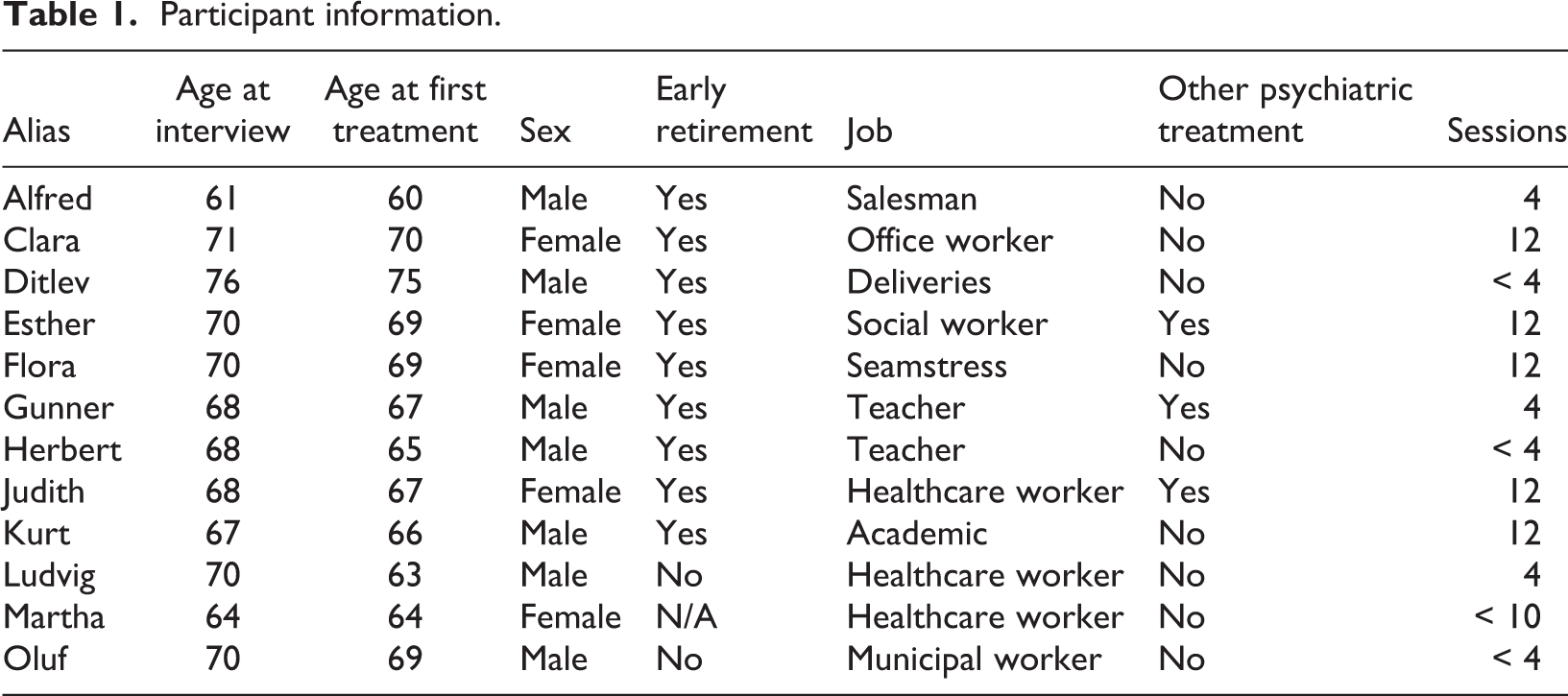
The interviews were recorded and transcribed by the interviewer in order to ensure consistency between the interviews and transcriptions. The transcriptions were semantically focused. The quotations presented here have been translated by the authors – one being a native English speaker and the other being a native Danish speaker. All participants’ names were substituted with aliases as evident in Table 1.
Participant information.
Participants
The group of participants consisted of seven men and five women aged between 60 and 76 years. Three participants had been in psychological or psychiatric treatment before entering The Elderly study. All the participants were formally educated beyond lower secondary school (9–10 years), and ten had further or higher education. Nine had taken early retirement. They had been abstinent for at least two weeks prior to the interview and none reported a use of illegal substances (see Table 1). The present study’s subject is men’s experiences of recovery, and how self-reliance in recovery can be viewed as an expression of masculinity. Therefore, we present and analyse quotations from only three participants (Alfred, Ditlev and Oluf – see Table 1), all Caucasian men over 60, as their statements were exemplary of the themes we wanted to compare with our literary reading.
Analysis
For this investigation, we employed interpretative phenomenological analysis (IPA) as we sought to gain insight into the experiences of older adults concerning alcohol use disorder and its onset. IPA is an approach intended to examine how individuals try to make sense of life experiences. For this purpose, an experience is defined as an awareness of what is happening or what has happened in a given situation, since it is people’s reflections on events that are of importance, as much as the events themselves. This means that people are viewed as sense-making creatures; the accounts we get from them through interviews are their attempt to make sense of the world. Moreover, IPA has an idiographic focus, focusing on small numbers of participants and individual recollections to reveal something of the experience of each of those individuals (Smith, Flowers, & Larkin, 2009).
The actual process of analysing empirical data with IPA is organised into steps. These steps involve refining the interview text into themes and then ordering them into superordinate themes to create analytical categories on which hermeneutic and ideographic interpretation can be based. It is beyond the scope of this article to give a comprehensive description of IPA methodology. For a detailed account of the method, refer to Smith et al. (2009) and for a further discussion please refer to Smith (2010), Smith and Eatougn (2007), Smith and Osborn (2008), Giorgi and Giorgi (2008) and Giorgi (1997).
This analysis revealed 18 superordinate categories. For the present study we will focus narrowly on the superordinate category of self-reliance and maintaining agency. This category contained sub-categories on self-discipline, the necessity of taking care of oneself, trying to make the decision to stop drinking, testing abstinence control, resisting temptation, self-reliance in maintaining change, and the importance of being a part of decisions.
The literary work
The text we consider here is Kingsley Amis’s 1954 novel Lucky Jim (Amis, 1954/1992), an account of university life in Britain which, we argue, illuminates a particular disposition against institutions in the alcohol-related aspects of a generationally specific form of hegemonic masculinity. Our approach to the text is a thematic close reading, which focuses on scenes and passages deemed especially relevant to the subjects of interest (here these subjects are masculinity, autonomy, and alcohol use). These passages are interpreted to show how the novel articulates a set of valuations which extend beyond it, and in this respect the reading owes more to the methods of cultural study than to those of aesthetic or deconstructive criticism.
The novel Lucky Jim was chosen as a test-case because of its connection to the generation now past retirement age, its endorsement of a masculinity defined by autonomy and self-direction, and its memorable, frequent scenes of alcohol use. The choice of text may is in some ways counter-intuitive; Lucky Jim is about a young Englishman engaged in graduate studies in history, while our study subjects are Danish men past the age of retirement. But Lucky Jim voices a generational attitude of iconoclasm and rebellion which crosses national lines within Western Europe, and which remains very much alive in members of the generation in question as they age. The protagonist’s status as a scholar might seem to imply an elite status which could separate him from popular generational trends, but the story is about his departure from the university setting, his rejection of what he perceives as its rarefied pretension in favour of the franker way of life he finds within the commercial workforce. The novel is in fact a populist attack on hierarchical institutions, with the university as prime target. The fact that the protagonist is white also bears mentioning. In the reading that follows, we link dynamics in the novel to the testimonies of Alfred, Oluf, and Ditlev in terms of a generationally specific rebellion against institutions. For non-white men in both Western and Western-colonised countries, a state of tension with public institutions might well be less generationally specific, and its significances would be different.
Findings
In the following we will present the findings from the literary close reading and the interpretative phenomenological analysis. Findings have been grouped into thematic sections regarding leaving work and the related loss of status, ideas of masculinity and alcohol in narratives, and questions of masculinity in alcohol recovery.
Leaving work and losing status
A common theme for participants in the interviews was the experience of leaving work. In Denmark and most developed nations, standardised retirement ages are part of the structure of professional life. The participants often reflected on the loss of responsibilities, duties, and authority in retirement as tantamount to a loss of identity. Here is Alfred’s account of how he felt after he left work: A: /…/ I was bored and /…/ [sigh]. Yeah, I really thought life was, was shit all of a sudden, right? /…/ Because, we were always busy. Getting going in the morning, and the phone was ringing, going out and selling some goods, back home again – and I felt I was somebody, right? I had a /…/ job with an international company /…/ that I was proud to work for /…/. (Alfred, l. 106–109) A: My /…/ identity, like, disappeared. I mean, I was nothing anymore [laugh] /…/ it meant a lot to me apparently /…/ to be what I was. (Alfred, l. 111–112) O: Well /…/ I was employed at the [municipality ed.] for [a lot of years ed.] /…/ and I’ve been happy about my job /…/ and that was when something snapped inside of me /…/. Well, I had a job where I was “on” a lot /…/ and had to work at home and in the night and stuff like that /…/ and all of a sudden /…/ there wasn’t really anything, right. (Oluf, l. 56–61) D: /…/ Because I was involved in a lot of business, /…/ you know. And /…/ in that way it was a very sudden transition, from being something, to actual nothing. /…/ It was in those silent moments /…/ where you were sitting and thinking, where nothing was happening in your daily life /…/ not very much at least /…/ it was easy to take something to drink. /…/ and that became a habit. /…/ So, you maybe start with one glass, right? /…/ but /…/ then we took it in the morning suddenly instead of the afternoon. But, then there was the whole afternoon too, right? Then we said /…/ “let’s just take a glass” /…/ and that was like a circle /…/ a vicious circle, I found myself in /…/ which was expanded more and more /…/ like a spiral, right? (Ditlev, l. 129–138)
Much of the discomfort the participants express with regard to their new positions can be read as anxiety about a new relationship to the hegemonic forms of masculinity. The vocabulary of drive, momentum, and purpose which both men use to describe their previous lives is subtly but powerfully suggestive of gender values. A: /…/ all of a sudden I felt alone in the whole world, I was scared, I was nervous, I didn’t have /…/ any relations to any people, I was a zero. I felt that I was standing all alone out on the field. We live in the country now [laugh]. Simply a nightmare. /…/ I didn’t have /…/ anything to put instead of my job. Something to be interested in. Because, I need to have something to do, right? (Alfred, l. 220–225). D: /…/ but honestly I must admit that /…/ I miss a lot of things anyway, but I’ve gotten used to it more or less /…/. And that my daily life is /…/ instead of, you know “swooosh” /…/ full speed ahead, and a lot of things happening and a lot of talk with /…/ a lot of people and all that /…/ yeah, now, all that happens is what I come up with myself. That’s all. (Ditlev, l. 210–215)
Masculinity and alcohol in narrative
The text of the interviews may seem to provide an adequate understanding of the behaviours in question: Alfred, Ditlev, and Oluf drink to palliate a painful shift in their circumstances. Such a conclusion, however, treats alcohol as culturally and symbolically neutral, and would be an unjust reduction of these men’s experiences. If pain reduction was really all they sought, Alfred, Ditlev, and Oluf might have used any substance that was physiologically appropriate and physically available. The above consideration of social science theory with regard to gender allows us to speculate further that alcohol is a kind of symbolic prosthetic for masculinity under threat. The literary reading to which we now turn is an effort to go further: more than a chemical last resort, alcohol is also more than an abstract sign for the masculine. The nature of its association with masculinity, like the terms which define masculinity itself, shifts over time. To understand how the association works for men like Alfred, Ditlev, and Oluf – to recognise the powerful animus it creates against institutions, our main finding here – we need to consider the ways in which it is articulated during their formative years.
The generation reaching retirement in Western countries today came of age in the post-war period. From those years forward it has had a very strong sense of itself culturally, a sense united around a set of common experiential touchstones – the moon landing, the 1968 riots, the fall of the Berlin wall – and exemplified in works of literature, music, and other media which bespeak the anxieties, values, and desires of this generation in particular. One such text is Kingsley Amis’s 1954 novel Lucky Jim (Amis, 1954/1992). This work is a turning point in the history of the British–American genre of campus novels. While earlier university novels like Brideshead Revisited (1945) tell stories of initiation, in which young men are introduced to habits and privileges guarded by older generations, Lucky Jim represents a defiant break from the discipline of the traditional university, a fictive equivalent (and in the English-speaking world, a frequent reference point) for the youth revolts that began in the years after its publication. 3 The novel follows Jim Dixon, at the story’s beginning a graduate student in history at an unnamed school in the English midlands, as he emancipates himself from a boring and supercilious supervisor, an unfulfilled sexual relationship, and finally the oppressive hypocrisy of university life altogether.
Most of the climactic moments of Jim’s liberation are heavily gendered, in a way that blends the more longstanding masculine values of autonomy and assertiveness with a generationally specific commitment to insurrection. These climactic moments are also all marked by, and indeed enabled by, the use of alcohol. At an early point in the story, Jim and several colleagues have gathered for a weekend at the house of his academic supervisor. Jim surreptitiously leaves, gets quickly drunk at a nearby pub, and returns again, entering the room of a fellow student named Margaret, who is not quite his girlfriend. “I say, don’t you think you ought to be going? It’s getting late.” “I know, I will in a minute. I’m enjoying this.” “So am I. It’s the first time we’ve been really alone for…how long?” One of the effects of this query was to make Dixon feel very drunk, and afterwards he could never quite work out why he did what he did next, which was sitting down beside Margaret on the bed, putting his arm around her shoulders and kissing her firmly on the mouth. (Amis, 1954/1992, p. 57)
Stories of successful seduction, real or fictional, often serve to advertise the masculine prestige of their male protagonists, offering evidence of hegemonic characteristics including determination, robust heterosexuality, a spirit of conquest, or willingness to take risks. Jim’s kiss, like many comparable actions in literature from other periods, rescues him from implications of cowardice, effeminacy, and childishness; his status in his own eyes is elevated by the action. More distinctively, however, the kiss is also a rebellion, and rebellion via licentiousness is an essential part of Lucky Jim’s generationally specific version of male-heterosexual prestige. In Lucky Jim, as in other places, the enemies of this rebellion include not only disapproving authorities, but also women who deny the male protagonist sex. The encounter ends with Margaret repelling Jim’s advances, and she is gradually revealed as the villain of the novel’s erotic plot, a figure of perpetual and calculated deferral who thrives on ungratified desire. 4 Alcohol, in time, becomes integral to Jim’s escape from her as well.
The novel’s insurrectional recasting of hegemonic masculinity has a class politics as well as a sexual politics. This element is especially clear in the moment when Jim abandons his academic career – again with the help of alcohol. Towards the book’s conclusion, he has been asked to deliver an important university lecture to a large assembly. He find the theme his supervisor has given him, “Merrie England”, falsely sentimental, and despises the text he has written for his speech. Just before the lecture, a mixture of anxiety and despondency leads him consume several drinks in quick succession. He begins to speak, finds his own words even more nonsensical than he had expected, and abruptly breaks from his notes. “What, finally, is the practical application of all this?” Dixon said in his normal voice. He felt he was in the grip of some vertigo, hearing himself talking without consciously willing any words. “Listen and I’ll tell you. The point about Merrie England is that it was about the most un-Merrie period in our history. It’s only the home-made pottery crowd, the organic husbandry crowd, the recorder-playing crowd, the Esperanto…” He paused and swayed; the heat, the drink, the nervousness, the guilt at last joined forces in him. (Amis, 1954/1992, p. 227)
In scenes like these, alcohol is an agent, helping Jim achieve autonomy in the pursuit of his masculine ambitions – sex, professional advancement, personal liberation – in defiance of the limitations placed on him by previous generations and by institutions. But as well as a way of empowering desire, alcohol is also an object of desire. At neither the weekend party nor the university lecture does Jim drink with the conscious objective of encouraging his own defiance. He drinks because he enjoys drinking.
Much of Jim’s consciousness throughout the novel is taken up in calculations as to how much his meagre income will allow him to drink, and while this is in part a comic extravagance, its necessity is also supposed to demonstrate to the reader the unacceptability of Jim’s situation. Alcohol is subject to the same prudish regulation which Jim faces with regard to sex and other things. From a college party midway through the novel: At that moment Maconochie arrived with the drinks Gore-Urquhart had ordered. To Dixon’s surprise and delight, the beer was in pint glasses and, after waiting for Gore-Urquhart’s “Find me some cigarettes, laddie,” to Maconochie, he leaned forward and said: “How on earth did you manage to get pints? I haven’t seen anything but halves in here the whole evening. I thought it must be a rule of the place. They wouldn’t give me pints when I asked for them. How on earth did you get round it?” While he said this he saw irritably that Margaret was looking from him to Gore-Urquhart and back again and smiling deprecatingly, as if to assure Gore-Urquhart that, despite all evidence to the contrary, this speech betokened no real mental derangement. Bertrand, too, was watching and grinning. Gore-Urquhart…didn’t seem to have noticed Margaret’s smiles…(Amis, 1954/1992, p. 110)
The rebelliousness of the generation which came of age after the war is well-noted; in many accounts it is this generation which invents youth rebellion in its contemporary sense, and no literary reading would be needed to remind us that alcohol, among other substances, was an important symbol of this rebellion. As Lyons and others may have led us to infer, alcohol use is a sign of masculinity for men within many generations – not only a physiological agent to numb the pain of a personal or professional loss, but a symbolic supplement for a decline in masculine status elsewhere in one’s life. The thing more precisely brought to light by Amis’s novel is how, specifically for men of this generation, alcohol use becomes a badge for the insurrectional force of individuals as they resist institutions, the point of intersection between a generationally specific interest in the Dionysian or carnivalesque (often linked to the deregulated modes of consumer capitalism through which many of this generation found gainful employment) and the more longstanding masculine values of autonomy and self-possession. When Jim escapes the university for the private sector, he is in part escaping its efforts to control his drinking. The book is evidence of a serious anxiety about how institutions affect masculinity, and this anxiety may extend from the institutions of education to those of medical treatment.
Out of the company: Generational masculinity in drinking and recovery
Now that it has been illustrated, this specific generational sensibility can illuminate aspects of the testimony of our study subjects. Perhaps most obviously, we find that control over one’s own drinking behaviour is a subject loaded with masculine values, and that a loss of this control would exacerbate the decline in self-perceived status which these men experienced in retirement. A comment from Ditlev suggests this. /…/ and I don’t want to sit there, when I’ve always been able to take a glass of wine /…/ and then all of a sudden say /…/ “I’m not drinking [alcohol] any more”. Then it would be like I recognised that I couldn’t control it. Then I would rather say no /…/ I’m going to have two glasses of wine for dinner and then that’s it. Then you are a part of the company [“selskab” from “selskabelighed”], instead of being totally cut off /…/ (Ditlev, l. 153–157)
In terms of what Lucky Jim suggests about institutions, the literary reading also helps illuminate aspects of the subjects’ relationships to formal therapy, in a way more specific than would be allowed by a general application of the idea of hegemonic masculinity. That general idea would make it possible to observe that, in the effort to preserve a sense of masculine independence, these men are wary of reliance on outside aid. From the interviews it is obvious that both Ditlev and Alfred are thankful for having the opportunity to engage in treatment. However, they both minimise its necessity in their particular cases: When I look back /…/ at the treatment I’ve had, I’m very grateful of course /…/ But it is not just the treatment that made me clean /…/ It’s given me a lot of tools /…/ and it gave my family, and especially my wife [peace of mind] /…/ They feel that it was good that I [got treatment]. And it was /…/ no doubt about it, but I believe that I could have done it by myself /…/ all of a sudden my wife put her foot down and said that I needed to stop or our marriage wouldn’t work out /…/ so I believe that I could have stopped by myself. (Alfred, l. 526–537) /…/ In most of my life /…/, where I’ve had different small problems along the way /…/, I’ve taken care of it myself, by helping myself. And I didn’t want to feel defeated, because I couldn’t solve /…/ the alcohol problem myself. Or, I wanted to give it a chance /…/ to see if it was doable, right? /…/ If it was not possible, well, then I /…/ had to resort to the next thing [alcohol treatment]. But first of all, I want to give myself a chance to handle it myself /…/. Because, I’ve handled the other things by myself /…/. (Ditlev, l. 444–452)
Discussion
This study has been an attempt to combine efforts in literary studies and clinical alcohol research to achieve a deeper understanding of the relationship between masculinity and alcohol use for older men. By comparing a literary close reading of Lucky Jim with results from an interpretative phenomenological analysis of interviews with older men above the age of 60, we have developed an enhanced understanding of how the loss of employment and the use of alcohol are connected for these men: alcohol, we have found, is part of a generationally specific construction of hegemonic masculinity which places emphasis on rebellion against institutions, especially those which police or limit consumption and sensual gratification. As well as an insight into some men’s resistance to treatment, we see this finding as evidence of the fruitfulness of our composite analytical method. Considerations of culturally relevant narratives and representations can significantly enrich the insights of the qualitative interview process, and we believe that this approach will reward further investigation in future.
As with any scientific investigation, there are limitations to this study. Qualitative investigations always face problems concerning memory bias, social desirability bias, etc. Furthermore, the data collected in the qualitative investigation was never specifically aimed at experiences of recovery or masculinity in relation to recovery. The interpretations regarding these themes were based on spontaneous utterances from the participants rather than specific inquiry. Our interpretations focused narrowly on three exemplary participants rather than all 12 originally interviewed, since our aim was to demonstrate how themes common to literary texts and qualitative interview material might be identified and interrogated, rather than to establish the statistical generalisability of a given pattern. As is evident from our secondary analysis in this study, however, we do believe that the themes we identify are prevalent as a primordial phenomenon in the data.
More unique methodological issues arise from the combination of approaches this article attempts to deploy. As previously indicated, there are a number of reasons for reading this particular novel alongside the responses of these particular men, though under other circumstances the pairing could have been more securely justified; if the collaboration had been planned at the time of the interviews, it might have been possible to select a text which the subjects had all read, and to ask questions about moments of recognition or affinity they felt in their reading. Investigations of this kind offer exciting opportunities for future work. For present purposes, however, we believe that Lucky Jim reveals dynamics broad enough to be connected to the experiences of Alfred, Oluf, and Ditlev, at least indirectly.
The abstract idea of hegemonic masculinity may seem to offer a sufficient explanation for the statistics on refusal of treatment in male populations: accepting aid from others is seen as weak, so men try to avoid or minimise use of healthcare, in a way that often has negative health consequences. From such a viewpoint, it is natural to conclude that men need interventions beyond those of treatment itself – that they need efforts at re-education and destigmatisation, by health providers and the public institutions which employ them, to help bring them into conventional treatment scenarios. Such efforts are no doubt invaluable where they are able to succeed. But by itself, “hegemonic masculinity” is too generalised a term to explain the situations of men like the ones we quote here, or the crucial and unique dynamics of their reluctance to be treated. Attention to more specific cultural narratives can help us capture those dynamics. In texts like Lucky Jim, and in the imagination of many who grew up around the time of its writing, alcohol is closely linked to a rebellion against institutions, which is in turn tied to masculinity. If the cessation of alcohol abuse is tied to compliance with institutions, this can only reinforce the sense that giving up alcohol means giving up masculine independence, as this generation recognises it. Thus, for men of a certain age and where alcohol is involved, institutional interventions risk compounding exactly the anxieties they are intended to alleviate. Through the consideration of texts like Lucky Jim, health researchers can understand the worries and priorities of this generation of male alcohol users with greater sensitivity and precision. Exactly how the healthcare system should approach individual men who want to cope alone is a complex question, but the effort can only benefit from more awareness of what is at work in this desire – of how, for some men, an institution telling them not to drink calls up an almost archetypal scenario of resistance.
Footnotes
Declaration of conflicting interests
The authors declared no potential conflicts of interest with respect to the research, authorship, and/or publication of this article.
Funding
The first author has received unconditional funding from the Lundbeck foundation, the Region of Southern Denmark and the University of Southern Denmark for conducting the qualitative investigation that is mentioned in this article.