




Abstract
Many contemporary efforts to govern global challenges are driven by combinations of numbers and futures. This special section proposes the novel concept of ‘quantified futures’ as a way of grasping this widespread entanglement. Because existing scholarship has largely treated quantification and futurisation as discrete governing technologies, their intersections have remained undertheorised and underexplored. In this introductory article, we discuss similarities between quantification and futurisation to build an integrated analytical framework that outlines how quantified futures operate across transnational policy domains by shaping the salience, scope and urgency of global challenges and their solutions. The special section at large cautions against overly optimistic expectations regarding the capacity of quantified futures to tackle global challenges. Rather, it underscores the need to enquire into the mutually reinforcing effects between, on the one hand, the growing use of quantified futures and, on the other hand, the increase and diversification of global challenges.
Introduction
The future and the realm of numbers are strange bedfellows. The future is flexible, characterised by an openness to multiple, yet unknown paths of development, which is why it is more appropriate to refer to what is still to come in the plural: ‘futures’. Accordingly, Louise Amoore and Rita Raley (2017: 3) speak of ‘the terrain of incalculable and uncertain futures’, where the epistemic foundations for political measures are shaky and constantly remade. Other authors similarly portray the future as a space of more or less likely but permanently unrealised imaginaries, dreams and options (Beckert, 2013: 222; de Jouvenel, 2012: 5; Gibson, 2011: 505; Luhmann, 1976: 143). Quantification, by contrast, renders phenomena more concrete and often also (seemingly) more precise than these things would be if they were left unquantified. Numbers are taken as objective expressions of ‘what is’, and so it is no wonder that quantification is the language of positivist science (Porter, 1995; Salais, 2016). Integrating futures and numbers is difficult because futures resist and frustrate quantification efforts. After all, a ‘horizon of possibilities’ (Berenskoetter, 2011: 657) can never be fully pinned down to something definitive.
And yet, as this special section demonstrates, global governance actors routinely produce numbers and metrics that promise a glimpse into what lies ahead or that express a desired outlook. These quantified futures, as we name them, are visions constructed and communicated through various types of metrics, which either numerically represent the future directly (quantification of the future) or are used indirectly as cues about the future from the past or present (quantification for the future). The special section contributions illustrate how a range of political actors – including governments, international organisations (IOs), non-governmental organisations (NGOs) and cities – engage in practices of calculating the future in spite of its resistance to quantification. From the ways in which quantified futures are used in global politics, we infer that they serve to activate and mainstream discourses around an explicit or implicit notion of ‘grand challenges’, as recently analysed by David Kaldewey (2018). This is not to say that global challenges (Sandler, 1997) are always substantively different from conventional global problems. For Kaldewey (2018: 168), the term ‘challenge’ expresses an ‘optimistic futurological stance’ reflected in the belief that there are always solutions to be found. As global governors often rely on ‘provisional expertise’ (Best, 2014), quantification allows them to better cope with the inherently uncertain future.
We conceive of the quantification of futures as a specific, numerically inflected instance of ‘anticipatory global governance’ (Berten and Kranke, 2022). Through quantified futures, actors aim to tame the future, determining the likelihood and potential impact of harmful developments in advance, and to act before they materialise (McInnes and Roemer-Mahler, 2017). Quantified futures are central to the construction and governance of multiple global challenges, including those noted by the BJPIR editors in their recent editorial (Anderson et al., 2022), because they promise assurance in light of fundamental uncertainties. For example, within global climate governance, the fundamental challenge is defined by a forward-looking metric that conveys the predicted rise in global mean temperatures; it is then made actionable and solvable through orientation along severity thresholds (such as, most notably, 1.5° or 2.0°C). Quantified futures often live on beyond original intentions and first applications. A veritable futures ‘industry’ at the science-policy interface has emerged around the management of global challenges to provide knowledge and advocacy in the form of such tools as forecasts, projections or simulations (Andersson, 2012). These quantified futures populate the global political landscape, defining what key challenges are and what solutions to them could or should look like.
Quantified futures thus affect political dynamics in complex ways across a number of transnational policy domains, but their study remains rather siloed. Neither do the quantification and the futurisation literatures engage much with each other, nor are instances of quantified futures discussed as a general phenomenon of contemporary global politics. As a result, while research on quantification and on futurisation has mushroomed in different fields of study (e.g. Adam and Groves, 2007; Beckert, 2013; Esposito, 2011; Hacking, 1990; Koselleck, 2004; Mennicken and Espeland, 2019; Miller, 2001), it is difficult to ascertain what the increasing prevalence of quantified futures entails. The field of International Relations (IR) is a special case in this respect. Here, the body of work on numbers, quantitative indicators, ratings and rankings has become sizeable in recent years (e.g. Andreas and Greenhill, 2010; Broome and Quirk, 2015; Cooley and Snyder, 2015; Hansen and Mühlen-Schulte, 2012; Kelley and Simmons, 2019). The same cannot (yet) be said for research on global futures, which is still in its infancy (but see Berten and Kranke, 2022; Stockdale, 2016; Svendsen, 2020). To connect work on quantification and futurisation in IR and beyond, the six substantive contributions to this interdisciplinary collection showcase the relevance and prevalence of quantified futures by exploring their political role in the following key transnational policy domains: security (Rodehau-Noack, 2023), social protection (Berten, 2024), economy (Kranke and Yarrow, 2023), innovation (Chou et al., 2023), finance (Walter, 2023) and development (Grek et al., 2023).
Collectively, we embrace a broad understanding of ‘quantified futures’ as discursive and material manifestations of actors’ diverse anticipatory practices, which do not only represent but also remake the social world. Within this constructivist meta-theoretical stance, we primarily draw on the two large interdisciplinary bodies of scholarship most pertinent to our novel concept of ‘quantified futures’ – that is, on quantification on the one hand and futurisation on the other. These strands have been largely kept apart, except in risk governance research, in which the interplay of quantification and futurisation – often surrounding financial and security practices – is at least implied, albeit rarely theorised (Best, 2013; Kalthoff, 2005; Lengwiler, 2007; Power, 2007). The translation of uncertainties into risks through statistical operations replaces possibilities with probabilities of varying degrees of certainty (Kalthoff, 2011; Power, 2004). However, in the absence of evidence for the likelihood of certain events, governance by risk encounters limits (Best, 2008; Mythen, 2015). The novel concept of ‘quantified futures’ permits the inclusion of a wider array of anticipatory practices, as different examples covered in the special section, such as gaps, goals or thresholds, attest. In this introductory article, which has a specific remit, we ask the following: how do quantified futures contribute to the construction of global challenges and their solutions? As we develop an answer to this broad question, we unpack global challenges and solutions by outlining three specific dimensions, namely their salience, scope and urgency.
This introductory article is organised into three main sections. First, we delineate the conceptual differences between ‘issues’, ‘problems’ and ‘challenges’ as motivations for anticipatory practices, thereby engaging closely with and extending scholarship on problematisation in IR and beyond. Second, we review the quantification and futurisation literatures, which we argue need to be brought into closer communication, as well as research on risk, which has forged some connections between these two strands. Specifically, we discuss how numbers and futures amplify three interrelated dimensions of global challenges, namely salience, scope and urgency. Third, drawing together these large bodies of work, we elaborate on our novel concept of ‘quantified futures’, using the same three dimensions. Within this analytical framework, we elucidate how the various quantified futures analysed by the contributions shape the salience, scope and urgency of global challenges across diverse transnational policy domains. We conclude with general reflections on a future research agenda around quantified futures and the wider practical implications of their growing prominence in global politics.
From issues to problems to challenges
The introduction has already touched upon the point that ‘global challenges’ and ‘global problems’ are not necessarily different on a substantive level. Over the last decades, there has been a general tendency in global political discourse to describe transboundary issues as ‘challenges’ rather than ‘problems’ (Kaldewey, 2018), which indicates a shift in the way actors perceive and approach issues. If an ‘issue’ can be defined as a certain subject matter deemed politically relevant, a ‘problem’ constitutes a politically established obstacle, whether or not it is surmountable. Yet when actors use the term ‘challenge’, they tend to describe a task that can principally be accomplished through goal-setting and the use of particular governance instruments. In short, global challenges represent solvable problems of transboundary scope that policymakers and/or the general public agree shall and can be tamed. The nested circles in Figure 1 capture this conceptual distinction although we note that the boundaries between the categories are highly fluid as they are subject to actors’ constantly evolving perceptions.
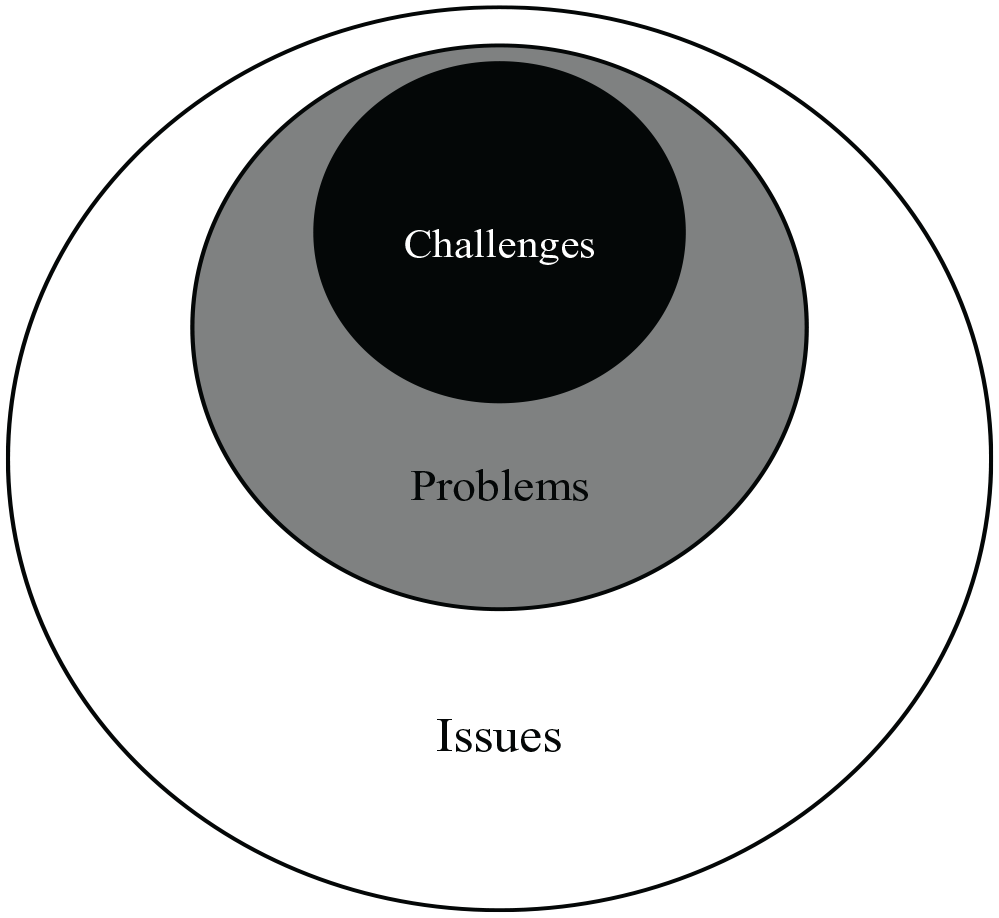
How issues, problems and challenges relate to each other.
As Figure 1 illustrates, some problems lie outside the realm of challenges since what is to be done about them, and how, is beyond the scope of political decision-making. Indeed, these ‘wicked problems can only be settled, never solved’ (Hoppe, 2010: 9; see Rittel and Webber, 1973), unless both (new) issue-specific knowledge about an issue and a societal consensus on the need for action emerge. Most problems can be (re)framed as challenges if appropriate remedies are conceived. Since challenges are a sub-type of problems that are narrated as principally solvable, the much broader and multidisciplinary literature on problems and problematisation applies to most aspects of challenges as well.
Issues do not develop into problems on their own, although a condition can become so overwhelming that it can hardly be ignored – from wars to natural disasters to pandemics, recent history provides a number of examples of this dynamic. Even if many matters have structural foundations and causes, political work is crucial for turning them into issues of concern that warrant being addressed. There are many transboundary issues that call for scarce political attention. Also, not all problems garner strong political support. Accordingly, the public policy literature posits that agenda-setting constitutes the first step in policymaking (Kingdon, 2014). Constructing problems thus requires explaining and convincing others of the deficiency of some condition (Kingdon, 2014: 109–115), as well as assigning responsibilities for both its cause and its resolution (Polletta, 2015: 42; Stone, 1989). Policy entrepreneurs actively try to lift certain issues to the top of the global agenda, frame them in ways that align with their desired interpretations, and win over other actors for support. How a problem is defined and can subsequently be solved is contingent on a variety of factors, including formative events, questions of power and interests, opportunities afforded by institutions, and potent narratives (e.g. Hajer, 2005; Steensland, 2006).
Before an issue can be dealt with politically, either some aspect of it or the issue in its entirety needs to be translated into a problem (Rochefort and Cobb, 1994; Weiss, 1989). Since an issue does not beget its own interpretation, this process involves interpretive struggles that subsequently structure what possible solutions come into view and are deemed appropriate (Béland and Howlett, 2016). IR scholars have found that the generation and communication of knowledge is crucial in problematisation processes since epistemic practices specify the boundaries of an issue in the first place (Allan, 2017; Bueger, 2015; see also Grek, 2010), which then allows for further critique and ascriptions of responsibility (Andrä, 2022; Hülsse, 2007). As the constructivist literature on social and political problems in both sociology and political science has established, problematisation includes the interpretation of some condition as not conforming to an either implicit or explicit normative ideal. A present that ‘is’ is claimed to be lacking in comparison with what ‘ought to be’, the foundations of which can be temporal by, for instance, pointing to a romanticised past or an imagined future; and/or spatial by, for instance, alluding to a space where the sought-after ideal has already been realised (Bacchi, 2012; Blumer, 1971; Jerolmack, 2008).
Quantification meets futurisation: The making of global challenges and solutions
In this section, we show how quantification and futurisation as distinct modes of governance influence the construction of global challenges and solutions. In this sense, we do not offer a conventional literature review but leverage the literatures on quantification and futurisation, as well as the risk literature (which sits somewhat at their intersection), to develop an analytical framework. This framework helps to explain why certain challenges are seen as more severe than others (salience), why some achieve universal status while others do not (scope), and why the perceived need to act is more or less pronounced (urgency). To avoid any misunderstandings, our perspective is not concerned with improving (the production of) metrics or anticipatory practices, unlike much of the practical literature on the subject. Instead, we aim to contribute to a better understanding of the dynamics within the construction and governance of global challenges.
Salience
If a political issue becomes salient, it attracts widespread attention as a problem worthy of governance. In other words, the issue gains visibility and can be problematised as an important challenge that a critical mass of people believe needs to be addressed in some way. If an issue lacks salience, however, it remains (largely) invisible. Actors can render a specific issue more salient through both quantification and futurisation, thereby defining the outlines and characteristics of a challenge.
Quantification has a unique capacity to alter the salience of issues by shaping the constitution of global challenges through objectification, complexity reduction and visibility in politically consequential ways. In contemporary societies, numbers stand for what they measure – as seemingly self-evident, impersonal, neutral and objective representations of reality – and are thus frequently perceived as more compelling than qualitative statements. By relying on records of polls, censuses and other counts, which are then subjected to methodical calculation, most numbers have attained quasi-factual qualities (Daston, 1992; Desrosières, 1998; Porter, 1995; Salais, 2016). Quantification thus enables actors to turn policymaking into a series of technocratic interventions, which present challenges as objective tasks rather than mere objects of concern (Barry, 2002; Erkkilä and Piironen, 2014). Relatedly, numbers simplify issues and make them more easily manageable (Heintz, 2010: 169). Complexity reduction is crucial to the perception of challenges since there would otherwise be unwieldy masses of information from which knowledge could be generated. Because of this selectivity and the associated contingency of all forms of measurement (Rottenburg and Merry, 2015: 11–12), numbers shed light on the social world in uneven ways, exposing some issues while concealing others (Espeland and Lom, 2015: 35). The World Bank’s now abandoned Ease of Doing Business (EDB) index was a prime example. Not only did it push the issue of bureaucratic inertia onto the global political agenda in an appealingly packaged way, it also reinforced competition among states for foreign investment (Broome et al., 2018; Doshi et al., 2019).
Futurisation can equally reconfigure the salience of global challenges. With reference to the genre of global scenarios, anthropologist Ulf Hannerz (2015: 798) writes, ‘You cannot observe the future, you have to imagine it’. Whereas the past can be recorded, stored and remembered, the future is an imaginary space into which dreams, fears, expectations and plans are placed, as sociologists such as Niklas Luhmann (1976), Ann Mische (2009) or Jens Beckert (2013) have pointed out. Thus, it principally allows for countless trajectories to co-exist. The future’s openness generates competition among actors to produce authoritative visions that garner political attention. From a lively and potentially infinite pool of potentialities, futures get compressed through seemingly precise visions of what will happen, rather than what might happen – a process that Luhmann (1976: 141) calls ‘defuturization’. For instance, anticipating the possibility of danger posed by future technologies or terrorist attacks can accentuate the visibility of a particular challenge by virtually shifting it to the present (Campbell-Verduyn and Hütten, 2022; Mallard and Lakoff, 2011; Prem, 2022). Such contexts are often shot through with attempts to estimate or calculate risks from future developments.
To some extent, scholarship on risk governance, which has predominantly focused on the realms of finance and security, fuses the logics of quantification and futurisation as amplifiers of political salience. Risk is, by definition, a future-related concept that revolves around quantification – unlike uncertainty, which resists quantification. There are risk metrics, but there are no uncertainty metrics. In the area of financial regulation, for example, there has been growing concern about the disruptive potential of ‘systemic risks’, which undergird efforts to prevent the next crisis or at least properly prepare for it (Braun, 2015; Konings, 2016; Lockwood, 2015). Similarly, the spectre of future terrorist attacks has attracted considerable political attention, spurring the application of anticipatory counter-measures (Aradau and Van Munster, 2007; de Goede, 2008; Heath-Kelly, 2013). Such security practices can reproduce problematic biases concerning who is the bearer of terrorist risk and who is not, attempting to forestall anticipated violence through interventions that are themselves violent (Amoore, 2009a, 2009b). More fundamental questions that concern the social underpinnings of security threats (Homolar and Rodríguez-Merino, 2019) or the advancing financialisation across spheres of life (Leyshon and Thrift, 2007) are easily marginalised or altogether lost in risk governance. The futures thus produced effectively highlight some issues while downplaying others, and enable their governing through the language of risk.
Scope
Salient political issues can become attached to different scales and temporalities. Whether a political issue gets perceived as a manageable global problem – or a global challenge, as we call it – depends to a considerable degree on the numerical and temporal format of its rendering. We use ‘global’ here not as a structural category of deepening economic connections between people and states worldwide or migratory movements between regions, which are common usages in the literature, but primarily as an epistemic and symbolic marker (see Fourcade, 2006; Meyer, 2010). Both quantification and futurisation can ‘globalise’ or ‘universalise’ a particular phenomenon by, first, making previously disparate problems commensurate, and, second, casting a challenge as requiring governance beyond the national level.
Quantification can help to illuminate the global or universal character of challenges. Metrics incorporate implicit assumptions about how issues interrelate through what David Strang and John W. Meyer (1993: 490–495) have called ‘theorization’, which supports the production of ‘cultural linkages’. The formulation of a shared understanding links formerly disparate issues to each other so that they come to be seen as belonging to the same category (Bühler and Heintz, 2017). Quantification is particularly well suited to consolidating such linkages because it relies upon commensuration – that is, ‘the valuation or measuring of different objects with a common metric’ (Espeland and Stevens, 2008: 408). The Corruption Perception Index (CPI), produced by the civil society organisation Transparency International, is a case in point. The CPI has rendered corruption commensurate, which has contributed to forming a shared interpretation of what corruption looks like and what its main sources are irrespective of local context (Andersson and Heywood, 2009: 747). In this vein, quantitative comparisons tend to stretch further and further, until they have reached global scope (Heintz, 2012).
Futurisation can also intensify commensurability, which is typically understood in mere spatial terms, such as when countries are made comparable, rather than in a temporal sense. As Barbara Adam (2006) argues, humans construct their identities through chronological reference points, which help them to delineate who they are and who they want to be in today’s highly interconnected world. Identities are thus increasingly contextualised by ‘[w]orldwide models [that] define and legitimate agendas for local action’ (Meyer et al., 1997: 145). Actors who are exposed to or even promote such models are more likely to think globally about the future and, accordingly, to globalise the challenges facing them. The work of contemporary IOs reflects this tendency. With their efforts geared towards developing solutions that transcend national boundaries, they tend to also frame the problems for which solutions are required as global in character (Hülsse, 2007). For example, there is nothing inevitable about rendering education as a global challenge, as leading IOs in this domain do (Robertson, 2022). In fact, policymakers in federal states may conceive of education in much more local terms, not only defending their constitutionally enshrined prerogatives but also warning against the dangers of national or even international education norms. The futures imagined in these different sites diverge sharply over the question of whether education presents a universal or a more contextualised challenge (Richardson and Abbott, 2009).
Again, the risk literature provides complementary traction on the matter. The calculation of risks is founded upon the idea of escaping the realm of unmeasurable uncertainties through commensuration. To return to an earlier example, various international actors have, since the global financial crisis, mainstreamed thinking that regulation had to centre less on the sum of the risks contained in individual institutions than on systemic risk (Baker, 2013; Kranke and Yarrow, 2019). In other domains as well, the rise to prominence of the very concept of ‘systemic risk’ indicates a type of risk that is almost necessarily global in scope because it relates to an entire functional (sub)system (Centeno et al., 2015). Systemic risk metrically transcends national borders: it locates intervention points through which large-scale change (or ‘system change’) may be successfully triggered. Although this focus does not rule out some local action, the orientation towards the global level is a constitutive element of systemic risk discourses (e.g. Goldin and Vogel, 2010). Those who speak the language of systemic risks thus invoke what they deem to be a universal challenge.
Urgency
Decision-makers and citizens alike can perceive challenges as more or less urgent. Urgent challenges typically attract more political attention, thus generating greater pressure to respond than non-urgent or ‘patient’ ones. The resulting tighter time frames impel decision-makers to pre-empt avoidable damages through action in the short term. Political priorities are shaped by how – and if – an issue is measured, and how its possible and probable futures are delineated.
Quantification can reinforce the urgency of challenges. This is especially true of rankings, where variation in performance expressed in distinct ranks easily overstates actual differences (Espeland and Lom, 2015: 26–28; Høyland et al., 2012; Sauder and Espeland, 2009: 73). By definition, there are top- and bottom-ranked entities, which implies that an entity may experience a rise or fall simply because others have scored worse or better than last time (Espeland and Lom, 2015: 26; Espeland and Sauder, 2007: 19–20). Rankings accordingly generate urgency mainly for two groups. First, those who rank at or near the bottom, or sharply disappoint expectations, carry the stigma of underperformance. States as diverse as Georgia (Schueth, 2011), Germany (Martens and Niemann, 2013: 322–325) and Russia (Cooley, 2015: 1) have aligned their policies with high-profile rankings or even officially announced plans to achieve a certain rank within a given time frame. Second, even those occupying a high rank feel the heat of urgency when the trend is no longer their friend (Werron, 2015). An entity whose top ranking deteriorates compared to the previous assessment is quickly regarded as having failed to live up to ‘past versions of itself’ (Espeland and Sauder, 2007: 20). The nervousness that gripped a US American law school after a very moderate fall in a prominent ranking is indicative in this respect (Espeland, 2015). Whether states or universities, entities seek to swiftly contain the reputational and potential material costs inflicted on them by an unsatisfactory ranking outcome.
Futurisation creates urgency when time-sensitive visions call for immediate action. Instead of expanding the political time horizon, some visions condense it. Legitimised by the unforeseeable but ever-threatening future, policymaking may shift to a reactive rather than a proactive mode (Stubbs, 2018). The more actors become aware of potential consequences of action or inaction, the more urgent challenges tend to appear. As horizons expand further into the future, entanglements between issues become increasingly temporal so that there appear to be more problems rendered ‘wicked’ today than in the past (Barbehön, 2018). At the same time, policy cycles frequently get curtailed, which requires policymakers to implement solutions quickly without adhering to traditional routines of long bureaucratic planning (Peck and Theodore, 2015). This urgency can be linked to the general acceleration of social life described by sociologist Hartmut Rosa (2013) as a cultural characteristic of our times, which also enables certain forms of politics. Protest movements such as Fridays for Future take advantage of the principal contingency of the future to envisage a more environmentally conscious and just society, while stressing that to reach this vision we must act now (Svensson and Wahlström, 2023).
Risk discourses often also generate additional urgency. Politically announcing emergencies generally highlights the urgency of action in the here and now (Anderson, 2017). Declarations of emergency serve to leave behind the tedious world of politics and to respond to threats in ways that would otherwise be impossible (Kreuder-Sonnen and White, 2022). While emergency-induced action is a familiar theme in anti-terrorist governance (Aradau and Van Munster, 2007; de Goede and Randalls, 2009), an air of urgency can also surround austerity measures to which allegedly ‘there is no alternative’ in times of economic crisis (Séville, 2017; Stanley, 2016). In these examples, urgency derives from perceptions of having to deal with risks that are best described as ‘unknown unknowns’. Such situations reveal the uneasy limits of risk management: ‘a moving complex emerges’, writes Amoore (2013: 5, original emphasis), and it remains ‘a complex of the governing of emergent, uncertain, possible futures’ even when sophisticated risk management techniques are deployed. Despite these practical limits, unknown unknowns call for immediate responses because one cannot know how big and near a threat is. Pre-emption, as one particular set of anticipatory practices, is built on this logic (Anderson, 2010: 789–790). The perceived urgency, however, may never vanish, thus instituting a quasi-permanent state of exception (Stockdale, 2013).
As our review illustrates, processes of quantification and futurisation underpin the construction of challenges as salient rather than negligible, as global rather than local, and as urgent rather than deferrable. The medium of how knowledge is produced and presented makes a difference in the construction of challenges. Not least thanks to a firm commitment to interdisciplinarity, the literatures on these two fundamental processes have made significant conceptual and empirical progress, but each has tended to tread on its own path. This separation obscures not only important parallels between governing by numbers and governing by futures, but also the interplay of quantification and futurisation, as hinted at by scholarship on risk. To demonstrate how strongly intertwined instances of numbers and futures fuel the construction of global challenges, beyond the governance of risk, we next apply our analytical framework to the notion of quantified futures. Concurrently, we present the individual contributions that the six articles in this special section make to understanding the governance of global challenges.
Quantified futures in global politics: Overview of the special section
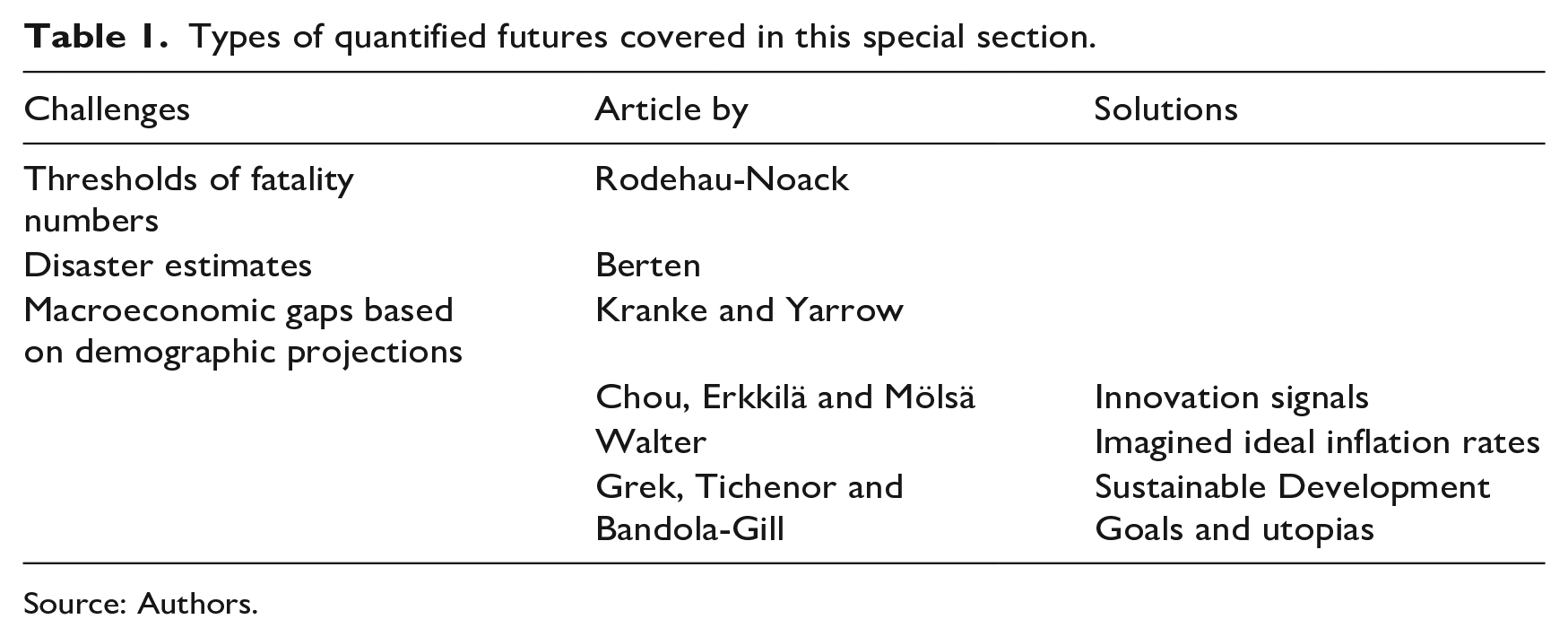
Covering a wide range of policy domains – security, social protection, economy, innovation, finance and development – the special section illustrates the multifaceted dynamics of governing global challenges through quantified futures. Consequently, all our contributors address transnational processes not reducible to either quantification or futurisation because the two phenomena are entangled. Based on their findings, we suggest that quantified futures affect the epistemic foundations of the construction of global challenges along the three dimensions of salience, scope and urgency. As indicated by the heuristic juxtaposition in Table 1, half of the contributions focus more on the role of quantified futures in problematisation processes through which certain problems become perceived as global challenges in the first place. The other half of the contributions, by contrast, provide accounts in which quantified futures tend to take the form of solutions to global challenges. These different angles also demonstrate that quantified futures are simultaneously ideational and material, cutting across this division in ways similar to what has been said about the concepts of ‘practices’ (Adler and Pouliot, 2011: 7) and ‘infrastructures’ (Bernards and Campbell-Verduyn, 2019: 777–779). Despite these different focal points, all the articles in this special section portray quantified futures as core governing technologies at the intersection of quantification and futurisation.
Types of quantified futures covered in this special section.
Source: Authors.
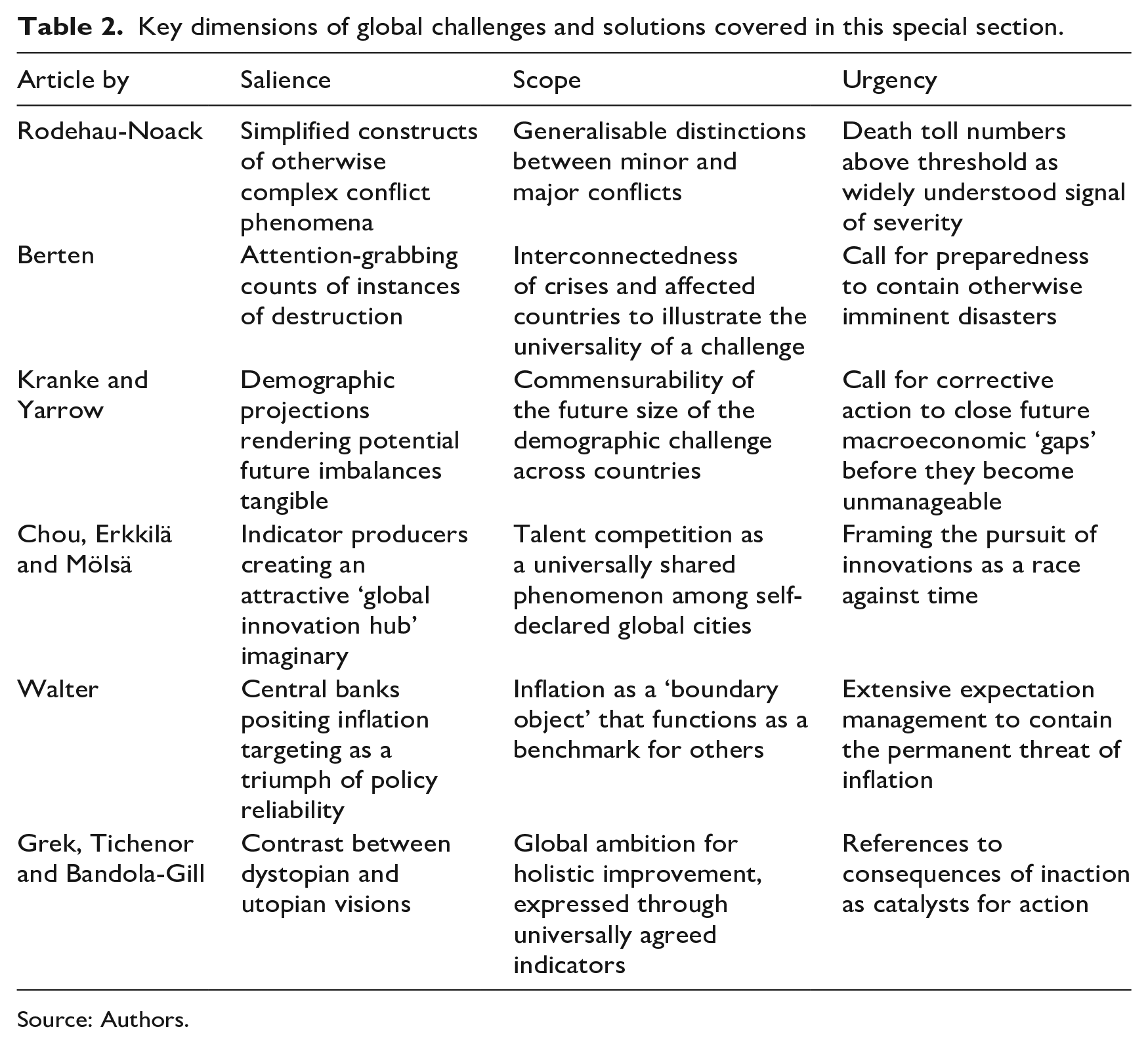
The contributors enrich interdisciplinary research agendas on global numbers and futures with insights from various fields besides IR and political science more broadly, including anthropology, science and technology studies, and sociology. This interdisciplinary approach is mirrored in the methodological pluralism exhibited by the collection. The articles contain analyses of documents, interviews and observations to illuminate different dynamics in the circulation and implementation of quantified futures. Overall, the articles shed light on the multitude of quantified futures seeking to respond to the heightened uncertainties of our time. Building on the foundations provided by our multidisciplinary and methodologically pluralist collection, we posit that the interplay of quantification and futurisation helps to explain why some challenges are perceived as more severe and timely than others, and how they are turned into commonly shared global concerns. In the next three subsections, rather than providing a summary of the results of the individual articles, we relate their respective contribution to these previously discussed axes of salience, scope and urgency. In each subsection, we highlight key insights from the special section into the dynamics of governing global challenges. We provide a condensation of these insights in Table 2.
Key dimensions of global challenges and solutions covered in this special section.
Source: Authors.
Salience
Quantified futures massively reduce complexity, purportedly saying something simple but meaningful about what the future may look like. We see this aspect vividly playing out in Johanna Rodehau-Noack’s analysis of how death counts serve as thresholds of conflict severity. These thresholds obscure dimensions of human suffering, such as gender-based violence, unless they result in deaths, which means that the challenge is framed as being primarily about preventing lethal violence. At the same time, the use of a threshold redirects attention to conflicts that cross the severity line whereas others just below it may thus be ignored or forgotten. Quantified futures can also simplify by other means. Matthias Kranke and David Yarrow foreground the discursive role of ‘gaps’, which define core areas of political action. The World Bank uses this notion to problematise insufficient human capital investments in young people while the European Union (EU) attaches it to fiscal pressures as a result of population ageing that justify less generous social benefits. Even though these macroeconomic ‘gaps’ are, in each case, constructed from questionable, necessarily uncertain long-term demographic projections, they make the abstract challenge of governing demographic trends tangible.
As we know from the quantification literature, numbers are widely deemed to be persuasive. Almost universally, numerical expressions are assigned an air of objectivity. Indeed, many take numbers at face value, treating them as unbiased representations of the social world (Desrosières, 2001; Porter, 1995). As Sotiria Grek, Marlee Tichenor and Justyna Bandola-Gill illustrate in the case of the Sustainable Development Goals (SDGs), tackling global challenges necessitates anticipating a future in which a suggested solution is implemented in light of the alternative of not acting at all. Their analysis suggests that such a contrast between diverging futures attracts political attention. Actors frequently furnish visions backed up by numbers or more sophisticated quantitative tools (Berten, 2017; Kranke, 2022; Müller, 2022). In this vein, John Berten shows that presenting an issue by pointing to dramatic projections frames a challenge as imperative, since these extraordinary or unexpected numbers are particularly striking. Quantified futures of crises, disasters and emergencies that loom close on the horizon haunt present social protection policymaking and stress the need for action.
Nonetheless, the future continues to be a space of potentialities that can only be somewhat condensed but never captured in all its complexity and contingency. This principal openness helps to explain why the future is such controversial terrain (Brown et al., 2000). After all, there are few political domains where the role of forecasting is as firmly in the hands of a single institution or community of practice as it is in the field of meteorology and its weather forecasts (see Lazo et al., 2009). Those who can ‘colonise’ the future by making their imaginations count can exert considerable power over others (Chamlian, 2016; Robertson, 2017), particularly when they accomplish ideational hegemony over the means of authoritative anticipation. Quantified futures, involving discrete embodiments of particular norms (see Hansen and Porter, 2012), are therefore deeply political. As the contribution by Meng-Hsuan Chou, Tero Erkkilä and Juho Mölsä demonstrates, the use of quantified futures in the measurement of innovation spawns new fields of competition and new status symbols for which actors strive as tokens of legitimacy.
Yet at the same time, measurements constrain creativity by circumscribing meanings of innovation. Timo Walter argues in this respect that quantified futures provide a source of power for those who authoritatively delineate future-oriented indicators, but also reveal the limits that an authoritative institution encounters in governing the conduct of other actors, such as financial market participants, through expectations. The contribution casts considerable doubt on central banks’ power to govern financial markets. Ultimately, central banks’ power may be largely ceremonial and thus allow for only diffuse influence over actors’ conduct around inflation targets, which serve as no more than orienting frames.
Scope
The future looms large in global politics as complex sets of interconnected issues can have massive transboundary effects. Under such demanding conditions, actors are particularly keen to get a reliable glimpse into possible and probable futures, which pre-structure the range of policymaking options. Even though qualitative sense-making efforts may often better capture the complexity of the unknowable domain that the future inhabits, their commensurability is notoriously weak, if not entirely absent. Simply put, it is easier to compare ratings than stories. These factors fundamentally shape the ease with which quantified futures circulate in global governance. As Berten illustrates, quantified futures construct a set of challenges that apply to all countries, thereby not only prescribing the scope of global challenges in a certain present but also effectively extending their meaning into the future. The analysis documents that future expectations of globally shared crises influence social policy in two main ways: as narratives for legitimising the expansion of social protection, and as actual design components of social policy models to prepare institutions and beneficiaries alike for the increasing prevalence of crises. Both factors (influence through narratives and on design) contribute to an understanding of problems and their solutions as universal.
Against this backdrop, the standardisation of quantified futures becomes critical. How can quantified futures be aligned so that they speak to similar concerns across sites? The quantification literature suggests that commensuration greatly aids circulation (e.g. Espeland and Sauder, 2007: 18). Global challenges have to be made legible through the commensuration of quantified futures even if (most of) their impacts have yet to be seen and felt. Epistemic practices ensure the alignment of quantified futures on which shared understandings of temporally distant challenges rest. Quantified futures abstract heavily from local context as Rodehau-Noack demonstrates through a dissection of how fatality numbers help to align interpretations of violent conflict across diverse contexts. In the process, retrospective death counts are translated into prospective thresholds for appraising conflict severity around the world, which mould the menu of security responses considered by the international community.
When quantified futures travel between sites, they can, however, take on new meanings. On their journeys, they function as ‘boundary objects’, facilitating understanding among actors whose backgrounds and worldviews differ (Star and Griesemer, 1989; see also St. Clair, 2011). Anticipating the future through quantified means is not the same as predicting it. Thus, quantified futures generate a number of possible trajectories and can never fully close off a debate but may even allow for contradictory positions on the grounds of forward-looking claims (Gusterson, 2008). Walter’s study of central banks’ financial governance provides an empirical example of how quantified future-oriented boundary objects work. A core lesson from the analysis is that while central banks seek to align the expectations of market actors through the boundary object of the interest rate, they often do not succeed in their mission of authoritative monetary policy. There are, therefore, strict limits to the universalisation of the meaning of issues by means of quantified futures.
Future visions can nonetheless develop into powerful governance tools when they serve as common reference points that structure and organise the pursuit of shared goals. If such aspirations remain qualitative and abstract, they still permit a multiplicity of interpretations. If, however, they are transformed into indicators that further specify their meaning and direction, such quantified future goals offer concrete guidelines for action in the long term (Biermann et al., 2017; Rose Taylor, 2020). While retrospective indicators deemed authoritative already delineate political spaces, quantified futures reinforce this effect. Forward-looking numbers not only normalise certain actions but also consistently subdue political alternatives by extending their scope into the future. The SDGs, which Grek, Tichenor and Bandola-Gill investigate, exemplify this dynamic. Combining a utopian vision of the future with a large set of tangible metrics that continuously measure and track progress, the SDGs to some extent predefine the space of political possibilities. In this case, quantified futures come in the form of goals, indicators and targets that operationalise the otherwise rather vague concept of ‘sustainable development’. The SDGs also emerged from a democratic process shaped by countries and not (just) by experts. This participatory element fuels their rendering as globally shared normative guideposts.
As numbers make commensurate what they measure, they facilitate performance management through benchmarking, or ‘governing at a distance’. By delineating issues and publicly comparing performances, producers of influential rankings can shape policymaking without direct intervention (Broome and Quirk, 2015; Hansen and Mühlen-Schulte, 2012; Rose and Miller, 1992). To describe such governing arrangements, actor network theory has coined the term ‘centres of calculation’ for key nodes in a network, where all data are collected and processed but only some information is allowed to pass through (Latour, 1987: 253; see also Berten, 2020; Porter, 2012). However, while governing at a distance is often narrowly interpreted in a spatial sense, the special section adds a temporal twist. Chou, Erkkilä and Mölsä provide an example of how governing the future at a distance works in the realm of urban innovation policy, where the accumulation of human capital in the form of ‘talent’ has become a new global norm. Here, producers of rankings act as powerful arbiters of what passes for city competitiveness as a universal challenge at the local level and how to achieve it, without being directly involved in the nitty-gritty of implementation. In a similar vein, Kranke and Yarrow point to World Bank and EU practices of rendering national (rather than local) human capital ‘stocks’ comparable. This attempt is very explicit in the case of the World Bank’s Human Capital Index (HCI), which ranks at times highly diverse countries on various facets considered relevant to their human capital development. Both articles thus show how quantified futures can discipline third-party behaviour by prescribing desirable outlooks and probable visions that claim timeless validity.
Urgency
The need for action and the potential consequences of inaction are communicated through spatial and temporal metaphors. While these metaphors could, in principle, rely on qualitative descriptions, numbers specify more clearly what needs to be done, and what happens if sufficient action is not taken. This logic is embodied not only by goals that must be reached, as discussed in recent work (Biermann et al., 2017), but also by gaps that must be closed and by thresholds that must not be crossed. According to Kranke and Yarrow, quantified population futures produce urgency for political measures designed to close the identified gaps. Urgency here is a function of the gap’s estimated size: its quantification seems to establish precisely by how much the productivity of a nation’s workforce will fall short of its potential or how big a hole an ageing population will eat into the national budget. Rodehau-Noack illustrates how crossing a threshold does not merely indicate a qualitative difference in the nature of a conflict, but it also highlights that a conflict becomes significantly more aggravated. As a result, conflict containment becomes more complicated, making it even more urgent to address the challenge. The SDGs, argue Grek, Tichenor and Bandola-Gill, convey urgency not only through targets with a distinct time frame, but also through narratives that exemplify the dramatic effects of non-action. Thus, the SDGs attempt to ensure actors’ compliance by striking a balance between achievable and ambitious goals, which illustrate desirable futures. Extending gaps, thresholds and targets into the future amplifies the urgency of challenges because the fundamental uncertainty of the future holds potentially disastrous and hard-to-control consequences.
Quantified futures are, however, not innocent governing technologies that merely involve creating a more evidence-based outlook for subsequent decision-making. If implemented in organisational routines and governing practices, quantified futures can shift rationales of global governance in fundamental ways. The disposability of anticipatory techniques enables preparatory, precautionary and pre-emptive logics of action to quickly (re)act after, in the event of or even before the occurrence of negative externalities (Adey and Anderson, 2012; Anderson, 2010; Berten, 2022; Hansen and Uldam, 2022). Since such actions demand particular legitimacy, quantified futures – given their veneer of objectivity, neutrality and certainty – are particularly sought after as foundations for predictions of possible and probable developments. Preparation, precaution and pre-emption rely on the narrative use of staggering and catastrophic numbers, and are thus closely linked to the affective character of quantified futures (Collier, 2008; Cooper, 2006). Calculating and projecting possible outcomes of (in)action can generate impressions of being too late, not yet there or almost in reach. Actors frequently mobilise numbers in combination with powerful narratives that stress the need to act now in order to forestall an unwanted future (Bandola-Gill et al., 2022: 81–84; Oomen et al., 2022). Berten explores how global challenges beget permanent reorientations in the underlying rationales of IOs’ social protection policy proposals. Comparing utopian discourses of ‘building back better’ after the COVID-19 pandemic with crisis-ridden dystopian futures, the contribution shows that quantified futures encroach upon design principles of ‘adaptive social protection’, which aim to enhance responsiveness to future shocks.
Global governance actors engaged in ‘script-writing’ (Heimo and Syväterä, 2022; Kentikelenis and Seabrooke, 2017) can use quantified futures to ascribe universal and timeless applicability to norms of appropriate action, while foregrounding what happens if a norm is abandoned. Quantified futures, intended to measure a certain phenomenon, become synonymous with the phenomenon itself (Akrich, 1997). Chou, Erkkilä and Mölsä shed light on how measurements of talent and innovation promote a policy script that revolves around the notion of ‘talent competition’. Urgency is increased since the objective of competition is not only to attract but also to retain talent – an ambition shared by many other cities with global aspirations worldwide. Walter suggests that a similar dynamic unfolds when central banks attempt to govern inflation through expectation management although the script of inflation control appears to be more fragile in this case. Even if central bankers try very hard to enact monetary policies that keep inflation in check, these policies may under certain conditions have unintended consequences, such as high inflation or even financial instability.
Conclusion
We opened this introduction to the special section on quantified futures by suggesting that futures and numbers fit together somewhat uneasily. However, they are not just strange but also regular bedfellows. The contributions to the collection underline why it is time for political scientists to more explicitly consider the varied intersections between quantification and futurisation, especially instances of quantified futures in areas or settings that do not revolve around risk. While recent work in IR has drawn more attention to time as a general social phenomenon (Chamon, 2018; Hom, 2018; Huebener et al., 2016; Ish-Shalom, 2016), the future as a particular temporal mode still remains undertheorised. Much of the quantification literature underplays the ways in which indicators, ratings and rankings are forward-looking, or connect past and future, in governing global challenges and solutions. This proclivity results in part from the widespread focus on the effects that performance measurement has on state behaviour. Conversely, the futurisation literature neglects how quantification frames, drives or modifies anticipatory practices. The futures typically studied thus tend to have textual formats even though they may be interlaced with quantitative elements, as this collection shows is often the case. It is thus in both these directions that research on quantified futures should push forward.
Studying quantified futures in action can illuminate crucial but widely overlooked dynamics of global politics. We have specifically pointed to how quantified futures help to construct global challenges – as a specific, manageable type of global governance problem – and corresponding solutions along three interrelated dimensions: salience, scope and urgency. Quantification renders futures, which are otherwise fairly loose forward-looking imaginaries, so tangible that transnational actors can justify why certain challenges must be addressed, why they have global or universal reach, and why they call for an immediate governance response. To borrow from Alejandro Esguerra’s (2019) work on ‘future objects’, quantified futures inspire the creation of a range of governance objects with varying degrees of malleability. As the analyses in this collection stress, although no governing actor can know the future, many claim to know, on the basis of quantified futures and corresponding objects, what kind of anticipatory action is required and what instruments are most suitable.
While these insights enrich our understanding of global politics, the special section itself lacks contributions that examine futures from Global South perspectives. The six articles feature ‘global futures’ that predominantly represent experiences and reflect standards from the comparatively affluent and powerful societies constituting the Global North. Next to such ‘Northern’ global futures, there are ‘Southern’ ones and also those co-produced in ways that complicate the North–South binary. Research on global futures therefore needs to better account for the positionality of practitioners constructing projections, and of scholars analysing these futures. Cognisant of our privileged positionality as scholars living and working in the Global North, we had sought a more inclusive lineup of contributors than eventually materialised. The initial set of manuscripts submitted for peer review in fact included two that had been written by scholars based in the Global South without involvement of colleagues from the Global North. Yet for different reasons, both those papers unfortunately did not make it into this special section. Given the coloniality inherent in much future-making, such as in the climate domain (Death, 2022), but also in the field of future studies itself (Sardar, 1993), future work would be well-advised to address questions of positionality in the making of global futures.
Self-reflexive and deeper engagement with the role of quantified futures in global politics is then also necessary for practical reasons, especially when purportedly global futures are more parochial than they may at first glance appear. On balance, quantified futures would seem to boost the prospects for effective global governance through increased analytical capacity (see Howlett, 2015). However, global governors face an under-appreciated paradox surrounding the routine quantification of futures: technological capacities to anticipate global challenges have increased dramatically over the last decades, but so has the number and complexity of challenges. The more seems to be known about future developments, the more options appear on the political menu, which can lead not only to informed decision-making but also to confusion, paralysis and denial (Jasanoff, 2007). For example, the recent translation of symbols and narratives from weather forecasts into the economy has only made its future more unsteady and has complicated navigation during stormy times (Schwarzkopf, 2022). Imaginations of possible and probable futures fuel uncertainties, ‘putting enormous pressure on the present’ (Strassheim, 2016: 159), which then recursively feed the need for additional, often more intrusive forward-looking instruments to manage ever-increasing risks (Amoore, 2009a; de Goede, 2018; Factor, 2015). In a sense, ‘the avalanche of printed numbers’ (Hacking, 1982; see also Rocha de Siqueira, 2017) has reached the future, but this metrical thirst can hardly be quenched. We are thus likely to witness the production of ever more quantified futures designed to ‘future-proof’ policies alongside a diversification of global challenges.
Footnotes
Acknowledgements
The authors contributed equally to this introductory article and the guest editorship of the special section. In developing this piece, they benefitted greatly from conversations with their contributors and other colleagues during two self-organised virtual workshops in April and June 2022. The authors are also grateful to the participants at a panel at the International Relations section conference of the German Political Science Association (DVPW), Zeppelin University, Friedrichshafen, 14–15 June 2023. Their thinking about the broader topic was further informed by comments and suggestions offered by numerous colleagues at several other events, starting with the European Workshops in International Studies held in Kraków on 26–29 June 2019. Finally, they wish to thank two anonymous reviewers for their critical but constructive engagement with their writing.
Funding
The author(s) disclosed receipt of the following financial support for the research, authorship, and/or publication of this article: Matthias Kranke gratefully acknowledges financial support from two fellowships that facilitated revisions to this introduction, as well as the coordination of the collection as a whole: (1) a Senior Research Fellowship at the Käte Hamburger Kolleg/Centre for Global Cooperation Research, University of Duisburg-Essen, Germany (held from April to September 2023), sponsored by the Federal Ministry of Education and Research (grant number 01UK1810); and (2) a Young Academy for Sustainability Research Fellowship at the Freiburg Institute for Advanced Studies (FRIAS), University of Freiburg, Germany (held from October 2023 to September 2024), sponsored by the Eva Mayr-Stihl Foundation. John Berten received no financial support for the research, authorship and/or publication of this article. For the purpose of open access, the authors have applied a Creative Commons Attribution (CC BY-NC) licence to any Author Accepted Manuscript version arising from this submission. They thank the University of Kassel for providing open access funding.
