




Abstract
In the late 2010s, the future of work gathered attention from the most influential actors in global social governance. The International Labour Organization (ILO), since 2015 and in the context of its Future of Work Initiative, aimed to position itself in the discussion by putting this issue at the centre of their activities for its centenary (2019). The normative and conceptual approach developed by the ILO in this initiative was named the ‘human-centred agenda’, aimed to align technological change with decent work and social justice. Although preliminary scholarly works have seen these efforts as a humanistic and pro-worker ‘countermovement’, a deeper analysis of the ideas and interests involved in the Future of Work Initiative reveals a different, more complex picture. This article studies the creation of the human-centred agenda led by the ILO secretariat and the Global Commission on the Future of Work, and how it was further negotiated and modified by the social partners in the making of the Centenary Declaration in 2019. In particular, it shows how business at the ILO and right-wing populist governments, in tandem, reoriented the human-centred agenda towards a pro-employer perspective, thus framing social and labour policy as a tool for adapting the workforce to technological change. It concludes with some reflections about the consequences of these developments for the ILO’s position in global governance.
‘The future of work is the future of the ILO’
Introduction
The future of work became a central theme in global governance in the last decade. The disruptive potential of technological change encouraged a broad international debate, focused on the dynamics of the so-called ‘fourth industrial revolution’. Scholars from different disciplines anticipated the new risks associated to this process (Balliester and Elsheikhi, 2018; Spencer, 2018), and international organisations, on their part, elaborated studies and strategies to respond to such challenges (Grimshaw, 2020). Key players in global labour policy even redesigned their social policy approaches to respond to the challenges of the changing world of work (McBride and Watson, 2019; Mahon, 2019). The main difference between scholars and international institutions is that the latter are not mere spectators of such changes, but in addition, they have the capacity to shape labour markets and employment relations through different mechanisms of transfer (Baccini and Koenig-Archibugi, 2014). Their relevance for the future of work, therefore, should not be underestimated, since their ideas and proposals might directly orient the institutions of work in the coming decades.
As the specialised agency in the global governance system to deal with labour-related issues, the International Labour Organization (ILO) has not been absent from this debate. From 2015 to 2019, it developed the Future of Work Initiative, in which the ILO secretariat and tripartite partners – workers and business associations, as well as governments – dialogued to elaborate an official ILO perspective on this matter. A variety of studies and publications, dialogues and a series of negotiations in the International Labour Conference were part of the initiative. The main outcome was the ILO Centenary Declaration for the Future of Work, published in July 2019, a document that was expected to become a re-foundational text for the organisation (ILO, 2019e). This article examines the development of this agenda (see the timeline in Figure 1), especially the ideas and interests that were behind the original ILO perspective on this theme: the ‘human-centred approach’ to the future of work. On the theoretical side, the article is grounded on a constructivist institutionalist approach, and it is based on a detailed analysis of the many documents made by the ILO secretariat and partners on this initiative, as well as on interviews with senior staff and researchers from the institution.
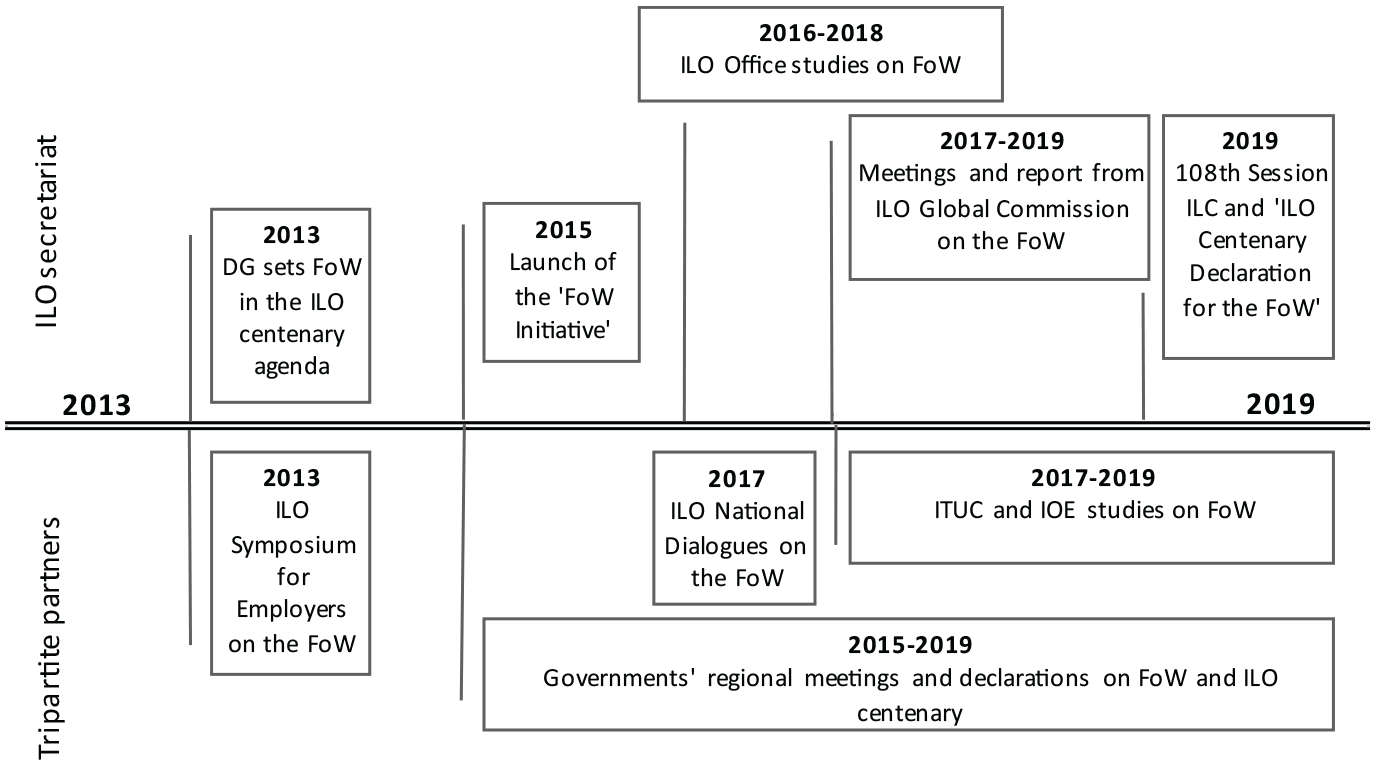
The ILO Future of Work (FoW) initiative, 2015–2019.
Preliminary scholarly studies have seen the human-centred framework as a form of ‘countermovement’ to embed new technologies in humanistic normative principles (Novitz, 2020), or as a critical contribution pointing to the worrying state of inequalities (Grimshaw, 2020). However, these accounts pay attention to the ideas endorsed by the external, ad hoc ILO Global Commission (ILO, 2019h), leaving aside the sharp disputes between the interests of the ILO partners, as well as the process of institutional negotiations that led to the Centenary Declaration of 2019. The findings indicate that, in contrast with the previous global strategy led by the ILO, the Social Protection Floor (2008–2012), in which capital and labour agreed on its orientation (Deacon, 2013), the Future of Work Initiative sparked a new antagonism between both factions. The materials analysed expose the relevance of governments in resolving the tension between workers and employers in favour of the latter. Particularly, in the making of the Centenary Declaration, right-wing governments crucially supported employers’ deregulatory views on technological change by invoking the need to let states make policies according to their ‘national circumstances’. The result was the dismantling of several ideas from the ILO Office’s human-centred framework endorsed by workers, and the consequent increase in the ideational power of business in the organisation.
The political economy of the ILO: a constructivist approach
There is a little doubt that policy-making in international organisations is a complex object of study. Contemporary political economy offers three basic dimensions that offer a helpful starting point to make sense of its dynamics: interests, ideas and institutions (Hall, 1997; Hay, 2004) – also known as the ‘three Is’ (Shearer et al., 2016). Simply put, interests refer to actors’ expected gains from certain policy developments; ideas are the cognitive and normative notions that help them make sense of reality, while institutions are the rules that enable or constrain their behaviour. The political economy of the ILO has been approached by scholars focusing on several of these dimensions. First, in relation to interests, the literature has studied the changing relationship between the ILO secretariat and its tripartite partners (Cox, 1977; La Hovary, 2015; Thomas and Turnbull, 2020). Second, in terms of ideas, studies have emphasised the agendas and concepts that have positioned the ILO in global governance (Deacon, 2015; Vosko, 2002), as well as its contributions through different declarations (Maupain, 2009). Third, academics have looked at the external role of the ILO as a global standard-setter, expressed in their many Conventions and Recommendations (Peksen and Blanton, 2017); at the same time, other works have examined internal patterns of institutional change and continuity in the organisation (Baccaro, 2015; Baccaro and Mele, 2012).
Different institutional theories understand the interrelationship between these dimensions in specific ways (Amenta and Ramsey, 2010). Since this article studies the emergence of a new policy framework at the ILO, it naturally focuses on the ideational dimension. However, the power disputes of actors within the ILO and the relevance of the institutional conditions of this process could hardly be ignored to make sense of it. For that reason, the article takes constructivist and discursive institutionalism to analyse this case study – an approach that certainly has been utilised in previous works on the ILO (e.g. Thomas and Turnbull, 2018). This perspective stresses the role of ideas and discourse in institutional processes, particularly by examining the communicative and coordinative instances where decisions are made (Schmidt, 2008). In such spaces, the capacity of actors to convince others depends on their differential ‘ideational power’, which stems from the persuasiveness of their ideas and the institutional position they occupy (Carstensen and Schmidt, 2016), as well as the identification they generate in their interlocutors (Mukand and Rodrik, 2018). In this framework, institutions rule interactions between actors, giving them meaning, but at the same time are open to interpretation and change through discourse (Schmidt, 2017). Interests, on their part, are a key aspect to understand why actors participate in communication; since the latter are constantly facing uncertain situations, they have to adapt their expectations and ‘construct’ interests through new policy ideas (Hay, 2011).
Rationale and methods of the study
Using this approach to interpret the ILO Future of Work Initiative and the making of the human-centred agenda means focusing on the institutional context of this process, the construction of interests and, naturally, the ideas contained in the mentioned agenda. These elements define the structure of the article. The first section describes the context that gave meaning to this Initiative – the celebration of the ILO centenary in 2019 – and how the future of work became the main theme in the organisation in the past decade. Then, the article explains the interests and expectations of the tripartite partners for the mentioned agenda, expressed in their communicative discourse – statements and publications focused on the future of work. The third point examines the Global Commission on the Future of Work (2017–2018) and its final report, which contained the human-centred approach and a series of policy recommendations that the ILO Office was going to propose for the Centenary Declaration of 2019. The fourth and last section focuses on the making of the Declaration in the International Labour Conference (ILC) of 2019, and the contrasting ideas of the different tripartite partners that led to substantive modifications of the original approach presented by the Global Commission and the Office.
In terms of methodology, the study looks at the two main channels through which actors at the ILO communicate and discuss their ideas. On one hand, the article examines a large sample 1 of publications and statements on the future of work, prepared between 2013 and 2019 by the Office, the International Trade Union Confederation (ITUC) and the International Organisation of Employers (IOE) – that is, organisations that respectively represent workers and business at the ILO. On the other hand, proceedings from the Governing Body’s meetings related to this agenda, as well as those from the 108th session of the ILC from 2019 are also considered. 2 Documents have been analysed comparing three types of ideas proposed by the respective actors (Mehta, 2011): problem definitions, policy solutions and conceptual foundations. Apart from the document analysis, 13 in-depth interviews were conducted in 2019 with senior ILO officials in the organisation’s headquarters in Geneva, as well as with the social partners, all of whom were directly implicated in the Future of Work Initiative. The conversations revolved around the making of the documents, also tracing the internal political processes related to the mentioned agenda. Their participation was anonymous, considering that some of the topics covered were politically sensitive.
The ILO Future of Work Initiative (2015-2019): institutional context, political interests and policy ideas
Institutional context: agenda-setting and positioning from the ILO secretariat on the future of work
The centenary of the ILO was taken by the Director-General and the Governing Body as an opportunity to reaffirm the institution’s purpose for the future. In 2013, it was agreed that seven initiatives were going to be created to guide the organisation’s activities until 2019: governance, labour standards, the green economy, enterprises, end to poverty and women at work (ILO, 2013b). The seventh and most important one for the centenary was the Future of Work Initiative launched in 2015. In words of Director-General Guy Ryder, setting aside the rich symbolism and historic achievement of an Organization approaching 100 years of existence, there is much in this circumstance . . . that makes it appropriate for the ILO to engage in a profound re-examination of its overall place in the international system and in the world of work, and indeed of the future of work itself (ILO, 2014: iii, emphasis added)
It is worth noting that the ILO had experienced several ‘existential crises’ before, generally related to exogenous factors – for example, the globalisation of the economy (Standing, 2010). The emergence of intelligent technologies had posed again a serious challenge for its purpose and had become a trending topic in the international policy spheres in the mid 2010s. This partly explains why they were the central dimension of this initiative, despite the existence of several other macro-trends – globalisation, demographic shifts, gender equality – recognised by the ILO as determinant for the future world of work (ILO, 2017a). The Employers Group in 2013 had already proposed that technological change – especially the new advances in robotics and automation – had to be an integral part of the organisation’s agenda for the centenary (ILO, 2013a).
Initially, Director-General Guy Ryder expressed the same type of concerns focused mostly on the threats of technological unemployment, the polarisation of jobs and skills mismatches (ILO, 2013b: 8). Over time, the Office developed a more multidimensional approach, beyond labour supply and demand. Hence, a technical platform composed by researchers from several areas and backgrounds was formed, mainly to provide inputs to the Global Commission on the Future of Work that was going to start meeting in 2017 (ILO, 2017b). As it typically happens with researchers from the Office, this group elaborated a series of issue notes and policy briefs from a rather pro-worker perspective. 3 Their publications expanded the discussion beyond the most resonant issues – for example, the robotisation of work – but still under the assumption that ‘the impact of technology’ was the ‘pivot’ of the debate on the future of work (ILO, 2016c: 1). For one thing, predictions about mass technological unemployment were considered overestimated (see Kucera, 2017), and their studies still stressed the relevance of skills development to avoid mismatches (Walwei, 2016) and labour market polarisation, an ‘ongoing trend’ that was ‘crowding out the middle class, and widening wage inequality’ (ILO, 2016b: 11).
Other additional aspects were included in the ILO Office’s problem definition, setting the ground for the ILO’s human-centred approach. First, employment relations were recognised as an area for potential disruption, particularly due to the rise of platform labour, a form of employment that often failed to provide security in terms of income and working conditions (Berg et al., 2018; ILO, 2018a). Second, there was also a strong emphasis on the role of new technologies for management and industrial relations. The use of workers’ data to monitor their performance (De Stefano, 2018), or decision-making methods powered by artificial intelligence (Ernst et al., 2018) had to be regulated to prevent discrimination or violations to employees’ privacy. Third, the reports from the Office highlighted that ‘technological changes have significant distributional consequences, with winners and losers’ (ILO, 2016b: 2). Inequalities between companies – with the upsurge of big tech companies in the last decade (ILO, 2016a) – and between capital and labour – linked to the global shrinking of unionism – were expected to increase in the future.
However, at the basis of the policy recommendations made by the Office was a conception of development as an institutionally mediated process of creative destruction. In this formulation, ‘a golden age of job creation’ and ‘the emergence of new growth sectors’ required ‘new social and political choices’ that redistribute productivity gains to consumers and innovative firms (Nübler, 2016: 23). For the Director-General, against what he called ‘techno-determinism’, current societies had ‘to manage technological innovation in ways that correspond to our social objectives’ (Ryder, 2016). Thus, in relation to automation, the Office proposed a ‘system of entitlements to training, funded through a reconfigured employment insurance system’ as a life-cycle measure to facilitate transitions and avoid technological unemployment (ILO, 2018b: 2, emphasis added). Such entitlement should be complemented by a protection floor and flexicurity measures that ensure ‘the portability of entitlements and ensuring effective minimum benefit levels’ (Behrendt and Nguyen, 2018: 31). When it comes to platform labour, the Office suggested to tackle the misclassification of workers as self-employed, strengthening the contract of employment (ILO, 2018c), and designing a ‘portable security account’ that allowed them to keep their benefits regardless of their status or current employer. Finally, proposals to regulate digital management included taking a human-rights perspective on workers’ privacy and the use of their data, as well as encouraging social dialogue to make algorithmic decision-making accountable for employees (De Stefano, 2018).
Constructing the ILO social partners’ interests for the future
While the Office was creating the foundations of the human-centred approach, the ILO tripartite partners were debating on their own interests and position on technological change, evaluating the ideas they were going to defend in later stages of this Initiative. First, encouraged by the ILO, member states organised in 110 countries ‘national dialogues’ joined by civil servants, policy-makers and leaders from business and trade unions (ILO, 2017c). Such dialogues indicated that national contexts were so heterogeneous that there was hardly a consensual position on the key challenges that were to be addressed. For example, European economies discussed how to become ‘leaders in knowledge creation’; data protection measures, and the possible implementation of a guaranteed income (ILO, 2017c: 5–11). Contrastingly, conversations in East Asia, Latin America and Africa stressed the need to formalise employment and provide educational opportunities for excluded groups (ILO, 2017c: 29–35). Such differences among regions spoke about an international lack of consensus about the future of work. The fact that innovations such as artificial intelligence or robotics became so central in the secretariat’s discourse therefore suggests that the agenda was inspired by the developed countries’ interest in technological progress. 4 In the International Labour Conference of 2019, all regions were going to be allowed to bring their concerns to the fore.
Workers and employers, on their part, had to develop their conception of the future in order to design their respective strategies for the ILO centenary. In previous moments of industrial transformation such as in the 1950s and 1960s ILO debates on automation (Cherry, 2020; Hoehtker, 2019), employers had highlighted the productivity gains from technology, as well as promoted state-backed lifelong learning programmes; workers had focused on their redistributive and individual effects. In the future of work agenda, similar approaches were developed, indicating a pattern of ideational path-dependence (Hay, 2011). There was space for innovation as well, developing new interests from the social partners. The Employers Group strongly supported a flexibilisation agenda, assuming that non-standard and platform work represented the future of employment relations (IOE, 2017: 10). Given the previous, companies should give greater levels of autonomy for employees, and governments should deliver tools – from portable social benefits to lifelong learning schemes – to generate this ‘adaptable workforce’ (ILO and IOE, 2019). The centrality of human capital in this perspective – the ‘most important resource’ of companies (ILO and IOE, 2019: 11) – and the opposition to establish ‘excessive regulatory constraints’ on platforms and human resources (IOE, 2017: 50), made the employers’ perspective really similar to that of the World Bank (2019).
The Workers Group, by contrast, portrayed a more pessimistic picture of the future. According to one of their reports (ITUC, 2017a), the ‘global workforce’ was ‘in serious trouble’, with two-thirds struggling under informal and unprotected working conditions; a decreasing income share for labour, and the consequent ‘concentration of economic power’ by technology companies (ITUC, 2017a: 1–3). One ITUC global poll revealed that 73% of workers in the world were ‘worried’ about people losing their jobs and a 51% was concerned about ‘technology taking over jobs’ (ITUC, 2017b: 17). Based on the previous, workers at the ILO expressed their support for larger investment in reskilling and training; a minimum living wage that improved the unequal distribution of income; decreasing working hours, and the establishment of a universal basic income (ITUC, 2017a: 5–6). The relevance of skills promotion was also present in the employers’ discourse, being arguably the only agreement between the latter and labour. In the international labour movement, there was the sense that ‘automation is being used by some as a “Trojan horse” for deregulation and the free market’ (International Transport Workers’ Federation [ITF], 2018: 1). In response, Global Unions – including the ITUC – focused on developing a counter-agenda to that of employers and the international financial institutions (Global Unions, 2018). The Workers Group at the ILO followed the same logic.
The Global Commission on the future of work: the human-centred agenda
The article has so far examined the ideas and interests expressed by the ILO secretariat and the tripartite constituents. In 2017, an additional voice was included to the mix: the creation of a ‘neutral’ commission with members external to the ILO to elaborate what would become the official discourse of the ILO Office and the Director-General on this topic. The plan was to take out the discussion on the future from the internal politics of the ILO, 5 creating a space that mirrored the World Commission on the Social Dimension of Globalisation that met between 2002 and 2004. 6 The Global Commission of 2017 was joined by high-level politicians from different regions, leading academics, as well as authorities from the labour movement and the world of business (ILO, 2019h). Representatives from the Employers and Workers Groups of the ILO were ex-officio members, meaning that they could participate in its debates only if they were invited by the Co-Chairs. They were not to sign off the final report ‘in order to preserve the independence of the Commission’ (ILO, 2019h: 75). In other words, the Commission was not considered an official tripartite instance to establish the ILO position on the future of labour – that role was going to be taken instead by the Centenary Declaration.
Since the Commission was not ‘an academic committee’, 7 it received technical support from the secretariat’s researchers, who also drafted its final report, Work for a brighter future (ILO, 2019h). The report’s central concept was the ‘human-centred agenda’. It was not an entirely novel idea, however. The World Economic Forum (WEF) had proposed in a white paper from 2017 – prepared by Richard Samans, who later participated in the ILO Global Commission – a ‘human-centred’ normative framework to rethink business models based on the principles of dignity, common good and stewardship (WEF, 2017). From an ideational view, the Global Commission’s agenda was instead inspired by the ‘capabilities approach’, which understands development as the increase of people’s economic and political freedom (Sen, 1999). The notion of capabilities implies that development strategies should be judged in view of their contribution to social justice and quality of life, considering questions like ‘what are people actually able to do and to be? What real opportunities are available to them?’ (Nussbaum, 2011: x).
In that sense, the Commission’s framework was proposed as an alternative to the social investment paradigm and its focus on human capital (Midgley, 2013: ch. 5). The latter had predominated in the discourse of other international organisations (World Bank, 2019; WEF, 2018) on this theme, under the idea of ‘preparing’ the workforce for technological change. Thus, the Commission stated, our approach goes beyond human capital to the broader dimensions of development and progress in living standards, including the rights and enabling environment that widen people’s opportunities and improve their well-being. (ILO, 2019h: 11)
The Global Commission’s report was published in January 2019. It represented an attempt to re-establish the ILO position in the two ‘discourse factions’ of global social governance (Münch, 2016), emphasising the ‘social’ dimensions instead of the purely ‘economic’ ones on the future of work. The human-centred agenda proposed by the report included three main pillars and several policy recommendations (Table 1).
The human-centred agenda by the ILO Global Commission on the Future of Work.

Source: Author based on ILO (2019h: 51).
The first pillar was ‘increasing investment in people’s capabilities’, recommending an entitlement to lifelong learning and reskilling – already proposed by the Office, as described earlier. Most of the international discourse had supported skills development to face rapid technological change, but it had not been framed as an entitlement. The second pillar referred to the institutions of work, and proposed the establishment of a ‘Universal Labour Guarantee’ that sets minimum conditions for all workers regardless of their employment status, including adequate living wages, increasing workers’ time sovereignty making use of technology, a ‘human-in-command approach’ to foster algorithmic accountability and privacy at work, and the creation of an ‘international governance system for digital labour platforms’ (ILO, 2019d: 44). ‘Labour is not a commodity, nor is it a robot’, the report stated (ILO, 2019d: 43), arguing for tighter regulations in the use of new technologies at work. The third and last pillar refers mainly to development initiatives, promoting spending in sustainable areas and supporting long-term investments in the real economy, as an alternative to the short-termism of shareholder-centred business models (ILO, 2019d). The three pillars refer, then, to different levels of analysis: individual, institutional and macroeconomic. According to interviewees, the meetings had discrepancies and agreements alike, but what appears in the human-centred agenda was consensual in the Commission.
The reception of the report by the social partners was mixed, setting the tone for the heated debates of the ILC 2019. Although several of its suggestions were explicitly oriented towards expanding workers’ freedoms – for example, by proposing living wages that go beyond the minimum conditions for subsistence, or defending time sovereignty – the Commission ‘was not pro-worker at all’, as an interview from the Workers Group declared. In any case, labour received the report positively, considering it as an attempt to renovate the social contract for the future (ITUC, 2019). Luc Cortebeeck (2019), ex-officio participant in the Commission, speaking on behalf of the ILO Workers Group, mentioned that the notion of a Universal Labour Guarantee (ULG) ‘makes a difference’, and welcomed the idea of an international mechanism to regulate platform labour. Some relevant dimensions for workers were missing, however, the ‘challenges for democracy and the danger of populism’; ‘the actual business models’ led by shareholders; the management of global supply chains, among others, but the commissioner made clear that despite these ‘weak points, the report as a whole is very strong’ (Cortebeeck, 2019). Global unions also supported the report: IndustriALL (2019), representing workers in the manufacturing sector, stated that the Commission’s report ‘is an impressive, visionary outline for a new social charter’. Phillip Jennings (2019) from UNI Global Union, who was part of the Commission on behalf of workers from the services industry, concluded that ‘this report provides the seeds for a “spring of hope” for working people’.
There was a sharp contrast between the response of workers and employers. It was clear from the outset that the Commission did not represent the voice of the social partners as it was not a tripartite instance, with formal participation of representatives of the ITUC, IOE and individual countries. However, the level of opposition shown by the Employers Group at the launch of the Commission’s report surprised labour representatives and the Office alike.
8
Arguably, that moment sparked the political confrontations on the future of work in the ILO, since the partners’ divergent interests had run in parallel until this point. Employers welcomed the Commission’s emphasis on lifelong learning, gender equality and enhancing social protection, but opposed to every single suggestion supported by the Workers Group and Global Unions. Employers Chairperson Mthunzi Mdwaba expressed at the launch that despite those positive aspects, I must though take this opportunity to distance myself from the recommendations on establishing a ‘Universal Labour Guarantee’ and on the ‘expansion of time sovereignty’ due to their non-feasibility and vagueness in terms of possible means of financing. Likewise, the recommendation on ‘setting an international governance system for digital labour platforms that sets and requires platforms and their clients to respect certain minimum rights and protection’ is highly challenging. I do not see this system of transnational rights being established and successfully managed . . . Moreover, there is no acknowledgement of the positive role of the private sector into the future of work . . . the recommendations require actions mainly from Governments and companies, thus leaving aside all other stakeholders that could have seized the occasion to take ownership and develop their own responsibilities. Everyone has an active role to play in the future of work. (IOE, 2019: 4–5)
The position of employers was consistent with their studies on the future of work cited earlier, promoting an ‘adaptable workforce’ and sharing responsibilities with governments and workers, against new entitlements or regulatory measures on business. However, as a discursive strategy, this opposition followed the confrontational approach to negotiations that marked employers’ participation in the ILO tripartite structure since their appellation against the right to strike in 2012 (La Hovary, 2013) and the discussions about the regulation of work in global supply chains in 2016 (Thomas and Turnbull, 2018). Their approach to the debates on the Centenary Declaration was going to have the same tone.
The making of the Centenary Declaration: disputing the human-centred approach
The ILC of 2019 also called Centenary Conference, offered a space to institutionalise the ideas promoted by the different actors at the ILO, to give their interests normative force or to discard them in case of not agreeing with the rest of the constituents. The Director-General presented the Global Commission’s document as his report to the ILC, meaning that their proposals were also the Office’s. Although the secretariat has been considered a ‘fourth partner’ in the ILO’s structure (e.g. Deacon, 2013), it does not have a deliberative voice in the ILC, where international labour norms are designed and approved. It is more an ‘orchestrator’ (Baccaro, 2015; Thomas and Turnbull, 2020) of interests, and certainly a relatively autonomous author of ideas, but it does not have enough institutional tools to exert ideational power over the tripartite constituents. What occurred in the Centenary Conference was a negotiation over the human-centred agenda made by the Commission, which was the basis of the first draft of the Centenary Declaration submitted to the ILC’s Committee of the Whole, made by a technical group from the ILO Office to open the debate (ILO, 2019b).
The expectations for the Declaration were varied – they had in common, though, their ambition. Director-General Guy Ryder expressed previous to the ILC that the text should be ’able to stand in comparison with the historic constitutional texts of the ILO, such as the Declaration of Philadelphia’ (ILO, 2019e: 5). The Workers Group expected it to ‘revitalise the social contract’ through ‘the establishment of a Universal Labour Guarantee’; employers pretended to highlight lifelong learning and the importance of an ‘enabling environment’ for business (ILO, 2019e: 19–31). Governments joined in the debates on the Declaration mostly grouped in regional blocs – Asia and the Pacific, Europe and Central Asia, the Americas, Africa. In previous years, the ILO had coordinated regional meetings where several declarations were made to position each bloc regarding the future of work. Such declarations indicated that there were two main concerns for governments. One was the development of ‘workforce development policies’, mainly linked to skills, as the Americas’ declaration put it (ILO, 2018d). Another was the ‘protection of labour rights’ and ‘a fair transition towards new forms of production and employment relationships, digitalization and automation’, as stated by Europe and Central Asia (ILO, 2017d: 2).
The relevance of government delegates and their position in the discussion on the Centenary Declaration relies on the fact that they, tipped the balance in favour of business or labour proposals. In most controversies, the Employers Group was victorious, receiving direct or indirect support from the regional spokespersons. As per interviewees from the ILO secretariat, confirmed by the proceedings of the ILC 2019, regions led by right-wing populist governments – for example, Brazil (ILO, 2019c: 29), Australia and the United States in tandem (ILO, 2019c: 132) – did not want to commit to new regulations or entitlements that increased the responsibility of states vis-à-vis their workers. In these cases, they would ask to include the clause ‘according to national circumstances’ in the paragraphs in dispute, adding a soft-law element to their conditions. This is arguably the most direct influence of nationalism and populism in the recent developments in the ILO, following a generalised trend in multilateral agencies, where national circumstances are invoked to counter these organisations’ capacity to govern the behaviour of states (Copelovitch and Pevehouse, 2019).
The proceedings from the ILC 2019 (ILO, 2019c) indicate that there were several ideas in dispute, particularly in the Committee of the Whole, where tripartite delegations debated the draft of the Centenary Declaration proposed by the Office. Table 2 presents a summary of the final version of the Declaration. The strong concept of the Universal Labour Guarantee, endorsed by the Workers Groups and Global Unions, was rejected as such by employers (ILO, 2019c: 132–133). In line with the previous, the United States questioned the relevance of the Global Commission report and considered the term ‘guarantee’ too constraining. Consequently, seeing opposition from both sides, workers tried unfruitfully to suggest ‘the novel idea of a universal labour protection floor’, arguing that ‘the Declaration needed to be ambitious’ (ILO, 2019c: 133). However, that concept and the other elements of the ‘guarantee’ had to be left behind: the proposal for adequate living wages was reduced to ‘adequate minimum wages’. The notion of ‘time sovereignty’ was rejected by employers because it did not ‘take into account the needs’ of business (ILO, 2019c: 5). Likewise, the ‘human-in-command’ approach to platforms and algorithmic management was not included in the Declaration, though the text promoted ‘appropriate privacy and personal data protection’ measures for workers. In the same line, despite ignoring the idea of an international governance system for platforms supported by the Global Commission, the Declaration explicitly recognised the challenge of the ‘digital transformation of work, including platform work’ (ILO, 2019b: 6). It is debatable if these inclusions were a proportionate response to the challenges they addressed.
The ILO Centenary Declaration on the Future of Work – key ideas.

ILO: International Labour Organization.
Source: Author based on ILO (2019a, 2019c: 4).
There were two other elements that benefitted employers’ interests, with the discursive support of certain governments. For one, the ‘entitlement’ to lifelong learning promoted by the Global Commission was taken further by the Workers Group in the ILC, who demanded to consider it a right in the Declaration (ILO, 2019c: 128–129). However, in previous discussions on this topic at the Conference, employers had put forward the ‘notion of the acquisition of skills as a shared responsibility’: for public education institutions, for companies and their training policies and for workers who ‘were responsible for attending training to upgrade their skills’ (ILO, 2019c: 68). Despite the initial opposition of the Canada, the African and Latin American groups to the principle of shared responsibility, it was accepted as a formality to ease the debate, but its effect in practice was to block the inclusion of an entitlement skills-wise. The second element that was considered a key triumph for employers according to interviewees from their group was their amendment to ‘introduce the notion of the role of business as a driver of inclusive economic growth and productivity’ (ILO, 2019c: 81). It found ample support in government delegates, mainly due to their focus on employment creation. The Workers Vice-Chairperson criticised this, arguing that such positive role referred to a desired normative scenario rather than to an existent reality (ILO, 2019c: 84). Nonetheless, the final text recognised that the private sector should be supported ‘as a principal source of economic growth and job creation by promoting an enabling environment for entrepreneurship and sustainable enterprises’ (ILO, 2019a: 4).
Considering the previous, it can be understood that, after the last version was presented to the Conference, employers expressed, ‘their satisfaction with the ILO Centenary Declaration for the Future of Work’ (ILO, 2019d: 6). It was considered a ‘pro-business’ text, in words of interviewees from the IOE. Conversations with the Workers Group also reinforced the conclusion that, all in all, the Future of Work Initiative allowed business to gain ideational power in the ILO. In the closing of the ILC, the labour delegate mentioned that they ‘would have welcomed a more visionary and ambitious Centenary Declaration’, especially a stronger commitment to face inequality, reinforcing the ILO’s place as ‘the house of social justice’ (ILO, 2019d: 7–8). However, interviewees from the Workers Group viewed the expansion of business power in the ILO and the United Nations system with concern, and saw the development of the Future of Work Initiative as just another sample of that broader trend. Even so, beyond pessimism, an interviewee affirmed with resignation: that is tripartism, that is democracy. You cannot have it all. At least it is not as in the International Monetary Fund, the World Bank or the World Trade Organisation, where workers do not have a voice
Finally, the contents of the Declaration structured the programme and budget for the next biennium (2020–2021) in the ILO, retaining some key working areas – labour standards, for instance – while giving prominence to other issues that were not central in their discourse, most evidently skills development (ILO, 2019g).
Conclusion
The findings have indicated the trajectory of the human-centred approach to the future of work at the ILO. In terms of policy ideas, the original proposals from the Global Commission, inspired by the capabilities conception of development, in the Centenary Declaration took a supply-side orientation. In terms of interests, instead of just ‘counter-framing’ (Thomas and Turnbull, 2020), employers added new ideas to the future of the ILO with the help of right-wing, pro-business countries at the ILC. In that occasion, the Cuban representative affirmed that ‘the purpose of the ILO was to promote social justice, not to support businesses in their role as drivers of growth’ (ILO, 2019c: 83); however, most governments supported emphasising the relevance of the private sector in the organisation’s discourse. However, the expectations of the Director-General and the Workers Group were just partially realised. The ILO Office’s limitations to translate an original approach, supported by the ad hoc Global Commission, into a wider organisational consensus that identified all tripartite constituents, were manifest. The secretariat kept supporting the original human-centred agenda – for example, in G20 meetings (L20, 2019) – thus highlighting the mismatch between their institutional message in communicative instances, and the political disputes exposed in coordinative spaces, such as the Centenary Conference.
Supplemental Material
sj-docx-1-gsp-10.1177_14680181211004853 – Supplemental material for The ILO and the future of work: The politics of global labour policy
Supplemental material, sj-docx-1-gsp-10.1177_14680181211004853 for The ILO and the future of work: The politics of global labour policy by Vicente Silva in Global Social Policy
Footnotes
Acknowledgements
The author thanks the Work, Economy and Welfare research group from Edinburgh University; Alejandro Castillo, Daniel Clegg, Raimundo Frei and Jay Wiggan for their useful comments on the initial drafts. He is also grateful to the two anonymous reviewers, for their thoughtful observations and suggestions.
Funding
The author(s) disclosed receipt of the following financial support for the research, authorship and/or publication of this article: This study was supported by CONICYT-Becas Chile nº 72180187.

Supplemental material
Supplemental material for this article is available online in the annex to this article: a detailed account of the documents considered in the study; the sample of the interviews and the questionnaire; the categories utilised to analyse the reports and the interviews.