



Abstract
Governments around the world have instrumentalised the idea of cities as innovation hubs in the drive for economic competitiveness and governance of anticipated futures. Producers of global indicators have identified cities as key actors in the global competition for talent – a race for human capital taking place against rapid technological changes, and political and social disruptions. In this article, we examine the rise of global cities as innovation hubs and its role in tackling global challenges. Using qualitative content analysis and conceptual analysis of strategies from rival cities in Europe (Amsterdam vs Copenhagen) and Asia (Singapore vs Hong Kong), we unpack how future cities are articulated and constructed in the nexus of migration and knowledge policy. We find that global indicators are actively used to produce more ‘robust futures’ that shape policymaking and strategies of cities while delimiting alternatives and potential ‘creative future visions’ in addressing global challenges.
Introduction
Global challenges such as sustainability, population growth, ageing, and more have dominated agendas around the world (Editorial, 2021). Governments have acknowledged that in order to survive and thrive (to remain ‘competitive’), it is essential to confront global challenges individually and collectively. As part of these efforts, the notion of ‘innovation hubs’ has been proposed as a possible policy instrument for addressing global challenges. Here, innovation hubs are generally understood as material spaces where the confluence of institutions, ideas, and people is found for generating ‘new’ solutions to feed policy work and practices tackling global challenges. Cities, especially global or world cities (Friedmann, 1986, 1995; Sassen, 1991, 1995), are singled out as sites of innovation hubs. Following Friedmann’s (1986, 1995: 25–26) leading work on ‘The World City Hypothesis’, we understand global or world cities as ‘large urbanized spaces’ serving as the ‘organizing nodes of a global economic system’ that ‘can be arranged hierarchically’. The Globalization and World Cities Research Network (GaWC) has contributed to this hierarchical classification since the late 1990s, dividing cities into alphas (four sub-categories: ++, +, alpha, and –), beta, and gamma according to the cities’ connectivity with the world (GaWC, 2009). It is thus important for the studies of international relations to attend to the role of cities as innovation hubs in efforts to address global challenges.
Our article explores how governments have conceptualised and articulated cities as innovation hubs in attempting to implement a global policy script on ‘talent competition’. By focussing on policy scripts on cities as innovation hubs (Kentikelenis and Seabrooke, 2017; Schank and Abelson, 1977), we show how global indicators and rankings are significant in constructing the salient model of ‘innovation hubs’ as entities that exist within cities, often involving peer concepts such as ‘start-up ecosystems’, ‘research centres’, ‘networks’, and ‘helixes’ that all imply knowledge intensive activity and skilled individuals (‘talent’). Specifically, we highlight how global indicators help to link different policy domains such as higher education and migration (Chou, 2021), allowing for seemingly holistic comparative assessments of the subjects of measurement, be they actual sites (for example, Los Angeles) or themes (‘liveability’). The outcomes of such assessment place knowledge creation and education as central elements of the urban environment, and suggest the overall readiness of ranked entities in facing the future (see ‘quantified futures’ in Berten and Kranke, 2023). This is most clearly observed through debates concerning the global competition for talent: metrics objectify a blueprint for talent competition that are supposed to be implemented by innovation hubs, conceived as engines of economic competitiveness built on global talents.
The notion of ‘national innovation system’ emerged in the 1980s, though its roots can be traced to the work of the Organisation for Economic Co-operation and Development (OECD) in the 1960s on ‘system approach’ (Godin, 2009). There were also parallel developments leading to the emergence of ‘knowledge-based economy’ and ‘new economy’ that further highlighted the role of knowledge in national economic activities (Godin, 2004, 2005). Innovation hubs are often associated with other hubs (for example, trade, finance, education), but differ from them through the specific focus on physically limited (urban) spaces. These spaces are characterised by their linkages and flows of knowledge both within and outside the hub as well as resources, institutions, and policies supporting innovation activities (Baark and Sharif, 2006: 194–196; Jiménez and Zheng, 2021; Knight, 2014; Mok and Bodycott, 2014). As we elaborate below, what is important to know about the concept of innovation is that it frames innovation as a process in time (Godin, 2016: 540) and future oriented, premised on the normative expectation that there is an output with a benefit for the wider society and not just those involved or have invested in these developments.
‘Policy script’ is ‘a medium by which [an actor] frames its own definition of a reform issue: a diagnosis of problems followed by a set of prescriptions’ (Halliday et al., 2010: 84). Unlike policy agendas or priorities of a more general nature, policy scripts define specific but generalisable measures to address a policy issue (Kentikelenis and Seabrooke, 2017: 1086–1087). As knowledge structures, scripts prescribe action through sequences of events that are based on storylines (Schank and Abelson, 1977). In so doing, examining policy scripts thus offers an analytical framework to unpack and account for how city actors define policy problems and approach policy solutions.
Our research design is comparative case studies. We examine city strategies of rivalling cities located in two distinct geographical regions: Europe (Amsterdam vs Copenhagen) and Asia (Singapore vs Hong Kong). Linking to the narrative elements of policy scripts (Kentikelenis and Seabrooke, 2017; Schank and Abelson, 1977), we study how the strategy documents operate as discursive governance devices that provide ‘screenplays for urban governance’ (Brandtner et al., 2017: 1080). These ‘screenplays’ are significant because they identify the key actors in these processes, their relationships with each other, as well as the plot of how their strategies emerge, evolve, and unfold. Strategies are cities’ standard devices for governing the future, carrying ‘templates that appear homogeneous in form and content’ (Brandtner et al., 2017: 1080).
Our analysis identifies a policy script on global talent competition in the strategies of Amsterdam, Copenhagen, Singapore, and Hong Kong. Specifically, we show how the strategy documents frame policy issues, communicate causal beliefs, distribute agency and propose courses of action while often building on templates that cities around the world share (Brandtner et al., 2017: 1078–1079). The themes of our qualitative content analysis focus on policy problems and future challenges the actors identified (references are made to governance issues, for example, demographic change, knowledge, sustainability, responsibility, digitalisation, automation, and competitiveness), concrete proposals for addressing identified issues (references to policy models), the systemic adaptability and approach to them (references to modalities of governance such as collaboration, democracy, conflicts, and balance), and envisioned timescapes (references to time and temporality) that traverse all themes.
Our analysis shows that the indicators and rankings behind the talent imaginary are future looking, with ranking producers arguing how their metrics are indicative of countries’ and cities’ ability to adapt and emerge resilient in light of the uncertain future (see Erkkilä et al., 2023; Kangas, 2017). The rankings producers thus offer visions of ‘quantified futures’ (Berten and Kranke, 2023) for those seeking solutions to remedy identified policy problems at any governance level. Anticipatory global governance may operate to widen or narrow future horizons, providing either ‘creative’ or ‘robust’ visions of the future (Berenskoetter, 2011). Here, creative visions see the future as consisting of a horizon of possibilities; by contrast, robust visions explore their probable success (see Berenskoetter, 2011; Berten and Kranke, 2022: 160).
The future visions constructed with the help of global indicators are robust: the metrics are used to objectify a blueprint for innovation hubs focused on urban areas as engines of economic competitiveness in need of talent, the skilled and educated individuals who power the activities and generate the ideas for addressing global challenges. Using past performance of ranked entities as proof for their ability to adapt to future challenges assumes strong continuity and even linearity of activities, despite the rhetoric of global challenges and rapid changes unfolding around the world. In so doing, the rankings narrow future horizons and the range of possible policy solutions for tackling global challenges.
We will proceed as follows. First, we discuss how cities – a less examined perspective in studies of international relations – are being constructed as global actors that are to respond to global challenges through their innovation activities. We then analyse the role of rankings in this process, demonstrating how the metrics objectify a blueprint for ‘talent competition’ implemented by innovation hubs as engines of economic competitiveness built on global talent. Next, we present our comparative research design and examine the innovation strategies of our selected case studies of top-performing regional rivalries in Europe and in Asia. Our comparisons show how a policy script of talent competition (the blueprint that rankings producers proffer) is pervasive in how these four cities express their future vision: they aspire to become global innovation hubs, with ‘talent competitiveness’ as a tool for ensuring future prosperity and addressing global challenges. Building on institutional and conceptual analysis, we spotlight how the actual surprising effect of global competition is one of homogeneity and uniformity between the ranked entities. This observation invites us to consider whether innovative solutions for tackling global challenges are being generated by governments of world cities keen to ensure their survival and resilience in the future. We conclude by discussing the implications of conformity, and not creativity, as the chosen strategy forward for tackling global challenges.
Constructing the future: (Global) cities, innovation hubs, and rankings
Cities as global actor
Several developments have contributed to the growth of scholarly interests in cities as international or global actors in the international relations literature. First, changing geopolitics such as the end of the Cold War have highlighted the challenge in theorising world politics with states as the main units of analysis. While earlier literature on global or world cities (Friedmann, 1986, 1995) has focussed on cities as sites of concentrated economic activities and power, more recent literature has approached cities as non-state actors playing important roles in today’s international politics. Three contemporary developments have been singled out as contributing to the growing prominence of cities: globalisation, urbanisation, and decentralisation (Nijman, 2016). All three developments have challenged, in their own ways, the centrality of states as the key or sole actor on the global stage. Here, urbanisation is especially relevant when considering cities as actors. Today, cities housed half of the world’s population within just 2% of the world’s landmass (Curtis, 2014: 3). This dense concentration of people and competition for resources have compelled city governments to take a more active role in addressing borderless challenges such as ageing, clean water, poverty, and the future of work configured by algorithms (Chou and Gomes, 2023; Marrone and Peterlongo, 2020; van Doorn, 2020).
Second, the empirical observation that cities have engaged in many cross-border activities has raised awareness of cities as a global actor. For instance, more than 5660 cities around the world are involved in tackling the proliferation of nuclear weapons through the Mayors for Peace group, initiated by the then-mayor of Hiroshima in 1982 (Acuto, 2010; Travers, 2013). In his work, Barber (2013) examined in great detail the diverse roles that mayors of global cities play in contemporary governance (compare with Acuto, 2014). It is also common knowledge that cities were among the first actors to actively address the climate change issues (see Barber, 2017; Bulkeley and Betsill, 2003; Kern, 2018; Kern and Bulkeley, 2009; Kern and Mol, 2013). For example, the city of Toronto was the first government to formally adopt an emissions reduction target (Kousky and Schneider, 2003). The C40 network, launched by the then-mayor of London in 2005, was created to tackle the same issues and jointly work towards resolving climate change–related effects (Koch, 2021; Mokhles and Davidson, 2021). Cities played key roles in European Union (EU) multilevel climate governance (Kern, 2018; Kern and Bulkeley, 2009; Valente de Macedo et al., 2023), confirming the capacity of city governments to bypass national governments and work directly with other regional and sub-regional entities. Other examples include cities as security actors collaborating in counterterrorism activities with other cities (Frost, 2009; Ljungkvist, 2016: 4; 2021), as actors addressing forced migration issues (Betts and Memisoglu, 2021), and as actors participating in global health governance by developing their own biosafety laboratories to analyse viruses that may result in pandemics (Sample, 2012). While the above examples are now commonplace among scholars with an interest in the role of cities in world politics, cities remain less examined in international relations studies.
These developments highlight an obvious question: How and why have cities been overlooked in studies of international relations? Acuto (2010, 2013: 1–2) provides a telling analysis by stating how cities are the ‘invisible gorillas of international relations’. Here, the invisible gorillas example refers to an experiment carried out by Harvard psychologists in the late 1990s to emphasise people’s inattentional blindness when given specific tasks (Acuto, 2010, 2013: 1). Acuto (2013: 1) states that ‘international analysts cannot see them [cities] because they are entrusted with looking at players the discipline has traditionally assumed crucial’: the state. This ‘embedded statism’ bias in international studies, or methodological nationalism (Wimmer and Schiller, 2003), is important and requires acknowledgement (Kangas, 2017: 533). This inattentional blindness has contributed to cities being less attractive analytically and empirically despite earlier international relations studies that emphasised the importance of cities as units of analysis in explaining world politics and power (see Alger, 1990; Fry, 1990; Hobb, 1994). Indeed, Brenner (1998) argues for approaching contemporary governance as an interaction between global cities and glocal states, entities intertwined. Those engaged in the growing literature on paradiplomacy and city diplomacy have highlighted this development (see Acuto et al., 2021; Marchetti, 2021; Schiavon, 2019; Tavares, 2016), and our study intends to contribute to this growing research interests in cities as global actors in world politics.
Scholars promoting the study of cities as global actors in international relations have sought to overcome this inattentional blindness by focussing on how cities are empowered (Curtis, 2014), and possess agency or ‘claim to political authority’ (Ljungkvist, 2016: 8). At the heart of these attempts lies analytical efforts to unpack the actorhood of cities. For Kangas (2017: 532), a useful way forward is to conceptualise the global city as a dispositif, which has both descriptive and prescriptive elements. In descriptive terms, Kangas (2017: 532) states that the global city is ‘an imago mundi – a term that stands for the centralisation of the world economy’s command and control functions’. It is also a fabrica mundi, which projects the global city as possessing ‘a prescriptive, world-making capacity’ (Kangas, 2017: 532). By being able to make the world in its own image, global or world cities possess tremendous power in how we imagine the future. Our study empirically contributes to substantiating Kangas’ claim of global cities’ fabrica mundi capacity. As we elaborate below, this is achieved through the active use of indicators and global rankings towards the construction of cities as innovation hubs (see ‘quantified futures’ in Berten and Kranke, 2023). Indicators and global rankings are not neutral tools as they depict a specific version of reality as imagined by a select few – an argument we detail next.
Rankings and the construction of the future
Rankings is not a new phenomenon, but the emphasis on ‘talent’ in rankings is more recent. Indeed, the Global Talent Competitiveness Index (GTCI), first published in 2013, illustrates how salient the mobility of the highly skilled has become on the global agenda (compare with OECD, 2008). The 2013 GTCI report outlines its instrumental, generalisable, and programmatic aims as follows: Today, countries are competing globally to grow better talents, to attract the talents they need, and to retain those that bring them competitiveness, innovation and growth, while seeking to put economic and social policies in place that will facilitate this. In such a context, governments, business and the various components of civil society need quantitative instruments that can inform their decisions (as investors, employers, employees or job seekers) and help them to design and implement better policies in areas such as education, human resource management, and immigration, to name a few. This is the purpose of the GTCI. (INSEAD, 2013: 21, italics added)
These GTCI aims offer a storyline (Schank and Abelson, 1977) revolving around the need for ‘talent’. What is remarkable about the GTCI’s focus on ‘talent’ is that the term is rarely defined in a detailed form. As Cerna and Chou (2019) observed in their review of the management and migration literatures – two sets of literature in which ‘talent’ is a common research subject – there are at least two ways in which ‘talents’ are defined. First, ‘talent’ is perceived as qualities a person possesses; thus, one either has talent or does not. Second, ‘talent’ is approached in comparative terms: a person is more or less ‘talented’ in relation to others within the same organisation or sector. What is important for our current discussion is that, despite the general ambiguity accompanying how ‘talent’ is used, the GTCI storyline informs a policy script that defines specific, but generalisable, measures (for example, in education, in migration) to address a policy issue (Kentikelenis and Seabrooke, 2017). Indicator use has intensified the generalisability and predetermination of policy measures by combining data from different domains to enable seemingly holistic analysis of performance even in the absence of a shared definition (such as ‘talent’). This positive feedback loop has powerful reinforcing effects, especially in the context of cities as innovation hubs.
‘Innovation’ has received, interestingly, negative connotations for centuries. In his conceptual historical analysis, Godin (2014, 2016) describes how innovation was only seen in positive light in the 20th century after being reduced to ‘technological innovation’. This highlighted the application of scientific research results for economic gain and framed innovation as a process in time (Godin, 2016: 540). Perceiving innovation as a process carries a normative expectation for an output that also benefits the society at large. Moreover, innovation is similarly linked to actors outside of academia, including economists, managers, and governmental actors. This ties innovation to a particular location, often discussed from a systemic perspective as a ‘national innovation system’ (Godin, 2009) or as a ‘regional innovation system’ (see European Commission, 2022).
Scholars of global education and innovation have identified a shift from ‘regional innovation systems’ to ‘global innovation hubs’, even though these two are related (Malik et al., 2021). The hubs are closely linked to educational systems as well as mobility of skilled individuals. The emphasis has changed over time, ranging from early schemes of student mobility to current talent migration policies and public–private initiatives for knowledge creation and innovation (Knight, 2014; Knight and Lee, 2014). Innovation or knowledge hubs are also increasingly the subjects of conscious development, being built on the changing role of higher education institutions and systems that are now seen as key actors in national economic competitiveness (Erkkilä and Piironen, 2013; Youtie and Shapira, 2008).
The spatial and temporal aspects of these developments are important for our analysis of ‘quantified futures’. On one hand, the debate on innovation hubs highlights the new role of cities and urban areas (vis-à-vis countries and regions) as drivers of innovation. On the other hand, the innovation hubs are posited at the heart of future-oriented innovation strategies of countries and cities. This has taken place alongside the intensification of external evaluation of innovation hubs, often involving indicator knowledge and ranking. These metrics provide means for ‘anticipating’ or ‘taming’ the future, rendering it seemingly governable by objectifying governance issues and providing means for assessing the measured entities (here cities) performance in facing these challenges (see Berten and Kranke, 2023). In our analysis of city strategies, we are particularly attentive to the construction of governance issues and policy problems that are directly linked to measured attributes of global metrics and appear across the cities analysed. In other words, we critically explore conceptual and discursive links between the global metrics and the ‘templates’ that appear in the city strategies (see Brandtner et al., 2017: 1080).
Over the past decade, the global indicators of competitiveness and good governance have been complemented by metrics of innovation and city competitiveness. The emergence of new indicators is part of the field development in global rankings (Erkkilä and Piironen, 2018), where new actors are joining the knowledge production with novel data sets, often claiming to provide methodologically more advanced and sophisticated indicators or alternative conceptualisations. The global innovation and city metrics have made new conceptual grounds for policy indicators as well as a new governance level for assessment, focusing on innovation and urban areas instead of ranking the competitiveness of countries. Rankings describe the subjects of their measurement, but also prescribe, very importantly, policy models. These indicators have been instrumental for crafting the global policy prescriptions on cities (Kangas, 2017), including as innovation hubs.
These developments have also coincided with shifting ideas of economic competitiveness. While the idea that organisations, cities, or states have competed economically is much older, the concept of economic competitiveness emerged only in the literature in the 1990s (Cerny, 1997; Krugman, 1994; Porter, 1990). The 2004 World Economic Forum’s Global Competitiveness Ranking, however, quickly transformed ‘competitiveness’ into a knowledge brand (Sum, 2009). It is notable that the World Economic Forum revised the Global Competitiveness Index (GCI) in 2018 to highlight ‘human capital, innovation, resilience and agility’ as drivers of competitiveness amid ‘the Fourth Industrial Revolution’ (World Economic Forum, 2018: 1–2). The revised GCI includes assessments of the national ‘innovation ecosystem’ in addition to the earlier measure of human capital (health, skills). This change reflects recent debates on competitiveness and industrial policy amid technological change and artificial intelligence (AI), arguing for a broader collaboration between enterprises, academia, and the public sector while highlighting regional policy, employment, migration, and sustainability (see Aiginger and Rodrik, 2020: 191–193, 202–203; Ketels, 2006: 116–118; Porter, 1990, 2003).
Changes to the World Economic Forum measurements are part of the transformation in global rankings, where new indicators are constantly emerging to challenge previous ones. The rankings of economic competitiveness have been complemented by rankings of innovation, human capital, and city competitiveness. These rankings compete against each other, but there is also close collaboration and learning between them. More specifically, these rankings have all embraced the talent competition imaginary even though ‘talent’ has been stretched conceptually (see Cerna and Chou, 2019). Table 1 presents a content analysis of Global Competitiveness Index, Global Innovation Index (GII), Global Talent Competitiveness Index, and Global Power City Index (GPCI) concerning three key concepts of global talent competition: education and human capital, mobility, and innovation that are elementary for constructing the imaginaries of future city. Focusing on the sub-indicators of these four rankings, Table 1 elaborates their composition in technical terms, assessing the concepts used and their operationalisation as well as their sources of data.
Metrics of education and human capital, mobility, and innovation in GII, GCI, GTCI, and GPCI.
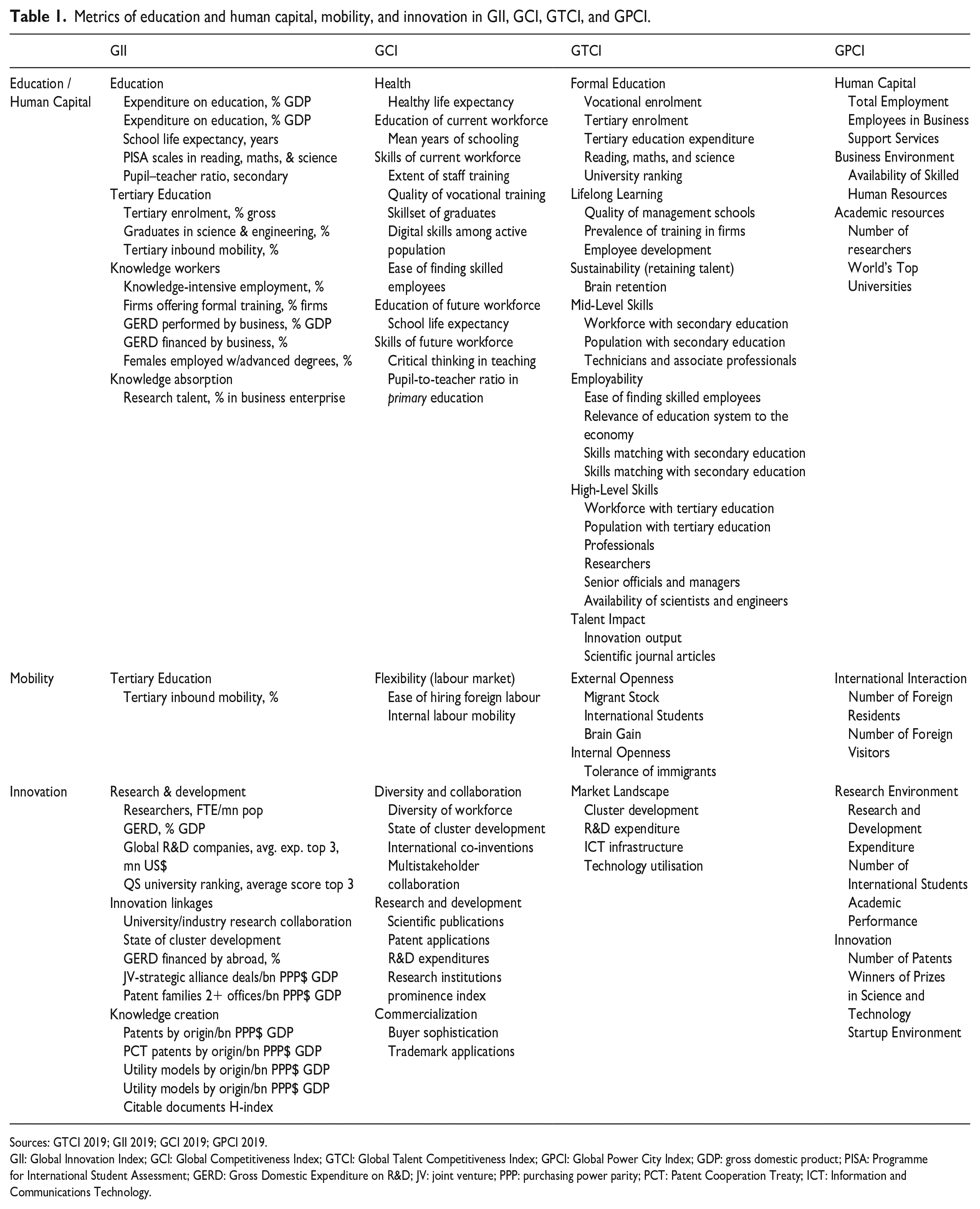
Sources: GTCI 2019; GII 2019; GCI 2019; GPCI 2019.
GII: Global Innovation Index; GCI: Global Competitiveness Index; GTCI: Global Talent Competitiveness Index; GPCI: Global Power City Index; GDP: gross domestic product; PISA: Programme for International Student Assessment; GERD: Gross Domestic Expenditure on R&D; JV: joint venture; PPP: purchasing power parity; PCT: Patent Cooperation Treaty; ICT: Information and Communications Technology.
For our purposes, these four indexes purportedly measured different themes and features – competitiveness in the case of GCI, innovation (GII), talent (GTCI), and city ‘magnetism’ (GPCI), but they contained surprisingly similar elements and data sources. As Table 1 shows, a content analysis of human capital, mobility, and innovation metrics revealed how human capital has been reduced to educational levels of the population. Here, the GCI is an exception: it acknowledged the health aspects of the population as an important indicator. There is also conceptual stretching towards employability and public–private collaboration in innovation and ranking scores of universities, highlighting the economic and competitive elements of education. This is indicative of the innovation hub model, stressing the relationship between different actors and the economic benefits of innovation.
The metrics on mobility (Table 1) reflect the talent competition imaginary by emphasising inbound mobility of higher education degree holders and students as well as work-based migration and ‘brain gain’. The policy idea conveyed here is that having a ‘stock’ of ‘talent’ makes innovation possible. The innovation component of all four metrics shows great similarities with emphasis on research and development (R&D) investments, scientific publications, patents, university–industry collaborations, and, again, ranking performance of academic institutions. The policy model of the ‘innovation hub’ is hence intimately linked to the metrics of education and university rankings. In fact, the global university rankings are instrumental for the rankings of local innovation (Erkkilä and Piironen, 2020).
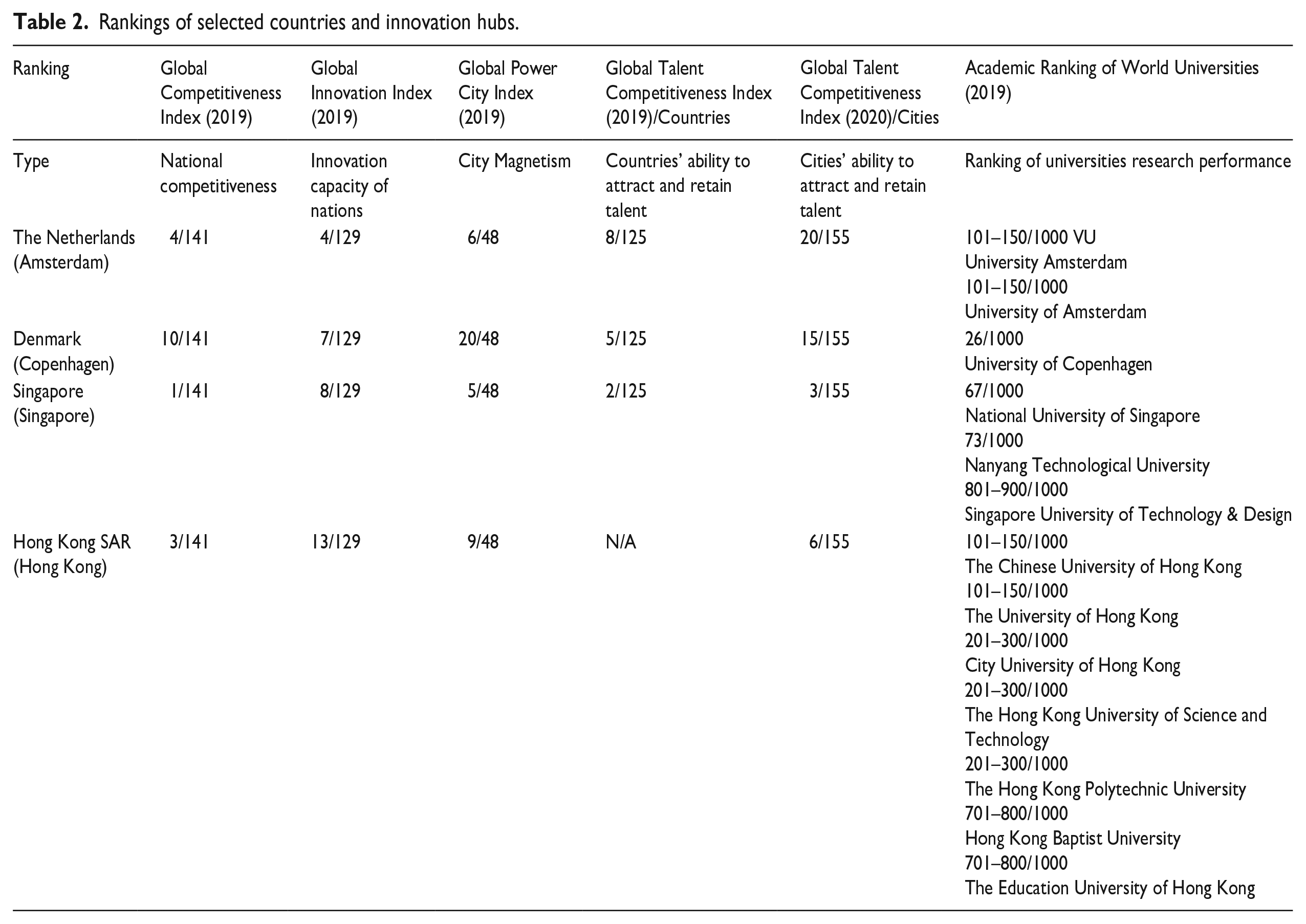
The rankings project a very uniform view of the world. For example, Table 2 presents the performance of four selected countries and cities (‘innovation hubs’) concerning their rankings in the abovementioned indicators and university rankings (Academic Rankings of World Universities). In so doing, these indicators and rankings revealed how the world is to be imagined. Scholars of political economy have highlighted the importance of imaginaries for capitalism in explaining and assessing the uncertain future (Beckert, 2016; Jessop, 2004, 2010; Robertson, 2017), but imaginaries are equally important for analysis of global governance and policy (Archer, 2012; Hajer and Versteeg, 2019; James and Steger, 2014; Kamola, 2014; Levy and Spicer, 2013; Steger and James, 2013; Wright et al., 2013), and science and technology studies (Jasanoff and Kim, 2015). Scholars have also highlighted the connections between future studies, political history (Andersson, 2012), and planning (Neuvonen, 2022). Imaginaries are also linked to collective identities and nationalism (Anderson, 1991; Castoriadis, 1987; Strauss, 2006; Taylor, 2002, 2004). Put simply, imaginaries matter.
Rankings of selected countries and innovation hubs.
The imaginaries are visible in the narrative elements of the policy script: the storyline. This is future-oriented, but the storyline also contains references to the past, involving medieval city states, cartography, and navigation (Erkkilä et al., 2023). The World Economic Forum (2014: 7), producer of the Global Competitiveness Index ranking countries, shifted its interest towards cities in 2014 with a historical narrative of the global economy of cities. Similarly, China launched the Belt-and-Road Initiative in 2013 by invoking the storied past of the Silk Road. The Portulans Institute (2022), producer of the Global Talent Competitiveness Index, also similarly defines itself and its mission statement in historical terms: Portulans (or portolans) are ancient nautical maps, first made in the 13th century in the Mediterranean basin and later expanded to include other regions. The word portolan comes from the Italian portulano, meaning ‘related to ports or harbors’, and which since at least the 17th century designates ‘a collection of sailing directions’. In these maps, only a few harbors were visible, and much of the coastlines were hypothetical. This is how we see our mission: in an uncertain world, much is yet to be explored, and many opportunities have yet to be identified. Like the navigators of the 16th century, modern leaders have to make decisions on the basis of imperfect information and incomplete maps. The Portulans Institute aims at providing them with the best available data and analyses, and the directions that they need.
The global rankings and policy indicators function as navigation tools for the uncertain future amid digitalisation and automation, building on the imaginaries of competitiveness that now emphasise the ability to ‘grow, attract and retain talent’. Through objectification (Desrosières, 1998), indicators help to turn concepts such as ‘research excellence’, ‘skills’, or ‘talent’ into governable objects (Miller and Rose, 1990). But an equally important mechanism of influence in numerical governance is subjectification, where subjects of measurements are pressured to acquire particular identities linked to proposed action (see Erkkilä and Piironen, 2018: chap. 2; Lawler, 2014: 6, 69).
This concerns particularly cities as actors of global governance that are increasingly obtaining responsibilities for their ‘competitiveness’. As noted above, city strategies as discursive devices are based on narratives, they also tend to carry templates that appear homogeneous in form and content in different contexts globally (Brandtner et al., 2017: 1080). We see a strong ideational link with such templates and global rankings, as cities are highlighting similar topics (‘talent competition’) as significant and using the same vocabulary (‘fostering’, ‘attracting’, and ‘retaining’ talent) in their strategy documents as used in the prominent rankings. In the next section, we introduce our research design and methodology to begin our exploration of how cities as innovation hubs are being conceptualised and articulated to address global challenges.
Research design and methodology
Our research design is explicitly comparative, using the case study approach. Specifically, our case selection is built around top-performing regional rivalries in Europe (Amsterdam vs Copenhagen) and in Asia (Singapore vs Hong Kong). The focus on rivalries underlines the contemporary imaginary of talent competition, where cities are increasingly seen as global actors, often overshadowing the countries where they are located. Indeed, according to the 2020 Globalisation and World Cities Research assessment, Singapore and Hong Kong are categorised as ‘alpha+’ cities (‘highly integrated’ or ‘primary’ cities), Amsterdam is an ‘alpha’ city (‘very important world cities that link major economic regions and states into the world economy’), and Copenhagen is a ‘beta+’ city (‘instrumental’ world cities) (GaWC, 2020). Moreover, rankings have helped to identify new rivals and peers for ranked entities that might not otherwise be self-evident. At the same time, rankings have become a common reference point for actors all over the world, classifying the subjects of measurement as innovators and laggards, lifting some as winners while punishing others as losers in the global race.
Although cities apply discourses of global competition (for example, ‘world-class’ and ‘leading’), we identify that the measurable objectives in city strategies are more often set against regional rivalries. For instance, Amsterdam aims to be in the top five performing economies in Europe (City of Amsterdam, 2022b), and Copenhagen wants to be among the top three of Europe’s best cities (City of Copenhagen, 2015: 5). Looking at Hong Kong, its 2030+ vision is to be ‘Asia’s World City’ (Planning Department and Development Bureau, 2021: 2). As cities strive to become the ‘best’ in their region, they identify competitors within the region. For example, in Copenhagen’s strategic documents, Amsterdam has been identified as an explicit rival (City of Copenhagen, 2020: 6). In the same way, Singapore notes its position against regional competitors in rankings, with Hong Kong as a consistent country comparison in talent competition and innovation (Wang, 2018).
Rivalries are thus important especially in ranking environments where cities are not only interested in global positioning but also in regional league tables. However, the models that travel across regions and in discourse competition are a global phenomenon. For instance, Singapore notes innovation performance in other small advanced economies such as the Netherlands (National Research Foundation Singapore, 2020: 6). In this context, it is important to point out that Singapore is included both in country- and city-level comparisons. The case of Singapore thus offers an interesting perspective as to how the government activates the ‘city’ and/or ‘state’ lens concerning its global competition for talent. Singapore is also a common case for those national and city governments seeking models in times of uncertainty. For instance, UK politicians have looked at Singapore as a model for a post-Brexit London (‘Singapore-on-Thames’) (Ranta, 2019).
Our explicit cross-regional comparisons (for example, ‘East’ vs ‘West’) aims to identify the contextual variations within and across regions, if any. There are limitations to our research design given our coverage of only four case studies. Our trade-off here is between granularity of the case comparisons (depth) and coverage concerning the number of cases (breadth). The four case studies we have selected should be seen as the first step towards highlighting a phenomenon of interest to international relations scholars: How cities are steering their future through constructing innovation hubs. In the concluding section, we identify research steps forward that would enable us to draw conclusions regarding the broader trends of constructing future cities and tackling global challenges.
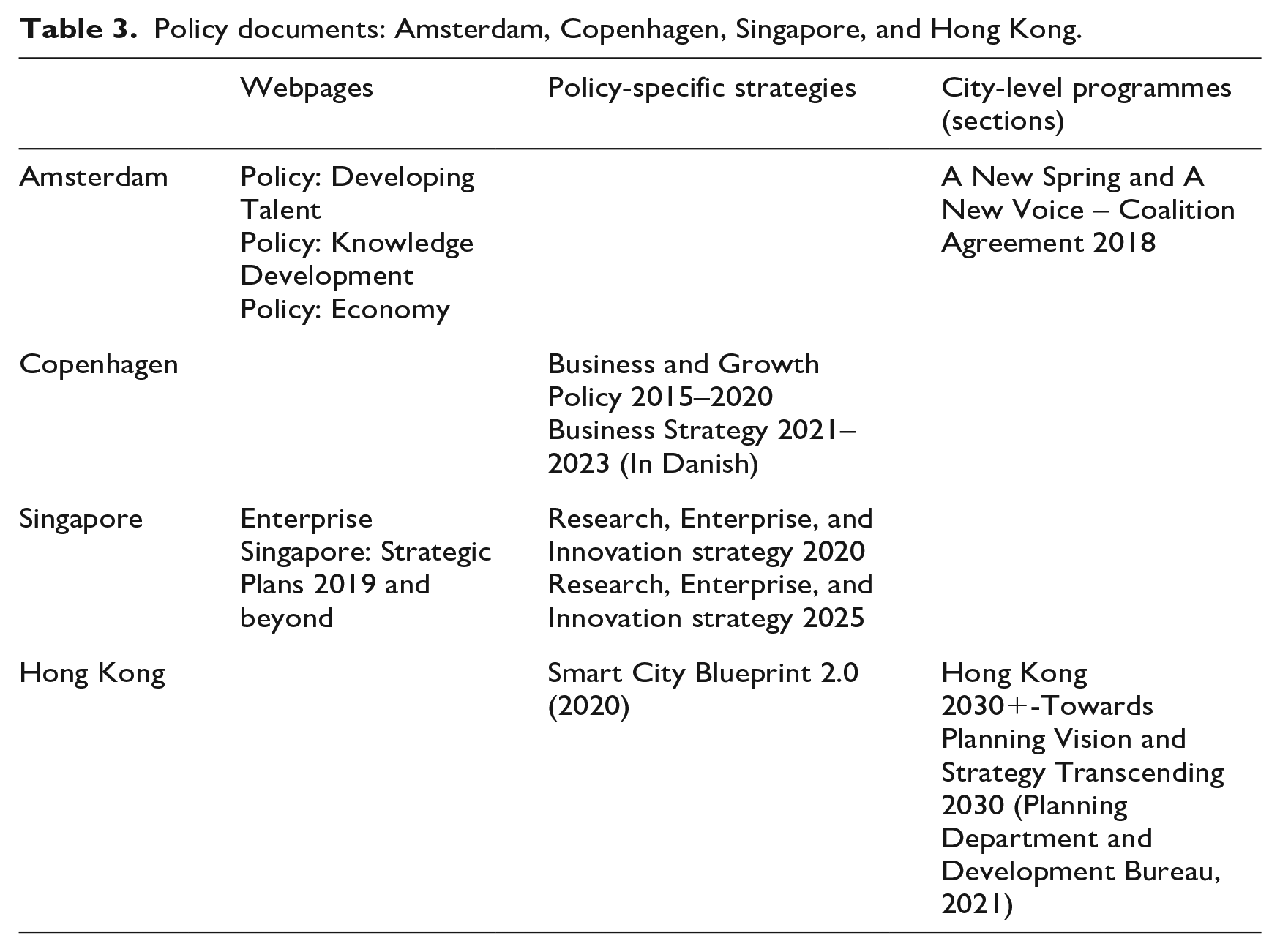
In terms of methodology, we used qualitative content analysis (Drisko and Maschi, 2015; Prior, 2020) to compare and analyse policy documents and statements as well as global indicators concerning competitiveness, innovation, and knowledge. Table 3 presents a list of the documents and webpages we analysed. We collected the documents from the city governments’ websites in Autumn 2020 (August–September) and in Spring 2022 (April). Specifically, the policy documents included webpages dedicated to innovation and knowledge policies (Amsterdam, Singapore), business, innovation and growth strategies (Singapore, Copenhagen), and sections from the city government’s programmes (Amsterdam, Hong Kong). The material consists mainly of policy documents in English, except for one Copenhagen document in Danish. The strategic policy documents have been chosen since they are distinct ‘discursive devices’ used in city governance to ‘describe’ the aspired futures, but also to authoritatively ‘prescribe’ actions and ‘arrange’ the actors involved (Brandtner et al., 2017: 1076). As our material consists of strategy documents in various formats, we do not analyse frequencies, cross-tabulations, or other quantitative metrics. Instead, we qualitatively compare the policy scripts in the selected documents.
Policy documents: Amsterdam, Copenhagen, Singapore, and Hong Kong.
The coding was conducted by a single coder using the ATLAS.ti 1 software. As mentioned earlier, our coding scheme includes governance issues (demographic change, knowledge, sustainability, responsibility, digitalisation, automation, and competitiveness), references to policy models, modalities of governance (collaboration, democracy, conflicts, and balance), and references to time and temporality. Each of these coding schemes allowed us to identify how the city governments define policy problems and future challenges through governance issues, develop concrete proposals through identified policy models, promote systemic adaptability through specified modalities of governance, and understand time in these processes. We developed our coding scheme following a deep and wide reading of the literature on rankings and indicators as well as our insights into their field development. Coded documents were analysed to find both commonalities and variations in themes, policy content, and discourses. We categorised indicators using a similar coding scheme, and qualitatively compared how the indicators conceptualise and operationalise the policy issues. Our approach is thus a distinctively qualitative version of content analysis. The approach, including the single-coder execution, also entails limitations concerning the nature of our conclusions. While our approach is certainly suitable for identifying the phenomena, such as evolving conceptualisations, a more nuanced and controlled comparative design would be more appropriate for drawing explanatory observations.
In the next section, we turn to our results to highlight the commonalities and differences between our city cases in how they imagine and design their locations as innovation hubs for addressing global challenges. We begin with the governance challenges that city governments have identified, and how they have translated these challenges into policy problems that can be addressed before moving on to concrete proposals and systemic adaptability, with time present in each of the storyline sequences.
Comparing Amsterdam, Copenhagen, Singapore, and Hong Kong
Governance challenges and future visions: Robust, but creative?
Our analyses have confirmed that cities have identified a shortage of ‘talents’ as a policy problem for global competition, and a clear strategy to address this (that is, by transforming into global innovation hubs), but it remains unclear whether their approaches could meet the demands of global challenges. To explore this likelihood, it is essential to drill down on which major challenges cities have identified as particularly confounding. In doing so, we can then discuss the policy solutions cities have developed so far to confront these major challenges and whether these solutions are fit-for-purpose.
A major challenge for cities and their competitiveness is connected to the global megatrend of ageing societies. Here, ageing societies have direct implications for the available talent pool and cities’ governance performance (City of Amsterdam, 2022a; City of Copenhagen, 2020: 19–20; National Research Foundation Singapore, 2020: 24). Explicitly and implicitly, our four city case studies have all acknowledged that the pool of the most wanted talents is quite limited – hence the intense global competition for these scarce human resources. For example, Copenhagen explicitly notes that incoming mobility of talents may help address some of the global challenges it faces, but this alone will not solve all the problems due to the global nature of the challenge. In other words, the origin cities and states share the same problems emerging from ageing societies and are thus motivated to retain their talents – domestic or foreign – to address these same issues (City of Copenhagen, 2020: 19–20). The prevalence of the concerns revolving around ageing societies is visible in our city cases: all cities worry about their ageing population (City of Amsterdam, 2022a; City of Copenhagen, 2020: 19–20; Planning Department and Development Bureau, 2021: 22; National Research Foundation Singapore, 2020: 23–24).
To respond to challenges emerging from ageing societies, our city case studies have pointed to cities adopting a twofold approach in which they want to develop solutions that can solve labour market challenges of decreasing work-age population (for example, through digitalisation), while at the same time trying to innovate in the area of elder care (City of Copenhagen, 2015: 5) and overall welfare services (National Research Foundation Singapore, 2016: 16; 2020: 24). This dual approach reflects the ways in which ageing cuts across multiple policy sectors: labour market, health, transportation, and more. Alongside battling against adverse effects of ageing by encouraging innovation and technology development, the cities are developing policies to make their locations friendly to families (nuclear, multi-generational), children, and youths (Planning Department and Development Bureau, 2021: 11) that could potentially alleviate pressures from an ageing society in multiple ways (see subsection on ‘Hub’ below). This twofold approach, however, relies on being able to have the required talents to translate, implement, and realise these visions.
Newer city strategies have pointed to the major challenge that unexpected exogenous shocks such as the COVID-19 pandemic have posed to cities: these shocks constitute strong risks for cities in the future. Indeed, city governments have questioned their capacity to deal with, and to adapt to, unknown challenges even though they are confident in identifying some risks stemming from, for example, climate change (City of Amsterdam, 2018: 6; City of Copenhagen, 2015: 5; National Research Foundation Singapore, 2020: 28). In response, objectives such as preparing for change and being resilient (Planning Department and Development Bureau, 2021: 2; National Research Foundation Singapore, 2020: 17, 27), and ‘incorporate flexibility to cater for our unknown future’ (Planning Department and Development Bureau, 2021: 20) are found in the strategies. These needs are also discussed in relation to innovation and competitiveness policy, for instance, in capacities of life sciences and vaccination development (National Research Foundation Singapore, 2020: 20), and supply chain resilience (National Research Foundation Singapore, 2020: 15, 17–18). As cities question their capacity to confidently predict future challenges as a result of the COVID-19 pandemic, they are also attentive to how the pandemic has noticeably disrupted the flow of talents (National Research Foundation Singapore, 2020: 47). Talents, as we discuss next, are seen as needed and their absence framed as a policy problem.
Talents wanted: Foreign, domestic, and city-specific
The four cities we analysed have all identified a shortage of ‘talents’ as a policy problem their cities face. While these four city governments have used the generic concept of ‘talent’, a closer reading of city strategies reveals that cities have quite clear preferences for the types of talents, their attributes, and professional or academic fields. Starting with the most wanted pool of talents, we find uniformity among our four city cases that echo the prioritisation of skills in the rankings (see Table 1). Indeed, the strategy documents reveal a discursive process that frames more specific policy problem with the help of rankings, but there are some variations based on the city’s profile and visions. The most sought after talents are those highly educated in science and technology, with a growing emphasis for sustainability or green experts. In science specialisations, Planning Department and Development Bureau (2021: 20) identified STEM fields and biotechnology, City of Amsterdam (2022a) singled out mathematics, physics, and computer science, and Singapore emphasised life sciences (National Research Foundation Singapore, 2020: 21). On the technology and digital front, those working in priority fields such as health tech (City of Copenhagen, 2015: 7, 18; National Research Foundation Singapore, 2020: 21), AI, and related new technologies and cybersecurity (City of Amsterdam, 2022a; City of Copenhagen, 2020: 20; National Research Foundation Singapore, 2020: 6, 33, 36–37) are welcomed. For Copenhagen (2020: 3, 12, 20), talents working in green or cleantech are seen to offer future competitive advantage due to climate pledges and international policy development.
In addition to their fields of expertise, cities also wanted specific attributes talents should possess. The most desirable attributes include flexibility, meaning that the talents should preferably be multi-skilled or have ‘in-depth knowledge’. Multi-skilled are those individuals who can combine knowledge of business with expertise in technology, or what Singapore calls ‘bilingual talent’ (National Research Foundation Singapore, 2020: 10, 47). In a similar vein, ‘entrepreneurial talent’ is wanted (National Research Foundation Singapore, 2020: 56) to cultivate innovation and chart new pathways. On the other hand, Amsterdam aims to attract talents with ‘more in-depth expertise’ (City of Amsterdam, 2022c). At the same time, Amsterdam wants ‘flexible talents’ (City of Amsterdam, 2022a) with a capacity to be mobile and retrain. The examples from Singapore and Amsterdam tell us that city governments seek individuals who are able to lead in blazing new pathways – in science and technology, in business, and more – while highly adept at pivoting towards new promising areas and sectors.
Alongside attracting talents from elsewhere, cities also identify the need to cultivate local talents. Indeed, the objective for retraining is widely shared by all city governments (City of Amsterdam, 2022a; City of Copenhagen, 2020: 10; Innovation, Technology and Industry Bureau, 2020; National Research Foundation Singapore, 2020: 10), and includes upskilling or reskilling through education and during career lifespans. In these instances, educators and public-sector employees have been singled out as needing to have up-to-date skills in the use of digital tools and knowledge about sustainability. In comparison to European rivals, our two Asian rival cities have stated this goal more explicitly. For instance, continual emphasis has been placed on developing local talents in key sectors (Innovation, Technology and Industry Bureau, 2020; National Research Foundation Singapore, 2020: 8v), with Singapore strategising to bring back their own nationals from abroad (National Research Foundation Singapore, 2016: 3). In addition, Copenhagen and Singapore have acknowledged the need for local talents when promoting the importance of knowledge transfers from foreign to local experts (City of Copenhagen, 2020: 12; National Research Foundation Singapore, 2020: 8, 35). Our four city cases also have specific goals for foreign talents: to create ‘global impact’ (National Research Foundation Singapore, 2020: 8), to ensure ‘economic vibrancy’ (Innovation, Technology and Industry Bureau, 2020, 32), to improve international competitiveness (City of Copenhagen, 2015: 3), and to match the needs of businesses (City of Amsterdam, 2022a).
The tension between investing in the local and attracting the international has contributed to cities differentiating their strategies. Indeed, some cities have expressly set out some criteria for (international) businesses seeking to establish presence in their territory. For example, Amsterdam explicitly states how businesses searching for only tax benefits should not bother relocating to the city, but international businesses seeking to be sustainable and innovative are warmly invited (City of Amsterdam, 2018: 55). Likewise, Copenhagen explicitly states that it expects all businesses to contribute to better environment and working conditions, a green, tolerant, and diverse city, and to embrace social responsibilities (City of Copenhagen, 2015: 5). Here, we can see that the European rivals are stating these restrictions more explicitly in their city statements. However, looking at the evolution of talent migration policies in Asia, we can see how these criteria have already been integrated into labour market protection measures (see Singapore’s Fair Consideration Framework in Cerna and Chou, 2023). What these examples tell us is that city governments also seek to balance the need for both foreign and domestic talents through different sectoral strategies – in migration policies, and through labour market access. As we shall discuss next, while cities frame the general absence of wanted talents as a policy problem, they also envision their presence in a more specific setting: an innovation hub.
The city as a hub of talents: A model for all?
The emerging policy script of talent competition is implemented through the policy model of global ‘innovation hub’, to which all of our city case studies adhere. The city strategies all share a common view that businesses, investments, and talents should coalesce around hubs that have other businesses, talented workforce, and knowledge institutions. The idea is not to start from scratch; rather, it is to grow what is already present. Here, collaborative modalities of governance are highlighted with the aim to build attractive ‘hubs’, ‘helixes’, ‘centres’, and ‘networks’, where more of the desired components could join forces and compete with counterparts. The perceived attractive features for such hubs are similarly widely shared. For businesses and investments, these include business-friendly governance, high levels of digitalisation across a wide range of services and also in government, internationalisation in collaboration, and good digital and transportation infrastructures, including international accessibility such as airports and high speed trains. In short, the city strategies talk about visions in which businesses (of all sizes), knowledge institutions, and the city government work strategically together to establish their city as an innovation hub.
A key element of cities as innovation hubs is the presence of talents. We find this in the discourse on talent competition, which pervades the city strategies we analysed (see above). As the examples from Amsterdam and Singapore illustrate, the policy script of ‘to grow, attract, and retain’ talents is reproduced in different parts of the world: Amsterdam’s labour market is changing, and it’s time to take action. . . . As the labour market itself has failed to solve these problems, Amsterdam’s city government has stepped in and is Sustain a vibrant, diverse and globally-connected research ecosystem that
The individual parts of the script, such as attracting talent, can also be formulated as a policy problem that stems from a characteristic of the city (see above). As the Copenhagen example shows, this is often identified in comparison to rivals (named or unnamed): Many foreign city regions have more residents and businesses and are more commercially specialised than Copenhagen. This is often identified as an important reason why
As solution to such problem statements, the city strategies evoke more specific yet generalisable elements of the script, also corresponding with the logical elements of global rankings, such as the ‘liveability’ of a city. Our city cases all enumerated a list of environmental factors for attracting talent grouped under such terms as ‘liveability’ (Planning Department and Development Bureau, 2021: 18), or ‘high quality of life’ (City of Amsterdam, 2022a; City of Copenhagen, 2020: 6). More concretely, the following factors were listed. Good city services that are accessible through, for instance, one-stop-shop for all authorities or digitalised channels (City of Copenhagen, 2020: 20). Talents and their families need good housing, international day-care and schools, and support for spouses in employment (City of Amsterdam, 2022a; City of Copenhagen, 2015: 21). More broadly, the attractive features include clean air and water, good digital and transport infrastructure, and welfare provisions (City of Copenhagen, 2020: 6). In addition, such issues as cultural and leisure offerings (City of Copenhagen, 2015: 21; 2020: 6) are deemed to be important assets a city should possess to bring in the ‘best-and-brightest’. By providing these city-level amenities, city governments believe that they would grow their city into a competitive global innovation hub that would attract and retain global ‘talents’.
Our city cases have also revealed the importance of strategy differentiation as key in constructing their innovation hubs. For instance, in Singapore’s case, the strategy setting is guided by choosing and focussing on priority technologies and subfields selected based on broader politico-societal goals (National Research Foundation Singapore, 2020). In Amsterdam’s case, there is a distinctive focus on managing or balancing out externalities of internationalisation, growth, and innovations by city government action such as regulation and cushioning policies in labour markets while supporting start up communities and entrepreneurial spirit (City of Amsterdam, 2018; 2022a, 2022b, 2022c). In Copenhagen’s case, the green and sustainability city objectives along with welfare are mainstreamed into growth policy and they seem to heavily guide the priority setting in innovation policy (City of Copenhagen, 2020; 2015). In Hong Kong’s case, it aims to build the strategies around its role as the hub of hubs or central connectivity node that attracts and connects regional and global flows of investment, innovation, and, of course, ‘talent’ (Innovation, Technology and Industry Bureau, 2020; Planning Department and Development Bureau, 2021). While the cities in our analyses differentiated how their ‘innovation hub’ would be from their rivals’, they all began with the notion of ‘innovation hub’—a policy model for global cities. In the concluding section, we reflect on the implications of this strategy convergence in light of ready futures for tackling global challenges.
Conclusions
In this article, we set out to examine how cities have been conceptualised and articulated as innovation hubs for addressing global challenges. We do so by focussing on the policy scripts emerging from city strategies of Copenhagen, Amsterdam, Singapore, and Hong Kong to detail what they tell us about the governance of futures. This is a significant topic for the studies of international relations for several reasons. As an editorial of this journal (Editorial, 2021) has elaborated, global challenges now define contemporary studies of international relations. We need to know how states meet, or fail to face, global challenges. To do so, however, we need to have a good understanding of the empirical landscape, for example, the actors involved, the strategies introduced, their interactions and results. The methodological nationalism prevalent in the study of international relations has affected our analytical ability to see the empirical landscape (Acuto, 2010). Administration and policy are global (Chou et al., 2023; Moloney, 2021; Moloney et al., 2022; Stone and Moloney, 2019), and cities play a central role in the construction and implementation of the future. Non-state actors such as cities are involved in international relations; increasingly, global or world cities have paradiplomatic relations with regional and sub-regional entities that overshadow those of the countries where they are located. The study of international relations should attend to the ways in which cities as non-state actors are steering global governance. Our article identified a dominant policy script that determines policy actions of four world cities in Europe and in Asia towards global challenges.
To address the broad and complex policy issues of sustainability, digitalisation, and workforce ageing, our city cases seek to transform themselves into global innovation hubs, capable of growing, attracting, and retaining talent. Here, the shortage of talents is a policy problem that concerted efforts towards becoming a competitive global innovation hub is expected to address. Similar to the metrics of competitiveness and innovation found in other indexes, they emphasise the close collaboration of various actors while also stressing ‘liveability’ as outlined in city rankings. The future visions the city strategies projected are surprisingly uniform, based on similar causal beliefs and assumed sequences of events, informed by global rankings and indicators. The implications of conformity is that the intensifying competition in ‘innovation’ leads to the paradoxical loss of creativity in future visions. Indeed, to ensure their survival and resilience, the cities we analysed have embraced robust visions of futures based on assumptions of continuity and linearity of activities.
As we emerge from a global pandemic in which scientific creativity generated new vaccines, the time is ripe to question whether creative visions (not just robust) of futures are needed for tackling global challenges. Future research could thus explore several avenues. For instance, analyse the ways in which creative visions of futures are actively curtailed by examining global ranking productions and how ranking producers successfully promote their knowledge products for global governance. Since we focussed on top-performing rivalled cities in Europe and in Asia, future research could investigate whether creativity is to be found in non-top-performing cities, not yet driven by the policy script on global talent competitiveness. Indeed, what are the local solutions for global challenges? Future research could also attend to how city strategies are crafted and the processes through which the policy scripts of transnational actors and knowledge brokers are adopted. It would be particularly interesting to assess the extent to which city strategies are the result of reflexivity over rankings, or if learning from city peers is involved.
Footnotes
Funding
The author(s) disclosed receipt of the following financial support for the research, authorship, and/or publication of this article: Tero Erkkilä’s and Juho Mölsä’s research was supported by the Strategic Research Council at the Academy of Finland [grant numbers 345950 and 345953] and Academy of Finland [grant number 354866]. Meng-Hsuan Chou received funding from the University of Helsinki as a visiting professor at the Faculty of Social Sciences (2019-2021).
