




Abstract
Existing research on party leader questioning in legislatures usually focuses on single case studies, less-than-ideal behaviours across leaders, and often post-election periods. Our article compares hostility and positivity in behaviours across three parliaments and, because of the COVID-19 crisis, across different time periods and modes of operation (live, hybrid, and online) while controlling for the same leaders. Using content analysis at the sentence level (N = 3554), our data contrast parliamentary leader hostility and positivity levels in the UK, Scottish, and Welsh Parliaments across three time periods: pre-COVID-19, initial, and lockdown COVID-19. Findings for positivity are mixed, but for hostility, we find that while the initial shock of the COVID-19 crisis suppressed hostility, Westminster has higher ratios of hostility across all three time periods, and that format of operation has little effect on behaviour. Findings suggest less hostility in Scotland and Wales than in Westminster adding possible weight to ‘new politics’ arguments.
Keywords
Introduction
In recent years, there has been increased interest in the quality of legislative procedures like the Prime Minister’s questions (PMQs) (see, e.g. Bates et al., 2014; Bull and Strawson, 2020; Shephard and Braby, 2020; Waddle et al., 2019) and First Minister’s questions (FMQs) (Parker et al., 2018). However, most of the attention has focussed on single cases (especially the PMQs in the House of Commons), with comparisons focussing more on changes over time than across countries. In this article, we take a comparative approach by comparing PMQs in the House of Commons with FMQs in both the Scottish Parliament and the Welsh Parliament/Senedd. We also make use of comparisons across a unique period of a world-level crisis (COVID-19), permitting a pre-crisis versus crisis comparison of how procedures fared over time epochs and across three similar procedures in three different parliaments across six different leaders.
The present study is the first to explore whether FMQs deviates from its Westminster counterpart in terms of both hostility and positivity levels. It does this across a ‘normal’ pre-crisis period and then across a crisis-discovery period and a lockdown crisis period to explore whether procedures work differently in different parliaments and across different political scenarios that affect both parliaments equally. In sum, our research is both comparative across similar cases and across similar comparative crisis time epochs.
Theoretically and empirically, we explore a number of new dimensions: 1) To what extent is there any kind of ‘new politics’ in the Scottish and Welsh Parliaments compared with the UK Parliament during questions to the leaders?; 2) How does a worldwide crisis affect hostility and positivity in the three parliaments over time; and 3) To what extent does elite behaviour vary according to whether the operating format was online, hybrid, or face-to-face?
Adapting and developing the typology/coding schedule used by Waddle et al. (2019), we used content analysis to code for hostility and positivity. Our data are the transcripts of the exchanges between the First Minister and the leader of the Scottish Conservatives in the Scottish Parliament and the exchanges between the Prime Minister and the leader of the SNP in the House of Commons between January and July 2020. To check the validity of the findings with regard to new politics, crisis effects, and format effects, we also coded exchanges across a comparable period between the First Minister and the leader of the Scottish Conservatives in the Welsh Parliament.
Our results suggest that there is generally less hostility and less positivity in the Scottish and Welsh Parliaments than in Westminster. However, the immediate threat of COVID-19 had a temporary calming effect on all institutions. The format of interactions between the leaders (face-to-face versus hybrid versus online only) appears not to be related to levels of hostility and positivity, as there is considerable variation of hostility and positivity within the same format of operations.
In the next section, we discuss our theories pertaining to ‘new politics’ (or not), the behaviour observed in legislatures, the behaviour that we might expect during crises, and different working arrangements (face-to-face versus hybrid versus online). We then explain the nature of our data and methods before providing more details about our results, conclusions, limitations, and implications for the literature.
Theories
A ‘new politics’?
At the outset (e.g. Consultative Steering Group, 1998; Scottish Constitutional Convention, 1995), there were hopes that the new Scottish Parliament (and, to a somewhat similar extent, the Welsh Parliament/Senedd 1 : see, for example, Bradbury and Mitchell, 2001) could help deliver a less adversarial ‘new politics’ by designing a parliament that would be different from Westminster, for example: unicameral; more powers to committees to provide the possibility of more balanced executive-legislative relations; a less adversarial semi-circular seating arrangement with seats for all members; and an electoral system that would permit fairer representation of smaller parties. Moreover, the inclusion of both the U-shaped chamber and the electoral system was designed to facilitate a more diverse representation of party voices and more collaboration (Parker et al., 2018; St Denny, 2020) as members sit connected to one another rather than opposite one another in the more confrontational and crowded seating design of Westminster (for the importance of architectural design, see also Goodsell, 1988). Indeed, the expectation was for more consultation and cooperation not just within the Parliament but with outside groups and citizens too. Not only was there a fairly prominent new Petitions Committee and process but committees were encouraged to travel around Scotland to facilitate the inclusion of a myriad of voices in political and policy processes (St Denny, 2020). According to St Denny (2020), this was not just intended to be about institutional change but also about embracing cultural change too.
While the procedures at Westminster did help inform choices made for the Scottish and Welsh Parliaments too (e.g. both FMQs are derivatives of Westminster’s PMQs in which all parliamentarians have a weekly opportunity to question the leader of the government), there were initial hopes that some of the differences devised for Scotland and Wales could be enough to facilitate the possibility of a new way of doing things (Brown, 2000; McAllister, 2000). That said, there were also concerns expressed early on in both the Welsh and Scottish Parliaments that reforms did not go far enough, and moreover, both systems inherited political parties and actors used to a Westminster culture of operation (Bradbury and Mitchell, 2001).
Many of the expectations for the Scottish and Welsh Parliaments fit within the theoretical lens of Lijphart’s (1999) consensus model of democracy and how it differs from the Westminster model of democracy (most notably given the limits of devolution: executive power-sharing; executive-legislative balance of power; multi-party system; proportional representation; and interest group corporatism). As King (2007) notes, many developments under Tony Blair (e.g. devolution, the Human Rights Act, and handing power over interest rates to The Bank of England) have challenged notions of a centralised Westminster state. Moreover, as Cairney (2011a) argues, the dichotomous theoretical modelling of consensus and majoritarian systems is also as problematic for understanding the realities of the Scottish political system as it is for the Westminster political system. Cairney (2011a) illustrates that if we avoid isolated cases that confirm caricatures, both systems invariably consult with wider groups in the policy process, both governments tend to drive policy, and the power of both parliaments in impacting the policy process is minimal. Also, engagement with the public and the petition process has had little tangible effect on public policy (Cairney, 2011b). Compounding this, sometimes plurality voting systems lead to coalition governments (UK 2010–2015), and sometimes more proportional voting systems lead to a single-party majority or single-party minority governments (e.g. Scotland 2007–2021; and Wales 2003–2007, 2011–2016; and 2021+). In the case of Wales, theoretically, the majority government should be more likely on average than in Scotland due to a greater proportion of seats being decided according to the first-past-the-post plurality system (40/60 or 67% for Wales versus 73/129 or 57% for Scotland).
After the heady enthusiasm and expectations of the early years, it soon became apparent that the high expectations for a ‘new politics’ were difficult to meet. Indeed, Mitchell (2010) argues that once we delve beyond issues of the electoral system and representation, the institutional set-up and operation of the Scottish Parliament resembles Westminster in many ways. For example, while the additional member system used in Scotland does ensure parties are more accurately represented in the Scottish Parliament according to their levels of support compared with the House of Commons, many procedures are very similar to Westminster; for example, FMQs is clearly modelled on PMQs, and the highly partisan nature of Westminster party politics has been replicated in Scotland as the parties are not new. A similar scenario of existing party politics and culture exists for Welsh politics and Welsh FMQs (Bradbury and Mitchell, 2001). In the case of Scotland, Henderson (2005) finds that three-quarters of the MSPs had prior political experience under the old system and that hints of new politics in various participation measures were eclipsed by the second month of operation. Indeed, Mitchell argues that FMQs are like PMQs but ‘with more parties hurling abuse across a U-shaped chamber’ (Mitchell, 2014: 55). Moreover, party political tensions have been heightened in recent years over constitutional divisions between the parties over Scottish independence and Brexit, particularly between the Conservatives and the Scottish National Party (SNP) who have more ‘clearly defined positions’ here on both of these issues (Mitchell and Henderson, 2020: 144). Both Scottish independence and Brexit will have compounded the likelihood of abuse increasing even more during FMQs. Indeed, research on questions asked in FMQs by Parker et al. (2018) suggests that FMQs have become more negative in tone over time. In turn, despite the layout and extra space of the Scottish Parliament chamber compared with the Westminster House of Commons, we hypothesise that:
Hypothesis 1 (H1). Given the similarity of Scottish (and Welsh) FMQs to UK PMQs and the adversarial nature of party politics across all three parliaments, hostility in the Scottish and Welsh Parliaments is unlikely to be that different from hostility in the House of Commons.
Hostile versus positive political behaviour
Most of the literature on elite behaviour tends to focus more on the negative behaviours than the positive behaviours of politicians. There is an obvious reason for this because researchers are fundamentally interested in exploring what is deemed not to be working well, so that they can assess the validity or not of the situation before possibly suggesting potential solutions such as procedural changes. For example, initial studies tended to focus on participation rates and procedural changes in Prime Ministers’ engagements (see Dunleavy et al., 1993).
Newer studies have explored more of the specific content that occurs during exchanges with Prime Ministers. For example, Bates et al. (2014) found that PMQs have become rowdier, more diverse in question range, more likely to produce unanswerable questions, and more dominated by leaders over time. Waddle et al. (2019) devised a coding scheme for the analysis of personal attacks and found that these had heightened in more recent time periods, possibly due to heightened TV and social media coverage. Shephard and Braby (2020) explored the state of Prime Ministers asking questions of the leader of the opposition (the converse of what is expected in a procedure such as PMQs) and found an increase in this behaviour over time. Finally, Bull and Strawson (2020) explored the extent to which the Prime Minister answered questions and found a very high degree of equivocation (e.g. ignoring questions, modifying questions, or stating that answers had already been provided). What all this literature has in common is the depiction of a less-than-ideal operating procedure that most literature suggests has declined over time (see also Parker et al., 2018 for a similar depiction of questions during FMQs over time).
Work on the positive side of behaviour is far less developed and is one of the measures we aim to include in our own research here. That said, in a world of office-seeking behaviour, ‘positive’ behaviour is not as one-sided as it might seem. In a study of applause during political speeches, Bull (2006) illustrates how applause can both be indicative of support for the politician making the speech as well as an indicator of hostility towards those who do not hold the same view, typically the opposition. In short, evidence of positive self-reference may be as much about attempting to elevate the position and status of one’s own side as it is about attempting to puncture the position and status of the opposition. Consequently, we expect that it would be logical for:
Hypothesis 2 (H2). Office-seeking leaders to be hostile to the opposition and any associates, and
Hypothesis 3a (H3a). Office-seeking leaders to engage in positive referencing of their own side and any associates.
One caveat with H3/positive referencing here is the status of the parties in the public’s perception at any one time, particularly when we account for the post-devolution party system changes that have created multi-party politics across different levels of government (see Lynch, 2007). Leaders of a party at one level may not wish to draw attention to the same party leaders or party positions at another level of government if that is a potential liability to the electoral success. This issue is particularly acute for the Conservatives in Scotland. At the Scottish level, for example, Brexit is not popular (62% voted to remain in the EU), and so Scottish Conservatives have to be cautious about associating themselves with the UK Conservative Party’s position, particularly given the discordant goals of delivering Brexit and preserving the domestic union between England and Scotland (see Kenny and Sheldon, 2021) and a different flavour of unionism for the Scottish Conservatives (Hassan, 2020). We also know that support for the UK leader of the Conservatives is not just low among the Scottish electorate (see IPSOS – Scottish Political Monitor ratings with satisfaction declining from just over 20% in December 2019 to 12% in May 2022), but low among Scottish Conservative politicians themselves. Scottish Conservative leader (2011–2019) Ruth Davidson had been openly vocal and critical of Prime Minister Boris Johnson, while four of the six Scottish Conservative MPs (including Scottish leader Douglas Ross) expressed no confidence in a vote on the UK Conservative leader Boris Johnson in a June 2022 ballot. Consequently, we expect that:
Hypothesis 3b (H3b). Conservative leaders in Scotland will be most likely to tread carefully regarding the broader party, so they are least likely to engage in positive references.
Crisis politics
COVID-19 provided the world with an unprecedented international public health crisis. Given such a crisis, the literature suggests that there is a ‘rally-around-the-flag’ effect in which support for governments increases in response to the perceived threat (Hetherington and Nelson, 2003), albeit subject to a decay over time (Kritzinger et al., 2021; Mueller, 1970) and less likely where there is a strong partisan divide (Kritzinger et al., 2021).
Similar findings are also found from the perspective of the legislature. Howell et al. (2013) found that legislative priorities often move from the local to the national at times of war, resulting in greater tendencies of legislators to defer to the President. In relation to the crisis of COVID-19, research has suggested that power has moved from legislatures to executives, as the overestimation of the pandemic risks creates real limitations on the legislatures’ operation and increased tolerance and even support for executive actions (Bar-Siman-Tov, 2020).
Consequently, we hypothesise that:
Hypothesis 4a (H4a). During the advent of a crisis (e.g. COVID-19), party leaders will reduce hostilities temporarily, and
Hypothesis 4b (H4b). During the advent of a crisis (e.g. COVID-19), the Scottish Conservative Leader will be most supportive of the UK Conservative leader.
Online versus face-to-face
One of the bi-products of COVID-19 was its effect on the workplace, and legislatures were no exception. Parliaments responded by introducing social distancing measures in the chambers (e.g. increasing the distances between members) and new ways of doing business (e.g. opening up the capacity for virtual/online contributions). In the case of Wales, most interactions of leaders during our lockdown COVID-19 period were online, while the UK Parliament operated largely in a hybrid format for our leaders with one party leader live (Boris Johnson, Conservative) and one party leader invariably virtual/online (Ian Blackford, SNP). The Scottish Parliament was quite different as both leaders under investigation remained predominantly live and face-to-face.
Exploring the literature on face-to-face versus computer-mediated communication, Okdie et al. (2011) found that more positive impressions developed during face-to-face interactions compared with online interactions. They contend that face-to-face interactions are more advantageous to online communication as you are more likely to pick up on social cues and expressions than online (see also Sproull and Kiesler, 1985). Moreover, Okdie et al. (2011) found that interacting through the computer heightens an individual’s self-awareness leading to a more self-focused and self-centred behaviour and less ability to perceive others accurately. Consequently, we expect that:
Hypothesis 5 (H5). Face-to-face exchanges between leaders are likely to be less hostile than exchanges involving online contributions, and
Hypothesis 6 (H6). Face-to-face exchanges between leaders are likely less positive than exchanges involving online contributions.
Data and methods
The analysis is based on the official transcripts of the Scottish FMQs (Scottish Parliament, 2020) and Welsh FMQs (Welsh Parliament/Senedd Cymru, 2020) and the UK PMQs (UK Parliament, 2020). The data are freely available from the Official Report of the Scottish Parliament, The Record of the Welsh Parliament/Senedd, and Hansard for the House of Commons. Research focuses on exchanges between the SNP and Conservative Party leaders in the House of Commons and the Scottish Parliament. The rationale for the case selection strategy was to compare two parties that were simultaneously both in government and opposition, albeit at different levels (SNP leads the Scottish Government and is the second biggest opposition party in Westminster, while the Conservatives form the UK government and are the biggest opposition party in the Scottish parliament). Both parties are also the core counterparties in the Unionist/Secessionist divide, which has arguably been the main ‘fault line’ underpinning Scottish politics since 2014 (Curtice, 2022; Keating and McEwen, 2017).
Our initial analysis focussed on the Scottish First Minister (Nicola Sturgeon) and the Leader of the Scottish Conservative and Unionist Party (Jackson Carlaw) in the Scottish Parliament and the Prime Minister (Boris Johnson) and the Leader of the SNP in the House of Commons (Ian Blackford) between the period 8 January 2020 until 22 July 2020. We then extended the analysis to include Wales, which had a Labour Government, and so the included leaders were Labour’s Mark Drakeford (Welsh First Minister) and Paul Davies (Leader of the Welsh Conservatives). The sampling frame excluded any exchanges in which any of the six leaders across the three parliaments were absent. The exclusion of exchanges where somebody else stood in for one of the political leaders (such as the PMQs on 22 and 29 April 2020) is necessary to control for changes in discursive styles. We also excluded the Leaders Virtual Question Time (LVQT) in the Scottish Parliament (9 April and 16 April 2020) as it only operated with leaders and was unlike regular FMQs. We also excluded two time points for Wales (24 March 2020 and 17 June 2020). On 24 March 2020, the motion to suspend Standing Order 12.56 was approved meaning that the requirement for the Welsh First Minister to answer once a week oral questions for a maximum of 60 minutes in the Plenary was removed. In addition, Davies only engaged once directly with Drakeford in this session, making it substantially different to Welsh FMQs and their substitutes. The session on 17 June 2020 was excluded since large parts of this session were dedicated to death tributes for Mohammad Asghar (Member of the Senedd). Drakeford and Davies did not engage in that session.
Table 1 summarises our data sampling and its organisation around key COVID-19 events. The time frame of the sample covers the pre-COVID-19 period (January until late February 2020), the first month in which COVID-19 was recognised as an issue (March 2020) and the UK-wide lockdown period (from 23 March 2020 until the summer recess in 2020). Including time periods of an ongoing crisis allows us to compare how the different stages of the crisis impact the exchanges while also covering ‘normal’ time periods where COVID-19 has not been the subject of debate. Overall, exchanges of 22 PMQs, 20 Scottish FMQs, and 23 Welsh PMQs have been included in our sample. We refrained from including different time frames (e.g. exchanges in FMQs/PMQs in 2019 or after summer 2020) since there would have been different incumbents for the leadership positions in place, which would undermine our like-with-like approach to leader comparisons.
Time frame and date range and (N) for UK PMQs and Scottish and Welsh FMQs.
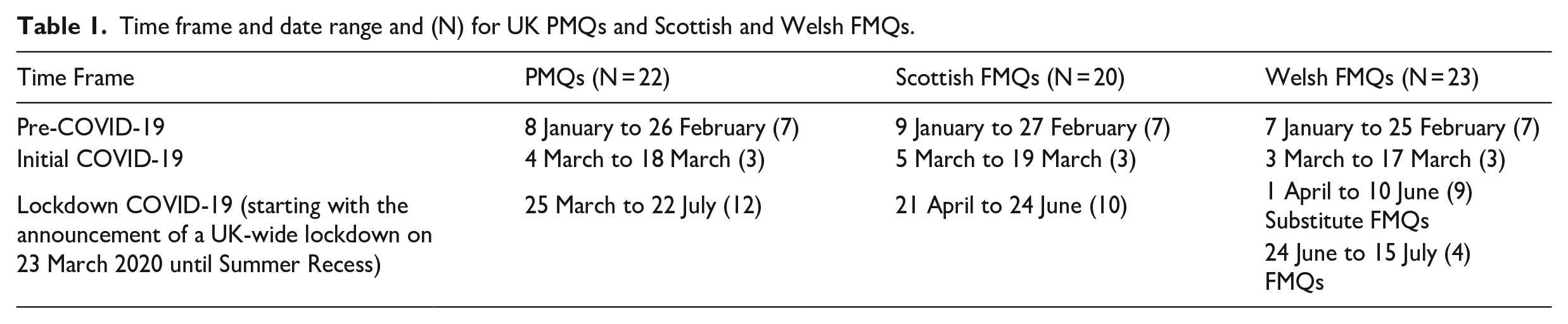
Up to the lockdown in late March 2020, PMQs and Scottish FMQs took place face-to-face without social distancing measures. PMQs and Scottish FMQs post-lockdown were socially distanced and allowed for online contributions (hybrid Parliament). While all exchanges in the Scottish Parliament between the First Minister and the leader of the Scottish Conservative and Unionist Party have been face-to-face, discussions between the leader of the SNP and the Prime Minister in the House of Commons have varied between face-to-face (15 July 2020) and hybrid (in the remaining PMQs Ian Blackford participated online).
In the case of Wales, the pre-COVID-19 and initial COVID-19 periods were face-to-face, but most of the lockdown COVID-19 period was online only. It is important to note that while Welsh FMQs were paused for a substantial period of time (see substituted Welsh FMQs in Table 1, which were virtual/online), the Welsh First Minister provided weekly updates on COVID-19 and party leaders were given a substitute opportunity to ask questions based on those statements. Given the dominance of COVID-19 discussions during the lockdown period, and given the prevalence of this arrangement, the resulting subject focus of exchanges in Wales was very similar in nature to those found in both Scottish FMQs and UK PMQs and so a comparison is still useful. Moreover, the Welsh data provides an interesting comparison with the Scottish data re: the format of operation, as the Welsh data have both face-to-face and online-only elements making it arguably more like Westminster than Scotland.
The coding was conducted in two rounds. In the first round, we applied our coding schedule on hostility (towards leader values, identities and policies, or upon closely associated organisations or individuals – see Annexe 1 for details). The coding schedule builds upon the schedule used by Waddle et al. (2019). We made two adjustments to their coding schedule (see Annexe 1 for coding details):
We redefined the categories to reduce the overlap between those categories.
We added a new category accounting for hostility administered in the exchange that attacks organisations or individuals closely associated with a leader.
Coding was completed at the sentence level (total number of sentences analysed = 3554). The focus on sentence level rather than the whole individual contribution was chosen to improve the internal validity of our measurements. Most individual contributions are often more nuanced than presented at either the paragraph or the level of the contribution at any one turn at speaking. In several instances, for example, hostility only manifested in one sentence, and so to code all sentences within a contribution as hostile is arguably overstating the nature of the contribution. Moreover, by coding at the sentence level, we are more able to avoid the situation of coding something as hostile, where the first sentence might actually praise the opposing leader for action(s) taken, but then a subsequent sentence closes with a critique of where the action(s) have been lacking. 2
Sentences that include one of the categories of the coding schedule (see Annexe 1) on hostility have been coded as hostile and sentences without any hostility were coded as neutral. A second coder coded for hostility or not using a blind sample of 20% of the sentences. Using Cohen’s Kappa test, results showed high inter-coder reliability (Kappa = 0.81). To ensure intra-coder reliability, the initial coder has revisited the coding several times before undergoing an inter-coder reliability test. To determine the degree of hostility of the coded elements, we calculated the hostility ratio by dividing the hostile units by the sum of both neutral and hostile units.
In the second round, we applied our coding to positivity (positivity on own values, identities and policies, or upon closely associated organisations or individuals – see Annexe 2 for details). Our approach to utilising this schedule in the second stage mirrors the application of the coding schedule on hostility in the first round. One author coded the whole sample and applied the schedule on the sentence level. Sentences that included positivity were coded as positive, and sentences without any positivity were coded as neutral. The other author coded for this positivity or not using a blind sample of 20% of the sentences. Using Cohen’s Kappa test, results showed high inter-coder reliability (Kappa = 0.78). To determine the degree of the positive content of the coded exchange, we calculated the positivity ratio by dividing the positive units by the sum of both neutral and positive units. 3
After coding exchanges in the House of Commons and the Scottish Parliament, two additional rounds of coding were conducted on exchanges between the First Minister of Wales (Mark Drakeford, Welsh Labour Party) and the Welsh Leader of the Conservative Party (Paul Davies). 4 Both rounds of coding mirror the approach outlined above re: the measurement of attacks and positivity. Again, coding was conducted at the sentence level, and a second coder coded a blind sample of 20% of the sentences (Cohen’s Kappa = 0.82 for hostility coding and 0.77 for positivity coding). The results of our comparison of exchanges in the Scottish FMQs and the PMQs will be contrasted with the results from the Welsh FMQs as a further test case of both a similar new devolved institution within the UK and as a way of adding a check on the possible uniqueness of leader effects. In short, we are interested in examining the extent to which any Scottish differences in the operation of FMQs compared with UK PMQs are replicated in the case of Welsh FMQs compared with UK PMQs. To control for period effects, the chosen time frame for Wales (see Table 1) is the same as for Scottish FMQs and PMQs.
Results/empirical analysis
Hostility in PMQs and FMQs
Our findings suggest that the average hostility ratios were highest in the UK Parliament across all three time periods (see Figure 1). While hostility levels differ in both FMQs compared with PMQs, what is interesting is that trends of hostility follow similar patterns over time. The average hostility of exchanges in the pre-COVID-19 period was the highest for all three parliaments, whereas the initial COVID-19 period had the lowest levels of hostility across all three parliaments. Indeed, the exchanges in March 2020 were the least hostile in both FMQs 5 and PMQs. 6 While the hostility in the exchanges during PMQs and FMQs remained lower during the lockdown COVID-19 period than the pre-COVID-19 period, hostility levels had recovered somewhat since the atypical period of March 2020, particularly in Westminster (see Figure 1).
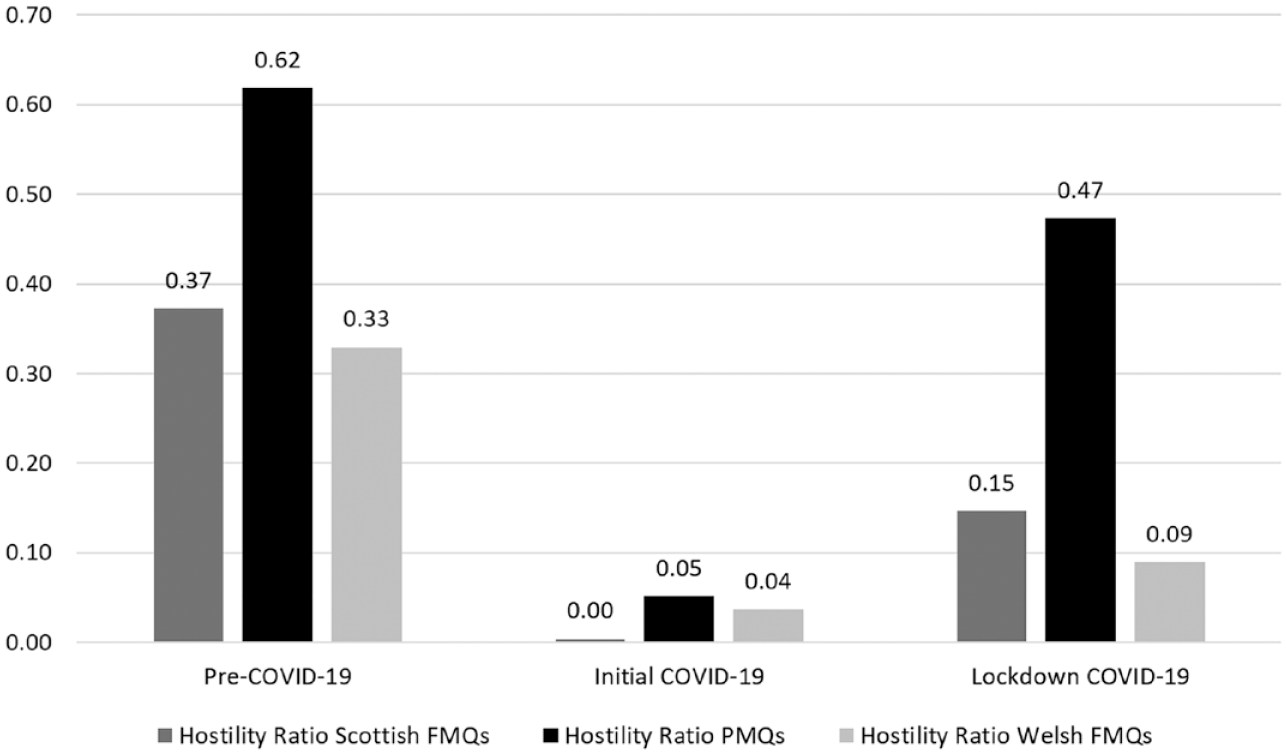
Average hostility ratios in exchanges between First/Prime Minister and Opposition in FMQs/PMQs by time period.
However, there is more variation in the hostility ratios at the individual PMQ or FMQ unit level, suggesting that hostility per day can be more episodic in nature rather than consistent (see Figure 2 disaggregation of the lockdown COVID-19 period). That said, hostility ratios are still invariably highest for Westminster on any given day, particularly as time proceeds during the lockdown COVID-19 period (see Figure 2). The differences in the recovery of hostility levels across institutions are evident when comparing the hostility ratios of PMQs and both FMQs on a week-by-week basis (see Figure 2).
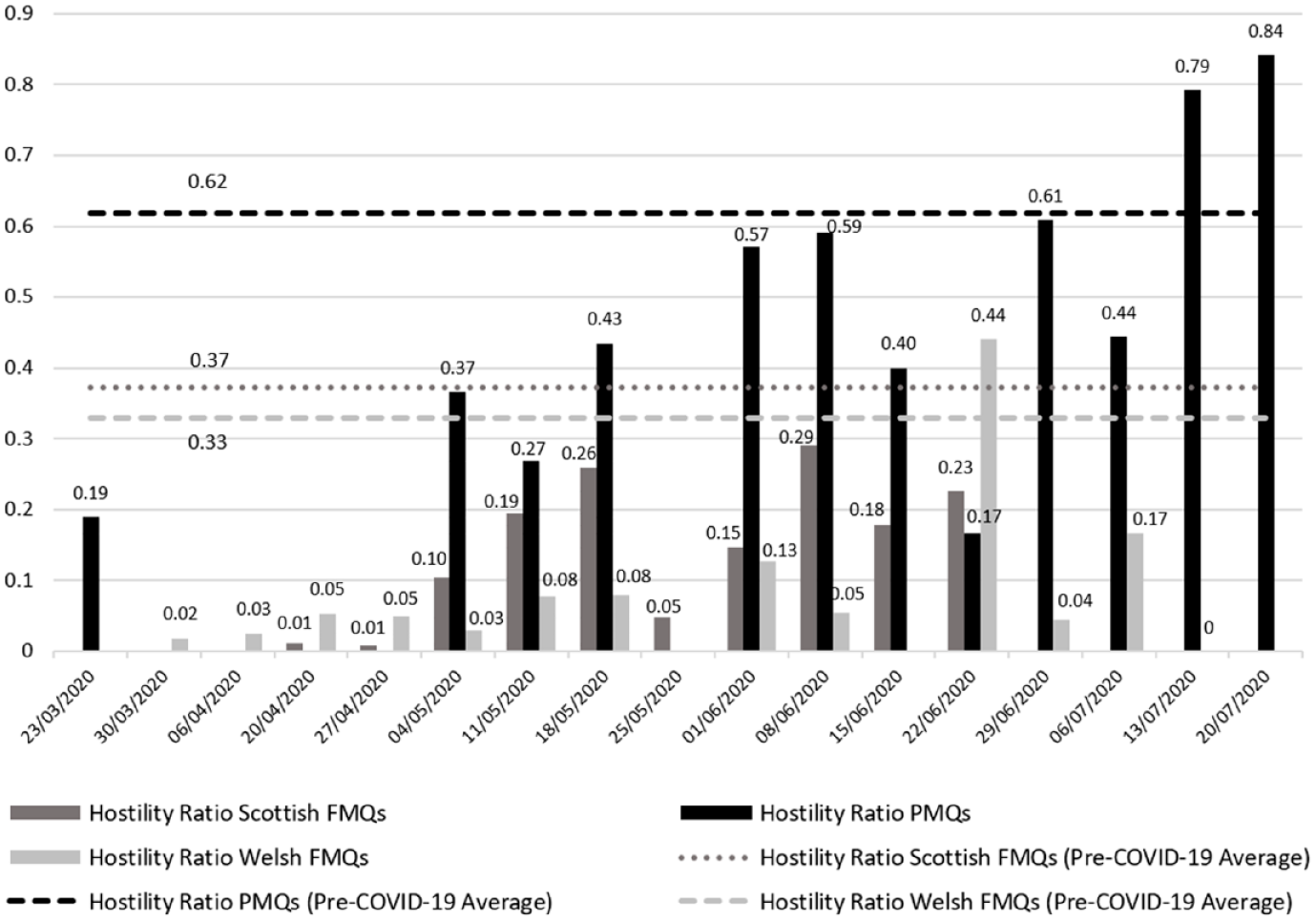
Hostility ratios of PMQs/FMQs during lockdown COVID-19 (week by week).
In terms of individual leaders, pre-COVID-19 exchanges between Johnson and Blackford (UK) were more hostile than any of the other leaders (see Figure 3). This is mirrored in the leader hostility ratios of both Johnson (UK) compared to Sturgeon (Scotland) and Drakeford (Wales), and (albeit to a lesser extent) the opposition leader hostility ratios of Blackford (UK) compared to Carlaw (Scotland) and Davies (Wales). Of particular note, Johnson (UK) is more than twice as likely to be hostile compared with Sturgeon (Scotland) and nearly three times more likely to be hostile than Drakeford (Wales). In sum, leaders in both the Scottish and Welsh Parliaments were, on average, less hostile than their counterparts in Westminster (see Figure 3).
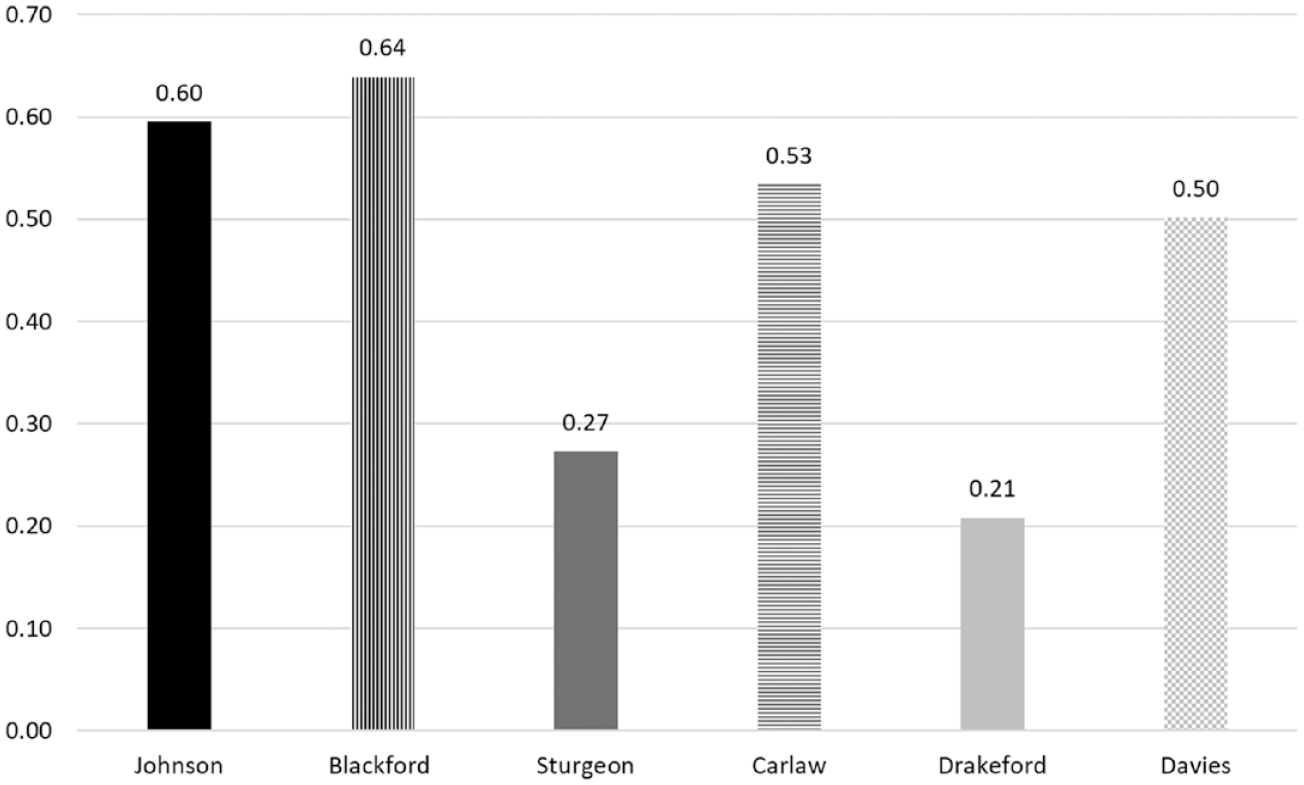
Pre-COVID-19 average hostility ratios for all leaders (UK = Johnson & Blackford; Scotland = Sturgeon & Carlaw; and Wales = Drakeford & Davies).
In Figure 4, we contrast differences in hostility ratios between leaders pre-COVID-19 versus lockdown COVID. We leave out the initial COVID-19 period as hostility was generally relatively low. Compared with our pre-COVID-19 period, we find that Johnson’s (UK) level of hostility during lockdown COVID-19 was much higher than for both Sturgeon (Scotland) and Drakeford (Wales).
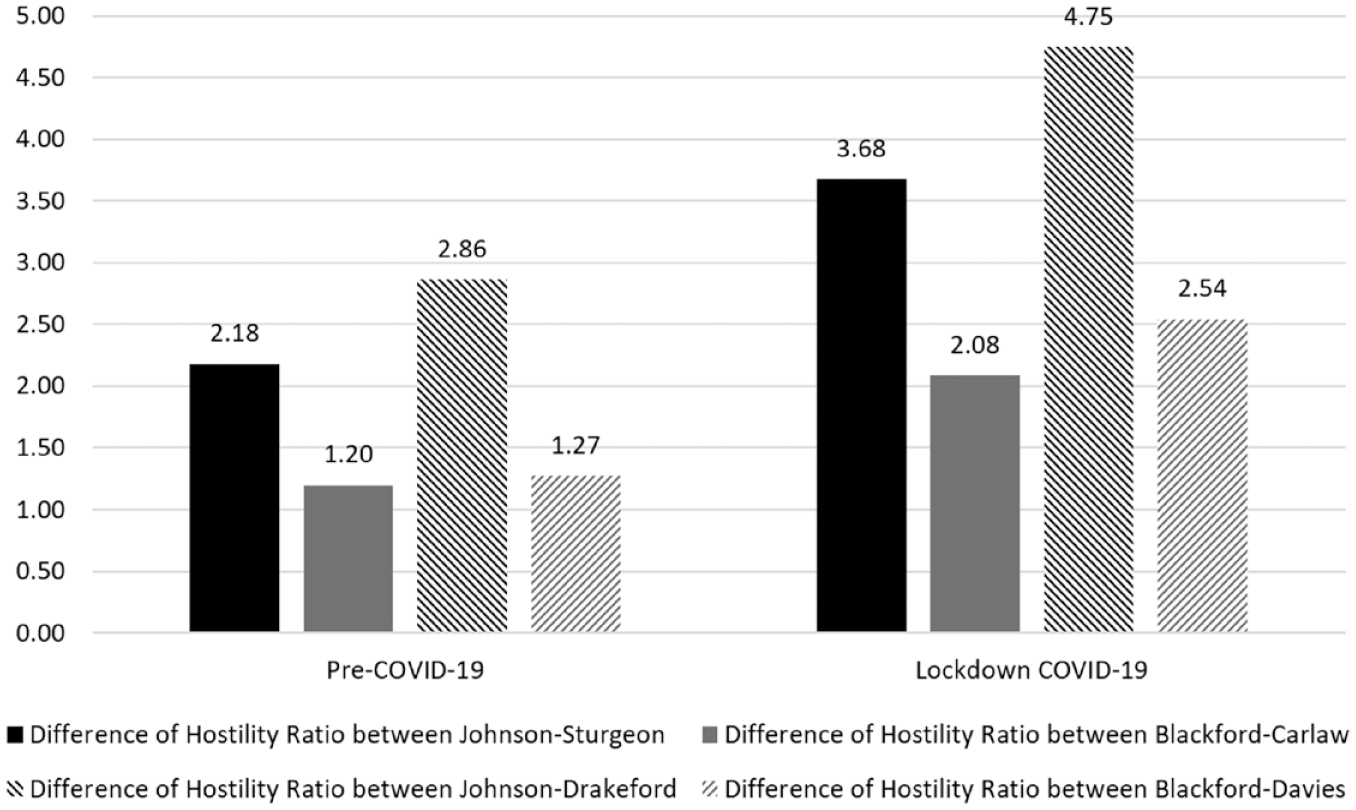
Difference of magnitudes in the average hostility ratios of contributions by political leaders pre-COVID-19 and lockdown COVID-19 (Johnson compared to Sturgeon, Blackford compared to Carlaw, Johnson compared to Drakeford, and Blackford compared to Davies).
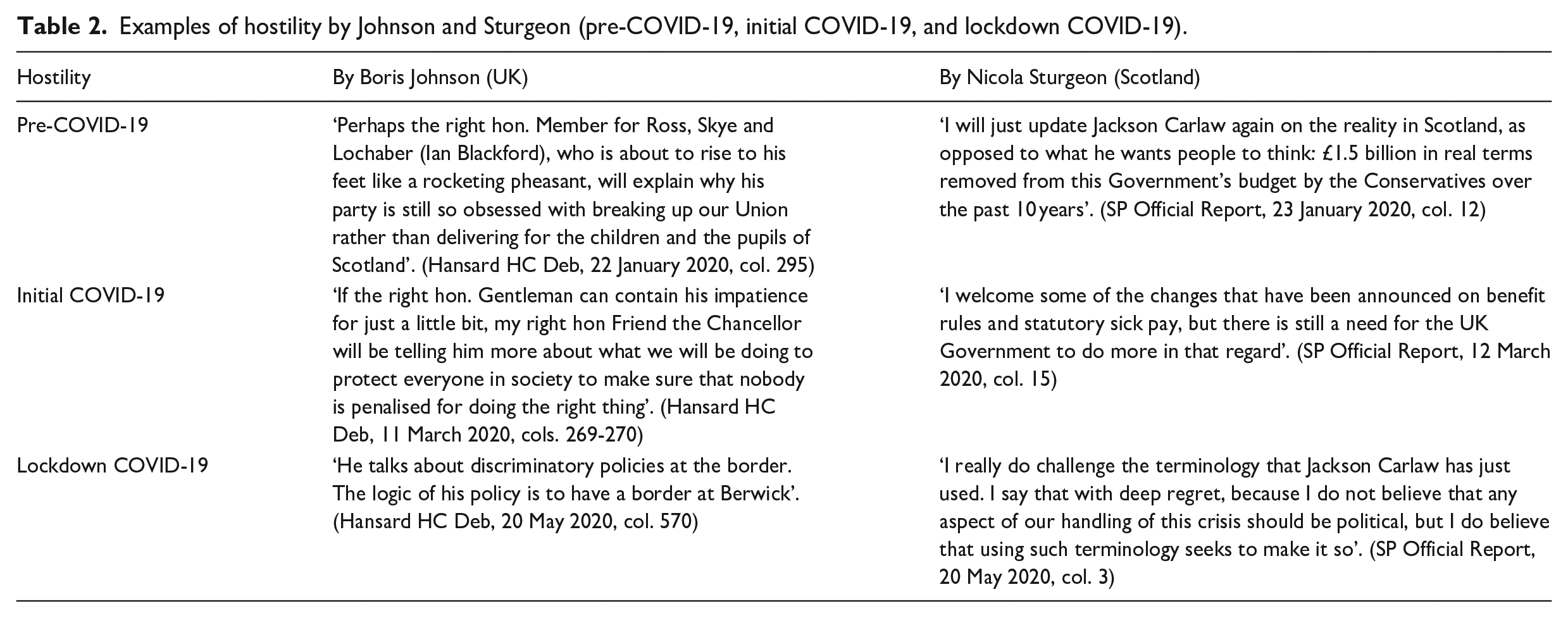
To give an illustration of the types of hostility (see Annexe 1 for the full range of types), Table 2 provides several examples of attacks by Johnson compared to Sturgeon throughout the observed time frame:
Examples of hostility by Johnson and Sturgeon (pre-COVID-19, initial COVID-19, and lockdown COVID-19).
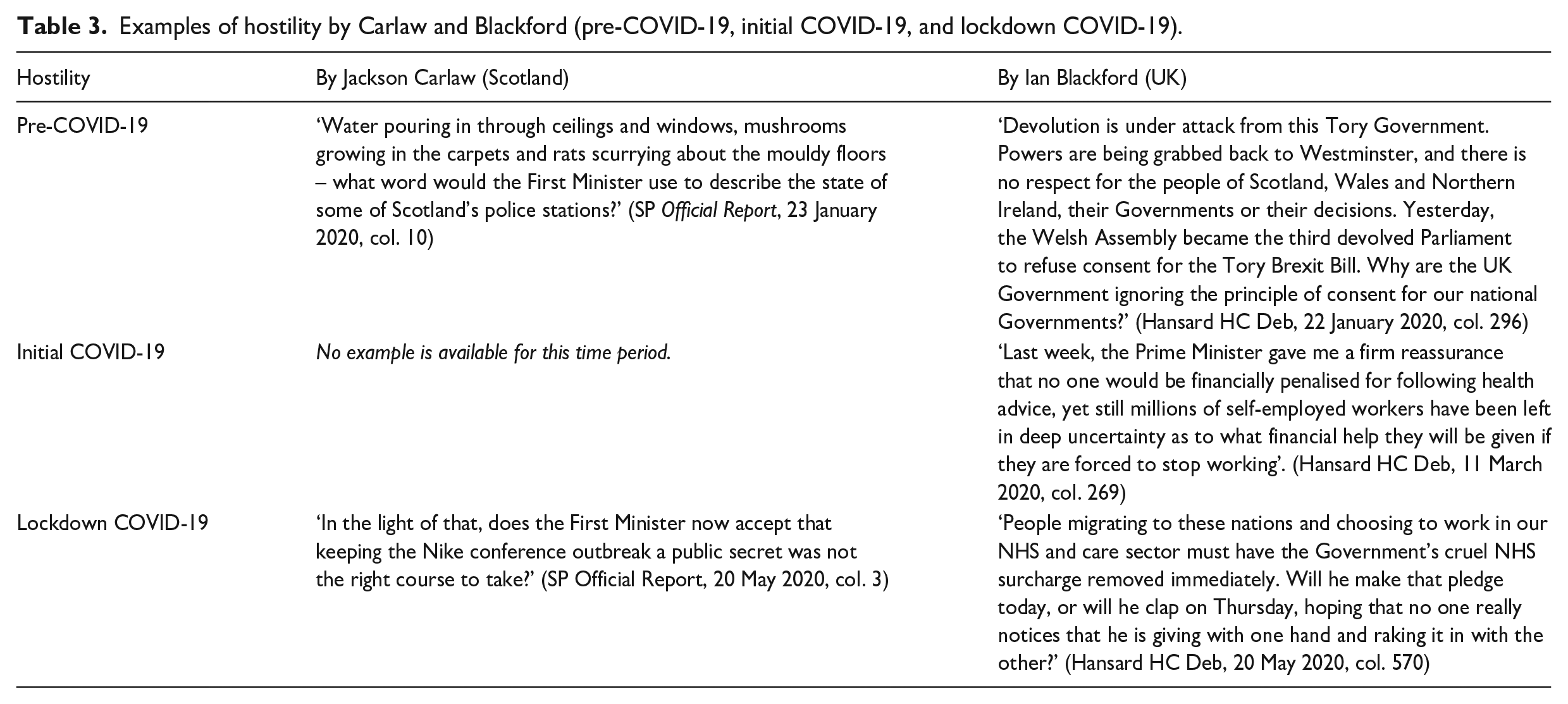
For leaders of the opposition parties, we find that Blackford’s (UK) level of hostility was also much higher than for Carlaw (Scotland) and Davies (Wales) in the lockdown COVID-19 period compared with the pre-COVID-19 period (see Figure 4). Again, to give an illustration of the types of hostility (see Annexe 1 for the full range of types), Table 3 provides several examples of hostility by Blackford compared to Carlaw throughout the observed time frame:
Examples of hostility by Carlaw and Blackford (pre-COVID-19, initial COVID-19, and lockdown COVID-19).
Going back to the initial research question on whether the nature of exchanges in the Scottish and Welsh Parliaments are substantially different to those in the UK Parliament, our findings can confirm a lower degree of hostility in the observed exchanges in both Scottish and Welsh FMQs compared to UK PMQs. While the magnitude of the differences varies by time period (very low during initial COVID-19, for example) and by leader versus opposition leader (opposition leaders are all more hostile on average), our disaggregated data at these levels still suggests more hostility in the UK Parliament than the Scottish and Welsh Parliaments regardless of the time period and leader and interestingly, regardless of the format of operation (face-to-face versus online or hybrid). In turn, there appears to be a noticeable difference in hostility levels between the more hostile UK Parliament and the comparatively less hostile Scottish and Welsh Parliaments.
The data also suggests that the onset of the COVID-19 pandemic substantially reduced levels of hostility in exchanges between all political leaders across all three institutions. While there is no conclusive evidence why hostilities largely ceased during the initial COVID-19 period pre-lockdown in March 2020 (see Figure 1), it is possible that fear and the need for more unity of approach given a common unknown threat provide a possible explanation. Leaders arguably refrained from hostile attacks at the outset of COVID-19 as this would appear petty during a public emergency with heightened public concerns. Another possible driver might also be a rally around the flag effect, which, combined with genuine concern for public health in times of crisis, possibly encouraged participating leaders to be more constructive in their approach. Indeed, there is some evidence of both in this comment by Jackson Carlaw: ‘Partisan rough and tumble may be the stuff that excites some of the parliamentary sketch writers, but I believe that there is a huge and understandable public appetite for detailed information on coronavirus and the measures that are being taken to deal with it. [. . .] The public are [sic] worried and need reassurance’. (SP Official Report, 12 March 2020, col. 11)
The COVID-19 pandemic also led to the introduction of social distancing measures in parliaments, effectively reducing the number of possible attending parliamentarians in the chambers. While our findings cannot conclusively indicate whether and to what extent social distancing measures influenced degrees of hostility, they nonetheless coincided with reduced levels of hostilities. In particular, Scottish FMQs are most suitable for use as a case study: while both leaders participated throughout the observation period in person, social distancing measures were put in place after the lockdown was announced, and pre-pandemic data with the same leaders was also available. If there was an impact due to social distancing measures, we might also have expected hostility levels to have remained low during the subsequent lockdown COVID-19 period. However, beyond the first couple of sessions, there is little evidence that this made much of a difference (see Figure 2).
Positivity in PMQs and FMQs
Our findings suggest that the average Positivity Ratios (see Annexe 2 for details) were noticeably highest in the UK Parliament during the pre-COVID-19 period. In the initial COVID-19 period, it looks like leaders in the UK Parliament became more measured, while Positivity Ratios rose in both Scotland and Wales before falling again in Scotland during the lockdown COVID-19 period (see Figure 5).
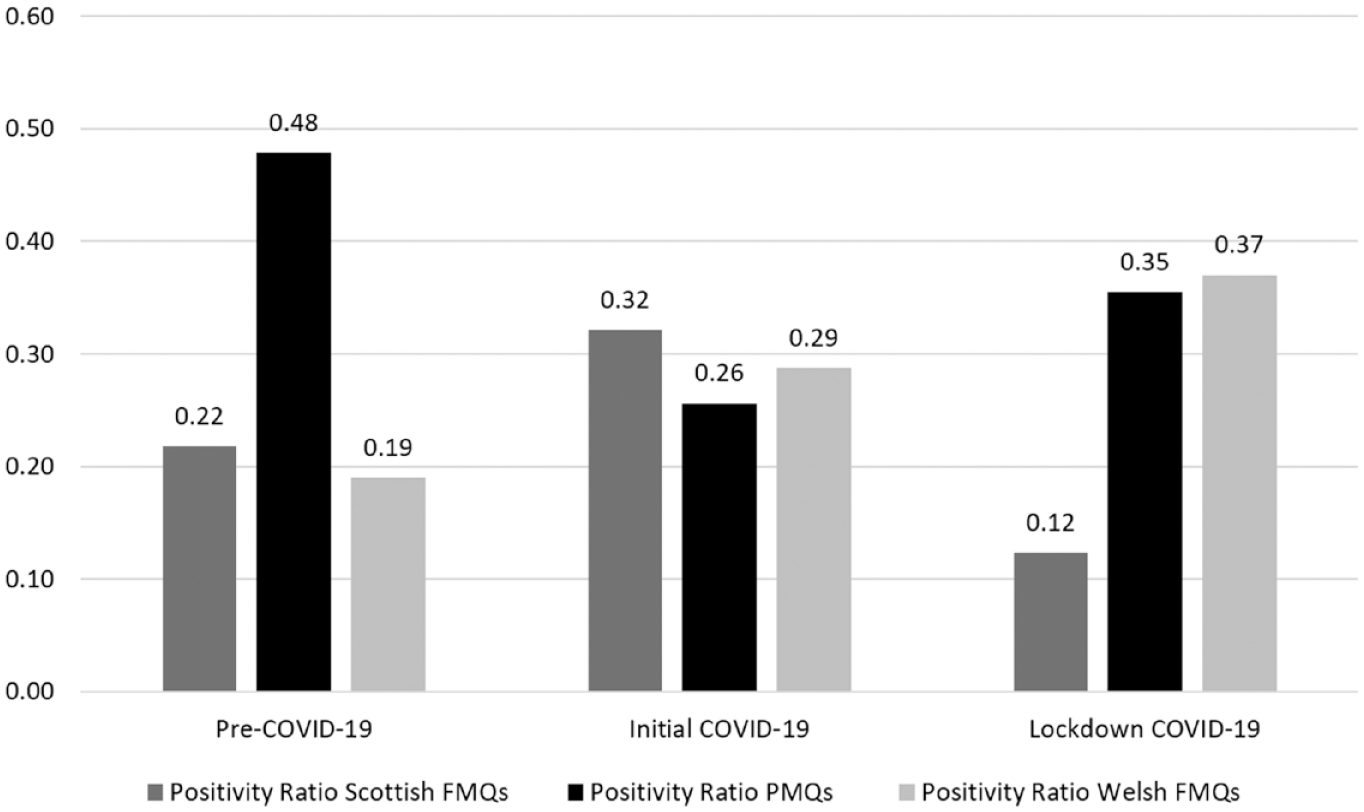
Average positivity ratios in exchanges between First/Prime Minister and Opposition in FMQs/PMQs by time period.
To disentangle these more complicated findings concerning positive references, we disaggregate these findings by time period and by opposition leader (Figure 6) and PM/FM (Figure 7). Our findings suggest that aside from the initial COVID-19 period, positive references were highest in the UK for both the PM (Johnson) and the SNP opposition leader (Blackford).
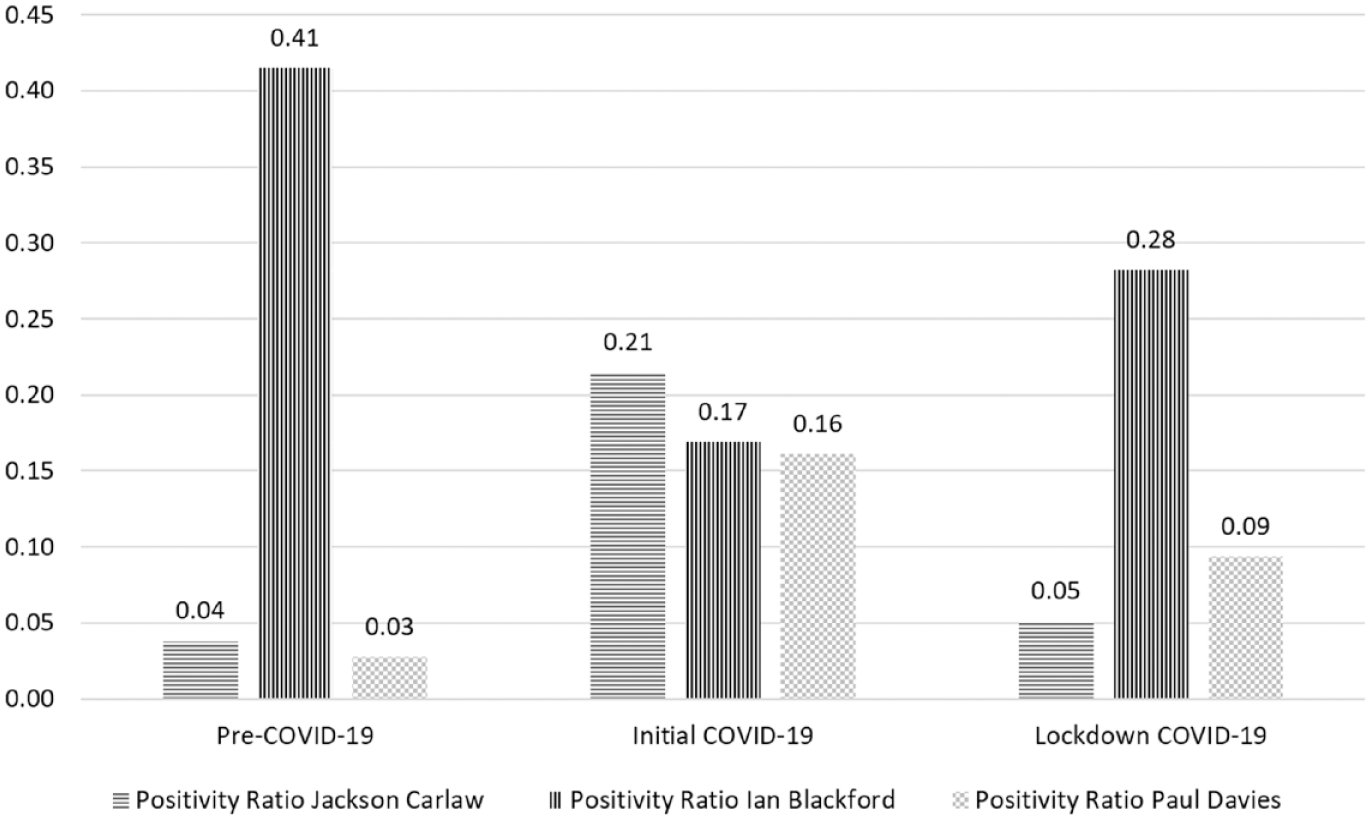
Average positivity ratios of opposition leaders (Carlaw, Blackford, and Davies) by time period.
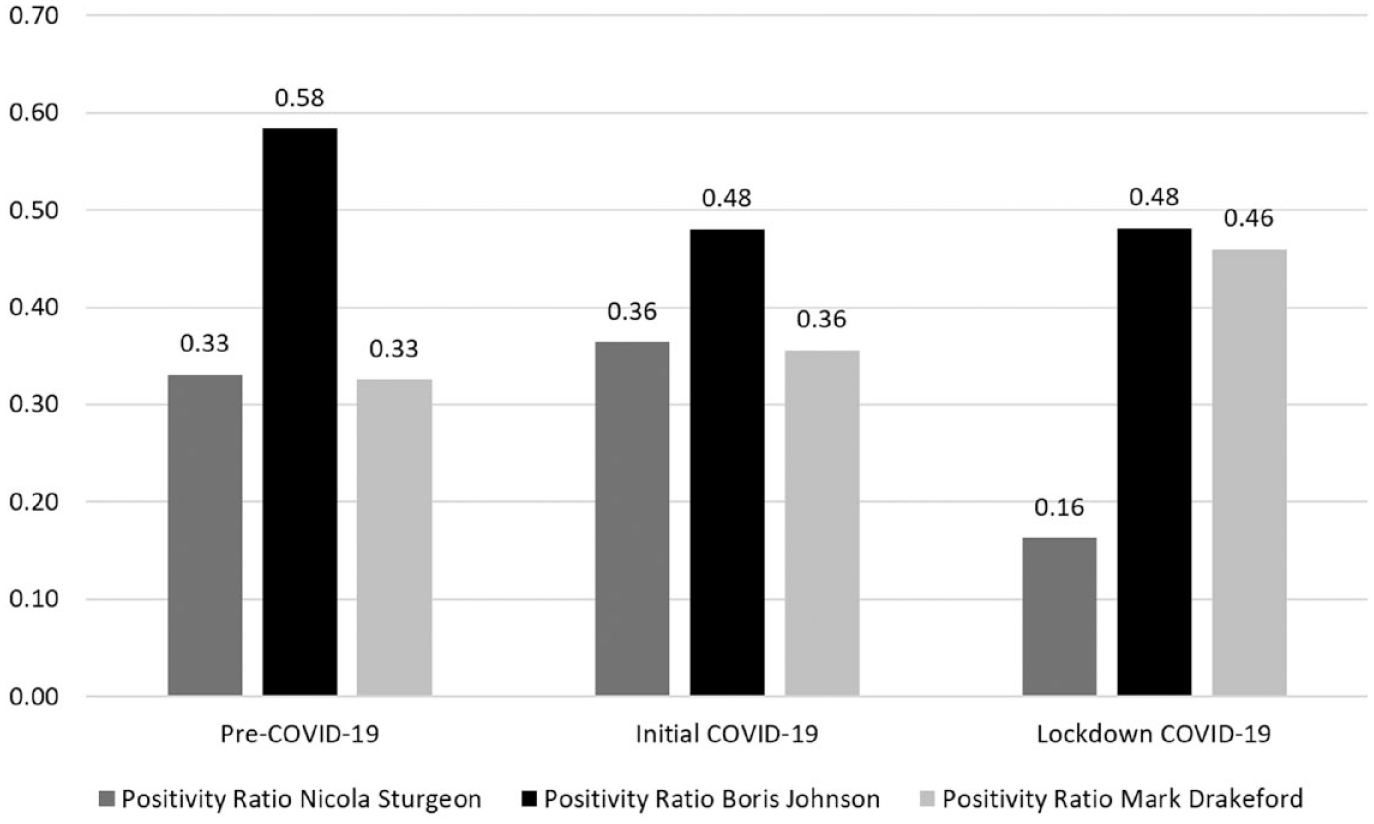
Average positivity ratios of FMs and PM (Sturgeon, Johnson, and Drakeford) by time period.
Interestingly, Johnson (UK) and Drakeford (Wales) were considerably more likely to engage in positivity than Sturgeon (Scotland) during the lockdown COVID-19 period. Indeed, positivity for Sturgeon more than halved (0.16/033 = 0.48) in the lockdown COVID-19 period compared with the pre-COVID-19 period (see Figure 7). In contrast, and for the same period of comparison, Johnson’s positivity ratio only slightly dropped (0.48/0.58 = 0.83) while Drakeford’s positivity ratio actually increased (0.46/0.33 = 1.39). In sum, results suggest that the SNP leader took a less positive tone than comparable leaders in the UK or Wales.
In Table 4, we provide some examples of positivity (again, see Annexe 2 for details of coding):
Examples of positivity by Carlaw, Sturgeon, Blackford, and Johnson throughout the observed time period (pre-COVID-19, initial COVID-19, and lockdown COVID-19).
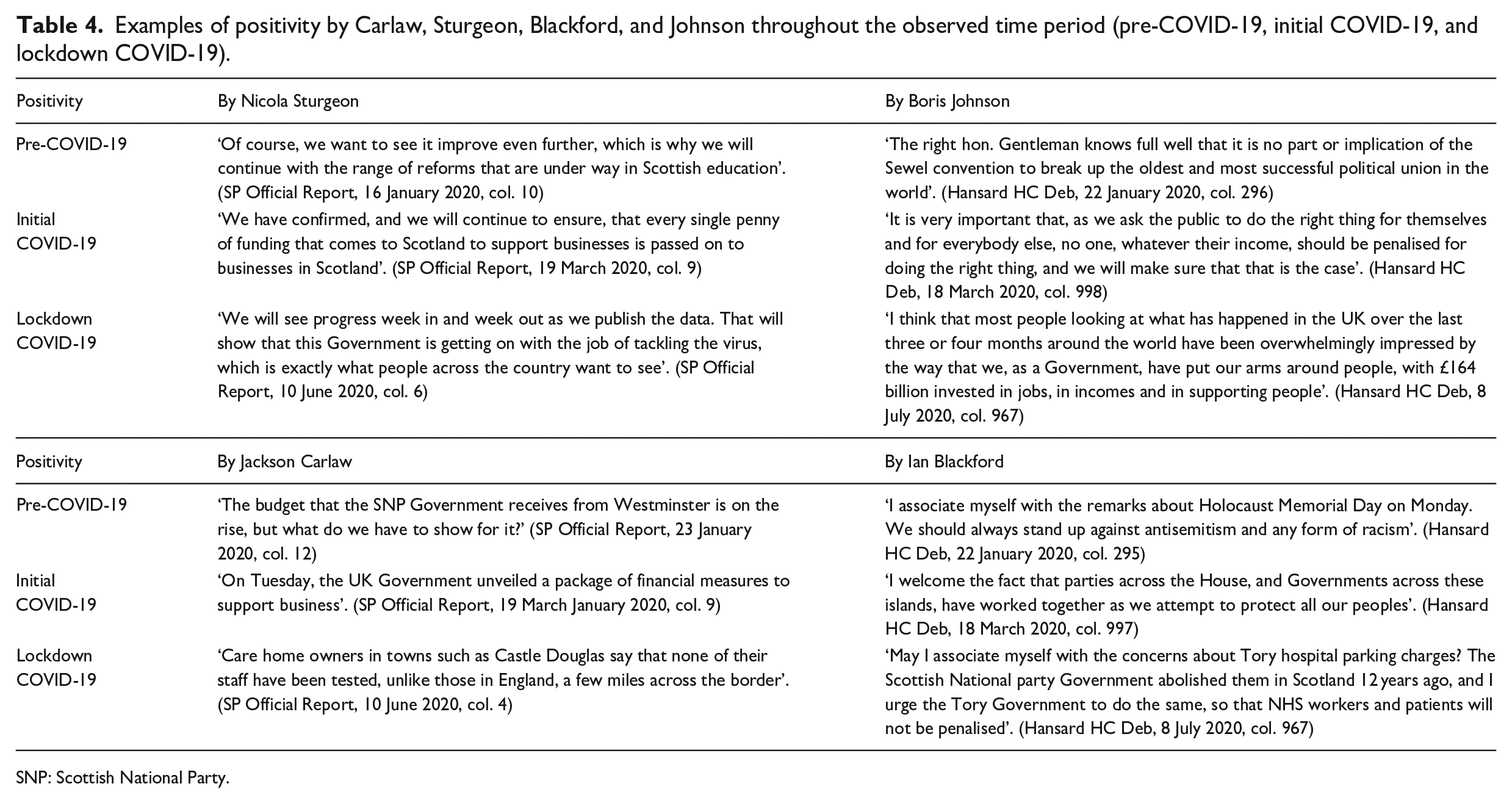
SNP: Scottish National Party.
The only outlier for Scotland occurred during the initial COVID-19 period when opposition leader Carlaw was more positive on average than his counterparts in Wales and the UK. This finding fits with our expectation that during the advent of crisis (e.g. COVID-19), the Scottish Conservative Leader would be most supportive of own values, policies and associations during the advent of a crisis (given the greater distance to be filled due to Brexit, for example). A typical example is the exchange between Carlaw and Sturgeon during the FMQs on 19 March 2020. Carlaw emphasised the importance of constructive collaboration, as well as the contribution of the Conservative and SNP governments: ‘The public should know that both Scotland’s Governments are working to ensure that as much clarity as possible is provided as quickly as possible, and we should all support the people who are working flat out to achieve that’. (SP Official Report, 19 March 2020, col. 11).
Although our findings do not allow us to provide an exhaustive explanation for this divergence, it is likely that the crisis situation and the Scottish context partly shape this change in Positivity Ratios. The Scottish Conservative and Unionist Party is, in the context of the Scottish party system, a medium-sized party in contrast to the Conservative and Unionist Party in England and Wales. The Conservative and Unionist Party, the governing party in the UK, is comparatively unpopular in Scotland, and the UK government is less trusted than the Scottish government for being seen to be acting in Scotland’s best interest (Reid et al., 2020).
Consequently, there are ordinarily few incentives for Carlaw to try and emphasise his connections with the Westminster Conservatives through positive references, as this association might damage the Scottish Conservative and Unionist Party’s image. However, when COVID-19 was becoming a serious world public health issue, a presumed ‘rally-around-the-flag’ effect could have encouraged the promotion of affiliations and connections with Westminster. Indeed, it offered a rare opportunity to relate to an otherwise unpopular but closely associated political actor to promote not just the Scottish Conservatives but also the UK Union. Another explanation could be that promoting the activities of the Conservative and Unionist Party in Scotland and Westminster was an attempt to encourage collaboration and a constructive relationship between the SNP and the Conservative and Unionists Party to deal with the crisis since both are governing parties, albeit at different levels. As Carlaw noted: ‘Both of Scotland’s Governments need to work together constructively and effectively’. (SP Official Report, 5 March 2020, col. 10).
Ultimately, the data suggest positivity is more independent of devolution/new politics than our hostility measures, as it is typically highest in both the UK and Wales. Interestingly, during the lockdown COVID-19 period, when the UK and Wales largely operated either hybrid or online exchanges, positivity was noticeably higher than for Scotland, which operated face-to-face. That said, the highest ratios are found in the UK pre-COVID-19 period, which was also face-to-face. In terms of the time period, there is some evidence of a rally around the flag/all in this together (especially in Scotland) during initial COVID-19. However, this was short-lived. In turn, results for positivity are more mixed and complicated than they are for hostility.
Conclusions, limitations and implications for the literature
In this article, we explored the comparative dynamics of hostility and positivity during questions between Conservative and SNP leaders in Scotland and Westminster across three time periods: pre-COVID-19, initial COVID-19, and lockdown COVID-19. We also added another devolved institution (Wales – with two further leaders) to check the validity of our findings by institution type, the format of operations (online versus hybrid versus face-to-face), and the time period of the COVID-19 crisis.
Regarding average Hostility Ratios, we found that, irrespective of our three time periods, these were higher in the UK Parliament than in the Scottish or Welsh Parliaments. Time was important, although, as hostility ratios were highest for all three parliaments pre-COVID-19 and lowest for all three parliaments during the initial COVID-19 period. The initial COVID-19 period had a clear calming effect on the usual level of hostilities between party leaders. While this was short-lived, results suggest that leaders can put aside more of their differences when an issue is pressing. However, hostilities quickly resumed as time elapsed and the policy (e.g. care homes 7 ) and personal mistakes (e.g. Barnard Castle 8 ) over COVID-19 became evident.
In terms of average positivity ratios, the patterns in the data are more mixed. While positivity ratios were highest in the UK pre-COVID-19, in the initial COVID-19 period, positivity ratios were broadly similar (going noticeably down in the UK while rising in the two devolved parliaments). During lockdown COVID-19, we found a very different scenario with the lowest positivity ratios in Scotland and higher positivity ratios in Wales and the UK.
The implications of our research and findings for the literature are several. First, literature to date has suggested that ‘new politics’ in Scotland and Wales has not manifested largely due to the institutional legacy of the Westminster model in Scotland and Wales and to the continuation and perpetuation of party political animosities. However, our data suggest that both the Scottish and Welsh Parliaments are less hostile than Westminster and, most importantly, less hostile during a procedure virtually identical to that in Westminster.
However, one possible alternative explanation could be that there are more UK Members of Parliament (650) than Members of the Scottish Parliament (129) and Members of the Welsh Parliament/Senedd (60), and so this may facilitate higher levels of noise (support or opposition) in the UK Parliament that could feed into greater hostility and positivity ratios.
Another alternative explanation is that variations (especially in hostility ratios) could be the product of the dynamics and communication styles between the leaders themselves (e.g. more hostility between Johnson and Blackford than between either Sturgeon and Carlaw or Drakeford and Davies) and less a reflection of the different institutions themselves. Consequently, while we find interesting differences in hostility ratios between the two devolved parliaments and the UK Parliament, this does not necessarily equate to a ‘new politics’ per se.
Despite coding all applicable cases in our time periods, we also need to be cautious given the unusual nature of the COVID-19 crisis period we studied. While our data do illustrate greater hostility in UK PMQs versus Welsh and Scottish Parliaments, and, moreover, we find this regardless of pre- or post-crisis periods, further research on the three legislatures over longer time periods and other procedures would need to be conducted before any definitive claims over ‘new politics’.
Second, our findings suggest very few patterns for the format of operation (e.g. noticeably higher hostility in the UK pre-COVID-19 period despite all three systems being face-to-face, and higher hostility in the UK during the lockdown COVID-19 period with a hybrid system compared with lower hostilities in both a fully online Wales and a face-to-face Scotland). Consequently, our data suggest that institutions and leaders are more important than the internal procedural format of operations decisions.
Third, and finally, our data add weight to the crisis literature that points to heightened levels of cross-party elite cooperation during periods of severe crises. That said, like much of the literature, our data also point to a decline of the collaborative language of the exchanges between the head of the government and the opposition over time, albeit interestingly more delayed for the Scottish and Welsh Parliaments than for Westminster.
