




Abstract
This paper compares the practice of holding prime ministers to account in four case studies: Australia, Canada, Ireland, and the United Kingdom. Using text analysis, as well as research on prime ministerial responsibilities, it investigates oral questions asked in parliamentary procedures where prime ministers are questioned together with ministers (Question Period in Canada and Question Time in Australia) versus procedures where they are questioned individually (PMQs in the United Kingdom and Oral Questions to the Taoiseach in Ireland), and explores the degree to which they are questioned for matters that are within their remit. It argues that the practice of prime ministerial accountability is decisively shaped by procedural features such as whether written notice is required for questions, as well as by the broader role of the questioning mechanism in the political system, and less by the collective or individualised nature of questioning.
Keywords
Introduction
Prime ministers wield considerable authority and visibility in parliamentary democracies, yet their powers and responsibilities are scarcely defined. The premiership often developed as a result of conventions and practice, and this applies to systems as varied as the United Kingdom (Blick and Jones, 2010), Canada (Brodie, 2018), Belgium, and the Netherlands (Andeweg, 1988; Fiers and Krouwel, 2005). Prime ministers have multiple roles: while they chair cabinets and ‘speak for’ the government, they do not just lead as first among equals and share responsibility with ministers for government decisions; they also have powers that they exercise exclusively. This tension between the collective authority of the government, the individual authority of ministers, and prime ministerial authority is central to parliamentary democracies.
Consequently, we would expect prime ministers to be questioned on a wide range of issues. This requirement to engage publicly with various topics is, doubtless, a way of ensuring that they are challenged to justify government decisions. But to what degree are they questioned about matters for which they are personally responsible? Do different parliamentary questioning mechanisms provide adequate scrutiny of prime ministerial responsibilities and decision-making, or do they leave accountability gaps? Understanding how this process of parliamentary accountability plays out is important for several reasons: above all, the extent to which political leaders are held to account for their actions and decisions is a crucial component of democratic politics; and political scientists studying parliaments, as well as practitioners looking at executive scrutiny, have long held an interest in the quality and effectiveness of accountability mechanisms and processes. Exploring whether questioning mechanisms achieve the aim of scrutinising prime ministers for their responsibilities constitutes a first step towards mapping the quality and effectiveness of prime ministerial accountability.
Drawing on research on prime ministerial responsibilities, as well as quantitative and qualitative analysis of parliamentary questions, this paper investigates the practice of holding prime ministers to account in four case study countries: the United Kingdom and Ireland, where individualised parliamentary questioning mechanisms are used, and prime ministers are questioned alone; and Australia and Canada, where questioning mechanisms are collective, and prime ministers are questioned together with ministers. Specifically, it examines the topics they are questioned on: the extent to which they are questioned on matters for which they are personally responsible, or jointly responsible with a minister, compared to matters for which a minister is responsible.
The first section traces the complexity of prime ministerial accountability in existing literature. The second part outlines the research design. Next, I compare the roles and responsibilities of prime ministers in Canada, Australia, Ireland, and the United Kingdom. Part four evaluates the practice of accountability in collective and individualised mechanisms comparatively by reviewing the topics on which prime ministers were asked questions and the extent to which they were questioned about issues for which they are personally responsible. Finally, I discuss insights on the practice of accountability in the four cases, and implications for institutional design. By exploring and documenting practices associated with the parliamentary accountability of heads of government, this research sheds light on the ‘missing link’ in the chain of delegation (Bergman et al., 2003) between parliaments and cabinets in parliamentary democracies, and contributes to the literature on the processes and practices of political accountability (Bovens, 2007, 2010; Mansbridge, 2014; Mulgan, 2003; Olsen, 2013).
Holding prime ministers to account: Power, roles, and responsibilities
Prime ministerial power
Research on prime ministers involves a long-standing preoccupation with the ‘power’ that heads of government hold, either across countries (Jones, 1991; King, 1994; O’Malley 2007; Rose 1991; Sartori, 1997), or relative to other institutions within countries (e.g., Andeweg 1988, 1991; Arter, 2004; Blondel 1997; Dowding, 2013b; Hine and Finocchi, 1991). The literature charts variables that influence prime ministerial power: institutional (Jones, 1991; Rose, 1991), personal (Helms, 2005; Jones, 1991; Strangio et al., 2013), cultural or historical factors (King, 1994), and interactions among these variables (Blick and Jones, 2010; Dowding, 2013a; Hennessy, 2001; O’Malley, 2007; Weller, 2014). The difficulty of delineating prime ministers as individual actors arises first because of the collective nature of government in parliamentary systems. While the elevated status of prime ministers within the cabinet is recognised in most parliamentary systems (King, 1994; Poguntke and Webb, 2005), they are still part of a collective entity, and this is expressed constitutionally through the notion of collective responsibility. Second, the legal responsibility for policy domains lies with ministers (Mayntz, 1982; Weller, 2014), which makes it difficult to evaluate the areas for which prime ministers are directly responsible. The tension between prime ministerial authority, individual ministerial authority and collective authority sits at the heart of parliamentary systems, and is crucial for understanding prime ministerial responsibility, as well as for understanding the relationship between prime ministers and other institutions.
Prime ministerial roles
Prime ministers fulfil multiple roles in parliamentary systems: head of government (Farrell, 1988; King, 1994); chair of the cabinet, party leader and manager (Campbell, 1982; Farrell, 1988). Prime ministerial roles are ‘position roles’ within the political system, which require the performance of specific duties and responsibilities (Andeweg, 2014; Searing, 1994; Strangio et al., 2013; Weller, 1993).
As heads of government, prime ministers are expected to explain government decisions to the public and to parliament, as well as to represent their countries internationally (Campbell, 1982; Farrell, 1988; Strangio et al., 2013). They lead and manage the operation of cabinet and coordinate government decision-making (Alley, 1992; Mayntz, 1982; Punnett, 1977; Weller, 1985, 1989). This steering role raises questions of responsibility and accountability: To what extent are prime ministers asked to give account for government decisions and for the decisions of ministers? The selective, indirect, and yet decisive character of prime ministerial involvement in policy-making (Mayntz, 1982; Rose, 1982; Weller, 1985) invites questions about how such interventions are scrutinised in parliament: What are prime ministers questioned about? Which areas of policy are perceived as within their remit?
A second dimension of the role of head of government entails the powers that prime ministers hold in a personal capacity. For example, the British Prime Minister exercises a wide range of ‘prerogative powers’ on behalf of the head of state, which include appointing and dismissing ministers, foreign affairs and defence prerogatives, as well as appointing life peers to the House of Lords (Blick and Jones, 2010; Cabinet Office, 2010; Hennessy, 2001). Across systems, the office of Prime Minister involves exclusive responsibilities that only the office holder can exercise (Twomey, 2018). To what degree are prime ministers questioned about these areas of exclusive responsibility?
The premiership is a complex institution, involving multiple roles and responsibilities, and at the same time an elevated, powerful status. Understanding whether, and how such prominent political leaders are questioned for their decisions, and whether parliaments provide an adequate forum for this scrutiny, is therefore a crucial question for democratic politics.
Executive accountability
Holding governments accountable is one of the core functions of parliaments. Accountability is defined as a multi-stage process (Akirav, 2011; Bovens, 2007; Mansbridge, 2014; Mulgan, 2003; Olsen, 2013) that involves explanation to be given by the responsible actor to a forum, which can then scrutinise the information provided (Bovens, 2007, 2010). This paper focuses on the mechanisms and practices of political accountability, particularly parliamentary accountability – the accountability of the head of government to parliament through parliamentary questioning. Accountability processes involve extracting information, explanations and justifications, and imposing remedies or sanctions (Mulgan, 2003). This process also entails different types of accountability: ‘role accountability’, which is carried out on behalf of a collective, in this case by the prime minister on behalf of the government; and ‘personal accountability’, which refers to the responsibilities held by an individual (Mulgan, 2003), in this case by the prime minister for their own responsibilities, actions and decisions. Gauging the extent of these different types of accountability requires analysis of what topics prime ministers are questioned on.
The complexities of accountability relationships in parliamentary systems pose challenges for conceptualising prime ministerial accountability: government accountability entails individual ministerial responsibility, which involves the responsibility of ministers for their departments, and collective responsibility, which involves the support provided by ministers to government decisions (Everett, 2016; Mulgan, 2003; Woodhouse, 1994). The precise accountability relationship between prime ministers and legislatures hence remains a notable gap in executive-legislative studies, both theoretically and empirically. Notably, the principal–agent model (Bergman et al., 2003; Laver and Shepsle, 1999) describes the delegation–accountability relationship between parliaments and cabinets, and between cabinets and prime ministers, but remains silent about the direct relationship between prime ministers and parliaments.
Although accountability is presumed to be by design a primary function of questioning mechanisms among other functions such as representation and expression of criticism, few studies have sought to measure it empirically. In a study of questioning in Australia, Canada, New Zealand and the United Kingdom, McGowan (2008) coded whether questions were answered or not to measure accountability. Discussing oral questions in the Knesset, Akirav (2011) suggested that ‘effective’ questions must achieve three goals: demanding action, requesting policy statements, and eliciting information. For the United Kingdom, Shephard (1999) measured ‘oversight of the executive’ as a function of PMQs by counting the frequency of questions asking the PM to ‘explain’ or demanding an ‘inquiry’. The literature also suggests that accountability may be performed alongside other functions of parliamentary questions, and that it may be achieved both directly, by explicitly asking for information, and indirectly, by asking politicians to address an issue publicly (Rasch, 1994; Wiberg, 1995; Wiberg and Koura, 1994). Yet a precise link between the topics of questions and perceived or actual responsibilities – and thus for what the ‘forum’ requires the ‘responsible actor’ to give account for – is missing. Consequently, this paper sets out to answer the following research questions: To what extent do different types of parliamentary questioning mechanisms perform accountability? What are prime ministers questioned about, and how do questions relate to their responsibilities?
Methodology
To answer these questions, I use a comparative case study design to explore the extent to which there is more or less focus on personal prime ministerial accountability in different types of mechanisms: in collective mechanisms, where prime ministers are questioned together with ministers, or in individualised mechanisms, where they are questioned individually. This aims to provide insights into the types of questioning facilitated by different mechanisms, and into the quality of accountability in the case study countries.
Focus on personal prime ministerial accountability measures the frequency of questions on topics that are within the prime minister’s responsibility. I investigate the topics on which prime ministers are questioned, and whether they refer to (a) matters for which prime ministers are personally responsible, (b) matters for which they share responsibility with a minister, and (c) matters that are within the remit of a minister. Focus on personal prime ministerial accountability means evidence of more questions on topics within their responsibilities, rather than on the responsibilities of a minister.
Case selection
Countries and questioning mechanisms
Drawing on a study of questioning mechanisms for prime ministers across 31 parliamentary democracies (Serban, 2020), I selected four cases for further comparative study: Question Period (Canada) and Question Time (Australia) as collective plenary mechanisms; and PMQs (United Kingdom) and Oral Questions to the Taoiseach (Ireland) as individualised plenary mechanisms.
The first criterion for case selection was exploring diversity: illustrating how different types of questioning mechanisms operate. The second criterion is to identify diverse comparators for the United Kingdom’s PMQs as a prominent empirical case. Taken in pairs, the cases are similar on the key dimension of interest (collective versus individualised), but vary in other procedural features that may affect the practice of accountability–particularly the openness/restrictiveness of questioning.
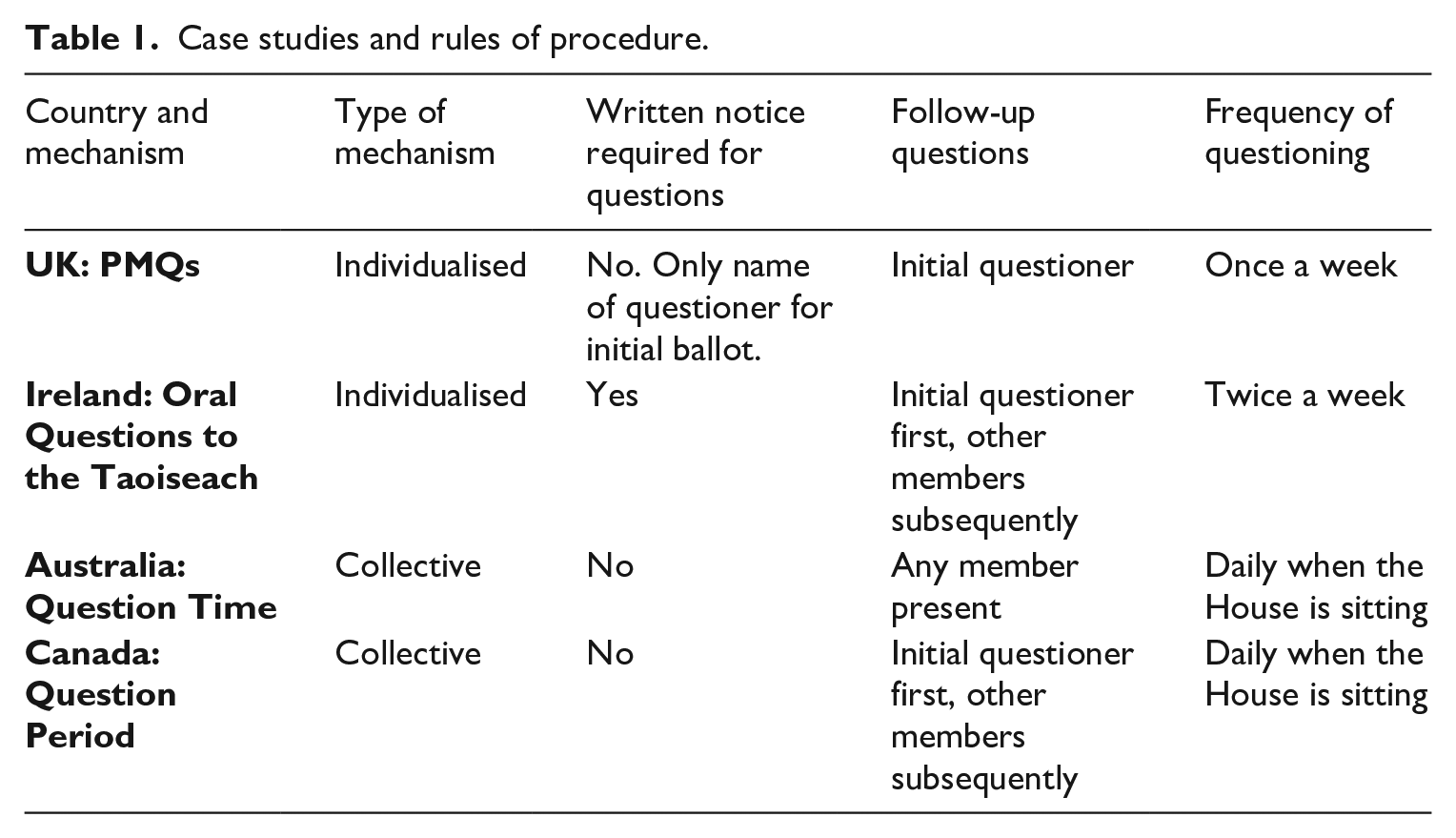
As an individualised procedure that differs on the degree of openness of questioning, Oral Questions to the Taoiseach is a good comparator for the United Kingdom. PMQs allows largely spontaneous interaction: questions do not require written notice. Members who wish to ask a question submit their names for a ballot by Thursday during the week preceding PMQs. If they are successful, their names are printed on the Order Paper, but there is no formal requirement to submit notice for the actual questions, though members occasionally submit a substantive question. By contrast, at Oral Questions to the Taoiseach, members submit questions in writing in advance, and all supplementary questions must be connected to the initial written question. Question selection is managed by the Speaker, who examines questions to ensure that they conform to Standing Orders. In selecting collective procedures, Canada and Australia appeared to be the cases that were most compatible for being compared to each other, as well as for being compared with the United Kingdom. They are identical to each other on the notice dimension and similar to the United Kingdom: in neither case is prior notice required for questions. By contrast, other cases of collective mechanisms such as Belgium and New Zealand are very different, in that written notice for questions is required. Consequently, the final case selection included the following types of mechanisms.
The survey of prime ministerial questioning mechanisms (Serban, 2020) found that the most frequent types are plenary mechanisms (41 out of the 59 procedures surveyed); out of these, mechanisms that allow routine questioning were the most frequent (28 plenary procedures/ 41). The aim of the current study is hence to understand the functioning of such routine plenary mechanisms, and to compare how they function in parliaments that either provide or do not provide other mechanisms for holding the prime minister to account. Taken in pairs, the cases (Table 1) differ in their place in the political system relative to other accountability mechanisms. In Canada and Australia, Question Period and Question Time are the only oral questioning mechanisms attended by the prime minister. By contrast, in the United Kingdom and in Ireland, PMQs and Oral Questions to the Taoiseach operate alongside other mechanisms. The UK Prime Minister has been questioned two or three times a year by the Liaison Committee since 2002, and answers questions after giving statements to the House of Commons, usually after international events or summits. In Ireland, the parallel mechanism of Leaders’ Questions, which allows party leaders to ask the Taoiseach questions without notice, was introduced in 2002 to allow the opposition to raise topical issues without the constraints of advance notice (MacCarthaig 2005). In both the United Kingdom and in Ireland, there are also separate questioning opportunities for ministers.
Case studies and rules of procedure.
Prime ministerial terms in office
For each case, I sampled questioning sessions during one term in office of one prime minister, aiming to include comparable premierships (Table 2). I selected terms in office of comparable duration, with similar types of government, and with similar types of cabinet termination. I aimed to include terms in office terminated in normal circumstances (e.g. by an election), with the exception of Australia, where the pattern of prime ministers being ousted by leadership spills meant that all premierships considered ended with a resignation. In all cases, in order to cover a full term in office, I excluded incumbent governments.
Case selection: Terms in office.
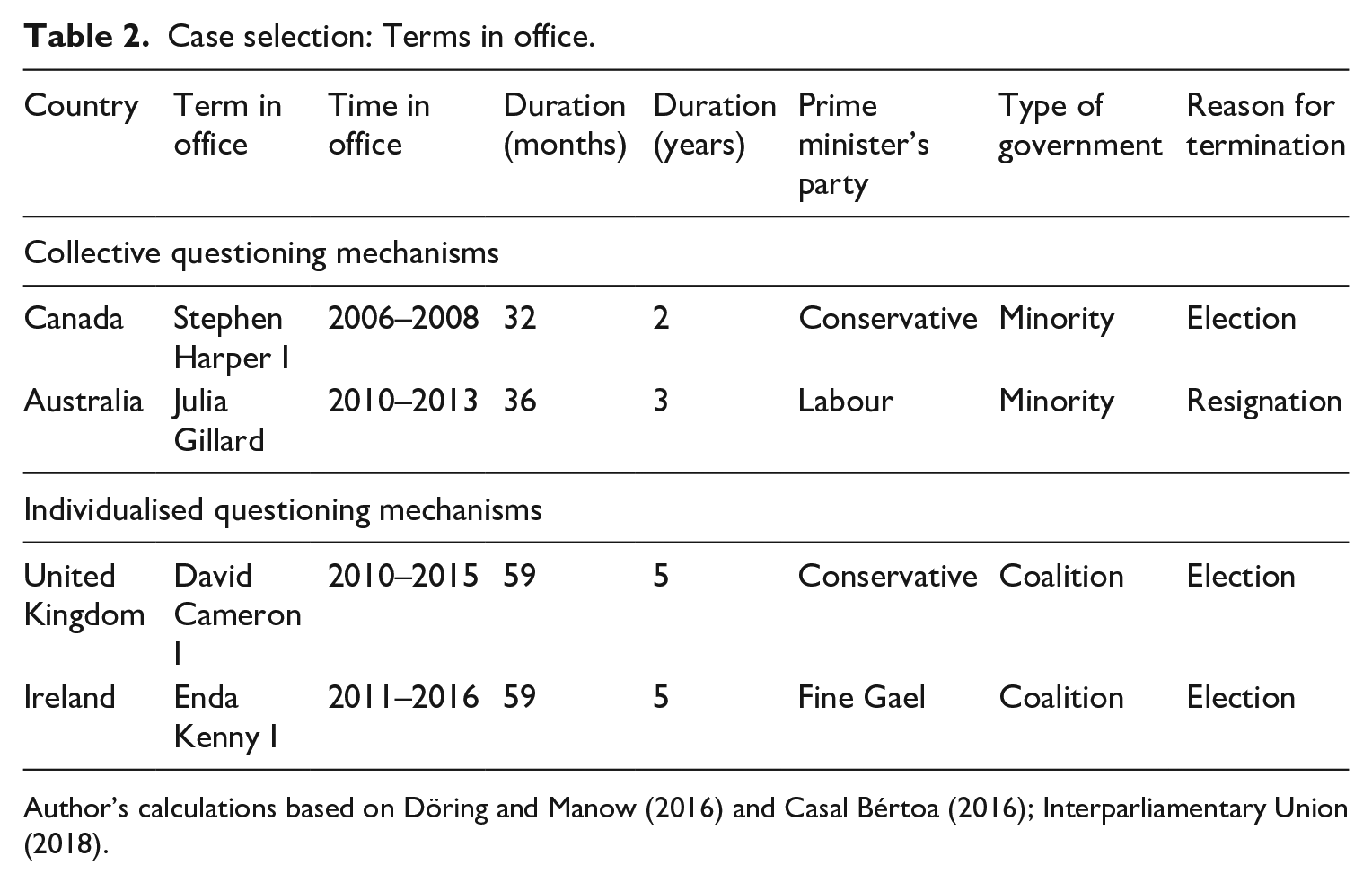
Author’s calculations based on Döring and Manow (2016) and Casal Bértoa (2016); Interparliamentary Union (2018).
This strategy aimed to identify premierships that are as comparable as possible. Time frames were delineated by the same criterion and covered the full legislative cycle of a government from election to termination. Importantly, this selection allows comparison between full terms in office of prime ministers that underwent the full legislative cycle. The caveat is that longer legislative cycles, such as in Ireland and the United Kingdom, potentially allow prime ministers to be questioned on a wider range of topics from different policy areas. The implications of this shortcoming are mitigated in three ways detailed in further sections of the paper. Procedurally, aside from the Australian House of Representatives, which sits for shorter parliamentary sessions, all other cases present a similar volume of questions addressed to the prime minister per year, and hence potentially a similar level of scrutiny (Table 5). In raw numbers, the number of topics covered for each case appears to be similar. Focusing on the 10 most frequent topics for each case allows comparison on an equivalent measure, exploring how the topics with the highest scrutiny importance map on to the prime minister’s responsibilities.
Sampling questioning sessions
To cover the entire duration of each term in office, while also ensuring that the sample included sessions from various time points, I constructed a random sample of 30 questioning sessions for each premiership, stratified by year; the total sample comprised 120 sessions and a total of 3212 questions (see Appendix 1).
Coding topics of questions
To measure the accountability function of questions, I examined the extent to which prime ministers were questioned about their responsibilities, that is, the topics of questions addressed to them, using the Comparative Agendas Codebook (n.d.). The codebook provides extensive definitions of each topic and sub-topic 1 and is a reliable, widely used tool for coding policy topics.
Questioning sessions were sourced from the official record of each parliament and analysed in NVivo. Each oral question (procedurally, each new intervention by an MP marked as an oral question in the official report) was assigned a code for topic and sub-topic from the Comparative Agendas Project codebook. Questions were also coded for question addressee, that is, whether the questioner indicated that the question was addressed to the prime minister or to a minister.
To assess validity and intra-coder reliability, the coding scheme derived from the CAC was tested through two rounds of pilot coding. To assess reliability, a second coder was trained on the CAC list and second coded a random sample of sessions for each case that had already been coded by the first coder in NVivo. Coding of topics yielded percentage agreement of 99% and a Kappa score of 0.87, which taken together indicate very good inter-coder agreement (Krippendorf, 2013). In total, 24 topics from the CAP were found to apply to the dataset. There was a slight variation between cases, with 16 topics identified for Ireland, 21 recorded for Australia and for the United Kingdom, respectively, and 22 for Canada. Some of the topics recorded a very small number of questions. As mentioned, the analysis focuses on the 10 most frequent topics in each case, as topics with the highest scrutiny importance.
To investigate how questions map onto responsibilities, I used official documents and secondary literature to identify prime ministerial responsibilities in each case study, detailed in the next section.
Prime ministerial responsibilities
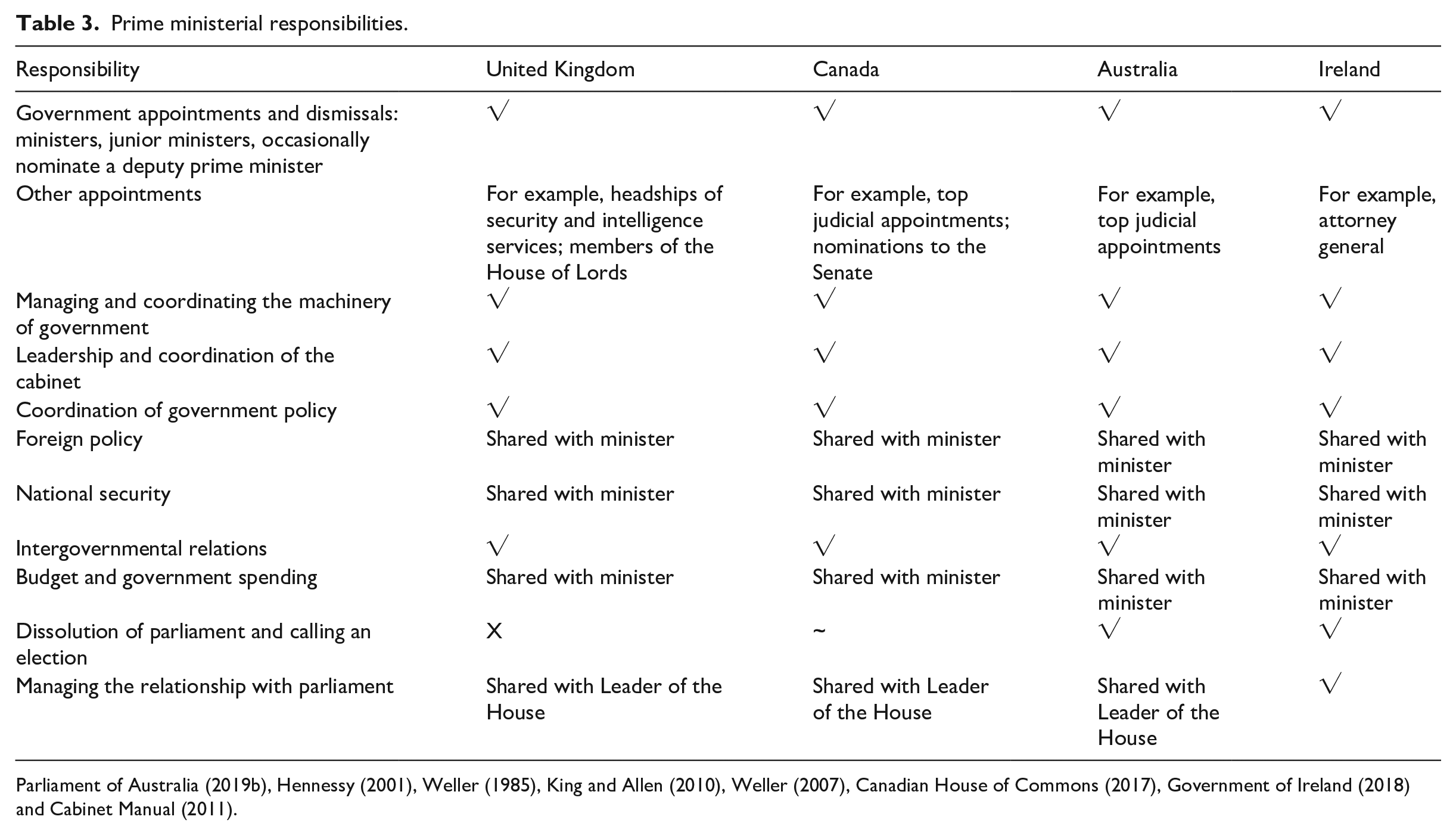
In all four cases the prime minister is the head of government and holds this position by virtue of leading the party that commands the confidence of parliament. They derive their authority from parliament, and consequently must give account to parliament. In Ireland, these institutional relationships are described in the Constitution. In the United Kingdom and in Canada, the relationship between the head of state, the head of government and parliament are generally a matter of convention. Some conventions are described in official documents, such as the Cabinet Office (2011) in the United Kingdom or the Open and Accountable Government (2015) document in Canada. The development of the office of Prime Minister in Australia also relied on convention and practice; it is famously not mentioned in the Australian Constitution (Weller, 2007). Table 3 reconstructs and summarises the main roles and responsibilities that apply to prime ministers across the four cases, and also singles out roles and responsibilities particular to some cases. This analysis led inductively to a distinction between areas of exclusive prime ministerial responsibility, versus areas of shared responsibility with a minister.
Prime ministerial responsibilities.
Parliament of Australia (2019b), Hennessy (2001), Weller (1985), King and Allen (2010), Weller (2007), Canadian House of Commons (2017), Government of Ireland (2018) and Cabinet Manual (2011).
The most important area of direct responsibility concerns government appointments and dismissals, as well as the power to make other appointments in the political system. Across all cases, prime ministers are also responsible for the configuration of the machinery of government; they allocate ministerial portfolios, and also establish the remit of ministers and of their departments.
Three areas of shared responsibility stand out. In all four cases, the prime minister represents the country internationally and is responsible for international summits and, in the cases of the United Kingdom and Ireland during these periods, EU Council meetings, but the policy area is shared with a minister. The prime minister is usually involved in all matters related to national security, but aside from direct responsibilities such as chairing meetings of the National Security Council or Committee, prime ministers share authority with a minister. Prime ministers are seen as responsible to parliament for the government’s spending decisions, particularly in Canada, Australia, and in the United Kingdom (Brodie, 2018; Hennessy, 2001). But this is primarily the responsibility of the finance minister in Canada, and of the Treasurer and Chancellor of the Exchequer in Australia and the United Kingdom. For the purpose of the analysis in this paper, macroeconomics as a general topic is treated as the finance minister’s responsibility, but budget and spending are discussed as close to the prime minister’s remit. 2
The Prime Minister also coordinates relations between the state and federal levels in Canada and Australia, and intergovernmental relations with the devolved administrations in the United Kingdom. In Ireland, the Prime Minister manages the relationship between the Republic and the United Kingdom in matters that concern Northern Ireland.
In Australia, the Prime Minister retains the full prerogative to advise the Governor General about the dissolution of parliament and calling an election. Similarly, in Ireland the Prime Minister advises the President on dissolution and summoning the Dáil. In Canada, elections are on a fixed-term basis (every 4 years), but the Prime Minister may still advise the Governor General about the dissolution of Parliament. 3 In the United Kingdom, the Prime Minister can no longer exercise the prerogative power to dissolve parliament and to call an early election; this has been regulated under the Fixed-term Parliaments Act 2011. 4
Tracing personal prime ministerial responsibility
This paper traces the degree to which prime ministers are questioned for exclusive or shared responsibilities, on matters such as appointments and government machinery, foreign affairs, or defence. Acknowledging the complexity of accountability relations, this offers a close proxy for evaluating whether prime ministers are held to account for their responsibilities. But capturing direct prime ministerial responsibility empirically is not unproblematic. For example, the prime minister may have played a decisive role in decisions taken by ministers, and such behind-the-scenes dynamics of decision-making are difficult to capture. What these categories ultimately intend to capture is how questions are addressed to the prime minister, and whether questions target their areas of responsibility, and which decisions and areas of responsibility are attributed to them.
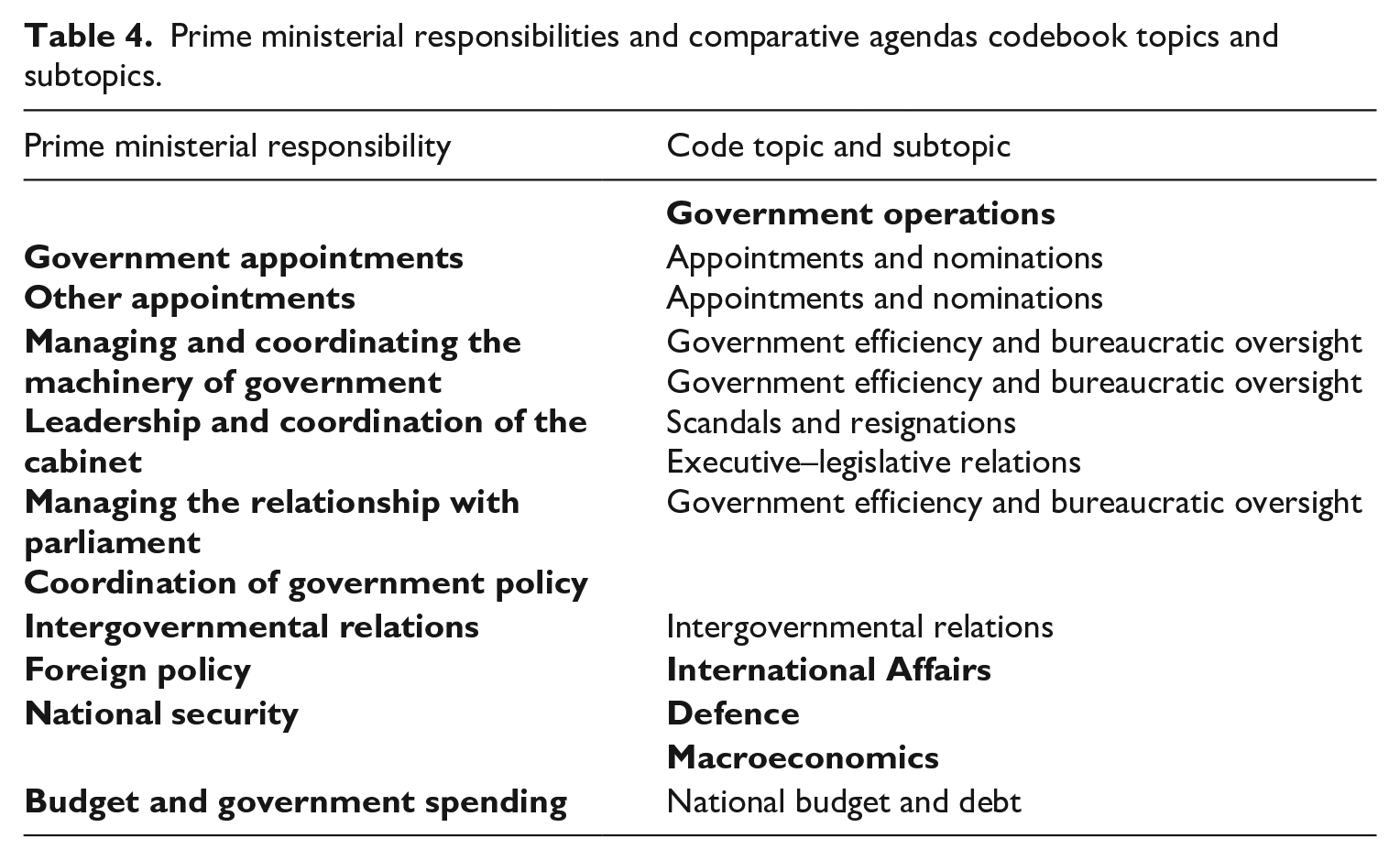
The correspondence between topics and subtopics in the Comparative Agendas Codebook (n.d.) and prime ministerial responsibilities is summarised in Table 4. This analysis is meant to offer an overview of how prime ministerial accountability was carried out in the periods analysed, taking into account contextual factors. The distribution of topics presented in the results naturally also reflects the issues that were salient at the time during each premiership.
Prime ministerial responsibilities and comparative agendas codebook topics and subtopics.
Going back to the wider role of questioning mechanisms, topics may also depend on whether parliamentarians have other venues for questioning the prime minister, and on whether these venues facilitate a different kind of questioning. In the United Kingdom, the Prime Minister is also questioned by the Liaison Committee, which was introduced to facilitate more in-depth scrutiny (Kelso et al., 2016). The Prime Minister also gives statements to the Commons after international events and summits, so questions on foreign affairs may be addressed in more detail on these occasions. But given that statements are made as-and-when an event occurs, we would expect foreign affairs to also come up at PMQs. As Leaders’ Questions was introduced to complement Oral Questions to the Taoiseach by facilitating more spontaneous questioning, it is likely that current affairs mainly arise during Leaders’ Questions, while Oral Questions covers issues connected more closely to the prime minister’s actions. In Canada and Australia, parliamentarians do not have other opportunities to address oral questions to the Prime Minister, aside from Question Time. There are also no separate questioning opportunities for ministers. A great onus is therefore placed on Question Time/Period in Australia and Canada to cover prime ministerial responsibilities as well as other topical matters.
Accountability in collective and individualised questioning mechanisms
The first aspects to consider in investigating how prime ministers are questioned through different types of mechanisms are regularity and frequency. Questioning mechanisms in all four cases allow a regular dialogue between parliamentarians and the head of government.
The regularity with which mechanisms are convened is set out in the rules of procedure. If questioning is collective, as in Canada and Australia, this raises the issue of whether the prime minister’s attendance is a matter of rule or of convention, and how often they attend in practice. To measure the frequency of questioning, I counted how many sessions took place and were attended by the prime minister during a full year of their term in office (Table 5). 5 In all four cases this was a typical parliamentary year, with no indication that there would be more or fewer questioning sessions than expected. There is no procedural requirement in Canada or Australia for the Prime Minister to attend oral questions, but it is conventional that they will attend every time unless they are engaged in other business. In the United Kingdom, if the Prime Minister cannot attend PMQs the Deputy Prime Minister or a senior minister stands in (Kelly, 2015). A similar convention operates in Australia and Canada, where the Deputy Prime Minister or a Minister stands in if the Prime Minister is absent.
Frequency and volume of questioning.
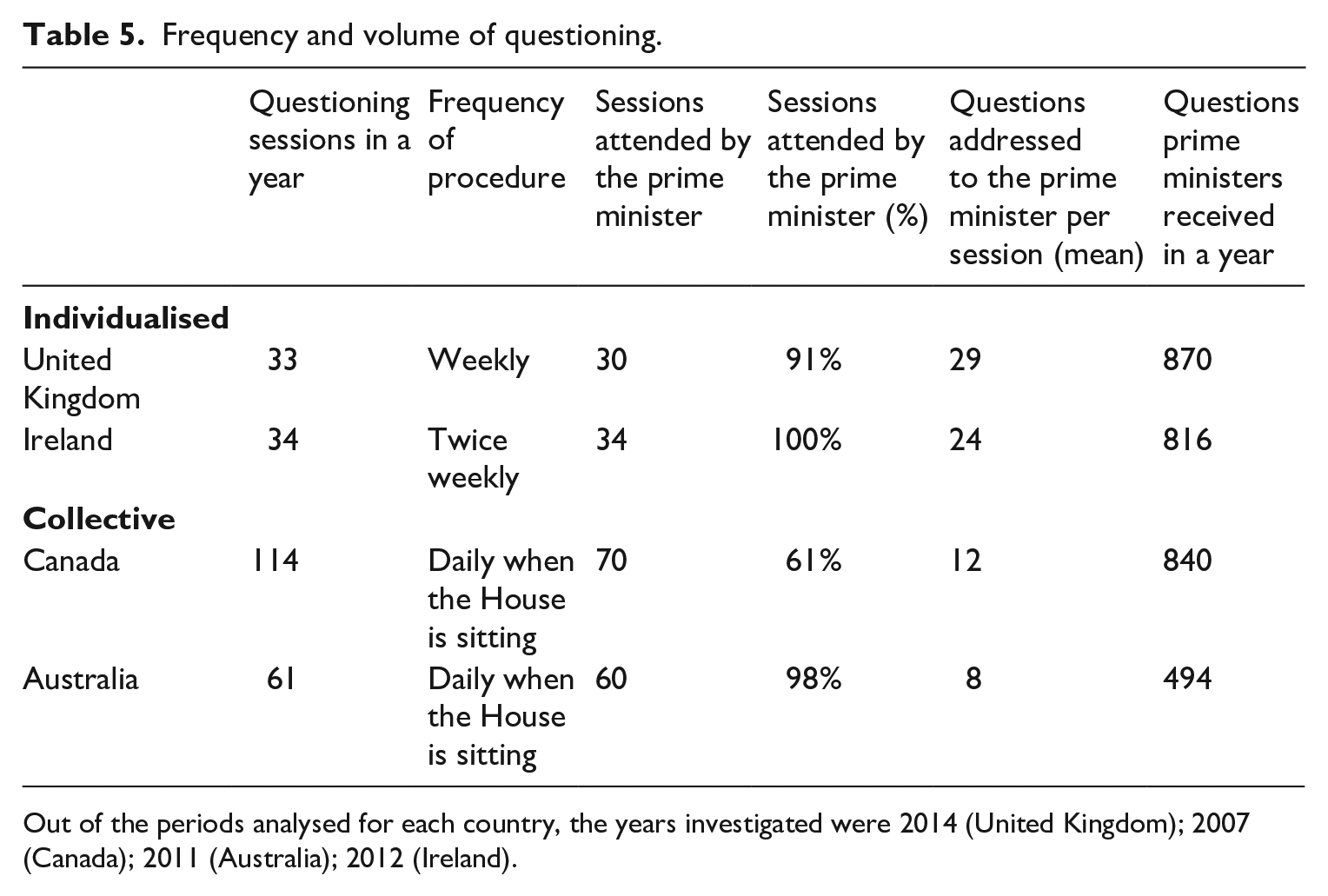
Out of the periods analysed for each country, the years investigated were 2014 (United Kingdom); 2007 (Canada); 2011 (Australia); 2012 (Ireland).
Table 5 also shows a clear difference between individualised and collective procedures in what concerns the extensiveness of questioning, and potentially in the degree to which the Prime Minister is held to account. The Prime Minister received more questions per questioning session in individualised procedures in the United Kingdom and in Ireland in the period analysed: each session involved extended questioning, comprising between 24 and 29 questions, compared to 8–12 questions in Australia and Canada. In the case of Canada, this difference evens out throughout the year due to the frequency with which Question Period is convened and the habitual attendance of the Prime Minister: they are addressed around 840 questions each year, which is directly comparable with the volume of questions in the United Kingdom and in Ireland.
An overview of the cases reporting the total number of oral questions (Figure 1) shows that there were more questions to prime ministers targeting personal prime ministerial responsibilities, either direct or shared, at Question Period in Canada (66%) than at Question Time in Australia (27%), and at Oral Questions to the Taoiseach in Ireland (77%) compared to PMQs in the United Kingdom (21%). This suggests important contrasts between countries, and between types of mechanisms, with respect to the practice of prime ministerial accountability. These patterns are explored and explained in subsequent sections, and questions to ministers in Canada and Australia are also added for comparison (Figures 2 and 3).
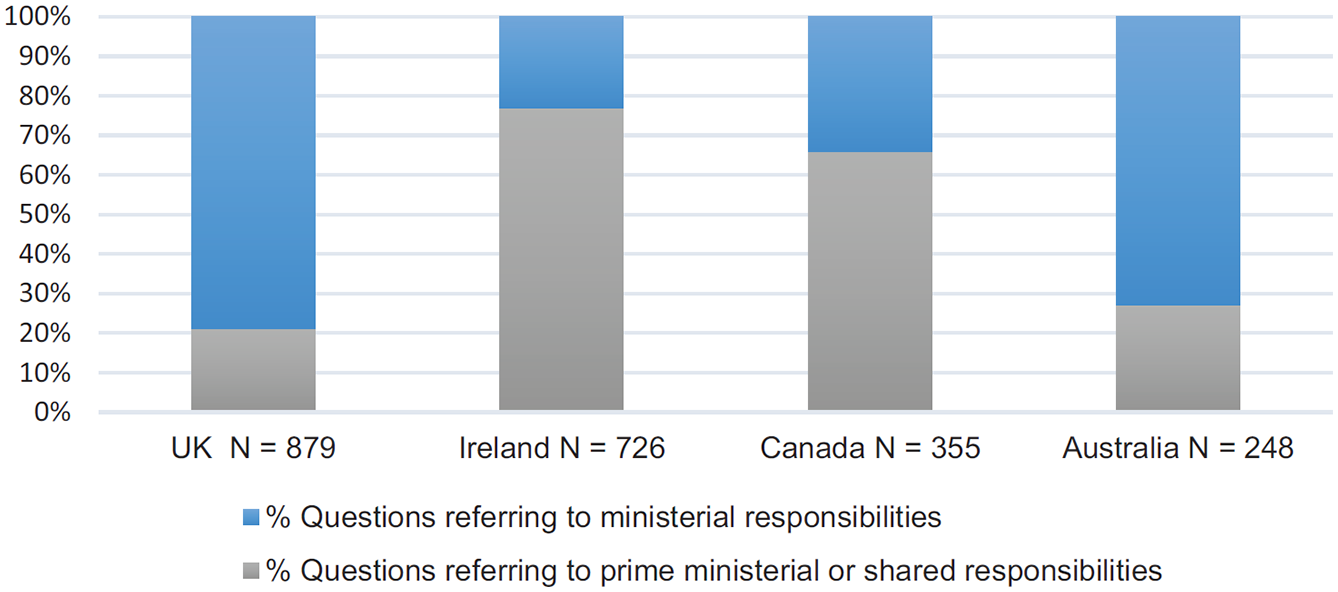
Questions to prime ministers and prime ministerial responsibilities.
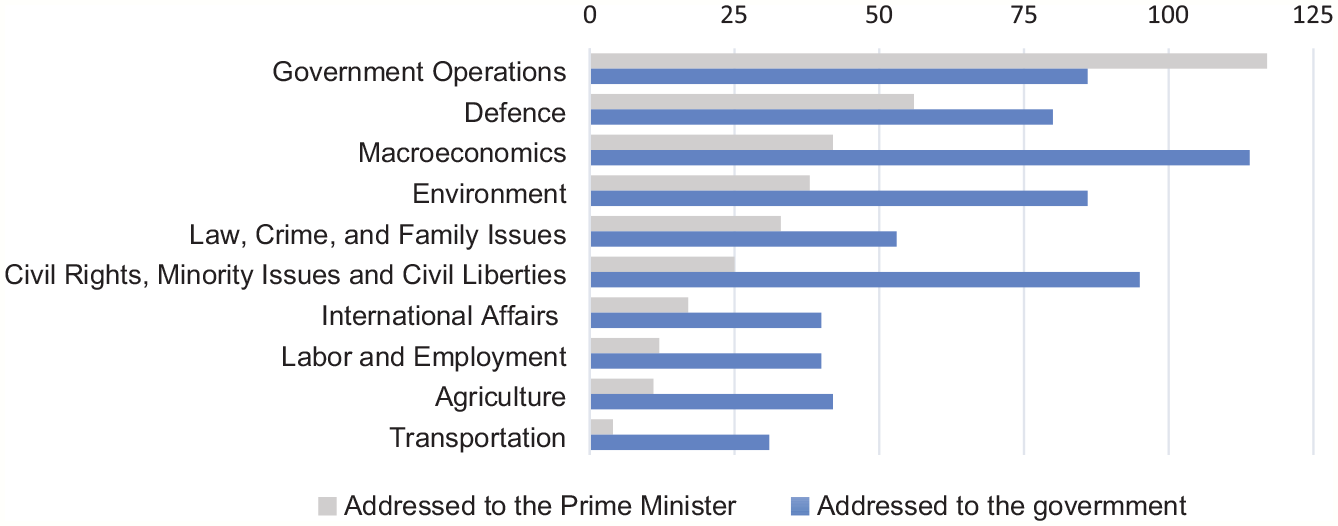
Canada: Top 10 topics in questions to the prime minister and to ministers (N = 1067 questions).
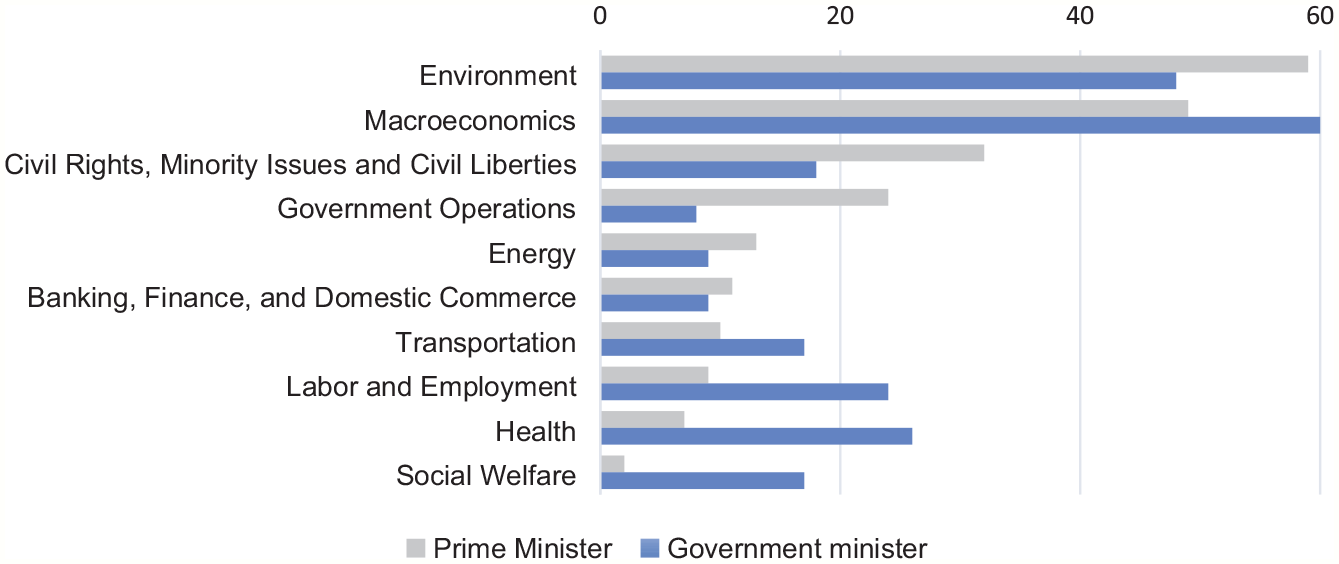
Australia: Top 10 topics in questions to the prime minister and to ministers (N = 540 questions).
Collective questioning mechanisms: Canada and Australia
Canada
Figure 2 presents the top 10 topics that came up in questions to the Prime Minister and to ministers, ordered by topics on which the Prime Minister received the most questions.
During Stephen Harper’s premiership, questions targeted prime ministerial responsibilities, either exclusive or shared, to an important degree: 66% of the 355 questions addressed directly to Harper concerned prime ministerial responsibilities (Figure 1). The top two topics are matters for which the Canadian Prime Minister is solely responsible (government operations), or for which they have an important degree of responsibility but share responsibility with a minister (defence). He was also questioned about the budget, which is an area for which the Canadian Prime Minister is traditionally seen as responsible (Brodie, 2018).
Importantly, Harper was scrutinised for government appointments, as well as for other appointments, which is an exclusive prime ministerial responsibility. One recurring question concerned the appointment of a Minister of Foreign Affairs and security concerns in connection to the minister’s partner. Another example concerned the decision to appoint the Chair of the Aboriginal Affairs Committee in the House of Commons, in light of evidence of his misconduct. Many of the questions on appointments accused the Prime Minister of patronage and political appointments benefitting the Conservative Party – Harper was accused of allowing his role as party leader to interfere with his direct powers as head of government.
Turning to shared matters, on defence, the majority of questions concerned Canada’s involvement in the war in Afghanistan. Harper was questioned both about long-term, strategic decisions, for example, how long the Canadian mission was set to continue, but also on matters of government decision-making in particular situations. A sequence of questions on 25 April 2007 referenced a report regarding human rights concerns about Afghan detainees. The Prime Minister was questioned both on decisions taken by the Minister of Foreign Affairs and by the Defence Minister, but also on his own involvement, illustrating how, on shared matters, prime ministers are asked to perform both role and personal accountability (Mulgan, 2003).
Australia
Turning to Australia, the landscape of questions to the Prime Minister is notably different. Neither of the top two topics is an area for which the Prime Minister is responsible either exclusively, or shared with a minister, with the exception of the few questions referring to the budget. The most frequently mentioned topic concerned environmental policy, due to the controversy around the introduction of a carbon pricing scheme. After Gillard had ruled out a carbon pricing scheme during the 2010 federal election, famously declaring that ‘there will be no carbon tax under the government I lead’, the Labour government introduced legislation for a carbon pricing scheme in the Clean Energy Bill 2011 (Sydney Morning Herald, 2010). Given Julia Gillard’s change of position, the passage of the bill was criticised fiercely by the opposition, and featured prominently in questions. As Gillard was seen as the lead spokesperson for the policy, many questions concerning the carbon tax were addressed directly to her – responsibility was, to an important extent, attributed to her. Hence, on the environment, the Prime Minister received more questions than the responsible minister (45% environment questions were addressed to the minister; 55% to the Prime Minister). This illustrates the complexity of prime ministerial responsibility: although the environment is not an area within the Australian Prime Minister’s remit, the fact that she assumed leadership of the policy meant that she was seen as responsible for it.
The degree to which Julia Gillard was held to account for topics that are within the Australian Prime Minister’s direct or shared remit is strikingly lower than in Canada: only 27% of the 248 questions addressed to her (Figure 1). Gillard received 24 questions on government operations, which only amounts to 10% of the questions addressed to her. On shared matters, she received 19 questions on the budget (8%), and very few questions on foreign affairs and on defence – 4, and 5 questions, respectively. The latter two did not even enter into the top 10 topics. Overall, the Australian Prime Minister was questioned more on topical issues and current affairs (the environment, due to the carbon tax, and economics) than on issues for which they are directly or jointly responsible.
Gillard was also asked to intervene in a national crisis. On transport, most of the questions addressed to the Prime Minister referred to the strike affecting the Australian airline Qantas in November 2010. 6 As the Qantas situation was perceived as a national crisis, the Prime Minister, as leader of the government, was seen as the person to act. But, similarly to the carbon tax, it was also matter of blame attribution: a highly topical matter is one for which the Prime Minister must publicly take responsibility.
Questions addressed to the Prime Minister were considerably more targeted at prime ministerial responsibilities in Canada, compared with more topical, current affairs questioning in Australia, during the two premierships. This contrasting evidence suggests that questioning the prime minister can take a targeted, individualised form even in collective mechanisms, but also that collective mechanisms may perform different functions within political systems. These conclusions will be discussed further in the final section.
Individualised questioning mechanisms: United Kingdom and Ireland
United Kingdom
David Cameron was questioned on a variety of topics, few of which relate to the British Prime Minister’s direct responsibilities (Figure 4). The main two topics were the economy and health, as the contested issues of austerity measures and NHS reform remained at the top of the opposition’s questioning agenda throughout the coalition government (Seldon and Snowdon, 2015; Yong and Bale, 2016). PMQs is thus very personalised and individualised: the Prime Minister is asked to account personally across many topics, regardless of whether they are directly within their remit. This confirms findings in previous studies (Bates et al. 2014; Bevan and John, 2016) that showed that the UK Prime Minister has been asked questions on an increasingly diverse range of topics over time: everything is seen as within the Prime Minister’s responsibility.
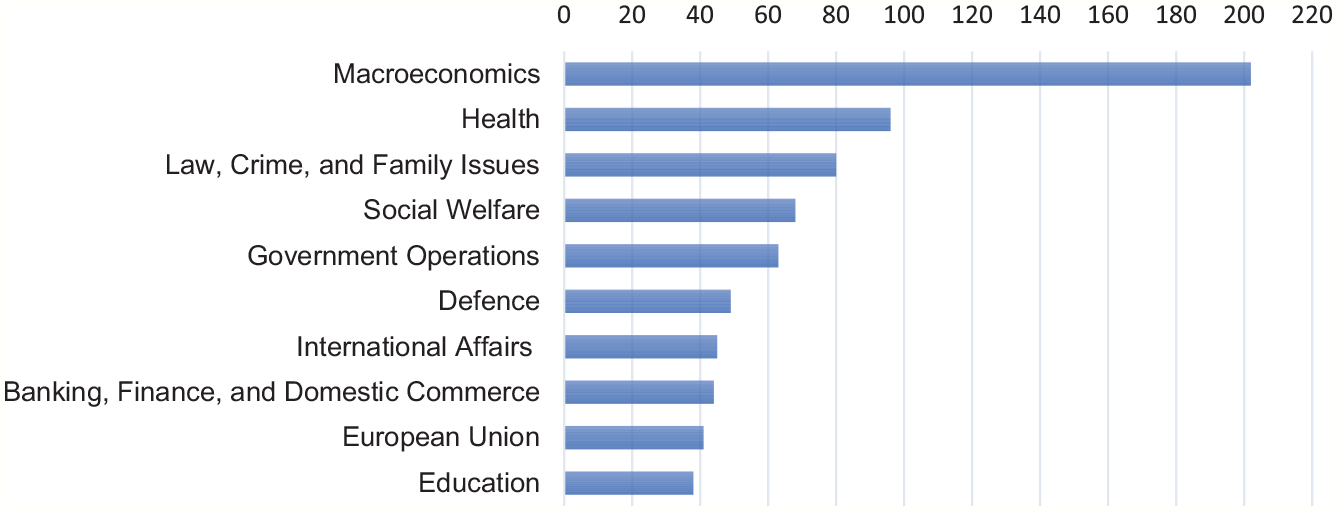
UK: Top 10 topics in questions (N = 879 questions.
In total, only 21% of questions addressed to David Cameron were connected to the UK Prime Minister’s direct or shared responsibilities. In terms of topics that are within the Prime Minister’s direct remit, Cameron received 63 questions on matters related to government operations, amounting to only 7%. On topics on which UK Prime Ministers hold significant responsibility but share responsibility with a minister, he received 49 questions on defence (6%), and 45 questions on foreign affairs (5%). Overall, PMQs shows moderate evidence of targeting prime ministerial responsibilities; the focus was on topical affairs and on topics for which the Prime Minister is seen as having an important steering role. PMQs is strikingly similar, in this respect, to the Australian Question Time.
Ireland
Turning to Ireland, (Figure 5) questioning during Enda Kenny’s premiership was predominantly focused on issues for which the Irish Prime Minister is personally responsible, more so than in all the other three cases: 77% of questions were on areas within his direct competence. The top two topics are within prime ministerial remit: foreign affairs and government operations. Within these topics, on foreign affairs, the Taoiseach was asked predominantly on two areas for which they are personally responsible: bilateral and other high-level talks, and issues related to Northern Ireland.
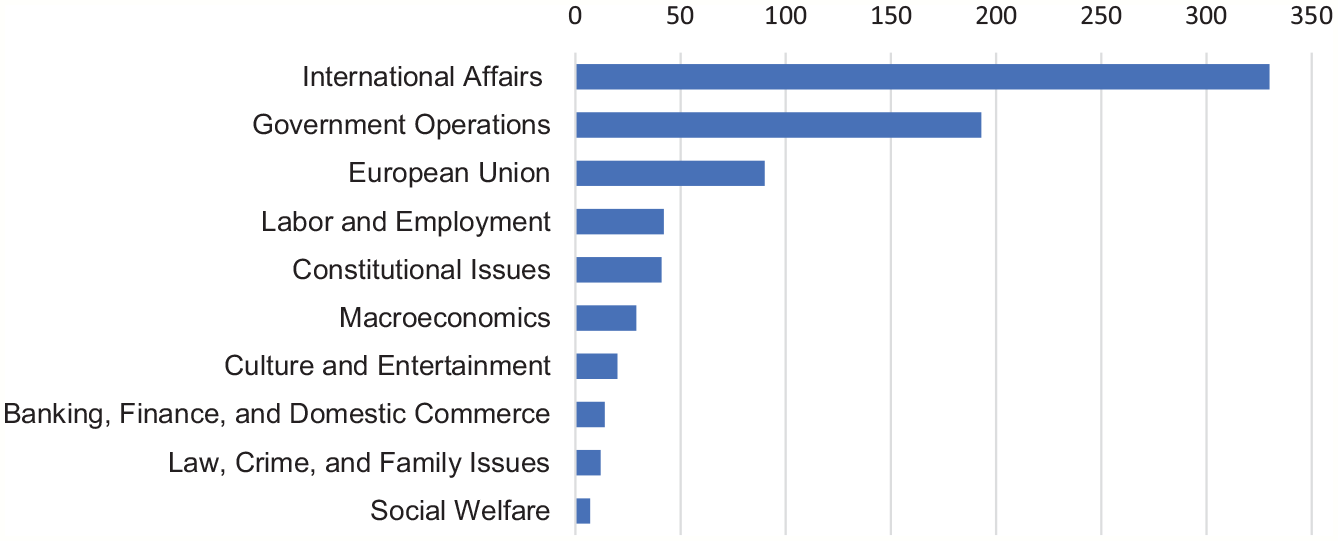
Ireland: Top 10 topics in questions (N = 726 questions).
Across all topics, oral questions submitted in advance were both prospective and retrospective – the Taoiseach was asked both to report on issues that had been discussed in meetings, and to outline what he was planning to address in future meetings. Questions submitted in writing often cast a wide net and cover various aspects of the same topic, to ensure that all relevant issues may be further explored through supplementaries. Questions on preparations for the United Kingdom’s Brexit referendum are a clear example of this strategy: on 29 September 2015, members submitted 18 questions in writing covering aspects such as whether the Taoiseach’s department had undertaken an impact assessment on Brexit, whether the Taoiseach had discussed the referendum with David Cameron, and whether he had discussed the issue with other European leaders at recent EU Council meetings. These topics were then followed-up extensively through supplementary questions. The potential effect of creating a scripted exchange is thus mitigated in practice: even though the Taoiseach reads out a prepared answer to the questions submitted in advance, they are then probed further through spontaneous supplementary questions.
The Taoiseach was also asked about EU matters, mainly in connection to EU Council reunions. In the United Kingdom, the Prime Minister conventionally makes statements in the House of Commons following international summits, so some of the questions on those topics will be asked following statements, rather than at PMQs. In the Irish Dáil statements are not followed by debate, so any such questions will be raised during Oral Questions.
Questioning in the United Kingdom and in Ireland thus presents notable differences. Compared to the British Prime Minister, the Taoiseach was predominantly questioned on matters that are within their responsibilities and in which they had a direct involvement. The notable procedural differences between the two mechanisms allow some ground to generalise beyond the time periods analysed, and to posit that it is likely that similar patterns may be observed during other periods.
Conclusion
Whether or not prime ministers are questioned about their direct or shared responsibilities does not appear to follow the collective/individualised division. Canada was closer to Ireland in terms of targeting prime ministerial responsibilities than to Australia, and the United Kingdom ranked lowest among the four countries. The variation of topics is clearly connected to the issues that were salient during the periods analysed–for example, the data range for the United Kingdom pre-dates the Brexit referendum debates, but data for Ireland include 2016, hence the high salience of Brexit and Northern Ireland. But some patterns may also be explained by the operation of rules of procedure, and by the role of questioning mechanisms in each political system.
The stark contrast between the United Kingdom and Ireland indicates that individualised questioning during Oral Questions to the Taoiseach is remarkably more honed on targeting personal prime ministerial responsibilities compared to PMQs, and thus potentially a more efficient mechanism for holding the prime minister accountable. One fundamental difference between the two mechanisms is procedural. PMQs allows spontaneous questioning, which may encourage more focus on current and topical issues. This indicates that a mechanism that requires questions to be submitted in advance, and for supplementary questions to be connected to the questions submitted in writing, as in Ireland, is potentially more conducive to questions being targeted at the Prime Minister’s personal responsibilities. Hence, to the degree that questions submitted in advance lead to more provision of information, this type of mechanism may be considered more conducive to accountability.
A second interpretation concerns the role of questioning mechanisms within the political system. In the United Kingdom, PMQs is the routine check-up on the Prime Minister (Hazerika and Hamilton, 2018), and mainly concerns topical issues. The Liaison Committee is a more appropriate setting for detailed scrutiny of the Prime Minister’s personal responsibilities (Kelso et al., 2016). Similarly, on foreign and EU affairs, the Prime Minister’s statements in the Commons offer another opportunity for scrutiny. The main role of PMQs is routine scrutiny spanning across many policy areas, rather than focused scrutiny. It facilitates a regular exchange with the head of government on current affairs, based on spontaneous questions. By contrast, in Ireland, Oral Questions to the Taoiseach is the main forum for detailed scrutiny. The parallel procedure, Leaders’ Questions, was introduced precisely to allow leaders to question the Taoiseach on topical, current issues. The Irish system also provides other questioning venues, for example, on legislation at Business Questions. In both the Irish and the UK case, potential accountability gaps may thus be filled by other mechanisms: insufficient scrutiny on current affairs in Ireland may be filled by Leaders’ Questions, and the Liaison Committee may fill more detailed scrutiny gaps if PMQs predominantly focuses on topical affairs.
This raises the question of whether having one plenary mechanism for questioning the Prime Minister is enough to enable parliament to cover both topical, current affairs as well as more in-depth longer-term issues, or whether a combination of mechanisms of different types (both in the plenary and in committee) might be more appropriate. Canada and Australia, as countries that do not offer alternative oral questioning mechanisms, provide additional insight into the role of questioning mechanisms in parliament’s scrutiny capabilities. Question Period served the function of targeting prime ministerial responsibilities to an important degree, as well as covering topical affairs. By contrast, in Australia, questioning the Prime Minister is also mainly an instrument for routine scrutiny on current affairs – making Question Time more similar to PMQs than to the ostensibly similar collective Question Period in Canada. But given the absence of any other mechanism for questioning the prime minister, this may create considerable accountability gaps.
These results have important implications for the design of plenary questioning mechanisms, indicating which procedural features may be conducive to focused scrutiny of prime ministerial responsibilities, and which rather facilitate a regular exchange with the head of government. While areas of direct prime ministerial responsibility remain difficult to delineate, parliamentary questioning procedures can be designed to target specific areas of decision-making by either requiring questions to be submitted in advance, or by agreeing a set of topics that will be discussed, as in the case of the Liaison Committee. Evidence from the four cases suggests that introducing different types of questioning mechanisms that fulfil complementary roles is desirable for a comprehensive accountability relationship between the prime minister and parliament. Having a combination of different questioning mechanisms ensures that prime ministers can be questioned on their specific responsibilities and decision-making, as well as on the routine affairs of government.
Beyond constitutional prerogatives, the topics on which prime ministers are questioned may also reflect expectations of accountability specific to different countries. In the same way that the Canadian Prime Minister is expected to be responsible for the budget (Brodie, 2018), the British Prime Minister is judged on how their government handles NHS funding, policy, and reform proposals. As illustrated by the Australian case, the Prime Minister is also the leader accountable in the case of a national emergency in any policy area. In addition to constitutional provisions, it is therefore important to consider case-specific conventions and understandings of prime ministerial responsibility in assessing the degree to which prime ministers are held to account for their responsibilities. While a pre-defined list of topics such as the Comparative Agendas Codebook (n.d.) has the advantage of reliability and cross-case comparability, a more inductive approach to understanding local topics of interest is necessary in order to reconstruct a valid account of prime ministerial responsibility in different countries.
It is also important to note that oral questions perform a variety of functions alongside accountability. MPs may use questions to criticise the opposite side, to defend their own party, to represent their constituents’ interests, or to frame the agenda around a policy topic of interest (Bates et al., 2018; Bevan and John, 2016; Wiberg, 1995; Wiberg and Koura, 1994). The degree to which questioning mechanisms facilitate the performance of different functions is likely to depend on rules of procedure, but also on media attention. For example, a plenary mechanism based on spontaneous questions such as PMQs, which is also reported on extensively, may be a venue for MPs to express disagreement or solidarity with the government in a forum that is visible beyond the parliamentary audience. The degree to which accountability is the primary function of a particular questioning mechanism may also be related to the culture of particular legislatures. Some questioning procedures, notably the United Kingdom’s PMQs and Question Time in Australia, are notorious for the adversarial style of questioning.
These findings also suggest directions for further research. The central question, and a key limitation of the study, is whether the patterns found in the four cases are theoretically transferable to comparable contexts – particularly whether the patterns observed within one premiership are consistent over time, or whether they vary depending on type of government, and also whether questioning mechanisms with similar procedural features lead to similar patterns of accountability, or whether other variables also influence this process. The degree to which four case studies can offer definitive conclusions on these matters is limited, but they offer a starting point from which future research could further contribute to the understanding of the mechanisms and practices of prime ministerial accountability in parliamentary democracies.
Footnotes
Appendix
Number of coded questions for each case study country (N = 120 questioning sessions, 30 sessions per case).
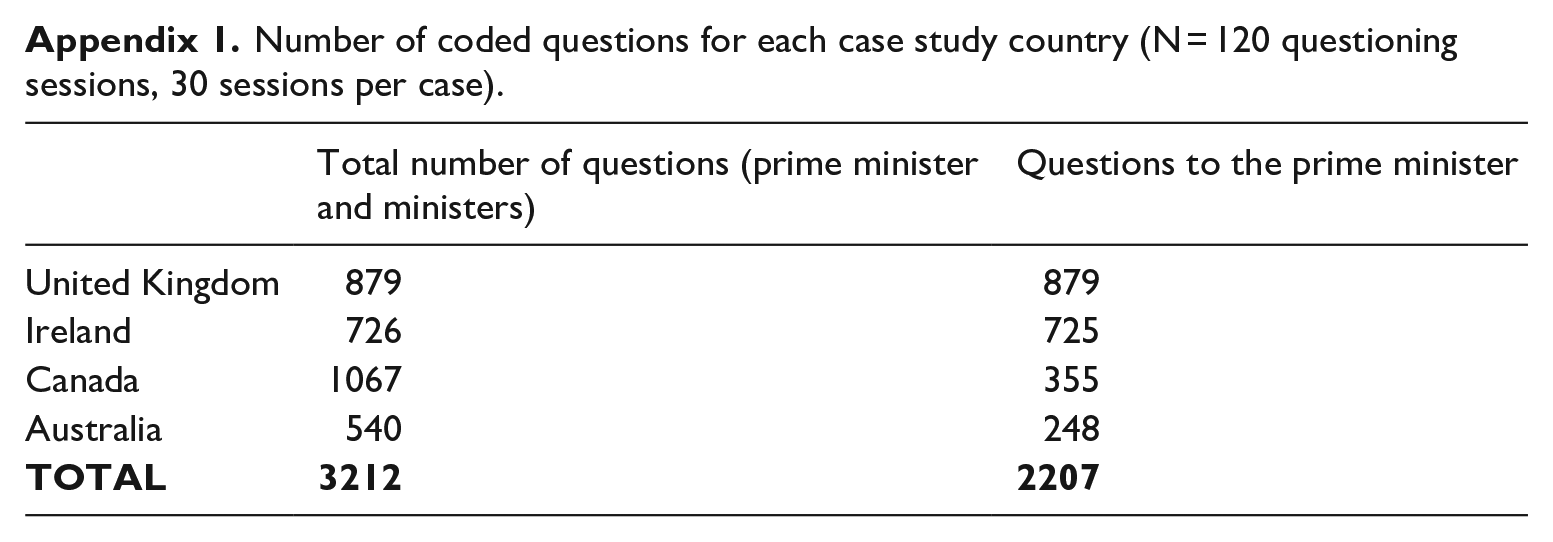
| Total number of questions (prime minister and ministers) | Questions to the prime minister | |
|---|---|---|
| United Kingdom | 879 | 879 |
| Ireland | 726 | 725 |
| Canada | 1067 | 355 |
| Australia | 540 | 248 |
|
|
|
|
Funding
The author(s) disclosed receipt of the following financial support for the research, authorship and/or publication of this article: UCL Department of Political Science Bentham Doctoral Scholarship, 2015-2018.
