




Abstract
One of the key defining features of Westminster-type democracies is the acknowledgement of an official Opposition and a Leader of the Opposition typically referred to as a ‘prime minister in waiting’. This article focuses on this crucial element of Westminster democracy and applies a gender perspective, looking into women Leaders of the Opposition in the UK, Canada, New Zealand, and Australia (1975–2022). As this inquiry reveals, there have been few and mostly short-lived women Leaders of the Opposition. Further, contrary to plausible assumptions, there have been more women Leaders of the Opposition from conservative than from left-wing parties. In particular, however, the office of Leader of the Opposition has, with few exceptions, not proven to be a springboard to the premiership. In fact, a majority of women prime ministers were ‘takeover prime ministers’, inheriting the office from a predecessor from their own party, rather than former Leaders of the Opposition, while many women Leaders of the Opposition were not even given the opportunity to lead their party into a national election campaign. The article discusses possible explanations for these patterns.
Introduction
More than half a century after its early peak (Dahl, 1966), political oppositions have powerfully bounced back on scholarly agendas worldwide. The past decade has seen an impressive surge of political research on oppositions in fundamentally different types of political regime (see Helms, 2023). Real-world developments – including in particular the emergence of better-educated and more critical citizens as well as the proliferation of various new types of challenger parties – have combined with the ambitions of a new generation of scholars that increasingly considers the right to contest governments a core principle of democratic governance worth studying in its own right. While opposition can take many forms, many of which relating to extra-parliamentary arenas and activities, parliament-based forms of political opposition have retained a special place in many parliamentary democracies (see e.g. De Giorgi and Ilonszki, 2018; Helms, 2009). This is true in empirical terms, but even more so with regard to the normative foundations of parliamentary democracy, and related theoretical perspectives on parliamentary government. In conceptualizations of parliamentary government as a principal-agent-based ‘chain of delegation’, parliaments (or MPs for that matter) have been staged as the people’s closest agent (Strøm, 2000). From this perspective, parliamentary oppositions can be conceived as the central actor guarding the interests of the electoral losers towards the government between elections.
In no other type of representative democracy have parliamentary oppositions enjoyed a more venerable and widely accepted status than in Westminster-type democracies (see Dewan and Spirling, 2011; Kaiser, 2008; Norton, 2008; Palonen, 2016; So, 2018). In line with the established adversary logic of Westminster-style politics, even major opposition parties in that type of regime enjoy little veto powers; at the same time, they are exceptionally well-fitted to launch alternatives (see Garritzmann, 2017). More than that, the principal opposition party in parliament is considered to operate on a par with the government. Its officially acknowledged status is that of an alternative government, a ‘government-in-waiting’, popularly referred to as an ‘Opposition with a Capital O’. The institution of a ‘shadow cabinet’, which gathers the most senior representatives of the official Opposition, is arguably the most tangible feature of this ‘alternative government’ model of opposition. The shadow cabinet is chaired by the Leader of the Opposition (i.e. the elected leader of that ‘other major party’). The distinct and constitutionally acknowledged status of the Leader of the Opposition can especially be seen from the fact that it is a publicly salaried office with several other public resources attached. 1 In this particular institutional context, the Leader of the Opposition is conceived of as a ‘prime minister in waiting’, being opposition leader constituting a ‘formative experience’ and a natural apprenticeship for prime ministerial leadership (Errington, 2011: 58). The popular idea of Leaders of the Opposition representing ‘prime ministers in waiting’ has barely been damaged by the considerably more complex empirical patterns of winning prime ministerial office in constitutional practice. In fact, in the countries investigated in this article, a significant proportion of prime ministers won office as intra-party successors to a departing prime minister rather than as successful challengers from the opposition benches (see below). And yet, all Leaders of the Opposition invariably face the challenge of being evaluated with regard to their perceived quality as a potential prime minister (rather than just opposition leader as such), even though it is open to debate if both offices actually require an identical set of qualifications and qualities.
In many Westminster democracies, the Leader of the Opposition has significantly gained in status over the past decades, both in the electoral and parliamentary arena. This is certainly true for the UK (see Heppell, 2012b). In particular Prime Minister’s Question Time (while always having been somewhat biased towards the two key protagonists) has increasingly turned into a real showdown between prime ministers and opposition leaders (see Serban, 2021). Yet, even in countries such as Canada, where the designation of the status of official Opposition has been challenging due to particularities of the party system, Leaders of the Opposition have, if at all, gained rather than lost in political stature and prominence (Michaud, 2000). The ongoing personalization and mediatization of politics, which has come to mark most contemporary democracies and many other regimes as well (Cross et al., 2018; Rahat and Kenig, 2018), has affected not just political chief executives (i.e. prime ministers and presidents) but also opposition leaders. That said, these globally observed developments have not completely levelled out established differences in government/opposition relations between countries even within the Westminster family, which reflect to some considerable extent different procedural regimes in place (see Serban, 2023). These differences at the level of parliamentary statutes are symptomatic of the considerable institutional and political variation marking individual countries conventionally referred to as Westminster systems (see below).
Curiously, neither the recent revitalization of international opposition research nor the acknowledged, and growing, importance of opposition leaders in Westminster systems have given rise to any more extensive inquiries into Leaders of the Opposition beyond the British case. 2 Among the many gaps in the literature on political oppositions (see Helms, 2023), one is particularly glaring and disturbing: the nearly complete absence of a gender-sensitive perspective on opposition leaders, which is not made less severe by the more general scholarly ignorance towards women political leaders in Westminster systems. Indeed, ‘Westminster women’ (Lovenduski and Norris, 2003), it seems, have not only been given a hard time in real-world politics, they have also been conspicuously neglected in the political study thereof, or at least when it comes to systematic comparative assessments. 3 From that perspective, acknowledging the particular prominence of ‘masculine’ elements and a wealth of manifest and latent gender-related discriminations that characterize politics in many Westminster democracies, an inquiry into women leaders challenging those at the very top of the power hierarchy, can reasonably claim to be of particular importance.
The central goal of this paper is to make a first step towards studying women Leaders of the Opposition in Westminster systems from a systematic comparative perspective. It seeks to identify and evaluate the political backgrounds, patterns of ascendancy and key aspects of political performance of women Leaders of the Opposition in four Anglo parliamentary democracies: the UK, Canada, Australia and New Zealand. While this piece is of a genuinely explorative nature, it seeks to relate this inquiry to the wider literature on politics and gender to identify key issues and criteria, and to add meaning to its findings. The next section offers some conceptual discussion and theoretical reflection, designed to prepare the ground for the comparative assessment to follow.
The contested boundaries of the Westminster family, and the variable settings of oppositional leadership
A first necessary note concerns the differing degrees to which the four countries under investigation – the UK, Canada, Australia and New Zealand – can be meaningfully referred to as Westminster systems. While some of the finest and most authoritative work on these four Anglo parliamentary democracies has continued to group this countries together without much further discussion (see e.g. Aucoin, 2008; Curtin et al., 2022; Galligan and Brenton, 2015; Rhodes et al., 2009; Shaw and Eichbaum, 2014), some stocktaking is in order. Canada, Australia and – more than any other country from this sample – New Zealand all lack key elements of Westminster democracy as famously defined by Arend Lijphart (2012) and others, as strongly power-concentrating, majoritarian regimes. In Canada and Australia, especially the genuinely federal nature of the polity, and its effects on the party system, mark major deviations from this scholarly conception of Westminster democracy. In New Zealand, the very nature of the electoral system (mixed member proportional representation instead of first-past-the-post since 1993), the party system (multi-party rather than two-party), and not least the government format (with frequent coalition or minority governments) have conspicuously been at odds with the classic Westminster model since the early 1990s (see e.g. Levine, 2004). Indeed, even the UK itself has experienced changes over the past decades (such as devolution and the introduction of central bank independence as well as temporary instances of coalition government) moving it away from the classic format of Westminster democracy, with many of the lost features having not fully been restored after Brexit (see Baldini et al., 2022; Giuliani, 2022). For all that, the shared concept of an official Opposition with a Leader of the Opposition stands out as a central feature marking all four Anglo parliamentary democracies. Thus, while this paper does not specifically aspire to mark a major contribution to the ongoing debate about the conceptual and empirical boundaries of Westminster systems (see Flinders et al., 2022; Grube and Howard, 2016; Russell and Serban, 2021), its focus on women Leaders of the Opposition can safely claim to add to a deeper understanding of the political nature of four major democracies that have traditionally been perceived as firmly rooted in the Westminster tradition of parliamentary government.
If one were to use these cursory assessments of the basic institutional arrangements for formulating an expectation about the likelihood that a country has had one or several women Leaders of the Opposition, New Zealand should clearly fare best. That said, the nature of a given polity can obviously not be captured from its institutional arrangements alone; culture and agency are no less important, which applies also to our sample of countries. Specifically, given the striking levels of ‘toughness’ marking politics inside and outside the parliamentary arena, Australia has been widely considered an extremely competitive, even ‘brutal’, democratic regime (Switzer, 2018), which implies that Australian politics is a particularly difficult context for women when it comes to securing (and holding on to) top leadership positions.
A further preliminary note concerns the very nature of Leaders of the Opposition in these countries. While being placed at the centre of parliament, Leaders of the Opposition are as much ‘party creatures’ as they are ‘parliamentary creatures’. An MP becomes Leader of the Opposition by securing the leadership of his or her party, if and when that party is the largest non-governing party in parliament. While it is usually the electorate that determines which one is the second-largest party in parliament (and thus normally the official Opposition), it is the parties who select their leaders. In the four Anglo parliamentary democracies under study, notwithstanding a recent trend towards expanding the selectorate, the parliamentary party has largely continued to be the center of intra-party power across different types of parties (see Cross and Blais, 2012). However, studies on the selection of candidates for parliamentary elections and of party leaders concur that formal rules alone cannot explain the (usually low) number of women as either candidates or leaders (see, e.g. Van Dijk, 2023). As Wouters and Pilet summarize their sophisticated comparative inquiry into the politics of party leadership elections, ‘The use of more inclusive or more exclusive selectorates does not decrease the chances of having female leaders selected, nor does it increase them. What matters is the broader context – that is, how open political parties and politics are to women in general’ (Wauters and Pilet, 2015: 89).
There is reason to suppose that differences in political ideology are a factor in its own right (forming part of the ‘broader context’ that Wauters and Pilet refer to). Across a wide range of fields, progressive/left-wing parties have been shown to be more gender-sensitive and to provide better opportunities for women candidates than conservative parties (see e.g. Paxton and Kunovich, 2003; Kittilson, 2013; Krook, 2009). When left parties spend longer periods in opposition than conservative parties – which has characterized the political histories of most countries under study (with the exception of Canada) – there are particularly good reasons to expect a higher number of women Leaders of the Opposition affiliated with left parties.
As mentioned earlier, this article can only make the very first steps towards a gender-sensitive understanding of oppositional politics in these four Anglo parliamentary democracies by identifying the protagonists and looking into their backgrounds, tenures and roles. Rather than testing any hypotheses, for which this sample is too small (both in terms of countries and cases), our aim is to offer some tentative explanations of noteworthy patterns and possible causalities as we go along. The period covered stretches from the first ever emergence of a woman Leader of the Opposition in these four countries – Margaret Thatcher in 1975 – through 2022.
Women leaders of the opposition: profiles and patterns
Women leaders of the opposition in the UK, Canada and New Zealand (1975–2022): Affiliations, terms and key features.
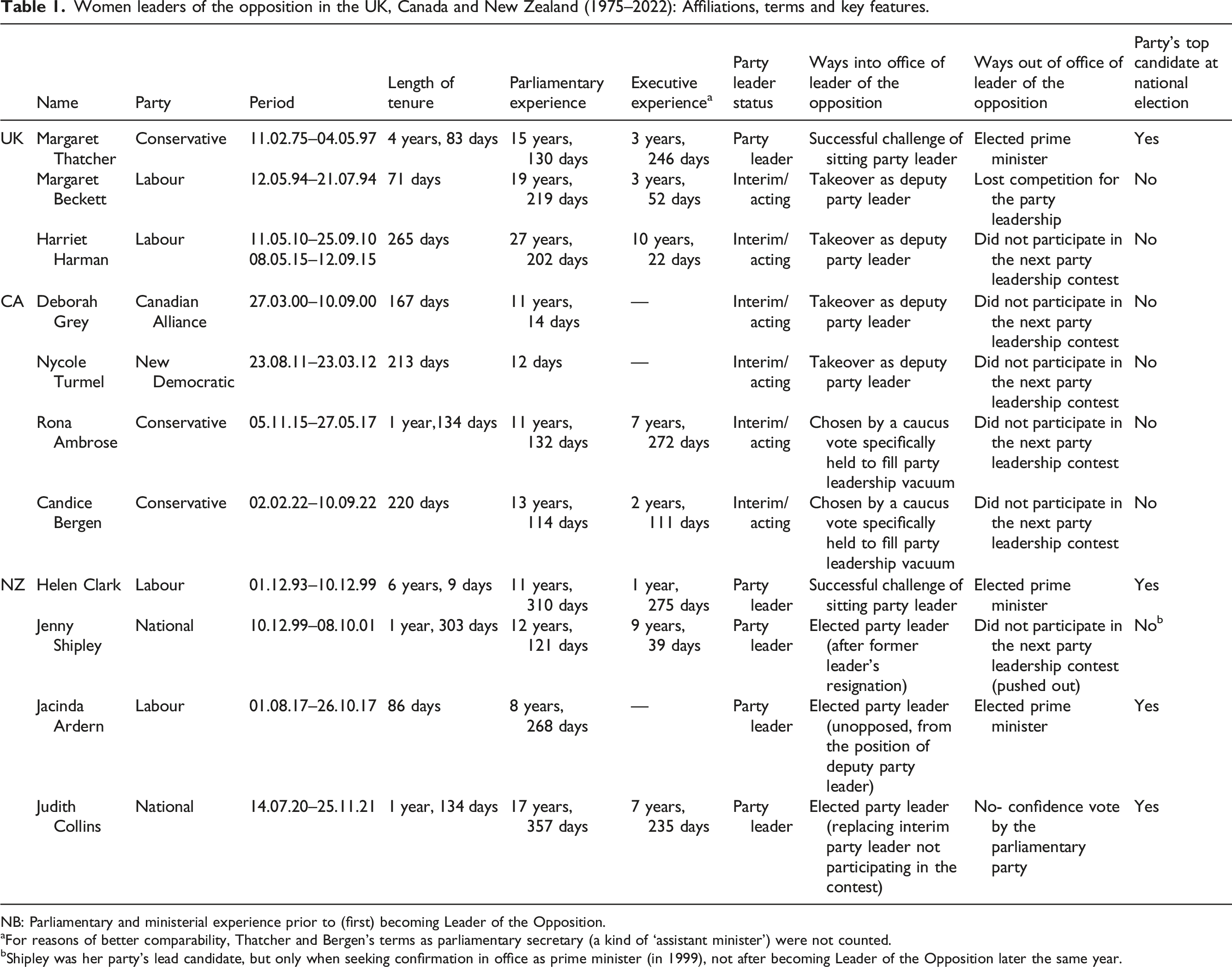
NB: Parliamentary and ministerial experience prior to (first) becoming Leader of the Opposition.
aFor reasons of better comparability, Thatcher and Bergen’s terms as parliamentary secretary (a kind of ‘assistant minister’) were not counted.
bShipley was her party’s lead candidate, but only when seeking confirmation in office as prime minister (in 1999), not after becoming Leader of the Opposition later the same year.
What also meets the eye immediately is the major differences between the four countries: while New Zealand and Canada both had four different women Leaders of the Opposition each, and the UK three, there has not been a single woman Leader of the Opposition in Australia to the present day. This is in line with the widely noted ‘blood sport qualities’ of Australian politics, and the concentration of intra-party power in the parliamentary party that has marked leadership election regimes in Australian political parties. 4 New Zealand marks the most clear-cut opposite to the Australian case, in particular if one considers the status and performance of women Leaders of the Opposition in this country.
Before analyzing the ways individual candidates won and lost office, it would seem useful to have a brief look at the political qualifications that these candidates commanded. The three cases from Britain (Thatcher, Beckett and Harman) perfectly match established notions of political elites in parliament-centred Westminster democracies. All three of them had more than 15 years of parliamentary experience, 5 and more than three years of senior ministerial experience. While incumbents from all three countries – with one major exception 6 – had more or less extended parliamentary careers, there has been a great variety in terms of ministerial experience. Three Leaders of the Opposition from our sample (Grey and Turmel, CA, and Ardern, NZ) had no ministerial experience at all, while Ambrose and Shipley had eight and nine years of senior ministerial experience respectively. However, in this regard, it is difficult to identify any meaningful country patterns. Women Leaders of the Opposition from Canada had a notably more limited average executive experience, but both the most experienced (Shipley) and the least experienced candidate from our sample (Ardern) came from New Zealand. Also, the length of previous ministerial experience is a notably poor indicator of success as Leader of the Opposition. None of the four most experienced candidates (Harman, Ambrose, Shipley and Collins who all commanded between seven-and-a-half and more than 10 years of senior ministerial experience) managed to win the premiership from the position of Leader of the Opposition. By contrast, the only two other women Leaders of the Opposition from our sample winning the premiership except Thatcher – Clark in 1993, and Ardern in 2017 – had less than two years or no ministerial experience at all respectively.
Further, there are major differences regarding the leader status that these candidates had within their party before or on becoming Leader of the Opposition. New Zealand is the only country from our sample, in which all women Leaders of the Opposition were regular party leaders (in contrast to mere deputy or interim party leaders), while their British and Canadian counterparts (save Margaret Thatcher) were just deputy or interim party leaders. There are important differences beyond this basic distinction: Of the five regular party leaders, only two (Thatcher and Clark) won that position by challenging the sitting party leader; the other three faced just one other non-incumbent contender (Shipley) or were elected unopposed (Ardern and Collins). Further, while some of the ‘non-regular’ party leaders became Leaders of the Opposition in their capacity as deputy party leaders, others were specifically elected as interim party leaders that were, by convention, not allowed to participate in the upcoming party leadership election (which is true for Ambrose and Bergen).
Quite a few women Leaders of the Opposition from our sample lost their office as they failed to become their party’s permanent leader. However, remarkably, most of them not even tried to. In fact, Margaret Beckett is the only Leader of the Opposition from our sample who entered – and failed to win – a party leadership election contest. While most women Leaders of the Opposition gave up that office voluntarily, some were actually ousted by their parties – either formally, as Judith Collins who was brought down by a formal vote of no-coincidence by her parliamentary party, or more informally, as Jenny Shipley (whose fellow MPs launched a call for an immediate leadership election against her will, why she stepped down ‘but not by choice’ 7 ).
Constituting a major issue in its own right, few women Leaders of the Opposition ever had the opportunity to lead their party into a national election campaign – Margaret Thatcher and three leaders from New Zealand (Clark, Ardern and Collins) being the exceptions in this regard. Helen Clark stands out among those candidates as she served as her party’s top challenger in three consecutive elections (1993, 1996 and 1999).
Another key feature revealed in Table 1 is the fact that – contrary to popular assumptions about the greater ‘women-friendliness’ of left-wing parties – the majority of women Leaders of the Opposition (six out of eleven) came from conservative parties, even though two of the three countries with women Leaders of the Opposition (NZ and the UK) had longer cumulated spells of left-of-centre opposition between 1975 and 2022. Thus, conservative parties in opposition have indeed provided somewhat better opportunities for women candidates than left-wing parties (with a women leader share of 12.7% and 7.3% respectively).
This may, of course, reflect motives other than a genuine commitment to gender-parity, including a possible masculine hubris and a tendency to underestimate women candidates (if sometimes for the latter’s benefit). Indeed, even a ‘political beast’ like Margaret Thatcher was, until well into the early stages of her premiership, underestimated by many of her male peers (see Evans, 1997: 42–43). In 1975, ‘she had stepped forward to contest the leadership only when a more experienced figure, Sir Keith Joseph, had decided not to take on Heath [… who] had led the party to two consecutive General Election defeats’ (Norton, 2012: 99–102). At that time, Thatcher was relatively inexperienced and considered by many in the party a political lightweight.
There may also have been a particular willingness among conservative male peers to let women do the ‘dirty work’ until the chances to get back into power again improve. When Tory MPs selected Thatcher, they did not really expect to form a government anytime soon. Similarly, Jenny Shipley continued her career as opposition leader (for about 22 months) after having been defeated as prime minister in the 1999 general election, with little hope to regain the premiership in the near future. These and other cases fit the scholarly wisdom on particular political opportunities that can bring women to power very well: women tend in fact to fare best in times of crisis, which tend to keep younger male contenders at bay, and when vacant positions are less attractive than usual (see Beckwith, 2015; O’Brien, 2015; Verge and Astudillo, 2019).
What perhaps further adds to the understanding of this pattern is the realization of the particular ideological context in which most women Leaders of the Opposition from our sample won office. The last quarter of the twentieth century (and in some cases beyond) was an era dominated by a staunchly conservative governing philosophy and ‘neo-liberal’ policies in many parts of the world (see, e.g. Lévy et al., 2022; Sykes, 2000). In this period, conservative parties and their leaders generally tended to generate notably ‘tough’ policies and were keen to appear as taking strong and firm positions that would convey ‘masculine’ attributes favored in adversarial environments. One possible explanation for the dominance of women at the top of conservative parties (well beyond the UK) is this toughness that can possibly compensate for stereotypes of women as weak, whereas left-of-center parties in this era often appeared as unduly ‘soft’ – which may, however, place women in an even weaker position than personal gender stereotypes tend to do. Indeed, the left-wing parties from our sample have not treated their women candidates significantly better: Many of them were also only interim or acting party leaders and thus leaders of the opposition in particularly challenging times (both Beckett and Harman in the UK as well as Turmel in Canada). With a ratio of 1:1.75, there remains a substantive advantage for Conservative candidates at the bottom line.
Leaders of the opposition leading their party into a general election campaign, PMs with previous experience as leader of the opposition, takeover PMs, and past PMs as leaders of the opposition, 1945–2022 (overall number/percentage share).
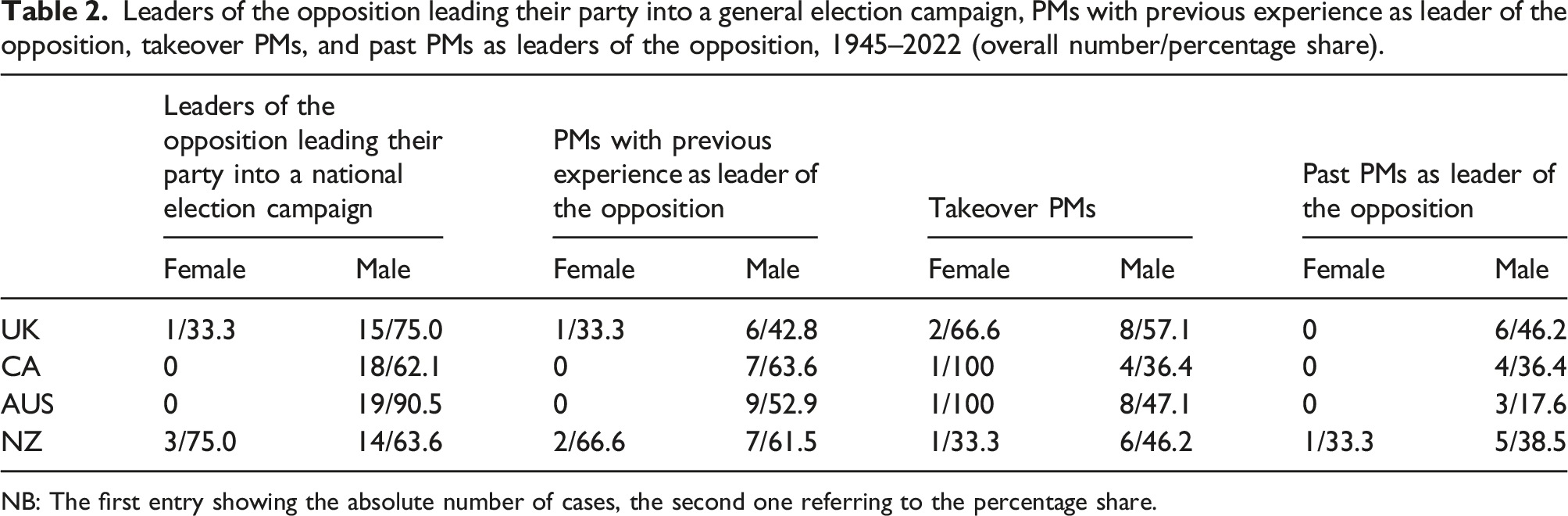
NB: The first entry showing the absolute number of cases, the second one referring to the percentage share.
To begin, concerning one of the most prominent roles of Leaders of the Opposition, namely to challenge an incumbent prime minister at an election, the figures reported above contrast starkly with the electoral activities of male Leaders of the Opposition in all four countries. The share of male Leaders of the Opposition serving as their party’s top challenger was lowest for Canada and New Zealand, but even there included well above 60% of all incumbents. No less than three quarters of all British and more than 90% of all Australian male Leaders of the Opposition led their party into a general/federal election at least once. Quite a few candidates were granted two or even three attempts by their parties (the latter is true for Stanfield in Canada, Nash and Kirk in New Zealand, and Evatt, Calwell and Whitlam in Australia). Given the strikingly limited opportunities for women Leaders of the Opposition to win an election with and for their party, it is no wonder that just three of them managed to swap their opposition leadership with the premiership.
At the same time, these figures indicate that when women leaders were given the chance to feature as their party’s chief challenger at elections, they were exceptionally successful (if obviously, even in an era of ‘personalized politics’, neither electoral victory nor defeat can be reasonably attributed to the party leader alone, see e.g. Lobo and Curtis, 2014). Indeed, Judith Collins was the only woman Leader of the Opposition from our sample who was ultimately unsuccessful at the polls; all others succeeded, Thatcher and Ardern at the first attempt, and Clark at the third. 8 As Table 2 also reveals, New Zealand is the only country from our sample, in which the overall success score of women candidates advancing to the premiership from the position of Leader of the Opposition is even higher than for male candidates. That is, women candidates in New Zealand have more lived up to the expectation that incoming prime ministers should have lived through a previous career as Leader of the Opposition than their male counterparts.
Women prime ministers in the UK, Canada, Australia and New Zealand (1945–2022): Affiliations, terms and career patterns.
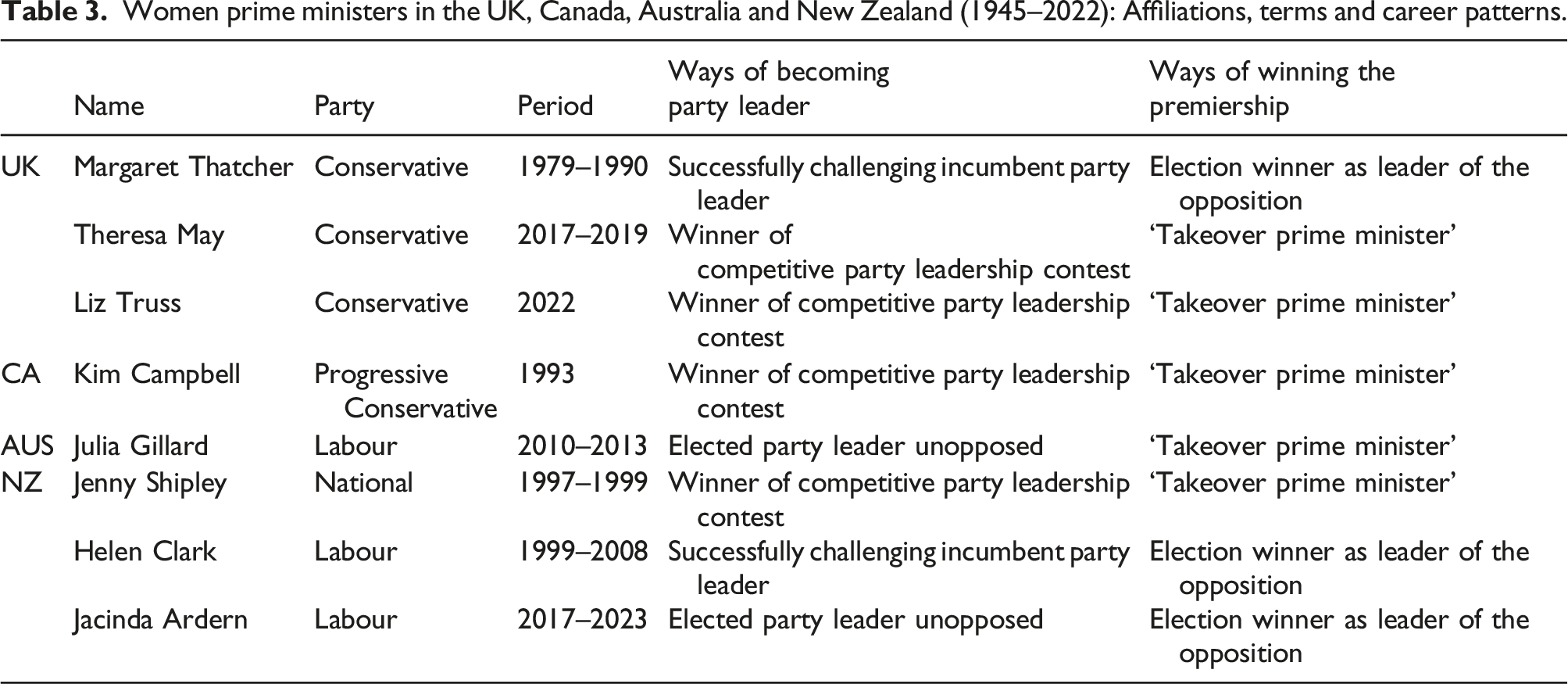
Even this remarkable pattern can be explained along the lines of established arguments of the gender literature (see Beckwith, 2015; O’Brien, 2015; Verge and Astudillo, 2019). While the premiership is indeed the heart of power that parties are committed to keeping control over at any expense, a prime minister departing in the midst of a legislative term usually signals a deep crisis of the government and the party, which requires special measures and talents. In such particular situation, reflecting deep-seated stereotypical notions of women leadership that shape the selection of political elites, women can possibly benefit from being considered ‘natural-born’ consensus-builders and ‘healers’. This reading is also supported by the more particular features of the party leadership election contests bringing those leaders to power, revealed in Table 3. Six of the eight women prime ministers originally emerged from a competitive party leadership contest; only two (Gillard and Ardern) were elected unopposed. However, importantly, only two of the six facing one or several contenders actually had to challenge the sitting party leader/prime minister (Thatcher and Clark).
The pattern of a majority of women advancing to the premiership as ‘takeover candidates’, rather than election winners, looks less bewildering if one considers the career pathways of the overall 55 male prime ministers from our four countries (accounting for all those being first appointed in 1945 or later through2022 9 ; see Table 2). In the UK no fewer than eight out of 14 (i.e. 57.1% of all) male prime ministers were ‘takeover prime ministers’; the highest score for our sample. However, in the other three countries, there has been a sizeable number and share of male ‘takeover prime ministers’ 10 , too, with shares running between roughly 36 and 47%. New Zealand is the only country from our sample, in which the share of women ‘takeover prime ministers’ has been lower than that for male holders of the premiership or – put differently – has seen a greater share of victorious women Leaders of the Opposition (see Table 2).
Jenny Shipley was not only New Zealand’s first women prime minister ever; she also holds a special place among women leaders in terms of becoming Leader of the Opposition only after having been prime minister. Again, a broader comparative perspective reveals that her pathway to the premiership was by no means unique. Indeed, quite a few leaders of the post-1945 period have served as prime ministers before becoming Leader of the Opposition. There were three post-war prime ministers in Australia (Menzies, Chifley and Whitlam), four in Canada (St.-Laurent, Diefenbaker, Trudeau and Turner), and no less than six both in the UK (Churchill, Attlee, Heath, Wilson, Callaghan and Major) 11 and in New Zealand (Fraser, Holyoke, Marshall, Muldoon, Shipley and English) that served as Leaders of the Opposition after vacating the premiership.
That said, the convention of returning to parliament as Leader of the Opposition after losing the premiership is apparently largely a thing of the past. The only more recent case relates to Bill English, the 39th prime minister of New Zealand, who initially continued as Leader of the Opposition in the New Zealand House of Representatives, after losing the premiership in October 2017, but eventually resigned as party and opposition leader in late February 2018; he left parliament altogether two weeks later. This fundamentally altered pattern is much too distinct to be considered as mere coincidence. Rather, it seems reasonable to attribute this sea change to the scathing effects of personalization and mediatization. Unlike many of their historical predecessors, contemporary prime ministers are increasingly vulnerable (Helms, 2012: 660; Webb et al., 2012: 81); they tend to be ‘used up’ and politically bankrupt on leaving office, and are thus rather useless for their parties to lead the battle back to power. Especially 3-time attempts of Leaders of the Opposition to win the premiership for their party are apparently no longer an option in any of these four countries. There has been no such case ever since Helen Clark’s bid for New Zealand’s premiership in 1999. Again, it fits the bill that Australian post-war prime ministers have apparently been particularly ‘worn-out’ politically on leaving office; just about 17% of them continued their career as Leader of the Opposition. More particular features and differences between countries apart, it should also be noted that there are now significantly better post-executive and post-political career opportunities for former prime ministers than in the past across different countries (see Edwards, 2021; Musella, 2020; Theakston and de Vries, 2012), which makes the position of Leader of the Opposition relatively less attractive than it used to be.
Discussion and conclusion: from spotting women leaders of the opposition to studying women oppositional leadership
As this comparative inquiry reveals, even among what has conventionally considered a most-similar-cases sample of four Anglo parliamentary democracies, differences abound. Institutional arrangements at the political systems level, and the political cultures embracing them, shape the opportunities for women to become Leader of the Opposition. This is impressively demonstrated especially by the cases of New Zealand and Australia, which represent opposite ends of the spectrum in terms of the number of women Leaders of the Opposition. Across different countries from our sample, party families have shaped the opportunities for women to become Leader of the Opposition, too – if in an unexpected way. Indeed, as at the level of women prime ministers, a majority of women Leaders of the Opposition have come from conservative parties, rather than left-of-centre parties. As discussed above, the reasons behind this pattern remain dubious, however. Considering the wider circumstances under which women candidates were elected to the party leadership (including selecting some of them as interim party leaders that were not allowed to join the ensuing party leadership contest), it would seem questionable to conclude that conservative parties are generally more open to issues of gender and gender-equality.
What our inquiry further suggests is that being Leader of the Opposition and leading the largest opposition party into a general election campaign is not the same – and, importantly, for women leaders considerably less so than for their male counterparts. Many, in fact most, women Leaders of the Opposition departed well before the next general/federal election. In particular, however, there is little empirical support from our investigation for the popular assumption that prime ministers in Westminster democracies generally make the final step of their political career as Leader of the Opposition, swapping that office with the premiership at some point. While there have been both women and male ‘takeover prime ministers’ in all four countries studied, the pattern revealed is distinctly gendered. Specifically, there has been a notable bifurcation of careers of women Leaders of the Opposition and women prime ministers. While a majority of women prime ministers from our four countries belong to the category of ‘takeover prime ministers’, little more than a third of all women Leaders of the Opposition have led their parties into a general election campaign.
Overall, New Zealand fares best both regarding the overall number of women Leaders of the Opposition and the share of the latter eventually becoming prime minister. There is a major irony to this: Precisely the country that has gotten rid of many defining features of a classic Westminster-type system three decades ago, has by far best managed to deliver on what remains a key promise of Westminster democracy – namely that opposition leaders can become prime ministers – be they men or women.
That in all countries except New Zealand women are more likely to become prime minister by succeeding a departing prime minister representing their own party is of major importance not just in terms of representation but also in terms of (perceived) performance and success. As related research on the rating and ranking of prime ministers suggests, to be a considered a ‘great’ prime minister apparently requires having been elected to office in the first place (Helms, 2020: 277). The only three women prime ministers from our sample that secured the premiership in the wake of an election victory of their party, provide impressive evidence of this nexus. Helen Clark and, if to a somewhat lesser extent, Margaret Thatcher have constantly scored highly in various rankings (see Johannson and Levine, 2013; Theakston, 2013), while Jacinda Ardern has been New Zealand’s most popular prime minister in a century (https://www.reuters.com/article/us-newzealand-politics-poll-idUSKBN22U0PI).
More recently, such prime ministerial rankings have come to be complemented by scholarly ratings and rankings of Leaders of the Opposition (Gill and Theakston, 2021). The key findings from these surveys further underscore the importance of having had the chance to serve as the party’s lead candidate in an election to leave a lasting impression. 12 As to be expected, those who won an election tend to lead the field, and it is worth noting that Margaret Thatcher, the only woman Leader of the Opposition included in this list featuring 18 different UK party and opposition leaders, ranks among the three top scorers (Gill and Theakston, 2021).
This prompts the question why the few and far women Leaders of the Opposition in our four Anglo parliamentary democracies have so rarely been given the chance to lead their party into an electoral contest for the premiership. Is the position of ‘chief attacker’ perhaps so inherently masculine that even the most able and committed women in the post of Leader of the Opposition face a major dilemma when it comes to acting reasonably authentic and convincing peers and the public that they are fully up to the job ‘despite their sex and gender’? Such troubling questions apart, it is important to realize that the value of oppositional leadership cannot be measured meaningfully only in terms of winning an election and bringing about an alternation in government. Oppositions shape the actual and perceived performance of governments to a significant extent, even in the absence of a change in party control of the government (see e.g. König et al., 2022; McAllister, 2003; McCaffrie, 2012; Seeberg, 2020, 2022). The more skillfully and efficient the opposition operates, the higher the incentives of the government to perform to the very best of their capabilities. In that sense, even ‘prime ministers in waiting’ ultimately waiting in vain can make much of a difference.
In order to assess the ‘leadership factor’ for the overall performance of the opposition, we need substantive case studies and comparative work on how women Leaders of the Opposition have actually performed, and been perceived to have performed. This is a major area stretching from questions of intra-party leadership and staffing (in particular the shadow cabinet) to issues of leadership in parliament and public communication. New research in this field holds valuable opportunities to relate questions and findings to the larger debate about if women leaders behave differently and, if so, how and why. While there are no Westminster-type leaders of the opposition in other parliamentary democracies, the parliamentary party group leaders (often combining this office with that of party leader) usually mark their closest equivalent elsewhere (see Dingler et al., 2023; Dingler and Helms 2023). It should therefore be easy to transfer the analytical perspectives from this comparative case study to other contexts of parliamentary and party government.
One of the perennial questions in studying women leaders’ performance in the world of Westminster and beyond concerns their willingness and ability to advance women issues, and offer special support to other women seeking senior political careers. The importance of these agendas has come to be widely acknowledged. However, acknowledging the need to pay proper attention to these issues is not to be confused with expecting women leaders to actually behave like this. It is about time to accept that women have neither to perform better nor in any particular way, suitable to meet stereotypical expectations of how they should behave, to deserve being their party’s – and their country’s – political leaders.
Footnotes
Acknowledgements
The author gratefully acknowledges the constructive feedback by Sarah C. Dingler, Michelangelo Vercesi and the three anonymous referees of this journal on earlier drafts of this paper. A previous draft of this paper was presented at a research seminar, held at the Institute of Commonwealth Studies (ICWS) at SOAS, on 8 February 2023. I am extremely grateful to Dr. Sue Onslow, the director of ICWS, for inviting me and organizing this gathering, and to Dr. Kiran Hassan for kindly chairing this special event.
Declaration of conflicting interests
The author(s) declared no potential conflicts of interest with respect to the research, authorship, and/or publication of this article.
Funding
The research for this publication has been supported by the BritInn Fellowship Programme of the Universität Innsbruck, which funded an academic visit to the School of Advanced Study (SOAS), at the University London early in 2023.
