




Abstract
Questioning mechanisms such as Prime Minister’s Questions in the United Kingdom and Question Time in Australia are notoriously adversarial. Much less is known about whether and how questioning facilitates conflict in other legislatures. This question is particularly important given the criticism that excessive adversarialism may hinder the performance of accountability, and hence may be detrimental to the work of legislatures. Building on legislative studies literature, this article presents the first comparative study of conflict in oral parliamentary questions; in so doing, it explores patterns of conflictual remarks in questions addressed to prime ministers in Canada, Australia, the United Kingdom and Ireland. It posits that institutional culture, party discipline, government and opposition status and the authority of the Speaker are key factors in explaining the performance of conflict, and that rules of procedure alone are not enough to curb the manifestation of conflict in legislatures where questioning is a known opportunity for criticism.
Keywords
Introduction
In parliamentary democracies, the executive derives its authority from and is directly accountable to parliament. Although parliamentary questions fulfil a wide range of functions, their primary role is ostensibly to allow parliamentarians to hold the government to account by requesting information and explanations. Accountability inherently involves a degree of criticism, as government decisions may be contested by the opposition, and policy inadequacies demonstrated. But some questioning mechanisms have been criticised for the excessively adversarial nature of exchanges, with the implication that conflict is detrimental to accountability. Notably, the United Kingdom’s Prime Minister’s Questions and Question Time in Australia have been described as overly confrontational and consequently inadequate mechanisms for holding the government to account. But how conflictual are parliamentary questions in different legislatures? What is the role of conflict in questions, and which actors perform it?
In terms of potential negative effects of adversarial behaviour in parliament, evidence about public attitudes towards questioning mechanisms is puzzling. In the United Kingdom, surveys and focus groups (Hansard Society, 2014, 2015) reported that the aggressive nature of PMQs puts members of the public off politics. But in a study of oral questions in 22 countries, Salmond (2014) found that parliamentary questioning mechanisms that allow open, spontaneous and adversarial exchanges increase engagement with and attention to politics. In a recent survey experiment, Convery et al. (2021) found that exposure to PMQs does not decrease trust in parliament and has the positive effect of making citizens feel better equipped to understand politics. In Germany, the weekly Question Time was regarded as ‘boring’ (The Economist, 2014), with a more animated PMQs-style mechanism considered desirable.
Alongside accountability and representation, conflict management is hence also a key function of legislatures: parliaments provide an arena for conflict to be expressed. Within legislatures, some procedures may facilitate the manifestation of conflict more than others, and oral questions, in particular, allow parliamentarians to express disagreement publicly. Criticising the government is primarily an attribute of the opposition, but government parliamentarians may also make critical remarks. Given the visible, public nature of oral questioning, conflict may also take a performative form, with each side wanting to appear as having won against the other. Considering the criticism levelled against conflictual interactions in questioning, this article uses evidence from four case studies to explore the extent to which conflict is manifested in different oral questioning mechanisms, and how.
Parliaments as a space for the expression of conflict
Conflict management as a function of parliaments
Parliaments perform multiple functions in the political system, such as linking citizens and governments, providing an arena for debate, recruiting and socialising politicians (Loewenberg, 2015; Loewenberg and Patterson, 1979; Mezey, 1979; Packenham, 1970), policy-making, accountability (Kreppel, 2010; Packenham, 1970) and conflict management (Loewenberg and Patterson, 1979; Mezey, 1979). Importantly, legislatures provide mechanisms and forums for disagreement to be expressed: conflict management is especially carried out through procedures that facilitate debate between government and opposition (Olson, 1994). While conflict management primarily refers to disagreement over policy (Loewenberg and Patterson, 1979), parliaments also allow other types of expression of conflict. Debates and parliamentary questions offer parliamentarians the opportunity to express disagreement and to criticise the government. These micro-level, intra-parliamentary forms of conflict manifested in various procedures contribute to what Packenham (1970) describes as the ‘safety-valve’ or ‘tension-release’ function. Conflict, in its various forms, is hence part of the routine work of legislatures.
Expression of conflict as a function of parliamentary questions
The functions of parliamentary questions have long been an important area of research in legislative studies (S. Martin, 2011; Rozenberg and Martin, 2011). A series of studies have proposed extensive lists of functions of parliamentary questions, acknowledging their diversity (Chester and Bowring, 1962; Franklin and Norton, 1993; Shephard, 1999; Wiberg, 1995; Wiberg and Koura, 1994). In their widely cited typology of micro-functions of questions, Wiberg and Koura (1994) include items such as ‘to request information’, ‘to press for action’, ‘demonstrating the government’s faults’, ‘gain personal publicity’ or ‘show concerns for constituency interests’ (Wiberg, 1995: 181). Functions such as ‘attacking ministers’ and ‘tension release’ recur across several studies (Franklin and Norton, 1993; Shephard, 1999; Wiberg and Koura, 1994). Providing a forum for conflict and disagreement to be expressed may be a distinct function of plenary questioning mechanisms, resulting in notably adversarial parliamentary exchanges in some legislatures. For example, Uhr (2009) notes that in New Zealand Question Time is a distinct occasion for manifesting opposition and conflict, with more consensual practices associated with other procedures. Similarly, cross-party work in Select Committees in the UK House of Commons (Russell et al., 2017) contrasts with the adversarial behaviour displayed at PMQs. The expression of criticism and conflict is hence a crucial function of parliamentary questions, alongside accountability and constituency representation, but the degree to which they perform this function may vary among political systems and legislatures.
Performing conflict: Group- and individual-level patterns
Government and opposition status
The ways in which the functions performed by parliaments are enacted are a result of the interactions between parliamentary actors within parliamentary procedures. The government–opposition divide is likely to have an important effect on the interaction between parliamentarians and prime ministers. But there is considerable variation in what ‘opposition’ means in different political systems (Helms, 2008; Kaiser, 2008; Norton, 2008). In systems with a Westminster legacy, the opposition plays the role of an alternative government and is likely to use floor time to actively criticise the government (Andeweg, 2013; Dewan and Spirling, 2011; Norton, 2008). We would expect the opposition to be primarily confrontational in interactions with prime ministers, particularly during questioning. Furthermore, the opposition comprises both backbench and frontbench roles. The Leader of the Opposition is a prominent position in legislatures with a Westminster legacy, where they are expected to be the ‘prime-minister-in-waiting’ (Alderman, 1992). We would hence expect them to assume a prominent role in questioning and to lead the attack against the prime minister.
Correspondingly, the government side involves a variety of roles. While the distinction is relatively straightforward in the case of a single-party majority government, arrangements ranging from coalition to minority government will generate different patterns of interaction between MPs on the government side and the prime minister. Such parliamentarians are generally assumed to provide support, as they share ideological goals with the government, and an interest for the party to appear competent. Government backbenchers are known to provide support for the government during questioning in the United Kingdom (Bates et al., 2014; Borthwick, 1993; Chester and Bowring, 1962), Australia (Larkin, 2012; McGowan, 2008; Weller, 1985) and New Zealand (Palmer and Palmer, 2007). But, depending on the strictness of party discipline, government backbenchers may also use oral questions for other purposes, and their acquiescence should not always be taken for granted. Under conditions of relatively lower party discipline, government backbenchers could potentially use questions to attack the prime minister on sensitive policy issues if there are intra-party disagreements, or if the member is part of a coalition party that wishes to ‘keep tabs’ on the prime minister (Höhmann and Sieberer, 2020; S. Martin and Whitaker, 2019).
Modes of interaction
The government or opposition status of MPs is likely to be significant for their interactions with prime ministers, but other patterns of interaction are also possible. King (1976), Andeweg and Nijzink (1995) and more recently Russell and Cowley (2018) have discussed executive–legislative relations as different ‘modes of interaction’ between parliamentary actors. Actors interact as ‘ministers and MPs’ in the cross-party and non-party modes, as government and opposition members in the inter-party mode and as party members in the intra-party mode (King, 1976).
The parliamentary modes typology conceptualises relationships in parliament mainly as interactions between collective actors. This also raises the question of where prominent individual actors, such as party leaders or prime ministers, fit into this scheme. Investigating the ways in which prime ministers are questioned therefore requires investigating both collective-level behaviours displayed by government and opposition backbenchers during questioning, as well as the degree to which these groups act cohesively, and individual-level behaviours displayed by parliamentarians in leadership roles.
Conflictual behaviour in questions: Empirical studies
Studies on Prime Minister’s Questions in the United Kingdom particularly underline the importance of conflict as a function of oral parliamentary questions. Authors have documented conflict strategies in questions at PMQs in the form of asking unanswerable questions (Bates et al., 2014; Murphy, 2014) or various forms of ‘face-threatening acts’ (Bull and Wells, 2012; Harris, 2001; Waddle and Bull, 2020; Waddle et al., 2019). Analysing exchanges between the Prime Minster and the Leader of the Opposition at PMQs, authors have identified types of face-threatening remarks inductively, such as negative personality statements; disparaging insinuations; condescending remarks, impoliteness or mockery (Bull and Wells, 2012; Murphy, 2014; Waddle et al., 2019).
These studies focused on linguistic particularities of conflict, identifying recurring types of insults and face-threatening strategies, and classifying them inductively. They not only offer a useful starting point for investigating conflict as a function of questioning mechanisms, but also point towards broader questions: knowing that PMQs in the United Kingdom is conflictual, to what degree and how do questioning mechanisms in other legislatures perform conflict management? How do parliamentary rules restrict conflict? Which actors perform conflict, and what explains patterns of conflictual behaviour during oral parliamentary questions? Evidence from the United Kingdom hence calls for a comparative study of the role of conflict in questioning mechanisms that looks at patterns of conflictual behaviour in the context of parliamentary rules of procedure, as well as within the constraints of the roles of different parliamentary actors.
Methodology
To answer these questions, I built an empirical strategy to explore and compare patterns of conflictual behaviour in oral parliamentary questions to prime ministers across four case study countries: the United Kingdom, Australia, Canada and Ireland. This strategy consists of a two-pronged approach: in-depth case-level analysis of the role of parliamentary actors during questioning, as well as of parliamentary rules of procedure, and quantitative and qualitative analysis of parliamentary questions.
Case selection
Countries and questioning mechanisms
Drawing on a wider study of questioning prime ministers in parliamentary democracies (Serban, 2022), and using United Kingdom as the anchor case, I selected four cases for in-depth study: Question Period (Canada), Question Time (Australia), PMQs (United Kingdom) and Oral Questions to the Taoiseach (Ireland). The four countries share important similarities: they are parliamentary democracies, so the executive is drawn from and accountable from the legislature, and the prime minister is regularly and routinely questioned by parliament through a questioning session in the plenary. In terms of patterns of conflict, the set includes two positive cases – the United Kingdom and Australia, known for the adversarial nature of questioning, and two candidate cases – Canada and Ireland, which share important procedural similarities with the positive cases, but about which much less is known in terms of patterns of conflict during questioning. The aim of this case selection strategy is both confirmatory and exploratory. It aims to empirically test propositions about conflictual legislatures, as well as to explore the extent to which similar legislatures display conflictual patterns during questioning. It also aims to test propositions and explore the behaviour of different types of parliamentary actors.
Prime ministerial terms in office
For each case, I sampled questioning sessions during one prime ministerial term in office. I selected terms in office of comparable duration, with similar types of government and similar types of cabinet termination. For each premiership, a random sample of 30 questioning sessions, stratified by year (accumulating a total sample of 120 sessions covering the entire premiership), was sourced from official parliamentary transcripts (see Supplemental Appendix). As detailed further in the Supplemental Appendix, the study covers the premierships of Enda Kenny in Ireland (2011–2016), David Cameron in the United Kingdom (2010–2015), Julia Gillard in Australia (2010–2013) and Stephen Harper in Canada (2006–2008). The final sample included 3212 oral questions.
Measuring conflict in oral questions
Building on previous studies that focused on inductively identifying insults in questions, I propose a deductive operationalisation of the full range of manifestations of conflict during questioning:
To determine the roles of parliamentary actors in questioning, as well as the degree to which parliaments restrict contextual and manifest conflict during questioning, I reviewed the parliamentary rules of procedure for each case study parliament, as well as the treatises on parliamentary procedure in Australia, Canada and the United Kingdom. I also counted the number of instances when the Speaker intervened to police either contextual or manifest conflict during the periods analysed.
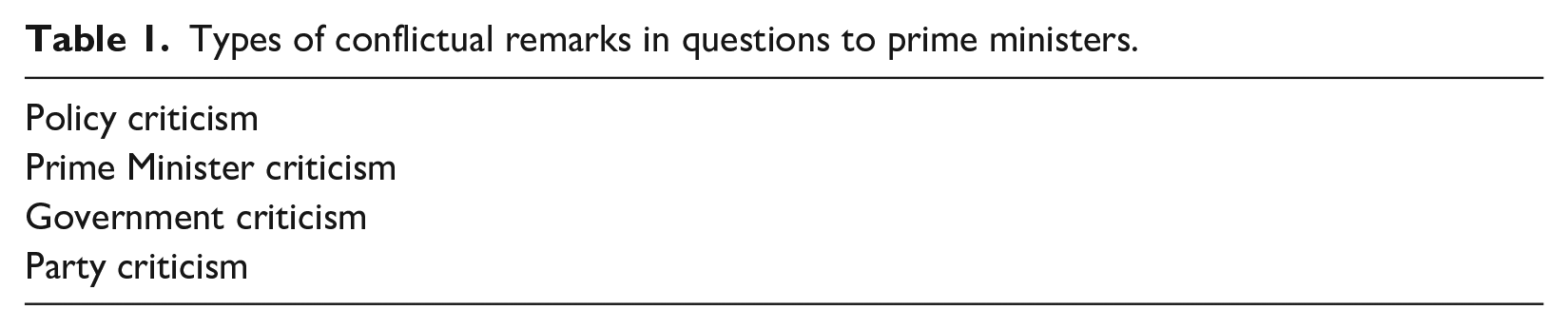
To measure the presence of manifest conflict, I coded conflictual remarks in questions addressed to prime ministers. The codes were developed deductively around targets of a conflictual remark, distinguishing between political criticism of the prime minister, the government or of a political party and technical criticism of policy (Table 1 and Supplemental Appendix). The main coding unit is an oral parliamentary question. Due to the nature of parliamentary speech, each question may contain one or more instances of conflict. For this purpose, I included ‘conflictual remark’ (a sentence or group of sentences that represents a manifestation of conflict) as a coding sub-unit. Each coding unit may be assigned one or more codes, depending on how many relevant sub-units it contains. For example, if a question contains a conflictual remark referring to the government and one referring to the prime minister, it will receive both codes. Coding individual instances of conflict allows us to identify conflict both at the question level, and hence to establish whether a question displays conflict, and also at the level of instances of conflict within questions. The latter measure captures the diversity of conflictual behaviours more fully and more qualitatively. For example, for the Leader of the Opposition, this shows not only how many questions are conflictual, but also how many conflictual remarks they made overall, and of which type. At the sub-unit level, the codes are mutually exclusive. This approach aims to identify instances of conflictual language and to map conflictual strategies of different parliamentary actors. It does not aim to measure whether some questions are more conflictual than others.
Types of conflictual remarks in questions to prime ministers.
Before the full sample of sessions was analysed, the coding protocol was assessed for validity, intra- and inter-coder reliability. To assess validity and intra-coder reliability, the coding protocol was tested through two rounds of pilot coding. To assess reliability, a second researcher was trained on the protocol and coded a random sample of sessions for each case that had already been coded by the first coder. Coding yielded percentage agreement of 90% and a Kappa score of 0.71, which taken together indicate good inter-coder agreement (Krippendorf, 2012). The coders discussed instances of disagreement in order to determine how much disagreement was due to human error (i.e. one of the coders missing a code that was detectable in the data), and how much disagreement was due to low reliability (i.e. the same code applied differently by the two coders). Where instances of disagreement were due to low reliability of certain codes, the coders agreed clarifications to be added to the coding protocol going forward. The new, revised coding protocol was applied to the entire sample.
Criticism of policy
An important form of criticism in parliamentary questions is that of policy – referring explicitly to a policy and highlighting potential negative consequences, or faulty design and features. An example of such an examination of negative consequences of policy can be seen in a question on 7 September 2011 by Labour MP Grahame Morris:
The Prime Minister will be aware that his Government are consulting on their changes to housing benefit claims under the criteria of under-occupancy. This will adversely affect 450,000 disabled people, including 33,000 in the north-east alone, who stand to lose on average £676 a year. A substantial number will be affected in my constituency. How does this policy meet his Government’s fairness test?
Criticism of the prime minister
Personal criticism addressed to the prime minister is perhaps the best-known form of critical remark at PMQs. Such a critical remark identifies the ‘prime minister’ as the subject and refers to actions, statements or decisions undertaken by the prime minister. For example, in a question on 19 March 2014, Labour MP Ian Murray asked David Cameron:
Are we really all in this together when the Prime Minister thinks that some public sector workers do not even deserve a 1% pay rise while he signs off on bumper pay rises of up to 40% for his own Government’s special advisers? Does that alone not show that not only is the Prime Minister out of touch, but he only stands up for his own privileged few?
Criticism of the government
A remark referring to the government explicitly identifies ‘the government’ or an individual minister as the subject and refers to an action, statement or decision undertaken by the government collectively or by a minister. For example, a frequent theme in the Australian opposition’s remarks (further detailed in section ‘Conflict in questions’) is that the ‘government has lost its way’. Another remark in a question by Warren Truss, leader of the National Party of Australia, asked ‘why should anyone believe that this government will ever pay off the record net debt that it has run up in just five years?’
Criticism of a political party
Finally, MPs are often critical of other parties – and this includes both opposition MPs being critical of the government party (or of one of the coalition parties) and government MPs being critical of the opposition. One example of the former category is a question from Labour MP Frank Roy, on 12 June 2012, asking David Cameron: ‘Twenty years on, will the Prime Minister apologise for his party’s shameful role in the demise of the Scottish steel industry?’
Conflictual behaviour in questions: Expectations
Interactions during oral questions are subject to institutional constraints and imperatives derived from government and opposition roles, as well as from party and leadership roles. Given the known adversarial style of questioning in the United Kingdom and Australia (Bull and Wells, 2012; Larkin, 2012; Waddle et al., 2019; Weller, 1985), conflict levels are expected to be higher in these cases compared to Ireland and Canada. Drawing on studies on the opposition in Westminster-type parliaments (Andeweg, 2013; Dewan and Spirling, 2011; Uhr, 2009), opposition actors are expected to use conflictual remarks in questions to criticise policy, the prime minister, the government or the government party. A concerted attack of the opposition against the prime minister reflects the ‘opposition mode’ (King, 1976), which sees the opposition frontbench and backbench united in an attack against the government. As ‘prime-ministers-in-waiting’ in all four cases, Leaders of the Opposition are expected to be particularly conflictual. On a more exploratory note, I aimed to observe which actors are more conflictual, and how they perform conflict: for example, how attack strategies are shared between backbenchers and leaders, and whether that reflects the intra-party mode.
Considering the inherently adversarial nature of the government/opposition divide in these parliaments, I expect government backbenchers to use conflictual remarks to criticise the opposition in the cases with considerable government backbench presence in questioning: the United Kingdom and Australia. On an exploratory note, I look at whether government backbenchers make conflictual remarks towards the government, the prime minister, policy or towards the government party. This would be evidence of intra-party conflict and disruption of the intra-party mode. I also examine whether coalition partners make conflictual remarks towards each other.
Who can ask questions?
Government and opposition: Roles and status of actors
As parliamentary behaviour is conditioned to an important degree by backbench/leadership and government/opposition status, understanding which actors get to question prime ministers is crucial for understanding the types of questions they ask. The four parliaments share many similarities with respect to the status and roles of parliamentary actors. They operate similar configurations of government and opposition roles, and similar divisions between frontbench and backbench roles. The largest party in opposition is recognised as the Official Opposition and forms a Shadow Cabinet, and its leader holds the office of ‘Leader of the Opposition’.
Rules, conventions and practice
Having identified the actors, the next step is to investigate how rules and conventions configure their participation: Who gets to ask questions?
Parliamentary party groups have internal mechanisms to manage their parliamentary operations. Party groups are often involved in managing participation during questioning (Rasch, 2011; Wiberg, 1994), but parliamentary questions are generally seen as an activity that is less subject to party control (S. Martin, 2011). At the intra-parliamentary level, a good performance from leaders contributes to backbench morale (Bates et al., 2018; Hazerika and Hamilton, 2018). At the extra-parliamentary level, given the high levels of media attention, both the government and the opposition have an incentive to appear as having ‘won’ against the other side. Consequently, both sides have incentives to coordinate and to control the topics of questions in order to ensure an effective attack strategy, in the case of the opposition, and to demonstrate a convincing defence in the case of the government.
Evidence suggests that parties are involved in deciding who gets to ask questions as well as the topics of questions to a large extent in Canada and Australia, and to a smaller extent in the United Kingdom. On paper, questioning mechanisms in Australia and Canada are designed to encourage spontaneous interaction: members are not required to give written notice for their questions. But questioning mechanisms in both countries involve an informal selection regarding which MPs will get to ask questions. In Canada, party whips provide lists of members to the Speaker, who then uses them as guidance in recognising members at Question Period (O’Brien and Bosc, 2017). Each party has a Question Period strategy committee which usually includes the party leader and whip, as well as the Leader or Deputy Leader of the House (Docherty, 2014). Participation at Question Period is hence managed to a large extent by parties, though the treatise on procedure claims that authority to select members ultimately rests with the Speaker (O’Brien and Bosc, 2017). Similarly, in Australia, specialised party committees (known as ‘tactics committees’) meet daily to decide the strategy for Question Time. Given this high degree of coordination from the opposition, it seems logical that the government should try to marshal its backbenchers to act supportively. Government backbenchers in Australia are known for asking ‘helpful’ questions, also known as ‘Dorothy Dixers’ (Larkin, 2012; McGowan, 2008).
Prime Minister’s Questions in the United Kingdom are also quite open, as questions do not require written notice: members who wish to ask a question submit their names for a ballot. The role of party whips mainly involves preparing leaders and less coordinating the behaviour of backbenchers. The preparation of the Leader of the Opposition is integrated in the main opposition party’s PMQs strategy: party whips ensure that opposition backbenchers will raise questions that have been left out of the Leader’s prepared set (Hazerika and Hamilton, 2018). Similarly, on the government side, whips ask backbenchers to intervene with strategic ‘helpful’ questions that prompt the Prime Minister to present government policies in a favourable light or to attack the opposition (Bates et al., 2014, 2018; Chester and Bowring, 1962; Franklin and Norton, 1993). This relatively smaller degree of party control on backbench members suggests that backbenchers in the United Kingdom may be freer to ask their own questions than their counterparts in Canada or Australia.
Questioning in Ireland is less open: members must submit questions in writing at least 4 days in advance. The selection process is managed by Speaker, who examines all parliamentary questions to ensure that they conform to Standing Orders. Participation is restricted to the set of members who have submitted a question in writing, and party spokespersons have priority (MacCarthaigh, 2005). This makes Oral Questions to the Taoiseach an unusual case as a plenary mechanism: whereas generally plenary mechanisms are more open in allowing participation from more parliamentarians, OQT primarily features party leaders.
In addition to the rules of procedure and to party management, participation is also determined by conventional recognition patterns (Table 2).
Sequence and patterns of intervention during questioning.
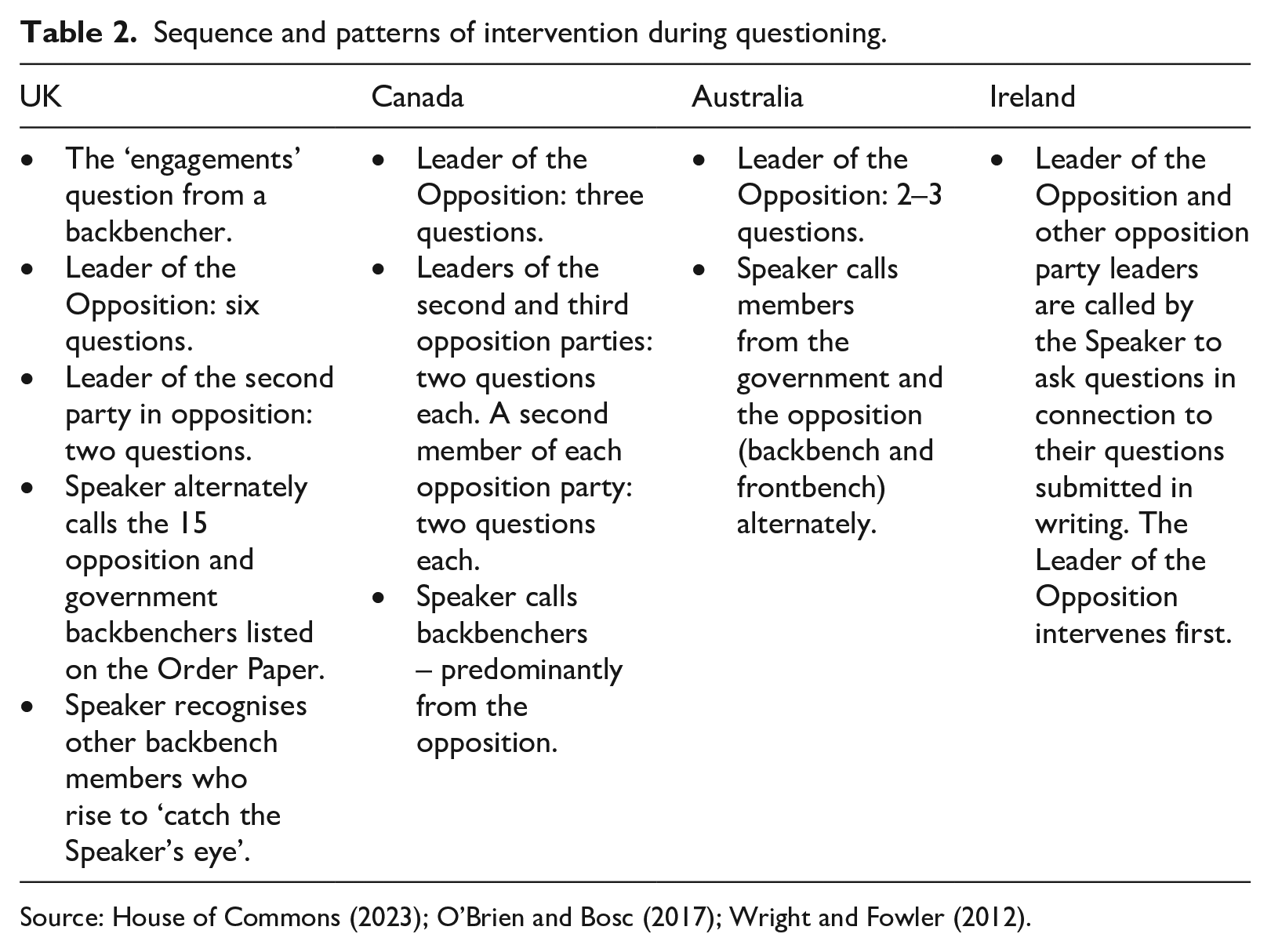
The sequence of interventions determines the types of interactions that take place. MPs in leadership positions are always the first to intervene; backbench members intervene subsequently. 1 The degree to which backbenchers are involved in questioning varies: they play a prominent role in the United Kingdom and in Australia, but in Canada, backbench participation primarily involves the opposition, and government backbenchers have a much more limited role. The Canadian Prime Minister hence rarely has helpful backbench questions to fall back on. Given these roles assigned in questioning, and considering government and opposition backbench and leadership roles, we might expect different actors to assume different strategies of questioning.
Who asks questions?
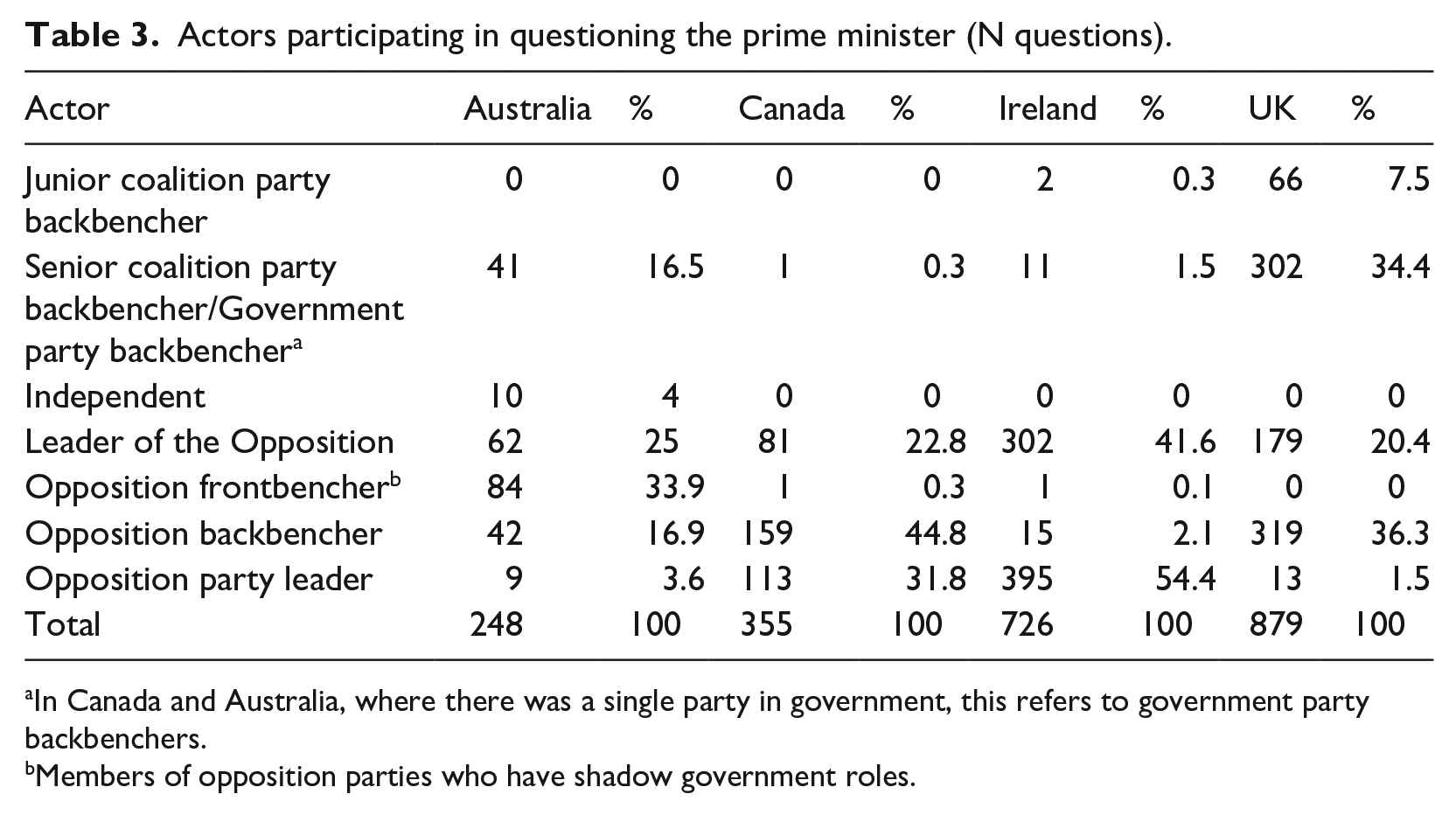
Table 3 describes the participation of different actors in the sample of sessions for each case study. Overall, patterns of participation reflect the rules and conventions regarding which actors may intervene, and which are recognised with priority, but also how actors use their allocated speaking rights.
Actors participating in questioning the prime minister (N questions).
In Canada and Australia, where there was a single party in government, this refers to government party backbenchers.
Members of opposition parties who have shadow government roles.
In the United Kingdom, Canada and Australia, the patterns of participation of the Leader of the Opposition showcase the importance of recognition conventions. The Leader of the Opposition accounts for around a quarter of questions in the United Kingdom, Australia and Canada as a result of the fact that they are conventionally allowed to ask several questions at the beginning of the questioning session. There are no procedural or conventional provisions in Ireland for the order in which members are called, but given that the procedure mainly involves the participation of party leaders, the Leader of the Opposition has ample room to intervene.
Opposition frontbenchers participate in questioning in both Canada and Australia, but they feature much more prominently in Australia (33.9%). Members of the main opposition party’s Shadow Cabinet do not usually participate at PMQs in the United Kingdom. In part, this is to do with the fact that questioning in Australia and Canada is collective: opposition shadow ministers ask questions of their government counterparts. In the United Kingdom, where PMQs is individualised, the Prime Minister is addressed questions by the Leader of the Opposition (Table 2). Opposition frontbenchers participate in Departmental Question Time, where they question the government department that they shadow. The small number of questions from UK opposition party leaders is also due to the fact that the traditional second party in opposition (the Liberal Democrats) was in the government coalition during the period investigated.
Backbench participation patterns not only differ starkly among countries, but also reflect important effects of rules of procedure. Government backbenchers ask a significant number of questions in the United Kingdom compared to all other cases, accounting for about 34% of questions. Government backbenchers in Australia also have a degree of access to questioning the head of government, accounting for 16.5% of questions. This is in stark contrast to Canada, where out of the total of 77 questions asked by government backbenchers in the period analysed, only 1 was addressed to the Prime Minister.
Hence, while in the United Kingdom and in Australia, Question Time is an opportunity for both government and opposition, in Canada and Ireland, it is mainly a forum for the opposition. In Canada, the fact that the Speaker mainly calls opposition parliamentarians is recognised by the treatise on procedure (O’Brien and Bosc, 2017). This is reflected in the participation of opposition backbenchers, who account for 44.8% of questions, compared to 36.3% in the United Kingdom and 16.9% in Australia. In the United Kingdom and in Australia, the similar distribution of time between backbenchers reflects the convention that the Speaker must call members alternately from each side. In Ireland, the only members who participate are those who have submitted a question in writing, which largely restricts participation to opposition party leaders, and only occasionally backbenchers.
Rules and practice regarding the content of questions
In addition to participation, rules of procedure also prescribe the limits within which conflict may be performed: whether members may use certain types of language in their questions depends on what the rules allow, and on the extent to which the rules are enforced. All four parliaments list two types of restrictions regarding the content of questions: restrictions concerning topics that may be addressed in questions, and restrictions concerning language. Table 4 summarises categories of interventions by Speakers with respect to contextual and manifest conflict.
Interventions by the Speaker during questioning.
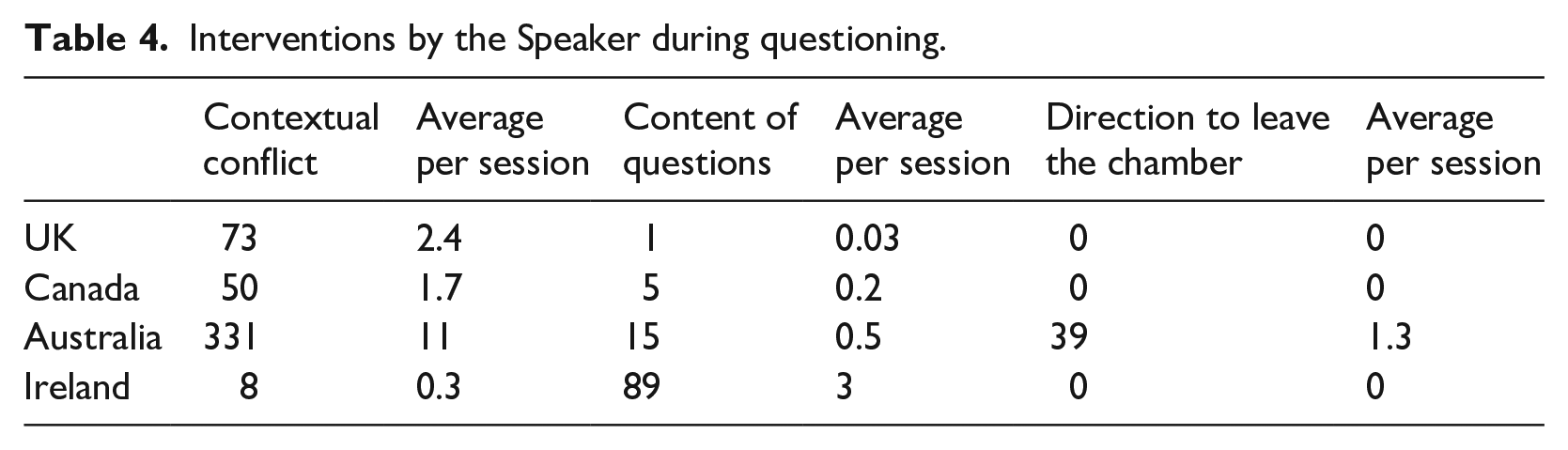
Contextual conflict: count of instances when the Speaker called the House, or a member, to order for heckling, shouting or for any other type of contextual conflict manifested during an exchange between the prime minister and a questioner.
Content of questions: count of instances when the Speaker intervened to make a remark about the topic or the language of a question.
Direction to leave the chamber: refers to the enforcement of Standing Order 96(a) in Australia, which allows the Speaker to ask members to leave the chamber for disorderly conduct.
Given that in Australia, Canada and the UK questions are spontaneous rather than submitted in advance, the power of the Speaker to decide on orderly language is crucial. In all four legislatures, rules regarding permitted language are quite extensive, but they also leave scope for interpretation, and hence for the Speaker to decide what is admissible. The degree to which Speakers intervened to police the content of questions varied among the four countries.
First, all Speakers intervened to police contextual conflict. Questioning mechanisms already known for their adversarial culture (Australia and the United Kingdom) display evidence of interventions by the Speaker – particularly Australia, with 331 such interventions recorded during the 30 sessions analysed, and an average of 11 interventions to ask members to be quiet per questioning session. In Canada, the Speaker on one occasion reminded members that they are not spectators of a hockey game (10 May 2006). But Speakers mainly intervened to police noise, and very rarely to coerce the content of questions.
Second, there is considerable variation in how Speakers police the content of interventions. The Speaker intervened to object to the content of questions in Australia, but this referred mainly to topics that were not directly relevant to the prime minister’s responsibilities, and rarely to the language used, except for cases when he judged that members had used unparliamentary language. For example, on 5 June 2013, the Australian Leader of the Opposition, Tony Abbott, ended his intervention with what would be termed as an unanswerable (Bates et al., 2014), political point-scoring question: ‘will the Prime Minister now concede that Labor’s policies have made Australia less safe than it was under the former government?’. The Speaker intervened to declare that ‘[t]he last part of the question was out of order’. On 10 October 2012, the Speaker asked Tony Abbott to withdraw his remarks, having referred to the Prime Minister as ‘a piece of work’. But many other similar interventions, both in Australia and in the United Kingdom and Canada, as detailed further in section ‘Conflict in questions’, went unpunished.
A key difference between Ireland and the other cases is the fact that questions are submitted in writing in advance, which allows the Speaker to leave out questions that do not comply with the rules. However, the rest of the questioning session comprises supplementary questions, so there is still scope for members to intervene out of order. It is then the responsibility of the Speaker to enforce the Standing Orders. The Speaker intervened, on average, three times per session to comment on the content of questions, but this did not refer to conflictual language. The most frequent type of intervention asked members to put a question, rather than to engage in debate, and also to suggest that some questions are within the remit of ministers, rather than of the Taoiseach. This type of intervention is connected to the time limits for questions in Ireland, which allow members to make longer interventions; if they digress, the Speaker intervenes to require them to ask a question.
This variation demonstrates that the interpretation of the Speaker is key in deciding whether a question breaches the rules or not. Speakers allow adversarial interventions, and only intervene to rule them out of order when unparliamentary language is used. One possible explanation is that Speakers allow members to interact freely up to the point where there is a major transgression of language; some adversarial language is seen as a part of the conduct of oral questions. Expression of conflict is hence part of the culture of questioning and one of the established functions of oral questions in some legislatures.
Conflict in questions
Having explored the rules, this section looks at evidence of conflictual behaviour in questions in the four legislatures.
Evidence of conflictual behaviour in questions
The first measure of conflictual behaviour in questions is the proportion of questions to the prime minister that contain at least one conflictual remark.
The level of conflict in questions varied among legislatures. Selected in order to explore patterns of conflict beyond the United Kingdom and Australia, the Canadian Question Period appears to be particularly adversarial, displaying the highest proportion of questions that contain at least one conflictual remark (Figure 1). By comparison, the proportion of conflictual questions in the United Kingdom and Australia was around 40%. Figure 1 hence confirms the conflict management function of questioning: parliamentarians use questions to criticise and to express disagreement, and some mechanisms present higher levels of conflict than others. Question Period in Canada, Question Time in Australia and PMQs in the United Kingdom have an important role in providing an arena for conflict, but this applies much less to Ireland.
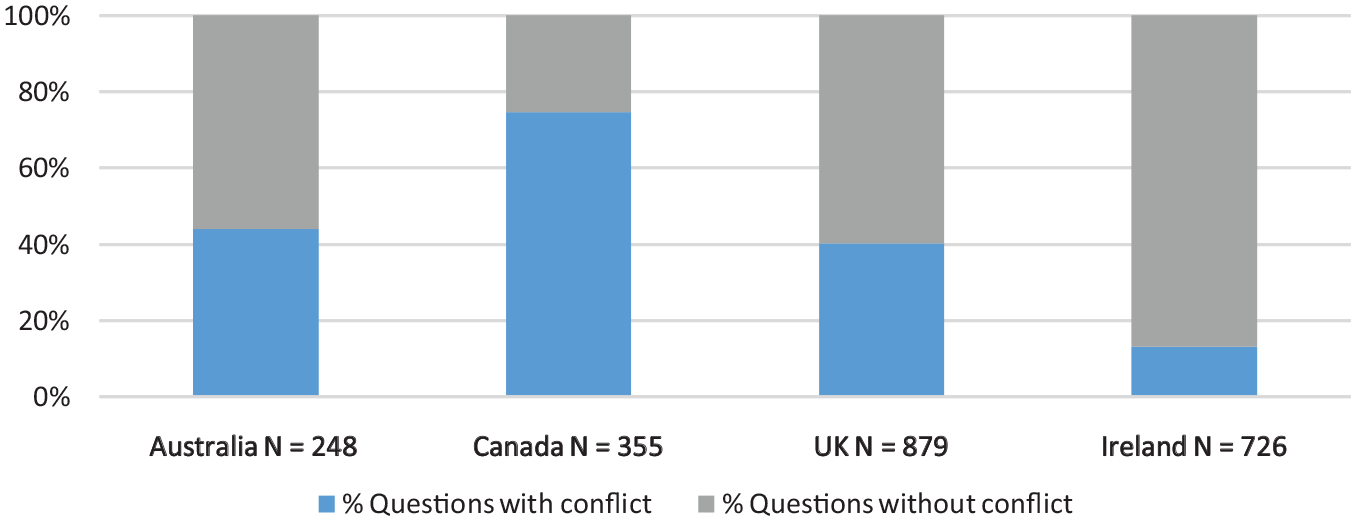
Proportion of questions to prime ministers with conflictual remarks (N = Total number of questions).
A key question is whether conflictual questions are used to criticise policy, or for political point-scoring and personal attacks. Across legislatures conflictual remarks appear to be aimed primarily at political point-scoring against the PM, the government or the governing party, but policy criticism also features prominently in the United Kingdom and in Australia (Figure 2). The next step is hence to unpack this variation further by looking at how actors used their questions to perform different types of conflict.
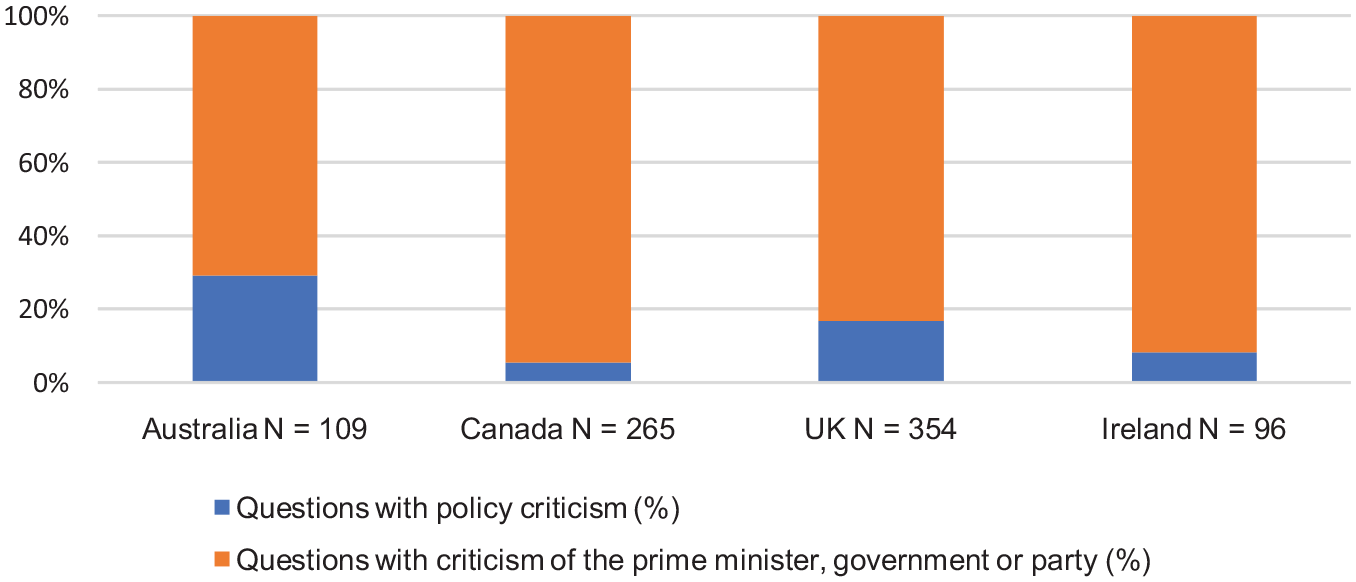
Policy and political criticism in conflictual questions (N = questions containing a conflictual remark).
How do different actors perform conflict through questions?
Figure 3 provides an overview of the variation of the proportion of conflictual questions by different actors, out of the total number of conflictual questions in each country. As expected, opposition MPs were the most conflictual, accounting for 99% of such questions in Australia and Canada, and around 85% in the United Kingdom. Part of this variation reflects the roles of different actors in the questioning process: Leaders of the Opposition occupy a prominent position, and they single-handedly account for a significant proportion of conflictual questions across all cases. Frontbenchers and party leaders play a significant role in Ireland, Canada and Australia, with frontbenchers taking a front-stage role in Australia. Conflict expressed by government backbenchers not only refers to conflictual remarks addressed to the opposition, but also includes conflictual remarks towards the government or the prime minister. Unusual among the four cases, government backbenchers in the United Kingdom also engage in conflictual behaviour, as detailed below.
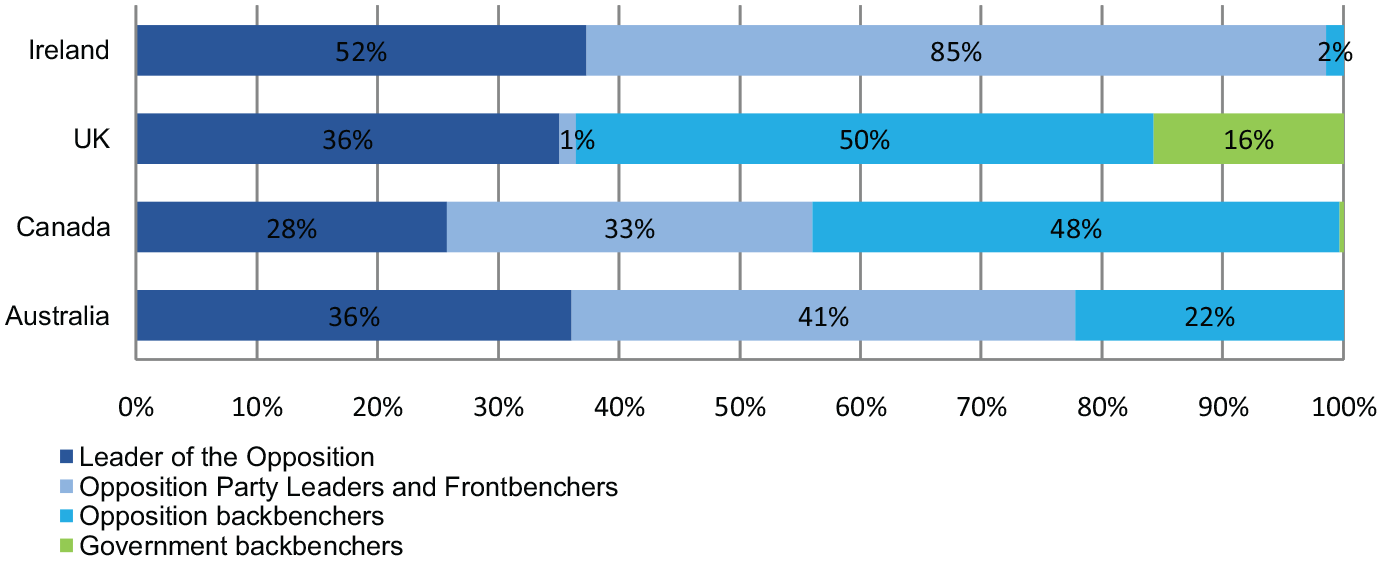
Proportion of conflictual questions by different types of actors in questions to prime ministers.
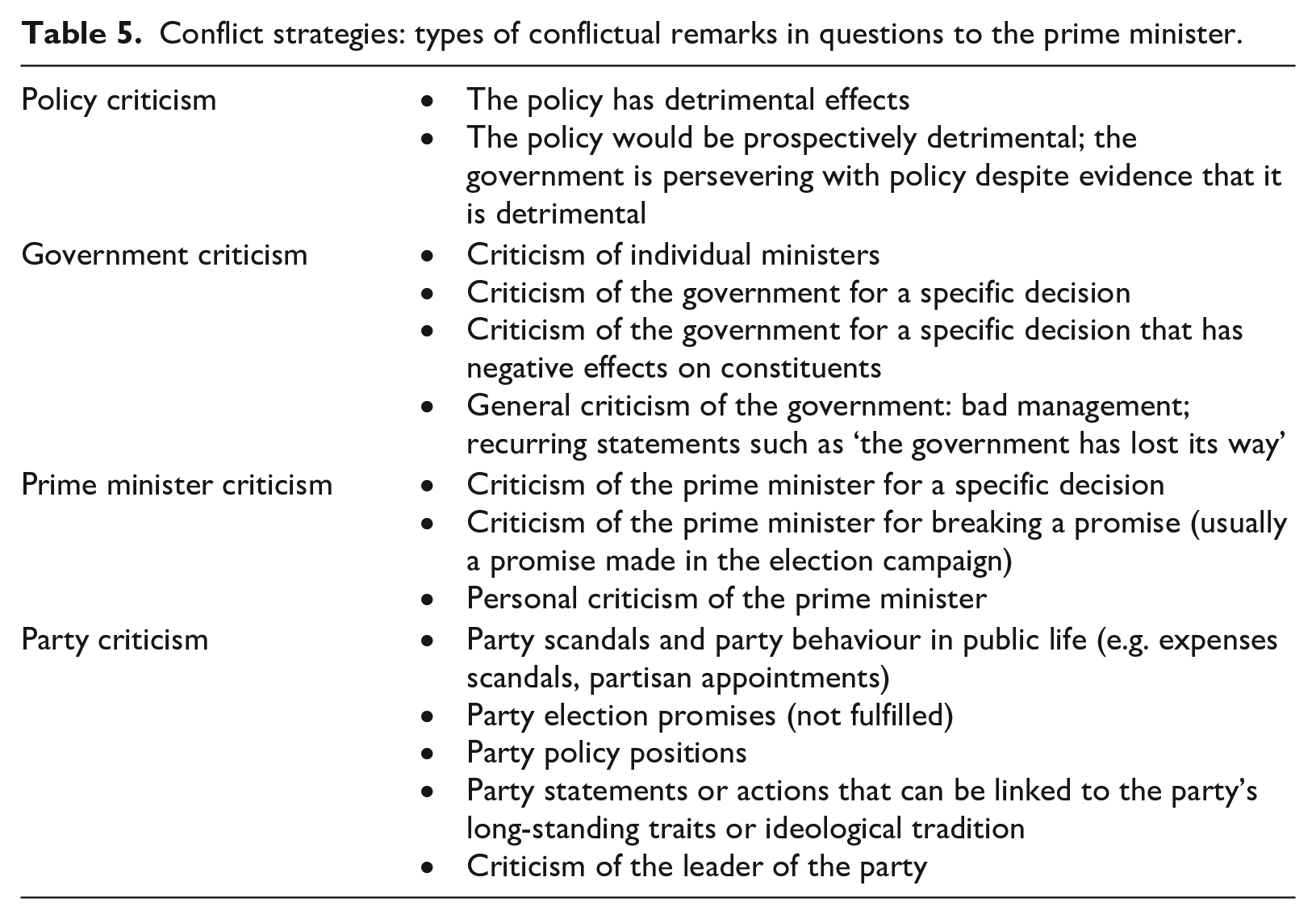
Table 5 summarises sub-types of conflictual remarks found as recurring themes in questions to prime ministers. This classification draws on an examination of the population of questions within each category and on inductively identifying sub-categories.
Conflict strategies: types of conflictual remarks in questions to the prime minister.
MPs in leadership positions posed questions incisively, with Leaders of the Opposition leading the attack against the prime minister and the government. Procedurally, the interaction between the Prime Minister and the Leader of the Opposition is the centrepiece of questioning in all four legislatures. Leaders of the Opposition were significantly confrontational, with 93% of their questions containing instances of conflict in Canada, 72% in the United Kingdom and 63% in Australia. Across systems, Leaders predominantly used questions to highlight the contrast between the government’s and the opposition’s policies; they pointed out negative effects of existing policies, and also suggested that the government is persevering with policy despite evidence that it is detrimental. For example, on 18 May 2011, Ed Miliband told David Cameron: We are getting used to this. As we saw on health, when there is a terrible policy the Prime Minister just hides behind the consultation. Frankly, it is just not good enough. Let me tell him what people think of this policy. The judges are saying the policy is wrong, End Violence Against Women is saying that it is the wrong policy, and his own Victims Commissioner says that the policy is ‘bonkers’. I know that he is in the middle of a consultation, but I would like to hear his view on this policy, which he should drop.
In Australia, Tony Abbott was a famously adversarial Leader of the Opposition – he was the first Leader in 26 years to be suspended for conflictual behaviour during Question Time (ABC News, 2012). He recurrently pressed Julia Gillard on the carbon tax, particularly on the fact that the government was ignoring evidence that the policy was detrimental: Given that Alcoa warned the government last year that the carbon tax would impact on its economic viability, given that Alcoa has today shelved a $3 billion investment because of the carbon tax and given that the government’s own modelling says that the carbon tax will reduce aluminium production by 61.7 per cent, why is the Prime Minister still in denial about the carbon tax destroying jobs in manufacturing industry? (15 February 2012)
As their questions are the opening act, Leaders of the Opposition predominantly deployed personalised criticism of the prime minister. They criticised prime ministers not only for specific decisions, but also for perceived long-term mismanagement and faulty strategy. The theme of breaking a promise, particularly an electoral promise, was common to all cases – prime ministers are seen as responsible for the electoral promises made by their parties. There are also instances of purely personal criticism. On 11 April 2006, the Leader of the Opposition accused the Canadian Prime Minister that he ‘cannot cope with anyone who disagrees with him’. Similar examples of negative characterisations occurred at PMQs, where Ed Miliband suggested that David Cameron should take ‘anger management’ training (16 May 2012) or that ‘He breaks his promises, he does not think things through and when the going gets tough, he dumps on his colleagues’ (11 May 2011).
Opposition party leaders intervened most frequently in Ireland, where they are the main actors together with the Leader of the Opposition, and in Canada, where they are afforded time by the established recognition patterns. The behaviour of opposition frontbenchers and party leaders resembles that of Leaders of the Opposition across all cases to a great degree. In Australia, general criticism of the government was often expressed through the formula that ‘the government has lost its way’, which was part of the communications strategy of the main opposition party, the Liberal–National coalition. Deputy Leader of the Opposition, Julia Bishop, claimed that ‘the government has clearly lost its way on border protection’ (15 November 2010). Other opposition frontbenchers claimed that ‘the government seems to have lost its way on banking’ (17 November 2010), or asked ‘Does the Prime Minister agree that these policy announcements were obvious political mistakes and further evidence that the government has lost its way?’ (17 November 2010).
Procedurally, opposition backbenchers play a significant role in questioning the Prime Minister in Canada and in the United Kingdom, as well as in Australia. They are highly confrontational actors in these systems, particularly in Canada, where 77% of their questions included a conflictual remark. The most frequent types of negative comments referred to specific decisions made by the Prime Minister, or alleged that the Prime Minister had broken a promise. In terms of policy criticism, opposition backbenchers usually presented evidence that a particular policy had detrimental effects and suggested that the government had been pursuing it in spite of such evidence. These tactics are similar to the ones used by opposition Leaders and frontbenchers. In the United Kingdom, this tactic sometimes included evidence of negative effects of policy on constituents. Criticising the government also took similar forms to the types of conflictual remarks found in questions from leaders: opposition backbenchers criticised particular decisions as well as the government’s overall handling of affairs. The notable similarities between backbench and frontbench attack tactics bring evidence of coordinated, opposition mode behaviour in questioning prime ministers (King, 1976; Russell and Cowley, 2018) and underline the importance of party discipline during questioning.
Government backbenchers
Although we would expect government backbenchers to be vocally critical of the opposition, there are almost no instances of conflictual questions in any of the other cases aside from the United Kingdom (Table 6). As expected, government backbenchers in the United Kingdom criticised the main opposition party. They often criticised Labour policies, usually either to demonstrate faults or to suggest that the opposition was against beneficial government decisions. Contrary to expectations, government backbenchers in the United Kingdom also made a few critical remarks about government policy and criticised government departments. In line with the role of ‘keeping tabs’ on coalition partners (Höhmann and Sieberer, 2020; L. W. Martin and Vanberg, 2011), members of the junior coalition party also criticised the Prime Minister, the government and the senior coalition party, but this occurred at a very low level, with only 12 conflictual questions out of the total of 66 questions they addressed to the prime minister.
Conflictual remarks in questions from government backbenchers.
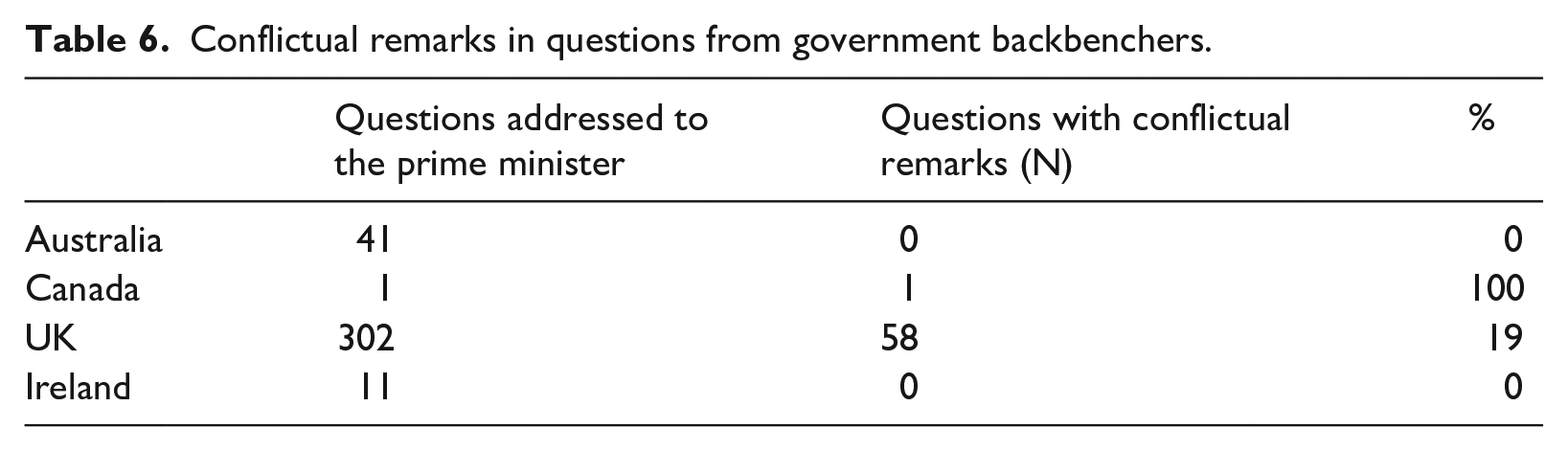
Evidence of intra-party conflict hence appears to be low. But, even under conditions of permissive party discipline, the degree to which government backbenchers can be openly critical about the government is a sensitive matter. Parliamentarians must perform scrutiny and speak up for issues that concern their constituents. They may also wish to signal ideological differences on policy. But, ultimately, it is also in their strategic interest to maintain the image that the government is doing its job well and to contribute to the prime minister’s performance at PMQs. Given the media spotlight in which PMQs operates, too many critical questions from government backbenchers may allow the opposition to argue that the government is divided, or that the Prime Minister does not have the support of their backbenchers. Although government backbenchers in Australia and Canada contribute very little to the conflict function, they instead support the government by asking helpful questions; their efforts to contribute to their own side’s case are primarily directed towards offering the government opportunities to defend their decisions, rather than attacking the opposition.
Conclusion
This article has explored the degree to which conflict is a function of oral questions to prime ministers in four case study legislatures, and asked whether factors such as the restrictiveness of rules of procedure, institutional culture, the authority of the Speaker, government or opposition status, or party discipline may explain different levels of conflict. Evidence about patterns of conflict in the four case studies contributes to theoretical debates about the functions of questioning mechanisms and functions of legislatures, and illustrates modes of executive–legislative relations during questioning.
First, questioning represents an arena for the manifestation of conflict in some parliaments, but to a lesser degree in others. In line with expectations, questioning performs a clear conflict function in the United Kingdom and Australia, and much less in Ireland. New evidence also places the Canadian Question Period among conflictual parliamentary procedures.
Second, all four legislatures have extensive rules regarding the content of questions, but ultimately the authority of the Speaker is pivotal for how the rules are enforced. Despite evidence of highly conflictual behaviour in questions in Canada, Australia and in the United Kingdom, Speakers mainly intervened to limit noise (contextual conflict) and much less to police language (manifest conflict). Speakers only ruled conflictual interventions out of order when explicit unparliamentary language was used. One plausible explanation for this permissiveness is institutional culture (Best and Vogel, 2014; Keating, 2008) and practices: conflict may be an established part of the shared meanings associated with questioning prime ministers. Speakers allow members to interact freely up to the point where there is a grave transgression of language, but otherwise do not intervene to curb argumentative exchanges. The function of questioning mechanisms in providing an arena for the expression of conflict is hence an entrenched feature of parliamentary proceedings in these legislatures. This also confirms the intuition that parliamentarians are socialised in a way of ‘doing’ questioning (Hazerika and Hamilton, 2018; Lovenduski, 2012). Parliamentary rules of procedure on their own are hence not enough to curb conflictual behaviour in parliaments that already display a long-established adversarial culture.
The behaviour of parliamentary actors was mostly in line with expectations associated with their government/opposition status. Most legislatures analysed here display a strong ‘opposition mode’ of prime minister–parliament relations in the form of concerted attacks of the opposition frontbench and backbench against the head of government, confirming the expectation that questioning mechanisms are more conducive to ‘opposition mode’ behaviour (Uhr, 2009), as well as the expectation that government/opposition status explains patterns of conflictual behaviour. This also suggests cohesive intra-party behaviour, as well as strong party discipline operating during questioning on both sides.
The most notable differences appear in the behavioural patterns of backbench MPs, particularly government backbench MPs. Considering the famously adversarial culture of the Australian parliament, the lack of conflictual remarks directed at the opposition in questions from government backbenchers is surprising. By comparison, government backbenchers in the United Kingdom criticised the opposition, as expected, but they also criticised policy, or the government. Unique among the systems analysed here, this behavioural pattern suggests that government backbenchers in the United Kingdom can choose to support the government, but also have some scope to use questions to express disagreement. These patterns indicate variation in levels of party discipline during questioning in different legislatures, as well as in the relationship between the government and its backbenchers during questioning – the intra-party mode (King, 1976; Russell and Cowley, 2018). Variation in party discipline hence also explains patterns of behaviour during questioning. Thinking back to the plurality of functions performed by questioning mechanisms, these patterns also point to the performance of support as a function of parliamentary questioning. Just as parliamentarians have an incentive to attack the other side in questions, they are also motivated to support their own side. Government backbenchers in the United Kingdom and in Australia famously do this through ‘helpful’ questions (or ‘Dorothy Dixers’ in Australia) that prompt the prime minister to present the government’s achievements. Despite not participating in the concerted attack against the opposition, government backbenchers in Australia help their own side predominantly through supportive questions.
These findings suggest important directions for future research to explore the variation of conflictual behaviour during questioning in other legislatures, to test the institutional culture hypothesis, and to define and trace institutional culture as a causal mechanism in determining conflictual behaviour. But beyond macro-level factors, different levels of conflict, as well as different conflict strategies by parliamentary actors, may also be explained by relevant local contextual factors, as noted in the case of the Gillard government’s carbon tax, which sparked an organised questioning campaign from the opposition. It is also likely that some behavioural patterns reflect the individual style of different actors. For example, other Leaders of the Opposition in Australia may be less conflictual than Tony Abbott was during Julia Gillard’s premiership. Some politicians may also be less confrontational in particular interactions than in others: Waddle et al. (2019) suggest that David Cameron was less adversarial at PMQs in his second premiership when he was facing Jeremy Corbyn as Leader of the Opposition. Similar observations have been made about the interactions between Theresa May and Jeremy Corbyn at PMQs. Looking at levels of conflict in parliamentary questions over time within a single country would provide further evidence of the extent to which conflictual behaviour is explained by individual style.
Supplemental Material
sj-docx-1-bpi-10.1177_13691481231189381 – Supplemental material for Conflictual behaviour in legislatures: Exploring and explaining adversarial remarks in oral questions to prime ministers
Supplemental material, sj-docx-1-bpi-10.1177_13691481231189381 for Conflictual behaviour in legislatures: Exploring and explaining adversarial remarks in oral questions to prime ministers by Ruxandra Serban in The British Journal of Politics and International Relations
Footnotes
Funding
The author(s) disclosed receipt of the following financial support for the research, authorship, and/or publication of this article: Bentham PhD Scholarship, Department of Political Science, University College London, 2015–2018.

Supplemental material
Additional supplementary information may be found with the online version of this article.
Content
Notes
References
Supplementary Material
Please find the following supplemental material available below.
For Open Access articles published under a Creative Commons License, all supplemental material carries the same license as the article it is associated with.
For non-Open Access articles published, all supplemental material carries a non-exclusive license, and permission requests for re-use of supplemental material or any part of supplemental material shall be sent directly to the copyright owner as specified in the copyright notice associated with the article.
