



Abstract
The European Parliament is often presented as a success story regarding women's representation. Yet, recent studies observe gendered patterns in parliamentary behaviour. This article contributes to this scholarship by studying gender differences in MEPs’ parliamentary behaviour on ‘masculine’ and ‘feminine’ policy domains. Analysing 136,787 parliamentary questions over 25 years (1994–2019), the study reveals moderate gender differences in MEPs’ behaviour. Moreover, gender differences are influenced by seniority and women's numerical presence in the European Parliament's political groups. Gender-stereotypical policy foci are more pronounced among newcomers and disappear for experienced MEPs. In political groups with fewer women, seniority is key for women MEPs seeking engagement in masculine policy domains. Overall, our findings underscore the interplay between gender, seniority, and women's presence in shaping MEPs’ parliamentary behaviour within the European Parliament’s gendered context.
Keywords
Introduction
The European Parliament (EP) is often presented as a ‘success story’ regarding women's representation (see Frech, 2025a): the descriptive representation of women MEPs has grown from 15.2% (1979) to almost 40% in the latest European elections (2019). On this account, the EP surpasses almost all national parliaments (Dingler and Fortin-Rittberger, 2022; Frech, 2025b; Kantola, 2010) – with a few rare exceptions (e.g. Sweden, Belgium). The so-called ‘EU exceptionalism’ is even more striking when considering the access of women members of the EP (MEPs) to positions of influence in the supranational assembly: recent studies confirm that the allocation of ‘mega seats’ (e.g. committee chairs and influential rapporteurships) to women has been increasing, along with the growing delegation of women elected to the EP (Dingler and Fortin-Rittberger, 2022). In other words, even though the EP has not yet achieved a state of gender parity, an unmistakably gradual trend towards this goal has been observed since 1979.
Yet, another research strand shows that shifts in the composition of a parliament may not necessarily alter the underlying ‘rules of the game’ (Chappell and Waylen, 2013: 599). Parliaments as ‘gendered institutions’ (Lovenduski, 2005) often reproduce gender norms, stereotypes, and hierarchies. Such gendered arrangements do not only shape who is elected but also set behavioural norms and expectations for men and women in the institution (Krook and Mackay, 2011; Lowndes, 2020), influencing patterns of parliamentary behaviour through a ‘gendered logic of appropriateness’ (Krook and Mackay, 2011; Lowndes, 2020). In theory, the EP's achievements in descriptive representation provide a promising context wherein gender-stereotypical divisions of labour in parliamentary behaviour could diminish or disappear. Yet, recent studies also reveal gender biases in its institutional arrangements and practices (Ahrens and Rolandsen, 2019; Ahrens et al., 2022). Notably, women MEPs are underrepresented in influential committees linked to ‘masculine’ policy domains, establishing a gendered divide between ‘masculine’ and ‘feminine’ politics (Dingler and Fortin-Rittberger, 2022). This raises questions about women MEPs’ opportunities to engage in gender non-conforming and non-stereotypical parliamentary behaviour, beyond their mere presence.
This article contributes to this debate by examining gendered patterns in parliamentary behaviour in the EP through the content analysis of 136,787 written parliamentary questions (WPQs) over 25 years (1994 to 2019). Based on automated imputation of a newly created EU policy dictionary, our quantitative analysis determines the policy fields of WPQs and whether gendered patterns emerge. We study whether gender differences exist in MEPs’ parliamentary questions on ‘masculine’ and ‘feminine’ policy domains (Krook and O’Brien, 2012), and whether these align with traditional gender-stereotypical divisions of labour (i.e. women MEPs asking fewer questions on ‘masculine’ policy domains and more questions on ‘feminine’ policy domains compared to men MEPs). Moreover, we investigate the conditions under which patterns of parliamentary questioning change or weaken, hypothesising that shifts in women's presence and their increased seniority in the EP alter gender-stereotypical divisions of labour.
Overall, this article makes a triple contribution to the understanding of the EP as a gendered institution, and to how ‘Gendered European Careers’ (Frech, 2025a) play out in this context. First, by examining gendered patterns in MEPs’ parliamentary questioning on ‘masculine’ and ‘feminine’ policy domains, the article complements other studies on gender in the EP that have either adopted an institutional outlook (e.g. Ahrens and Rolandsen, 2019; Ahrens et al., 2022), or have analysed committee allocations (e.g. Dingler and Fortin-Rittberger, 2022) or women's representation (e.g. Däubler et al., 2022; Gouglas et al., 2025; Synnøve and Hermansen, 2025). Unlike studies on descriptive and substantive representation, our article does not study whether women MEPs are present or whether they act on behalf of women, but rather explores whether MEPs conform to gender-stereotypical divisions of labour, offering insights into gendered logics of appropriate behaviour in the EP. Our results confirm that gender differences exist in MEPs’ parliamentary questioning, but that they are (only) moderate, lending some support to the EP's gender exceptionalism. Second, by studying how MEPs’ seniority and women's numerical strength moderate gendered parliamentary behaviour, our article contributes to the evolving research on how M(E)Ps’ gendered careers shape their parliamentary work (Bailer et al., 2022; Frech, 2025a; Hargrave, 2023). We find that seniority significantly impacts MEP's behaviour, with gender-stereotypical policy foci being more pronounced among newcomers. As women MEPs gain seniority, they increasingly focus on masculine policy domains, thereby converging with their male counterparts. This convergence is less evident for feminine policy domains, which suggests that men MEPs have limited incentives to adopt a feminine policy focus in gendered institutions. Lastly, our results show that the interaction between seniority and women's numerical strength significantly affects women MEPs’ focus on traditionally masculine policy domains. Notably, in European Parliament groups (EPG) with a low share of women, seniority emerges as a crucial asset for women MEPs seeking involvement in masculine policy domains. Overall, our findings underscore the interplay between gender, seniority, and women's presence in shaping MEPs’ parliamentary behaviour within the EP's gendered context.
In what follows, we first present the analytical framework and develop hypotheses on why MEPs focus on ‘masculine’ versus ‘feminine’ policy domains. Then, we present our methodology and research strategy for a quantitative content analysis. Next, we present the empirical results based on descriptive statistics and multivariate hierarchical models. Finally, we discuss the implications of our empirical results for the gendered functioning of the EP and its broader impacts for legislative studies.
Gender patterns in MEPs’ parliamentary activities and policy focus in the EP
Since the pioneer studies of Raunio (1996), Proksch and Slapin (2010) and Jensen et al. (2013), there has been a growing interest in the use and focus of (written) parliamentary questions by MEPs (Brack and Costa, 2019). Explaining what MEPs do in the EP and how they specialise in certain policy fields is of direct interest for legislative scholars. Indeed, ‘the use of parliamentary questions may be considered an especially interesting indicator of how the elected understand their role as representatives’ (Wilberg quoted in Raunio, 1996). These roles are impacted by the broader opportunities structure in which legislators operate: the institutional and political settings explain differences between MEPs in terms of activity as well as policy specialisation in the use of WQPs. The literature highlights the impact of the electoral system (Chiru, 2022; Koop et al., 2018; Sozzi, 2016), the size of EPGs (Brack and Costa, 2019; Navarro, 2019; Sorace, 2018), the position towards European integration (Proksch and Slapin, 2010), committee membership (Navarro, 2019; Sozzi, 2021) as well as government-opposition dynamics (Jensen et al., 2013; Kaniok and Kominkova, 2019; Proksch and Slapin, 2010). In addition, the individual dimension such as the MEPs’ personal and political background has been identified as a determining factor in legislative specialisation (Sozzi, 2021). Surprisingly, the effects of other individual descriptive characteristics – such as gender and race that have been largely studied in national legislative assemblies (see infra) – is relatively missing in the study of MEPs’ parliamentary behaviour. In most studies on WPQs in the EP, gender is merely included as a control variable without proper theoretical framework to explain gendered patterns (e.g. gender is statistically significant in Sozzi's (2021) result, but the reasons for this gendered pattern are not developed further).
Despite earlier positive accounts that the EP might be more ‘gender-friendly’ than national politics, 1 studies are less optimistic when it comes to gendered patterns of divisions of labour in the EP. The sharp increase in women's political representation has not (yet) led to a rise in women occupying positions of power. Women MEPs remain underrepresented in the EP's most powerful and prestigious committees (Beauvallet and Michon, 2013). Women are also less likely to be appointed to political leadership positions, including EP presidents and EPG leaders or deputy leaders (Dingler and Fortin-Rittberger, 2022). They are also less likely to be appointed as (vice-)chairs of committees, especially when it concerns powerful or prestigious committees (Dingler and Fortin-Rittberger, 2022). Moreover, Dingler and Fortin-Rittberger (2022) find that women as committee chairs are more often assigned to committees that are seen as ‘feminine’ and dealing with ‘feminine’ policies.
Even though recent studies have questioned the presence of gendered patterns in parliamentary behaviour in the EP, it remains currently largely unanswered. This contrasts with the well-established scholarship on gendered patterns in parliamentary activity at the national level. These studies find that there are differences in how men and women members of national parliaments ‘consider’ and ‘do’ politics. While gender differences may vary in size depending on the focus or context of the study, they nevertheless signal that gender structures the policy preferences and behaviour of members of parliament (MPs). Several studies identify gender differences in parliamentary activities on social issues, including social welfare, education, work-family, and care (Catalano, 2022). Wängnerud (2000) finds that women politicians in Sweden pursue gender equality policies and social welfare policies more often than men in their campaign work. Going beyond these initial differences in ‘feminine’ policy domains, some recent studies report gender differences in parliamentary activities in relation to security, defence, trade, and environmental policies (Ramstetter and Habersack, 2020; Sundström and McCright, 2014). Itzkovitch-Malka and Friedberg's (2018) analysis of private member bills and parliamentary questions in the Israelian Knesset documents that women MPs engage less with national security issues compared to men MPs. Bäck et al. (2014) find that women MPs give fewer speeches in parliament than men when debates deal with ‘masculine’ policy domains such as macroeconomics, energy, transportation, banking/finance, and space/science/technology. To explain why these gender differences appear, the extant scholarship usually refers to two theories that we present below.
The politics of presence
A first set of studies links gender differences to the notion of a ‘politics of presence’ (Phillips, 1995). Women and men MPs’ distinct priorities and activities in parliament are said to result from MPs’ gendered life experiences and social positioning. Catalano (2009: 56) for instance argues as follows: ‘Women MPs may see health care as a women's issue because of the traditional caretaking role of women, because nearly all women go to the hospital to have children, and because women take their children and others they care for to the hospital’. Because women MPs share some descriptive characteristics with women in society, they are more likely than their men colleagues to pay attention to women's interests, engage women in the representative process, and articulate policy issues that are important to women. The latter may also encourage women to sometimes pursue different policy specialisation or become members of different parliamentary committees than men (Bækgaard and Kjaer, 2012). If the politics of presence is not realised, this is seen as being the result of individual preferences of women and men (Celis and Erzeel, 2015; Olofsdotter Sensota, 2020); or institutional and party constraints that may dissuade women from ‘making a difference’ (Childs and Krook, 2008).
Gender stereotyping and gender roles
Yet, gender differences in parliamentary behaviour do not only result from differences in priorities or experiences; they are also related to explicit or implicit understandings of which policies are ‘best’ addressed by men or women. A second set of studies, therefore, focuses on how patterns of parliamentary behaviour are shaped by expectations and norms regarding gender roles (which may exist in the minds of parties, voters, and MPs themselves). Parliaments are gendered institutions operating according to distinct gendered rules, norms, and practices. Members who enter parliament (need to) adapt to these rules and ‘fit’ into the gendered logic of appropriateness of the institution, as feminist institutionalism argues (Chappell and Waylen, 2013; Erikson and Josefsson, 2022; Krook and Mackay, 2011).
Moreover, this gendered logic is not specific to parliaments, but reflects and interacts with social norms on what constitutes appropriate roles and behaviour for men and women. Hence, these studies refer to theories on gender stereotyping and gender role congruity to explain why women act on issues that are considered ‘communal’ and ‘feminine’ – because they receive strong incentives to display gender-conform behaviour which aligns with ‘communal traits’ such as ‘concern with the welfare of other people – for example, affectionate, helpful, kind, sympathetic, interpersonally sensitive, nurturant, and gentle’ (Eagly and Karau, 2002: 574). Men, on the other hand, are more often associated with ‘agentic’ and ‘masculine’ traits such as a ‘assertive, controlling, and confident tendency – for example, aggressive, ambitious, dominant, forceful, independent, self-sufficient, self-confident, and prone to act as a leader’ (Eagly and Karau, 2002: 574). These traits are seen as fitting with ‘masculine’ and more prestigious policy domains.
Hence, while studies in the ‘politics of presence’ tradition focus more on women's desire or willingness to advance women's issues, theories of gendered institutions, gender stereotyping, and gender role congruity emphasise the element of coercion which may ‘force’ women (and men) MPs to behave in certain gender-conform and ‘gender-appropriate’ ways in parliaments. These studies also emphasise that women and men may be or feel pushed by their peers, parties, voters or other gatekeepers (like the media) towards policy domains that conform to gender stereotypes. Deviating from gender-stereotypical behaviour may lead to comments, ridicule, or interruptions (Kathlene, 1994) or may affect MPs’ career prospects (Bäck and Debus, 2018; Boussalis et al., 2021). Women and men furthermore also internalise these norms and adapt their behaviour accordingly. For example, Itzkovitch-Malka and Friedberg (2018: 17) find in their study of the Knesset that while women are less likely than men to engage with national security issues, this is for both ‘involuntary’ and ‘voluntary’ reasons: ‘women are either pushed very far away from these cardinal issues by the male majority, who attempts to own them, or make a strategic decision to avoid them, as they know they will have to fight the gendered stereotypes ruling this domain’.
A focus on the EP: Gendered patterns in MEPs’ behaviour (WPQs)
Many of the above studies have focused on the national level of politics. As such, it remains unclear whether they also hold at the European level. However, given that gendered divisions of labour, practices, and norms seem to unfold in the EP,
2
we formulate in line with studies on national politics the following baseline hypothesis: Women MEPs ask fewer questions on ‘masculine’ policy domains and more questions on ‘feminine’ policy domains compared to men MEPs.
The moderating effects of individual position and political contexts
While we expect to find gender differences in policy domain focus in parliamentary questioning, we do not expect the size of this gender gap to remain static. After all, the EP as a (gendered) institution has witnessed several significant institutional and political changes over time, not the least in relation to its gender composition, which may have impacted the gender gaps in parliamentary behaviour. Moreover, opportunities for women and men MEPs to act in certain ways depend on their individual position in the institution, in particular their seniority (Bailer et al., 2022; Hargrave, 2023). We, therefore, consider the moderating effects between MEPs’ seniority and women's numerical strength in the institution.
MEPs’ seniority is key for understanding their position in the institution, as it matters for their assignment to certain committees (McElroy, 2006; Yordanova, 2009) and positions of parliamentary leadership (Chiru, 2022; Daniel and Thierse, 2018). In addition to being an important resource, seniority also shapes the content of, and conditions for, parliamentary behaviour. Studies on gender in national parliaments, for instance, show that newness influences how women and men operate in gendered institutions (Bailer et al., 2022; Beckwith, 2007; Childs, 2004; Hargrave, 2023). Newcomer women are found to focus more on issues traditionally associated with women, for personal reasons (because they have personal experience and expertise on these issues) and/or strategic reasons (because it supports their credibility as junior MPs) (Bailer et al., 2022; Hargrave, 2023).
Newness shapes the behaviour of newcomers who must learn the (gendered) institutional rules and practices, but also the behaviour of incumbents who are socialised in these rules and practices and respond to newcomers in particularly gendered ways. According to Beckwith (2007: 43), newness is ‘characterized by a range of uncertainties and unpredictabilities: uncertainties among newly elected women about their capacity for legislative influence and uncertainties among incumbents about the (not yet) predictable (in party and parliamentary terms) behaviour of the newly elected’. As a result, gendered divisions of labour which may already exist in parliament, will be heightened among the group of newcomers. Newcomers – and newcomer women in particular – will receive incentives to not go against the party or against parliamentary practices, and to conform to ‘gender-appropriate’ forms of behaviour (Beckwith, 2007). To the extent that newcomer women (or men) may want to ‘do politics differently’, they have less institutional wiggle-room to pursue their preferences, or go against gendered divisions of labour or committee membership allocations. The latter has consequences for their policy focus when these issues are discussed in more powerful committees, as membership to these committees are more likely granted to experienced and senior MEPs. Incentives to act in gender-conform ways, however, may diminish with seniority. As their experience and credibility grows and diversifies, ‘seniority affords politicians greater freedom to act in a way they individually choose, and champion the sets of policies that align with these choices without fear of backlash from colleagues and their party’ (Hargrave, 2023: 8). Hence, we can expect that the initial baseline gender differences in policy focus (H1) will be larger among newcomers than among more senior MEPs. With increasing seniority, more opportunities for ‘gender non-conforming’ behaviour may occur. Gender differences in policy domain focus (with women MEPs asking more questions on feminine policy domains and fewer questions on masculine policy domains compared to men MEPs) are largest among the group of newcomers but decrease with individual MEPs’ seniority.
Gender gaps in MEPs’ policy focus will also be shaped by the numerical presence of women in the EP. The percentage of women MEPs over time has grown from a ‘token’ presence of 15.2% in 1979, to an almost ‘gender balanced’ presence of 39.3% in European elections in 2019. Increases in women's presence are also witnessed at the level of the political groups (Lühiste and Kenny, 2016). These changes may shape MEPs’ policy focus in different ways, leading to contradictory hypotheses.
On the one hand, and without assuming any direct or immediate effects that would hint at a ‘critical mass’ effect (see Childs and Krook, 2008), there are indications that a larger women's presence beyond a token presence can change institutions in a non-gender-stereotypical way (Kanter, 1977; Rudman and Phelan, 2008). When women's presence is low, there is a higher likelihood that hegemonic gender stereotypes are reinforced, leading to role entrapment and pressures on token women to behave in stereotypical ways (Kanter, 1977: 980). Hence, in such a context we might witness larger gender differences in MEPs’ policy foci, in a gender-conform way. When women's presence increases beyond a token presence, pressures to adapt to or accept stereotyped roles may decrease. Especially when this is accompanied by changes in gender roles and in the ‘gendered logic of appropriateness’, more women may decide to act on ‘masculine’ issues and more men may decide to act on ‘feminine’ issues. This would lead to a decrease in gender differences in policy focus: Gender differences in policy domain focus (with women MEPs asking more questions on ‘feminine’ policy domains and fewer questions on ‘masculine’ policy domains compared to men MEPs) decrease with women's numerical strength.
On the other hand, gender differences may not (fully) disappear with increasing numbers of women. Studies show that women's increased presence in parliaments, especially when it is perceived as threatening by the dominant group, may lead to increased resistance towards women, limiting their opportunities to act on certain topics (Bäck and Debus, 2019; Kathlene, 1994). The latter may again reinforce gender role confinement and gender-stereotypical patterns of parliamentary behaviour. At the level of the political party groups, changes in the gender composition can also relate to gendered divisions of labour in relation to ‘women's issues’ specifically (Erzeel, 2015; Kroeber, 2023). Höhmann (2020), for instance, finds that in the German Bundestag, men decrease the intensity with which they represent women's interests when the number of women in the Bundestag increases. The author labels this a ‘specialisation effect’: when women's presence increases, men refrain from representing women's interests because they consider it ‘a function that should be fulfilled by women MPs’ according to norms of ‘appropriate gendered behaviour’ (Höhmann, 2020: 32). In this case, men may no longer feel responsible, competent, or credible to represent policy domains that are, according to traditional gender norms, considered ‘women's domains’ (see also Kroeber, 2023). So, with increasing numbers, men do not become more involved in ‘feminine’ issues which remain a prerogative of women colleagues. Gender differences in policy domain focus (with women MEPs asking more questions on ‘feminine’ policy domains and fewer questions on ‘masculine’ policy domains compared to men MEPs) do not decrease with women's numerical strength.
Finally, we seek to analyse how H2 and H3 interact with one another. In line with Beckwith's (2007) work on newness and numbers we expect that women's numerical strength will interact with seniority. Pressures to conform to the gendered logic of appropriateness will be largest among women (and men) newcomers (see H2). However, changing contexts, such as those generated by a larger women's numerical strength (H3), may create opportunities for all M(E)Ps to ‘do politics differently’ and act in gender non-conforming ways, including newcomers who experience less institutional flexibility in contexts where they have only a token presence. The effect of seniority on gender differences in policy domain focus decreases with women's numerical strength.
Data and methods
Dependent variable: The use of written parliamentary questions in the EP
The rich variety in the forms of parliamentary questioning (Sanchez and Wiberg, 2011), and the fact that it is used in all legislatures, make it an interesting scrutiny instrument to study. Rozenberg and Martin (2011) argue that the analysis of parliamentary questions is an adequate method to collect additional information about MEPs’ policy preferences and behaviour. Parliamentary questions in the EP serve several functions: they are used as an information-seeking tool as well as to control the European Commission, the Council and more recently, the European Central Bank. Other authors highlight the role of questions as a form of obstruction (Jensen et al., 2013) and a tool to promote MEPs’ reputation among relevant groups (i.e. constituency, interest groups, national party or the EPG, see Martin, 2011; Sozzi, 2016). Finally, parliamentary questions are described as a two-way information channel (Raunio, 1996), as they can also be used to send information to the executive (Rozenberg and Martin, 2011). In line with other studies on gender differences in parliamentary questions (e.g. De Vet and Devroe, 2023; Höhmann, 2020), we study parliamentary questioning as an indicator of parliamentary activity and specialisation, without making a difference in MEPs’ parliamentary goals for tabling questions.
The focus of this article is on WPQs. First, WPQs are the most popular form of questioning in the EP. Their number has constantly been on the rise between 1979 and 2014, with a peak during the 2009 to 2014 legislative term. For the period covered in this contribution, our comprehensive datasets cover 163,709 WPQs over the last five legislative terms (LT) 3 : 13,100 WPQs during LT4, 18,723 WPQs during LT5, 30,292 WPQs during LT6, 55,742 WPQs during LT7 and finally, 45,852 WPQs during LT8. As some questions are tabled jointly by multiple MEPs and/with multiple policy focus (see below), we restrict our analysis to WPQs tabled by a single author and with a clear dominant policy focus (n = 136,787 WPQs). Second, as underlined by Navarro (2009; see also Brack and Costa, 2019), the procedure for WPQs in the EP is the most stable one (at least until 2014), 4 which allows comparison over time. Defined in Article 130 of the EP's Rules of Procedure, there exist two subtypes of written questions: non-priority (E) and priority (P) questions. While the number of priority questions is limited to one question per month per MEP (until the 8th legislative term), there is no limit regarding the number of non-priority questions an MEP could table. 5 Finally, WPQs permit to specifically analyse individual parliamentary behaviour because they are (a) accessible at the individual level and require little parliamentary effort or skills; (b) relatively independent of control from the party leadership; and (c) MEPs face few institutional constraints to use them (except for 8th legislative term).
Classification of masculine, feminine, and neutral policy domains
We develop a two-steps procedure to classify WPQs with ‘masculine’, ‘neutral’, ‘feminine’, policy domains. First, we associate each of the WPQs to a unique EU policy domain. We rely on Winzen et al.'s (2022) analytical framework which covers 22 policy domains. 6 This policy classification is highly congruent with typologies of policy domains used in other comparative projects (e.g. the Comparative Agenda Project). The main advantage of Winzen et al.'s classification is that it was specifically developed to cover European policy-making domains. The coding of the 22 policy domains is conducted via an automated imputation of policy domains based on a policy dictionary identifying the 22 EU's policy areas in each WPQ. Our original policy dictionary covers 9117 words based on EuroVoc thesaurus 7 and completed with existing policy dictionary (i.e. mostly from the Comparative Agenda Project, but also from Laver et al., 2003). 8 This approach allows us to identify at least one policy domain for 99.2% of all the 163,709 WPQs (1364 WPQs cannot be classified, see the Online appendix for all details).
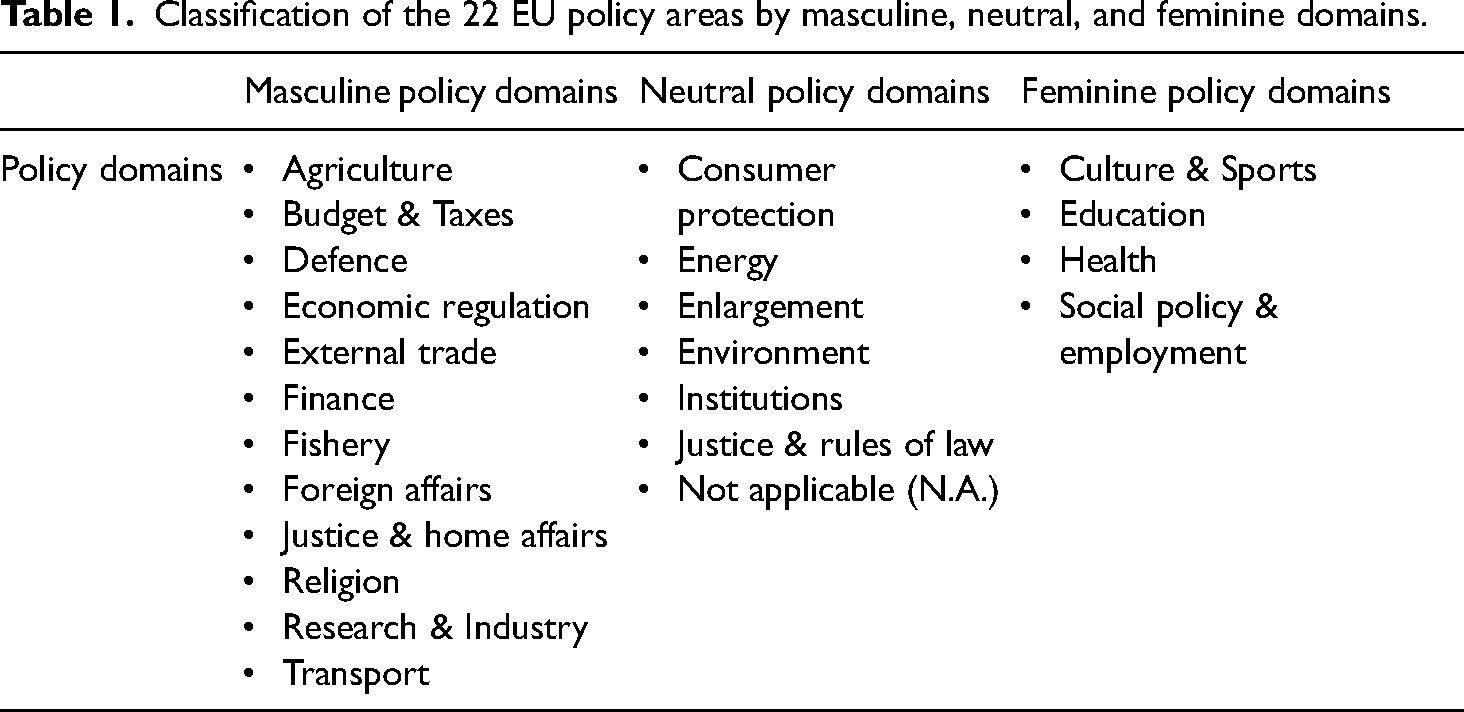
Second, we create our main dependent variable by establishing a categorical variable that labels each of 22 policy domains as ‘masculine’, ‘feminine’ or ‘neutral’ (see Table 1). Our categorisation is built upon Krook and O’Brien's (2012) analytical framework for the study of gendered patterns in parliamentary behaviour. This classification has been used in recent studies of gendered parliamentary questioning in national contexts (De Vet and Devroe, 2023; Dingler and Fortin-Rittberger, 2022). In Krook and O’Brien's (2012) taxonomy, the distinction between ‘masculine’ and ‘feminine’ policy domains is based on two elements: (a) whether the domain relates to concerns that link to the public sphere (politics and economy) or private sphere (home and family); and (b) whether the policy domain is ‘historically associated’ with men or women (Krook and O’Brien, 2012: 844). Hence, the taxonomy considers the public/private nature of the issue combined with what domains ‘signified normatively in relation to traditional views on men's and women's roles’ (Krook and O’Brien, 2012: 844). ‘Masculine’ domains are policy areas that are linked to the public sphere and are traditionally associated with men's roles. These include agriculture, budget and taxes, defence, economic regulation, external trade, finance, fishery, foreign affairs, justice and home affairs, transport, religion, and research and technology. ‘Feminine’ policy domains are linked to the private sphere and are traditionally associated with women's roles. These cover culture and sports, education, health, and social policy and employment. Policy domains that do not clearly correspond with one or both elements of the taxonomy are classified as ‘neutral’ (i.e. consumer protection, energy, enlargement, environment, institutions, rules of law as well as the non-applicable category). We have, furthermore, verified the robustness of our automated classifier by manually coding a sample of 2145 WPQs (i.e. 10 series of about 200 to 220 WPQs randomly selected on the 22 policy domains). The coding procedure included two coders specifically trained for the task. The coders’ labels are controlled and validated by the team of the Evolv’EP project (the principal investigator and two senior researchers). Overall, the policy dictionary classifier manages to reproduce 78.3% of the manual coding for our three categories of interest (masculine, neutral, and feminine policy domains). By comparative standard, this is a high achievement score, especially considering the difficulty of the task (for the 2145 WPQs sample, the average Cohen's kappa score between our trained coders was of 0.64).
Classification of the 22 EU policy areas by masculine, neutral, and feminine domains.
A gendered use of parliamentary questions in the EP?
We start our empirical analysis with descriptive statistics about policy domain focus by gender. First, and in line with previous studies (Sorace, 2018), we do not observe gender differences in the quantity of activity in the EP: men and women MEPs use parliamentary questions in relatively similar proportions, respectively, 40.5 WPQs and 36.1 WPQs are tabled by men and women MEPs (ANOVA, F(1,3388) = 1.7, p = 0.19). This means that if we find gender differences in the policy areas of WPQs, these are not driven by gendered differences in activity rates.
Figure 1 shows the distribution of policy domain focus between men and women MEPs in the WPQs they tabled in the EP. Gender differences occur in relation to only a few policy domains. As per our baseline hypothesis (H1), women MEPs tend to focus substantially more on feminine policy issues such as social policy and employment as well as health (nearly 5 percentage points higher than their men colleagues). Likewise, men MEPs focus on average more on masculine policy issues such as in finance and transport. Yet, other findings in Figure 1 contradict our baseline hypothesis (H1). Not only are gender differences absent in key policy domains (e.g. home affairs or education), but some gender differences also contradict H1. For instance, women MEPs present a higher percentage of WPQs in masculine policy domains such as agriculture as well as rules of law than their men colleagues. Overall, our descriptive statistics shows that gender differences exist, but that they are limited in terms of magnitude: men MEPs present a slightly higher percentage of WPQs on masculine policies than women MEPs (respectively, 53.1% and 47.4%), a difference that is statistically significant (ANOVA, F(1, 3388) = 34.35, p < 0.00). Likewise, women MEPs ask slightly more WPQs in feminine policy areas than men MEPs, respectively, 19.8% and 16.2% (ANOVA, F(1, 3388) = 23.64, p < 0.00). Finally, the gender differences are the smallest for WPQs in neutral policy arenas, respectively for men and women MEPs, 30.8% and 32.9% (ANOVA, F(1, 3388) = 5.67, p = 0.02). Overall, while gender differences are relatively limited in terms of magnitude, a distinct gendered divergence in parliamentary behaviour is unmistakably present, following expected patterns across all three categories: masculine policy domains are predominantly addressed by men MEPs, whereas feminine policy questions are more often tabled by women MEPs. Neutral domains exhibit the lowest and least significant gender differences. The descriptive statistics provide evidence for validation of H1.
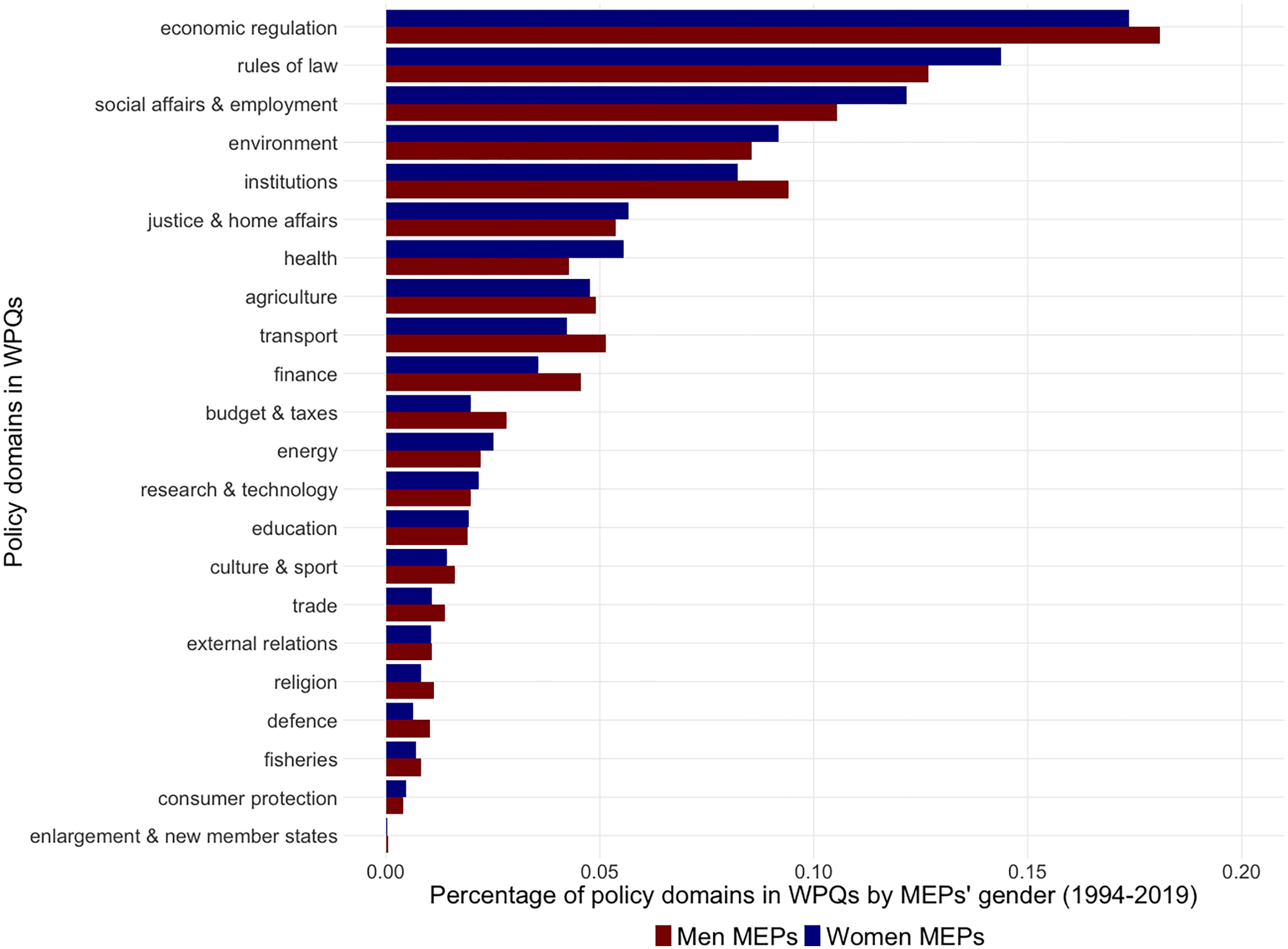
Distribution of policy domains in WPQs by gender (1994–2019).
Second, our empirical results are even more nuanced once we consider changes over time. Figure 2 shows the evolutions of masculine and feminine policy domain focus over time (from the 4th legislative term from 1994 to 1999 until the 8th legislative term from 2014 to 2019). On the one hand, Figure 2 shows that the gender gap, despite fluctuations, remains relatively limited in terms of magnitude throughout the entire period of analysis. During the 4th legislative term (1994 to 1999), WPQs with masculine policy domains are more often raised by men with a difference of almost 9 points. These differences have increasingly eroded over time, with a gap limited to 2.7 points in the 6th legislative term. Interestingly, during the 7th and 8th legislative terms, the gender gaps widen again to reach up to 6 points of difference with men MEPs focusing more on masculine policy domains than women MEPs. Although the gender gap is substantially smaller than in the 1990s, it is noticeable. In addition, our descriptive statistics show that gender differences show some ups and downs for feminine policy domains where women MEPs ask a higher ratio of their WPQs than their men colleagues (respectively 20.0% and 17.0% in the latest legislative term). This gender gap is wider in the late 2000s and 2010s than what it used to be in the 1990s and early 2000s. Overall, our goal in the next section is to test whether this gender gap is significant when considering all other intervening factors (be they individual, political, or institutional).
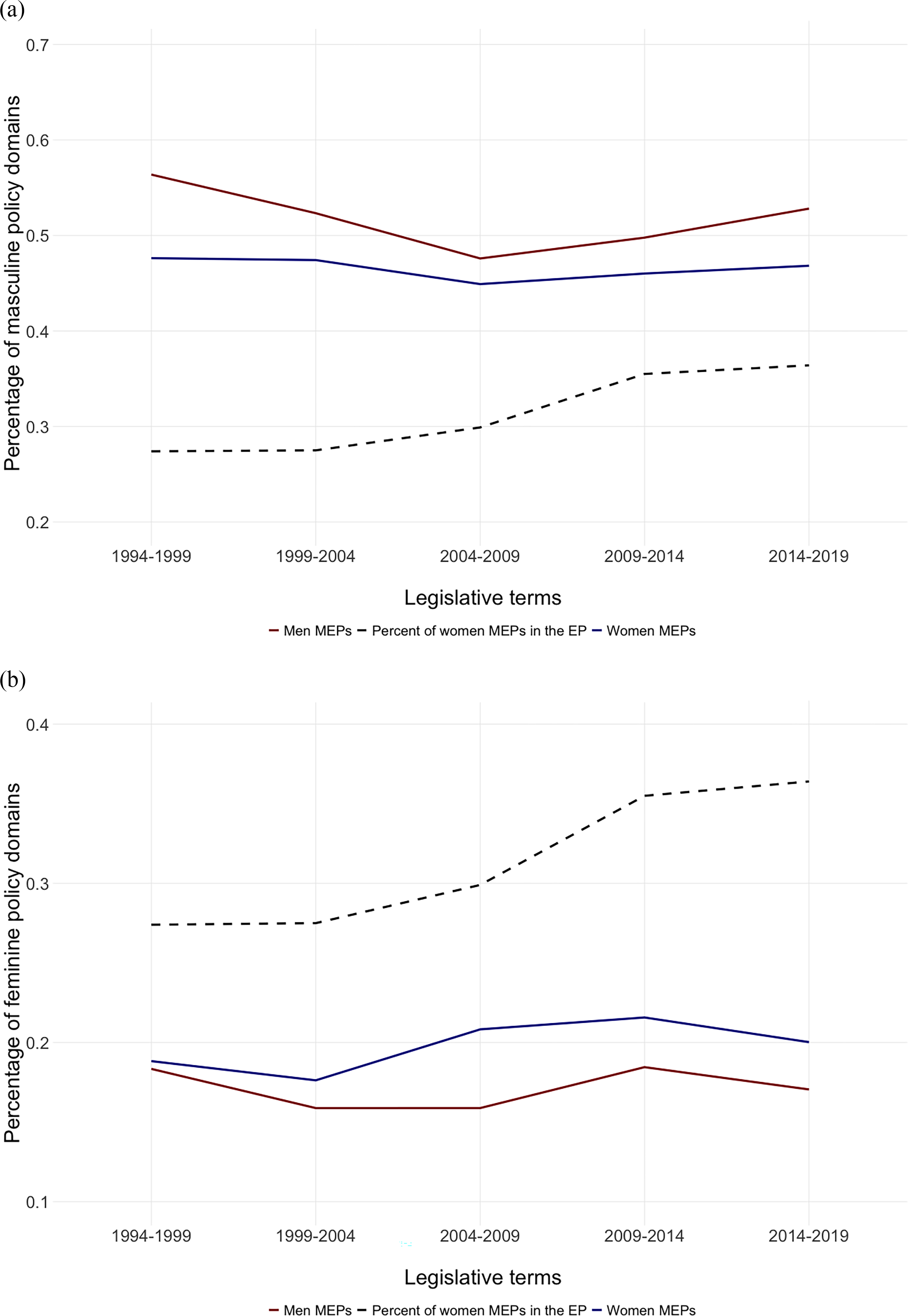
Evolution of masculine and feminine policy domains in WPQs by gender (1994–2019).
Multivariate hierarchical models
Multivariate hierarchical models allow us to assess the gender effects ‘all other things being equal’, but also to develop interactive effects between gender and other factors as suggested by our hypotheses. For that goal, the empirical analysis is based on the combination of our original dataset on WPQs (n = 136,787 WPQs) merged with MEPs’ biographical information and career orientation from the Evolv’EP project. The latter includes information on all 2219 MEPs having served in the EP during our period of analysis (from 1994 to 2019). Our dependent variable is the percentage of masculine, feminine, and neutral policy domains in the total number of WPQs tabled by MEPs (see above). Our main explanatory factors are gender (H1), seniority (H2) and the percentage of women in the EPG (H3 and H4).
For gender (H1), we observe that men MEPs are represented in larger numbers in the EP (70.5% of our dataset). This situation, however, greatly varies across EPGs with a distinctive GAL/TAN cleavage (i.e. Green, Alternative, Libertarian versus Traditionalist, Authoritarian, Nationalist). On average, hardly a fifth or a quarter of women are represented amongst the Conservatives, European People's Party (EPP) and Eurosceptics group; by contrast, women MEPs represent more than a third (Socialists group and radical left) or even more than 40% amongst the Greens. Percentages of women MEPs in the EP (H3 and H4) represent a steady increase over time (see Figure 2 above). For seniority (H2), we include MEPs’ experience in the EP (operationalised in number of months served). The average duration of service is about 1.5 terms (92.5 months), albeit with large variation (std = 61.5 months while the median duration is hardly one term, i.e. 59 months). In line with previous studies (Proksch and Slapin, 2010; Sozzi, 2021), we furthermore control for multiple individual, institutional, and political factors. On the one hand, at the individual level of MEPs, we control for social and political background in terms of age at the first office in the EP (mean being of 46.2 years) and MEPs’ experience in committees with masculine/feminine policy domains (while a few MEPs conduct their entire career in such committees, the average profile of MEPs serves about one third of their time in committees related to masculine policies). On the other hand, we control for variation across countries, EPGs, and electoral systems. Regarding EPGs, we included a dummy variable for each EPG to test whether group affiliation is a relevant factor in shaping parliamentary behaviour as well as to see whether MEPs from Eurosceptic groups behave differently (i.e. Eurosceptic model of Proksch and Slapin, 2010). We also control for variation across member states: on the one hand, we distinguish membership pre- and post-2004 enlargement; on the other hand, we include an index of gender parity by country (i.e. Public Gender Egalitarianism from Woo et al., 2023). Finally, we control for the impact of the electoral system used at European elections (COMEPELDA by Däubler et al., 2022 ), as former studies underline the importance of electoral motivations in parliamentary behaviour (Chiru, 2022; Koop et al., 2018; Navarro, 2019; Sozzi, 2016).
Because those MEPs are elected in as many as 28 countries, and they serve over multiple legislative terms while they belong to various EPGs, our models account for the hierarchical structure of our dataset. We fit a linear model with fixed and random effects to predict the percentage of masculine, feminine, and neutral WPQs introduced by MEPs. In these models, the 2219 MEPs’ specialisation in WPQs is measured multiple times over time. In theory, this model could include as many as 11,095 observations (i.e. 2219 MEPs’ policy specialisation measured five times for each legislative since 1994). Because most MEPs serve only one term in the EP (Dodeigne et al., 2024), most MEPs present only a single observation though. The total number of observations is, therefore, 3390 repeated measurements of policy specialisation (level I) for 2219 MEPs (level II). The main advantage of this model is to be able to include time-varying covariates (e.g. policy specialisation is measured in each legislative term for MEPs while we can assess the effects of MEPs’ seniority increasing over time). Finally, we also include a random effect for the 172 distinct EPGs nested in 28 countries (level III) (Table 2).
Presentation and descriptive statistics for the dependent and independent variables.
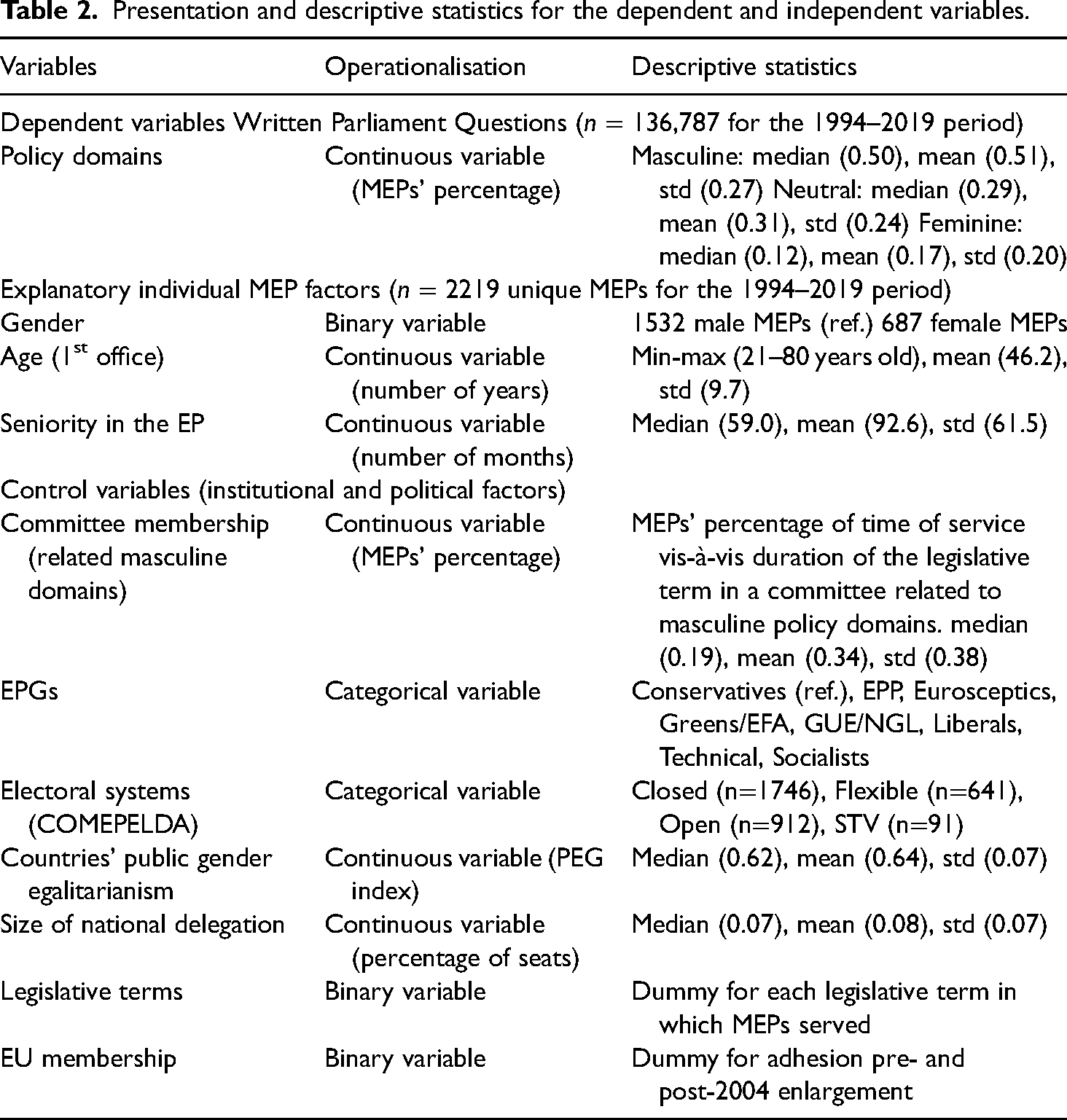
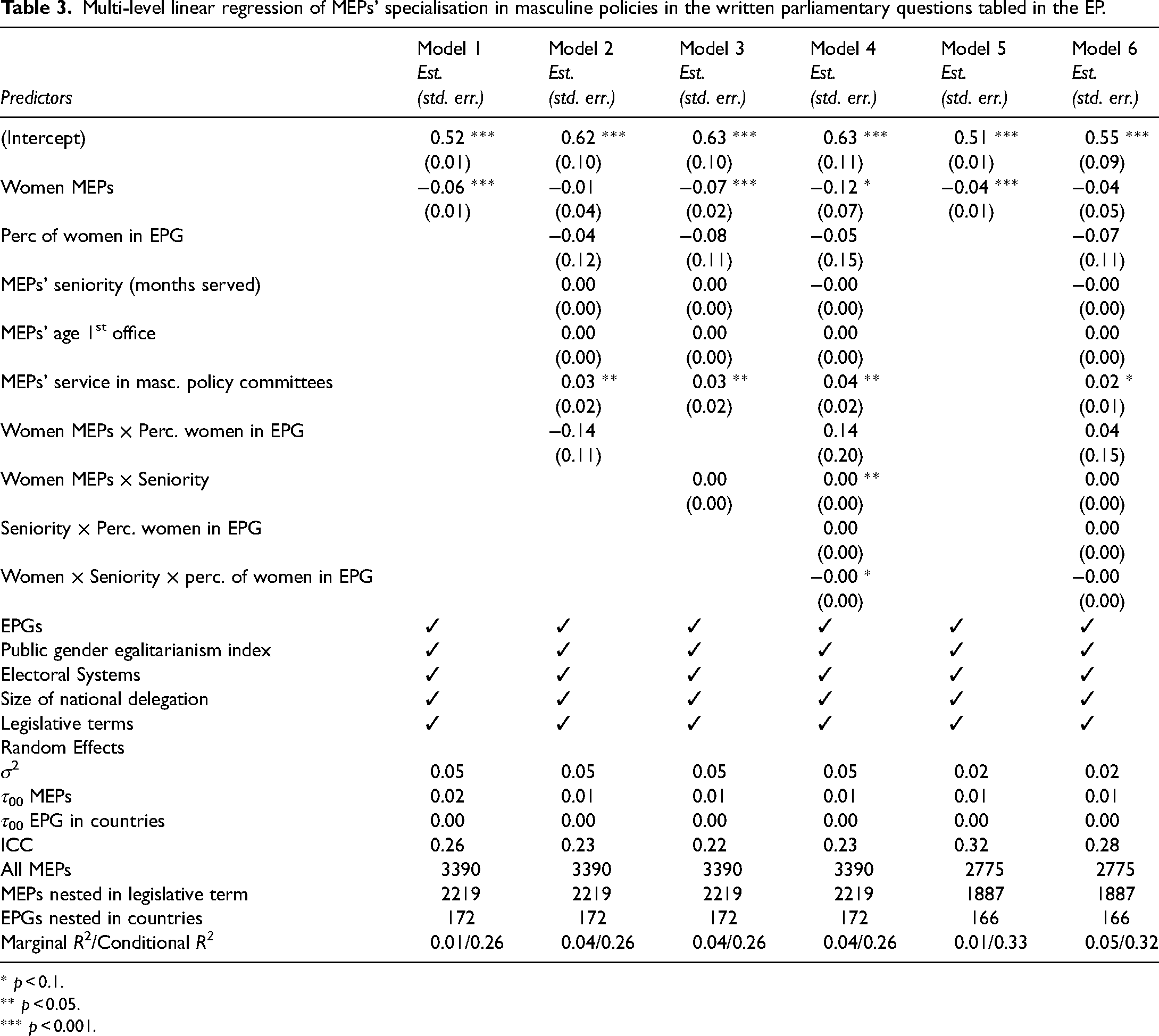
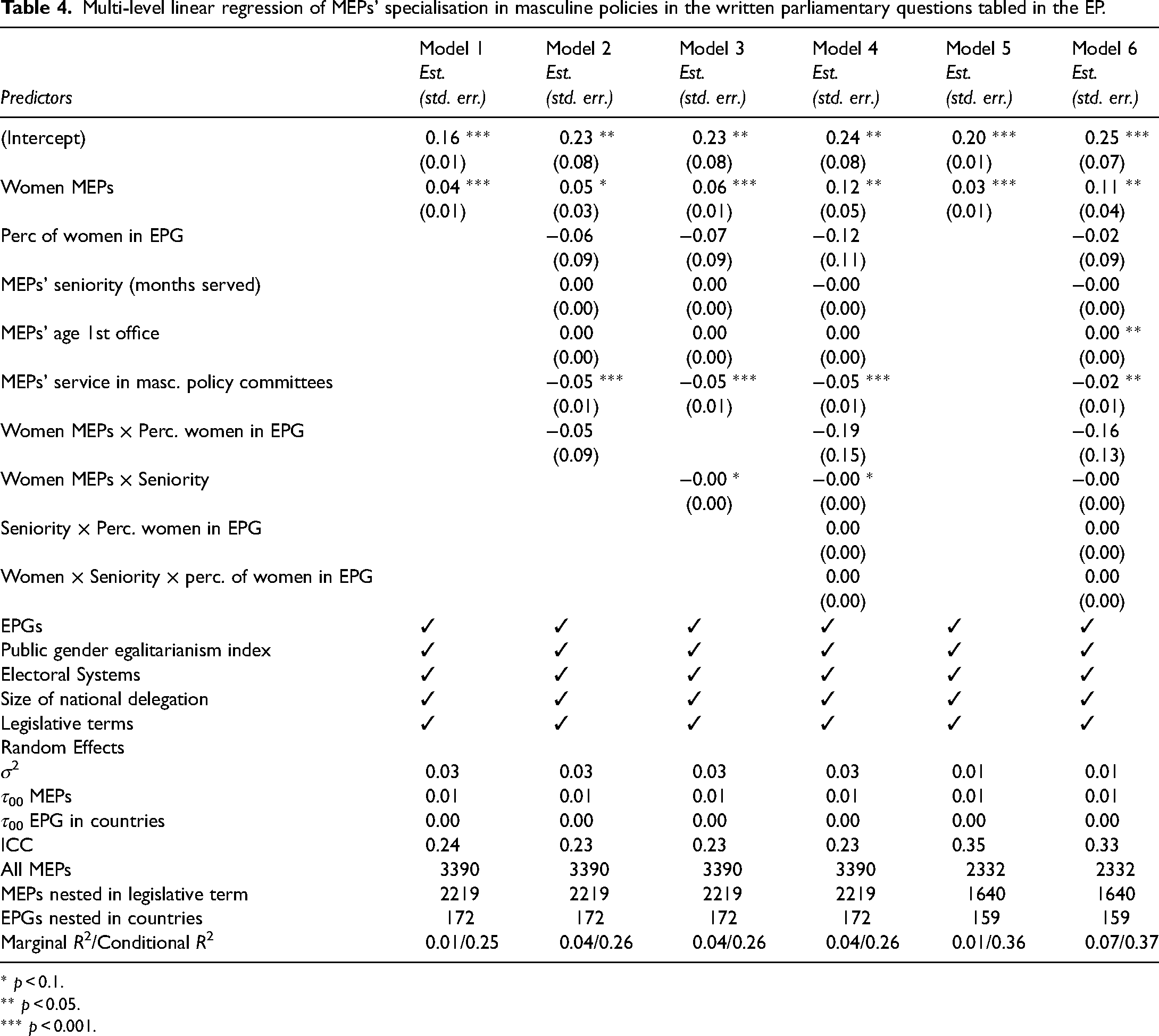
In Table 3, Model 1 is a baseline model that estimates the effect of gender (H1) upon MEPs’ percentage of specialisation in masculine policy domains. Table 4 provides the same regression models for feminine policy domains. The results being highly convergent, we mostly discuss the results for masculine domains for the sake of parsimony. Model 2 and Model 3 test our first four hypotheses (H1, H2, H3 and H4) while controlling for other individual biographical variables as well as political and institutional control factors. Model 4 tests H5 by including an interactive effect amongst the three factors (gender, seniority and percentage of women MEPs in the EPG). Finally, Model 5 and Model 6 are estimated as robustness checks with subsamples of MEPs (see details below). The models’ total explanatory power is moderate (marginal and conditional R-square oscillates between 0.26 and 0.33 across models). Within these three models (except for Model 2), the effect of gender is always statistically significant and negative, confirming H1. In other words, we observe that gender has a statistically significant effect on MEPs’ parliamentary behaviour, verifying that women MEPs ask fewer questions on masculine policy domains than men MEPs. In Model 1 (Table 3), we observe on average a gender gap of 6 percentage points (CI 95%: −0.04; −0.08). All other things being equal, women MEPs table 46% of their WPQs in masculine domains, while men MEPs table 52%. Likewise, models in Table 4 confirm that women MEPs table more WPQs in feminine domains than men MEPs. While this gender gap remains limited in terms of magnitude, those effects are consistent across all models.
Multi-level linear regression of MEPs’ specialisation in masculine policies in the written parliamentary questions tabled in the EP.
* p < 0.1.
** p < 0.05.
*** p < 0.001.
Multi-level linear regression of MEPs’ specialisation in masculine policies in the written parliamentary questions tabled in the EP.
* p < 0.1.
** p < 0.05.
*** p < 0.001.
Furthermore, we observe that interactive effects have statistically significant effects. These results confirm that gender effects in policy focus are moderated by seniority as well as by the percentage of women in the EPG. We cautiously indicate to the reader, that even though the interactive variables are not reported as significant on Table 3, the correct interpretation is that gender interacts significantly with seniority and presence of women in EPG. This is a common issue for models with interactive effect (as in Model 2 between gender and percentage of women in EPG). As stated by Brambor et al. (2006: 76), it is possible to observe statistical marginal effects that are different for substantively relevant values of the interactive variable but not for others. This information cannot be simply assessed via coefficients reported in regression tables. Their protocol permits to provide ‘substantively meaningful estimates of marginal effects and their standard errors’ (Brambor et al., 2006: 81). Therefore, we implement their procedure which visualises the marginal effects of gender across the distribution of values of the interactive variable (see the Online appendix). The Online appendix shows that the variable gender has a statistically significant negative effect for most observations.
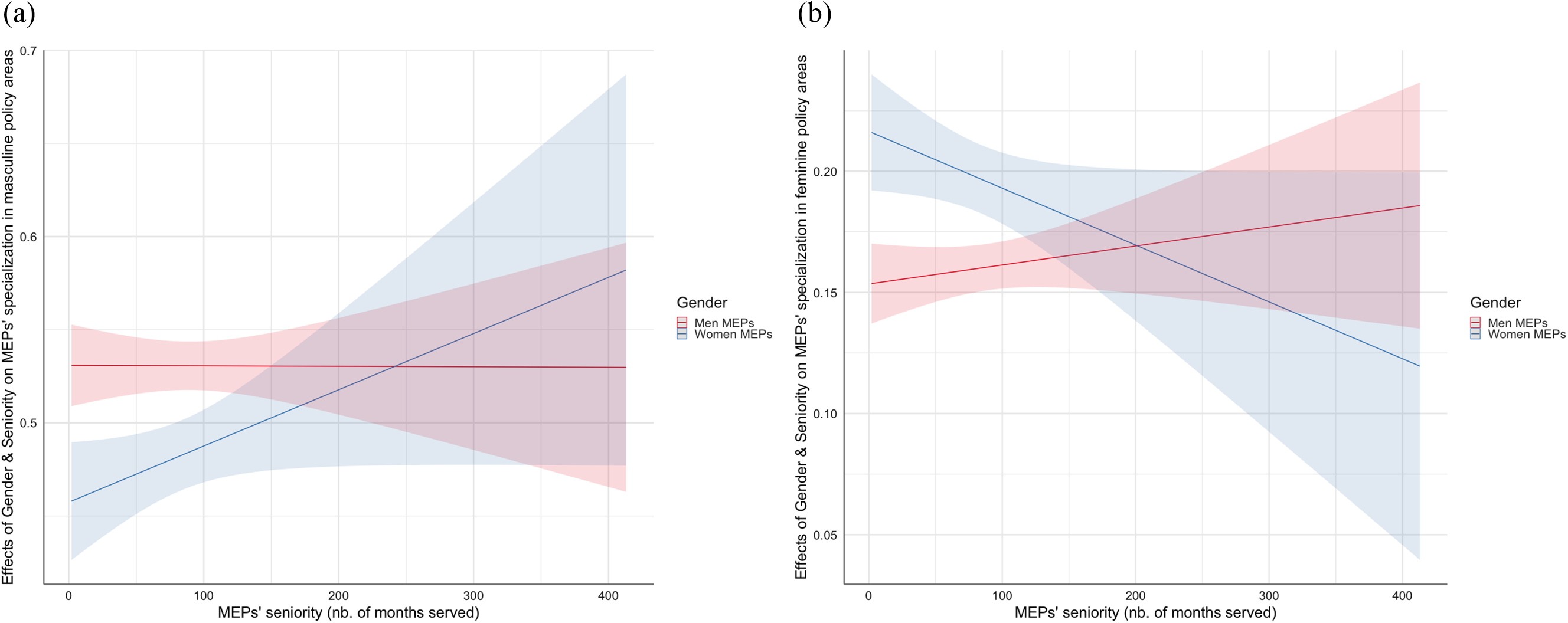
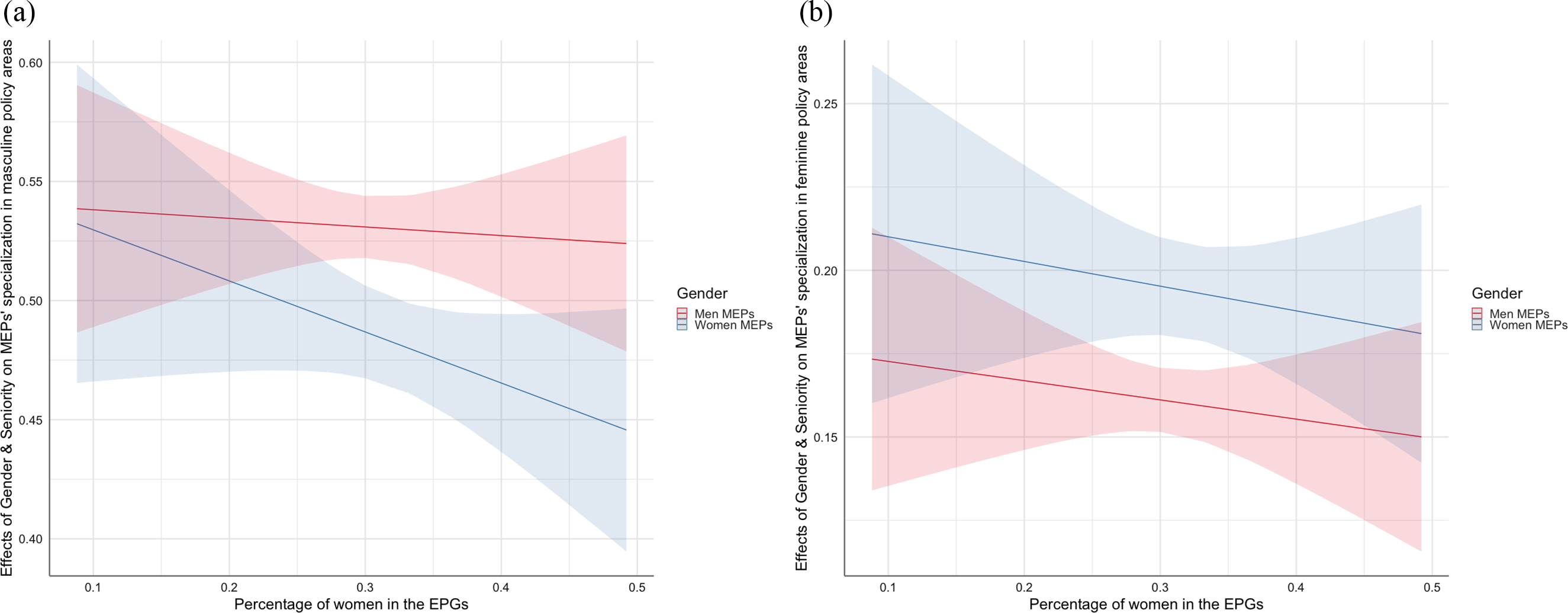
In line with H2, figure in the appendix shows that the coefficient is negative and the largest among the group of newcomers (least experienced MEPs). For the sake of clarity, we plotted the predicted values for masculine policy domains (Figure 3(a)) and feminine policy domains (Figure 3(b)). These figures clearly show that – compared to men MEPs (in red) – newcomers women MEPs (in blue) are less likely to focus on masculine policy domains while they are more likely to focus on feminine policy domains. Yet, as MEPs gain seniority, the gender gap increasingly reduces to fully vanished for the most experienced MEPs (at least 10 to 12 years of experience). Furthermore, our results indicate that the largest presence of women has a significant negative effect on masculine policy focus. This suggests that H3 should be discarded at the benefit of H4. The results are presented in Figure 4.
Finally, in Model 4, we observe that the triple interactive effect is significant for gender, seniority, and percentage of women in EPG. For the sake of interpretation, in Figure 5, we plot the predicted percentages of policy specialisation for women and men MEPs according to seniority and women's presence in EPGs (at 21%, 31% and 40%). The results establish clear interactive effects between these factors. Figure 5 shows that men MEPs are extremely consistent in their ‘masculine’ policy focus – irrespective of the percentage of women in their EPG or their own experience (the red line is almost always horizontal in all configurations). By contrast, we observe that newcomer women MEPs are much less likely to focus on masculine policy domains but that such effects vanish as seniority increases in the smallest presence of women. When the numerical presence of women is the highest (i.e. 40%), gender differences are no longer connected to seniority. Interestingly, we observe almost the exact reversed picture for feminine policy domain focus for women newcomers present in EPGs with low percentages of women in Figure 6. In other words, our results strongly suggest that gender and seniority are key factors to understanding the gendered logic of appropriateness, and that these effects are stronger when the presence of women is the smallest (H5).
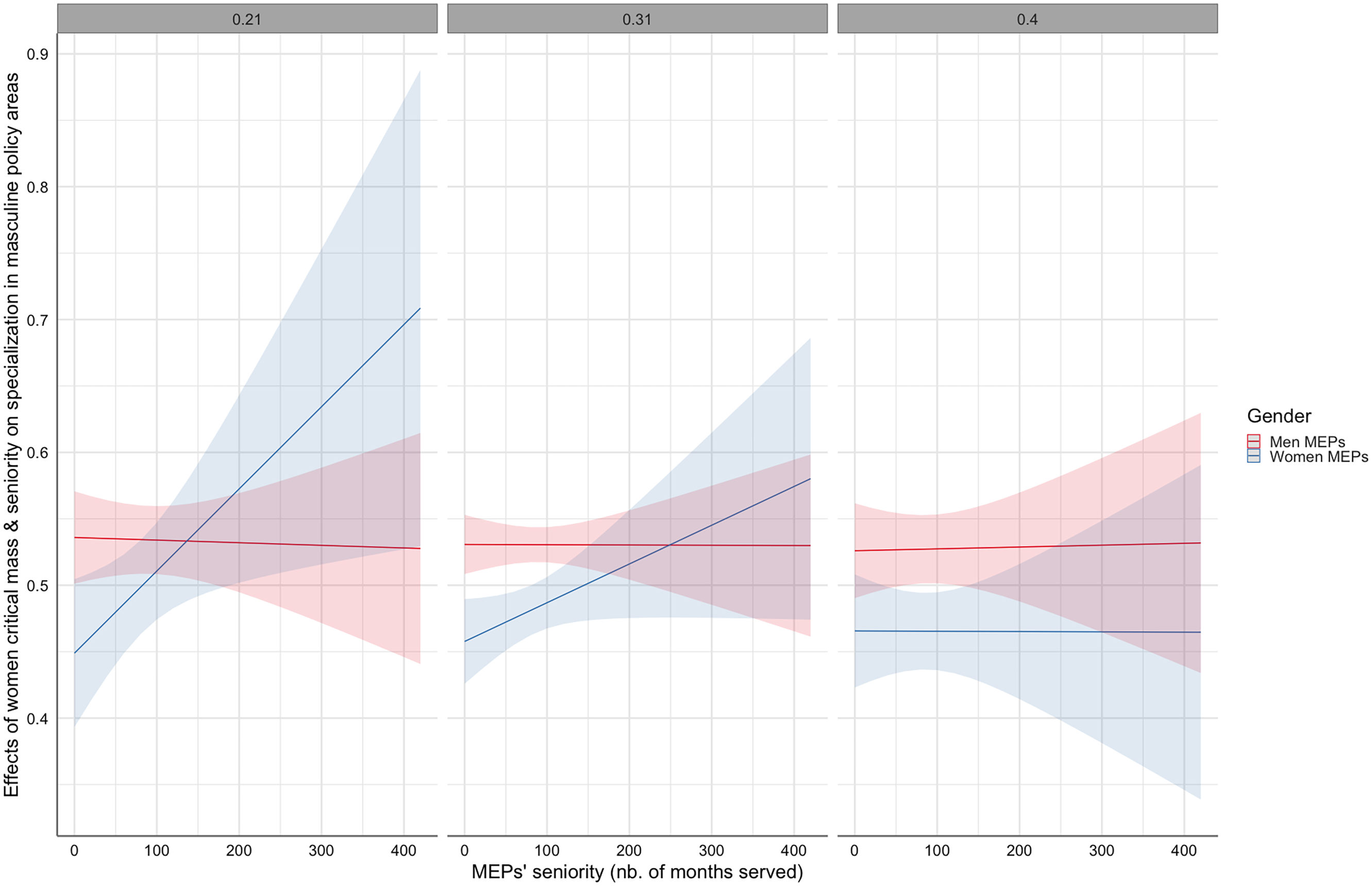
Predicted percentages of masculine policy areas by seniority, percentage of women in the EPG, and gender (model 4 –Table 3).
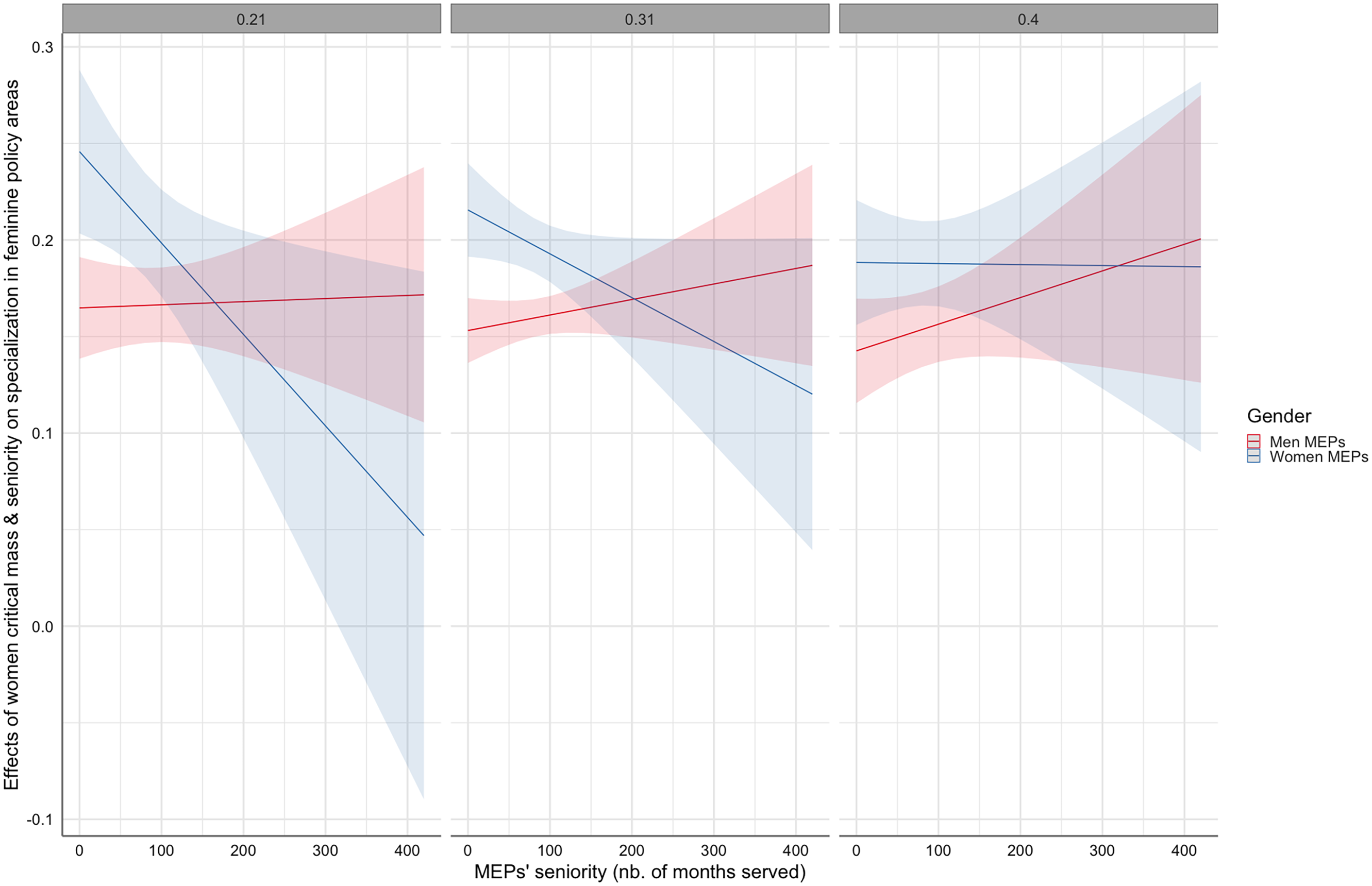
Predicted percentages of feminine policy areas by seniority, percentage of women in the EPG, and gender (model 4 – Table 4).
Before concluding, we report a couple of robustness checks. First, because of the extreme specialisation of MEPs in some policy domains (about 20% of all MEPs tabled WPQs exclusively in feminine or masculine domains), our dependent variable is not well distributed (especially for feminine policy domain focus in Table 4). Consequently, this could undermine the reliability of our empirical findings in the light of the diagnosis of residuals of the models (the distribution of residuals is not as problematic for masculine policy domain focus in Table 3). Therefore, we replicate our models with subsamples of MEPs excluding those with 0% and 100% specialisation (Models 5 and 6 in both Tables 3 and 4). These models indicate that while gender is significant in the baseline model, it is not anymore significant in these additional models (which is also confirmed when implementing Brambor et al.'s (2006) protocol analysis). In addition, we thus conduct an analysis including only MEPs who exclusively specialise in masculine domains in the Online appendix (i.e. 552 individual MEPs, about one sixth of the dataset – the model is a logit regression with random effect where the binary outcome being ‘full specialisation or not’ in masculine domains). The results are revealing about the gendered behaviour observed in the EP (Figure 7): this extreme profile of MEPs with exclusive specialisation seems to be the main drivers of our results. While it does not undermine the overall results found for the entire population of the EP, these results strongly suggest that future research should more specifically focus on extreme profiles of MEPs explaining most of the variance observed.
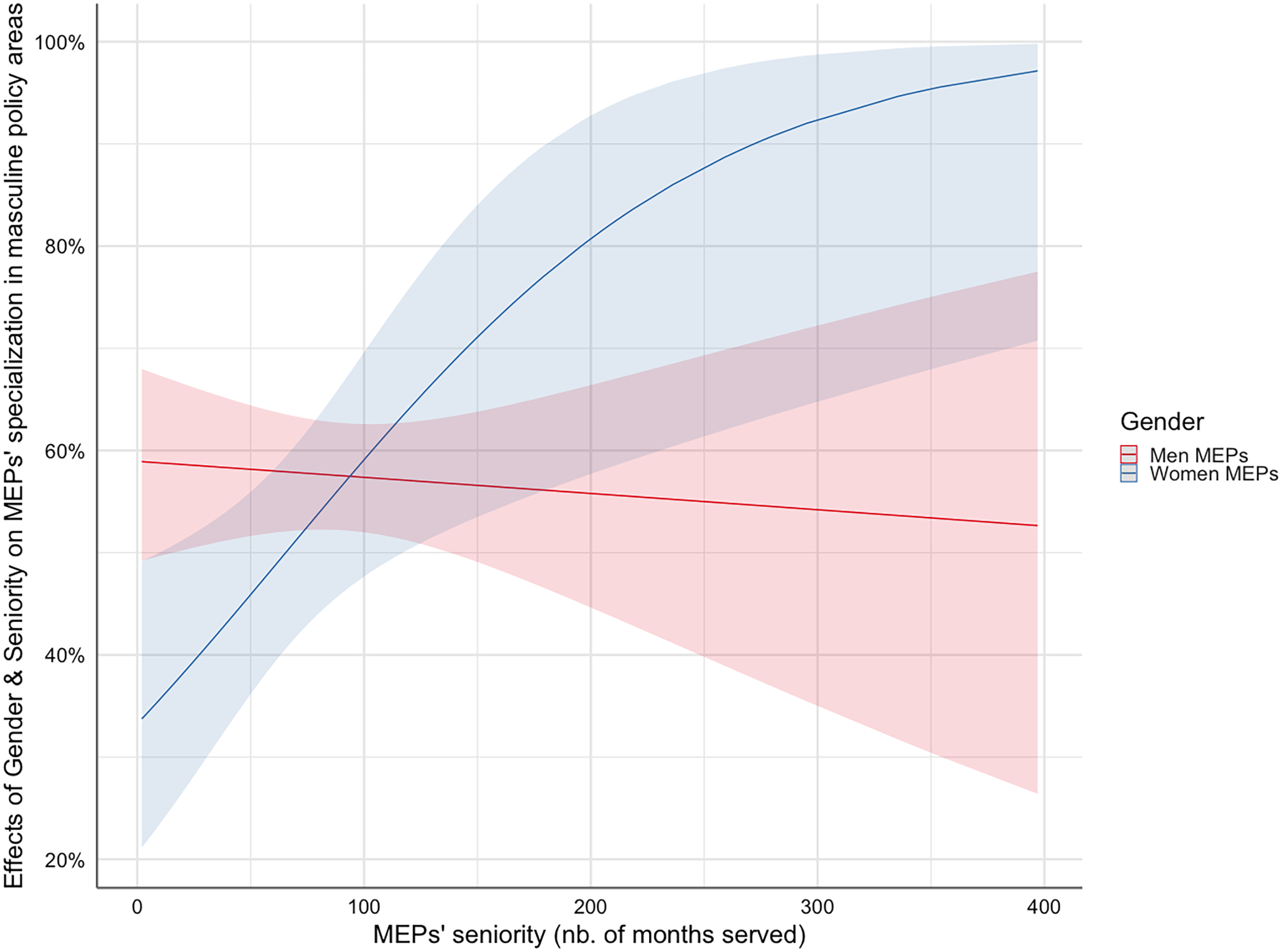
Predicted percentages of exclusive specialisation in masculine by gender and seniority (sub-sample of MEPs) (model 5 – see regression table in Online appendix).
Second, we conduct additional robustness checks to verify the reliability of our results across the diversity of policy domains, identifying the most influential policy domains regarding the EP's policy-making capacity. For that goal, we rely on a classic distinction of the influential policy domains in the EP (see Chiru, 2020; see the Online appendix). In these models (see the Online appendix), our results are extremely consistent with our other previous models establishing a clear gender effect (interacting with seniority) for masculine policy domains covering the most influential EP powers. Although the effects are slightly weaker, they are very consistent for the triple interactive effects (see the Online appendix).
Conclusion
This article contributes to our understanding of the EP as a ‘gendered institution’ by studying gender differences in parliamentary questioning on ‘masculine’ and ‘feminine’ policy domains. It examines (a) whether women and men MEPs differ in the proportion of written questions tabled on ‘masculine’ versus ‘feminine’ policy domains; and (b) whether they are related to individual characteristics of MEPs (seniority) and context factors (the numerical presence of women). For that goal, we analyse an original dataset of 136,787 WPQs tabled by 2219 MEPs over 25 years of European legislative politics (from 1994 to 2019).
Our empirical findings paint a mixed picture. On the one hand, gender differences are unmistakably observed in MEPs’ behaviour. Confirming our baseline hypothesis (H1), women MEPs ask more questions on feminine policy domains (such as social policy, employment, and health) than men MEPs, and men MEPs ask more questions on masculine policy domains (such as finance and transport), which hints at a gender-stereotypical specialisation in the EP. On the other hand, gender differences remain limited in terms of magnitude, and they fluctuate somewhat between issues and over time. This may lend support to the idea that in the EP gender-stereotypical divisions of labour may be in transition, and that the EU's gender exceptionalism may also apply to MEPs’ behaviour (although not for all MEPs evenly, see below).
Our results furthermore show that gender differences in parliamentary questioning are moderated by seniority and women's numerical presence. In line with H2, we find that gender-stereotypical divisions of labour are most prominent among newcomers, and that they diminish and even disappear for the most senior women MEPs. This effect is largely driven by changes in women MEPs’ behaviour. With increasing seniority women MEPs ask more questions on masculine policy domains, thereby converging with men MEPs in their masculine policy focus. This convergence does not occur for feminine policy domains. We conclude that men MEPs may have few incentives to adopt a feminine policy focus in gendered institutions, and this regardless of women's presence in the institution. The effect of seniority also interacts with women's numerical strength in the political groups. In line with H4 (and contrary to H3), gender differences do not disappear as such with increases in women's presence. Rather, women's numerical strength in the political groups interacts with seniority (confirming H5). Notably, within political groups characterised by a low share of women, seniority exerts a more pronounced influence on women MEPs’ opportunities to engage in traditionally masculine policy domains. Consequently, within such contexts, seniority emerges as a crucial asset for women MEPs seeking involvement in these domains.
What are the broader implications of our findings? First, the fact that gender differences are smaller for experienced MEPs than newcomers suggests a pattern of convergence as seniority increased. This could indicate that experienced women MEPs have overcome gender stereotypes and/or have altered their policy focus for career advancement purposes (see Bailer et al., 2022). Pressures to conform to gender stereotypes will be the strongest for newcomers in the institution; seniority changes the institutional position of MEPs and more opportunities to alter prevailing stereotypes may occur. Some earlier studies on national parliaments also show that women MPs increase their activities on specific ‘masculine’ issues that are deemed highly salient, with the intention of building a reputation on these issues (Swers, 2007). Having said this, our study does not allow us to disentangle whether (senior) MEPs’ policy domain focus is primarily driven by extrinsic motivations (such as career or electoral prospects, see e.g. Bailer et al. (2022)) or intrinsic motivations (such as inherent satisfaction). Both can be strongly intertwined, and future research is needed on this topic (e.g. surveys asking MEPs about their intrinsic or strategic considerations).
Second, feminine policy domains unmistakably remain policy areas that are taken up by (newcomer) women MEPs and overlooked by men MEPs. And, contrary to some evolution for masculine policy domains, this does not change over time (the gender gap is wider in the 2010s than in the 1990s). Our data do not allow us to assess whether newcomer women MEPs are ‘pushed’ or ‘pulled’ to these feminine domains; for this, successive research is needed on MEPs’ policy domain preferences before they enter the EP, and on their perceptions of the gendered rules, role expectations, and incentives in the EP (Ahrens et al., 2019; Bækgaard and Kjaer, 2012). Future work may also find it interesting to study the reasons why men MEPs overlook feminine policy domains. Here too, studies on national parliaments offer a source of inspiration (e.g. Celis and Erzeel (2015) on men's electoral incentives to act on behalf of women and Höhmann (2020) on men's policy specialisation in relation to ‘women-specific’ issues).
Finally, the changes over time show that understanding MEPs’ behaviour requires unpacking temporal evolutions as well as moderating and enhancing effects of other institutional and political factors. Future research can tap into the role of parties and the extent to which they control MEPs’ policy specialisation (Ahrens et al., 2022; De Vet and Devroe, 2023), and the role of committees. Studies can also further explore differences within the larger categories of ‘masculine’ and ‘feminine’ policy domains, for example, by considering the role of issue salience (Swers, 2007).
Supplemental Material
sj-docx-1-eup-10.1177_14651165241299115 - Supplemental material for Putting the European Parliament's gender exceptionalism to the test: MEPs’ specialisation in masculine and feminine policy domains in parliamentary questions
Supplemental material, sj-docx-1-eup-10.1177_14651165241299115 for Putting the European Parliament's gender exceptionalism to the test: MEPs’ specialisation in masculine and feminine policy domains in parliamentary questions by Jeremy Dodeigne, Silvia Erzeel and François Randour in European Union Politics
Supplemental Material
sj-zip-2-eup-10.1177_14651165241299115 - Supplemental material for Putting the European Parliament's gender exceptionalism to the test: MEPs’ specialisation in masculine and feminine policy domains in parliamentary questions
Supplemental material, sj-zip-2-eup-10.1177_14651165241299115 for Putting the European Parliament's gender exceptionalism to the test: MEPs’ specialisation in masculine and feminine policy domains in parliamentary questions by Jeremy Dodeigne, Silvia Erzeel and François Randour in European Union Politics
Footnotes
Acknowledgements
The authors wish to thank the participants of the workshop organised by Elena Frech (‘EUropean Careers: The Careers of European Political Elites and their Representative Effects’, 5–6 May 2023 University of Bamberg, Germany) for their inspiring comments and suggestions. They also thank Tevfik Murat Yildirim who was our discussant at the ‘8th Conference of the ECPR Standing Group on Parliaments’ (6–8 July 2023, University of Vienna, Austria), as well as the two reviewers of this special issue, for their much-appreciated comments on former versions of this article. Finally, they are indebted to Hubert Naets (CENTAL – UCLouvain) and Patrick Watrin (CENTAL – UCLouvain) for their stimulating contribution regarding strategies in natural language processing in the Evolv’EP project. Future collaborations will allow them to present new and innovative methodological approaches to analyse parliamentary behaviour.
Author contributions
The authors contributed equally to the article.
Funding
The author(s) disclosed receipt of the following financial support for the research, authorship, and/or publication of this article: This project benefited from funding support of Fonds De La Recherche Scientifique – FNRS. Grant Number: PDR T.0076.20 (35292892). The study was also supported by the Research Foundation Flanders (FWO) under grant G040823N.

Data availability statement
Data is available upon request to the corresponding author (F.R.S.-FNRS open science policy applies, with availability at the end of the funded project).
Supplemental material
Supplemental material for this article is available online.
Notes
References
Supplementary Material
Please find the following supplemental material available below.
For Open Access articles published under a Creative Commons License, all supplemental material carries the same license as the article it is associated with.
For non-Open Access articles published, all supplemental material carries a non-exclusive license, and permission requests for re-use of supplemental material or any part of supplemental material shall be sent directly to the copyright owner as specified in the copyright notice associated with the article.
