




Abstract
This article analyses the extensive coverage in UK newspapers of the shooting, recovery and activism of Malala Yousafzai, the prominent campaigner for girls’ rights from the Swat Valley in Pakistan. The study uses discourse analysis and a poststructuralist, feminist and postcolonial approach to analyse 223 newspaper articles, identifying the dominant discourses about Yousfzai in the context of the United Kingdom’s colonial history and perceptions of its current role in global politics. The article demonstrates that the UK media’s representation of Yousafzai’s story embraces and reproduces seemingly emancipatory discourses around girls’ education, yet is ultimately limited by enduring gendered and orientalist discourses that underlie these new initiatives, which are simultaneously produced by, and productive of, unequal power relations. Despite Yousafzai’s courageous campaigning, these discourses still make it easier for UK journalists to label her the ‘shot Pakistani girl’ than to call her powerful, a survivor or indeed a feminist.
Introduction
I am focusing on women’s rights and education because they are suffering the most. There was a time when women asked men to stand up for their rights, but this time we will do it for ourselves. (Malala Yousafzai’s speech to the United Nations, cited in Holpuch, 2013)
Malala Yousafzai, the well-known campaigner for girls’ education from the Swat Valley in Pakistan, has blogged, given speeches and lobbied politicians since the age of 11 in response to the Pakistani Taliban, or Tehrik-i-Taliban Pakistan (TTP), and their acts of violence and intimidation against girls and their teachers in the region. Although Malala Yousafzai had been blogging for some time for the British Broadcasting Corporation (BBC) Urdu Service, she was relatively unknown in the United Kingdom until the considerable media interest after 9 October 2012, when two gunmen claiming to represent the TTP shot her in the head at point-blank range while she was sitting on a bus waiting to return home from school. This article analyses the way in which the shooting of Yousafzai, her medical treatment in Pakistan and the United Kingdom, her return to school and her continued activism have been treated by UK newspapers. While many of the findings echo the wealth of literature on historically gendered and orientalist discourses of the ‘East’, which see Muslim countries as ‘carried over from the times of the Prophet Mohammed’ (Mohanty, 1991b: 61–62), and in need of ‘corrective study by the West’ (Said, 2003: 40–41), they also reveal the adoption of new and emerging discourses. These discourses have emerged in the context of what Mohanty (2006: 9) sees as ‘informal and not violently visible empire building’, which relies upon ‘hypernationalism, hypermasculinity and neo-liberal discourses of “capitalist democracy” bringing freedom to oppressed third world peoples—especially to third world women’.
Spivak (2004: 525) has argued that since decolonisation, new discourses serve to justify the continuing undoing of, and intervention in, former colonies: ‘the human rights aspect of postcoloniality has turned out to be the breaking of the new nations, in the name of their breaking-in into the international community of nations’. In recent years, one particular focus of the international human rights apparatus has been that of girls’ education. There has been an unprecedented level of concern for the cause of girls’ education at the highest levels of international politics, with particular attention to the concept of the ‘girl effect’—also the name of a campaign by the Nike Foundation and United Nations (UN) Foundation which champions investing in girls in developing countries—which posits girls as the untapped resource of the developing world, who, with the right investment, will ultimately lift their communities out of poverty (see, e.g. Bent, 2013; Girl Effect, n.d.-a; PLAN International, n.d.). Initiatives such as the Girl Effect and Chime for Change, an organisation cofounded by Gucci, Beyoncé Knowles-Carter and Salma Hayek-Pinault, combine powerful multinational corporations with celebrity endorsement and seek both to change the way that girls in developing countries are perceived and to alter the opportunities available to them through Western investment. These powerful discourses promote girls’ education as a potential boost to the global economy, and girls have come to be seen as ‘“both the dire problem and the fantastical possibility” of personal success in an unstable global economy’ (Ringrose, cited in Bent, 2013).
In Pakistan, the right to education carries a long and complex history of Western intervention, which still shapes the opportunities available to all children today. Pakistan’s madrasa system, in particular, has been the subject of much Western preoccupation. Heavily undermined by the policies of the East India Company and by British modernisation drives, madrasas were no longer, under colonial rule, a useful route into employment (Bano, 2007: 48). As a result, they began to focus increasingly on the spiritual education of their students alone. It is claimed that it was within some of the more extreme Deobandi madrasas in Pakistan that key members of the Taliban were educated, and they have as a result become a target of recent US reform packages (Bano, 2007: 43–44; Kronstadt, 2004: 1–4). In a report for the US Congress in 2004, Kronstadt writes, ‘In the longer-term interest of promoting moderation and democratic values in Pakistan, and in improving the socioeconomic status of its people, sector-wide reform of the education sector seems vital’ (5). More recently, this Western concern about the nature of education offered in Pakistan’s system has combined with discourses emerging from a context in which ‘Muslim girls in developing nations are constructed predominantly as the objects of Western interventions on a range of military, economic, humanitarian and educational fronts’ (Marshall and Sensoy, 2010: 296). Although one recent study found leaders across the religious spectrum in Pakistan to be in favour of the education of girls, there is vast disparity across the religious spectrum concerning what girls’ education should consist of and prepare them for, with some advocating a curriculum equal to that of boys and others favouring an education that focuses on preparation for domestic duties (Bradley and Saigol, 2012: 677). A very small minority have condemned any form of education of girls as ‘un-Islamic and a violation of purdah’ (Sudduth, 2009: 572), with some claiming to act under the auspices of the TTP carrying out attacks against girls’ schools and female teachers. One such violent campaign in 2007 in the Swat District saw girls’ school attendance drop from 45% to 25% (Sudduth, 2009: 582–583). It is in the context of this intimidation that Yousafzai began her campaign and courageously fought for her rights. However, it was not until she was shot by the TTP that she came to the attention of the West. This article analyses the UK media’s representation of Malala Yousafzai’s story, demonstrating how it embraces and reproduces seemingly emancipatory discourses around girls’ education, yet is ultimately limited by enduring gendered and orientalist discourses that underlie these new initiatives, which are simultaneously produced by, and productive of, unequal power relations.
In the following section, I outline my research design before structuring my analysis using three concepts from Doty’s (1993) work on discursive foreign policy analysis: predication, presupposition and subject positioning. Finally, I discuss the implications of the study’s findings. Yousafzai’s story, and its representation in the United Kingdom, the latter of which is particularly pertinent because it intersects all of the many different discourses that shape how we as a society view the ‘East’. While Said’s (2003: 40) analysis of the construction of the ‘Oriental’ man as ‘irrational, depraved (Fallen), childlike, “different”’ and Mohanty’s (1991b: 64) analysis of the portrayal of women in Muslim countries as having ‘needs’ and ‘problems’, but not ‘choices’, or ‘freedom to act’ still very much apply to aspects of the discourses emerging from these texts, there are also visible influences of the discourses that allowed Laura Bush to claim in a speech that ‘the fight against terrorism is also a fight for the rights and dignity of women’ (Abu-Lughod, 2002: 784). Malala Yousafzai is politically aware, educated, eloquent and extremely brave, having knowingly risked her life to fight for her own rights and the rights of girls around her. In every way she challenges Western depictions of the ‘average third world woman’, who ‘leads an essentially truncated life based on her feminine gender (read: sexually constrained) and her being “third world” (read: ignorant, poor, uneducated, tradition-bound, domestic, family oriented, victimised, etc.)’ (Mohanty, 1991b: 56). Furthermore, she fits perfectly into emerging discourses that see girls as the potential saviours of themselves, their communities and ultimately, the global economy. However, a close analysis of the media texts reveal that these seemingly opposing discourses are in fact strongly linked, that they tell us far more about enduring attitudes in the West than they do about Malala Yousafzai, Pakistan, or indeed girls in developing countries in general, and that the underlying assumptions that they rely on are rooted in perceived hierarchies that still see Pakistan, Islam and Pakistani gender relations as inherently inferior to the United Kingdom, secularism and gender relations in the West.
Research design
The material analysed in this study is taken from the websites of five national newspapers between 9 October 2012 and 21 July 2013. 1 The search term ‘Malala Yousafzai’ was used, and articles were then selected which had Yousafzai as their main theme or which discussed girls’ education or women’s struggles against the Taliban and featured content about her as an example of this. 2 The five newspapers chosen were The Daily Mail, The Guardian, The Independent, The Sun and The Telegraph to gather material from newspapers with varying readerships, including readers across the political spectrum in the United Kingdom. 3 The search produced 223 articles to analyse, with a total of nearly 140,000 words of coverage about Malala Yousafzai. 4 Using information on the newspaper websites, along with LinkedIn and Twitter profiles, the gender and nationality of the journalist or journalists of 181 of these articles were identified. Interestingly, two-thirds of these articles (122) were written by male journalists, just 26 were written by Pakistani nationals and, despite covering a story about a Pakistani woman endangering her life to fight for her rights, just nine articles were written by Pakistani women. While it would by no means be plausible or necessarily desirable to insist that every news item should be written by a journalist of the same nationality and/or gender of its protagonist, it is certainly necessary to question who produces knowledge about those in former colonies and where they produce it from (Mohanty, 1991a: 3). While individual journalists do not have the power to shape discourses by themselves, they certainly can reproduce them and are extremely likely to do so because it is impossible for them to ‘evade the power structures which shape the vocabulary and other aspects of the way the language makes sense’ (Matheson, 2005: 5). Richardson (2004: 47) has argued that journalism aligns itself with the interests of the powerful because of a combination of different factors: ‘corporate bureaucracy, the reliance on other corporations for funding (through advertising revenue), the institutional conservatism of white management and editorial staff, and apathetic, or self-serving and career-hungry, journalists’. It is the implicit power structures within the articles and their links to the interests of those in power that this article seeks to deconstruct.
I analysed the content from a poststructuralist, feminist and postcolonial approach, examining the portrayals within these texts of the ‘East’ and what those can tell us about the ‘West’. 5 Some scholars have questioned the legitimacy of employing a transhistorical colonial analysis, as this approach may in fact be guilty of perpetuating the portrayal of former colonial peoples as static or as not having progressed since the times of colonisation and also risks reducing the vast array of different countries, cultures, languages and resistances to one term or phenomenon (Yeğenoğlu, 1998: 30). Chow (2003: 344) also argues against attempts to ‘rescue’ the ‘native’: ‘must we represent them a second time by turning history “upside down,” this time giving them the sanctified status of the “non-duped”? Defilement and sanctification belong to the same symbolic order’. Furthermore, some scholars have discussed the tensions between postcolonial scholarship and feminism, the latter of which has at times been seen to reproduce ‘the axioms of imperialism’ (Spivak, 1999: 114) and to reveal ‘complicities as well as dissent in relation to the project of empire’ (Mohanty, 2006: 15) through attempts to ‘rescue’ the third world woman. However, there is space for work that intersects postcolonial and feminist scholarship, as it is only in this way that research can explore the multiple oppressions that women in developing countries experience. Furthermore, rather than attempting to identify ‘errors’ within the discourses analysed or present a more ‘accurate’ portrayal of Malala Yousafzai or of Pakistan, I seek to analyse what these representations can tell us about the West, which helps to problematize the power relations inherent within them: ‘From the view of many postcolonial scholars uncovering oppressions, and ultimately shifting one’s gaze towards the colonising practices of Europe and the United States, constitutes a form of resistance’ (Chowdry and Nair, 2002: 25).6,7
In the assertion that all is discursive, poststructuralism does not seek to deny the material existence of objects, but rather posits that we cannot interpret those same objects independently of discourse (Hall, 1997: 44–45; Laclau and Mouffe, 1987: 85; Torfing, 2005: 18) and that ‘in language, we do not simply name things but conceptualise things’ (Fairclough et al., 2011: 358). My adoption of poststructuralist analysis in this article is premised on the assumption that both racism and sexism are discursive: ‘simultaneously a product of and a contributing factor in the continuation of hierarchical and unjust social relations’ (Richardson, 2004: xiv). This is an interpretation of Foucault’s knowledge/power nexus that Said described in his analysis of orientalism: ‘orientalism was made possible by the imperialist expansion into the Muslim world, and, simultaneously, it made such an expansion possible’ (cited in Richardson, 2004: 7). Despite the historic debates around the implications of such a theoretical approach, the combination of feminist, poststructural and postcolonial analysis in this study has revealed gendered and racist discourses that are simultaneously produced by and productive of social relations within the United Kingdom and within international politics. Reversing the gaze onto those discourses is in itself a way of challenging their hegemony.
In analysing the texts, I have adopted Doty’s (1993: 303) concepts of predication, presupposition and subject positioning, which analyse the ways in which ‘discourses create various kinds of subjects and simultaneously position these subjects vis-à-vis one another’. Predication is the attachment of verbs, adverbs and adjectives to nouns, which ‘construct the thing(s) named as a particular sort of thing, with particular features and capacities’ (Miliken, 1999: 232). 8 These differences often reveal presupposition: ‘an important textual mechanism that creates background knowledge and, in doing so, constructs a particular kind of world in which certain things are recognised as true’ (Doty, 1993: 306). In order for the predicates and for the discourse as a whole to make sense, certain assumptions about the world, and relationships within it, need to be made. These relationships form the subject positioning, which often involves the hierarchisation of one term in relation to another. Intertextuality is key to this approach, which seeks to identify the logic behind the texts in question and to demonstrate that, ‘if differences are constructed according to the same logic in a variety of texts, we can reasonably suggest that there is a dominant discourse’ (Doty, 1993: 309). 9 In the following three sections, I analyse the predication, presupposition and subject positioning at play in the 223 texts analysed in order to identify dominant discourses.
Predication
Once the many thousands of predicates had been grouped according to the subject they were attached to, I then identified the most frequently recurring tropes or repertoires associated with each subject. 10 Three particular constructions emerged as particularly dominant across all of the texts: the portrayal of Malala Yousafzai as a little girl, the depiction of the Taliban as ‘extremely Muslim’ and the construction of difference between the medical treatment Yousafzai received in Pakistan and in the United Kingdom. These are discussed below.
‘She is a precious jewel’: making Malala a little girl
One of the immediate themes to emerge from grouping the labels applied to Malala Yousafzai is an emphasis on her youth. When the news story first broke that she had been shot by the Pakistani Taliban, it erroneously emerged that she was 14 years old. While this was corrected a few days later, all five newspapers considered in this study originally referred to her as a ‘14-year-old’ and it is perhaps indicative of the levels of interest in her shooting, compared to her recovery and continuing activism over the following 9 months, that she is called a 14-year-old more times in this coverage than a 15-year-old (83 and 77, respectively). This was perhaps merely an error; however, there does seem to be a tendency to infantilise Yousafzai in the newspaper coverage (see Table 1): she is labelled a girl 143 times, a schoolgirl 185 times, a teenager 116 times, a small girl and even a little girl on five occasions, while she is called a young woman just 23 times and a woman only once. While the choice of the word schoolgirl may be intended to highlight Yousafzai’s cause of girls’ education or the fact that she was attacked while sitting on a bus on the way home from school, the repetitive use of this term along with ‘girl’ serves to undermine her activism. While the term ‘teenager’ is perhaps more contentious and could be understood to imply some agency, it has also been shown to conjure up negative imagery, ‘while the term “young people” represents a more idyllic, future-oriented, “whole-life-ahead” picture’, which would seem far more appropriate for a young woman such as Malala Yousafzai (Weller, 2006: 104; see also Mazzarella, 2003; Skelton, 2000). While she is frequently described as brave, courageous, outspoken, strong and even powerful, these adjectives are in stark contrast with the labels that accompany them. These labels may limit the extent to which the reader believes that Yousafzai has the ability to make her voice heard or to make a change, as there is a vast difference between the image of a ‘brave young woman’ and a ‘brave little girl’; the latter has a patronising tone that conjures images of a child who is dealing courageously with circumstances that are beyond her control. In one article in The Sun, columnist and TV presenter Lorraine Kelly adopts a maternalistic tone in condemning the ‘monsters’ who did this to ‘little Malala’, who is a ‘vulnerable girl’, and Kelly concludes that ‘we’, presumably the West, need to do ‘everything humanly possible’ to protect this ‘precious jewel’ (Kelly, 2012).
Predicates about Malala Yousafzai.
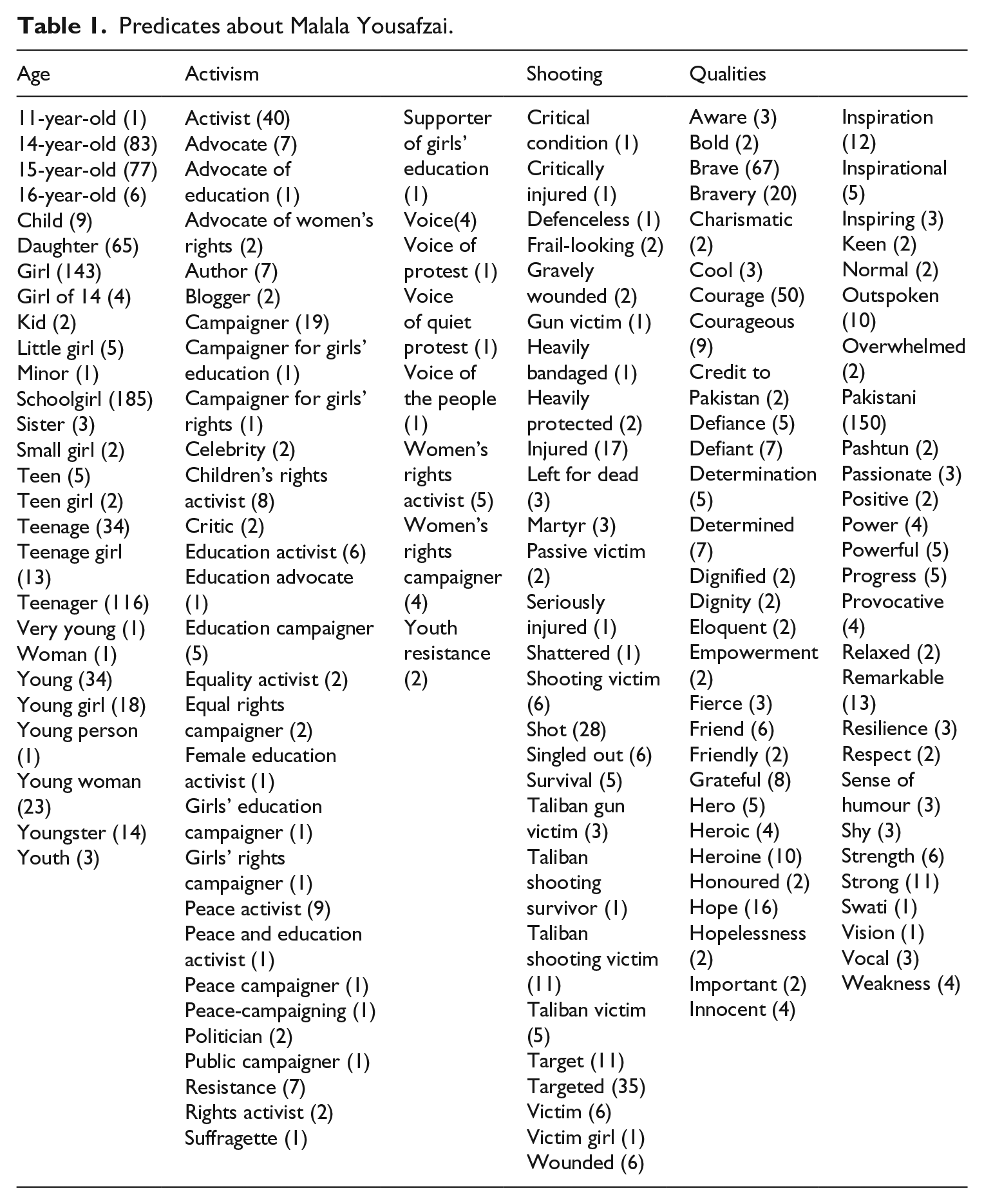
Similarly, in spite of the apparent celebration of her bravery and her willingness to speak out, the newspaper coverage of her campaigning and of her feminism is underwhelming. In total, 122 words or phrases are used to describe her as an activist, campaigner or advocate, yet only 17 of them refer to girls’ or women’s rights. The vast majority call her an education campaigner, a child’s rights campaigner or even a peace activist, but very few mention her focus on women and girls, which she herself emphasised in her speech to the UN (quoted at the beginning of this article). The resulting depiction of Yousafzai is one that sees her as a young, idealistic campaigner for children’s rights and peace, rather than an extremely courageous feminist who has the capacity to be an agent for change. However, even this depiction, which allows some level of agency, is frequently undermined by a portrayal of her as a passive victim, in particular in the references to the shooting, as she is labelled a ‘victim’ (as in ‘Taliban shooting victim’, ‘Taliban gun victim’ or even ‘victim girl’) 35 times, and 28 times the participle ‘shot’ precedes her name or label to reduce her to ‘shot girl/shot schoolgirl/shot Malala/shot Pakistani girl’. By contrast, despite recovering from being shot in the head, she is linked with survival just five times and called a ‘Taliban shooting survivor’ only once.
The portrayal of Muslim masculinities
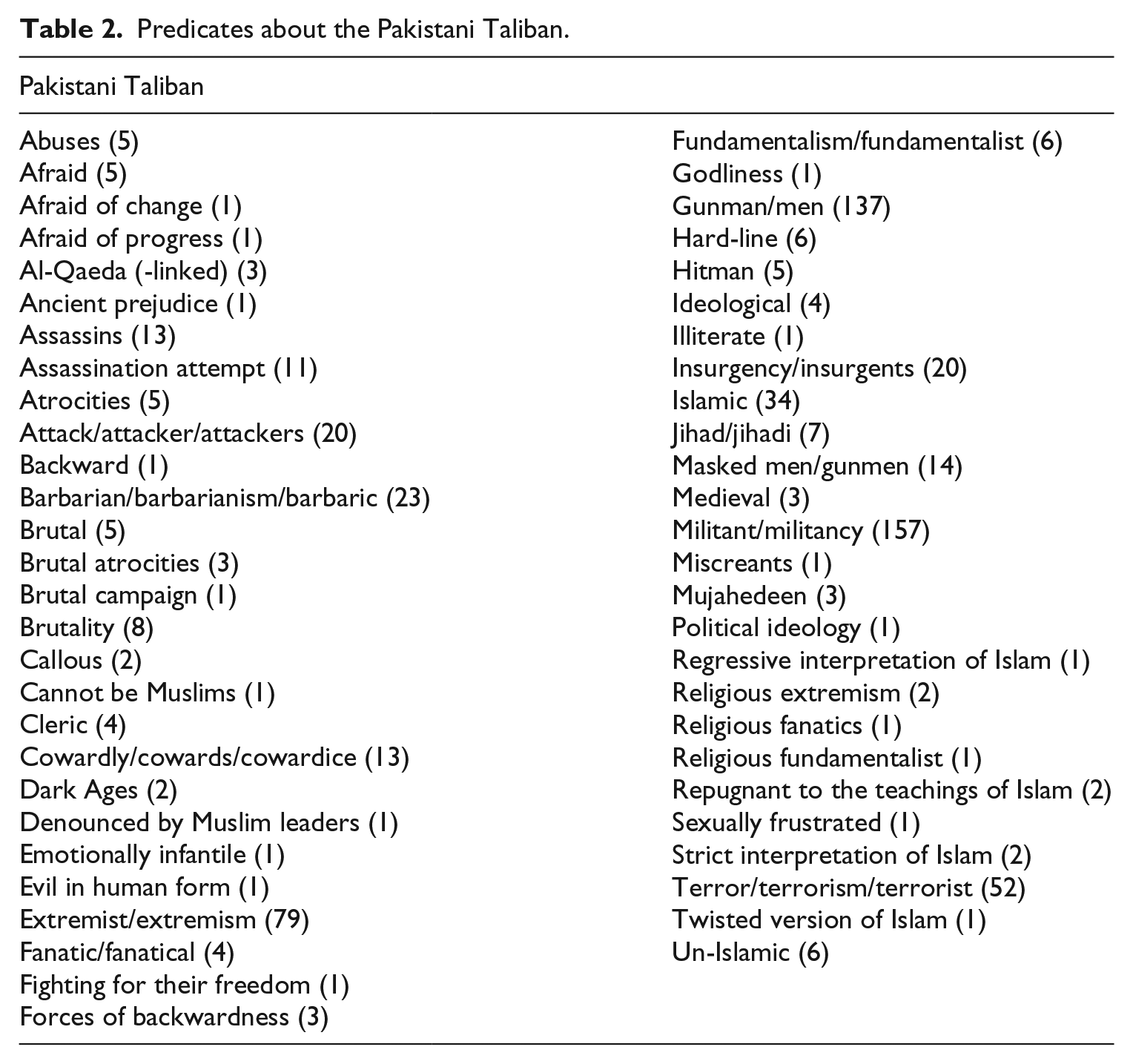
As demonstrated in Table 2, the predication of the Pakistani Taliban resonates with historical, orientalist discourses that portrayed Muslim societies as in some way ‘stagnant’ or suffering a ‘temporal lag’ by which they were perceived to be much further behind the ‘natural process to development already completed by the West’ (Yeğenoğlu, 1998: 98). In particular, they are referred to as being motivated by ‘ancient prejudice’, as hailing from the ‘Dark Ages’, as the ‘forces of backwardness’, as ‘Medieval’ and as ‘regressive’. Furthermore, while many of the predicates used to describe the Taliban, such as assassins, gunman/men and attackers, to some extent simply reflect the nature of the act committed against Malala Yousafzai, the qualities attributed to the attacks and to the gunmen imply an inferior masculinity, such as ‘abuses’, ‘atrocities’, ‘barbaric’, ‘brutal’, ‘callous’ and ‘evil’. While the shooting of Yousafzai for standing up for girls’ education is undoubtedly an atrocity and an abuse, the implicit opposite here is Western masculinity, which conducts clean and humane killings through the use of drones and not ‘barbaric’ assassination attempts. These discourses also undermine the Taliban’s masculinity through portraying its members as childlike and naive, repeatedly calling them cowardly or alluding to a fear of change or progress, with two articles even attributing their actions to being ‘emotionally infantile’ or even ‘sexually frustrated’. They are also overwhelmingly associated with religion (in total 69 times), and their beliefs or actions are labelled as Islamic 34 times or named a hard-line, fundamentalist or strict interpretation of Islam. In spite of a fatwa being issued against the gunmen by prominent Sunni clerics in Pakistan, which labelled their actions ‘un-Islamic’ and detailed the many principles of Islamic Hudood that the shooting contravened, the Taliban are labelled ‘un-Islamic’ just six times, with a further five references to their actions being contrary to the teachings of Islam. Similarly, they are identified as having an ideology just six times. The discourses on Muslim masculinity within these texts are of violence, yet cowardice, and of fanaticism without political aims.
Predicates about the Pakistani Taliban.
The construction of difference in Malala Yousafzai’s medical treatment
Perhaps the most startlingly obvious example of the assumption of difference between the United Kingdom and Pakistan is in the media’s reporting of Yousafzai’s medical treatment. In the aftermath of the shooting, she was rushed to hospital in the Swat Valley before being moved to a military hospital in Peshawar and eventually transferred to the United Kingdom where her treatment continued. In Pakistan, the bullet which entered her skull and travelled alongside her brain, before becoming lodged in her neck, was removed in an operation that required great skill and saved her life. However, according to the discourses revealed in UK media coverage and demonstrated in Table 3, it was in fact doctors in the United Kingdom who saved her life with their superior expertise. While the hospitals involved in treating Yousafzai in Pakistan are named just 10 times in all, 11 the hospital in Birmingham where she was later treated is named some 179 times. 12
Predicates about Malala Yousafzai’s medical treatment in Pakistan and the United Kingdom.
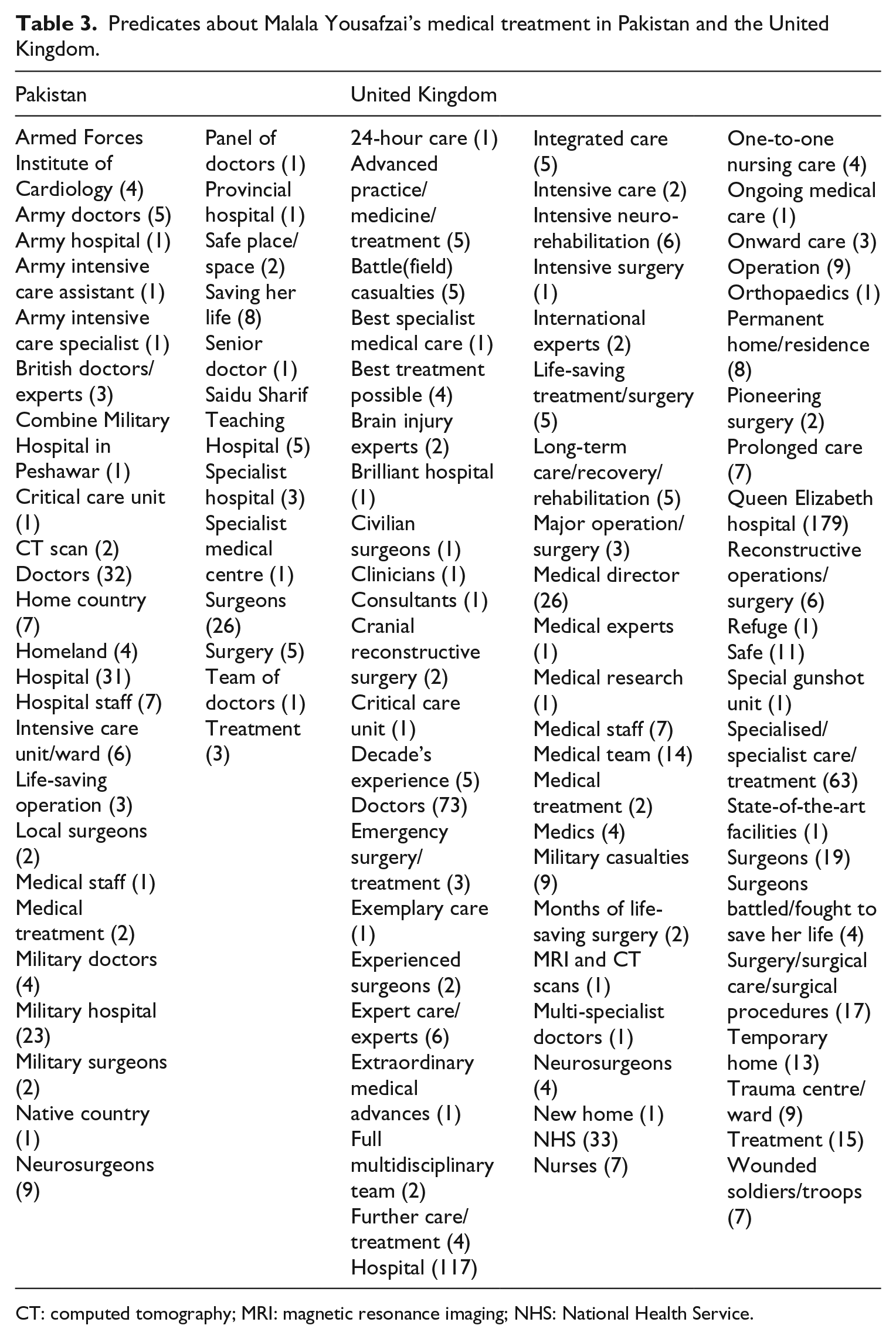
CT: computed tomography; MRI: magnetic resonance imaging; NHS: National Health Service.
Similarly, the staff, facilities and treatment in Pakistan and the United Kingdom are given very different focuses, always implying that the United Kingdom is better placed to treat and care for Malala Yousafzai. Pakistan’s staff are labelled ‘army doctors’ (five times), ‘doctors’ (32 times), ‘hospital/medical staff’ (eight times), ‘surgeons’ (30 times) and ‘neurosurgeons’ (nine times). The facilities are an ‘army/military hospital’ (24 times), a ‘hospital’ (31 times) and a ‘specialist hospital/medical centre’ (four times). The treatment Yousafzai received is ‘specialist’ (once), ‘critical/intensive care’ (eight times), ‘medical treatment/treatment’ (five times) or ‘surgery’ (five times). When contrasted with the presentation of medical facilities in the United Kingdom, a striking difference begins to emerge. The UK staff are also ‘doctors’ (73 times), ‘surgeons’ (20 times), ‘neurosurgeons’ (four times) and ‘medical staff’ (seven times); however, they are also ‘experts/medical experts/international experts’ (11 times), ‘experienced surgeons’ (twice), ‘clinicians’ (once), ‘consultants’ (once), a ‘medical team’ (14 times), a ‘full multidisciplinary team’ (twice) and ‘multi-specialist doctors’ (once). Yousafzai is treated in a hospital, but there are also mentions of its ‘special gunshot unit’ (once), ‘critical care unit’ (once) and its ‘trauma centre/ward’ (nine times). The treatment that she receives is referred to as simply ‘treatment’ or ‘medical treatment’ 17 times, while it is labelled ‘specialist/specialised treatment/care’ on 63 occasions, ‘advanced’ on five occasions, the ‘best treatment possible’ four times and ‘exemplary’ once; alongside a long list of medical terms to give more gravitas to the treatment offered, including ‘cranial/reconstructive surgery’, ‘integrated care’ and even ‘intensive neuro-rehabilitation’. Furthermore, the only reference to ‘experts’ in relation to the medical personnel in Pakistan is when the word is used to describe two British surgeons working in Pakistan who assisted with Yousafzai’s treatment.
Presupposition
There are various assumptions that must be made in order for the predication demonstrated above to make sense. In the following sections, those assumptions are outlined and supported by examples of such assumptions from individual articles.
Feminism is on the side of the West
The depiction of Yousafzai as a young victim assumes that only a passive role is available to girls in Pakistan, even for those who attempt to make their voices heard. In a blog entry featured on The Telegraph website entitled ‘Girls in Pakistan: Victim, figurehead, martyr’, Rob Crilly (2012) writes about how women’s rights causes in Pakistan are largely ignored by politicians unless something extreme attracts the attention of the world’s media, such as the shooting of Malala Yousafzai. He argues that no matter how much attention is paid to campaigners like Yousafzai, a lack of political will means that discriminatory laws will not be overhauled: ‘Just as girls and women remain at the mercy of religious extremists, so too they remain largely voiceless in a society that can only see them as victims. They are powerless’ (Crilly, 2012). He concludes, regretfully, that even ‘girls’ as brave and outspoken as Yousafzai are ‘stuck in someone else’s narrative: first as victim, then as figurehead and possibly, finally, as martyr’. What Crilly fails to see is the contradiction in this argument, as his blog piece, its wording and particularly, its headline contribute directly to the very narrative he wishes to challenge. The dominant discourse he seeks to critique, which finds it easier to see Yousafzai as a young girl and a victim than as a young woman and agent of change, is in fact limiting the vocabulary and concepts available to Crilly in reporting this story, leading him to conclude that Pakistani women’s activism will inevitably lead them on a path to victimhood and martyrdom.
Astonishingly, in nearly 140,000 words of coverage about Malala Yousafzai, a campaigner for girls’ and women’s rights, the word feminist is used just twice (once in The Telegraph and once in The Independent); both times it is when an article is linking the issue back to the United Kingdom and in neither case is it used to describe Yousafzai (Guest, 2013; McCartney, 2013). This would suggest not only an assumption that places ‘feminism on the side of the West’ (Abu-Lughod, 2002: 788) but also a deep reluctance in UK journalism to discuss feminism or to attribute the term feminist to a campaigner for girls’ rights. This contradiction epitomises Angela McRobbie’s (2009: 12) description of postfeminist discourses, in which feminism is seen to have been entirely successful in societies such as the United Kingdom and United States and is therefore dismissed as no longer relevant; women in developing countries cannot have feminism, while women in the West no longer need it.
In the most extraordinarily contradictory article of the entire coverage, entitled ‘Malala Yousafzai’s new challenge: Navigating the politics of a British girls’ school’, Jennifer O’Mahoney (2013) writes in The Telegraph comparing Yousafzai’s first day at Edgbaston High School for Girls to her own return to an independent girls’ school in the United Kingdom after spending most of her childhood as an expatriate in Dubai. She quotes the president of the Girls’ Schools Association, Hilary French, proudly proclaiming that: ‘whatever Malala’s academic or extra-curricular interests, at Edgbaston High she will be able to pursue them without any pressure to look, be or act a certain way’. However, the advice provided by O’Mahoney for Yousafzai paints a very different picture of UK girlhood. O’Mahoney recommends various tactics to survive the ‘mind games of teenage girls’. The first is perfecting the ‘cool geek persona’, as she will find herself in an environment where it is far ‘cooler’ and more socially acceptable to pretend to be spending all of one’s time with boys rather than studying and will need to ‘cultivate a look of studied detachment while somehow aceing [sic] all those tests’ (emphasis in original). The second piece of advice is that there are two possible looks Yousafzai can adopt; the first being ‘incredibly thin’ and spending ‘hundreds of pounds at wherever is the new Abercrombie/Hollister/Miss Sixty’, and the second ‘going emo’, for which she will need ‘a few piercings, a cheeky tattoo and a giant black hoodie with a red anarchist symbol on the back’. Going emo, O’Mahoney writes, will also have the added bonus of making people think she is bisexual and so consult her for advice when questioning their own sexuality. It is astonishing that in an article aimed at showing that Malala Yousafzai will be safe to achieve in the United Kingdom, a girl who has come within centimetres of losing her life to fight for her right to an education is advised to tone down her ambition lest it make her seem unattractive or ‘uncool’ to her fellow students and is given advice on how best to regulate her appearance in order to succeed, in pretending to only be interested in boys and on how different choices of looks will lead to assumptions about her sexuality. The society reflected in this article is not one where girls have equality with boys, but rather one where ‘being sexually attractive, smart and savvy—and declaring this through consumption and display—is the new package of young female success’ (Harris, 2004: 22). O’Mahoney’s patronising advice not only assumes that fashion, boys and peer pressure will all be totally alien to Yousafzai but it also assumes that she is in need of advice from her Western ‘sisters’ to be able to succeed. Given the image-obsessed, postfeminist society that O’Mahoney presents, it is perhaps Yousafzai who will be able to offer insights and inspiration for the girls at Edgbaston on fighting to be judged for one’s actions and intellect, rather than one’s appearance and fashion choices. However, this article follows the logic of the dominant discourse, as demonstrated by the predicates, which infantilises and patronises Malala Yousafzai and assumes that the West, having achieved gender equality, can advise, protect and nurture her.
The Pakistani Taliban as ‘extremely Muslim’
While the history of Pakistan and its search for national identity is both long and complex, marked by centuries of invading conquerors (Hodson, 1997: 9; Jaffrelot, 2004: 7), to label current divisions as ancient hatreds is to ignore the way that particularly over the past century, these divisions have been exploited or even fuelled by Western intervention. The Taliban Movement itself emerged during the 1980s and 1990s, with US backing, in response to the Soviet invasion of Afghanistan (Dorronsoro, 2004: 161). 13 Since then, the Pakistani Taliban has received a mixture of support and condemnation from the Pakistani government, whose successive military and civilian regimes have at times engaged militants in the fight with India over Kashmir, at times courted their support before crucial elections, and rarely denounced them outright (Behuria, 2008: 534–537). Some argue that the Taliban would have been largely ignored or even tolerated by the West had it not been for the attacks on the World Trade Centre in 2001 and the subsequent focus on their links to Al-Qaeda (Behuria, 2008: 530; Usher, 2007: 10). With this association came the US-led War on Terror and, particularly devastating for areas of Pakistan, constant US drone attacks against suspected Taliban or Al-Qaeda targets, with unintended civilian casualties as a result, helping not only to fill the ranks of the Pakistani Taliban but also to stifle any moderate voices that did exist within it previously (Metcalf, 2002: 15). As discussed earlier, changes to the Pakistani education system imposed by British rule significantly altered the nature of education provided at Deobandi madrasas, from which the first leaders of the Taliban are believed to have emerged. However, this interpretation of the Pakistani Taliban as reacting to, or resulting from, Western intervention is for the most part entirely absent from the UK media. Instead, the predicates feed directly into orientalist discourses that date back to colonial times, and which have been adapted and renewed in the context of the War on Terror, which portray extremism as simply meaning ‘extremely Muslim’ (Biswas, 2002; Richardson, 2004; Tohidi, 1991). In order for the temporal references to the Taliban to make sense, we must assume that they represent a continuation of, or reversion to, the past of Muslim countries, rather than a reaction to the present. Similarly, in order for the constant linking of the Taliban with ‘extreme’, ‘fundamental’ or ‘hard-line’ Islam to make sense, we must assume that anyone following a strict reading of the Quran would interpret it as they do.
There is one article that strives to pin down the specific context and aims of the Pakistani Taliban, written in The Telegraph by Imran Khan, the former cricketer and Pakistani politician who has faced criticism at home and in the West for being a Taliban apologist. In his article, he calls for a ‘peaceful solution to Pakistan’s brutal reality’, which means ‘not another military one’, arguing that drone attacks cannot defeat an organisation like the Taliban (Khan, 2012). Khan identifies six different types of militants who fall under the label of the Pakistani Taliban and explains their motivations and aims, ranging from the imposition of Sharia law to Pashtun nationalism, and a belief that the US-led war on terror is a war on Islam. Just over 10 days previously, Khan was criticised in The Guardian for using verses from the Quran to justify labelling the Taliban’s war in Afghanistan, which he labels ‘fighting for freedom’, a holy war (Boone, 2012). Khan’s comments, made while visiting the hospital where Malala Yousafzai was lying unconscious, are incredibly insensitive and disrespectful and could certainly be seen to be justifying the extreme violence of the Taliban. However, his article is the only 1 of all 223 to attempt to explain the specificity of the various groups labelled the Taliban and one of very few to identify Western intervention as influential in their formation and expansion.
Finally, the predicates reveal extremely patronising assumptions about ‘Eastern’, and particularly Muslim, masculinities. This is also demonstrated in an article for The Telegraph entitled ‘The fate of Malala Yousafzai and the new oppression that makes slaves of women’, in which Judith Woods (2012) laments the ‘hardline religious zealots’, who are taking control of ‘Muslim states’. She starts off by recounting an incident on a recent trip to Egypt on holiday when she was spat at by a passing man on the street, before championing the cause of Malala Yousafzai; thus, in one article reducing all Muslim states and societies to ‘sexual harassment’, ‘mob-style attacks’, the ‘niqab’, ‘vigilante mobs’, ‘zealots’ and a ‘contagion of chauvinism’. The implication is that the problems of post-Mubarak Egypt are identical to those of the Swat valley: Muslim men. Similarly, in an article in The Sun, Robin Galloway (2012) laments the ‘economy of emotions’ and ‘pecking order of outpouring’ of the population of Pakistan, who in his eyes have failed to show ‘the sort of wrath that certain portions of the Islamic faith are all too quick to demonstrate the minute anybody dares to lampoon their religion’. These discourses reduce the population of Pakistan, and to some extent, all Muslim countries, to religious fanatics who can be driven to ‘protests, rioting—even killings’ in defence of Islam (Galloway, 2012), yet are unable to protect their own women. The implicit binary opposition is Western masculinity, and the West more generally, whose reason and compassion mean that they can only look on and ‘disapprove’; ‘We throw our hands up in horror at the grievous sins committed in the skewed name of religion’ (Woods, 2012).
A caring Britain
Narayan (1995: 135) argues that a sort of ‘paternalistic caring’ could frequently be found in colonial discourses, in which colonisers cared about the wellbeing of their subjects, and this caring ‘can also be wielded as a form of domination by the powerful and privileged’. In the UK media’s response to Yousafzai’s shooting, it is assumed that the United Kingdom is a safe, fair and caring place for her to be. This portrayal is especially true in the discourses on her medical treatment, which, although not specifically denigrating the treatment she received in Pakistan, assumes a much higher standard of care in the United Kingdom or by British doctors in Pakistan. One of the recurring factors listed as giving the United Kingdom this ability to provide exceptional medical treatment is its self-perceived role as a paternalistic protector in international relations. The hospital is seen to be capable of treating Malala Yousafzai’s injuries because it is a centre for treating British soldiers who have been, as The Telegraph puts it, ‘wounded abroad’ (The Telegraph, 15 October 2012). The Telegraph and The Guardian each devote an entire article to describing the ‘extraordinary medical advances’ in treating amputees, made at the ‘£545 million hospital’ with its ‘£20 million national trauma research centre’ (Meikle, 2012; The Telegraph, 15 October 2012). The Sun claims that surgeons at the hospital have ‘honed their skills treating soldiers flown back from Afghanistan’ (Larcombe, 2012), while in an interesting error that hints at interventionism, The Guardian writes that the hospital in the United Kingdom can offer ‘more advanced medical attention from staff who specialise in treating UK soldiers returning from Pakistan’ (Jackson, 2012, emphasis added), presumably meaning to say ‘UK soldiers returning from Afghanistan’. The emphasis on the United Kingdom’s experience in treating gunshot wounds not only arrogantly assumes superiority over Pakistani counterparts but also ignores the fact that, given Pakistan’s long-running struggle against militancy, doctors in the Pakistani facilities where Yousafzai was treated will unfortunately be all too experienced in treating people with similar injuries; probably far more so than their British colleagues.
The assumption of a caring Britain, however, requires the near total omission of one aspect of protection: that of asylum. Studies have found that the representation of asylum seekers in UK media is overwhelmingly negative and even sometimes deliberately misleading in what Greenslade terms ‘negative misinformation’ (cited in Baker and Gabrielatos, 2008: 6). There is a contradiction in the reporting of Malala Yousafzai’s family’s migration to the United Kingdom. Although the press, including the right-wing news and tabloids, are quick to feel pride that Yousafzai is ‘set to make Britain permanent home’ (The Daily Mail, 24 November 2012), there is ‘New hope for Pakistani girl shot by Taliban as father is offered UK job’ (Dutta, 2013), and The Sun rejoices that ‘Malala’s safe now’ (Larcombe, 2012), they are all reluctant to label a young woman who has fled persecution an asylum seeker or refugee. The word asylum is used just six times in all; once jokingly in an article about all girls’ private schools in the United Kingdom and five times speculatively when considering the options for her family while they remain in Pakistan. The word refugee is used just once in an article about camps for displaced people. Once the Yousafzai family reach the United Kingdom, the media are limited by the very same ‘negative misinformation’ that they themselves perpetuate around asylum, in that they cannot use the appropriate term to describe their pride at the United Kingdom providing safety to someone they see as the ‘right’ type of migrant, when there is an overwhelming association between the term and the ‘wrong’ type of migrant. In a similar contradiction, while singing the praises of the National Health Service (NHS) for treating Malala Yousafzai, for example, in an article in The Sun entitled ‘Malavellous’, which argues that ‘the NHS should be proud of its success in treating the brave schoolgirl’ (The Sun, 5 January 2013), every newspaper emphasises that the Pakistani government ‘would meet all of the expenses of Malala’s treatment and the needs of the family while they were in the UK’ (Dutta, 2013). This is because at the time a debate was, and still is, raging about the rights of migrants to access free healthcare. Just 2 weeks after its ‘Malavellous’ article, The Sun featured a headline ‘NHS “too good to migrants”’, with an article in which it claimed that ‘more than half of GPs think that the NHS is “too generous” to immigrants’ and ‘many are refusing to treat people who can’t prove they are Brits’ (Ashton, 2013). In many ways, the desire to present the United Kingdom as a paternalistic benefactor to Malala Yousafzai has created problems for journalists who have had to negotiate the xenophobic, anti-migration discourses the media at times deliberately perpetuate in order to express pride at providing safety and medical treatment to someone facing persecution in their own country. While the outpouring of public support for Yousafzai could perhaps have represented an opportunity to influence and even change some of the discourses on asylum, the media instead remained largely silent on the issue.
Subject positioning
These discourses serve to position Malala Yousafzai as a passive object in need of Western rescue. This passivity is particularly evident from a simple analysis of constructions in the headlines of these articles. When analysed to see whether they presented Yousafzai in an active (doing and deciding things) or passive (having things done or decided for or against her) role, 14 just 69 of 211 constructions were indeed active, with the tabloids in particular preferring headlines such as ‘Double op success for shot girl Malala’ (Parker, 2013). Furthermore, despite writing a blog, signing a book deal, giving numerous statements and even delivering a speech at the United Nations to mark her 16th birthday, in over 424 quotations from sources and experts in these articles, Yousafzai herself was only the ‘expert’ cited 47 times. Despite these journalists’ wholehearted embracing of discourses around girls’ voices and education, nearly nine times out of ten they still rely on someone else to explain how this theme is significant. Similarly, writing in The Daily Mail, Pakistani journalist and editor-in-chief of The Friday Times Najan Sethi (2012) writes about various Pakistani politicians’ responses to the attack on Malala Yousafzai. Yet, following the dominant discourse, his manner of expressing his outrage at the actions of the Tehrik-e-Taliban and the reluctance of Pakistan’s politicians to denounce them actually serves to undermine Yousafzai’s achievements. The attack, rather than proving that a young woman’s words can pose a serious threat to an armed group, only proves to Sethi the stupidity of the Taliban: ‘Imagine the paranoid, illiterate mind set—a child of 14 [sic] spreading discord!’ He finishes his article by repeating the question he asks in its title; Malala Yousafzai has survived, but ‘who will take her back to school?’ The paternalistic idea of being taken to school conjures up an image of a girl much younger than Yousafzai’s 15 years, who needs escorting, or perhaps even her hand holding, in order to safely make the journey to school, rather than a young woman who chose to make that journey alone, day after day, despite being all too aware of the threat against her life. Written by a Pakistani journalist, the question of ‘who will take Malala back to school’ is typical of what Spivak (2004: 527) identifies as ‘human rights culture’, which ‘runs on unremitting Northern-ideological pressure, even when it is from the South’. These discourses undermine Yousafzai’s agency, falsely claim gender equality for the West, and place her in ‘an imagined geography of West versus East, us versus Muslims, cultures in which First Ladies give speeches versus others where women shuffle around silently in burqas’ (Abu-Lughod, 2002: 784).
Crucially, these discourses also construct a world in which the United Kingdom, as paternalistic, caring, benefactor and as champion of gender equality, must reach out to help others. By obscuring the role of the West in creating existing issues in former colonies, by assuming equality for Western women and by undermining Muslim or Eastern masculinity as barbaric and irrational, these discourses position Pakistan as ultimately in need of intervention. While they do not always express it so explicitly, the predication and presupposition of these texts follows the logic of Lorraine Kelly’s (2012) article in The Sun, in which she writes that supporting girls and women like Malala Yousafzai ‘to be able to live in freedom and peace’ is ‘one of the reasons why our troops are in Afghanistan’.
Conclusion
This analysis tells us a great deal about recently emerging discourses that promote investment in the education of girls and young women in developing countries. Recent campaigns to invest in girls’ education have received backing from prominent celebrities, non-governmental organisations (NGOs) and transnational corporations alike and have resonated at the highest levels of international politics. An International Day of the Girl Child has even begun to be observed around the world on 11 October, with Ban Ki Moon marking that day in 2013 with a speech that stated: Empowering girls, ensuring their human rights and addressing the discrimination and violence they face are essential to progress for the whole human family. One of the best ways to achieve all of these goals is to provide girls with the education they deserve. (United Nations, 2013)
It is difficult to imagine Malala Yousafzai’s story capturing the attention of the West to quite the same extent if it did not resonate so clearly with an increasing interest in the fortunes of girls in developing countries. However, the analysis in this article demonstrates that while many of the individual articles, if taken on their own, may seem to speak of nothing but admiration for Yousafzai and wholeheartedly embrace seemingly emancipatory discourses about girlhood, an analysis of the patterns emerging across such a large sample of articles reveals a dominant discourse founded on dangerous assumptions that belittle Yousafzai and demean Pakistani society. It reinforces British perceptions of superiority and ultimately serves to legitimise an interventionist approach to the human rights agenda. There is no doubt that the journalists producing knowledge about Malala Yousafzai care about her story and are horrified by the attack on her; however, there is every reason to doubt whether they would be producing this knowledge and telling her story at all if it did not fit so perfectly into already existing discourses of how the West perceives its own position in the world and in relation to a Muslim ‘other’. While it cannot tell us how these articles are read or interpreted by the British public, an analysis of their reporting paints a vivid picture of how the United Kingdom depicts itself through journalism. This depiction reveals far more about a perceived superiority in relation to others than it does about Pakistan because as Narayan (1995: 138) argues, ‘social relationships of domination often operate so as to make many who have power unable to genuinely care about the marginalised and powerless’. The analysis in this article, by deconstructing this depiction of the United Kingdom, serves to challenge and problematize the assumptions within it and the unequal power relations that allow those assumptions to appear to make sense. Describing her aims for her teaching, Spivak (2004: 532) writes that she wants to achieve in her students ‘a suspension of the conviction that I am necessarily better, I am necessarily indispensable, I am necessarily the one to right wrongs, I am necessarily the end product for which history happened’. In deconstructing the discourses emerging from a story about a young woman risking her life for an education, this article has demonstrated that despite increasing interest in the cause of girls’ education, there is still much work to do in order to suspend the conviction that the West is necessarily better, that Western women are necessarily empowered and that the West is necessarily the one to right the wrongs of gender discrimination.
The day after her speech to the United Nations, Yousafzai is reported to have spoken at a reception event about how she wishes to be thought of: ‘to be true, I want to say that I don’t want to be the girl who was shot by the Taliban, I want to be the girl who struggled for her rights’ (The Hindu, 2013). If that is her wish, then this article has shown that the UK media is far from granting it. Perhaps as the morbid fascination with the attack on her fades and as she continues her campaigning work, this emphasis may shift; however, it seems that for those journalists writing in UK newspapers about the shooting, recovery and ongoing activism of this incredible young woman, it still seems far easier to label her the ‘shot Pakistani girl’ than it is to call her powerful, a survivor or indeed a feminist.
Footnotes
Acknowledgements
I am grateful to Jutta Weldes, Karen Tucker and Magnus Feldmann for their advice and feedback on an earlier draft of this article. I would also like to thank the three anonymous reviewers for their helpful comments.
Funding
The author’s research is funded by the Economic and Social Research Council 10.13039/501100000269.