



Abstract
Negative campaigning has long concerned scholars because of the potential effects on the electorate and on democracy. Most scholarship has focused on single-election studies in the United States, whereas less is known about how campaigns go on the attack in the UK, and few compare two elections. Drawing from a dataset of Facebook posts by parties and leaders in Great Britain during the five weeks of campaigning in the 2017 and 2019 General Elections (N = 3560), we use supervised machine learning to categorise posts as negative campaigning and distinguish between attacks focused on issues and attacks on candidates’ images. Our findings show that the 2019 election was more negative than in 2017, and that larger parties were more inclined to adopt attacks as a campaign strategy. Moreover, we found that party accounts posted more attack messages than leader accounts and were more focused on attacking based on issues, rather than personal character or image. Finally, we found that attack messages elicit stronger engagement from audiences, with attack messages receiving more attention, particularly attacks on image.
Negative campaigning has been a topic of intense academic debate for several decades, with scholars concerned with the effects on the electorate and on democracy writ large (Brooks and Geer, 2007; Lau et al., 2007). Recently, this debate has been renewed due to growing levels of polarisation and division in Western Democracies, as well as by the use of social media (Stromer-Galley et al., 2018). Negativity benefits candidates insofar as it contributes to increasing mobilisation and recall of political arguments (Brooks and Geer, 2007; Mutz, 2015), and may attract news coverage (Maier and Nai, 2020). This research agenda has predominantly focused on the US, with limited research investigating parliamentary elections (Maier and Nai, 2022). Prior work in the UK has examined negativity in the context of Party Election Broadcasts (Sanders and Norris, 2001) from two decades ago, and only limited research has considered how the increasing adoption of social media affects the dynamics of electoral negativity.
Research based on the US suggests that contextual and candidate characteristics influence negative campaign strategies, such as race competitiveness and challenger status (Stromer-Galley et al., 2018), or gender (Evans and Clark, 2016). Scholars also found that negative campaigns may drive incivility by the public on platforms such as Twitter and Facebook (Hopp and Vargo, 2017; Rossini et al., 2020). While negative campaigns have mixed effects on the electorate, there is evidence that voters increasingly make decisions based on rejecting the candidate they dislike – including in multi-party democracies (Garzia and Ferreira da Silva, 2022). As such, it is imperative to understand how campaigns leverage social media to go on the attack, particularly in the context of heated, polarised elections.
The recent electoral cycles in the UK present a unique opportunity to investigate negative campaigning for several reasons. First, there is little research outside of the US that has investigated the use of communication strategies on social media – and, particularly, on Facebook
We hypothesise that there will be an increase in campaign negativity in 2019, both due to the continued disputes over Brexit and because scholars have described the 2017 campaign as having a tone of hope (Curtice, 2020; Margetts, 2017). As prior studies in the UK have focused on major parties – and studies in the US largely disregard third-party candidates – we also examine whether there are different dynamics in negative campaigning between major and minor parties. Considering the stronger focus on party communication in parliamentary elections, we also examine whether campaigns make strategic choices between using the more impersonal party account instead of the leader’s account to go negative, as well as whether campaigns focus on issue-based or image-based attacks, that is, focusing on candidates’ traits and characteristics. Our final set of questions examines the association between attack messages and audience engagement, to understand the extent to which campaign negativity yields public attention on Facebook.
Our results show that the 2019 election was more negative than in 2017, and that the leading parties were more likely to rely on negative campaigning compared with minoritarian and regional parties. Furthermore, our findings show party accounts posted more attack messages than leader accounts and were more likely to attack on the issues, providing insights into strategic choices campaigns make when going negative. Finally, we found that attack messages elicit stronger engagement from audiences, particularly attacks on image, suggesting benefits for campaigns that go negative on social media. To our knowledge, this is the first study to investigate campaign negativity on Facebook in parliamentarian campaigns over time.
Campaign Negativity and Its Effects
Scholars have been concerned with negativity in political campaigning for decades, initially focusing on television advertising in the US since the 1960s (Brooks and Geer, 2007; Jamieson, 1996), and more recently, on social media (Stromer-Galley et al., 2018). This scholarship suggests that US campaigns became more negative over time at both the Presidential and Congressional levels (Benoit, 1999; Fowler et al., 2016). The debate has intensified in recent years in the wake of figures such as Donald Trump who campaigned using childish epithets for his opponents (Mercieca, 2020) – and in the UK following the Brexit referendum (Schumacher, 2019). The mainstreaming of social media in campaigns has also been a focus of this debate, with suggestions this has contributed to negativity, personal attacks, and polarisation (Auter and Fine, 2016; Rossini et al., 2018b; Stromer-Galley et al., 2018).
Several scholars investigated the effects that negative campaigning has on electoral behaviour (Brooks and Geer, 2007). Despite initial fears that negative campaigning discouraged participation and turnout (Ansolabehere and Iyengar, 1994; Lau et al., 2007), empirical work demonstrated that the demobilisation effect had been exaggerated. Instead, there is evidence that negative advertising may encourage participation by reminding voters why they might want to deny a candidate their vote, or increase turnout by attracting more media attention (Lau et al., 2007; Maier and Nai, 2020; Ridout and Smith, 2008). Others discerned no strong effect either way (Jackson et al., 2009; Lau and Pomper, 2004).
More nuanced measures of the effects of negative advertising have been observed, including the potential backlash candidates and parties may suffer when campaigns go excessively negative (Nai and Maier, 2021). Uncivil rhetoric received some attention, with mixed effects: while Brooks and Geer (2007) found that personal and uncivil negative messages turned voters off, Mutz’s (2015) work suggests that politicians are not penalised for using incivility. Partisanship is also important because voters perceive attacks by their candidates less negatively than when done by the opposition (Haselmayer et al., 2020; Mutz, 2015). In a rare UK study, Sanders and Norris (2001) showed participants Party Election Broadcasts from the 2001 General Election and concluded that there was no clear impact of negativity on voters’ trust in, or opinion of, the party going negative. However, they also argue that attack broadcasts could increase support for the target of the attack, meaning that while parties might not be directly penalised, they may suffer backlash effects via an increased support for their opponent.
Other research in this area attempts to discern which individual and organisational factors may influence negative campaigning. For example, in races with more candidates, some ‘go negative’ to distinguish themselves (Peterson and Djupe, 2005). Gender also matters. Herrnson and Lucas (2006) found that women candidates in the US were far more likely to view negative campaigning as ‘unethical’, except, under certain circumstances, such as if opponents had faced past sexual harassment allegations or drink driving convictions. Contextual factors can also drive the use of negative advertising, with competitive races being generally more negative (Geer, 2006; Hassell and Oeltjenbruns, 2016; Lau and Rovner, 2009; Rossini et al., 2018b), and incumbents being less likely to campaign negatively than challengers (Druckman et al., 2009). Geer (2006) has suggested that this is because challengers have less to lose and may also feel they are not held to such high standards as office-holders. Some have suggested that small, new and more extremist parties may have more incentive to attack (Walter, 2013).
With few exceptions, this scholarship has been primarily based on the US – a country with a bipartisan presidential system and exceptionally long electoral cycles. Less is known about the dynamics of negative campaigning online in parliamentary systems, but limited research suggests a slightly different picture. For example, Walter (2013) assessed negativity in election broadcasts from British, Dutch and German parliamentary elections between 1980 and 2006 and found no systematic differences in negative campaigning, either on issue or trait (including the gender of the party leader), suggesting that party-centred systems in Europe reduce the effect of a leader’s personal traits on campaigning styles. However, since leaders have become more prominent in party-centred systems (Banducci and Karp, 2000), and with social media playing a more central role in campaigns, it is possible that the dynamics around negative campaigning in parliamentary systems have changed. Recent multi-country work in this area, specifically focused on social media, suggests this may be the case. In a study of 2019 European Parliamentary Election in 12 countries, Baranowski et al. (2022) found that opposition parties were more likely to deploy negative posts in their Facebook campaigning than those in government, providing further evidence of the role of incumbency in shaping campaign strategies. The authors also found that parties who were further away from the political centre (on the Left or the Right) were more likely to use negative messaging strategies.
Campaign Strategies on Social Media
Digital media are now a ubiquitous part of everyday life in Western democracies. While online campaigning dates back to the late 1990s – when websites mostly mirrored offline strategies (Druckman et al., 2009) – the extensive adoption of social media platforms by the public have promoted a significant shift in how campaigns communicate with, and engage, the electorate, allowing campaigns to reach those not traditionally interested in politics (Stromer-Galley, 2019). Social media can give candidates an ‘edge’, particularly ones that appeal to younger voters, with scholars attributing electoral success to social media use (Margetts, 2017).
Digital media play an increasingly important role in advertising and fundraising (Fowler et al., 2016; Stromer-Galley, 2019), due to the ability to engage supporters in ways that benefit broader campaign goals, for instance, sharing information, participating in events, and donating (Stromer-Galley, 2019). Evidence from the US suggests that social media campaigns partially corroborate offline dynamics, that is, challenger status leading to more attacks (Druckman et al., 2009; Evans et al., 2014; Stromer-Galley et al., 2018), but findings are mixed regarding other contextual factors, with some finding that competitive races were less negative than safe ones (Stromer-Galley et al., 2018). Studies investigating candidates’ standing in the polls, however, suggest that candidates in competitive races are more likely to attack on social media (Rossini et al., 2018b).
Research on how candidates use social media has disproportionately focused on Twitter (Jungherr, 2016). Twitter facilitates ‘broadcasting’ behaviours, allowing candidates to bypass media gatekeepers, talk directly to voters, and influence public opinion and media coverage (Broersma and Graham, 2012; Graham et al., 2013). Facebook has been less studied despite being used by a majority of the population – in the UK and most Western democracies (Ofcom, 2022). Cross-platform research based in US elections suggests candidates adapt their communication strategies to their expected audiences on each platform (Bossetta, 2018), for instance, prioritising Facebook to mobilise supporters while Twitter is used for ‘broadcasting’ (Rossini et al., 2018a). Moreover, Facebook provides candidates with important strategic affordances that are relevant for negative campaigning, such as the ability to bypass the news media and reach voters directly (Baranowski et al., 2022), and there is evidence that users of the platform are receptive to negative messages (Bene, 2017).
Research focusing on the UK has studied candidate adoption of, and interactivity on, digital media (Southern, 2015; Southern and Lee, 2019) and how social media use influenced media coverage of campaigns (Broersma and Graham, 2012). Other work considered the relationship between Twitter use and electoral success, with Burnap et al. (2016) finding at least some predictive power between Twitter sentiment and electoral outcomes. Furthermore Bright et al. (2020) established a connection between different types of candidate posts on Twitter (defined as ‘interactive’ or ‘broadcasting’) and voting outcomes in the 2015 and 2017 elections, finding a marginal positive effect of Twitter use on voting in constituencies with high Internet penetration. Research has also suggested that social media use during elections in the UK can benefit citizens by, for instance, increasing political knowledge (Munger et al., 2020).
Less attention has been given to campaign strategies on social media in the UK. One exception is a thematic analysis of Facebook posts by the Conservative and Labour parties and their respective leaders, during the 2017 General election, focusing on the positivity of campaign topics (Gerbaudo et al., 2019). The authors find that messages about positive topics – particularly by Jeremy Corbyn – helped drive public engagement, and conclude that negative campaigning does not prevail on social media based on the positive correlation between audience engagement and ‘positive and optimistic messaging’. However, the conclusions seem to misrepresent ‘negative campaigning’ as it is broadly understood and conceptualised in the literature, reducing the concept to negative policy topics (Brexit, national security) and negative engagement reactions (sad, angry), instead of the actual content of the message. Two other studies on social media campaigning in parliamentary systems found very similar patterns when it came to the effects of negative posts on audience engagement. In a study of the 2013 Austrian national election, Heiss et al. (2019) found that negative tonality in Facebook posts increased the number of comments and shares, but not likes. Bene’s (2017) study of the 2014 Hungarian general election also found that negative Facebook posts elicited more comments and were much more likely to be shared, but again had little impact on likes. From a strategic perspective, shares and comments are more important for campaigns than likes and so this is likely to be seen as a positive for campaigns. Since these studies were published, however, Facebook has updated its broad ‘Like’ to a more nuanced ‘react’ which included Anger, Laughter and Love. Assessing this more nuanced reaction measure will provide an important update here and may reveal different associations with negative posts.
To our knowledge, this is the first study to examine the dynamics of negative campaigning on social media in the UK, across two elections. The focus on the two most recent ‘snap’ elections allows us to understand how increased issue polarisation may affect campaign messaging choices. UK Prime Minister Theresa May, in conjunction with the opposition parties, overrode the Fixed-Term Parliament Act to call a snap election for 8 June 2017, hoping to win a larger majority to pass her EU withdrawal agreement. Instead, she lost her majority and after 2 years struggling to win support for the agreement, she resigned and Boris Johnson replaced her in July 2019. Johnson dissolved parliament to hold another general election on 12 December, 2019, securing a landslide majority and leading to the approval of the withdrawal agreement not long afterwards. The 2017 and 2019 General Elections were forced by the consequences of the UK’s ‘Brexit’ vote and reflected deep divisions in public opinion after the referendum (Schumacher, 2019). Despite not being ‘normal’ electoral cycles, these campaigns represent a unique opportunity to study the dynamics of negative messaging amid growing polarisation in parliamentary systems.
Considering that both elections were precipitated by one divisive issue, we expect that parties and party leaders would be inclined to ‘go negative’. Two important contextual factors motivate this hypothesis: first, snap elections are a disruption to politics as usual so parties may struggle to attract the public’s attention – thus negative campaign strategies can be an effective antidote (Geer, 2006; Mutz, 2015). This might be particularly true in 2019, as the election took place in the winter, when it can be harder to mobilise voters (Eisinga et al., 2012; Gomez et al., 2007). Second, the tension around Brexit in the 2 years separating these elections led to further polarisation around the topic (Curtice, 2020), potentially increasing the incentives for parties to adopt negative rhetoric to increase mobilisation (Geer, 2006; Mutz, 2015). Given this, we expect more negativity in the 2019 campaign:
H1. Campaigns will be more likely to attack in the 2019 elections than in 2017.
Drawing on the well-established literature on the normalisation versus equalisation thesis (Margolis and Resnick, 2000), we hypothesise that smaller parties will take advantage of the lower costs and lack of editorial controls on social media in an attempt to level the playing field during campaigns, where they cannot compete equally via traditional and paid media. Studies focused on the use of Twitter in US and Spain suggests that when candidates from minor parties have little to lose, they may go on the attack to gain attention and smear opponents (Evans et al., 2014; Pineda et al., 2021). These patterns appear to hold in parliamentary contexts, with challengers and parties further away from the political centre being more likely to resort to negative campaigning online (Baranowski et al., 2022). Recent work in the UK suggests that smaller parties actually outperform the incumbent (Conservative) party but the Labour Party, are most dominant on social media (Southern and Lee, 2019). Evidence from the UK then suggests that gaining attention on social media may offer a useful route for smaller parties to increase their visibility. As controversies online are often then reported in the traditional media, this can offer further incentive to smaller parties for attack-style campaigns on social media. Thus:
H2. Opposition parties will be more likely to attack than the incumbent party across both elections.
Besides general trends, there might be important differences when considering the Conservatives and Labour – as they were the only parties to have a realistic chance at forming a majority. While research in the US suggests that challengers tend to go negative (Evans et al., 2014), studies looking at social media in the 2017 election pointed in the opposite direction, with Labour seen as running a positive and optimistic campaign (Gerbaudo et al., 2019; Margetts, 2017). Thus, we ask:
RQ1. Did Labour campaign more or less negatively than the Conservatives (a) overall; and (b) are these dynamics consistent over time?
Considering the distinctive nature of parliamentary elections, where party accounts might be more prominent than leader accounts when compared to presidential systems, it is possible that campaigns make strategic choices to distance leaders away from the potential backlash of negativity. In this context, we further ask:
RQ2. Are campaigns more negative using the party account compared with leader accounts?
Research on Facebook use in the 2017 UK General Election suggested that posts about ‘positive’ topics gathered more user engagement (Gerbaudo et al., 2019), in contrast with evidence from the US that more outrageous and negative content leads to more user-engagement with Facebook pages of news outlets and congress members – at least outside of the campaigning period (Rathje et al., 2021). There is also evidence that campaign negativity drives engagement in other platforms, such as Twitter (Stromer-Galley et al., 2018). While prior research in the UK has not examined the message content of online campaigns, we hypothesise that attacks will drive user engagement, in the form of shares, comments and reactions:
H3a. Attack messages will be more likely to receive comments, shares, and reactions than messages that do not contain attacks.
Research on campaign negativity often distinguishes between attacks and contrast, or comparative messages – that is, when candidates advocate for themselves while attacking opponents (Jamieson, 1996). While much of the research on online campaigning has not considered the nuance between attacks and contrast messages, we expect that prior findings around the relationship between negativity and engagement are driven by ‘pure’ attacks, as contrast messages may be perceived as softer and less negative (Haselmayer, 2019):
H3b. Attack messages will be more likely to receive comments, shares and reactions than contrast messages.
The literature on perceptions of campaign negativity has highlighted that citizens react differently to attacks based on personal character and traits in comparison to attacks based on policies (Maier and Nai, 2020; Mutz, 2015). While these dynamics have not been explored in the context of online campaigns, we can likely expect the public to engage differently with attacks based on issue versus image. Specifically, as image-based attacks focus on personal characteristics and skills and might be perceived by the public as more uncivil than attacks based on policy and issues (Muddiman, 2017), we expect them to drive more engagement from supporters for a few reasons. First, negativity and incivility are strategic tools in the realm of politics, often used to fire up the base (Herbst, 2010). Second, there is evidence that partisans do not punish, and may be activated by, negativity from their own side (Haselmayer et al., 2020; Mutz, 2015). Second, some people find negativity and incivility more engaging and entertaining (Sydnor, 2018). With the caveat that incivility and negativity are not the same construct, this literature would suggest that the public will perceive – and engage – differently messages that attack an opponent’s image compared with attacks focused on issues:
H4. Image-based attacks will be associated with higher engagement than issue-based attacks.
Finally, given the circumstances of these two ‘snap’ elections, and the continuing fallout of the Brexit vote, there is reason to expect that there may be temporal predictors of issue-based and image-based attacks. The 2017 campaign was fought by a Prime Minister whose electoral strategy was premised on the idea of her competent leadership, which she sought to contrast with that of her main rival (Harmer and Southern, 2018) suggesting that parties may focus on image-based attacks. The 2019 election, by contrast, was focused on the issue of how and when Britain would leave the EU, so attacks may be more likely to have been issue-based. This second election came after a period of near-stalemate in the parliament and therefore negative sentiment on both sides of the debate may have informed the social media campaigning. We therefore ask:
RQ3. Are there differences in the (a) contextual and (b) temporal predictors of issue-based and image-based attacks?
Data and Methods
Data Collection
Data from this study were collected using Crowdtangle. For each electoral cycle, we collected all public posts from official party accounts (N = 8) and the accounts of party leaders (N = 12) in the 5 weeks corresponding to the official campaign period (2 May to 8 June 2017, 4 November to 12 December 2019), a total of 3560 posts (2017 = 1788, 2019 = 1782). Parties and leaders from Northern Ireland were excluded from the sample due to the presence of multiple regional parties that are not represented in the rest of the UK (N = 683). Table 1 presents the breakdown of posts per page and electoral cycle.
Posts × Page × Election.
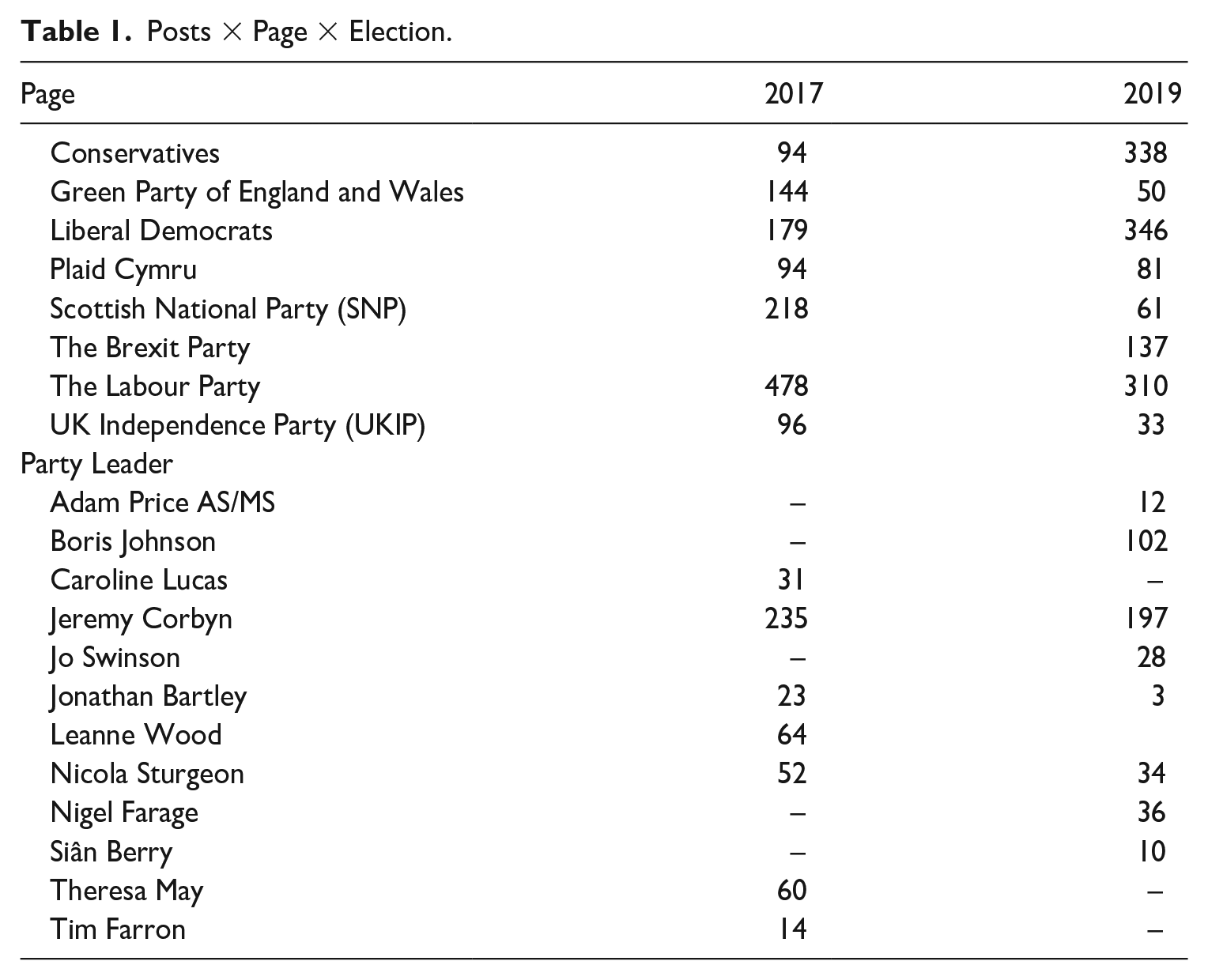
Crowdtangle allows access to historic data, and data collection for both campaign cycles took place in May 2020. While we assume we have population data for both elections, we cannot account for posts that could have been excluded. Despite this limitation, we do not expect that deleted posts would affect the overall tone of the campaign given the breadth of the sample.
Content Analysis and Supervised Machine Learning
Content analysis was based on an existing codebook developed to classify political campaign messages in several categories: advocacy, attack, image, issue, call to action and informative (Stromer-Galley et al., 2018). We did not make changes to the codebook other than contextualising examples to reflect the UK context. By leveraging a categorisation that has been used across multiple US electoral cycles, we can reflect on our findings vis-a-vis prior research on campaign communication on social media.
In our coding scheme, message categories were not mutually exclusive, meaning that a message could be labelled as both an attack and a call to action, or an attack and advocacy. Our analysis focuses exclusively on attacks. Attacks are posts that criticise a clear target, for example, an opponent (including surrogates, parties, organisations), based on personality, leadership skills, track-record, policies and so on. Attacks have two subcategories: image-based attacks primarily focus on character, personality, style and/or values, such as competence, moral character, benevolence or popularity and issue-based attacks focus on issue or policy positions, both past or future, including broad claims about the state of the country.
Attacks can also include a positive message, otherwise known as a ‘contrast’ message. Contrast messages include advocacy for the candidate or party while attacking an opponent. We did not code for contrast messages specifically: instead, since categories are not mutually exclusive, we combined posts coded as both attack and advocacy post hoc, for the purpose of analysis. In total, attacks accounted for 31% of the posts, with the majority (19.8%) being contrast messages.
A random sample of 2772 messages 2 was annotated by two trained undergraduate research assistants (see Table 2 for intercoder reliability) (Krippendorff, 2004). Following Zhang et al. (2017), students coded the same samples of Facebook posts and then adjudicated any disagreements to create ‘gold-labelled’ datasets for model development. Meetings were mediated by at least one of the lead authors.
Intercoder Reliability.
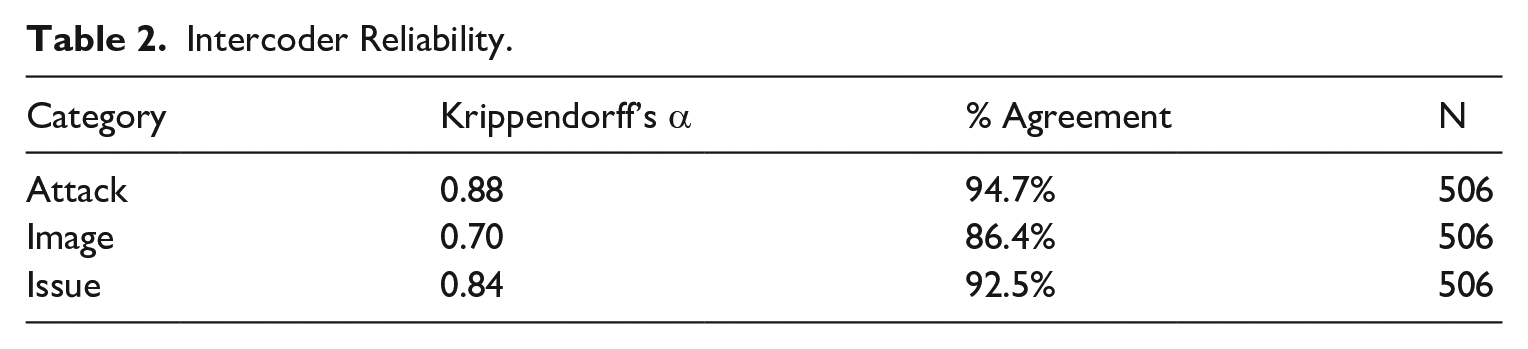
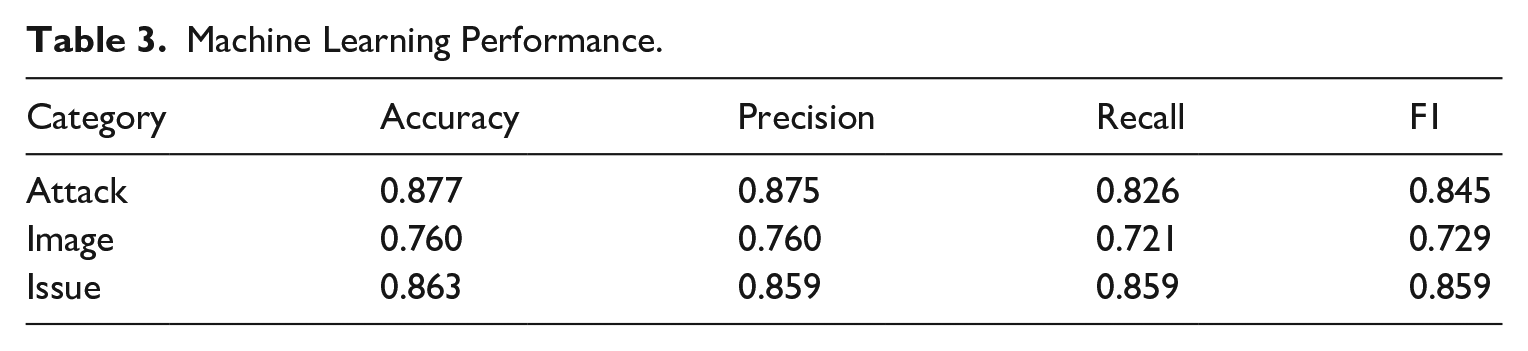
We trained a classifier using discrete models for each category, using the Scikit-learn toolkit in Python (Pedregosa et al., 2011). For pre-processing, we parsed each post into tokens and part-of-speech tagging using the ARK Twitter Tokenizer (Owoputi et al., 2013) and converted tokens to lowercase to avoid superfluous features. Then, we used the OneVsRest classifier, a multi-label approach that fits one classifier per category and a five-fold cross-validation approach with a 75:25 split, wherein we split the sample into a 75% training, 25% test set five times, and then averaged the Precision, Recall and F1 scores. We experimented with classifiers for each election, but our best performing models were trained with samples from both elections (Table 3).
Machine Learning Performance.
Results
Before testing our hypotheses and research questions, we present the descriptive statistics of our key variables. Overall, 31% of all messages in the dataset were attacks, with differences between 2017 (26.5%) and 2019 (35.4%), confirming the expectation that 2019 was proportionally more negative. Issue-based attacks corresponded to 14.2% of all posts, 5.9% were image-based attacks, and 10.6% contained attacks on both image and issue. Considering the main parties, 35.7% of posts by the Conservatives and 32.5% of Labour’s posts were attacks, pooling party and leader accounts across both elections.
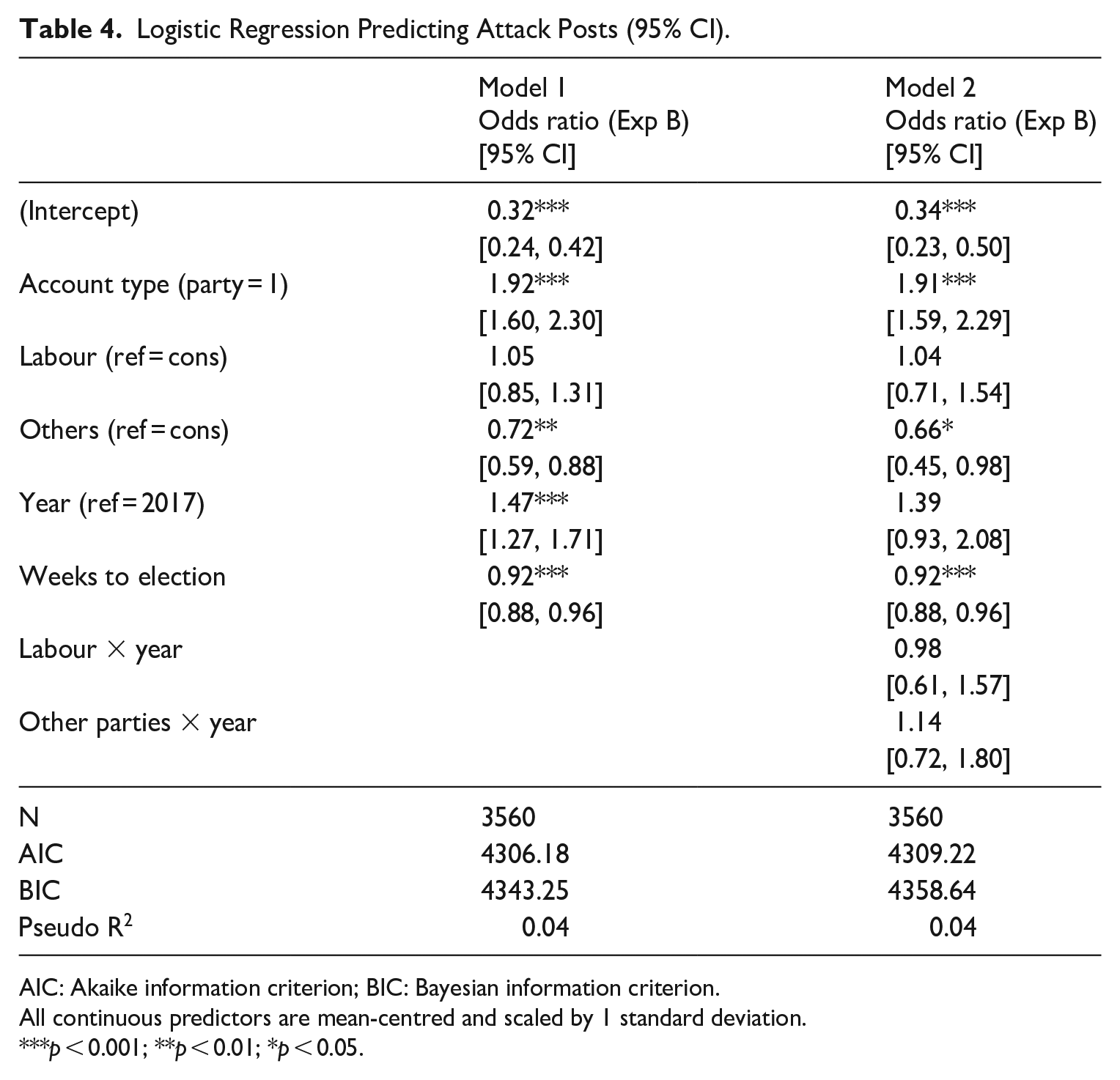
We use a series of binomial logistic regression models to test H1 and H2 and answer research questions. The dependent variable for the first set of models is an attack, binary coded. For the second set of models, we created a binary variable for attack-issue and attack-image. For our independent variables, we used dummy-variables: account type distinguishes party and leader accounts (reference: party), we account for parties with a three-level categorical variable (Labour, Other Parties, reference = Conservatives) that combines posts by party and leader accounts, year indicates which election (reference: 2017). We further include interaction terms for parties x year of election, and control for ‘weeks until the election’ (0–5), reverse coded with 5 representing the election week. We report odds ratio instead of log odds to facilitate interpretation, and coefficients are mean-centred.
The first hypothesis predicted a more negative campaign in 2019, which was confirmed by the positive and significant coefficient for Year (Table 4, Model 1). The second hypothesis predicted that challenger parties would be more likely to attack, but our findings suggest the opposite: the Conservative party was more likely than minor challenger parties to go negative, but the result is not significant against Labour, meaning that the difference in attacking patterns across the two main parties was not significant (Model 1). To address the first research question, we consider interactions between party and election year, but the coefficients are not significant, meaning that there are no meaningful differences in Labour’s negative campaign strategy in these two election cycles.
Logistic Regression Predicting Attack Posts (95% CI).
AIC: Akaike information criterion; BIC: Bayesian information criterion.
All continuous predictors are mean-centred and scaled by 1 standard deviation.
p < 0.001; **p < 0.01; *p < 0.05.
The second research question focused on the dynamics of party versus party-leader accounts. We find that campaigns consider the type of account when posting negative messages, with party accounts being over 90% more likely to post attacks. We also note that attacks are less likely to be posted as the election day comes closer, suggesting a temporal dimension of this messaging strategy.
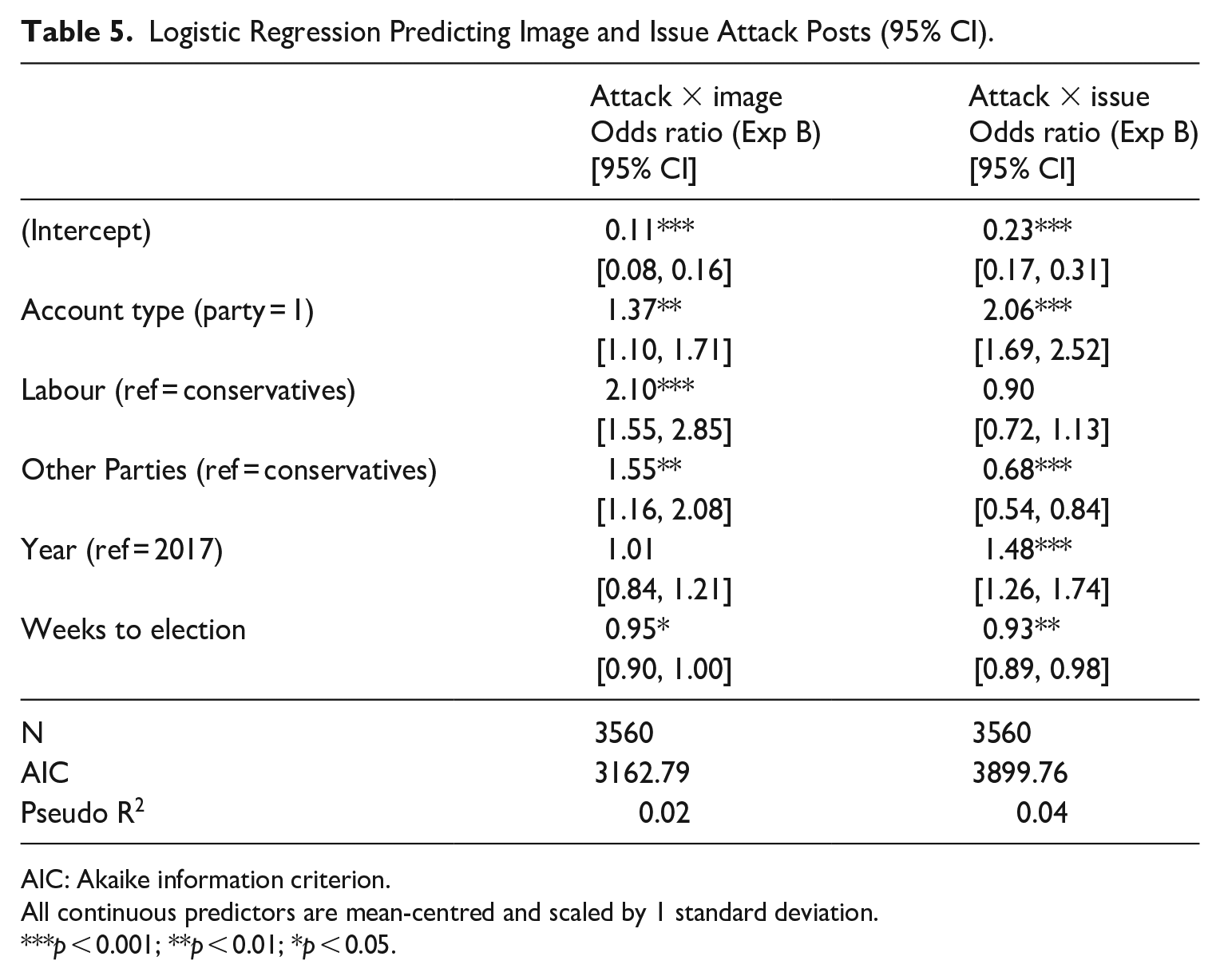
The last research question asks about contextual and temporal predictors of different attacking strategies: image-based and issue-based attacks. Models 3 and 4 (Table 5) present the results of this analysis, considering each attack type as a dependent variable. Comparing these models, we note distinctive dynamics behind image- and issue-attacks: party accounts are much more likely to use both types of attacks, and the effect is stronger for those that are issue-focused. Challengers are much more likely to post image-based attacks, but the effects are not significant for Labour on issue-based attacks, and go in the opposite direction for other parties, compared with the Conservatives – providing some support for H2, but only for image-based attacks. In other words, challenger parties concentrated their negative messaging on their opponents’ character and personal traits, but not on specific issues. Looking at temporal dynamics, issue-based attacks were about 48% more likely to be posted in 2019, whereas the difference for image-based attacks was not significant. Both attack types are slightly less likely to be posted closer to the election day (Table 5).
Logistic Regression Predicting Image and Issue Attack Posts (95% CI).
AIC: Akaike information criterion.
All continuous predictors are mean-centred and scaled by 1 standard deviation.
p < 0.001; **p < 0.01; *p < 0.05.
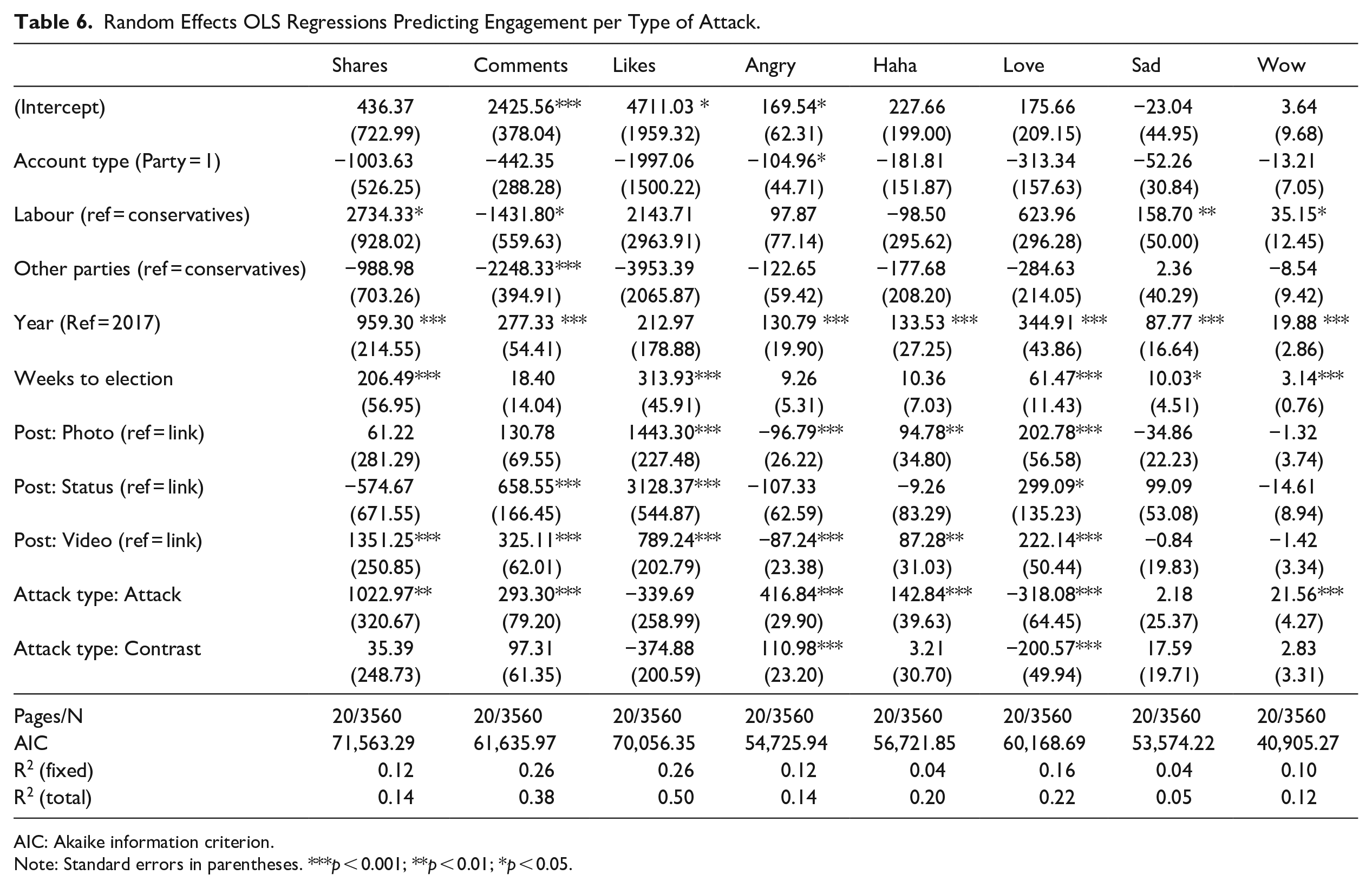
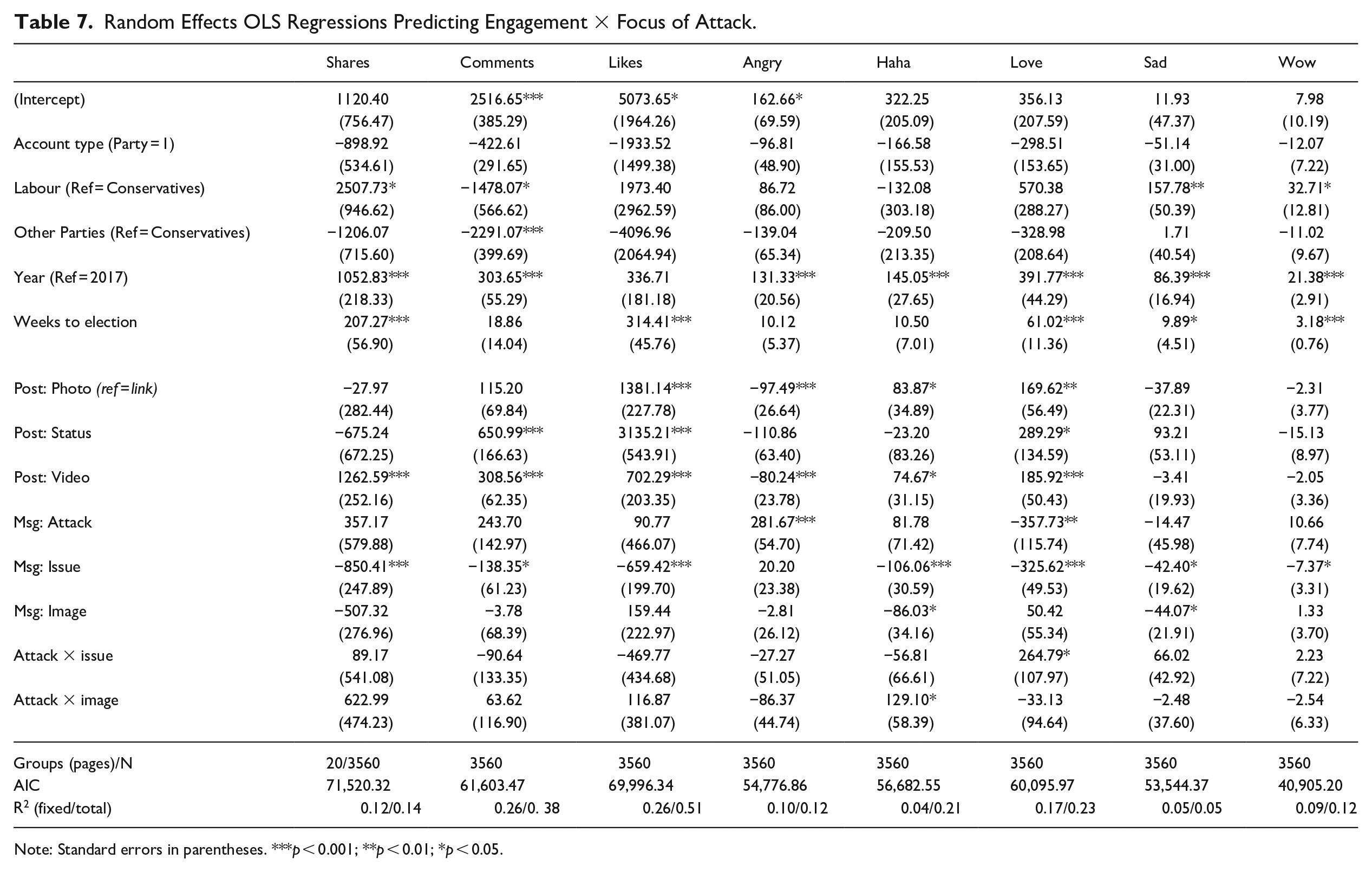
To address H3a and 3b and H4, we ran a series of OLS models using the different types of engagement counts as DVs (likes, shares, comments, angry, haha, love, sad, wow) with random effects for pages to account for the nested nature of the data, meaning that the posts are clustered around pages (Table 6). In the first set of models, we include the type of attack (contrast vs ‘pure’ attack) to address H3a and 3b, and in the second set of models we focus on an interaction term to examine the effects of different attack focus (image vs issue), testing H4 (Table 7).
Random Effects OLS Regressions Predicting Engagement per Type of Attack.
AIC: Akaike information criterion.
Note: Standard errors in parentheses. ***p < 0.001; **p < 0.01; *p < 0.05.
Random Effects OLS Regressions Predicting Engagement × Focus of Attack.
Note: Standard errors in parentheses. ***p < 0.001; **p < 0.01; *p < 0.05.
We find that different types of attacks elicit distinct reactions from the public. Specifically, attacks are more likely than other types of messages, including contrast attacks, to be shared and to receive comments and wow reactions (H3b). Attack and contrast messages are more likely to receive angry reactions from the public, and attack and contrast messages are much less likely to receive likes than messages containing no attacks (H3a).
Finally, we turn to the last set of engagement models, including interaction terms between attacks, image and issue to test H4 Table 7. Contrary to the expectation that image-based attacks would elicit higher engagement from the public, our results suggest that the focus of the attack seems to have little effect on how the public reacts to Facebook posts. There is no evidence that either image or issue-based attacks can elicit more shares, likes or comments, and the only reactions that have a significant association are love, which is associated with attacks based on issues, and laughing (haha), which is more likely to occur in response to image-based attacks.
Discussion
While negative electoral campaigning has been the topic of scholarly concern for decades, the increased polarisation in politics and the mainstreaming of social media have established a context where scholars might study this topic afresh, particularly outside of the United States. This article set out to assess the dynamics around negative campaigning on Facebook across the two most recent UK ‘snap’ elections, which took place outside of the normal electoral cycle in response to the divisions elicited by Brexit. While these elections may not be representative of a ‘normal’ campaign, they are particularly interesting from the standpoint of negative campaigning as they take place amidst increasing polarisation (Hobolt et al., 2021). Another contribution of this study is to disaggregate attacks on image and attacks on policy in the context of social media campaigns. We were able to answer several important questions.
Our findings suggest that the increased polarisation in UK politics since Brexit was reflected in these electoral cycles, with campaigns being much more likely to leverage negative messaging on Facebook in 2019 compared with 2017, supporting the assumption that a heavily polarising electoral context will lead to an increase in negative campaigning, and demonstrating the importance of observing the dynamics of negativity over time. While prior work including the UK had suggested a negative relationship between polarisation and negativity in Europe (Papp and Patkós, 2019), our findings indicate that that the deep divisions imposed by Brexit may provide incentives for negative campaigning – bringing UK campaigns closer to the US when it comes to polarisation and negativity (Geer, 2006; Hobolt et al., 2021).
At odds with prior research, we did not find that challengers were more likely than the incumbent party to go negative. On the contrary, the Conservative party was more negative than minor parties, and not significantly different from its main opponent, Labour. This may be explained in part by the different party dynamics in the UK compared with countries where third parties are fringe concerns. Third-regional parties in the UK often win substantive parliamentary representation, which might remove some of the incentive to gain attention and potentially increase concerns around backlash effects. It is also possible that minor parties in the UK opt to differentiate themselves by focusing on a positive agenda to maximise their chances to elect MPs in select constituencies instead of antagonising the major parties. Minor parties in the UK also tend to have a specific geographical focus (i.e. parties who only contest seats in Wales and Scotland, for example) or distinctive issue agendas (i.e. UKIP/Brexit party, and the Green Party), hence they may be more focused on imparting their own political vision instead of attacking major parties.
While we did not find differences between the two main parties’ use of attacks, in general, patterns emerge when considering the focus of the attack: image or issue. Our results are reflective of the context surrounding the campaign, considering the debacle over Brexit. Challengers were likely to focus on image-based attacks, which aim to undermine an opponent based on their personal character and skills, including the ability to lead. In both cases, the Conservatives called an election in attempts to secure a majority and pass a withdrawal agreement, which may suggest that the lack of political ability to deliver on the results of the referendum may have been perceived by the opposition as a weakness to exploit. Conversely, the Conservatives were more likely to attack on the issues, reflecting a single-issue strategy as both elections focused on Brexit. This strategy could also have been facilitated by the unclear position taken by Labour on Brexit (Hobolt et al., 2021).
We also find some evidence that campaigns consider the different types of accounts before posting negative messages, with party accounts posting far more attack messages overall when compared with party leaders. When looking at attack types, party accounts were much more likely to post attacks focused on both issue and image. Consistent with prior research (Brooks and Geer, 2007; Nai and Maier, 2021), this suggests campaigns are aware of potential backlash effects, and leverage their institutional party accounts to distance their leaders from their negative messaging. Considering the temporal predictors of image- and issue-based attacks, we find different dynamics. Issue-based attacks were far more likely in 2019, reflecting the dominance of Brexit as a more divisive issue by then. Both types of attacks became less likely as the polling day got closer in 2019, potentially reflecting other campaign strategies in this period such as getting out the vote, which may have been more prevalent in 2019 due to the more difficult mobilisation context in the winter (Eisinga et al., 2012; Gomez et al., 2007).
Finally, considering the relationship between user engagement and attacks, we find evidence that attacks can effectively drive engagement from the audience – in the form of comments, shares, and some reactions like angry and wow. However, we note that the type of attack matters: contrast messages, which typically attack an opponent while advocating for the candidate, were only associated with an increase in angry reactions and a decrease in love reactions – and not with more meaningful engagement like comments or shares. This suggests that the public is much more willing to engage with, and spread, messages that solely focus on disparaging opponents, which may be seen as an indication that those who are more likely to engage with political content online may also be more polarised (Brooks and Geer, 2007; Haselmayer et al., 2020). Importantly, our findings contribute to strengthen the argument for a nuanced understanding of different strategies in negative campaigning, particularly the role of contrast messages (Haselmayer, 2019; Lau and Rovner, 2009).
Considering the focus of the attack, we find little evidence that it changes engagement patterns, with only a few reactions being associated with image or issue-based attacks, and no effects related to shares or comments. Particularly with regard to sharing, our results are not aligned with prior research on Facebook (Baranowski et al., 2022; Bene, 2017) and Twitter (Stromer-Galley, 2019). Such differences could also be related to different platform strategies, as Twitter is more used for broadcasting while Facebook facilitates mobilisation (Bossetta, 2018; Stromer-Galley, 2019). The unexpected nature of both elections we studied may also mean that the public was less attentive to the race, particularly in 2019 when the campaign happened in the winter (Eisinga et al., 2012; Gomez et al., 2007).
The disincentive for users to share negative campaign content might be related to the specific context surrounding these two elections, namely heightened issue polarisation around Brexit (Hobolt et al., 2021). Prior research suggests that people may avoid talking about politics on social media, particularly in polarised contexts (Fox and Holt, 2018; Hayes et al., 2006). We also note that sharing may be less relevant than ads for campaigns to reach broader publics (Kreiss and McGregor, 2017). In the era of increased ad spending on Facebook, it is possible that ‘organic posts’ are used to mobilise those who already are aligned with a campaign (Stromer-Galley, 2019) – which may explain why simple attacks received more shares and engagement, but contrast messages, which are perceived as less negative, did not.
Our study has limitations. First, we only focus on Facebook, but campaigns adopt multiple platforms and tailor strategies accordingly (Bossetta, 2018). Thus, our inferences cannot be extrapolated to negative campaigning in other platforms. Second, the analysis is limited to public posts and does not include ads, which might feature distinctive dynamics due to micro-targeting. Although social media ads were not available to researchers in 2017, future work can now consider whether paid messages differ from public posts in terms of negativity, considering that ads may allow campaigns to detach themselves from their negative messaging, as the source of an ad is not always clearly labelled (Kim et al., 2018). Third, our work is limited to attacks, and does not investigate other communication strategies campaigns might use on social media. Fourth, the context surrounding these two snap election campaigns in the UK was heavily shaped by Brexit, and our findings might have been different if they included campaigns in regular electoral cycles. More longitudinal work is needed to unveil the dynamics of negativity on social media over time. Finally, we cannot account for posts that may have been deleted by the party or candidate accounts before our data collection took place, nor is it possible to know how many may have been deleted. If some parties are more likely than others to delete posts, our data would not be able to account for these imbalances. Despite these limitations, we believe that this study contributes to the understanding of distinctive dynamics surrounding campaign negativity, particularly as it regards different types of attacks, and posting strategies, adopted by parties and party leaders in two competitive and contentious electoral cycles.
Conclusion
This article sought to establish the factors associated with, and the potential audience effects of, the adoption of negative campaign strategies on social media. This is the first article which considers these questions in the UK, testing assumptions that are primarily driven by presidential elections in the US across two election cycles. Our findings unveiled the impact of several contextual and temporal factors and highlight the distinctive dynamics of digital campaigns in polarised parliamentary elections. Our findings contribute to the literature on the use of social media for negative campaigning by examining different patterns of negative campaigning – including type and focus – supporting the argument that negativity is a multifaceted strategy which requires a more nuanced understanding. The patterns we observe between attacks focused on issues or image, as well as attacks compared with contrast messages, clearly demonstrate how these are distinctive strategies from a campaign standpoint, and also elicit different perceptions and reactions from the public.
The discrepancies between some of our findings vis-a-vis prior research based in the US highlight the importance of extending the understanding of campaign negativity beyond presidential and bipartisan contexts. For instance, our findings around the different dynamics between challenger and incumbent parties, as well as between party and candidate accounts, point to distinctive social media strategies in multi-party parliamentary elections compared to presidential systems (Walter, 2013). Parliamentary systems allow campaigns to leverage an impersonal ‘party’ account to go negative while preserving the personal accounts of party leaders, suggesting campaigns may take into account the risks of backlash and hence strategically distance leaders from attack posts (Lau et al., 2007). This is an interesting feature of social media campaigning, as it allows parties and party leaders to effectively adapt their strategies to the audience and venue (Bossetta, 2018; Stromer-Galley, 2019), but these dynamics have been overlooked by prior research on online negative due to the near-exclusive focus on US elections.
Much of the research around social media campaigning has emphasised the possibilities to engage voters. In this realm, our findings suggest that attack messages tend to elicit stronger engagement responses from audiences, particularly in the form of comments and shares, which contribute to increase the reach of campaign messages. Interestingly, this is only the case for pure attacks, and contrast messages do not elicit similar patterns. These findings contradict the early literature on negative campaigning which suggested negative campaigns deterred voters (Ansolabehere and Iyengar, 1994), and provide further evidence that supporters are engaged by negativity during, and outside of, campaign periods (Geer, 2006; Mutz, 2015). Particularly in the context of polarised campaigns, the public’s engagement with candidates and parties going negative on Facebook might signal to the campaigns that voters endorse this strategy. It is also possible that polarisation reduces the benefits of comparative, or contrast, messages. While research on TV ads had suggested that comparative messages are beneficial insofar as they effectively undermine the opponent without reducing support for the candidate, it is possible that these messages are less effective than pure attacks in the realm of social media, where campaigns need to ‘fire up’ supporters to engage on their behalf, consistent with prior depictions of Facebook as a mobilising tool for campaigning (Bossetta, 2018; Stromer-Galley, 2019). Considering what we now know about how social media algorithms prioritise outraging and negative content (Rathje et al., 2021), it is also possible that the increased negativity in online campaigns is an attempt to leverage, or ‘hack’, these dynamics in attempts to increase engagement with campaign posts.
There are wider implications of focusing on negative messages on social media. Parties may use attack messages to gain initial traction among their base and gain wider attention. This may incentivise parties to incorporate more personal attacks into their campaigns, as these attract more engagement, to the detriment of more positive, or comparative, posts. This is a concerning dynamic insofar as negative campaigning may increase the gap between strong partisans and the general public, potentially undermining support – and suppressing engagement – among those who have weak or no partisanship ties (Haselmayer et al., 2020). As social media becomes increasingly indispensable to political campaigns, these findings have implications for the tone and focus of campaign negativity in the future. While advocates for the benefits of negativity in campaigns have argued that voters may benefit from heated debates on the issues, the hyper-personalised focus of political campaigns on social media may provide further incentives for candidates to target their opponents’ character and personality, undermining the potential for voters to learn from, and compare, the stance of parties and candidates on issues that matter to them.
Footnotes
Acknowledgements
The authors thank Angelica Preda and Meghan Henshaw for their help with content analysis, and the Illuminating Project in the School of Information Studies at Syracuse University
Declaration of conflicting interests
The author(s) declared no potential conflicts of interest with respect to the research, authorship and/or publication of this article.
Funding
The author(s) disclosed receipt of the following financial support for the research, authorship and/or publication of this article: Research assistance for this project was supported by the University of Liverpool’s Undergraduate Research Scheme.
