




Abstract
The role social media plays in creating and disseminating misleading information, including fake images and visuals is well recognized by scholars and governments around the world. Many governments, including in Canada and the United Kingdom (UK), are working on, or have already introduced regulatory frameworks to combat disinformation and prevent harms for vulnerable populations. Among these vulnerable populations, migrant social media users form a distinct group of government social media users with specific information and interaction needs. As literature demonstrates, migrants are actively present on social media, including government social media and can benefit from information-sharing and connections it enables. However, social media can also deter migrants from pursuing migration opportunities. This paper examines the use of X (formerly known as Twitter) accounts by Immigration, Refugees and Citizenship Canada (IRCC) and the UK Home Office (Home Office) by government social media users, including migrant social media users. It specifically investigates if government social media users are spreading misinformation and the prevalence of misinformation on the IRCC and Home Office X accounts. As findings demonstrate, these two government accounts are used differently: IRCC X is used to advocate for causes and ask questions, while Home Office social media users are mostly voicing their opinions by critiquing politicians and government policies, and these critiques often contain misinformation. Finally, misleading tweets remain accessible for public consumption.
Introduction
Social media has become an integral component of communication practices of governments around the world. Targeted marketing campaigns to promote flu shots, announcement of new or revised government policies such as changes to the border entry rules for citizens and international travellers due to the COVID-19 pandemic, and an opportunity to join a social media townhall to discuss local budget – all these new ways of interacting with the public enabled governments to instantly share information, seek opinion on an issue of concern, or issue an alert in case of an emergency.
The extent to which governments engage with social media users, however, varies considerably: from “thickerˮ forms of citizen involvement in government decision-making in Iceland to “thinnerˮ forms of customer service support in Canada (Homburg and Rebecca 2021). Thus, some government agencies choose to use social media not just as a one-way communication tool, where it is only government that initiates the interaction (or “pushesˮ information), but also to utilize its capabilities as a two-way interactive platform, where members of the public can expect government agencies to respond to their social media posts (Gintova 2019). Government narratives on social media, particularly migration narratives, often use visuals (Massari 2024a; 2024b). In this Special Issue, Massari contends that visuals have evolved from mere tools into central agents of communication on multiple channels, including social media. Through the lens of the visual governance framework, she argues that in the digital era, visuals play a central role in migration governance by legitimizing or challenging existing power structures, policies, and practices (for more on the visual governance framework see Massari’s contribution in this Special Issue).
Government use of social media, however, does not come without its challenges. As users of social media platforms, governments are not immune to dis- and misinformation it creates and disseminates. Many governments, including in Canada and the United Kingdom (UK), are working on, or have already introduced regulatory frameworks to combat disinformation and prevent harms for vulnerable populations. However, it is yet to be determined how effective the newly established regulatory frameworks will be and if they are going to be implemented as intended (Codagnone and Weigl 2023).
As social media users, government agencies published policies governing the use of their social media accounts. However, these are not duly enforced with questionable content being available for government social media user consumption (Gintova 2019). Nevertheless, research shows that social media users tend to verify some information they find on elsewhere via government social media accounts (Muhammed and Mathew 2022). Therefore, governments continue to play an important role as the provider of accurate and reliable information.
Migrants represent an important user group for government immigration agencies. Although the research shows that some categories of migrants, specifically refugees, are less likely to use social media platforms due to risk of government surveillance (Moran 2023), Dekker and Engbersen (2014), Komito (2011), and Monteiro (2024a, 2024b) argue that migrants are benefiting from the use of social media to access important information about the country they migrated or intend to migrate to (e.g. information about available services and programs, housing, and employment opportunities). Moreover, even when migrants decide not to directly engage on government social media, they can passively consume the content generated either by government agencies themselves or by other users of government social media platforms (Gintova 2019).
This paper examines the use of X (formerly known as Twitter, this paper refers to posts on X as tweets) accounts of two government immigration agencies – Immigration, Refugees and Citizenship Canada (IRCC) and Home Office by government social media users. It specifically investigates two research questions – (1) how social media users interact on immigration agencies’ social media accounts and (2) if government social media users are spreading misinformation. The paper is structured as follows: first, it reviews existing scholarship on migrant social networks and use of technology, including use of social media in migration process. Then it briefly outlines methodology employed for this exploratory study and approach to data analysis. These are followed by discussion of findings and a conclusion.
Literature review
Social capital and migrant social networks
Scholars in migration studies have been interested in research questions related to migration and use of technology in the migration process for the last two decades. Moran (2023) argues that the Syrian refugee crisis of 2015 expedited the creation of a new sub-field in migration studies, namely digital migration studies, as many researchers sought to investigate migration in the digital era. Although cultural differences among social media communities are well recognized (Postill and Pink 2012), research on migrants’ use of technology has grown steadily since Diminescu (2008) introduced the concept of the “connected migrant”—a migrant who actively incorporates modern technology into their migration journey. This literature draws extensively on the interdisciplinary scholarship on social capital and social networks.
The concept of social capital, which essence can be summarized as “relationships make a difference” (Field 2017: 1), is widely used by scholars to explain migration decision-making (Flores-Yeffal 2013), migrant settlement and integration (George and Chaze 2009a; Menjívar 2000) and employment patterns and choices (George and Chaze 2009b; Xue 2008). Boyd (1989) puts emphasis on importance of social capital rather than economic factors in fostering and facilitating migration. Furthermore, a lot of emphasis is given to the negative effects of social capital on migration such as inequality of access to benefits between migrants and members of receiving society, pressure on group members to act in a certain way, unrealistic expectations regarding opportunities for migrants and restrictions of personal freedom (George and Chaze 2009a).
Social capital is distributed through social networks and these networks increasingly use social media. Migrant social networks, including those on social media, can be both formal and informal. Formal networks involve official organizations, which offer services to meet various migrants’ needs, and informal networks consist of friends and family that can be approached for help (George and Chaze 2009a). Thus, migration is understood as a dynamic movement that is dependent on social networks (Alonso and Oiarzabal 2010; Kok and Rogers 2017). As noted by Dekker and Engbersen (2014) and Dekker et al. (2016), the analysis of migrant social networks is really the key to understanding the dynamics of migration processes.
Although the dominant view in literature is that social networks assist in migration, Liu (2013) points out that there is still a lack of understanding of how exactly networks are benefiting or obstructing during the migration process. For example, as the initial desire to migrate might be shaped by family or friends, getting settled and finding employment will most likely depend on acquaintances or “weak ties”. Also, as noted by Flores-Yeffal (2013), most scholarly work emphasizes the importance of migrant networks but fails to explain how exactly support is exchanged. There is also a lack of understanding of how social media is used in these networks of “weak ties”.
Social media and migrant social networks
In recent years, as information-communication technology (ICT) and social media have developed, it became even easier to gain access to social capital through social networks from any country in the world. Migration studies scholars note that the existence of migrant networks is greatly facilitated by ICT (Alonso and Oiarzabal 2010; Hiller and Franz 2004). However, this research is specifically focused on a certain ethnic group such as South Asians, Chinese, etc. And investigates this group’s practices and routines online. Nevertheless, it is widely acknowledged that ICT facilitates information exchanges and knowledge sharing among migrants (Alonso and Oiarzabal 2010).
Another body of research looks at migrants’ information needs (e.g. Caidi et al., 2010; Shoham and Strauss 2008). According to these scholars, migrants are a distinct group of information seekers with specific information needs. These include the need to understand how to get employment, access healthcare, schools, etc. (Caidi et al., 2010; Shoham and Strauss 2008). The literature on information-seeking behaviours of migrants is, however, primarily focused on understanding what resources a particular ethnic group uses to get information they are looking for (Hakim Silvio 2006). Although researchers note that people usually reach out to their family and acquaintances for advice first, it is obvious that the Internet and social media have quickly become popular alternative sources for information on migration.
Social media brought further significant changes in people’s online experiences and interactions. As literature shows, many migrants use social media platforms for different purposes: to obtain and exchange information, to stay in touch, to get introduced to useful connections, to find employment (Dekker and Engbersen 2014; Dekker et al., 2016; Komito 2011), and understand what services are available to them in the receiving country (Monteiro 2024a; 2024b). More recent literature explores the role social media plays in assisting refugees to help fleeing their country of origin (Alencar 2018; Borkert et al., 2018). Therefore, social media role in creating and disseminating migration-related information became crucial for any group of migrants, including economic and family migrants, and refugees.
As Dekker and Engbersen (2014) note several advantages of social media for migrant users: they can now instantly obtain information and exchange streetwise knowledge on migration. This is viewed as an advantage because with the assistance of social media migrants can resist restrictive immigration policies. Moreover, according to Dekker et al. (2016), refugees use various strategies to validate information received through social media by using multiple sources and confirming information with the sources they trust as well as with their own experience. Nevertheless, as Muhammed and Mathew (2022) argue, government social media accounts are often viewed by social media users as a trusted source. Therefore, migrant social media users might be checking government social media resources to understand or get up to speed on the official government information and to inquire about experiences of other users present on government social media, thus accessing latent ties enabled on social media platforms.
Social media and latent ties
Latent ties are seen as a unique attribute of virtual social networks (Haythornthwaite 2002; Komito 2011). Latent ties are defined “as ties with whom a connection is made possible by an affordance of a technological platform, such as [social media], but with whom one never communicates” (Brown and Nicolas 2019: 1). Through access offered by social media, users can create networks and become members based on commonly shared interest (Haythornthwaite 2005). They can also join many social media networks, including government social media accounts: many have open access and can be joined by anyone who is interested and some require easy approval by the site administrator. Thus, most of the time, the only criterion to separate members from non-members is the ability to communicate in a certain language. Therefore, social media provides interested people with a point of entry to a social network and helps to connect individuals who otherwise will not know each other (Haythornthwaite 2005).
Latent ties can play an important role on government social media. Users can just skim through posts and messages left by other users and government agencies. They can take content in these messages as advice relevant to their specific situation or decide to ignore government official resources as unhelpful. Both scenarios may lead to non-government actors taking on the role of information providers on migration process. And with the spread of dis-and misinformation on migration noted above, this can lead to government agencies losing their position as providers of accurate and reliable information and overall diminishing trust in government.
Social media and dis- and misinformation on migration
Migrants, diasporas, members of migrant families, and migrant-serving organizations, however, are not the only non-government actors generating and sharing migration-related information on social media. As social media platforms monetize people’s emotions (for more on this point see Lynes’ contribution in this Special Issue), they also promote content created and shared by anti-immigration actors (Ekman 2019). In addition, scholars note the high degree of dis- and misinformation on migrants and migration processes being spread on social media (Hameleers 2022; Monteiro 2024b).
Devlin and Grant (2017) and Ekman (2019) note that most common dis- and misinformation content on social media includes making migrants responsible for violence against women, depicting male refugees as sexists and rapists, and refugees as illegal migrants. These posts are also categorized by high toxicity - rude, disrespectful, or unreasonable comments that make people who do not share this viewpoint very likely to leave the discussion or not participate in it (Pascual-Ferrá et al., 2021). Finally, Monteiro (2024b) highlights that newcomers to Canada often face misinformation on social media and visuals can reinforce migration stereotypes (see Desille and Nikielska-Sekuła in this Special Issue for more on visuals and stereotypes).
Overall, the increase in anti-migrant and racist attitudes on social media can influence the quality of information being available to migrants through their social networks as well as the quality of information available on the official government social media. Although the prevalence of misleading information on government social media currently remains understudied, this paper highlights that the IRCC and Home Office X accounts are not immune to this issue. Moreover, these tweets remain publicly available and provide migrant users with access to latent ties, which can facilitate their migration process or deter from migration altogether.
As existing migration studies research primarily focused on the opportunities and benefits created by social media, it is important to also examine risks and challenges associated with social media use, specifically those connected to its role in spreading misinformation on migration-related issues. This paper begins to uncover if immigration agencies’ social media accounts contribute to the spread of misinformation.
Methodology
It is important to note that there is consensus on the definitions of disinformation (false information that is deliberately intended to mislead) and misinformation (inaccurate or false information that is being spread without malicious intent) (UNHCR 2022). However, empirical studies have predominantly focused on misinformation due to the need to examine misleading content presented in a brief format (e.g. as a short text message or a visual) (Murphy et al., 2023). This study adopts a similar approach while exploring user interactions on X accounts of two immigration agencies – IRCC and Home Office. X accounts of these two departments were chosen for comparison as Canada and the UK have similar approach to the government use of social media and follow similar approval processes of social media content. Moreover, both IRCC and Home Office have active social media accounts on X and other social media platforms, including Facebook, YouTube, Instagram, and LinkedIn and their social media is very popular with government social media users. It is, however, important to note that Canada encourages immigration, especially looking to attract economic migrants (IRCC 2024), while the UK government is primarily interested in reducing immigration and tighter border controls (Home Office 2023).
The study draws on the results of the network analysis as well as the analysis of tweets and interactions on English language X accounts of IRCC and Home Office collected between March 2022 and February 2023. Tweets were collected via Communalytic – a research tool that enables the collection and analysis of social media data (Gruzd and Mai 2021). Results discussed below are based on the results of the network analysis for the whole data sets of tweets (N = 55,045 for IRCC and N = 98,267 for Home Office) as well as manual content analysis of user tweets on the IRCC and Home Office X accounts. Retweets were excluded from content analysis.
Sampling and coding
For this exploratory study, manual coding of random samples of tweets (Krippendorff 2004) allowed for in-depth understanding of categories of user tweets as well if these contained misinformation. Manual coding was chosen instead of i.e. AI-assisted one as no previous research looked specifically into misinformation on government social media and thus AI-assisted coding of complex content (e.g. sarcastic messages, messages containing slang expressions) could be inaccurate. Manual coding included two stages. First, a random sample of 500 user tweets was coded for each immigration agency. This allowed for comprehensive analysis to explore different types of tweets (e.g, questions, opinions, and advocacy) as well as tweets’ topics/themes (e.g. politics and policy and services). Each post was assigned only one category for the type of tweet but two categories for topics/themes of the message – one general (such as e.g. comment about politics and policy and services) and a more specific one (e.g. comment on immigration policy, delays in reviewing applications or identity attack on a politician). A combination of deductive and inductive methods was used to prepare a coding book. Deductive codes originated from the previous research on the IRCC social media use (Gintova 2019), while inductive codes were informed by data. Each user tweet was also flagged for containing potential misinformation by factchecking the message, verifying its originality or conducting reverse image search. For coding book, see Appendix A. The second stage of coding focused specifically on a sample of toxic tweets to get further insights into user-generated misinformation. This approach also allowed for triangulation of findings as coding was conducted by a single coder.
Misinformation and toxic tweets
In addition to the random sample of user tweets, the study relies on the analysis of 10% of toxic user tweets on IRCC and 5% of toxic user tweets on Home Office X accounts (N = 156 for IRCC and N = 962 for Home Office), therefore oversampling social media content that is more likely to contain misinformation (Cinelli et al., 2021). Toxicity analysis identifies hateful, disrespectful, or derogatory comments shared by social media users (Pascual-Ferrá et al., 2021). Although empirical studies did not detect a direct relationship between toxicity and misinformation spread (e.g. Cinelli et al. (2021) found no strict relationship between the usage of a toxic language and involvement in the misinformation community on YouTube and e.g. DiCicco et al. (2023) concluded that highly toxic Twitter users assisted with the spread of misinformation about the COVID-19 vaccines), the analysis of toxic tweets provided additional insights into misinformation content on government social media.
Commynalytic conducts toxicity analysis using Detoxify—an open-source library created to detect inappropriate or potentially harmful text (Hanu et al., 2021). We adopted Pascual-Ferrá et al.'s (2021) approach to identifying toxic user content where tweets with the Detoxify toxicity score over 0.3 (on the scale from 0 to 1) were selected for analysis. Results of misinformation analysis of toxic tweets below are based on tweets which contained enough text and other symbols (such as e.g. emojis) for Detoxify to calculate the toxicity score. All analysed tweets, as in the random sample, were assigned one category for the type of tweet and two categories for topics/themes of the message.
Findings
The analysis shows that there is a significant amount of misinformation circulated on IRCC and Home Office X accounts. The network analysis demonstrates that this misinformation does not spread, however, it remains available. Furthermore, toxic content that violates social media policies published by both immigration agencies accounts for about 3% of user tweets on the IRCC X account and about 20% of user tweets on the Home Office X account. Such prevalence of toxic user tweets on the Home Office X account might lead to migrant users being reluctant to engage or remain in a conversation on this account but being able to consume a lot of anti-immigration content via latent ties enabled by the account.
IRCC X account
IRCC is the federal government department responsible for immigration policies and programs, citizenship services, refugee protection, and issuing Canadian travel documents (Government of Canada 2024). IRCC is quite active on social media with eight social media accounts in English and eight social media accounts in French. As of October 2024, the IRCC general English language X account has over 1M followers.
IRCC social media use is regulated by Terms and Conditions document published on the Government of Canada web portal. The department also abides by social media terms and conditions of the Government of Canada. The Terms and Conditions document details how IRCC and social media users should be interacting on social media. It applies to all IRCC social media accounts and is available in both English and French.
The Terms and Conditions document begins with the acknowledgement that IRCC uses “as an alternative method to interact with users and stakeholders about our programs and services” (IRCC 2023). Furthermore, IRCC acknowledges that the department reads comments and engages in discussions on the official social media channels but only “when appropriate” (IRCC 2023). In addition, IRCC is committed to respond to questions within two business days, therefore declaring department’s intent to use social media for interaction with the public.
Furthermore, IRCC’s Terms and Conditions outline when the department reserves the right to remove content or block users – when spreading “racist, hateful, sexist, homophobic, slanderous, insulting, or life-threatening messages”, demonstrating offensive behaviour and/or unproven accusations against individuals or organizations, using coarse language, encouraging illegal activity and some other instances (IRCC 2023).
Home Office X account
The UK home Office has a much broader mandate than IRCC. In addition to immigration and passport policies and programs, the Home Office is responsible for drugs policy, crime, fire, counter-terrorism and police (UK Government 2024). The Home Office maintains accounts on five social media platforms. As of October 2024, the Home Office X account has around 1M followers.
Similarly to IRCC, the Home Office social media use is regulated by the Social Media Use Guidelines published by the UK government. This document details how Home Office moderates its social media accounts and has a special section on the use of X (still being referred as Twitter). Contrary to IRCC practice, the Home Office does not make any commitments to interact on its social media platforms. Instead, the social media team “will pass feedback on to relevant people in the department” (Home Office 2023).
The Home Office social media moderation policy encourages civil and open debate. Furthermore, the department states that it will delete posts, including the ones that are “abusive, racist, sexist, homophobic or inflammatory”, against the law (e.g. encouraging illegal activity), containing personal information, revealing information of the individual Home Office staff members, and containing commercial information (such as advertisements) (Home Office 2023). It is interesting to note that the department specifically states that if comments break X’s rules, the department reports these to X. It remains unclear if Home Office does monitor content on its X account, in addition to flagging it for the social media platform.
Therefore, there is an important difference in the IRCC and Home Office use of social media. While IRCC states that it uses its social media to answer questions, Home Office uses the accounts primarily to “push” government announcements and information. The way IRCC and Home Office maintain their X accounts predetermine how these are being used by social media users. For example, the IRCC X accounts draws questions and tweets from migrant users while the Home Office X account is mostly used by non-migrant social media users 1 to express their opinions on government policies and actions.
User interactions on IRCC and Home Office X accounts
Despite that the analysis of government agencies’ X content was out of scope of this study, it is important to highlight the differences in the use of language when referring to e.g. refugees who arrive into the country not at an official port of entry – IRCC uses the term “irregular migration” while Home Office refers to these cases as “illegal migration.” Furthermore, Home Office X account has been used to publish partisan political content while IRCC states in the Terms and Conditions of social media use that the department “will not engage in the issues of party politics” (IRCC 2023). Interestingly, the use of Home Office account for party politics led to a significant number of tweets highlighting that the government agency should remain impartial. The tweet below summarizes this position: How is this an appropriate use of an official government account? You are acting as a political tool which is a fundamental abuse and debases your independence.
Such differences in the use of accounts and language about migration, undoubtedly, could predetermine who will engage with departments’ content on X. The analysis revealed that the tone of IRCC user tweets is mostly neutral, however, toxic tweets account for about 20% of all user tweets on Home Office account. Furthermore, manual content analysis revealed that many of toxic tweets on the Home Office X account were responses to Home Office original messages. Therefore, the partizan and polarizing content Home Office was sharing at the time of the study could have provoked the high degree of polarizing and misleading user content. However, further research is required to determine the extent to which government social media messaging, including visuals predetermine the types of users that engage with this content.
Types of user tweets
The network analysis demonstrates that there are no established networks neither on the IRCC X nor the Home Office X accounts. On IRCC X, some of the interactions are bi-directional as users tweet at IRCC and very few receive responses back (about 2.3% of all interactions). For Home Office, the interaction is mostly unidirectional: users tweet at Home Office while Home Office interacts with the users very rarely (less than 1% of all interactions). This minimal difference can be explained by the unwillingness of IRCC to answer user questions related to processing backlogs and delays following the COVID-19 pandemic. It is also important to note that although IRCC and Home Office content is retweeted extensively, user tweets do not reach nor spread across large audiences.
The latter finding is important in the context of user-generated content on government social media. As per the results of the manual content analysis, 19% of user tweets on IRCC X (N = 97) and 85% of user tweets on the Home Office X (N = 241) are categorized as opinions. Figure 1 provides an overview of the types of user tweets on IRCC and Home Office X accounts. Type of user tweets of IRCC and Home Office X accounts.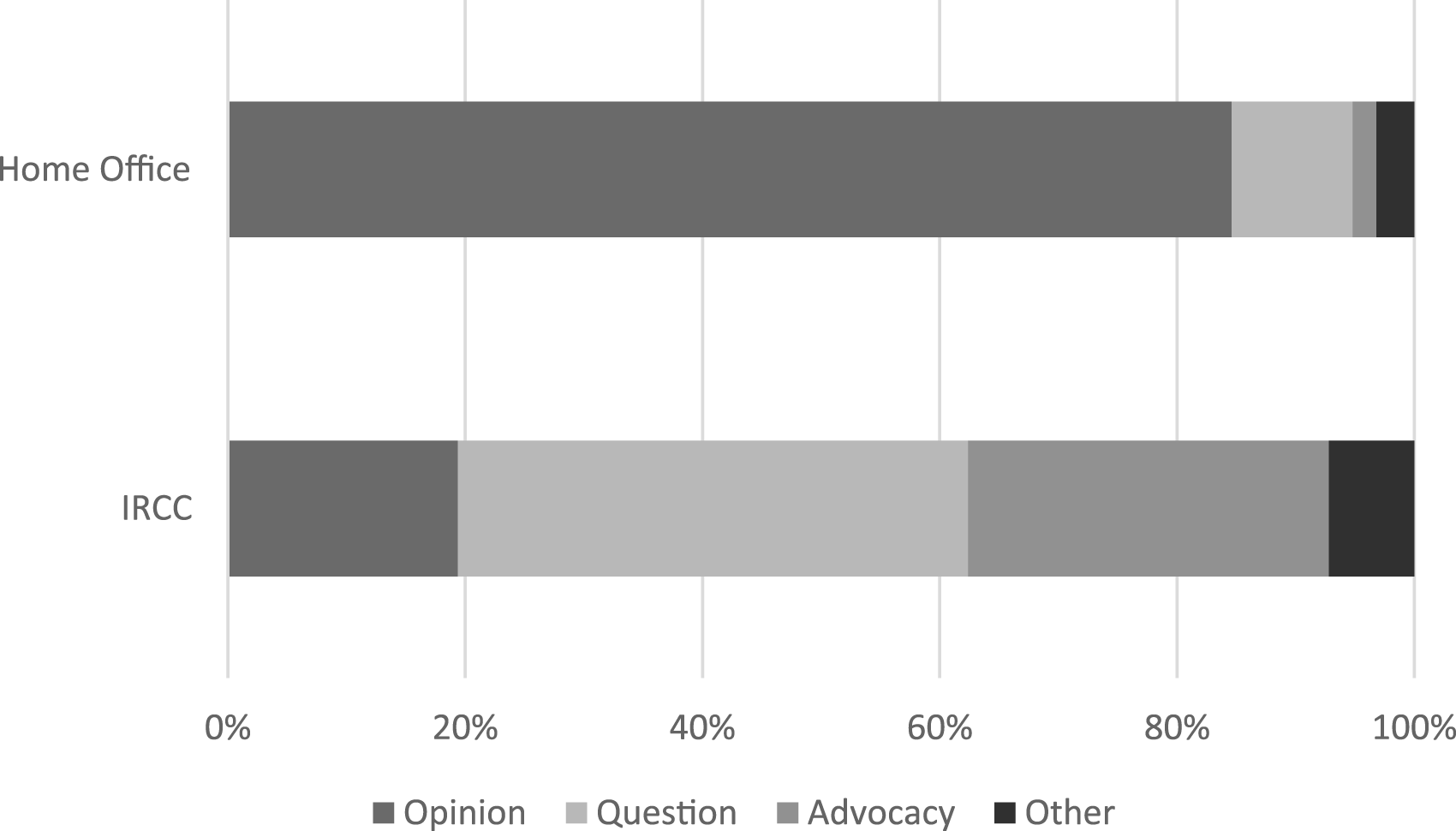
One significant difference stemming from the analysis of the IRCC and Home Office X accounts is the polarization of opinions. While IRCC X users tend to ask about immigration programs and services, advocate for the reduction of backlog in processing of applications, and vent about extended processing times, Home Office X users tend to voice their frustration with the Home Office policy initiatives, individual politicians or party politics. Moreover, although there are a few supporters of government policies, the majority of Home Office X users are either frustrated with government policies because they are not “tough enough” (e.g. in regulating irregular migration) or because they are “inhumane” (e.g. for entering in a partnership with Rwanda to deport failed refugee claimants). In any event, the overall user dissatisfaction with government performance on the Home Office X is quite significant and opinions shared via tweets are highly polarized.
Another important difference in user interactions on the IRCC and Home Office X accounts is the number of questions or requests for assistance addressed at the departments. 43% of all analysed user tweets on IRCC X are questions or requests for assistance. For Home Office the number is much lower – 10% of tweets are questions or requests for assistance. The latter can be explained by the lack of the Home Office responses and partially confirms the assumption that the Home Office X account is dominated by tweets from non-migrant users. It, however, remains unknown how many migrant social media users turn to the IRCC and Home Office X accounts as information sources.
Lastly, the topic/theme that dominated the discussion on both accounts is policies and services (Figure 2). However, far more IRCC user tweets were questions about policy and immigration services while Home Office policy and services tweets were mainly opinions in relation to government irregular migration policy. Topics/themes of user tweets of IRCC and Home Office X accounts.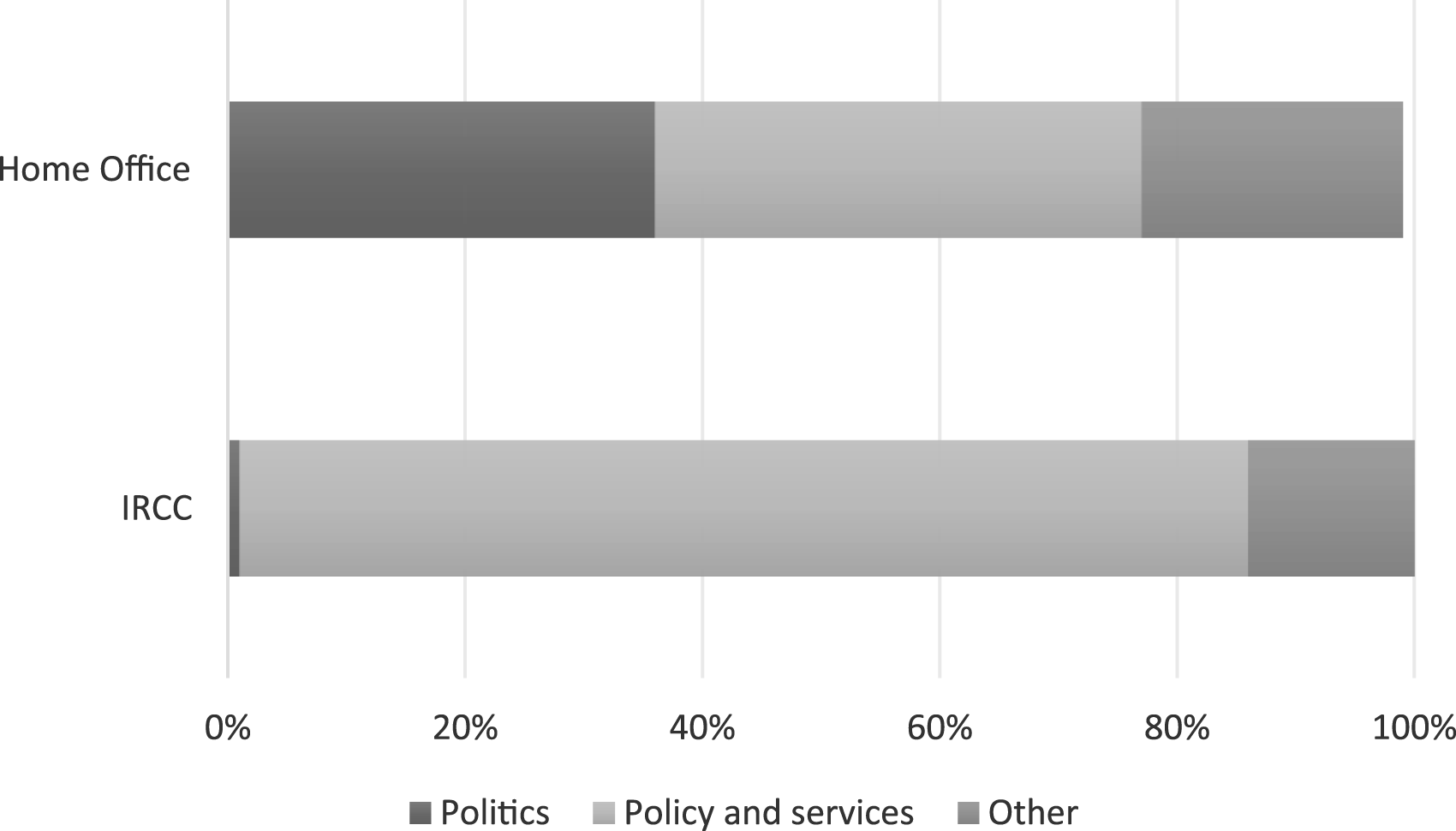
Misinformation and its types
Labelling tweets as containing misinformation presented a challenge despite the ability of the coder to investigate links included in the message. Below we discuss tweets that were labelled misinformation that were verified as misleading based on existing literature and/or verification tools. These included messages themselves, links to other tweets and/or visuals that accompanied these tweets. However, some claims about the number of refugees in a country (without a reference to a specific date), volume of immigration application backlogs (without a specific source), or calling irregular arrivals illegal immigrants (i.e. just repeating the language used by the UK government), were not categorized as misinformation. Furthermore, if tweets contained solely a link to a media source and even if this information was misleading (e.g. a media article claiming that refugees are being housed in castles or one outlet in the UK calling irregular arrivals “invaders”), these were not classified as misinformation. Where information could not be verified, tweets were labelled as undetermined. The coding book in Appendix A provides sample tweets that were categorized as misinformation as well as the ones that were not.
Misinformation about policies and services
This type of misinformation was the most prevalent on both IRCC and Home Office X accounts. Typically, the misleading message was embedded into an opinion statement, although there were some questions containing misinformation. Excerpts from user tweets presented below illustrate opinion statements on policies and services containing misinformation. @CitImmCanada So, what’s the point to make the correct path to immigrate if the IRCC rewards undocumented people? This is annoying for the people suffering with the correct process… (Opinion about Canadian immigration policy) @ukhomeoffice Yes, like defending our borders to keep out virile young males with no right to be in the uk; who believe that women were created for their pleasure and that its ok to rape, abuse, assault women and girls as long as they're of a different faith! (Opinion about UK refugee policy) @ukhomeoffice @SuellaBraverman ILLEGAL channel crossings by ILLEGAL immigrants. Stop them now! (Opinion about UK immigration policy) “@CitImmCanada Only those with IRCC are making fun of the desires of the people, everyone is a lie, the Embassy of Canada does not give visas and take fees [.]… IRCC is just making money, and playing with people’s hearts and willingness (Opinion about IRCC visa services)
These excerpts demonstrate that IRCC and Home Office X users are presenting misleading information to substantiate their claims. While some of the claims are similar to the ones noted in existing literature (e.g. about immigrants being responsible for violence against women and presenting refugees as illegal immigrants), some are specific to policy initiatives and services in Canada and UK.
Misinformation on politics
In addition to discussing IRCC and Home Office policies and services, a significant number of tweets containing misinformation, especially on Home Office X account, were about politics – either party politics or individual politicians. The tweets below provide a few examples. @CitImmCanada People come here as refugees because the liberal regime gives them a free ride in exchange for their vote. Canada is r[u]n by criminal pedophiles… (Opinion on Federal Liberal Government in Canada) @CitImmCanada No, thanks. The further away from Justin dictator, Trudeau, the better. Might try to convince us to kill ourselves, or mandate us to take the clot shot, and take courses to be sensitive to perverts. Then when we refuse close down our bank accounts. No thanks. (Opinion on Justin Trudeau) @ukhomeoffice Does the Home Office not know that there is no such thing as illegal immigration? You are throwing yourselves in front of a train to protect fascist liar Braverman. A give dept is meant to be impartial. Foul. (Opinion on Home Secretary Suella Braverman) @ukhomeoffice @Dines4Dales #ConservativeParty All corrupt and liars criminals. No confidence #Torychaos #CostOfLivingCrisis #GeneralElectionNow #ToriesDestroyingOurCountry #ToryCriminalsUnfitToGovern #TorySewageparty #ToryRecession #RishiOut60 #SunakOut (Opinion on Tory Government in UK)
Although not as deleterious to potential migrants as misinformation on immigration policies and services, this type of messaging is clearly violating established terms of government social media use and could undermine trust in government. However, these tweets remain available for public consumption despite the departments’ ability to delete or hide such content.
Misinformation and visual content
Some tweets containing misinformation included visual content. Very broadly, this content can be classified into three categories: images and graphics, references to media articles, and links to tweets of other users containing visuals.
Typically, user visual content on Home Office X account was used to support and substantiate the misleading information. For example, a picture of a residential area in Yorkshire was accompanied by a message that reads “So we have to put up with this behaviour … just because you are against illegal immigrants being processed in Rwanda?” Or a tweet “And what’s happening with the CRIMINALS IN POWER” with embedded picture of Telegraph’s story on police raid at Baroness Mone’s mansion. IRCC X users, on the other hand, used visuals containing information on e.g. delays in processing student visas and work permits or caregiver applications for permanent residence. The manual content analysis of these graphics revealed that some of these contained misleading messages as a part of the visual: e.g. a graphic with a Canadian flag and text claiming that IRCC was prioritizing processing of applications received at a later date while completely ignoring the ones submitted earlier.
Overall, both IRCC and Home Office X users preferred text messages to messages containing visuals to convey their opinions containing misinformation. However, this could be because of the additional work required to upload a visual in an X supported format.
Discussion and conclusion
The results of the study show that both IRCC and Home Office X accounts display a significant number of user tweets containing misinformation. These continue to remain available for public consumption despite that both departments reserved the right to remove content violating their published social media use policies. Although the user misinformation content does not circulate broadly, it does contain harmful messaging on migrants and migration processes. Our findings confirm those of Devlin and Grant (2017) and Ekman (2019) demonstrating that most common misinformation content on social media include making migrants responsible for violence against women, depicting male refugees as sexists and rapists, and all refugees as illegal migrants. We, however, also found a lot of false claims that refugees are treated better than citizens, irregular arrivals are not refugees but economic migrants, and government spends much more money on services for immigrants than on e.g. former military personnel. Moreover, government social media accounts are unique that they attract users who can spread misinformation in support of immigration as well. For example, we have identified misinformation claims that advocated for increased refugee intake from e.g. Ukraine, Afghanistan and Iran or heavily criticized the UK-Rwanda agreement on deportation of failed refugee claimants. Furthermore, Home Office X users who disagreed with government’s restricted immigration and enforcement policies were also likely to label Home Office secretaries and other Tory politicians as “fascists”, “criminals”, and “dictators.”
Contrary to dominating view in migration literature that social media assists migration (e.g. Dekker and Engbersen 2014; Dekker et al., 2018; Monteiro 2024a, 2024b), our analysis indicates that IRCC and Home Office X accounts are not providing reliable information for migrant social media users. Given the amount of anti-immigration rhetoric as well as derogatory, racist and hateful comments, in their current unmonitored state, IRCC and Home Office X accounts can potentially deter users from interacting on government social media and overall decrease the value of government social media use not just for migrant social media users but for any member of the public.
Overall, we conclude that the lack of content monitoring and enforcement of own social media polices on both IRCC and Home Office X accounts lead to unhealthy virtual environment and does not facilitate “lively debate that is civil and relevant” (Home Office 2023) or encourage respectful behaviour online (IRCC 2023). Moreover, availability of misinformation on immigration agencies’ social media could steer potential migrants toward alternative sources of information on migration issues. This is especially concerning in the area of migration where government services are being provided to vulnerable populations.
Important research question that this study could not investigate as it requires conducting a qualitative inquiry is why government immigration agencies allow for misinformation content to remain on their social media. Previous research (Gintova 2019) has indicated that government social media teams are relatively small in size and there is not enough capacity to monitor user content on government social media accounts. In addition, e.g. tweets are treated as public records that should remain available, if the public have interest in accessing this information. Despite this, it is important to understand how government agencies can enforce their own social media policies to address counter misinformation being available on their social media accounts. This could mean hiding questionable user posts, turning off comments for specific posts or providing government position on the issue of concern.
In conclusion, it is important for governments to realize that they have a responsibility to protect the public from misleading information not just as regulators but as users of third-party platforms such as social media. Therefore, monitoring of user content and enforcement of publicly available social media policies should become an integral part of existing social media strategies and practices.
Footnotes

Funding
The authors received no financial support for the research, authorship, and/or publication of this article.
Declaration of conflicting interests
The authors declared no potential conflicts of interest with respect to the research, authorship, and/or publication of this article.
Data Availability Statement
The datasets generated and analyzed during the current study are not publicly available due to privacy and confidentiality reasons but are available from the corresponding author on reasonable request.