




Abstract
In the wake of the police killing of George Floyd in Minneapolis on 25 May 2020, and the international uprisings which followed, racism moved to the forefront of public discourse. Yet, racism has no fixed interpretation and is a term used by different individuals and organisations for various functional and ideological purposes. This study provides an analysis of the ways that racism is discussed in four UK newspapers using a mixed-methods framework incorporating critical race theory, corpus linguistics, and the discourse-historical approach. It is argued that, as the protests were taking place, systemic racism began to be foregrounded over individualised forms of racism in newspaper discourse. However, journalists continued to use strategies of positive self-presentation to place racism outside of themselves and within racist ‘others’, leading them to stand against racism in the abstract, while potentially diminishing possibilities for structural change.
Introduction
In the wake of the police killing of George Floyd in Minneapolis on 25 May 2020, and the international uprisings which followed, racism has been at the forefront of public discourse. However, racism is a concept frequently defined in different ways for different purposes (Hoyt, 2012). This study explores the ways that UK newspapers constructed the meaning of racism in their reporting in the first half of 2020. Using a methodological framework incorporating critical race theory (CRT), corpus linguistics (CL), and the discourse-historical approach (DHA), I will provide an analysis of the discursive boundaries of racism in four UK newspapers. It is argued that, after the death of George Floyd, systemic racism began to be foregrounded over individualised forms of racism in newspaper discourse. However, journalists continued to use strategies of positive self-presentation to place racism outside of themselves and within ‘bad’ racist ‘others’, leading them to stand against racism in the abstract while minimising its effects and emphasising its debatability. These findings expand upon previous research conducted on how the meaning of racism was constructed in right-wing UK newspapers during a 2-month period in 2013, which showed that journalists portrayed racism as morally wrong, but almost exclusively discussed a narrow form of racism characterised by moral transgressions by individuals, with a particular focus on ‘insulting’ or ‘inappropriate’ language (Moore and Greenland, 2018: 68). By challenging racism only within these limited boundaries and minimising structural factors, Moore and Greenland argue, newspapers contribute to the maintenance of the racial status quo. This study shows that these patterns are also shared by left-leaning publications and are still prevalent 7 years later, despite a renewed focus on systemic racism in mainstream newspapers.
Context
Following the police killing of George Floyd in May 2020, millions of people across the world began protesting against police brutality and systemic racism, often under the banner of Black Lives Matter (BLM). BLM was founded in 2013 by Patrice Khan-Cullors, Alicia Garza, and Opal Tometi in response to George Zimmerman being acquitted for the murder of Trayvon Martin, a Black teenager (Khan-Cullors and Bandele, 2018: 131). Since its inception, it has transformed into a widespread movement containing various collections of grassroots organisers, both in the United States, where it began, and internationally (Lebron, 2017: xii). In 2020, as protests spread to the United Kingdom, these were ‘not only about solidarity with Black communities in the United States, but also about highlighting endemic racism in the United Kingdom’ (Joseph-Salisbury et al., 2020: 22). Here, too, #BlackLivesMatter has become ‘the most recognizable expression of widespread black outrage against police aggression and racist violence’ (Rickford, 2016: 35). Policing has remained at the centre of BLM’s messaging in both the United States and the United Kingdom. Although George Floyd’s death is used as a landmark event in this study, it is important to note that this is not because Floyd’s death was exceptional. Racism defines policing in both the United States and the United Kingdom, and ‘the enactment of state violence against Black bodies is an endemic feature of global modernity’ (Joseph-Salisbury et al., 2020: 21).
Despite the clear connection to police violence, activists have not focused their efforts solely on racist policing: ‘BLM’s ultimate message consists of far more than condemning police brutality against people of color, which BLM characterizes as merely a symptom of the larger problem’ (Updegrove et al., 2020). Since moving into public consciousness, a major success of BLM ‘lies in popularizing radical discourse’, with a focus on radical self-determination above inclusion in current (racist) systems (Rickford, 2016: 35). Spokespeople for BLM have echoed this radical, systemic analysis, making clear that racism is more than just an individual issue and calling for a fight against ‘police brutality, systemic racism, and white supremacy in America and around the world’ (Black Lives Matter, 2020). Rather than comprising an arbitrary collection of acts of exclusion or marginalisation, racism is primarily a social system which manifests globally and locally, in which group dominance is sustained by such discriminatory actions (Doane, 2017; Van Dijk, 1993). This is important because, if racism tends to be characterised as a systemic problem, solutions will be centred around a fundamental restructuring of social institutions, but if it tends to be individualised, solutions will be focused on changing the attitudes of prejudiced people along with a ‘vague commitment to “tolerance”’ (Doane, 2006: 268). Therefore, the meaning of racism is not a neutral dispute but ‘a generative political dimension of how racism functions’ (Titley, 2019: 3).
CRT, liberal racism, and colour-blind racial ideologies
CRT utilises a variety of methods to analyse the role race and racism play in shaping social life (see Delgado and Stefancic, 2017; Warmington, 2020). The motivation for conducting these analyses is to eliminate racial inequality and oppression, with early theorists hoping that ‘scholarly resistance [would] lay the groundwork for wide-scale resistance’ (Bell, 1995: 901). Contemporary discussions of racism and BLM come at a time when CRT has encountered increased negative attention in mainstream media and politics. Radical and/or anti-racist efforts and ideas have historically been met with various forms of resistance, and it is therefore unsurprising that, following the BLM protests in 2020, CRT, which is often used in reference to any kind of anti-racism, has become a target of backlash. Due to the misrepresentation of CRT in popular discourse, a short overview of CRT as it pertains to this study is provided here.
CRT provides a framework, based on a number of tenets, through which to analyse the role of racism in society. Three key tenets are particularly central to this study (see Delgado and Stefancic, 2017: 7–9). First, race and racism are considered social constructions, with no basis in biological reality. Second, racism is conceived of as an ordinary and everyday, rather than aberrational, phenomenon, and existing racial inequalities can be seen as evidence of the continuation of a system of racial hierarchy. Within the United Kingdom, this can be seen most clearly in the abundance of data on racial disparities which persist across many areas of life, including income, health, housing, poverty, policing, and educational achievement (Bhopal, 2017; Darlington et al., 2015; Equality and Human Rights Commission, 2016; Joseph-Salisbury et al., 2020; Lewis and Diamond, 2015; Li and Heath, 2020). A third tenet is based on the premise that the creation and maintenance of systems of race and racism serve important material and psychological purposes for the dominant group. As a result, many people in the United Kingdom have little motivation to dismantle these systems and will directly or indirectly work to maintain the racial status quo.
CRT views racism as a core feature of modern liberal democracies and, as a result, a defining quality of CRT is its critique of liberalism as a base from which to address inequality (Warmington, 2020). This critique is often echoed by scholars who have sought to conceptualise post-civil rights forms of racism, characterised by liberal racism and colour-blind racial ideologies. Liberal narratives primarily define racism only in its illiberal form, which is characterised by racist speech, overt discrimination, and violence (Mondon and Winter, 2020: 19). Racism is central to and deeply rooted in mainstream, liberal society, yet by casting illiberal racism as the only real form of racism, this link is concealed, and the structure of racism is perpetuated: ‘liberal racism is based on the premise that it is not racism. In this narrative, racism has been conquered – thanks to liberalism – or is framed as illiberal, pathological and individual’ (Mondon and Winter, 2020: 67).
The concept of liberal racism builds on Bonilla-Silva’s (2006) theorisation of colour-blind racial ideologies, a justification for the systemic racism which continued long after the civil rights movement. Bonilla-Silva outlines the ways that racial disparities have been maintained and reproduced through colour-blind narratives, which are used to explain and justify these disparities by claiming that racism is no longer a significant factor in society. This, he argues, is a key driver of continued inequality as it obscures the hierarchical way that societies are structured, leading to the rejection of policies and interventions which would reduce racial disparities. Racism, therefore, is maintained through the promotion of abstract liberal ideas and the simultaneous rejection of remedial policies which might reduce material disparities between groups, as well as the naturalisation and minimisation of racism alongside a focus on the immutability of cultural differences (Bonilla-Silva, 2006: 28). In addition to these frames, new networked media environments can be understood as producing the conditions which produce the debatability of racism, the ‘incessant, recursive attention as to what counts as racism and who gets to define it’ (Titley, 2019: 8). Importantly, colour-blind narratives and the production of debatability ultimately facilitate racism by asserting that it only exists within limited bounds, thereby impeding attempts to acknowledge or reduce the extent to which racism differentially shapes material outcomes (Forman, 2004; Titley, 2019: 6).
Racism in the news
Given the advent of online news, newspapers have the potential to influence much of the public across a range of demographic factors (Gabrielatos and Baker, 2008). Newspapers have an important role in shaping what issues the public believes is important and the boundaries within which these issues are conceived. As well as directing public interest towards certain subjects, this can perpetuate negative attitudes towards marginalised groups and limit the information with which audiences understand and conceive solutions to particular political issues (Happer and Philo, 2013). Almost all concerns on the public agenda are filtered through journalists’ reporting and, through the selection of newsworthy stories, journalists play a crucial role in determining the salience of a given issue, event, or phenomenon (McCombs, 2018).
At a basic level, newspapers ‘select, highlight, or reject content and decide on the extent and frequency of coverage according to their editorial policy or agenda’ and, as a result, they are not value-neutral (Gabrielatos and Baker, 2008: 9). If ‘every instance of language use makes its own contribution to reproducing or transforming culture and society’ (Wodak, 1996: 17), the language used to talk about race and racism in newspapers is not only shaped by existing racial hierarchies, but also potentially contributes to the maintenance of these hierarchies. Bonilla-Silva (2006: 9–10), for example, has stated that the (re)production of colour-blind racial ideologies takes place in communicative interaction through the use of particular frames, styles, and stories. Journalism, therefore, has a role to play in both reinforcing and opposing racism. Although it would be naïve to assume that anti-racist transformation will start in the newsroom, it is also important to acknowledge the essential role that journalists could have in supporting or opposing social change. To explore these issues in more depth, this study aims to provide an analysis of how discussions of racism in the UK press contribute to the reinforcement or eradication of ongoing racial inequalities, and how these dynamics might have changed during the BLM protests which took place in 2020.
Methodology
The primary methodology used is the DHA supplemented with CL. This ‘methodological synergy’ (Baker et al., 2008) provides a systematic, interdisciplinary approach to analysing discourse about racism in newspapers, allowing for analysis at the macro- and micro-level of discourse (by examining broad linguistic patterns as well as specific instances of language in use) and context (by accounting for the immediate linguistic context and the wider social context). To account for the wider social context, CRT is used as a theoretical foundation.
The DHA, as a subset of critical discourse analysis (CDA), is designed for study of social problems, making it well-suited to analysing discourse about racism due to ‘its attempt to integrate all available background information systematically into the analysis’ (Wodak, 2011: 359). DHA researchers propose two stages of analysis: entry-level and in-depth (see Krzyżanowski, 2010: 81). The aim of the entry-level analysis is to map discourse contents and establish boundaries between discourse topics. The second stage is an in-depth analysis of pragmatic features of discourses by identifying the prevalence of five discursive strategies: nomination, predication, topoi, perspectivation, and intensification/mitigation (see Reisigl and Wodak, 2016).
To account for potential weaknesses of the DHA, including a lack of representativeness and generalisability owing to the small datasets used (Nartey and Mwinlaaru, 2019), the resulting inability to reveal patterns of the frequency and distribution of linguistic features across a large number of texts (Gabrielatos and Baker, 2008), and potentially biased ‘cherry-picking’ of texts to analyse (Baker and Levon, 2015), the DHA here is combined with CL. CL is a collection of computational methods centred around the identification of linguistic patterns in naturally occurring language data through the analysis of keyness, collocation, and concordances (see Baker et al., 2008). Keywords provide a way of identifying the salient themes of a given focus corpus by comparing it to a reference corpus, a large corpus designed to be representative of English as a whole (Gabrielatos, 2018). Collocates account for the wider linguistic context in which keywords occur, allowing researchers to understand how keywords are used in context (Baker et al., 2008). As a supplement to collocation, an analysis of concordances is used to avoid over- or under-interpreting the findings from the collocation analysis. Taken together, these tools provide an empirical analysis of the dominant patterns in a corpus, and a ‘way in’ to the data without the need to rely solely on intuition (Baker, 2006: 126).
Data collection
The newspapers chosen for analysis represent the range of political leanings and styles available in the United Kingdom: the Guardian (left-leaning broadsheet), the Mirror (left-leaning tabloid), the Telegraph (right-leaning broadsheet), and the Daily Mail (right-leaning tabloid). The newspapers selected are therefore influential on the British public in terms of both breadth and scale of readership. While broadsheets are thought to have more influence on policy, with economically and politically powerful middle and upper class consumers, tabloid newspapers are much more widely read (Richardson, 2004: 36). The print and online versions of each of the newspapers were included in the analysis, and the articles were limited to those which appeared in the UK edition of each newspaper. Data were sourced from Nexis, an online database of newspaper articles, and the corpus was derived using the search query racis*. A frequency count of the number of articles per month in each newspaper is shown in Figure 1. This shows a clear spike in June, indicative of the increased reporting which began at the end of May. This period of increased reporting in June reflects the occurrence of a ‘racial event’, an occurrence which triggers public discussion about racism and provides prime opportunities to study racial ideologies (Doane, 2006).
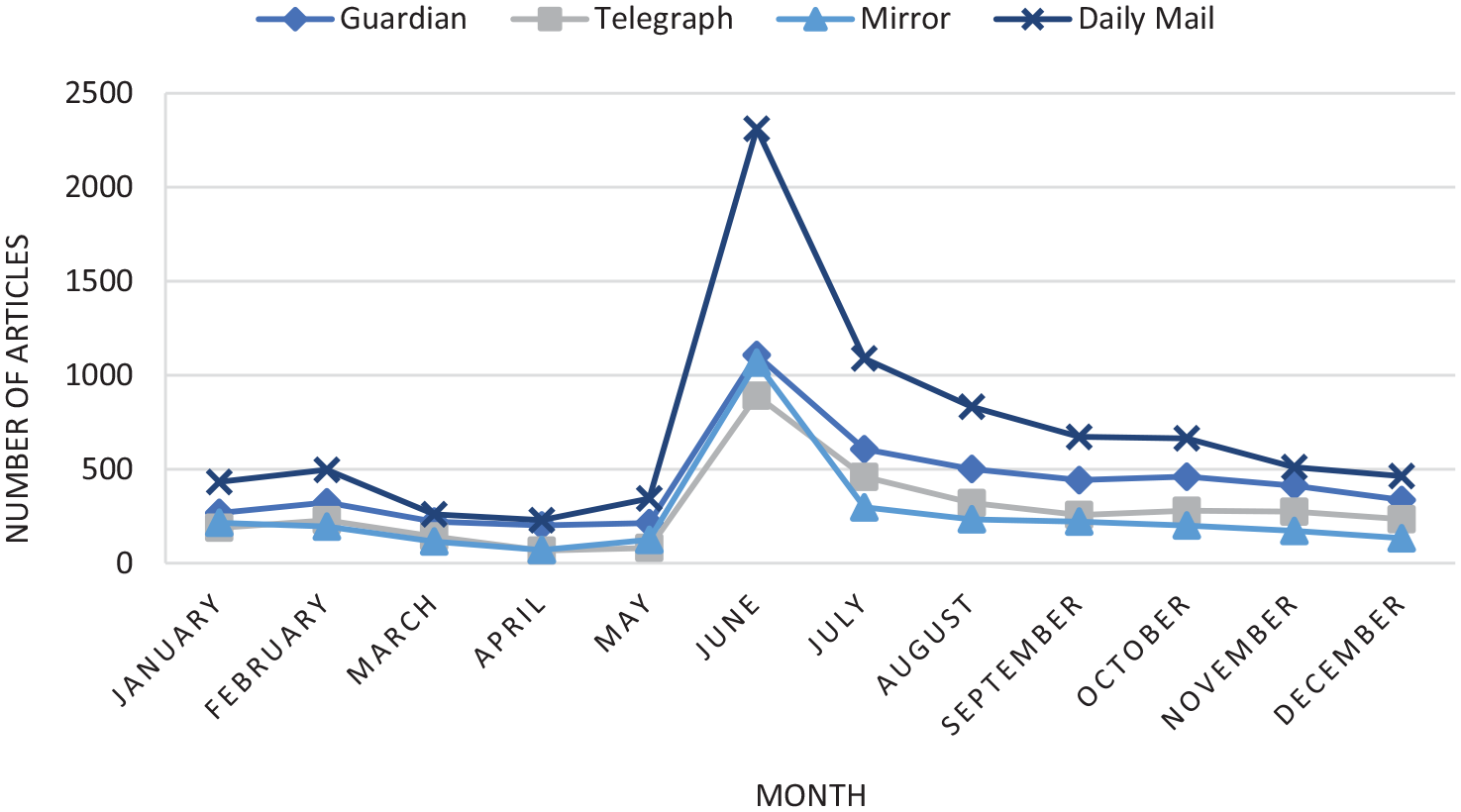
The number of articles in each newspaper per month containing the search term racis*.
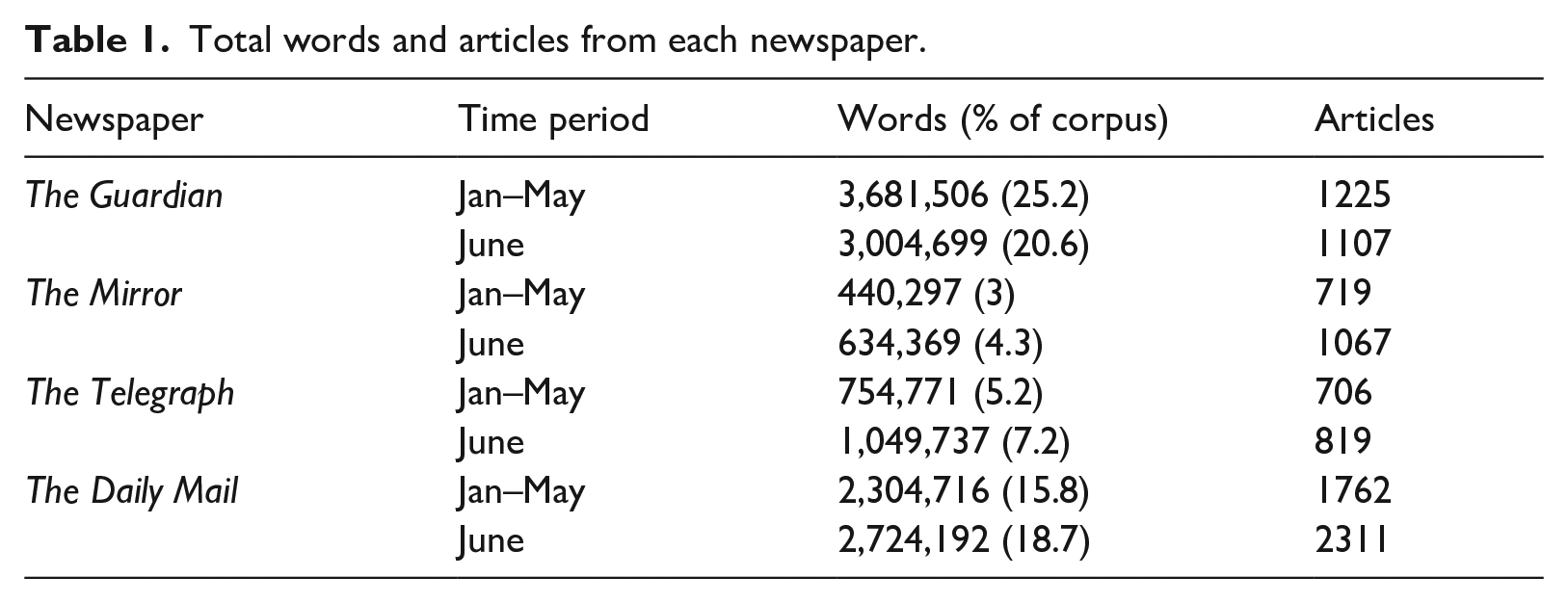
The data were organised into two sub-corpora (January–May and June), 1 which were of comparable size and provided a way of examining how racism was discussed before and during the uprisings, allowing for an analysis of the immediate effects of the protests on discourse about racism. All articles from each newspaper which included the search terms were included in the analysis, regardless of the type of article. As a result, a wide range of articles were included, such as sports, opinion pieces, news reporting, book reviews, and so on. The data collection procedure resulted in a corpus of 13,610,422 words (see Table 1 for a breakdown of the number of articles and words sourced from each newspaper in each time period).
Total words and articles from each newspaper.
Downsampling
Although the CL analysis was conducted on the entire corpora outlined above, downsampling was used to select a manageable number of texts for the DHA analysis. Corpora are typically downsampled according to principles such as frequency, representativeness, typicality, salience, and uniqueness (Reisigl and Wodak, 2016: 99). Articles were selected using ProtAnt, a software tool which produces a representative collection of articles from the corpus by computing keywords across the entire corpus and then identifying the articles which contain the greatest number of these keywords (Anthony and Baker, 2015). The primary motivation for this automated downsampling technique was to minimise researcher bias and increase representativeness of the corpus (Turner et al., 2018). To account for any loss of precision in the CL analysis and account for the time-specific context, and to have a comparable dataset for each newspaper, the same number of articles from each month were included in the downsampled January–May corpus. The five most representative articles from each month (as identified by ProtAnt) were selected from each newspaper from January to May, and 25 articles were selected from each newspaper for the June corpus. This resulted in 200 articles in total: 100 articles for each time period, with an equal number of articles from each newspaper. 2
Stages of analysis
As per the DHA, the articles were examined in two stages: an entry-level analysis and then an in-depth analysis. Both stages incorporated CL and the DHA, but the first stage relied more strongly on CL, and the second on the DHA. All of the CL analysis was conducted using SketchEngine, a web-based program which provides tools for conducting all required CL analyses as well as pre-loaded reference corpora. English Web 2015 (enTenTen15) was used as a reference corpus here due to its size (15 billion words) and proximity in time to the focus corpus compared to other available reference corpora. Each of the sub-corpora were compared individually to this reference corpus, allowing for both similarities and differences between the sub-corpora to be established. The salience of keywords was established with the in-built formula provided by SketchEngine, and the strength of collocates was established based on the LogDice score. To avoid reporting infrequent collocates, only those with a log likelihood score of at least 6.63 (p < 0.01) are included in the findings.
The first step in the analysis was to generate a list of single- and multi-word keyword lists from each sub-corpus, and a map of the key topics and sub-topics of each of the articles were identified using these keywords. Next, to obtain an understanding of the immediate contexts in which the words ‘racism’ and ‘racist’ occur, a collocation analysis was conducted on the search terms for each sub-corpus. Following this initial CL analysis, articles were downsampled according to the procedure set out above. The downsampled articles were manually coded using NVivo for strategies of nomination, predication, argumentation, perspectivation, and intensification/mitigation. Finally, a critique was formulated.
The discursive construction of racism in the January–May period
Journalists lay the groundwork for racism to be denied and debated by creating a distinction between a ‘bad’ racist out-group which exists on the margins and a ‘good’ in-group which contains the writer, the reader, and the mainstream. Whether discussed abstractly or with reference to a specific incident, racism is condemned only when it is placed within the out-group. By placing racism outside of the in-group, journalists reproduce colour-blind racial ideologies and generate debatability around racism. The main distinction between newspapers is the placement of the borders of the in-group and out-group, but in each, the positive self and negative other framing was prevalent. Therefore, many findings apply to all of the newspapers, but those which do not are highlighted.
Only bad people are racist: Creating the ‘good’ in-group
In all of the newspapers, racism was clearly regarded as morally wrong. It was often framed as an enemy which should be fought, exemplified by the common construction ‘standing up to racism’. When racism was framed as an opponent in this way, the people actually doing an act considered racist were either depicted passively or not mentioned at all. The following excerpt shows how people enacting racism can be absent from the reporting, even in an article in which the type of racism being discussed is specific acts of hate speech and physical violence:
On Thursday, actor Daniel Dae Kim . . . took aim at the racism that has affected some people of Asian background since the outbreak. (The Guardian)
This makes clear that racism is something which should be fought through the verb choice (‘took aim’). However, it is described as having ‘affected’ people of Asian background, depicting the people doing the racism as passive, rather than active participants and contributing to an understanding of racism as ‘simultaneously everywhere and nowhere’ (Titley, 2019: 1).
In most cases, however, a person accused of racism, rather than racism itself, was framed as the enemy, particularly when the form of racism being discussed was more extreme and overt. In these instances, racism tended to be conceptualised as residing within the accused individual:
‘It is chilling to think that in Australia in 2020 there are individuals with dangerous hatred in their hearts, walking our streets, who openly celebrate Hitler’s satanic ideology’, he said. (The Daily Mail)
This statement depicts racism as an irrational hatred and unequivocal evil residing in the bodies of ‘bad’ people. The distinction that this creates between racist people and ‘good’ people was strongest in articles about forms of racism associated with Nazism in right-leaning newspapers, and in this way, the meaning of ‘real racism’ is ‘frozen’ in reference to historical events, increasing the extent to which ‘new’, more covert forms of racism can be denied and debated and contributing to the acceptance of the idea that society is ‘post-race’ (Lentin, 2016). In the Mirror, one of the strongest condemnations of racism was a collection of articles about the soap Coronation Street, in which the fictional character ‘nasty racist Don’ made ‘a vile remark’, leaving fans ‘sickened’ and ‘disgusted’. The shock and outrage associated with the expression of particularly overt forms of racism, performed by a character intended to embody racism, make clear that the journalist places themselves in opposition to these practices. However, it is significant that a fictional depiction of overt racism is the most strongly condemned, as this provides a way for journalists to oppose racism conceptually without challenging real-world power structures. This is also reflected in the emphasis on criminalised forms of racism (e.g. physical violence, hate speech) which were reported on frequently (though to a lesser extent in the Guardian compared to the other newspapers). By placing racism within ‘bad’ racists and suggesting that racism tends to be extreme, shocking, and obvious, it is erroneously placed in the margins of society (Gilroy, 1990: 51; Mondon and Winter, 2020: 127).
Although all of the newspapers engaged to some extent with the idea of systemic racism, whether in relation to the UK government (The Daily Mail, The Mirror, The Telegraph), the media (The Daily Mail), systemic violence in the United States (The Daily Mail), or US government policy (The Guardian), the conceptualisation of racism as systemic and racism as existing within bad racists was often articulated simultaneously within the same article:
[About the shooting of Ahmaud Arbery] ‘It is systemic violence’, the progressive freshman congresswoman [Alexandria Ocasio-Cortez] posted . . . ‘Please safely support this family whose loved one was murdered in cold blood while jogging by gun-toting Trump supporting White supremacists’, director/writer Ava DuVernay said on Twitter [emphasis added]. (The Daily Mail)
Even within articles which discussed systemic forms of racism, manifestations of racism were commonly personified in this way. In multiple articles, when racism was discussed in the context of an institution, it was seen as being caused primarily by bad individuals within the institution. In articles about racism in the UK government, the institution itself was depicted as not racist, or at least neutral, while Boris Johnson was referred to as a ‘real racist’ (The Guardian). As a result, the solution to racism was implicitly or explicitly framed as removing ‘real’ racist individuals from supposedly non-racist institutions:
The Government’s hiring process has to be ‘looked at’ in order to prevent ‘racists’ from working in Number 10, Kwasi Kwarteng has said . . . We should prevent racists from coming into Number 10. (The Telegraph)
This type of construction suggests that once the individual racists are removed, racism will cease to exist, and crucial to this understanding of racism is that those who are not racist do not participate in it. Particularly in articles about institutions and governments, the ‘good people’ were those identified as being in the reasonable ‘mainstream’:
One of the tests for the new leader must be whether or not they are committed to eradicating anti-Semitism from the mainstream of the Labour party [emphasis added]. (The Telegraph)
The use of ‘eradicate’ here suggests that racism is an outside agent infiltrating the in-group. This was echoed in discussions of racism as a disease or a poison in the right-leaning newspapers (and once in The Mirror):
Their words would have much more weight if the Labour Party had not been poisoned by racism against Jewish people under Jeremy Corbyn’s leadership. (The Telegraph) There is no perfect cure to this disease of racism. (The Daily Mail)
The boundaries created around the ‘healthy’ society by this metaphor construct an in-group being infiltrated by racism (usually taking the form of ‘bad’ individuals). However, this ‘disease’ metaphor misses that society is designed around racism and racial hierarchy, so racism is the ‘normal’ state of society as it exists today (Delgado and Stefancic, 2017: 8; Warmington, 2020).
Through the construction of an out-group, racism is kept conceptually separated not only from the ‘self’ (in this case, the journalists, sources, and/or readers), but also from everyday life and social structures. By defining the in-group through disassociation with an out-group which exists on the margins, this leads to the assumption that the mainstream in-group, being ‘good’ and innocent, do not require scrutiny, since they frequently condemn racism and make an effort to distance themselves from racists (Andrews, 2018). Rather than being seen as formed by a racist society, individual racists are represented as outsiders to a tolerant society, and the implications of this are significant: Mondon and Winter (2020) argue that the liberal mainstream not examining and dealing with its own racism has facilitated the return of illiberal racist discourses and actions.
The perspective of the journalist
The discursive placement of the journalist in relation to key actors in the articles further entrenches the good–bad binary, with the vast majority of articles being centred around the ‘bad’ racist, and sometimes the ‘bad’ accuser. Accusations were almost always distanced from the journalist and framed from the perspective of an outside accuser through the use of sources and quotations:
His comment was condemned as racist by some commentators. (The Guardian)
By providing a ‘balance’ of perspectives from both the accused and accuser, but rarely accusing anyone directly, journalists can manage their positive self-presentation by distancing themselves from racism. Racism was named from the perspective of the journalist in only six cases, including:
The new spokesman for the Department of Health and Human Services made a series of now-deleted tweets that included racist and xenophobic language about Chinese people . . . Racism is littered in the tweets. (The Daily Mail) A real democracy is . . . not the one that, in 2016, yielded a result where whites were the only group to vote in the majority for the incompetence, misogyny, racism, xenophobia and corruption of Donald Trump. (The Guardian)
The types of racism directly named by journalists were always in cases where the racism can easily be placed within the out-group. In the first example, the accused person used overtly racist language, and in the second, the person accused was Donald Trump, who was frequently depicted as existing within the racist out-group and threatening liberal (non-racist) order, particularly in the Guardian. The management of the journalistic voice in relation to key actors is therefore an important strategy through which racism by default excludes the in-group, the mainstream, and the writer, allowing any accusations of racism towards the in-group to be denied and debated.
If someone is good, they cannot be racist: Denial and debatability
Discussions of racism in all of the newspapers tended to be actor-centric, allowing accusations of racism to be framed as part of an interpersonal ‘row’:
No 10 must look at hiring process after Andrew Sabisky ‘racism’ row, says minister. (The Telegraph)
This is reflected in a collocation analysis of the corpus, which showed that ‘row’ was the most frequent noun modified by ‘racism’. The effect of this is to minimise claims that racism has taken place by depicting it as an insignificant argument between individuals. In addition, the use of air quotes distances the journalistic voice from the process of naming racism, further contributing to its debatability. At times, the debate about what counts as racism was positively framed as democratic. By associating debatability with the positive qualities of ‘democracy’, it was implied that debating racism was in fact a good thing:
Anti-racism campaigner Trevor Phillips has accused the Labour party of shutting down ‘healthy debate’, after being suspended over allegations of Islamophobia . . . Mr Phillips described Labour as ‘a great party collapsing into a brutish, authoritarian cult’. (The Telegraph)
By representing claims of racism as a row, and framing such disagreements as positive and progressive, racism is depicted as almost always debatable. As well as failing to recognise the power struggles inherent in deciding who gets to define racism, this has real political consequences because debatability is ‘a dimension of how racisms change size, contours and function’ (Titley, 2019: ix). Rather than being a positive feature of a democratic society, it represents an important dimension of how racism continues to be reproduced. This perpetuation of racism is not achieved through silencing those who speak about it, but through the excessive attention paid to whether a particular accusation of racism really is racism, which makes space for racism to be consistently denied (Titley, 2019: 1).
Debatability creates the conditions for outright denials of racism, and the assumption that good people cannot participate in racism formed the basis of many of these denials. Based on the argument that ‘only bad people are racist’, articles in which an individual (or sometimes an institution or nation) is accused of racism often included an explicit denial that any racism had taken place:
Dele is a great guy. The last thing he is is anything connected with racism or disrespect. Absolutely not. (The Mirror)
When the accused person was considered part of the in-group, accusations were represented as a personal attack on the accused person’s good character. In an event discussed in three of the newspapers, the World Health Organization (WHO) director general said that ‘he had been subjected to months of attacks, including racist ones against him and black communities, and accused Taiwan of condoning the “campaign”’ (The Guardian). In response, ‘Taiwan’s foreign ministry demanded a clarification and apology for the “groundless” accusation and an “extremely irresponsible act of slander”’, saying ‘we can relate [to Tedros] and we condemn any form of discrimination and injustice’ (The Guardian). In an article on the same topic in the Daily Mail, the following was written:
It [Taiwan’s foreign ministry] added that Taiwan is a ‘mature, highly sophisticated nation and could never instigate personal attacks on the director-general of the WHO, much less express racist sentiments’.
Although drawing on ideas of national character rather than personal character, it is clear that the accusations of racism are framed as an insult, requiring the accused party to defend their progressive and sophisticated character. In this case, the citizens of Taiwan (‘we’) are good people who condemn racism and would never participate in it. Since denials are often based on the placement of real racism outside of mainstream society, those in the in-group can place themselves as separate from their own construction of ‘bad’ racists. This strategic definition of racism rejects that mainstream society and ‘good’ people participate in racism (Delgado and Stefancic, 2017: 7).
In summary, although illiberal forms of racism are readily acknowledged and condemned (particularly when an official body, such as a court or sports organisation, has ‘deemed’ an action racist), many other examples of racism are denied or debated, particularly when the person accused of racism is considered part of mainstream society. This can be seen as a strategic move which allows the in-group to construct themselves as post-racist (Mondon and Winter, 2020: 38). Overall, the ways that accusations of racism manifest in the UK press has not changed a great deal since Van Dijk’s (1993) study Elite Discourse and Racism. In this text, he outlines the ways in which denials of racism facilitate ‘social face-keeping’, the maintenance of a positive self-image, the delegitimisation of resistance, and, crucially, the reproduction of racism (p.193). By deflecting racism, fostering denial and debatability around accusations of racism, and constructing a definition of racism which comprises only a small set of actions perpetrated by outsiders, journalists minimise the extent to which racism can be understood as affecting every aspect of social life, simplifying both its causes and effects.
Re-creating the out-group during the protests
In the January–May corpus, colour-blind racial ideologies were reinforced through an emphasis on individualised forms of racism (Doane, 2006). During the protests which took place in response to the killing of George Floyd in police custody, one of the primary differences in reporting was the frequency with which systemic forms of racism were discussed. ‘Systemic’ appeared as a modifier of ‘racism’ 84 times between January and May, compared to 821 times in June. ‘Systemic racism’, ‘police brutality’, and ‘anti-racism’ appeared as keywords in each of the newspapers in June. However, rather than signalling the end of the prevalence of colour-blind ideologies, this section will explore how colour-blind narratives have adapted to the increased attention being paid to systemic racism.
Alongside the renewed focus on systemic racism, examples of individual racism were still frequently discussed, particularly in Daily Mail articles about reality TV stars’ ‘racist remarks’, ‘racist tweets’, ‘racist actions’, ‘racially-insensitive comments’, or ‘posting shockingly racist and degrading sexual imagery’. Like in the earlier time period, these articles tended to focus on the people accused of racism and the impact it had on them, often detailing what the accused person lost as a result of their actions, while erasing the victim(s) from the narrative. Taking the articles as a whole, though, victims of racism were more likely than before to be present compared to the earlier corpus, primarily because George Floyd was mentioned, at least in passing, in the vast majority of articles.
In many of the articles, like earlier in the year, an out-group of ‘bad racists’ was constructed. However, because many discussions of racism were less personalised overall, the distinction between good and bad people was less profound than in the January–May corpus. In the Guardian (and to a lesser extent in the Telegraph and Daily Mail), Donald Trump was frequently in role of ‘bad racist’, often criticised but quoted repeatedly:
Donald Trump calls Covid-19 ‘kung flu’ at Tulsa rally; Civil liberties groups have warned use of terms such as ‘Chinese virus’ can inspire racism against Asian Americans. (The Guardian)
In other newspapers, the far right and white supremacists were the ‘bad racists’, drawing focus and criticism from across the political spectrum:
She [Priti Patel] said: ‘They [far-right protesters] were violent, they were aggressive and abusive towards police officers. They were patently racist’. (The Telegraph) [Sadiq] Khan said . . . ‘extreme far-right groups who advocate hatred and division are planning counter-protests, which means that the risk of disorder is high’. (The Mirror)
As before, this allows racism to be deflected from the mainstream onto those considered racist outliers, a group conceptually separated from the ‘self’. Journalists directly named interpersonal forms of racism without the use of hedging or air quotes to around the same extent as earlier in the year:
Donald Trump used racist language to describe the coronavirus pandemic. (The Guardian) A day earlier, protestors in Nashville, Tennessee, toppled a statue of Edward Carmac, a racist politician and newspaper publisher. (The Daily Mail)
Again, they tended to only use such direct language about situations in which the person being accused of racism had been established as being in the out-group. Trump was often seen as part of the out-group in the Guardian, and in the example from the Daily Mail, the person they are referring to died in 1908 and expressed explicitly illiberal views. Crucially, this willingness to directly name racism in the out-group allows journalists to maintain their positive self-image by relying on the question: ‘How can we be racist when we denounce the real racists?’ (Mondon and Winter, 2020: 68).
While the continued emphasis on ‘bad racists’ alongside frequent discussions of systemic racism may appear contradictory, it can be interpreted as a positive self-presentation strategy which allows journalists, businesspeople, and politicians to place themselves in opposition to all forms of racism without necessarily acknowledging their involvement in it. Even within discussions of systemic racism, racism was deflected from the ‘good’ in-group in the ways that racism within institutions was abstracted:
The NFL announced an increased financial commitment of $250m over 10 years to ‘combat systemic racism and support the battle against the ongoing and historic injustices faced by African-Americans’. (The Guardian)
This frames racism as coming from the outside and not being caused by the organisation itself, and is reflected in the continuation of the ‘disease’ metaphor:
Prime Minister Boris Johnson’s spokesman said earlier that more needs to be done to eradicate prejudice and create opportunity for all in Britain. (The Telegraph)
This again depicts racism as an outside agent, distancing the government from racism and solutions to it by using the abstract value of ‘opportunity’ as a potential solution, without saying what this means or how it would be achieved.
Although systemic racism is readily acknowledged, it is represented as a ‘bad’ abstract entity which becomes easy to disidentify from because it is so abstracted (Ahmed, 2012: 46). This allowed right-leaning newspapers in particular to acknowledge and oppose systemic racism while also negatively portraying protesters moving beyond a conceptual resistance to racism as ‘anarchists and vandals’ (The Telegraph). This response is mirrored in media coverage of historical anti-racist movements and protests (Ince et al., 2017). News media are central in the construction of moral panics (Tong and Zuo, 2019), and there is a long history of UK newspapers constructing moral panics around Black people in particular, including those protesting anti-Black racism (Hall et al., 1978; Solomos, 2011).
Across all of the newspapers, the solutions to racism which were articulated rarely advocated for systemic changes and instead appealed to the values of peace, acceptance, and, most of all, speaking out against racism:
Williams driver George Russell tweeted: ‘Now more than ever, we need peace and equality in this world. It’s time we all stand together and kick racism out of our societies. Use your voice, spread awareness’. (The Telegraph) Obama urged Americans to start with ‘self-examination’ and to listen to people who are from different walks of life . . . ‘It ends with justice, compassion, and empathy that manifests in our lives and on our streets’. (The Daily Mail) Love Island presenter Whitmore took to Instagram to encourage people to be actively and vocally anti-racist, sharing images and quotes with impassioned captions. (The Mirror) One protester, Donna Ali, told the BBC: ‘If you’re silent, you’re not going to change anything. It’s something we’ve experienced for many years, whether it’s in the US or the UK. It’s really heart-breaking that people can’t see past the colour of skin’. (The Guardian)
These can be viewed as examples of ‘antiracist incorporation’, a form of argument which frames itself as anti-racist but perpetuates racial injustice by ‘appropriating, incorporating, misusing, and neutralizing antiracist discourses’ (Tomlinson, 2019). Unlike previous forms of colour-blindness, which denied the existence of systemic racism, anti-racist incorporation openly articulates the problem of racism. However, it only endorses sanitised forms of anti-racism, thereby defusing discourses which seek to dismantle the status quo and, like colour-blind racial ideologies, contributes to the continuation of the racist system (Blake et al., 2019: 21).
Conclusion
Echoing existing research, this study has found that, prior to the 2020 uprisings, while illiberal racism was readily acknowledged in the UK press, racism tended to be discussed mostly within these limited bounds in both left-leaning and right-leaning newspapers (Moore and Greenland, 2018). Racism was stripped of a structural analysis and seen as primarily about individual behaviour, reinforcing colour-blind racial ideologies. Journalists created a simplified binary between racist people and ‘good’ people. However, locating ‘real’ racism within ‘bad’ individuals, particularly when those individuals are framed as outliers, prevents an engagement with the multitude of ways that racism fundamentally shapes social, political, and economic life. Because the writers construct an in-group around themselves, they are given the power to define racism in a way that deflects it from themselves and the mainstream, ultimately facilitating its minimisation and debatability. Although, in June, the concept of systemic racism appeared much more frequently in all of the newspapers, the ways that racism was discussed in both time periods can be seen as upholding discourses of colour-blindness and liberal racism. To manage the contradiction of an increased focus on systemic racism alongside a deflection from journalists and mainstream institutions, writers employed positive self-presentation strategies to continue to place themselves in opposition to any form of racism. Long-term trends will need to be analysed in order to account for the ongoing effects of the protests on discourse about racism, but this study has shown that while some progress in foregrounding systemic issues has been made, much of the reporting remains grounded in denial and deflection, allowing journalists to stand against racism in the abstract while diminishing possibilities for structural change.
Footnotes
Funding
The author(s) disclosed receipt of the following financial support for the research, authorship, and/or publication of this article: This research was funded by the Economic and Social Research Council.
