




Abstract
Previous research has highlighted how ideological factors such as political self-identification, religiosity and conspiracy thinking influence our beliefs about scientific issues such as climate change and vaccination. Across three studies (combined N = 9,022) we expand on this line of inquiry to show for the first time that the ideological attitudes relating to authoritarianism and group-based dominance predict disagreement with the scientific consensus in several scientific domains. We show these effects are almost entirely mediated by varying combinations of ideological (political ideology, religiosity, free-market endorsement, conspiracy thinking) and science-specific (scientific knowledge, trust in scientists) constructs, depending on the scientific issue in question. Importantly, a general distrust of science and scientists emerges as the most consistent mediator across different scientific domains. We find that, consistent with previous research, the ideological roots of rejection of science vary across scientific issues. However, we also show that these roots may share a common origin in ideological attitudes regarding authority and equality.
Keywords
Climate change deniers, anti-vaxxers and anti-GM campaigners: groups of people characterised by sometimes vehement denial of the conclusions of scientific research. This “rejection of science” poses a problem for modern society, the spread of doubt and misinformation from these groups can have negative – and potentially tragic – consequences (Lewandowsky & Oberauer, 2016). 1 The natural response of many scientists confronted with counter-scientific beliefs is to provide ever more evidence to support the scientific position (Simis et al., 2016). However, rejection of science is not simply a symptom of lack of knowledge. Some people refuse to shift their beliefs in the face of evidence (Kraft et al., 2015). This behaviour has spurred social scientists to examine how individuals’ social beliefs and values drive their understanding of scientific issues (for reviews see Hornsey & Fielding, 2017; Lewandowsky & Oberauer, 2016; Rutjens et al., 2018). In this regard, a general distrust of, or lack of faith in, science as an enterprise explains some variation in people’s beliefs about scientific issues; however, there are much broader sets of beliefs and values which also have a bearing on rejection of science (Hartman et al., 2017).
Ideologies – in their broadest sense, coherent and stable sets of beliefs and values (Knight, 2006) – play a role in how people think about science. Both political ideology and religiosity are predictors of rejection of science, although the involvement of these belief systems largely depends on the issue under consideration (Rutjens et al., 2017). For example, political conservatism is consistently linked with climate change denial but rarely with opposition to the scientific consensus on GM food safety (Drummond & Fischhoff, 2017; Rutjens et al., 2017). Religiosity is a well-established predictor of denial of the theory of evolution, but explains little variance in peoples’ beliefs about climate change once political ideology is taken into account (Ecklund et al., 2017).
While politics and religion are noted correlates of rejection of science on some issues, recent research has uncovered further predictors which can be thought of as ideological in nature. “Conspiracy mentality” has been described as a “stable ideological belief system” (Imhoff & Bruder, 2014, p. 26) based around the perception that secret, powerful groups are behind important social, political or economic events. People who exhibit this propensity to endorse conspiracy theories are more likely to reject scientific findings across a number of issues, including: climate change, vaccines, evolution, GM food, HIV, and the link between cancer and smoking (Lewandowsky, Gignac, & Oberauer, 2013; Lewandowsky, Oberauer, & Gignac, 2013; Lobato & Zimmerman, 2019). People with an ideological commitment to free market principles are also more likely to disagree with mainstream science on climate change and medical issues (Lewandowsky, Gignac, & Oberauer, 2013; Lewandowsky, Oberauer, & Gignac, 2013).
Psychological research has sought to understand the deeper individual differences, such as personality traits, values and worldviews, upon which different ideological positions are based. One of the most promising approaches is found in Duckitt and Sibley’s Dual Process Model (DPM), which positions the “ideological attitudes” right-wing authoritarianism (RWA) and social dominance orientation (SDO) as drivers of a range of socio-political attitudes, including conservatism, racism and prejudice (Duckitt & Sibley, 2009). Right-wing authoritarianism comprises three covarying attitudinal clusters: authoritarian submission, authoritarian aggression, and conventionalism (Altemeyer, 2006, p. 35). Social dominance orientation is defined by Sidanius and Pratto as “the degree to which individuals desire and support group-based hierarchy and the domination of ‘inferior’ groups by ‘superior’ groups” (Sidanius & Pratto, 1999, p. 48). In the context of the Dual Process Model, Duckitt and Sibley (2016) describe these ideological attitudes as “two broad motivationally (or value) based social attitude or ideological dimensions” (p. 190).
Recent research has explored the role of RWA and SDO in climate change denial, demonstrating that these stable ideological attitudes robustly predict rejection of the mainstream scientific consensus that human-caused climate change is occurring (Stanley & Wilson, 2019). At the same time, no research has examined the role of these ideological attitudes in beliefs about other areas of publicly contested science, such as vaccination. However, there is good reason to believe that ideological attitudes would predict rejection of science across a range of issues. Notably, RWA and SDO predict all the aforementioned ideological correlates of rejection of science: political conservatism (Duckitt & Sibley, 2009; Wilson & Sibley, 2013), free-market ideology (Buckland, 2014; Jost et al., 2003), conspiracy mentality (Grzesiak-Feldman & Irzycka, 2009; Wilson & Rose, 2014), and religiosity (RWA only; Altemeyer, 1998; Wilson & Sibley, 2013). We would therefore expect the ideological attitudes RWA and SDO to be associated beliefs about a range of scientific issues, with effects mediated by different ideological constructs depending on the specific issue in question. However, the extent to which conservative political ideology, free-market ideology, religiosity and conspiracy would mediate the effect of RWA and SDO on belief in specific scientific findings, when considered in combination, is unclear. These ideological constructs are intercorrelated, but little research has examined their unique effects in multivariate models. For example, Rutjens et al.’s (2017), examination of the ideological correlates of rejection of science (specifically climate change, vaccination and GM food) did not include conspiracy thinking, and Lewandowsky, Gignac, and Oberauer’s (2013) similar modelling excluded religiosity.
In terms of explaining possible links between RWA, SDO and rejection of science, the current study focuses on the four ideological constructs outlined above (political ideology, free-market endorsement, conspiracy mentality and religiosity). We acknowledge that there are further possible factors at play (e.g., moral foundations, Amin et al., 2017; or system justification, Feygina et al., 2010; Hennes et al., 2016) but have limited our focus here to conceptually distinct constructs which have been shown to predict rejection of specific scientific findings in multiple domains.
Further, no studies have specifically examined RWA and SDO as predictors of attitudes to science and scientists more generally. Here we offer a tentative argument that ideological attitudes would also predict negative perceptions of scientists. More socially dominant individuals may be cynical about science and scientists because they perceive scientists as challenging hierarchical social structures. A great deal of scientific research takes place in universities and the public situate science in a university context (Bainbridge, 2015). This is important, as Social Dominance Theory highlights universities as examples of hierarchy-attenuating social institutions, that is, they function to decrease inequalities (Sidanius et al., 1991; Sinclair et al., 1998). Douglas (2015) also speculates that hierarchy-valuing individuals are likely to be less trusting of science as it is based on an “epistemic community that values recognizing that each scientist ‘stands on the shoulders of giants’ (i.e., all the other scientists who came before) and for which community criticism is part of the assurance of reliable knowledge” (p. 298). Thus, we might expect those who reported greater endorsement of SDO to be critical of scientists as members of hierarchy-attenuating institutions. However, we must recognise the possibility that a perception of scientists (and universities) as elite and hierarchical could lead high-SDO individuals to form positive evaluations of scientists.
Considering these two possibilities, we find there is some empirical support for SDO predicting negative attitudes towards scientists – if we consider constructs analogous to SDO. Within the “Cultural Cognition” framework, Kahan (2012a, 2012b) employs a measure of a hierarchy-endorsing cultural worldview: the Hierarchy–Egalitarianism scale. This scale has some conceptual overlap with the SDO scales employed in Social Dominance Theory (Sidanius & Pratto, 1999), including items such as “We have gone too far in pushing equal rights in this country” and “Our society would be better off if the distribution of wealth was more equal” (reverse coded). Hartman et al. (2017) included the Hierarchy–Egalitarianism scale in their validation of the Credibility of Science scale and report the two measures are moderately negatively correlated (r = –.45). That is, people who endorse a hierarchical structure of society are less likely to perceive scientists as credible.
There are theoretical reasons to expect that RWA is also associated with negative attitudes towards scientists and science more broadly. Scientists, as a group, may be perceived as challenging established authorities and violating moral norms. Rutjens and Heine (2016) provide data that support this assumption. Respondents to an online survey perceived scientists (compared to “regular people”), as less religious and as valuing knowledge, curiosity and exploration over “doing the right thing”, morality and “following the norms”. Reinforcing this, scientists were also perceived as less likely to endorse the binding moral foundations outlined in Moral Foundation Theory (Graham et al., 2011): loyalty, authority and purity. Previous research has mapped moral foundations onto RWA, finding that authoritarians place greater value on the binding foundations (Federico et al., 2013). Thus, high RWAs may see scientists as moral deviants or following a “different moral compass”.
One can also frame the potential conflict between ideological attitudes and science in terms of the norms of science. For instance, sociologist Robert Merton identified four key sets of values attached to the idealised pursuit of science: communism, universalism, disinterestedness, and organised scepticism (Merton, 1973; see also Rutjens et al., 2018). We can contrast these norms with values embraced by high RWA and SDO people. Communism, the free sharing of ideas and information, and universalism, the openness of science to all comers, conflict with the competitive and hierarchical beliefs of high SDOs. Disinterestedness, a lack of ideological loyalty, and scepticism, a questioning of tradition and established authority, conflict with the in-group loyalty and unquestioning obedience to authority of high RWAs. Merton (1973) writes that conflict with the norms of science likely manifests as a general opposition to science which “may exist quite apart from the introduction of specific scientific discoveries which appear to invalidate particular dogmas of church, economy, or state. It is rather a diffuse, frequently vague, apprehension that scepticism threatens the current distribution of power” (p. 278). To summarise, in the case of those who score relatively higher on RWA and SDO, a perceived lack of shared values with scientists and a perception that scientists threaten hierarchies and challenge authorities could underlie a distrust of science, which in turn leads to rejection of science (Fiske & Dupree, 2014; Hartman et al., 2017).
In terms of the scientific issues we draw upon as examples of rejection of science, we include in the current research the following claims – all supported by a scientific consensus: the reality of anthropogenic climate change (Cook et al., 2016), the safety of genetically modified food (National Academies of Sciences, Engineering, and Medicine, 2016b) and the safety and efficacy of vaccines (Omer & Yildirim, 2019). These three topics have been included in key studies investigating the ideological correlates of rejection of science (Lewandowsky, Gignac, & Oberauer, 2013; Rutjens et al., 2017). In Studies 2 and 3 we expand on the scope of this research and investigate two additional issues, agreement that community water fluoridation for the protection of dental health is safe and effective (Royal Society of New Zealand, 2014), and belief that humans evolved from earlier species (Dobzhansky, 1973).
The purpose of the following studies is twofold. First, we aim to establish if the two key constructs of the Dual Process Model, RWA and SDO, predict acceptance/rejection of science across a range of issues (Study 1). Second, we examine whether, and to what extent, several related ideological and science-specific constructs mediate these effects in US and New Zealand samples (Studies 2 and 3).
Study 1
Methods
Participants
Participants in the study were students enrolled in an introductory psychology course at Victoria University of Wellington in 2017. A total of 547 participants took part in the study (415 women, 128 men and four reporting non-binary or no gender). Ages ranged from 16 to 64 years of age (M = 19.19, SD = 3.56).
Materials
The following measures were embedded in a larger omnibus survey covering a wide range of topics. Responses to all items were captured on a seven-point Likert scale ranging from 1 (strongly disagree) to 7 (strongly agree). All scales demonstrated satisfactory reliability (see Table S1 in the online supplemental material).
Participants completed Altemeyer’s (1996) 30-item RWA scale (example item: Obedience and respect for authority are the most important virtues children should learn; α = .95) and the 16-item SDO7 scale (Ho et al., 2015) (example: We shouldn’t try to guarantee that every group has the same quality of life; α = .90). Rejection of science-dependent variables included Lewandowsky, Gignac, and Oberauer’s (2013) five-item scale capturing belief that human activity is causing climate change (example: Human CO2 emissions cause climate change; α = .75), Dixons’ (2016) three-item GM food safety scale (example: GM food is safe to eat; α = .86). A single item measured acceptance of vaccine safety: Vaccines are safe. Responses were coded such that higher values indicated greater agreement with the scientific consensus position.
Procedure
Participants completed the survey online on the SurveyMonkey platform in return for partial fulfilment of a mandatory course research component. Participants provided informed consent and were fully debriefed at the end of the survey. The study was approved by the Victoria University of Wellington School of Psychology Human Ethics Committee (application number: 0000023961).
Results
Students generally endorsed the scientific consensus position, with mean scores above the midpoint on the climate (M = 5.59, SD = 0.91), GM (M = 4.22, SD = 1.21) and vaccine (M = 5.69, SD = 1.27) science scales. Mean scores on the RWA and SDO scales were below the midpoint (MRWA = 2.64, SD = 0.89; MSDO = 2.81, SD = 0.89). Intercorrelations are reported in Table S1 in the online supplemental material. For each of the three scientific issues, agreement was regressed onto RWA, SDO, age and gender. All regressions were significant, Fs(4, 538) > 16.90, ps <.001, and revealed both RWA and SDO to be negative predictors of agreement that: anthropogenic climate change is occurring (βRWA = –.36, p < .001; βSDO = –.24, p < .001), GM food is safe to eat (βRWA = –.20, p <.001; βSDO = –.12, p < .05), and vaccines are safe (βRWA = –.24, p <.001; βSDO = –.12, p < .05; see Table S2 in the online supplemental material). The results indicate that students who endorse authoritarian or socially dominant values are more likely to hold beliefs in opposition to established scientific consensus regarding climate change, GM food and vaccination.
Study 2
In Study 2 we sought to replicate Study 1 results in an online US sample and identify potential mediators of the effects of RWA and SDO on agreement with scientific claims. Specifically, we included several theorised ideological consequents of RWA and SDO known to predict rejection of science on some debated issues: political ideology, religiosity, free-market ideology and conspiracy mentality. Additionally, we assessed perceived credibility of scientists and included a set of true/false items as a brief measure of science literacy. Here we also expanded the number of publicly debated scientific issues examined, adding brief measures of belief in evolution (i.e., agreement that humans evolved from earlier species), and water fluoridation safety and efficacy. We also replaced the single vaccination item with a multi-item measure of vaccine safety and efficacy beliefs and used shorter measures of authoritarianism (Duckitt et al., 2010) and SDO (Ho et al., 2015).
Methods
Participants
Participants were recruited via the Prolific Academic platform (prolific.ac), with participation limited to US-based individuals only. A total of 710 individuals completed the survey. Participants who failed either of two attention checks (e.g., “Please select ‘agree’ for this statement”; Gummer et al., 2018) embedded in the survey were removed from the sample (47 participants).
There was a relatively even split of gender in the remaining sample with 325 women (49.0%), 316 men (47.6%) and 22 participants reporting no or non-binary gender (3.3%; excluded from analyses). Age was captured on a 12-point scale, with 25–29 years the median and modal response. Most participants identified as White (76.3%), followed by Black/African American (10.4%), Asian (10.3%), Hispanic/Latino (3.8%) and other (3.7%).
Materials
In discussing the variables examined in this study we differentiate between the ideological attitudes RWA and SDO and other ideological constructs (religiosity, conservatism, free-market ideology and conspiracy mentality) which we will refer to as ideological mediators, given their role in the current study and their more theoretically proximal role as foundations for issue-based attitudes. We refer to science literacy and perceived credibility of scientists as science-specific mediators and the dependent variables capturing agreement with the scientific consensus are collectively referred to as rejection of science variables, although higher scores indicate greater agreement with the consensus position (Lewandowsky, Gignac, & Oberauer, 2013; Rutjens et al., 2017). Unless otherwise specified, all responses were recorded on seven-point Likert scale (strongly disagree to strongly agree). With one exception, noted below, all scales demonstrated satisfactory reliability (see Table S3 in the online supplemental material).
Ideological attitudes
Participants completed Duckitt et al.’s (2010) 18-item revised form of Altemeyer’s (1996) RWA scale (example item: Obedience and respect for authority are the most important virtues children should learn) and the shortened eight-item SDO7 scale (Ho et al., 2015) (example: We shouldn’t try to guarantee that every group has the same quality of life).
Ideological mediators
Political ideology was calculated as the average score of responses to three items asking participants to indicate their political position generally, and on social and economic issues. Responses were recorded on a seven-point scale ranging from very liberal (1) to very conservative (7). Religiosity was measured using the brief version of the Santa Clara Strength of Religious Faith Questionnaire (Plante et al., 2002) (example: My faith impacts many of my decisions). Free-market ideology was measured using Heath and Gifford’s (2006) five-item scale (example: The free-market system is likely to promote unsustainable consumption – reverse coded). 2 Conspiracy mentality was measured using Bruder et al.’s (2013) five-item Conspiracy Mentality Questionnaire (example: I think that there are secret organisations that greatly influence political decisions).
Science-specific mediators
Science literacy was captured using an adapted version of the National Science Foundation’s science literacy scale, a widely used true/false test of general science knowledge (example: Electrons are smaller than atoms; Miller, 2004). Following the recommendations of Roos (2014), we removed items relating to evolution, the Big Bang and continental drift from the original scale, as these tap a religious dimension. In addition to providing a true/false response for the remaining eight items, participants also reported how confident they were of each of their answers on a four-point scale ranging from very unsure to very sure. Answers and certainty were combined such that scores for each item ranged from 1 (incorrect and very sure) to 8 (correct and very sure). This approach is similar to that of Nisbet et al. (2015) and others in creating a continuous rather than dichotomous response set for these items. A scale formed from the average of these scores displayed only marginal reliability (α = .63), but was retained to allow comparison with other studies, given the widespread use of these items as a measure of scientific knowledge (Allum et al., 2008). Perceived credibility of scientists was measured using Hartman et al.’s (2017) six-item Credibility of Scientists Scale (COSS; example: People trust scientists a lot more than they should). Following the recommendation of Hartman et al., scores on the COSS were reversed such that higher values indicated greater perceived credibility of science and scientists.
Rejection of science
Participants’ beliefs about scientific issues were measured using five separate scales. Belief in the existence of human-caused climate change was measured using Lewandowsky, Gignac, and Oberauer’s (2013) five-item scale (example: Human CO2 emissions cause climate change). Dixon’s (2016) three-item scale measured agreement that GM food is safe to eat (GM food is safe to eat). Agreement that vaccines are safe and effective was measured with Lewandowsky, Gignac, and Oberauer’s (2013) five-item scale (Vaccines are a safe and reliable way to avert the spread of preventable diseases). Acceptance of the theory of evolution was measured with two items (Human beings, as we know them today, evolved from earlier species; and Humans evolved from earlier primate ancestors over millions of years; r = .93). As there were no established and well-validated scales for assessing attitudes towards fluoridation, agreement that community water fluoridation is safe and effective was captured using a new scale with four items covering both the purported negative and positive health effects of fluoride (Royal Society of New Zealand, 2014), with an equal number of positive and reverse items (examples: Community water fluoridation is effective in reducing tooth decay; Adding even small amounts of fluoride to drinking water can have harmful effects on those who drink it). A principal components analysis (varimax rotation) indicated all items loaded (.84 or higher) onto a single factor explaining 81.54% of variance.
Procedure
Participants who registered to undertake the survey were directed to the Qualtrics survey platform (qualtrics.com) and provided informed consent before starting the survey and completing all measures. Participants read a debrief at the end of the survey and received US$1.60 compensation via the Academic Prolific platform. The study was approved by the Victoria University of Wellington School of Psychology Human Ethics Committee (application number: 0000025633). Data were cleaned, and descriptive and inferential statistics calculated in SPSS v23. A small number of missing values (0.16%) were imputed using the Expectation-Maximization procedure in SPSS.
Model specification
A structural equation model was constructed using the R package lavaan (Rosseel, 2012). Stable ideological attitudes RWA and SDO were considered exogenous variables predicting rejection of science on the five separate issues. Political conservatism, religiosity, free-market ideology, conspiracy mentality, science literacy and perceived credibility of scientists were included in the model as potential mediators of these effects. That is, each latent rejection of science variable was regressed onto ideological attitudes as well as ideological and science-specific mediators. Ideological and science-specific mediators were also regressed onto ideological attitudes. We note that there may be theoretical justifications for including science-specific variables as a second set of mediators between ideological mediators and rejection of science as these could be assumed to be more psychologically proximal to beliefs about scientific issues (c.f. Rutjens et al., 2017). However, in pursuit of parsimony in the current model we include all mediators in parallel. Our primary focus here is to explain the association between RWA/SDO and rejection of science. Items for the RWA, SDO and science literacy latent variables were randomly parcelled to create three observed indicators for each variable (Little et al., 2009). All mediator variables were correlated with each other. In the absence of theoretical grounds for omission from the starting model, all paths were retained in the final model although only significant paths are reported here. Given the significant influence of demographic controls (see Table 1), age and gender were included as covariates (effects are not reported here but can be found in Table S3 in the online supplemental material). We did not remove non-significant paths or make adjustments based on modification indices.
Demographic and ideological predictors of acceptance of science (US sample, Study 2).
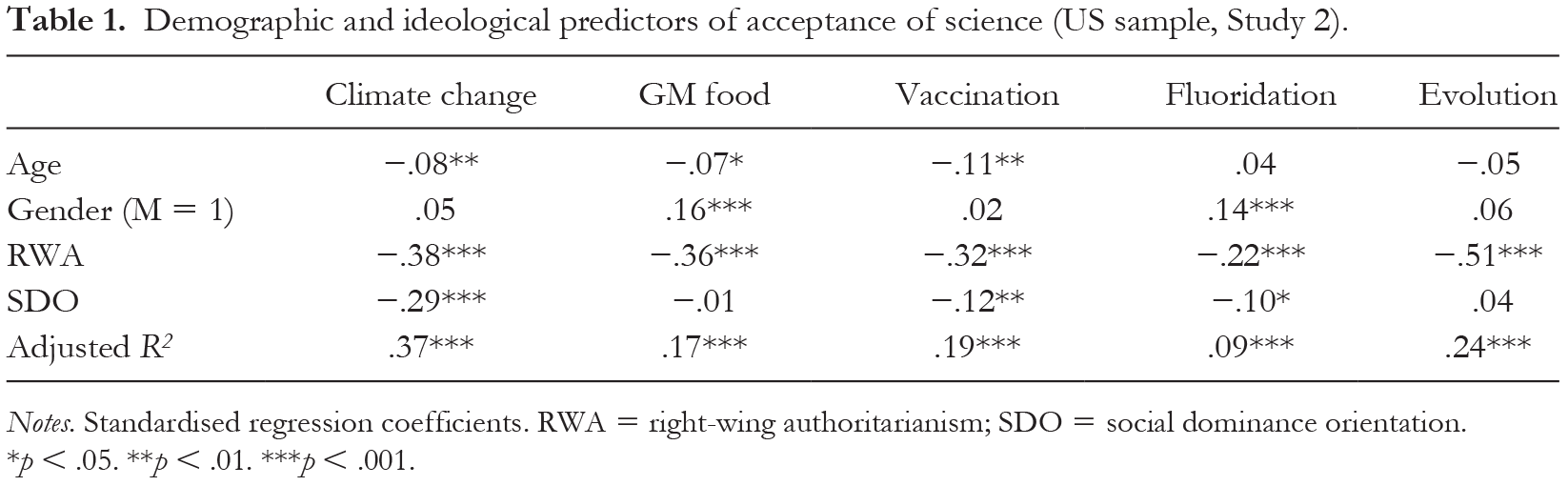
Notes. Standardised regression coefficients. RWA = right-wing authoritarianism; SDO = social dominance orientation.
p < .05. **p < .01. ***p < .001.
Fit statistics robust to non-normality were computed using the MLM estimator in lavaan (employing Satorra-Bentler scaling). Bootstrapped confidence intervals for indirect effects were obtained using the ML estimator as the MLM estimator precludes bootstrapping.
Results
Descriptive statistics and correlations are reported in Table S3 in the online supplemental material.
To examine the unique effects of ideological attitudes, we first regressed each of the five scientific belief variables onto RWA and SDO, with gender and age as covariates (as in Study 1). All regressions were significant, Fs(4, 636) > 15.89, ps < .001. The results, shown in Table 1, reveal RWA is a consistent predictor of rejection of science across all five issues, while SDO predicts rejection of climate change, vaccination and fluoridation.
To examine ideological mediators of these effects we constructed a structural equation model using the R package lavaan. The resulting model displayed reasonable fit (χ2(1278) = 3234.04, CFI = .912, RMSEA = .049 [0.047, 0.051], SRMR = .063; computed using the Satorra–Bentler scaled chi-squared statistic), according to widely used criteria (Hu & Bentler, 1999): RMSEA < .06 and SRMR < .08 (although the CFI was below the suggested .95 threshold). Significant associations between latent variables are shown in Figure 1.
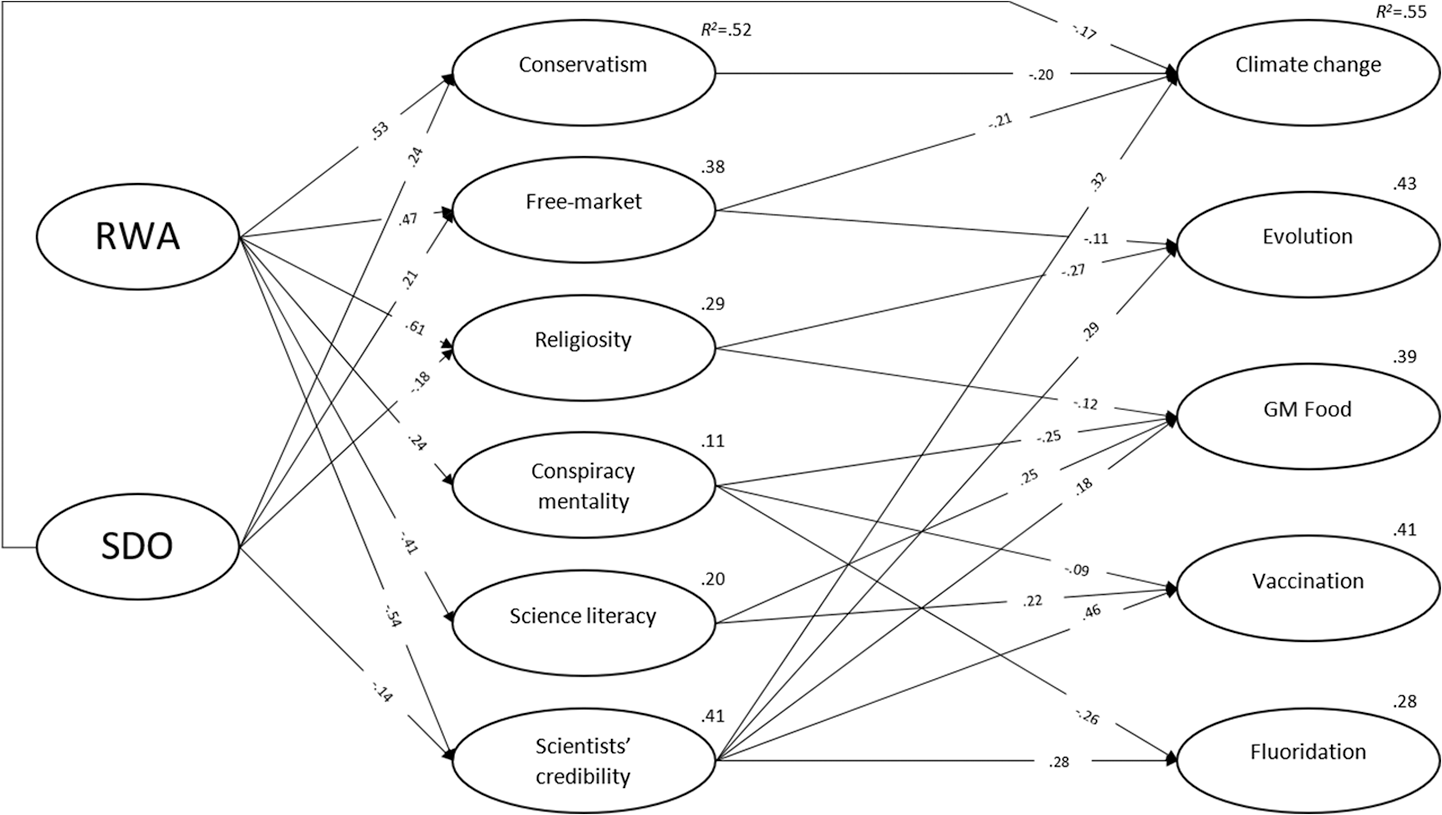
Mediators of the effects of RWA and SDO on acceptance of science in Study 2. Age and gender covariates and non-significant paths (p > .05) not shown (estimates for all parameters are reported in Table S4 in the online supplemental material).
Due to space we do not report the large number of individual indirect effects here (see Table S5 in the online supplemental material). To summarise, any two connecting significant paths (ideological attitude → mediator → acceptance of science) represent a significant indirect effect (i.e., the bootstrapped 95% confidence interval did not include zero). For example, the total effect of RWA on GM food was mediated by religiosity (β = –.07, b = −.10, bootstrapped 95% CI [−0.19, −0.02]), conspiracy mentality (β = −.06, b = −.08, [−0.14, −0.03]), science literacy (β = −.10, b = –.14, [−0.23, −0.07]), and perceived credibility of scientists (β = −.10, b = −.13, [−0.23, −0.03]). Of note was the effect of SDO on evolution and GM food beliefs. While the total effect of SDO on these variables was not significant (consistent with the results of regression analyses, Table 1), examination of indirect effects revealed significant opposing effects. We detected a positive effect of SDO on evolution and GM food beliefs mediated via religiosity (βevolution = .05, b = .06, [0.02, 0.13]; βGM = .02, b = .03, [0.005, 0.07]) and a negative indirect effect via credibility of scientists (βevolution = .04, b = .05, [−0.12, −0.01]; βGM = −.02, b = −.03, [−0.08, −0.005]). In the case of evolution, free-market ideology also mediates a negative effect (β = −0.02, b = −0.03, [−0.07, −0.004]). There was a significant indirect effect of SDO on fluoridation via credibility of scientists (β = −.04, b = −.05, [−0.12, −0.01]), though this did not result in a significant total effect. Thus, SDO does have indirect and, at times, conflicting influences on GM food, fluoride and evolution beliefs. We also note that there was a significant direct effect of SDO on climate science acceptance in the model, indicating that the full effect of SDO on the climate latent variable was partially mediated, i.e., the mediated indirect effect did not fully account for the total effect.
Notably, the only consistent mediator across all five outcome variables was perceived credibility of scientists, which mediated significant, negative effects of RWA and SDO on all outcome variables (Table 2).
Indirect effects of ideological attitudes on scientific beliefs, mediated by perceived credibility of scientists (Study 2, US sample).
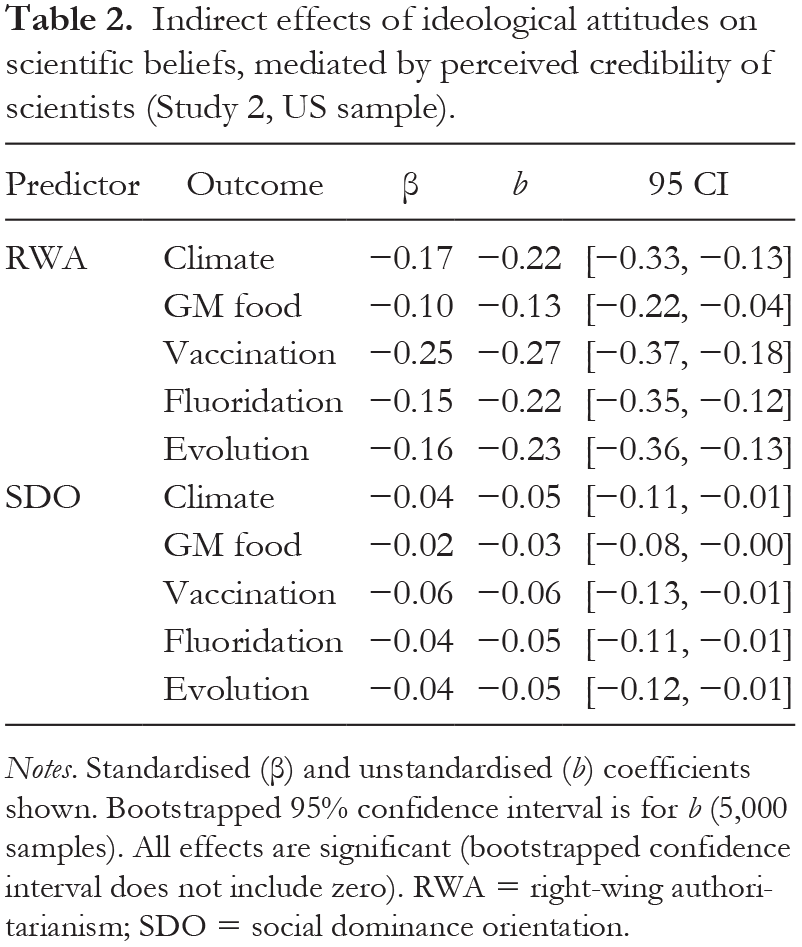
Notes. Standardised (β) and unstandardised (b) coefficients shown. Bootstrapped 95% confidence interval is for b (5,000 samples). All effects are significant (bootstrapped confidence interval does not include zero). RWA = right-wing authoritarianism; SDO = social dominance orientation.
The analysis shows that RWA is a significant, negative predictor of agreement with scientific consensus across domains, but the combination of variables which mediate this effect changes depending on the scientific issue under consideration. Perceived credibility of scientists, however, emerges as a consistent mediator in this context. While SDO only demonstrated a significant total effect on two scientific belief variables (climate change and vaccination) SDO also had a consistent negative indirect effect on all issues mediated via perceived credibility of scientists. We reiterate this key finding: both RWA and SDO predict lower perceived credibility of scientists, which in turn predicts rejection of science in all five domains examined.
Study 3
Methods
In Study 3, we broadly replicated these finding in a large, non-representative sample of New Zealanders recruited through a major New Zealand newspaper.
Participants
Participants were recruited through a through a national newspaper (see Procedure section below). Only participants who completed the survey were included in analyses. A total of 9,126 New Zealand-based individuals completed the survey. Participants who failed either of two attention checks (e.g., “Please select ‘agree’ for this statement”; Gummer et al., 2018) embedded in the survey were removed from the sample (1,025 participants).
The final sample displayed a relatively even split of gender with 46.8% of participants identifying as women, 53.2% as men and 0.08% reporting non-binary or no gender (excluded from analyses). The median age bracket was 45–49 years. In terms of reported ethnicity, the sample was primarily European/Pākehā (91.5%), followed by Māori (6.4%), Asian (1.8%) and Pacific Peoples (1.1%). A substantial number of participants (7.1%) provided an “Other” response. Ethnicity response options were not mutually exclusive; 7.2% of participants selected more than one option. Reported highest qualification was as follows: high school completion or lower, 17.3%; partially completed bachelor’s degree/trade certificate, 12.8%; completed bachelor’s degree/trade certificate, 42.2% (median and modal response); and postgraduate degree, 27.7%. Demographically, the sample was older, more educated and skewed towards European ethnicity compared to the general New Zealand public (Statistics New Zealand, 2013).
Materials
Measures used in the survey were identical to those in Study 2 (scale αs are reported in Table S6 in the online supplemental material). The survey was undertaken in collaboration with other researchers and included a range of other items unrelated to the current study.
Procedure
Participants were recruited through a collaboration with a large New Zealand weekend newspaper. This approach has proven successful in gathering relatively large and broadly representative samples previously (e.g., Wilson et al., 2014). Several news articles highlighting the survey were published in print and online, providing participants with a link to complete the survey on the Qualtrics platform. The survey was presented as a study of New Zealanders’ opinions about scientific, health and environmental issues.
Participants who opted to take part in the study accessed the survey via a link provided in both print and online versions of newspaper articles highlighting the survey. The link directed participants to the Qualtrics survey platform where they provided informed consent and completed the survey. Upon completion participants were offered the option to enter a prize draw to win an incentive prize (an Apple iPad Pro). The study was approved by the Victoria University of Wellington School of Psychology Human Ethics Committee (application number: 0000025633). Data were cleaned, and descriptive and inferential statistics calculated in SPSS v23. A small number of missing values (0.52%) were imputed using the Expectation-Maximization procedure in SPSS.
Results
As in Studies 1 and 2, as a first step we regressed rejection of science variables onto age, gender, RWA and SDO. All regressions were significant, Fs(4, 8033) > 108.2, ps < .001. The results, shown in Table 3, largely mirror those of Study 2: RWA is a significant predictor of rejection of science across all issues and SDO predicts rejection of science regarding climate change, vaccination and fluoridation but not GM food. In contrast to Study 2, we also report a small but significant positive effect of SDO on belief in evolution.
Demographic and ideological predictors of acceptance of science (NZ sample).
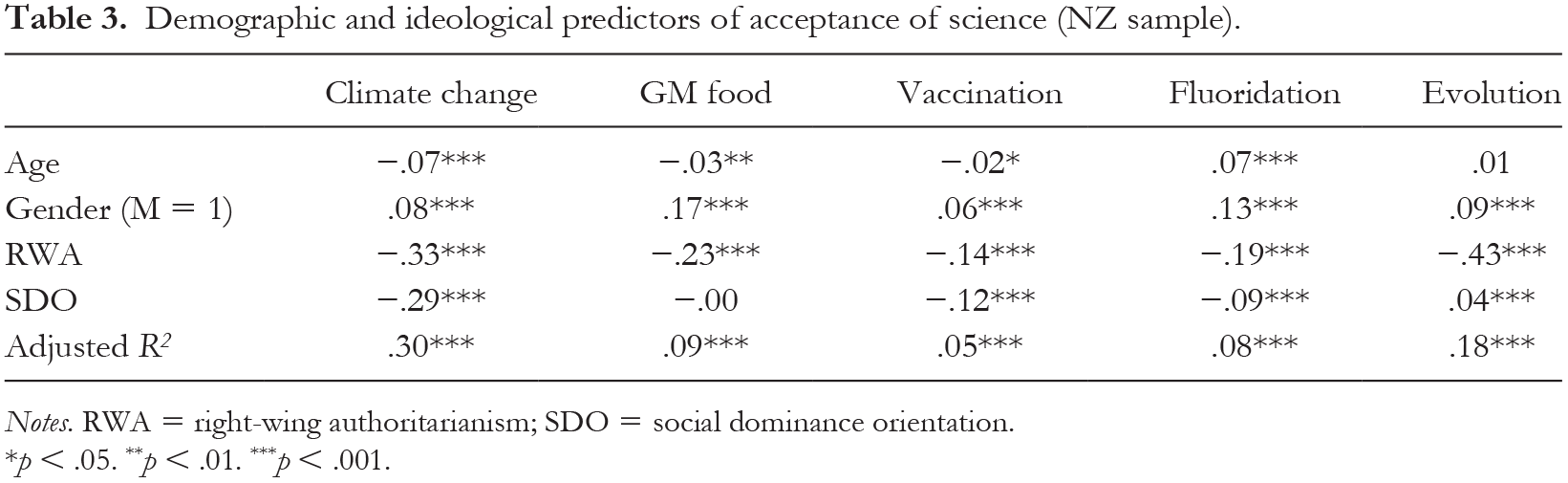
Notes. RWA = right-wing authoritarianism; SDO = social dominance orientation.
p < .05. **p < .01. ***p < .001.
We also fitted a structural equation model identical to that described in Study 2 (χ2(1278) = 16454.37, CFI = .927, RMSEA = .038 [0.038, 0.039], SRMR = .040). We found that both RWA and SDO have significant, negative indirect effects on beliefs about all five scientific issues mediated via perceived credibility of scientists (Table 4), controlling for effects mediated by other variables. That is, both RWA and SDO negatively predict perceived credibility of scientists which in turn positively predicts agreement that: humans are causing climate change; GM food is safe for human consumption; vaccines are safe and effective; water fluoridation is safe and effective; and humans are descended from primate ancestors. Total effects of RWA and SDO and indirect effects mediated by other variables are reported in the supplementary material, where we note several minor differences regarding the pattern of substantive results reported in the US and NZ public samples.
Indirect effects of ideological attitudes on scientific beliefs, mediated by perceived credibility of scientists (Study 3, NZ sample).
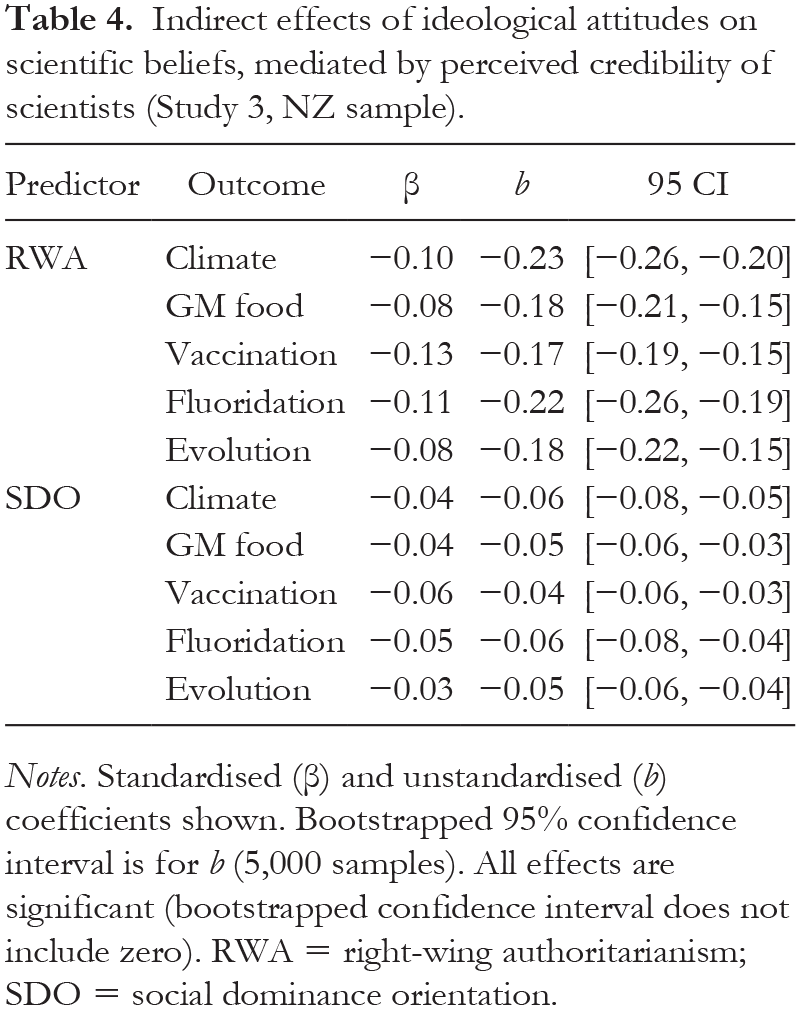
Notes. Standardised (β) and unstandardised (b) coefficients shown. Bootstrapped 95% confidence interval is for b (5,000 samples). All effects are significant (bootstrapped confidence interval does not include zero). RWA = right-wing authoritarianism; SDO = social dominance orientation.
Discussion
We report here, for the first time, that RWA predicts rejection of the mainstream scientific consensus on GM food, vaccination, evolution and fluoridation. Social dominance orientation also predicts rejection of the scientific consensus on vaccination and, marginally, fluoridation. Previous research has noted the role of ideological attitudes RWA and SDO as predictors of climate change denial (Stanley & Wilson, 2019), a finding we replicate across all three studies. In sum, individuals who are more authoritarian or more accepting of inequality are less likely to align their views with scientific consensus on socially debated issues. Thus the current research adds to the growing literature examining the ideological antecedents of rejection of science (Hornsey & Fielding, 2017; Lewandowsky & Oberauer, 2016), situating these predictors within the larger theoretical framework of the Dual Process Model (Duckitt & Sibley, 2009). Our results also extend previous research by examining beliefs about community water fluoridation and evolution, two issues which are subject to continued public debate (Barnes et al., 2017; Helmi et al., 2018) and, in the case of water fluoridation, can have wide ranging impacts on public health (Armfield, 2007; Moore et al., 2017).
In Studies 2 and 3 we used structural equation modelling to examine potential paths by which RWA and SDO might influence beliefs about specific scientific issues in US and New Zealand samples. Drawing on previous research examining rejection of science, we identified several ideological and science-related variables associated with rejection of science. These were incorporated as parallel mediators in a model with the aim of disentangling the paths which lead to high RWA and SDO individuals rejecting science. Our model explained substantial variation (between 28% and 55%) in beliefs about all five scientific issues examined and revealed the heterogeneity of influences across scientific domains. Across Studies 2 and 3 we did observe one important, and consistent, pattern: perceived credibility of scientists – predicted by both RWA and SDO – is significantly associated with rejection of science in every domain examined.
In some cases there was no significant total effect of SDO on rejection of science (specifically GM food and evolution); however, examination of indirect effects revealed some mediated effects had opposing signs, effectively cancelling each other out (an example of inconsistent mediation; MacKinnon et al., 2007). For example, high (vs. low) SDO individuals perceive scientists to be less credible, which in turn is associated with rejection of evolution science. However, they also report lower religiosity, which predicts greater acceptance of evolution science. Such findings highlight the value of the structural equation modelling (SEM) approach in examining the relationship between ideological attitudes and rejection of science.
Our findings make a strong case for the role of RWA and SDO in rejection of science, with relatively consistent results across three very different samples. However, we must acknowledge several limitations. First, all three studies were cross-sectional in nature, limiting the causal inferences that can be made regarding the relationships between ideological attitudes and rejection of science. Future experimental and longitudinal work is required to confirm the causal direction assumed in our models. Second, while our research used samples from two countries, both were developed Western nations. Thus, we must exercise caution in generalising the current results to different cultural and political contexts, a point we return to below. The combination of predictors for each rejection of science issue offers rich insights for researchers focusing on beliefs and attitudes in each domain. However, due to space, we will focus our discussion here on the consistent mediator identified across all issues in both models: perceived credibility of scientists. We hypothesised that RWA and SDO would be linked with negative general perceptions of science and scientists as well rejection of specific scientific conclusions. Our results show this to be the case. We theorised that this lack of trust in science might arise from the perception that scientists threaten hierarchical social structures and violate moral norms. This reasoning remains speculative. Further research is required to find out how individuals with higher levels of RWA and SDO perceive the actions and intentions of scientists and how this in turn affects their perceptions of scientists’ credibility.
The finding that both RWA and SDO predict negative attitudes to scientists should also be considered in the context of previous research applying the DPM to group prejudice. Duckitt and Sibley (2007) report that attitudes towards a range of social groups appear to cluster into three distinct categories – dangerous, derogated and dissident – with prejudice towards these broad groups differentially predicted by RWA and SDO. High RWA (but not SDO) individuals show greater prejudice towards socially threatening, but not subordinate, dangerous groups such as terrorists or drug dealers. High SDO (but not RWA) individuals show greater prejudice towards derogated groups who are socially subordinate or compete for social status and resources, such as ethnic minorities, immigrants, and people with disabilities. Both high RWA and high SDO individuals show greater prejudice towards dissident groups “dissenting from, challenging, or opposing mainstream norms and values” (p. 120), such as feminists, protestors and “people who cause disagreement”. This three-factor model of prejudice has been confirmed in subsequent research (Asbrock et al., 2009; Sibley et al., 2010). Examining prejudice towards scientists alongside other social groups could aid in understanding what drives the association between RWA, SDO and distrust of scientists. The fact that both RWA and SDO predict negative attitudes towards scientists in the current research suggests that scientists may sit in the dissident category (alongside atheists, feminists, environmentalists, protestors, and “people who criticise”; Cantal et al., 2015). Such a conclusion fits well with claims that scientists (at least in an academic setting) are “subversive” or “the critic and conscience of society” (Grace, 2010; Sidanius et al., 1991). Future research should confirm the place of scientists as a social group within the three-factor model of prejudice (see Cantal et al., 2015, for an example focusing on politicians).
As noted earlier, we recognise that our findings focus only on two Western, developed countries. It is possible that in countries where scientists are perceived as political authorities (e.g., representatives of the state) or as members of elite and hierarchical institutions (i.e., more so than in the US or New Zealand), RWA and SDO respectively may predict positive attitudes towards scientists and their claims. Given our study is the first to examine the association between ideological attitudes and perceptions of scientists, comparable data from other countries are lacking. However, there is some supporting evidence in the form of international surveys of public perceptions of science. Nisbet and Nisbet (2019) report that the relationship between defiance of authority (which could be assumed to negatively correlate with RWA) and negative perceptions of science is moderated by country-level democratic development, such that authority-rejecting individuals in less democratic (vs. more democratic) countries hold more negative perceptions of science. The authors suggest this arises from science being associated with government and societal control in more authoritarian regimes. In such a scenario we might expect people who embrace authoritarian values to hold scientists in higher regard – in contrast to the results of the current study.
The finding that perceived credibility of scientists is associated with rejection of science (controlling for ideological predictors) also has a bearing on discussions regarding the role of ideologically motivated reasoning. Druckman and McGrath (2019) note substantial “concept creep” regarding the term “motivated reasoning”, such that some researchers label any disagreement with scientific consensus (e.g., climate change denial) as the product of directionally motivated reasoning (that is, reasoning in pursuit of a given conclusion; see also Hennes et al., 2020; Washburn & Skitka, 2018). Our results offer some support to Druckman and McGrath’s suggestion that rejection of science may be attributed, in part, to distrust of scientists, whereby accuracy-motivated individuals do not consider scientists’ claims to be a valid source of information in drawing conclusions about debated issues. As our research is cross-sectional we cannot make causal inferences in this regard and do note there is some evidence that ideologically motivated reasoning may lead individuals to discount the credibility of scientists (Cook & Lewandowsky, 2016; Kahan et al., 2011). In such a situation, (ideologically motivated) rejection of science leads to lower trust in scientists generally, rather than vice versa. 3 We plan to investigate these causal paths in future longitudinal research.
Understanding how ideology and trust in scientists influence people’s opinion on specific scientific issues is critical to public engagement (National Academies of Sciences, Engineering, and Medicine, 2016a). By drawing on more nuanced analyses of the ideological predictors of rejection of science, science communicators can craft messages to be ideologically congenial to a given audience for a given issue and sidestep potential conflicts (Hornsey & Fielding, 2017). For example, organisations seeking to promote water fluoridation to a sceptical audience could account for the fact that less scientific knowledge, greater inclination to conspiracy thinking, and a distrust of scientists are all associated with fluoridation opposition. Efforts to engage such an audience might involve some basic description of water fluoridation and evidence of its efficacy (addressing lower science knowledge), presented by a trusted non-scientist source, such as a community leader. Engagement efforts could also incorporate some communication techniques aimed at overcoming suspicions of a conspiracy, such as validating general conspiracy belief while debunking fluoridation conspiracies (Bolsen & Druckman, 2018).
In sum, when considering the role of factors such as politics, religion and conspiracy thinking, our results echo the findings of Rutjens et al. (2017) who conclude that “. . . different forms of science acceptance and rejection have different ideological roots, although the case could be made that these are generally grounded in conservatism” (p. 396; emphasis in original). Here we believe the authors refer not to political conservatism specifically but a more general orientation towards valuing tradition, stability and hierarchy. Our finding that ideological attitudes predict rejection of science across issues validates Rutjens et al.’s second point. In this respect we argue that RWA and SDO represent this grounding orientation, capturing deeper ideological attitudes regarding tradition, hierarchy and authority upon which ideologies (such as politics) may be predicated (Duckitt & Sibley, 2009; Wilson & Sibley, 2013).
As a final note, we remind the reader that RWA and SDO are stable, but not immutable attitudes. Though empirical evidence is limited, RWA and SDO are theorised to increase in response to threatening and competitive environments (Duckitt & Fisher, 2003; Sibley & Duckitt, 2013). Following from this we would expect that events such as terrorist attacks, wars and financial crises would have an indirect eventual impact on public opinion regarding science. Increases in RWA and SDO may drive a rise in political conservatism, religiosity and conspiracy thinking as well as undermining trust in scientists – all ultimately leading to more disagreement over scientific findings. There is a counterpoint to this: if people perceive the world as a less threatening and competitive place, society as whole may become more accepting of scientific evidence.
Supplemental Material
sj-pdf-1-gpi-10.1177_1368430221992126 – Supplemental material for Right-wing authoritarianism and social dominance orientation predict rejection of science and scientists
Supplemental material, sj-pdf-1-gpi-10.1177_1368430221992126 for Right-wing authoritarianism and social dominance orientation predict rejection of science and scientists by John R. Kerr and Marc S. Wilson in Group Processes & Intergroup Relations
Footnotes
Data availability

Funding
The authors disclosed receipt of the following financial support for the research, authorship, and/or publication of this article: This research was supported, in part, by a grant from the Sasakawa Young Leaders Fellowship Fund (SYLFF).
Supplemental material
Supplemental material for this article is available online.
Notes
References
Supplementary Material
Please find the following supplemental material available below.
For Open Access articles published under a Creative Commons License, all supplemental material carries the same license as the article it is associated with.
For non-Open Access articles published, all supplemental material carries a non-exclusive license, and permission requests for re-use of supplemental material or any part of supplemental material shall be sent directly to the copyright owner as specified in the copyright notice associated with the article.
