




Abstract
Collective ownership threat is the fear of losing control over what is perceived to be owned. In two experimental studies, we examined the intergroup consequences of collective ownership threat in relation to perceived owned territories. First, among a sample of Dutch adolescents (N = 227), we found that infringement of a hangout place owned by a group of friends led to more perceived collective ownership threat (and not symbolic threat), which was in turn related to more marking and anticipatory defending behavior. Second, among a sample of native Dutch adults (N = 338), we found that framing Turkish EU accession as an infringement of the collective ownership of the country led to more perceived collective ownership threat (and not symbolic and economic threat), which was in turn related to more opposition to Turkey’s possible accession. Our findings indicate that collective ownership threat is an important construct to consider in intergroup research.
Keywords
Although ownership is a fundamental aspect of social life, structuring social relations between individuals and groups, a sense of ownership is little researched in social psychology (Verkuyten & Martinovic, 2017). People intuitively understand that being an owner implies having the right to determine what happens to entities that are owned and who can use them. A sense of ownership is based on the psychology of possession and is argued to be basic and universal (Rochat, 2014). A psychological association between the owner and the target of ownership makes owners value their possessions “simply because they are theirs” (Beggan, 1992; Morewedge et al., 2009, p. 948), and makes children as young as 2 protest when their possession is interfered with or taken away from them (Rossano et al., 2011).
The possibility of being dispossessed is intrinsic to ownership (Rochat, 2014), and people can fear to be deprived of or lose the right to decide about their target of ownership. They can fear car theft; losing their mobile phone; burglary; their ideas or songs being used without permission; or infringement of their territory such as their garden, office, neighborhood, or country. This fear, labeled ownership threat, can have important social psychological implications. Existing literature has examined the consequences of losing personal ownership (Brown & Robinson, 2011; Weinstein, 1989), but we aim to make a novel contribution to the social psychological literature by focusing on the fear to lose collective ownership. As group members, people can have a sense that a target of ownership is “theirs,” and can fear to lose control over it (Pierce & Jussila, 2009; Pierce et al., 2017). More specifically, we examine the intergroup consequences of threats to the collective psychological ownership of a territory as one of the most important targets of collective ownership that leads to intergroup conflicts in many parts of the world (Toft, 2014).
We argue that the focus on collective ownership threat can improve our understanding of the psychological processes involved in intergroup threat that drive negative intergroup relations (Verkuyten & Martinovic, 2017). A variety of intergroup threats have been distinguished in the literature (see Riek et al., 2006) and, in addition to the much studied symbolic and economic threats, we argue for the theoretical and empirical distinctiveness and importance of collective ownership threat (Verkuyten & Martinovic, 2017). Whereas in situations of symbolic and economic threat our identity and our resources are at stake, in situations of collective ownership threat our sense of being in control is at stake. We further argue that collective ownership threat and economic threat might both be considered specific types of realistic threat.
In two studies, we examine the consequences of threat to the collective ownership of territories at different levels of abstraction, that is, a hangout place and a country. Focusing on both a concrete and a more abstract territory offers a conceptual replication of the psychological processes involved in collective ownership threat. In a first study, among adolescents, we experimentally test whether infringement of a hangout place owned by a group of friends leads to more perceived collective ownership threat and whether this, in turn, relates to intentions to engage in marking and defending behavior. We also consider symbolic threat to examine whether the relationship found is specific to collective ownership threat. Next to this concrete everyday-life context, in a second experimental study, we examine whether similar processes play a role in threat to country ownership among a demographically diverse sample of participants. We test whether framing Turkish accession to the EU as an infringement of the collective ownership of the country (i.e., the Netherlands) elicits stronger perceptions of collective ownership threat, and thereby generates more opposition to Turkish accession. In this study, we additionally consider symbolic and economic threats to examine the unique contribution of collective ownership threat.
Collective Psychological Ownership
Legal scholars, philosophers, and sociologists have argued that ownership is a central organizing principle in society with profound implications for human behavior (Ye & Gawronski, 2016). Ownership implies normative and moral rights, privileges, and responsibilities, and is codified in laws and legal regulations concerning, for example, theft, trespassing, and copyright. Ownership is accompanied by a “determination right” (Merrill, 1998; Nijs et al., 2020; Snare, 1972). The right to determine and control what one owns is rather intuitive, and developmental research has shown that preschool children already recognize that the person who controls the use of an object, owns it (Neary et al., 2009).
A sense of ownership can be experienced in the absence of legal recognition (Brown & Zhu, 2016). People may have the feeling that it is “their” parking spot in the street, “their” sandcastle they built on the beach (Verkuyten et al., 2015), or “their” idea they came up with (Shaw et al., 2012), even if they do not legally own it. This psychological sense of ownership manifests itself not only at the personal level, but also at the group level in the form of collective psychological ownership—a sense that an object, idea, or place belongs to “us” (Pierce & Jussila, 2009; Pierce et al., 2017). Ownership is a powerful justification for what “we” can rightfully do with what is “ours,” including the right to exclude others.
Ownership can be challenged, disputed, or threatened, which can lead to ownership disputes and conflicts. Ownership threat refers to the question of “what do we control?” and is expected to have profound attitudinal and behavioral consequences. Perceptions of ownership threat can arise following an act of infringement of what is owned. Such an infringement can threaten the owner’s sense of possession, self-efficacy, and control (Brown et al., 2005). Infringement leads to a loss of control that instigates behavioral responses to retain or regain ownership. For example, burglary or car theft triggers investments in locks or bars on windows, alarms, and surveillance to protect the target of ownership (Weinstein, 1989). Further, individual psychological ownership of “my” working space is related to marking and defending behavior (Brown et al., 2005; Brown & Zhu, 2016), especially when there are threats and concerns about infringement (Brown et al., 2014; Brown & Robinson, 2011).
Threats to collective psychological ownership are also expected to trigger marking and defending behaviors to communicate and (re)claim ownership (Brown & Robinson, 2011; Pierce & Jussila, 2009; Pierce et al., 2017). Group members can defend their shared ownership by anticipating infringement by, for example, placing a fence around a community garden (Schmelzkopf, 1995), or can defend their ownership in a reactionary way by asking others not to use the target of ownership or by physically expelling them. They can also mark their ownership physically by, for example, spraying graffiti in the neighborhood (Ley & Cybriwsky, 1974), or socially by telling others that the target of ownership is “theirs.”
Collective Ownership Threat and Other Intergroup Threats
There is a large body of literature on the nature and importance of realistic, symbolic, and other forms of intergroup threat, which are distinguished, for example, in integrated threat theory (Stephan & Stephan, 2000). Symbolic intergroup threat relates to the question “who are we?” and involves the perception and feeling that our self-defining norms, values, beliefs, and traditions are challenged, changed, or lost (Riek et al., 2006; Stephan et al., 2002). Symbolic threat can be experienced when encountering other groups with conflicting values and beliefs, or when other groups undermine the distinctiveness, value, and continuity of the ingroup identity (Kinder & Sears, 1981; Riek et al., 2006; Tajfel & Turner, 1979). Collective ownership threat can arise when others challenge or dispute the right to control what is “ours,” without self-defining norms and values having to be at stake.
Realistic intergroup threat has been conceptualized in different ways in the literature, and we can distinguish between a broad and a narrower understanding. The broad understanding includes threats related to scarce material resources, political power, and the very existence and physical safety of one’s group (Morrison & Ybarra, 2008; Stephan et al., 2002). This conceptualization implies that collective ownership threat can be considered as a form of realistic threat. However, in this conceptualization, quite different phenomena that tap into different psychological processes are grouped together (Rios et al., 2018). Competition over scarce resources, competition over power, and the perception that outgroups are violent and dangerous (the latter being labelled safety threat; see Sniderman & Hagendoorn, 2007) are likely to trigger quite different concerns and coping strategies. Instead, a more narrow and common understanding of realistic threat emphasizes competition over scarce material and economic resources such as housing, jobs, and welfare (Esses et al., 1998; Riek et al., 2006; Sherif & Sherif, 1969; Zarate et al., 2004), and is also referred to as economic threat (Sniderman & Hagendoorn, 2007). In this paper, we specifically distinguish ownership threat from economic threat. The central issue that is at stake in this economic understanding of realistic threat relates to the question “what do we need to live our lives in a comfortable way?” (Verkuyten & Martinovic, 2017). This is different from collective ownership threat in which perceived infringements and the sense of one’s exclusive determination right are at stake. People can fear to lose control over what is theirs, even if they are not concerned about economic competition over scarce resources. Jetten et al. (2017) found that, in times of economic prosperity, people are less inclined to reason against immigration in terms of economic competition and more in terms of the unfairness of having to share what is “ours,” which suggests that a distinction between different psychological processes can be made.
Threat to Local Ownership
A local context in which collective ownership threat may have clear social psychological consequences is a hangout place. Such a place can be perceived to be owned by a group of friends and can play an important role in the social lives of young people. Especially for teenagers, hangout places can foster a sense of autonomy, identity, and feeling of belonging (Matthews et al., 2000). Therefore, we experimentally tested whether infringement of one’s collective hangout place leads to more perceived collective ownership threat, and whether this in turn relates to stronger intentions to engage in marking and defending behavior. By examining this indirect effect, we can test if the behavioral consequences are due to the theorized collective ownership threat perceptions.
Next to collective ownership threat, people can also experience symbolic threat in relation to a hangout place. However, marking and defending behaviors are expected to be specifically triggered by a fear of losing control over what is ours and not by symbolic threat. One way in which people might feel that the value of an important group membership (e.g., friends) is threatened is when others are dismissive about group-defining features (in this case, the hangout place). Such a symbolic threat to the value of social identity might not trigger intentions to engage in ownership marking and defending behavior, but can be expected to negatively affect individual perceptions of collective self-esteem (Branscombe et al., 1999; Luhtanen & Crocker, 1992). As people strive for a positive sense of self (Tajfel & Turner, 1979), a threat to the value of the ingroup identity is likely to trigger negative feelings about belonging to the ingroup, rather than proactive behavioral responses that communicate and (re)claim ownership. To test this, we also examined whether outgroup derogation leads to higher perceived symbolic threat (and not collective ownership threat), and whether this in turn relates to decreased collective self-esteem.
Threat to Country Ownership
People can have a sense of collective ownership of a country, despite the abstract nature of “the country” as an entity (Brylka et al., 2015; Nijs et al., 2020; Selvanathan et al., 2020; Verkuyten & Martinovic, 2017). For example, a vast majority of Dutch and British natives were found to have at least some sense of collective ownership of their country (Nijs et al., 2020). A threat to country ownership can result in marking and defending behavior by using ownership rhetoric, exhibiting country flags, implementing stricter border controls, or building a wall. Right-wing populist politicians appeal to collective ownership threat to mobilize opposition to immigration and to the European Union (EU): “We are losing our country and have to reconquer it” (Wilders, 2017); “Our country is being stolen from us and we have never been asked for our permission” (Robert Kilroy-Silk, 2005, as cited in Mudde, 2007, p. 66).
In the context of the EU, its possible enlargement with the Turkish accession to it is one important issue that might elicit feelings of collective ownership threat. Negotiations about Turkish accession started in 2005 and led to much debate and media coverage. The thought of accession might induce collective ownership threat among European citizens because they fear that they cannot exclusively decide about Turkey’s membership and will lose their determination right when it comes to Turkish migration to their own country. In terms of population, Turkey would become the largest member state of the EU, and its related influence on European policies may incite a fear of Turkey taking over the EU and thereby taking over European citizens’ country. As a result, people might oppose Turkish accession, which can be regarded as an anticipatory defense response (Brown et al., 2005). We experimentally tested whether framing Turkish accession as an infringement of the collective ownership of one’s country leads to more perceived collective ownership threat, and whether this in turn relates to higher opposition to Turkish accession to the EU.
However, this opposition need not only be based on collective ownership threat. Turkish accession is also likely to be a source of symbolic and economic threats. A content analysis of newspapers in six countries found that negative articles about Turkish EU membership were framed in terms of cultural and religious differences (a “clash of civilizations”), and also in terms of negative economic consequences (Koenig et al., 2006). Turkey would be the first Muslim-majority European member state, which might be regarded as a symbolic threat to the value, distinctiveness, and continuity of the historically Christian and increasingly secular (West) European nation states. Furthermore, the opposition to Turkey’s accession can be triggered by economic concerns, as Turkey has a relatively weak economy and relatively high unemployment rates.
Experimental research that presented Turkish accession to the EU in a symbolic- or economic-threat frame found that both frames had negative effects on attitudes toward Turkish accession (De Vreese et al., 2011) and Turkish immigrants (Meeus et al., 2009). Therefore, we also framed Turkish accession as conflicting with European identity and as a burden to economic and material resources, and examined whether these frames elicit more perceived symbolic and economic threat respectively, and in turn generate more opposition to Turkish accession. More importantly, we predict that the effect of the ownership-infringing frame on opposition to Turkish accession is specifically due to increased perceptions of ownership threat, and not to increased perceptions of symbolic and economic threat. We further predict that the effects of the symbolic- and economic-threat framing are due to increased perceptions of symbolic and economic threat respectively, and not to increased perceptions of collective ownership threat.
To sum up, in two studies, we test our central hypothesis that situations in which a collectively owned territory is infringed trigger perceived collective ownership threat, which in turn relates to intentions to mark and defend the territory.
Study 1
In Study 1, we experimentally tested whether infringement of an imaginary hangout place owned by one’s group of friends leads to more perceived collective ownership threat (and not symbolic threat), and whether this in turn relates to more intentions to engage in marking and defending behavior. We additionally tested whether a situation threatening to the value of the ingroup identity leads to more perceived symbolic threat (and not collective ownership threat), and whether this in turn relates to decreased collective self-esteem.
Sample and Procedure
Data were collected among Dutch adolescents aged 16 to 19 (M = 16.54, SD = 0.69) from a gymnasium (the highest level of secondary education in the Netherlands). Based on a priori power calculations, assuming a medium-sized effect (F = 0.25) and aiming for a power of .80 and an alpha of .05, the required sample size was 147. 1 As we were uncertain about the expected effect size due to the lack of similar existing experiments on this topic, we decided to recruit at least 200 respondents. Ultimately, we reached a total of 227 respondents. The study was preregistered on the Open Science Framework. 2 Of the sample, 46% was female; 0.4% (one person) was in fourth grade of secondary school, 55% in fifth grade, and 45% in sixth grade, which is the last year of secondary school at the gymnasium level. Eight people (4%) were not born in the Netherlands.
Participants were randomly assigned to one of three experimental conditions: collective ownership threat, symbolic threat, and no threat (control). Intergroup threats have been previously invoked by manipulating different features, and we manipulated the behavior of a relevant outgroup since this enables a clear distinction between forms of threat (Rios et al., 2018; see the manipulation in Appendix B of the supplemental material). 3 Each condition consisted of a short text about an imaginary hangout place. Participants were asked to read the text carefully and try to imagine the situation, and they were told that, afterwards, they would be asked questions about the text. More specifically, they read about a place where they and their group of friends always went to after school and on weekends. They were told that it was a separate place in a park in their neighborhood that had not been used before: a place that really felt like it was their own and where they had put an old picnic table (a picture of a picnic table in a park was shown next to the text). The collective ownership threat condition had an additional paragraph in which participants were informed that another group of youngsters had been sitting at the table in the last few weeks, and that they acted like it was “their” place and wanted to take it over. In contrast, the symbolic threat condition had a paragraph in which participants were informed that other youngsters were dismissive and negative about their ingroup, as they found the hangout place childish.
Measures
After the manipulation, participants answered two direct questions on perceived threat. Perceived collective ownership threat was measured with, “I would be afraid that others want to take our place away from us” (M = 2.81, SD = 0.97). Perceived symbolic threat was measured with, “I would be afraid that others try to make fun of us” (M = 1.91, SD = 0.96). The use of rather simple and straightforward single questions reduces the problem of meaning and interpretation inherent in more complex measures, and has been shown to have adequate validity and reliability in measuring perceived discrimination (Noh et al., 1999; Stronge et al., 2016). Items were answered on 5-point scales (1 = certainly not, 5 = certainly), with higher scores indicating more perceived threat. Perceived symbolic threat was skewed towards the right (skewness = 1.01). Threat perceptions were positively but weakly associated (r = .17, p = .010).
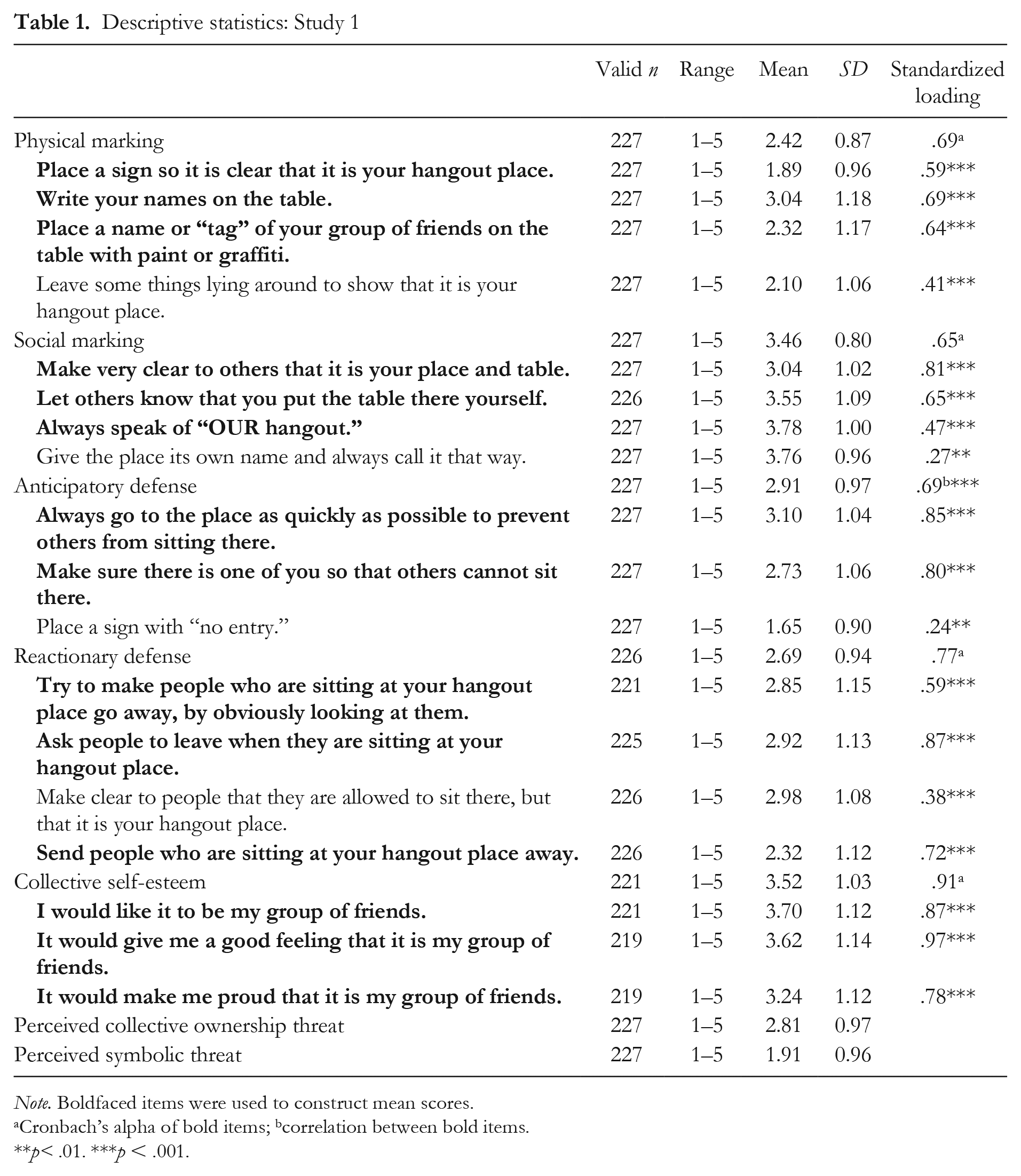
Participants were then asked how likely it would be that they and their friends would engage in a set of actions (Brown et al., 2005). These included physical marking (four items; e.g., “Place a sign so it is clear that it is your hangout place”), social marking (four items; e.g., “Always speak of ‘OUR hangout’”), anticipatory defense (three items; e.g., “Always go to the place as quickly as possible to prevent others from sitting there”), and reactionary defense (four items; e.g., “Ask people to leave when they are sitting at your hangout place”). All items and descriptive statistics are presented in Table 1. Items were answered on 5-point scales (1 = certainly not, 5 = certainly), with higher scores indicating more intentions to engage in these behaviors.
Descriptive statistics: Study 1
Note. Boldfaced items were used to construct mean scores.
Cronbach’s alpha of bold items; bcorrelation between bold items.
p< .01. ***p < .001.
Our collective self-esteem measure was based on the existing Private Collective Self-Esteem Scale of Luhtanen and Crocker (1992), measuring private judgements of one’s social groups. Respondents were asked, “Imagine that this is really your group of friends. Would you agree or disagree with the following statements?” There were three items (e.g., “It would give me a good feeling that it is my group of friends”; see Table 1). Answers were given on a 5-point scale (1 = totally disagree, 5 = totally agree), with higher scores indicating higher collective self-esteem.
As some items loaded poorly on their respective factor, we used only some items (boldfaced in Table 1), thereby reaching Cronbach’s alphas of .65 or higher. A measurement model with all boldfaced items loading on five latent variables had a satisfactory fit, χ²(67) = 107.09, p = .001, CFI = .97, RMSEA = .05, SRMR = .05, which was significantly better than a model in which all items were included, ∆χ²(58) = 217.18, p < .001. We used mean scores rather than latent factors to reduce complexity.
Results
We estimated indirect effects with the collective ownership threat condition (= 1 vs. control condition = 0) and symbolic threat condition (= 1 vs. control condition = 0) as independent variables; perceived collective ownership threat and symbolic threat as two parallel mediators; and physical marking, social marking, anticipatory defense, reactionary defense, and collective self-esteem as dependent variables. We tested this model using structural equation modeling in Mplus (Version 8.3; Muthén & Muthén, 1998–2017). We used full information maximum likelihood (FIML), which allows missing values in endogenous variables, assuming missingness at random.
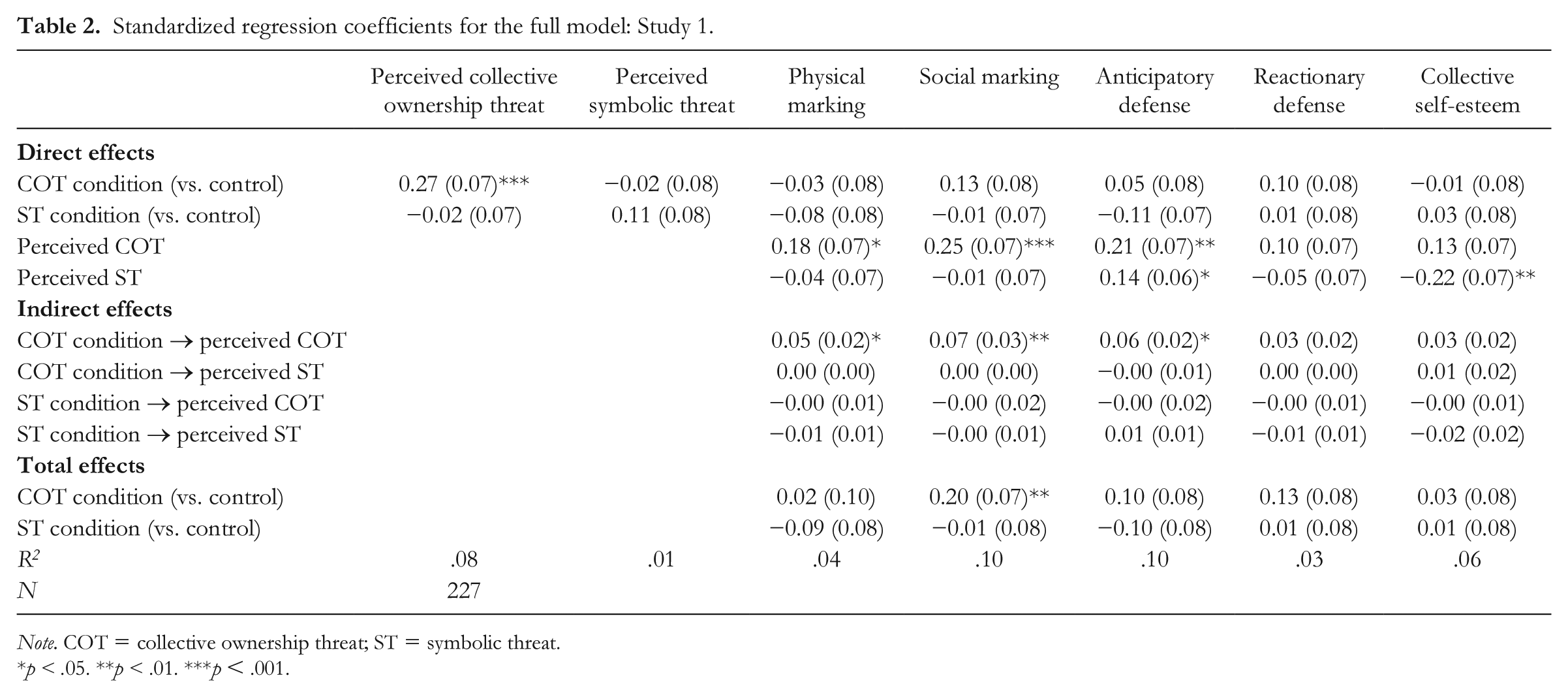
As shown in Table 2, the collective ownership threat condition led to more perceived collective ownership threat compared to the control condition (β = .27, SE = 0.07, p < .001). 4 Perceived collective ownership threat, in turn, was related to stronger intentions for physical marking (β = .18, SE = 0.07, p = .010), social marking (β = .25, SE = 0.07, p < .001), and anticipatory defense (β = .21, SE = 0.07, p = .001), but not to significantly more reactionary defense intentions (β = .10, SE = 0.07, p = .165). We obtained significant indirect effects of the collective ownership threat manipulation via perceived collective ownership threat on physical marking (β = .05, SE = 0.02, p = .037, 95% CI [0.00, 0.09] 5 ), social marking (β = .07, SE = 0.03, p = .008, 95% CI [0.01, 0.12]), and anticipatory defense (β = .06, SE = 0.02, p = .016, 95% CI [0.01, 0.10]). Contrary to our expectation, there was no significant indirect effect on reactionary defense. It is important to further note that there were no indirect effects of the collective ownership threat manipulation via perceived symbolic threat. Finally, we found no significant total or direct effects of the collective ownership threat manipulation on any of the dependent variables, except for the total effect on social marking (β = .20, SE = 0.07, p = .007).
Standardized regression coefficients for the full model: Study 1.
Note. COT = collective ownership threat; ST = symbolic threat.
p < .05. **p < .01. ***p < .001.
We were unable to trigger perceived symbolic threat with the symbolic threat manipulation (β = .11, SE = 0.08, p = .164); note that perceived collective ownership threat was not triggered by this manipulation either (β = −.02, SE = 0.08, p = .765). However, as expected, perceived symbolic threat was negatively related to collective self-esteem (β = −.22, SE = 0.07, p = .001), while perceived collective ownership threat was not. 6 Moreover, perceived symbolic threat was unrelated to the behavioral intentions, except for more anticipatory defense (β = .14, SE = 0.06, p = .035). We found no significant indirect or total effects of the symbolic threat manipulation on any of the dependent variables.
Discussion
The results of Study 1 indicate that collective ownership threat can have consequences for behavioral intentions. A situation in which a collectively owned territory is infringed is indirectly related to marking and anticipatory defending behavioral intentions via higher perceived collective ownership threat and not via perceived symbolic threat. However, we found no indirect effect of the collective ownership threatening situation on reactionary defense behavior. People might perceive reactionary defense behavior as a last resort that one only engages in when marking and anticipatory defense behavior do not have the desired effect. Trying to make others go away can be regarded as a rather confrontational strategy that is only necessary when ownership is lost and should be reclaimed, which remained ambiguous in the current manipulation. Respondents might have kept the possibility open that the infringers were not aware that they were violating a proprietary claim, which might have decreased the chances of involving in reactionary defense behavior (Brown et al., 2005). Moreover, while adolescents might have been able to imagine responding to the collective ownership threat by physical and social marking and anticipatory defense, they might have found it harder to imagine responding in a rather confrontational manner by trying to make others go away.
Further, we were unable to trigger perceived symbolic threat. Adolescents were generally not very afraid to be made fun of in any of the conditions, or at least did not report this fear. However, when they did experience symbolic threat, they felt less collective self-esteem and, unexpectedly, they were also more likely to engage in anticipatory defense behavior. A possible explanation for the latter result is that adolescents were inclined to respond to a threat to the value of their ingroup and simultaneously wanted to prevent further dismissal. Anticipatory defense behavior (e.g., making sure that there is always one of “us” at the place) can be used as an identity management strategy in which group members “display subtle collective responses as a means of reinforcing or displaying their commitment to the group” (Branscombe et al., 1999, p. 48). Reactionary defense behavior (e.g., making others go away), social marking (e.g., communicating their hangout place to others), or physical marking (e.g., putting up a sign) might be perceived as too outspoken and susceptible to further outgroup dismissal, since these responses might be regarded as rather childish.
Study 2
In Study 2, we aimed to conceptually replicate our findings in relation to a country (the Netherlands) as a more abstract target of ownership, by using Turkish accession to the EU as the source of threat. We focused on explaining opposition to Turkish accession as a form of anticipatory defense, and compared collective ownership threat to both symbolic and economic threat. This offers a stricter test of whether collective ownership threat can add to the existing intergroup threat literature, since the importance of symbolic and economic threat in the context of EU enlargement has been established in previous research (De Vreese et al., 2011; Meeus et al., 2009).
Sample and Procedure
Data were collected among adult native Dutch participants from a panel maintained by the research agency Kantar. The sample of invited participants was diverse in terms of age, gender, education level, and region. Participants were randomly assigned to one of four experimental conditions. 7 We removed 11 participants with at least one parent not born in the Netherlands, thereby retaining 404 participants.
Participants were presented with one of four fictive newspaper articles, based on the manipulations of De Vreese et al. (2011) and Meeus et al. (2009). As in Study 1, we manipulated the behavior and characteristics of the source of threat, as this enables a clear distinction between forms of threat (Rios et al., 2018). In three of the four articles, Turkish accession was framed either as an infringement of the collective ownership of the country (collective ownership threat condition), as a burden to economic resources (economic threat condition), or as conflicting with European culture and identity (symbolic threat condition). In the three articles, the heading (“The Consequences of Turkish Accession to the EU”), introduction, and layout were identical. In the control condition, the general procedure of accession to the EU, not specifically related to Turkey, was discussed in a neutral way. The articles were presented in a realistic layout and introduced as if they had been published in a Dutch newspaper (manipulations can be found in Appendix D of the supplemental material).
As a reading check, participants were asked in which domain lie the most important challenges of possible Turkish accession to the EU, according to the text. The three possible answer categories were economic domain, cultural domain, and domain of control. Those who did not answer this question correctly were expected not to have read or understood the article well enough. Seventeen percent of the participants in the collective ownership threat condition, 20% of the participants in the economic threat condition, and 32% of the participants in the symbolic threat condition did not answer the question correctly. Twenty-one percent of those who read the symbolic threat condition thought the article mainly dealt with the domain of control. 8 After removing incorrect answers, we retained 338 participants. Of the sample, 50% was female; 15% was low educated, 44% was middle educated, and 41% was high educated. The average age of this adult sample was 51.51 (SD = 16.67), and the sample was significantly more left-wing-oriented than the neutral midpoint “centre” (3), M = 2.81, t(295) = −2.71, p = .007. The experiment was part of a larger survey, and sensitivity analyses suggest that with this sample we were able to obtain an effect size of .41 when comparing the mean of opposition to Turkish accession between the collective ownership threat and control conditions. 9
Measures
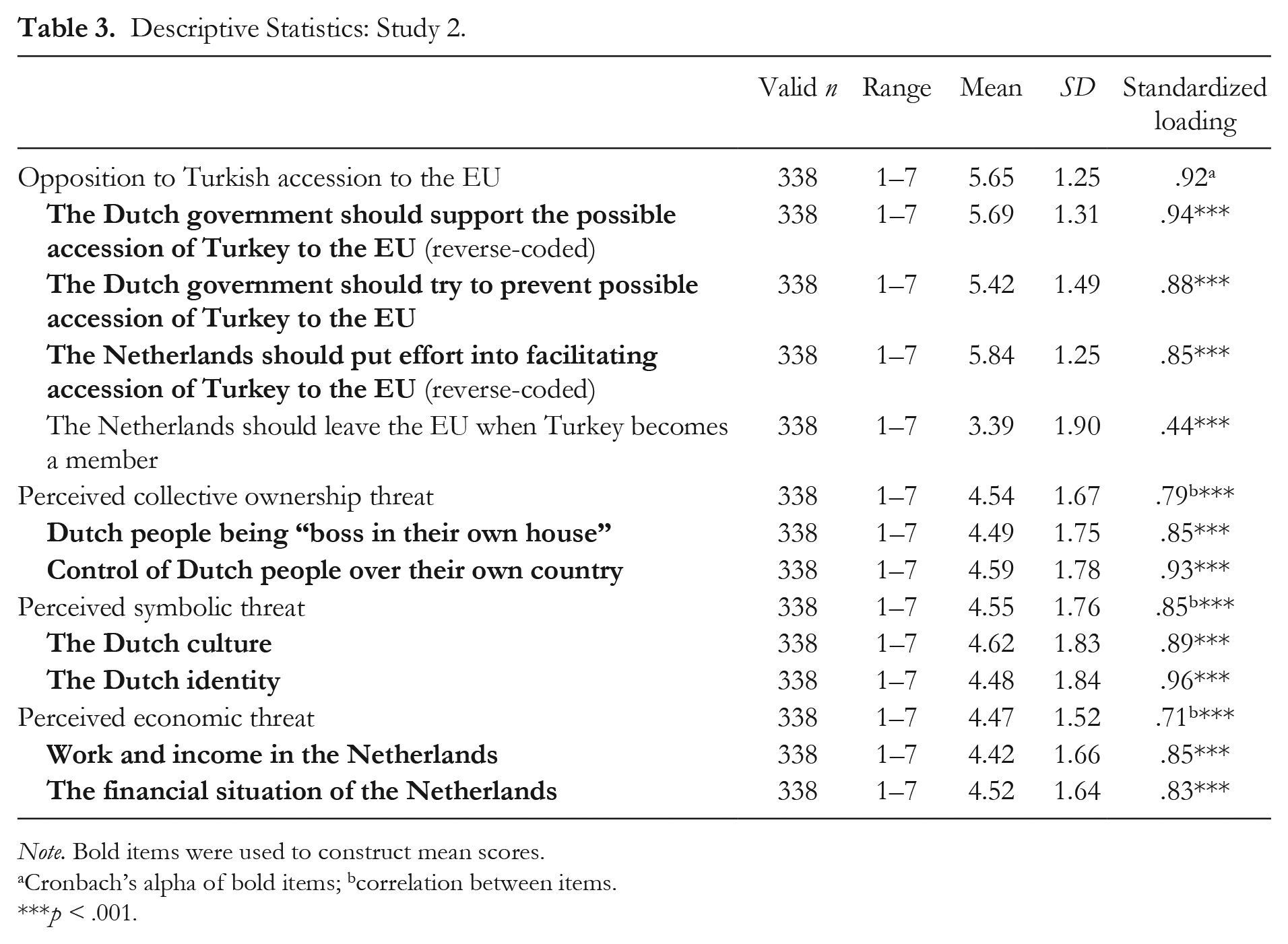
After the reading check, participants responded to items measuring perceived ownership, symbolic, and economic threat (7-point scale; 1 = not at all, 7 = very much). They were asked to what extent a range of issues are being threatened or under pressure because of Turkish accession to the EU (see Table 3 for all items). Subsequently, they were asked about opposition to Turkish accession to the EU, which was measured with four items (7-point scales). As the fourth item loaded relatively poorly on the factor, we used the three boldfaced items in Table 3, which had a Cronbach’s alpha of .92.
Descriptive Statistics: Study 2.
Note. Bold items were used to construct mean scores.
Cronbach’s alpha of bold items; bcorrelation between items.
p < .001.
A four-factor model with the items loading on their respective factors fitted the data well, χ²(21) = 35.26, p = .026, CFI = 1.00, RMSEA = .05, SRMR = .03, and significantly better than a model in which the threats were combined in one factor, ∆χ²(5) = 76.27, p < .001. We used mean scores rather than latent factors to reduce complexity. Although confirmatory factor analysis indicated a clear three-factor structure, collective ownership threat correlated strongly with economic (r = .71) and symbolic threat (r = .87), and the correlation between economic threat and symbolic threat was also high (r = .72).
Results
We tested indirect effects with the collective ownership threat condition (= 1 vs. control condition = 0), symbolic threat condition (= 1 vs. control condition = 0), and economic threat condition (= 1 vs. control condition = 0) as independent variables; opposition to Turkish accession as dependent variables; and perceived ownership, economic, and symbolic threats as mediators. However, the high correlations between the three types of threat led to multicollinearity issues, making the results unreliable (see Appendix E in the supplemental material). Therefore, we ran three separate models with only one of the perceived threats included as a mediator.
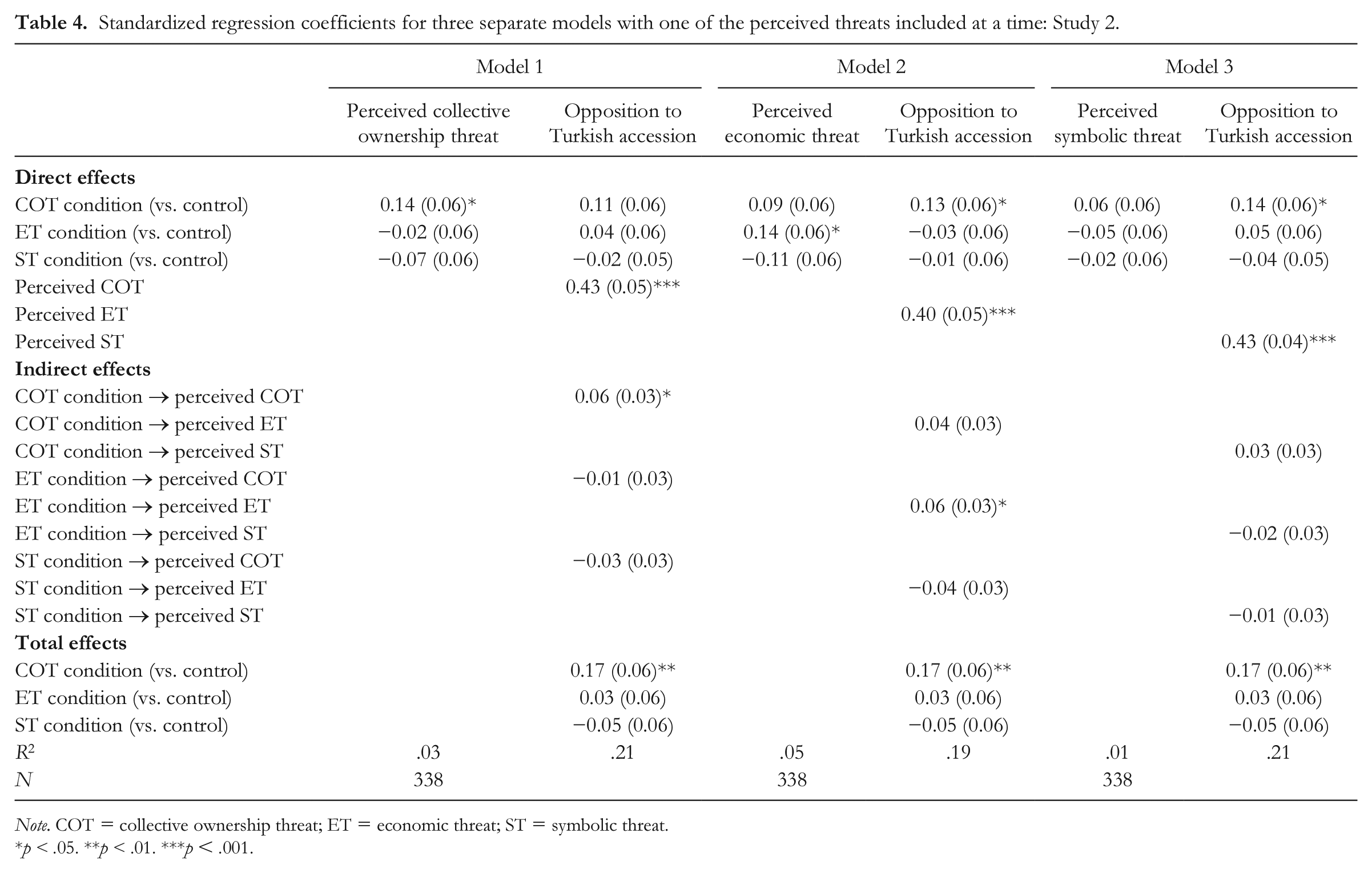
As shown in Table 4, the collective ownership threat manipulation led to more perceived collective ownership threat (β = .14, SE = 0.06, p = .023), which in turn was related to more opposition to Turkish accession (β = .43, SE = 0.05, p < .001). A significant indirect effect indicates that the collective ownership threat manipulation indirectly led to more opposition to Turkish accession via higher perceived collective ownership threat (β = .06, SE = 0.03, p = .027, 95% CI [0.01, 0.11]), but not via perceived economic (β = .04, SE = 0.03, p = .154, 95% CI [−0.02, 0.09]) or symbolic threat (β = .03, SE = 0.03, p = .299, 95% CI [−0.03, 0.08]). Similarly, the economic threat manipulation indirectly led to more opposition to Turkish accession via higher perceived economic threat (β = .06, SE = 0.03, p = .023, 95% CI [0.00, 0.11]), but not via perceived ownership (β = −.01, SE = 0.03, p = .756, 95% CI [−0.06, 0.05]) or symbolic threat (β = −.02, SE = 0.03, p = .430, 95% CI [−0.08, 0.04]). Although perceived symbolic threat was related to more opposition to Turkish accession (β = .43, SE = 0.04, p < .001), we were unable to trigger perceived symbolic threat (or perceived ownership or economic threat) with the symbolic threat manipulation, leading to no indirect effects of the symbolic threat manipulation via perceived symbolic threat on opposition to Turkish accession (β = −.01, SE = 0.03, p = .760). Finally, the collective ownership threat manipulation, but not the economic or symbolic threat manipulation, had a positive and significant total effect on opposition to Turkish accession (β = .17, SE = 0.06, p = .006). The effect of the collective ownership threat condition (compared to the control condition) on opposition to Turkish accession had an effect size of .42.
Standardized regression coefficients for three separate models with one of the perceived threats included at a time: Study 2.
Note. COT = collective ownership threat; ET = economic threat; ST = symbolic threat.
p < .05. **p < .01. ***p < .001.
Discussion
The results of Study 2 indicate that a situation in which the collective ownership of a country is infringed is indirectly related to more opposition to the infringer (Turkey) via higher perceived collective ownership threat, and not via perceived economic or symbolic threat, which is consistent with the results of Study 1. Similar indirect effects were found for the economic threat manipulation via perceptions of economic threat (and not via perceived ownership or symbolic threat). We were unable to trigger perceived symbolic threat, but perceived symbolic threat was related to more opposition to Turkish accession. This pattern of findings indicates that collective ownership threat represents a separate avenue toward stronger opposition to Turkey’s accession to the EU.
General Discussion
Based on the idea that people tend to have a basic and common notion of possession with an accompanying fear of being dispossessed (Rochat, 2014), this research examined the perceived threat of losing what is psychologically seen as “ours.” In two experimental studies, we found that infringement of a place that is perceived to be owned by a meaningful group leads to more perceived collective ownership threat, which relates to stronger intentions to engage in territorial marking and anticipatory defense behavior. To our knowledge, our research is the first to examine the consequences of a fear to lose what is collectively owned, and to establish the relevance of collective ownership threat for intergroup relations.
We offered a conceptual replication of the consequences of collective ownership threat in two contexts with different levels of abstraction. Specifically, we found (a) that infringement of an imaginary hangout place owned by a group of friends led to more perceived collective ownership threat among adolescents, which in turn related to stronger intentions to engage in marking and defending behavior, and (b) that framing Turkish accession to the EU as an infringement of the collective ownership of one’s country led to perceived collective ownership threat, which in turn related to opposition to Turkish accession to the EU. These findings show that collective ownership threat can help explain intergroup behavior in a local setting, but also discontent and skepticism about hotly debated societal topics such as European enlargement. This suggests that right-wing populist politicians, who regularly use ownership rhetoric (Partij Voor de Vrijheid, 2012; see also Vlaams Belang’s website: https://www.vlaamsbelang.org), might have identified a fruitful avenue for enlarging their electorate.
The findings also suggest that collective ownership threat is an important construct to consider in other settings and contexts. Questions of collective ownership and the related threats can be expected to be salient and consequential in institutions, (voluntary) organizations, working groups, neighbourhoods, and cities. In examining such contexts, it might be useful to also examine various collective emotions that might be involved in collective ownership threat, such as indignation, insecurity, and anger. For example, people tend to get upset and angry when their individually owned property is damaged, violated, or used without permission (Pesowski & Friedman, 2015).
Collective ownership threat is of course not the only relevant threat in intergroup relations, and in both studies, we considered other types of intergroup threat, namely symbolic threat (Studies 1 and 2) and economic threat (Study 2). We showed that economic threat plays a similarly important, though distinct, role in predicting opposition to Turkey’s accession to the EU compared to collective ownership threat, and that the two types of threat get triggered by different scenarios. Although both collective ownership threat and economic threat might fall under the same umbrella when following the broad conceptualization of realistic threat, our findings suggest that different types of threat are at stake. This suggests that the realistic threat literature might benefit from more differentiation between subdimensions that are often lumped together (Morrison & Ybarra, 2008; Stephan et al., 2002).
We also showed that collective ownership threat and symbolic threat involve different processes. In both studies, a manipulation of infringement only triggered collective ownership threat and not symbolic threat. Furthermore, unlike collective ownership threat, symbolic threat was unrelated to marking behavior and, in contrast, only perceived symbolic threat, but not perceived collective ownership threat, was related to less collective self-esteem (Study 1). However, just as collective ownership threat, symbolic threat was related to anticipatory defense intentions, both in terms of defending the hangout place (Study 1) and opposing Turkish accession to the EU (Study 2).
It should be noted that we were unable to trigger perceived symbolic threat in both studies, even though the respective manipulations focused on different aspects of symbolic threat. The imaginary situation that was designed to trigger symbolic threat in Study 1, in which other youngsters derogated the respondents’ group of friends might have required rather much imagination. Moreover, by manipulating the dismissal of the ingroup, we tried to trigger a threat to the value of social identity, which is a specific variant of symbolic threat (Branscombe et al., 1999). A manipulation with conflicting values and beliefs between the ingroup and a particular outgroup (e.g., skinheads) might have led to more strong effects, because this would more directly have challenged the continuity of the ingroup identity.
The newspaper article that was designed to trigger symbolic threat in Study 2 might have been ineffective because the article did not introduce much new information for the participants. As Turkish accession is frequently framed as a cultural threat in news media (De Vreese et al., 2011), the mention of cultural concerns might have been too familiar to affect attitudes. Stronger statements about Dutch identity being undermined by Muslim beliefs and practices might have resulted in a more pronounced effect. For example, Meeus et al. (2009) used strong (and probably new) information about widespread torture in Turkish prisons to successfully trigger symbolic threat. Moreover, the manipulation of symbolic threat might have been rather difficult to understand, given that the results of the reading checks suggest that a substantial portion of respondents was unable to correctly identify the intended manipulation, especially the lower educated participants.
Regarding the correlations between the types of perceived threat, we found that in relation to a hangout place (Study 1), perceived collective ownership threat and perceived symbolic threat were weakly associated, but in relation to the country (Study 2), these two threat perceptions seemed to be closely intertwined in people’s minds, and also with perceived economic threat. In Western European public debates, ownership, economic, and symbolic threats are often used interchangeably to argue for anti-immigrant and anti-EU attitudes (Partij Voor de Vrijheid, 2012). Other studies also have found that economic and symbolic threats strongly correlate (.7–.8; Aberson & Gaffney, 2009; Croucher, 2013; Schweitzer et al., 2005; Stephan et al., 2002), and still other studies have found that these threats cannot always be empirically distinguished (Lucassen & Lubbers, 2012; Meeus et al., 2009). The high correlations prevented us from simultaneously including the three perceived threats in our model, and from ruling out the possibility that the relationship between perceived collective ownership threat and attitudes towards Turkish accession was partly due to relatedness to perceived symbolic or economic threat. Although our results suggest that the three types of threat are conceptually distinct and represent separate avenues in explaining intergroup relations, future research should examine further the distinctive nature of threat to country ownership by testing, for example, who is more likely to experience collective ownership threat, for whom this threat more strongly translates into different responses, what triggers it, and when it can be less or more clearly distinguished from other forms of threat. For example, country ownership threat might be specifically experienced by individuals who perceive a lack of control over their personal lives, and it might be triggered by various sources such as the influx of immigrants and the interference of the EU. A more explicit examination of what is exactly at stake (ownership: what do we control?; economic: what do we need?; symbolic: who are we?) could help to understand the specific routes that are driving the different types of threat and to reduce the strong empirical relatedness. Further, future research should disentangle collective ownership threat from other relevant types of threat, such as physical safety threat.
Examining interactions between collective ownership threat and other types of threat is another direction for future research. Experimental studies have found that attitudes towards immigrants are mainly influenced by manipulations in which realistic and symbolic threats were combined (Stephan et al., 2005). It could be argued, for example, that collective ownership threat is not only relevant next to, but also in combination with, other types of threat, and that a sense of ownership can strengthen the effects of economic and symbolic threat on intergroup attitudes. Immigrants who “come and take ‘our’ jobs” is an example of an economically threatening situation that might be partly threatening because of the perceived ownership of what is considered “ours.” Moreover, criticism of “our” culture or traditions could be an example of a symbolically threatening situation that is partly threatening because of the perceived right to decide about our culture or traditions. For example, the United Nations concluded in 2015 that the Dutch tradition of “Zwarte Piet” (“Black Pete”) should be changed because it “reflects negative stereotypes of people of African descent” (Committee on the Elimination of Racial Discrimination, 2015). Dutch Facebook users reacted to this conclusion by stating that “the UN should get their hands off our culture and our traditions,” [emphasis added] and by wondering whether “we can still have a say in our own country” (RTL Nieuws, 2015). These possible interactions between forms of threat indicate that specific situations or outgroups can simultaneously elicit several types of threat, and that a careful consideration of what exactly is at stake for people can improve our understanding of negative intergroup relations (Rios et al., 2018; Verkuyten & Martinovic, 2017).
In conclusion, our study demonstrates that collective ownership threat is relevant in different situations, as it helps to understand intergroup behavior in a local context, and right-wing populist rhetoric and discontent in a country-level context. We believe that these contexts are two of many in which collective ownership threat can play an important role. Taking collective ownership threat into consideration adds to our understanding of what exactly drives intergroup attitudes and behaviors. A sense of ownership is mostly ignored in the intergroup literature, although it is a fundamental and intuitive aspect of social life, structuring social relations between people and groups (Verkuyten & Martinovic, 2017). Ownership implies normative and moral rights and provides a powerful justification for what “we” can rightfully do with what is “ours,” including the right to exclude others (Merrill, 1998; Snare, 1972). Yet perceived ownership can be challenged, disputed, or threatened, which can lead to ownership disputes and conflicts, and negative intergroup relations more generally.
Supplemental Material
sj-pdf-1-gpi-10.1177_1368430220980809 – Supplemental material for Losing what is OURS: The intergroup consequences of collective ownership threat
Supplemental material, sj-pdf-1-gpi-10.1177_1368430220980809 for Losing what is OURS: The intergroup consequences of collective ownership threat by Tom Nijs, Maykel Verkuyten and Borja Martinovic in Group Processes & Intergroup Relations
Footnotes
Acknowledgements
The authors thank Gert-Jan van den Nieuwenhuijzen for his help with the collection of data used in Study 1.
Funding
This research has received funding from the European Research Council (ERC) under the European Union’s Horizon 2020 research and innovation programme (grant agreement No 715842) awarded to the third author.

Supplemental material
Supplemental material for this article is available online.
Notes
References
Supplementary Material
Please find the following supplemental material available below.
For Open Access articles published under a Creative Commons License, all supplemental material carries the same license as the article it is associated with.
For non-Open Access articles published, all supplemental material carries a non-exclusive license, and permission requests for re-use of supplemental material or any part of supplemental material shall be sent directly to the copyright owner as specified in the copyright notice associated with the article.
