




Abstract
People can display negative reactions towards those who challenge their sense of psychological ownership. We tested whether natives would show negativity towards refugees upon perceiving collective ownership threat (COT)—the fear of losing control over a territory that is perceived to be “ours”—in the context of mass immigration (Syrian refugees in Turkey; total N = 1,598). Correlational Studies 1 and 2 demonstrated COT to be associated with intolerance and negative reactions towards refugees through negative intergroup emotions (anger specifically). Preregistered experimental studies demonstrated that while there was no causal effect of COT in neighborhoods with relatively high refugee concentration (Study 3a), COT decreased outgroup tolerance and increased defensive reactions towards Syrian refugees via outgroup anger among a more general community sample (Study 3b). The wider intergroup implications of the fear of losing one’s sense of territorial ownership are discussed.
Keywords
A sense of psychological ownership (“mine”) is omnipresent, structures social situations and relationships, and develops early in life, with children recognizing ownership over objects as early as 24 months of age (Neary et al., 2009; Ross et al., 2015). It involves the perception that a certain object or place belongs to someone with determination rights over what is owned. Ownership implies a variety of rights (e.g., to occupy, use, profit from, sell, and exclude) that one holds towards others (Blumenthal, 2010; Merrill, 1998). Thus, a sense of ownership involves not only a personal connection to what is owned, but also relationships among individuals regarding the things that are owned and the related rights.
Individuals can also have a sense of what they own collectively (“ours”), and this collective psychological ownership can play an important role in structuring intergroup relationships. A sense of collective ownership shapes how people think, feel, and act, since ownership implies a bundle of ingroup entitlements and rights in relation to outgroups, including the gatekeeper right to exclude others (Verkuyten & Martinovic, 2017). Collective ownership also connects a variety of individuals to a particular place and can be based on different principles such as the belief that first comers to a territory 1 are more entitled to decide about it (Martinovic & Verkuyten, 2013), or the belief that prior investment in the territory justifies ownership (Toruńczyk-Ruiz & Martinović, 2020).
Understanding the collective psychology of territoriality is critical given that territories often constitute a central issue in many intergroup conflicts (Toft, 2014). However, the importance of territory has received little attention among social psychologists (Meagher, 2020) and has been rarely evaluated as an intergroup phenomenon (Verkuyten & Martinovic, 2017). There is a newly emerging literature that provides initial evidence about the negative intergroup outcomes of displaying a strong sense of collective psychological ownership of a territory (e.g., Brylka et al., 2015; Nijs, Martinovic, et al., 2021), but little is known about how individuals respond emotionally and behaviorally to threats of losing control over a collectively owned territory (Nijs, Verkuyten, & Martinovic, 2021). Across three studies (two correlational and one set of preregistered experiments), we aimed to examine the outgroup consequences of collective ownership threat (COT) by investigating (a) natives’ perception of threat to their collective ownership in relation to their attitudinal and behavioral reactions towards refugees, and (b) intergroup emotions as potential explanatory mechanisms in these relations.
We tested these research questions in Turkey which has been home to a variety of ethnic and cultural minority groups with a complicated intergroup history and a unique geopolitical position. The recent mass intake of Syrian refugees to the country (UNHCR, 2021) provides a particularly relevant intergroup context for studying collective ownership threat at the level of the country. For testing the generality of the ownership threat process, we then focused on collective ownership threat at the more concrete level of the neighbourhood. While homeland and national territory have been important dimensions of Turkishness, and Turks have experienced various international conflicts to protect their territoriality (e.g., Özdoğan, 2010), the neighbourhood also constitutes a central aspect of the identity of many Turkish natives (Göregenli et al., 2014; Tuğcu & Arslan, 2019), suggesting these two contexts to be particularly relevant for Turkish citizens’ attitudes and behaviors towards refugees.
Threat to Collective Psychological Ownership
Collective psychological ownership can have negative implications for outgroup attitudes and behaviors, since it involves ingroup entitlements and rights in relation to outgroups, including the right to exclude newcomers (Snare, 1972). When something is perceived to be “ours,” such as a territory, then “we” have the self-evident right to decide what happens with it, who can use it, and who can enter. This determination right distinguishes collective ownership from other psychological-territorial constructs such as place attachment (Storz et al., 2020). A sense of ownership thus implies clear group boundaries and a gatekeeper right which provides a justified reason for rejecting newcomers (Verkuyten & Martinovic, 2017). For example, Nijs, Martinovic, et al. (2021) demonstrated that among Dutch and British participants, country-level ownership explained exclusionary attitudes (towards immigrants and the EU) and populist voting. Similarly, Storz et al. (2020) examined country-level ownership in the context of the Balkans and found it to predict lower levels of support for conflict reconciliation. Further, at the neighbourhood level, Toruńczyk-Ruiz and Martinović (2020) found that perceived ownership and the related entitlements were associated with the exclusion of ethnic others.
The exclusionary nature of collective ownership may be particularly detrimental for intergroup relationships when it is associated with the perception of threat. The possibility of loss, theft, or trespassing is intrinsically linked to the notion of ownership and can lead to defensive reactions (e.g., Blake & Harris, 2009; Wang et al., 2015). COT can be conceptualized as a specific form of realistic threat that uniquely predicts outgroup negativity (Nijs, Verkuyten, & Martinovic, 2021). People can have the feeling that what is “ours” is gradually been taken away from us so that we, as owners, can no longer decide what happens with, for example, “our” country (Brylka et al., 2015) or “our” neighborhood (Toruńczyk-Ruiz & Martinović, 2020).
While previous research has found collective psychological ownership to be associated with anti-immigrant attitudes and behaviors (Brylka et al., 2015; Martinovic et al., 2016; Selvanathan et al., 2020; Storz et al., 2020; Verkuyten & Thijs, 2019), to our knowledge, only one empirical study examined the intergroup outcomes of the perception of threat to collective ownership by showing that perceived infringements of one’s territorium (either a hangout place or a country) increase ownership marking and anticipatory defensive reactions (Nijs, Verkuyten, & Martinovic, 2021). Other studies provide indirect evidence for the exclusionary role of COT by focusing on the negative intergroup consequences of a sense of threat to one’s ingroup power (Verkuyten & Martinovic, 2015) and the perception of outgroup encroachment (e.g., Bobo, 1999).
In the current research, we argue that perceived threat to one’s sense of collective ownership should be particularly associated with two critical sets of outgroup outcomes. First, we expect that COT will have negative implications for the support of refugees’ social and political rights in the form of lower support for cultural diversity and lower outgroup tolerance. Both of these outcomes are closely related to individuals’ willingness to support the extension of basic rights to all members of society (Sullivan et al., 1993), and thereby implicate sharing some entitlements over what is collectively owned. Second, we expect that perceived COT from refugees will trigger defensive behavioral reactions among the owners. Individuals are likely to engage in marking, controlling, and defending what they consider to be theirs (Verkuyten & Martinovic, 2017), particularly under threats of infringement to individual (G. Brown & Robinson, 2011) as well as collective ownership (Nijs, Verkuyten, & Martinovic, 2021). Therefore, we examine the role of COT in defensive reactions such as verbally and physically challenging infringers, complaining to authorities, and using strategies to get back control over the territory that is considered “ours.”
Intergroup Emotions as Mediators
We further examined potential underlying mechanisms that explain the associations between COT and negative outgroup reactions. The perception of threat typically elicits negative feelings towards the outgroup, including emotions of anger and fear (e.g., Kamans et al., 2011). Negative intergroup emotions are likely to play a central role in the association between COT and territorial behaviors, since the perception of infringement and encroachment is typically emotional (Verkuyten & Martinovic, 2017). Hence, in Study 1, we examined whether COT is associated with lower levels of outgroup tolerance and support for cultural diversity via stronger antirefugee feelings, which is an important predictor of policy preferences (e.g., Mughan & Paxton, 2006; Verkuyten, 2009).
In Studies 2 and 3, we tested whether COT is related to negative outgroup outcomes through the more specific emotions of anger and fear. Previous research demonstrates that perceived territorial infringement tends to be closely associated with emotions and particularly to elicit anger responses (G. Brown & Robinson, 2011). This is in line with the notion that anger results from thwarted goals and inconsistencies between one’s desires and the external situation (Roseman, 2001; Smith & Lazarus, 1993). Cottrell and Neuberg’s (2005) sociofunctional model also proposes an obstacle–anger–aggression process whereby outgroup threat to ingroup’s resources and property evokes anger which, in turn, fuels reactionary behaviors (see also Aubé & Ric, 2019). Furthermore, anger toward an outgroup results in a desire to confront and exclude outgroup members (Mackie et al., 2000) and has been found to predict less support for refugees and immigrants (Montada & Schneider, 1989; Verkuyten, 2009).
Additionally, fear might also be an emotional response to situations where one’s perceived ownership and the related entitlements are at stake (e.g., Rapee, 1997). COT involves the possibility of losing one’s control and gatekeeper rights (Verkuyten & Martinovic, 2017), which may elicit feelings of fear that result in more negative outgroup behaviors. The association between outgroup fear and behavioral tendencies towards the outgroup is complex because fear can involve withdrawal and avoidance as well as defensiveness and attack (see Cottrell & Neuberg, 2005; Öhman, 2009). Other, research has also shown fear to elicit a tendency to take preventive measures and promote exclusionary attitudes towards the outgroup (Erisen & Kentmen-Cin, 2017; Skitka et al., 2004), particularly when the intergroup context is conflictual (Spanovic et al., 2010).
Contexts of Collective Ownership Threat
While collective ownership and its threat can be perceived in a variety of social contexts such as organizational settings (e.g., Pierce & Jussila, 2011), previous theoretical work suggests that one potential intergroup context where ownership threat can have critical implications is the context of immigration (Verkuyten & Martinovic, 2017). Immigrants and refugees constitute a group of newcomers who might be perceived as potentially taking away what is “ours,” and thereby challenge “our” ownership entitlements. In the current context, while initial responses towards Syrian refugees were positive among Turkish citizens, the open-door policy of the government and the continous granting of rights to refugees over the years have led Turks to feel uneasy with the presence of Syrian refugees (E. Erdoğan & Uyan-Semerci, 2018), and have triggered feelings of threat to territorial ownership and negative attitudes toward refugees (Saraçoğlu & Bélanger, 2019), who are depicted as “getting out of place” (Özden, 2013). Thus, the focus has gradually shifted to potential threats to the nation and local communities (e.g., M. M. Erdoğan, 2014), since Syrian immigrants’ settlement has become more permanent (Gülyaşar, 2017). Syrians are increasingly described as a threat with words such as “looters” and “exploiters” (Özden, 2013), and are seen as having a negative impact on the country and taking over local communities and neighborhoods (Konda Barometer, 2016). Historically, the construct of owning a territory or land and the principles of territoriality have been major aspects of Turkish nationalism, and the idea of homeland is ubiquitous in the national identity since the early years of the Republic of Turkey (e.g., Özkan, 2012; Ürer, 2009). This suggests that Turkish natives potentially perceive a significant level of entitlement and privilege over their territory, which may then result in various reactions towards a potential source of infringement, especially when ownership is threatened.
Besides the country (Study 1), the neighbourhood (Studies 2 and 3) may also form a particularly relevant societal context for the study of COT in Turkey. Not only the country but also neighborhoods are of great importance to Turkish people, who generally display a strong attachment and commitment to their local identities in addition to their national identity (Haerpfer et al., 2020; Tuğcu & Arslan, 2019). Previous research has also indicated that territoriality often involves the immediate locality, such as neighbourhoods, whereby the local space becomes an extension of one’s culture (Penrose, 2002). Moreover, the Syrian residential settlement in Turkey has been partly segregational, with a high level of refugee concentration in specific neighborhoods in big cities (M. M. Erdoğan, 2017). Thus, both country- and neighborhood-level COT are expected to be associated with how Turkish people evaluate and react towards Syrian refugees.
Overview of Studies
With three studies, we aimed to investigate the role of COT in reactions towards Syrian refugees in Turkey. In Study 1, we tested whether country-level ownership threat from Syrian refugees is related to more antirefugee feelings and, in turn, to lower support for cultural diversity and outgroup tolerance. In Study 2, we investigated whether neighborhood-level ownership threat is associated with stronger fear and anger towards Syrian refugees, and thereby relates to more defensive reactions and lower outgroup tolerance. In preregistered Studies 3a and 3b, we tested experimentally whether COT decreases tolerance and increases defensive reactions through stronger anger and fear towards Syrians (see Table 1 for an overview of the studies, and the supplemental material for power analyses).
Overview of studies.
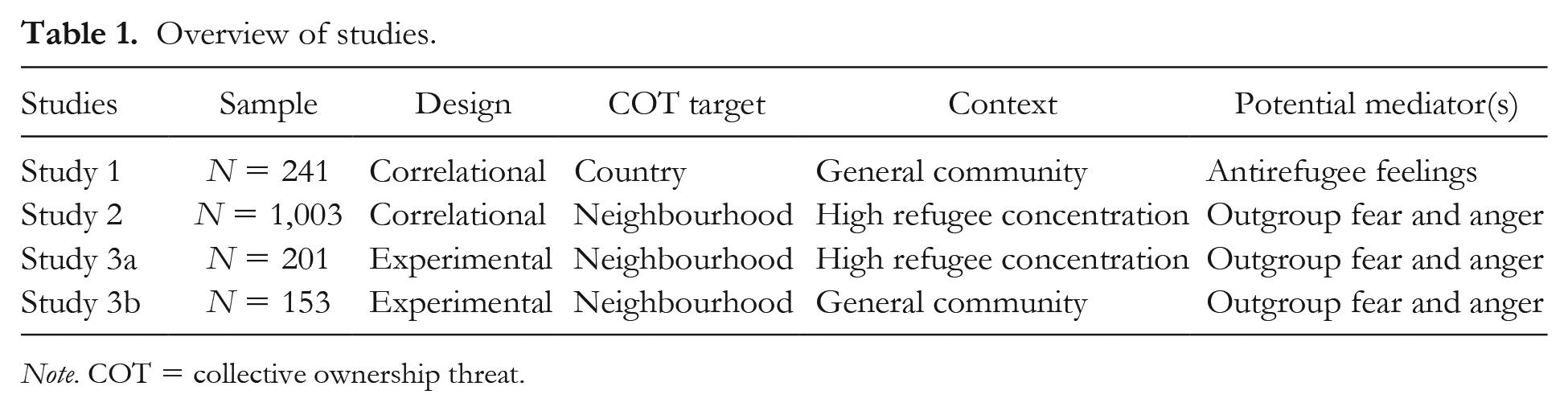
Note. COT = collective ownership threat.
We expected COT to be related to lower outgroup tolerance and lower support for cultural diversity (Study 1), as well as more defensive reactions to territorial infringement (Studies 2 and 3; Hypothesis 1). Acknowledging the importance of negative emotions in the perception of infringement (G. Brown & Robinson, 2011) and for outgroup behaviors and attitudes (Mackie et al., 2000), we further proposed the effects of COT on behavioral and attitudinal outcomes to be mediated by general antirefugee feelings (Study 1) and the particular emotions of anger and fear (Studies 2 and 3; Hypothesis 2).
Study 1
In Study 1, we investigated the perception of threat to country ownership in relation to tolerance towards refugees and support for cultural diversity, and the mediating role of antirefugee feelings.
Method
Participants and procedure
Data were collected from 241 Turkish nationals (90.5% Turkish ethno-nationals; Mage = 25.00, SD = 7.51; 186 females and 55 males; 68% university students) through nonprobability convenience sampling in various cities in Turkey. Participants were invited to a study examining Turkish natives’ evaluation of Syrian refugees, advertised through social media platforms (Facebook, Messenger, Twitter), and completed the scales online. All participants provided informed consent, and participation was voluntary. The study was approved by the ethics committee of the first author’s university of affiliation.
Measures
Unless stated otherwise, the response scale for all items ranged from 1 (strongly disagree) to 7 (strongly agree). Collective ownership threat was measured with six items adapted from Nijs, Verkuyten, and Martinovic (2021), asking participants to rate the extent to which they perceived that Turks’ collective ownership of the country is threatened by Syrian refugees (e.g., “I fear that our country is less and less owned by us Turks”; α = .91).
Antirefugee feelings were measured by three affective evaluation items (“To what extent do you find Syrian refugees warm/cold, positive/negative, friendly/hostile?”; α = .86) frequently used in previous research (e.g., Turner et al., 2007) and based on a response scale ranging from 1 to 7. Higher scores indicated greater levels of antirefugee feelings.
Outgroup tolerance measured the extent to which participants were supportive of Syrian social and political rights (adapted from Frølund Thomsen, 2012; e.g., “Syrian refugees should have the same right as native Turks to protest against the authorities when feeling ill-treated”; α = .79).
Support for cultural diversity (Verkuyten, 2005) was assessed with five items that measured the extent to which respondents favored and valued cultural differences (e.g., “The presence of Syrian refugees is good for the society”; α = .79). The full list of items is presented in the supplemental material. 2
Control variables included the demographic variables of age (in years), gender (1 = female, 2 = male), and ethnic group (1 = Turkish, 2 = other), as previous research has shown such demographic variables to predict anti-immigrant attitudes (Gorodzeisky & Semyonov, 2016). We also controlled for the perception of increased country diversity (“To what extent do you think the Syrian population has grown recently?”; 1 = not at all, 7 = a lot; M = 6.30, SD = 1.05), which may be associated with participants’ feelings and support for immigrants and refugees (e.g., Schlueter & Scheepers, 2010).
Results
Descriptive statistics are presented in Table 2. As expected, COT is positively correlated with antirefugee feelings and shows a negative association with support for cultural diversity and tolerance of Syrian refugees.
Descriptive statistics for main variables: Study 1.
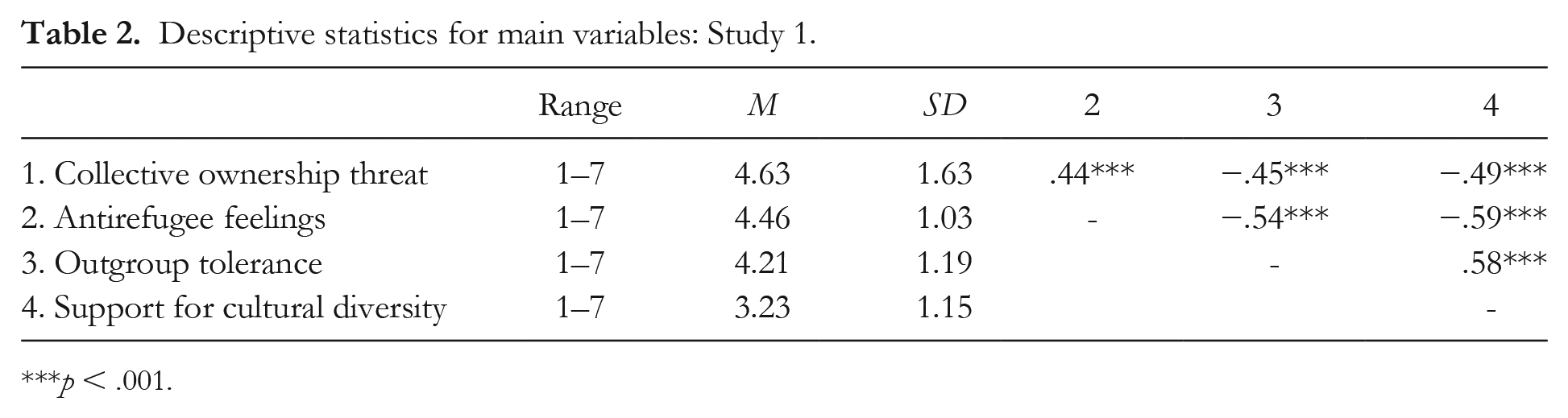
p < .001.
We tested our hypothesized mediation model using Mplus (Version 7; Muthén & Muthén, 1998–2020) with maximum likelihood estimation. We used random item parcelling for representing COT, outgroup tolerance, and cultural diversity in order to achieve a more optimal variable to sample size ratio and more stable parameter estimates (Bagozzi & Heatherton, 1994). The fit of the model was assessed by the following cut-off values: χ2/df < 3, CFI ⩾ .93, RMSEA ⩽ .07, and SRMR ⩽ .07 (Bagozzi & Yi, 2012; Marsh et al., 2004). We treated COT as the independent variable, antirefugee feelings as the mediator, and outgroup tolerance and support for cultural diversity as the two dependent variables, while controlling for the effects of age, gender, ethnic group, and perceived diversity on the mediator and the two outcome measures (effects of control variables are fully reported in the supplemental material). Indirect effects were computed with 1,000 bootstraps and using 95% confidence ıntervals.
The fit of the full measurement model with the main constructs was excellent, χ2(21) = 15.48, p = .80, χ2/df = 0.74, CFI = 1.00, RMSEA = .00, SRMR = .02, with all items loading significantly on their respective factor (loadings > .61). The structural model also had a good fit to the data, χ2(45) = 68.10, p = .015, χ2/df = 1.51, CFI = .98, RMSEA = .05, SRMR = .07, and indicated that COT is associated with stronger antirefugee feelings (β = .45, SE = 0.06, p < .001). Antirefugee feelings, in turn, predict lower outgroup tolerance (β = −.48, SE = 0.06, p < .001) and lower support for cultural diversity (β = −.55, SE = 0.06, p < .001). COT is also directly related to lower tolerance and lower support for cultural diversity (β = −.33, SE = 0.06 and β = −.32, SE = 0.07, respectively, ps < .001). Antirefugee feelings significantly mediate COT’s associations with outgroup tolerance (IE = −.21, SE = 0.04, 95% CI [−0.23, −0.10]) and support for cultural diversity (IE = −.25, SE = 0.04, 95% CI [−0.21, −0.10]). Figure 1 presents the standardized path coefficients in the final mediation model.
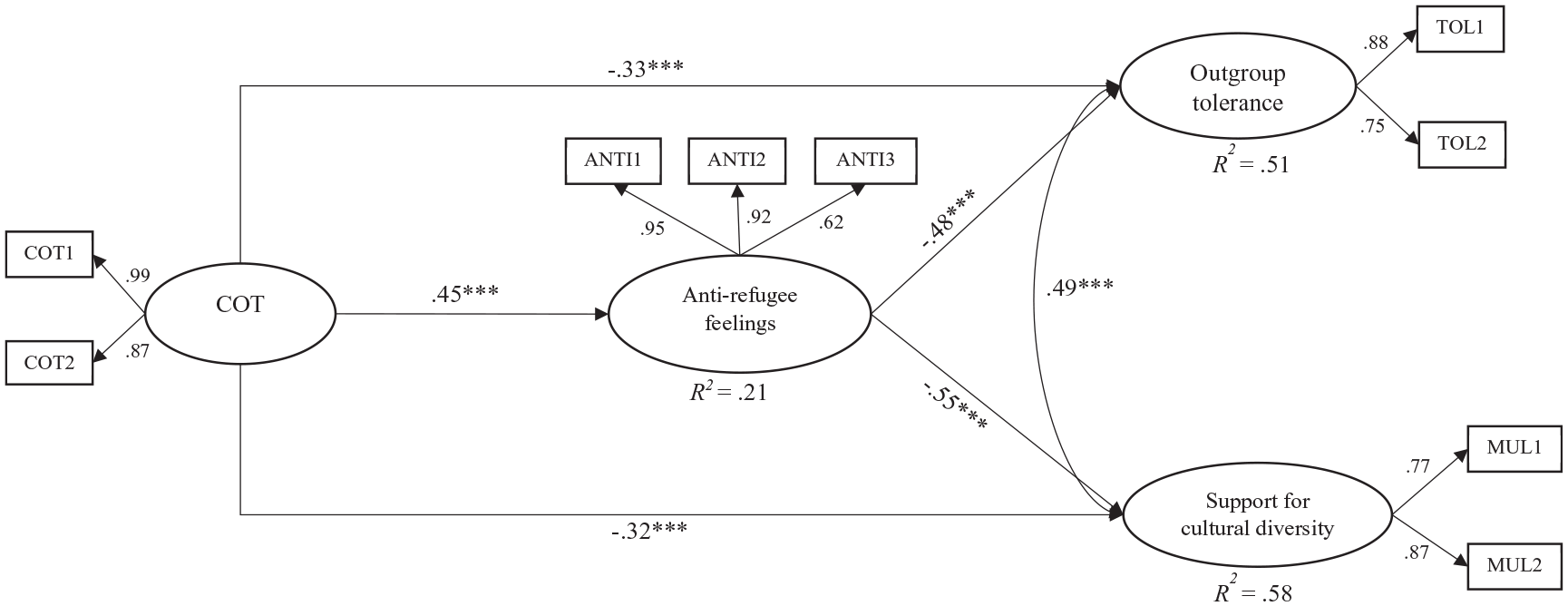
Mediation model: Study 1.
In summary, Study 1 confirmed both Hypotheses 1 and 2 by showing perceived country-level ownership threat to predict lower outgroup tolerance and lower support for cultural diversity through stronger antirefugee feelings.
Study 2
We aimed to conceptually replicate the findings of Study 1 by conducting a second study that focused on neighborhood-level ownership threat, following previous research that considered the neighbourhood as the target of collective ownerhip (Toruńczyk-Ruiz & Martinović, 2020). Moreover, we included a larger community sample selected from neighbourhoods that have witnessed a significant level of Syrian intake, and extended our dependent variables to more specific outcomes of ownership threat such as territorial behaviors. Furthermore, we focused on the role of fear and anger as more specific explanatory mechanisms compared to general feelings. Territorial infringement has been previously associated with increased negative emotions such as anger (e.g., G. Brown & Robinson, 2011), and both fear and anger have been previously considered as primary emotions that could explain negative reactions to outgroup members (e.g., Kamans et al., 2011). Especially in the context of Syrian refugees, public discourses highlight the prevalence of security concerns due to the segregation of Syrian refugees in some neighbourhoods, and associate refugees with crimes, socioeconomic problems, as well as cultural deprivation (Koca, 2016). This suggests that anger and fear might constitute critical mediating mechanisms in the association between COT and outgroup behaviors.
Method
Participants and procedure
We collected data through the assistance of a research company (Optimist Research) via home interviews and reached 1,003 Turkish nationals (Mage = 37.33, SD = 13.65; 502 females, 501 males; 86.8% ethnic Turks, 13.2% other ethnicity) residing in neighbourhoods with a relatively high level of refugee concentration. 3 The study was approved by the ethics committee of the first author’s university of affiliation.
The mean income level assessed by a self-rated income measure (“How would you rate your income?”; 1 = bottom 25% of the country, 2 = between 25–50% of the country, 3 = between 50–75% of the country, 4 = upper 25% of the country) was 1.76 (SD = 0.72). Educational level ranging from 1 (no formal education) to 6 (master’s degree or higher) was 3.26 (SD = 1.17). The mean political orientation ranging from 1 (extreme left) to 10 (extreme right) indicated slightly right-wing political attitudes (M = 6.18, SD = 2.67). Participants also reported the length of residency in their neighbourhood (in years; M = 20.02, SD = 13.80).
Measures
Unless otherwise indicated, all response scales ranged from 1 (strongly disagree; not at all) to 5 (strongly agree; a lot). 4
Collective ownership threat was measured with six items similar to the ones used in Study 1 but focusing on the neighbourhood (e.g., “Our neighbourhood is gradually been taken over by Syrian refugees”; α = .97).
Intergroup emotion scales, adapted from Mackie et al. (2000), assessed each emotion by two items with the following instruction: “How angry/irritated (anger, r = .79, p < .001), worried/fearful (fear, r = .45, p < .001) do you feel when thinking about Syrian refugees in your neighbourhood?”
Outgroup tolerance was measured by similar political and social tolerance items as in Study 1 (α = .84). Measure of defensive reactions to territorial infringement (adapted from Brown & Robinson, 2011) included six items with the instruction: “In relation to the Syrian refugees coming to your neighbourhood and starting to act as if they own it, to what extent would you or have you ever done the following?” The items included, for example, complaining to other residents (or to an authority) in your neighbourhood and devising a strategy to get back your neighbourhood from them (α = .95). The full list of items is presented in the supplemental material. 5
Control variables included age (in years), gender (1 = female, 2 = male), ethnic group (1 = Turkish, 2 = other), income, political orientation, education (1 = no formal education, 6 = master’s degree or higher), length of neighborhood residency (in years), and perceived neighborhood diversity (“How many Syrian refugees do you think there are in your neighbourhood?”; 1 = none, 5 = a lot; M = 4.11, SD = 1.05). In Study 2, we extended our control variables to include income (e.g., Schneider, 2008) as well as education and political orientation (e.g., Rustenbach, 2010), which have been found to predict anti-immigrant attitudes. Length of neighbourhood residency has been also previously demonstrated to predict openness to immigrants into neighbourhoods (Toruńczyk-Ruiz & Martinović, 2020). Moreover, because our data were collected after the coronavirus (COVID-19) pandemic spreaded in Turkey (although not during the strict confinement period), we used seven items from the COVID-19 Concern Scale (Conway et al., 2020; e.g., “COVID 19 has impacted me negatively from a financial point of view”; α = .79) in order to control for the potential role of COVID-19 in attitudes and reactions towards Syrian refugees (Adam-Troian & Bagci, 2021).
Results
Means, standard deviations, and bivariate correlations are presented in Table 3. As expected, COT is strongly associated with both greater fear and anger, as well as lower tolerance and stronger defensive reactions to infringement. Fear and anger are related to lower outgroup tolerance and stronger defensiveness.
Descriptive statistics for main variables: Study 2.
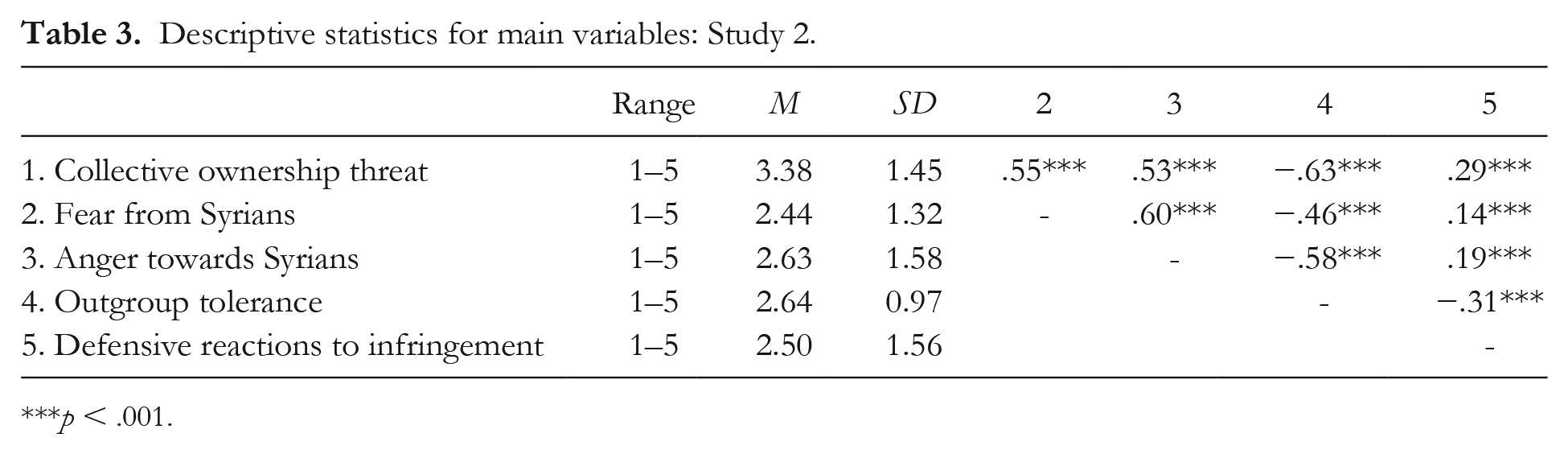
p < .001.
As in Study 1, we used Mplus to test our hypothesized mediation model and applied the same analytic strategy. We constructed models considering COT as the independent variable, outgroup fear and anger as simultaneous mediators, outgroup tolerance and defensive reactions as outcome variables, while controlling for the effects of age, gender, ethnic group, income, education, political attitudes, length of residency, perceived diversity, and COVID-19 experience on both mediating and outcome variables.
The measurement model demonstrated a good fit, χ2(25) = 57.24, p < .001, χ2/df = 2.29, CFI > .99, RMSEA = .04, SRMR = .01. The initial structural model demonstrated a rather poor fit with relatively high RMSEA and SRMR values (.081 and .084, respectively). After the inclusion of COT’s correlation with diversity, COVID threat, and political attitudes (indicated by modification indices), the model demonstrated a good fit, χ2(94) = 356.84, p < .001, χ2/df = 3.80, CFI = .97, RMSEA = .05, SRMR = .04.
As expected, higher COT is associated with both stronger feelings of fear (β = .69, SE = 0.04, p < .001) and anger (β = .54, SE = 0.03, p < .001). In turn, anger towards Syrians predicts lower tolerance towards this outgroup (β = −.50, SE = 0.05, p < .001) as well as higher defensiveness (β = .17, SE = 0.08, p = .025). Fear, however, is unexpectedly associated with greater tolerance and lower defensive reactions to infringement (β = .19, SE = 0.10, p = .048 and β = −.22, SE = 0.11, p = .039, respectively). 6 COT is also directly associated with both outcome variables (tolerance: β = −.50, SE = 0.05, p < .001; defensive reactions: β = .24, SE = 0.06, p < .001).
The indirect effects indicate that COT is related to lower tolerance (IE = −.27, SE = 0.05, 95% CI [−0.36, −0.17]) and stronger defensive reactions (IE = .09, SE = 0.04, 95% CI [0.01, 0.18]) through increased feelings of anger. Fear’s mediational role was in the opposite direction, but did not reach statistical significance (tolerance: IE = .13, SE = 0.08, 95% CI [−0.03, 0.29]; defensive reactions: IE = −.15, SE = 0.08, 95% CI [−0.30, 0.003]). Figure 2 presents standardized path coefficients in the final mediation model.
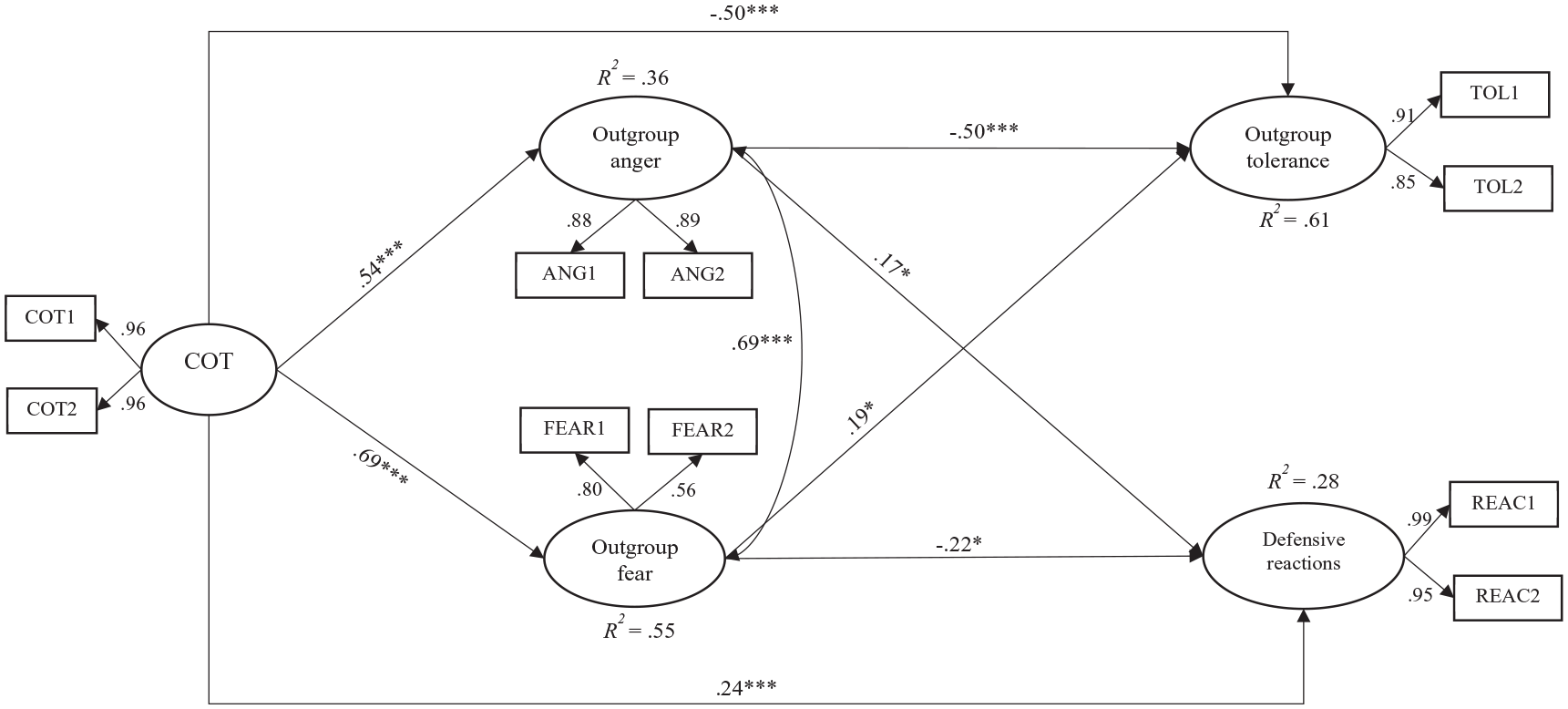
Mediation model: Study 2.
Similar to Study 1, the findings in Study 2 provide evidence for the negative implications of COT for intergroup relationships, while additionally showing the mediational role of outgroup anger in particular. However, the correlational nature of these two studies does not allow to make causal interpretations about the role of COT in intergroup outcomes, and it is possible that COT is the by-product of negative intergroup emotions and initial intolerance towards refugees (e.g., Blinder & Lundgren, 2019). In a next step, we therefore tested whether an experimental manipulation of COT leads to the same intergroup emotions and associated attitudinal and behavioral outcomes. For Study 3, we first conducted a pilot study and then ran two preregistered experiments in different neighbourhood contexts.
Study 3
Pilot Study
The aim of the pilot study was to explore the effectiveness of a COT manipulation. We designed a condition to manipulate COT and tested its effectiveness in relation to a control condition. Data were collected from a general community sample (total N = 62; Mage = 28.70, SD = 10.45; 38 females and 24 males; 60 ethnic Turks and 2 other ethnicity) through online questionnaires.
While the control group did not receive any task, in the COT condition, participants were asked to imagine a hypothetical scenario in which two key ownership principles were presented, namely primo-occupancy and investment (Verkuyten & Martinovic, 2017): The original residents of your neighborhood have lived here for centuries and have made the neighborhood to what it is today. Imagine that you, as a resident of your neighborhood face the challenge of receiving many Syrian refugees into your neighborhood; refugees who may gradually take over and start to act as if they own the neighborhood. Now, describe your thoughts and feelings with 5–6 sentences.
As a manipulation check, we asked participants to indicate the extent to which they would feel threatened by Syrian refugees in terms of losing their ownership over their neighborhood (“To what extent would you be worried about losing your say over your neighborhood?”; 1 = not worried at all, 7 = extremely worried). We also included a mood check (“How do you feel at the moment?”; 1 = very negative, 7 = very positive) and a question on collective ownership itself (“To what extent do the residents of your neighborhood feel that they own the neighborhood?”; 1 = not at all, 7 = very much), in order to confirm that threat effects were not due to mood biases or changes in degree of perceived ownership. Independent samples t tests demonstrated that participants in the COT condition reported stronger ownership threat (M = 3.37, SD = 2.08) compared to the control condition (M = 2.40, SD = 1.44), t(44.17) = −2.07, p = .044. There was no significant difference between the two groups in terms of mood (MCOT = 3.83, SD = 1.32 and Mcontrol = 3.50, SD = 1.92), t(41.72) = 0.75, p = .457, or collective psychological ownership (MCOT = 4.70, SD = 2.11 and Mcontrol = 4.09, SD = 1.73), t(59) = −1.25, p = .215.
Study 3a
Study 3a (preregistered at the Open Science Framework; https://osf.io/8yb3u/?view_only=43ee4d2ea8cc4ea299fc4162d4689e21) tested whether participants who imagined the neighbourhood-level COT scenario would report greater anger and fear, which, in turn, should predict outgroup tolerance and defensive reactions to territorial infringement.
Method
Participants and procedure
A total of 201 Turkish nationals (Mage = 35.71, SD = 12.83; 99 females and 111 males; 99% ethnic Turks) participated in the study. Similar to the procedure in Study 2, data were collected through a research company and from neighborhoods where refugee concentration is relatively high. Ethical approval was granted from the first author’s university of affiliation. The mean income level (from 1 to 4) was 1.81 (SD = 0.73), and on the 10-point scale, the sample displayed a slightly rightist political orientation (M = 6.40, SD = 2.69).
Measures
Similar measures as in Study 2 were used (see the Variables section in the preregistration for minor changes; alphas ranging between .79 and .92; see supplemental material for all reliabilities). Participants were randomly divided into two groups (Ncontrol = 100 and NCOT = 101) and first answered demographic questions. The experimental procedure was the same as the one used in the pilot study.
Results
Manipulation check
The same manipulation checks as in the pilot study were used, and the two experimental groups were not different in terms of positive mood, t(199) = −1.32, p = .187 (Mcontrol = 3.24, SD = 1.17 and MCOT = 3.45, SD = 1.02) or collective psychological ownership, t(199) = −0.63, p = .532 (Mcontrol = 3.54, SD = 1.22 and MCOT = 3.64, SD = 1.13). More importantly, we failed to detect any difference between the two groups in terms of COT, t(199) = −0.04, p = .971 (Mcontrol = 2.26, SD = 1.43 and MCOT = 2.27, SD = 1.46).
A further MANOVA test including all dependent variables (outgroup fear, outgroup anger, outgroup tolerance, and reactions to territorial infringement) revealed no significant multivariate effect for condition, F(4, 196) = 0.94, p = .44, ηp2 = .02. All univariate effects were also nonsignificant (all ps > .05). Means and standard deviations for the main variables are included in the supplemental material. 7
Study 3b
Findings demonstrated that while our COT manipulation successfully increased ownership threat among a general community sample (pilot study), there was no increase in COT in a sample from neighborhoods with a relatively high level of refugee concentration (Study 3a).
In Study 3b, we therefore tried to show that the manipulation of COT does have the expected effects among a general community sample (see preregistration at https://osf.io/azf97/?view_only=b011e2365e4042bf870c7c061a672d51).
Method
Participants and procedure
The sample included 153 Turkish natives (Mage = 30.68, SD = 10.68; 78 females, 74 males, one other gender; 96.1% Turkish). Data were collected online through convenience sampling and the study was ethically approved by the first author’s university of affiliation. The mean income level (from 1 to 4) was 2.24 (SD = 0.80) and the average political orientation (from 1 to 10) approached the left (M = 4.73, SD = 2.58). Perceived diversity at the neighbourhood level assessed by a single item (“How many Syrians do you think there are in your neighbourhood?”; 1 = none, 7 = a lot) was 2.81 (SD = 2.05).
Measures
The exact same manipulation and measures as in Study 3a were used. All reliabilities ranged between .83 and .93 (see supplemental material for all reliabilities). Participants were randomly divided into two groups (80 control, 73 COT). COT participants received the imaginary COT scenario from the pilot study, whereas control participants did not receive any task.
Results
Manipulation checks
Similar to the pilot study, participants in the COT condition reported higher collective ownership threat (M = 3.23, SD = 2.08) compared to participants in the control condition (M = 2.46, SD = 1.81), t(150) = −2.46, p = .015. Mood and collective ownership did not significantly differ between the two conditions, t(150) = −0.41, p = .680 and t(150) = −1.28, p = .201, respectively. We also found that the randomization was succesful because the conditions were not significantly different in terms of age, gender, education, income, diversity, length of residency, and COVID-19 threat. Hence, these variables were not included as covariates.
Group comparisons
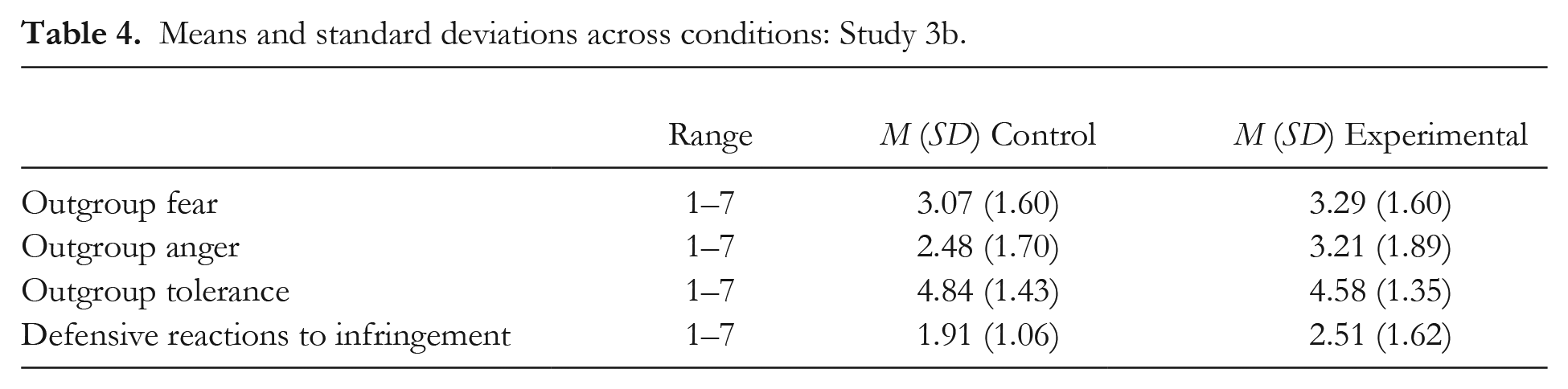
A MANOVA was performed in order to test the effect of condition on the outcome variables. The multivariate effect of condition was significant, F(4, 145) = 2.50, p = .045, ηp2 = .07. The univariate effects of condition on outgroup fear and on tolerance were not significant, F(1, 148) = 0.72, p = .40 and F(1, 148) = 1.26, p = .26, respectively; both ηp2 < .01. However, participants in the COT condition (M = 3.21, SD = 1.89) reported greater anger towards Syrians compared to those in the control condition (M = 2.48, SD = 1.70), F(1, 148) = 6.21, p = .01, ηp2 = .04. Similarly, the COT manipulation significantly increased defensive reactions to territorial infringement, F(1, 148) = 7.37, p = .007, ηp2 = .05 (MCOT = 2.51, SD = 1.62 and Mcontrol = 1.91, SD = 1.06). Table 4 shows the means and standard deviations.
Means and standard deviations across conditions: Study 3b.
Mediations
We used Mplus to test a mediation model whereby condition (0 = control, 1 = COT) increased outgroup anger, which in turn relates to outgroup tolerance and defensive reactions to territorial infringement. We did not include fear as a mediator since initial mean comparisons across conditions were nonsignificant.
We used path modelling due to the relatively smaller sample size, and the model fit indices are not reported since the model was fully saturated. Findings demonstrate that the effect of condition on outgroup anger is significant (β = .20, SE = 0.08, p = .010), with anger being further associated with lower outgroup tolerance (β = −.58, SE = 0.06, p < .001) as well as greater defensiveness (β = .56, SE = 0.06, p < .001). The direct effects of condition on the outcome variables are not significant (tolerance: β = .02, SE = 0.07, p = .735; defensiveness: β = .11, SE = 0.07, p = .110). The indirect effects show that COT decreases outgroup tolerance and increases defensiveness via increased anger towards Syrian immigrants (IE = −.12, SE = 0.05, 95% CI [−0.21, −0.03] and IE = .11, SE = 0.05, 95% CI [0.02, 0.21], respectively). Figure 3 presents standardized coefficients for the paths from experimental condition to outcome variables via outgroup anger. 8
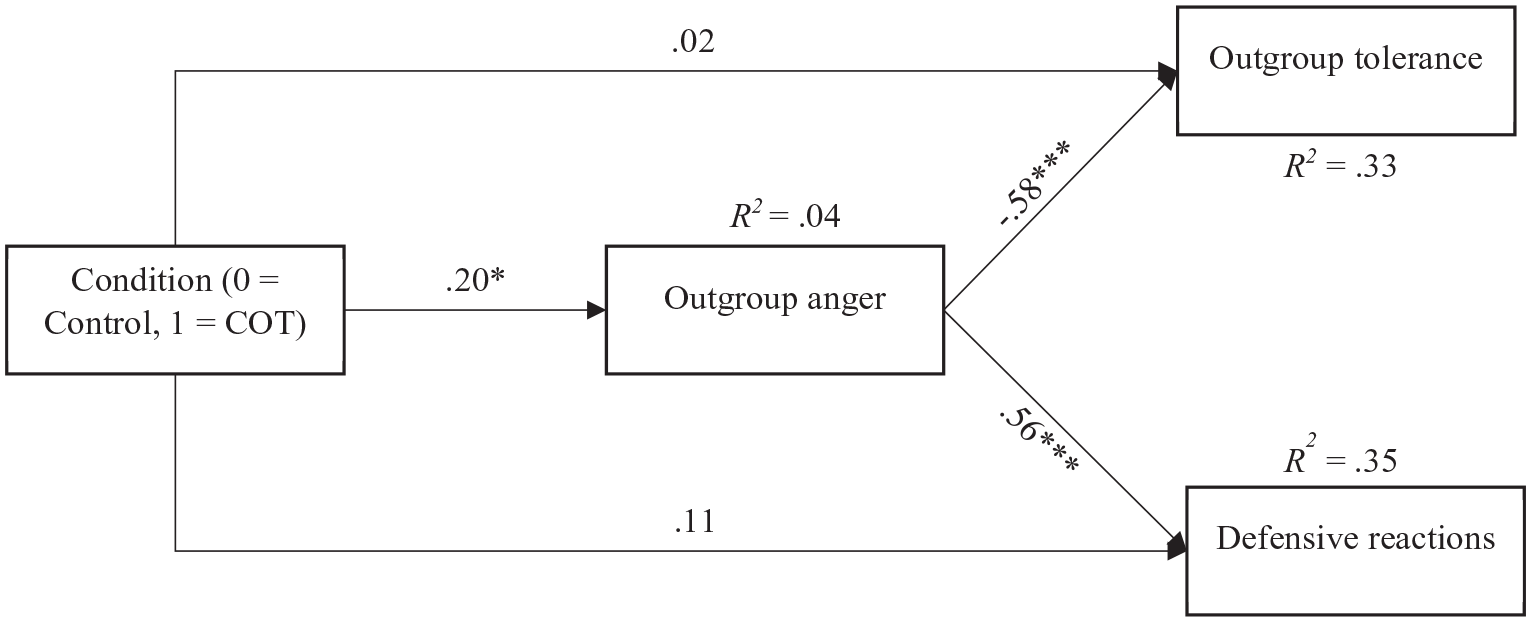
Mediation model: Study 3b.
General Discussion
A sense of ownership implies entitlements and rights, structures social relationships, and therefore is a critical feature of how people think, feel, and act towards others (Verkuyten & Martinovic, 2017). Ownership also denotes the possibility of losing one’s say and control over what is owned, which can lead to exclusionary and defensive reactions towards outsiders. The current research examined the perception of threat to the ownership of “our” country and “our” neighborhood for understanding natives’ tolerance and defensive reactions towards refugees. As expected, both correlational and experimental findings demonstrated that higher COT was associated with lower outgroup tolerance and stronger negative behavioral reactions towards refugees through negative intergroup feelings, and particularly anger as a critical emotion.
Confirming Hypothesis 1, we found that higher COT was associated with lower outgroup tolerance and support for cultural diversity (Study 1), as well as stronger defensive reactions to territorial infringement (Study 2). Moreover, a COT manipulation where participants were asked to think about losing their ownership triggered these defensive reactions (Study 3b). Hence, in line with previous empirical research on the exclusionary role of collective psychological ownership (e.g., Nijs, Martinovic, et al., 2021; Storz et al., 2020) and negative reactionary behaviors upon infringement of individually and collectively owned territories (G. Brown & Robinson, 2011; Nijs, Verkuyten, & Martinovic, 2021), COT was associated with negative intergroup outcomes related to one’s willingness to support outgroup rights, and generated intolerant and defensive behaviors aimed at reclaiming ownership from the potential infringer.
Second, the findings suggest that intergroup feelings and emotions are likely to be important drivers of the negative effects of COT. Providing evidence for Hypothesis 2, we found that general antirefugee feelings (Study 1) and outgroup anger (Studies 2 and 3b) accounted, in part, for the associations between COT and negative intergroup outcomes. While in Study 2 COT was associated with both anger and fear, only anger predicted intolerance and defensive reactions to infringement. The experimental findings in Study 3b corraborated this result by showing COT to fuel outgroup anger, which was associated with decreased tolerance and increased defensive reactions. These findings are consistent with empirical literature demonstrating infringement to personal ownership to be associated with defensive behaviors through increased outgroup anger (G. Brown & Robinson, 2011), and threat to provoke movements against an outgroup through increased anger (Cottrell & Neuberg, 2005; Mackie et al., 2000).
The role of outgroup fear as an explanatory mechanism between COT and outgroup reactions was less clear. We theorized that the anticipation of losing the sense of ownership over what is “ours” is likely to evoke fear of the potential infringer and this would be associated with more defensive and negative reactions, as previous research demonstrated fear to be associated with aggressive tendencies (Skitka et al., 2004). In Study 2, higher COT was correlated with both stronger anger and fear, but unlike anger, fear actually predicted less defensive reactions to territorial infringement and higher tolerance (although the overall mediation through fear was nonsignificant). This indicates that the two intergroup emotions might have opposing implications for our outcome variables. Additional analyses showed that these relationships only occur when anger is included in the analysis, suggesting a potential suppression effect (see Endnote 6). Nevertheless, in Study 3b, COT increased only outgroup anger but not fear, suggesting that the attitudinal and behavioral reactions to COT are mostly driven by increased feelings of anger.
Potential explanations for the inconsistent findings regarding fear include the particular societal context, because fear might elicit aggressive responses mainly in the context of ongoing conflict (Spanovic et al., 2010). Further, threat may lead to different emotions (anger or fear) and translate into different reactions (avoiding or confronting) depending on whether one feels more or less powerful relative to the outgroup (Kamans et al., 2011). Participants in Study 2 were from neighbourhoods where refugee concentration was relatively high and the socioeconomic background was relatively low, which could mean that individuals may have been more likely to prefer avoidance than confrontration strategies upon experiencing fear.
We also found differences in the way COT impacted our outcome measures. While in experimental Study 3a there was no effect of a COT manipulation, Study 3b (as well as the pilot study) demonstrated an increase in COT that was related to both anger and defensive reactions. The different findings in Study 3a and 3b might be due to sample characteristics such as participants’ political orientation. Additionally, research has shown that a variety of contextual variables have an impact on the effectiveness of experimental threat manipulations (Rios et al., 2018). Study 3a was conducted in a neighbourhood with relatively high numbers of Syrian refugees. This could mean that perceived threat from Syrians and the notion of immigrants “taking over” might have already been a prominent feature of residents’ beliefs (Narli & Özaşçılar, 2020), overall making it difficult to increase COT with a short experimental reading task. Future research should try to understand under which social conditions COT’s effects on various outcomes are less or more profound.
In summary, we make a novel contribution to the intergroup literature by (a) providing, for the first time, empirical evidence for the role of COT in relation to refugees, (b) examining intergroup emotions as critical mechanisms underlying COT’s associations with negative reactions towards refugees, (c) conceptually replicating the findings at both national and neighborhood ownership levels, and (d) using both correlational and experimental research designs. However, we need to acknowledge various limitations and suggest possible future directions for further research.
For example, while we argued that COT would be particularly important in relation to one’s intentions to reclaim ownership, it is possible that COT also functions in addition to other types of threats, and in the context of Syrian immigration particularly (Yitmen & Verkuyten, 2020). While ownership threat has been suggested and found to constitute a conceptually unique form of threat which refers to one’s determination rights (Verkuyten & Martinovic, 2017), its empirical distinction from other types of threats such as symbolic, economic, safety, and existential threats is not always easy to make (Nijs, Verkuyten, & Martinovic, 2021). Depending on the type of ownership and the intergroup context, ownership threat might be more or less closely associated with other types of threats, and more or less critical for negative outgroup attitudes and behaviors. For example, Nijs, Verkuyten, and Martinovic (2021) suggested that symbolic, economic, and ownership threats are more interconnected in the context of country ownership than in other types of ownerships. This suggests the need to further disentangle unique and shared properties of various types of threats in relation to different territories across various intergroup settings.
Our research focused on COT’s implications for intergroup relationships, but future research can also investigate the antecedents of COT by examining whether particular social conditions and psychological predispositions lead people to be less or more prone to display COT. Among the contextual variables, potential antecedents may include the objective and subjective experiences of diversity (Laurence et al., 2018) and the history of conflict between groups (e.g., Storz et al., 2020). At the psychological level, individuals who hold authoritarian values or have a social dominance orientation might be more likely to feel a sense of ownership threat, because they may be more strongly focused on the exclusive determination right of collective ownership (e.g., Nicol, 2007). Similarly, need for cognitive closure (Roets & van Hiel, 2011) and need for chaos (e.g., Arceneaux et al., 2021) might be relevant constructs to consider in future research. While some of these factors may increase one’s responses to the perception of any form of threat (e.g., Duckitt, 2006), individual differences in sensitivity to personal space invasion, for example, may play a unique role in explaining why some people feel more threatened upon infringement and engage in defensive territorial behavior (Wollman et al., 1994). Furthermore, although perceived threat with the related intergroup emotions is a leading factor in the explanation of outgroup attitudes and behaviors (e.g., Cottrell & Neuberg, 2005), these attitudes and emotions might also affect threat perceptions. Future research could examine this possibility by using, for example, a longitudinal research design.
We concentrated on intergroup emotions as potential mediators, but future research is needed to examine other mechanisms that can potentially explain the role of COT in negative outgroup behaviors. For example, it may be interesting to examine whether COT’s detrimental outcomes are also due to a reduced sense of efficacy among the owners. Previous research has demonstrated that, at the individual level, ownership satisfies one’s need for controllability (Pierce et al., 2003), and lack of control is closely associated with defensive group reactions and less positive outgroup attitudes (Marchlewska et al., 2020). This suggests that COT can provoke a feeling of reduced collective efficacy and/or control loss, which can in turn harm intergroup relationships. Furthermore, and in addition to anger and fear, anxiety may also play a role in the association between ownership threat and defensive reactions. Anxiety has been found to be a predictor of prejudice towards refugees in various intergroup contexts (e.g., Koc & Anderson, 2018; Stephan et al., 1999), and Turkish people might feel anxious because of the reduced uncertainty and controllability related to Syrian refugees.
Future research can also examine the importance of collective psychological ownership and the related feelings of ownership threat for other targets of ownership. We have examined COT at the level of the country and neighborhood, but there might be other contexts in relation to which people make collective territorial ownership claims, such as when individuals mark a place as theirs (e.g., Kirk et al., 2018) and have a sense of ownership over public spaces (e.g., Peck et al., 2021), or with territorial feelings in institutional and organizational settings (Brown et al., 2005; Pierce & Jussila, 2011) and in gang behavior (Kintrea et al., 2008), as well as in forms of cultural appropriation. A sense of collective ownership (“ours”) and ownership threat are likely to be meaningful in many different settings with various exclusionary consequences for newcomers and outsiders. Ownership is of profound, and often self-evident, importance for how people perceive the world in a range of settings, which makes it a very relevant topic for broader social psychological research.
Conclusion
To conclude, the current research provides important insights into the implications of perceived territorial ownership threat. Despite its potential power in shaping intergroup outcomes, the psychological importance of territory and the detrimental role of collective psychological ownership for intergroup relations have been largely overlooked in the literature (see Meagher, 2020; Verkuyten & Martinovic, 2017). We argued that natives’ intolerance and negative reactions towards newcomers, who can be seen as taking over what is “ours,” may be explained by the sense of threat to one’s ownership determination rights. With both correlational and experimental evidence, we demonstrated that ownership threat is associated with negative feelings, and particularly anger, which have negative intergroup implications.
The understanding of COT and its intergroup consequences is not only important for theoretical reasons but also has implications for policies and politics regarding immigration issues. For example, research has shown that right-wing populist leaders’ narratives of immigrants “taking over what is ours” may create a sense of collective ownership threat (Mols & Jetten, 2016). The use of a collective ownership discourse (“this country is ours”) is likely to instigate the belief that one has the moral and justified right to exclude newcomers. Hence, framing immigration as a form of infringement of one’s collective ownership rights might fuel people’s perception of threat and consequently trigger defensive behaviors and opposition towards immigrants and refugees. Further research is needed to better understand the potential sociopolitical implications of perceiving threat to the ownership of one’s territory.
Supplemental Material
sj-docx-1-gpi-10.1177_13684302221084232 – Supplemental material for When they want to take away what is “ours”: Collective ownership threat and negative reactions towards refugees
Supplemental material, sj-docx-1-gpi-10.1177_13684302221084232 for When they want to take away what is “ours”: Collective ownership threat and negative reactions towards refugees by Sabahat Cigdem Bagci, Maykel Verkuyten and Esra Canpolat in Group Processes & Intergroup Relations
Footnotes
Data availability

Disclosure statement
We report all manipulations, measures, and exclusions in these studies.
Funding
The author(s) disclosed receipt of the following financial support for the research, authorship, and/or publication of this article: We would like to thank Sabanci University for their integration grant (B.A.CG-20-02180), funding Studies 2 and 3a.
Supplemental material
Supplemental material for this article is available online.
Notes
References
Supplementary Material
Please find the following supplemental material available below.
For Open Access articles published under a Creative Commons License, all supplemental material carries the same license as the article it is associated with.
For non-Open Access articles published, all supplemental material carries a non-exclusive license, and permission requests for re-use of supplemental material or any part of supplemental material shall be sent directly to the copyright owner as specified in the copyright notice associated with the article.
