



Abstract
Collective psychological ownership as a sense that a territory belongs to a group might explain attitudes of the White majority toward territorial compensation for Indigenous Peoples in settler societies. Ownership can be inferred from different general principles and we considered three key principles: autochthony (entitlements from first arrival), investment (entitlements from working the land), and formation (primacy of the territory in forming the collective identity). In two studies, among White Australians (Study 1, N = 475), and White South Africans (Study 2, N = 879), we investigated how support for these general principles was related to perceived ingroup (Anglo-Celtic/White South African) and outgroup (Indigenous Australian/Black South African) territorial ownership, and indirectly, to attitudes toward territorial compensation for the Indigenous outgroup. Endorsement of autochthony was related to stronger support for territorial compensation through higher perceived outgroup ownership, whereas investment was related to lower support through higher perceived ingroup ownership. Agreement with the formation principle was related to stronger support for compensation through higher outgroup ownership, and simultaneously to lower support through higher ingroup ownership.
“It is my father’s land, my grandfather’s land, my grandmother’s land. I am related to it, it gives me my identity”—Father Dave Passi, plaintiff in the landmark “Mabo” Case on the land rights of the Indigenous Meriam People in Australia (Graham, 1989, 0:02:08).
In this quote, Father Dave Passi explains why he fights for the recognition of Indigenous ownership over the Mer islands in Australia by emphasizing his ancestral connection to the land and the importance of the land for defining who he is. These arguments reflect some of the general beliefs, or principles, that people use for inferring and claiming ownership of territories. Three principles are proposed to be particularly relevant: ownership derived from primo-occupancy (autochthony), from historically investing in and developing the land (investment), and from the formative meaning of the territory for the group identity (formation) (Beggan & Brown, 1994; Gans, 2001; Geschiere, 2009; Murphy, 1990; Verkuyten & Martinovic, 2017).
Debates about land ownership of Indigenous Peoples are prominent in settler societies, such as Australia, New Zealand, Chile, and South Africa, that were colonized by White Europeans. The original (Indigenous) inhabitants call for the return of their ancestral lands and claim compensations, while the descendants of White settlers can argue that they have invested and developed the land into what it is today. These debates about land ownership exist not only between original inhabitants and Whites, but also within the White group. Because of the more powerful position of Whites in settler societies, the latter debates are particularly important for territorial compensation, that is, the restitution of Indigenous lands and the rights associated with the land. Some Whites might be inclined to give territorial compensation to original inhabitants because these inhabitants were “here first” and were formed by the land, and therefore own the land more than the White group. However, other Whites might be reluctant to give compensation because they feel that their group owns the territory based on the believe that they have developed the land and were also formed by it. Thus, the degree to which White people endorse the general principles of autochthony, investment, and formation can be expected to matter for inferring ingroup and outgroup territorial ownership and thereby for their attitude toward territorial compensation for Indigenous Peoples.
We examined whether Whites’ endorsement of the general principles of autochthony, investment, and formation are indeed related to perceptions of ingroup (White) and outgroup (Indigenous) ownership of the territory, and via these ownership perceptions, to support for territorial compensation for Indigenous Peoples. We focus on two settler societies—Australia (Study 1) and South Africa (Study 2)—which allows us to compare the findings across two different contexts. In Australia, White Europeans are the numerical majority, whereas in South Africa, they represent a numerical minority. Furthermore, White Europeans in both contexts have a powerful position in regard to land: In Australia, they are the dominant group in society, and while White South Africans are not the politically dominant group in South Africa, they do continue to hold the majority of land.
Collective Psychological Ownership and Support for Territorial Compensation
Ownership is a key aspect of social reality that structures relationships between individuals and groups. Ownership involves a bundle of rights that one holds toward others, including the right to determine what happens to that which is owned (Merrill, 1998). People can have a sense of ownership which involves the perception that a certain object or place belongs to someone with absolute rights over that which is owned (Pierce et al., 2003). A sense of ownership implies, for example, the right to occupy, use, profit from, sell and exclude others, and thereby structures the relationships between people in relation to those rights (Blumenthal, 2010). Thus, a sense of ownership involves not only a connection to what is owned but importantly also relationships between individuals in relation to the things that are owned. Ownership involves a social arrangement in which individuals refrain from taking or using what belongs to someone else.
Furthermore, just as people can feel that they personally own something (“mine”), they can also think that something belongs to their group (“ours”). This is referred to as collective psychological ownership (CPO, see Pierce & Jussila, 2011), such as ownership of territories like “our beach” (Due & Riggs, 2008), “our neighbourhood” (Toruńczyk-Ruiz & Martinović, 2020), and “our country” (Nijs et al., 2020; Storz et al., 2020). Collective ownership structures relationships between groups in relation to what is owned. People do not only have a sense of what belongs to their own group, but can also recognize other groups as owners with the related entitlements and rights.
People possess enhanced memory for ownership relations (DeScioli et al., 2015) and the recognition of other’s ownership already develops at a young age (Kanngiesser et al., 2020). Children spontaneously reference ownership to explain why it is, or is not, acceptable for someone to use an object owned by others (Nancekivell & Friedman, 2017). Furthermore, children argue that things that were lost and found or that were taken away should be returned to the owner (Rossano et al., 2011), and that the owner should be compensated when something is damaged, broken, or stolen. Taking someone’s property without permission is generally considered theft, and research shows that children develop an understanding of this at a young age and think that stolen property should be returned to the owner (Blake & Harris, 2009). When people feel that the group they perceive as owners of a territory in fact does not have the rights over that territory, they will desire changes in land ownership and entitlements in order to resolve this. Thus, we expect that, for Whites, perceiving a territory as rightfully belonging more to the outgroup (the Indigenous group), will be associated with being more supportive of territorial compensation for the Indigenous group (H1). At the same time, perceiving a territory as rightfully belonging more to the ingroup (Whites) should be related to less support for territorial compensation (H2).
Principles of Ownership
A sense of collective ownership and the related ownership claims can be based on different principles (Verkuyten & Martinovic, 2017). In non-settler societies, members of the dominant group may feel that their group owns the territory because they arrived first, invested most, and are formed by the land. However, in settler societies there are groups with different histories of arrival, and the different principles of ownership may therefore relate to perceived ingroup and outgroup ownership in different ways. In such a context, Whites are likely to recognize that Indigenous Peoples arrived first, whereas they may simultaneously believe that their ingroup has invested more, and that the identities of both groups are formed by the land. Thus, depending on the specific principle, White people may either see their ingroup or the outgroup as being more entitled to the territory (Nooitgedagt, Figueiredo et al., 2021; Verkuyten, Sierksma, & Martinovic, 2015). We focused on the endorsement of autochthony, investment, and identity formation as principles for inferring ownership and we measured these as general beliefs, independently of the particular intergroup context.
First, one of the most basic and pervasive principles for inferring ownership is first-possession (of objects) or first-occupancy (of territories). Entitlements and rights derived from first-occupancy (autochthony) are often perceived as self-evident or even “natural” (Geschiere, 2009) and are central in so-called “Sons of the soil” conflicts (Fearon & Laitin, 2011). Research shows that in the absence of additional information on the ownership of an object, people assume that the first person seen to possess it, is its owner (Friedman, 2008), and experimental research has shown that children infer territorial ownership from first arrival (Verkuyten, Sierksma, & Martinovic, 2015; Verkuyten, Sierksma, & Thijs, 2015). Support for autochthony belief should therefore relate to seeing the primo-occupant group of a territory as relatively more entitled to ownership of that territory.
The majority of previous research on autochthony belief has focused on contexts where the dominant majority group is also considered the first occupant of the territory. In these contexts, majority support for autochthony belief relates to seeing their ingroup as more entitled to ownership, and this rhetoric has indeed been used in various contexts. For example, in Côte D’Ivoire and Cameroon autochthony has been used to exclude ethnic groups that allegedly arrived later from political participation (Ceuppens & Geschiere, 2005), and majority support for autochthony belief is associated with negative attitudes toward newcomers in the Netherlands (Martinovic & Verkuyten, 2013), as well as with support for movements defending the majority status quo in Malaysia (Selvanathan et al., 2021).
In contrast, in settler societies, support for autochthony belief should undermine settler territorial ownership. Anthropological research has shown that ownership claims based on first-occupancy have indeed been used by some Indigenous Peoples to resist and challenge occupation (Gagné & Salaün, 2012). Furthermore, although the autochthony principle undermines settlers’ territorial ownership claims, research shows that people generally do not try to deny the validity of this principle (Gans, 2001). In fact, experimental research in relation to real and disputed territories has shown that people recognize first arrival as a valid argument for claiming land ownership not only when their own group arrived first but also when a rival outgroup is presented as the first occupant (Martinović et al., 2020). Furthermore, research in Chile has shown that support for the autochthony principle by the White majority is related to stronger support for territorial compensation for Indigenous People because the latter group is seen as owning the land relatively more (Nooitgedagt, Figueiredo et al., 2021). We add to this previous research by examining how endorsement of the principle of autochthony relates to ingroup and outgroup ownership separately. We expect that higher endorsement of this principle is related to more support for territorial compensation for the Indigenous group (H3a), both via higher perceived outgroup (Indigenous) ownership (H3b), and lower ingroup (non-Indigenous) ownership (H3c).
Second, creating an object or investing time, effort, and resources into changing and developing it, is also an important general principle for inferring and claiming ownership. For example, experimental research in different countries has shown that people judge that the creator of an object owns it (Beggan & Brown, 1994; Kanngiesser et al., 2014; Levene et al., 2015). Past investment into a territory or contributing to the cultivation of the land can similarly be used to infer and claim territorial ownership (Banner, 2005) or to recognize another group as a rightful owner. Furthermore, experimental research has found that children perceive their own investment into an object as a legitimate reason for transferring ownership from the first-possessor to themselves (Kanngiesser et al., 2010). Additionally, other experimental research (Kanngiesser & Hood, 2014) has shown that when asked to judge in a conflict between first-possessor and investor over the ownership of an object, most people assign ownership to the one who invested in it (but see Hook, 1993).
In line with these findings, the investment principle has been used by settlers to claim territorial ownership. For example, in Australia the usurpation of Indigenous lands was long justified with the assertion that it was terra nullius, “nobody’s land” (Short, 2003), and in South Africa the “empty or vacant land theory” was propagated by European settlers to support their claims to land (Boisen, 2017; Crais, 1991). In both cases, ownership of land was considered to originate from (long-term) cultivation of the land and because the colonizers claimed that Indigenous Peoples did not cultivate the lands, they argued that they did also not own it. 1 Research has found that White majority members in Chile who endorsed the investment principle were less supportive of territorial compensation for Indigenous Peoples (Nooitgedagt, Figueiredo et al., 2021), and White Australians endorsing this principle were less supportive of the Invasion Day protests against the celebration of the foundation date of modern Australia (Selvanathan et al., 2021). We separately examined the role of ingroup and outgroup ownership perceptions in the association between the endorsement of the investment principle and support for territorial compensation. We expect that stronger endorsement of this principle is related to less support for territorial compensation for the Indigenous group (H4a), via lower perceived outgroup (Indigenous) ownership (H4b) and also higher perceived ingroup (non-Indigenous) ownership (H4c).
Third, ownership claims can be based on the constitutive role of the land in forming the identity of the group (Toft, 2014). For example, Jewish people claim territorial ownership rights of Israel because the land was of primary importance in forming the Jewish identity (Gans, 2001). Furthermore, Indigenous Peoples often feel that their identities are strongly connected to the land (Giguère et al., 2012), and they emphasize the importance of this connection in territorial conflicts (Banerjee, 2000; Kana’iaupuni & Malone, 2006). At the same time, descendants of White settlers can also feel that they belong to the land and that the land has profoundly shaped who and what they are, such as with Afrikaners in South Africa (Verwey & Quayle, 2012) and among White Australians (Moran, 2002). We therefore expect that Whites’ stronger endorsement of the formation principle will be related to both higher perceived outgroup (Indigenous) ownership as well as higher ingroup (non-Indigenous) ownership (H5a). Consequently, we expect that stronger endorsement of the formation principle is related to more support for territorial compensation through higher outgroup ownership (H5b), and simultaneously to less support for territorial compensation through higher ingroup ownership (H5c).
Research Context: Australia and South Africa
To test our hypotheses, we draw evidence from two countries with a colonial history, Australia and South Africa, where we examine the perspectives of Whites (Anglo-Celtic Australians 2 and White South Africans) on territorial compensation for Indigenous Peoples.
In Australia, the conflict over ownership of Indigenous lands has been shaped by the official overturning of terra nullius in the landmark Mabo case (Strelein, 2005), which resulted in the recognition that some Indigenous Australians continue to hold rights in land and water according to their traditional laws and customs (native title). Native title claims can be made on land owned by the government (National Native Title Tribunal, 2021) and can co-exist with non-Indigenous property rights, such as pastoral stations. Granting native title over a certain area has relatively few consequences for non-Indigenous Australians but it is not without controversy in Australia and it is not supported by all White Australians (Pedersen et al., 2000).
In South Africa, land ownership is highly divided by race as a consequence of centuries of colonialization and apartheid, and White South Africans own the majority of the land (South African Government, 2018). In an attempt to ameliorate racial inequalities related to land ownership, the first law passed by South Africa’s first post-apartheid government was the Restitution of Lands Rights Act (South African Government, 2021). This law sought to catalyze a process of land restitution to those who were dispossessed of land based on their race, based on a principle of “willing buyer, willing seller.” Opinions on land redistribution in South Africa are highly divided by race: Research shows that while only about a third of White South Africans support land redistribution, it is supported by more than 80% of Black South Africans (Gibson, 2010). Furthermore, the pace of land reform has been much slower than anticipated (Lahiff, 2007), and in recent years, land expropriation without compensation has been proposed as a solution to speeding up this process (Makhado, 2012). This possibility is currently being discussed in the South African parliament (news24, 2021), and it has been quite controversial. For example, the prominent White South African civil society organization, AfriForum, labeled land redistribution without compensation as being racist (AfriForum, 2019).
In summary, both countries have been colonized by European settlers, Indigenous Peoples have lost much of the land, and the ongoing conflict over the ownership of land continues to shape relations between groups. However, there are also important differences between the countries that affect the conflicts around territorial compensation. One difference is the relative power and size of the groups involved. Anglo-Celtic Australians (56.4%) currently constitute the majority of Australians, while Indigenous Australians (~2.8%) 3 comprise a small minority (Australian Bureau of Statistics, 2016, 2017). In contrast, White South Africans comprise a minority of South Africans (7.8%) while Black South Africans (80.8%) comprise a majority (Statistics South Africa, 2020). While political power is no longer the privilege of White South Africans, they do continue to hold the majority of land. Another country difference is the nature of (the debate about) territorial compensation. In Australia, this concerns land owned by the government, while in South Africa the redistribution of land specifically concerns privately held lands.
Study 1
Method
Data and participants
Participants for Study 1 were recruited by an international research consultancy agency (Qualtrics), which aggregated 45 Australian panels. The data collection targeted Australians with at least one parent of Anglo-Celtic origin (English, Welsh, Scottish or Irish). Anglo-Celtic Australians comprise the majority of the White population in Australia and being Anglo is often portrayed as a core part of being Australian (Walton et al., 2018). Due to concerns about the potential sample size, foreign born Australians of Anglo-Celtic descent were also targeted, and 73 participants (15.3%) were not born in Australia. Twenty participants indicated that they had some Indigenous ancestry, and their data was therefore removed from the sample. The final sample was 475. Approximately two-thirds of the participants had two parents of Anglo-Celtic origin (65.2%). Of those with one parent of Anglo-Celtic origin, the second parent had other European roots in 80% of cases. 4 There were an equal number of women and men in the sample, and one participant identified their gender as other. Ages ranged from 18 to 85 (M = 41, SD = 16.14). Incentives for participating differed depending on the panel, but participants were generally awarded points which could later be redeemed for gift cards, SkyMiles, etcetera.
Measures
Unless otherwise indicated, all variables were measured using a seven-point scale ranging from 1 = completely disagree to 7 = completely agree, so that higher scores on the items indicate stronger support. Importantly, the three ownership principles were measured as general justifying beliefs without referring to the specific intergroup context.
Autochthony belief was measured with three items that have been previously used in research on autochthony in the Netherlands (Martinovic & Verkuyten, 2013), Great Britain (Nijs, Martinović et al., 2021), and Australia (Nooitgedagt, Martinović et al., 2021): “Every territory belongs primarily to its first inhabitants.”, “Those who arrived first in a territory can be considered to own it more.”, and “‘We were here first’ is a good argument for determining who owns the territory.”
Investment belief was measured with three items designed to be similar in general formulation to the autochthony items: “A territory primarily belongs to the people who made it prosper.”, “The ones who developed the territory can be seen as its rightful owners.”, and “‘We made the territory into what it is today’ is a good argument for determining who owns the territory.”
Formation belief was also measured with three similarly phrased items: “A territory primarily belongs to the people who were shaped by it into who they are today.”, “A territory belongs to those whose identity is most connected to it.”, and “‘This territory has made us into who we are’ is a good argument for determining who owns the territory.”
Collective psychological ownership, the extent to which participants believe that a group is the owner of Australia, was measured using two sets of three items, one set in relation to the “ingroup (Anglo-Celtic Australians),” and one set in relation to the “outgroup (Indigenous Australians).” We designed these items for the purposes of this study, based on a measure assessing collective psychological ownership in organizations (Pierce et al., 2018). The three items were “In your opinion, how much does Australia belong to [group]?”, “To what extent do you consider each of the following groups the rightful owner of Australia?”, and “How strongly would you say that each of these groups has the right to claim Australia more for themselves?” Participants answered each question for each group on a scale of 1 (not at all) to 7 (very much) and were instructed that giving groups the same score meant that they felt that Australia belongs to the two groups to the same degree.
Support for territorial compensation was measured with three items, which we based on the debates surrounding territorial compensation (see: Banerjee, 2000; Mercer, 1997): “Indigenous Australians’ interests regarding the usage of their lands should matter more than any industrial or commercial interest.”, “We should compensate Indigenous Australians for resources mined on their land.”, “I believe that Indigenous Australians should get complete sovereignty in their lands.”
We controlled for four standard demographic variables: gender (0 = male, 1 = female), age (in years), educational attainment as a continuous variable (year 10 or less; year 12; certificate or diploma; bachelor level; postgraduate level), and the often used political self-placement scale (ranging from 1 = “strongly left,” to 5 = “strongly right”) (Jost, 2006).
We considered that participants who were not born in Australia, or who have only one Anglo-Celtic parent, might feel differently about collective ownership of Australia, and may also differ in their support for compensation. We therefore controlled for country of birth (0 = born abroad, 1 = born in Australia) and parents’ ethnicity (0 = one Anglo-Celtic parent 1 = both parents Anglo-Celtic).
Results
Measurement model
We performed a Confirmatory Factor Analysis in Mplus (version 8) to test whether the latent factors autochthony, investment, and formation belief, ingroup and outgroup collective psychological ownership, and territorial compensation were empirically distinct constructs. Modification indices suggested freeing the error covariance between the third items of the collective ownership scales that introduced both groups (“How strongly would you say that each of these groups has the right to claim Australia more for themselves?”). Freeing this error covariance resulted in a model fit which was significantly better (Δdf = 1, Δχ2 = 90.73, p < .001) and acceptable (χ2[119, N = 476[ = 292.43, p < .001, RMSEA = .055 [90% CI 0.047 0.063], CFI = .949, TLI .934, SRMR = .062).
We assessed scale reliability using composite reliability (ρ, see Raykov, 2009) in order to account for measurement error, and all factors were highly reliable (see Table 1). For verifying that the factors represented distinct constructs, we estimated alternative models where we forced any two of the ownership principles to load on one factor, as well as a model where all three principles were forced to load on a single factor, and a model where both collective ownership factors form a single factor. All alternative factor specifications yielded a significantly worse fit, which supports our assertion that the factors represent empirically distinct constructs (see Supplemental Table S1).
Bivariate Correlations, Descriptive Statistics and Composite Reliability Scores for the Main Variables Used in the Analysis in Study 1 (N = 475).
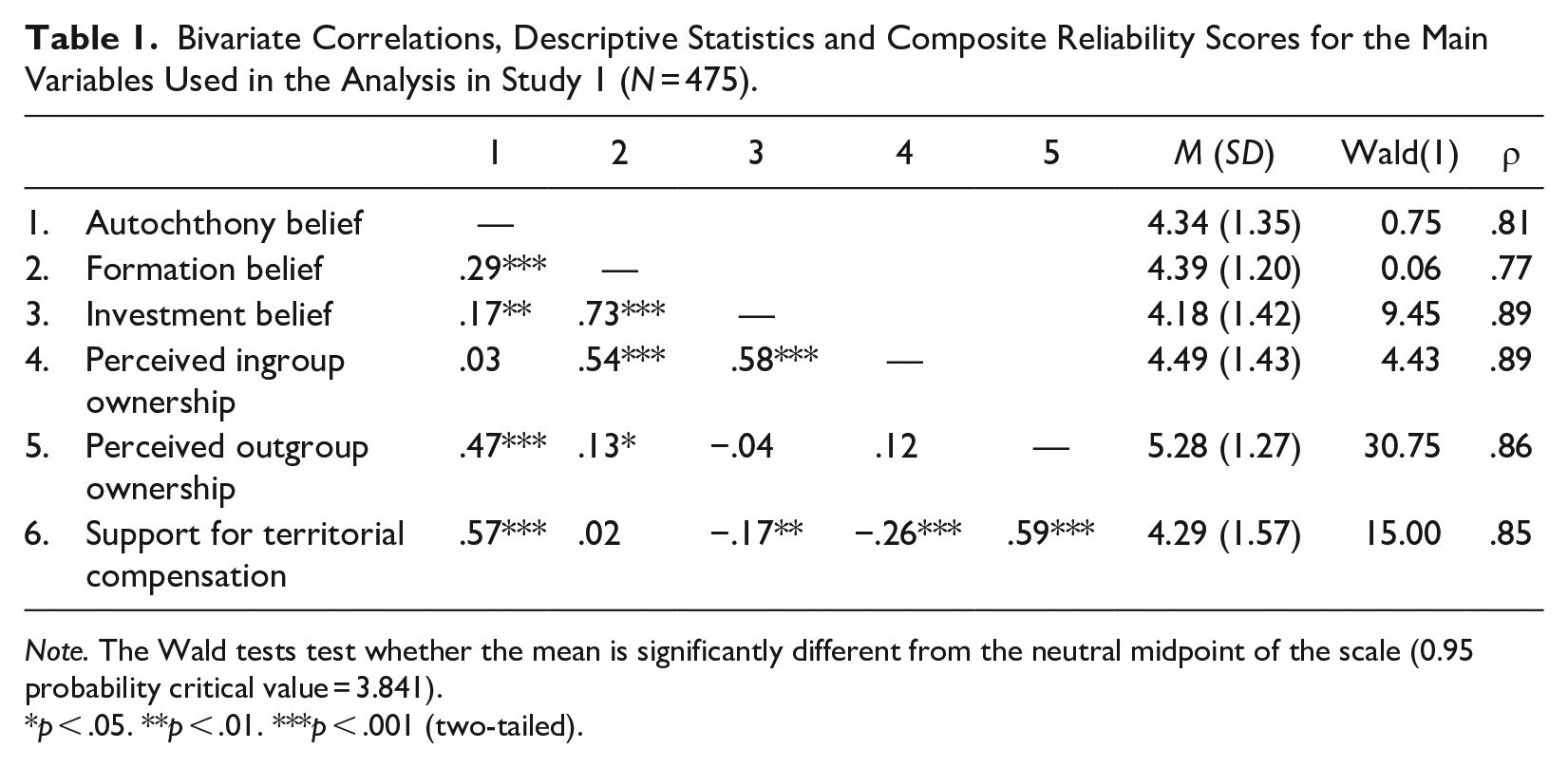
Note. The Wald tests test whether the mean is significantly different from the neutral midpoint of the scale (0.95 probability critical value = 3.841).
p < .05. **p < .01. ***p < .001 (two-tailed).
Descriptive findings
Bivariate correlations, descriptive statistics, and composite reliability scores for the main variables used in the analysis are presented in Table 1. The mean scores show that, on average, support for autochthony and formation belief were around the neutral midpoint of their respective scales, and support for investment belief was significantly higher than the neutral midpoint. This indicates that these beliefs are recognized as principles for inferring ownership. Furthermore, support for both perceived ingroup and outgroup ownership were also significantly above the neutral midpoints, and support for outgroup territorial ownership was higher than support for ingroup ownership (Wald(1) = 31.90, p < .001). Finally, support for territorial compensation for Indigenous Australians was also significantly above the neutral midpoint of the scale.
Autochthony, formation, and investment belief were all positively and significantly correlated. Multicollinearity between these factors was not a concern (autochthony VIF 1.09; formation VIF 2.24; investment VIF 2.12). Most of the other bivariate correlations between the main variables were significant and in the expected directions. Autochthony belief positively correlated with outgroup ownership, but not significantly with ingroup ownership. Investment belief was positively associated with ingroup ownership but not significantly with outgroup ownership. Stronger support for formation belief was positively correlated with both ingroup and outgroup ownership. Furthermore, ingroup ownership was negatively associated with territorial compensation and outgroup ownership positively. There was no significant correlation between ingroup and outgroup ownership, which indicates that these are distinctive and not mutually exclusive.
Support for territorial compensation in Australia
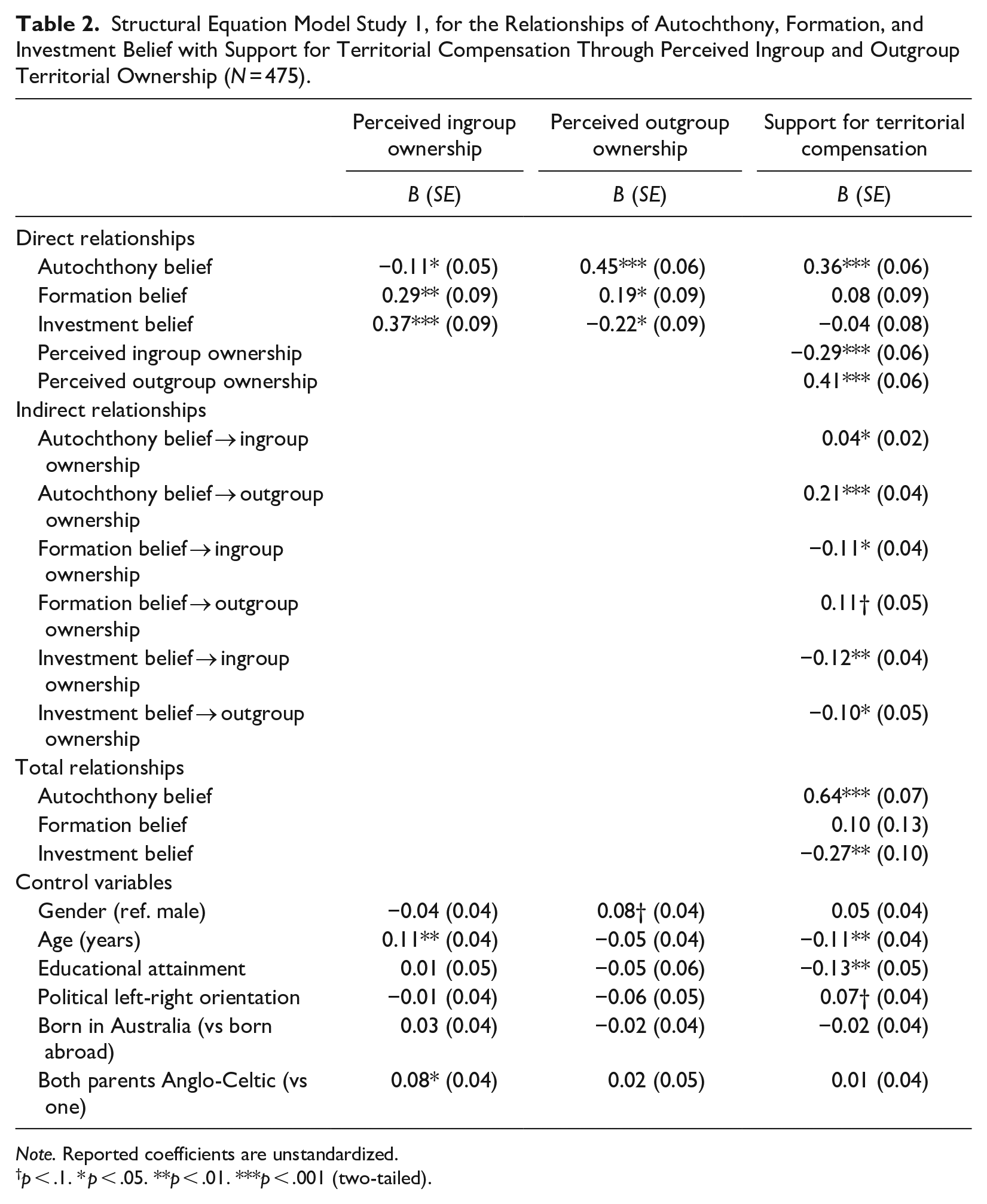
We estimated a structural equation model in Mplus (version 8) in which we examined whether support for territorial compensation is related to autochthony, formation, and investment beliefs through perceived ingroup and outgroup ownership. We accounted for missing values using Full Information Maximum Likelihood (FIML). The indirect effects were tested by means of the significance of all individual coefficients (also known as the joint-significance test), as well as bootstrapping procedures with 10,000 samples (Preacher & Hayes, 2008; Yzerbyt et al., 2018). A 95% confidence interval (CI) which does not include 0, as well as significance of both coefficients, indicates a significant indirect effect. We controlled for gender, age, educational attainment, political orientation, whether participants were born in Australia, and parents’ ethnicity, in relation to the dependent variable and the mediating variables. The unstandardized coefficients for this model are presented in Table 2 and the standardized coefficients of the main paths of the structural equation model are presented in Figure 1.
Structural Equation Model Study 1, for the Relationships of Autochthony, Formation, and Investment Belief with Support for Territorial Compensation Through Perceived Ingroup and Outgroup Territorial Ownership (N = 475).
Note. Reported coefficients are unstandardized.
p < .1. * p < .05. **p < .01. ***p < .001 (two-tailed).
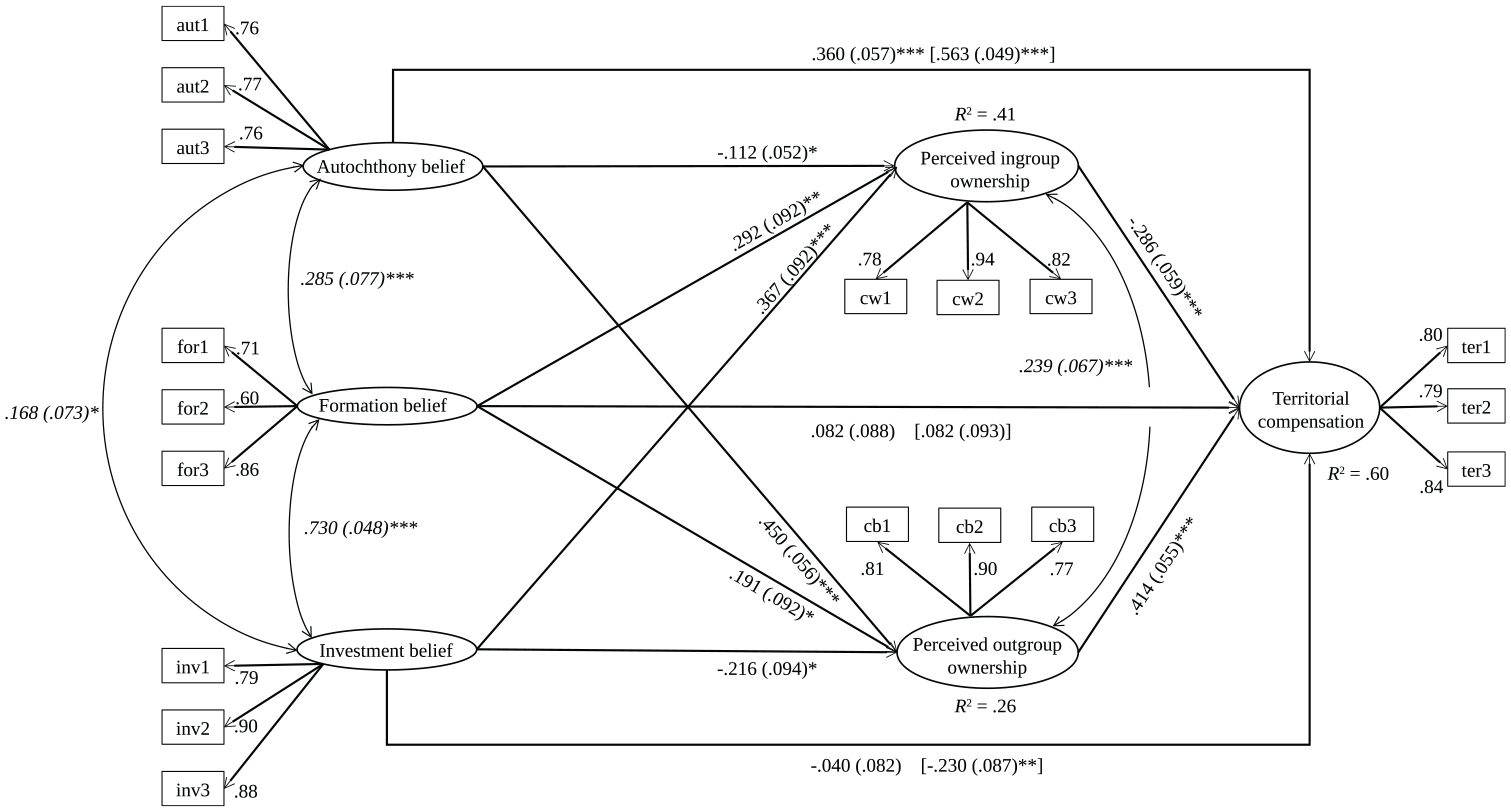
Structural equation model with standardized coefficients.
As expected, and in line with H1 and H2, stronger endorsement of ingroup ownership was significantly associated with less support for territorial compensation, and outgroup ownership was associated with more support. Furthermore, the total relation between endorsement of autochthony belief and support for territorial compensation was significant and positive, in line with H3a. Higher endorsement of autochthony belief was significantly associated with less support for ingroup ownership and with more support for outgroup ownership. Finally, consistent with H3b and H3c, autochthony belief was indirectly associated with more support for territorial compensation through lower ingroup ownership and higher outgroup ownership, unstandardized 95% CIs [0.00, 0.08], [0.13, 0.29], respectively.
In contrast to autochthony, and consistent with H4a, the total relationship of investment belief with territorial compensation was significant and negative. Stronger endorsement of the investment belief was associated with more ingroup ownership and less outgroup ownership. In line with H4b and H4c, investment belief was indirectly associated with less support for territorial compensation through both ingroup and outgroup territorial ownership, [−0.21, −0.05], [−0.22, −0.01], respectively.
The total relationship between formation belief and territorial compensation was not significant. The lack of a significant total relationship can be explained through the relationships between formation belief and ingroup and outgroup ownership: Stronger endorsement of formation belief was associated with both higher ingroup ownership and higher outgroup ownership, which was consistent with H5a. Furthermore, in line with H5b and H5c, formation belief was significantly indirectly associated with less support for territorial compensation through ingroup ownership [−0.22, −0.04], and with more support for territorial compensation through outgroup ownership [0.01, 0.22].
Finally, most of the control variables were not significantly related to support for territorial compensation or with ingroup or outgroup ownership. Age was associated with greater support for ingroup ownership and less support for territorial compensation. Having two (rather than one) Anglo-Celtic parent was associated with greater support for ingroup ownership. The coefficients of the main paths of the model were not substantively different in a model without control variables (see Supplemental Table S2).
Discussion
Study 1 provides first empirical evidence for the importance of three ownership principles for perceived ingroup and outgroup territorial ownership and support for territorial compensation among Whites in Australia. Autochthony and investment principles had contrasting effects: whereas endorsement of the general principle of autochthony was related to more support for territorial compensation via higher Indigenous and lower White ownership, endorsement of the investment principle was related to less support for territorial compensation via lower Indigenous and higher White ownership. To the extent participants endorsed the formative principle, however, they considered both their ingroup and the Indigenous outgroup as owning Australia more, and therefore formative principle was not decisive in the question of territorial compensation.
Study 2
The aim of Study 2 was to replicate the findings from Study 1 in South Africa as a different national context. The question of territorial compensation is an ongoing issue in this country but the context differs in terms of the nature of the political debate surrounding territorial compensation (Banerjee, 2000; Gibson, 2010) and the fact that Whites are a numerical minority in South Africa and Black South Africans the majority.
Method
Data and participants
Participants for Study 2 were recruited among White students from the University of South Africa in 2020. The university’s IT department sent invitation emails to White undergraduate and graduate students registered for various degrees. Students who consented to taking part after reading the invitation email were redirected to the online survey. There was no incentive for participating in the survey. In total, 889 participants completed the survey. We excluded participants who indicated that they were not South African (N = 10), 5 which left a remaining sample of 879 White South African participants. Roughly two-thirds of the participants identified as female (N = 548), one third as male (N = 212), and 12 participants identified their gender as other. Ages ranged from 18 to 73 (M = 30, SD = 11).
Measures
Autochthony, investment, and formation belief were measured with the same items and the same 7-point scale as in Study 1. Collective psychological ownership was also measured with the same scale as in Study 1, and the items differed only in that they referred to South Africa instead of Australia, and White and Black South Africans instead of Anglo-Celtic and Indigenous Australians.
Support for territorial compensation was measured with two items on a 7-point scale ranging from 1 = completely disagree to 7 = completely agree. We based these items on the items from Study 1 and adapted them to the public debate on territorial compensation in the South African context (e.g., South African Government, 2021): “Redistributing land back to Black South Africans,” and “Land should be given back to Black South Africans.”
We again controlled for gender (0 = male, 1 = female) and age (in years), but due to space constraints in the survey a question for political left-right orientation was not available. Furthermore, because all participants were university students, we did not control for educational attainment in Study 2.
Results
Measurement model
We again performed a Confirmatory Factor Analysis in Mplus (version 8) to test whether the latent factors autochthony, investment, and formation belief, ingroup, and outgroup collective psychological ownership, and territorial compensation were empirically distinct constructs. Due to an error in the data collection, for roughly the first two-thirds of participants (N = 595) the third item assessing formation belief was a duplicate of the third autochthony belief item. These answers were treated as missing. We accounted for missing values using FIML. This initial model did not fit the data well. Similar to Study 1, a model where the error covariances between the third items of the ingroup and outgroup ownership factors were freed fit the data better than the initial model (Δdf = 1, Δχ2 = 125.09, p < .001), and this model had an acceptable fit (χ2[103, N = 777] = 501.79, p < .001, RMSEA = .071 [90% CI 0.064 0.077], CFI = 0.935, TLI .914, SRMR = .061).
We explored several alternative models in which we forced any two principles to load as one factor, as well as an alternative model where the ownership factors were forced to load on a single factor. All alternative factor specifications yielded a significant worse fit, which supports our assertion that the factors represent empirically distinct constructs (see Supplemental Table S3, for all model fit statistics).
Descriptive findings
The descriptive statistics, composite reliabilities, and bivariate correlations between the main variables used in the analysis are presented in Table 3. On average, endorsement of autochthony and formation belief were both below the neutral midpoint, while endorsement of investment belief was not significantly different from the neutral midpoint. Support for ingroup and outgroup ownership was higher than the neutral midpoint, and support for outgroup territorial ownership was higher than support for ingroup ownership (Wald(1) = 8.62, p = .0033). Finally, support for territorial compensation was lower than the neutral midpoint of the scale.
Bivariate Correlations, Descriptive Statistics and Composite Reliability Scores for the Main Variables Used in the Analysis in Study 2 (N = 879).
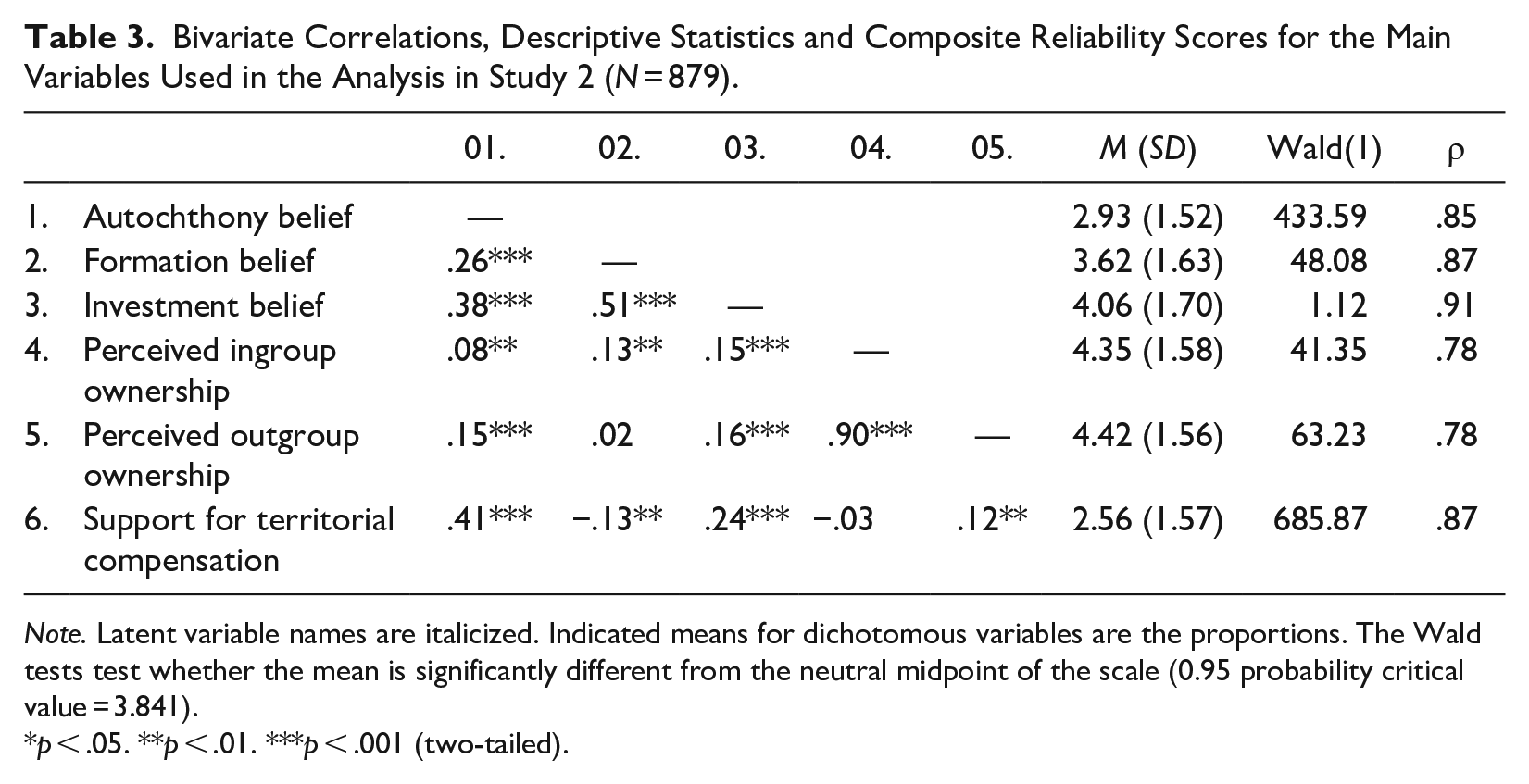
Note. Latent variable names are italicized. Indicated means for dichotomous variables are the proportions. The Wald tests test whether the mean is significantly different from the neutral midpoint of the scale (0.95 probability critical value = 3.841).
p < .05. **p < .01. ***p < .001 (two-tailed).
Autochthony, formation, and investment beliefs all correlated significantly and positively. Multicollinearity between these factors was not a concern (autochthony VIF 1.18; formation VIF 1.49; investment VIF 1.37). Most of the other bivariate correlations between the main variables were significant and in the expected directions. Outgroup ownership was positively correlated with autochthony and formation belief, but not with investment belief. Ingroup ownership was positively associated with formation and investment belief, and contrary to expectations also with autochthony belief. Furthermore, perceived outgroup ownership was positively associated with support for territorial compensation, but ingroup ownership was not.
Finally, perceived ingroup and outgroup ownership were strongly positively correlated and the majority of participants (72.7%) supported ingroup and outgroup ownership equally. Ingroup ownership was more strongly supported by 8.7% of participants, and outgroup ownership by 18.6%. Therefore, and although the Confirmatory Factor Analyses indicated that a model with ingroup and outgroup ownership as separate factors fit the data best (see Supplemental Table S3), we additionally explored an alternative model with a relative territorial ownership score (perceived outgroup ownership—perceived ingroup ownership) so that a higher score indicates relatively higher outgroup than ingroup ownership.
Support for territorial compensation in South Africa
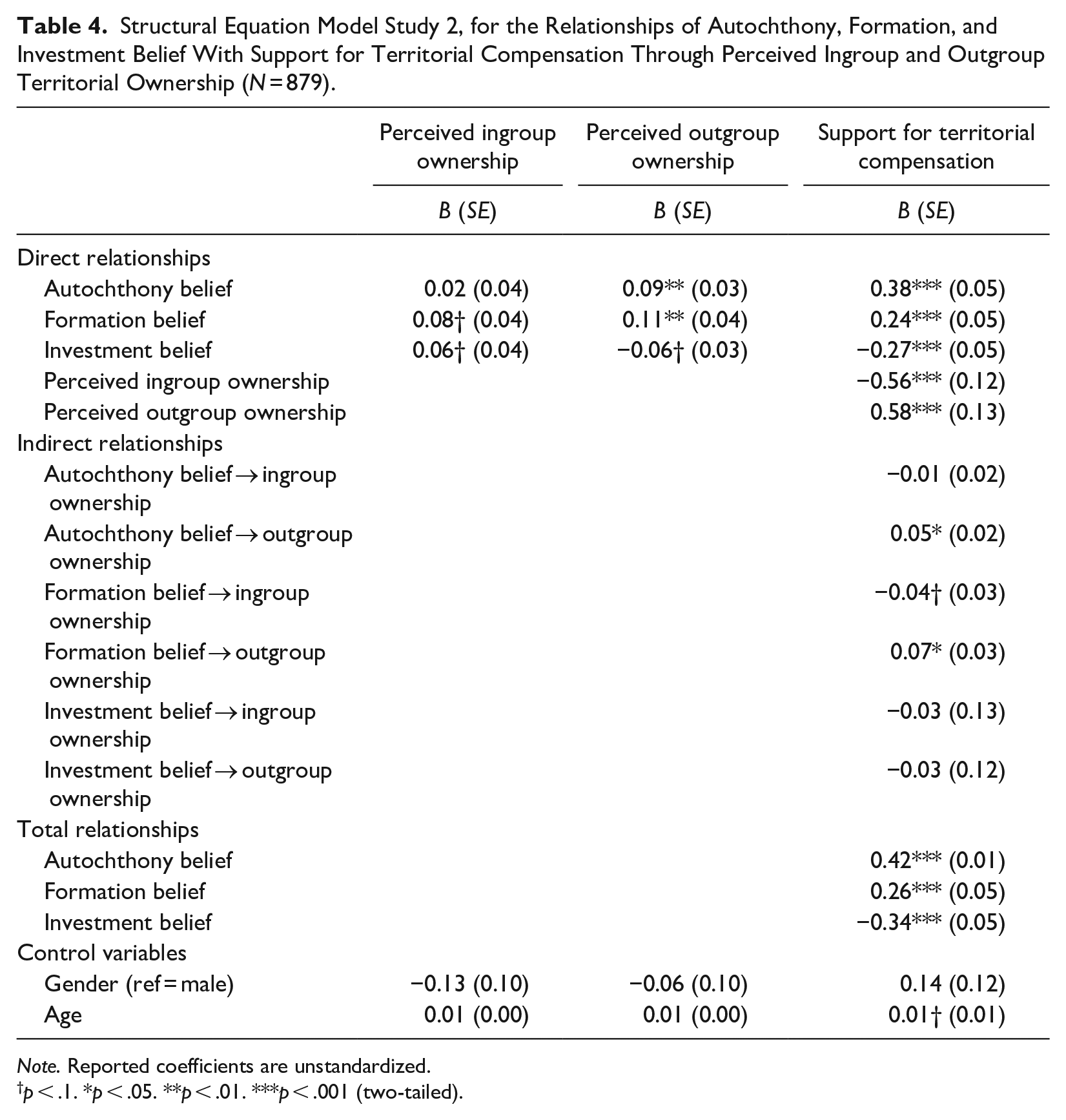
We estimated a similar structural equation model as in Study 1. The unstandardized coefficients for this model are presented in Table 4, and the standardized coefficients of the main paths are presented in Figure 2.
Structural Equation Model Study 2, for the Relationships of Autochthony, Formation, and Investment Belief With Support for Territorial Compensation Through Perceived Ingroup and Outgroup Territorial Ownership (N = 879).
Note. Reported coefficients are unstandardized.
p < .1. *p < .05. **p < .01. ***p < .001 (two-tailed).
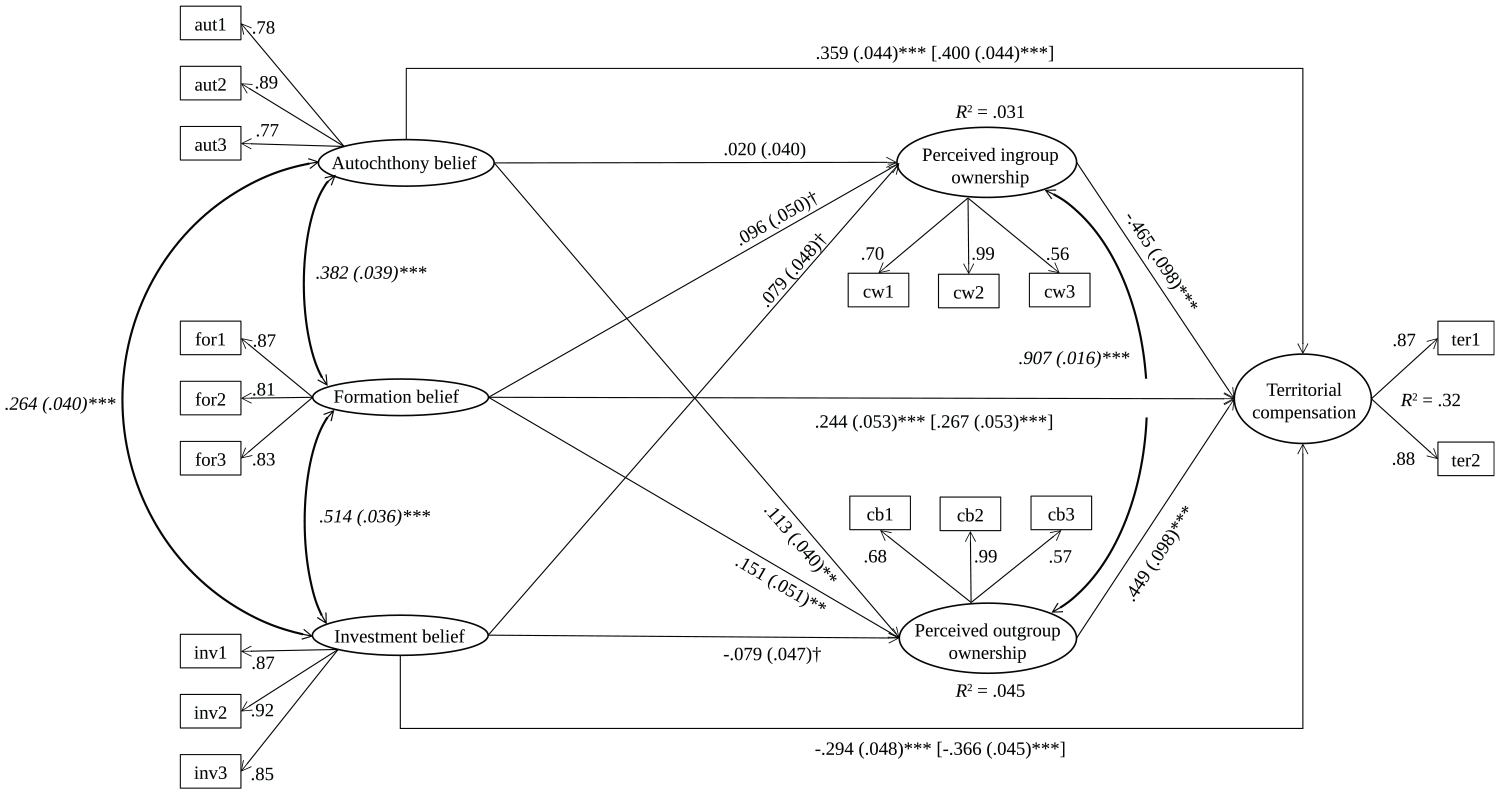
Structural equation model Study 2 with standardized coefficients.
Consistent with our hypotheses (H1 and H2) and similar to Study 1, stronger ingroup ownership was significantly associated with less support for territorial compensation, and stronger outgroup ownership was associated with more support.
Furthermore, the total relationship between autochthony belief and support for territorial compensation was significant and positive, in line with our expectations (H3a). Endorsement of autochthony belief was also positively associated with perceived outgroup ownership, but not with ingroup ownership. Therefore, consistent with H3b and Study 1, autochthony belief was indirectly associated with more support for territorial compensation through higher outgroup ownership (p = .005), unstandardized 95% CIs [0.01, 0.10]. However, autochthony belief was not indirectly associated with territorial compensation through ingroup ownership (p = .611), [−0.05, 0.03], which does not support H3c, in contrast to Study 1.
In contrast to autochthony belief, the total relationship of investment belief with territorial compensation was negative, consistent with H4a and Study 1. Further, while stronger endorsement of investment belief was associated with both lower perceived outgroup ownership and higher ingroup ownership, these associations were not significant (p = .092; p = .099, respectively). Furthermore, in contrast to Study 1, investment belief was not significantly related with support for territorial compensation through outgroup or ingroup ownership, [−0.09, 0.01], [−0.08, 0.01], respectively, which does not support H4b and H4c.
The total relationship between endorsement of the formation belief and territorial compensation was positive and significant. Further, formation belief was positively and significantly associated with outgroup ownership (p = .004), and also positively (but not significantly) with ingroup ownership (p = .061), which supports H5a. Consistent with H5b and Study 1, formation belief was significantly indirectly related to more support for territorial compensation through outgroup ownership [0.02, 0.13]. However, formation belief was not significantly indirectly related to territorial compensation through ingroup ownership, [−0.10, 0.00], which does not support H5c and is not in line with the findings from Study 1.
Finally, neither age nor gender were significantly associated with ingroup ownership, outgroup ownership, and support for territorial compensation. There were only minor differences between the main model and a model where the control variables were excluded (see Supplemental Table S4). In the model without control variables, formation belief was significantly associated with perceived ingroup ownership and thus indirectly with support for territorial compensation both through outgroup and ingroup ownership. Further, the negative association between investment belief and outgroup ownership was also significant.
Relative group ownership
Because of the high correlation between ingroup and outgroup territorial ownership, we performed an additional analysis with a relative group ownership score whereby a higher score indicates relatively higher outgroup than ingroup ownership. The unstandardized results are displayed in see Supplemental Table S6. 6 The analysis shows that perceiving relatively more outgroup than ingroup ownership was significantly associated with greater support for territorial compensation, in line with our expectations. Furthermore, the relationships between the three ownership principles and relative perceived ownership were also in line with our expectations. Autochthony belief was significantly associated with perceiving relatively more outgroup ownership than ingroup ownership, whereas investment belief was significantly associated with perceiving relatively more ingroup ownership. Finally, formation belief was not significantly associated with more strongly perceiving territorial ownership for either group.
Discussion
In a different national context, we again found that more strongly believing that the territory belongs to the ingroup (White South Africans) was associated with lower support for territorial compensation, while stronger belief in outgroup (Black South African) ownership was associated with greater support for territorial compensation. Furthermore, the pattern of associations between ownership principles, ingroup, and outgroup ownership and territorial compensation were descriptively similar to Study 1, but not all associations were significant. Specifically, autochthony, investment and formation belief were not significantly indirectly related to territorial compensation through ingroup ownership, and investment belief did not indirectly relate to support for compensation through outgroup ownership. We further discuss these findings in the General Discussion. Because of the high correlation between perceived ingroup and outgroup territorial ownership we also examined an alternative model with relative group ownership. The results of this model were in line with our expectations and similar to Study 1.
General Discussion
We examined the relationship between Anglo-Celtic Australians’ (Study 1) and White South African’s (Study 2) attitudes toward territorial compensation for Indigenous Peoples and their perceptions of the degree to which the White ingroup and the Indigenous outgroup own the country. Furthermore, we focused on the role of three general principles for inferring and claiming place ownership that may be particularly relevant in the context of territorial disputes in settler societies: entitlements derived from primo-occupancy (autochthony), from historically investing in and developing the land (investment), and from the formative meaning of the territory for the collective identity (formation) (Beggan & Brown, 1994; Gans, 2001; Geschiere, 2009; Murphy, 1990). We examined these as general beliefs, independently of the particular intergroup context.
We found that greater perceived ingroup ownership of the land relates to lower support for territorially compensating the Indigenous outgroup, while greater perceived outgroup ownership relates to greater support for territorial compensation. The latter finding indicates that people are in favor of territorial compensation if they feel that the Indigenous group owns the land but does not have full rights over it. Previous research on territorial ownership and relations between groups has primarily focused on the perceptions of ingroup ownership (Brylka et al., 2015; Nijs et al., 2020; Storz et al., 2020; Toruńczyk-Ruiz & Martinović, 2020) or relied on a relative measure of ingroup versus outgroup ownership (Nooitgedagt, Figueiredo et al., 2021). Ours is the first study that shows that ingroup and outgroup ownership perceptions independently matter for intergroup relations, and more specifically, that these are associated with attitudes toward territorial compensation in settler societies.
Our findings furthermore show that, as expected, the three general ownership principles relate differently to perceived ingroup and outgroup territorial ownership. First, the endorsement of autochthony belief by Whites in both Australia (Study 1) and South Africa (Study 2) was consistently related to higher support for territorial compensation for the Indigenous outgroup. This finding was in line with our expectations and with research in Chile where endorsement of autochthony belief was related to higher support for territorial compensation for the Indigenous Mapuche (Nooitgedagt, Figueiredo et al., 2021). Furthermore, we found that endorsement of autochthony belief was related to greater recognition of outgroup ownership in both studies. This has also been found in experimental research showing that children infer ownership from first possession and first occupancy (Friedman et al., 2013; Verkuyten, Sierksma, & Martinovic, 2015). In Australia, autochthony belief was also related to perceiving less ingroup ownership, which suggests that endorsing the idea that first-comers should be entitled to the land can undermine settler ownership. However, in South Africa no relation was found between endorsement of the autochthony belief and ingroup ownership. This might be due to the different historical context and the fact that some White South Africans nowadays still draw on the empty land myth to argue that the land was vacant when their ancestors settled in South Africa, and that they are therefore primo-occupants as well (AfriForum, 2019; Boisen, 2017).
Second, we showed that endorsement of investment belief by Whites in Australia and South Africa was related to lower support for territorial compensation. This finding is in line with our expectations and also with research in Chile (Nooitgedagt, Figueiredo et al., 2021). Furthermore, in both countries, greater endorsement of investment belief was related to stronger perceived ingroup ownership and lower outgroup ownership. The findings for South Africa were weaker, however, and the indirect paths from investment to territorial compensation did not reach significance in that sample. Yet, the results from the additional analysis with the relative measure of territorial ownership showed that when White South Africans endorsed investment more, they perceived South Africa as belonging relatively more to their ingroup and this, in turn, was related to lower support for territorial compensation. Thus, in settler societies having invested in and developed the land might be used by Whites to justify territorial ownership for their ingroup and therefore reject territorial compensation for Indigenous Peoples (Verkuyten & Martinovic, 2017).
Third, we showed that for both Whites in both countries, stronger endorsement of formation belief relates to both higher ingroup and outgroup territorial ownership, though the former association was weak in the South African context. These findings are consistent with our expectation that the descendants of White settlers will also feel that the land has profoundly shaped who they are as an ethnic group (Moran, 2002; Verwey & Quayle, 2012), and that they therefore feel ownership of the country. Furthermore, in both studies, greater endorsement of the formation belief was related to lower support for territorial compensation through ingroup ownership (marginally so in South Africa) and to higher support for territorial compensation through outgroup territorial ownership.
Future Directions and Limitations
We want to highlight three possible directions for future research on ownership perceptions and support for territorial compensation and also consider some limitations. First, while the overall pattern of results was similar in both countries, there were also some notable differences. One difference relates to the average scores in both countries (Tables 1 and 3). For example support for territorial compensation was much lower in the South African sample compared to the Australian sample, whereas perceived outgroup ownership was higher in Australia compared to South Africa. Additionally, scores for autochthony, investment and formation beliefs were more varied in the South African sample compared to the Australian sample. These country differences might have substantial meanings but might also be due to the different samples in both studies (general population in Australia and students in South Africa). Further research using representative samples would allow for a direct comparison and test of these average differences.
However, differences in average scores do not have to imply differences in the proposed associations. The results show that the relationships between the ownership principles and perceptions of territorial ownership largely followed the same pattern in Australia and South Africa, although the relationships were weaker and not always significant in South Africa. Additionally, while perceived ingroup and outgroup territorial ownership were not significantly related in Australia, they were highly correlated in South Africa. These country differences might have to do with the specifics of the national contexts. At the fall of the apartheid regime, South Africa adopted the non-racial ideal of a “rainbow nation” which argues for identification with the superordinate national category, rather than with a racial group (see Sidanius et al., 2019). Because of this political context, White South African participants might have the tendency to think of themselves as members of a common national ingroup and as a result do not believe that either racial group should own South Africa more.
Furthermore, it is possible that Whites in Australia and in South Africa experience different levels of threat to their ingroup’s territorial ownership (see Nijs, Verkuyten et al., 2021). Anglo-Celtic Australians (56.4%) outnumber Indigenous Australian (~2.8%; (Australian Bureau of Statistics, 2016, 2017), but White South Africans (7.8%) are a much smaller group compared to Black South Africans (80.8%; Statistics South Africa, 2020). Politically this means that White South Africans are much less powerful compared to White Australians. Furthermore, Indigenous Peoples in Australia can only claim government owned land (National Native Title Tribunal, 2021), while in South Africa the debate explicitly includes land privately owned by White South Africans (Gibson, 2010) and there have been proposals in the South African parliament for land expropriation without compensation in order to speed up the process of land reform (Makhado, 2012). Acknowledging relatively more outgroup ownership may therefore represent a larger threat to ingroup entitlements for Whites in South Africa than in Australia. Future comparative research on perceived territorial ownership may want to consider examining perceived territorial ownership threat as a possible explanation for country differences in the relation between ingroup and outgroup ownership.
Second, we used correlational survey data in our research. This means that we cannot make claims about the direction of influence, and reverse mediation testing with cross-sectional data is not a useful strategy for determining causality (Lemmer & Gollwitzer, 2017). However, our predictions on the directionality of the proposed relationships between the principles of ownership and perceived ownership were theoretically derived (Geschiere, 2009; Toft, 2014; Verkuyten & Martinovic, 2017) and are supported by experimental research (e.g., Friedman & Neary, 2008; Levene et al., 2015; Verkuyten, Sierksma, & Martinovic, 2015). Furthermore, we examined endorsement of general principles of ownership—which did not refer to the intergroup context in question—to predict specific group ownerships. A reverse causal order from perceptions of specific group ownerships to general principles of ownership seems less likely. It is also more likely that lower perceived ingroup ownership drives support for outgroup compensation rather than the other way around. Still, it is possible that there are mutual directions of influence. For example, people who have a strong sense of ingroup ownership of the country may more strongly endorse principles of ownership (i.e., investment) which justify their sense of collective ownership. Longitudinal and experimental research is needed to further examine the directions of influence.
Third, we focused on Whites’ perceptions of White and Indigenous ownership. Future research could examine both sides of the debate by additionally examining Indigenous participants’ perceptions of territorial ownership. However, there are different ways of thinking about the ownership of land. For example, some Indigenous Peoples insist that land cannot be “owned,” while others claim that they have owned their land since “time immemorial” (see Todd, 2008). It may therefore be the case that the concept of owning land will be less relevant for some Indigenous groups and their members. Furthermore, we phrased our items on collective ownership in relation to the countries as a whole, as territorial ownership on the national level was the most relevant level of ownership for White participants. However, Indigenous Peoples in many countries claim ownership of specific territories rather than the country as a whole. In order to ensure that the questions and research are relevant to the participants, it would therefore be best if future research with Indigenous participants focused on a particular Indigenous group and region, as questions on local ownership are likely to be more meaningful to Indigenous participants than questions on ownership in relation to the whole territory of a nation-state. In conclusion, research with Indigenous Peoples should carefully consider the relevance, phrasing, and focus of questions on perceived collective ownership of territories.
Conclusion
With the present research we have provided the first empirical evidence that the general ideological beliefs of autochthony, formation, and investment can indirectly inform support for territorial compensation in settler societies both through ingroup and outgroup territorial ownership perceptions. The findings indicate that for Whites in Australia and in South Africa, endorsement of autochthony belief validates Indigenous ownership, investment belief validates White ownership, and formation belief validates both Indigenous and White ownership. These findings also have implications for promoting intergroup justice and improving intergroup relations in Australia and South Africa, and in other settler societies. Importantly, the findings indicate that territorial ownership perceptions matter. The different principles that people use to infer and claim group ownership have different intergroup implications and can be put forward but also challenged in political and public debates. The different principles shape people’s understanding of who can claim territorial ownership differently, making it important to recognize and discuss these principles with the related ownership claims of the groups involved.
Supplemental Material
sj-docx-1-jcc-10.1177_00220221211051024 – Supplemental material for Collective Psychological Ownership and Territorial Compensation in Australia and South Africa
Supplemental material, sj-docx-1-jcc-10.1177_00220221211051024 for Collective Psychological Ownership and Territorial Compensation in Australia and South Africa by Wybren Nooitgedagt, Borja Martinović, Maykel Verkuyten and Sibusiso Maseko in Journal of Cross-Cultural Psychology
Footnotes
Author Contributions
Wybren Nooitgedagt designed the study, conducted the analyses and drafted the paper. Borja Martinović, Maykel Verkuyten, and Sibusiso Maseko were involved in the study design and theorizing and critically reviewed the manuscript. All authors read and approved the final manuscript.
Availability of Data and Material and Code Availability

Declaration of Conflicting Interests
The author(s) declared no potential conflicts of interest with respect to the research, authorship, and/or publication of this article.
Funding
The author(s) disclosed receipt of the following financial support for the research, authorship, and/or publication of this article: This research has received funding from the European Research Council (ERC) under the European Union’s Horizon 2020 research and innovation program (grant agreement No. 715842) awarded to the second author and the University of South Africa’s College of Humanities Foreign Conference/Summer School grant awarded to the last author.
Ethics Approval
This research line has been approved by the Ethics Committee of the Faculty of Social and Behavioural Sciences of Utrecht University (clearance number: FETC18-064), by the UNISA Research Permission Sub-Committee of SRIHDC (reference number 2017_URERC_004_FA), and by the UKZN Humanities and Social Sciences Research Ethics Committee (reference number HSS/1874/016D).
Supplemental Material
Supplemental material for this article is available online.
Notes
References
Supplementary Material
Please find the following supplemental material available below.
For Open Access articles published under a Creative Commons License, all supplemental material carries the same license as the article it is associated with.
For non-Open Access articles published, all supplemental material carries a non-exclusive license, and permission requests for re-use of supplemental material or any part of supplemental material shall be sent directly to the copyright owner as specified in the copyright notice associated with the article.
