




Abstract
Three studies explored the association between intergroup contact and intercultural competence. Study 1 and Study 2 provided evidence of a cross-sectional association between intergroup contact and intercultural competence in which positive contact was associated with increased intercultural competence and negative contact was associated with reductions in this outcome. In Study 3, longitudinal data allowed us to test the possibility of mutual influence between these variables whereby intercultural competence is not only a consequence of intergroup contact but is also predictive of the quality of future intergroup contact. Results showed that positive contact was longitudinally associated with improvements in intercultural competence, and that higher intercultural competence was associated with a reduction in future negative contact. Findings speak to the importance of taking a dynamic outlook on contact effects. The beneficial consequences of positive contact may be the same variables capable of transforming future contact encounters and reducing the likelihood of negative interactions.
Within many Western countries and especially the United Kingdom, the social landscape is becoming increasingly ethnically and racially diverse. At the time of the last census, approximately 19% of the resident population in the UK identified as racial/ethnic minorities, an increase from 9% in 2001 and 6% in 1991 (Office for National Statistics, 2012). The contact hypothesis holds that sustained positive contact (i.e., friendships) with members of other ethnic, racial, religious, or national groups produces more positive attitudes toward that group (Allport, 1954). This hypothesis has been supported by ample experimental, cross-sectional, and longitudinal evidence (Pettigrew & Tropp, 2006). It has now evolved into a sophisticated theoretical framework, more complex and complete than Allport’s (1954) original formulation which specifies how, when, and why contact is associated with reduced prejudice (see Hodson & Hewstone, 2013; Pettigrew & Tropp, 2011).
In recent years, critics have called for contact researchers to move beyond prejudice. While it is now well established that intergroup contact can reduce prejudice, there is a need to enlarge the pool of outcomes assessed in intergroup contact research in order to more fully capture its influence beyond simply improving individuals’ feelings towards others (e.g., Dixon et al., 2005; Dixon et al., 2012; McKeown & Dixon, 2017; Pettigrew & Tropp, 2011; Vezzali et al., 2018; Wright & Lubensky, 2009). Responding to these calls, Hodson et al. (2018) recently argued that intergroup contact can serve as an agent of cognitive liberalization that promotes mental expansion and growth in ways that are not rigid or specific to the experience.
As the authors highlight, amongst the less widely touted benefits of contact in the literature is evidence that contact facilitates the learning of new information about the outgroup and increases intercultural understanding (e.g., Allport, 1954; Pettigrew & Tropp, 2008; Stephan & Stephan, 1984). Contact can also impact worldviews and ideologies making individuals less accepting of dominance and hierarchy as a general outlook on life (e.g., Dhont et al., 2014; Meleady et al., 2019; van Laar et al., 2005). Research also demonstrates that contact “deprovincializes” the mind, removing the self and the ingroup as the focus of judgment, and rendering participants more open to experience (e.g., Pettigrew, 1997; Sparkman et al., 2016; Verkuyten et al., 2010). In these ways, intergroup contact is relevant for shaping not only the content or valence of intergroup attitudes but how people think about, approach, and deal with the world more generally. In this paper we continue to explore the generalized benefits of intergroup contact by exploring its association with a novel outcome variable—intercultural competence.
Intercultural Competence
Intercultural competence refers to “the ability to communicate effectively in cross-cultural situations and to relate appropriately in a variety of cultural contexts” (Bennett & Bennett, 2004, p. 149). Intercultural competence is increasingly important as the social world becomes more diverse, and both academic and applied interest in this construct is burgeoning (see Spitzberg & Changnon, 2009). Prior research has identified different dimensions of intercultural competence, and various assessment tools that focus on different elements of intercultural competence are available. One widely cited approach is Chen and Starosta’s (1996, 2000) model of intercultural sensitivity. Individuals high in intercultural sensitivity are said to (a) be more attentive, (b) be better able to perceive intercultural signals and adjust their behaviours, (c) show more self-monitoring, (d) be more empathic, and (e) be more effective in intercultural interactions (Chen & Starosta, 2000). Using this theoretical framework, the current paper explores the potential for intergroup contact to boost intercultural competence.
The intergroup contact literature has a long track record of examining outcomes relating to the outgroup (e.g., outgroup attitudes and stereotypes). Aside from the notable literature on intergroup anxiety (for reviews, see R. Brown & Hewstone, 2005; Paolini et al., 2006; Pettigrew & Tropp, 2008), contact research has largely neglected to examine how intergroup contact impacts the self. The cognitive liberalization hypothesis (Hodson et al., 2018) suggests that intergroup contact may impact a range of sociocognitive skills. As is the case with domain-specific social competencies (Caplan et al., 1992), intercultural competence can be learned and is considered to be a developmental process that continues throughout one’s lifetime (Bennett, 1986). As well as shaping beliefs and attitudes towards the contacted group, intergroup contact may also provide an important opportunity to learn new behaviours and practice intergroup communication skills thereby improving one’s own intercultural competence.
Intercultural competence goes beyond previously studied contact outcomes such as intergroup anxiety, which captures an individual’s affective state in anticipation of an intergroup encounter, or outgroup knowledge, which captures one’s declarative knowledge of outgroup norms and culture (Stephan & Stephan, 1984). Although there is likely to be a relationship between intercultural competence and these variables, the construct of intercultural competence is broader than these traditionally measured outcomes by assessing a person’s ability to execute effective and appropriate communication behaviours in diverse environments. There is evidence that study abroad programmes (Hammer, 2004; Hansel, 2008a, 2008b), international work experience programmes (Yashima, 2010), and culturally diverse collaborative learning groups (de Hei et al., 2019) can enhance intercultural competence. Just as these formal intercultural experiences provide opportunities to develop awareness of, and adapt to, cultural differences, everyday intergroup contact experiences should also provide informal opportunities to improve intercultural adaptability and communication competence.
It is also important to consider the potentially detrimental effects of negative contact on intercultural competence. The emphasis on intergroup contact as a strategy to improve intergroup relations has understandably meant that research has focused on investigating the consequences of positive interactions across group lines (Pettigrew, 2008). There is now a growing understanding that while positive contact reduces prejudice, negative contact increases prejudice, with some research suggesting the latter effect is stronger than the former (Barlow et al., 2012; Graf et al., 2014; Paolini et al., 2010). However, we know little about the more distal consequences of negative contact beyond focal intergroup attitudes. In this paper we explored the association between both positive and negative intergroup contact and intercultural competence. While we may expect positive contact to enable improvements in this outcome, the opposite may be true of negative contact. Negative contact experiences may reduce openness to cultural differences and impair one’s ability to communicate and relate appropriately in diverse environments.
Dynamic Processes in Intergroup Contact
One could also conceptualize intercultural competence as an antecedent of intergroup contact. The intergroup contact literature has traditionally considered intergroup contact to be “the starting point,” with the key outcome being a reduction in prejudice. As well as exploring the consequences of intergroup contact there is also a need for research that treats intergroup contact as a dependent variable. Initial explorations of the antecedents of intergroup contact suggest that various macro-level (e.g., cultural norms, institutional characteristics), meso-level (e.g., processes that occur at the level of social interactions), and micro-level factors (e.g., personality-based tendencies and motivations) are likely to play a role in explaining individuals’ intentions and willingness to engage in intergroup contact (for recent reviews, see Paolini et al., 2018; Ron et al., 2017).
In their recent exploration of the antecedents of intergroup contact, Paolini et al. (2018) called for contact researchers to take a dynamic approach that recognizes that the beneficial consequences of intergroup contact may function as reward systems reinforcing future intergroup contact behaviours and further contact seeking (see also Paolini, Harris, & Griffin, 2016). Paolini et al.’s (2018) view of the dynamic, self-reinforcing consequences of intergroup contact is consistent with the notion of “confidence in contact” recently proposed by Turner and Cameron (2016). Turner and Cameron’s model explores the key predictors or conditions that promote cross-group friendship amongst children and adolescents. The authors describe confidence in contact as a state of readiness for contact whereby individuals have the necessary confidence, skills, and abilities they need to successfully navigate intergroup encounters. According to this model, enhancing confidence in contact will increase the chance that individuals form cross-group friendships, and those who experience cross-group friendships will subsequently feel even more confident in contact in the future. In keeping with a dynamic outlook, we explored whether intercultural competence may serve as both a consequence and antecedent of intergroup contact.
While initial investigations of the antecedents of intergroup contact have generally focused on predicting willingness to engage in contact (e.g., Al Ramiah et al., 2015; Halperin et al., 2012; Paolini, Wright, et al., 2016; Stürmer et al., 2013; Tropp & Bianchi, 2006), we focused more specifically on contact valence and explored how intercultural competence may influence the frequency of positive and negative intergroup encounters. Intercultural competence is expected to provide individuals with the skills and abilities they need to successfully navigate intergroup encounters. As is the case with general social competence (Rose-Krasnor, 1997), intercultural competence should make cross-group interactions more effective and more positive. When challenges or difficulties in an interaction arise, a competent-feeling person is better able to handle these challenges. A reciprocal interplay between intergroup contact and intercultural competence would mean that not only does positive contact increase, and negative contact decrease, intercultural competence, but that such competence will also increase the likelihood that future encounters are positive and successful, and decrease the likelihood of negative, unsuccessful encounters. The third study in this investigation allowed us to explore the direction of (mutual) influence between positive and negative contact and intercultural competence.
The Present Research
Three studies explored the association between intergroup contact and intercultural competence. While much research has demonstrated that intergroup contact can improve evaluations of outgroup members, intergroup contact should also impact the self and our abilities in intercultural contexts. Two cross-sectional studies explored whether British participants’ experience of intergroup contact with two different outgroups—Eastern Europeans (Study 1) and Blacks (Study 2)—was associated with generalized improvements in intercultural competence. While positive contact was expected to be associated with improvements in individuals’ ability to communicate and behave in appropriate ways with those who are culturally different, negative contact was expected to be negatively associated with intercultural competence. In keeping with a dynamic outlook (Paolini et al., 2018; Turner & Cameron, 2016), we then conducted a third, longitudinal study (Study 3) to allow us to explore whether, in addition to being predicted by intergroup contact, intercultural competence may also predict the quality of future intergroup contact. Improvements in intercultural competence were expected to help make future interactions more positive and run more smoothly.
Study 1
Study 1 aimed to provide initial evidence of a cross-sectional association between positive and negative intergroup contact and intercultural competence. Participants in Study 1 were British nationals who reported on their contact with Eastern Europeans. Antagonism towards European migrants, particularly those from poorer Eastern European nations, is a long-standing problem in the UK (Blinder & Richards, 2018), and anti-immigrant sentiment was a large part of the media coverage surrounding the British referendum on its membership within the European Union (see Meleady et al., 2017). We expected that participants’ contact with Eastern Europeans would not only be associated with their attitudes towards this group, but also with their broader sense of intercultural competence. While positive contact was expected to be positively associated with intercultural competence, negative contact was expected to be negatively associated with this outcome.
Participants
A power analysis was conducted in G*Power (Faul et al., 2009) to determine the sample sizes necessary for Study 1 and Study 2. We used the linear multiple regression option to specify a model with two predictors. Assuming a small-to-medium effect size (f2 = .10) and a desired power of 80%, we sought to recruit > 100 participants to test the hypothesized effects. In Study 1, data were collected from university undergraduates who completed the survey in exchange for course credit (62.1%), and from participants recruited online via social media websites (37.9%). Only the data of British nationals were retained. No further exclusions were made. The final sample consisted of 103 participants, including 19 males and 84 females aged between 18 and 48 (M = 21.17, SD = 4.81). No significant differences were observed between participants recruited via undergraduate panel and social media websites on any measures (all ps > .10).
Procedure
Responses within all studies reported in this paper were obtained in the format of online questionnaires. Participants first indicated the frequency of their positive contact with Eastern Europeans with three items concerning how often they have had pleasant, positive, and friendly interactions with Eastern Europeans (1 = never, 7 = very often; α = .89). Frequency of their negative contact was then measured with three items concerning how often they have had unpleasant, negative, and hostile interactions with Eastern Europeans on the same scale (α = .90; Meleady et al., 2019).
Intercultural competence was measured using the Intercultural Sensitivity Scale (ISS) developed by Chen and Starosta (2000). The scale consists of 24 items with five factors: interaction engagement (e.g., “I often give positive responses to my culturally different counterpart during our interaction”); respect for cultural differences (e.g., “I can tell when I have upset my culturally distinct counterpart during our interaction”); interaction confidence (e.g., I feel confident when interacting with people from different cultures”); interaction enjoyment (e.g., “I often get discouraged when I am with people from different cultures” (reverse-scored); and interaction attentiveness (e.g., “I am sensitive to my culturally distinct counterpart’s subtle meanings during our interaction”). All items were measured on a 5-point scale (1 = strongly disagree, 5 = strongly agree). Items marked as reverse-scored were recoded so that higher scores always indicated higher intercultural competence. According to Chen and Starosta (2000), the ISS is valid in its omnibus form, and together the items demonstrated good internal consistency (α = .89) and were combined into a single composite score of intercultural competence. 1
Finally, to confirm the effect of intergroup contact on outgroup attitudes, participants completed the General Evaluation Scale (Wright et al., 1997). Participants indicated their feelings towards Eastern Europeans in general on six bipolar scales (1–7; warm–cold, negative–positive, friendly–hostile, suspicious–trusting, respect–contempt, admiration–disgust). Items were coded so that higher scores corresponded to more positive outgroup evaluations (α = .91).
Results and Discussion
Correlations amongst all variables as well as their means and standard deviations are presented in Table 1. As expected, positive contact was found to be positively associated with both intercultural competence and outgroup evaluation. Negative contact, on the other hand, was negatively associated with intercultural competence and outgroup evaluation. Positive and negative contact were uncorrelated.
Means, standard deviations, and correlations for all variables: Study 1
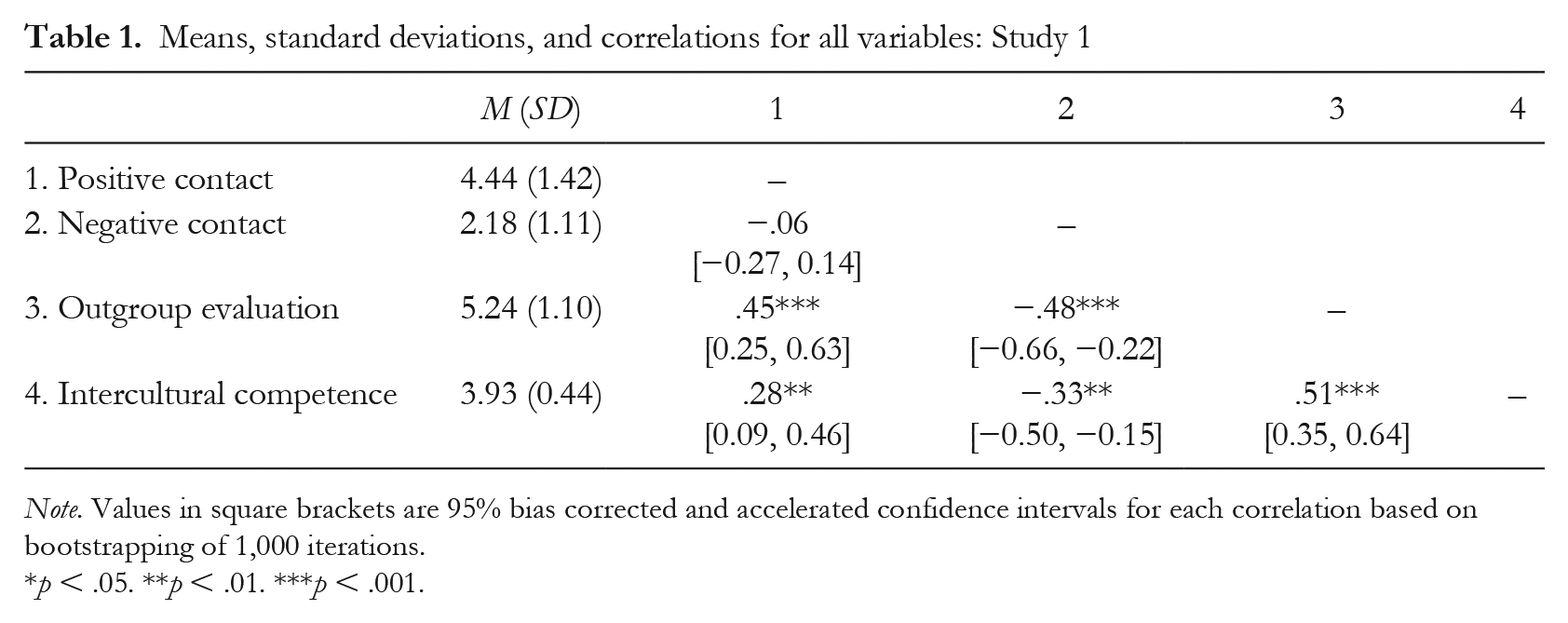
Note. Values in square brackets are 95% bias corrected and accelerated confidence intervals for each correlation based on bootstrapping of 1,000 iterations.
p < .05. **p < .01. ***p < .001.
Regression analyses were conducted to examine the unique associations between positive and negative contact and the dependent variables. Table 2 displays the full model’s statistics and coefficients. Together, positive and negative contact accounted for a significant amount of variance in intercultural competence, R2 = .18, F(2, 102) = 10.82, p < .001. Whereas positive contact was associated with higher intercultural competence (β = .27, p < .001), negative contact was associated with lower intercultural competence (β = −.31, p < .001). The model also explained a significant amount of variance in outgroup evaluation, R2 = .40, F(2, 100) = 33.92, p < .001. Positive contact was associated with higher outgroup evaluation (β = .42, p < .001), while negative contact was associated with lower outgroup evaluation (β = −.45, p < .001).
Positive and negative contact as predictors of outgroup evaluation and intercultural competence: Study 1
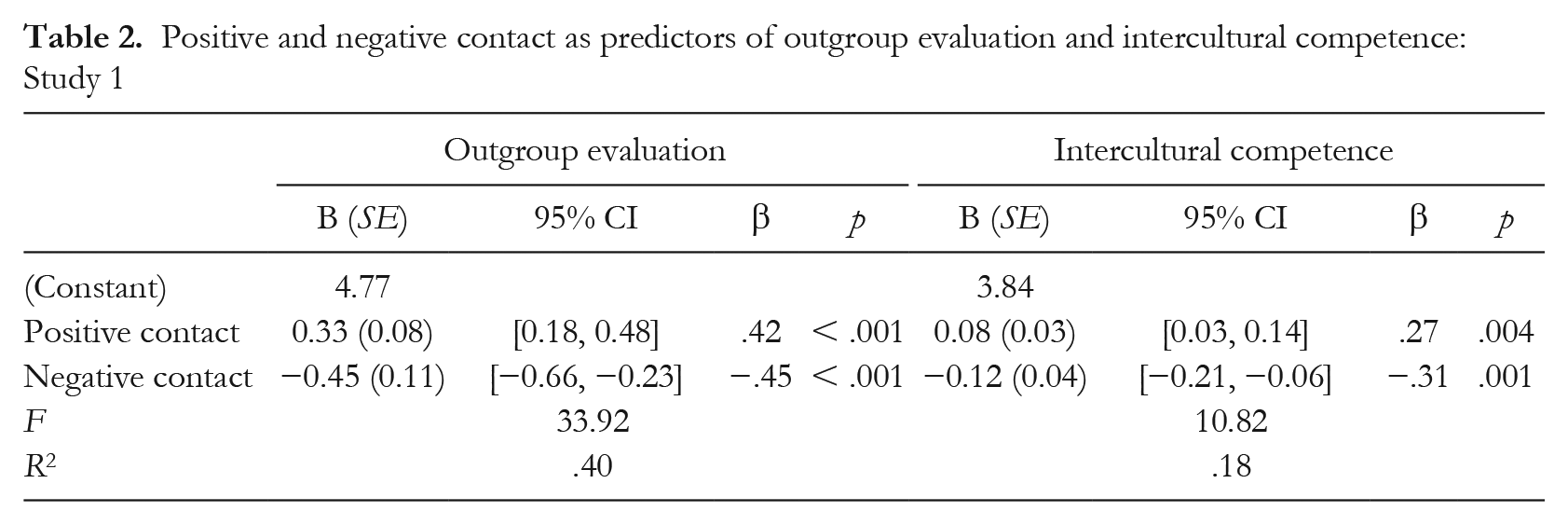
The results of Study 1 provide initial evidence of an association between intergroup contact and intercultural competence. In line with the hypotheses, positive intergroup contact was associated with improvements in both outgroup attitudes and intercultural competence. Meanwhile, negative contact was independently associated with a reduction in both outgroup evaluation and intercultural competence. Importantly, while intergroup contact and outgroup evaluation were measured at the group level (toward Eastern Europeans), the measure of intercultural competence captured individuals’ confidence in cross-group situations generally. While much of the focus of the existing intergroup contact literature has been on contact’s ability to improve attitudes towards the contacted group, these findings are indicative of the broader impact of intergroup contact and its ability to enable generalized improvements in intercultural competence.
Study 2
Study 2 sought to replicate the results of Study 1 in a different intergroup context. In Study 2, White British participants reported on their positive and negative contact with Blacks. Modern Black British culture is largely urban (Clark & Drinkwater, 2002), with roots in postwar African and Afro-Caribbean immigration. Black British culture is diverse, but scholars agree there are key cultural differences between Black and White British residents (see Baker et al., 1996; Owusu, 2000). Therefore, Whites’ contact with Black people involves exposure to cultural differences expected to have implications for intercultural competence. We also included a further outcome measure in Study 2. Universal-diverse orientation (UDO) measures the degree to which an individual possesses openness to, and appreciation of, cultural similarities and differences. High-UDO individuals report greater desire for interactions with diverse others and enjoy learning about both similarities and differences between themselves and others with whom they interact (Miville et al., 1999). This variable has previously been used to measure intercultural competence (see Spitzberg & Changnon, 2009), and was used here in pursuit of conceptual replication.
Participants
Data were collected from an undergraduate participant panel at a British university. Because we were interested in Whites’ contact with Black people, only the responses of White participants were retained. No further exclusions were made. Our final sample consisted of 215 participants, including 32 males and 182 females (one participant did not report their gender) aged between 18 and 47 (M = 20.07, SD = 3.54).
Procedure
The same measures of positive contact (α = .95), negative contact (α = .89), and outgroup attitudes (α = .90) were used as in Study 1, adapted to the relevant target outgroup. Intercultural competence was again measured with the ISS (Chen & Starosta, 2000; α = .87). Participants also completed 13 items from the Miville-Guzman Universality-Diversity Scale (M-GUDS; Miville et al., 1999; see also Fuertes et al., 2000). The M-GUDS contains three subscales: diversity of contact, which assesses individuals’ interest in participating in diverse social and cultural activities (e.g., “I am interested in learning about the many cultures that have existed in this world”); relativistic appreciation, which assess the extent to which individuals value the impact of diversity on self-understanding and personal growth (e.g., “Knowing about the different experiences of other people helps me understand my own problems better”); and comfort with differences, which assesses individuals’ degree of comfort with diverse individuals (e.g., “Getting to know someone of another race is generally an uncomfortable experience for me” [reverse-scored]). All items were measured on a 5-point scale (1 = strongly disagree, 5 = strongly agree). The scale is intended for use as a unidimensional scale, and all items were combined into a single composite score (α = .79). 2
Results and Discussion
Correlations amongst all variables and their means and standard deviations are reported in Table 3. As expected, positive contact was found to be positively associated with intercultural competence as assessed with both the Intercultural Sensitivity Scale (ISS) and the Universality-Diversity Scale (M-GUDS), as well as outgroup evaluation. Negative contact was negatively associated with all three outcomes. Positive and negative contact were moderately negatively correlated.
Means, standard deviations, and correlations for all variables: Study 2
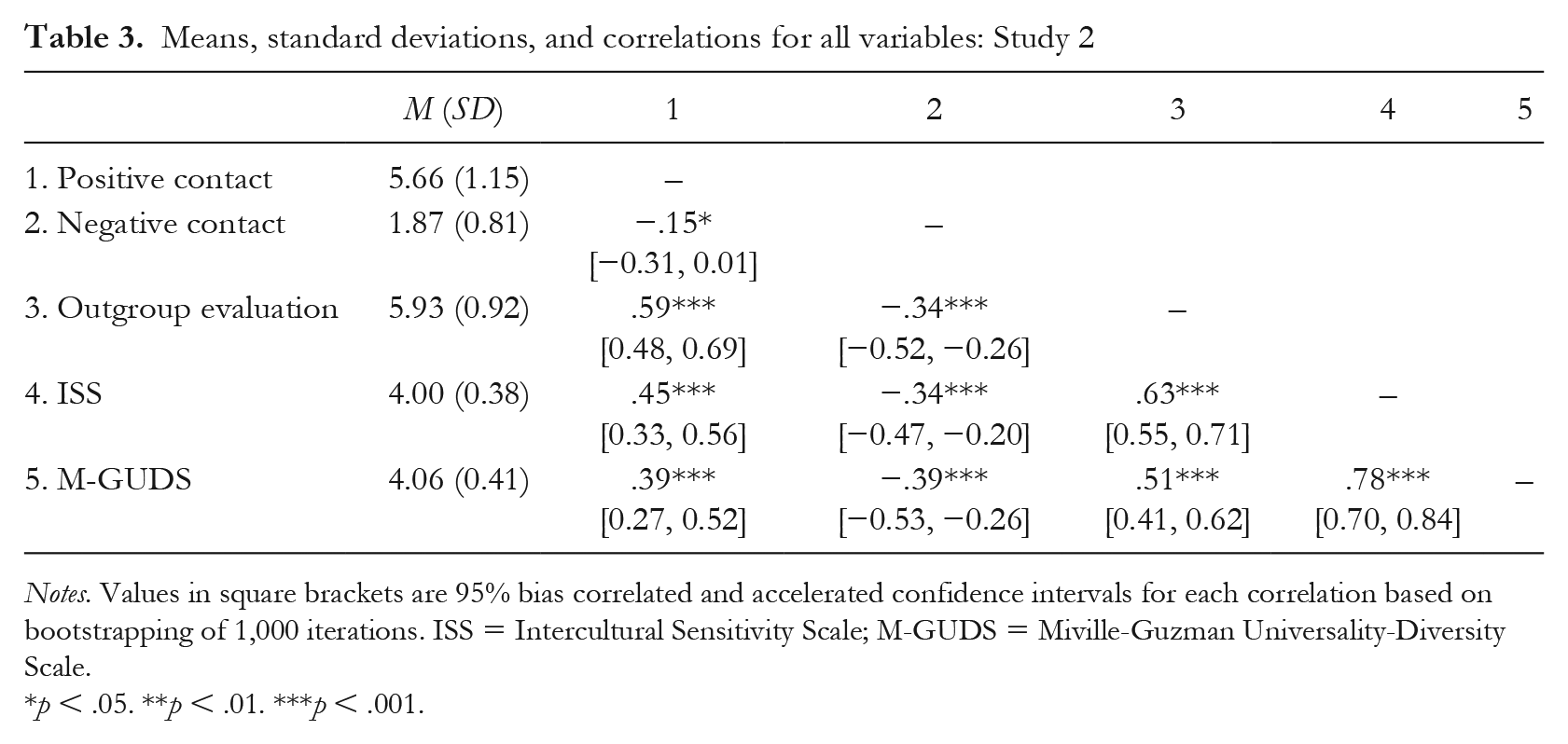
Notes. Values in square brackets are 95% bias correlated and accelerated confidence intervals for each correlation based on bootstrapping of 1,000 iterations. ISS = Intercultural Sensitivity Scale; M-GUDS = Miville-Guzman Universality-Diversity Scale.
p < .05. **p < .01. ***p < .001.
Next, we conducted regression analyses to examine the unique associations between positive and negative contact and each of the dependent variables as per Study 1 (see Table 4). Together, positive and negative contact explained a significant amount of variance in scores on the ISS, R2 = .28, F(2, 212) = 42.10, p < .001. Whereas positive contact was associated with higher intercultural competence (β = .41, p < .001), negative contact was associated with lower intercultural competence (β = −.28, p < .001). Similarly, the model explained a significant amount of variance in scores on the M-GUDS, R2 = .27, F(2, 212) = 38.68, p < .001. Whereas positive contact was associated with higher universal-diverse orientation (β = .34, p < .001), negative contact was associated with lower universal-diverse orientation (β = −.34, p < .001). The model also explained a significant amount of variance in outgroup evaluation, R2 = .44, F(2, 212) = 84.26, p < .001. Positive contact was associated with higher outgroup evaluation (β = .55, p < .001), while negative contact was associated with lower outgroup evaluation (β = −.31, p < .001).
Positive and negative contact as predictors of outgroup evaluation and intercultural competence measured with the ISS and the M-GUDS: Study 2
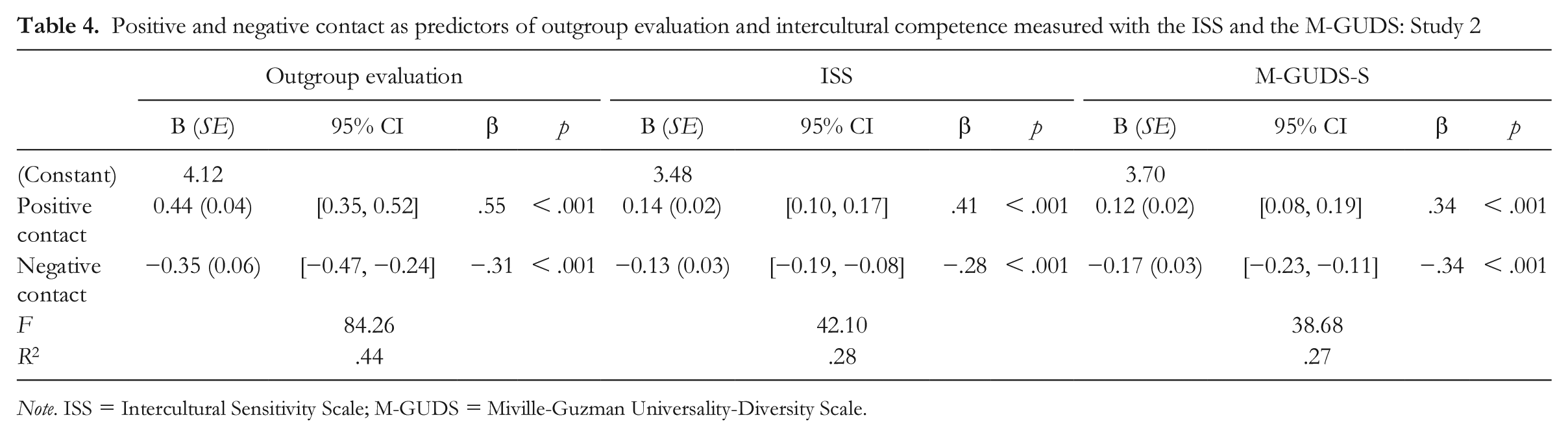
Note. ISS = Intercultural Sensitivity Scale; M-GUDS = Miville-Guzman Universality-Diversity Scale.
The results of Study 2 provide further evidence of a cross-sectional association between intergroup contact and intercultural competence. The results replicate those of Study 1 in a different intergroup context. White British participants’ experience of positive contact with Blacks was associated with improvements in both outgroup evaluation and intercultural competence. Negative contact, on the other hand, was negatively associated with both outcomes. Confidence in this association is further increased by replication with an alternative measure of intercultural competence in the form of the Universality-Diversity Scale. While positive contact was associated with higher UDO scores, negative contact was associated with lower UDO scores.
Study 3
Two studies have provided initial evidence of an association between intergroup contact and intercultural competence. The aim of Study 3 was to provide a longitudinal test of this relationship. Both Study 1 and Study 2 were cross-sectional and thus cannot speak to causality. We can be more confident that intergroup contact (positive and negative) has a causal effect on intercultural competence if contact at Time 1 is predictive of intercultural competence at Time 2 whilst controlling for intercultural competence at Time 1. Importantly, longitudinal data also allow us to test the reverse causal pathway whereby intercultural competence at Time 1 is predictive of intergroup contact at Time 2 (while controlling for intergroup contact at Time 1). Whilst Study 1 and Study 2 examined intercultural competence as an outcome of intergroup contact, it is also important to explore the possible role of intercultural competence as an antecedent of intergroup contact. Improvements in intercultural competence are expected to increase the likelihood that future contact encounters are positive and successful, and decrease the likelihood of negative, unsuccessful encounters. In keeping with a dynamic outlook (Paolini et al., 2018; Turner & Cameron, 2016), Study 3 tested both causal pathways in which intercultural competence may serve as both a consequence and antecedent of intergroup contact.
Participants
In order to collect a more heterogeneous sample in Study 3, data were collected from a commercial platform, Prolific. Participants received a small fee in exchange for their participation. Although samples recruited through these platforms are not fully representative, they typically include respondents who vary more broadly in age, level of education, political ideology, and geographic distribution than those recruited from undergraduate student populations (Huff & Tingley, 2015; Levay et al., 2016). Sample size was increased relative to Study 1 and Study 2 given the longitudinal design and uncertain attrition rates. Study 3 used structural equation modelling (SEM) to test the hypothesized longitudinal effects. Conventional criteria suggest a sample size between 200 and 400 for SEM (e.g., Jackson, 2001). We recruited a total of 303 participants at Wave 1. Only White British participants were eligible to participate. This included 92 male and 210 female participants (one participant did not report their gender), aged between 19 and 73 (M = 38.14, SD = 12.39). A total of 72.6% of the initial sample participated at Time 2 (NTime 2 = 220).
Procedure
Participants completed an identical questionnaire in each wave of data collection. All respondents from Time 1 were contacted again approximately 100 days later with a request to complete the second questionnaire. This intersurvey interval is consistent with other recent longitudinal investigations of intergroup contact (Meleady et al., 2019; Reimer et al., 2017). Participants indicated the frequency of their positive contact with Blacks (α = .95 and .97 at T1 and T2, respectively) and the frequency of their negative contact with Blacks (α = .90 and .87 at T1 and T2, respectively) on the same scales used in Study 2. Intercultural competence was measured with the Intercultural Sensitivity Scale (ISS) from Study 1 and 2 (Chen & Starosta, 2000; α = .92 and .91 at T1 and T2, respectively). Finally, outgroup evaluation was again measured with the General Evaluation Scale (Wright et al., 1997; α = .92 and .95 at T1 and T2, respectively). All items were measured on appropriately anchored 7-point scales, except intercultural competence, which was measured on a 5-point scale.
Results and Discussion
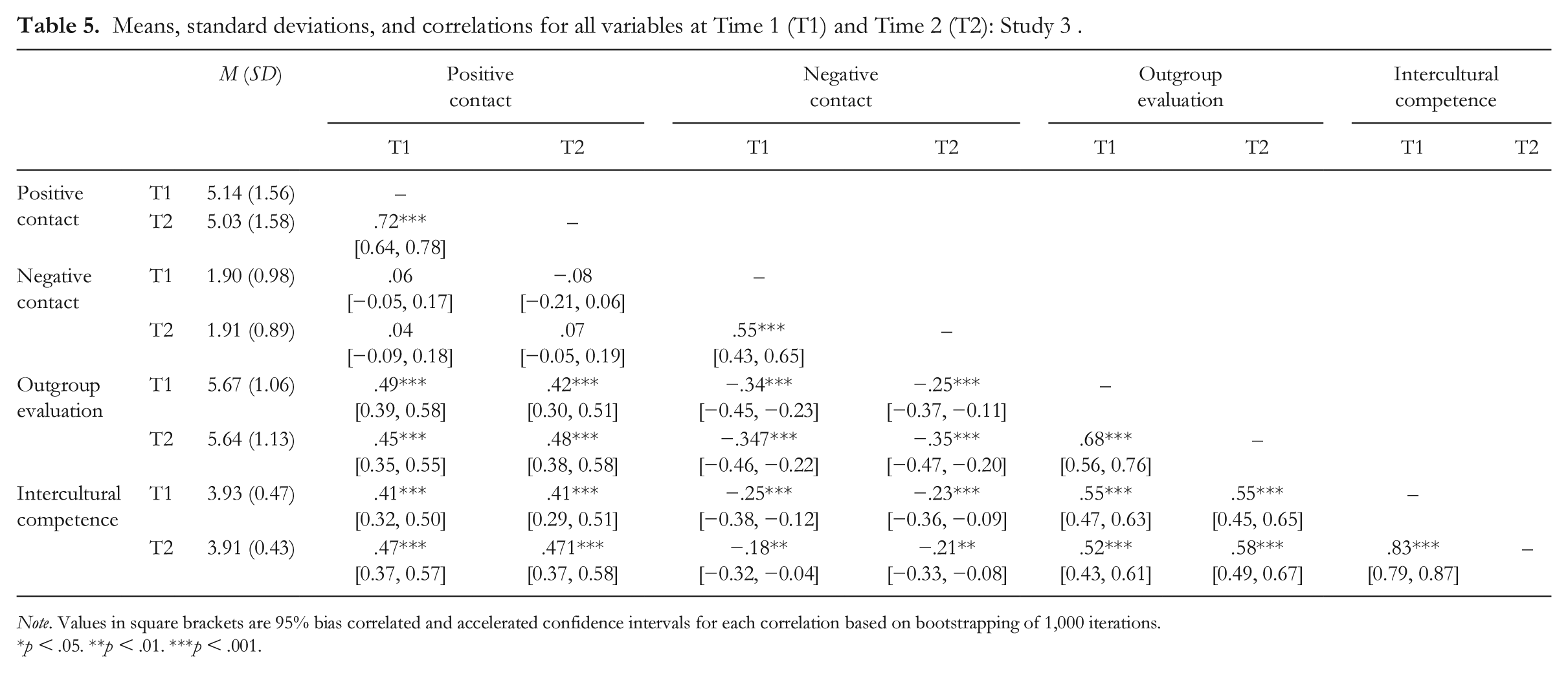
Means and standard deviations for all variables at T1 and T2 and their correlations are reported in Table 5. To test the hypothesized longitudinal effects, we tested a SEM model with latent constructs using the lavaan package (Rosseel, 2012) within R (R Core Team, 2018). Before testing the models, we first ran a multivariate analysis of variance to determine whether the respondents who participated at both time points differed significantly from the respondents who dropped out after Time 1 along the demographic variables of gender and age, as well as the three constructs under investigation. Results of the analysis showed multivariate differences between the respondents who dropped out after Time 1 and the matched respondents, F(5, 296) = 2.34, p = .042, partial η2 = .04. An inspection of the univariate statistics showed that the only significant difference was participants’ age. Respondents who dropped out after Time 1 (Mage = 34.33 years, SD = 11.07) were significantly younger than matched respondents (Mage = 39.42 years, SD = 12.53), F(1, 300) = 10.31, p = .001, partial η2 = .001. The respondents who dropped out after Time 1 did not differ significantly from the matched respondents on gender, nor along any of the three main variables under investigation. Hence, it is unlikely that selective attrition played a significant role in subsequent findings and so we could use full information maximum likelihood estimates to deal with missing values.
Means, standard deviations, and correlations for all variables at Time 1 (T1) and Time 2 (T2): Study 3 .
Note. Values in square brackets are 95% bias correlated and accelerated confidence intervals for each correlation based on bootstrapping of 1,000 iterations.
p < .05. **p < .01. ***p < .001.
Before testing longitudinal relationships it was also necessary to (a) test the fit of the longitudinal measurement model to investigate the factorial validity and construct independence of the latent constructs, and (b) investigate whether the measurement properties of the factors could be considered invariant over time (Byrne et al., 1989; Little et al., 2007; Meredith, 1993; see also Dhont et al., 2014; Meleady et al., 2019). Therefore, we first tested a model including the latent factors and accompanying indicators of positive and negative contact, outgroup evaluation, and intercultural competence from each time point with freely estimated parameters. To smooth measurement error and to maintain an adequate ratio of cases to parameters (Little et al., 2002), we used the subscales of the ISS to form five indicator parcels for the latent factor of intercultural competence. The parcels were created by averaging the items belonging to each subscale, and the parcels were held constant over time. The first factor loading of each latent variable was set to unity in order to scale the factors, and the residual errors of parallel indicators were allowed to correlate in all analyses, reflecting stability in systematic error over time (see Dhont et al., 2011; Dhont et al., 2014; Meleady et al., 2019).
Goodness of fit was assessed using the chi-square test statistic (χ²), comparative fit index (CFI), root-mean-square error of approximation (RMSEA), and standardized root-mean-square residual (SRMR). A satisfactory fit is indicated by a CFI value greater than .90, an RMSEA value close to or lower than .06, an SRMR value close to or lower than .08 (Hu & Bentler, 1999; Kline, 2005), and a χ²/df ratio smaller than 3 (Kline, 2010). The longitudinal measurement model showed satisfactory fit, χ²(226) = 538.72, p < .001, χ2 / df = 2.38; CFI = .96; RMSEA = .07; SRMR = .04. Next, to establish longitudinal measurement invariance (MI; Byrne et al., 1989; Little et al., 2007), we compared this unrestrictive longitudinal model with a second model in which factor loadings of corresponding indicators across time were constrained to be invariant (T. A. Brown, 2006; Christ & Wagner, 2013; see also Dhont et al., 2014; Swart et al., 2011). The restrictions imposed in this second model did not result in a significantly worse fit compared to the less restricted model (with freely estimated parameters), ∆χ²(13) = 12.45, p = .491, confirming metric MI over time.
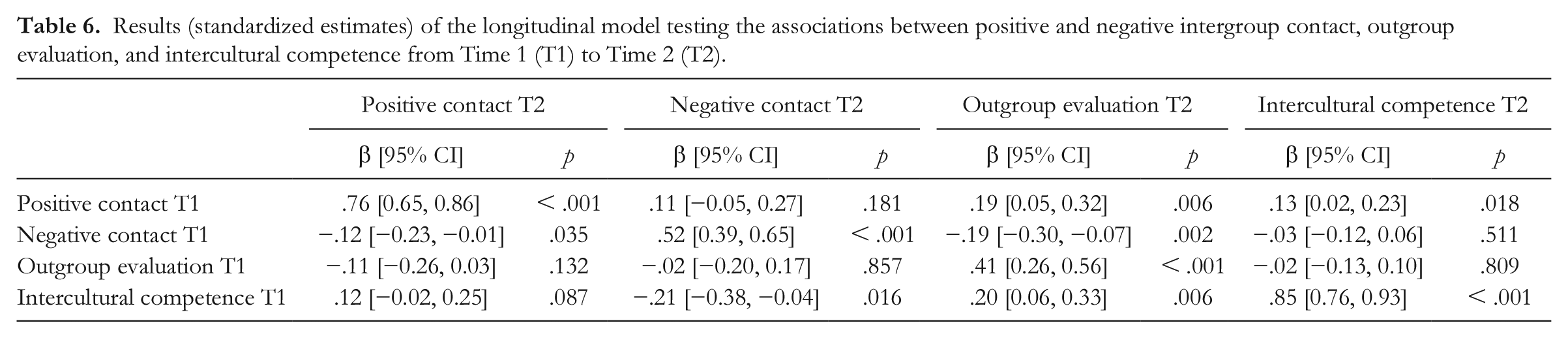
Having established satisfactory measurement invariance for the latent factors, we tested a full cross-lagged model which included all paths from positive and negative contact, outgroup evaluation, and intercultural competence at Time 1 to positive and negative contact, intercultural competence, and outgroup evaluation at Time 2 (i.e., the autoregressive and cross-lagged paths). The latent variables at Time 1 were allowed to be correlated, and the latent variable residuals (the disturbance terms) at Time 2 were allowed to be correlated. The model fit the data well, χ2(482) = 900.93, p < .001, χ2 / df = 1.87; CFI = .95; RMSEA = .05; SRMR = .05. Results (i.e., standardized estimates) are shown in Figure 1. Only significant paths are shown (for full results, see Table 6). As can be seen, both positive and negative contact had a significant longitudinal effect on outgroup evaluation (β = .19, p = .006 and β = −.19, p = .002, respectively). Regarding intercultural competence, only positive contact (β = .13, p = .018) and not negative contact (β = −.03, p = .511) had a significant longitudinal effect on intercultural competence. When looking at the reverse direction of causality, there was no significant longitudinal effect of outgroup evaluation on either positive contact (β = −.11, p = .132) or negative contact (β = −.02, p = .857). There was a significant longitudinal effect of intercultural competence on negative contact (β = −.21, p = .016), but no longitudinal effect of intercultural competence on positive contact (β = .12, p = .087).
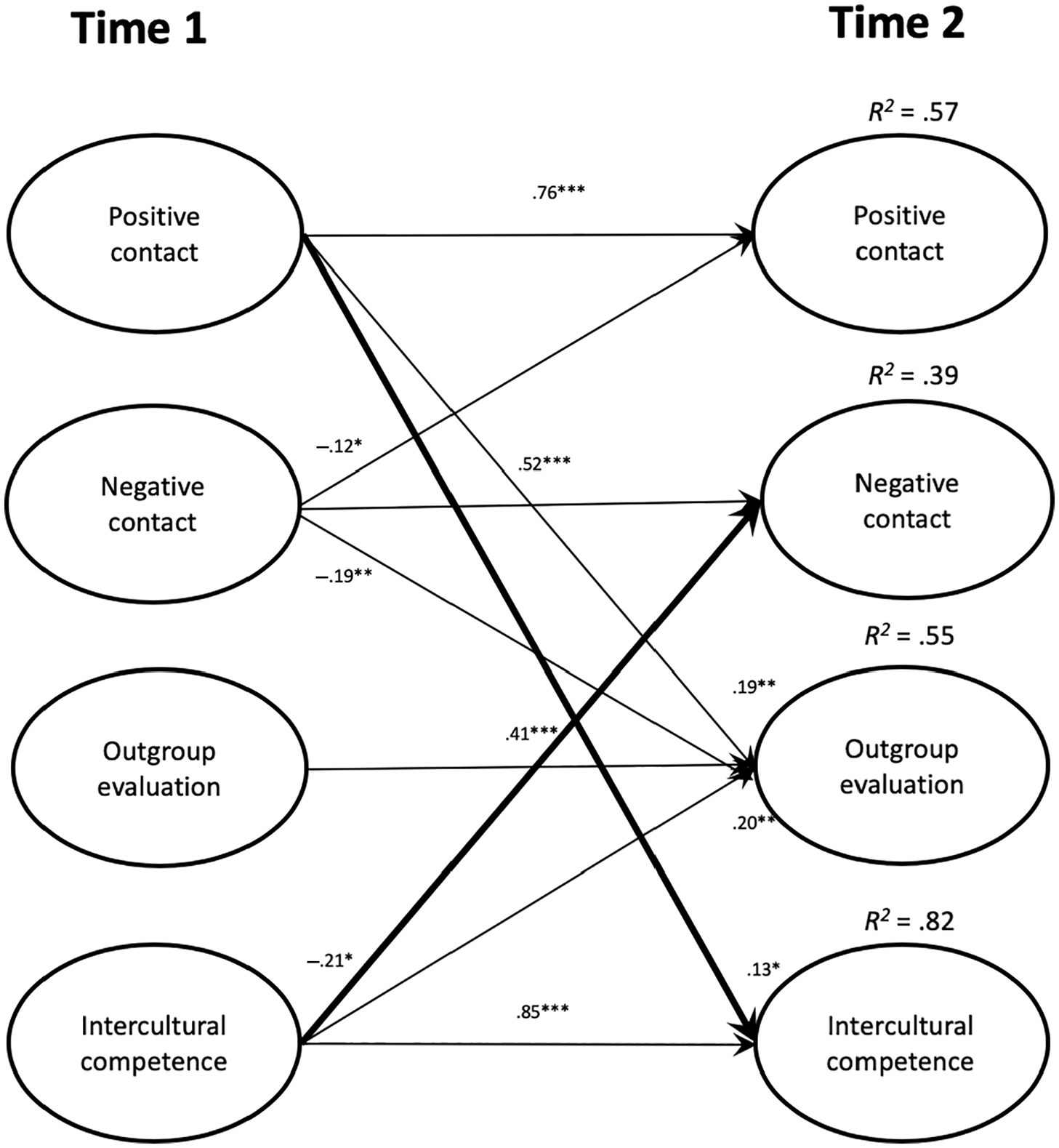
Longitudinal associations between positive and negative intergroup contact, outgroup evaluation, and intercultural competence: Study 3.
Results (standardized estimates) of the longitudinal model testing the associations between positive and negative intergroup contact, outgroup evaluation, and intercultural competence from Time 1 (T1) to Time 2 (T2).
Replicating the traditional contact effect, results of Study 3 demonstrated that both positive and negative intergroup contact had a significant longitudinal association with outgroup evaluation. Whilst positive contact at Time 1 was associated with higher outgroup evaluation at Time 2, negative contact was associated with lower outgroup evaluation at Time 2 (controlling for the autoregressive effects of the same variable measured at each time point). There was no evidence for the reverse direction of causality whereby outgroup evaluation predicted the rate of positive and negative intergroup contact over time. There was, however, evidence of mutual influence between intergroup contact and intercultural competence. Specifically, we found that only positive contact at Time 1 was associated with improvements in intercultural competence at Time 2. There was no longitudinal association between negative contact at Time 1 and intercultural competence at Time 2. Meanwhile, intercultural competence at Time 1 was associated with a reduction in negative contact at Time 2, but there was no longitudinal association between intercultural competence at Time 1 and positive contact at Time 2.
Taken together, the results suggest that a simple unidirectional or bidirectional model of the association between intergroup contact and intercultural competence cannot be accepted. Rather, positive and negative contact appear to interact with intercultural competence over time in a more complex, valence-dependent fashion. While positive contact appears to enable improvements in intercultural competence over time, higher intercultural competence reduces the likelihood of future negative contact. The implications of these results are considered in what follows.
General Discussion
Traditionally, intergroup contact research has focused on changing prejudicial attitudes. More recently, it has been argued that intergroup contact can exert a generalizing reaction, promoting learning in ways that are not rigid or specific to the experience itself but rather reflect a more liberalized mindset (Hodson et al., 2018). This paper continued to explore the potential for intergroup contact to impact a range of more expansive variables, beyond focal intergroup attitudes. We focused specifically on intercultural competence. Three studies explored whether intergroup contact can not only improve intergroup attitudes but also serve as a learning platform that improves individuals’ ability to communicate and behave appropriately in cross-group situations generally.
Study 1 and Study 2 provided initial cross-sectional evidence of an association between intergroup contact and intercultural competence. Positive and negative contact were measured as two independent dimensions. In Study 1, British participants’ experience of positive contact with Eastern European immigrants was associated not only with improvements in outgroup evaluation, but also improvements in generalized intercultural competence. Negative contact, meanwhile, was associated with reductions in both outgroup evaluation and intercultural competence. Study 2 replicated these results in a different intergroup context. White participants’ experience of positive contact with Blacks was associated with improvements in intercultural competence and the related construct of universal-diverse orientation (UDO), which captures an individual’s openness towards, and appreciation of, cultural differences (Fuertes et al., 2000). Negative contact was associated with reductions in both outcomes.
In Study 3, longitudinal data helped to decompose the cross-sectional associations observed in Studies 1 and 2. Recent models of intergroup contact have called for a dynamic approach that recognizes that the beneficial consequences of intergroup contact may also function as reward systems that reinforce future contact behaviours (Paolini et al., 2018; Turner & Cameron, 2016). The longitudinal data collected in Study 3 allowed us to test the possibility that intercultural competence may serve as both a consequence and antecedent of intergroup contact. Positive and negative contact were again measured as independent constructs. The results suggest that there is mutual influence between intergroup contact and intercultural competence that is valence dependent. Specifically, positive contact was longitudinally associated with an increase in intercultural competence, but there was no longitudinal effect of negative contact on intercultural competence. Meanwhile, intercultural competence was longitudinally associated with a reduction in negative contact, but not with an increase in positive contact.
These findings speak to the importance of recognizing positive and negative contact as related but separate dimensions of intergroup contact. While foundational research in this area found negative contact to have a more powerful impact than positive contact (e.g., Barlow et al., 2012; Graf et al., 2014; Paolini et al., 2010), subsequent research has found the opposite pattern (e.g., Meleady & Forder, 2019; Visintin et al., 2017; Wölfer et al., 2017) or no reliable differences in the magnitude of positive and negative contact effects (e.g., Árnadóttir et al., 2018). These differences may emerge because negative and positive contact impact different variables to different extents (Aberson, 2015; Barlow et al., 2019). In our longitudinal study, we found evidence consistent with an effect of positive contact on intercultural competence, but no evidence of an effect of negative contact on this outcome. This finding adds to the growing appreciation of the caveats and nuances of the positive–negative contact asymmetry effect (see Pettigrew & Hewstone, 2017).
Future research should explore the mechanism underlying the positive valence asymmetry observed here. Unlike most outcome variables assessed in intergroup contact research, intercultural competence is an evaluation of the self, rather than the other. Positive social feedback increases feelings of self-efficacy (Bandura, 1993) and self-esteem (Leary et al., 1998). In an intergroup context, positive contact with others will likely trigger self-perception processes leading to the evaluation of the self as competent in such situations. Following negative interactions, on the other hand, it might not be salient to an actor what, if anything, they could have done differently. People also distort social information in a self-serving direction so that positive feedback is more likely to be integrated into the self-concept than negative information (Korn et al., 2012; Taylor & Brown, 1988). Therefore, feelings of intercultural incompetence may be less likely to occur through negative contact than competence is to occur through positive experiences.
The longitudinal data suggest that the association between negative contact and intercultural competence observed in Studies 1 and 2 is instead explained by the reverse direction of causality whereby increases in intercultural competence reduce the chance of negative contact in the future. As previously discussed, little existing work has explored the antecedents of intergroup contact, and the research that has been conducted has focused primarily on identifying factors that predict intentions or willingness to engage in contact (for reviews, see Paolini et al., 2018; Ron et al., 2017). We focused instead on factors that predict the quality of intergroup contact (i.e., positively vs. negatively valanced contact), with intercultural competence expected to provide individuals with the skills and abilities they need to navigate intergroup encounters successfully. Interestingly, we found that intercultural competence was longitudinally associated with a reduction in negative contact but not with an increase in positive contact. In other words, gains in intercultural competence help to reduce the likelihood that future encounters will be negatively toned, but do not necessarily increase the rate of positive and friendly encounters.
Previous research suggests that when an individual is high in intercultural competence, he or she is more likely to have the experience and the outlook necessary to keep an interaction from becoming conflictual (Ting-Toomey & Oetzel, 2001). Sharma and Wu (2015), for example, demonstrated that people higher in intercultural competence may be relatively more tolerant and more able to avoid negativity in a service encounter scenario with an outgroup member. People higher in intercultural competence are better able to avoid negative spirals and other types of miscommunication in joint decision-making tasks (Bennett, 1998). They may also be less likely to experience conflict caused by violating the expectancies of others, or being intolerant of accidental violations from others (Burgoon & Hubbard, 2005). In keeping with these findings, our results suggest that intercultural competence may be more useful for avoiding negative interactions than for creating positive encounters.
Another interpretation of this result is that intercultural competence may influence how individuals make subjective valence appraisals in intergroup contact. Contact valence is a fundamentally subjective experience. Hence, it is not contact positivity and negativity per se that count; rather, how the experience is psychologically constructed by those involved (Graf & Paolini, 2017). Factors such as intercultural competence may influence how individuals appraise valence in intergroup contexts. Specifically, people who feel able to address challenging situations may be less likely to experience such situations as negative, and this might explain why individuals with greater intercultural competence reported significantly less negative intergroup contact. Future research should explore how other skills or mindsets (e.g., self-expansion motivation, novelty seeking) may also be capable of subjectively transforming the valence of contact experiences.
There are some limitations to the present research that should be acknowledged. First, the relatively short gap between the two waves of data collection in Study 3 limits the interpretation of the longitudinal relationships, as there is less time for skills acquisition to manifest. Second, this study only consisted of two waves of data collection. Future tests of the dynamic association between intergroup contact and intercultural competence would ideally include at least three waves of data collection to provide a firmer test of the self-reinforcing nature of this relationship. Turner and Cameron’s (2016) model envisions a chain of events in which confidence in contact promotes more cross-group friendships, and cross-group friendships, in turn, increase confidence in contact. Incorporating contact valence into this model, we may expect positive contact at Time 1 to increase intercultural competence at Time 2 which, in turn, would reduce the likelihood of negative contact at Time 3. While our cross-lagged model provides evidence of mutual influence between intergroup contact and intercultural competence, it cannot speak to how these variables may reinforce themselves through a feedback loop. Paolini et al. (2018) talk about the possibility of “virtuous cycles” of contact whereby the beneficial consequences of positive intergroup contact (e.g., enhanced intercultural competence) feed into future contact encounters. It will also be important to consider how the harmful consequences of negative contact (e.g., intergroup anxiety, anger) may fuel unhelpful expectations and compromise future contact encounters in “vicious cycles” of effects.
Methodologically, longitudinal studies are conducted to provide a clearer understanding of the relationship between variables. However, in order to make firm conclusions regarding causal relationships, experimental studies are required. Future research should seek to confirm true cause-and-effect relationships by testing both the impact of experimental intergroup contact interventions on subsequent intercultural competence, and the impact of intercultural competence interventions on subsequent intergroup contact. Finally, throughout this investigation, intercultural competence was measured via self-reports. Although this is a standard way of assessing intercultural competence (see Matveev & Merz, 2014), self-report measures are open to self-presentational concerns, and people are generally not very good at evaluating their own abilities (e.g., Mabe & West, 1982). Future research should seek to confirm the effects observed here with more resource-intensive methods such as observational methods and diary studies that are often used in interpersonal communication research (Ickes et al., 1994).
Conclusion
An idealized version of our future includes a global society in which people freely engage in intercultural experiences and think broadly and compassionately about others’ welfare, regardless of ethnic or national group. Such a future requires individuals to be high in intercultural competence. However, social psychologists have neglected to link their most studied prejudice-reduction technique, intergroup contact, to intercultural competence. Together, the three studies reported here demonstrate that intercultural competence is indeed an outcome of intergroup contact, and that gains in intercultural competence may also result in a reduction of negative intergroup contact experiences in the future. This work provides an important illustration of the dynamic processes involved in intergroup contact, and how the beneficial consequences of intergroup contact may transform future contact experiences.
