



Abstract
Virtual reality (VR) expands the opportunities for meaningful intergroup contact, surpassing the perceived naturalism and emotional salience of other online contact experiences. By embodying an avatar of ingroup characteristics, one can interact with outgroup members in a shared virtual space while maintaining a high sense of body ownership and copresence. Two studies conducted in Finland (N = 53) and Italy (N = 134) assessed the impact of intergroup contact in VR on implicit and explicit attitudes towards Black people. Utilizing the VR app AltspaceVR, participants were immersed in a virtual environment as White avatars to play an interactive game with another player represented as a Black (intergroup contact) or White avatar (intragroup contact). In Study 1, the avatars played the game as a team to win against other teams. The participants’ attitudes were assessed both pre- and postcontact using questionnaires and the Implicit Association Test (IAT). In Study 2, participants were randomly assigned to either cooperate (play as a team) or compete (play against each other) in the game. The IAT and explicit attitudes were measured postcontact. The findings from both studies revealed that cooperative contact with a Black avatar led to improved attitudes towards Black people. While Study 1 demonstrated an improvement in explicit attitudes, Study 2 demonstrated positive effects of contact at the implicit level exclusively. Additionally, the positive impact of contact on implicit attitudes was observed following cooperative, rather than competitive, intergroup interactions.
Keywords
Theoretical Background
Intergroup contact and prejudice
The role of intergroup contact in prejudice reduction has long been recognized, tracing back to Allport’s (1954) seminal work on the contact hypothesis. A substantial body of research spanning diverse contexts has lend support for the positive impact of contact on intergroup attitudes (Dovidio et al., 2017; Paluck et al., 2009; Pettigrew & Tropp, 2006; Zhou et al., 2019). Beelmann and Heinemann (2014) conducted a meta-analysis of 81 intervention studies targeting the mitigation of explicit negative intergroup attitudes among young individuals through intergroup contact, knowledge acquisition, and the fostering of social-cognitive competencies. Their results showed that interventions inducing positive contact experiences and increased empathy yielded the largest effects, consistent with prior meta-analyses by Pettigrew and Tropp (2006, 2008) and Lemmer and Wagner (2015). Notably, the impact of contact on intergroup attitudes extends beyond physical encounters to encompass online interactions (Imperato et al., 2021). Recently, a rising number of researchers have attempted to extend intergroup contact interventions for prejudice reduction to virtual reality (VR), but results have been ambiguous (see a systematic review by Tassinari et al., 2022b). In this research, we developed two complementary research designs to test the effectiveness of positive and negative intergroup contact in VR to reduce prejudice.
For positive contact to result in prejudice reduction, several conditions need to be met (Allport, 1954; Pettigrew & Tropp, 2000), such as equal status between groups in the situation, common goals, cooperation between groups, and support of authorities, as otherwise interventions can backfire and even lead to increased intergroup conflict (e.g., Paolini et al., 2010). Intervention studies that meet most of the optimal contact conditions have been shown to be most effective at reducing prejudice (Pettigrew & Tropp, 2006). However, as shown by Pettigrew et al. (2011), even when Allport’s conditions are not fully met, intergroup contact on average still diminishes prejudice.
The same cannot be said about negatively experienced intergroup contact. According to Graf et al. (2014), negative contact was more strongly and negatively related to outgroup attitudes than positive contact, despite the latter being 3 times more frequent. Negative and positive contact have also been suggested to be qualitatively different in terms of their consequences, as positive contact might have a greater effect on positive emotions, and negative contact on negative emotions (Barlow et al., 2019). On the other hand, Aberson (2015) demonstrated that, while both types of contact were similarly predictive of affective dimensions of prejudice, negative contact more strongly predicted cognitive dimensions of prejudice such as stereotypes.
The effect of intergroup contact on outgroup attitudes also depends on whether attitudes are operationalized and measured implicitly or explicitly. Implicit attitudes are automatically activated, while explicit ones are normatively monitored (Greenwald & Banaji, 1995). A meta-analysis by Lai et al. (2014) revealed that while half of the interventions were effective in reducing implicit preferences for Whites over Blacks, the effect of contact on explicit racial preferences was less consistent. This discrepancy may be explained by differing impacts of positive contact on explicit versus implicit bias. Aberson and Haag (2007) suggested that positive contact’s influence on explicit bias stems from reappraisal, while its effect on implicit bias operates more directly by creating positive contact experiences that counteract the negative associations produced by ingrained societal biases and stereotypes.
Prejudice reduction in virtual reality
Creating optimal settings for positive intergroup contact has proven to be challenging and resource-intensive in naturalistic settings. This has led researchers to increasingly investigate the possibilities of online and virtual contact for reducing prejudice. These settings provide numerous opportunities for positive intergroup experiences and allow for cost-effective and ecologically valid experimental designs to study the effects of both positive and negative intergroup contact (Amichai-Hamburger & McKenna, 2006; Dovidio et al., 2017). A recent systematic review by Tassinari et al. (2022b) identified 54 intervention studies utilizing intergroup contact in VR, of which, 32 were published between 2020 and 2022. Regarding the effectiveness of VR contact, the review noted three key concerns: counterproductive interactions with outgroup avatars, limited ecological validity due to computer-controlled avatars, and inconsistent usage of outcome measures (Tassinari et al., 2022b). The first concern refers to counterproductive results (i.e., more prejudice and social distance towards the outgroup). This has been specifically found in studies using the embodiment of an outgroup avatar (e.g., Schulze et al., 2019), but also in one study where participants were asked to customize their avatars to resemble themselves (Peña et al., 2021). The second caveat relates to underrepresentation of intervention studies using actual avatars, that is, virtual individuals steered by humans. That is, the majority of prior studies used virtual agents steered by computers, undermining the agency of outgroup avatars in intergroup contact (Tassinari et al., 2022b). This might have led participants not to view virtual agents as representing human beings, and thus prevented categorization into a specific social group (Pan & Hamilton, 2018). Finally, consistent with the prior observation that implicit and explicit measures of intergroup attitudes often lead to discordant findings (for an overview, see Cunningham et al., 2004; Greenwald & Nosek, 2008; Schimmack, 2021), VR studies have found conflicting evidence when using implicit measures as opposed to explicit outcome measures. In fact, very few studies used both implicit and explicit measures of intergroup attitudes to assess prejudice reduction due to intergroup VR contact (Tassinari et al., 2022b). These critical caveats of the existing literature call for further research on VR-based intergroup contact.
The mechanisms of VR contact
According to Pettigrew and Tropp (2008), the link from positive contact to reduced prejudice is both direct and mediated by acquisition of knowledge, reduced anxiety, and increased empathy. While affective factors like intergroup anxiety and empathy have been recognized as the most influential mediators in prejudice reduction through intergroup contact (Pettigrew & Tropp, 2008), the role of affect in mediating VR-based contact remains poorly understood. Existing VR studies tackling the effect of empathy on intergroup attitudes often focus on embodiment of outgroup members to reduce prejudice (e.g., Chen, Ibasco, et al., 2021; Herrera et al., 2018). When it comes to studies enacting intergroup contact from the ingroup (majority) perspective, perception of warmth seems to mediate the decrease in prejudice towards the contacted (minority) outgroup (Collange & Guegan, 2020). However, empathy’s mediating role in VR-based intergroup contact from a majority ingroup perspective remains unexplored. Similarly, intergroup anxiety in VR-based intergroup contact remains understudied. To our knowledge, there is only one study examining intergroup anxiety in VR contact. In this study by Kuuluvainen et al. (2021), no significant improvement was observed in intergroup anxiety among White participants following exposure to virtual intergroup contact with a Middle Eastern man, as opposed to exposure to the same content in a 2D format.
Moreover, the effect of positive contact on reduced prejudice can be mediated by the formation of a new common ingroup identity emerging in the intergroup contact (Eller & Abrams, 2004; Gaertner et al., 1996, 2016). Identifying with this new common ingroup improves positive contact’s effect on attitudes, as positive encounters prompt recategorization into a shared ingroup (Gaertner & Dovidio, 2005). The extent to which this phenomenon also operates in VR intergroup contact remains unclear. It can be assumed that, while negative interactions in VR can reinforce bias, especially at the implicit level (Aberson & Haag, 2007), positive interactions might promote recategorization into a shared ingroup, similar to offline contact (Capozza et al., 2013; Gaertner & Dovidio, 2005). Previous attempts to establish common ingroup identity in VR using offline attributes (e.g., university affiliation, gender, political orientation) have not been successful in reducing prejudice (Alvidrez & Peña, 2020a, 2020b; Peña et al., 2021).
Thus, instead of promoting common real-life social identities in VR, we should focus on VR-specific social identities that could produce positive contact effects. In this study, we suggest that VR users perceive a standalone identity when embodying an avatar, making their nonvirtual group memberships temporarily less salient. Namely, VR users would feel that they belong to the same social group as other users regardless of other differentiating factors such as ethnicity, gender, disabilities, and so on. We suggest that such common cyber-identity (CCI) acts as an overarching social identity that leads to improvement of outgroup attitudes.
Finally, it is also important to acknowledge factors that are specific to the VR user experience. One such factor is the sense of copresence that has been seen as an essential prerequisite for successful VR contact experiences (Riva et al., 2014). According to Youngblut (2003), copresence in VR encompasses both the sense of presence of other people in the virtual environment and the perception of being together. In our previous study using the same data set as in Study 1, we found that feelings of copresence with the avatar representing the outgroup member moderated the effect of intergroup contact on empathy (Tassinari et al., 2022a). Another factor is the sense of body ownership that comes from being embodied in an avatar and is defined as the perception of the virtual body representation as the subject’s own body (Kilteni et al., 2012). Therefore, in this study, we examine both affective (empathy and anxiety) and identity-related (CCI) mediators of VR intergroup contact, as well as the impact of VR-specific experiences such as body ownership and feelings of copresence on intergroup attitudes.
General Aims and Hypotheses
In this study, we contribute to research on intergroup contact in VR in six novel ways. First, in positive contact conditions, we engaged participants in VR intergroup contact that satisfies the conditions outlined in Allport’s (1954) contact hypothesis (i.e., equal status, cooperation, shared goals, and normative support). Second, we developed an experimental design to test the effect of both cooperative and competitive intergroup contact on outgroup attitudes among majority group members by assigning participants to four conditions (intergroup vs. intragroup and positive vs. negative contact). Third, we used both implicit and explicit measures of outgroup attitudes to achieve a better understanding of the different pathways through which intergroup attitudes can be influenced in VR. Fourth, the participants engaged in intergroup contact with an avatar steered by a real person, not a computer. Finally, we tested the mechanisms of the effect of VR contact on prejudice by focusing on both previously attested emotional mediators (intergroup anxiety and empathy; Pettigrew & Tropp, 2008) and a VR-specific process, namely CCI, which is suggested to account for the effect of VR contact on intergroup outcomes.
In two separate studies conducted in Finland and Italy, we investigated the effects of VR contact on prejudice against Black individuals. In Finland, recent research shows that 6 out of 10 individuals of African descent have experienced racist harassment or violence, making Finland the highest ranked among 11 European countries (European Union Agency for Fundamental Rights, 2017). In 2021, people of African ethnic background accounted for 1.1% of the Finnish population, showing a 5.8% raise compared to the previous year (Statistics Finland, 2022). In Italy, residents with African ethnic background amount to 1.2% of the population (ImmigratiStat, 2002). About 3 out of 10 North African immigrants in Italy reported experiencing discrimination, with only immigrants in the Netherlands reporting higher rates (European Union Agency for Fundamental Rights, 2017). Thus, studying racial prejudice reduction is crucial in both Finnish and Italian contexts.
We formulated the following set of hypotheses that were preregistered for Study 1 and Study 2 on the Open Science Framework (OSF; https://osf.io/eda4x and https://osf.io/dgqj9, respectively). Deviations from the preregistered plan are detailed in the supplemental material.
H1a (Studies 1–2): Attitudes towards Black people will be more positive in the cooperative (positive) intergroup contact (with an avatar resembling a Black person) than in the cooperative intragroup contact (with the other avatar representing a White ingroup member).
H1b (Study 2): Cooperative (positive) intergroup contact in VR (with an avatar resembling a Black person) leads to more positive outgroup attitudes compared to competitive (negative) intergroup contact in VR.
H2: Empathy (H2a; measured only in Study 1) and intergroup anxiety (H2b; Studies 1–2) mediate the effects of positive intergroup contact on attitudes towards Black people.
In addition to these emotional mediators of contact effects, we want to explore the role of a common ingroup identity formed in VR as a factor producing or strengthening the effect of positive contact in VR. So, we examined the extent to which participants forming a common cyber-identity with the other avatar mediated the link from contact to intergroup attitudes:
H3 (Studies 1–2): CCI mediates the difference in attitudes towards Black people between the positive intergroup contact and intragroup contact conditions.
Finally, we explore whether CCI serves as a moderator (H4) and not a mediator of the VR contact effects, and also whether copresence (H5) and body ownership (H6) serve as mediators enabling the change in attitudes following positive contact in VR.
Given that these analyses (H4–H6) are exploratory, we have chosen to present them in the supplemental material.
Study 1: The Effect of Positive Contact
Methods
Participants
Participants were recruited through push-out strategies on social media and convenience sampling. Sixty-seven participants took part in the experiment.
After applying preregistered criteria, we excluded 14 participants in total. Of those, one reported having African ethnic background, one completed the questionnaire 1.75 times faster than the average, two identified the purpose of the study, and one answered 10% of the Implicit Association Test (IAT) trials faster than 300 milliseconds. Notably, nine participants failed to identify the ethnicity (skin color) of the avatar they met in VR. These participants were excluded, as per preregistration, as they did not perceive the intergroup aspect in the intergroup contact condition. The final sample was N = 53, of which, 31 were assigned to the control and 22 to the experimental group. The mean age of participants was 18.3 years in the control condition, and 20 years in the experimental condition. In the experimental group, 72.7% were female, 22.7% male, and 4.5% identified as “other.” The control condition had 77.4% females, 19.3% males, and 3.2% “other.” Participants reported on average little prior experience with VR.
Due to time and resource constraints related to challenges in laboratory research caused by Covid-19 safety measures, we were unable to recruit the preregistered sample of n = 150 but had to cease data collection by the end of 2021 (as specified in the preregistration). Using sensitivity power analyses in G*Power (Faul et al., 2007), we calculated statistical power to detect the effect of the intervention on the outcomes of interest in a mixed within-subjects x between-subjects ANOVA. Results indicated that our sample provided 80% power for a true effect size of f = 0.20, 70% power for an effect size of f = 0.17, and 60% power for an effect size of f = 0.15. This limitation is specifically acknowledged when examining the mediation and moderation hypotheses. We sought to reduce the mean square error by using a repeated-measures design, controlling for confounding variables such as social dominance orientation (SDO) and national identification, and assessing variables through previously validated instruments with high internal consistency.
Procedure
The research protocol for this study received approval from the Research Ethics Committee of the University of Aalto, Finland. All participants took a pretest questionnaire using the online platform Psytoolkit (Stoet, 2010), which also included an informed consent form.
Next, participants wore an Oculus Quest 2 head-mounted display and were led to the virtual room shown in Figure 1. The experimenter was present in the room, embodied in the avatar shown in Figure 2C. When entering the room, the participants were instructed to play a cooperative ball toss game (detailed instructions can be read in the supplemental material). The experimental procedure was designed to satisfy Allport’s positive contact conditions, in that participants and their teammate were of equal status (both participants, and equally agentic), cooperating and with common goals (winning the game as a team), and with support from the authorities (the experimenter, who was present in VR and moderated the game).

The virtual room where participants played ball toss (above), and the virtual waiting room (below).
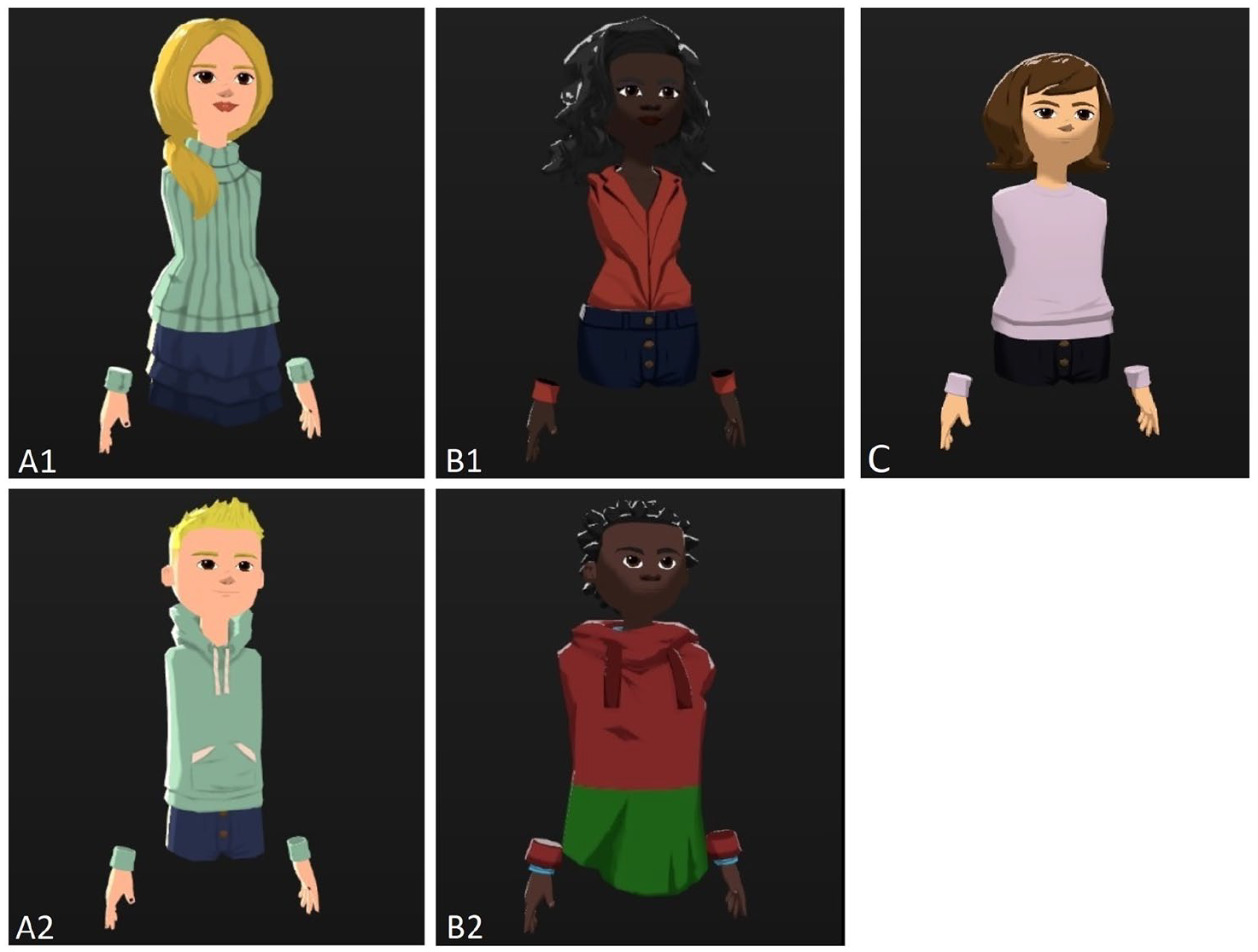
The avatars representing the ingroup (control condition, A1, A2), the primary outgroup (experimental condition B1, B2), and the experimenter (C).
Depending on the condition the participants were randomised into (for this purpose, the online tool Research Randomizer 4.0 was used; Urbaniak and Plous, 2013), the avatar steered by the confederate would either resemble a White (control) or a Black (experimental) person. The game was stopped by the experimenter as soon as the team scored 10 points. The experimenter then instructed the participants to join a different virtual room (see Figure 1) and take a seat while the scores were computed (except for n = 5, due to complications loading the environment). There, they would wait for around 3 minutes with another avatar resembling a Middle Eastern person, which was also steered by a confederate. All participants were informed that their team had won and could remove the headset.
Lastly, participants took a posttest questionnaire on a laptop provided by the experimenter. To minimize the risk of performance and detection bias, participants were asked what was in their opinion the purpose of the study, and whether they answered the questions according to expectations.
Except for the experimenter’s avatar (Figure 2C), all other avatars (see Figure 2) were gender-matched with the participants’ avatar.
Measures
Two independent researchers translated each scale from English into Finnish, when the validated Finnish translation was not available.
Dependent variables
Explicit outgroup attitudes
Explicit attitudes towards the racialized outgroup, namely Black people, were assessed through feeling thermometers (American National Election Studies, 1964). Participants were instructed to rate the valence of their feelings towards people with African racial background on a scale from 0 to 100 (0 = very cold/unfavorable, 100 = very warm/favorable). Participants’ explicit attitudes were assessed both pre- and posttest. This measure has been a more reliable measure of emotional prejudice than other Likert-type scales (Alwin, 1997), and shown to correlate with subtler methods of assessing prejudice (Dovidio et al., 2001).
Implicit outgroup attitudes
We used a racial IAT (Greenwald et al., 1998) to measure implicit attitudes towards Black people, which requires participants to categorize faces (of White or Black individuals) and words (positive or negative). The difference arising from accuracy and speed when categorizing (e.g., associating Black faces with positive words, or White faces with negative words) is used to compute implicit racial bias. Higher IAT scores indicate worse implicit attitudes towards Black people, for they represent slower and less accurate association of Black faces with positive words.
Mediators
Intergroup anxiety
Intergroup anxiety was measured both pre- and posttest through a six-item scale by Stephan and Stephan (1985), which assesses “anxiety stemming from contact with outgroup members” (p. 158). Participants were asked how they felt when thinking about interacting with people of African racial background by rating six adjectives (worried, nervous, awkward, comfortable, safe, at ease, and anxious) on a 5-point scale (1 = not at all, 5 = very much). This scale had a McDonald’s omega of .93 for the pretest, and .94 for the posttest.
Empathy
The Affective Empathy Scale by Batson et al. (1987) was used to assess situational empathy before and after the experiment. Participants were asked to rate the extent to which they experience 14 emotional states represented by specific adjectives on a 7-point scale (1 = not at all, 7 = very much). The adjectives represent two subscales, namely empathic interest (empathetic, sensitive, affable, compassionate, affectionate, moved) and personal distress (alarmed, embittered, annoyed, uncomfortable, baffled, embarrassed, worried, upset). McDonald’s omegas for this scale were: .94 (empathic interest pretest), .92 (empathic interest posttest), .87 (personal distress pretest), and .94 (personal distress posttest).
Common cyber-identity
CCI was measured with two items developed for the purpose of this study in order to assess the degree to which participants identified with a new social group stemming from presence in VR in the shape of avatars. The items were: “When I was in virtual reality, I felt as if the other players I met and I belonged to the same social group” and “When I was in virtual reality, I felt as if the other avatars I met and mine belonged to the same virtual group.” Participants rated their agreement on a 7-point scale (1 = not at all, 7 = very much).
Control variables, including SDO and national identity, are reported in the supplemental material.
Analysis
We used a multilevel linear model (MLM) with restricted maximum likelihood estimation to test H1a, which posits that positive VR contact with an outgroup member leads to more positive implicit and explicit outgroup attitudes after intergroup contact. MLM was chosen over repeated measures ANCOVA due to data violating ANCOVA’s assumption of homogeneous regression slopes. MLM assumes a linear relationship between predictors and continuous dependent variables that can vary on two or more levels, such as attitudes measured in two time points (Raudenbush & Bryk, 2002). Separate MLMs were conducted for IAT and explicit attitudes (i.e., feeling thermometers) ratings. Models included fixed effects of time (pre- vs. postcontact) as a within-subject factor, and fixed effects of contact type (intragroup vs. intergroup) as a between-subject factor. In addition to the fixed effects of the factors and their interaction, we tested the fixed main effects of control variables (SDO and national identification). Participants’ identifier served as a random intercept. H1a was tested examining the fixed effect of interaction between time and contact using an omnibus F test conducted with Type III sum of squares with Satterthwaite’s method.
Mediation hypotheses (H2a, H2b, H3) were tested using ordinary least squares (OLS) regression-based path analysis, where relative direct and indirect effects and direction (±) of the associations between contact and mediators and between mediators and outcome were tested following Hayes’s (2022) protocol. To this end, we used the PROCESS macro written for R (Hayes, 2022). Separate models were calculated for IAT scores and explicit attitude ratings, and for each mediator due to their moderate-to-strong intercorrelations. Simple mediation models were chosen over parallel multiple mediation due to multicollinearity between mediators. Models controlled for SDO, national identification, and baseline dependent variable (DV) measure. Relative direct effects were presented as standardized beta weights. Total, direct, and indirect effects’ 95% confidence intervals (CIs) and standard errors (SEs) were estimated from 5,000 percentile bootstrap samples.
Analyses were carried out using R Studio (RStudio Team, 2020). The path diagrams for the tested simple mediation models can be seen in supplemental Figures 1 and 2, and moderation analysis results in supplemental Table 1.
Results
Descriptive statistics
Table 1 shows means (M) and standard deviations (SD) of implicit and explicit outgroup attitudes in the experimental (intergroup) and control (intragroup) contact conditions; and Table 2 shows means, standard deviations, and correlations (Person r) among the continuous variables measured in the experiment.
Means and standard deviations of implicit attitudes (IAT) and explicit attitudes (feeling thermometer) in the control and experimental conditions: Study 1.
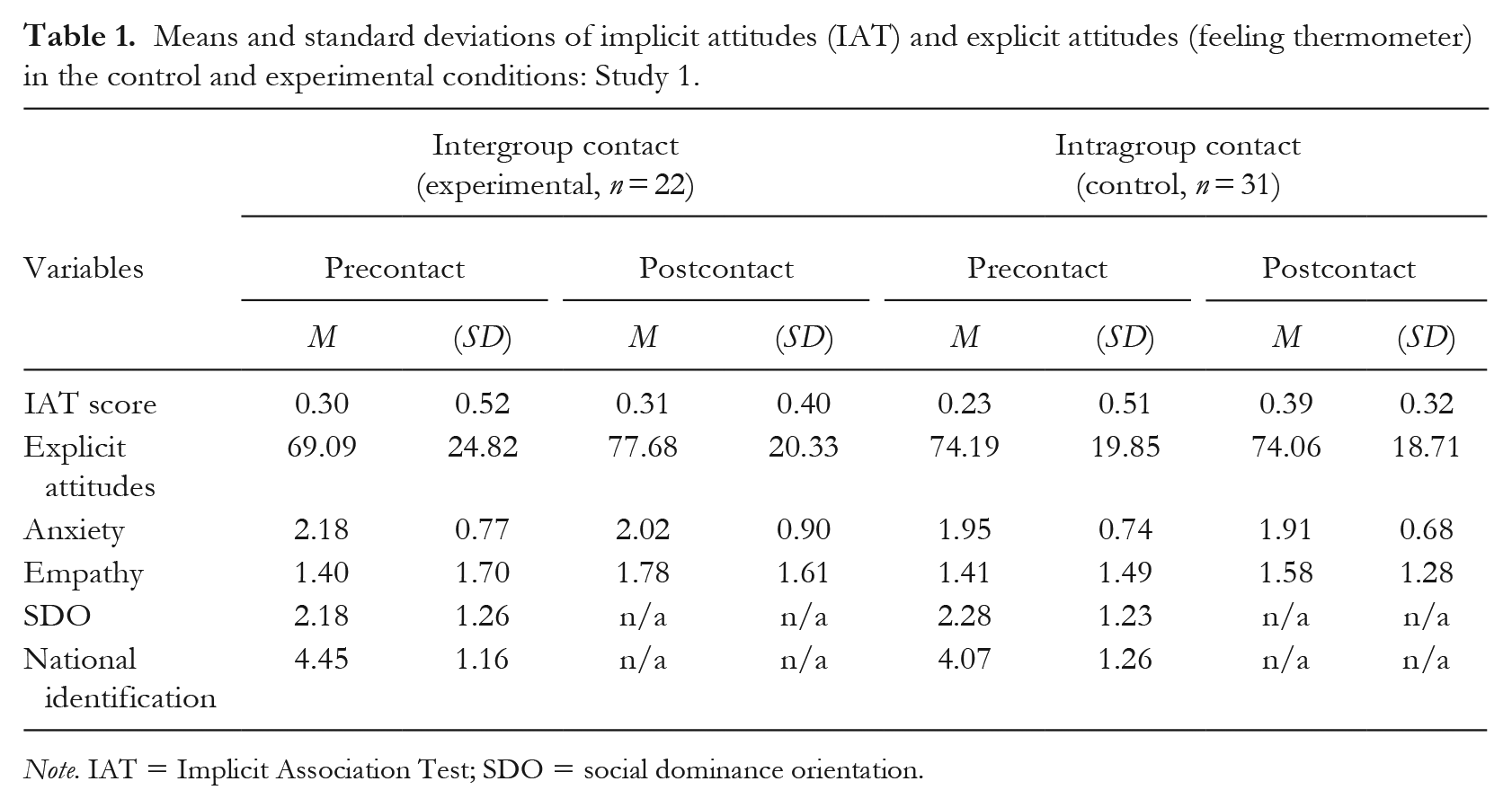
Note. IAT = Implicit Association Test; SDO = social dominance orientation.
Means, standard deviations, and correlations of continuous variables: Study 1.
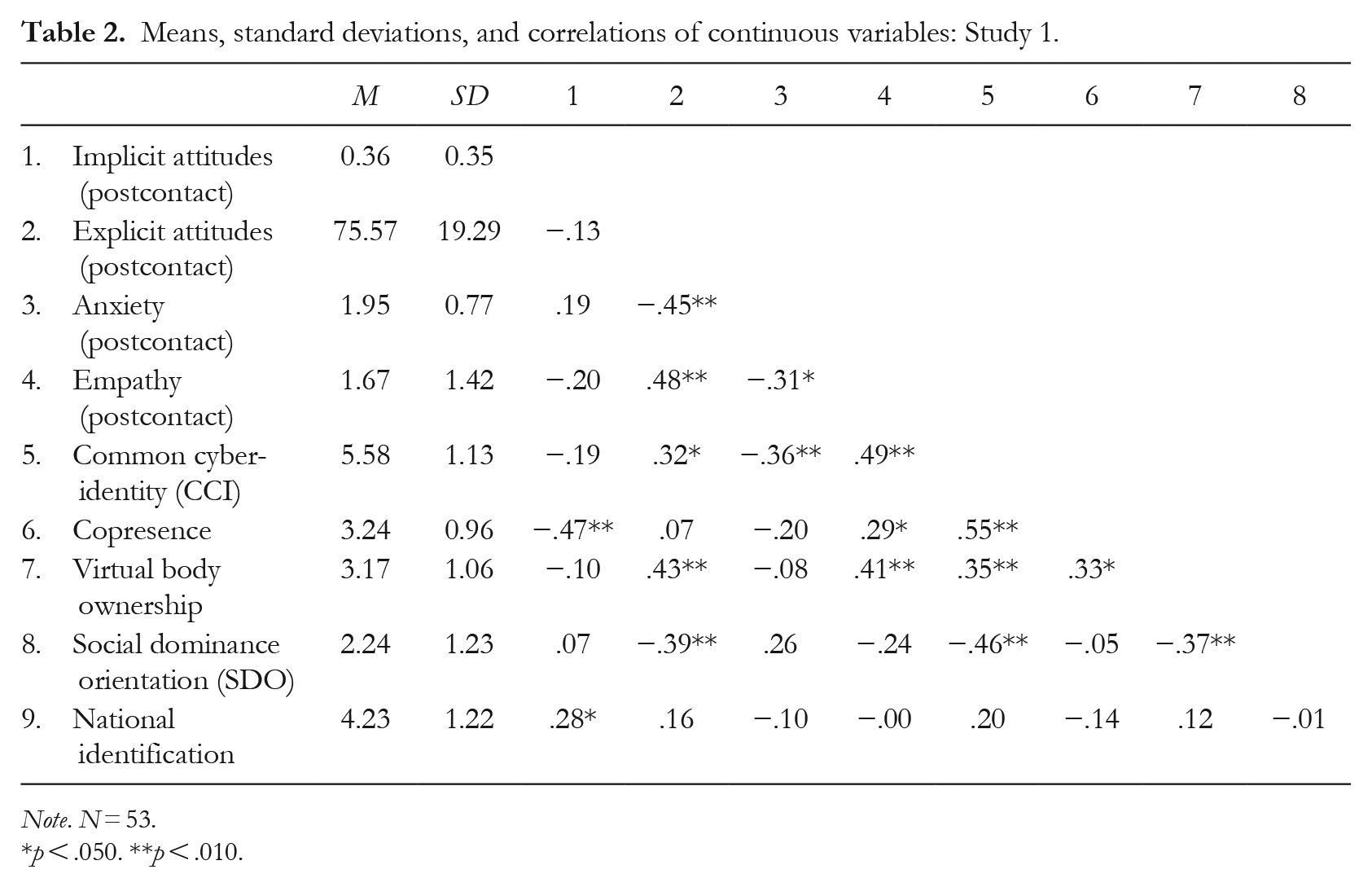
Note. N = 53.
p < .050. **p < .010.
Effect of VR contact on implicit and explicit outgroup attitudes
First, we examined the effect of positive intergroup contact on implicit and explicit attitudes towards Black people (H1a). The omnibus test results of MLM fixed effects showed no significant main or interaction effects of time (pre- vs. postcontact) and condition (intergroup vs. no intergroup contact) on the IAT score (Table 1, left side). However, a significant main effect of national identification was found, indicating a positive association with IAT scores irrespective of measurement time (b = 0.10, p = .011). When examining the effect of intergroup contact on explicit attitudes, a significant main effect of time and a significant interaction between time and condition were found (Table 3, right side). In alignment with H1a, intergroup attitudes changed into more positive from pre- to postcontact in the intergroup contact condition as compared to the control group (intragroup contact 1 ; Figure 3). 2 Additionally, both covariates—SDO and national identification—exhibited significant main effects: SDO was negatively (b = −6.60, SE = 1.93) and national identification was positively (b = 4.24, SE = 1.97) associated with explicit attitude ratings across the contact conditions.
F-test results of MLM fixed effects on implicit and explicit attitudes: Study 1.
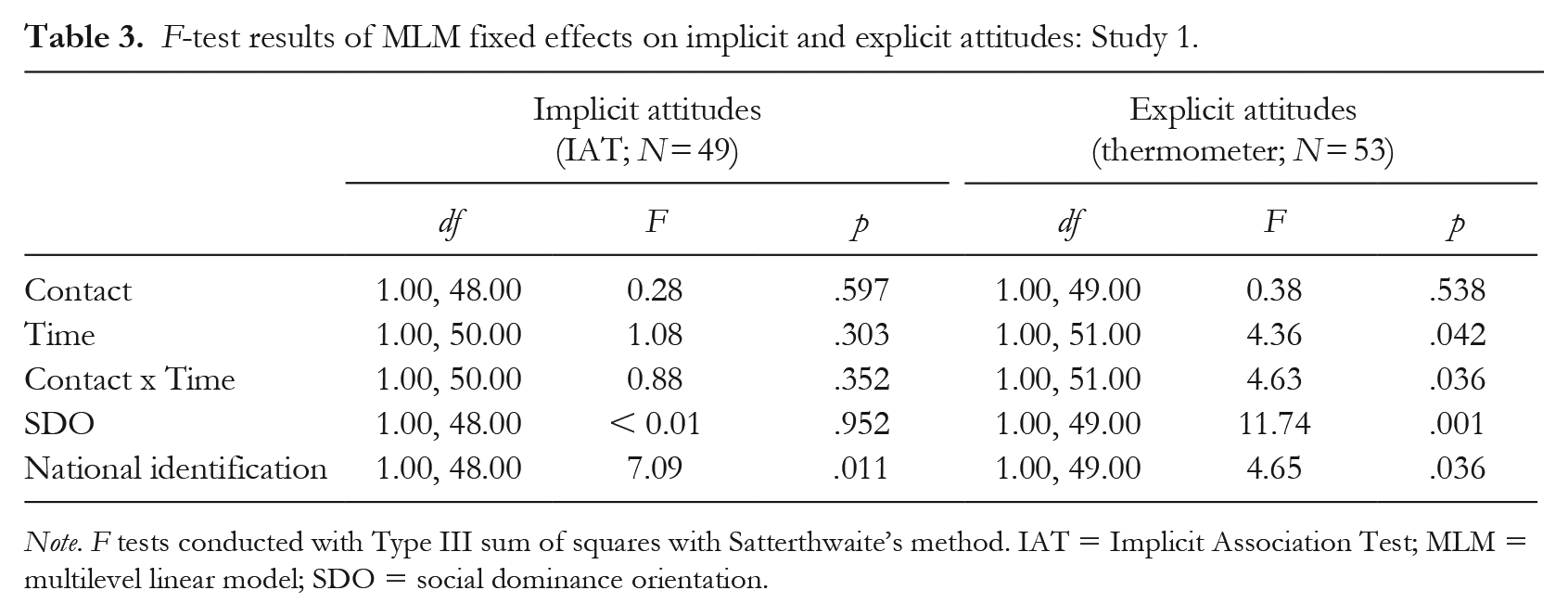
Note. F tests conducted with Type III sum of squares with Satterthwaite’s method. IAT = Implicit Association Test; MLM = multilevel linear model; SDO = social dominance orientation.
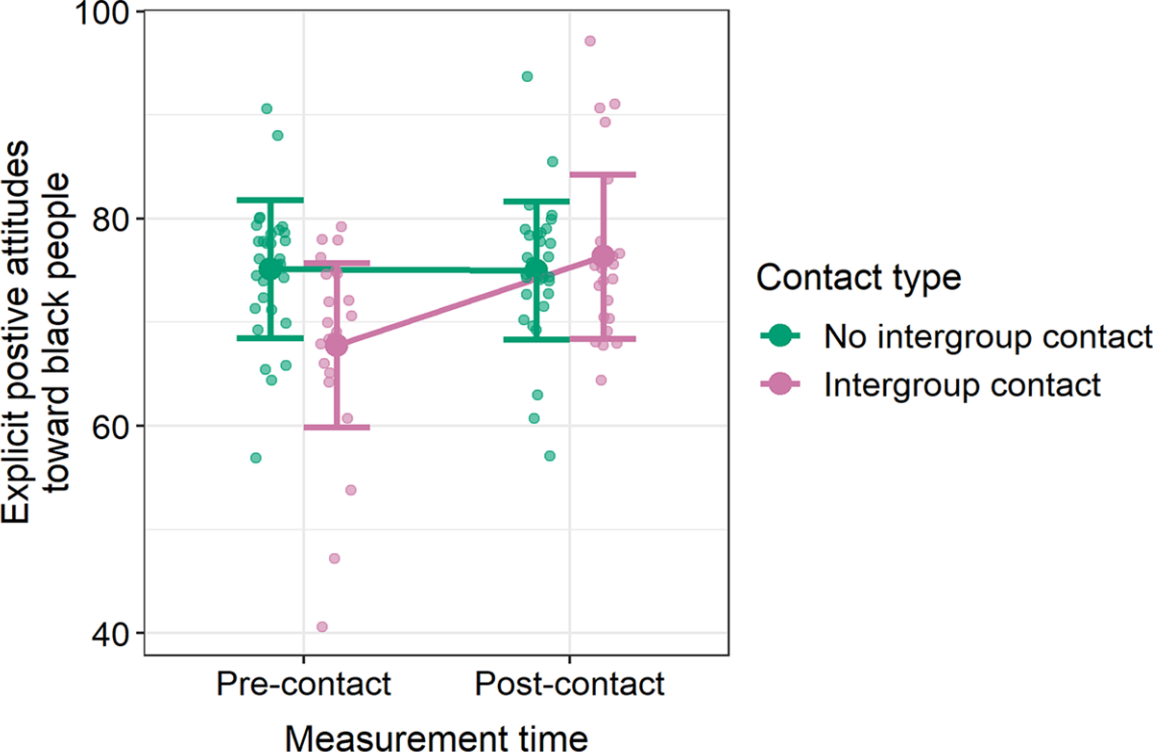
Interaction effect between time and contact type on explicit outgroup attitudes.
Mediation analyses
To assess H2a and H2b regarding intergroup anxiety and empathy mediating intergroup contact’s impact on implicit attitudes (IAT), relative direct and indirect effects of contact on mediators (a) and of mediators on postcontact IAT scores (b) were analyzed. Simple mediation models were conducted individually for each mediator due to their intercorrelations. Covariates included precontact IAT score, SDO, and national identification. Results are reported in Table 4. Compared to the control condition, intergroup contact did not reduce intergroup anxiety (a1 = 0.23, p = .422; relative direct effects are reported as standardized beta weights), and anxiety had a nonsignificant link to postcontact IAT scores (b1 = 0.26, p = .077). Similarly, intergroup contact did not affect empathy (a2 = 0.13, p = .647), and empathy’s link to IAT was nonsignificant (b2 = −0.19, p = .192). Covariates showed no significant total effects (ps > .053). Contact condition’s relative direct and total effects on IAT score were nonsignificant (ps > .150), as was the total effect of precontact IAT (b = 0.11, p = .454). Contrary to our hypothesis, neither H2a referring to mediation through anxiety (ab = 0.06 [−0.11, 0.25]) nor H2b referring to mediation through empathy (ab = −0.03 [−0.19, 0.11]) received support. Indirect effects are reported in partially standardized form.
Total and indirect effects of contact on implicit and explicit attitudes: Study 1.
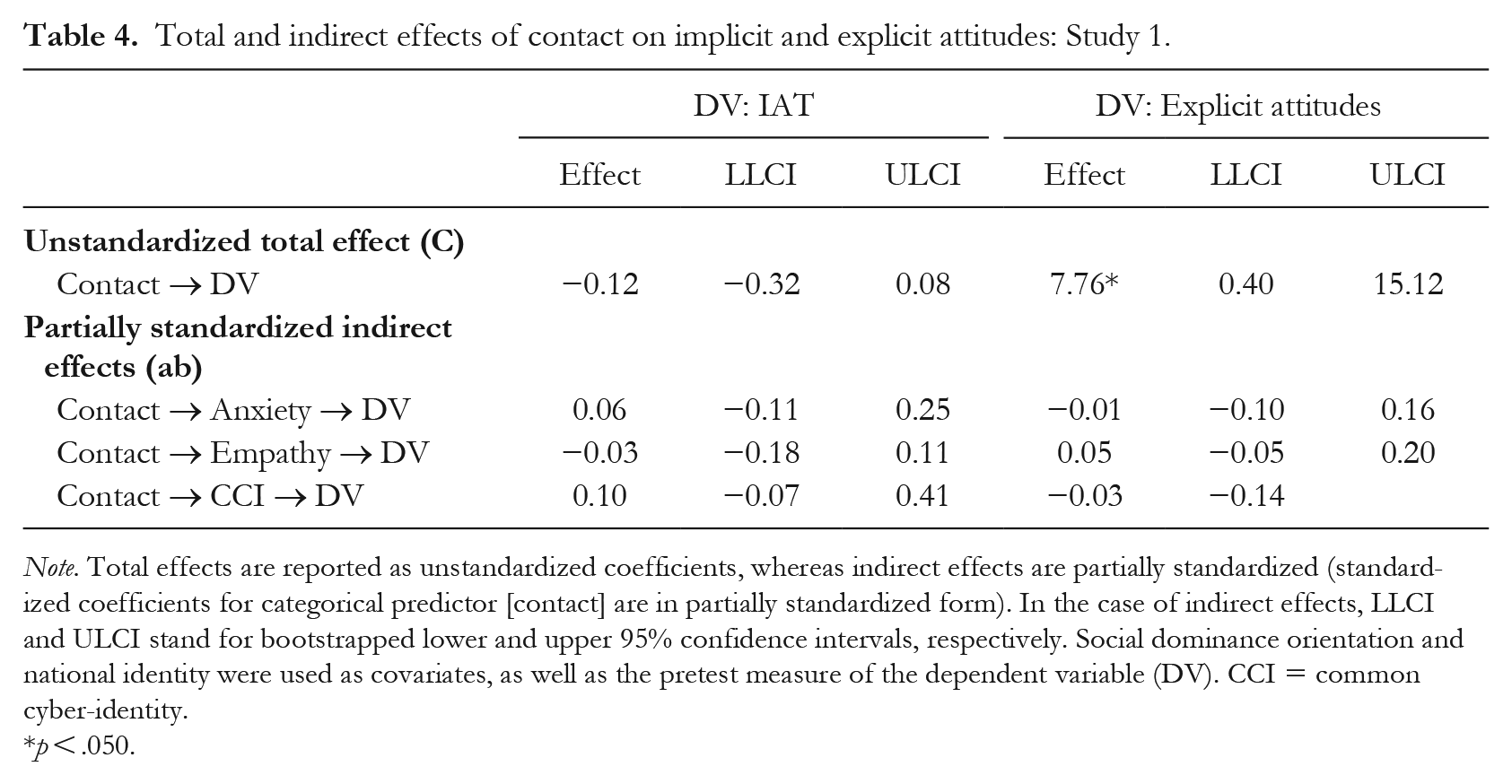
Note. Total effects are reported as unstandardized coefficients, whereas indirect effects are partially standardized (standardized coefficients for categorical predictor [contact] are in partially standardized form). In the case of indirect effects, LLCI and ULCI stand for bootstrapped lower and upper 95% confidence intervals, respectively. Social dominance orientation and national identity were used as covariates, as well as the pretest measure of the dependent variable (DV). CCI = common cyber-identity.
p < .050.
Two similar simple mediation models were conducted to test whether intergroup anxiety or empathy mediated the influence of intergroup contact on explicit outgroup attitudes. Precontact explicit attitudes, SDO, and national identification were set as covariates. Positive contact with an outgroup versus ingroup member was not significantly related to anxiety ratings (a1 = 0.04, p = .876), and the link from anxiety to postcontact attitudes was likewise nonsignificant (b1 = −0.17, p = .090). While contact did not influence empathy either (a2 = 0.26, p = .341), a significant positive effect of empathy on postcontact attitudes was found (b2 = 0.20, p = .043). The relative direct effect of intergroup contact on postcontact attitudes also reached significance (c´ = 0.41, p = .033), as did the total effect of contact (c = 0.40, p = .039). Regarding mediation, no evidence was found for H2a referring to the mediation through anxiety anxiety (ab = −0.01 [−0.10, 0.15]), or H2b referring to the mediation through empathy (ab = 0.05 [−0.05, 0.21]). The covariates were not significantly associated with the attitude ratings except for precontact attitudes (b = .70, p < .001).
Then, a similar simple mediation model was conducted to examine the mediating effect of CCI accounting for the effect of VR contact and implicit attitudes (H3). The effects of precontact IAT, SDO, and national identification were added as covariates. The results (see supplemental Figure 2) showed that compared to the control condition, positive intergroup contact did not significantly affect CCI (a1 = −0.31, p = .229). However, the link from CCI to IAT score (b1 = −0.33, p = .037) was significant, indicating that higher perceived CCI predicted less implicit bias after the experiment in both contact conditions. The total and relative effects of contact condition, and the effects of SDO and national identification on postcontact IAT, were all nonsignificant across the models (ps > .230). Regarding the mediations, the indirect effects lent no support for mediation through CCI (H3).
Then, an additional simple mediation model was calculated to examine the mediation effects of CCI on explicit attitudes, controlling for precontact explicit attitudes, SDO, and national identification. Again, contact type did not influence ratings of CCI (a1 = −0.21, p = .419). Also, the link from CCI to explicit attitudes (b1 = 0.12, p = .253) did not reach significance. Of the three covariates, only precontact attitudes significantly predicted postcontact attitude ratings (p < .001). However, like the previous models, there was no support for mediation through CCI (H3).
Study 2: Positive and Negative Contact
The aim of Study 2 was to further investigate the scope of Allport’s (1954) contact hypothesis in VR by testing two different types of intergroup contact, namely competitive and cooperative. We hypothesize that while cooperative contact can be operationalized as positive, competitive contact does not align with Allport’s optimal contact conditions (i.e., lack of common goals and cooperation), and so it rather represents a negative intergroup contact with no effect or even negative effect on outgroup attitudes. All hypotheses were preregistered and can be read in detail in the General Aims and Hypotheses section.
Methods
Participants
Participants were recruited through push-out strategies on social media and snowball sampling. One hundred and sixty participants took part in the study. Applying the preregistered criteria, we excluded 26 participants (four reported having mixed ethnic background, three answered 10% of IAT trials faster than 300 milliseconds, two reported poor functioning of the VR headset, and 17 failed to identify the ethnicity of the avatar they met in VR). Thus, the final sample was N = 134 (67 males, 66 females, one other; age ranged from 18 to 88 years, Mage = 32). Participants were randomly allocated to one of the four conditions: intergroup cooperation (n = 36), intragroup cooperation (n = 33), intergroup competition (n = 30), intragroup competition (n = 35). A sensitivity power analysis using G*Power revealed that our sample provided 80% power for an effect size of f = .29, a medium effect (Cohen, 1988).
Procedure
This study received ethical approval from the Research Ethics Committee of the University of Aalto, Finland. Conducted at an Italian university, the experiment involved White Italian female researchers. The procedure mirrored that of Study 1, with adaptations for two new conditions: intergroup competitive contact (Caucasian–African) and intragroup competitive contact (Caucasian–Caucasian). Adjustments included modified participant instructions (see supplemental material) and enhanced avatars for better ingroup resemblance (see Figure 4). The rest of the procedure and instructions followed Study 1. At the conclusion of the experiment, we took additional care in debriefing participants, providing thorough explanations about the study’s goals to mitigate the potential risk of fostering negative attitudes in those that participated in the outgroup competition condition. The headset used for Study 2 was the same model as in Study 1 (i.e., Oculus Quest 2), as were the virtual rooms.
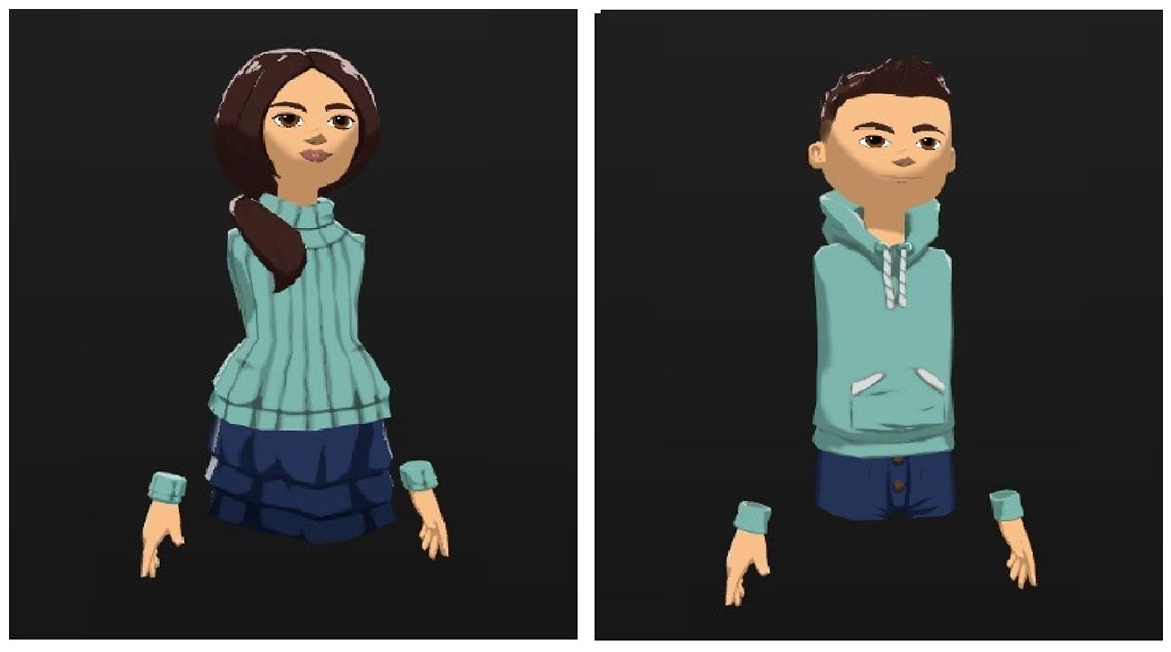
The avatars representing the ingroup in Study 2.
Measures
In Study 2, we assessed implicit outgroup attitudes, explicit outgroup attitudes through both feeling thermometers and a multi-item scale, intergroup anxiety, frequency of intergroup contact, feelings of body ownership, copresence, and CCI.
Explicit outgroup attitudes
Attitudes toward people with African racial/ethnic origin were used as dependent variable and were measured by six bipolar items from Wright et al.’s (1997) General Evaluation Scale (GES) with response options ranging from 1 to 7: “cold/warm,” “suspicious/trusting,” “positive/negative,” “friendly/hostile,” “respect/contempt,” “admiration/disgust.” Higher scores represent more negative attitudes toward the outgroup. Scores were averaged to create a reliable composite score (ωGES = .92).
Intergroup anxiety
In Study 2, we used a measure of intergroup anxiety derived from Stephan and Stephan’s (1985) scale to better account for its intergroup component. Participants reported how much, on a scale from 1 to 5, they felt worried, nervous, embarrassed, and anxious when thinking about interacting with a person with African ethnic background. McDonald’s omega was ωanxiety = .95.
Frequency of intergroup contact
Since we did not directly measure pretest attitudes towards the outgroup in Study 2, we addressed this limitation by controlling for prior contact with the outgroup, enabling us to derive an estimated proxy for pretest attitudes. We measured how often participants encounter people with African ethnic background through a single item (“In everyday life, how often do you interact with people with African ethnic background?”) to be answered on a 1–5 continuum. This measure was used as a covariate.
Body ownership
Body ownership, that is, the degree to which participants felt as if the virtual body they steered in VR belonged to them, was assessed using a six-item scale from Peck et al. (2013). The items measured self-overlap with the avatar and control over it, and were rated on a 5-point Likert scale. This scale’s McDonald’s omega was .78.
Copresence
We adapted a four-item scale by Biocca and Harms (2002) to measure copresence in VR, meaning how much the subject is aware of the presence of others in the virtual environment. Agreement with each item was rated on a 5-point Likert scale. This scale’s McDonald’s omega was .85.
Analysis
We conducted two-way ANCOVA models to test our 2 × 2 between-subject factorial design, examining task type (cooperation vs. competition) and contact (intergroup vs. intragroup). Orthogonal contrasts were employed to compare specific conditions of interest, focusing on differences between intergroup and intragroup contact during cooperative tasks (H1a), and between competition and cooperation during intergroup contact (H1b). Separate models were run for each dependent variable (IAT, feeling thermometers, and GES). Parallel mediation models were used to test the mediation hypotheses (H2b, H3) for explicit (feeling thermometers and GES) and implicit (IAT) attitudes. We tested mediation within cooperation versus competition, and intergroup versus intragroup contact conditions. Four separate parallel mediation models were created to assess indirect effects of contact via intergroup anxiety and CCI on explicit and implicit attitudes. Each model controlled for prior outgroup contact and for age and gender, given their increased variability compared to the sample of Study 1. Supplemental Figure 3 illustrates the path diagrams for the simple mediation models. We also conducted exploratory mediation and moderation analyses, as per preregistration, to test the mediating and moderating roles of intergroup anxiety, copresence, and CCI, which are reported in the supplemental material (Sections 11–13).
Analyses were carried out using R Studio (RStudio Team, 2020).
Results
Descriptive statistics
Table 5 shows the means and standard deviations of the dependent variables, and mediators divided by condition.
Means and standard deviations of dependent variables and mediators per condition: Study 2.
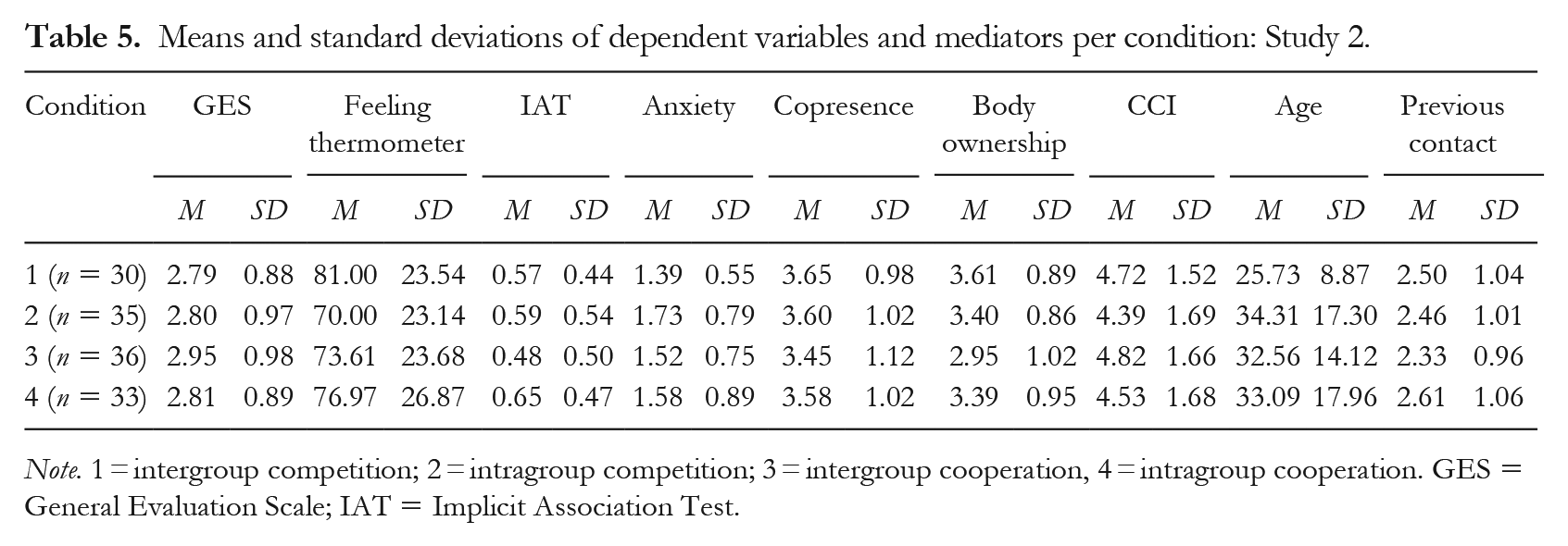
Note. 1 = intergroup competition; 2 = intragroup competition; 3 = intergroup cooperation, 4 = intragroup cooperation. GES = General Evaluation Scale; IAT = Implicit Association Test.
Table 6 reports the means, standard deviations, and correlations between the continuous variables. Both measures of explicit prejudice (GES and feeling thermometers) were highly intercorrelated, while the IAT was not correlated with either. Intergroup anxiety was also moderately correlated to both GES and the feeling thermometers. Furthermore, CCI was moderately correlated to copresence.
Means, standard deviations, and correlations with confidence intervals: Study 2.
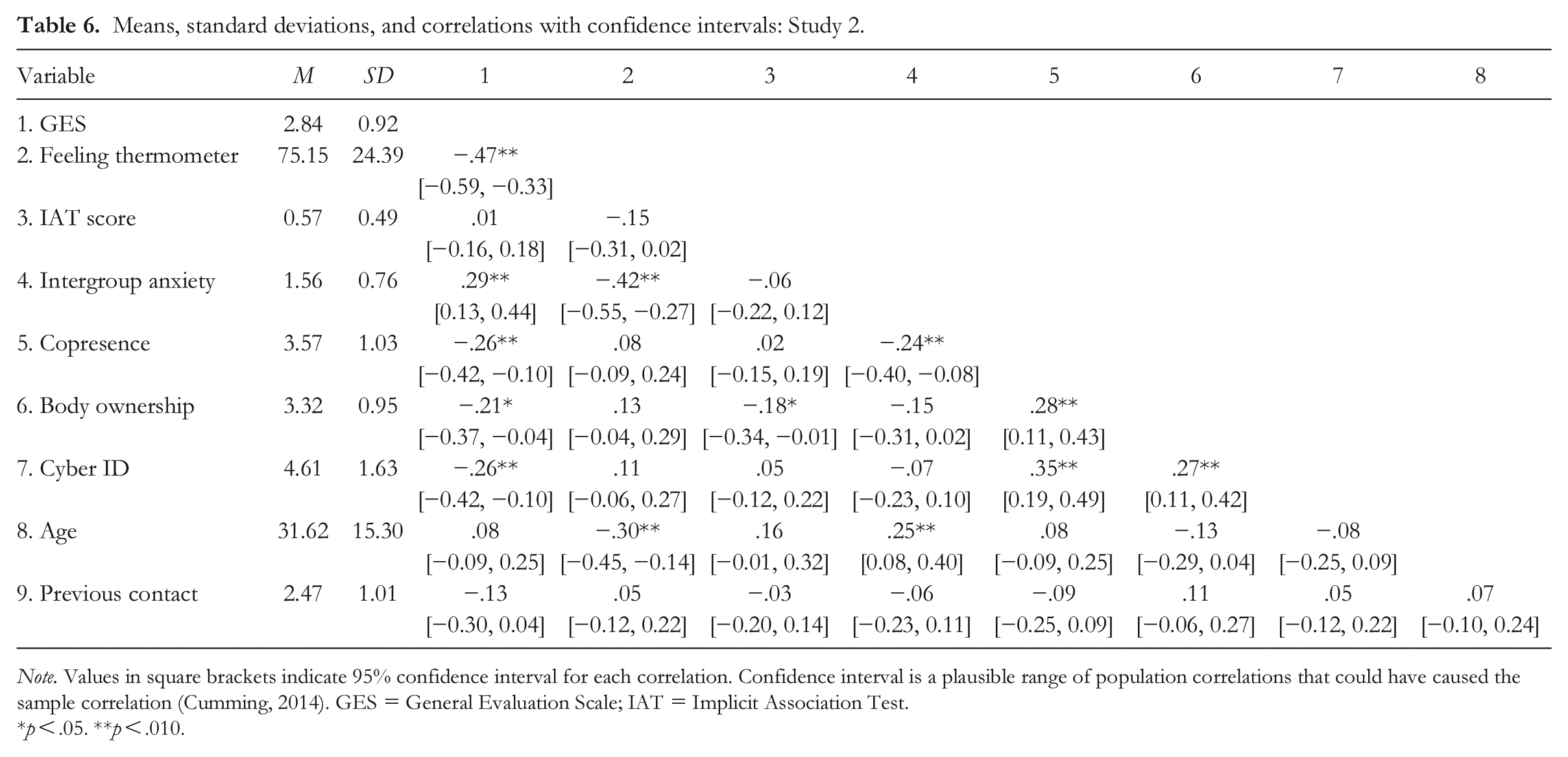
Note. Values in square brackets indicate 95% confidence interval for each correlation. Confidence interval is a plausible range of population correlations that could have caused the sample correlation (Cumming, 2014). GES = General Evaluation Scale; IAT = Implicit Association Test.
p < .05. **p < .010.
Effect of VR contact on implicit and explicit outgroup attitudes
We conducted ANCOVA for each DV to assess effects of task type (cooperation vs. competition) and contact (intergroup vs. intragroup), and their interaction effects on implicit (IAT) and explicit (GES and feeling thermometers) attitudes. Age, body ownership, previous outgroup contact, and the mediators were used as control variables. 3 Notably, the effect of task type on GES (F = 0.00, p = .981) and feeling thermometers was nonsignificant (F = 0.82, p = .368), though marginally affected IAT (F = 3.27, p = .073). Contact lacked significant effects on GES, feeling thermometers, or IAT. Interaction between task type and contact showed no significant effects on GES (F = 0.02, p = .879), feeling thermometers (F = 1.04, p = .311), or IAT (F = 2.52, p = .115). Detailed results are shown in supplemental Table 2.
Orthogonal contrasts were then applied for pairwise comparisons to test H1a and H1b. Planned Contrast 1 compared cooperation with a member of the ingroup (used as reference category) to cooperation with a member of the outgroup. Planned contrasts revealed that while the factor still did not influence GES (t = 0.59, df = 124, p = .599, d = 0.05) or feeling thermometers (t = −0.74, df = 124, p = .461, d = −0.07), the effect of contact on IAT scores was significant such that intergroup cooperation led to less bias than intragroup cooperation (t = −2.12, df = 124, p = .035, d = −0.19; see also Figure 5). Then, we applied Planned Contrast 2 to compare cooperation with a member of the outgroup and competition with a member of the outgroup (used as reference category). Similarly, Contrast 2 revealed nonsignificant difference between conditions in GES (t = 0.16, df = 124, p = .877, d = 0.01) and feeling thermometers (t = −0.60, df = 124, p = .548, d = −0.05), but there was a marginally significant effect on IAT, with cooperation leading to slightly less bias than competition (t = −1.82, df = 124, p = .071, d = −0.16). 4
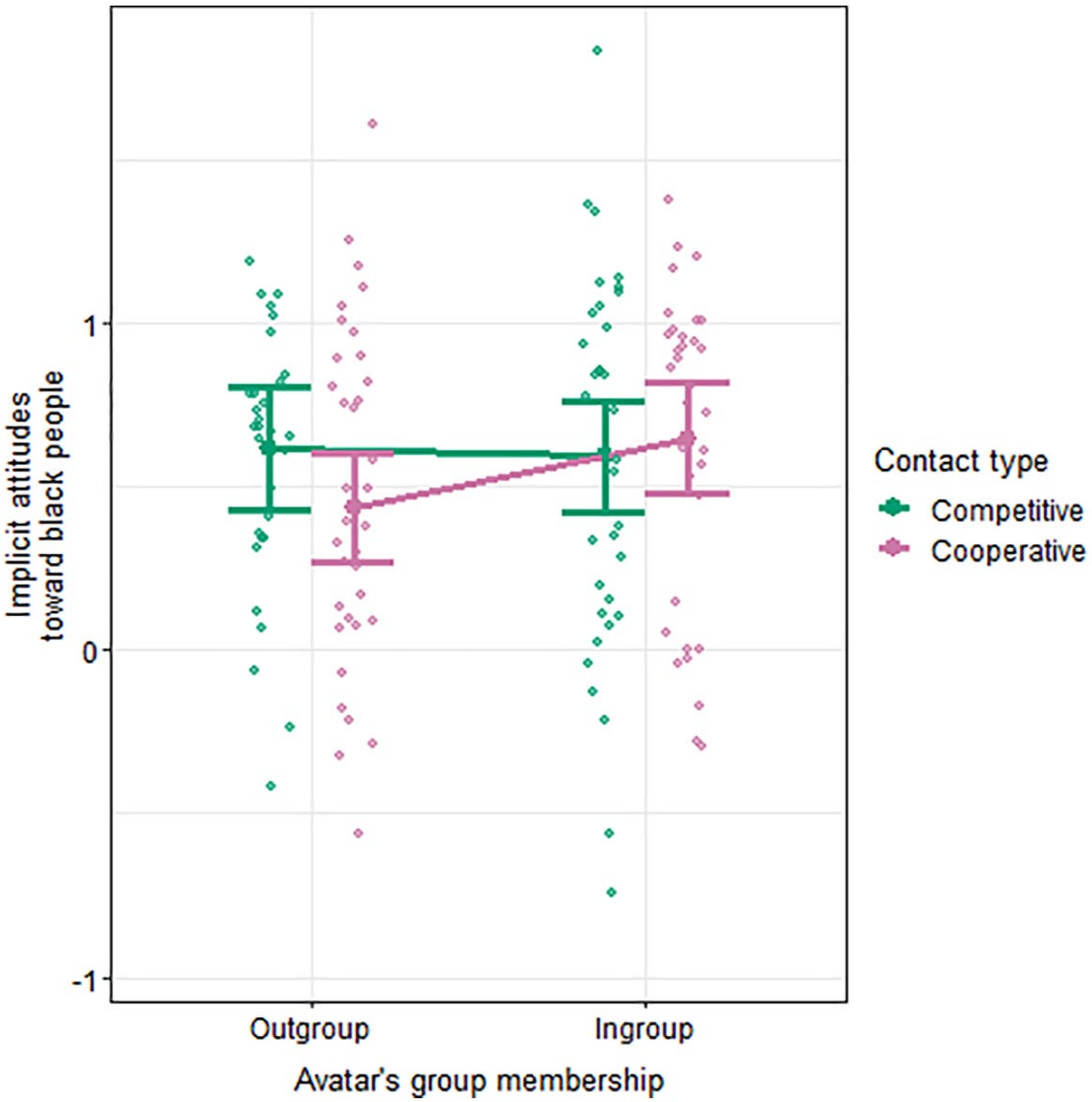
Interaction effect between contact quality (positive vs. negative) and contact type (intragroup vs. intergroup) on implicit attitudes.
Mediation analyses
The mediation analysis results are organized so that we first present findings related to the intragroup cooperation versus intergroup cooperation conditions, and then examine the mediation model results related to the intergroup cooperation versus intergroup competition conditions. The relative indirect effects of the path analysis are reported in Table 7. Due to the limited statistical power, the results of these analyses should be interpreted with caution.
Total and indirect effects of contact contrasts on explicit (GES and thermometer) and implicit (IAT) attitudes: Study 2.
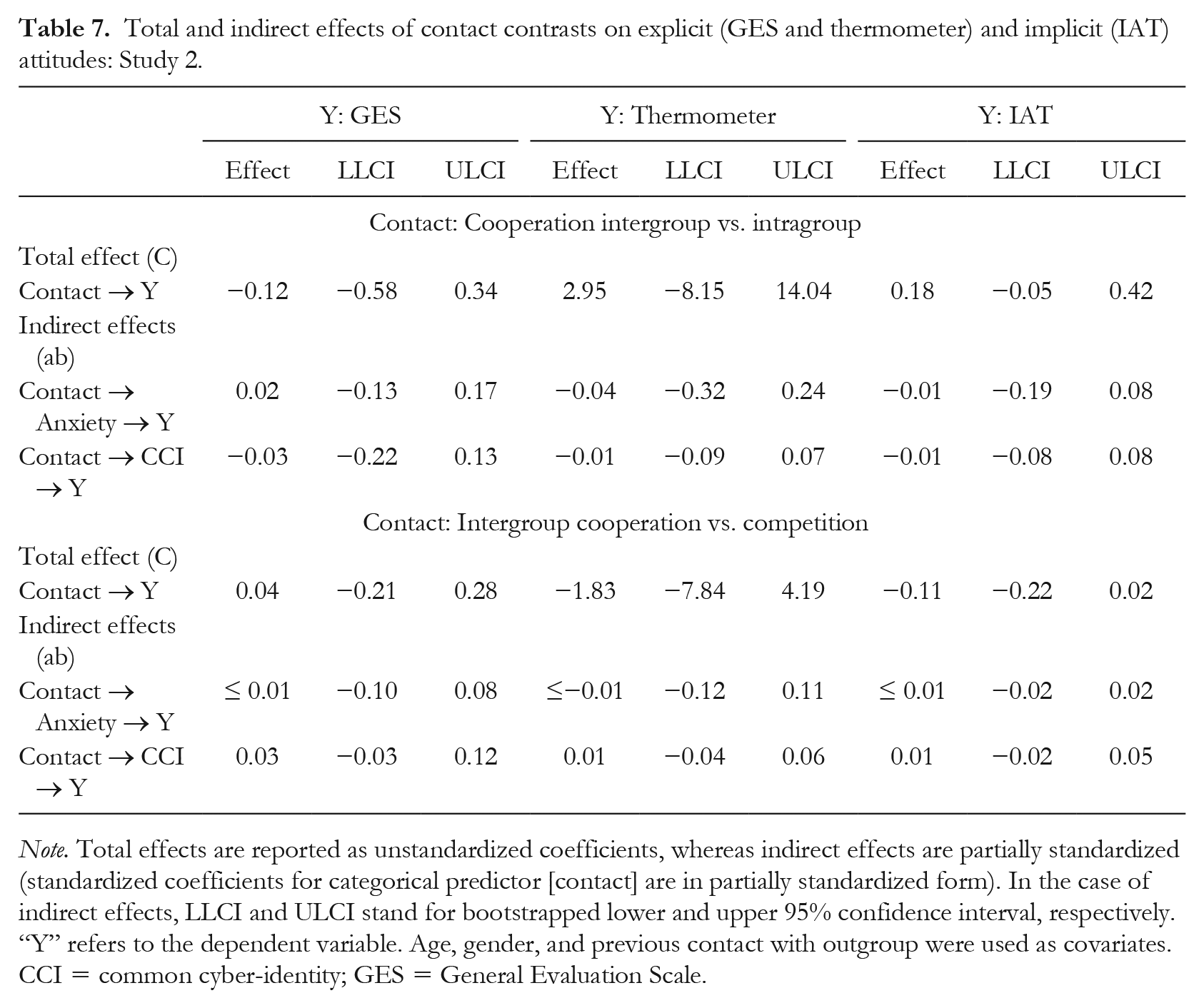
Note. Total effects are reported as unstandardized coefficients, whereas indirect effects are partially standardized (standardized coefficients for categorical predictor [contact] are in partially standardized form). In the case of indirect effects, LLCI and ULCI stand for bootstrapped lower and upper 95% confidence interval, respectively. “Y” refers to the dependent variable. Age, gender, and previous contact with outgroup were used as covariates. CCI = common cyber-identity; GES = General Evaluation Scale.
Intragroup cooperation versus intergroup cooperation
First, it was examined whether the influence of cooperating with an ingroup versus outgroup member was mediated by intergroup anxiety (H2b) or CCI (H3). Cooperation with the different groups had nonsignificant relations to intergroup anxiety (a1 = 0.07, p = .786; the relative direct effects are reported as standardized beta weights) or CCI (a3 = 0.19, p = .433). However, both intergroup anxiety (b1 = 0.29, p = .012) and CCI (b3 = −0.30, p = .008) were significantly associated with GES. The total effect of contact on GES was nonsignificant (c = −0.13, p = .610). Regarding the mediations, the indirect effects lent no support for a mediation through either of the three variables (see Table 7).
Feeling thermometer ratings as the DV showed a significant negative association with intergroup anxiety (b1 = −0.56, p < .001), but the other two DVs had nonsignificant associations (ps > .160). The total effect of contact was nonsignificant (c = 0.19, p = .297), and no mediation through intergroup anxiety or CCI was supported (see Table 7). For IAT as the dependent variable, no mediator was significantly associated (ps > .131). The total effect of contact on IAT was trending toward significance (c = 0.42, p = .083), but no mediation through intergroup anxiety or CCI was supported (see Table 7).
Intergroup cooperation versus intergroup competition
Finally, we examined whether the attitude-changing influence of intergroup cooperation versus competition was mediated by intergroup anxiety or CCI. The type of intergroup contact (cooperation vs. competition) had no significant association with either mediator (ps > .224). Intergroup anxiety had a significant association with GES (a1 = 0.33, p = .018), but the association of CCI with GES was nonsignificant (p = .170). The total effect of contact on GES was nonsignificant (c = 0.04, p = .768), and no mediation through intergroup anxiety or CCI was supported (see Table 7).
With feeling thermometers as the DV, intergroup anxiety had a significant negative association (b1 = −0.39, p = .004), while CCI had a nonsignificant relative direct effect (p = .070). The model with IAT as the DV showed that neither of the mediators had a significant relative direct effect on IAT. The total effect of contact on IAT was nonsignificant (c = −0.21, p = .102), and no evidence supported mediation through anxiety or CCI (see Table 7).
General Discussion
Both Study 1 and Study 2 employed a positive intergroup contact intervention within VR, allowing individuals to embody avatars representing their White majority ingroup and interact with another avatar representing a Black minority outgroup. The contacted avatars were steered by people rather than a computer, and the contact experience was tailored to meet the established criteria of effective contact (Allport, 1954; Pettigrew & Tropp, 2000). Furthermore, Study 2 compared the effect of positive (cooperative) and negative (competitive) intergroup contact on intergroup attitudes. The results showed tentative support for the potential of positive intergroup contact in VR to reduce prejudice (H1a). However, there were inconsistencies in relation to the effects of VR contact on explicit versus implicit attitudes, a discrepancy that will be further discussed in the following sections. Then, Study 2 lent tentative support for H1b by showing that the effect of contact on implicit attitudes was present only if the contact was of cooperative nature. Furthermore, neither Study 1 nor Study 2 lent support for the mediating role of intergroup anxiety (H2a) or empathy (H2b). Likewise, CCI was not found to mediate the effect of contact on explicit or implicit attitudes (H3). The subsequent discussion will delve into a detailed analysis of these findings, exploring their implications and associated limitations.
In general, our findings show that positive intergroup contact in VR can successfully improve White individuals’ attitudes towards Black people when Allport’s (1954) conditions for optimal contact are met. This finding is in line with previous real-life contact interventions but challenges observations of some previous VR studies (Alvidrez & Peña, 2020a, 2020b), which failed to find a decrease in behavioral intergroup bias following a virtual intergroup contact. Allport’s positive contact conditions were not fully met in the VR studies by Alvidrez and Peña (2020a, 2020b), and their studies utilized different behavioral measures of intergroup bias. These aspects could explain discordance between previous and current findings. The importance of meeting the positive contact conditions was further supported by Study 2, which showed that contact improves intergroup attitudes when the encounter is of cooperative nature, but not when contact is of competitive nature. Furthermore, participants engaging in competitive (negative) contact with an outgroup member had more negative implicit attitudes towards the contacted outgroup after VR interaction compared to those who engaged in positive contact. This finding underlines the importance of accounting for the type of VR social activities so the most optimal are selected when simulating intergroup encounters, as negative contact has been shown to have a greater detrimental impact on negatively stereotyped groups (Paolini & McIntyre, 2018), in addition to discouraging future intergroup contact (Meleady & Forder, 2019). In VR, games and social experiences have often competitive elements that pose a risk of negative contact experiences and pronounced prejudice.
The implications drawn from the current findings are therefore widespread when examined across different attitude measures. However, when examining the explicit and implicit measures separately, the picture becomes less clear. Specifically, while in Study 1 positive intergroup contact improved explicit attitudes towards the outgroup, in Study 2, the same positive contact experience influenced attitudes only at the implicit level. It remains thus unclear whether and when positive intergroup contact in VR influences explicit attitudes, and when the effect occurs on the implicit nonreflective level. This discrepancy in results, though challenging, resonates with the fact that no previous intergroup VR contact interventions aimed at reducing prejudice have yielded congruent conclusions across both implicit and explicit measures (Tassinari et al., 2022b). In the context of the current study, the inconsistency could be due to the differences between samples. For example, the Finnish participants in Study 1 were younger compared to the Italian sample in Study 2. Adolescents, being more susceptible to social influence than young adults (Gardner & Steinberg, 2005), might have been more inclined to align with the experiment’s normative message, thereby reporting increasingly positive explicit attitudes following intergroup contact, as observed in Study 1. Conversely, somewhat older participants in Study 2 might not have been as responsive to the same message for explicit attitude change. The disparity observed between explicit and implicit attitudes in the two studies might also be influenced by national or cultural differences between Finland and Italy. Particularly, the intergroup climate regarding ethnic and religious diversity, as well as the reception and integration of immigrants, tends to be more stringent in Italy (Barisione, 2020). Rothermund and Wentura (2004) proposed that IAT effects stem from salience asymmetries, where quicker performance in an IAT occurs when the categories assigned to the same key share similar salience. Hence, it is plausible that the positive VR contact experience altered the salience of negative intergroup associations, particularly within Italian contexts characterized by pronounced intergroup biases.
Besides examining the direct effects of intergroup contact on prejudice, the current work aimed at increasing understanding of the underlying mechanisms. To this end, we examined whether intergroup anxiety and empathy would mediate the effect of contact on intergroup attitudes. Across the two studies, we did not find support for mediation through these factors. Notably, while the assumed emotional mediators themselves were associated with explicit attitudes, there was no significant effect of contact on those mediators. Moreover, we further examined whether the emergence of a common social category in the course of the virtual contact (i.e., common cyber-identity) would mediate the link between contact and prejudice in VR. The results showed that higher perceived CCI predicted less implicit bias after the experiment in Study 1 in both positive contact conditions (intragroup and intergroup). This tentatively suggests that CCI developed during interaction in VR may reduce prejudice regardless of the form of contact, which is an important insight, showing the potential of positive social interaction in VR for prejudice reduction. Indeed, the lack of mediation results can well be due to the lacking statistical power, as detecting a mediation effect with .80 statistical power requires a much larger sample than that for detecting a simple effect (Fritz & MacKinnon, 2007). We will further discuss the implications of this in the Limitations and Strengths section.
Implementing intergroup contact in VR brings in new aspects that should be taken into account when designing a contact intervention and measuring its effectiveness. One of these aspects is related to a sense of presence. For instance, Alvidrez and Peña (2020a) found that higher engagement presence (i.e., “a psychological experience of awareness and/or connectedness with social others in virtual interactions”; p. 90) during VR contact increased desire for maintaining social distance from the outgroup member. In addition, Peña et al. (2021) found that avatar customization led to greater social distance from the contacted outgroup. Contrarily, our results showed the independent role of VR-specific factors (CCI reported in the main text, and copresence and body ownership reported in the supplemental material) in predicting explicit attitudes. Notably, these correlations occurred regardless of whether the participants were exposed to negative or positive interaction with an outgroup or ingroup member. A possible explanation is that immersion in the virtual environment may act as a levelling agent towards distinguishing features of social interaction. The experience of body ownership and CCI in VR similarly improved explicit attitudes following VR contact in Study 1.
Limitations and Strengths
While the present studies make significant contributions to the research on intergroup contact and VR-based prejudice reduction interventions, it is important to note certain limitations. First, the contact scenarios utilized in the current research employed human-steered avatars, and the interactions were limited to nonverbal communication. The avatars were muted to standardize the content of interaction with the confederate across subjects. Nevertheless, the chance of verbally interacting with other social actors in VR could offer opportunities for more in-depth and ecologically valid intergroup contact. Therefore, a natural progression of the current work is to analyze whether more realistic virtual interaction with outgroup members could yield greater effects on intergroup attitudes. Allowing people to speak with each other during contact would provide the possibility to examine new aspects of intergroup behaviors such as the quality of interaction.
Second, as already noted above, both studies had a limited statistical power to detect small to medium-sized effects of contact. This limited sensitivity to detect small to medium effects could explain why the effects of contact on explicit and implicit attitudes were not consistent across the two studies. Furthermore, the lack of statistical power made the planned mediation analyses severely underpowered; thus, the results should be interpreted with caution. Therefore, future studies should prioritize replicating the results with a larger sample that would better enable examination of the mechanisms through which contact effects are mediated.
A third limitation worth noting is related to the empathy measure utilized in Study 1. The employed measure focuses on situational empathy, not specific to intergroup situations. In other words, we measured the extent to which participants felt empathy at the time of answering the pre- and posttest surveys. This feeling of empathy was, however, not targeted to any group or person. The conceptualization of this measure must be considered when interpreting the results, as it was chosen to detect changes in empathy also imputable to the medium (i.e., VR). Nevertheless, subjects experiencing more empathy also had more positive explicit attitudes towards Black people after the VR intervention, across conditions (Study 1). Whereas empathy has been previously studied with regard to embodiment of an outgroup member (e.g., Chen, Ibasco, et al., 2021), Study 1 uniquely highlights that empathy enhances intergroup attitudes even while embodying the avatar of an ingroup member. The measure was, however, a suboptimal mediator because the reported empathy did not have an outgroup target. Therefore, further research should utilize intergroup empathy instead of situational empathy (used in the current study).
Finally, the contact intervention was intended to affect attitudes towards Black people. Given that both the contact and the outcome measures were used in the context of this minority group, we cannot generalize the results to other stigmatized minorities. Therefore, further research is needed to examine the effect of intergroup VR contact on attitudes toward other minorities and stigmatized groups.
These limitations notwithstanding, we want to stress one important aspect acknowledged in the current study: the emergence of CCI. We argue that one of the reasons why earlier attempts (see Alvidrez & Peña, 2020a, 2020b) to induce common identification with other VR players were not successful is due to their focus on preexisting real-life social groups (e.g., gender, studying at the same university) rather than a common identity category relevant in the specific virtual intergroup context. This study utilized a unique feature of VR contact, which is its ability to stimulate the development of a common virtual identity among its users. This common cyber-identity does not only assist VR users to ignore traditional social group boundaries in VR interactions, but it also has the potential to change their views on existing social hierarchies and inequalities in the real world.
Conclusions
The current research fills several gaps in research on intergroup contact within VR. Notably, we offer a previously unexplored comparison between positive and negative intergroup contact in VR. Both studies employed positive contact that adhered to Allport’s optimal contact conditions, ensuring equal status, shared goals, intergroup cooperation, and authority support. Moreover, by incorporating both implicit and explicit measures of prejudice, our research makes visible how complex and multifaceted the influences of contact can be. Additionally, the use of human-steered avatars, rather than virtual agents, is a distinctive feature of the current research. In conclusion, this research has significant implications, although replication studies with larger samples and alternative contact interventions are required. Notwithstanding these limitations, the contributions of this work extend beyond the academic realm. By shedding light on the potential effects of engaging with video games and social media in VR, our findings contribute to a broader understanding of social interactions in VR. As intergroup contact in VR is a daily occurrence, there is an urgent need for increased knowledge about its consequences on intergroup attitudes. The results of our research not only contribute valuable insights to advance the field of social psychology, but also provide practical guidance for game developers and policymakers. In a rapidly evolving field where discussions surrounding ethical risks and challenges are more active than ever (Kenwright, 2018), our results can serve as a foundation for the development of informed policies that ensure the responsible and ethical use of VR.
Supplemental Material
sj-docx-1-gpi-10.1177_13684302241237747 – Supplemental material for The effects of positive and negative intergroup contact in virtual reality on outgroup attitudes: Testing the contact hypothesis and its mediators
Supplemental material, sj-docx-1-gpi-10.1177_13684302241237747 for The effects of positive and negative intergroup contact in virtual reality on outgroup attitudes: Testing the contact hypothesis and its mediators by Matilde Tassinari, Matthias Burkard Aulbach, Ville Johannes Harjunen, Veronica Margherita Cocco, Loris Vezzali and Inga Jasinskaja-Lahti in Group Processes & Intergroup Relations
Supplemental Material
sj-docx-2-gpi-10.1177_13684302241237747 – Supplemental material for The effects of positive and negative intergroup contact in virtual reality on outgroup attitudes: Testing the contact hypothesis and its mediators
Supplemental material, sj-docx-2-gpi-10.1177_13684302241237747 for The effects of positive and negative intergroup contact in virtual reality on outgroup attitudes: Testing the contact hypothesis and its mediators by Matilde Tassinari, Matthias Burkard Aulbach, Ville Johannes Harjunen, Veronica Margherita Cocco, Loris Vezzali and Inga Jasinskaja-Lahti in Group Processes & Intergroup Relations
Footnotes
Acknowledgements
We would like to thank Mira Oikarinen, Sara Debora Riboldi, Martina Vignali, Serena Velani, Irene Boni, Angela Niso, and Giulia Ferrarini for the thorough work carried out during the data collection process.
Authors’ Note
Preregistrations of the submitted studies are available at the Open Science Framework (https://osf.io/eda4x and  ).
).
Declaration of Conflicting Interests
The author(s) declared no potential conflicts of interest with respect to the research, authorship, and/or publication of this article.
Ethical Approval
This research project received ethical approval by the Research Ethics Committee of Aalto University, under the decision number D/218/03.04/2021.
Funding
The author(s) disclosed receipt of the following financial support for the research, authorship, and/or publication of this article: M. T., M. B. A., V. J. H., and I. J.-L. were funded by the Academy of Finland (Suomen Akatemia, Grant No. 332311).
Human Studies and Subjects
All participants signed an informed consent form. Following local legislation, participants younger than 16 were allowed to take part in the experiment given that no objections were expected from their legal guardians.
Permission to Reproduce Material
The authors have obtained permission to reproduce material from other sources included in the article (i.e., figures from Altspace VR).
Reporting
We report all measures, manipulations, and exclusions in the study.
Supplemental Material
Supplemental material for this article is available online.
Notes
References
Supplementary Material
Please find the following supplemental material available below.
For Open Access articles published under a Creative Commons License, all supplemental material carries the same license as the article it is associated with.
For non-Open Access articles published, all supplemental material carries a non-exclusive license, and permission requests for re-use of supplemental material or any part of supplemental material shall be sent directly to the copyright owner as specified in the copyright notice associated with the article.
