



Abstract
More and more research is considering the effects of both positive and negative intergroup contact on intergroup attitudes. To date, little is known about what factors may differentially influence these effects. We propose that differentiating not only between positive and negative contact (i.e., its valence), but also considering the intensity (i.e., low or high positivity/negativity) of contact valence is critical to understanding contact effects. We predicted that intensifying positivity in the realm of positive contact would have a stronger effect on outgroup attitudes than intensifying negativity. We report evidence supporting this hypothesis from three experiments which manipulated the quality of feedback given during a cooperation task by a confederate who acted as a member of a student outgroup (two online: N = 87, N = 169; one in person: N = 78), summarized in an internal meta-analysis and a large survey of White British majority and Asian British minority members (N = 2,994). Our results suggest that intensity of valenced intergroup contact may be a key factor for resolving inconsistencies in the current literature on valenced intergroup contact.
Building on a long tradition of research on intergroup contact theory (e.g., Allport, 1954), previous research has found that intergroup contact reduces prejudice and increases intergroup cooperation (e.g., Brown & Hewstone, 2005; Lemmer & Wagner, 2015; Pettigrew & Tropp, 2006). While most of this research has focused on positive forms of contact, researchers have only recently highlighted that it is equally important to study the effects of negative forms of intergroup contact (e.g., Barlow et al., 2012; Paolini et al., 2010). Investigating negative intergroup contact is important because negative contact may undermine, even prevent, the beneficial effects of positive intergroup contact (e.g., Árnadóttir et al., 2018). Despite this much-needed recent focus on both positive and negative contact, we emphasize that contact experiences may not only vary in their valence (i.e., whether they are positive or negative), but also in the intensity of this valence (i.e., their respective degree of positivity or negativity). Missing out the intensity of positive and negative contact experiences might crucially affect our understanding and comparison of valanced contact effects. In the present paper, we argue that acknowledging the intensity of different contact experiences will bring more theoretical clarity to the nascent literature on valenced intergroup contact and will additionally inform us about optimal forms of contact to manipulate in potential interventions.
Hayward et al. (2017) introduced the differentiation between valence and intensity, and found in their correlational data (Study 1 and Study 2) that negative contact was experienced less frequently and perceived as less intense than positive contact. Nonetheless, they demonstrated that the combination of lower negative contact intensity and infrequency had a larger impact on negative intergroup attitudes for both majority and minority members than the combination of more frequent and more intense experiences of positive contact. These findings suggest that positive contact experiences of high positivity, such as friendships, might be required to match the effects of even mildly negative contact experiences. However, while Hayward et al.’s work offered first insights into the importance of the intensity of intergroup contact, these authors computed a combined score of frequency and intensity, thus not permitting investigation and potential discovery of possible differences in the effects of positive and negative intensity. Furthermore, their experimental study did not manipulate intensity, but only valence of intergroup contact with a fictitious outgroup. We argue that it is crucial to disentangle the effects of frequency and intensity to provide theoretical clarity and necessary information for potential interventions. We suggest it is therefore necessary to examine whether differences in the intensity of valenced intergroup contact have an effect on intergroup attitudes, and whether this effect differs for positive versus negative intergroup contact.
First, the present paper provides theoretical arguments for why intensity differentially impacts the effects of positive versus negative intergroup contact. Research from other areas of psychology suggests that increasing valence intensity differentially impacts the effects of positive and negative events (e.g., Baumeister et al., 2001; Rozin & Royzman, 2001). Specifically, the effects of negative experiences should rise more steeply than those of positive experiences. For example, approaching a negative event increases avoidance faster than approaching a positive event increases approach tendencies (e.g., Cacioppo et al., 1997), or even small doses of negativity can elicit contagion effects (e.g., Rozin et al., 1992). We thus propose that the increase in intensity of valenced contact experiences should primarily be relevant for effects of positive intergroup contact, since for negative contact even little negativity might be sufficient to reduce attitudes, and therefore a further increase in negativity should not make much of a difference. We acknowledge at the outset, however, that cases of extreme negative events, such as being the victim of a violent hate crime, might not fit these theoretical considerations and will have to be a topic of special consideration.
Second, the present paper provides an experimental test of our theoretical assumption. As noted above, Hayward et al. (2017) demonstrated that positive and negative contact vary differentially in their frequency and intensity in correlational data. To test our assumption that an increase in intensity influences the effects of positive intergroup contact to a stronger degree than it influences the effects of negative contact, we need to be able to compare the effects of positive intergroup contact to the effects of negative contact of the same intensity. It is thus necessary to manipulate valence and intensity in an objective manner (Peeters & Czapinski, 1990). An experimental examination of these effects additionally allows us to make causal claims and, furthermore, addresses the need for more experimental studies on negative contact (e.g., McKeown & Dixon, 2017).
To summarize, our aim is to test whether an increase in the intensity of valenced contact affects the outcomes in the realm of positive contact to a stronger degree than in the realm of negative contact. We test this hypothesis in an experimental framework adapted from the indirect collaboration task (Fell, 2015; Wilder, 1984) whereby contact quality is manipulated through intergroup feedback in Studies 1–3. In Studies 1 and 2, we provide an objective manipulation of the intensity of the contact experience in an online experimental setting in which students from a German distance-learning university interacted with a confederate enacting a student from a traditional university (Study 1) and vice versa (Study 2). Study 3 implements the same paradigm in an offline setting in which students from a Dutch research university interacted with a confederate enacting a student from a Dutch university of applied sciences. We subsequently integrate our experimental findings in an internal meta-analysis, to increase reliability and demonstrate the robustness of our findings. Finally, Study 4 examines increasing positivity and negativity of everyday contact experiences using survey data from a survey including White British and Asian British respondents in the UK.
Positive and Negative Contact
Large-scale, meta-analytic data find robust evidence for an association between positive contact and lower levels of prejudice, with effect sizes small to medium in magnitude (Lemmer & Wagner, 2015; Pettigrew & Tropp, 2006). Considerably less is known, however, about the effects of negative contact; but in recent years, significant advances have been made to address this gap. For example, we now know that, in most contexts, negative contact is less frequent than positive contact (Graf et al., 2014; Hayward et al., 2017; Schäfer et al., 2021). Negative contact is also associated with higher values on prejudice measures, and initial experimental evidence supports a causal link with prejudice: as expected, negative contact increases prejudice (Hayward et al., 2017, Study 3). This is in line with prior work showing that negative experiences, such as higher perceived intergroup threat (e.g., Stephan et al., 2002), are associated with more negative attitudes; similar effects have been found in research on interpersonal impression formation (Vonk, 1993).
Initial work in this field has furthermore raised the concern that negative intergroup contact might have stronger effects than positive intergroup contact: Paolini et al. (2010) provided first evidence that negative intergroup experiences between ethnic and age groups result in higher category salience than positive experiences. Yet, these authors did not test the generalization to intergroup attitudes. Comparing the overall effects of positive and negative contact in eight studies, which assessed contact quality and quantity and their effects on intergroup attitudes, Barlow et al. (2012) identified a “positive–negative asymmetry effect” (p. 3) whereby negative contact increases prejudice more than positive contact decreases it. To date, however, evidence for this effect is inconclusive (see also Árnadóttir et al., 2018; Schäfer et al., 2021).
Research has since tried to explain these inconsistent findings and has highlighted the role of potential moderators of positive and negative intergroup contact effects. For example, one line of explanations highlights the role of stereotypes held against the respective outgroup involved in the contact. A meta-analysis by Paolini and McIntyre (2019) found that negative contact is associated with higher category salience for stigmatized outgroups, whereas for admired outgroups, positive contact yields stronger associations with category salience. Yet, applying this rationale to intergroup attitudes, Zingora et al. (2020) showed that stereotype-inconsistent contact (i.e., holding a negative outgroup stereotype but having a positive experience with an outgroup member, and vice versa) had stronger effects than stereotype-consistent contact. Another exemplary line of explanation suggests that not only stereotypes about the group, but also an individual’s previous valenced experiences with the respective group can moderate the effects of positive and negative intergroup contact. Again, the evidence regarding the direction of such a moderation has, to date, yielded inconsistent results (Paolini et al., 2014; Schäfer et al., 2022).
While these initial findings demonstrate that positive and negative contact effects might be moderated by factors like shared stereotypes about a group or an individual’s personal history of intergroup experiences, they still yield inconclusive results. We suggest that it is of added value to take one step back and focus on the contact experience itself to further understand valenced intergroup contact effects.
Positive and Negative Contact of High or Low Intensity
Critiques of the intergroup contact literature suggest that especially experimental research has sometimes neglected the complexity of intergroup contact situations in real-life settings (e.g., Dixon et al., 2005). Studying the effects of negative intergroup contact has been an important response to the claim that research so far has focused too much on contact under positive conditions (see also Pettigrew & Tropp, 2006). However, especially from an applied perspective, it is important not to fall into a “single factor fallacy” (Pettigrew & Hewstone, 2017), thus neglecting the large variation in qualitative differences of intergroup contact experiences, which go beyond the mere subjective valence (i.e., positive vs. negative) of the situation. Assessing the intensity of intergroup contact will help to close the gap between real-world contact and contact commonly assessed in psychological science, as it furthers our understanding that intergroup contact can occur in many different forms, ranging from an unfriendly word by a stranger to meeting an old friend (Hayward et al., 2017). We thus distinguish between the valence of intergroup contact (i.e., positive or negative) and the intensity of valence of intergroup contact (i.e., contact of low or high positivity/negativity), as suggested by Hayward et al. (2017).
To our knowledge, there has been no research explicitly examining the influence of the intensity of valenced intergroup contact on intergroup attitudes. For positive contact, there is evidence that intimate intergroup contact (which might also entail high positivity) has stronger effects on intergroup attitudes than superficial contact (which might also entail low positivity): Cross-group friendship is a reliable predictor of prejudice reduction (Davies et al., 2011; Pettigrew, 2008) and has stronger effects than other forms of positive contact (Pettigrew & Tropp, 2006). Moreover, measures of cross-group friendship assessing actual engagement with the friend (which included, for example, the feeling of closeness, self-disclosure, and spending time with outgroup friends, which might represent high positivity) tend to have the strongest effect on prejudice reduction (Davies et al., 2011). While friendship also typically fulfils most of Allport’s (1954) conditions for optimal contact (although not necessarily institutional support; Marinucci et al., 2021), friendship also tends to comprise aspects like closeness and companionship (e.g., Bukowski et al., 1994), which are likely to include intense forms of positive contact. Therefore, we suggest that these results provide initial support for the idea that increased intensity in the realm of positive contact is associated with and may lead to a stronger reduction in prejudice, and that intensity differentially affects the effects of positive and negative contact on attitudes.
Recent research has extended the study of both intimate and superficial intergroup contact to negative intergroup contact, examining one potential qualitative difference in intergroup contact situations. In the realm of superficial contact, Thomsen and Rafiqi (2018) demonstrated that contact quality moderated the effects of superficial contact frequency, with negative contact increasing, and positive contact decreasing, antiforeigner sentiment, a result that replicates previous findings on overall measures of positive and negative intergroup contact effects. Results from Graf et al. (2018) showed that positive contact in intimate intergroup relationships was related to the most positive attitudes, compared to positive contact in more casual or formal relationships and negative contact in all forms of relationships. In contrast, negative contact in nonintimate relationships had a stronger association with intergroup attitudes than negative contact in intimate relations. The same pattern of results was found by Fuochi et al. (2020): While positive intimate contact had stronger effects on outgroup attitudes than positive superficial contact, negative superficial contact had stronger effects than negative intimate contact.
Yet, taking negative intergroup contact into consideration also highlights that intensity and intimacy represent different constructs: It is plausible to have contact experiences of high negativity as well as contact of low negativity in both intimate as well as superficial relationships. For example, one might have an intense argument with an intimate partner but feel threatened by a stranger, as well as feeling slightly annoyed by a reoccurring discussion at home or by being ignored while greeting an outgroup neighbour. And even in the realm of positive contact, although highly intense positive experiences might be more likely in intimate positive relationships compared to superficial relationships, experiences of low positivity are also possible in intimate relationships. For example, long-term friends might have months or years with almost no contact but send each other a card at Christmas, while one might engage in a highly positive conversation with a stranger while taking the same train.
Therefore, while we acknowledge that intimacy of intergroup contact is an important qualifier for valenced intergroup contact effects, intensity of intergroup contact provides a clearly distinct construct that needs to be examined as an independent factor. Additionally, several empirical findings support the idea that many intergroup contact experiences are probably with nonintimate partners (e.g., while shopping or taking the bus; see Schäfer et al., 2022; Thomsen & Rafiqi, 2018), and it is therefore important to understand if and how the intensity of the experiences (e.g., being yelled at vs. being ignored) affects their impact on intergroup attitudes. Since, to our knowledge, there has been neither direct evidence nor theorizing about the effects of intensity in the realms of positive and negative intergroup contact, we suggest it is important to consider evidence and theorizing from other domains of psychology.
Effects of Intensity of Positive and Negative Experiences
Further evidence across multiple domains of psychology suggests that examining intensity (i.e., high or low) of valence (i.e., positivity/negativity) is important, as intensity might differentially affect the effects of positivity and negativity. More specifically, Rozin and Royzman (2001) reviewed a range of studies and found that, for example, aversion should increase faster than attraction during approach of a valenced entity. They suggest a steeper increase in effects of negative, compared to positive, events, and that this increase should be very rapid, so that a maximum of negativity might be reached very quickly (see also Cacioppo et al., 1997). This urgent reaction to events of even mild negativity could for example be explained by adaptive reasons (e.g., Taylor, 1991): negative events should evoke more urgent reactions than positive events. Indeed, negative cues, like angry faces, are detected faster than their positive counterparts (e.g., Fox et al., 2000; Hansen & Hansen, 1988; Öhman et al., 2001) and evoke more immediate and elevated physiological reactions (e.g., Ito et al., 1998; Northoff et al., 2000; Taylor, 1991).
Additionally, evidence from the field of contagion research suggests a relative dose insensitivity for negative stimuli, such that even very brief contact with a small dose of a negative entity produces large effects (e.g., Rozin et al., 1992). This idea receives further support from research on diagnostic decisions, where amount and intensity of positive information are shown to increase diagnostic ability gradually, while negative information of low intensity already has high diagnostic value (e.g., Czapinski, 1986; Leyens & Yzerbyt, 1992). In line with this reasoning, initial evidence suggests that even relatively mild negative contact, such as behavior that leads one to feel rejected, is associated with increased levels of racism and avoidance of outgroups (Barlow et al., 2009).
Taken together, for negative contact, we would thus expect that even mildly negative events on an objective scale should evoke immediate negative reactions and, more specifically, a change in attitudes. Considering both the initial findings on the effects of intimacy in intergroup contact as well as these findings from psychology more broadly, we suggest that while increasing intensity of positive contact (e.g., merely greeting someone vs. making a new friend) should add to the effects of positive contact on attitudes, increasing intensity of negative contact (e.g., feeling rejected vs. actually being bullied by an outgroup member) should not increase the explained variance in attitudes to the same extent.
The Present Research
The present research is, to our knowledge, the first to examine the influence of intensity of valenced contact (i.e., high or low positivity/negativity) as a dimension of valenced (i.e., positive and negative) intergroup contact. Furthermore, to our knowledge, this research is the first to experimentally examine intensity of both positive and negative contact between real groups. We thereby not only address calls to reflect the complexity of contact situations (e.g., Dixon et al., 2005), but also to increase experimental research on positive and negative intergroup contact (e.g., Paluck & Green, 2009). Specifically, our hypothesis was that an increase in intensity would increase the effects of positive contact, while an increase in intensity in the realm of negative contact would not yield corresponding effects.
In Studies 1 and 2, we implemented a manipulation of intensity and valence on an objective scale in two online experiments measuring intergroup attitudes. We adapted the indirect collaboration task (Fell, 2015; Wilder, 1984), during which, participants interact with a confederate and interaction quality is manipulated through feedback on several tasks. In Study 3, we implemented the same paradigm in an offline version of the experiment. All experimental manipulations took the form of interactions between student groups from different types of universities (for details, see the respective study description below). As all three of our experiments were designed in a very similar manner, we integrated their main findings in an internal meta-analysis. Finally, in Study 4, we investigated the effect of perceived intensity of positive and negative contact experiences in a large cross-sectional sample of ethnic majority (White British) and minority (Asian British) respondents in the UK.
Study 1
In order to establish an appropriate manipulation to compare the effects of intensity under different valence, one crucial element is not only to provide an objectively positive and negative situation, but also to keep intensity comparable on an objective scale (see also Peeters & Czapinski, 1990). To address this issue, we adapted the indirect collaboration task (Fell, 2015; Wilder, 1984), during which, participants interact with a confederate and receive bogus, differentially valenced, feedback on a task they have completed. Valence of the interaction in this task is varied by means of delivering feedback on several scales, which allows systematic manipulation of the two dimensions of valence (positive vs. negative) and intensity (low vs. high positivity/negativity) on an objective scale of intensity (see the Procedure section, for details). We acknowledge that this manipulation only addresses one dimension of interactions, namely cooperation. Moreover, we highlight that this manipulation does not represent events of extreme positivity and, more importantly, extreme negativity. A severe negative experience (e.g., being physically harmed by an outgroup member) might lead to different results. We tested the hypothesis that increased intensity would lead to a larger effect on outgroup attitudes in the realm of positive than in the realm of negative intergroup contact. Study 1 used the context of Germany’s only public distance-learning university in comparison to students at traditional universities. At this distance-learning university, students are, on average, older than conventional students, and 80% are currently employed and only study part-time (Stoessel et al., 2015). Within the German context at the time of the study, distance-learning students could be seen as having lower status compared to traditional university students (e.g., because they met less rigorous entry criteria). In Study 1, participants from the distance-learning university interacted with a partner (a confederate) they were informed was a student from a traditional university. The preregistration of this study and original materials can be found at the Open Science Framework (OSF; https://osf.io/6sjsz/).
Method
Participants and design
Ninety students from Germany’s only public distance-learning university took part in the study. In a 2 (valence: positive vs. negative) × 2 (intensity: low vs. high) between-subjects design, participants were randomly assigned to one of four experimental conditions comprising differently valenced contact: high negativity versus low negativity versus low positivity versus high positivity. 1 Three participants were excluded because they did not find the feedback credible at all (one from the highly positive, two from the highly negative condition). The final sample included 87 participants (66 females, 20 males, one person indicated other gender; Mage = 37.02, SDage = 10.51). The number of participants per condition was almost equal (high negativity = 23, low negativity = 22, low positivity = 22, high positivity = 20). Participants entered a raffle for money and could receive course credit after participating. Participants were fully debriefed after the end of data collection.
Procedure
We adapted the indirect collaboration task (Fell, 2015; Wilder, 1984) to an online environment (Adobe Connect, Copyright © 2018 Adobe Systems Inc.). The task uses false feedback to manipulate valence and intensity of valence in a highly structured and objective manner. For a flow chart of the procedure, see Figure 1. Participants were recruited via several online platforms. A short text invited students to participate in an online experiment on cooperation competence in virtual environments. After agreeing to take part, participants were told they would either be teamed up with a student of their own distance-learning university or with a student from a traditional university (the outgroup). They first answered a small pretest questionnaire, which was mainly used to establish the cover story, 2 before choosing individual appointments for the online meeting.
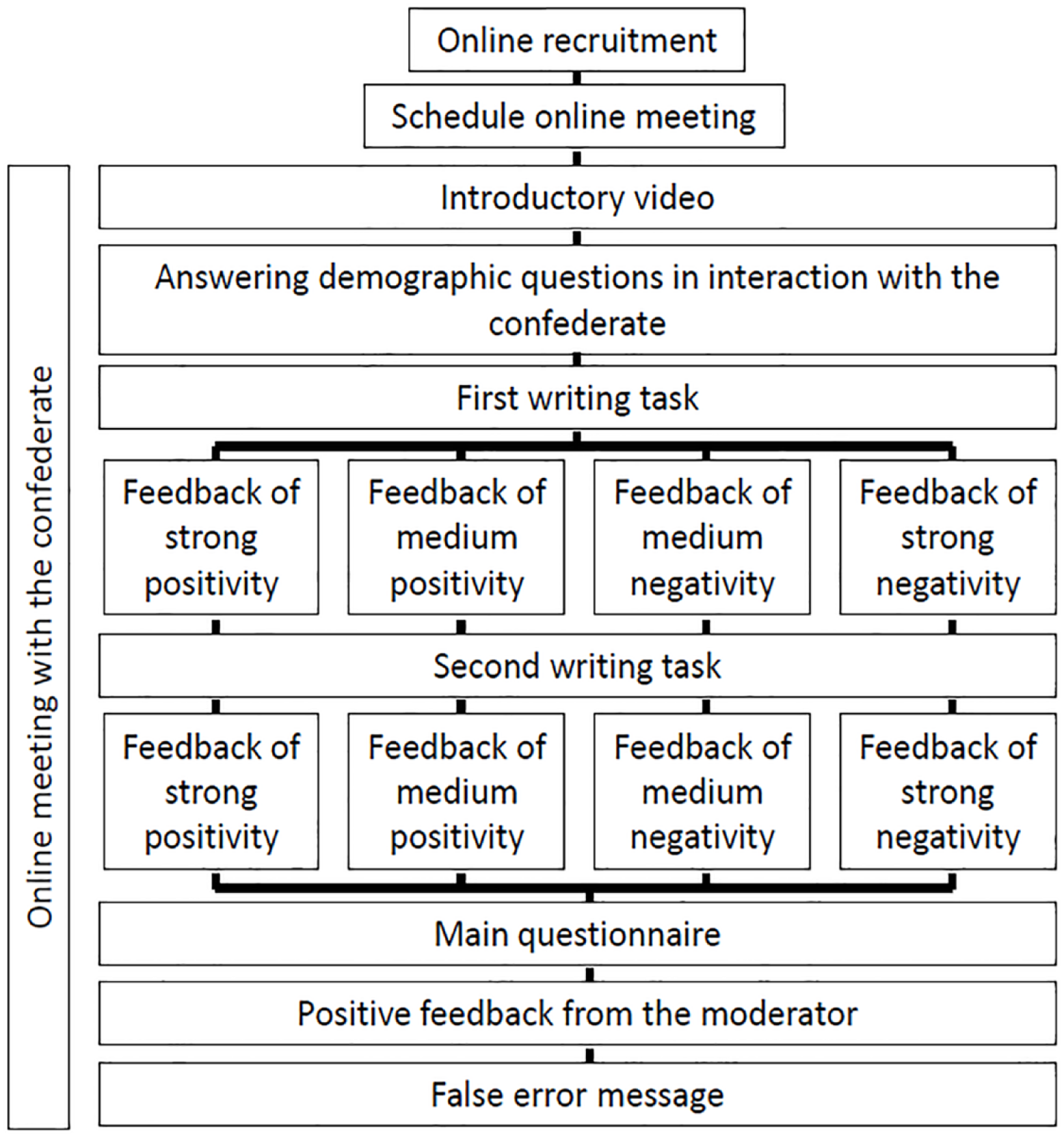
Flow chart depicting the procedure of Study 1.
During this online meeting, a confederate always played the role of an outgroup university student. A short introductory video explained the main properties of the online environment and the task to come. Subsequently, the confederate and participant were asked to introduce themselves to their partner by answering some questions about themselves. Participants were then told that they were randomly chosen to complete two small writing tasks in the first round, on which their partner would give them feedback, and that their turn to give feedback would come after they had finished these first two writing tasks. Thus, each participant received bogus valenced feedback twice, which varied according to their respective condition. After the second round of feedback, participants were asked to answer some questions about their expectations and attitudes towards their partner’s group (i.e., students at traditional universities). Subsequently, after the final questionnaire for this study, all participants received positive feedback from the moderator to decrease the impact of the previous experiences on intergroup attitudes after ending the experiment, in an attempt to ensure that participating in our study did not have a negative impact on our participants. Following this final feedback, a false error message ended the experimental session; thus, participants did not get to give feedback to the confederate.
The manipulation material consisted of two feedback sheets (see supplemental material). This bogus feedback was symmetrically arranged around the midpoint of several 7-point scales employed, to provide a rigorous test of the influence of different levels of intensity. These scales on the feedback sheet recorded, for example, the overall quality of the participant’s answers, or whether or not the participant should put more effort into answering these questions. To enhance the emotional impact on the participants in an online environment (Wang et al., 2014), emoticons were used as additional scales on the feedback sheet.
Measures
To assess outgroup attitudes, participants rated outgroup members on three items, which used a 7-point Likert-type scale ranging from 1 (0 - do not agree) to 7 (6 - fully agree). 4 Participants were asked to describe the group of students their interaction partner belonged to, and to choose their impression of the partner’s group on the dimensions “likeable,” “warm,” and “good-natured” (α = .88; adapted from Asbrock, 2010). 3
Results and Discussion
We used SPSS Version 28.0 (IBM, 2021) to test our hypotheses in Studies 1–3. A detailed summary of the results on the main outcomes for all experimental studies, including forest plots and graphs for the overall interaction effects, can be found in the Internal Meta-Analysis for Studies 1–3 section. Means and standard deviations for all conditions are reported in Table 1.
Means and standard deviations for all constructs: Study 1.
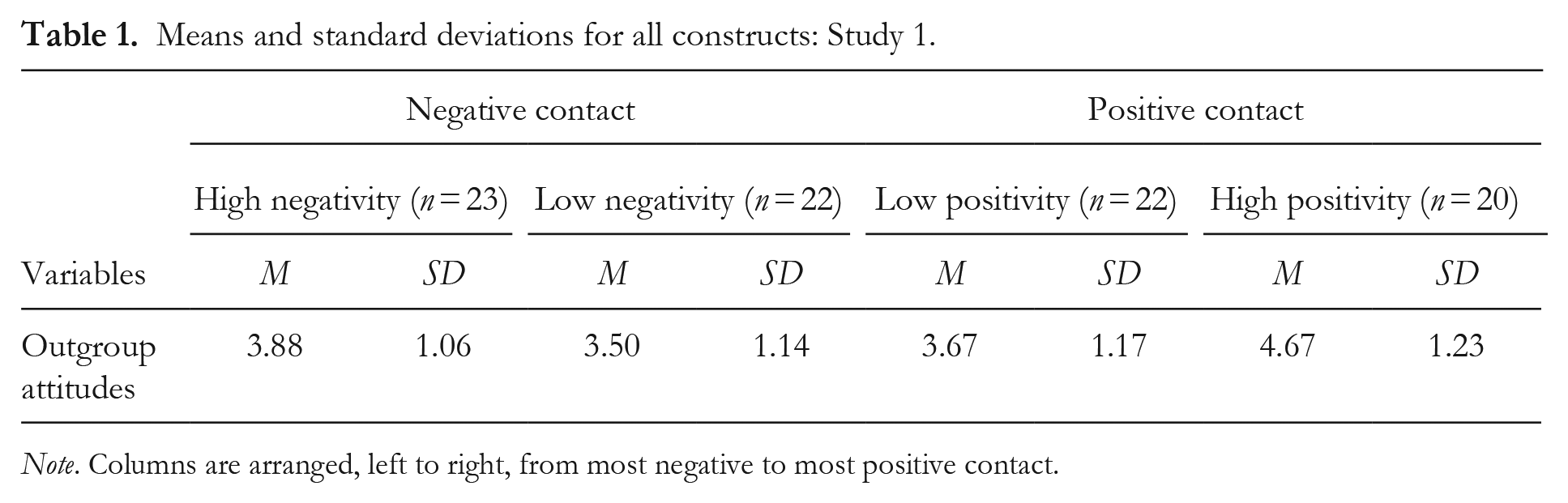
Note. Columns are arranged, left to right, from most negative to most positive contact.
For outgroup attitudes, a two-way analysis of variance (ANOVA) revealed a significant main effect for both valence, F(1, 84) = 5.21, p = .025, η²p = .06, and intensity, F(1, 84) = 9.73, p = .002, η²p = .10. To test whether an increase in intensity actually increases the magnitude of the effect in the realm of positive and negative contact to the same degree (see Kervyn et al., 2016), we recoded the increase of intensity for the high and low negativity conditions (for this test of the interaction only, recoded as high = 0, low = 1). This recoding was necessary because otherwise, a significant interaction would not imply a difference in the magnitude of the effects but would rather signify that we would find a positive effect in the realm of positive and a negative effect in the realm of negative intergroup contact. The recoding allowed us to compare the magnitude of the effect regardless of direction. Following this procedure allowed us to test whether the magnitude of the effect, regardless of its direction, actually differed between positive and negative contact. Results revealed a significant difference between the magnitude of the effect of intensity in the positive and negative conditions, F(1, 83) = 10.29, p = .002, η²p = .11. A subsequent examination of the simple effects (where high intensity was coded as 1 for positive and negative contact, to ease understanding) revealed that an increase in intensity increased positive outgroup attitudes in the positive condition, F(1, 40) = 10.51, p = .002, η² = .21, but decreased outgroup attitudes to a lesser degree in the negative condition, F(1, 43) = 1.36, p = .249, η² = .03.
Study 1 provides the first experimental evidence that varying the intensity of the contact experience primarily impacts the effects of positive contact. As expected, increasing intensity improved outgroup attitudes for positive contact, but worsened outgroup attitudes for negative contact to a lesser degree, which did not reach significance. These results are in line with our assumptions. Yet, although our research included a minimum of 20 participants per cell, which is discussed as a minimum of participants in Simmons et al. (2011), power for this study was low, affecting the robustness of the results. Additionally, even though the low-positivity condition used positive feedback on an objective scale, the resulting intergroup attitudes scarcely differ from those in the negative conditions. Therefore, within this context, low positivity might not be sufficient to elicit an intergroup contact effect. Furthermore, previous research demonstrates that having outgroup friends can influence both the perceived quality of intergroup contact (Blascovich et al., 2001; Page-Gould et al., 2008) and the resulting outgroup attitudes (Pettigrew & Tropp, 2006). As we did not assess previous experiences with the real-life groups used in Study 1, we could not test whether these experiences might have influenced our results. To address this concern, Studies 2 and 3 measured and controlled for previous experiences of positive intergroup contact, and again tested the hypothesis that increased intensity would have stronger effects in the realm of positive, compared to the realm of negative, intergroup contact.
Study 2
Method
Participants and design
Study 2 used a similar experimental design to Study 1 (see Figure 1), but here, participants were 174 German-speaking students from traditional universities (i.e., nondistance learning universities) across Germany and Austria. Thus, we swapped around the in- and outgroup in this study, to consider students from distance-learning universities as the outgroup, to ensure our findings from Study 1 were not specific to distance-learning students. 5 Five participants were excluded across all conditions (two from the low-negativity condition and one from each other condition) because they did not find the feedback credible. The final sample for Study 2 was almost equally distributed over conditions (high negativity = 42, low negativity = 45, low positivity = 40, high positivity = 42), and comprised 169 participants (108 females, 59 males, one participant used an additional gender category, and one did not indicate gender; Mage = 23.86, SDage = 3.48). Participants entered a raffle for a small monetary payment after participating. Participants were fully debriefed after the end of data collection. The preregistration of this study and original materials can be found at the OSF (https://osf.io/eucrs and https://osf.io/6sjsz/.
Procedure
The full study materials for Study 2 can be found in the supplemental material. We implemented only small changes to the paradigm used in Study 1, to increase plausibility of the manipulation (see supplemental material). First, we slightly adapted the bogus feedback questionnaire to improve credibility of the feedback. Specifically, the anchors for the feedback sheet of Study 2 now ranged from −3 (very poor) to 3 (excellent). Additionally, we chose slightly less intense emoticons. Again, participants were recruited on several online platforms, following the same procedure used in Study 1.
Measures
All scales used a 7-point Likert-type scale (0 = do not agree, 6 = fully agree) unless specified otherwise. 6 Means and standard deviations for all scales are reported in Table 2. Correlations between all scales are reported in Table 3.
Means and standard deviations for all constructs: Study 2.
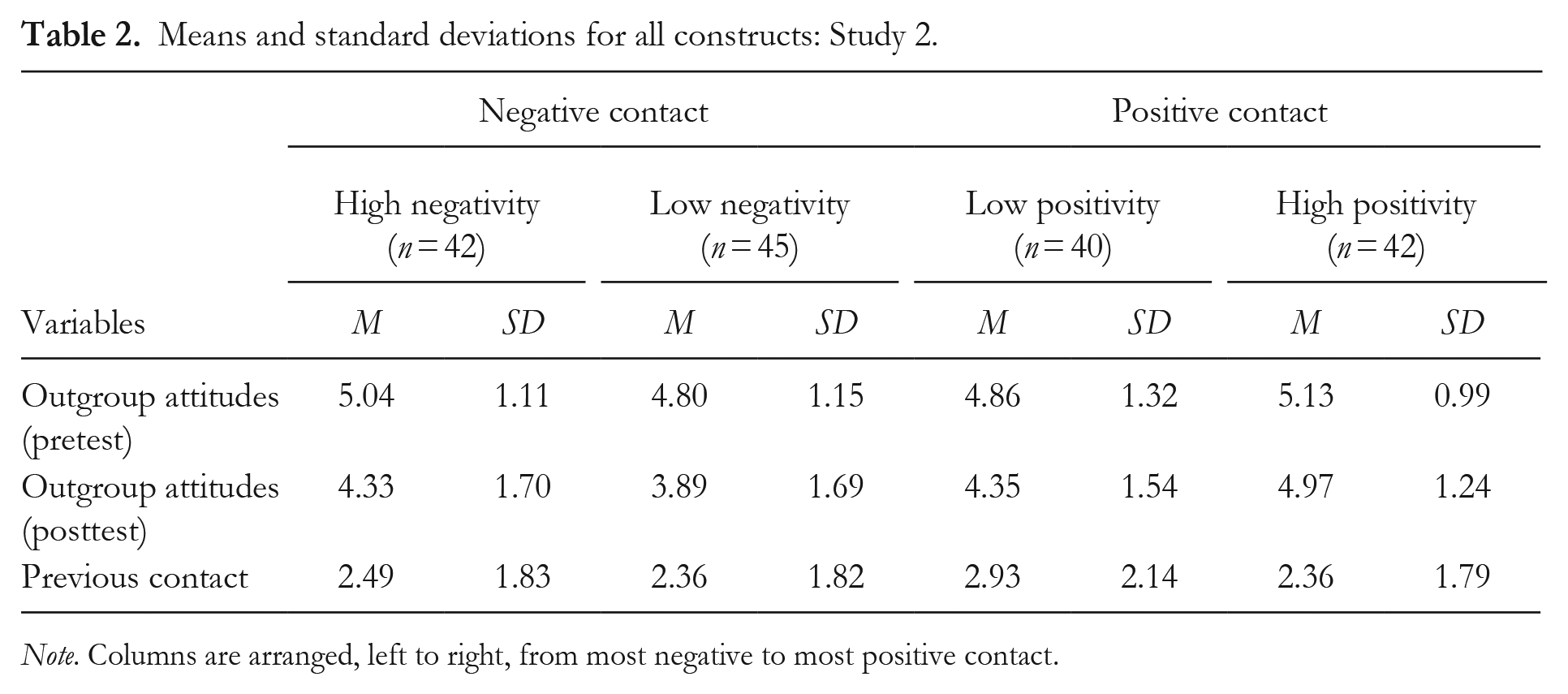
Note. Columns are arranged, left to right, from most negative to most positive contact.
Correlations between all constructs: Study 2.
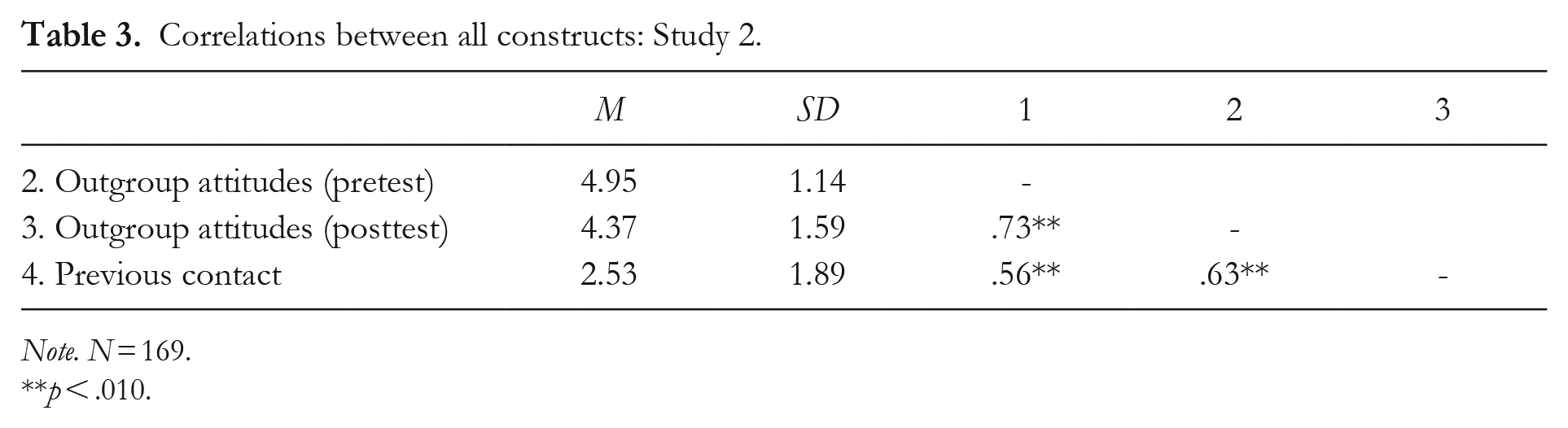
Note. N = 169.
p < .010.
Outgroup attitudes were assessed with the same three items used in Study 1 (“likeable,” “warm,” and “good-natured”). We included outgroup attitudes both as a pretest measure (outgroup attitudespre α = .93) and as a measure in the final questionnaire (outgroup attitudespost α = .97). Additionally, previous experience of positive contact was measured with one item asking how many of the participants’ friends were outgroup members (1 = 0 to none, 7 = 6 to all).
Results and Discussion
To ensure successful randomization, we first ran a two-way ANOVA for our pretest measures of outgroup attitudes and previous experiences of positive contact. We found no results indicating unsuccessful randomization (see supplemental material). Results for intergroup attitudes are controlled for the baseline measure and previous contact experiences.
A two-way ANOVA on posttest outgroup attitudes revealed a main effect of valence, F(1, 160) = 7.78, p < .001, η²p = .07, and a main effect of intensity, F(1, 160) = 10.16, p = .002, η²p = .06. As in Study 1, we recoded intensity in the realm of negative contact to test for a significant interaction effect of valence and intensity that allowed us to compare the magnitude of the effects, regardless of their direction, F(1, 159) = 10.36, p = .002, η²p = .06; Madj_high_pos = 4.96, SE = 0.14; Madj_low_pos = 4.37, SE = 0.14; Madj_low_neg = 3.99, SE = 0.17; Madj_high_neg = 4.22, SE = 0.17.
Examination of the simple effects revealed that an increase in intensity augmented outgroup attitudes in the positive, F(1, 76) = 9.25, p = .003, η² = .11, but did not reduce outgroup attitudes in the negative condition, F(1, 81) = 0.92, p = .340, η² = .01.
Results from this second experiment with an objective manipulation of contact valence (negative vs. positive) and intensity (low vs. high intensity) replicated our main findings, suggesting that intensity of the contact experience differentially affects the effects positive and negative contact on intergroup attitudes. Our results provide further evidence that positive contact in particular is affected by an increase in intensity, which is in line with our prediction, and with results from Study 1. Overall, our results suggest that the online version of the collaboration and communication task provides an effective and highly standardized paradigm for studying positive and negative intergroup contact. It should be highlighted, however, that it might take feedback of high positivity to engender typical contact effects, as feedback of low positivity might not meet students’ expectations in this setting and might, therefore, be perceived as rather negative (see supplemental material) and even worsen intergroup attitudes in a rather positive outgroup context.
Nonetheless, we sought next to replicate this paradigm in the lab, with face-to-face contact, to ensure that the results obtained from online interactions would also generalize to offline ones, and to further confirm the validity of findings from experiments conducted in a purely online environment.
Study 3
Method
Participants and design
Eighty students from a Dutch university across a total of 25 disciplines (most prominent: veterinary studies n = 14, psychology n = 14, and sociology n = 8) took part in the experiment. Two participants were excluded because of extreme outliers on studentized deleted residuals (with values >±3). 7 This left a final sample of 78 participants (69 female, nine male; Mage = 20.71, SDage = 2.18), assigned to one of the four conditions: high positivity (n = 21), low positivity (n = 19), low negativity (n = 19), and high negativity (n = 19). Again, results for intergroup attitudes were controlled for the baseline measure of intergroup attitudes and previous contact experiences. The preregistration of this study and original materials can be found at the OSF (https://osf.io/7e5qn and https://osf.io/rcsme/).
Procedure
Overall, Study 3 followed the same procedure as Study 1 (see Figure 1). We used the same feedback manipulation as in Studies 1 and 2, except that Study 3 did not include emoticons, which had been included in Studies 1 and 2 expressly for the online environment (see supplemental material). Study 3 used the context of the Dutch university system that distinguishes between research universities and universities of applied sciences. While research universities focus on scientific research skills and might be seen as of higher status, applied universities offer a more practical education with skills directly needed for the workplace. Participants were recruited on campus, mostly via flyers and by visiting lectures. Students who were willing to participate were able to sign up online, upon which, they were asked to fill out the online pretest survey. In the lab, participants met a researcher and the confederate shortly before the experiment started. In this study, the group paradigm differentiated between students of a “university” (the ingroup) and students of a “university of applied sciences” (the outgroup), whose representative was a confederate. 8 Participants gave their written consent before the experiment started and were fully debriefed and given a small financial reimbursement after completion.
Measures
To assess outgroup attitudes, participants rated the outgroup on the same three items used in Studies 1 and 2, except that items ranged from 0 to 10 (αpre = .91, αpost = .90).
Previous experience of positive contact was measured with one item asking how many of the participants’ good friends were studying at a university of applied sciences (response options: 1 = none, 2 = one, 3 = two to five, 4 = five to ten, and 5 = more than ten).
Results and Discussion
Descriptive statistics for all the main variables as well as the correlations between them can be found in Tables 4 and 5, respectively. As in Study 2, we first ran a two-way ANOVA for our pretest measures of outgroup attitudes and previous experiences of positive contact to ensure successful randomization, which found no evidence that outgroup attitudes differed between conditions (see supplemental material). Results for intergroup attitudes were again controlled for the baseline measure of intergroup attitudes and previous contact experiences.
Means and standard deviations for all constructs: Study 3.
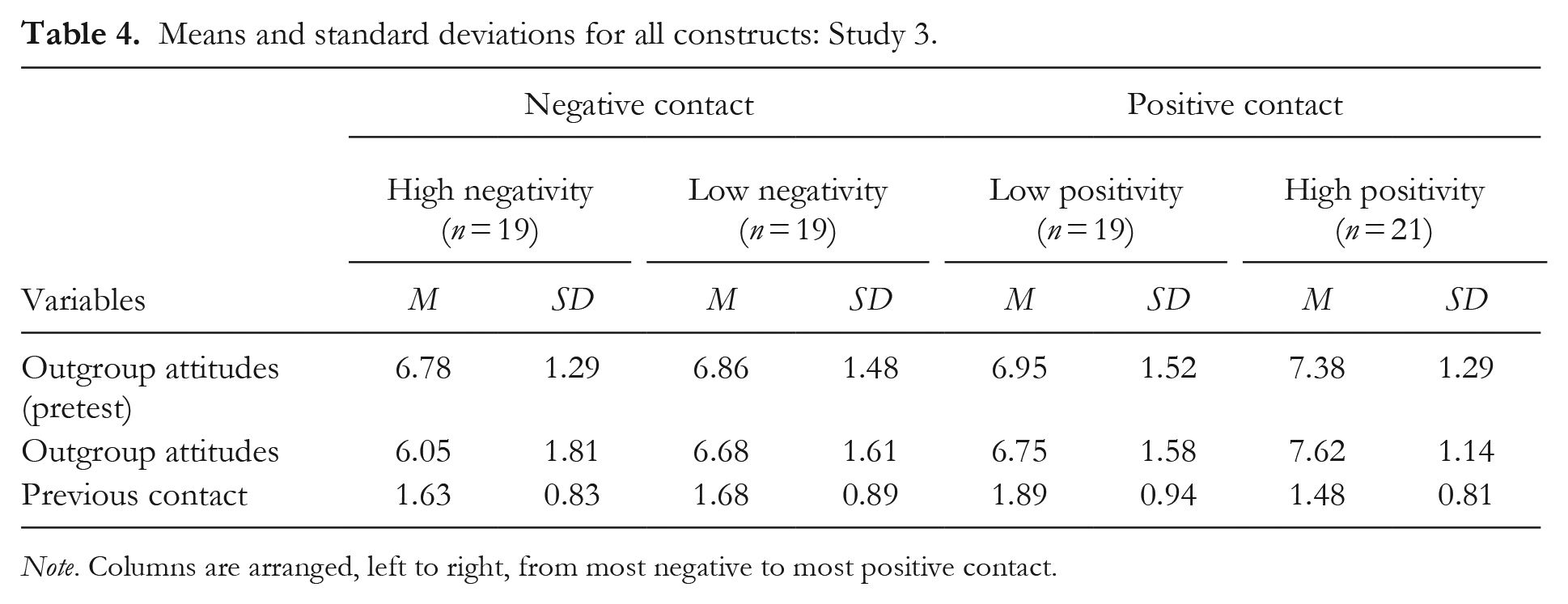
Note. Columns are arranged, left to right, from most negative to most positive contact.
Correlations between all constructs: Study 3.
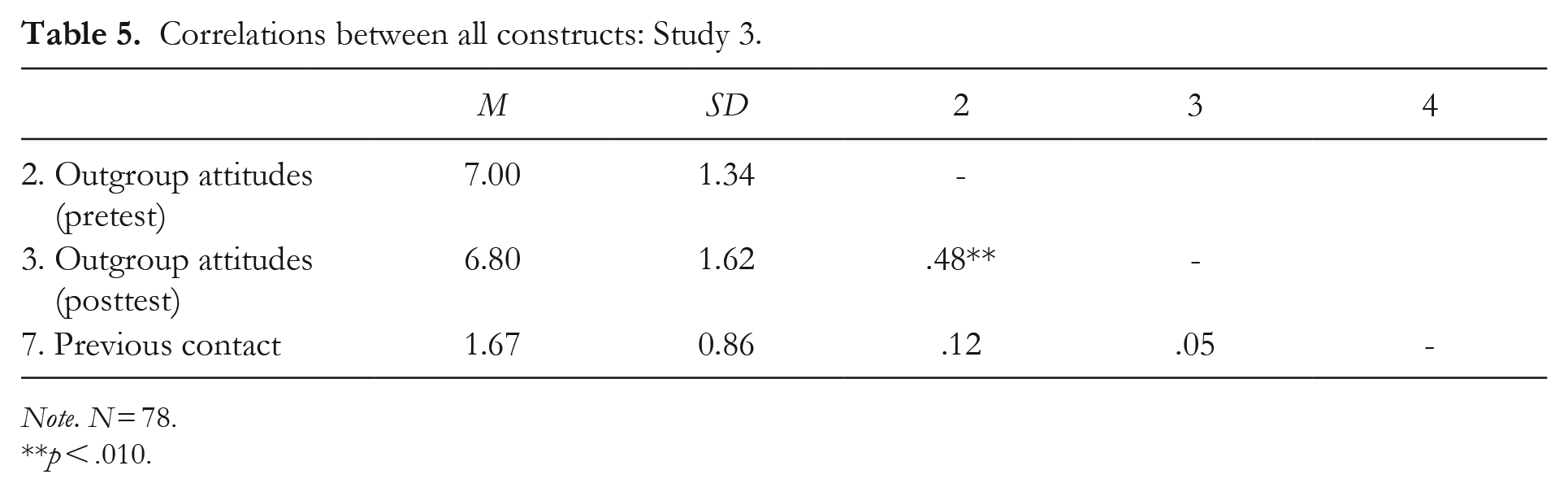
Note. N = 78.
p < .010.
A two-way ANOVA revealed a main effect of valence, F(1, 71) = 3.88, p = .053, η²p = .05, but there was no significant main effect for intensity, F(1, 71) = 0.07, p = .800, η²p < .01. As in Studies 1 and 2, we recoded intensity in the realm of negative contact to compare the magnitude of the effects, regardless of their direction. There was no significant interaction effect of valence and intensity, F(1, 70) = 0.06, p = .803, η²p = .001; Madj_high_pos = 7.50, SE = 0.32; Madj_low_pos = 6.77, SE = 0.33; Madj_low_neg = 6.75, SE = 0.32; Madj_high_neg = 6.19, SE = 0.33. Even though the interaction was not significant, we examined the simple effects to assess whether the pattern of results matched our previous finding. The simple effects revealed that an increase in intensity improved outgroup attitudes in the positive condition, but only yielded a small effect that barely approached conventional levels of significance, F(1, 35) = 3.11, p = .087, η² = .08; it did not worsen outgroup attitudes in the negative condition, F(1, 36) = 1.22, p = .277, η² = .04. Although Study 3 did not fully replicate our findings from Studies 1 and 2, the examination of the simple slopes revealed a pattern of results in the same direction. Due to difficulties in recruiting more participants in the preregistered time frame, and limited funding for further confederate hours, Study 3 only included a rather small number of participants, which limited the power of this study. To address this issue, and to integrate the findings of our three experimental studies, we conducted an internal meta-analysis.
Internal Meta-Analysis for Experimental Studies 1–3
All three of our experiments were designed in a very similar manner and yielded results in the predicted direction based on our hypothesis. To provide a more accurate assessment of the effects of the variables of interest, given issues of low power in Studies 1 and 3, we integrated our results on the main outcome (outgroup attitudes) in an internal meta-analysis. As an internal meta-analysis yields an increase in power compared to the single studies, it increases reliability and demonstrates the robustness of the obtained findings. A meta-analytic summary of results has the benefit of basing results on larger sample sizes and, while it cannot solve problems with methodically flawed studies (Nelson et al., 2018), it still provides a good way to systematically summarize sound research with similar designs (Goh et al., 2016). We thus ran an internal meta-analysis to examine the overall results for the interaction of contact valence and intensity on outgroup attitudes. We computed Hedges’s g for the respective interaction effects, 9 and used R (Version 3.5.2; R Core Team, 2018) and the “metafor” (2.0-0) package to run fixed effect models for an estimation of the summarized effects over all three experiments.
Results of the Internal Meta-Analysis
As demonstrated in Figure 2, when the results of all three studies were meta-analytically combined, the interaction of valence and intensity significantly predicted outgroup attitudes, with a medium effect size, M g = 0.70, SE = 0.11, p < .001, 95% CI [0.47, 0.93].
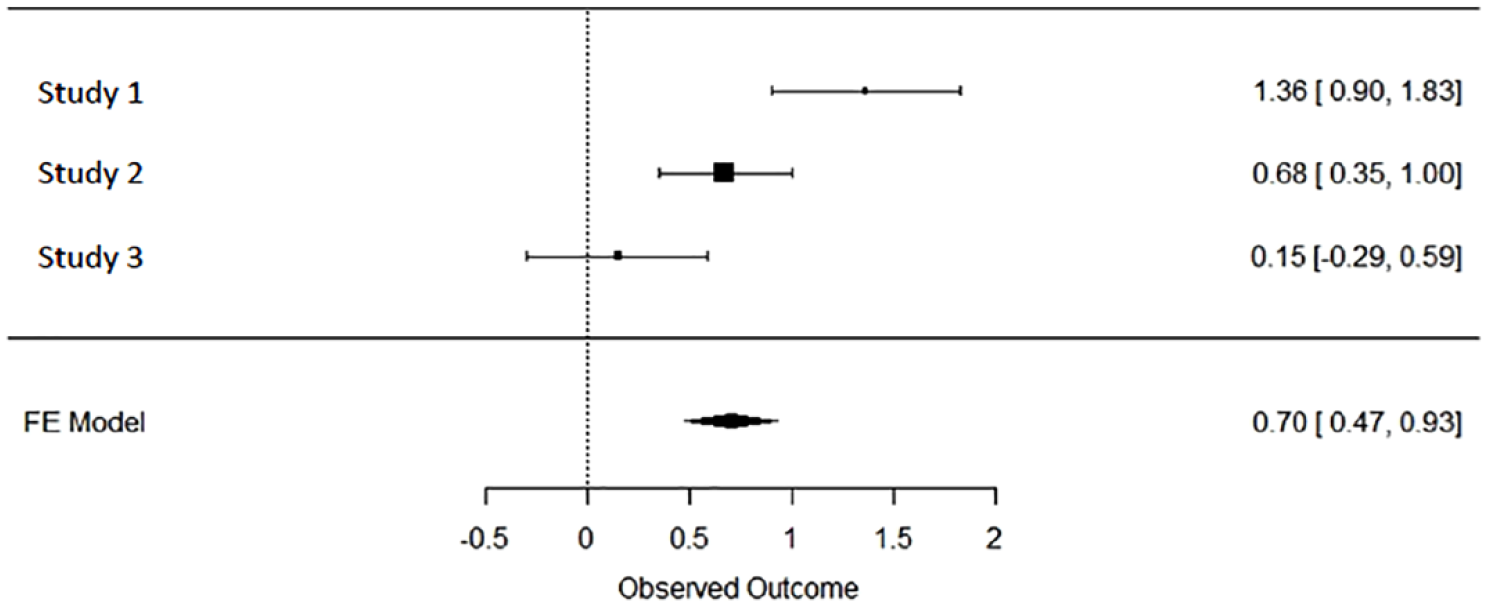
Forest plot for the results of the internal meta-analysis regarding the interaction effect of valence and intensity on outgroup attitudes.
To address the hypothesis driving this work, the examination of the direction of this interaction was of particular interest. We therefore summarized the simple effects of intensity within the realm of positive, M g = 0.37, SE = 0.16, p = .020, 95% CI [0.23, 0.67], and negative, M g = 0.15, SE = 0.15, p = .131, 95% CI [−0.15, 0.45], contact in an internal meta-analysis. As illustrated in Figure 3, outgroup attitudes did significantly change with an increase in positivity, but not in negativity (see Figure 3).
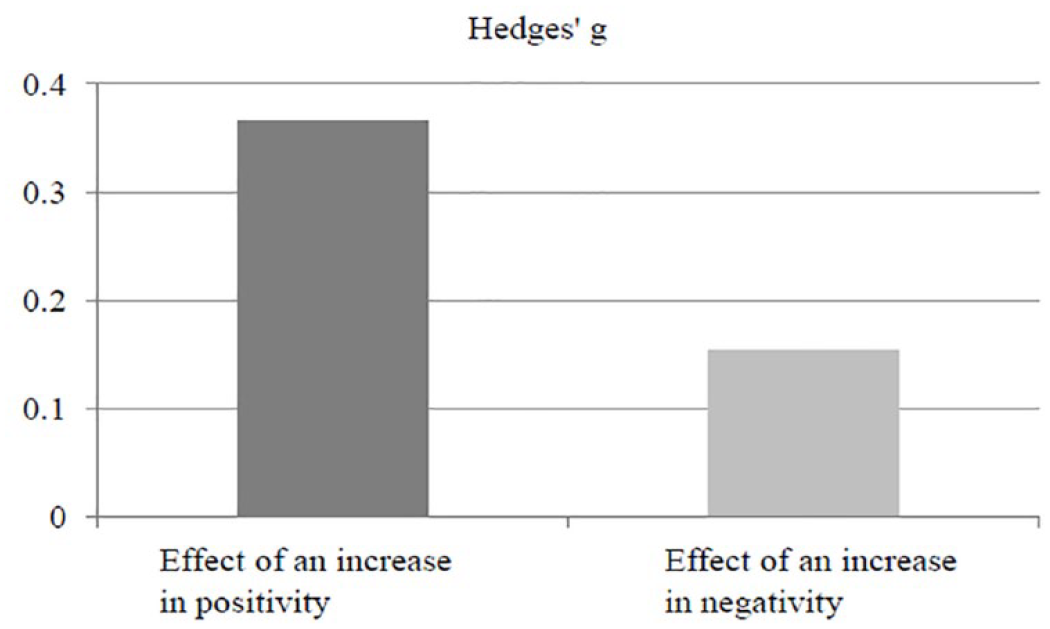
Bar chart for Hedges’s g of the simple effects of an increase in positivity and negativity on outgroup attitudes, summarized for all three experiments.
Building on the merits of a much larger sample size, the results of the internal meta-analysis support the hypothesis that outgroup attitudes significantly change with an increase in positivity, but to a lesser degree with an increase in negativity. The summary of the simple effects (see Figure 3) demonstrated that, in line with our hypothesis, intensifying positivity had a larger effect than intensifying negativity.
Study 4
The primary aim of Study 4 was to support our findings from the experiments that intensity influences the effects of positive but not negative intergroup contact, with data from outside the laboratory. Data for Study 4 came from a larger survey conducted in the context of intergroup relations between White British and Asian British people—mostly with Indian, Pakistani, or Bangladeshi heritage, who form the second largest population group in England and Wales and the one that grew the most in absolute percentage points in the last decades (from 5.1% of the population in 2001 to 7.8% in 2011 to 9.3% in 2021; Office for National Statistics, 2013). Furthermore, they face discrimination across a wide range of measures (e.g., Social Mobility Commission, 2016). Previous research has shown that the effects of positive intergroup contact on attitudes are, on average, slightly but reliably greater for majority than for minority members (e.g., Tropp & Pettigrew, 2005), which makes it necessary to consider majority and minority groups separately, even though we do not have assumptions about differences in the effects of intensity between majority and minority group members. Furthermore, we are not aware of research systematically comparing the effects of negative contact for different status groups. As a manipulation of face-to-face negative contact and contact intensity might be ethically questionable in a relevant intergroup context, and would not be possible in a survey, we instead used participants’ perception of contact intensity as a proximal indicator to test our prediction. We want to specifically highlight two aspects when considering Study 4, as compared with Studies 1–3. First, while the experimental studies manipulated valence (i.e., positive and negative) and intensity (i.e., high and low intensity), and tested for an interaction between them, Study 4 was a cross-sectional survey which included separate measures of both types of valence and the intensity of each. Thus, we are here interested in the main effects of intensity in the realm of positive, compared to negative, intergroup contact. These main effects provide the most comparable information to the simple slopes provided for Studies 1–3. Second, Studies 1–3, which manipulated contact, did not address the role of frequency at all, and our theorizing builds on the differentiation of contact quality and does not address contact frequency. Given the method of a large-scale survey, we considered this the most appropriate approach. The data from a relevant intergroup context provided in Study 4 can test the prediction that intensity is associated with intergroup attitudes above and beyond the frequency of contact in the realm of positive, but to a lesser degree of negative, intergroup contact.
Method
Participants
Two thousand nine hundred and four people (49% women, 51% men; Mage = 45.39, SDage = 18.88) participated in a larger 20-minute survey involving White British (N = 1,520) and Asian British (N = 1,474; 35.3% Asian British Indian, 46.3% Asian British Pakistani, 15.3% Asian British Bangladeshi) respondents from 290 British neighborhoods. The survey was conducted by a specialized company (Ipsos MORI) and used a face-to-face random location quota approach (e.g., Szolnoki & Hoffmann, 2013). The survey company maintains a database of people who regularly participate in surveys for remuneration. All interviews were conducted in English.
Measures
Frequency of positive and negative contact were assessed with one item each, asking how often respondents had positive/negative contact with the respective outgroup (Asian British/White British; e.g., “In general, how often do you have positive contact with White people?”). Answers were given on a 6-point scale (1 = never, 6 = every day).
Perceived intensity of positive and negative contact was measured with two items (1 = not at all, 5 = a great deal). These items referred to the contact frequency items, asking participants how positive or how negative they would rate the respective contact. 10 The item for positivity was, “In general, how would you rate this positive contact with [White British] people?”; answers were given on a 5-point scale (1 = barely positive, 5 = extremely positive). The item for negativity was, “In general, how would you rate this negative contact with [White British] people?”; again, answers were given on a 5-point scale (1 = barely negative, 5 = extremely negative).
To indicate their outgroup attitudes, participants rated the warmth of the respective outgroup (1 = very cold, 5 = very warm). 11
Results and Discussion
Statistical analyses were conducted with SPSS Version 28.0 (IBM, 2021). Only respondents who had reported at least some intergroup contact on the respective measures of positive and negative contact frequency were included for all analyses using perceived intensity of contact. Descriptive statistics and correlations between all scales are reported in Table 6. The results support the idea that intensity and frequency are indeed different concepts. In the overall sample the frequency and intensity of positive contact were correlated only to a moderate degree (r = .40, p < .001), as were frequency and intensity of negative intergroup contact (r = .33, p < .001). The frequency and intensity of positive contact were higher than the frequency and intensity of negative contact.
Correlations between all items: Study 4.
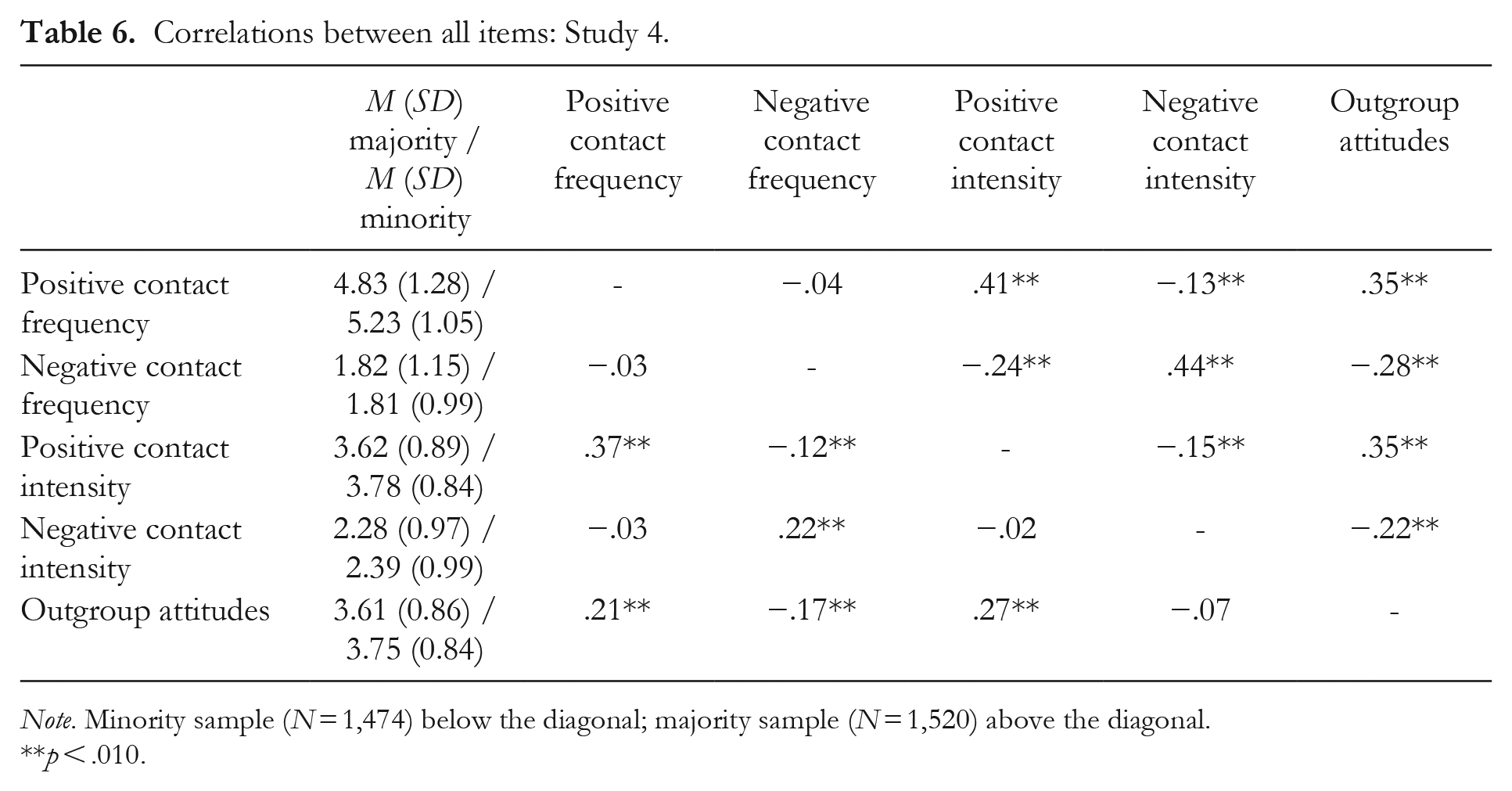
Note. Minority sample (N = 1,474) below the diagonal; majority sample (N = 1,520) above the diagonal.
p < .010.
Group status moderated the effects of both positive and negative contact. As expected from previous research, the association of positive contact frequency with outgroup attitudes (b = −0.07, SE = 0.03, p = .017, 95% CI [−0.12, −0.01]) was stronger for the majority than for the minority group; additionally, status moderated the association of negative intensity with warmth (b = 0.14, SE = 0.05, p = .003, 95% CI [0.05, 0.23]). We thus report majority and minority data separately.
Table 7 displays results for the influence of perceived intensity of contact on outgroup attitudes in a multivariate regression. For this analysis, we followed the suggestion of Hayward et al. (2017) and coded intensity as zero for respondents who had reported no positive or negative contact. 12 We entered all predictors simultaneously for each group. In line with previous research, for both majority and minority group members, an increase in the frequency of positive contact was associated with improved outgroups attitudes. For both groups, an increase in the positivity of contact was associated with improved outgroup attitudes over and above the association of positive contact frequency with outgroup attitudes. For negative contact, an increase in the frequency of negative intergroup contact was associated with worsened outgroup attitudes for majority as well as minority group members. In line with our predictions, increased negativity of contact had an association with intergroup attitudes of smaller magnitude than increased positivity. Increased negativity was not significantly associated with outgroup attitudes, beyond the association of negative contact frequency and intergroup attitudes, for both majority and minority group members.
Results for the association of contact frequency and perceived intensity of valenced contact with outgroup attitudes among majority and minority members.
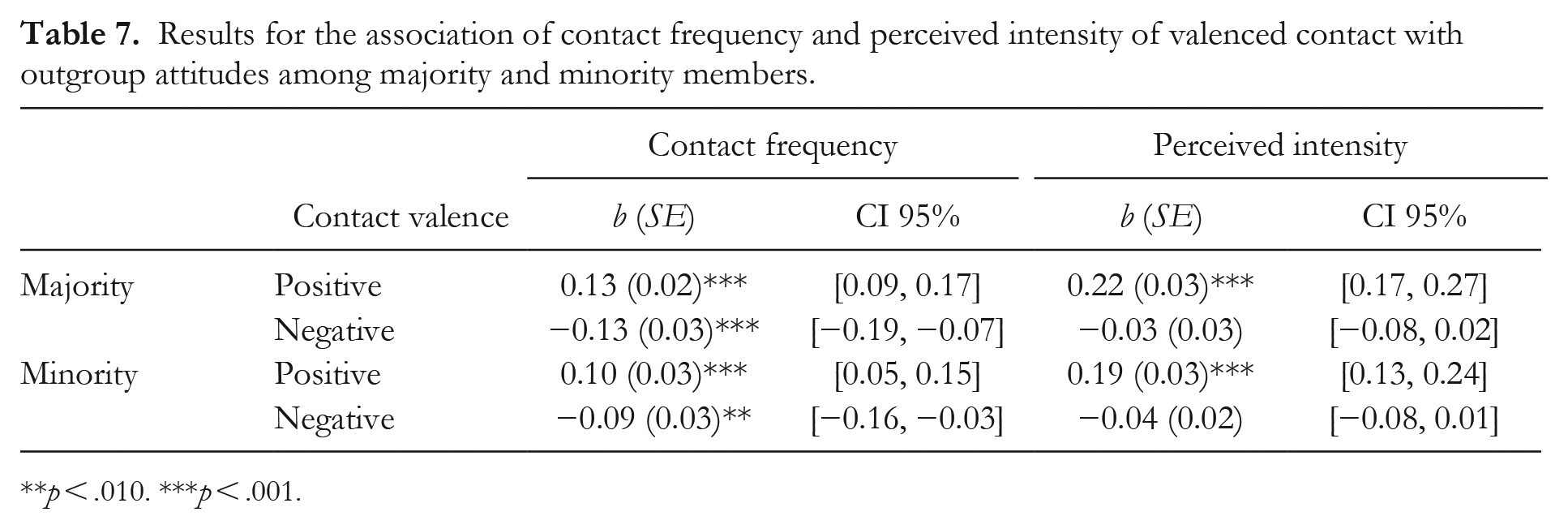
p < .010. ***p < .001.
Conducted in a highly relevant intergroup context, Study 4 provides further evidence in support of our hypothesis that increasing intensity primarily increases the magnitude of contact effects in the realm of positive, but not negative, contact. These results are in line with the findings from our experimental Studies 1–3, and our theoretical reasoning relying on findings of research from other fields suggesting that even minimally intense negative events can have profound effects (e.g., Peeters & Czapinski, 1990; Rozin & Royzman, 2001). Furthermore, we found that positive contact frequency had a stronger association with intergroup attitudes for majority than for minority group members, which is in line with previous findings (Tropp & Pettigrew, 2005).
We wish to highlight, however, that in the current design, the survey did not tap into the intensity of single instances of intergroup contact as the experiments did. The overall measures provided in the survey do not allow the possibility to differentiate whether a person had experienced a lot of contact of high and low intensity or simply several contacts of medium intensity. Future studies could take this research one step further by not only asking for the mean intensity of an overall frequency of valenced contact, but by assessing differential frequencies of valenced contact of high and low intensity, and possibly even considering other forms of intergroup contact (e.g., extended or vicarious contact). However, it is important to note that respondents in this sample reported almost no negative events of very high intensity; potentially, more intense negative experiences might have changed the observed pattern of results. Nonetheless, this study was conducted in a context in which we expected to tap such experiences, as Asian British people, the largest minority group in the United Kingdom, face considerable discrimination (e.g., Social Mobility Commission, 2016). It is additionally important to note that, in line with previous research (Hayward et al., 2017), we found that the negativity of negative events was lower but varied more than the positivity of positive events.
General Discussion
The current research advances prior work on valenced intergroup contact to include intensity of contact as a key factor influencing the effect of intergroup contact on outgroup attitudes. Evidence was accrued from two online experiments (Studies 1 and 2), one experiment in person (Study 3), and one large cross-sectional survey (Study 4). Although we acknowledge the rather low sample sizes in the two experimental studies, we replicated the same pattern of results across all studies, and increased our confidence in the reliability of the key pattern of results observed by integrating all three experiments in a internal meta-analysis. Study 4 complemented the experimental studies by supporting the key finding in a study with increased external validity.
Our findings demonstrate that, as expected, an increase in the intensity of the contact experience had a stronger effect in the realm of positive contact than in the realm of negative contact. These findings are in line with research from other fields of psychology, notably impression formation (e.g., Peeters & Czapinski, 1990) and contagion (e.g., Rozin et al., 1992), suggesting that the influence of intensity differs between positive and negative experiences (e.g., Fiske, 1980; Rozin & Royzman, 2001). In line with research in the realm of intimate intergroup contact (Fuochi et al., 2020; Graf et al., 2018), we demonstrated that positive contact of high positivity had a stronger effect than positive contact of low positivity; yet, while negative contact in intimate relationships had weaker effects than negative contact in superficial relations, we did not find an impact of different levels of negativity. That the effects of positive and negative contact are differentially influenced by intensity provides a possible explanation for the mixed results of the relatively sparse literature on valenced contact to date. We consider it important to point out that while our theoretical assumptions mostly build on findings from other fields of research (i.e., impression formation, contagion), which did not consider an intergroup context, we found the expected effects on intergroup attitudes, a measure which did not involve an evaluation of the interaction partner themself, but generalized toward the interaction partner’s group. We cannot, however, determine whether our findings are specific to intergroup contexts or might also be true in within-group interactions, an issue that could be addressed in further research by including interactions with ingroup members or a wider variety of dependent variables relevant for intergroup relations beyond intergroup attitudes.
Additionally, our findings add to the nascent field of research on the effects of negative intergroup contact (e.g., Barlow et al., 2012). In this relatively new field of research, we are among the first to provide experimental evidence on the effects of positive and negative intergroup contact, as most of the research on negative intergroup contact to date relies on cross-sectional surveys (see McKeown & Dixon, 2017). Finding experimental paradigms that provide an ethically acceptable way of manipulating the valence of intergroup contact, thereby controlling the positivity and negativity of these contact situations, is a crucial prerequisite for the thorough examination of independent and interactive effects of positive and negative contact. Furthermore, our findings highlight the importance of going beyond one factor (i.e., valenced contact) to adequately represent the rich variety of intergroup contact experiences (Pettigrew & Hewstone, 2017). By including intensity of positive and negative contact as a key factor in explaining the effects of these types of contact, we demonstrate one way to address critiques that the diversity of valenced contact experiences might not be sufficiently represented in previous measures (see also Dixon et al., 2005; Hayward et al., 2017).
Limitations and Future Directions
Notwithstanding its contributions, we acknowledge three major limitations of our research that should be addressed in future studies.
First, almost none of our participants experienced experimentally (Studies 1–3) or reported (Study 4) negative events of high intensity. Therefore, the current work is not able to make any claims about the effects of extremly negative (or positive) events—such as being the victim of a violent assault (or falling in love)—which might be rare but are likely still a relevant factor in intergroup relations. The lack of reported negative events of really high negativity in Study 4, which assessed positive and negative contact between White British and Asian British adults using a representative sample and had high external validity, is surprising. It may suggest the need for future research in settings such as neighborhoods or schools known to have problematic intergroup relations, or even open conflicts. Creating more negative events in the lab, however, poses a different challenge, namely an ethical one given that pilot testing for our paradigm revealed the strong impact of even low-intensity negative feedback, which prevented us from using stronger manipulations. One way to adress this issue might be to examine whether our results can also be observed for vicarious contact. The lack of extremely negative experiences might also explain why we did not find the same pattern of results as suggested by Fiske (1980), who found the strongest effects (in the case of person evaluations, rather than generalizations to outgroups) for extremely negative situations. It is furthermore noteworthy that, in our studies, even mildly positive experiences seemed to be evaluated as rather negative, suggesting that the perception of positivity and negativity is differentially affected by intensity (see supplemental material for further results), and it thus takes events of strong positivity to actually improve intergroup attitudes. We thereby want to highlight that an objective manipulation of an apparent level of intensity does not necessarily translate into a commensurate perception of intensity, which is an important research question for future studies. While this finding might be specific to the chosen context of intergroup feedback in university settings, it might in general require very positive interactions, such as intergroup friendships, before high intensity of positive contact is perceived; a mildly positive event might not meet expectations and might, therefore, already be perceived as rather negative.
Second, and relatedly, all three experimental studies were set in a very specific context in which university students received feedback from a peer. We acknowledge this as a limit on the generalizability of our findings, because this selected setting does not represent all kinds of possible intergroup contact experiences; results might be specific to the context of feedback as one specific form of potential intergroup interaction. Although the manipulation of valence and intensity was realized in an objective manner, anchors of what positive and negative feedback would look like in this specific context might have affected our results as, especially among students, the norm would be to expect rather positive feedback from their peers. And while we would expect most individuals to perceive the majority of their social environments as rather positive (e.g., Unkelbach et al., 2019), and therefore to set positive anchors, future research should supplement this with other paradigms and in other contexts to examine effects of intensity more broadly. Contexts in which members of targeted groups have more negative than positive experiences might be of special interest (e.g., police officers’ contact with immigrants, see Dhont et al., 2010; contact between Bulgarian majority members and Bulgarian Turks with Roma people, Visintin et al., 2017). In such contexts with a higher frequency of negative intergroup contact, contact of low positivity might have a larger impact compared to enviornments where negative interactions are rare.
Third, although we introduced controls for prior contact in Studies 2–3, we only controlled for prior positive contact (in the form of having outgroup friends), and we used only a single-item measure. While older studies suggest that having past experiences of positive contact (i.e., having outgroup friends) is relevant for the perception of intergroup contact (Blascovich et al., 2001; Page-Gould et al., 2008), recent work suggests that not only positive but also negative contact experiences might influence subsequent intergroup contact effects (Schäfer et al., 2022). Future research should therefore assess, and subsequently control for, the possible effects of a wider range of (positive and negative) contact experiences when assessing the experimental impact of intensity on valence.
Conclusion
To conclude, our research—which exploited the benefits of laboratory experiments allied to a large-scale, general population survey—shows that varying intensity of contact experiences has different effects for positive compared to negative contact experiences. Although negative contact experiences tend to be rare (extremely negative experiences are even rarer), such experiences might not need to be strong to cause strong negative effects. For positive contact, on the other hand, rather than simply having superficial intergroup contact, more intense positive experiences (such as situations bearing the potential to make outgroup friends or for fruitful cooperations) are likely to yield greater benefits than merely having a few positive but superficial interactions with outgroup members. We argued at the outset that it was crucial to disentangle the effects of frequency and intensity to provide theoretical clarity and necessary information for potential interventions. Returning to that theme, going beyond superficial experiences and building opportunities for positive experiences of high intensity should remain a key, but not the sole, focus of interventions aimed at improving intergroup relations. When members of different groups are brought together in planned contact interventions, practitioners should seek not only to minimize the frequency of negative experiences, but also to maximize (the intensity of) positive experiences.
Supplemental Material
sj-doc-1-gpi-10.1177_13684302241258070 – Supplemental material for Differential effects of positive versus negative contact: The importance of distinguishing valence from intensity
Supplemental material, sj-doc-1-gpi-10.1177_13684302241258070 for Differential effects of positive versus negative contact: The importance of distinguishing valence from intensity by Sarina J. Schäfer, Mathijs Kros, Miles Hewstone, Katharina Schmid, Benjamin F. Fell, Eva Jaspers, Mathias Kauff, Gunnar Lemmer and Oliver Christ in Group Processes & Intergroup Relations
Supplemental Material
sj-doc-2-gpi-10.1177_13684302241258070 – Supplemental material for Differential effects of positive versus negative contact: The importance of distinguishing valence from intensity
Supplemental material, sj-doc-2-gpi-10.1177_13684302241258070 for Differential effects of positive versus negative contact: The importance of distinguishing valence from intensity by Sarina J. Schäfer, Mathijs Kros, Miles Hewstone, Katharina Schmid, Benjamin F. Fell, Eva Jaspers, Mathias Kauff, Gunnar Lemmer and Oliver Christ in Group Processes & Intergroup Relations
Supplemental Material
sj-doc-3-gpi-10.1177_13684302241258070 – Supplemental material for Differential effects of positive versus negative contact: The importance of distinguishing valence from intensity
Supplemental material, sj-doc-3-gpi-10.1177_13684302241258070 for Differential effects of positive versus negative contact: The importance of distinguishing valence from intensity by Sarina J. Schäfer, Mathijs Kros, Miles Hewstone, Katharina Schmid, Benjamin F. Fell, Eva Jaspers, Mathias Kauff, Gunnar Lemmer and Oliver Christ in Group Processes & Intergroup Relations
Supplemental Material
sj-docx-4-gpi-10.1177_13684302241258070 – Supplemental material for Differential effects of positive versus negative contact: The importance of distinguishing valence from intensity
Supplemental material, sj-docx-4-gpi-10.1177_13684302241258070 for Differential effects of positive versus negative contact: The importance of distinguishing valence from intensity by Sarina J. Schäfer, Mathijs Kros, Miles Hewstone, Katharina Schmid, Benjamin F. Fell, Eva Jaspers, Mathias Kauff, Gunnar Lemmer and Oliver Christ in Group Processes & Intergroup Relations
Supplemental Material
sj-docx-5-gpi-10.1177_13684302241258070 – Supplemental material for Differential effects of positive versus negative contact: The importance of distinguishing valence from intensity
Supplemental material, sj-docx-5-gpi-10.1177_13684302241258070 for Differential effects of positive versus negative contact: The importance of distinguishing valence from intensity by Sarina J. Schäfer, Mathijs Kros, Miles Hewstone, Katharina Schmid, Benjamin F. Fell, Eva Jaspers, Mathias Kauff, Gunnar Lemmer and Oliver Christ in Group Processes & Intergroup Relations
Supplemental Material
sj-docx-6-gpi-10.1177_13684302241258070 – Supplemental material for Differential effects of positive versus negative contact: The importance of distinguishing valence from intensity
Supplemental material, sj-docx-6-gpi-10.1177_13684302241258070 for Differential effects of positive versus negative contact: The importance of distinguishing valence from intensity by Sarina J. Schäfer, Mathijs Kros, Miles Hewstone, Katharina Schmid, Benjamin F. Fell, Eva Jaspers, Mathias Kauff, Gunnar Lemmer and Oliver Christ in Group Processes & Intergroup Relations
Footnotes
Acknowledgements
The authors thank Kathrin Wolff, Franziska Spannbauer, Linda and Juliane Debertshäuser, Anne van der Put, and Jaap van Slageren for their help with data collection.
Authors’ Note
The results of this paper were reported at the 51st annual meeting of the German Association of Psychology. Studies 1, 2, and 3 were registered.
Data Availability
All data will be made available in the respective osf projects; the experimental studies were preregistered. This manuscript is in line with the ethical guidelines specified in the APA Code of Conduct and our national ethics guidelines.
Declaration of Conflicting Interests
The author(s) declared no potential conflicts of interest with respect to the research, authorship, and/or publication of this article.
Funding
The author(s) disclosed receipt of the following financial support for the research, authorship, and/or publication of this article: This research was supported by grants to Oliver Christ (DFG, Grant No. 278649612), Miles Hewstone (ESRC, Grant No. ES/N018893/1), and Eva Jaspers (NWO, Grant No. 464-15-265). Study 4 was also supported by a VENI grant to Eva Jaspers from the NWO (Grant No. 016-125-141).

Supplemental Material
Supplemental material for this article is available online.
Notes
References
Supplementary Material
Please find the following supplemental material available below.
For Open Access articles published under a Creative Commons License, all supplemental material carries the same license as the article it is associated with.
For non-Open Access articles published, all supplemental material carries a non-exclusive license, and permission requests for re-use of supplemental material or any part of supplemental material shall be sent directly to the copyright owner as specified in the copyright notice associated with the article.
