




Abstract
This article analyses the communication activities of Filmstichting West Indië, which in the late 1940s and early 1950s produced 12 documentary propaganda films about Dutch colonial Suriname, and the resistance against these reductive representations in zines of the Surinamese migrant organization Vereniging Ons Suriname. We draw on hence unstudied archival material to dissect the role of media operations, as persuasive, strategic media productions, in constructing and challenging differential relations between colonizers and colonial subjects, and symbolically negotiating how different territories and bodies relate to each other. A visual and textual analysis of the cases unpacks historical struggles over the regimes of (post)colonial (im)mobilities, as they are produced and articulated within regimes of representation. We ultimately argue that, in order to understand the historical constitution of mobility regimes (and, in order to be able to critique them), we need to study the co-production of mobility regimes within regimes of mediated representation.
Keywords
Introduction
One of these winter evenings, right by the sea, in the Seinposttheater in Scheveningen, we saw about six films about Suriname, Curaçao and Bonaire. Polygoon made them for the Filmstichting West Indië and we (personally) complimented those gentlemen of film making […] We first walked along the snow-covered beach of Scheveningen. It was a lovely winter evening. Crackling cold and dry, the sea lapped in endless swell. There were stars in the inky sky and then suddenly we were (in the mind, which is often more substantial than the frail body) in the sub-tropics. We walked through Paramaribo […] as if there was no snow in the air. We saw folks milling about on the waterfront in the sun […] the jungle of Suriname […] a nice diversion. 1
Between the summer of 1947 and mid-January 1948, the Filmstichting West Indië (Film Foundation West Indies) in the shape of a crew of white, male Dutch filmmakers, government officials and tradesmen, travelled to the so-called Dutch ‘West Indian’ colonial territories – now Suriname, Aruba, Bonaire, Curaçao, Saba and Sint Eustatius. 2 In little over six months they shot 16,000 metres of 35 millimetre film, which they edited into tapes of 300–400 metres. Indigenous music, recorded live on location with a magnetophone, 3 was included in the film score of several documentaries. 4 As an audience member is quoted saying in the news item included in the epigraph above, the films reactivated connections between the Dutch metropole and the almost forgotten colonial periphery in South America. The quote was taken from a lengthy review, published in the periodical Elsevier Weekblad, describing a festive premier evening where a set of seven documentary films produced by the Filmstichting West Indië was released in the Netherlands. In the words of Johannes Henricus van Maarseveen, the Dutch Minister of Overseas Territories, these documentaries would ‘support the internalization of the relationships between the Territories’. 5 Specifically, the documentary propaganda films served to justify occupation and extraction of ‘the West’ by the Netherlands, seeking to legitimize, support and attract white Dutch farmers to contribute to the colonial project after the end of the Second World War. The films became the most screened documentaries shown as film pre-programmes in Dutch cinemas that year. 6
However, the film production project and the specific discourses about colonial relations it circulated did not remain unchallenged. Colonial migrants from Suriname living in the Netherlands gathered in the Vereniging Ons Suriname (Association Our Surinam) voiced concerns in their zines Mededelingsblad Ons Suriname (Our Suriname Bulletin)) and De Koerier (The Courier). T. Dijkstra, a female board member of the Vereniging, for example, responded by arguing these films were an ‘old recipe’, suitable for reaffirming stereotypes about the colonies to white Dutch audiences. She added they were certainly not meant for ‘our circle’, meaning fellow colonial migrants living in the Netherlands. 7 For the Netherlands, among other countries, the years following the Second World War were a historical moment of transition. These were the years of waning colonial power for many former European empires as a postcolonial world order was shaped (Sharma, 2020). This article gives insight into the media operations and discursive articulations that shaped differential relations between colonizers and colonial subjects, and symbolically negotiated how different territories, and the bodies inhabiting those territories, relate to each other. Specifically, in this article, we analyse how the two media operations – surrounding the Filmstichting's documentary propaganda films, as well as Vereniging Ons Suriname's zines – provide insight into struggles over mediating regimes of (post)colonial mobility, articulated through specific regimes of representation.
The ways mobilities of people and goods across the globe are enabled and disabled are not predetermined. Instead, structures of migration control are deeply historical, contingent assemblages of rules and laws, technologies and infrastructures, and practices and imaginaries, all of which regulate how bodies and things can(not) roam the planet. As Ghosh (2021: 178–9) notes, specifically ‘Western ideas about migration are drawn largely from an experience of settler colonialism’, arguing that the imaginary of people permanently settling elsewhere is in fact a historical and contemporary anomaly, as impermanent circulations of people are much more common. In England of the 1800s, he continues, ‘people were so reluctant to move that a new literary genre of what might be called “migration propaganda” came into being to convince them that they might be better off elsewhere’ (2021: 179). Ghosh's observation leads to the role of media and communication as the preconditions and sites of production for imaginaries of how different territories relate, and mobilities of people and goods across territories can(not) unfold. Thus, we argue in this article, that in order to understand the historical constitution of mobility regimes (and in order to be able to critique them), we need to study the entanglement and co-production of mobility regimes within regimes of mediated representation.
The concept ‘regimes of (im)mobility’ (Glick-Schiller and Salazar, 2013; Salazar, 2021) offers means to unpack how hierarchical power relations are reflected in assemblages of movement and stasis. As Salazar (2021) further points out, ‘not all movements are equally meaningful or life-shaping’, and in fact ‘socio-cultural processes of meaning-making’ (2021: 21) negotiate the differential structures and experiences of (im)mobility regimes. These regimes of (im)mobility are not set in stone, but are historically contingent and continuously reproduced. For instance, migration historian Mongia (2018) identifies how (post)colonial migration governance has brought forth ‘logics of constraint’ and ‘logics of facilitation’ (2018: 2) as formations of (im)mobility regimes in the case of colonial migration of Indians, where mobilities across empires include both a desired movement for some and stasis for others.
Departing from an analysis of propaganda films and activist zines in the 1940s and 1950s, the goal of this article is to further dissect the historical processes and conditions of such meaning-making around (im)mobility regimes. In particular, the notion of ‘regimes of representation’ (Hall, 2013) comprises the power of symbolic repertoires of representing difference: in this case differences of people, territories and mobilities. By focusing on the mediation of mobility regimes, we seek to understand the historical role of different media operations in enacting regimes of representations, which in turn condition regimes of (im)mobility. The propaganda films and zines can be grasped as media operations that produce discursive representations legitimizing and resisting specific articulations of (post)colonial mobility regimes. Yet, beyond their merely symbolic and textual dimension, we understand the films and zines more holistically as media operations, as historical objects and practices, planned and executed by institutional actors, enacting and organizing communities and audiences.
In our understanding of the relationship of mediation and mobility, we follow Chouliaraki and Georgiou's (2022) understanding of the ‘digital border’, arguing that mobility regimes are doubly articulated by interlocking territorial and symbolic bordering operations: the infrastructures that materially condition and govern differential mobilities are discursively negotiated and legitimized in the symbolic realm, producing the discursive structures of exclusions, which result in detrimental embodied and material consequences for those undesired and filtered out. Thus, regimes of mobility are not developed in isolation from symbolic representation, rather the two interrelate and constitute one another. Critically deconstructing the structures of meaning-making around mobility regimes, through regimes of representation, can ultimately aid struggles for ‘mobility justice’ (Sheller, 2018), by highlighting the uneven discursive formations and historical conditions of their articulation around who can and cannot move.
In this article, we analyse the propaganda films by Filmstichting and reactions to them by the community organization Vereniging Ons Suriname in their zines in the 1940s and 1950s. For this purpose, hence unstudied analogue and digitized archival material was gathered in person and online at the National Archives of the Netherlands, National Archives of Surinam, The Netherlands Institute for Sound and Vision, National Library of the Netherlands (KB), the Black Archives, the International Institute of Social History (IISG) and the Internet Archive. Gathered material include correspondences, policy briefs, budget specifications and funding applications, meeting notes, (annotated) film scripts and preserved recordings, security files, and the zines. 8 We carried out a thematic analysis of this archival material in search of emergent patterns to reconstruct and trace historical discursive formations around mobility (cf. Sterne, 2011), asking how, which kinds of, and whose mobilities were represented, imagined, and contested? The analysis zooms into a historical context at the onset of postcolonial mobility regimes after the Second World War, uncovering the interrelations of regimes of representations (and resistance to them) in conjunction with regimes of mobility. In particular, our visual and textual analysis reveals how relationships of land/territory, the sea, and different bodies are portrayed and challenged, and thus gives insight into the dialectical meaning-making and contestation processes surrounding transforming mobility regimes.
Thinking regimes of representation and regimes of mobility together
In this section, we draw connections between the concepts of ‘regimes of representation’ and ‘regimes of (im)mobility’. Grasping representation and mobility as circularly constructed and reinforcing each other, we argue that a focus on media operations – that is, a holistic view on the planned and targeted production of a media product, including its organizational and funding structures, material infrastructures, textual articulations, and reception – can productively tease out how symbolic representations are produced and entangled with mobility regimes. Thus, the second part focuses on the forms such media operations take, specifically within documentary propaganda film and zine making.
Going beyond the more neutral and descriptive concept of media practices, we approach the Filmstichting's and Vereniging's activities as goal-oriented media operations. This notion, we contend, captures practices of persuasive, strategic communication, echoing a critical, socio-cultural perspective on public relations of organizations as a ‘contingent, cultural activity that forms part of the communicative process by which society constructs its symbolic and material “reality”’ (Edwards and Hodges, 2011: 3). This critical approach to strategic communication embeds such persuasive operations of media and communication in historical, cultural and political contexts, and their power dynamics: ‘public relations affects the distribution of power between groups in specific contexts or across society, its capacity to empower or disempower different audiences, its use as a tool for securing or resisting power by different organisations, the ways in which different identities, behaviours and values are represented as more or less powerful’ (Edwards, 2018: 5). As our case studies demonstrate, such media operations can happen on different levels of power within regimes of representation: in one case, the goal being a social movement, and organization of grassroots community; in the other case, the goal being legitimating and ensuring support for a state-led colonialist project.
Regimes of (im)mobility and regimes of representations
Regimes of (im)mobility and regimes of representation are two analytic lenses that have been developed separately to attend to how difference is produced: the first is concerned with procedures, imaginaries and matter that result in differential forms of mobility and stasis, focusing mostly on infrastructures, policies, rules, or technologies; the latter is concerned with how differences between people, groups and communities are constructed in cultural, political and legal discourse, focusing mostly on media, language, symbols and patterns of meaning-making. The regime of (im)mobility notion invites mobility scholars to ‘explore the relationships between the privileged movements of some and the co-dependent but stigmatised and forbidden movement, migration and interconnection of the poor, powerless and exploited’ (Glick-Schiller and Salazar, 2013: 188). In turn, the notion of regimes of representation is a tool for cultural and media studies scholars to analyse ‘the whole repertoire of imagery and visual effects through which “difference” is represented at any one historical moment’ (Hall, 2013: 222). Although it may be expected that regimes of representation impact upon regimes of mobility and vice versa, these two frameworks are scarcely deployed in tandem. To enable scrutiny of the interactions between (im)mobility and its representation, we address below the assumptions that both frameworks have in common.
First, regimes of (im)mobility and regimes of representation acknowledge non-singularity and encompass multiplicity. For example, Kesselring argues that ‘a multitude of mobilities regimes’ can be discerned at different levels of society, which range from ‘informal and socially coded norms and rules’ to formal, global legislative frameworks, administrative systems and modalities of governance (2014: 8). Stretching across colonial and postcolonial eras, these multiple mobility regimes are informed by ‘logics of facilitation’ in support of the transnational movements of selected bodies and ‘logics of constraint’ which affects others (Mongia, 2018: 2). In parallel, in her research on cultural diversity, Siapera (2010: 147) distinguishes between various regimes of representation, for example, the ‘racist regime of representation’, which discursively distinguishes people as members of specific ‘races’ on the basis of essentialized biological or cultural characteristics, the ‘domesticated regime of representation’ seeks to tame and limit difference within the confines of acceptability and the ‘regime of commodification of difference’, which seeks to market and monetise differences. As such, various regimes can always be expected to coexist, and to function in competition over dominance and hegemony.
Second, both regimes of mobility and of representation are conceptualized as social constructs. Regimes of (im)mobility revolve around socio-political-cultural processes that define contours, regulate and discipline particular forms of (im)mobility, through sets of ‘norms that prestructure action’ (Kesselring, 2014: 8). As constructs, these regimes advance a processual understanding, addressing on the one hand mobility as a circuit, and on the other cultural representation as a circuit. In both these circuits constant feedback loops exist, making these regimes subject to change, evolution, contestation and development over time. In these circuits, there are particular ‘moments’ that are significant, for example in the fixing of particular representations of racial difference. At these moments the ‘dominant’ and ‘dominated’ may both appear through forms of representation, practices, policy or institutionalization, however their relationship is oftentimes hierarchical (Hall, 2013: 251).
Third, both regimes call attention to the workings of power, as regimes result in establishment, reinforcement and/or contestation of power relations. Cresswell addressed the politics of mobilities as ‘the ways in which mobilities are both productive of such social relations and produced by [them]’ (2010: 21). The representational regime notion is derived from Foucault's (1976) concept of ‘regimes of truth’, which refers to the ‘power-knowledge knot’. For Foucault, particular statements can obtain status as truths, gaining authoritative power as validated knowledge: ‘by “truth” is meant a system of ordered procedures for the production, regulation, distribution and circulation of statements’ (1976: 14).
Based on these cornerstones of regimes of mobility and representation – multiplicity, dynamic social construction, and power – we can put into focus the historical contingencies of how differential mobilities are interlocked with forms of representation. This conceptual approach crystallizes the constellations of actors, institutional structures, and their discursive articulations in negotiating, consolidating and challenging interlocked regimes of mobility and representation. Mobilities and representations emerge in a circular relationship, where mobility regimes historically do not stand outside of media operations that perpetuate respective representational regimes – and vice versa: where regimes of representation are bound to the specific formations of mobility at different moments in time, co-shaped by different subjects and actors within those mobility regimes. Specifically, we focus on media operations that negotiate mobility regimes, in order to unpack how politics and regimes of representation and mobility have been constructed and challenged.
Mediating differential mobilities
Conceptualizing (im)mobility regimes as mediated through regimes of representation moves the analytical focus beyond a reductive understanding of mere mirroring through media to the constructive, agentic role of mediated representation in projects of knowledge production and its entanglement with differential mobilities (e.g. Morley, 2017). In their work on postcolonial cinema, Ponzanesi and Waller (2011: 1) state that ‘it matters less what a film is thematically about and more about how it engages with history, subjectivity, epistemology, and the political ramifications of all of these’. The production of visual, cinematic representations constitutes ‘imperial ways of knowing, feeling and seeing’ (2011: 9), that serve to legitimize and naturalize a binary worldview of colonial peripheries and metropolitan centres, whose relation is built on material exploitation and violent, orientalist, exoticizing and/or gendered othering of colonized populations in contrast to colonizers, who are portrayed as culturally dominant and civilized (cf. also Hall, 2013; Olivieri, 2012). In particular, part of this colonial project of representation – and in fact co-constitutive of it – are constructions of mobility relations.
Representations of the colonies are imbued with the production of seemingly ahistorical, neutral knowledge about who and what is allowed to, should, must, or cannot move across territories. In particular, the genre of documentary propaganda film holds a key position in the manufacturing of authentic visual evidence and truth claims, which in turn could be used to justify domination and exploitation. At the intersection of entertainment, education, and strategic communication, documentary propaganda films served multiple purposes, such as the: promotion of imperial interests in the colonies and in the home countries, war propaganda and military activities, or evangelism; but also less well-understood objectives related to the reinforcement of colonial state policy, the upholding of the pre-colonial socio-political status quo during colonial times, and even, intentionally or unintentionally, resistance against colonial regimes. (Aitken and Deprez, 2017: 17)
In concrete terms, such projects, funded by public and private institutions, ‘[i]n contrasting civilization and barbarism […] depicted natives who were irrational, superstitious, and ignorant’, in a mission to ‘bolster public support for colonialism’ (Cowans, 2015: 12). Particularly, representations of technology, and the creation of a ‘colonial sublime’ (Larkin, 2008), were part of a discursive construction of a ‘civilizing mission’, as Fidotta (2016) argues in his analysis of Italian colonial cinema: ‘the representation of the Colonies had to shift from a spectacle of an untamed nature to the paradigm of the “living laboratory”, that is, the place where science, technology, and social engineering cooperate’ (Fidotta, 2016: 112). Arguably, such discursive operations of legitimizing colonizing relations through representational regimes also extend to legitimizing specific differential mobilities – often literally enabled by technologies represented on screen (such as aeroplanes or ships).
As a media form and genre, documentary propaganda film puts a specific emphasis on the truth-claim capacities of the visual. As Scott (1991: 776) argues, ‘[s]eeing is the origin of knowing’, and documentary exploits this characteristic for exerting discursive power: ‘the project of making experience visible precludes critical examination of the workings of the ideological system itself’, the ideological system in this case being colonialism. Furthermore, such projects of making experiences visible, specifically experiences of the Other in relation to the self, are deeply entangled with scientific projects of ethnography and anthropology. Geoghegan (2023) traces how anthropology during the early and mid-20th century, specifically projects by Mead and Bateson in Bali, used visualization methods in their ‘search for impersonal cultural patterns’ (Geoghegan, 2023: 63), reproducing an ethnographic gaze, that in turn represented local tribes as ‘functioning as a self-contained and stable system for visual documentation’. As Geoghegan further argues, such forms of visualization and knowledge production ‘embodied colonial forms of objectivity and governance’ (2023: 66) and were, ultimately, ‘expressions of a project of planetary enclosure that corresponded to the waning of colonial frontiers and the turn toward containment policy to manage threatening global entanglements’ (2023: 68) – which further supports the argument of understanding regimes of representation and regimes of (im)mobility as deeply entangled and co-constitutive.
Yet, while such media operations are powerful truth claims enwrapped in projects of domination, they are never present without resistance also being. Although Scott (1991) further argues that visual ‘evidence of experience then becomes evidence for the fact of difference, rather than a way of exploring how difference is established’ (1991: 777), acts of resistance and counter-mediation can challenge the power of evidence provided, in fact exploring how difference is established and counter-speaking to it. Specifically, as the case of Vereniging Ons Suriname demonstrates, the production, exchange, circulation and consumption of zines enables specific social groups with a counter-hegemonic communication infrastructure and practice from below, characterized by different political economies. Zines have a rich history throughout the 20th century, ranging from the amateur press, for example Black magazines in the US, to science fiction fandom, punk, or feminist movements, all united by a DIY spirit and a subaltern position, thus lacking access to other means of public communication in society (Clark-Parsons, 2017; Licona, 2012). As Clark-Parsons (2017) illuminates for the case of feminist zines, zine production needs to be understood as a media activist practice and tactic that is embedded in the wider repertoire of action and mediation of a specific social movement or organization.
Thus, zines span multiple purposes, communicating both outward and inward. Zines as activist media operations also have affective dimensions, that go beyond the mere dissemination of information and productions of symbolic counter-discourses. Activist media productions are also important platforms and ritualistic infrastructures for communities of solidarity and struggle, materializing a sense of togetherness and connectedness, regardless of the concrete content of the media products (Waltz, 2005: 25–35). In terms of discursive articulation, zines, as Licona further argues, produce ‘re-presentations of self and community as contradictory, complicated, ambiguous, and on the move’ (2012: 3). Thus, the more informal nature of zine production enables the production of representations that are de-stabilizing and open up alternative spaces of meaning-making. In the context of this article, such practices of challenging regimes of representation stand in contrast to the propaganda films’ colonial projects of fixing representations that close down regimes of meaning for the colonies, their inhabitants, and mobilities across them.
In this sense, we analyse the entire media operations of both the Filmstichting's documentary propaganda project and the Vereniging's zine productions as sites of power and resistance, as producers and negotiators entangled in regimes of representation and regimes of (im)mobility. This includes the journeys of film teams to colonial territories, the filming and interaction with local populations on site, the screenwriting, the editing, and the viewings in the Netherlands, as a wider media technological practice of establishing intersecting regimes of representation and regimes of mobility between the colony and the metropole. Similarly, the production of zines in response to the representations covers the wider processes of community organization and subsequent production of the zines as part of a protest movement.
Analysis: mediating mobility
This empirical section seeks to tease out how media operations constructed and interrelated particular sets of representational and mobility regimes. First, the organizational characteristics of the Filmstichting and Vereniging are detailed by considering who the various operators involved were. Subsequently, we discuss the discursive contents featured in their media operations. Third, we discuss the varied reception of these media operations.
Organizational set-up of media operations
Who were the operators in the media operations of the Filmstichting and the Vereniging, and how did their operations further particular representational and mobility regimes? To pursue this question, here we address the origins of both organizations, how they were supported, how they were financed and what kind of knowledge they pursued in whose interests. The Filmstichting West Indië was founded in 1945, right after the end of the Second World War, to provide information and propaganda about ‘Dutch possessions in the West’ (Lamé, 2007: 49). The foundation was established by private individuals active in the organization Nederlands Volksherstel (Reparative Organization for the Dutch People), an umbrella organization which aimed to ‘promote the mental and physical rehabilitation of the part of the Dutch people in distress due to the war events’. Scholars have critiqued the post-war reconstruction efforts of the Nederlands Volksherstel, for using slogans like ‘Restoring the family restores the people’, and its dismissal of the position of Dutch women who had contributed to the military industry during the Second World War by championing pre-war patriarchal gendered norms of domesticity (Neij and Hueting, 1988). Here we emphasize that it also sought to legitimate a return to pre-Second World War Dutch colonial rule over its overseas territories, in pursuit of political and economic domination.
Among the board members of the Filmstichting we see representatives of the Dutch Ministry of Foreign Affairs; the Ministry of Overseas Territories and the Ministry of Education, Arts and Sciences, as well as various major industries and knowledge institutes. This indicates substantial investment in terms of finance, logistics and knowledge, facilitating and reinforcing a particular hegemonic logic of mobility, namely that of the white Dutch colonial ruler. Ministries, for example, were on board for their expertise on information campaigning and propaganda through involvement of their press offices, while particular knowledge input was also provided through scholarly and artistic support offered by the Colonial Institute in Amsterdam. The Filmstichting received financial support not only from government institutions, including those in the colonies, such as the Chamber of Commerce of Paramaribo and Curaçao, but also from a number of private Dutch companies, such as Royal Dutch Airlines (KLM), the Royal Dutch Steamboat Company (KNSM), and the Curaçao Petroleum Industry Company (CPIM). When we follow the money and the interests served, we can highlight that the foundation was set up by operators who pursued clear financial and political aims, and who would benefit from particular mobility regimes. The private–public partnership of the Filmstichting thus sought to pursue a return to the pre-Second World War status quo, reclaiming Dutch hegemony over colonized land and peoples. This meant mobility of settlers in pursuit of economic development, legitimized through bringing knowledge and infrastructure to pursue modernity and industrialization of underdeveloped but resource-rich Dutch territories overseas.
In order to successfully translate their mobility regime into a representational regime, the Filmstichting contracted Polygoon-Profilti Productions (PPP), a premier Dutch film production company at the time. From 1922 onwards Polygoon became well known and respected for its Polygoon newsreels, Hollandsch Nieuws. These news productions were shown in cinemas). Polygoon newsreels were known for the motto/slogan ‘where they are not present, nothing happens’, referring to the company's cameramen travelling the country to document events (Loeffen, 1985). Their productions had achieved an aura of authenticity, objectivity, neutrality and facticity, which are of particular importance in reinforcing the propaganda ambitions of the Filmstichting, to regain support for colonial control and propagate migration of Dutch settlers to overseas territories.
Furthermore, there is an important predecessor to Polygoon's partnership with the Filmstichting. In 1925, to stay ahead of competitors that wanted to break into and have a share in the lucrative Dutch news production market, Polygoon established a sister company, the Nederlandsch-Indische Film Maatschappij, which gathered 200,000 Dutch guilders to cover their expedition to Indonesia, and the first film Naar Tropisch Nederland (To the Tropical Netherlands) became a financial success. The company's interest in covering overseas territories thus also serves important financial interests. In 1931, a competitor journal started the newsreel Nederland in Klank en Beeld (Netherlands in Sound and Image), produced by Profilti. After the end of the Second World War, newsreels were considered by the Dutch national government as an important medium to reach a substantial part of its citizens. Partly also to meet governmental policy demands, Profilti and Polygoon merged on 22 May 1945 (Hogenkamp, 2016: n.p.). A crew consisting of Filmstichting board members and filmmakers made two trips to Dutch overseas territories in the Caribbean and South America in 1947, which resulted in several newsreel items and seven films, lasting between 10 and 12 minutes. In 1950 another five short films were made. The Filmstichting was dissolved several years later, after it decided the responsibility for propaganda lay with the state. The films were bought by the Dutch Government Information Service (Rijksvoorlichtingsdienst, RVD).
Vereniging Ons Suriname is a non-governmental organization based in the Netherlands that was founded on 18 January 1919. It successfully united Surinamese workers, students and intellectuals living in the Netherlands. The Vereniging provided assistance and support to Surinamese immigrants in the Netherlands. It has played an important role in promoting the cultural, social, and anti-colonial political identity of Surinamese people in the Netherlands. The Vereniging organized cultural events, published a magazine called Mededelingenblad Ons Suriname (Our Suriname Bulletin), which in 1954 became De Koerier (The Courier). The organization has also been active in advocating for the rights of Surinamese people and addressing issues such as discrimination and racism worldwide. For example, in 1952 the Vereniging lobbied with the Surinamese government to discuss racial discrimination in the US and South Africa at the level of the United Nations (Oostindie and Maduro, 1986: 80).
The programme of the Vereniging was ‘self-exploration’ and ‘cultural liberation’,
9
which signal aspirations to challenge dominant representational and mobility regimes, notably formulated in an anti-colonial vocabulary that only much later entered postcolonial academic discourse:
liberation from Dutch/Western cultural domination, which meant discovery, appreciation and development of our own cultural reality liberation from the Dutch ethnocentric description of our history, our country, our nature, which involved critical reading of the books written by the Dutch about Suriname, and small attempts, e.g., to rewrite history as seen through the eyes of the Surinamese themselves liberation from foreign economic domination state independence (see also Eersel, 1989: 42–43). The high material costs and the small print run have made it possible to lower the price, but we feel assured of your interest and support. We appeal to all Surinamese and friends of Suriname to subscribe to this magazine and to propagate it further.
10
In the 1950s, Vereniging Ons Suriname became the ‘organisational meeting point of progressive Surinamese, the hotbed of nationalist ideas, the centre for political and cultural manifestations and the breeding ground of future leadership’ (Sedney, 1989: 53). Vereniging Ons Suriname aimed to mobilize the Surinamese community in the Netherlands through its own media operation. The board sought to publish the Mededelingsblad Ons Suriname and De Koerier on a monthly basis. Due to financial constraints, they appeared on an irregular basis, for example in 1949 and 1948 only eight issues were published in each year. In seeking to survive under difficult financial conditions, calls for members to pay their contributions and to strengthen the reader base were common:
Publication of De Koerier zine were discontinued in October 1956 as a result of financial problems (Marshall, 2003). However, the combination of the Dutch and the Surinamese creole language Sranantongo in Vereniging Ons Suriname zines when they were circulating, is significant in terms of language politics. In the Dutch colonies, contact between white settlers and enslaved people was kept to a minimum; for example, enslaved people were forbidden to speak the Dutch language. As a result, historically, the appropriation of Dutch as the language of colonizers – a fundamental aspect of their hegemonic representational regime – became associated with upward social mobility (Diepeveen and Hüning, 2016: 135). In addition, enslaved people's writings and testimonies are rare, as in Suriname, besides the ban on the use of the Dutch language, rulers also forbade enslaved people to read and write. From the archives we learn that descendants of enslaved people writing and pursuing their own media to serve the Surinamese community was not without consequences – nearly eight decades after the legal abolition of slavery in Suriname on 1 July 1863. 11 Members active in the organization were scrutinized for their Surinamese nationalism and potential communist tendencies by the Dutch intelligence services; they experienced difficulties in finding jobs in Dutch or Surinamese public institutions; and they faced restrictions in travelling to Suriname (Marshall, 2003: 81).
Contents of media operations
Our study of the actual content of the media operations of the Filmstichting is necessarily partial and limited. From the 12 films made, we have to focus here on the three documentary propaganda films which to our knowledge have survived. The three films preserved in the archives have also been digitized. We have analysed these films alongside, for example, multiple iterations of film scripts of these films and films which have been presumably lost. These materials present us with a time-capsule of the Filmstichting's colonial representational regime. Rather than the dominant early colonial emphasis on civilizing untamed nature and people (Fidotta, 2016), the material offers a glimpse at the discursive construction of a particular post-Second World War image of the colonial sublime. In the moving images that remain, we can glean how this particular rendering of the colonial sublime references a romanticized and glorified colonialism by emphasizing progress, in terms of the economy and societal advancement.
Here we first focus on the documentary propaganda film Sociale zorg op de Antillen (Social Care in the Antilles), see Figure 1. Echoing Italian colonial cinema of the time (Fidotta, 2016), this 12:39-minute film presents the Dutch colonies as living laboratories of industrial, modern life. Following Scott (1991), the genre of documentary achieves a sense of trustworthiness and directness, making viewers forget about all the ideological choices that have been made which have led to a particular story. Upon critical scrutiny, this documentary propaganda film legitimizes Dutch occupation by detailing the advances brought by public–private investments in industries, infrastructure, city planning, hygiene and social services. The voice-over celebrates the possibilities for indigenous people and descendants of enslaved people to enter modernity as factory workers: ‘When the oil refineries were established in the Antilles and grew into huge enterprises, thousands of people from the Caribbean were recruited as workers.’
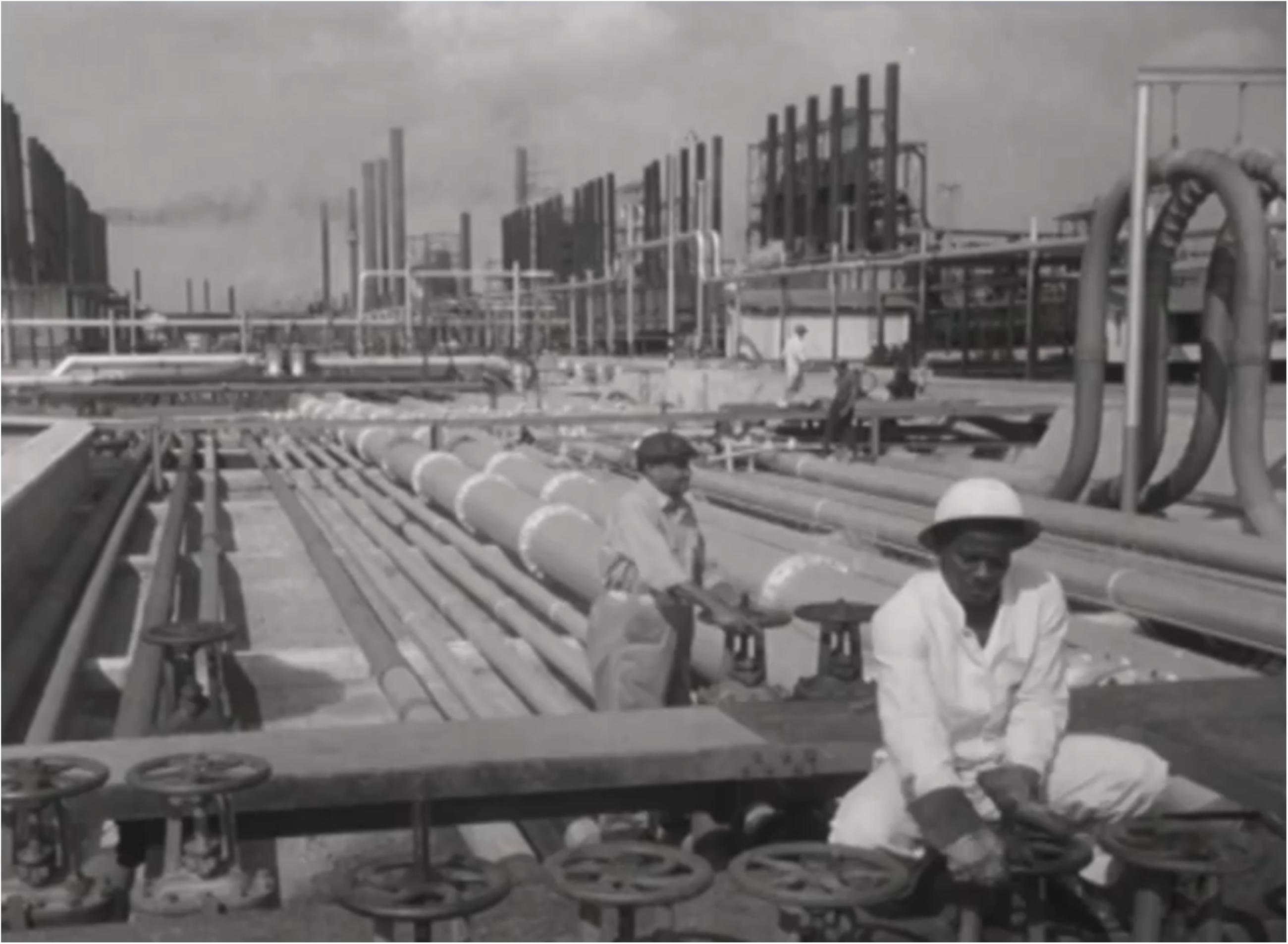
Film still Sociale zorg op de Antillen (Social Care in the Antilles)
Rather than performing hard work on the land, as we also see visualized, with people attending to the fields and donkeys idling around, the voice-over goes on to say that workers recruited by the oil refineries ‘came into contact with a modern industry for the first time’. From the images that fetishize the oil industry we get the impression that workers find themselves in an efficient, tidy and neat environment, where one can wear crisp and unstained white uniforms and sun hats. As employees, we hear workers’ hygiene was monitored through ‘regular medical check-ups’. Workers were expected to support their families, sharing meals during lunch breaks in their own dwellings: Today's generation sees its children grow up under the social care of modern society into happy and healthy people…. These people no longer live in the old slave huts. More comfortable homes are still being built for them that are functionally and comfortably furnished.
While we see women performing patriarchal duties in domestic settings, attending to children and cooking meals for their male companions, we are also offered a reminder of how the mobility regime of this racialized class of workers is restricted. As we see a group of black women reading and browsing books in a library setting, the voice-over comments: ‘A well-equipped public reading room with a lending library opens up the feelings and thoughts of other peoples for those who may have never left the shores of this island.’ Here we are reminded of a particular ‘logic of constraint’ (Mongia, 2018), which intends to restrict physical mobility of island dwellers, who with the new public–private investments are offered new means to travel beyond their region only in their imagination, and not in person. Sociale zorg op de Antillen thus represents possibilities in its specific framing of the advances brought about by the oil industry while containing the physical immobility of local black workers from the Caribbean.
The 11:26-minute film Aruba in de Branding (Aruba in the Surf) symbolically represents a different mobility regime, see Figure 2. As an example of ‘migration propaganda’ (Ghosh, 2021: 179) this film directly addressed white middle-class viewers in the Netherlands, possibly in a bid to entice them to consider moving to overseas Dutch territories and benefit from the new attractive possibilities offered by industrial colonization. Rather than focusing on the radical changes brought about in the lives of black workers, the film celebrates the allures and pleasures or ‘logics of facilitation’ (Mongia, 2018) post-Second World War colonial life could bring to middle-class Dutch settlers. This story is framed by opening and ending shots of rock caves in Aruba, and the petroglyphs made by indigenous people. In contrast to the shots of empty fields and dry soil, accompanied by a voice-over announcing that an ‘ancient people maintained itself in a harsh but balanced existence’, we see shots of modern infrastructure of transnational and local mobility. We hear: ‘With the arrival of modern industry, the natural calm of the island was disrupted.’ Shots are included from the airport, a taxiing plane is shown which comes to standstill. This shot is followed with one showing white people descending from the plane. What is followed is a depiction of idealized suburban life.
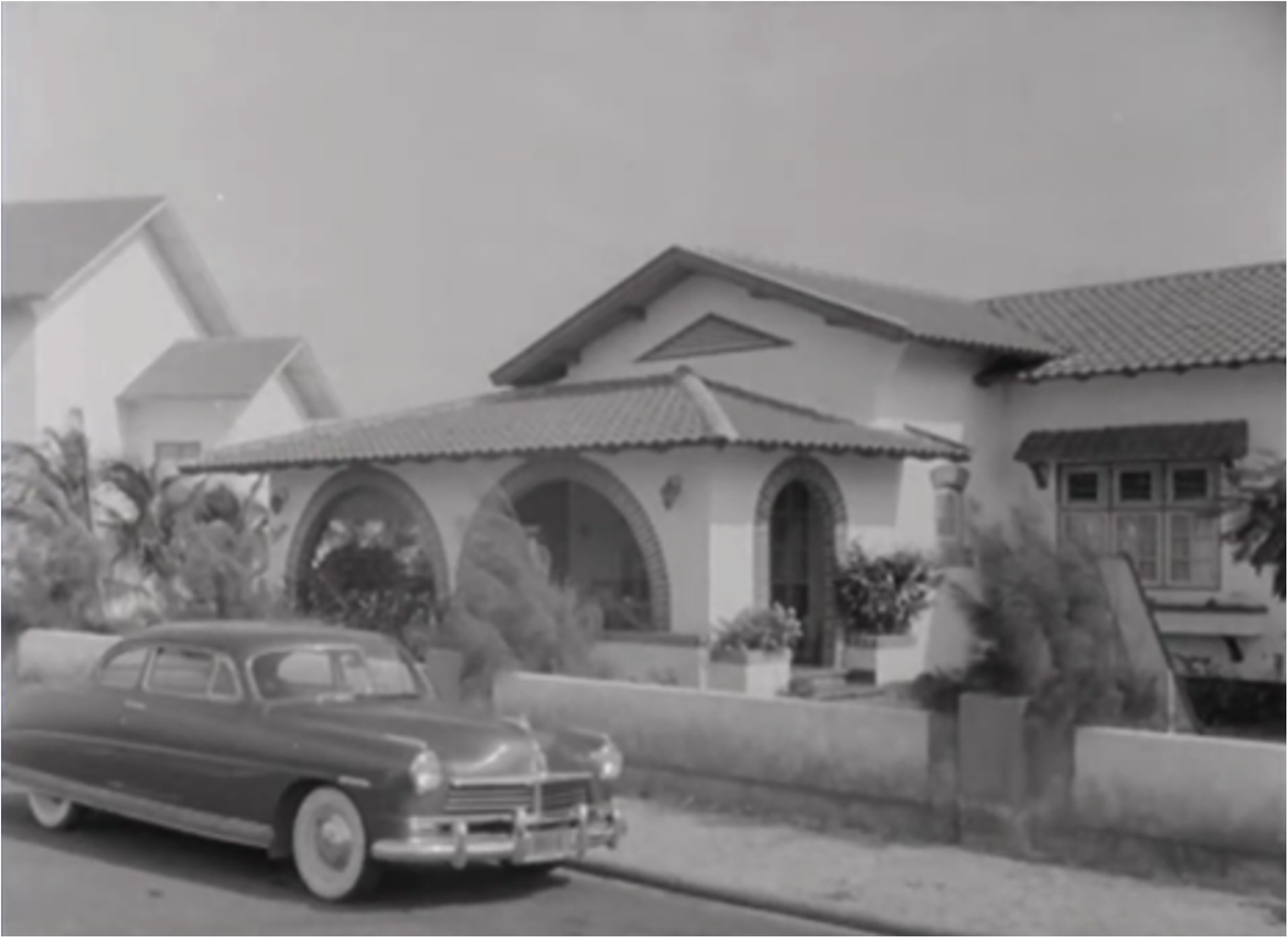
Film still Aruba in de Branding (Aruba in the Surf).
While we hear from the voice-over that the ‘capital Oranjestad is growing rapidly, and simultaneously with its new residential areas, public buildings, churches, banks, offices and schools are being built’, we see visuals of modern buildings such as the bank, church and school with white workers, churchgoers and children. Large homes, wide streets and parked automobiles are shown offering sharp contrasts to the more modest and densely populated accommodation depicted for the black oil refinery workers in the Sociale zorg op de Antillen documentary. This film incentivizes white Dutch audiences with its images of attractive city life – cars lining up, women going shopping for clothes, as well as a café culture scene showing men raising their glasses in a café, with a jukebox visible in the background. These are juxtaposed with images of rural settings, where we see dust roads, people idling, donkeys transporting goods and black farmers tending to their fields. These images are presented alongside a voice-over describing ‘the “kunuku”, the rural Aruba, which has maintained its age-old way of life’.
In addition, we see a group of white men and women enjoying their time playing volleyball at the beach in bathing suits, with a palm tree and surf serving as an idealized backdrop. ‘A modern beach life has emerged at the previously deserted beaches’, the voice-over announces, accompanied by what appears to be a black youngster who gazes upon the white people playing at the seafront while being fully clothed. Alongside focusing on modern infrastructure and leisure, the representational regime perpetuates a mobility regime of white elite, middle-class people who have access to automobiles, leisure time and are able to travel easily between Europe and the Caribbean using steamboats and aeroplanes. The public–private constellation of the Filmstichting West Indië thereby depicts a colonial sublime based on infrastructural modernity in relation to forms of aspirational transnational – and upward social – mobility for the people depicted. Overall, the Filmstichting's films aimed to capture promise and ideals, as is also evidenced in one version of the archived filmscript of the documentary Brug van Willemstad (Bridge of Willemstad), where we found a hand-written note: ‘this ending is not very successful, more enlightenment is required’.
The media operations of the Vereniging revolved around circulating zines to its membership, initially the Mededelingenblad and later on De Koerier. The logos of both zines included an outline of the territory of Suriname, including the Suriname River in the middle of the country, after which the country was named. While the Medelingenblad featured dots in recognition of major Suriname settlements (see Figure 3), De Koerier featured a pigeon to signal its journalistic ambitions (see Figure 4). Analysing the contents of these zines, like the documentaries, resembles the opening of a time-capsule. What is specific about the zines is that they offer a ‘portal back in time, but also […] examples of history being created’ from the perspective of a bottom-up social movement (Robinson, 2018). De Koerier aimed to offer ‘commentary on developments’ around the ‘economic, political, social and cultural developments in Suriname’ and ‘other parts of the world’. As Heilbron (2019) also points out, the Vereniging actively sought to challenge the hegemony of Dutch culture, and used their zines as a means for emancipation by claiming the power of definition over affairs that concerned Suriname and Surinamese people at home and in the diaspora: The cultural policy of the current government differs only slightly from those of the former Dutch rulers. Eegie Sanie [Sranan tongo for ‘Our Own things’] seeks to preserve and ennoble all that which belongs to the Surinamese People because they know that a people which lacks an attachment to their own values, is a people adrift. […] When we point this out, people will probably think that it is in our intention to fight against Dutch culture in Suriname. However, this is an optical illusion. We are not fighting against something, but for something. Our association is not directed against the over-valuation of Dutch culture, but strives to teach the Surinamese to appreciate their own culture.
12
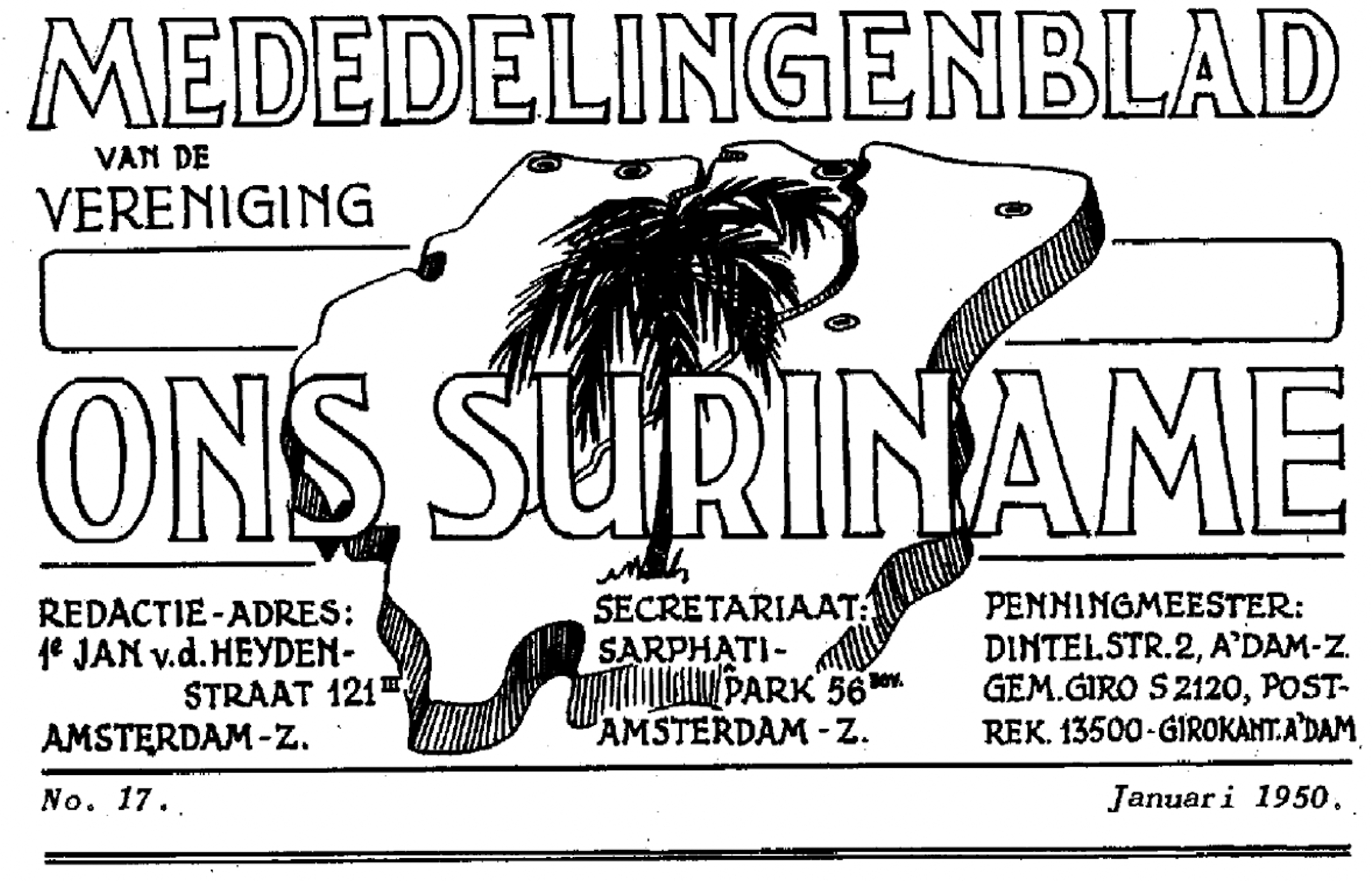
Logo Mededelingenblad van de Vereniging Ons Suriname (Our Suriname Bulletin; see note 18)
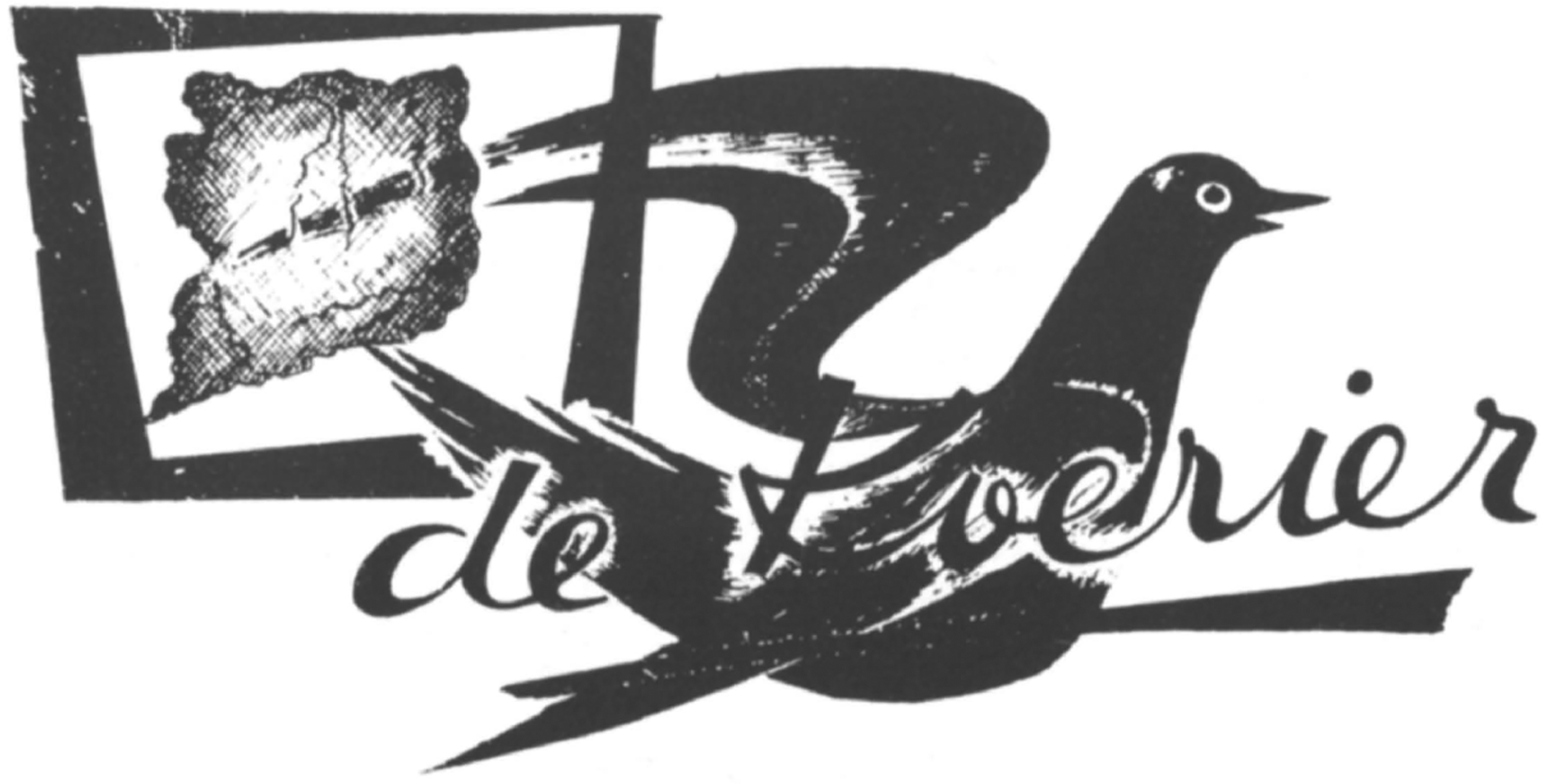
Logo De Koerier (The Courier; see note 19)
With De Koerier and other initiatives, the Vereniging sought to provide means to gather as a community and speak back to power. For example, in an editorial commentary contributors challenged how Surinamese people were predominantly represented in the media: it is ‘evident that here one does not hear the voice of the Surinamese people, but that the system, under which Suriname has lived for almost 300 years, has been reformulated’.
13
Contributors to the zine carefully crafted their writings; in fighting ‘for’ Surinamese community and culture they had to tread a tightrope for fear of drawing unwanted attention from the Dutch intelligence services. The dual emphasis of inward and outward communication, while not seeking to alarm authorities is commonly observable across various issues of the zines. This stance is also apparent in the review Vereniging Ons Suriname board member T. Dijkstra wrote about the Filmstichting West Indië documentary covering Suriname in the Mededelingenblad van de Vereniging Ons Suriname as a tried and ‘old recipe’: It must be said that we have never had a film about Suriname in our hands which was of such a technically advanced standard and which came with a soundtrack. My criticism is certainly not intended as a disapproval of these films in their own right – which are of great value to the Dutch audience – but I have to express my disappointment about the fact that we, insiders, are not provided with any new points of view concerning Suriname.
14
The film, Dijkstra recognizes was of an ‘advanced standard’, meeting the expectations of the Dutch audiences, but not addressing concerns and interests of her readership of fellow Surinamese viewers. The zines offered elaborate anti-colonial cultural critiques of the dominant representational regimes. Dijkstra's critique of the documentary propaganda film can be understood an example of an early postcolonial conceptual toolkit offered by the Vereniging Ons Suriname zine makers to their intended audience. Readers were, for example, also trained to reflect on how colonial educational (and, by extension, representational) regimes resulted in the mis-education of the mainstream white Dutch population: Colonial education […] is directly aimed against the history of the people, historical facts are falsified, the history of the people is completely supplanted by that of the motherland, or it is simply ‘obscured’. National heroes become criminals and terrorists, while the colonialists are presented as paternal, humane, more highly educated and sometimes even elevated as national heroes of the colonized people.
15
In 1955, Suriname ceased to be a Dutch colony; it remained a part of the Dutch Kingdom until independence in 1975. In this period De Koerier was taken up as a platform where the degree of Surinamese autonomy could be quesitoned. Importantly for our argument, the Dutch state being in charge of the mobility of Surinamese people is a particular focus of scrutiny. In an anonymously published editorial, it was critically stated: ‘Suriname is now presented (on paper) as an equal part of the kingdom, where, however, a non-Surinamese can determine who behaves properly and who is politically unfavourable.’ These criteria underpinned the Dutch mobility regime, as they were used by Dutch officials to distinguish between those eligible for travel between Suriname and the Netherlands, and those who were not eligible. In the editorial, Surinamese in contrast are invoked as ‘citizens of the world’, as a basis for raising critical questions about how ‘it is possible that in Surinamese part of the Royal Dutch empire, a Dutchman can decide which country's children may repatriate’. 16
The analysis presented above illustrates how media operations are not a neutral vessel offering transparent, direct evidence of particular events. Instead, content circulated is always reflective of collective experiences and ideological decisions. Documentary propaganda film and zine makers do not somehow stand outside of the social world, but their work reflects their positionalities. As such their representational regimes reinforce particular socio-cultural, economic and political notions of what is normal and abnormal, in this case in particular we learn about which forms of mobility and immobility are normalized and expected for particular racialized groups.
Receptions of media operations
In this final empirical section, we address how both media operations were received by journalists as well as security agencies. A typical review of Filmstichting West Indië documentaries emphasized how ‘forgotten territories’ were successfully brought to the attention of the Dutch wider public. Typically, the filmmaker crew media operations were celebrated as forms of conquests overcoming strong hurdles and obstacles, for example, ‘They have not shunned the wild interior of Suriname, this resulted in a very detailed report about the doings of the indigenous population, illustrating the primitive way of life of the Surinamese.’ 17 Reviews commonly include attention to the aesthetic finesse and innovative craftsmanship of the makers: ‘the filmmakers also turned out to have a sensitive eye for small, fine features, and managed to avoid the always threatening monotony of the documentary genre through an original vision’. Not only were genre conventions playfully challenged and extended, the focus on lived experience in relation to modern infrastructures appealed to the audience. For example in reviewing Aruba in de Branding ‘a touch of romance and appropriate combination of images of seas and ships, of rocks and caves, of jungle and rapids … fully exploited the filmic possibilities presented by the truly gigantic apparatus of the oil refineries’. 18 As such, the documentaries were successful propaganda media operations, and contributed to the ‘promotion of Empire within empire’ (Tampoe-Hautin, 2021: n.p.). Their representational regime sought to re-establish a status quo, which implied a mobility regime would legitimate, entice and facilitate movement of white entrepreneurs and farmers from the colonial centre to the periphery, which was a racialized and unidirectional path, as it was not intended for Surinamese to pursue opportunities in the Netherlands.
Criticism of Surinamese living in the Netherlands voiced in the zines of Vereniging Ons Suriname Surinamese apparently also influenced mainstream public debate. For example, the Catholic newspaper Het Binnenhof, reporting from centre of political power in the Hague, noted: what the camera has recorded there has undoubtedly been rather simplistic for insiders, but it is crafted so refreshingly and is so full of sunny optimism that one has to be a terrible Nurks not to get in the right mood, when one sees the West like this.
19
In their reporting, journalists thus seem to engage in dialogue with critiques coming from the Surinamese community in the Netherlands. The media operations of the Vereniging and the Filmstichting did not go unnoticed by the Dutch security agencies. In recently declassified archived materials, we can find extensive diligently typed observational reports from the Binnenlandse Veiligheidsdienstt (BVD, Dutch Homeland Security) about both the Vereniging and the Filmstichting. ‘The “N-word” feel disadvantaged’, 20 the BVD recognizes, in its reports about Vereniging Ons Suriname and reports covering Surinamese living in Surinam and in the Netherlands. 21 The BVD profiled the organization, its board members and its publications. For example, a report on Activities of Surinamese Nationalists in the Netherlands, dated 6 December 1954, assesses De Koerier and Vereniging Ons Suriname board members. The report classifies the association and zine as politically motivated, ‘geared to nationalistic feelings and aimed at national liberation as well as the so-called reconstruction of Suriname’. 22 The surveillance persists; for example, in their classified monthly report of March 1957, attention is paid to the challenging financial situation of the association and De Koerier, as the potential risks of the association’s communist orientations. 23 Reports detail the communist leanings of board members, such as Otto E.G.M. Huiswoud, who is also the editor for De Koerier. Reports state ‘nothing unfavourable known’ about female Vereniging Ons Suriname board member T. Dijkstra, who we quoted throughout this article, while, for example, treasurer W.L. Hing is assessed as follows: ‘wouldn’t hurt a fly’. 24
The archives of the BVD, however, do not only contain reports on the Vereniging Ons Suriname. Records show that the Filmstichting West Indië should not be seen as a homogeneous entity uniformly supporting hegemonic colonial power. For example, the expedition crew included people who questioned the role of the colonial Dutch state. In a declassified 7 November 1947 Report of Attorney General at the Court of Justice to Johannes Cornelis Bron, then Governor of Suriname, the security threat resulting from the film expedition to the Surinamese areas around the Marowijne, Lawa and Tapanahoni rivers were detailed. 25 Here the profile and actions of one key crew member, L.J.A. Van Dijk, who joined the expedition in his role as the producer for the Filmfabriek Profilti, and who also acted as representative of the Film Department of the Ministry of Education, Arts and Science, were covered in great detail.
He was observed during the film expedition and he was found to be ‘anti-military, a fierce socialist, and advocate of the liberation movement’, and it was noted he acted ‘more Surinamese than the Surinamese’. Moreover, ‘on several occasions [he] offended the Governor […] and the Dutch flag’, while particular details were provided on his encounters with indigenous groups: ‘with the bush-N-word he crossed the line, he spoke with them about autonomy, and made the Djoekas
26
feel that he saw them as his equals’. Van Dijk was observed to disobey protocols and expectations: ‘when he had the chance he conducted separate meetings with village heads and other important people in the bush-N-word society’.
27
In the commentaries on filmscripts we found in the archives, Van Dijk's personal input on the plans for the film on Suriname, titled De Strijd om de Bodem (The Struggle Over the Soil), has been preserved: in connection with Surinamese sensitivities, different types of the agricultural population must be shown: Creoles, Javanese, Dutch. There should be as little talk as possible about the new Dutch farmers, destined for Nickerie, partly because they are not there yet, and about further Dutch agricultural initiatives: Suriname certainly does not like that.
28
This commentary illustrates Van Dijk's hesitations over being co-opted for the state's dominant propagandistic representational and (im)mobility regime, showing the cracks in the state colonial project, which would eventually collapse with the independence of Surinam two decades later, on 25 November 1975.
Conclusions
Based on unstudied archival material, in this article we offer a reading of two historical cases of the media operations that negotiate regimes of (im)mobility at a moment of postcolonial transition of the Dutch colonial empire. Understanding the activities of Filmstichting West Indië and Vereniging Ons Suriname as media operations – as persuasive, strategically planned productions and engagements with regimes of representation – our examination of their organizational structures and actors involved, the content they produced, and its reception demonstrates how the groups’ communication activities both legitimated, co-constructed, and challenged regimes of (im)mobilities at the time. In interpreting these media operations on the levels of the operators, content and reception, it is important to dissect the different positionalities held by the actors involved within regimes of representations and regimes of mobility. Producers of state-funded documentary propaganda films and anti-colonial community organizers can engage with regimes of representation and regimes of (im)mobility from very different power positions. Holding different financial, social, cultural, and political capital, the media operations of Filmstichting and Vereniging engaged in an asymmetric dialectical negotiation of meaning-making over (post)colonial relations and mobilities.
The fact that Vereniging Ons Suriname ended up under surveillance indicates that the Dutch state acknowledged the organization was accumulating power, by revealing a fear that their activities, including their media operations, could substantially challenge colonial mobility regimes. Thus, what Doreen Massey (1993) calls the ‘power-geometry’ of mobility, namely that different social groups relate differently and asymmetrically to the flows and movements imposed on them by modern mobility regimes, extends to regimes of representations as well: ‘some are more in charge of it than others; some initiate flows and movement, others don’t; some are more on the receiving end of it than others; some are effectively imprisoned by it’ (Massey, 1993: 62). Our analysis shows, that this holds true in an intersecting way for the movement of bodies as well as symbols, for regimes of representation and of mobility, within which different actors constantly (re)construct and seek to consolidate specific, yet multiple, relations of territories and bodies.
As, notably, neither regimes of representation nor regimes of mobility are inherently not set in stone, yet constantly articulated and materialized anew in their entanglements, any understanding of these regimes must include (the limits of) their challenging. In that sense, this article contributes to a critical (pre-digital) historiography of ‘(post)-migrant media’ resistance, as Jacobs termed media products through which ‘(post)-migrant subjects resist the material, legal, epistemic, and symbolic violence produced through these categories’ (2022: 1) in the case of France. The Dutch cases discussed in this article equally point at a longer history of mediated resistance against regimes of representation and regimes of (im)mobility from the grassroots level, indeed pre-dating the main academic discourses of postcolonial critique and theory which gained prominence in the 1980s, showing how key anti-colonial, liberatory terminology and acts of resistance can be observed from at least the late 1940s and 1950s. These early voices did not always fall on deaf ears, as the Dutch state surveillance archive also reports on members of the Filmstichting West Indië expeditions who were sensitive to the concerns and perspectives of Surinamese communities.
Ultimately, this observation underlines an asymmetrically dialectical perspective on (post)colonial media history, where media operations stand central to articulate and resist against relations of (im)mobilities within regimes of representations. Werkmeister's (2016) calls for a postcolonial media history, which acknowledges that specific media techniques, e.g., alphabetical writing, photography, or cinematic film, are ‘media-historical constellations’ which as a ‘condition and origin’ are ‘directly interwoven with colonial history’ (238). Our analysis further scrutinizes how media operations are both crucial for ‘experiments in observing, recording and describing the non-European Other’ (253), as well as are sites of postcolonial, subaltern resistance and community organizing in opposition to such regimes of representation. And ultimately, this imbalanced power-geometry of mediated representations is both structuring and structured by which and whose mobilities are possible and desired in different ways.
Footnotes
Acknowledgements
We are grateful for the support of Bas Agterberg, who in his role as curator at the Netherlands Institute for Sound and Vision was of great help in locating relevant archival material. In addition, through crowd sourcing on social media we accessed relevant audio-visual material from personal and community archives. Two peer reviewers provided generous and inspiring feedback on a previous version of this article, which helped us sharpen our argumentation.
Funding
The author(s) received no financial support for the research, authorship, and/or publication of this article
