




Abstract
This article was written collectively in the spirit of the commons and homemade, do-it-yourself (HADIY) creativity. It is animated by the observation that the once-radical suggestion of Raymond Williams that culture is ordinary forms the ‘commonsense’ of cultural studies. However, it argues that this remains a blind spot in the landscape of cultural policy and the creative ecology, especially as it pertains to the everyday creativity of ordinary people. The article is inspired by critical (re)engagements with sites and spaces in cultural studies which is evidenced in our work on the generative complexities of HADIY practices and sites across Australia. It derives its insights from the bounded space of a creative workshop led by zine-maker Cora Zon facilitated by the co-authors and in which they participated. Cora guided attendees through a range of introductory creative techniques to make their own zines and learn about HADIY culture. The article reflects on the zine-making workshop as a potential commons space, illustrating its insights with pages from a zine which was collectively created following the workshop and available as supplementary material to downloaded, read in physical form, preserve and share. The zine presents some of the possibilities of the form and further imagines the themes and experiences documented here, challenging the reader to ‘do-it-yourself’.
Prologue
The once-radical suggestion of Raymond Williams that culture is ordinary now forms ‘the disciplinary commonsense’ of cultural studies (Kay, 2021: 1011) yet remains a broader blind spot within the cultural policy landscape. We see this at play in Revive, the Australian Government’s National Cultural Policy, the title of which signals its approach to invigorate the cultural sector post-COVID. Despite welcome engagement with some dimensions of First Nations and other nationally marginalised communities, Revive focuses overwhelmingly on professional artists, major cultural institutions and their audiences. As such, Williams’ work – especially his belief in ‘the creative capacities of ordinary people’ (Kay, 2021: 1011) and grasp of the significance of the ordinary (Williams, 1989 [1958]) – remains animating for research on prosaic creativities and everyday cultural participation against and alongside publicly-funded and commercial spheres of cultural and creative industries.
So too is the concept of the commons. Reflecting on cultural studies and/from/of the Global South, Fong and Lin (2024: 5) explore cultural commons as sites which exist ‘both inside and outside the system’ to consider ‘a vision of community-based commoning from within’. From this work, we see that critical (re)engagements with sites and spaces offer much inspiration and we take up this approach in our work on the generative complexities of homemade, amateur and do-it-yourself (hereafter HADIY) practices and sites across Australia. Here, we begin by thinking through a more bounded space: a zine-making workshop. Led by zine-maker Cora Zon, this open workshop was held in mid-2024 in Melbourne, Australia, as part of an annual festival held at an Australian university. Cora guided attendees through a range of introductory creative techniques to make their own zines and learn about HADIY culture. Here we reflect on the zine-making workshop as a potential commons space and consider what we have learnt about commoning from the workshop.
The images which punctuate this text are pages from a zine which we collectively created following Cora’s workshop (see Figures 1-7, below). A supplement to our thoughts and reflections here, the zine can be downloaded and read in physical form as per the instructions in Figure 8 (below). The zine presents some of the possibilities of the form and further imagines the themes and experiences documented here.
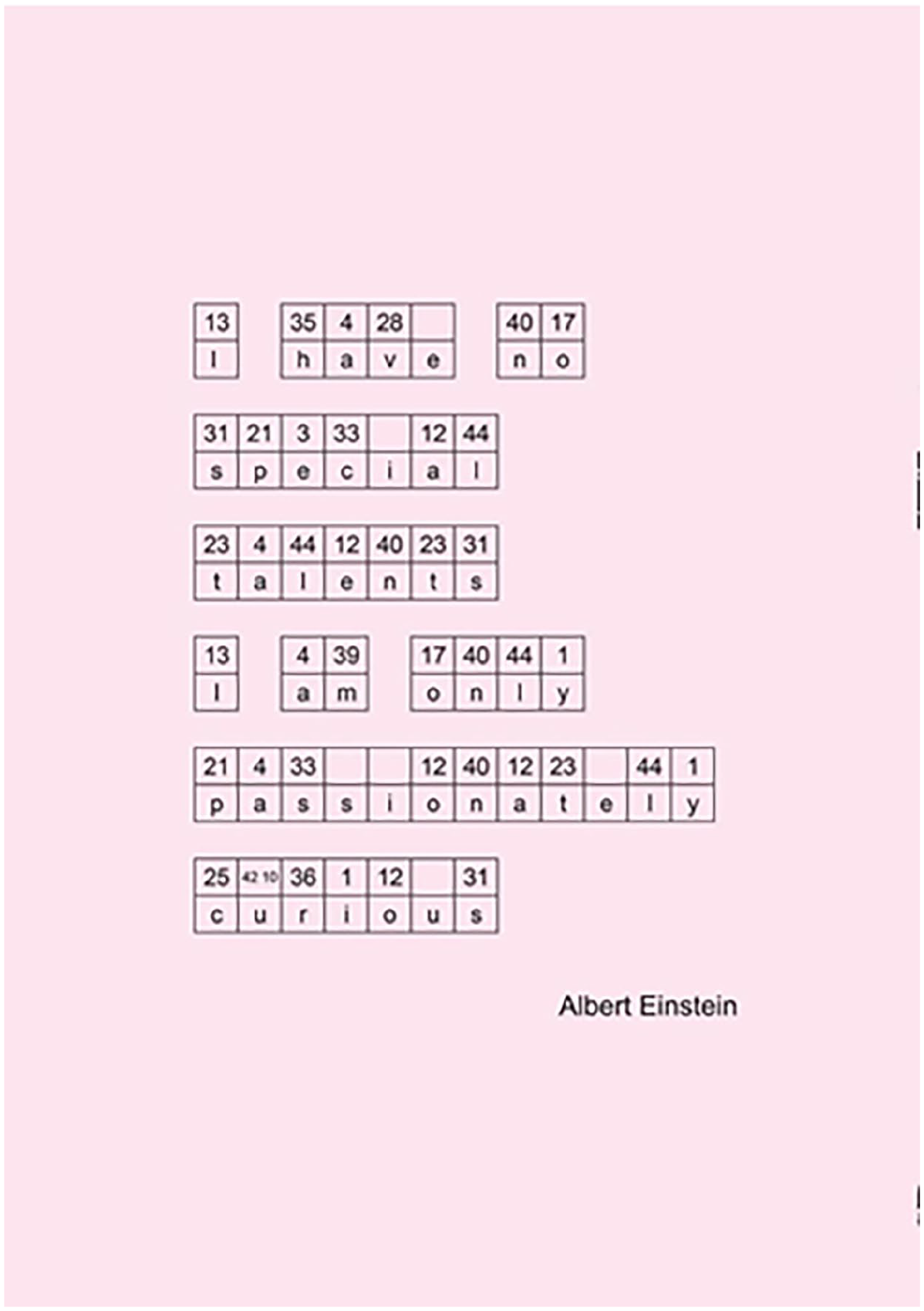
Authors’ zine page [see accompanying zine in supplementary material].
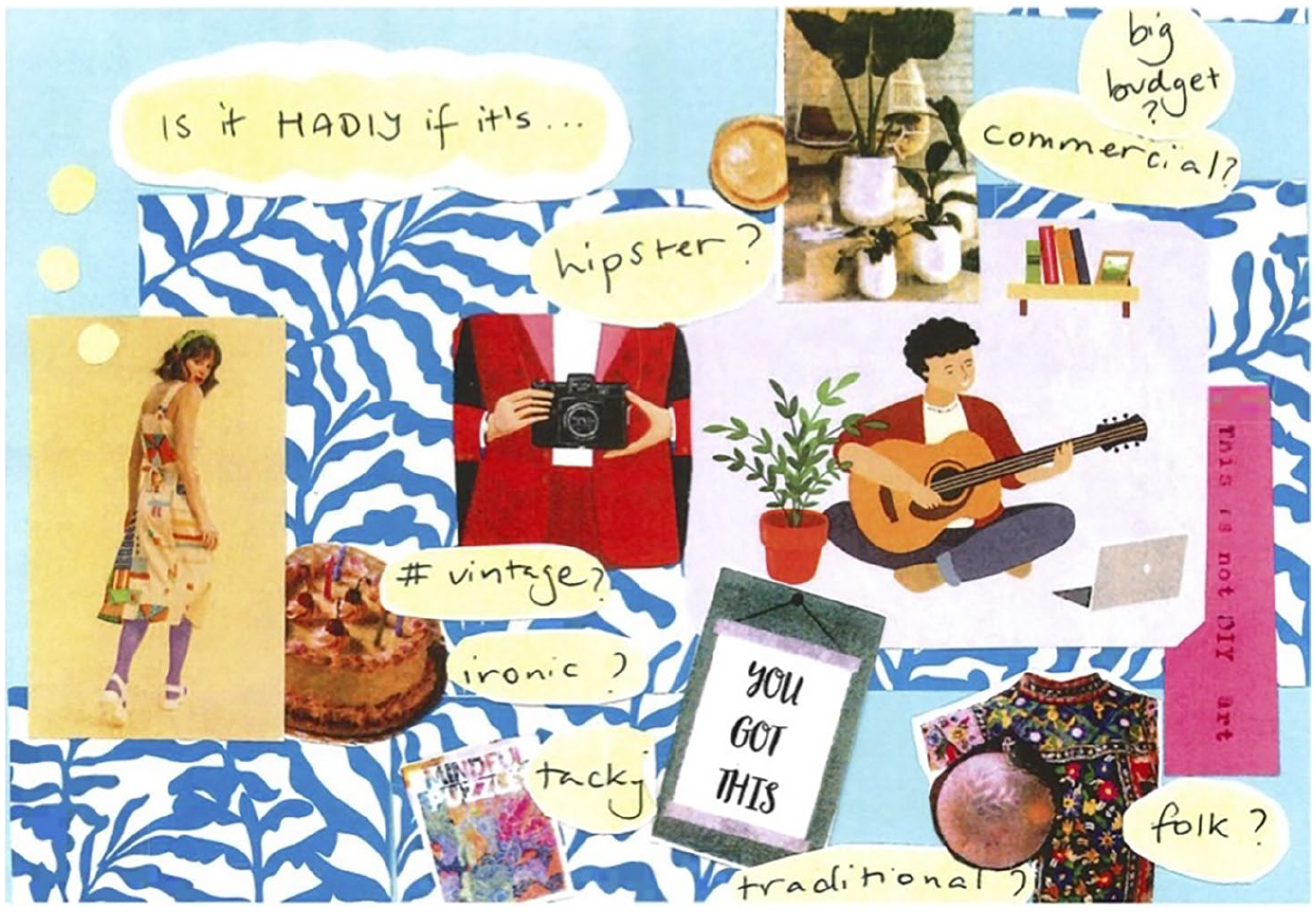
Authors’ zine page [see accompanying zine in supplementary material].
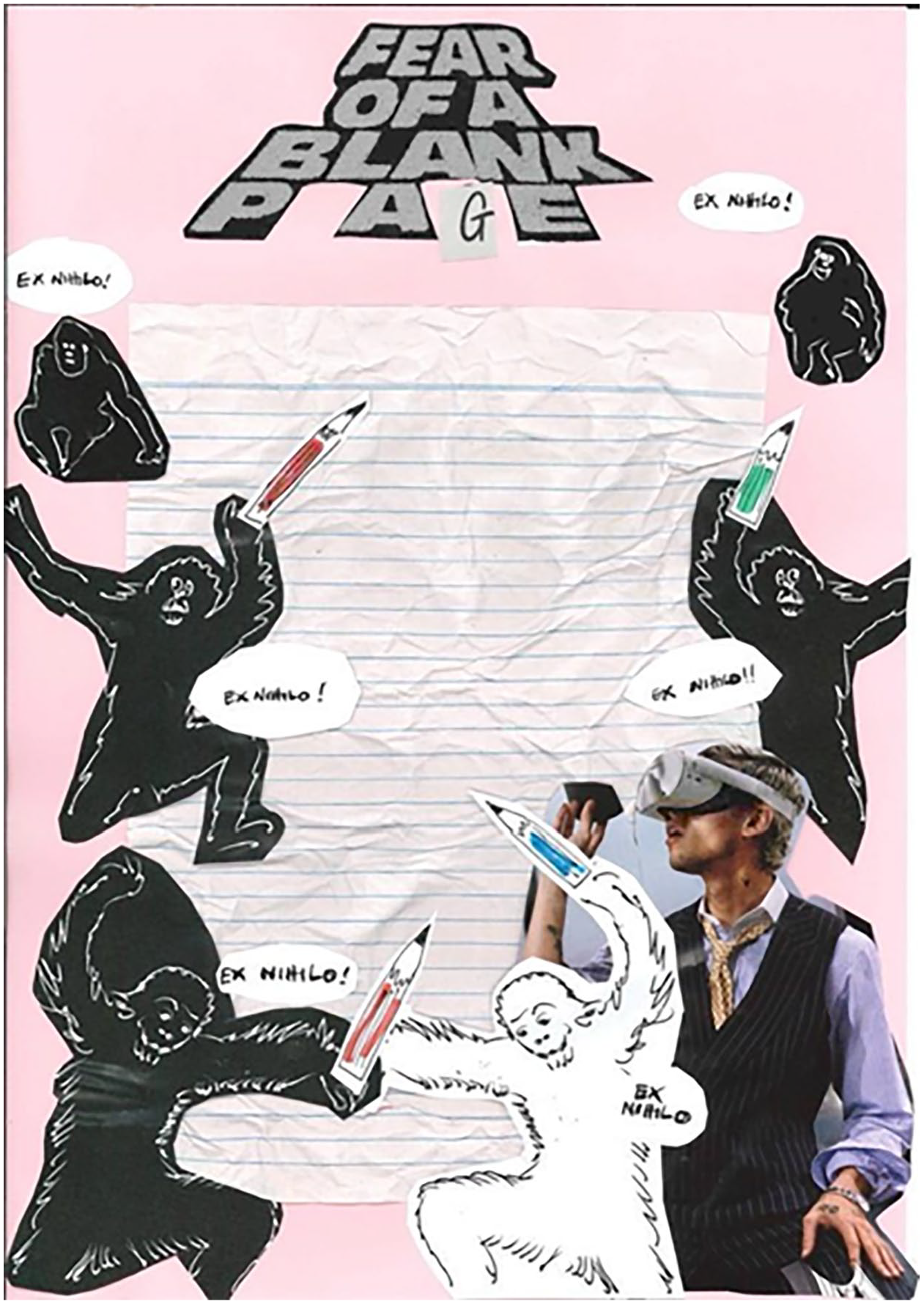
Authors’ zine page [see accompanying zine in supplementary material].
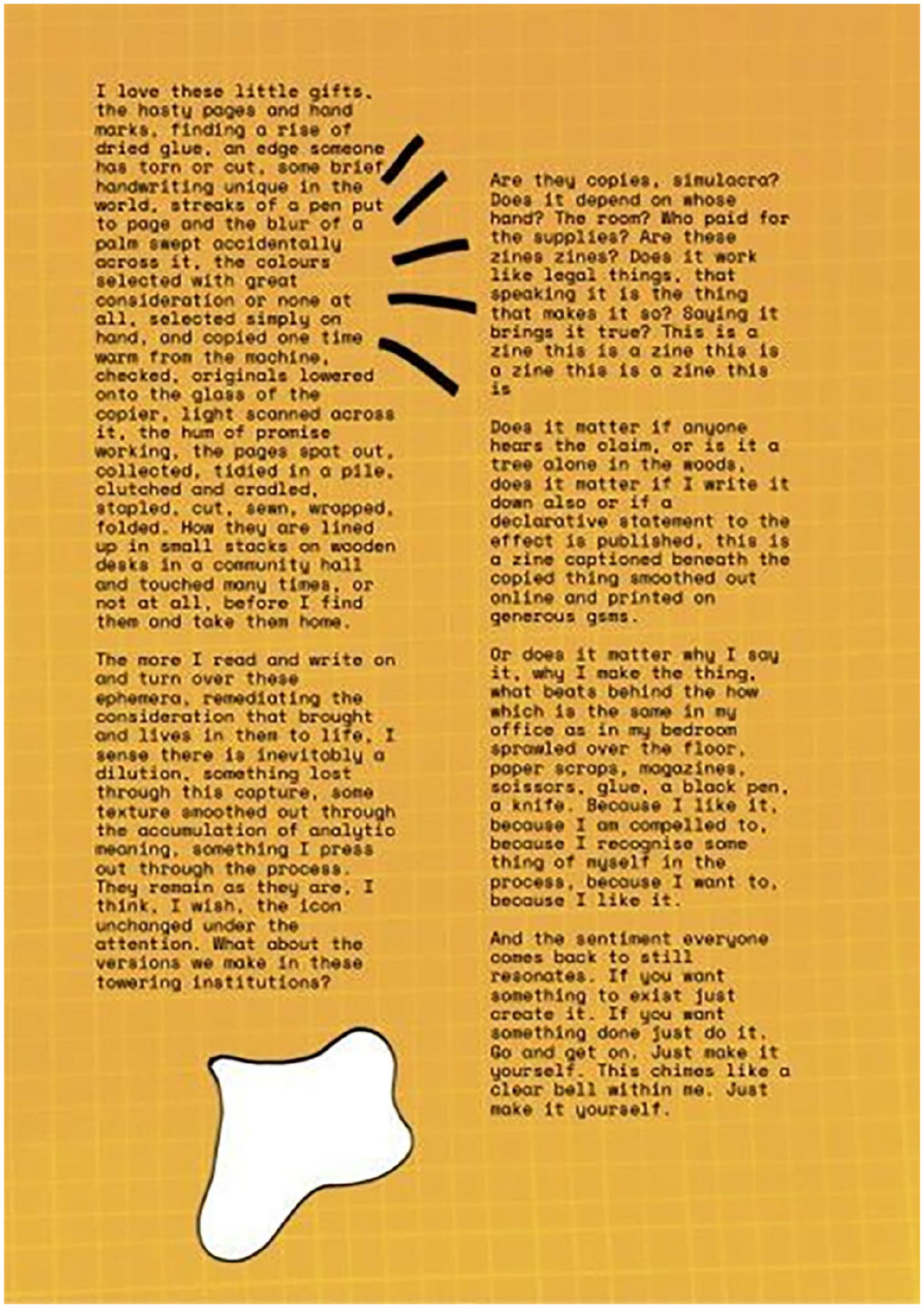
Authors’ zine page [see accompanying zine in supplementary material].
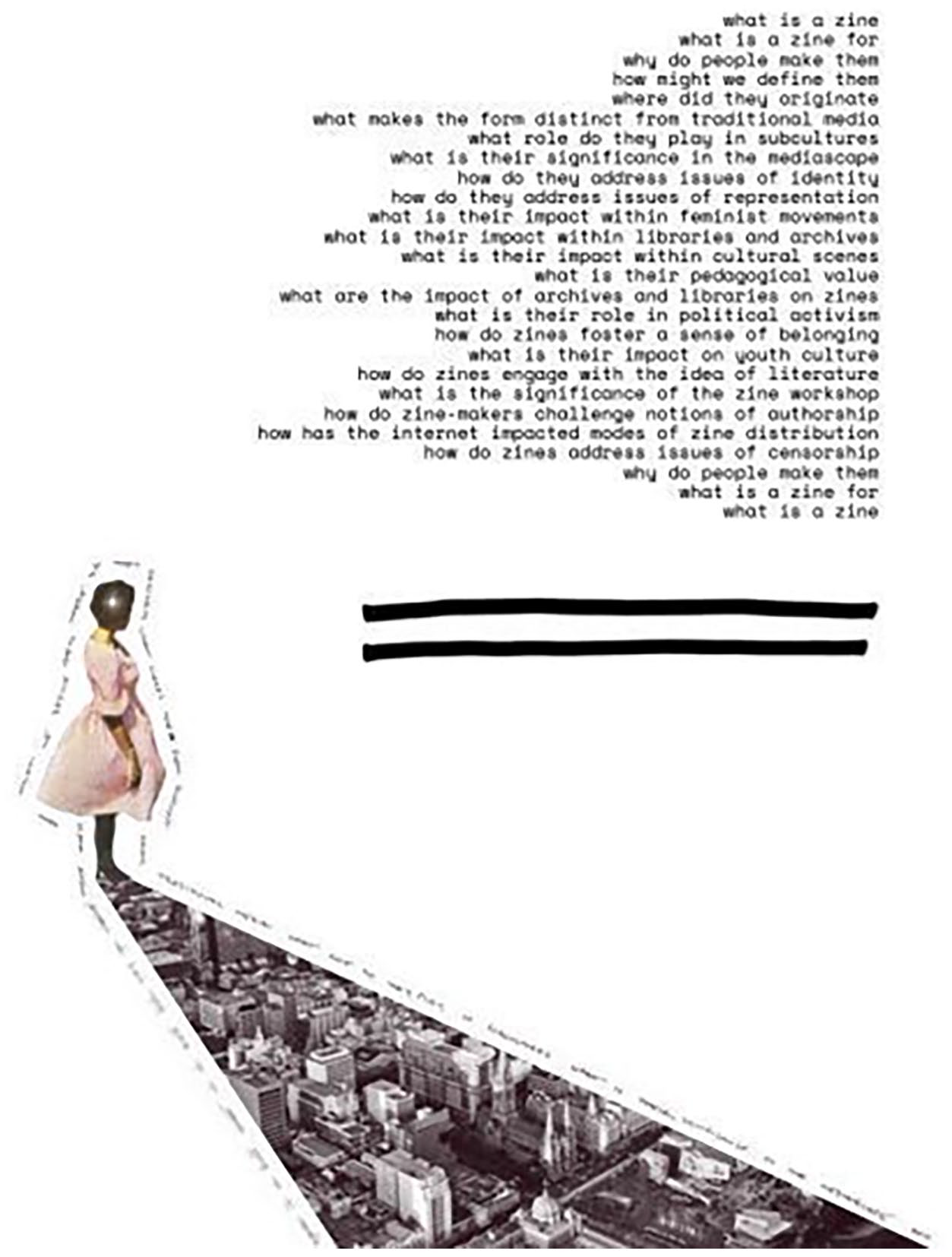
Authors’ zine page [see accompanying zine in supplementary material].
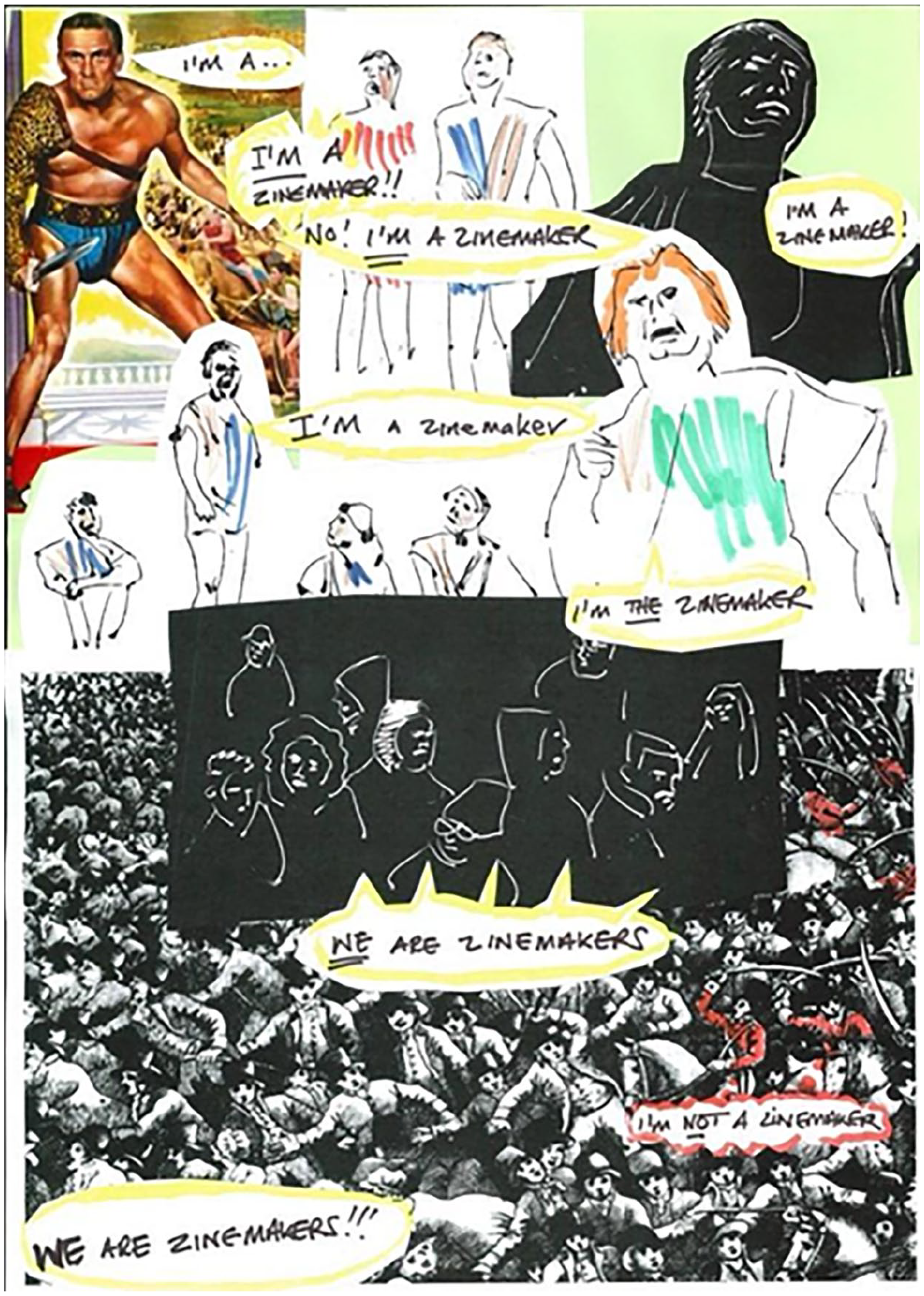
Authors’ zine page [see accompanying zine in supplementary material].
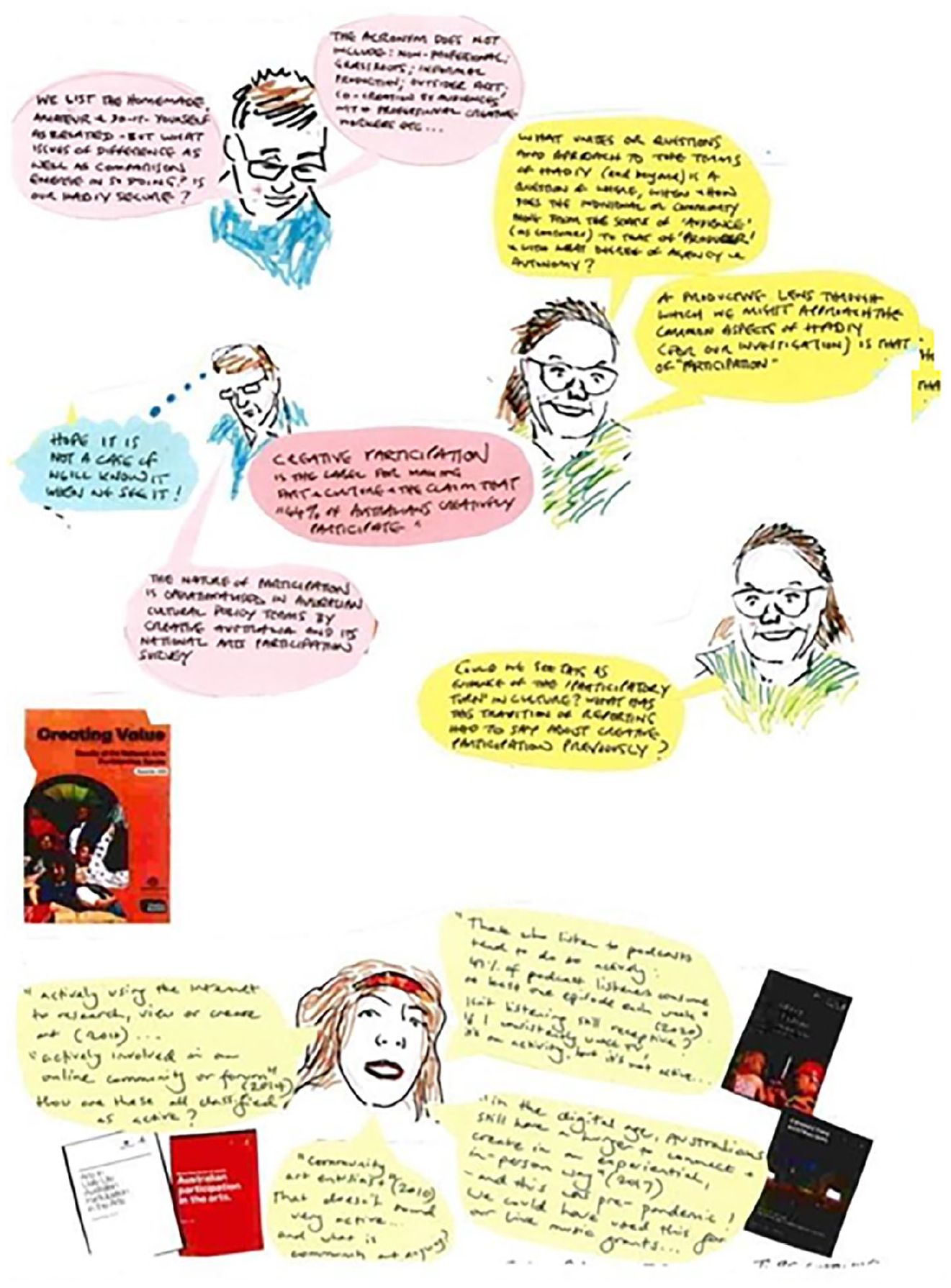
Authors’ zine page [see accompanying zine in supplementary material].
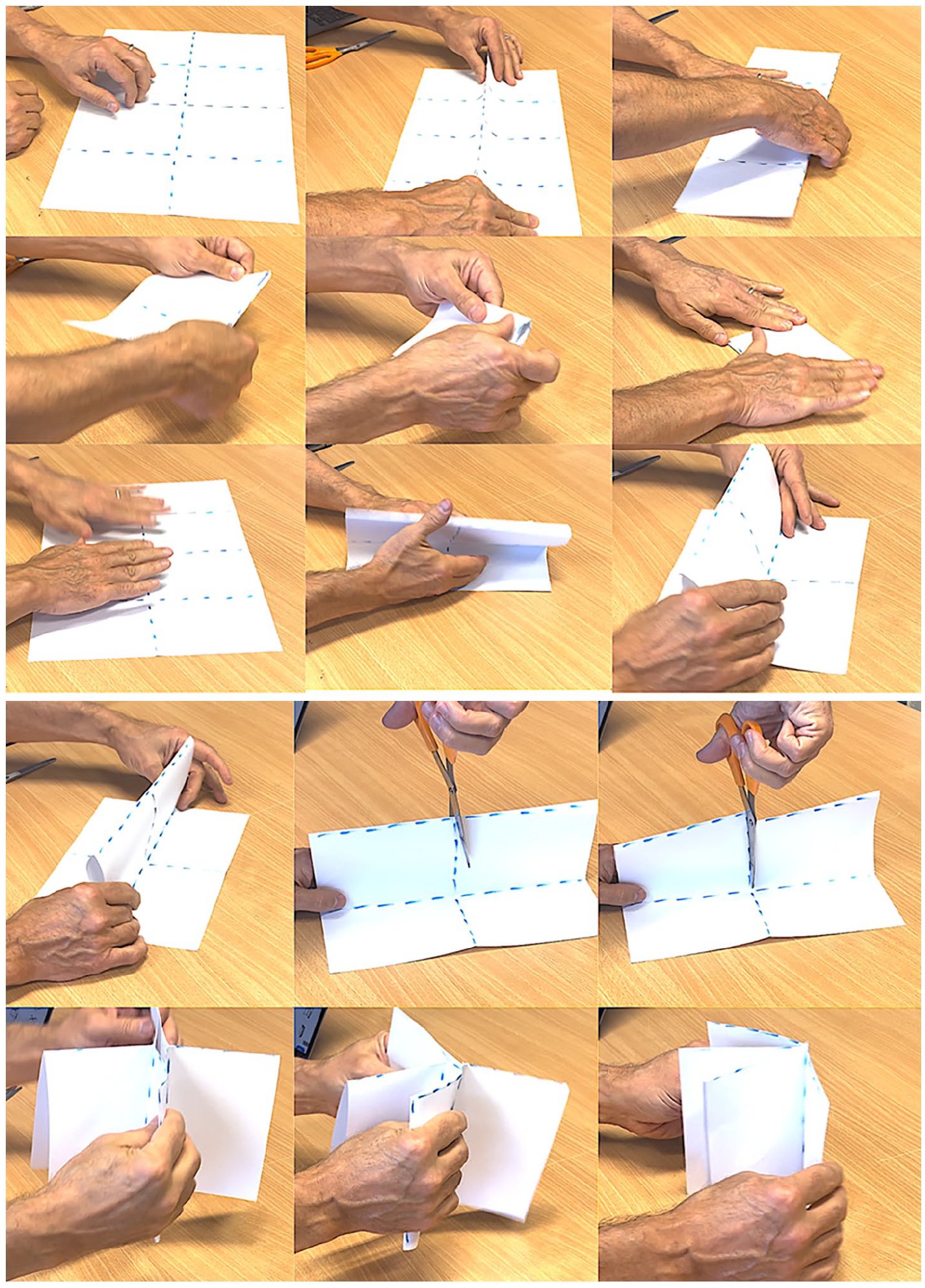
Take an A3 sheet of paper, fold it three times to make eight compartments on the sheet. Pinch and cut down the centre line. Fold to make an eight-page zine. Cut, paste, draw on the page at any time to create content. Alternatively make separate pages and edit them together or make your own rules.
Zine-making: the process
In Cora’s workshop, we each produced our own personalised zine. A myriad of subjects, perspectives and colourful responses to the injunction to be creative; every document sui genris, yet conversely and recognisably a zine for the fact that each worked from an A3 piece of paper, folded and cut to create a physical template. A stack of magazines and newspapers had been scoured for inspiration, images and headlines appropriated, torn out or cut up and pasted as collage, background or newly configured statement and sign. Old bodies were given new heads, hands or legs, floral displays and borders decorating pages, typefaces reconvened to be vaguely reminiscent of the ransom-note style. Some drew and sketched their own images alongside the found materials. Some eschewed prose completely, others wrote up their inspiration, individuation expressed by handwriting and calligraphic expression.
Cora had brought a typewriter along. It remained untouched for the first half of the workshop, but eventually one participant proved a brave explorer and soon there was a line for the machine, for developing prose or playing with the figures and rhythms it produced from its keys and ribbon. When asked, Cora explained this choice of archaic instrument when every participant in the session was equipped with a smartphone and, most likely, a personal computer. The typewriter, she affirmed, was ‘where zines began’; while acknowledging the value of digital creativity, its presence conveyed ‘a part of the physicality of zine-making’.
We were then making zines anew while enjoining with a set of practices and challenges held in common by whoever designates that the pages they make constitute a zine. As Cora reported, her discovery of zining meant liberation from the constraints and barriers to entry of the publishing world to which she had once aspired. Zining was homemade: it could be avowedly amateur, do-it-yourself. It meant, as she said, ‘anybody could do anything: they could write, they could draw, they could do poetry. It was really open, and I really liked the freedom and the accessibility of zines’. But with freedom comes great responsibility, and the flowering of expression that could be audited at the end of the workshop had begun with the considerable and fear-inducing challenge of the blank page. Even worse, the A3 sheet, when folded, created a zine of eight pages. Eight blank pages.
For Cora, the zine is ‘just a way of expressing yourself’. A zine could be about anything – but did we have anything to express? Something about the heart perhaps, a political point of view, a cultural review? Typewriter, coloured paper, pens and pencils, glossy printed pages of magazines waiting to be torn or cut up did not make the ready pages any less blank. Cora’s method to aid us was a version of what you hear in creative writing classes, to ‘write what you know’. In this case, she offered a starting point: an invitation to list twenty things from each participant’s life ‘that they really liked, to jumpstart the creative process’, a positive and generative way to ‘tap into a space where you start to activate your imagination. Go inward a bit’. Still, that’s 20 things, but we did it: a zine of the found poetry of the printed page (at least cut up to be so); a Beatles zine built on an apparently inexhaustible fascination with the band in the media; another eight pages (maybe one or two provocatively blank), asserting ‘This is not DIY art’, assessing what might be in or out of our assessment of the homemade, amateur and DIY.
There were over 30 of us in the workshop, each departing with something that constituted a zine: our zine. Maybe some left their zines behind, unrecognisable in the heaps of cuttings and discarded pages. For those with English as a second language – the majority of our collective being international students studying in Australia from across a number of Asian countries – the zine encouraged the diversity of expression Cora envisioned: diversity of languages, experiences, styles of representation. For some students among us, this creative opportunity was one encountered long ago in their education, certainly not usually one found in the social science space. For colleagues among us, this was a happy connection to something that was not labour. We worked alongside each other, in discussion and exchange, but not together as such. After all, we could all have produced a page or two and made one super zine. While we were inevitably operating under the time constraints of the workshop and a room booking system, this was a form of production not aligned to learning outcomes, a publisher’s deadline or institutional demand. There was no assessment, peer review, audit or indeed payment required or expected from participants. The only regret was that we had no photocopier in the room to turn unique artefacts into versions for the record and, perhaps, circulation. Not to worry however; the experience was momentary; some zines are made for the ages, some to be left around and found, and some specifically for the trash bin.
Zine-making: what is a zine?
Zines are independent, small-run, lo-fi, eclectic publications that people create themselves or in small collectives to share their interests, experiences, ideas or creative work. They can be handmade, hand-drawn, handwritten, typed, collaged, photocopied, stapled and/or hand-stitched: the creative diversity of the form means zines defy easy definition, yet each possesses a recognisable iconicity that makes material a DIY ethos and enlivens the substantial histories of independent and amateur publishing which zines progress (Radway, 2011; Watson and Bennett, 2021). The zine developed its iconic contemporary form throughout the 20th century as fan communities ballooned through postal networks and media technologies such as the photocopier became widely accessible (Bennett, 2005; Duncombe, 1997; Piepmeier, 2008; Poletti, 2008). Key figures of this recent history include sci-fi magazine readers who circulated their own fanfiction and fanzines in the 1930s, and punks and riot grrrls who embraced the medium as an alternative anti-mainstream mode to share material, build networks and connect throughout the 1970s and 1990s in particular. Zines have a significant place within feminist and queer cultures and histories too, intertwined with and apart from various other (sub)cultural manifestations (Barrière and Finkel, 2022; Ding, 2024; Grinnell, 2022; Radway, 2012). While still forming around other nuclei of interest – as with 20th century fanzines where more distinct networks were tied to specific music scenes, sports teams, other cultural or political interests or marginal subjectivities (e.g. Šima, 2022) – zine communities increasingly coalesce today around a central love for the zine itself.
Despite concerns that the Internet would herald the death of the form, zine genres have proliferated, zine fairs continue to grow, and public and academic interest in zine cultures and zine collections/archives is rising. This is in part due to the new scale of peers and audiences that creators can now reach with e-commerce sites and social networking platforms, as well as the broader intertwining of – as well as resistance to – the analogue and the digital in everyday life. Even as they seem to grow in popularity and circulate via mainstream digital platforms, zines continue to move ‘on the margins’ (Chidgey, 2006: 1) and enact a handmade, alternative, HADIY practice in opposition to mainstream, exclusionary, technocratic discourses and modes of creative production (Fife, 2019). The significance of this can be glimpsed through changing lexicon within zine cultures, such as the shift from zine networks to zine communities (Piepmeier, 2008) which reflect the participatory intent and invitation of zine-making (Triggs, 2010: 209). It can also be seen in the aesthetic modalities that remain popular: small physical print runs despite the infinite readerships and ease of digital publishing; creative tools such as typewriters (or the use of typewriter-esque fonts in digitally-made zines) that are clunky and leave traces of mistakes; the continued resistance to markers of artistic quality – the kind of ‘polish’ that draws acclaim within art and wonder fields; and the primacy of the hand-held experience of creation, acquisition, sharing, and reading (see Watson and Bennett, 2021).
An experiential dynamic, an open and intentional invitation to seek, play and try was central to the ethos Cora reflected. Discussing her style of approach to running such workshops, Cora explained that her role is
more about holding space. . . you could set out the same materials on a table and people may or may not sit down and make zines. But there’s something about holding space, encouraging, just offering your energy, an intentional energy that we’re going to do this.
With her presence, she works to cultivate the sense of openness and access that drew her to the medium as an alternative to traditional forms of creative work and publishing. Cora said, ‘when I came across zines it was quite different. Anybody could do anything, they could write, they could draw, they could do poetry. . . it was really open, and I really liked the freedom and the accessibility of zines’. We see the participatory ethos of zine cultures in the experiential dynamic of the workshop: in the experience of making a zine yourself, in making it alongside others. As Cora suggests, participation is embodied in the form of zines themselves. The aesthetic qualities of a zine enliven a HADIY invitation. The sites and spaces where zines are found, stored, shared, archived and experienced carry a similar quality. This resonates with conceptualisations of the commons: commoning as a process, the commons as a thing, and commoning in/as sites and spaces of situating coalitions and communities of/for mutual interest (e.g. Fong and Lin, 2024).
Zine-making: where do zines go?
Here one detects how zines and zine-making expresses a specific ethos of the commons and connects with wider ideas of its maintenance and sustainability. First, in the form of the object itself: a materialisation of cultural expression untutored, uncontrolled and independent of any authority but that of a collectively owned agreement of what a zine might be. One’s zine is still a zine even if another individual, however unlikely and whatever their authority and experience as a maker, might challenge that fact. Second, and building on this community of interest, is the making of zines as an articulation of the commons as practice and process. This process is expansive enough to incorporate the work of the individual who imagines themselves to be the latest inventor of any one zine as well as the domain of those who actively share in zining as commoning. This quality is manifest in the discovery of a wider field of practice and recognition of one’s inclusion and approval of one’s creativity within it.
While zine communities are informally constituted, it is important to register where and how self-made organisations operate and connect with public institutions and can affirm the values associated with them. Zines may be ephemeral by design, but their method merits recognition and preservation as public goods. A signal example is Melbourne’s Sticky Institute, affectionately known as Sticky: a volunteer, artist run, not for profit zine-making hub which has been run by Luke Sinclair since 2001. This is a shared working and retail space in which one can make, buy and sell zines, its connectivity signalled by the fact that almost 20,000 zines have circulated through Sticky since it first opened. It was and continues to be the only zine shop in Australia, proudly representing ‘the zine community, DIY ethics and the enduring spirit of punk’ (Sticky Institute, n.d.). Sticky supports the zine-making ecology by hosting two annual zine fairs that are free to attend as stallholders and attendees: Hallozeen (launched in 2013) and the Festival of the Photocopier (launched in 2010), where 200 stall holders and attendees gather over two days to give away, buy, swap, sell and celebrate all things zine. All the proceeds from zine sales go directly to the zine makers.
Cora recalled her excitement the first time she took a zine to Sticky and placed copies on its shelves. She was further delighted to find how ‘one of them has ended up at a Canberra library, and it’s catalogued. My very first zine. So that’s pretty exciting’. Outside of Sticky and festivals, zines are collected, exhibited and archived in Australia through a variety of GLAM institutions. These include the Museum of Contemporary Art Australia (2024), the National Gallery of Victoria (n.d.), Monash University, The University of Melbourne, and the State Library of Victoria which now holds the largest zine collection in Australian after the acquisition of the Polyester Books (2018) zine collection. The National Library of Australia acquires zines through zine fairs and donations (Ronning, 2020); the most notable collection in the library is the Nick Henderson (n.d.) Zine Collection, where Cora’s zine is now housed (Zon, 2020).
Zine makers like Cora are proud that their creativity is recognised and elevated by the selection, collection and archival preservation by a national institution. Cora expressed her delight at encountering zines in the State Library of Victoria, of enjoying the process of ‘tipping out the boxes of zines on the table in the reading room and, with gloved hands, poring over the zines with a sense of wonder’. Nonetheless, the process of consecration is not without its critics. John Stevens, chair of Sticky Institute and Arts Librarian at State Library Victoria, notes that some associate the collection and archiving of labelled zines, packaged in Mylar slips and stored in temperature and humidity controlled, archival quality, acid-free boxes as spaces ‘where zines go to die’. Such perspectives pose challenges to the ephemeral, spontaneous, informal, peripatetic and undisciplined nature of the DIY zine when it appears ‘enclosed’ by formalised, institutionalised technologies of barcode and catalogue.
Stevens (2017) responds to this challenge by asserting the integrity of the State Library as a public institution and the value of this process that seeks to archive zines as history:
We are able to provide that for makers and for those interested in zines. And in terms of being able to engage with the community, as time goes on, as awareness of the collection builds, to be able to facilitate interaction between zine makers and zine enthusiasts and the collection.
Epilogue
Zining is an instance of the homemade, amateur, DIY; a materialisation, space and process of commoning culture and creativity. Snapshots indicate its prodigious expression: Sticky’s inventory, the number of stallholders at Festival of the Photocopier or the fact that Luke Sinclair’s You zine has appeared weekly since its inception in 2001.
In general, zine-making constitutes a decidedly non-commercial form where its producers are ignorant of or actively resistant to growth models, exploitation of income streams and routes to profit. Stevens (2017) observes how even when dealing with those who are not invested in particular ideologies such as anarchism or socialism,
there is still a pervading kind of belief that advertising and things like that don’t really work within zines or don’t really work within the zine community. And because of that, and because zines themselves are made in quite a small number and they’re often not made for much money, there’s not much money to be made off them really.
While zines might be sold and bought, bartered or given away, it would be difficult to imagine that any one example might enable its creator to make a living from their labour, let alone imagine the form as a creative industry.
To imagine such a connection may be contrary, but points to a wider absence in thinking about the continuum of the cultural economy, between commercial imperatives, public funding, everyday cultural participation and ordinary creative capacities.
Supplemental Material
sj-jpg-1-ecs-10.1177_13675494251347748 – Supplemental material for Zine-making the commons: Reflections on a DIY workshop
Supplemental material, sj-jpg-1-ecs-10.1177_13675494251347748 for Zine-making the commons: Reflections on a DIY workshop by Ash Watson, Suzanne Grasso, Cora Zon and Paul Long in European Journal of Cultural Studies
Footnotes
Acknowledgements
Thanks are extended to all of those who participated in the zine workshop documented above.
Data availability statement
Data sharing is not applicable to this article as no datasets were generated or analysed during the current study.
Declaration of conflicting interests
The author(s) declared no potential conflicts of interest with respect to the research, authorship and/or publication of this article.
Funding
The author(s) disclosed receipt of the following financial support for the research, authorship and/or publication of this article: Research for this article was supported by funding from the Australian Research Council for the project Mapping Australian Homemade, Amateur & Do-it-Yourself Cultural Economies (Grant number DP240102301).

Supplemental material
Supplemental material for this article is available online.
Biographical notes
References
Supplementary Material
Please find the following supplemental material available below.
For Open Access articles published under a Creative Commons License, all supplemental material carries the same license as the article it is associated with.
For non-Open Access articles published, all supplemental material carries a non-exclusive license, and permission requests for re-use of supplemental material or any part of supplemental material shall be sent directly to the copyright owner as specified in the copyright notice associated with the article.

