




Abstract
Zines represent acts of resistance and rebellion against mainstream structures, expectations and experiences. They provide an accessible form of alternative media-making, exposing the uncertain, emotional and physical experiences that initiate journeys into liminality. This study aimed to understand how zine-makers, through forms of writing that directly addressed the reader, such as forewords and editorials, described and shared their rites of passage and their reasons for making and distributing zines, by conducting a constructivist grounded theory analysis of 70 zines collected between 2004 and 2019. Adapting the anthropological framework of liminal communitas, the study demonstrated how zine-makers navigated their resistance to the structural bounds of their inhabited community, their uncertainty and their narratological approach to discover a home within the communitas of zines. The article argues that zine-makers and readers viewed liminality as a destination, rather than a way station to more ‘normal’ social structures, which counters the established behaviours of the liminal individual.
Keywords
Introduction
Zines are a unique, small circulation, print-based media that have survived and flourished within select cultural and sub-cultural communities, including third-wave feminism and punk music. The definition of zines and the processes of zine-making are contested, in part due to the wide variety of forms, materials, content and communities involved in making them (Chidgey, 2006; Kempson, 2015a). Zine-makers share their sometimes rebellious, sometimes revolutionary and personally insightful or challenging messages, ideas and perspectives with readers (Nijsten, 2016; Zobl et al., 2014). They engage in an emancipatory and democratic form of media-making, shaped by behaviours of resistance against the mainstream and rebellion against expectations (Cameron, 2016; Debies-Carl, 2014).
Zine-making offers control over how zine-makers construct meaning and share their thoughts, emotions and opinions in semi-private spaces, where they can safely share intimate secrets and experiences with a limited number of strangers (Clark-Parsons, 2017). This demonstrable assertion of control positions zines as sites of cultural production, imbued with the aspirational outcomes of personal empowerment, ownership, agency and creativity (Kempson, 2015b). The aesthetic and attitudes of zine-making personalise representations of how the zine-maker sees their own world and how that worldview is constructed within and through their own experiences, although they are not exclusive of the norms of society or the community they reside in (Nijsten, 2016). Making zines can represent a purposeful form of resistance or response to the environment in which zine-makers are experiencing life. Bryant (2023) argues that the ‘decision to make zines and subsequently interact with others in the community emerge(s) from very personal places and from the tensions and traumas [zine-makers] experienced within their normative social structures’. They choose zines as a media form deliberately to find affiliation and communion with others through zine-making.
While not specifically naming zines, Bourdieu (1993) describes a space within the field of cultural production where radical media activities exist between the commercial (large scale) and the non-commercial (oppositional to commercial). He argues that artists who have enjoyed the economic capital generated by commercial success ‘dominate’ these radical media producers. Bourdieu’s ‘dominated producers’ choose subversive forms of making where they usurp, mock or repurpose the traditions of mainstream media in their means of production, distribution and communication. The enacting of sub-versiveness creates a sense of being the outsider from the mainstream resisting its influence over societal norms, or the insider within a secret or exclusive community that the maker owns or controls themselves (McRobbie, 2016). But as Bourdieu (1993) notes, this revolution is only partial. Zine-makers enact the transgression of conventions within zine-making because they often feel dissatisfied, uncomfortable or uncertain within the established social structures and norms or their state of being (Guerra, 2023), the circumstances and experiences of their life (Verbuč, 2024) or isolated through how they interact, share or communicate with others especially about their mental or physical states of being (Silberstein and Thomas, 2022). Zine-making as a practice therefore can be both a destination or a part of the journey towards different states of being and doing (Weida, 2020).
Zine-making practices are deeply intertwined with the communities inhabited by the zine-maker. This interconnectedness manifests as a community of like-practised zine-makers that the they are either already a part of, or trying to move away from or to (Piepmeier, 2008). The relationship zine-makers have to their community is often complex and personal, with the role of the zine varying from that of change agent to an instrument of codification or an organ of expression (Schilt, 2004). Community members can use zines as an instrument to form networks and share experiences, resources and creativity (Drüeke and Zobl, 2014; Zobl, 2004). These connections can help community members transition from passive to active participation (or from reader to zine-maker), as they share lived experiences and explore the potentialities that arise when they join the zine-making community (Spencer, 2005) or rest within a liminal space of reflection and serendipitous creation (Gray et al., 2022).
Zine-making and liminality
Zine-makers engage in ritual actions of making at the thresholds of established media practices (Chiu, 2022; Radway, 2016). The variability and uncertainty of zine-making can expose the messy and ambiguous liminal states in which zine-makers both practice and define their craft (Brouwer and Licona, 2016). Turner (2008) identifies the in-betweenness of residing in liminal spaces, observing that they are ‘. . . neither here nor there; they exist betwixt and between the positions that law, custom, convention, and ceremony assign and array’ (Turner, 2008: 95). Turner (1987) argues that liminality creates a ritualised transition and sense of discovery between cultures and states. Actors inside liminal spaces develop a sense of comradeship, familiarity and ‘mutual outspokenness’ through these rites of passage.
Gunnarsson Payne (2013) observes that movement media (including zines) do not remain static, nor do immutable rules or messages bind them to existing practices and communities. Instead, attitudes of resistance and rebellion within zines enable an agency that liberates the zine-maker from the alienating effects of society (Dunn, 2016). Gray et al. (2022) use the concept of ‘generative pause’ to articulate the conditions within the liminal space of zine-making and, in part, to define the ecosystems of emotional, physical, practical and reflective states of being that those experiencing liminality express, simultaneously alone and together. Zine-makers navigate thresholds of identity and creativity, crafting ephemeral artefacts that capture, record and share with readers their transitional, uncertain states of being (Poletti, 2008).
Licona (2012) characterises the liminal states of being of zine-makers as borderlands, where makers form and re-form emergent attitudinal motivations and practices such as rhetoric, identity, safety and resistance through their experiences of creating in an interstitial third space. She describes this transition into and through liminality as a collective one, asserting ‘I make this move as my own act of coalition to pursue and make meaning with others whose geographic location is not the border’ (Licona, 2012: 13). The sociological framing of the borderlands (see Zartman, 2010) as both a place of transition through which people journey and a place where people reside and become implicated in the ambiguity and liminality of the borderlands represents a relevant metaphorical lens for zine-making. Donnan and Wilson (2021) argue that people traverse the borderlands to move from one state to another, sometimes risking their lives and livelihoods to move between states. Borderlands in their geopolitical sense are not natural creations; therefore, they must reckon with both the cultural and inherent power structures that define and defend the border spaces and counterbalance the agency (or lack thereof) of those within the structures. Brunet-Jailly (2011) characterises the tension between structure and agency as a ‘tug of war’ that that enmeshes people and leaves them struggling to find the agency or the means of enacting agency to make strategic choices in their lives.
The content of a zine is essentially self-determined by the zine-maker and serves to achieve the specific purposes and aspirations they have for their zine as Hays (2017) notes:
. . . to consider a zine’s content is to consider its materiality, and how its production benefits its creator and its reader. As a mode of textual transmission in an increasingly digital age, then, it is important to question how the zine carries its creator’s message. (p. 87)
The aesthetics and attitudes arising from control and ownership represent how the zine-maker sees their own world and how their experiences construct that worldview, although they do not exclude the norms of society or the community in which the zine-maker exists (Nijsten, 2016). The ‘tug-of-war’ represents a constant strain on the practices of making, creating and expending tensions between rebellion and professionalism, or between inside or outside the norm, for example. Kempson (2015b) notes that asserting control through cultural production is not risk-free for the zine-maker. She suggests that the assertions of control arising from engaging in cultural production risk the community ascribing outsider status to the zine-maker for transgressing or challenging the established values. Zines expose the liminal spaces between ‘dominant neoliberal ideologies and segregated subcultural spaces’ (Kaltefleiter, 2024: 297), effectively transgressing the border between these structures and offering an agential medium to the zine-maker to reside in in-between spaces form and marginalised identities to flourish. The liminality within the borderlands can also empower individual zine-makers, allowing them to assert an identity that is itself agential. Zine-making affords the maker the opportunity to resist the cultural and personal constraints and constructs they feel uncomfortable residing within and to find new ways of being, knowing and living (Goulding, 2015). It also enables a third space to create different models of community and different forms of resistance and activism (Piepmeier, 2009).
Research question and methodology
The role of communities in influencing the decision to make zines has been deeply explored across several fields of study. These have included studies located within specific social movements, where zines have been central to defining the communication modalities and aesthetics of the movement (e.g. see Grimes and Wall (2014) on punk music and Radway (2016) on riot grrrl and third-wave feminism). Other studies have explored the individual motivations for engaging in zine-making, spanning a range of zine forms, content, readerships and aesthetics (e.g. see Nijsten, 2016; Zobl et al., 2014). Some researchers have taken a specific focus on the liminal nature of the medium itself, exploring the tensions and different structural states within zine-making (such as mainstream and alternative media) (see Gray et al., 2022; Licona, 2012). Poletti (2003, 2008) applies a narratological lens, exploring the importance of life-writing in zines as form of autobiography, as a way of exploring how zines enable zine-makers to produce narratives of their lived experiences. These studies do not explore the conditions zine-makers experience as they journey through liminal states of being, instead focusing on the states of being that triggered their initial and ongoing engagement in zines.
Our study focused on the zine-makers themselves, their liminal journey and how they expose and share that journey with readers. Did zine-makers address or explain to their readers the dialogic between their individual motivations, their zine content and their own states of being? Was their making journey a deliberate step into liminality, where they could find and join a community of others residing in similar liminal states, or did they use the rite of passage of making as a transitive pathway through ambiguity into another, more defined social structure?
The study utilised a qualitative research approach implemented through a constructivist grounded theory methodology (Charmaz, 2006), which we used to construct a theory and analyse meanings and concepts within the stories and words of the community itself. Constructivist grounded theory supports and privileges the subject’s capacity to tell their own stories and use their (written) voice. This afforded us the opportunity to understand the phenomena of zine-making participation from the subjects un-reconstructed words and accounts (Charmaz, 2006; Mills et al., 2006). We used paratexts taken from zines, which operate at the thresholds of the main text and address the reader directly, such as forewords, editorials, introductions, postscripts and acknowledgements. Genette (1997) argues that paratexts are liminal spaces operating in the borderlands between the texts and the world in which they inhabit. In zine-making, paratexts are often a ‘spontaneous disgorge of whatever the editor has on his or her mind’ (Duncombe, 1997: 33). In a narratological sense, paratexts represent ‘a site of agency and intervention, a generative space of artistic and discursive negotiation, of interaction and exchange’ (Whitlock, 2020: 708). The confessing of secrets and the sharing of intimate knowledge through writing, the use of culture-specific language and the deployment of swear words and euphemisms is closely aligned to the diary-like nature of many zines (Hwang, 2022). This was represented in the tone and style of many of the paratexts, which required us to make a textual check against the literature to ensure consistency of interpretation and enhanced the credibility of the study (Weber, 1990).
Constructivist grounded theory analysis of these paratexts helped us to identify the specific behaviours and discursive motivations of zine-makers (see Forcier, 2017). We deployed a theoretical sampling approach (Soulliere et al., 2001) that started with a corpus of 147 zines from English-speaking countries including Australia, Great Britain and the United States, which were purchased between 2008 and 2019. A final sample of 70 zines was identified as having paratexts that were ‘‘on the threshold’ of other texts: texts like prefaces, introductions, dedications and epigraphs that present the text and put it into relation with readers and the rest of their world (Parrish, 2022). In total there were 3843 words of relevant paratexts, with extracts ranging from 7 to 148 words in length.
As the study was focusing on text as an analytical form, the construction or materiality of the zine was not a consideration, unless it was part of the communicative intent of the paratext. The aim was to aggregate a sample that was broadly representative of the complex milieu of zine-making, making no claims about systematic representation (conceptually very difficult to define and assure). The zine production dates in the sample span 15 years between 2004 and 2019 (where we could identify dates on the zines), traversing the impact on zine-making by several different iterations of online DIY publishing (blogs, social media and journalling platforms like LiveJournal). In other art forms where social media and digital technology have exponentially affected and changed the media form and have circumvented editorial and financial barriers to entry (such as music-making and digital photography), significant changes have occurred in the modes and scale of participation in participatory culture (Beer, 2008; Driessen et al., 2024; Gustin, 2012). Despite being positioned within a medium ideally suited to digital distribution and making, zines have not experienced the same impact on their participation due to these technological and platform shifts of social media (Clark-Parsons, 2017; Hroch, 2020; Verbuč, 2024). Though production dates in the sample spanned the growth of Web 2.0 and social media, the physical zines (which contained paratexts and shared motivations) existed independently of social media’s explicit influence. The widely spread production dates therefore did not affect our sample selection.
Data analysis
Open coding was used to identify, collate and generate theory from the multiple social realities at play in the paratexts (as opposed to the single core category or reality that is critical to theory formation in traditional grounded theory) (Hallberg, 2006). Summative content analysis was used to identify underlying meanings in the data through a two-stage process: counting the occurrence of specific words in the paratexts and searching for latent meanings and degrees of relevance in the use of those words, aligned with meanings emerging from the literature (Hsieh and Shannon, 2005). This summative content analysis process addressed the directness of the communication, the broader references to the audience or the individual reader, the meanings behind specific assertions or statements and the tone of the paratexts.
Categories emerged both within and then between the extracts. At the completion of the open coding, eight broad categories emerged (see Table 1). We found clear patterns within each category that shared and exposed the zine-makers motivations. The relative importance and presence of some categories changed when the paratext moved from past tense (past states of being) through the often liminal present and then again when articulating future states of being.
Most frequent open coding categories.
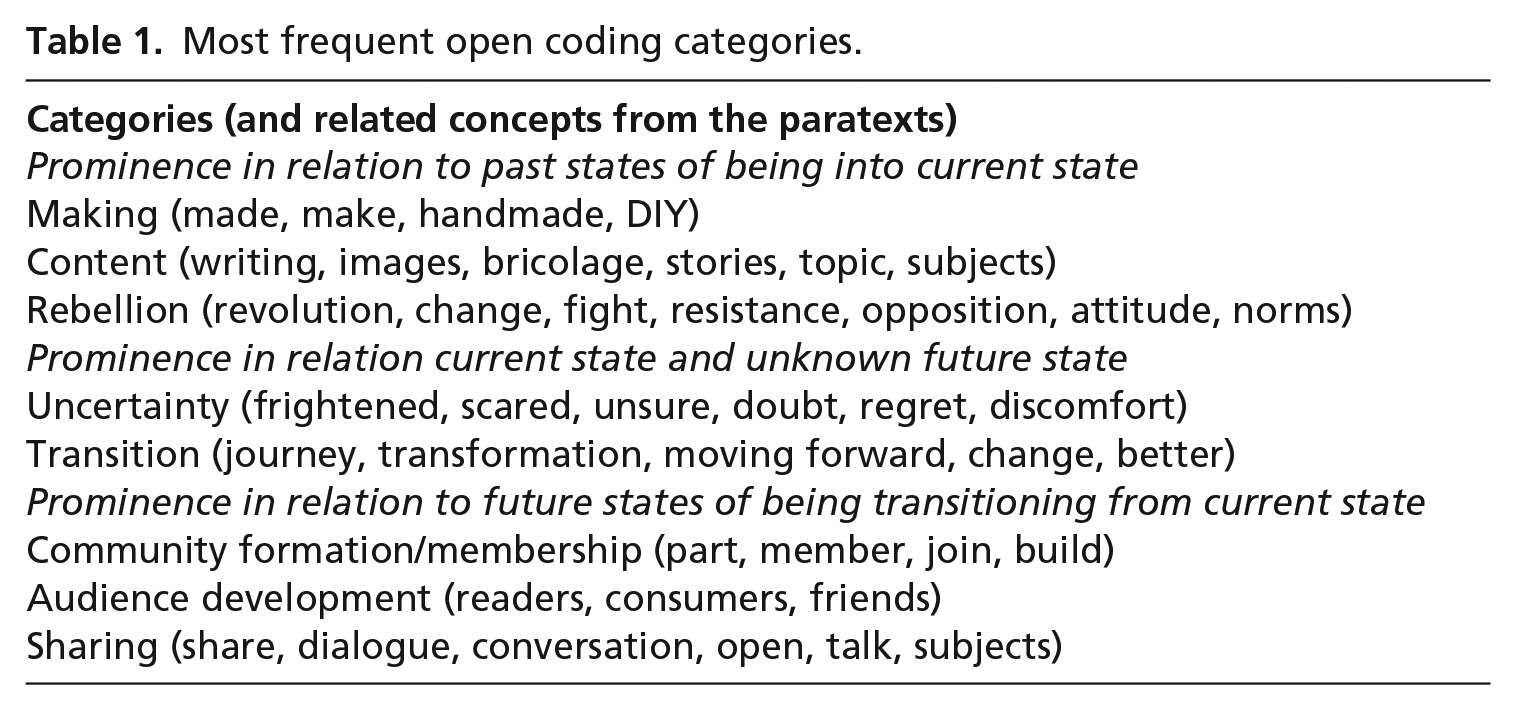
We found that the zine-makers reasons for creating zines were not homogeneous and did not follow any logical sequence. The critical intersection of their lives and cultures with their zine-making practices meant that multi-faceted constructs ranging from very personal, individual and through to community and cultural experiences influenced their decision to participate. One benefit of using summative content analysis is its ability to deconstruct meaning in and around the use of words or concepts (Humble and Mozelius, 2022). As we coded and recoded the data at each tranche, we discovered that while the categories held true, personal factors, outward focus and a blurring between past, present and future states shaped the tensions and intersections between categories. Our analysis revealed patterns in the categories that refined and elaborated the developing theory, represented in Figure 1. The presence of the community, the forwardness of communion, collectivity and inspiration for others, even within the uncertainty and betweenness of liminality, acted as bookends to many of the paratexts.
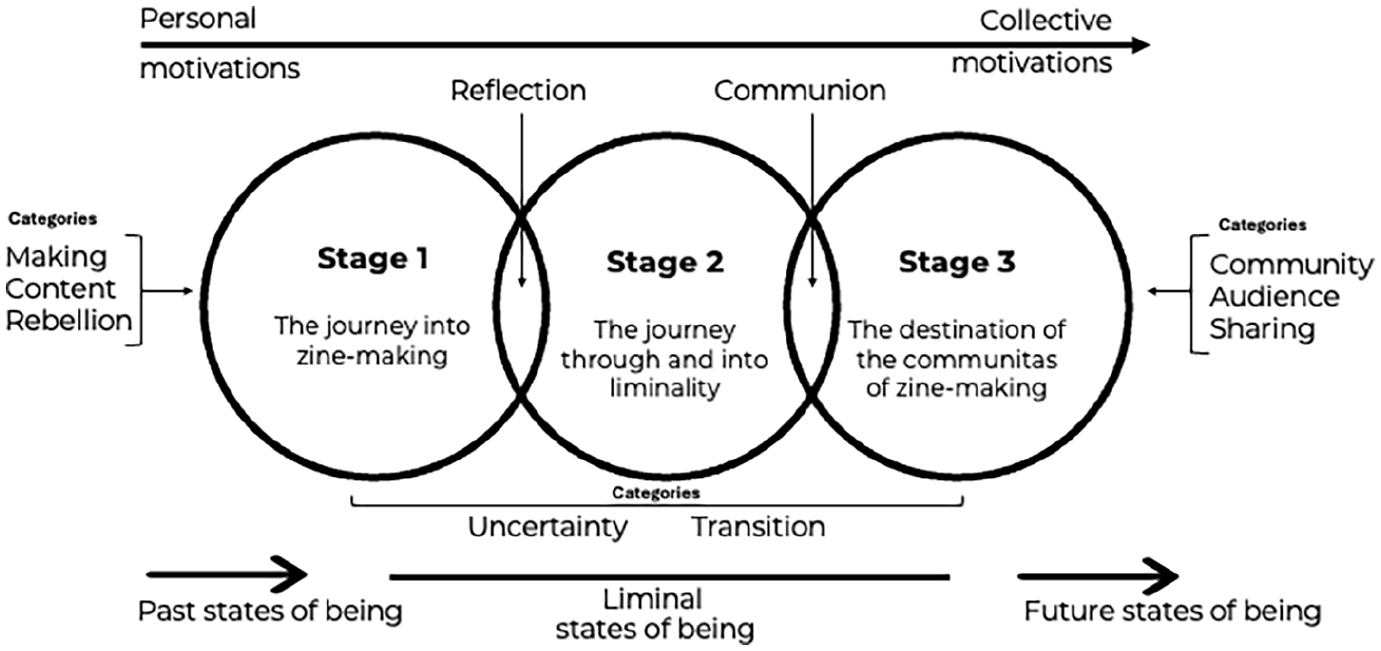
The journey into a zine-making communitas.
The open coding approach critically allowed for multiple realities to exist in the data. This approach supported zine-making’s location in multiple self-defined contexts and within the complexities of self-described motivations and rationales across multiple states of being. The analysis clearly showed that these acts did not occur in isolation from the zine-maker’s social context. Sometimes triggered by a single life event or experience, and in other cases from a convergence of experiences and attitudes towards life and living and the realisation of ambitions and expectations, the participation in zine-making was marked by influences that extended beyond the practical considerations of making. There were delineations between the stages of the journey being undertaken, although these stages were not discrete within each paratext. The narratives related to their journey into and through zine-making were frequently discursive, non-linear and sometimes contradictory.
Theory development
Returning to our research question, we have developed a theoretical model of the zine-making journey as a transition through different states of being, informed by changes in motivations across three intersecting stages of a liminal journey into a zine-making community. In the first stage, zine-makers described why they started making their zines as a record of historical action or as a justification of effort or reason. We theorised this as the journey into zine-making and aligned it with the categories of sharing, rebellion and content. In paratexts that articulated this stage, the zine-makers reflected the past states of being, explaining why they chose to act in specific ways within their zine, what led them to zine-making participation or the experiences in their life that shaped the commencement of their journey. These were often deeply personal in nature, frequently explicit, confronting or excoriating.
The second stage involved the liminality and uncertainty of their lives, their sense of self or the social structures they inhabited or journeyed away from. We theorised this as the journey through and into liminality, aligning it most closely with the themes of audience and sharing, and to a much lesser degree, community. The transition into and through a liminal state of being demonstrated, through interpretative and critical reflection, a socially constructed (or socially unstructured) engagement with an unseen collective audience. Zine-makers discovered kindred spirits in the community of liminality and uncertainty during the third stage. We theorised this as the destination of the zine-making communitas, closely aligning it with community, sharing and audience in the context of transitioning readers into the same journey and liminal state. A communitas emerges as a spontaneous modality: members experience communion and togetherness in brief collective social interactions within liminal spaces. Turner (1977) describes this as ‘. . .full, unmediated communication’ that challenges and scrutinises the core values and assertions of the community (Turner, 1977: 46). Since a communitas can often exist within the borderland states of actions such as making, the narratives contained within the paratexts critically represented the assertion of what the respondents believed they were participating in. This also pointed to the future states of being for the zine-maker, where they collectively resided in the communitas or found ways through their liminality to a safer, more stable state.
Stage 1 – the journey into zine-making
Zine-makers did not describe their decisions to participate in zine-making in simple, quotable statements of intention. Many of them shared deeply analytical processes, with descriptive narratives emerging from both the critical sites of meaning they created within the zine and from the material immediacy of putting ‘pen to paper’ and seeing what spilled out. In many of the zines, the zine-makers wrote intensely personal descriptive narratives, rent with emotions, reflections and confessions, revealing deeply traumatic or troubling reasons for engaging in zine-making, as in this text from the zine The Worst #1:
The process of making this zine has also been very painful. Whilst these pages contain much strength and hope for the success of our many struggles, each piece also signifies tremendous loss, trauma, or life changing experience. I named the zine ‘The Worst’ because I am tired of delicate Hallmark Card statements about death which dictate the reactions I am ‘supposed to have’ when someone I love is gone.
Some paratexts chronicled the zine-makers journey through their past states of being. This included narrating their life experiences, commentating on their uncertainties and idiosyncrasies and exposing their personal mental and emotional states. In these cases, the descriptive narratives were often longer and told in story-like form or were presented in rhetorical terms, instilling the texts with self-doubt, as seen in the zine Floodlight Viscera #22, which posed a series of questions to an unknown and unnamed reader, with the zine-maker chronicling their transition from a ‘safe’ space to somewhere unknown and ambiguous, but clearly painful and traumatic:
So much has happened this past month. Much if it feels very undeserving of poetry. My feelings are too big, too loud, too painful. I don’t know how to tread this particular line. How honest should I be with you? How much of my pain should I reveal? Should I try and make it beautiful, full of metaphor and hope, or can I just. . . be honest?
Far from being instrumental or utilitarian, many of the zine-makers described their making practices in personal, persuasive, aspirational, contradictory and frequently uncertain terms. In some texts, zine-makers described how they chose to deliberately reside within spaces of unknowing, sharing their confidence (or lack thereof) and exposing the creative and social uncertainty of their lives. These public acts were sometimes defiant and assertive but in other cases descriptive of a reflective journey into an unknown or transitive state. In a series of rhetorical statements, rent with uncertainty, the maker of She’s So Very #9 shared their betwixt state with the reader:
I am bad at getting my point across, I always have been. It doesn’t matter what medium I chose; I can never fully express myself. I have amazing things inside me, but it almost feels like I don’t have the intelligence or creativity to get it out of me . . . I don’t know how to create what I’m searching for. I want something meaningful, but I don’t know where to begin . . .
In other paratexts, zine-makers offered readers insight into their sense-seeking behaviours, enacting their search for meaning and identity through writing and creating. In these cases, they described the journey to become zine-makers less explicitly, but the immediacy of the writing exposed vulnerability, laying their doubts bare to the reader and seeking reassurance and validation of their behaviours. The zine If I could only see around corners exemplifies this:
The first day of the visual diary! My pen is poised, my breath is bated. I am well and truly on tenderhooks (sic). Some questions assail my mind on this exceptionally sunny morning . . . will I tell the truth? Will I abridge? WILL I CHEAT?
Some zine-makers shared how their perspectives, positions and attitudes transformed because of their zine-making. Their narratives became historical chronicles of how their circumstances changed from where their journey started to where they were now, often drawing on motivations of rebellion, resistance or rejection of cultural, societal or personal stereotypes or norms. Some paratexts described this transition within a single passage of writing. The zine I do not have an eating disorder used its foreword as a mea culpa of sorts, describing a journey from one set of assumptive rituals to the rituals and norms of their current state, finally apologising to the reader for any offence their initial views or perspectives might have caused them:
The views put forth in the first page of this comic are extremely close minded. They reflect what I thought I knew about eating disorders before I was diagnosed. I acknowledge that these views are pretty awful. As I’ve worked on this journey of recovery, I’ve learned a lot about eating disorders, and one of the things I have learned is how wrong my initial assumptions were. I sincerely apologise if my immature views represented in this page of the comic are triggering for anyone.
The positionality of the reader in both the paratext and as the assumed consumer of the zine itself represented another manifestation of how zine-makers described their journey into zine-making. In some cases, zine-makers marginalised the reader, delimiting them in scale to a select, unknown public or ignoring them as invisible or irrelevant to the narrative. These texts were deeply exposing, even in their apparent isolation from the reader. They were critically reflexive, with uncertainty and ambiguity emerging from how the zine-maker reflected on the process and impact of their making. The writer of Edgy zine number 18 explored both the journey they were experiencing, starting with their current state of being (I seem to keep myself a secret, while simultaneously offering up intimate information to the select public), then rationalising what this journey or transition meant to them (sometimes I feel like I don’t exist except in my head) through to their ‘arrival’ (but then I remember, this zine is how I externalise my inner life). The zine-maker relegated the reader to that of a public, to whom sharing this intimacy seemed counter-intuitive or risky. The opposite was true in other texts, where the zine-maker brought the reader into their circle of friends, sharing intimate secrets and assuming that by reading the zine the reader was inculcated into their community and were part of their journey, as the maker of Culture Slut observed, ‘It really has been a while, hasn’t it? I feel like a bad friend. Haven’t been keeping up with my letters)’.
Stage 2 – the journey through and into liminality
Liminality describes a transitory phase between states of being, setting the liminal apart from society and the practices, behaviours and symbols of the everyday (Skjoldager-Nielsen and Edelman, 2014). The zine-makers initiated part of the journey through liminality by reflecting on their past state of being and analysing how their analytical or emotional responses to that reflection affected their comfort or certainty with their social structures. This emerged especially in how they directly addressed the audience and shared both their reflections and their (dis)comfort. The reflective resonance of experience and emotion triggered the journey from representing deeply personal motivations towards greater collective motivation, enabled by the existence and recognition of the reader of the paratext. The introduction to the zine I am a camera exposed the layers of explicitness and tacit acknowledgement of the transition from personal to collective motivation present in these paratexts:
I found when writing the stories for this zine that at this time in my life, truth and fiction have equal weight. What really happened is less important than how I want to tell these stories. Imagine my mind as a complex filing system, with memories grouped around objects, association and senses. Regard this as some of the files and you’re slyly reading them whilst I’m out of the room.
Many of the paratexts represented cognitively complex journeys into and through liminality. They described iterative, progressive and sometimes discontinuous processes of cognitive interpretation that drew together disparate observations, memories and past actions to translate and share their rite of passage. The metacognitive nature of zine-making was visible in these texts, with zine-makers focusing on sharing their own thought processes, actions, personality and lived experiences with the reader, as demonstrated in the foreword of the zine Asylum #1:
This evening I read a really good zine that reminded me of why I love this medium so much. The hope, the energy, the brilliant sentences that exist not for an editor or an agent but because the person writing them had to get it out there, and because they knew somebody was listening, somewhere. Fuck the many downsides of zining, the soul draining copy schemes, the aching wrists from folding and stapling, the money lost, the occasional feeling of futility. It’s not futile. It’s fucking worth it.
In other texts, the zine-makers shared their inner reflexive dialogue, where they described the social structures that they were moving away from, without a clear idea of where they were moving to. These texts were iterative, with narratives presented to the reader as a stream of consciousness. These paratexts exposed states of self-doubt and derisory self-image, and sometimes confident and defiant self-belief, as seen in this paragraph from Missives from Murray Bridge #4:
Things seem a little brighter. I feel grateful. A large part of moving on has come in large thanks to finishing Don’t Call Me Cupcake 9 and Don’t Call Me Cupcake 9.5. Writing those zines was incredibly hard. It took a lot of ice cream and a lot of tears to finally sit down and just write it all out once and for all. There is something beautifully cathartic about it all, however. Absolutely beautiful. I felt literally lighter . . . and ready to put it all behind me.
Turner (2008) argues that liminality is a phase where the individual reflects on their place within a social structure, so as to return to ‘society’ with a new identity and reasons for being. He adds that being in a liminal state runs counter to the human desire to make sense of uncertainty in the world and leaves the liminal individual with a sense of ambiguity, indeterminacy and vulnerability (Abouras, 2019). The paratexts showed how many of the zine-makers engaged in making as a deliberate step towards discovering their new society and new social structures. They used their zines to search for others who might share the journey so as not to be alone in the world and to be reassured that others could hear, understand and legitimise their feelings. The maker of Floodlight Viscera #1 locates the reader’s experience as being ‘inside me’, imbuing the text with deeply intimate imagery to describe their transitive state:
FLV is always very personal, and so it has also been an excellent way of exercising my vulnerability as well. Thank you for witnessing my self-reflection and expression. Words and poetry have immense power to allow others to inhabit us for a brief time, to visit our internal landscape and gain empathy for each other. I hope that your time inside me gives you some sense of connection with me, and that you enjoy our literary time together.
Stage 3 – the destination of the communitas of zine-making
The third stage was finding a destination or home by participating in zine-making and journeying through a liminal state of being. The categories here were deeply informed by reflections on community and the explicit articulations of communion, coming together, being a part of something and sharing the feeling of liminality or the emotional triggers that were initiated and expressed in the parts of the paratexts that informed stage 1. Turner (2008) describes this kind of aggregation as a communitas, which members experience as a temporary state, partly because they feel uncomfortable residing outside their normative social structures while undergoing a rite of passage. Turner (2012) argues that communitas, while capable of de-structuring sociological and psychological practices and patterns that create senses of unease and uncertainty among members, can also elicit a sense of joy.
As the paratexts were located within the context of a zine itself, none of them described the exiting of the communitas into a post-zine future state of being. They did however describe both how they felt within that communitas and what it means to them to be there. They described how they had previously lived within social structures, relationships and societal expectations that conflicted with the structures necessary to contextualise and process the impacts of their lived experiences. Through zine-making, they actively sought new structures and social networks that gave them the chance to discover their place in the world. The liminal states of the zine-makers were socially constructed, where the expectations and imaginations of behaviours were as important as those that could be demonstrated as having happened. Zine-makers shared their dislocation from the ways their social structures expected them to act and behave. Many of them experienced this liminality together with their imagined readers, united in the commonly held belief that they were participating in something important, relevant and desired. Through a collective liminal experience generated by the unique combination of participatory acts and decisions, zine-makers participated in or aspired to be part of a communitas. Once there, they felt comfortable, as the writer of Dear Anonymous II declared:
I am done with sacrificing living in the name of staying safe. Writing, typing and using the letters I have received to create (this zine) have made me see how much I am missing. The people who have contributed to this edition have written letters so full of emotion because they are feeling what it is to live. A lot of it is dark crap that no one should go through, that brings tears to my eyes, but in that way, we are all survivors.
The comradeship that emerged from an ordeal or the plurality of being ‘the other’ within a social structure engendered a spontaneous modality among zine-makers and readers (Turner, 2012). They experienced communion and togetherness in brief, collective, but powerful social interactions. Through these social interactions, the readers and the zine-maker found and shared meaning, sometimes directly by sharing content or the practices of zine-making, other times surreptitiously by imagining how others would consume and receive their zines. The maker of Best Zine Ever #3 actively encouraged their readers to join them in the communitas of zines and be part of something potentially life-changing:
Reading a good zine makes you feel alive like few things can. It’s like you are dialled into someone else’s brain and as you read their stories, witness their art and experience their life. These days the bravest thing you can do is just not give up. The act of creating and reading zines is the act of not giving up, of not giving in. Zines are life. Be alive.
The journey to discover the communitas did not always follow a linear path. The desire to rid themselves of the social structures, norms and rituals of their current non-liminal state represented tentative steps on the zine-makers journey. These zine-makers often exposed raw descriptions of their state of being as they rejected the roles and behaviours others expected them to demonstrate, without a clear destination in mind, not yet having discovered the communitas or merited its value. When they finally reached their destination, they experienced something that was truly emancipatory, as described in the zine World Wide Web Girl:
All of me is made up of memories, experiences, passions, loves and hopes. And for me, a lot of those have their roots in the online. You may look at me on my phone and deem me anti-social but that couldn’t be further from the truth. I used to carry a chain of 3 USB sticks held together with a blue and purple sparkly ‘scoobie’ I threaded myself. All I needed was the nearest computer to bring my world to life. Now all I need is the closest photocopier.
Many zine-makers did not want to make this liminal journey alone or arrive in the communitas to find themselves the only person there. They invited readers to join them, opening the door and encouraging them to become part of the communitas. By making intimate connections, sharing insights or telling secrets to their communitas, zine-makers imbued their texts with a sense of vulnerability and curiosity. This allowed readers to understand the zine-makers’ rationales for taking risks in making zines, while simultaneously inviting them to share the moment and be a part of their lived experiences. In some texts, zine-makers issued a persuasive call to arms, recognising the liminal journey of others and reassuring them that the risks were worth it, as was noted in the zine Gellhorn:
. . . so, OK, about five people will read what you write. Maybe even nobody. That’s not the point. The point is that for a brief period you were involved. You chose what was to happen; you didn’t do what was expected of you, you weren’t limited to what choices corporations and government laid out for you. You had control.
The maker of the zine Giantess Seven directly addressed the reader with openly honest assertions about why they made their zine and about their own liminal state. They imbued the language with confessions, interjections of self-doubt and direct statements of what they aren’t. The zine-maker presented the reader with defiant statements of meaning and identity, where the benefits of owning their rebellion against expected behaviours and structures outweighed the risks of making and sharing:
This isn’t the whole story, and this isn’t me attempting to be a journalist or a novelist, or a creative writing student. This isn’t me trying to sound slick or finished because guess what? I’m a mess and a contradiction and an introvert and a loudmouth and a girl hiding in the corner.
The zine-maker presents their zine 13 Months in the form of a five-page typed letter addressed to ‘Dear Reader’ and sealed in a nondescript manila envelope, describing their ‘first relationship and the impact it had on my life’. What follows is an intensely personal story of love, insecurity, sexual violence and the consequences of depression and social isolation. The zine-maker recounts traumatic, explicit and searingly honest experiences, describing the broken relationship that led to their alcoholism, dangerous acts of self-harm and anorexia. Telling this story helps the zine-maker deal with the ‘memories and the hurt’ and provides support for others (perhaps those who read the zine) caught in similar cycles of abuse. The zine-maker signs the letter ‘From a person’ with no identifying email address or nom-de-plume. They seal the letter in an envelope with the hand-stamped title on the outside. The reader surreptitiously opens the envelope to see the deepest and most personal confessions of the zine-maker, leaving them to decide if it is truth or fiction and to imagine the life they are peering in on. 13 Months allows the zine-maker to control the way they tell their story. They do not have an editor interpret their experiences or a publisher decide on the value or worth of their words; they tell their story as they see fit, for the communitas and for their honestly discovered place within it. The intimacy of the text and the found nature of the relationship with the reader invite them into a secret world of pain, like one would a friend. It is an invite couched in intimate and difficult experiences that readers are not wont to share, but there in 13 Months, a private communitas of liminality makes it safer for them to open themselves up and find communion in their vulnerability and humanity.
Conclusion
Turner (2008) observes that a communitas ‘breaks in through the interstices of structure, in liminality; at the edges of structure, in marginality; and from beneath structure, in inferiority . . . it transgresses and dissolves the norms that govern structured and institutionalized relationships and is accompanied by experiences of unprecedented potency’. The normative social structures within the resident communities of the zine-makers in this study had, in part, failed them. They turned to zine-making to break through those structures, to help rationalise and process their experiences and to find people who understood what they were feeling or thinking. Once they ‘arrived’, they found the communitas comfortable, safe and welcoming, despite its liminal nature.
Zine-makers viewed making a zine and sharing it with readers as anti-structural acts of pure potency, becoming the physical and emotional manifestation of their journey into liminality. They often undertook these acts with uncertainty, knowing they were rebelling, resisting or challenging something or someone, but in a generalised and non-specific way, in a space where they no longer felt safe or welcome. Many zine-makers found the freedom, relief and sometimes pure joy they experienced through zine-making revelatory. The act of zine-making became part of their identity, bringing new social structures to the fore as they processed complex, liminal experiences. While individuals held and enacted these creative acts, they shared them collectively. The zines in the study addressed incredibly potent experiences, such as grief, serious illness, traumatic events, guilt, disassociation or sexual assault. The knowledge that they were making this content available to an audience, however limited, made these experiences even more potent. By engaging and identifying with those experiences, either through common behaviours or memories or through a rational desire for communion and being part of something, the readers joined the communitas.
Zine-makers and their readers experienced a genuine sense of comradeship and familiarity within the communitas. They found a place where they could be themselves among others who understood them. Members actively constructed and shared meaning and identity within the communitas, rather than passively residing there. They achieved this through the modalities of human interrelatedness within the communitas (such as control, political and cultural beliefs, resistance and rebellion behaviours and personal states of being), which required members to maintain their individuality while being bound by what brought them together and protecting it collectively.
Zine-makers urged others to join them in the communitas, validated their decisions and reassured them if they had doubts. Members defended and celebrated the communitas. It was more than a waystation on a journey through liminality; it was the destination. For many of the zine-makers in the study, the communitas provided a safe space that felt like home. The zine-makers felt a strong need to share the space with others through the proximity of the intimacy of their lives. Many of the paratexts shared stories and experiences they would not normally tell strangers. In the communitas of zines, even though the audience was unknown, zine-makers rarely viewed them as strangers. The communitas acted as a space where individuals could share intimate secrets but never disclose them, like the bedroom of the maker, alluding to the intimacy inherent in their acts of making. The bedroom was their space. It was somewhere they would not normally invite strangers, a place to enact confession and secret-telling as modes of exchange (Poletti, 2011), as the maker of Giantess Seven noted:
I have been questioning lately my own involvement in zines . . . Read a few by my friends, and little else . . . Still, I feel the need to define zines to myself over and over, as a reminder of why they are so important. A personal zine is a record of something . . . it’s my bedroom in black and white. I don’t need a CV or a degree in journalism to make one. I don’t need to send out a double-lined submission to a stranger for it to exist.
The fact that zine-makers told these kinds of personal stories, even to the controllable, limited audience that zine-making afforded them, was a critical component in defining new social structures that would not fail the members as they journeyed through liminality. They created a communitas of embodied participation where they felt safe to be and act in ways that felt truer to their real selves. This was not a static destination. The communitas of zines, while bound by zine-making and reading, constantly evolves, offering opportunities for new practices, communities and individuals to join. This evolution keeps the Bourdieusian revolution partial, as the structures within change with the nature of those who choose to reside in it. This study aimed to understand how zine-makers described and shared their rites of passage with readers through the content of their zines, and how those journeys ended up in membership of a communitas of zines. There is an opportunity for further study of what the new social structures in the communitas have become in an age of ubiquitous social media, the growth of influencers sharing intimate content through platforms like TikTok and Instagram and the critical importance of identity formation and assertion to a modern, progressive society.
Zines cited
13 MONTHS (no date), no author
Asylum #1 (2010), Matt Hahn
Best Zine Ever Issue 3 (2004), Greg Beans
Culture Slut (2009), Amber
Dear Anonymous II (2012), Jamie Nyx
Edgy Zine 18 (no date) no author
Floodlight Viscera #22 (2018), Erin Kyan
Floodlight Viscera Volume 1 (2017), Erin Kyan
Gellhorn – A zine by ‘Martha Gellhorn’ (no date), Martha Gellhorn
Giantess number seven (2007), Candace Petrik
I am a Camera #9 (2005), Vanessa Berry
I Do Not Have an Eating Disorder (2016), Khale McHurst
If I Could Only See Around Corners (no date), Isabel Greenberg
Missives from Murray Bridge #4 (2017), Jaime Nyx
She’s So Very. . . #9 (2007), Melissa Ann
The Worst #1 (2008), Kathleen McIntyre
World Wide Web Girl (no date), Kassi Grace
Footnotes
Data availability statement
Data sharing not applicable to this article as no datasets were generated or analysed during the current study.
Funding
The author(s) received no financial support for the research, authorship, and/or publication of this article.
