




Abstract
Participation in zine-making is enacted through a series of inter-linked making practices and intentions, constructed within both personal and interpersonal frames, and shared with others in different ways. Zines are catalysts for network formation within a cultural or sub-cultural community, with zine-makers sharing experiences, resources, and creativity to inform and associate with the community. Drawing on the constructivist grounded theory analysis of thirty-four semi-structured email interviews with zine-makers, this study sought to theorize a transdisciplinary understanding of the potential role zine-making communities play in the decision by an individual to participate in zine-making and how that participation was defined, enacted, and enculturated through zine-making. Using a constructivist grounded analysis, a model of participation was developed that defined and explored the bounded boundaryless of the zine-making communitas. In these spaces, members of the communitas deliberately transitioned into or through liminality and found affiliation and communion through engaging in and sharing the processes involved in zine-making (such as construction, distribution, and writing). Within this semi-fragile zine-making community, smaller sub-spaces were formed through engagement or affiliation with different interpretations and enactions of these processes, manifest in the production of different zine typologies and the creation and engagement with readership or circulation networks.
Keywords
Introduction
The making of print zines is a uniquely contradictory, lo-fi, do-it-yourself (DIY) media-making practice, rich in parallel traditions and cultural engagement across a range of vocal, creative, and active communities and sub-cultures (Duncombe, 1997). Zine-making is an accessible form of media-making enabling expression, access, and networking for many marginalized, under-represented, and disenfranchized individuals and cultures (Kempson, 2015). In recent years, zines have chronicled an increasing number of emerging communities (for example, refugees and recent migrants (Oliveira, 2019) and the diasporas of gender, youth, and identity (Wright et al., 2022), whilst continuing to represent and promulgate established sub-cultures where the role of zines has been deeply explored in the literature (for example, punk, riot grrrl and third-wave feminism (Baker & Cantillon, 2022; Dillon, 2021)).
Writers such as Bourdieu and Habermas have prosecuted the case for what they believe are the instigators of cultural participation within an informed society. Bourdieu (1993) argues that cultural participation is a function of social class and education, and this influences participation in avant-garde cultural activities. Habermas (1991) argues that within the public sphere, access to cultural participation performs the role of bringing people together through the mass media (including ‘laypersons’). Friedland (2001) asserts that it is impossible to disentangle social structures from the practices of participating in communication, enabling communicative communities to both connect social groups and find avenues toward social change within those communities. Some writers argue that zine-making operates counter to the theories of community communication in the public sphere, noting that despite its wider position as a voice or instrument of inter-community communications or within social movements (Holtzman et al., 2007; Snyder, 2006), remains effectively the pursuit of an individual or a small collective, engaging in personal media production and the construction of self-identity (O'Neil, 2004).
Zines remain catalysts for network formation within a community, with zine-makers sharing experiences, resources, and creativity to inform but also recruit members (Debies-Carl, 2014). Zines form embodied connections within and between sub-cultural communities, supporting how members transition from passive to active forms of cultural participation, sharing their lived experiences, their production skills, and the aspirational potential of being part of the community (Kearney, 2006). Zine-making can be both the gateway for people to join a community, opening channels of communication and facilitating the connections that trigger association and communion for new entrants (Mageary, 2020) and act as an instrument of sociality, education, sharing, or engagement within the community (Richardson, 1996). Zines also act as the thread that links disparate, diverse, and unique individuals residing loosely within a sub-culture, which as Radway (2016) notes, excludes the practices of many of those aligned with the sub-culture: What concerns me is that as these histories organize a messy, distinctly wild, range of social practices into the thing-ness of a “movement,” they thereby miss the disparate routes young women travelled as they intersected in different ways with the loose constellation of activities and technologies known to constitute the punk and post-punk scenes and the cultural underground more generally. (p. 4)
Defining the social and mechanical practices involved in zine-making is complex and contested in both the academic literature and among zine-makers themselves. While there are common themes about the physical form zines take, the control exerted by the maker over the production process, and the non-commerciality of the final product (Piepmeier, 2009; Poletti, 2008), there are equally passionate disagreements on the influences of technology and social media on zine-making, the typologies of zines and the participatory intentions and motivations of zine-makers (Desyllas & Sinclair, 2014). Over the course of the last decade, zine-making practices have been reconfigured and disrupted by social media, dissolving and coalescing into other media forms, redefining zines, the role of zines within cultural and sub-cultural communities, and what it means to be a zine-maker (Hall, 2021). The boundaries between physical and digital making practices continue to blur as zine-makers build portfolios of DIY-making in their virtual shopfronts or at zine fairs that include badges, stickers, books, posters, t-shirts, and other ephemera as well as physical print zines (Guerra & Quintela, 2020; Watson & Bennett, 2020), use digital platforms such as Etsy to distribute their zines and communicate with readers, their communities and other makers through social media (Clark-Parsons, 2017) and redefining (and reinforcing) the Habermasian notions of the public sphere and its inclusivity for readers, participants and audiences alike.
Making a zine is a combination of physical and emotional acts initiated by a decision to participate in some form of cultural production. Cultural production through making spans contexts greater than the act of making an object, affording larger, more aspirational possibilities such as participation in digital citizenship, social change, collective action, sub-cultures, and identity and meaning-making for the individual maker (Schilt & Giffort, 2020). Making media as a form of cultural production creates contested societal and community spaces, where practices such as digital citizenship and civic engagement are shaped by how participation facilitates inclusivity, altruism, clicktivism, and digital literacy and access (English & Irving, 2015; Knobel & Lankshear, 2014; Lacharite, 2017). Participation in making can enable transformative capacities amongst makers and readers for engaging in democratic acts and empowering disenfranchized socio-demographic communities in political and social acts of change through communications (Friedland, 2001; Heikka, 2015; Neuman et al., 2011). Jenkins (1992) argues that zine-makers are part of a community of makers that build, through their own stories, words, and creative content, a different and alternative community of social interactions, with zine-making used as a ‘…means of building and maintaining solidarity within the fan community’ (Jenkins, 1992, pp. 213–214).
Research Question and Methodology
Zine-making is a highly personal representation of the emotions, thoughts, opinions, and creativity of the maker, enabled by the modalities and attitudes of the DIY ethic. The aspirational assertions inherent in the phrase ‘do-it-yourself’ imply the lack of reliance on others to make a zine. Alternately, Tanenbaum et al. (2013) make the case that the processes of DIY media-making are both personal and interpersonal with individual acts of making satisfying the intrinsic and collaborative motivations of the maker, noting that: …identity production, skill, reputation, participation, norms of sharing, learning through teaching, and communities and collectives of practice are components of DIY making, privileging pleasure, expressiveness, and communicative practices over the utility of making the end product. (Tanenbaum et al., 2013, p. 2604)
This constructivist grounded theory study was designed to transgress the disciplinary boundaries and definitional limitations of the existing literature and develop a transdisciplinary understanding of the potential roles (if any) that membership, access, and connection to zine-making communities have on how and why people chose to participate in zine-making. Are there common traits within zine-making communities that influence the initial or ongoing decision to participate in making zines? Can these motivations be understood separately from the individual, sub-cultural, or societal reasons for engaging in zine-making? The non-linear nature of zine-making was a significant factor in choosing constructivist grounded theory as a methodological approach and discounting others. Constructivist grounded theory is an approach used to construct theory inductively from the stories of the community or group under study and additionally seeks to maintain the presence and the voice of the participants in a meaningful way (Charmaz, 2006).
Stories were collated from thirty-four semi-structured email interviews with self-selected and self-identified zine-makers who responded to various calls through mailing lists and web groups. These respondents came from six different minority or majority English-speaking countries (Australia, New Zealand, the United Kingdom, the Netherlands, Canada, and the United States). Each interview was conducted through an exchange of emails with the zine-maker. This allowed an asynchronous conversation to form within the interview (Ison, 2009) and recognized the critical importance of the positionality of the researcher and the influence of a posteriori knowledge about the research question being explored. While email interviews sacrificed some immediacy, they created narrative discourses and conversations with the respondents that explored their participation in zine-making and their engagement with the community over time (James, 2015).
The use of theoretical sampling is a critical aspect of a constructivist grounded theory approach, in that it allows the researcher to adjust the sample to explore and refine the theory until the point of data saturation (Glaser & Strauss, 1967). To start the process of theoretical sampling and begin the generation and definition of categories, the initial call for respondents outlined some broad sampling criteria to ensure that the participants were able to discuss and describe their own experiences of zine-making and legitimately be able to provide insight into the question under study (Morse, 2010). Respondents needed to have made at least one zine, which ensured that the zine-maker had something they could identify as zine-making practice to describe. The purpose of theoretical sampling is to direct the research where the researcher needs it to go, as opposed to allowing the sample to progress by the same rules that you started with (Birks & Mills, 2015). Theoretical sampling also works as a self-correcting process, whereby the process of constant comparison within the data analysis identifies gaps in the data and directs the next iteration of sampling (Charmaz, 2014).
After the completion of an initial tranche of fifteen interviews and subsequent open coding, I applied the theoretical sampling approach to direct the data collection and analysis toward exhausting the categories emerging from the data (Charmaz, 2006). Sequences of interviews were progressively added to the data set and analyzed using open coding methods to identify initial patterns, followed by a summative content analysis, a two-stage process of counting the occurrence of specific words and searching for latent meanings in the use of those words within the texts and then aligned with themes emerging from the literature (Hsieh & Shannon, 2005). The data analysis identified meanings and concepts agreed by the actors, without starting with a pre-formed model or hypothesis (Suddaby, 2006). This approach supported the emergence of theory from personal testimonies to describe and understand the personal decisions the respondents made to make zines, the role that their practice played in enabling their participation in a zine-making community (or not), and the conditions they experienced within that community.
The Liminal States of Zine-Making
Data saturation is a concept that is debated extensively in grounded theory literature, often uncritically (Charmaz, 2006; Glaser, 1992), with constructivist methodologists noting that it occurs when the conceptualization of categories yields no new insights. After the final series of email interviews and the subsequent open coding of that new data, no new insights emerged from the interviews; they simply reinforced the existing categories and the emerging theoretical model. The zine-makers in the study described complex, inter-connected, and personal reasons for participating in zine-making, sharing deeply personal, affecting, and reflexive narratological journeys that evolved through the course of the interview. For many of the respondents, the interview became an iterative process of cognitive interpretation that drew sometimes disparate observations, memories, and past actions together to try and describe how they came to and continued to make zines. The decision to participate in zine-making was rarely linear and evolved from the uncertain confluence of their lived (or living) experiences, rejection, or rebellion against established social structures or behaviors and the discovery of zines as a medium, either as a maker or reader, as described by R.13: I guess it started out as being lonely in high school and wanting someone else to be able to understand the things I was seeing and having trouble dealing with. That motivation has changed as I've grown up, and maybe now my focus is more loose as I just want to be able to talk about my life and have a creative outlet to express myself in. I'm also really motivated by the prospect of community and meeting new people and sharing my experiences with them. (R.13) We chose zines to get our thoughts and views across - not in any rash political or extreme social manner but to create an output and release of our what we believe in. I feel the act of writing the articles are not as important as knowing that our ideas will either resonate or strike a wrong chord with someone on the other end. (R.34) I also think it [zine-making] is a radical and highly political act for women, any woman or oppressed person to tell their story and express themselves because our society is so much about silencing people and white-washing and sanitizing everything into tidy shiny fake piles of crap. Life is not like a movie or a margarine commercial it is raw and gritty and hard and painful and authentic which doesn't sell mouthwash or pre-mixed drinks does it? (R.26) The discovery of zines coincided with my leaving my hometown and venturing out into the big, wide world as well. It was that combination, the discoveries I made at that stage that contributed to my creating not just zines but a new identity for myself as well. It seemed to all be integrated and combined. I guess that experience was life-changing! (R.18) By age 16 I started writing stories and collecting them from others. I’d put them together, copy them, staple them, hand them out. I had no idea that there was a ‘zine culture’, or what zines were. I just wanted to share my stories and be creative. As much as that, I also wanted to encourage others to be creative. (R.28) After a breakthrough of my own, I decided I could make such a zine! In particular, I read an auto-biographical comic by a woman about incest from her uncle and I admired her courage in sharing that painful and traumatic story in such a creative way that reached out to others, and I hoped I could do something similar. (R.26) SO my zine isn't just “my story” it is part of a rebellious fabric of society that is a movement for change. It believes change is possible and it starts now! (R.26)
From a Zine-Making Community to a Communitas of Zine-Makers
The engagement in the collective processes of zine-making afforded the respondents the opportunity to describe their reasons for participation as a conceptual whole that was greater than the sum of its parts. Far from being instrumental or utilitarian, the decision to participate was often explained by the respondents in personal, persuasive, aspirational, contradictory, and demanding terms. This did not mean the decision to participate in zine-making was described in selfish or conceited ways, but rather that collective and community responsibility and voice were functions of how the respondents understood or needed to construct and share meaning and identity. As each progressive tranche of data was collected and analyzed, understanding the liminal states of zine-makers provided the granularity necessary for theory generation about the potential role of communities in the decision to make zines. The demonstrable existence of these liminal spaces made the case that the personal and interpersonal acts involved in zine-making were interconnected.
In an anthropological sense, the collective experiencing of liminality can trigger the formation of a communitas. This is a temporal, voluntary, and transient state of collective being, that marks the journey from one state to another (Turner & Turner, 2011). A communitas is defined by the modality of its sociality, manifest through the violation of social norms and structures (anti-structures), the exhibition of behaviors that run counter to status, and the member's ability to commune as equals. For members, it can shatter perceptions of normal and generates potent experiences stripped of established and ritualized behaviors and relationships (Turner, 1974b). There is no single form of communitas, with the enacting of social structures (or anti-structures) defining both the stability of the communitas and its ambition to shape a utopian or countercultural society (Turner, 1969). A communitas can be transgressive, with members feeling uncomfortable at their diversion from established structures, whilst for others, this transgression offers freedom from the tensions of needing to act within social mores and norms. A communitas is defined not by a collective identity, but by how unity and solidarity liberate members to be more socially human, marked by a sense of spontaneity, openness, anti-structural behaviors, and an interest in how others enact them, which leads to a pronounced sense of belonging (Turner, 1982).
For most of the respondents, zine-making triggered the rite of passage they were seeking, away from the social structures that created the uncertainty they were experiencing. At the core of exploring and understanding this point of transition or transformation were the lived experiences of the zine-makers. How zine-makers made their zines afforded certain interdependencies that were framed by how the zine-maker lived their life, expressed their culture, and constructed their own meanings and identity within that context. The rites of passage and the normative social structures they were escaping or leaving were not universally experienced but resulted in the respondents transiting through or into liminality, nonetheless. The journey into a liminal state was often experienced alone, but the destination (the communitas) was populated by readers, other zines, and other zine-makers, a connected network of friends, comrades, and family, both known and unknown, finding commonality in the aspirational, political, and practical acts of making and sharing zines, as R.2 described: Initially I was motivated by the idea of trying to become less of a private. I kept a lot to myself; I wrote diaries and stories, I was often quiet. And I was working on changing all this. I started to see that the things I thought and wrote needed to be brought into the world. Zines in particular are quite an immediate way of getting read, making your voice and your experiences accessible. So, there's quite a thrill from that, and from confessing secrets to strangers anonymously. But the motivation changed or grown a little. I started to realize that not only is it cathartic for myself to really unlock myself in this way, but it's also useful for a reader to delve straight into another country, culture, sexuality, background, set of experiences and assumptions. It's enlightening, it shows people they aren't alone in the problems they face, and its political (R.2) One of my favorite things about zines and the creation of them is all the possibilities, and better yet, when someone presents a new one to you that you just couldn't have thought up… It's endless and inspiring. The community is very accepting, welcoming, and collaborative, even if only subtly, and the nature of making them and sharing them is the best I've ever encountered, and so far-reaching. (R.17) I was probably a bit too young to understand it all, but the sudden appearance in my life of a vibrant and connected underground was at once thrilling and scary to me. I felt quite intimidated by how cool and hip it seemed, and I felt like a voyeur in this secret society. I should point out that this was before the internet took hold of the world: living as a teenager in a remote, provincial town in the north of England was a very isolating experience without the connectivity and culture that the web brings. I would say that a concern with ‘reaching out’ to like-minded people is still present in my zines now. (R.19).
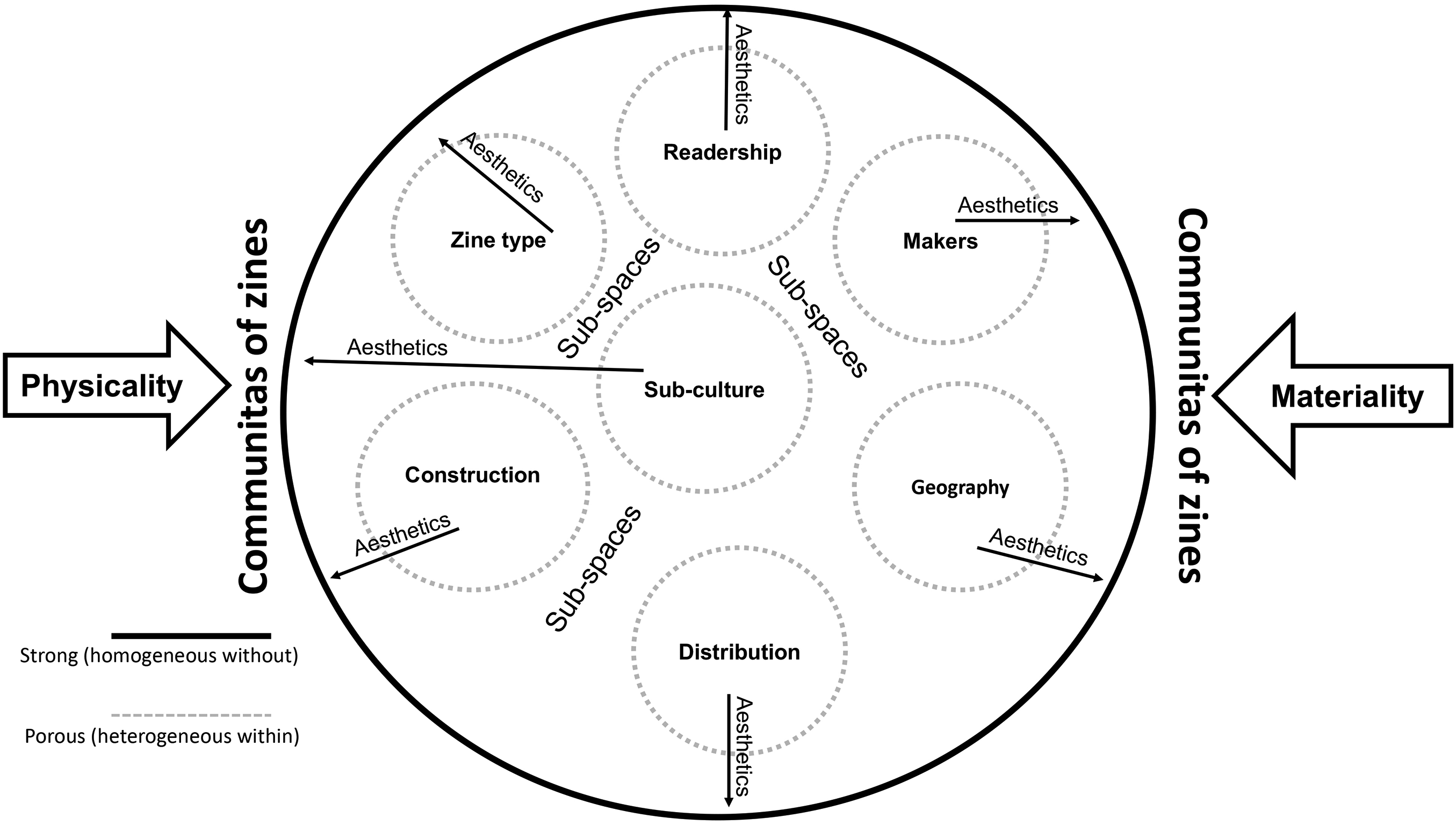
The communitas of zine-making.
Members of the liminal communitas might identify with the practices of other zine-makers but exhibit only a fleeting or weak connection with them. For example, some respondents questioned whether a zine made by another person in the communitas was a zine, but stopped short of declaring this, giving them the benefit of the doubt. The acts of making a zine were representable as cognitive schemata, with the processes of making zines and how those processes and acts coalesced to determine the aesthetics of zines for the maker. The cognitive schemata, which represented the acceptance of an object as a zine or as presenting a zine aesthetic, were not applied to exclude or remove zines and zine-makers from the communitas, but to interpret making experiences and recognize the rites of passages being enacted by others. The responses of R.22 and R.34 showed how they used cognitive schemata to define the boundary of the communitas: I don't want to open up a big can of worms, but I'm never sure what people are talking about, and what they're including or excluding, when they say “zine”. I might have gotten “basically produced” publications through the mail before I ever heard of the word zine. (R.22) A great zine should stir up uneasy conversation, not just controversy in order to raise awareness and thought on issues relating to their particular target audience. I think it'd be great for every time a reader disagrees with the views of the writer a new zine is born. (R.34) I currently focus on my zine Cats Teeth which I would class as a perzine (because it's non-fiction and focuses on diary entries, reflections, and has a confessional tone). It's quarter-sized and it tends to be equally text and image heavy. I select images and artwork that tend to be quite dark, bordering on slightly erotic. I also include some of my own sketches. In terms of content, I talk about the issues and experiences that play on my mind at the time of writing, usually it flows like a journal with occasional film, book and music reviews or literary and philosophical quotes/excerpts. Reoccurring themes tend to be polyamory, myth and matriarchy, sex and sexuality, psychoanalysis, philosophy, wanderlust. (R.2)
Associative Commonality and the Boundaries of the Communitas of Zines
The acts of zine-making triggered cues for respondents that enabled them to join, reside or invite others into the communitas of zines. The analysis identified two aesthetical frames (physicality and materiality) that the respondents used to eschew their uncertainty and find their associative commonality within the communitas. These frames, whilst structured through different meanings, definitions, and cultural contexts, acted as lenses through which acts of making enabled membership of the communitas (or fragmented it within as sub-communitas) or as gateways to facilitate the liminal journey or provide a guiding light to find the communitas in the dark of the transitive state.
Located in the practices of making (including construction, reproduction, distribution and communications between zine-makers and zine readers), the physical acts of zine-making defined participation for many respondents. Physicality offered them a tangible way to demonstrate their membership of the communitas and to recognize others on similar rites of passage. This tangibility took many forms including, from the replication of making tropes (black and white reproduction or the use of manual typewriters for typesetting, for example) to more tacit forms (building relationships with zine readers through letter writing or email, for example). An equally significant number of respondents argued that how their zine was made was less important than the materiality inherent in its making. For these respondents, the making of the zine and the production of an aesthetic facilitated a higher-order form of participation. Making zines was a site in which to construct and share meaning and identity, both personally and socially. They recognized others through their shared experiences, their common trauma or their political or social views. These respondents recognized the emancipatory potential of pen and paper and how their participation supported the continued efficacy of DIY production as a method of community and personal empowerment (Radway, 2011).
The common thread between these experiences was the notion that zine-making was a manifestation of materiality, where the way something is made becomes the message, as opposed to signifying the message through the content. It is in effect an ontological interpretation of making, where the engagement in doing facilitates higher-order levels of understanding and knowing. These higher order knowledges emerged as ways in which the zine-maker expressed and demonstrated the need to construct and share meaning, to represent and form their identity, aligned to their ways of being, their sense of belonging, their attitudes to society and life, and their wider perspectives of their role in the communitas, as described by R.34: Although at the end of the day I do believe zine writing and reading is a community act I feel there is an importance in writing for yourself. Even though all of our articles are written for others to read and either agree or disagree with we do write for ourselves and without the criteria or demand of others. In the future I'd love to interact with other zine creators who share similar beliefs and attitudes but although it is a healthy element to have, I do not feel it is necessary (R.34) I have to emphasize the importance of zines in the sense that they capture the true spirit of a community. They provide some of the most honest reflections of a society; documenting its ups and downs. I feel exhilarated when I read a good article in a zine or see a good piece of art. Zines often succeed in making me feel like a part of a community, like my opinions and views may be shared with someone else. (R.6)
Conclusion
Returning to the primary research question that this study attempted to theorize on the potential roles (if any) that membership, access, and connection to zine-making communities have on how and why people chose to participate in zine-making, the respondents described a communitas of zines that was encircled by the acts of associative commonality that enabled them to reside within the notions that what they were making (and reading) could be described and recognized as a zine. They felt part of the culture of the communitas, with an enculturation forged through the processes of discovering and making zines that shared common experiences, perspectives, practices, and concerns. Within the communitas, the ‘innumerable threads of crisscrossing lines of meaning, flows of meaning’ (Turner, 2012, p. 3) coalesced into sub-communitas where meaning was found through association and community within the aesthetic of zines. While the processes, motivations, and performative actions that defined membership of sub-communitas were sometimes porous and fragile, the communitas itself was not weak. Members were often fiercely loyal to the aesthetic of zines, defending the form and the freedoms they believed zines afforded makers and readers alike. Finding zines was often a surprise for the respondents, and when they did, they felt they had discovered a secret mode of expression that represented ‘a spring of pure possibility’, which mainstream media denied them, as noted by R.12: I was picking up alternative menstrual zines … and I remember thinking that there were totally bad-ass women making rad shit out there and I wanted to surround myself with it. Not necessarily make zines myself - that would come much later. But it did help show me that it was possible and totally awesome, and that anybody could do it. (R.12)
The members of the communitas did not necessarily know who their readers might be (and in several cases, did not care). They did want to communicate with them, recognize their membership of the communitas, and in some cases, encourage them to become zine-makers themselves. This aligns with the broader community communication assertions of Friedland (2001)and the deep entanglement he argued between social structures and communication. The presence of both producers and consumers within the communitas, often undertaking the same journey away from established social structures but enacted in very different ways, was a unique feature of the communitas of zines. The act of reading a zine and sharing in the zine-maker's rite of passage was viewed by many of the respondents as being as important as the act of making. The invitation to join the communitas through reading, or through more active methods of skills sharing, storytelling and direct engagement and communications defined participation as essentially Bordieuan in that cultural production exists within the social conditions of production, circulation, and consumption. Bourdieu argued that aesthetics represent a critical lens to understand art as a ‘socially constituted’ form, created through display in public and private spaces, consumed by social actors (makers, readers, patrons) and not existing sans forms of sociality that engage producers in the search for meaning and value (Bourdieu, 1993, pp. 318–319). The critical importance that Bourdieu placed on social experiences defines the boundary of the communitas centered on a common appreciation, enthusiasm, and passion for zines.
The members of the communitas of zines did not lose sight of the political and social implications of zine-making nor the critical importance of readers and their cultural and sub-cultural communities to the meaning and identity that emerged from the enacting of those implications. Zine-making offered the respondents a path toward something different from the cultural and structural sociality they were residing within. The shared experiences of zines and the agreement that zines represented something different from the social structures they were escaping or seeking to change was the tensile strength of the communitas. Enculturation into the communitas was not always a comfortable journey, with some respondents finding it confronting and contradictory, and the acts of production and consumption sometimes painful, triggering, traumatic and emotional. Discovering and residing within the communitas brought stability, safety, and sociality, even if the associative commonalities of making and reading fractured their states of residence to varying degrees within the communitas. It was this fracturing and healing of sub-spatial lines that saw the communitas constantly challenged and evolving in form. Being enculturated into (or influencing the culture itself) allowed respondents to share their own constructed version of zines and zine-making with others in the communitas that worked to draw them in and commence their own journey into liminality, a journey that seeps into not just making but into how the zine-makers chose to live their lives,
Footnotes
Declaration of Conflicting Interests
The author declared no potential conflicts of interest with respect to the research, authorship, and/or publication of this article.
Funding
The author received no financial support for the research, authorship, and/or publication of this article.
