




Abstract
Research on cultural practices has highlighted the rise of different cultural consumption patterns that challenge the classic theories on class-based hierarchies. However, most scholarly work has focused on active, rather than passive, cultural consumers. This article aims to fill that gap by exploring the orientations of cultural participation of hypothetically passive cultural consumers in contemporary Finland. Existing research proves that culturally non-active groups are difficult to reach through quantitative methods, so this project will draw on qualitative data: 40 individual interviews on everyday life, cultural taste, knowledge and participation with a theoretical sample of people whose background profiles statistically predict cultural non-participation. This article finds three main orientations of participation, expressed as attitudes on different kinds of cultural practices and symbolic boundaries drawn – these orientations of participation are the social-mundane, the cultural-legitimate and the introvert-hostile. It is argued that while none of the orientations equals to cultural non-participation, the latter orientation stands out from the other two as drawing symbolic boundaries upward, highlighting that cultural participation remains a highly stratified and polarized field, also in an egalitarian society.
Keywords
Introduction
Cultural practices, whether tastes, knowledge or participation, are thoroughly linked to cultural capital and the reproduction of inequality (Bourdieu, 1984). Bourdieu’s main idea is that there is a homology between class positions and lifestyle differences, and that these are directly reflected into social exclusion and the unequal distribution of opportunities, creating a scenario of cultural stratification in which privileged classes embrace ‘highbrow’ cultural practices to distinguish themselves from the lower groups, out of which the middle classes show their cultural goodwill by trying to emulate the upper ones and popular classes, adapting popular practices. With a vast body of literature criticizing Bourdieu’s theory and showing that socio-economic divisions might be more salient than cultural or class-based ones in some societies (Lamont, 1992), that national contexts profusely shape cultural stratification (Katz-Gerro, 2002), and that cultural lifestyles are products of individual life trajectories rather than class positions (Lahire, 2004), international and cross-national research has repeatedly shown that the substantial class-based differences regarding most cultural practices persist (e.g. Chan and Goldthorpe, 2007a, 2007b; García-Álvarez et al., 2007; Katz-Gerro and Jaeger, 2013).
Scrutinized apart from the other types of cultural practices, cultural participation shows these same trends and hierarchies of cultural stratification. People with privileged backgrounds have distinctive participation patterns compared to their less privileged counterparts (Bennett et al., 2009; Purhonen et al., 2011). When observed by volume, the same trend holds: active cultural participation is linked to higher education and class position and it predicts better future income, even when all other factors are accounted for (Reeves and Vries, 2018).
What, then, is known about its mirror image, cultural non-participation? First of all, as already pointed out by Bourdieu, education plays an important role in legitimizing the highbrow arts and making knowledge and participation seem ‘natural’ skills of the middle and upper classes that possess the abilities to decipher and appropriate highbrow-oriented cultural participation (Bourdieu and Darbel, 1991), rendering low education a typical factor associated to cultural non-participation. Indeed, higher educational level seems to be connected to both the breadth and frequency of cultural participation (Stichele and Laermans, 2006). Time is an important factor for cultural non-participation, excluding especially shift workers from traditional event-based cultural participation (Miles and Sullivan, 2012) and pointing out the negative impact of family commitments for cultural participation (Willekens and Lievens, 2016). However, lack of time is also an often-cited reason for non-participation of well-off people living busy lives in big cities (Gayo, 2017). Scholars studying the role of the location or access for cultural non-participation often argue that not enough attention is paid to it (c.f. Brook, 2013), making the lack of suitable venues close to home a reason and driver for cultural non-participation. It might also be useful to consider digital access as an essential factor for cultural non-participation, since recent scholarship has pointed out that online cultural participation might reproduce exactly the same hierarchies and inequalities that already exist in physical participation (Mihelj et al., 2019). Finally, it should be kept in mind that the inequality of cultural non-participation varies across countries according to their wealth and levels of social mobility: there is less differentiation in highbrow cultural participation in wealthy countries, and countries with large social mobility (van Hek and Kraaykamp, 2013).
Taken together, cultural non-participation is a rather common phenomenon across Western societies. When comparing the compositions of different groups, research has found that more than half of the population could be categorized as passive cultural consumers. For example, Katz-Gerro and Jaeger (2013) report that 57 percent of their Danish sample could be categorized as passive. In their study on musical tastes in the United States, García-Álvarez et al. (2007) found that 56 percent of their respondents had ‘limited’ taste. Chan and Goldthorpe (2007b), in their research on arts participation in England, reported that 59 percent of their sample were non-consumers or ‘inactives’. The colorful terminology reflects well the fact that the operationalizations of cultural non-participation vary: the non-participants are referred to, for instance, as simply ‘passive’ (López-Sintas and Katz-Gerro, 2005), ‘limited’ (García-Álvarez et al., 2007), ‘inactive’ (López-Sintas and García-Álvarez, 2002), ‘non-attendees’ (Willekens and Lievens, 2016), ‘TV viewers’ (Taylor, 2016) or ‘univorous’ (Chan and Goldthorpe, 2007a). While cultural non-participation typically correlates with low status, it is extremely common also in the upper echelons of society (Lahire, 2004; van Eijck and Knulst, 2005). Still, its reasons are stratified strongly along social hierarchies, with respondents from upper strata lamenting their lack of time and people with low incomes and low levels of education citing lack of money as main reasons for non-participation (Gayo, 2017).
There seems to be a strong consensus in the literature that cultural non-participation does not equal to passivity as such: current research has repeatedly and in many national contexts identified a cluster of people who are deeply involved with practical, kin-based, local activities without engaging in traditional legitimate culture and pointed out that the division between general cultural activity and non-participation can actually be a more relevant structuring principle than the traditional divide between highbrow and lowbrow (Bennett et al., 2009; Miles and Sullivan, 2012; Purhonen et al., 2014; Roose et al., 2012). It emerges from the literature that because of its deeply social nature, cultural non-participation is not linked to stigmatic social exclusion (Bennett et al., 2009: 59): the UK data show convincingly that its non-participants are in fact socially and community-wise extremely active people.
The starting point of this article is that calling lower class taste milieus ‘inactive’ is, indeed, problematic and that cultural non-participation probably is a methodological artifact simply because research on cultural capital mostly focuses on tastes and practices typical to middle and upper-middle classes (Flemmen et al., 2018: 146; Taylor, 2016). My attempt is to contribute to and nuance this discussion by asking what individuals whose backgrounds strongly predict cultural non-participation in the light of extant research mainly do in their free time, what their attitudes toward differing kinds of cultural practices are and whether different kinds of symbolic boundaries are drawn. On the basis of these research questions, my aim is to define whether different orientations of cultural participation can be distinguished in this kind of group, mainly consisting of people from underprivileged popular classes. Mapping orientations of cultural participation among people that potentially are low participants makes an interesting case in Finland, a small country in terms of population and one of the so-called Nordic welfare states (Esping-Andersen, 1999) with still relatively small income differences (OECD, 2020) and equal public and decommodified education opportunities. Finnish sociologists have repeatedly pointed out that Finland is a culturally homogeneous society with few opportunities for effective distinction (Mäkelä, 1985), mainly because of historical reasons like a lack of feudal nobility and a strong working-class culture.
Why focus on cultural non-participation instead of participation? I argue that cultural non-participation could be interpreted as either mere distaste for possible forms of cultural participation, something that Bourdieu (1984) famously considered a key element for cultural distinction: ‘tastes are perhaps first and foremost distastes’ (p. 56), or a more profound and socially structured consequence of long-term social and cultural exclusion. What is more, some forms of cultural participation are, unlike other forms of cultural practices such as cultural tastes or knowledge, subvented through public policies. Like in most other Western countries, the lion’s share of public funding to culture in Finland is directed to a relatively small number of cultural actors that operate among the highbrow arts: these are mostly theaters, orchestras, operas, museums and so on (Saukkonen, 2014). As cultural policies are clearly targeted toward traditional kinds of mostly legitimate culture which in turn is consumed most by such privileged groups as we have seen earlier, it is important to ask whether certain people might choose to withdraw from it and in what ways.
Research design
The interviews
The empirical problem about researching the ‘non-participants’ of cultural activities is that they are typically underrepresented in surveys on cultural practices (Purhonen et al., 2014: 423). At the same time, they are a large and relatively heterogeneous group (Chan and Goldthorpe, 2007b; Gayo, 2017). Earlier (Heikkilä, 2017), I have found that cultural non-participation can entail resentment and hostility toward the established order and its accredited lifestyles altogether: in this sense, my research could reveal underlying symbolic struggles of culturally non-active popular classes, totally disregarded by Bourdieu (1984) and still not discussed enough in contemporary sociology. While we know that cultural non-participation tends to be linked to certain recurrent factors such as low education and low class position, it can be expected that on the individual level there are different orientations of participation or non-participation.
Instead of studying people who would volunteer for interviews on cultural participation as self-reported ‘passives’ and thus hypothetically coming across mostly hostile discourses (c.f. supra), I chose to focus on a theoretical sample of people whose profiles statistically predict low cultural participation and to study these ‘potential passives’ through qualitative methods, namely by conducting interviews. I expected also that this would be the most suitable way to uncover different kinds of cultural participation patterns and orientations. Two nationally representative Finnish surveys from previous years measuring cultural taste and participation 1 were used to map potentially non-participating groups and profiles. This was done by using two survey questions – We will next enumerate different places and events. How often do you visit them? and Which places related to culture and the arts have you visited in the following time spans? – and constructing a scale of the groups that never or very rarely attended a set of activities, intentionally including items from both highbrow and lowbrow milieus (a large variety of cultural items, from opera and classical music concerts to theater shows, movies, restaurants, pubs and bingo halls). This group then was examined against the background variables of the full data sets in order to produce a sample that would mirror the non-participating population.
For the ‘never or very rarely’ attending groups, Residential area was a highly significant variable in both data sets, in the sense that groups living in the countryside were more likely non-participants than others. Province (directly only available in one of the data sets) was a significant variable, with higher proportions of non-participating groups in Northern and Eastern Finland. Education, expectedly, was a highly significant variable, groups with low education and especially no education being the most likely non-participants. Occupation, likewise, was highly significant (but not as significant as residential area or education). Manual workers were more likely non-participants than others. Other significant predictors included being a pensioner, being a farmer, being unemployed and taking care of young children at home. Age and gender, probably because of the wide range of items included, were less significant factors.
As a next step, I recruited interviewees whose profiles would cover at least four statistically significant indicators of cultural non-participation mentioned in the previous paragraph in each individual case, observant of the fact that these indicators served as mere probabilities. This yielded profiles such as a farmer from a small countryside village in Eastern Finland with only basic education, or an unemployed electrician in a small province city in Northern Finland: see Table 1 for all individuals interviewed. Education was prioritised as a main structuring variable known to correlate strongly with cultural participation (Bourdieu, 1984; Reeves, 2015) so no interviewed person had tertiary studies. Regarding the province, around one-third of the interviewees were recruited from the Helsinki metropolitan area for the sake of both possibly interesting future comparisons and work economic reasons. It could be argued that the sample mirrors the Finnish working class: yet, I have chosen not to use that term, since all interviewees could not unambiguously be categorized as working class (mainly because some occupations came close to intermediate class jobs, and because some individuals were on parental leave or different types of disability pension). Meanwhile, most interviewees could be categorized as, by and large, underprivileged popular classes. The final data comprise 40 individual interviews I conducted in early 2018.
Background information on all participants (n = 40) a .
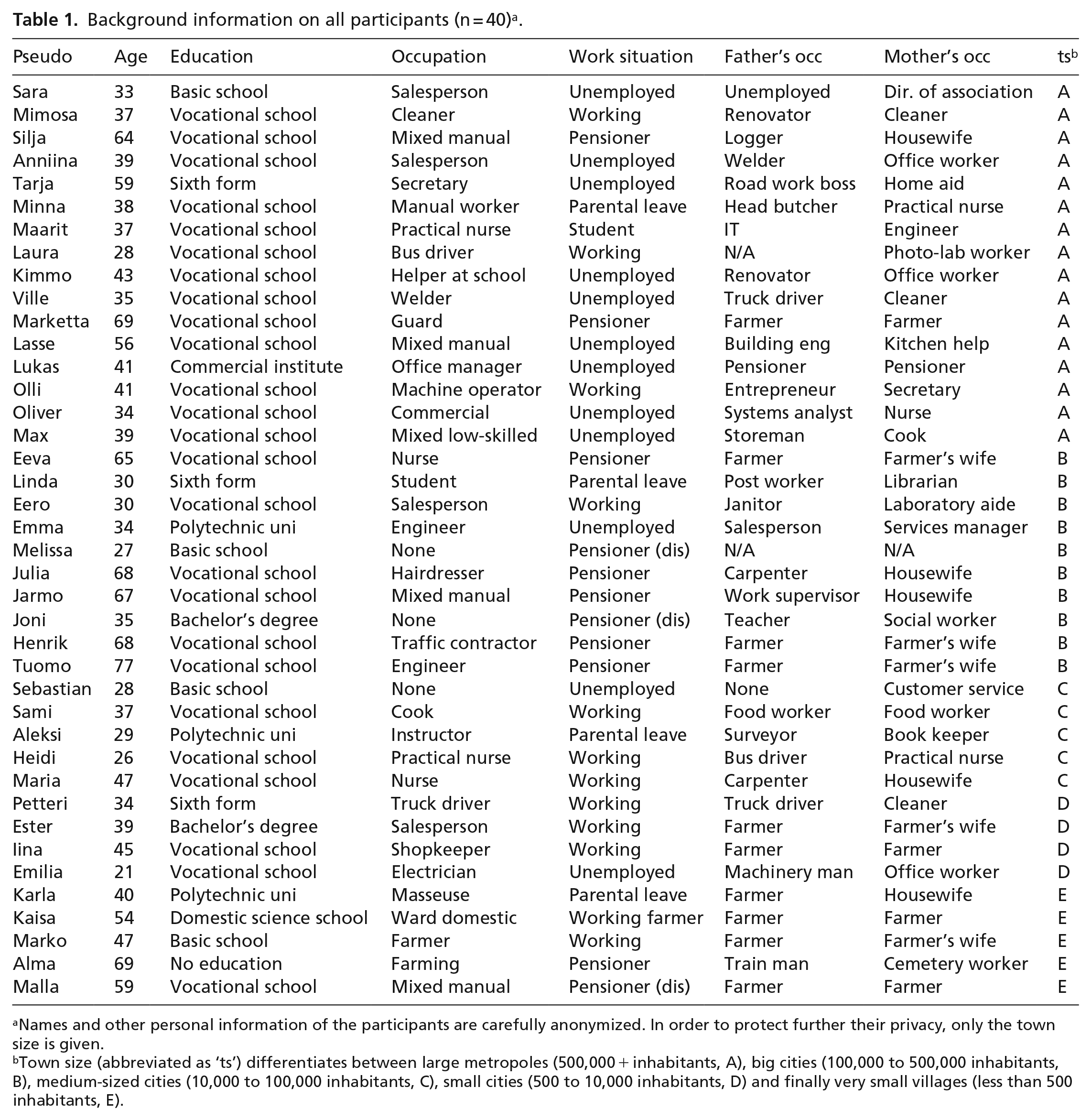
Names and other personal information of the participants are carefully anonymized. In order to protect further their privacy, only the town size is given.
Town size (abbreviated as ‘ts’) differentiates between large metropoles (500,000 + inhabitants, A), big cities (100,000 to 500,000 inhabitants, B), medium-sized cities (10,000 to 100,000 inhabitants, C), small cities (500 to 10,000 inhabitants, D) and finally very small villages (less than 500 inhabitants, E).
While the theoretical sampling relies on a rather conventional image of culture and participation, the interviews were targeted to capture as large as possible an idea of interviewees’ everyday participation habits, letting them define what they understood as culture themselves instead of departing from (assumed) non-participation. The topic guide developed for the interviews was designed according to the model of several recent studies, most importantly the sub-study of the British National Child Development Study (Elliott et al., 2010) and the Finnish Cultural Capital and Social Differentiation in Contemporary Finland research project (Purhonen et al., 2014). The interview guidelines were designed in order to document the interviewees’ daily life and cultural practices as meticulously as possible and to capture all three dimensions of cultural practices: taste, knowledge and participation (Bourdieu, 1984). The interviews started with a talk about the interviewees’ homes, families, friends, schooling and employment, and then moved on to free time and hobbies. After that, the interviews shifted to the more specific areas of cultural taste (through specific topics such as music, reading, television, cinema and food), cultural knowledge (through showing cards that depict Finnish art and encouraging the interviewees not only to discuss the artwork but also to identify the painting, if they could) and finally cultural participation (by going through a closed-end list of possible participation in varied forms such as bingo, sports events, cinema, different types of concerts and theater item by item). As a final question, participants were asked to describe the ‘day of their dreams’.
Analytical strategy
Why study cultural non-participation through interviews instead of other methods like time-use diaries or participant observation, thereby risking ‘attitudinal fallacy’ by interpreting verbal accounts as indicators of actual behavior (Jerolmack and Khan, 2014)? While the interviews certainly are artificial encounters in which the interviewees present themselves using the strategies they choose or are able to mobilize (Ollivier, 2008), my point of departure is that from the vast repertoire of qualitative methods, interviews are the most suitable way of mapping embodied perceptions, opinions, values and attitudes (Kvale and Brinkmann, 2009). Individual interviews add depth and complexity difficult to reach using other methods (Silverman, 2014) and illustrating larger findings with individual cases is a long-standing tradition within cultural sociology (Bennett et al., 2009; Bourdieu, 1984; Purhonen et al., 2014).
After a careful reading of the material, my analysis was based on the mapping of three strands of discourses found in the interviews, building on the idea that both the ‘what’ and ‘how’ aspects of cultural practices (Jarness, 2015) would be covered and that the notion of symbolic boundaries, understood as the repertoires of evaluation that people use to distinguish themselves from others (Bourdieu, 1984; Lamont, 1992) would be considered. I, first, focused on the main bulk of the free time narrated by each individual interviewee. What kinds of activities did it mainly consist of? Was there an orientation toward highbrow or popular culture? Inside or outside home, with whom, traditional or modern? Second, I paid attention to the discourses of the interviewees regarding their attitude to different kinds of cultural practices. How were the mentioned cultural practices perceived, appreciated, appropriated and talked about? Were there signs of cultural goodwill or indifference? Finally, I observed the attitudes the interviewees would show toward differing kinds of lifestyles. What symbolic boundaries were drawn? How were discourses toward others’ perceived or imagined lifestyles expressed? Through tolerant, indifferent or antagonistic tones?
Qualitative content analysis (Silverman, 2014) was used to map recurrent themes and systematically categorize the discourses. Finally, the discourses presented in the interviews were organized into broad categories that I labeled as orientations of participation, with the idea that individual interviewees are not necessarily tied to one specific orientation but that these orientations can serve as ingredients in processes of social differentiation, which means that individual interviewees could mobilize several orientations during the interview. There were in total three: the social-mundane, legitimate-cultural and introvert-hostile.
Orientations of participation
Social-mundane
The social-mundane is the milieu that many scholars (c.f. Bennett et al., 2009; Flemmen et al., 2017; Miles and Sullivan, 2012) have recognized and, to some extent, legitimized, as something that looks ‘passive’ in the light of most survey data but which, after closer inspection, has a deeply active and communitarian heart. In my data, there is a strong and recognizable discourse on the importance of social life and remaining active, typically in spheres relatively far from highbrow cultural participation. The social-mundane discourse is typically expressed as a certain disinterestedness toward attending the theater or visiting museums, and with fervent interest toward things such as picking mushrooms or enjoying the sauna in good company, playing in bands, helping elderly relatives, baking cakes, participating in associations, socializing with friends and so on. The discourses belonging to this category generally express open-mindedness and even curiosity toward different kinds of cultural practices and lifestyles. Not many references are made to perceived highbrow culture, and few symbolic boundaries are drawn in any direction. In short, very little or no traditionally labeled cultural activity, but lots of inside-home oriented, mundane and social participation and a tolerant attitude.
A good example of the social-mundane orientation of participation is provided by Sara, a 30-something resident in the capital region who has no education and is on sick leave from her supermarket job due to health troubles and quarrels with the social security system, but who, despite of her situation, has an active social life: she takes care of her sister’s children and hangs out daily with her best friend. Sara likes to bake and bring people something straight from the oven and often mentions lack of money as the sole reason not to go out more. The little outside-home cultural participation she does is mostly focused on popular entertainment such as pop concerts. Her dream day would be the following: I would be with a good friend – or my sister. First we would eat somewhere really fancy. For instance, we would have a hotel room somewhere, whether in the center of Helsinki or in a hotel in Vantaa, whatever, a hotel room in which we could take our stuff and put on make-up. Then we would eat a really good meal in some fancy restaurant, then go for a while to the hotel to sit in some restaurant, and then we could go and see an Antti Tuisku
2
gig.
For younger interviewees, the social-mundane orientation of participation sometimes grazes legitimate lifestyles or emerging trends, which is the case with Sami, a cook interviewed at his workplace, a restaurant with its own brewery, where he became interested in making beers himself: A couple of years ago a friend started to make beers, and when I came here, this is a brewery restaurant, so I’ve been following how they make beer here. And then I started playing with the thought that it would be awesome to have my own beer tap, and when the friend started to make beer I got interested too, now we exchange recipes – I made some basic APAs and IPAs and wheat beers for myself, and now I should start brewing a saison.
Emilia, an unemployed female, 20-something electrician talks about the importance of how the car stereo has to sound when cruising around the central quartiers of her small town with her best friends in the backseat and how crucial these devices are to distinguish them from an ignorant dilettante: ‘Because you just have to have a good machine. You have to have proper amplifiers and subwoofers. If you have bad speakers, it rattles and burns at some point and destroys the sheeting . . .’.
In the case of older interviewees exemplifying the social-mundane orientation of participation, pastimes are more stereotypically traditional and tend to revolve around mostly home-based activities, outdoor recreation and social life. For instance, Silja, a pensioner with low education and a career in several subsequent manual jobs, listens to Finnish schlagers, mostly at home but occasionally in concerts. Her free time mostly comprises physical and social activities: apart from picking berries and mushrooms, it is ‘swimming mostly, Nordic walking . . . I made it to ski a couple of times this winter, but in the summer it’s pretty much biking and that kind of stuff’. She lives in a rental flat far from the center of Helsinki, and is extremely active in her neighborhood. Henrik is a province counterpart for Silja; he is a retired truck driver, who, after a tough career driving around Europe with no time for his family or any hobbies (‘my company was number one for me at that point, which I later regretted’), has as a pensioner become an active member in various associations. He also does volunteer work and takes care of his grandkids, for whom he cooks elaborate local foods. Henrik’s active attitude crystallizes well the active ethos of the social-mundane orientation of participation: ‘There is no need to twiddle one’s thumbs’.
Legitimate-cultural
On the other side of the coin, naturally, are the discourses emphasizing a similar volume of activity as the previous orientation, but with an interest directed first and foremost toward the legitimate and out-of-home sphere of culture, toward things such as classical music concerts, theater, museums, opera and so on. Within the legitimate-cultural orientation, cultural practices are discussed in an excited way. Strong cultural goodwill is exhibited by stressing many times the importance of participating in legitimate culture, resembling Bourdieu’s initial definition of cultural goodwill, manifested as an ‘enthusiasm for a culture too recently acquired, a culture which still bore the visible marks of the effort included in its acquisition and could not, therefore, compete with the casual self-assurance of the “natural” aesthete’ (Bourdieu, 1984: 274). Lack of money is often mentioned as a reason for possible non-participation: lamenting for instance the price of opera or theater tickets is common. The value of intergenerational transmission of what the legitimate-cultural discourse perceives as high culture is strongly recognized. The legitimate-cultural orientation shows tolerance and appreciation of different kinds of lifestyles: the symbolic boundaries drawn are rather expressions of acceptance of their own lifestyles than aversion felt for perceived others’ cultural practices. The legitimate-cultural orientation of participation is typically mobilized by women, which echoes the often-repeated finding (Bihagen and Katz-Gerro, 2000; Katz-Gerro and Jaeger, 2015; Purhonen et al., 2011) that women generally are more inclined toward highbrow culture than men.
A good example of the legitimate-cultural orientation is given by Eeva, a 65-year-old pensioner whose life has been heavily influenced by a lack of money, from early childhood on a farm to the collapse of the family company, leading her to complicated loan arrangements. Eeva was born to poor farmer parents, and her childhood was marked by struggles to study, with her father wanting her to help out at home but with a relative finally helping her move to a bigger town and study beyond the (at the time) 6-year compulsory school. Apart from the pro-school relative, Eeva’s mother played an important role: My childhood home was of course poor – I learned to labour, but you could not get away, except that our mother was musically talented, and we did a lot. Also, perhaps through education we learned the joy of singing . . .
Her mother’s musical influence led Eeva to love classical music. Nowadays, she sings in a well-known classical music choir that has toured the world, and she has struggled to educate her children at classical music institutions. Eeva’s legitimate cultural practices and tastes carry across fields: reading classics is for her a passion, she likes and knows established classical music, and she goes to museums. Her small pension prevents her from visiting regularly the theater and other highbrow events, but she manages to attend the opera, thanks to relatives who give her tickets as gifts. In the same vein, Eeva draws boundaries excluding lowbrow tastes and practices: she shuns heavy music (c.f. Bryson, 1996) and exclaims ‘No!’ when asked about bingo attendance.
Another example comes from Linda, a 30-year-old young mother on maternity leave. Linda has a wide palette of participation. As for music, she plays classical music on the violin herself, but when it comes to listening, it is ‘punk or metal or something . . . everything goes, depends on the day, sometimes it’s fados and sometimes tangos and now and then heavy metal’. In her childhood, Linda had many hobbies; she played several instruments, danced, was a Girl Scout and went swimming. Mostly, it was her parents, especially her mother, who encouraged her and offered practical help such as giving lifts and sometimes joined the same hobbies herself. Linda has in a way internalized this attitude of a thoroughly Bourdieusian cultural goodwill and remaining active: ‘One has to have hobbies. If I find people who never go anywhere, I’m like, what do you do?’ Due to her situation outside of the labor market, Linda is short of both money and time. She cannot attend any weekly hobby but tries to find ways of attending highbrow culture cheaply: ‘I love to go to the theatre, for instance. I go pretty often because I get last-minute tickets with a student discount’.
Introvert-hostile
The introvert-hostile orientation of participation comprises discourses expressing quiet, solitary displays of leisure practices. In contrast to the two orientations presented earlier, the introvert-hostile orientation embraces mainly things typically done alone: watching TV, gambling, going shooting, spending the day at home painting, listening to the radio, solo DIY projects and so forth. Unlike in the two orientations of cultural participation presented earlier, here practices were usually discussed in an indifferent way, putting almost no emphasis on the potentially interesting or worthwhile aspects of one’s personal tastes and participation or refusing to elaborate it, possibly because a lack of the right kind of conversational competences, translated as unease in the formal discussion situation and undue comments (c.f. Silva and Wright, 2005). Non-participation, whenever discussed, is presented as a fact without further explanations, unlike the previous orientation. Finally, and again, unlike the other two orientations of participation, there were strong symbolic boundaries drawn upward: the introvert-hostile orientation of participation included a relatively marked discourse of hostility and even antagonistic tones toward perceived middle-class lifestyles, regarded as too tolerant, ignorant of the hardships of the lower groups, or simply culturally pretentious. Interviewees mobilizing the introvert-hostile orientation of participation were mostly men.
Perhaps the best example of this orientation comes from the unemployed and frustrated 50-something Lasse who has jumped from one manual job to another without ever having had the chance to work in the field in which he has his vocational degree. When asked about hobbies, Lasse starts by saying that ‘actually there are not many things I like . . . well, my hobby is to follow football through the website of Veikkaus
3
’, a pastime that also has led him to lose some money. Later, he explains why he quit subscribing to a proper newspaper, referring to middle-class values he perceived as too tolerant: There started to be things that they emphasize a lot that did not speak to me anymore, well, like feminism and this kind of stuff. I don’t have the energy to be sympathetic towards everybody. I have had some issues with my own life, lots of work with it, I don’t have energy for that kind of stuff anymore.
The introvert-hostile discourse typically expresses a brusque attitude toward the idea of participating in any kinds of activities with a predefined timetable. Work, especially shift work, is often cited as physically and mentally exhausting, but it is usually not presented as a reason for non-participation. Typically, the discussions drift toward more symbolic barriers: a good illustration of this is Eero, a 30-year-old kiosque worker extremely tired of his face-to-face service job that leaves him with no energy to participate in anything after arduous work shifts, who is frustrated with his life and sees practically no one during his free time, mainly jogging alone and fixing computers: ‘I like being pretty much on my own’. The dream day depicted by Eero seems to gather together the resentment he feels for the rest of the world: I would like to be – a genuine dick-head, a totally genuine dick-head – if it would be possible for one day, I would like to park my car in the disabled parking lot, pass everybody in the queue, shout to my mother, be the extreme that I unfortunately have to encounter.
As has already been mentioned, indifference vis-à-vis cultural practices altogether and difficulty toward expressing tastes are typical aspects of the introvert-hostile orientation of participation. A good example of this comes from the 70-year-old ex-guard Marketta, who is clearly upset about most of the questions and refuses to elaborate on her answers, sometimes in a hostile way. For instance, she has the radio on 24 hours a day, but she cannot identify what she likes exactly:
Would you like to tell what kind of music you like?
Ordinary Finnish music.
Like what?
Well anything a Finn would perform.
Even newer stuff?
I don’t care, I just listen.
Thus far, we have seen that expressed orientations of participation cluster up as social-mundane, cultural-legitimate and finally, introvert-hostile. Although the introvert-hostile category embraces solo activities and a certain indifference toward strong cultural affinities, it is in no way reducible to ‘cultural non-participation’: watching TV, gambling, fixing computers or having the radio on are in every sense of the word activities, although they have nothing to do with the cultural practices linked to cultural capital and power (Bourdieu, 1984).
Concluding discussion
This article asked what kinds of orientations of participation emerge from interviewees whose background factors strongly predict cultural non-participation, thus people from different kinds of underprivileged popular milieus: what they do in their free time, what their attitudes toward different cultural practices are and whether they draw specific symbolic boundaries. While the sampling strategy was not perfect in the sense that background factors can predict but not promise a certain kind of behavior, the data showed clearly different orientations of participation in a sample with many potential ‘passives’. The interviewees’ discourses were classified as social-mundane, cultural-legitimate and introvert-hostile.
Another key finding is that, out of a theoretical sample of potential ‘passives’, no one stood out as totally ‘passive’, if an anthropological stance is adopted. This echoes Bennett et al. (2009) who emphasize that cultural non-participation is in no way linked to social exclusion and that the ‘culturally disengaged are not to be viewed as “socially excluded” or somehow devoid of social interaction of various kinds’ (Bennett et al., 2009, 59) – finding instead, in their data, that people who were cultural non-participants were, in fact, socially active and happy (see also Miles and Sullivan, 2012), very much like the interviewees quoted in my social-mundane category. This finding could be interpreted in the light of the debate of the appropriate scale of observation when studying the coherence of lifestyles in general: statistical-level observations can be illustrated further with individual narratives (c.f. Bennett et al. 2009) which, because of their specificity might look dissonant, but it does not necessarily mean that they rule each other out (Purhonen and Heikkilä, 2017).
The third important finding is that a small yet significant part of the introvert-hostile orientation of participation builds upon a strong antagonism toward others’ cultural practices through resolute symbolic boundaries drawn. It seems surprising that the polarization of lifestyles is so large in a sample of relatively similar profiles – starting from a shared low education and many other often overlapping factors, hinting toward strong intra-class tensions in an egalitarian society (Jarness, 2017). In a way, the symbolic boundaries drawn among the introvert-hostile orientation travel beyond mere cultural practices and could be interpreted as moral ones (Jarness and Flemmen, 2017; Lamont, 1992). Finally, while both the discourses of social-mundane and introvert-hostile orientations come close to participation orientations that might well resemble traditionally measured ‘cultural non-participation’ if scrutinized only through cultural participation surveys, it is important to notice that there is a fundamental difference between them, whereas, the former shows no signs of social exclusion or strong boundary-drawing, the latter bears several markers of it: both a strongly experienced social exclusion and a fervently expressed hostility toward perceived other groups.
While the three orientations of participation discovered were very clear-cut, this article has not been able to tackle the relationship between the orientation of participation and actual cultural participation at the individual level and the trajectories possibly leading toward or away from cultural participation. An important next step would be to address this question, keeping in mind that the orientations of participation and actual cultural participation are not necessarily converging (c.f. Yaish and Katz-Gerro, 2012). This step would echo also the numerous studies (Flemmen et al., 2017; Miles and Sullivan, 2012; Taylor, 2016) that call for a more integral understanding of cultural engagement and point out that it is misleading to label lowbrow/popular/mundane participation ‘non-participation’.
The main restrictions of this study include the fact that the sample consisted of people who were ‘cultural non-participants’ only hypothetically, on the basis of background factors predicting passivity according to previous research. It is possible that the people agreeing to be interviewed, despite these background factors, would be more talkative or even more active (given that talking to a stranger entails some kind of activity and openness) than their peers. We should equally keep in mind that non-participation is a common phenomenon, also in the upper status groups (van Eijck and Knulst, 2005). Nevertheless, trajectories that lead lower status groups to forgo participating in culture probably are different from the trajectories leading upper status groups to not participate, and my case has, indeed, been a special one, offering a close-up on the participation discourses of Finnish underprivileged popular classes underrepresented in nationally representative surveys on cultural participation.
Also, the concept of participation is not an unchanging unity. Scholarly literature has recently highlighted the new, often hybrid cultural categories usually associated with young age such as the Internet and social media (c.f. Leguina and Miles, 2017; Mihelj et al., 2019) and sometimes associated with ‘emerging cultural capital’ (Prieur and Savage, 2013). With the proliferation of digital devices and medialization, technically anyone can discover an infinite number of cultural products on the Internet and ‘participate’ through different online communities (c.f. Jenkins et al., 2015), making a traditionally measured ‘passive’ an active ‘user’ (Balling and Kann-Christensen, 2013). Internet use, not analyzed further in this article because of lack of space, clearly has a dividing effect that was seen also in the interview data: it is used in both deeply social, essentially cultural-legitimate and fully introvert-hostile ways.
We are definitely witnessing a participative turn in cultural policy (Bonet and Négrier, 2018), with public policy documents everywhere in the Global North stating, like the strategic program of the Finnish government, that ‘(c)ultural services will become more accessible, and the conditions will improve to allow culture to flourish’ (Government programme, 2019: 184). Whether public funding is considered to reproduce the existing hierarchies of society (Bjørnsen, 2012; Feder and Katz-Gerro, 2015) or to modify the social hierarchies by funding culture consumed by underprivileged groups (Belfiore, 2002), it remains unclear what kinds of returns cultural participation really generates and whether non-participation should be considered a problem in the first place (Stevenson, 2013) – or whether lamenting non-participation just further legitimizes existing social hierarchies. While Bourdieu often emphasized that disadvantaged groups should be given the ‘keys’ to assess culture through education, offering them ‘an implicit recognition of the right not to understand and to demand to understand’ (Bourdieu and Darbel, 1991: 94), it seems like in the case of some of the interviewees in this study, several overlapping and structural factors are an effective barrier to any influence that cultural consumption, or even carefully targeted cultural policies, could possibly have. In this sense, cultural non-participation seems to flood out from the sphere of culture; it is linked to other forms of exclusion and inequality, proving once again that cultural participation is an essential form of cultural capital and a conveyor of social exclusion.
Finally, I have explored orientations of cultural participation using interview data from Finland, a small and fairly egalitarian welfare society. Recent sociological research (Purhonen et al., 2011) has shown that despite the egalitarian model, there is indeed cultural stratification in Finland, very much in line with that of other Western capitalist societies; sometimes an egalitarian spirit can ‘conceal, maintain and even help to shape, the hierarchical structures of society’ (Jarness, 2015: 68). The extremely polarized Finnish cultural participation orientations showed once again that relatively homogeneous societies and even backgrounds do not produce homogeneous cultural participation, quite the contrary, thereby suggesting that social exclusion should indeed stay among the key topics of scholarly research and discussion on cultural participation.
Footnotes
Funding
The author(s) disclosed receipt of the following financial support for the research, authorship, and/or publication of this article: This research has been funded by the Academy of Finland (grant number 307756), the Finnish Cultural Foundation and City of Helsinki Urban Facts.
