




Abstract
Increasingly artificial intelligence (AI) is employed by artists for creative purposes. At the same time, AI causes significant concerns among creative professionals in terms of copyright violations and possible job loss. To understand how it may be possible to (co)create with AI this article will enter into conversation with Indian artist Harshit Agrawal who is both a designer with Adobe and an artist who works with AI for creative purposes. Introducing the concept of the sociocultural archive comprising AI imaginations as they have featured in popular culture, this article suggests that when we seek to understand how we now live, work and create with AI in the ‘present’, we must also interrogate how this was once envisioned in the ‘past’. This will facilitate a more productive approach to AI for the ‘future’.
Introduction
In the science fiction action film The Creator (2023), an artificial intelligence (AI) is held responsible for having detonated a nuclear warhead over the city of Los Angeles. In response, Western nations have united to wage war against the technology to prevent humankind’s extinction. Resistance comes from a block of countries referred to as ‘New Asia’, which have firmly embraced AI and are assumed to harbour an ‘ultimate’ weapon, a threat an American army sergeant is tasked to investigate and eliminate. While the movie relies on rather trite tropes that stylistically draw upon Blade Runner-esque depictions of Asians having fused with technology in various convoluted ways, it also manages to subvert these by suggesting that the real danger is not AI but Western/Caucasian ‘human’ paranoia.
The release of The Creator coincided with a period when the world itself was waking up to the ‘reality’ of AI because of the arrival of ChatGPT, an AI text generator that was quickly adopted by the public at large. This followed the earlier release of image generators such as DALL·E, Midjourney and Stable Diffusion, which in their ability to generate creative output on the basis of pre-existing imagery continues to result in heated discussions among artists and creative professionals over ownership, copyrights, plagiarism and possible job loss. A persistent question here is whether output generated by such tools could be considered ‘art’ when no human hands are involved. Is AI actually creating something or merely using data composed of the creativity of others? To understand how it may be possible to (co)create with AI, this article will enter into conversation with Indian artist Harshit Agrawal who is both a designer with Adobe and an artist who develops art installations that run on AI. Introducing the concept of the sociocultural archive comprising imaginations of AI as they have featured in popular culture, this article suggests that when we seek to understand how we now live, work and create with AI in the ‘present’, we must also interrogate how this was once envisioned in the ‘past’. The work of Indian artists who use AI for creative purposes adds another layer to this as it allows visitors of exhibitions to directly engage with the ‘actual’ workings of AI. This article takes the ‘question of creativity’ as a starting point to work towards a more productive approach to AI for the ‘future’.
A sociocultural archive of AI
The Creator blends two genres of science fiction imaginations of AI that are broadly divided along apocalyptic/dystopic versus techno-optimistic lines of which the former exceeds the latter by a significant margin. While the overview below is limited to examples from the West, there is ample evidence of similar imaginations from the Global South as the recent edited volume Imagining AI: How the World Sees Intelligent Machines (Cave and Dihal, 2023) shows. One of the earliest movie examples from the West is Fritz Lang’s German expressionist silent movie Metropolis (1927). Set in a futuristic urban dystopia, it works with a man versus machine scenario which has become a staple ingredient in many Hollywood movies since. In a critical junction, one of the main characters in the movie witnesses the explosion of a machine that he later comes to interpret as the temple of Moloch devouring labourers. A Canaanite god and in the Book of Leviticus strongly associated with the sacrifice of children and thus suggesting a loss of innocence, it is not uncommon to see the word moloch employed in analyses that are critical of the all-devouring beast of social media, the potential of AI and the involvement of big-tech in its development (Mogi, 2023). With respect to the latter, IBM was even a direct source of inspiration for Stanley Kubrick’s 2001: A Space Odyssey (1968). The name of the spaceship’s computer system HAL 9000 comprises the three letters that precede those of IBM in the alphabet. The movie draws inspiration from George Orwell’s 1984 (1949), but by the time it was released, there were numerous other novels that played with similar dystopian scenarios such as Aldous Huxley’s (1932) Brave New World and Ray Bradbury’s (1953) Fahrenheit 451. In these, society is almost always governed by an all-seeing and all-powerful government or body of wealthy technocrats that tightly control the flow of information and have limited individual (most notably workers’) rights to a bare minimum.
One could argue that such a preoccupation with control via technological means even draws on much older sources. The Old Testament’s rendering of Original Sin was deeply saturated with the danger of knowledge for which it drew upon the Talmud which envisioned Adam as animated out of clay. In the Middle Ages, it led scholars to study the Book of Creation or Sefer Yetzirah for insight into how to create a Golem, something which resulted in numerous fictional creations featuring out-of-control man-made soul-less beings such as the creature brought to life in Mary Shelley’s Frankenstein (1818). It is here that we see the earliest forms of the anthropomorphization of AI even if the term itself did not exist before the 1960s. The way popular culture has captured AI’s conceptual intelligence, spirit or intention (autonomy) in the body of a robot adds to this. Movies such as Blade Runner (1984), The Terminator (1984), Robocop (1987), The Matrix Trilogy (1999, 2003, 2003), I, Robot (2004), Ex Machina (2014) and M3GAN (2022) and TV series like Westworld (2016-), all merge concerns of AI with that of robots on an apocalyptic path of destruction. The message that emerges from this is that once technology develops self-awareness, it will display a brutal and savage sense of rationality.
Like the bias in terms of gender, sexuality, race and ethnicity that characterizes the datasets that AI relies on, this sociocultural archive is also biased at multiple levels and should not be treated as universal even if it knows significant overlap in terms of the way it envisions AI globally (see also Cave and Dihal, 2023). It is, however, crucial to take seriously the long-lasting legacy of AI’s presence in the (general) imagination, especially now that the technology is making its inroads in typically human domains such as that of creativity. How do we engage with this new reality where indeed AI can perform certain tasks instantaneously that would have required a labour-intensive process otherwise? How do artists and creative professionals think about this themselves?
AI and the question of creativity
Mid 2023, The Harvard Gazette took up the question of AI’s relationship or capability of being ‘creative’ to interview six professionals and hear their opinion. On the basis of having recently been a judge on a short story context, the writer in question notes that she thinks ‘AI is a superb mimic and quick learner’ that ‘might easily write strong works in recognizable modes, and with linguistic experimentation if prompted . . .’ However, she adds that it ‘will lack true insight and experience’. This resonates with what the musician argues voicing that AI is not a concern to him as an artist. ‘Music can transmit and represent emotion, and AI cannot do either of those things yet’. The architect seems to think the same. He appreciates AI’s extraordinary capacity to analyse but does not ‘see it yet doing the kinds of things we, architects, do in our head when we design, which involves taking into account a very large number of variables and sorting them out’. The only person who deviates from this line of thinking is the animator. Even though it might be too much to think of AI as creative or imaginative, she is of the opinion that ‘the melding of images from different sources, with large elements of the random, closely approximates some aspects of the creative process’. As a ‘collective unconscious’, she finds what some of AI produces ‘interesting’ (Mineo, 2023), raising wider questions about the relationship between a ‘collective unconscious’ or sociocultural archive, and ideas about what constitutes creativity.
In labelling what AI produces as potentially interesting, the animator in question seems to leave open that the technology might be capable of (some form of) creativity. The question of creativity was also central to an exhibition of AI art installations I recently curated as part of a so-called confest (conference and festival) on ‘AI and Society’, hosted by Alliance University in Bengaluru (formerly Bangalore), India. I conducted extensive ethnographic research among artists, creative professionals and data scientists in India, both online and on-site in Bengaluru. The exhibition built on the insights generated by this project. Installed in the centre of the ground floor of the Bangalore International Centre (BIC) – besides on-campus installations the main venue for the exhibition – was Harshit Agrawal’s The G(u)arden of Digital Delights (see Figure 1). 1 Presented on four large LED screens that together formed a cube, the work draws inspiration from Hieronymus Bosch’s The Garden of Earthly Delights (1490–1510). By means of an AI-powered interpretation of the original work, taken collectively and as a journey, it offers a delirious blend of digital footage that runs for about 4 minutes. Through it, Agrawal questions the idea of digital delight in today’s times and employs the garden as a metaphor for online space (and social media in particular). He sees it as a place that allows one to simultaneously establish and maintain a sense of identity yet one that also gets distorted by ‘being online’. Agrawal draws parallels with data centres and filter bubbles that are created with ‘the gardening tools of AI’ that now also power drones and (other) surveillance tools. He belongs to a first cohort of Indian artists who started working with AI not just for its creative purposes but also to question the technology itself. Others here include Goan-based artist Hasan (no last name), Computational Mama aka Ambika Joshi from Udaipur and Sahej Rahal who works from Mumbai. 2 While in the remainder of the article I will limit myself to Agrawal’s installations and the interactions I had with him about AI and creativity, his engagement resonates with the approach of other artists I interacted with as part of my ethnographic research.
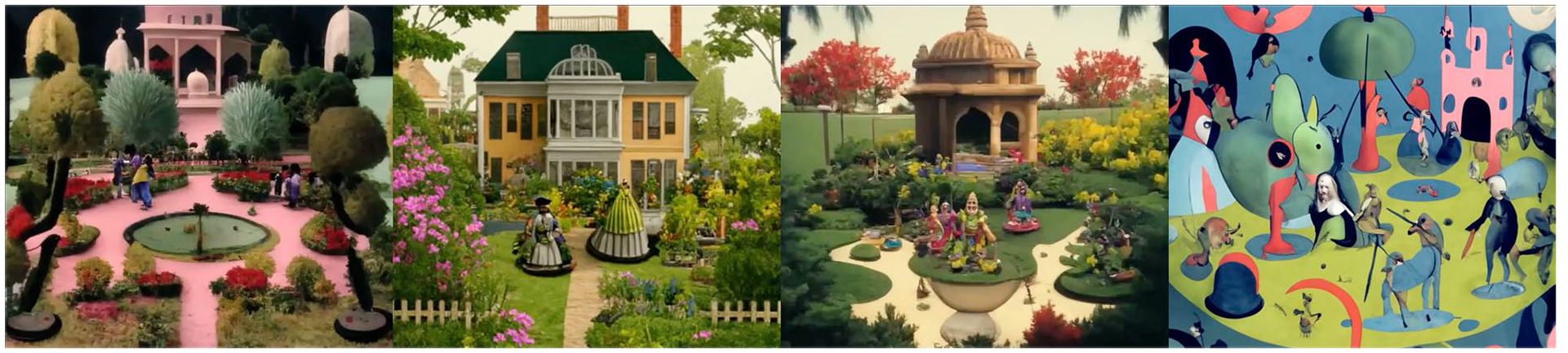
Image of The G(u)arden of Digital Delights by Harshit Agrawal (image by artist).
AI and The G(u)arden of Digital Delights
Originally part of what was touted as the first ‘AI-art show in the world’ – titled Gradient Descent (2018) – hosted by the Nature Morte gallery in Delhi, Harshit Agrawal was the first Indian to have a solo exhibition of AI-facilitated art with his Exo-Stential- AI Musings on the Posthuman (2021) at the Emami Art Gallery in Kolkata. Besides his work as an artist, Agrawal remains involved in Adobe’s Machine Intelligence and New Technologies (MINT) unit as a designer contributing to the further development of Adobe’s Creative Cloud Products. In principle terms, Agrawal understands the technology as an extension of himself (as an artist). The way he enters into dialogue with the technology to produce art points at the symbiotic relationship humankind now has with AI. The way he unpacks the inner-workings of AI and uses it to generate ‘original’ footage – such as the G(u)arden does – offers an important contrast with how the technology has been imagined (to function/perform) over time. As data scientists based in Bengaluru would also reiterate, the underlying datasets that algorithms make use of to generate text and images reflect our collective data footprint and would not be able to function without it. In this, AI does rely on not only original artwork and text but also what data humankind produces otherwise by social media and making use of online services. While a deeper technical exploration of how this works is not possible here, what stands out is that the clinical and cold-hearted rationality of AI of the sociocultural imagination, in reality may resemble our human biases and frailties much more directly. Agrawal’s G(u)arden offers insight into this by asking us to interpret what its AI produces in terms of aesthetics, merit and value. His work therefore also offers a competing viewpoint to Chinese dissident artist Ai Weiwei who recently labelled the output of AI-powered text and image generators ‘meaningless’ (Bakare, 2024). Instead, Agrawal’s work suggests that it is the ‘meaning’ that texts and images come with by way of the intentions of users, the labels they use and the inherent bias embedded in this, that now makes it possible to be creative with the technology. For Agrawal, the question here is not if this results in ‘good art’ but how it reflects the layering of the underlying datasets and what this unveils about humankind itself. It is also here that the sociocultural archive of AI imaginations is of specific relevance as it not only influences how we look at and interpret AI but what the technology itself might actually draw upon. To Agrawal, AI’s functioning cannot neatly be separated from this, even though it does not necessarily point at ‘actual intelligence or sentience’. The New York Times journalist Kevin Roose’s conversation with the AI-chatbot integrated into Microsoft’s search engine Bing offers particular insight here. The exchange quickly went viral as it appeared that the chatbot had given itself a name (Sydney), that it was in love with Kevin and that it harboured a desire to destroy humanity (Roose, 2023). It is not hard to see how a chatbot that relies on massive amounts of pre-generated text could be provoked to give such answers considering how many ‘storylines’ have revolved around AI being in love, having embarked on a path of destruction or no longer wanting to do the task it was designed for.
Inspired by Bosch’s garden of delight, Agrawal’s intention with his installation is to compare it with the way ‘we’ experience digital space and what the consequences are of ‘our involvement’ in it. ‘I wanted to offer different lenses to that garden, to see how we now live in it’, something that the four panels emphasize. In the first instance, he wants his audience to think about the figure of the gardener itself to have them contemplate on ‘the human cost of maintaining the garden’. He is particularly concerned with the ‘human labour to provide a clean garden space’, as he formulates it. He is critical of the ‘common held assumption of AI as functioning autonomously – as if with a mind of its own’. In his view, this all too easily relies on a ‘human fantasy’ of AI that ‘you may see in the movies’ but that tells you very little about how ‘AI actually does its job’. His G(u)arden is designed to ‘immerse yourself in AI’ as if stepping into an actual garden and to become aware of the work that goes into maintaining it. ‘You may think it is all about automation but there are thousands of thousands of people labelling data’. To maintain ‘a sense of digital delight and properness it is in fact an “artificially” crafted world designed to keep people in the confines of their bubbles’. To Agrawal, this makes it very much a ‘guarded garden’.
Walking around the installation and switching headphones, each time one enters a different soundscape designed in collaboration with artist Arunatpal as well. A subsequent panel is much more aggressive in its audio and visuals drawing attention to the ‘gore and pornographic content’ that requires ‘many people to make sure it does not leak out into the open’. Agrawal maintains that this comes at a human cost as do the politics involved in AI’s development and functioning. ‘AI itself changes politics, it changes our understanding of it due to filter bubbles and government intervention’. To the artist, this is another example of how ‘we are all complicit in keeping the garden clean’, though he argues ‘sanitized’ might be a better term. With each panel, ‘it is really one version of the garden that you get to see’. A third one points at the attractive aesthetics and visuals digital platforms work with ‘to lure you in . . . something that kind of blocks out reality . . .’ By providing you with almost limitless ‘fun, cute content, it traps you into that feeling. There is a lot of subliminal influence’, he says. The final panel in the installation therefore collapses all these ideas into a ‘kind of zombie-like, wild screen’ that he hopes the visitor will understand as ‘social commentary on AI and the idea of how it creates this ideas seemingly spaces of delight but with other repercussions’.
Conclusion
Harshit Agrawal’s The G(u)arden of Digital Delights is just one example of (co)creation with AI that also asks critical questions of its underlying functioning in terms of datasets and algorithms. As Agrawal puts it, ‘AI thrives where data is produced and transformed, irrespective of its actual quality’. The randomized way the installation produces imagery underscores how AI defies direct cultivation, to stay with the theme of the (digital) garden. Agrawal’s G(u)arden therefore also allows us to ask more critical questions about the ‘meaning’ of what text and image generators are now able to generate in terms of output. Working and creating with AI involves a process that is collective, even symbiotic in nature, where the datasets it uses do not exist separate off but stand in a direct and continuous relationship to ‘us’. While concerns of artists and creative professionals over copyright infringements cannot be ignored nor the fear of potential job loss, it is paramount that we separate these discussions from AI’s potential for creative output. Too easily and perhaps even greedily is this dismissed as ‘meaningless,’ while what it draws upon is humankind’s collective data footprint. These data are layered with human bias, opinions, preferences and so on that not only reflects us but by means of AI also influences us. In this, the sociocultural archive of AI imaginations plays an important factor in two interrelated ways. In general terms, it influences the interpretation of AI’s functioning and its potential future because knowledge of its technological operations remains limited among the population at large. During fieldwork, even data scientists admitted that at a certain level, it was hard to predict AI’s exact functioning. At the same time, the sociocultural archive has also become part of datasets itself which then may give the impression that AI is indeed capable of having desires, opinions and original thinking. It is at this junction that we find that the work by Indian artists such as Harshit Agrawal offers such crucial insight into the way we understand and situate ourselves (as ‘data’) vis-à-vis the ‘creative’ output AI is capable of generating. As the technology is developing and spreading at an astonishing and ever-faster pace, there is an urgent need for scholarship to engage in a more determined fashion to explore how humankind now lives, works and creates with AI at ‘present’. By interrogating how AI was once envisioned in the ‘past’ and the way this lives on in the collective imagination, we have an important starting point for a more productive approach to the technology for the ‘future’.
Footnotes
Data availability statement
Data sharing not applicable to this article as no datasets were generated or analysed during this study.
Funding
The author(s) received no financial support for the research, authorship and/or publication of this article.
