



Abstract
Artificial intelligence (AI) can create works deceptively resembling paintings, graphics, or photographs. This article examines how to treat these works, and under what circumstances, if any, they should be understood as art. The focus is placed on the work itself in the l’art-pour-l’art-tradition, on the reception, on the skills involved in the creation, and on the authors themselves. Besides looking at literary sources touching on the aforementioned aspects, the evaluation considers the perspective of people with an affinity for art through in-depth interviews. Most interviewees revised their initial reaction after learning that the works were AI generated, being more skeptical about their status as art. It then becomes obvious that the role of the artist is undergoing change. The confrontation with the artificial brings the human creator into the foreground and makes them inseparable from the work. The new technical-cultural situation leads to a new, more contextual evaluation of art.
Introduction
This article explores whether images created by artificial intelligence (AI) can be considered “art,” a topic described as “touchy” (Walter, 2023) that increasingly receives attention in discourses (e.g. Dinda, 2022; Mikalonytė and Kneer, 2022). It combines the perspectives of well-known scientific approaches to the definition of art, as well as the assessment of people with an affinity for art.
The definition of art is an impossible undertaking and countless texts exist on the topic – sometimes with the result that it cannot be grasped at all. The term itself is problematic: art is seen as a cultural universal, but several societies do not have an “independent concept of (or word for) art – even though people in these societies do engage in making and enjoying one or more of the arts” (Dissanayake, 1988: 35) and possibly see art as such an integral part of everyday practices that a separation would not make sense.
In the so-called “Western” cultural context, there seems to be a common sense (Croce, 2007 [1915]: 5) that defines art. Art can denote the activity of creating something, an expression of skill and imagination, single pieces of art, or the entity of artworks by particular persons or in particular styles. Several common definitions of art like “work with imagination” (Bolton, 2013: 24) or “human activity” and its results (Wikipedia) may – depending on further specifications – exclude images generated by AI: although the prompt suggests it, AI cannot “imagine” something and the writing of prompts as a “human activity” is subject to further discussion.
Thus, the terms “human” and “imagination” already illustrate the difficulty with regard to works created by AI. But how does this creation process work? This article focuses on diffusion models, a technology capable of interpreting natural language instructions or “prompts” and generating images. These models are made possible by the availability of large-scale image corpora such as ImageNet (Deng et al., 2009) and LAION-2B (Schuhmann et al., 2022) containing pairs of images and associated human annotations, the evolution in natural language models such as Transformers and the GPT-2 architecture (Radford et al., 2019) capable of representing real-world concepts in a mathematical vector space, and the use of neural latent diffusion models that continuously refine images as conditioned by the input text (Rombach et al., 2022). Starting from either pure noise or a seed picture, a diffusion model refines its input iteratively following patterns learned from the training data and the text of the input prompt until reaching a final image after a number of steps.
We focus on pictures generated with prompts (see Figure 1). The words used here can refer to concrete image contents such as “woman” or “landscape,” and provide attributes such as “beautiful” or “strange,” as well as more abstract image contents such as “dystopia” or “dream” (see Figure 2). Words can also denote a style of image (“hyperrealistic”), a style of period or techniques (“Renaissance art”), as well as single or combined names of different artists (“Van Gogh”).
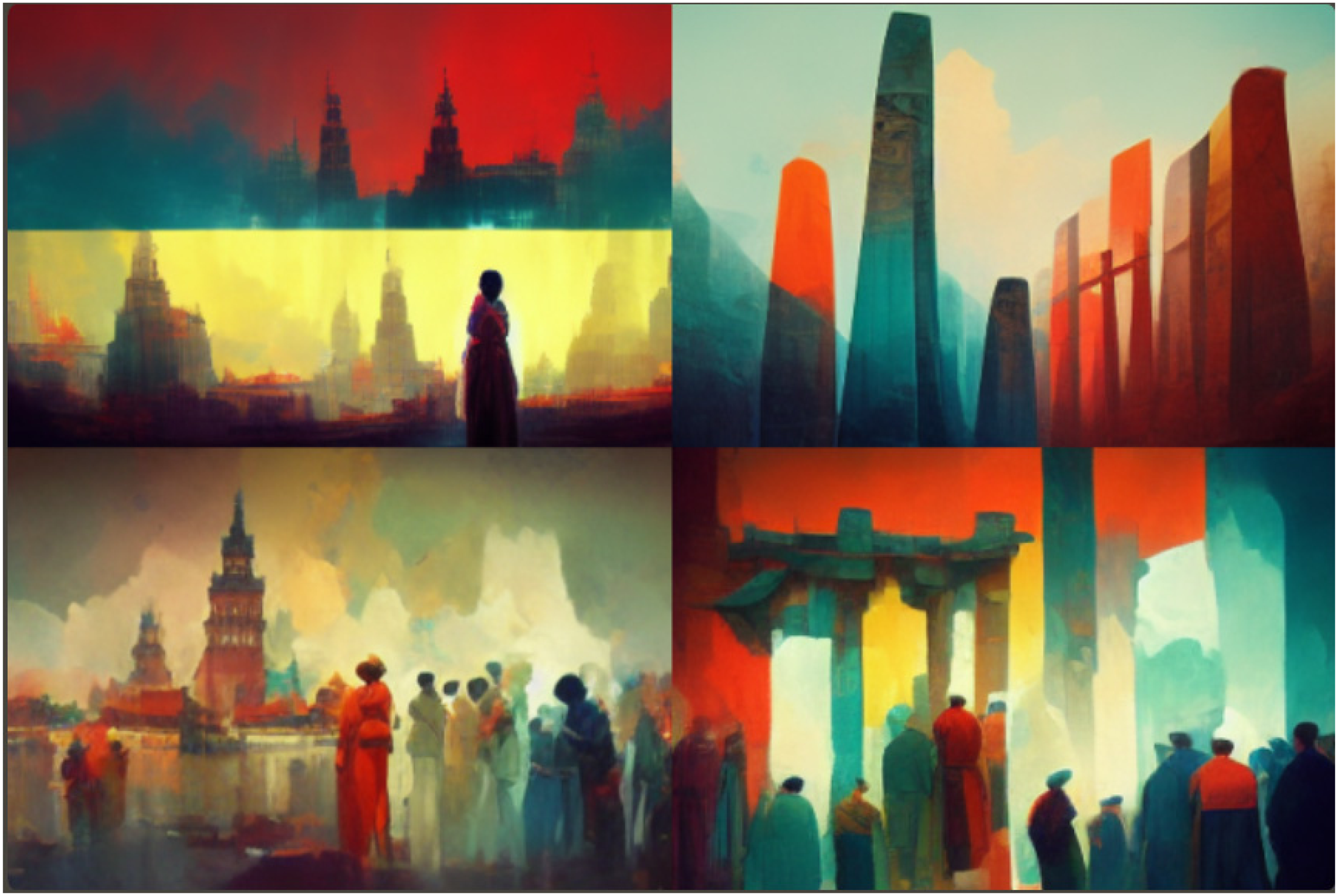
Initial options given by Midjourney when prompted with “analyzing culture –ar 3:2,” December 2022.
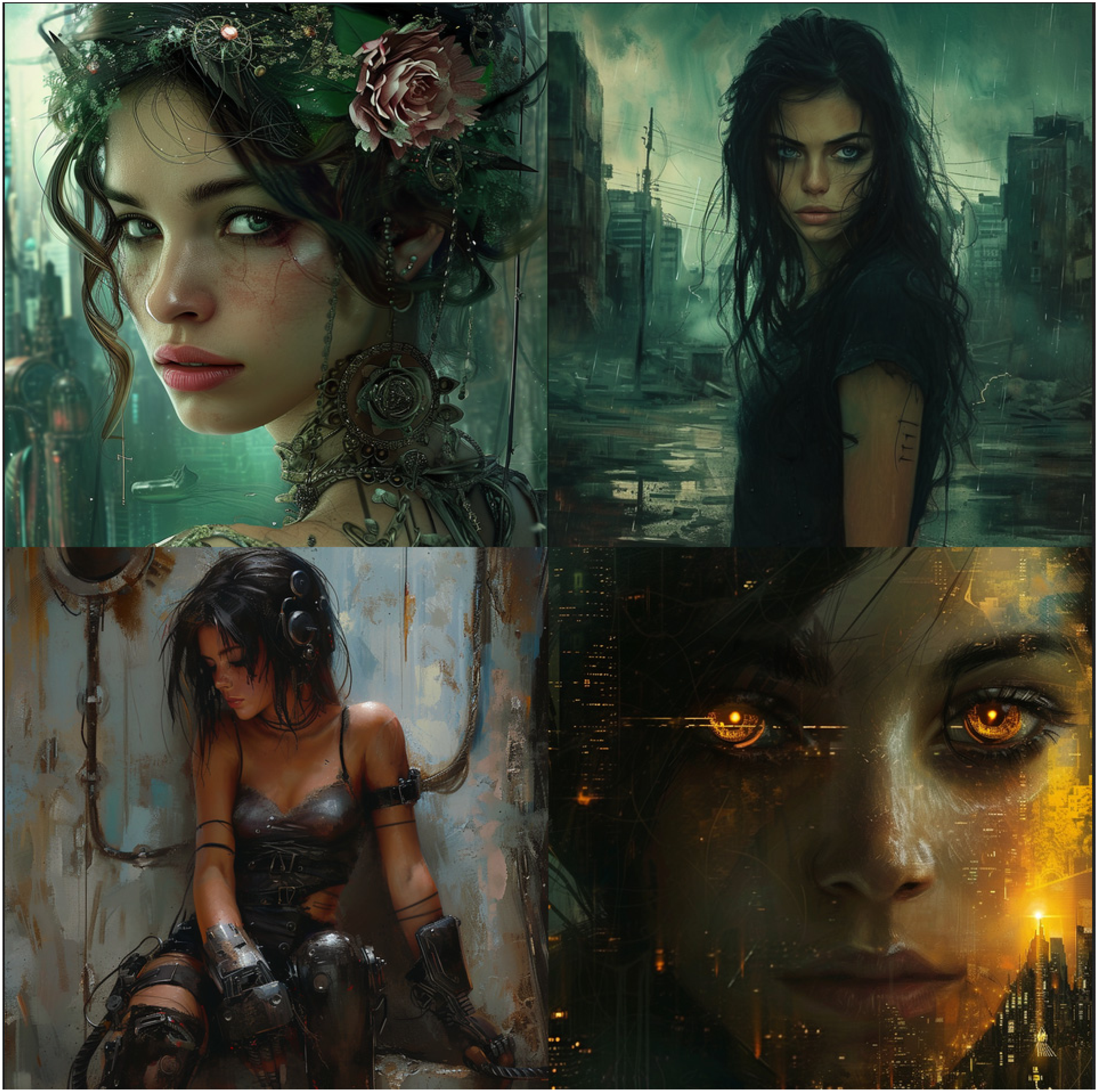
Results for the prompt “beautiful woman, dystopia” in version 6 of Midjourney: the “beautiful woman” is young, white, slim and has long dark hair, adhering to known stereotypes.
The visual material and associated human-written textual descriptions the algorithm uses to realize the prompts are taken from large datasets of training data (e.g. Willison, 2022). As observed in other AI-related contexts like face recognition, tendencies and biases are likely to occur when relying on such datasets, resulting in “a hugely stereotypical view of the world” (Sterne, 2000: 191;Turk, 2023; see also Figure 2).
Among the other topics discussed regarding AI, which are often difficult to separate from one another, are possible impacts of AI on the digital divide (Carter et al., 2020), the transformation of business practices (Nishant et al., 2020), educational topics like student projects in the age of AI (Bannister et al., 2023), stakeholder and ownership issues, and the type of knowledge imparted by AI (Colton and Banar, 2023: 51f.).
Literature review on the understanding of art
This article deals with visual, two-dimensional images generated by AI, setting aside art practices where the result is not important and favoring “works” of art, the results of doing art. Points of view diverge when regarding the status of “art.” According to art philosopher Jerrold Levinson (2005: 4.) this would first be art for itself, that is, the focus on the work and on its aesthetic properties – which go hand in hand with the cultural context. Focusing on aesthetic experiences, the audience comes to the fore. One naturally moves on to a concern with the ontology of art, with the process of artistic creation (Levinson, 2005: 7) and consequently on to the artist, their abilities, and eventually also their persona.
This review focuses initially on “classical” positions towards the ontology of art that have not been articulated specifically with regard to AI. Later parts focus on more recent studies that deal with AI in order to answer how or whether AI images challenge existing concepts.
Focus on the picture
To focus on the picture itself and not consider its reception, its cultural context or the author's underlying skill is surprisingly difficult: “the fact that we refer to works of art […] emphasizes a concern for and interest in the work, both perceptual and conceptual” (Muelder Eaton, 2004: 74). Even the simple formalistic definition of art includes the creator with its “tidy response: x is an art work if and only if x is primarily designed in order to possess and to exhibit significant form” (Carroll, 2001: 93). Thus, the mode of creation is difficult to separate from the picture itself.
If art should be exclusively defined about the picture, only an absolute value immanent to the picture could maintain this option – for example “beauty” (Redies, 2014), understood as an inherent quality of an artwork to trigger visual pleasure (Redies, 2007) or, more encompassing, the Greek term “kallos” meaning “beautiful” but also “good,” appropriateness, proportion and harmony. Unlike the saying “beauty lies in the eye of the beholder,” the beautiful is objectively ascertainable. However, the perception of some mind is the basis for being able to call something “kallos” (Kennick, 1979: 421), which brings the perception to the fore. The famous nightingale example of the difference in pleasure when perceiving natural objects or art objects (Muelder Eaton, 2004: 74) shows that beautiful, even in the sense of “kallos,” may not be enough to judge the beauty of an object without knowledge of its purpose. Focusing on modern art, Leder and Nadal (2014) illustrate that the focus on beauty has tendentially been abandoned as a criterion for the understanding of art. Instead, cognitive engagement comes to the fore, and knowledge of the author and their intentions, circumstances, and cultural context gain importance.
Another focus has been on expression. In Philosophy of the Arts (1950), Morris Weitz (1950: 51) defines art as “an organic complex or integration of expressive elements embodied in a sensuous medium”. Here, “expressive” refers to emotional qualities that “both are something and are about something” (Bresnahan, 2014: 2). Both the “aboutness” of art (Danto, 1974: 139) and its inherent emotionality are addressed, but a person is needed to judge or experience this.
A radical approach to art that places works of art themselves at the center is “l’art pour l’art.” This concept touches “the most contradictory problem of aesthetics” (Hauser, 1967 [1953]: 772), the question of whether art is an end in itself or a means to achieve other goals. The idea dates back at least to Immanuel Kant, who was convinced that “the beautiful is that which without any concept is cognized as the object of a necessary satisfaction” (Kant, 1964 [1790]: 77). Theophile Gautier goes further, claiming that only that which serves nothing is truly beautiful, “everything that is useful is ugly” (Heftrich, 1977: 22) because “useful” means instrumentalized. But if art is not supposed to be useful, this implies that the creator of art does not anticipate a reaction in the viewer or that it simply does not matter. If one assumes, however, that people have to express themselves, act intentionally, and perform deeds based mostly on expectations and value (Fishbein and Ajzen, 1975), it becomes challenging to stick with this definition.
Focus on the perception
Many definitions of art take human perception into account: “To call something art is to establish certain expectations for its social value” (Dillon, 2013: 2). However, the reception of an artwork depends – at least also – on historical and cultural contexts, as countless examples show: Van Gogh only sold a few works during his lifetime, and Johannes Vermeer died poor. Consequently, each work of art has to be seen in interaction with the culture it encounters.
In his seminal essay “The work of art in the age of its technical reproducibility,” Walter Benjamin describes the quality inherent in originals, in contrast to reproductions, as “aura,” an artwork's charisma characterized by originality and uniqueness: “Even if an art reproduction is truly accomplished one aspect is missing: the ‘Here and Now’ of an artwork” (Benjamin, 1980: 475). Photographs, however, are per se reproducible and can hardly be auratic (although Benjamin makes some exceptions). In front of a photograph or film one would not feel the awe that arises when following the brushstroke of the master in a painting. The feeling and/or knowledge that an artwork is a time-bound original would thus be the basis of an auratic sensation.
Other approaches emphasize the audience's feelings differently: from the point of view of Expressivism, Tolstoy writes that “art is a human activity consisting in this, that one man consciously by means of certain external signs, hands on to others feelings he has lived through, and that others are infected by these feelings and also experience them” (Tolstoy, 1930: 123). It is about the evocation of a feeling “of spiritual union with another” (1930: 227). Italian philosopher Benedetto Croce located the essence of art in the expression and transmission of emotion (Levinson, 2005: 5). Recent research has focused on the change of feelings evoked with regard to historical circumstances (Drymer, 2021: 4; for NFTs [non-fungible tokens] see Frye, 2023) or the mechanisms underlying art-evoked feelings (Nummenmaa and Hari, 2023).
The emphasis on feeling and unity is also consistent with South Asian art theory. Spiritual texts state that “the arts generate and consolidate moods, sentiments, and transient emotions (rasa), freed from the fluctuations of fleeting desires and impulses, focus and diffuse these in the minds and hearts of the people” (Mukherjee, 1965: 91). Originally, the use of the term “rasa”: ranges over a variety of interconnected meanings: a fluid that quickly tends to spill, a taste […], the soul or essence of something […] the life-giving sap in plants and even poison. Almost all these distinct meanings are exploited at different junctures of the complex aesthetic phenomenology centring the concept of rasa. (Chakrabarti, 2016: 8)
Foregrounding the evocation of feelings, it can also be argued that artwork thus performs functions, contradicting the aforementioned “l’art pour l’art.” These functions may lie in the realm of the artist, for example as self-therapy, but usually (also) relate to the audience. Besides conveying emotions, such functions could be approval, social criticism, or entertainment. Of course, the artist's intention does not have to correspond to the actual result and the function may also change through use or instrumentalization in different contexts. Recontextualization, however, can go far beyond the realm designated as “art,” for example in global icons such as the Mona Lisa, used to market countless products.
Focus on the skill
The German saying “Kunst kommt von Können” (“art comes from skill”) can be invoked here – in fact, “Kunst” (= art) shares its etymology with “Können” (= skill). Art can only emerge if the artist has a certain level of skill (Dissanayake, 1988: 36), mirroring Plato's definition of art as imitation, where an image “looks like the real thing but isn’t the real thing” (Danto, 2013: ix). In this context, the word “techne” is also used more often, meaning “the capacity to make or do something with a correct understanding of the principle involved” (Dissanayake, 1988: 35) and including precursors of what we call today applied science. However, it is difficult to define the tools to be mastered (Mazzone and Elgammal, 2019: 8) and the kind and level of skill necessary to make “art.” Recent research often highlights decisions that the author of an artwork has to take, focusing on cognitive engagement (Lyu et al., 2024), which may be understood as a skill just like a painting technique.
Moreover, skill alone does not seem to be enough: the works of engineers, hairdressers, doctors, or journalists are only called “art” in exceptional cases. Everyday experience from the so-called artistic field also shows that technically flawless works are nevertheless evaluated only mediocrely in competitions or in higher education, as “not really artistic.” That missing “extra” has been described as originality or creativity: “Art is the expression or application of human creative skill” (Messmer, 2017). The coupling of “art” and “creativity” is historically young (Reck, 2019: 537) and arguments can be made for a strict distinction between them. However, the concept of creativity already interferes with the definition of artwork, because it has to be “created.” Accordingly, it can be seen as useful to illuminate the term as a kind of skill.
With the root word “creare (lat.) = to create,” creativity denotes an original, productive activity. The standard definition assumes that “creativity requires both originality and effectiveness” (Runco and Jaeger, 2012: 92), but describing creativity with reference to its end results has been contested (Walia, 2019) as it can be understood as a dynamic process. Following Berys Gaut (2003: 150f.), “creativity is a kind of making that produces something which is original,” “has considerable value,” and “must involve flair by the maker,” meaning it requires skill and is not produced in a simple mechanical way.
Keith R. Sawyer (2006) defines two perspectives on creativity, that of rationalism, “the belief that creativity is generated by the conscious, deliberating, intelligent, rational mind,” and that of romanticism, “that creativity bubbles up from an irrational unconscious, and that rational deliberation interferes with the creative process” (2006: 15). Research tends to support the first point of view with creativity falling under “skill.” Like “art,” the term “creativity” is also often used in the context of psychological well-being or therapy: creativity can help the development of an inner core of the individual (Reckwitz, 2012: 218), emphasizing the process over the work.
We can conclude that the terms “creativity” and “art” are not in every aspect distinct, and that creativity as well as technical ability can be understood as skills associated with art respectively as conditions to define something as art.
The role of the author
If one sets the beginning of “Western” art history with Giorgio Vasari's book The Lives of the Artists, one places focus on the artist (Hellwig, 2005: 9f.). Yet, alternatives exist, as seen in creations from other eras or cultural contexts where the author can hardly be reconstructed and was not significant for the work. In this context, W.K. Wimsatt and Monroe Beardsley formulated the intentional fallacy, defining “intention” as “design or plan in the author's mind” (Wimsatt and Beardsley, 1946: 469): artists absent in space or time cannot explain their work, and their answers could distract from the work's actual quality. Recipients see different aspects in works depending on their culture, prior knowledge, and emotional state. Consequently, the artist and his/her intention should not be relevant for the understanding and appreciation of an artwork. Literary critics Steven Knapp and Walter Benn Michaels (1982) take the contrary view and see the intention of the creator as the only possible basis for interpretation, that the author's intention and the meaning of their work are identical. Without an artist, even the natural could be misunderstood as a work.
Between these two extreme positions other aspects often play a role, such as the question of how recipients come to terms with biographical aspects of an artist that may not be acceptable to them. Picasso, for example, is undoubtedly considered one of the most important and influential artists of the 20th century while, as a human being, he does not appear to be worthy of all his qualities (Wilson, 2004). The question is often raised of whether one can appreciate someone's work if one despises the person who created it. Conversely, some works seem particularly appreciated precisely because they were created by a particular artist.
Creations that require hardly any action on the part of the author, such as ready-mades, pose further complications. A ready-made is “an ordinary object elevated to the dignity of a work of art by the mere choice of an artist” (Obalk, 2000). In this context, Simon Evnine (2013: 407) asks whether the artist creates “anything new by merely choosing (or displaying) an already-made object.” Hector Obalk (2000) gives a telling example: “MD [Marcel Duchamp, considered the inventor of ready-mades] also has to believe and make believe that he (and not the designer) became the author of these chosen objects.” As found objects, ready-mades stay the same but are transformed by their arrangement and context (Eggink, 2010). Through transformation and recontextualization, ready-mades make it possible to view the familiar in a new way and, seen in this light, the person who publicly defines an object as artwork provides the impetus for a new perspective. More recent approaches to the ready-made have focused on the practice of appropriation and misunderstanding (Xiaoling and Qing, 2020) and on the active, sometimes physical interaction with a ready-made, which is unlikely in the case of two-dimensional images (Kessels and Schrenk, 2022).
We can then conclude that it is not completely irrelevant who the author of an artwork is and that authorship sometimes does not concern the creation itself but the designation.
The study: Perspective and approach
This article, based on a cultural anthropological perspective, assumes that there is, after all, a common sense about what art means. For this reason, it makes sense to include the perspective of interested and artistically engaged persons.
The author has been active for many years in a cultural scene that evolves around the notion of art: the scene of staged photography. In this scene, pictures are shared and discussed via social media, which also helps people organize shoots and events (Jerrentrup, 2021). The scene deals with images with a photographic mode of creation, that is, an indexical relationship between the image work and the person depicted, but boundaries to the primarily or purely digital image work are fluid: image processing is capable of fundamentally changing photographs, inserting people into new settings, changing their appearance to the point of unrecognizability, and so on. From mid 2022 onwards various people in the scene (including the author) increasingly shared images created entirely or partially by artificial intelligence.
In addition to the emic perspective, an empirical, qualitative study took place in which the author conducted semi-structured in-depth interviews with ten people active in the photography scene, six men and four women between the ages of 28 and 68 with origins in Europe. All interviewees have been dedicated to photography for several years as an intensive hobby and/or side job. Most prefer pictorial motifs with people. Four persons had already dealt intensively with AI at the time of the interview. The persons were chosen because, on the one hand, they are not involved in the scientific discourse about art, that is, their opinions and assessments are given largely independently of corresponding literature. On the other hand, they are very interested in looking at and creating art, and experience themselves that more and more works created by AI are presented in the photography scene, that is, in an artistic context. Thus, the question is relevant for them, for example, whether they should work with AI as well and, if yes, how they should frame this.
No clear topic was mentioned before the interview, saying only that it would be about “artistic works.” The interviewees were shown both conventional photos and AI-generated images and then asked for their opinions. This was to serve as a spontaneous and unguided initial assessment, and was followed by semi-structured questions which moved the topic to “AI and art.” The interviews were designed as a conversation as much as possible to prevent the atmosphere from being perceived as artificial.
The understanding of art with regard to AI
There is always human intervention when creating works with AI: the people who created the algorithms, the people who created, selected and uploaded the images that the AI uses as template, and finally, the people who enter prompts and choose the results. Thus, AI is never purely artificial, but is indexically related to various people, if not to a considerable part of humanity.
This section examines to what extent the criteria mentioned in the literature review apply to AI and how they relate to statements from the interviewees.
AI – focus on the picture
When focusing purely on a picture, it is often by no means clear how it was made, if and to what extent AI was involved, and, when considering the quality of the creation, one could argue, it does not have to be treated differently from any other artworks.
One possibility discussed earlier is to define art formalistically. But not every AI work is designed with the goal of being art – as seen in the Midjourney groups, it is also about fun, watching the software create something from an undefinable color surface or about crazy challenges. The same technique, perhaps even identical prompts and results, would thus be defined as something different depending on the creator or situation, for example, as a work of art, as fun, or as an experiment. However, just focusing on the work, the ontology should not play any role, but rather the designation.
Previously, the aspects of beauty and expression were mentioned. Since AI-generated works cannot necessarily be distinguished from purely human-made ones by their appearance, it must be said that, following these criteria, no special role can be attributed to them: they can be beautiful and expressive.
This matches the observation that the interviewees were inclined to initially define works created by AI without any hesitation as art. In some cases, certain aspects were praised or criticized, for example, “the skin is over-processed, it doesn’t suit my taste, but it's not badly done” or “I like the color scheme.” Relationships to famous artists were made as well: “The gold tone reminds me of Gustav Klimt.” Several of them gave evaluations such as “aesthetic”, “creative,” or “original”.
AI – focus on the perception
When it comes to the reception of art generated by AI, the question arises whether the experience differs from that of conventional art.
As AI-generated pictures do not include the notion of an “original,” Walter Benjamin's notion of aura may be important. Yet, such pictures sometimes even suggest brushstrokes and, since they can be created in the style of certain artists, could even be assigned to epochs or trends. Furthermore, today's recipients are used to “original-free” artforms such as photography and film, and to look at and watch art online. Benjamin's argument is not specific to AI-generated art and may be disputable with regard to (post)modern times. The decisive factor here, as several interviewees emphasized, is rather the context of perception: “If I were to see the AI images in a gallery, I wouldn’t question if it is art,” said one interviewee and another “What matters is that it gives me the artsy vibe.”
If, as in the case of South Asian art theory, the immediate feelings that pictures evoke are placed in the foreground, there should not be any difference between traditional and AI-generated images as they cannot be distinguished by their look. There has been even a tendency among the interviewees to ascribe a higher potential to AI. One interviewee remarked that the artwork should directly speak to her, and, as another interviewee put it: “It's important to me that the work triggers something in me, whether that comes from a great artist or was painted by a monkey doesn’t matter.” Another remarked that “AI-generated images are often wonderfully rich in detail, you can really lose yourself in these worlds.” The term “kitsch” was introduced by another interviewee: “When AI shows a beautiful landscape, it's really magical; in photography, however, you have to work with what's there. In painting […] you’re a little freer, but the skills are often lacking.” In this context, the interviewee also addressed the reserved attitude of some artists: “Often, as a photographer or painter, you perhaps don’t dare to get really kitschy. AI doesn’t care about such restraints.”
Johan Cilliers (2010) suggests as a working definition of kitsch as “the reduction or inversion of aesthetic objects or ideas into easily marketable forms”, where the term “marketable” suggests that kitsch should appeal to a large number of people. This is precisely what AI is based on, namely on what is found in the training data and, by liking or disliking the resulting pictures, on users’ opinions. From this point of view, AI works can show parallels to kitsch. The controversial term has further been described as “the enemy of art” (Retief, 2003: 680). Yet artists such as Jeff Koons or Pierre et Gilles (Bender, 2020) repeatedly graze the boundaries with kitsch. This is often about “reinterpreting aesthetic poverty and mass culture through ironic affirmation” (Bender, 2020), but perhaps also about acknowledging the need for the feelings that kitsch triggers. In its focus on pure feelings, kitsch resembles the South Asian concept of rasa, and apparently AI creations often succeed in appealing directly to emotions. The idea of feeling a kind of unity with the artist, the artwork, and a larger number of recipients, and accordingly experiencing a feeling of connection on a meta-level (Gottman et al., 1997: 7), can function with AI because of its connection to the masses using and creating the internet. As expressed by an interviewee “kitsch is beautiful, because it is peace.”
AI – focus on the skill
On a very basic level, following Marshall McLuhan (1964), one can consider any media as extensions of the body. One can see AI as a logical further development of the paintbrush, camera obscura, and photography. AI, consequently, would not mark a break in the history of human creativity, but only another new technology that facilitates it, and the question of whether AI works can be art would not fundamentally differ from the question of whether you can create art with a camera or a graphics tablet. Furthermore, even in classical art, the execution may not have been done by the master him/herself: “Even great artists like the Renaissance masters let their students paint everything, themselves just providing ideas. There's not much difference,” remarked one interviewee, and pointed out that the most fundamental skill would be the idea, not the execution. Another interviewee linked it to staged photography: “I didn’t design the dress, I didn’t build the chateau, I didn’t plant the flowers, but I did put it together for the photograph.”
Yet, if we look at the question of skill in more detail, the results of AI like Midjourney can be considered ambiguous, and it has been argued that “the bottleneck [of AI technologies] would lie in creativity” (Jlang et al., 2022: 10). The programmers must have certain skills to create the software. The users, however, can achieve results that look interesting with very simple and not original prompts, or even copy existing prompts. Nevertheless, prompts can always be composed in creative ways, for example, to combine art styles or to create something never seen before. Problem-solving capacity is also often required to work around software problems: the software struggles with complex actions such as the representation of a performer dancing on a rope and corresponding prompts must be avoided or skillfully reformulated. Two interviewees gave the well-known example of inaccurate hand depictions, remarking that the AI user must try to avoid hands with the help of well-written prompts.
Results are further guided by the human decision of which results to keep: the focus in AI-generated art shifts “from technical tasks to strategic decisions related to visual appeal, cognitive engagement, and emotional resonance” (Lyu et al., 2003: 65; Hong and Curran, 2019: 1). More than half of the interviewees discussed these arguments, often giving parallels to photography like “selecting the best photograph from a shoot is often very difficult. With AI art, this must be the same.”
An interviewee who has always heavily edited her photographs thinks that evoking images in the recipient's mind is actually the domain of a poet, and therefore one would also have to define the person who creates images through words or prompts as a poet rather than a visual artist. However, for her, the quality of the words played a fundamental role and she could not accept a stringing together of simple terms: “If you only write ‘woman, pretty, beautiful, elegant, hyperrealistic’, the level of creation is not reached, even if the picture looks good in the end.” Consequently, the prompt would be essential to understand a work as art, much like a ready-made needs a title and recontextualization to be understood as art.
The question of skill results in a situation similar to modern art: in the case of the person who ultimately prompted and chose the picture into being, there may be quite some underlying skill – not necessarily painterly or photographic, but still knowledge of art styles and aesthetics – and the AI may often rather augment than replace human creativity (Anantrasirichai and Bull, 2021: 589). Still, even a small child without any training could – if they can write or dictate – create a picture based on a prompt whose look does not necessarily have to differ from that of a more elaborate prompt.
AI – the role of the author
An early work created by artificial intelligence is Edmond de Belamy (2018) implemented by the Paris-based arts collective Obvious and auctioned in 2018 for $432,500 as the first AI portrait at Christie's. This work was appreciated precisely because it was AI generated, which had a novelty value (Christie's, 2018). Yet, even though robots nowadays can have exhibitions (Ambrosio, 2019), Elzė Sigutė Mikalonytė and Markus Kneer showed that “people are much less willing to consider robots as artists than humans, which is partially explained by the fact that they are less disposed to attribute artistic intentions to robots” (2022: 1). Interestingly, the Turing test in relation to artistic creativity “has been passed in a relatively strong form” by AI (Boden, 2010), that is, machine creativity mimics human creativity so well, that both become indistinguishable for the observer.
Nevertheless, the interviews partly support the results of Mikalonytė and Kneer: two thirds of the interviewees said that, for a work to be recognized as art, it was important that the author had not only entered a textual prompt, but either that the prompt had to be “elaborate” or “artistic,” or the author had to have used their own photograph in the prompt or to have processed the AI-generated image further, “by [their] own hand.” Interestingly, many interviewees also revised their opinion about the pictures shown at the beginning of the interview, for which no further information had been given. By making statements about the status of the pictures without any information about how they were created, they initially followed Wimsatt and Beardsley's (1946) assumption that the author and their intentions were not relevant. However, learning it was AI generated, most interviewees questioned their initial assumptions: “If I had known that, I would not have called it art right away. I would have needed more information. I just assumed it was a painting,” said one interviewee. Several interviewees considered their initial reaction to the pictures as “(maybe) naïve” or “too fast.” One interviewee explained: “On Instagram, when I see who uploads them and whether it's an AI-affine person, I immediately classify it differently.” A good quarter, on the other hand, did not attach any importance to information about the work – partly after weighing up arguments.
In this context, looking at the definitions in the first part of the article, the question also arises whether an image created by artificial intelligence can be called a ready-made. Creating a ready-made has been described as making “anything new by merely choosing (or displaying) an already-made object” (Evnine, 2013: 407). This definition does not fit AI creations: the picture does not exist before the prompt. The aspect of choice, however, is correct. Therefore, this was also asked in the interviews, whether the choice that the user of AI has to make and the declaration of this choice as art are sufficient conditions to recognize the picture as art. A majority of the interviewees saw the choice as a creative act, and parallels were made several times, for example, to the choice of certain colors used by a painter or to a photographer's choice of perspective. However, it was also noted that the choice alone may not be sufficient. Similar to ready-mades, the aspect of transformation (Eggink, 2010) and contextualization also applies to works created by AI; framing, in particular, plays an important role, such as whether works are presented as gimmicks, gags, or works of art. The same piece could be “an artwork or a joke, depending on the context in which it is presented,” as one interviewee put it, “and will evoke different associations – in a museum maybe thought-provoking, and in a joke forum simply funny.”
On a more fundamental level, several interviewees addressed the fear of “losing the traditional artist/author,” echoing a concern articulated in popular articles and social media (Dinda, 2022): if AI can do everything just as well and much more effectively, where is the space left for the human? In this context, the question was raised as to whether art and its author would not be completely devalued in view of the inflationary possibilities. “The author is a modern figure, a product of our society in so far as […] it discovered the prestige of the individual, of, as it is more nobly put, the ‘human person’,” writes Roland Barthes in “The death of the author” (1968). According to him, it would be the death of the author which enables the birth of the reader, in our case, of the person who interprets and uses the picture on their own and thus may be considered not just a mere recipient (= receiving person), but an inherent part of the art process, which leads us back to “AI – focus on the perception.” An eventual “death of the author” is therefore not necessarily to be lamented; although it is by no means inevitable, with regard to both literature (Anantrasirichai and Bull, 2021) and interviews. In contrast, one may assume that the way a picture was made and the individual reasons behind its creation – thus, the contextualization – could become even more important: “To better appreciate an artwork, nowadays, I want to know how, why, and by whom it was done”, said an interviewee.
Conclusion and outlook
Neither common definitions nor interviews with people with an affinity for art provide comprehensive clarity in classifying the status of works created by AI, but the following aspects offer an approximation: the look of a work alone is not perceived as sufficient to define a work as art, matching Danto’s (1992: 5) statement that “you cannot tell when something is a work of art just by looking at it, for there is no particular way that art has to look.” Yet, an original, beautiful, and/or thought-/emotion-provoking look can be seen as a condition enabling or facilitating the relationship between the artwork and its audience. A central question for many interviewees is whether the person entering the prompts can be described as an artist. In this logic, art is (co-)defined by the creator: art is what someone creates in their – more or less recognized – role as an artist. This shifts the definition of “artwork” to the definition of “artist.” Here, the people involved in the programming, or in the shaping of the internet, were not given much attention, only the person entering the prompt, who could have a direct artistic intention. In their prompts, skill can be expressed, including knowledge of art history and ingenuity in putting together different aspects – even though it is possible to copy or let another AI generate interesting prompts. The later selection of AI-generated pictures has also been understood as an expression of skill. Further, the contextualization and interpretation as art were seen as crucial.
Contrary to the fear that human artists are being devalued, AI-generated pictures could bring them to the fore, both the authors of traditional and AI art. How a picture was created and the technique applied by the author may be of increased interest. In the case of AI works, the focus may shift to the prompts used and the results selected, the author's personality, education, inspiration, and intention. In a way, they become part of a Gesamtkunstwerk. It is they who can give the picture its contextualization and its status as art. This shows a trend that began with ready-mades, which had to be declared “art” by some person, and which continues and intensifies in AI works.
Confronted with the artificial, the human being can take the foreground. AI-generated pictures confirm that the definition of art is only meaningful depending on the cultural background.
Footnotes
Funding
The author received no financial support for the research, authorship, and/or publication of this article.

Author biography
Maja Jerrentrup, PhD is professor and programme Director for “New Media & Intercultural Communication” at the University of Landshut, Germany. Previously she was a professor at ADYPU, India and active as a photographer and photojournalist. Her areas of interest include popular art, intercultural aspects of art and identity, and body art.