




Abstract
This article presents a qualitative interview study of Finnish screenwriters and commissioners about the impact of generative artificial intelligence on the profession of screenwriting. We ask how screenwriters and commissioners see the benefits and risks of AI tools in screenwriting and how screenwriters see their changing profession in the future. We identify three stances towards AI-driven work practices in screenwriting. The functional, critical and curious stance reflect the ways in which the writers position themselves against AI technologies. Prompt engineering has emerged as a new skill in commanding AI and will become a conventional part of creative work.
Introduction
In recent years, several new technologies have been adopted in creative work and industrial processes in film and television. Script analysis tools, generative artificial intelligence (AI)-based software, and audience analytics are promising to accelerate workflows in script development and screen production and help understand audience engagement with stories. The great talking point of 2023 was the launch of the improved ChatGPT AI tool and its potential to change numerous creative sectors, including film and television writing (Hartley et al., 2023: 2).
The logic of television distribution changed profoundly with the arrival of streaming services, as linear television broadcasting has shifted to algorithmically curated catalogues of content (Lobato, 2018). Lotz (2017) claimed that the shift from linear television to personalized delivery of content, independent of a schedule, represents a transformation in the logic of television industries from scheduling to curation. More content is available than ever before, and streaming companies are turning to analytics to produce compelling and profitable content (Behrens et al., 2021; Doyle, 2018). The multiplicity of distribution platforms and the intensive use of subscriber funding are other significant changes in television distribution (Casado et al., 2023). Changes in the infrastructure and economy of the industry have affected the work of industry professionals.
In May 2023, the Writers Guild of America (WGA) went on strike for better working conditions and fairer remuneration. The professionals were also worried that if the use of generative AI tools remained unregulated, they would lose opportunities to create original script ideas and thus a significant part of their income and intellectual property rights. Screenwriters’ and writers’ guilds globally voiced solidarity with the WGA, and supportive demonstrations were organized by screenwriters’ guilds in many countries.
As a profession, screenwriting has changed. Streaming platforms have altered the business models and practices of the industry (Navar-Gill, 2020; van Es, 2022), and AI-based content generators have rapidly advanced. This article presents an interview study of screenwriters and commissioners in Finland about their views on the arrival and use of AI and data analytics in the film and television industry. Screenwriters are an interesting group to study, as they work in various roles and positions in the industry, ranging from auteur-type creators and showrunners to writers’ rooms and more ground-level staff writers. Similarly, commissioners’ views are important to explore because though they often affect script development, their background influence may be complex or elusive. To contextualize and understand approaches to new technologies in the field, it is important to explore the views behind the judgements and distinctions of both practitioners and the gatekeepers who guide decisions around scripts (Redvall, 2013: 7).
Screenwriting research as a field
Screenwriting is a creative practice but is still subordinate to the production machinery making the finished script into a film or TV programme. We understand screenwriting as a complex process involving collaborative and individual activities of development and writing that intersect with industry policies and screen production practices (see Kerrigan and Batty, 2016; Taylor and Batty, 2024). Scripts are culturally and economically valuable in the industrial process of screen production: their worth resides in the potential screen work to be made (Kerrigan and Batty, 2016: 134). Script development is marked by the dialogic investment and labour of several participants with often competing and conflicting goals (Batty et al., 2018: 157). Creative workers contributing to script development—screenwriters, development executives, television network or streaming service commissioners, producers, directors, script editors, and script consultants—have differing notions of the practice (see Batty et al., 2018: 157). Procedures and practices of screenwriting vary in productions, but oral transmission of knowledge, advice, and opinions is central (Price, 2017: 326) to processes typically involving several rounds of rewriting.
Screenwriting as a practice has evolved in recent decades due to the availability of computer software, story visualization tools, and digital co-writing and communication platforms that enhance script work (Dooley, 2017: 291). Generative AI tools can be seen as a continuation of digital technologies that have altered script development processes as well as the creation of ancillary documents such as pitches, synopses, and treatments. However, based on animated discussion about the effects of AI on screenwriting, it seems many practitioners see the field as being at a watershed moment, where datafied and human aspects of work increasingly blend in the future.
Being multi-disciplinary, screenwriting scholarship has been shaped in academia since the 2000s, but it has been dominated by individual case studies, resulting in a rather fragmented field (Price, 2017). Screenwriting research has approached script development from many perspectives, including as creative labour, an industrialized system, a social process, and poetics (Batty et al., 2018). Key research areas have been the nature of authorship, the challenges of collaboration, and the difficulty of defining screenwriting as a professional practice (Batty et al., 2018: 155–156). This article demonstrates that rapidly developing AI tools are intensifying discussion in these areas because they entail new dimensions in practices of authorship and collaboration from the perspective of human versus non-human labour as well as from a legal viewpoint.
Methods and materials
Our research material consists of thirteen focused interviews with screenwriters and four interviews with commissioners from different instances (streaming service, commercial television channel, and public broadcaster). The screenwriters’ experience in the field ranged from 6 to 45 years, while all commissioners had at least 20 years of experience in the industry. Some of the writers had double roles, for example, as screenwriter-director or as screenwriter-actor. In the interviews, the screenwriters produced self-understanding as professionals and the practices they prefer in different phases of their work, sharing for example narratives about the development of the industry or their own career development.
Typology of the industry positions of screenwriters based on the interviews.
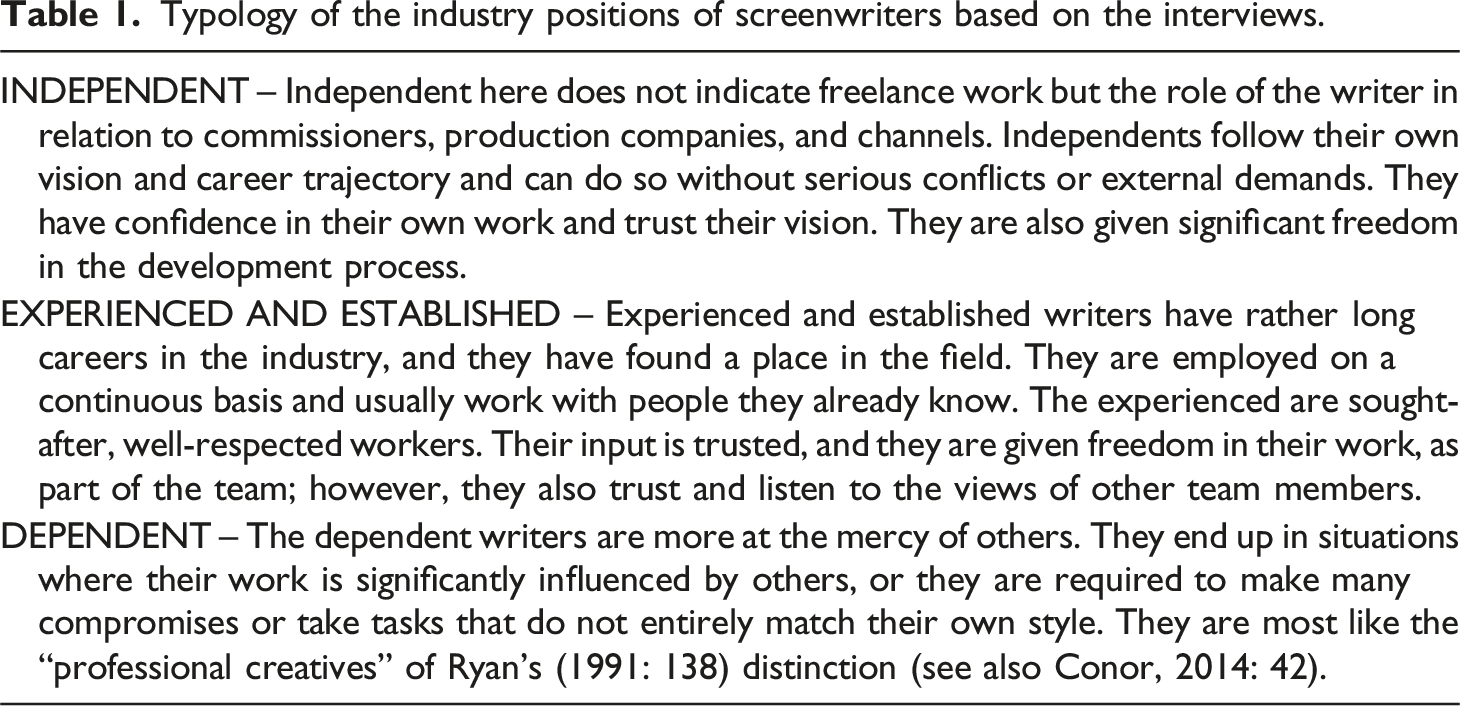
These positions are not stable, and they can change in different productions. For example, experienced screenwriters working in a team can be approached differently by commissioners or production companies depending on whether they are head writers or episode writers and on the overall cultural tradition of team writing.
Our goal was to understand screenwriters’ stances on AI-driven work practices and their ways of perceiving human authorship as well as imagining their profession in the near future. The following research questions directed our analysis: ⁃ Research question 1: How do screenwriters frame ideals of authorship as human labour? ⁃ Research question 2: How do screenwriters and commissioners perceive the potential benefits and risks of AI tools in creative screenwriting? ⁃ Research question 3: How do professional screenwriters see their changing profession in the future of the creative industries? (Table 2) Background details of the informants.
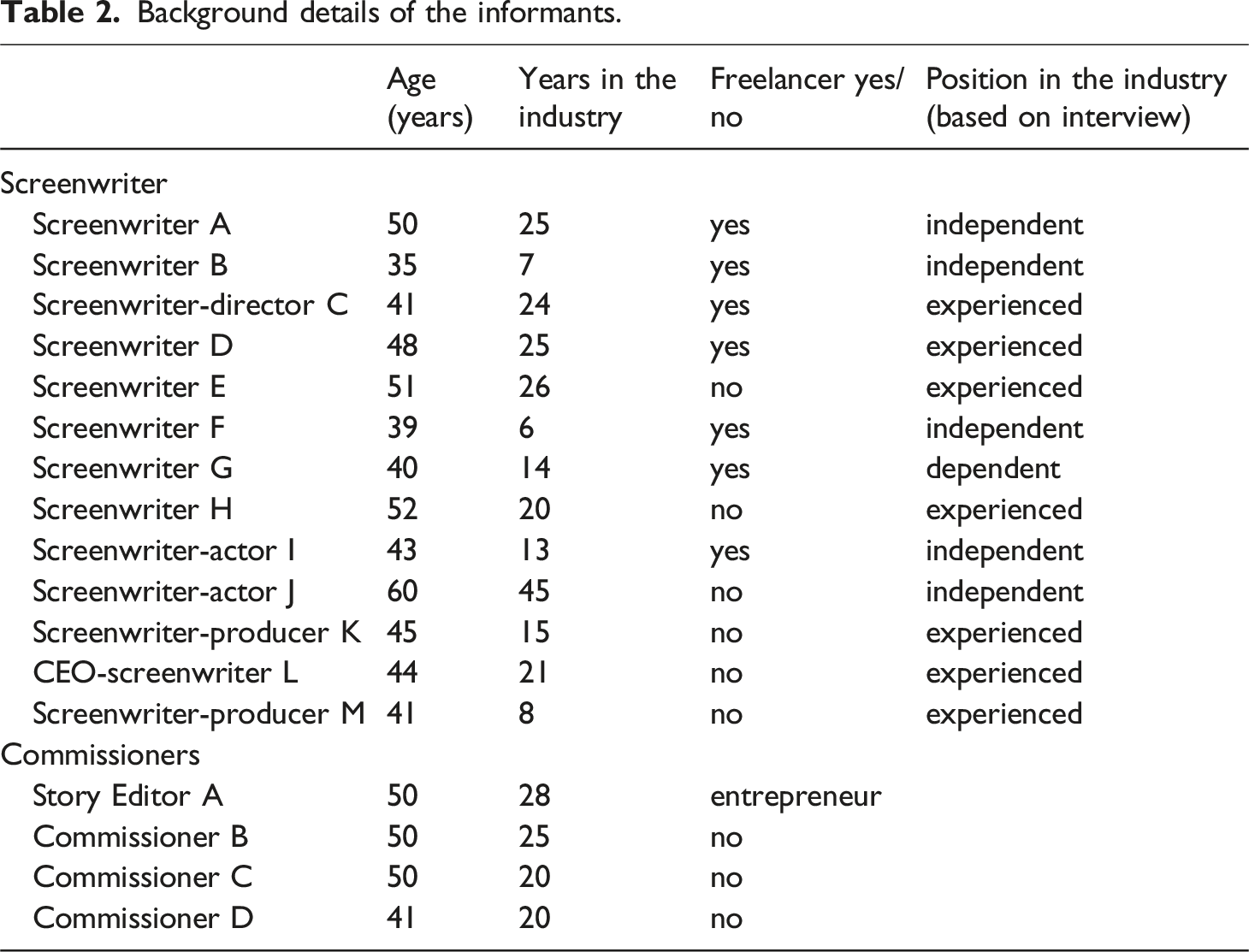
The focused interviews followed a set of themes about the professional roles and careers of the informants, views about streaming services, data, and audience analytics as well as AI tools, and the future of the industry in Finland. 1
In most of the interviews, we used a visual elicitation method (Glaw et al., 2017; Harper, 2002), where the informants were shown visualizations of scenarios depicting how data and AI might be used in television and film productions. We created with Canva images of four scenarios presenting graphical human figures with computer equipment and captions depicting their profession and an ongoing activity (Figure 1). The activities ranged from using script analysis software to developing a script with the help of ChatGPT to analysing audience reactions from social media using sentiment analysis. As a visual aid in the interviews, the scenarios more concretely demonstrated what we meant when talking about abstract ideas such as datafication in screenwriting and screen production. The visual elicitation helped reduce misunderstandings when talking about such broad topic as data analysis and AI and stimulated conversation, enhanced interviewees’ reflexivity, and enabled them to respond more concretely to researcher probes (Harper, 2002). Visualization of four scenarios of the use of AI and data in the film and television industry.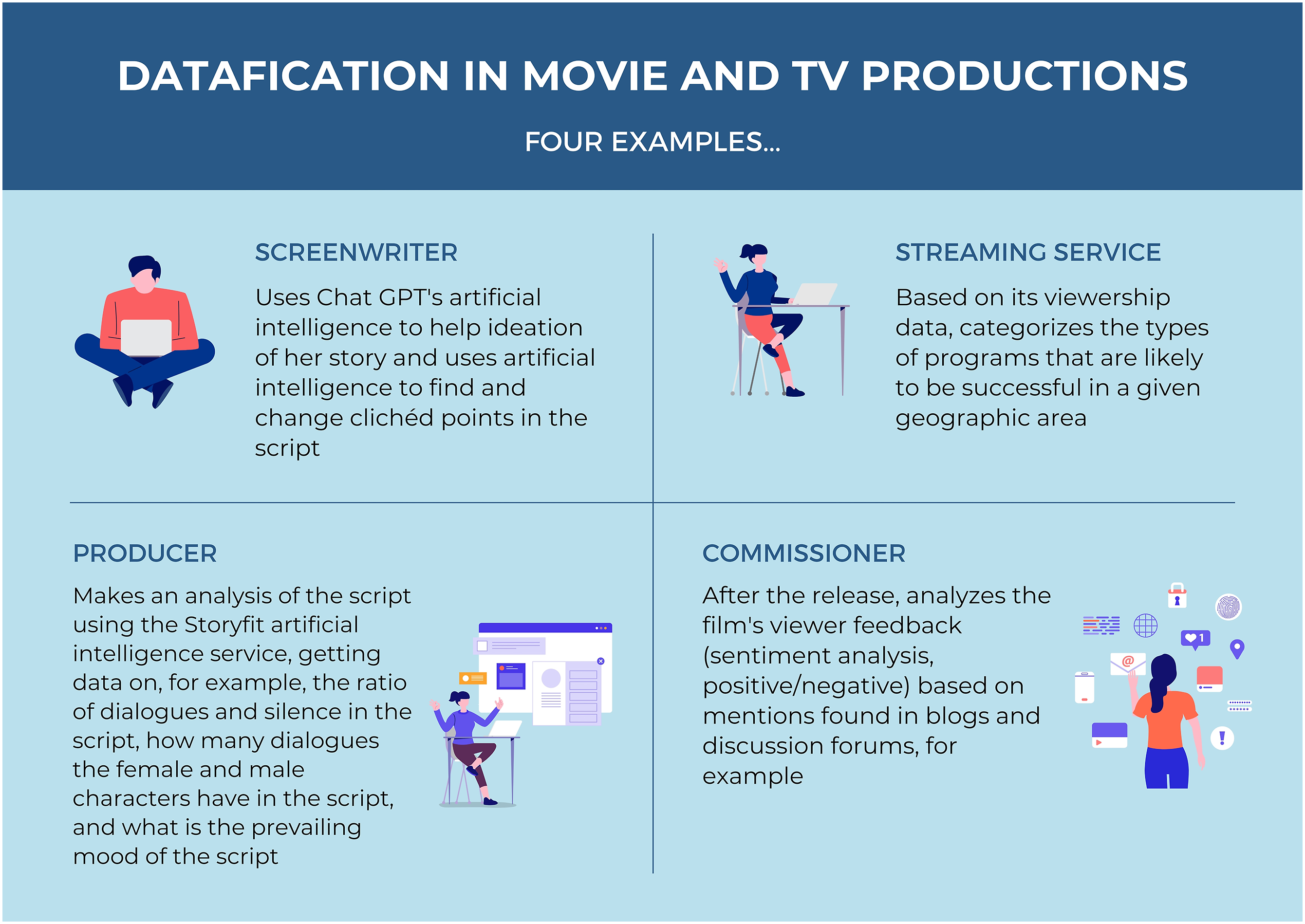
The interviews were coded in Atlas.ti in two phases. The first phase was thematic, in which all mentions relating to AI were identified. In the second, the mentions were classified by the attitudes or “stances” (Perrin, 2015) toward AI emerging from the extracts. By “stancing,” we refer to the practice of taking and encoding a particular position as the result of situated production and recontextualization activities in the professional field. With “position,” Perrin (2015: 161–162) refers to implicit or explicit commitments based on judgments and assessments and thus related to subjective properties, such as opinions, attitudes, and emotions. The process of encoding stance is guided by professional values and principles, and stancing results in using or omitting certain authorial means and modes of expression and making decisions within working processes.
The stances were grounded in the informants’ formulations of views and ideals regarding the emergence of AI. Three stances were discovered: functional, critical, and curious. Below, we first explore ideals of authorship as human labour in screenwriting. Then, we examine screenwriters’ approaches to AI-based tools in their current and future work. Finally, we discuss the views of commissioners on the use of AI and data analytics.
Authorship of screenwriters – Balancing human labour and AI assistance
Prompt engineering describes the practice of commanding AI: formulating specific queries and tasks for AI tools to get the best results. A prompt is a text describing the task that an AI should perform, and prompt engineering is the practice of formulating these tasks. Lo (2023) emphasizes creativity and intuition in creating prompts for AI, whereas the term “engineering” makes the practice sound more scientific and technical. Prompt engineering has indeed emerged as a compelling but complex practice in using AI and language models. Due to the operating logic of generative AI, the same prompt can lead to different results. The practice of prompt engineering requires some experience and skill but retains an element of chance. However, it is a compelling prospect in many fields of expertise to be able to produce convincing text and other content essentially at the push of a button.
Prompt engineering enabled one experienced writer to understand how clear he would need to be in articulating his visions in a way that others can capture his purposes. He referred to the written script as a prompt presented to the production crew. His allegory of the script as a prompt also illustrates how authorship of screenwriting may sometimes involve unexpected or uneasy responses from the production team. Following (Chris and Gerstner, 2013: 11), we perceive screenwriting authorship as a contested and negotiated terrain including embodied practices that are by necessity malleable and whose contours shift, given their cultural and technological conditions.
As Conor (2014: 38) notes, questions of authorship are central to understanding screenwriting as creative labour, even though films and television shows are results of collaborative work. Media industry processes are labelled by an understanding of industry operations as modes of authorship and by varying senses of ownership across multiple micro and macro perspectives (Freeman, 2016: 65 cited in Redvall, 2021; also Redvall, 2014: 232–233). Generative AI is challenging (and potentially transforming) a particular understanding of authorship and a sense of control and ownership of the process of screenwriting.
The screenwriters defined the boundaries of their profession by referring to the “unique life experience” and inspiration taken from real life. As the notions of objectivity, fairness, and commitment to public service are values of professionalism in journalism (Waisbord, 2013: 20), we can pinpoint the values and ideals of the screenwriters’ profession: intuition and creativity are naturally qualities connected to the authority of professional screenwriters. In collaborative writers’ rooms, it is felt important to create an atmosphere based on trust and a feeling of safety that enables spontaneous and “dumb” ideas, as well as a feeling of being free to fail (Phalen and Osellame, 2012: 11; Redvall, 2014: 231).
Our informants emphasized the ability of a writer to find fresh, novel views of phenomena. They were also careful about background research. The informants thoughtfully considered ethical aspects of who has the right to tell a particular story. Clearly, awareness about equality, diversity, and representation issues have had an impact on industry practices. The progress made in equality matters and the attention paid to the politics of representation came up often in the interviews.
Telling credible and novel stories based on unique human experiences distinguishes the human authority of screenwriting from AI-driven content creation. AI, such as ChatGPT, is incapable of such ethical–moral considerations, although it does have a somewhat formalistic way of looking at things from multiple perspectives. The aim for unique perspectives, reliance on authentic life experiences, and deep ethical and moral considerations could be named as the values and ideals of professional screenwriting. Reliance on “gut feeling” and intuition has also been mentioned, as well as knowledge of the intended audience (cf. Szczepanik, 2018).
When writing in a writers’ room or on a team, an open and working dialogue and connection seem crucial. Even when writing alone, the screenwriter is involved in multiple feedback loops and discussions about script development. The ability to receive feedback and be able to develop versions based on the feedback are essential. While most media industry studies highlight that authorship should be understood as a collaborative action (Redvall, 2021), the Romantic idea of the author lived in the minds of some screenwriters. The informants told of a balance between Romantic ideas of authorship and the requirements of daily work, where the commercial aspects of work are becoming more accentuated and limiting what they can create: This is a huge balancing act, it would be nice to do things in a very streamlined way, without extra work and so on… but at the same time, I have this terribly Romantic image of having artistic freedom. Like I was just saying that the whole industry has terrible contradictions and is living in the twentieth-century auteur world, where they only made art. And I guess it is so, that we as authors have a longing for that. (Writer-director C)
Many of the writers observed a contradiction between artistic freedom and the need to streamline work processes with the help of technological solutions. This combination of technology, as in the case of AI, and traditional creative work as artistic craft (Conor, 2014: 6) is not seamless.
Views of film and television professionals about the use of AI tools
When we raised questions about data and AI in the interviews, many writers talked about audience research in the traditional sense. In their minds, audience research seemed connected to data analytics, and they do have similar objectives: finding out more about the audience and their behaviour. Many had experiences of audience research and focus groups affecting their work and the decisions made about a production. Nielsen ratings have historically had a dominant position in the audience information regime in U.S. television (Navar-Gill, 2020). In Finland, television viewing research has been conducted since 1960, and traditional TV audience measurements have been done since 1987, when Finnpanel’s electronic meter data covered all Finnish channels (Finnpanel, 2024; Kannisto, 2016). However, whereas the Nielsen ratings or Finnpanel’s data are easily available, the audience data collected by streamers is secretive and a well-kept trade secret.
Intellectual property and copyright laws form the basis for protecting ownership of creative work. AI is forcing legislators and creators to rethink the foundations of intellectual property. The European Union is in the process of creating regulations for AI and copyright in the AI act of the EU, which emphasizes transparency. For example, content that is either generated or modified by AI will need to be clearly labelled as such (European Parliament 13.3.2024). In the resolution of the WGA strike of 2023, the parties agreed that generative AI will not be considered a “writer,” nor will the materials it produces constitute literary materials (Abramovich, 2023). In our interviews, writers did not refer to the legal aspects of AI, which shows that practical and philosophical aspects were more focal in their minds than copyright issues.
We focused on the theme that covered practices and tools that screenwriters prefer in developing, writing, and revising scripts. As part of this theme, the informants were asked if they had used AI in their work or if they knew of colleagues using it. They were also asked about their thoughts about AI, how it could potentially be used, and whether it offered promises or threats to their work. The informants were surprisingly practical and approving in their approaches to AI. Initial reactions were not the concerns foregrounded by the WGA strike; many had already used AI applications and thought of different possibilities where they could be used. Script analysis and screenwriting software can also be used to make better content, and these types of software can function as a kind of X-ray to identify elements, such as plot points or emotional tone, that drive success (Behrens et al., 2021). Some informants noted that screenwriting software already has advanced tools for analysing scripts but that these were not necessarily central in their work. In the following, we present the three stances toward AI technologies we found among the screenwriters.
Functional stance
In the interviews, a functional stance towards AI was the most common. This stance can be defined as a very pragmatic approach to new technological opportunities. When adopting the functional stance, the professionals try to find ways to make their work easier, more fluent, and more efficient. They are neither overly excited about the possibilities of AI nor sceptical about the potential risks but see it as a promising tool to be tried. For example, ChatGPT could be used in writing outlines and marketing materials, coming up with titles for episodes, or brainstorming in the development stage. Many production contexts require writers to use several skills to articulate and present their ideas before ‘proper’ collaboration begins, in the diverse forms of verbal pitching, writing of treatments, one-line summaries, and synopses as well as the very format-specific writing of scripts (Taylor and Batty, 2024: 164).
AI could also prove useful in translating or transcribing material, which is very slow work and is often delegated to production trainees or other assistant staff. Some of the writers had used AI for this type of simple tasks: I myself have tried now using it a little, for example, I’ve cut out some text into episodes. Well, the results vary quite heavily, but I feel that it can somehow be quite a good tool for that, when you just want a little different perspective, not so much in creating ideas from nothing, but just this handling of masses of texts and such, can be, will surely be an important tool, when people learn to use it. (Screenwriter F)
Some informants described having had conversations with ChatGPT, using it as a partner to throw ideas around but at the same time keeping control and producing the final idea themselves. The writer may suggest a character with an event happening to them, asking ChatGPT to write a synopsis based on this prompt. The writer can then decide whether they like the suggestion or some part of it and continue the conversation. To some extent, this practice is like the “dumb room” for idea development that Danish screenwriters use (Redvall, 2014: 231) because ChatGPT does not make value judgments of one’s ideas. Our impression is that non-human feedback on one’s idea might be easier to receive than a colleague’s judgment.
Some use generative AI like a search engine—to find answers to factual questions. However, this needs to be done carefully because the answers might not be based on facts at all: I have used it [ChatGPT] to some extent in [name of reality TV programme] in throwing around ideas when I write alone mostly, so I can throw a question out there and see what kind of responses I get from it and if it makes sense in any way. I must do some kind of cross analysis from that, to know if it’s true, because you can’t trust it at all. But anyhow, you can get some ideas from there. (Screenwriter-director C)
In the above quotation, ChatGPT is given the position of a conversational actor whom you cannot trust but who can open new lines of thought.
AI could also be useful in situations in which the writer is stuck with a problem. AI could be asked to give feedback and perspective. In the functional attitude, AI was seen as a useful sparring partner or assistant: I do believe that the machine will not be able to replace humans in creating entertainment or audiovisual art, rather it can be a good aid in assisting in processes. And I have indeed tried it in writing sales emails, ChatGPT as an aid… (CEO screenwriter)
In the previous quotes, AI is understood as an assistant facilitating either routine aspects of work or encouraging the screenwriter to find solutions in creative dilemmas when working alone.
Screenwriter D, who was an early adopter of AI, recognized both the limitations and advantages of ChatGPT: What the ChatGPT training data doesn’t have is my unique life experience, my unique experience neurology, my unique worldview, not my unique feelings. And because of that… Then I can, as long as I take inspiration from myself, my unique worldview, ideas and so on, then I’m creating something new. (Screenwriter D)
Here, the informant emphasizes the uniqueness of human decision-making based on life experiences, feelings, and powers of observation that are seen as necessary conditions for good scripts. By contrast, AI is seen as capable of compiling something likeable—something that already exists in one form or another. Although Screenwriter D emphasizes the fundamental difference between human intuition and AI-aided creation, in the pragmatic approach, they do not rule each other out. The relationship is more like experimental collaboration in which the person evaluates the work performance of AI technology and controls the process.
When adopting the functional stance, the screenwriters were not afraid of AI replacing them or taking their work. Instead, they were waiting to see what it would provide. They also offered many practical ideas for where AI could help with the more boring or mechanical aspects of their work or in streamlining their work processes, for example dividing longer chunks of text into episodes. Some informants highlighted a difference between using AI in the development stage versus on the advanced version of the script. The use of AI in the development stage seemed useful, but the informants considered revising script drafts and editing versions of a script to be the work of human intelligence and collaboration.
Critical stance
A critical stance toward AI was the second most common. It mirrored the fears of WGA—of AI replacing much of the need for creative work (Behrens et al., 2021). Utterances with a critical attitude also raise concerns related to the use of AI. Sometimes when adopting the critical stance, screenwriters question the commercial realities of the industry. In the following extract, the screenwriter outlines the fundamental fear that AI may steal their work, which forms a serious threat to one’s identity. The comment indicates that when imaging AI’s potential sphere of operations, one cannot avoid difficult feelings related to one’s professional self-esteem. These kinds of feelings may be more common when the position of the writer in the field is not secure. Maybe someone can talk about these things without bringing their own emotions to the table, but it’s very hard, when it’s your own profession in question, and I feel very strongly about my profession, because it… somehow being a writer defines my identity so much. You go to a philosophical level even, if artificial intelligence takes what I’m doing, so who am I then even anymore, if some machine can do that? (Screenwriter G)
Screenwriter F comments on colleagues’ critical attitudes and highlights anticipatory measures in relation to the risks of AI: That fear as such is useless […] you need to be prepared for it, but it’s possibly the weirdest thing how quickly a lot of people are ready to say that this won’t impact anything, this is completely useless in producing content, that could for example replace human labour, because in practice in six months it has made such crazy leaps, almost monthly, it goes forward so quickly […] It’s possible to end up in a trap, where we’re thinking that nothing will happen, and therefore we aren’t prepared for it. Not mentally, nor as an industry. Because the risk is being downplayed. (Screenwriter F)
The above comment reflects on the tendency to diminish the risks of AI among Finnish colleagues. Instead of dismissing the risks, the writer calls for acknowledgment of the situation and preparedness for the coming changes. From their viewpoint, it would be short-sighted to perceive AI as a pure instrument without any effects on human labour. Whereas screenwriter G felt slightly threatened by new technologies and had some negative experiences in the industry, screenwriter F was eager to experiment with technology, having gone so far as developing their own writing software. Screenwriter F had an independent, more artistic do-it-yourself attitude towards the profession. These two interviews with writers G and F illustrate well the professional positions in the industry, which might not be stable, but develop with time and in relation to different projects.
The most pessimistic visions for the future of the industry and the writers’ craft would include producers creating original ideas with the help of generative AI, without needing to pay anything, and even creating the first versions of the script, then hiring professional writers only to write out and edit the final script. The informants’ worries focused on the financial realities of the industry and uncertainty about the volume of productions in Finland in the future.
Curious stance
A curious stance overlapped strongly with the functional one. The curiosity of screenwriters towards AI could be seen in their willingness to try it, and thus the curious stance ran as an undercurrent across most of the interviews. Because creative screenwriters are constantly seeking new ideas, it is natural for them to be eager to experiment with new tools, such as AI. In the following quotation, the writer is willing to learn to use AI tools and thinks of it as an interesting possibility: I do understand their [WGA] concerns. But then again, I think that it will be impossible to stop. I don’t believe that we could go on strike and say that… I don’t think so. I believe that the only thing we as screenwriters can do is to learn to use it as well as possible. It’s my idea to try it. (Screenwriter E)
The view of Screenwriter E describes the development of AI as irreversible, and for this reason they see that it is to screenwriters’ advantage to train to use it efficiently. Although the writer thought that current AI was “very clumsy,” they were attracted to experiment with it. The clumsiness of AI language models was also highlighted in other interviews, and it was related to underdevelopment/unskillfulness of current AI tools to handle the Finnish language and its nuances.
Only a few of the informants expressed an interest in the possibilities of AI that could be described as excitement. One was an experienced screenwriter who described herself as being fascinated by the topic of AI and technology more generally. She could be described as an early adopter of AI: From a screenwriter’s perspective, the risk is that we get directors, who usually are more technologically minded than writers, and they want to tell the story. The downside is that anyone who can command the AI in the best possible way can tell those stories. And this is why I think that, at the moment, AI can’t write better than a screenwriter, but the screenwriter who is able to best utilize AI can write better than any other screenwriter. (Screenwriter D)
Interestingly, Screenwriter D imagines that the main threat of AI for her profession is related to other professionals or even amateurs who may easily produce stories with AI. From her perspective, screenwriters should understand and familiarize themselves with the benefits of AI even if they are not usually very “technologically minded.” Another informant, a writer-producer, saw that ignoring the potential possibilities of AI would mean the loss of an outsider’s gaze, which the analytical features provide. This writer-producer had created their own tool for analysing scripts and was eager to adopt new technologies. In his curious stance to AI was a divergent dimension because he described AI as a factor providing some fun in the formation of industrial knowledge.
Future of the profession
To answer our research question “How do professional screenwriters see their changing profession in the future of the creative industries?” we can say that writers acknowledge that their profession is facing changes, but they are prone to thinking that the focus of the profession remains on the creation of innovative stories with diverse representations. As streaming services increase the number of television productions (Lobato, 2018; Lotz, 2017), the role of the writer is more broadly acknowledged. In the Finnish television and film sectors, writers’ rooms have become more common, and showrunners are being hired in some long-running series.
The screenwriters interviewed in this study hoped for more communication between writers and directors, and some wanted more influence in the production stage. However, the role and position of the writer are dependent on many things often beyond their control, as Screenwriter G described: It depends so much on the project, it depends on the production company, it depends so much on the producer, it depends on the director, and it depends on what kind of combination of writers there is. There’s a big difference whether you’re alone there as the head writer or if it’s your own original idea, or then in the other end, if it’s not your original idea, and there are several writers and someone else has the power. It varies a lot, how the position of the writer is. (Screenwriter G)
In the extract, Screenwriter G refers to a sense of ownership of the script that is based on the authority of an original idea, and, in the case of several writers, who the head writer is. The sense of ownership depends on the division of labour, the collaboration between writers, and the authorship of the original idea, but the increasing authorship of AI was not a big concern in our data. As AI tools were used mainly in conceptualization and early development stages, they were not understood as a serious rival to creativity and the originality of high-quality content. These thoughts on ownership can be reflected against the industry positions in Table 1. The independents and the experienced/established writers had stronger ownership of their work than the dependent writers, who may work at a lower place in the hierarchy and not have much power over decisions.
The application of generative AI in creative screenwriting means that writers would need to learn to use it to generate functional prompts and to understand how to utilize the technology wisely without necessarily trusting the answers it gives. Although in many interviews one stance was more dominant than another, they could all be present in one interview. Screenwriters were exploring the possibilities of AI from different viewpoints and were prone to assess the consequences of AI tools for their development work and authorship. They appreciated open and supportive discussions and transparent decision-making in teamwork.
Commissioners as custodians of data
When we analysed the Finnish commissioners’ views on the use of AI in screenwriting, we saw that the discussion on AI in screenwriting was just emerging in their organizations, but they were familiar with national and global discussions on AI’s effects on the industry. For example, commissioners suggested that AI could potentially be useful in developing script versions for daily dramas and some television formats. However, they did not seem to be as aware as the screenwriters of the possibilities of AI in the idea creation and early development stages.
The use of data analytics may raise the risk that data inequality will increase. Data inequality refers to the unequal power structures in, for example, generating, storing, transferring, and processing data (Fisher and Streinz, 2022). As Navar-Gill (2020) indicates, there may be data asymmetry between creatives and the people with decision-making power in the streaming industry. Navar-Gill argues that streaming services have an interpretive monopoly, which refers to metrics from audience data and the actions platforms decide on based on those data, which may eventually undermine writers’ creative comfort.
In terms of data, there are (at least) business needs, consumer needs, and creative needs, such as feedback, to consider. Commissioner C referred to increased competition in the field, and in their opinion the need for data had increased in the past 5–10 years. Now, much more diverse data are also available. Commissioner C stated that she looks closely at both the numbers for each episode and the kinds of changes in the data within the presentation of the episode. When she launches a new product, she looks very carefully at what kind of performance comes across from the data and if, for example, the series needs marketing support.
Commissioner C said that she does share audience data with the creators and production companies. According to her, they have discussions about any changes in cooperation with the production company. Every episode is significant, and they cannot simply replicate a successful format or repeat the most cost-effective programmes. In the following quotation, the commissioner is emphasizing the human consideration in filtering and processing what the data reveals: We get data from many sources; we need to consider many sorts of information about the programmes and there we need people to process that information. […] We need to understand how we process all this existing information into the best possible outcome. (Commissioner C)
Story Editor A saw that AI has some potential in finding new perspectives and questioning existing perspectives, which is usually her job as a story editor responsible for commissioning series. The commissioners emphasized their role as real people in dialogue with the writers: they are participating in the development of the script, and they want to work closely with the screenwriters. For example, Commissioner B emphasized control of the creative process rather than data-driven decision-making.
The commissioners are thinking about the potential audience, but they also want to keep open the creative track, where the makers of series or films have the freedom to surprise and offer something new. Commissioner B, who worked as a commissioner of documentaries, mentioned that they do not want to rely too much on strict specifications about what they are commissioning but rather want to leave room for creative surprises. In this sense, AI could never replace the important development work between the writer and the commissioner. Story Editor A described the role of the screenwriter this way: We’re trying to teach Finnish directors that we’re working in cooperation with the writer and the producer and us, we’re all on the same page. We all know from the get-go what we’re trying to do, what is the tone, what is the main storyline, who are the characters, and it’s a shared discussion. But at the core is a good script. (Story editor A)
Story Editor A is emphasizing the collaborative nature of the work and a need to instruct directors that decision-making is based on a dialogue between screenwriters, producers, directors, and representatives of the streaming service.
The writers and commissioners look at AI from very different perspectives—the writers, as a practical and assisting tool, especially in the development stage; the commissioners, more broadly as part of the overall data infrastructure of the production and distribution process. The commissioners emphasize the importance of collective human decision-making, and hence, the role of AI in the process seems narrower than in the comments of the writers. The commissioners see the broader process of the production, and they negotiate with many people—producers, directors, and writers—and their focus is therefore on collaboration. There is some data asymmetry between the writers and commissioners, as the commissioners hold vast data resources, which the writers do not feel they get enough of, but on the other hand, the writers are able to utilize AI in the first stages of script development without disclosing this to the commissioner.
Conclusions
The technological opportunities provided by AI and other emerging technologies will change how screenwriters work. As an emerging, ambiguous, and fluid technology, the role AI will play is hard to discern. We have mapped how aspects of human and non-human labour might merge in the future and how writers see their profession in relation to AI and data. Technologies that challenge the primacy of traditional creative agencies are often feared and critiqued, and thus, their use can be hidden or framed as only supporting human decisions (Behrens et al., 2021). Considering this, we can question whether Finnish screenwriters who use AI tend to devalue its influence and see it more as a technical assistant. It may be easier to develop and test ideas with AI because it will work with prompts and requests without value-judging them. Acknowledging the usefulness of AI in early script development may entail the concern that artistic labour and human authority lose status in the eyes of audiences. Dismissing the threat of AI may also be a way of protecting one’s professional identity and career, a kind of siloing of data/AI and creative functions from each other, as Navar-Gill (2020) has argued.
The situation of Finnish screenwriters is not fully comparable with that of Hollywood writers, who campaigned fiercely for their rights in 2023. In Finland, the industry is much smaller and the fees lower, and the continuous one-upmanship and hostile industrial working conditions related to U.S. writers’ rooms (Caldwell, 2008: 220–221) were not observed in our data. In Finland, the industry experienced something of a boom in 2021–2022 (Sundqvist, 2023; Valtakari and Nyman, 2018), followed by a decline in broadcaster and streaming service commissions in 2023 (Helsingin Sanomat 11.2.2024). The threat from AI might seem marginal compared to the slowdown of commissioning and reduction in jobs.
To answer our research question, “how do screenwriters frame ideals of authorship as human labour?”, we can say that even those who fluently use AI in script development prefer to keep final creative control to themselves. The unique life experiences and feelings of the human author still guide the process of screenwriting. However, AI can assist creative work. Our assumption is that views about the impact of AI tools on human decision-making and screenwriting practices will develop and become more concrete as their use increases and as the ground rules between screenwriters and employers are established. Central elements of the profession are the ability to see things from several perspectives and to step out of one’s comfort zone. AI has the potential to enable something of the sort—to take the writer out of the customary ways of thinking and toward ideas and perspectives they had not considered. However, the other side of utilizing AI is the threat of conventional solutions and repetitive perspectives. What generative AI can offer is still somewhat speculative. Neither is it self-evident that working with AI would make script development faster or more efficient. Successful prompt engineering requires time-consuming articulation of carefully created prompts and critical evaluation. Thus, AI increases the number of choices to be made by human writers but does not diminish the assessment required by them to reach a desirable creative result.
AI now affects the work of screenwriters, as seen in their functional stance and practical approach to it. Simultaneously, its rapid development and many applications evoke caution in some writers. Although they do not explicitly mention as their concern deficiencies in AI literacy, referring to competencies that enable critical evaluation of AI technologies and effective collaboration with these technologies (e.g., Long and Magerko, 2020), writers describe accessing the functionalities of AI tools as a necessary professional competence. The dominant approach in the industry during our data collection was rather neutral, and professionals are waiting to see what the future brings.
Footnotes
Acknowledgements
This research was kindly funded by the Helsingin Sanomat Foundation. We would also like to thank all the interviewees who took part in this study.
Declaration of conflicting interests
The author(s) declared no potential conflicts of interest with respect to the research, authorship, and/or publication of this article.
Funding
The author(s) disclosed receipt of the following financial support for the research, authorship, and/or publication of this article: This work was supported by the Helsingin Sanomat Foundation.
