



Abstract
Purpose:
Pronominal resolution in Italian-style null-subject languages has played a central role in the discussion of how acquiring a second language later in life may impact the first, a phenomenon known as attrition. Within that literature, previous (offline) work has argued that attrition leads to a weakening of the interpretive bias for overt pronouns. This has been suggested to reflect processing difficulties rather than representational changes. However, despite this explicit processing claim, little published work has investigated how the online processing of pronominal forms in these languages is affected by attrition.
Method:
In response, we conducted a self-paced reading task in Italian using temporarily ambiguous stimuli. For this, we recruited L1 Italian speakers living both in Italy (N = 66) and in a majority English-speaking country (N = 32, minimum 5 years of residency).
Analysis:
Reading times from the disambiguating windows were subjected to mixed-effects regressions.
Findings:
Results indicated participants undergoing attrition exhibited a stronger – not weaker – processing bias for overt pronouns relative to participants still living in Italy (at least towards the beginning of the experiment).
Originality:
This study is original for two reasons. First, it addresses the gap in research investigating attrition and pronominal resolution from an online perspective. Second, it extends a recently reported offline strengthening effect for overt pronouns to online processing.
Implications:
Although our results seem to conflict with earlier online findings, they are convergent with recent offline findings. Moreover, there is evidence from other phenomena relating to the null-subject parameter (e.g. null/postverbal subjects) that attrition may lead to a general strengthening of L1 biases. Therefore, we argue that attrition affects overt pronouns inconsistently, with future research needed to understand why this should be the case.
Introduction
When a speaker acquires and uses a second language (L2) later in life, this can impact various aspects of their first language (L1, e.g. phonemic realisation, Flege, 1987, lexical diversity, Schmid & Jarvis, 2014, relative clause attachment biases, Dussias, 2004), a phenomenon referred to as attrition. An area of particular interest for researchers working on syntactic attrition has been the optionality between null and overt subjects in Italian-style null-subject languages. That work has generally reported that although the underlying availability of null subjects remains unaffected, speakers undergoing attrition produce overt referring expressions at a higher rate (e.g. Köpke & Genevska-Hanke, 2018; Martín-Villena, 2023) and their interpretive biases for overt pronouns weaken, resulting in more indeterminate interpretations (e.g. Gürel, 2004; Kaltsa et al., 2015; Tsimpli et al., 2004) with some evidence that this effect extends to online processing (Chamorro et al., 2016).
Although originally discussed in terms of representational change (Tsimpli et al., 2004), more recent work on attrition has focused on processing factors. In particular, Sorace (2011) suggests that attrition only affects the processing of pronominal forms, while leaving their underlying representations intact. Despite this explicit claim regarding online processing, few published studies have explored how attrition affects online processing of pronominal resolution, and only one of these provides clear support for Sorace’s (2011) proposal. In response, the present study presents a self-paced reading task looking at how attrition affects the processing of null and overt pronouns in Italian. We take this to represent a novel contribution to the literature for two reasons. First, it addresses the lack of online studies by investigating the effects of attrition on pronominal processing in a new language pair, L1-Italian, L2-English. Second, pace Chamorro et al. (2016), results indicate that our L1 Italian speakers undergoing attrition exhibited a stronger – not weaker – processing bias for overt pronouns, extending a trend recently reported for Spanish in offline judgements (Martín-Villena, 2023).
Background
Pronouns in Italian
In Italian, null subjects are licenced by agreement (Rizzi, 1982, 1986) such that the subject of a well-formed finite clause may be either null or overt. This syntactic optionality leads to interpretive differences. In intrasentential contexts like in (1), L1 speakers have been found to preferentially interpret null pronouns as co-referring with the matrix subject (here Marta). Conversely, they have been found to preferentially interpret overt pronouns as referring to non-subject antecedents (here Piera, e.g. Carminati, 2002; Contemori & Di Domenico, 2021; Vogelzang et al., 2020).
1. Martai scriveva frequentamente a Pieraj quando (øi/?j/?k / lei?i/j/k) era negli Stati Uniti. [Italian]
‘Marta wrote to Piera frequently when she was in the United States’ (Carminati, 2002).
To account for this asymmetry, Carminati (2002) proposed the Position of Antecedent Hypothesis (PAH). That posits that speakers of Italian possess two complementary biases relating to structural prominence. Whereas speakers are biased to process null pronouns as co-referring with the structurally most prominent antecedent (in her terms the antecedent in SpecIP), speakers are biased to process overt pronouns as co-referring with a structurally less prominent antecedent. Consistent with this proposal, Carminati (2002) observed that when L1 Italian speakers read pragmatically disambiguated sentences like (2), their reading times for matrix clauses were faster when null pronouns were disambiguated to co-refer with the embedded subject. For overt pronouns, the pattern was reversed. Similar results are also observable in sentences that are fully disambiguated via grammatical features, such as gender and number, although the effect is smaller in number-disambiguated items than in gender-disambiguated ones (Carminati, 2005).
2. Dopo che Giovanni ha meso in imbarazzo Giorgio di fronte a tutti, (ø / lui) si è scusato ripetutamente.
‘After Giovanni embarrassed Giorgio in front of everyone, he apologised repeatedly.’ [Italian]
Since Carminati’s (2002) original proposal, the PAH has also been extended to other Italian-style null-subject languages, where some cross-linguistic variation has been observed. For example, to explore potential differences between Spanish and Italian, Filiaci et al. (2014) translated Carminati’s (2002) pragmatically disambiguated items into Spanish. They then conducted otherwise identical self-paced reading tasks (both clause-by-clause and word-by-word) with groups of L1 Italian and Spanish speakers. While their Italian results replicated those in Carminati (2002), their Spanish results only partially matched. Those groups exhibited a clear subject bias for null pronouns comparable to the Italian participants. However, the Spanish participants did not show a clear difference in their readings times for overt pronouns depending on the disambiguation (although see the discussion of Chamorro et al., 2016 and Martín-Villena, 2023), suggesting that the PAH bias for overt pronouns is weaker/absent in Spanish (see also Contemori & Di Domenico, 2021 for evidence from interpretation and production).
Attrition in null-subject languages
For the scope of the present work, the term attrition refers to any non-pathological changes within an adult speaker’s L1 because of the acquisition/use of an L2 after the L1 had been acquired. In this sense, attrition is typically studied in migration contexts where speakers are immersed in their L2 (but see Martín-Villena, 2023, on attrition in instructed bilinguals). An important aspect of this working definition which we take to be shared by other researchers (e.g. Chamorro et al., 2016; Martín-Villena, 2023; Schmid & Köpke, 2017; Sorace, 2011) is that we do not presuppose the source of attrition; it may be the result of either transfer/influence from the L2 or changes due to cognitive effects of becoming bilingual.
In their seminal study on attrition, Tsimpli et al. (2004) conducted a picture selection task to investigate how the interpretation of null and overt subjects in null-subject languages is impacted. For this, they recruited two groups of L1-Greek and L1-Italian speakers, control participants living in their home countries and experimental participants who had been living in the UK for a minimum of 6 years and had achieved ‘near-native’ proficiency in English. During their task, participants read biclausal sentences as in (3).
3. a. L’anziana signora saluta la ragazza quando (ø / lei) attraversa la strada. [Italian]
‘The elderly woman greets the girl when she crosses the road.’
b. Mentre (ø / lei) esce dall’ascensore, l’infermiera urta la donna delle pulizie.
‘While she exits the elevator, the nurse bumps into the cleaning lady.’
Sentences were presented to participants in their L1s along with three pictures corresponding to the logically possible interpretations of the ambiguous pronoun (matrix subject, matrix object, other). The authors predicted that control groups would preferentially select non-subject interpretations for overt pronouns and subject interpretations for null pronouns. As for attrition, the authors predicted that experimental participants’ L2-English would influence the features that condition the interpretation of overt pronouns in their L1s. Specifically, they predicted a bleaching of a [+ topic shift] feature, resulting in indeterminacy. Partially consistent with their predictions, Tsimpli et al. (2004) reported that Italian speakers undergoing attrition exhibited a weakened interpretive bias for overt pronouns when they were preceded by their potential antecedents (3a). Convergent results have since been reported in other Italian-style null-subject languages (e.g. Turkish, Gürel, 2004; Gürel & Yılmaz, 2011; Greek, Kaltsa et al., 2015; Spanish Martín-Villena, 2023, but see Cairncross et al., 2026 for discussion of how previous results are more mixed than usually acknowledged).
Although Tsimpli et al. (2004) originally explained their finding in terms of representational changes to overt pronouns in the null-subject language, more recent work has focused on processing-based explanations. In particular, Sorace (2011) highlights that the felicitous use of pronouns requires rapid, real-time integration of multiple sources of information, both contextual and linguistic. Should this be more difficult for bilinguals either due to the need to inhibit the non-target language or due to a trade-off between increased inhibitory control and flexible updating in late L2 learners (Treccani et al., 2009), Sorace (2011) suggests that the overextension of overt pronouns might function to alleviate the cognitive pressure. The idea is based on an observation by Carminati (2002) that even unattrited L1 speakers sometimes overextend overt pronouns (e.g. single referent contexts like 4, 86% subject interpretations).
4. Gregorio ha detto che (lui / ø) sarà presente al matrimonio di Maria. [Italian]
‘Gregorio said he will be at Maria’s wedding.’
Such an account would predict that attriters should become less sensitive to the processing (and by extension interpretive) bias for overt pronouns only; the PAH bias for null pronouns as well as the underlying syntactic representations of both null and overt pronouns should remain intact. Moreover, such an account would predict that attrition effects are readily detectable via online measures.
To investigate Sorace’s (2011) proposal, Chamorro et al. (2016) conducted an eye-tracking-while-reading task for which they recruited three groups of L1 (Iberian) Spanish speakers: (i) a control group who had recently arrived to the United Kingdom, (ii) an experimental group who had been living in the United Kingdom for a minimum of 5 years (M = 7 years) and had achieved ‘near-native’ proficiency in their L2 English, and (iii) a re-exposed group who were similar to the experimental participants except that they had recently spent about 2 weeks back in their home community.
For their experiment, critical items consisted of temporarily ambiguous items as in (5), within which they manipulated the pronominal form (null or overt) and the position of the pronoun’s antecedent (SpecIP or non-SpecIP) which was disambiguated via number features. After reading each item, participants were asked to judge its naturalness on a 5-point Likert-type scale.
5. a. La madre.
b. Las madres.
‘The mother(s) greeted the girl(s) when she crossed the street with a lot of traffic.’ [Spanish]
Chamorro et al. (2016) expected participants to exhibit faster readings and give higher judgements when sentences were disambiguated with the PAH. As for attrition, they predicted experimental participants would exhibit a weaker online bias for overt pronouns (as compared to the control group), but no difference from control participants in naturalness judgements.
Consistent with the latter half of that prediction, naturalness judgement responses did not provide evidence of a meaningful difference between the experimental and the control groups; both rated non-SpecIP disambiguated trials with overt pronouns significantly higher than SpecIP disambiguated trials with the same pronoun. As for their eye-movement data, the control group exhibited slower reading times for SpecIP disambiguated trials with overt pronouns compared to non-SpecIP disambiguated trials with the same pronoun. However, the experimental group did not, resulting in a significant interaction with group. Chamorro et al. (2016) interpreted this to indicate that, consistent with their predictions, L1 speakers of (Iberian) Spanish undergoing attrition are less sensitive to the non-SpecIP bias for overt pronouns during real-time language processing, despite their underlying representations (as indexed by the naturalness judgements) remaining unaffected.
For the re-exposed group, Chamorro et al. (2016) based their predictions on the Activation Threshold Hypothesis (Paradis, 1993, 2007) which suggests that the availability of a form is affected by its frequency and recency of use; the more a form is used and the more recently that it has been encountered, the lower its activation threshold (i.e. it is more available) and vice versa. Relevant for the present discussion, the Activation Threshold Hypothesis predicts attrition to occur when a form in the L1 has a ‘competing’ form in the L2 with a lower activation threshold. Therefore, Chamorro et al. (2016) predicted that re-exposure to the L1 should make L1 forms more accessible, resulting in a reduction of attrition effects. As predicted, eye-tracking results indicated that re-exposed participants did not differ from control participants. However, they also did not differ statistically from experimental participants. As such, Chamorro et al. (2016) interpreted this pattern to indicate that even short re-exposure to the L1 partially mitigates attrition effects. Nonetheless, we should keep in mind that that interpretation is based on a null effect. Therefore, although compatible with Chamorro et al.’s (2016) interpretation, we cannot take this as evidence to favour a processing-based account.
Using a different design, Kaltsa et al. (2015) investigate the processing of null and overt pronouns in four groups of native Greek speakers: heritage speakers (Greek and Swedish bilinguals raised in Sweden), attriters (L1 Greek, L2 Swedish speakers who migrated to Sweden as adults), and two groups of age-matched monolinguals. During that experiment, participants listened to sentences from Tsimpli et al. (2004) in a self-paced fashion. An example is provided in (6), with vertical bars to indicate window boundaries. Before and during each item, participants saw an image (e.g., Figure 1) intended to bias a particular interpretation of the embedded subject (i.e. matrix subject, matrix object, and other referent). After each item, participants were then asked to judge whether the image matched the sentence they had just listened to. From this study, the authors reported three measures: (i) acceptance rates for the images, (ii) decision times for judgements, and (iii) listening times for the critical window.
6. a. I γiaγia │ xeretise │ tin kopela │ otan │afti │pernuse │ to δromo. [Greek]
‘The old lady greeted the girl when she crossed the street.’

Image from Tsimpli et al. (2004) used by Kaltsa et al. (2015) to bias a subject reading of afti in (6).
Focusing on their results that are most relevant to the present discussion, offline judgements were convergent with the Italian results in Tsimpli et al. (2004); although attriters accepted matrix-object readings for overt pronouns significantly more than matrix-subject readings (subject: 58%, object: 80%, other: 32%), this trend was significantly weaker than in the age-matched control participants (subject: 31%, object: 66%; other: 25%). No such group-level effect was observed for null pronouns.
Turning to the listening times at the critical window, the interpretation of the results is less straightforward. This is due to how the critical window was defined. For items with overt pronouns, ‘[t]he critical segment was the subject pronoun of the subordinate clause’ (Kaltsa et al., 2015, p. 272), that is, afti in (6). However, disambiguation was achieved by the combination of an image and the semantic content of the verb in the following window. Given that the participants cannot foresee what the upcoming material would be (as sketched in 7), items with overt pronouns were not yet disambiguated at their critical window.
7. The old woman greeted the girl while she. . . .
a. crossed the road. (she = the old woman)
b. waited on the pavement. (she = the girl)
No such issue arises for items with null pronouns, for which the critical window was taken to be the embedded verb. Results from those items indicated that neither group differed in their listening time of matrix-subject and matrix-object biased sentences (although the control group did listen to both faster than the other biased ones). At the group level, attriters were found to listen faster than control participants, regardless of condition. Therefore, integrating these results in the discussion above, while Kaltsa et al. (2015) provide evidence that the offline interpretive basis for overt pronouns in Greek can weaken, we cannot take their study as support for Chamorro et al.’s (2016) conclusion that attrition leads to reduced online sensitivity to the PAH, specifically for overt pronouns.
More recently, Martín-Villena (2023) investigated attrition effects in online processing using an adapted version of this task. For that study, Martín-Villena (2023) recruited three groups of L1 (Iberian) Spanish speakers. Like earlier work on attrition, they recruited a group of control participants still living in their home community and a group living in an English-speaking community (‘immersed bilinguals’). They also recruited a group of L1 speakers still living in Spain who nonetheless received substantial amounts of L2 input as they were actively studying for English degrees in English (‘instructed bilinguals’).
For Martín-Villena’s (2023) self-paced reading task, critical stimuli were adapted from Tsimpli et al. (2004) such that the matrix clause containing the two possible antecedents always preceded the embedded clause containing the subject pronoun (8). In half of the items, the pronoun was overt, in the other half, it was null. Before each item, participants were presented with one of Tsimpli et al.’s (2004) images corresponding to a SpecIP or non-SpecIP reading of the embedded pronoun. This remained on the screen throughout the trial. After reading the full sentence, participants were asked to indicate whether the image matched the sentence they had just read.
8. a. El abuelo habló rápido al nieto mientras ø leía el libro. [Spanish]
‘The grandfather spoke quickly to the grandson while he was reading the book.’
b. La madre besó a la hija mientras ella se ponía el abrigo.
‘The mother kissed the daughter while she was putting on the coat.’
Consistent with Martín-Villena’s (2023) predictions, results indicated that control participants read embedded clauses with overt pronouns significantly more quickly when the image biased a non-subject reading than a subject one. Although this effect was not significant within either experimental group when considered in isolation, pace Martín-Villena (2023), we should not interpret this as evidence of an attrition effect given that both experimental groups trended in the same direction and did not differ significantly from the control participants (Martín-Villena p.c.).
Thus, in summary, although attrition has been suggested to be driven by cognitive load during processing (Sorace, 2011), few studies have investigated how attrition affects the processing of pronominal resolution. Moreover, available results are mixed. On one hand, Chamorro et al. (2016) provide evidence that attrition affects online processing, but not offline acceptability judgements. On the other hand, results from Martín-Villena (2023) indicated changes to offline interpretations without clear evidence of changes to online processing. Notably, both studies were in Spanish, whereas it has been argued that Spanish and Italian differ in the strength of their biases (Filiaci et al., 2014). Against this background, we posed the following question:
Method
In response to our research question, we conducted a self-paced reading task in Italian.
Participants
For this study, we recruited two groups of L1 Italian speakers: a control group living in Italy and an experimental group living in a majority English-speaking country. Regardless of group, all participants reported (i) having lived in Italy until at least the age of 16, (ii) having grown up monolingually, 1 and (iii) having no diagnosed language-related disorders.
The control group was made up of 66 2 participants whose mean age was 43.31 years (SD = 7.55 years). 3 Responses to a language background questionnaire indicated that our control group were not idealised monolinguals. Rather, 97% of these participants could speak a language other than Italian (N = 64) – and 94% could speak English (N = 60) – at or above an ‘intermediate’ level. As such, Table 1 presents participants’ use of Italian, English, and other languages as percentages of a typical day (i.e. hours of language x / total hours reported for any language).
Demographic information by group.
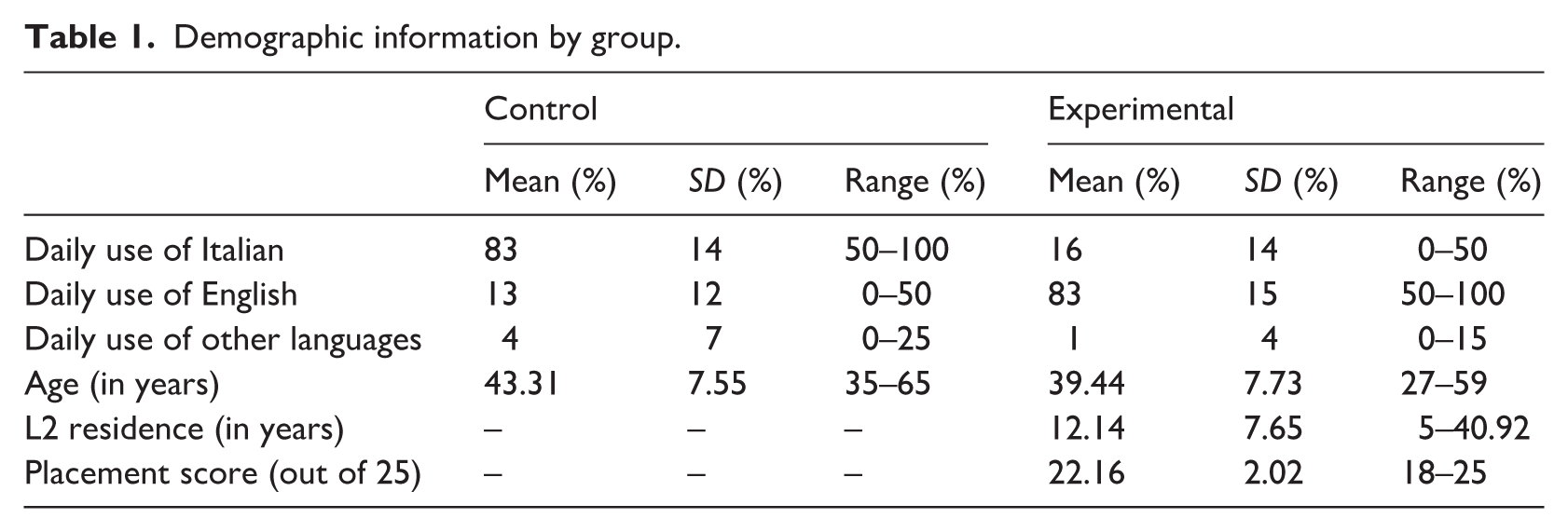
The experimental group was made up of 32 participants whose mean age was 39.44 years (SD = 7.73). Prior to testing, all participants had been living in their L2 community for a minimum of 5 years (M = 12.14, SD = 7.65, cf. Tsimpli et al., 2004). To avoid potential issues relating to re-exposure effects (Chamorro et al., 2016), participants were pre-screened to ensure that none had travelled back to Italy in the 2 months prior to testing. As with the control group, these participants were asked to indicate any language they could speak at or above an ‘intermediate’ level as well as how much they used each of these languages in a typical day. Their use of Italian, English, and other languages is also presented in Table 1. As some previous studies on attrition have restricted themselves to ‘near-natives’, we had our experimental group take the Cambridge Assessment General English quick placement test. 4 This suggested that our experimental participants are upper intermediate to advanced L2 speakers of English (mean score = 22.16/25; SD = 2.02). In combination with our experimental group’s prolonged immersion in their L2, lack of recent re-exposure to the L1 community, high use of the L2, and attenuated use of the L1, this suggests our experimental group is a suitable group in which to look for attrition.
Items
Critical stimuli were 32 biclausal sentences in which a matrix clause containing two possible antecedents preceded a temporal adverbial clause that was headed by mentre (‘while’) and contained a subject pronoun. Within these items, we manipulated the pronominal form (null or overt) and the position of the antecedent with which it co-referred (SpecIP or non-SpecIP). Gender marking was used to force co-reference. To that end, the two (determiner phrases) DPs in the matrix clause always differed in gender (with the gender of the first noun counterbalanced across items). As null pronouns trivially cannot overtly manifest gender features, all items contained an overtly agreeing (-o.
9. a. Null SpecIP [Italian]
Valeria.
b. Overt SpecIP
Valeria.
c. Null non-SpecIP
Valeria.
d. Overt non-SpecIP
Valeria.
‘Valeria greeted Adriano while s/he was coming back hungry from the gym.’
Critical items were distributed across four lists such that each item appeared only once per list with eight items per condition. To these lists, we also appended 32 ambiguous relative clause distractor items and 40 unambiguous biclausal fillers for a total of 104 sentences.
Norming of critical stimuli
To account for any potential semantic biases within the embedded clauses relating to our gender manipulation that might affect their processing, we originally generated 50% more items. After consultation with a L1-Italian linguist, three of these potential items were excluded. From the remaining items, we constructed two simple sentences corresponding to the SpecIP and the non-SpecIP interpretations of the embedded clauses (e.g. 10a and 10b from 9).
10. a. Valeria tornava affamata dalla palestra. [Italian]
b. Adriano tornava affamato dalla palestra.
These were then distributed across two lists and presented to 30 5 L1 Italian speakers (living in Italy) who did not take part in our main experiment. Those participants read the sentences in isolation and then rated how natural they sounded from 1 (very natural) to 5 (very unnatural) where ’very natural’ was explicitly defined as meaning that ‘they might hear such a sentence in a normal conversation with other native speakers of Italian.’ Items for which the difference in ratings for the a and b versions approached significance (p ⩽ .1) under a t-test were removed. We then selected the items with the highest global rating (final M = 4.70/5) such that we could counterbalance the gender of the matrix subject.
Procedure
Participants were recruited via Prolific and social media, and the experiment was coded using PCIbex (Zehr & Schwarz, 2018). Prior to testing, ethical approval was obtained from the Ethics Committee of the Faculty of Modern and Medieval Languages and Linguistics at the University of Cambridge. After providing informed consent, each participant was presented with a language history questionnaire, followed immediately by the self-paced reading task. During this task, sentences initially appeared as a series of underscores. Participants then pressed the space bar to view the first window. Pressing the space bar again would cause the first window to revert to underscoring and the second window to appear. This process was repeated until the final window, after which participants were presented with a polar comprehension question about the sentence they had just read. For the critical items, this targeted the subject of the embedded clause. In half of the trials, the expected answer was positive (counterbalanced within items). To respond, participants were instructed to press ‘F’ (sì – ‘yes’) or ‘J’ (no – ‘no’). 6
Data cleaning and analysis
Due to a coding error, one critical item (Item 28) was lost for all participants. Before cleaning or analysing the remaining data, we split the data by pronominal type. This was motivated by the difference in the point of disambiguation. Recall that overt pronouns overtly manifest gender in Italian, while null pronouns trivially do not. As such, items with an overt pronoun were disambiguated in the fifth window (pronoun + embedded verb), whereas items with a null pronoun were not disambiguated until the following window (i.e. the secondary predicate, compare 9a and 9b).
To clean reading times at the critical windows, we coded as missing any trial for which the critical windows or any windows before the critical windows were read implausibly fast (implemented as < 200 ms). For trials with overt pronouns, this affected 2.54% of control participants’ data and 2.22% of the experimental participants’ data. For trials with null pronouns, this affected 2.74% and 1.41% of the data respectively. To identify potential outliers in the data (e.g. due to distraction), we then calculated the inter quartile range (IQR) for reading times in each condition by group. Any value that lay 1.5 IQR above a group’s third quartile for that condition was coded as missing. For trials with overt pronouns, this affected a further 4.30% of the control participants’ data and 2.82% of the experimental participants’ data (total data loss: control: 6.84%; experimental: 5.04%). For trials with null pronouns, this affected 5.96% and 5.24% of the data, respectively (total data loss: control: 8.70%; experimental: 6.65%). The remaining data was equally distributed across conditions for both groups (Control: overt: χ2(1, 953) = 0.03; p = .87; null: χ2(1, 934) = 0.15; p = .69; experimental: overt: χ2(1, 471) = 0.002; p = .96; null: χ2(1, 463) = 0.05; p = .82).
To analyse our data, we used the lme4 package (Bates et al., 2015) in R (R Core Team, 2022). For each data set, we first logged the reading times at the critical window and identified the best fitting random-effects structure. To that end, we conducted families of intercept-only models that minimally contained intercepts by item and participant, in which we varied the random-effects structure of our theoretically motivated within-participant fixed predictors (i.e. random slopes by antecedent). From these, we then selected the best-fitting effect structure (Matuschek et al., 2017) using the Akaike Information Criterion (AIC). Next, we fit base models with our theoretically motivated fixed predictors using sum coding (−0.5, 0.5), antecedent (negative level: SpecIP) and group (negative level: control). To account for any potential adaptation effects, we then ran additional models which included trial order (centred over the experiment, −51 to 52) as either a simple predictor or potential interaction term. If complicating the model reduced the AIC by two or more, the more complicated fixed-effects structure was maintained.
Hypothesis and predictions
For this experiment, hypotheses were based on Chamorro et al. (2016) as this is the most closely related study to date; whereas Martín-Villena (2023) relied on images to bias readings, both the present study and Chamorro et al. (2016) exploited explicit linguistic features to force interpretation. Our hypotheses were as follows:
For item with overt pronouns, we predict an interaction between antecedent and group. Based on Chamorro et al. (2016), this is expected to surface as a clear non-SpecIP bias within the control group (i.e. slower reading times when the pronoun co-refers with the matrix subject), but a weaker (or non-existent) bias in the experimental group.
For items with null pronouns, then, we predict an effect of antecedent driven by faster reading times when the pronoun co-refers with the matrix subject relative to when the pronoun co-refers with the DP in a lower position. Moreover, based on the results reported by Chamorro et al. (2016), no interaction with group is expected.
Results
In response to a request by an anonymous reviewer, this section first presents our preplanned analyses of reading times at the critical window. This is followed by post hoc analyses of the post critical windows for which the same cleaning and modelling procedures were observed.
Critical window for overt pronouns (window 5)
Mean reading times for the critical window of trials containing an overt pronoun are presented in Figure 2. The mean reading time for the control group was slightly slower in the SpecIP condition (741.01 ms, SD: 398.49 ms) than in the non-SpecIP condition (690.43 ms, SD: 321.79 ms). A similar but more pronounced trend is observable within the experimental group (SpecIP: M: 849.22 ms; SD: 457.59 ms; non-SpecIP: M: 704.81 ms; SD: 308.61 ms).
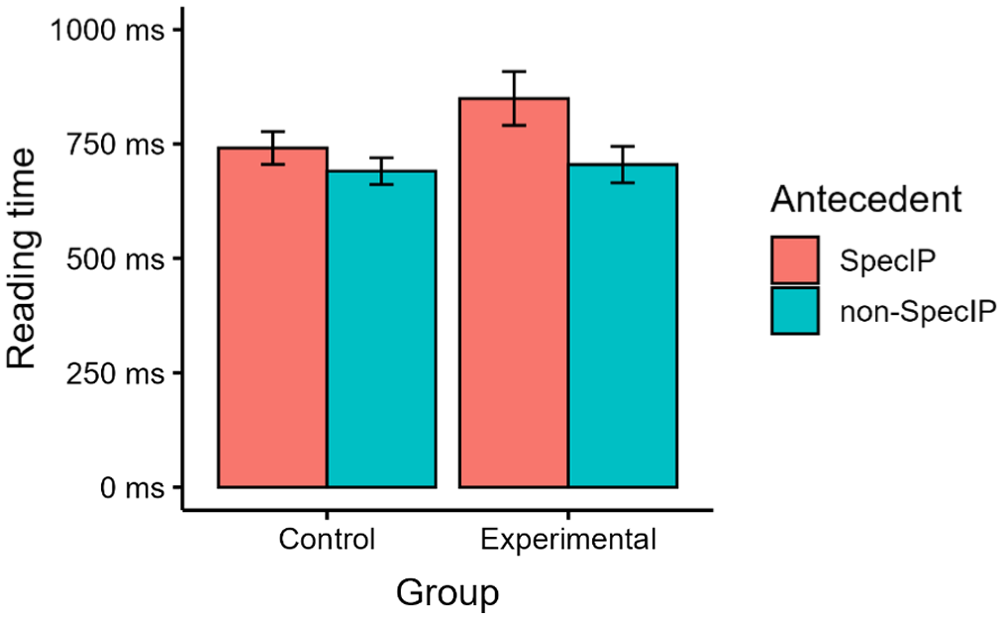
Global average reading times for the critical (fifth) window of trials with overt pronouns broken down by group with 95% confidence intervals.
Logged reading times for this window were subjected to a family of mixed-effects regressions as described above. Model comparison indicated that a model containing trial order as an interaction term best fit the data. That model’s output is presented in Table 2.
Model output for the logged reading times of trials with overt pronouns in the critical (fifth) window.
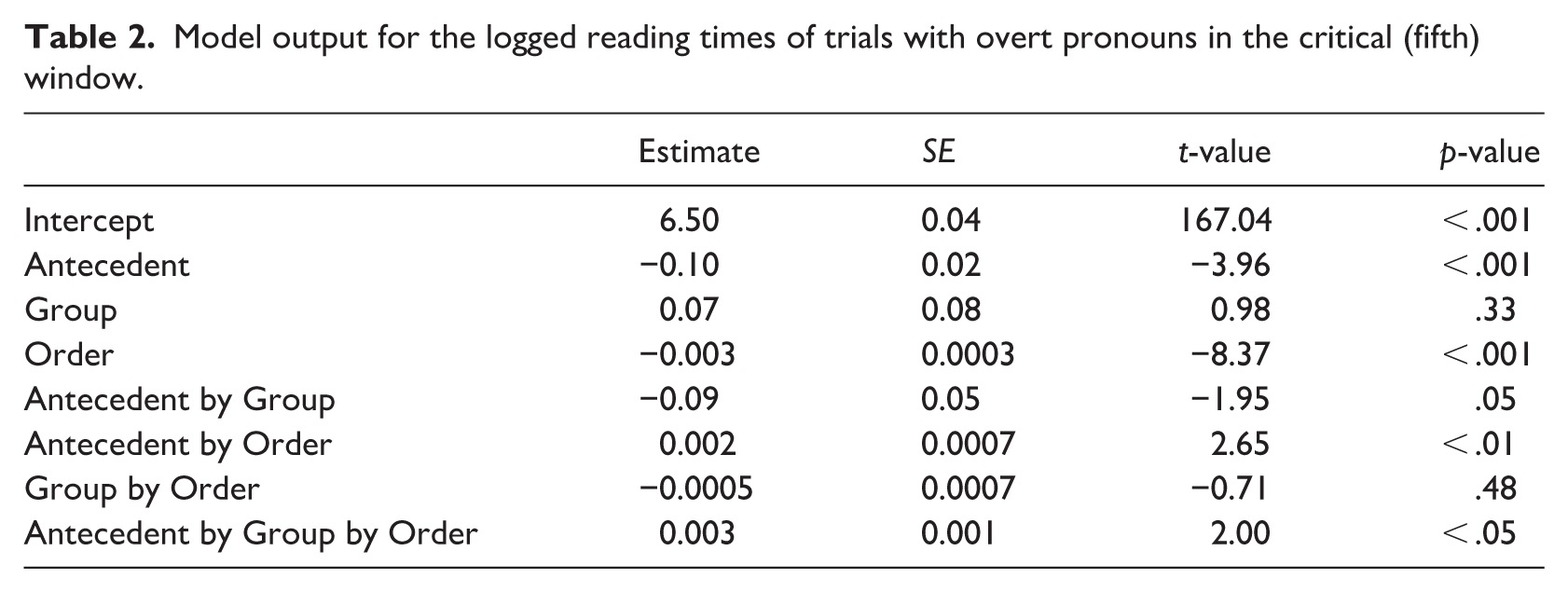
This revealed significant effects of antecedent (
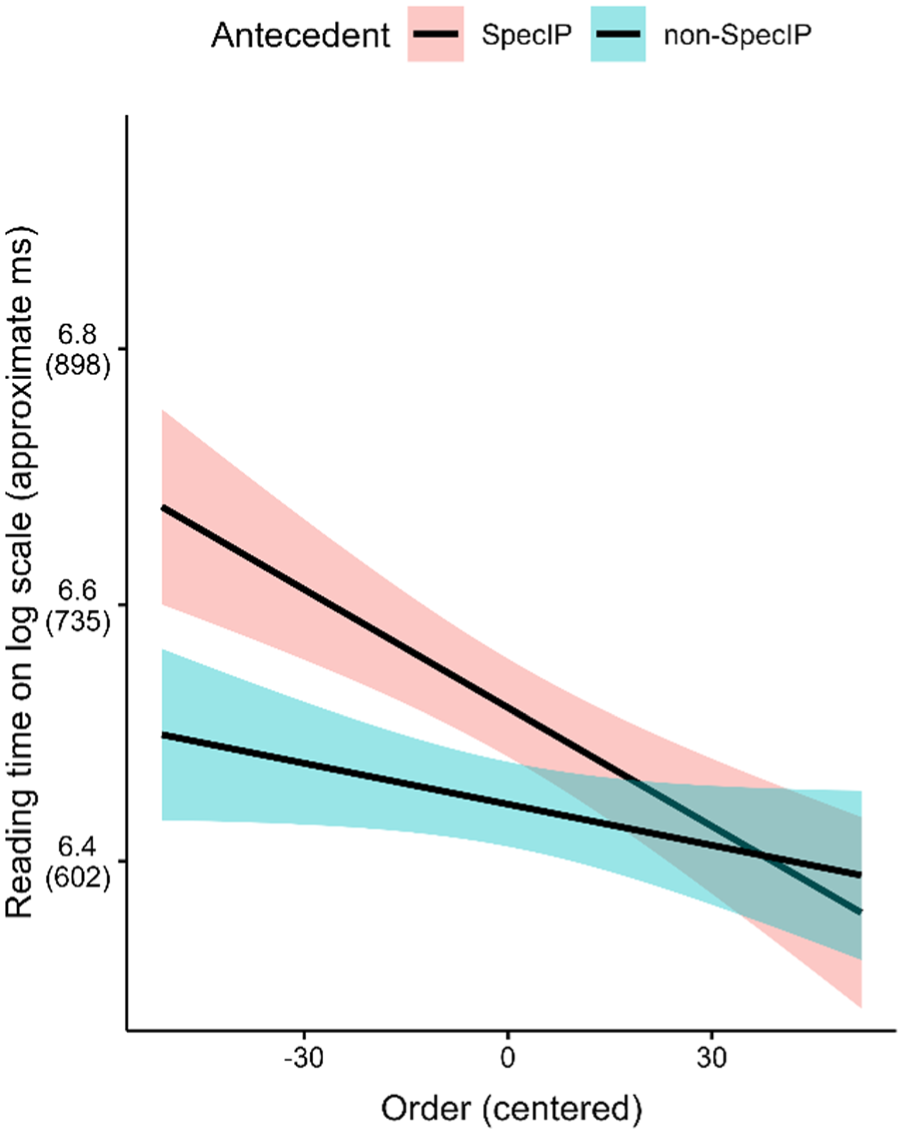
Reading times by antecedent over trial order in log milliseconds for the critical (fifth) window of trials with overt pronouns. This is plotted as a simple linear regression over the raw data for expositional purposes only.
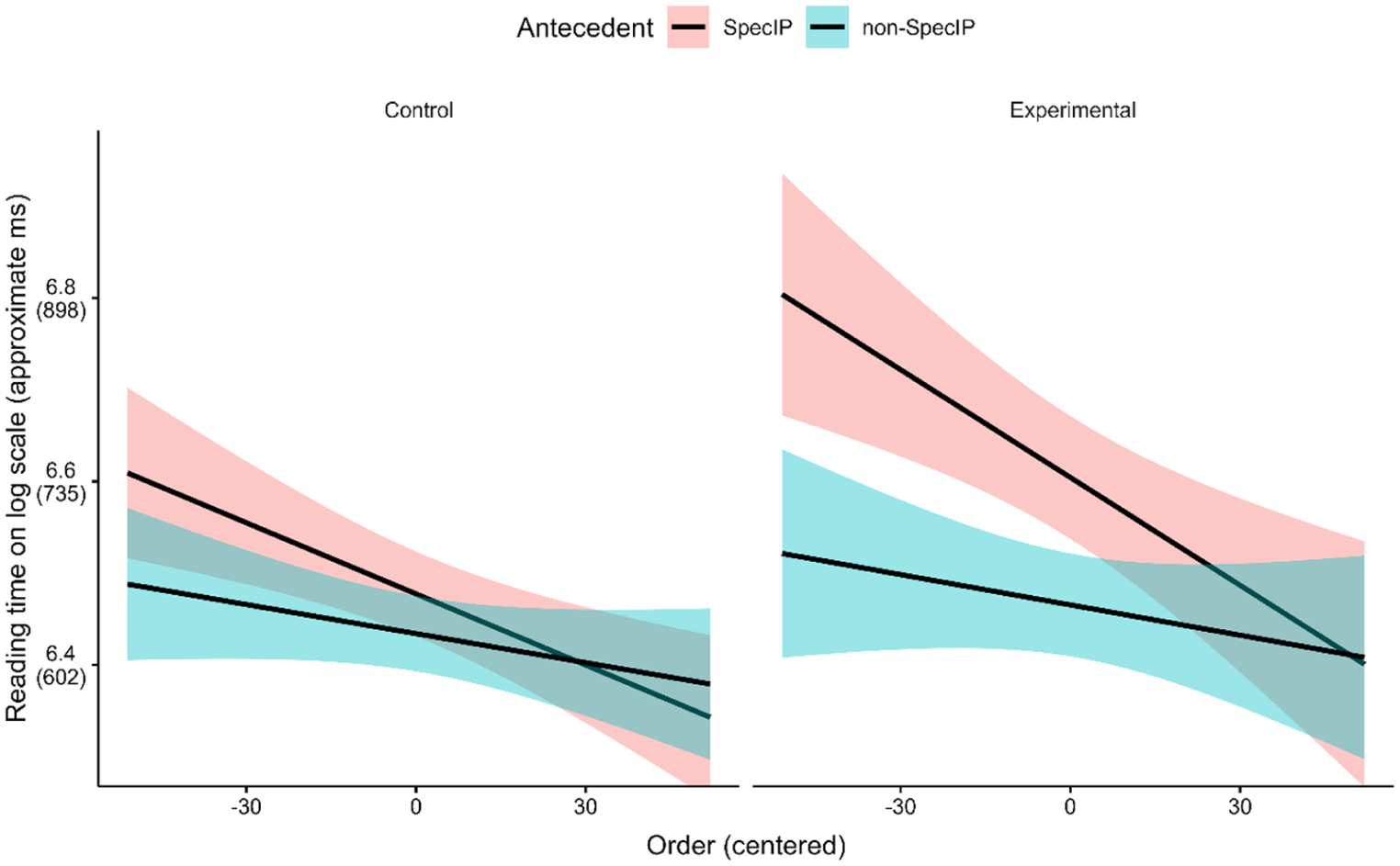
Reading times by antecedent and group over trial order in log milliseconds for the critical (fifth) window of trials with overt pronouns. This is plotted as a simple linear regression over the raw data for expositional purposes only.
To aid the interpretability of the three-way interaction, we decided post hoc to re-run the model with order de-centred. In this way, the lower-level model terms unrelated to order (i.e. the effects of antecedent and group as well as their two-way interaction) represented the data at the start of the experiment rather than at its centre. Shifting the intercept ( = 6.65; t = 155.08; p < .001) in this way, revealed a larger effect of antecedent (
Critical window for null pronouns (window 6)
Figure 5 graphically presents the mean reading times for the critical window of trials with a null pronoun. For both groups, the reading times for SpecIP (control: M: 642.44 ms; SD: 298.92 ms; experimental: M: 652.37 ms; SD: 261.97 ms) and non-SpecIP (control: M: 627.00 ms; SD: 252.64 ms; experimental: 662.75 ms; SD: 278.83 ms) disambiguated items were comparable.
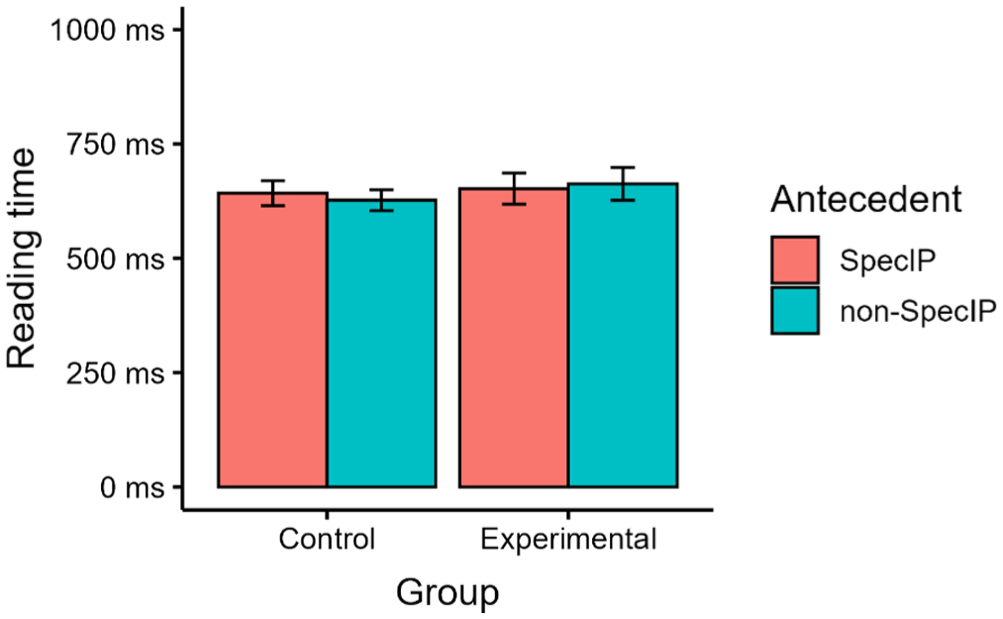
Global average reading times for the critical (sixth) window of trials with null pronouns broken down by group with 95% confidence intervals.
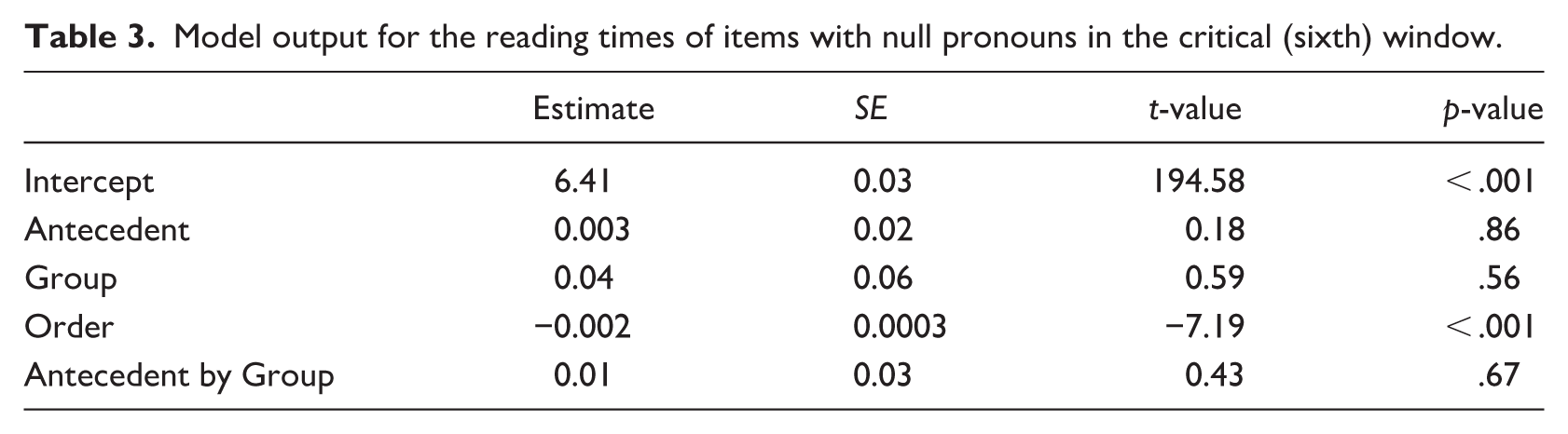
Logged reading times were subjected to a family of mixed-effect regressions as described above. Model comparison indicated that the best-fitting model contained order as a simple predictor but not as a potential interaction term. The output of that model is reported in Table 3. It revealed a significant effect of order (
Model output for the reading times of items with null pronouns in the critical (sixth) window.
Postcritical window for overt pronouns (window 6)
Mean reading times for this window are graphically presented in Figure 6. Both groups exhibited very similar reading times for SpecIP (control: M: 599.33 ms; SD: 204.54 ms; experimental: M: 595.65 ms; SD: 195.38 ms) and non-SpecIP (control: M: 583.14 ms; SD: 202.25 ms; experimental: 560.73 ms; SD: 170.87 ms) disambiguated items.
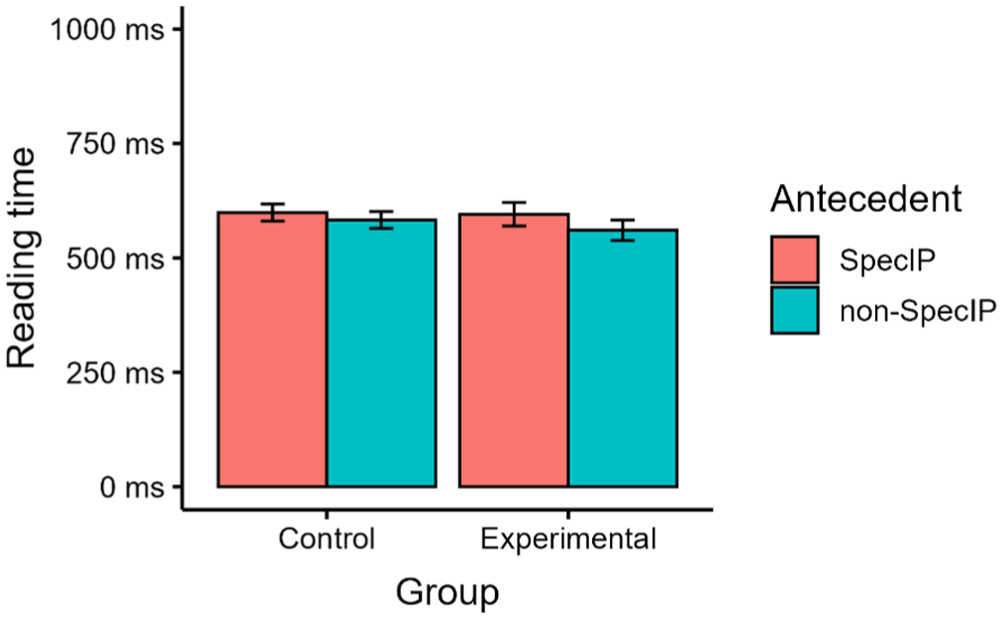
Global average reading times for the postcritical (sixth) window of trials with overt pronouns broken down by group with 95% confidence intervals.
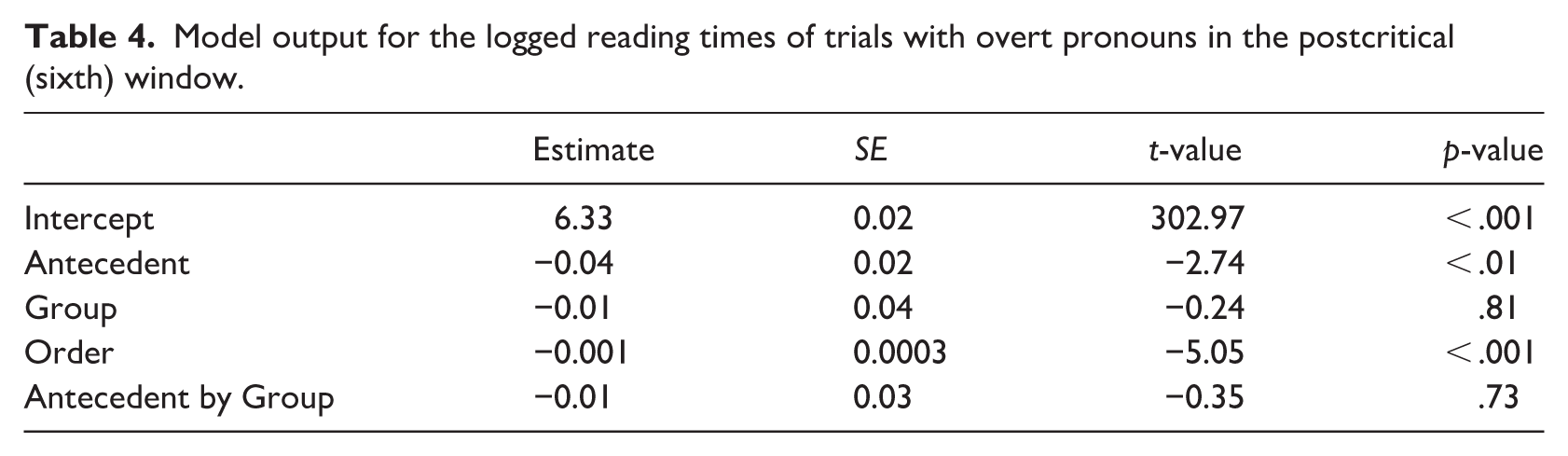
For this window, the best fitting model (reported in Table 4) contained order only as a simple effect, revealing that participants read more quickly as the experiment progressed (
Model output for the logged reading times of trials with overt pronouns in the postcritical (sixth) window.
Postcritical window for null pronouns (window 7)
On average, control participants read SpecIP disambiguated items (M: 855.64 ms; SD: 407.63 ms) slower than their non-SpecIP disambiguated counterparts (M: 777.07 ms; SD: 353.87 ms). The opposite was true for the experimental group with SpecIP disambiguated items (M: 800.01 ms; SD: 343.98 ms) read faster than non-SpecIP disambiguated ones (M: 890.19 ms; SD: 466.53 ms). This information is graphically presented in Figure 7.
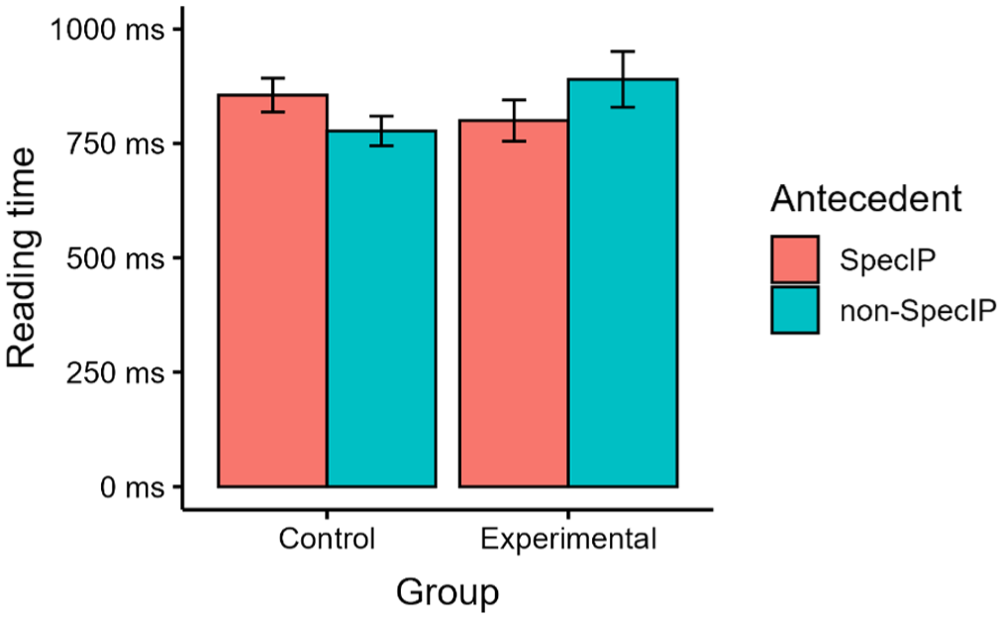
Global average reading times for the postcritical (seventh) window of trials with null pronouns broken down by group with 95% confidence intervals.
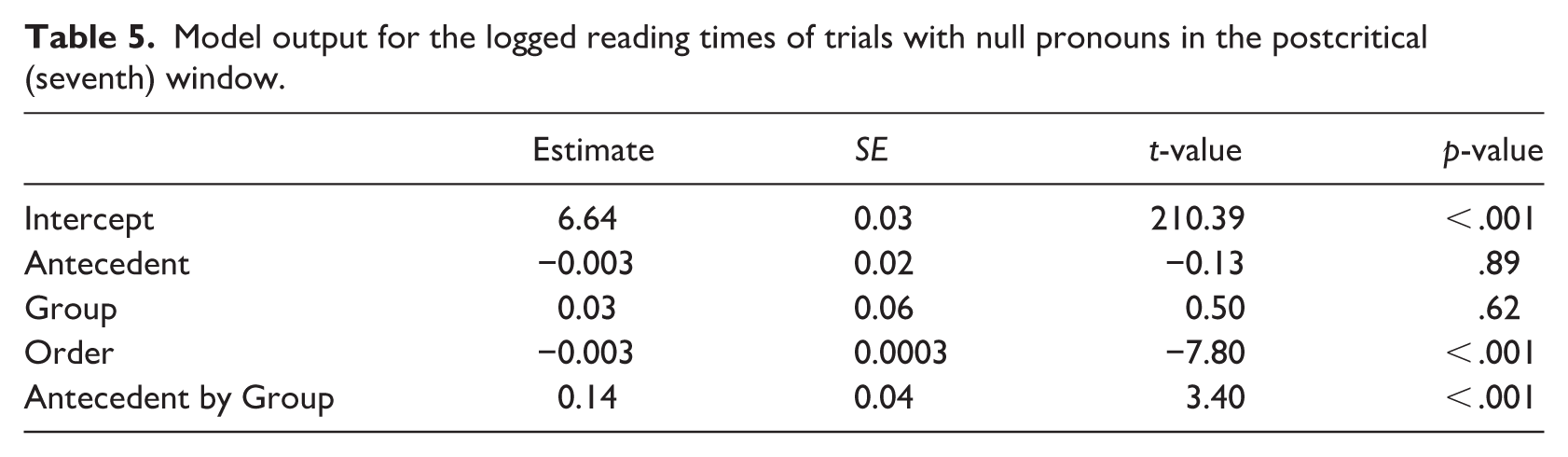
For this window, the best fitting model (Table 5) contained order as a simple term, but not an interaction, with participants again reading more quickly as the experiment progressed (
Model output for the logged reading times of trials with null pronouns in the postcritical (seventh) window.
Discussion
Above we have presented a self-paced reading task to investigate how attrition affects the processing of intrasentential pronominal resolution in Italian. Specifically, we were interested in whether the experimental group would exhibit a weaker non-SpecIP bias for overt pronouns during online processing relative to the control group as predicted by Sorace (2011). For this, we presented preplanned analyses of the reading times at the disambiguating window for temporarily ambiguous items, as well as post hoc analyses of the following regions.
Starting with the results for overt pronouns, reading times revealed the expected non-SpecIP bias at the critical and postcritical windows. However, in the critical window, this effect was both more pronounced and changed over the course of the experiment. Given that this surfaced as a more pronounced bias towards the beginning of the experiment, we interpret this interaction to indicate that participants adapted to the experimental context (e.g. Fine et al., 2013; Prasad & Linzen, 2021; Stack et al., 2018). Although this cannot be ascribed to some reliable cue within the pre-critical portion of the critical items (the gender manipulation was counterbalanced), it could relate to the fact that all critical items (and the 32 relative clause distractor items) were disambiguated via gender features; after being repeatedly garden pathed, participants may have begun to rely less on their (fallible) structural biases in favour of the disambiguating gender cue. Alternatively, it may simply reflect a task adaptation effect, whereby elements that were the slowest to read at the beginning of the experiment benefit the most from the general speed up (Prasad & Linzen, 2021).
Turning to group-level differences (i.e. attrition), although the predicted two-way interaction between group and antecedent was not significant at the centre of the experiment, the model for the critical widow revealed a significant three-way interaction over order. 7 This indicated that the adaptation effect discussed above was more pronounced for the experimental group. As such we interpret this to indicate that the participants undergoing attrition exhibited a stronger – not weaker – non-SpecIP bias for overt pronouns before adapting to the experimental context. 8 Consistent with this interpretation, the crucial two-way interaction is fully significant when order is de-centred. This is clearly inconsistent with the prediction of Sorace’s (2011) overt-as-processing-default proposal or Paradis’s (1993, 2007) Activation Threshold Hypothesis, both of which expect a weakening in online processing. It also contrasts with the findings in Chamorro et al. (2016).
Nonetheless, the present results are not without precedent. Although not usually acknowledged, previous work has also reported evidence that L1 interpretive biases for null pronouns, postverbal subjects, and reflexives may strengthen (Gürel, 2004; Gürel & Yılmaz, 2011; Tsimpli et al., 2004 for detailed discussion and additional evidence, see Cairncross et al., 2026). Moreover, Martín-Villena (2023) recently provided evidence that strengthening effects may also be observed in the offline interpretation of overt pronouns. In a large-scale pilot study with 131 L1 Spanish speakers still living in Spain, he found that participants who rated themselves as ‘highly proficient’ in their L2 English exhibited a significantly stronger interpretive bias for overt pronouns in Spanish than participants who rated themselves as ‘not proficient enough’. In addition, in the same main experiment where Martín-Villena (2023) found that decreasing L1 dominance (as indexed by Bilingual Language Profile questionnaire, Birdsong et al., 2012) was significantly associated to weaker interpretive biases for overt pronouns, results also indicated that becoming bilingual (either immersed or instructed) independently lead to significantly stronger interpretive biases for overt pronouns. Therefore, we interpret the unexpected strengthening effect in the present study to be non-spurious.
Given that this effect is in the opposite direction from that predicted by previous theories (e.g. featural change: Tsimpli et al., 2004; overt-as-processing-default: Sorace, 2011; competing L2 forms: Paradis, 1993, 2007), it is not clear how they could be modified to capture this effect. Therefore, we follow Cairncross et al. (2026) in interpreting our strengthening effect to be part of a more general tendency to increase reliance on L1 biases under attrition. That is not to say attrition always leads to a strengthening of L1 biases or that our results falsify Sorace’s (2011) or Paradis’ (1993, 2007) predictions. That position is demonstrably too strong; previous work has repeatedly reported evidence that overt pronoun biases can weaken under attrition (e.g. Chamorro et al., 2016; Gürel, 2004; Gürel & Yılmaz, 2011; Kaltsa et al., 2015; Martín-Villena, 2023; Tsimpli et al., 2004). Rather, Cairncross et al. (2026) suggested that the general tendency to rely more on one’s L1 biases competes with the weakening effect previously observed for overt pronouns, be it in the sense of Sorace’s (2011) overt-as-processing-default or Paradis’s (1993, 2007) Activation Threshold Hypothesis.
Accepting that there are competing pressures under attrition raises the question of why this should have led to different outcomes in the present study and in Chamorro et al. (2016). A salient initial variable to consider is the difference in languages. Recall that that the non-SpecIP bias for overt pronouns in Spanish is weaker than in Italian (Contemori & Di Domenico, 2021; Filiaci et al., 2014). As such, one might try to link the difference in the initial strengths of the biases to their outcome under attrition. However, this idea cannot be maintained given that there is now evidence for inconsistent effects of attrition on overt pronouns within both Italian (present study vs. Tsimpli et al., 2004) and Spanish (Martín-Villena, 2023 vs. Chamorro et al., 2016).
In a related vein, one might suggest that the differences in outcomes during online processing might relate to the cues used for disambiguation. This may go some way in explaining why the result in the present manuscript (as well as those in Chamorro et al., 2016) differ from those in Martín-Villena’ (2023). Recall that Martín-Villena’ (2023) items were not disambiguated via linguistic cues/features. Rather, the sentences were left globally ambiguous while images were used to bias particular readings. As such, participants were free to (and did) arrive at interpretations inconsistent with the biasing image. Therefore, it is reasonable to suggest that variability in participants’ use of images as a biasing cue may have introduced noise and may have washed out any group-level differences. As for Chamorro et al. (2016), recall that they used number features, whereas the present study gender features. Recall also that Carminati (2005) found that PAH violations for null pronouns were more pronounced in gender-disambiguated items. Assuming that asymmetry extends to overt pronouns, one might try to revive the idea that biases for overt pronouns in Chamorro et al.’s (2016) stimuli was weaker to begin with, resulting in the observed differences. However, ascribing the difference between the present results and those in Chamorro et al. (2016) entirely to the disambiguating feature would leave the conflicting results in the interpretation of ambiguous stimuli with overt pronouns unaccounted for.
Alternatively, given the heterogeneity inherent in any sample of potential attriters, we might try to resolve the conflicting results by dispensing with group as a factor. Follow recent trends in work on bi-/multilingualism more generally (e.g. Gullifer & Titone, 2019; Rothman et al., 2023 and citations therein), we might instead explore the contribution of different measures of language experience. Some initial support for the usefulness of this approach applied to attrition may be drawn from Martín-Villena (2023). Recall that they found that becoming bilingual and increasing L2 dominance affected the interpretation of over pronouns in opposite directions. This is despite the logical relationship between the two variables. As such, we might speculate that while becoming more L2 dominant increases processing pressure, leading to an overextension of overt pronouns as proposed by Sorace (2011) or increased competition in the sense of Paradis (1993, 2007), whereas some other aspect of becoming bilingual leads speakers to rely more on their L1 biases more generally. To follow up on this idea, additional exploratory modelling was conducted, looking at the effects of Length of residency, English proficiency, and English use within the experimental group at the critical window. Model comparison did not support the inclusion of any of these variables as interaction terms with antecedent. However, given the group-based design and relatively stringent inclusion criteria (e.g. a minimum of 5 years of residency for experimental participants) implemented for the present study, our participants do not represent an ideal sample for investigating this further. Therefore, we leave this issue open for future work.
Turning finally to the results for items with null pronouns, although we did not predict any effect of attrition, we did expect an effect of antecedent (i.e. a SpecIP bias). It is unclear why this did not surface at the critical window, given that previous work on Italian has repeatedly found this bias in both offline interpretation (e.g. Carminati, 2002; Contemori & Di Domenico, 2021; Vogelzang et al., 2020) and online processing (Carminati, 2002; Filiaci et al., 2014). However, our null effect should not be attributed to the disambiguating cue employed for several reasons. First, online effects have been observed in items using a gender disambiguation similar to the one implemented in the present study (e.g. 10 from Carminati, 2005).
11. Quando Maria.
‘When Maria looks for Roberto, (s/he) become anxious.’
Second, we cannot argue that placing our disambiguating cue on a secondary depictive predicate caused it to be insufficiently salient; although not analysed in the present manuscript, accuracy to comprehension questions following critical items was at ceiling (> 94% in all conditions for all groups), indicating participants were sensitive to our gender disambiguation. Moreover, analysis of the distractor items indicates that participants were immediately sensitive to this cue elsewhere during the experiment (Cairncross, 2024).
Instead, we might wonder whether the lack of SpecIP bias is somehow an artefact of the items employed. A salient difference between the present stimuli and those previously used to demonstrate the SpecIP bias for null pronouns during processing is the clausal order. Whereas the present study opted to have the matrix clause precede the embedded one for comparability with previous work on attrition (i.e. Chamorro et al., 2016), previous work looking at the PAH from an online perspective (Carminati, 2002, 2005; Filiaci et al., 2014) has used the opposite order (2, 9). This is relevant as Carminati (2002) originally opted for embedded-first items in their online experiments under the assumption that order gave the processor greater access to preceding structure. This assumption was motivated by the fact that the interpretation of an adverbial clause is dependent on the main clause such that an adverbial clause at the left edge must be maintained in working memory until it can be integrated (pp. 36–37). Some initial support for the idea that clausal order impacts the PAH might be taken from the observation that Spanish speakers’ offline interpretive preferences for null pronouns seem to be absent in matrix-first items but present in embedded-first ones, even when the linear order of the pronouns and their potential antecedent remains unchanged (de Rocafiguera & Bel, 2022). This could potentially account for why both Chamorro et al. (2016) and Martín-Villena (2023) reported no bias for null pronouns in their matrix-first items, despite evidence that Spanish speakers exhibit a SpecIP bias in embedded-first items (Filiaci et al., 2014). However, we would be remiss if we did not also remember that various groups of researchers, using different sets items, have observed that L1 Italian speakers exhibit a clear SpecIP bias for null pronouns in globally ambiguous matrix-first sentences as in (1) (e.g. 80% in Carminati, 2002; 75% in Contemori & Di Domenico 202; 78% in Fedele & Keiser, 2014; 72% in Kraš, 2008; 86% in Vogelzang et al., 2020, but see also Tsimpli et al., 2004 and Belletti et al., 2007 who found 50.8% and approximately 40% SpecIP responses, respectively, using the same set of items). Moreover, when Di Domenico and Contemori (2023) directly compared the interpretation of null pronouns in sentences that differed only in clausal order, as in (12), they found that L1 Italian speakers exhibited a clear SpecIP bias in both conditions (matrix-first: 76% SpecIP; embedded-first: 85% SpecIP) with the bias only marginally weaker in the matrix-first condition. A similar pattern for null pronouns can be found in Fedele and Keiser (2014, matrix-first: 78% SpecIP; embedded-first: 79% SpecIP). Therefore, we cannot argue that the matrix-first nature of the items in the present study led to PAH being inoperative for null pronouns:
12. a. Giorgio ha visto Luigi quando ø stava andando al bar. [Italian]
b. Quando Giorgio ha visto Luigi, ø stava andando al bar.
‘(When) Giorgio saw Luigi (when) he was going to the bar.’
Integrating the postcritical window, it might be tempting to interpret the fact that the experimental group exhibited the expected SpecIP bias as evidence that this effect actually is present, albeit delayed. Moreover, one might also be tempted to interpret the fact that only the experimental group exhibited this bias as additional evidence that attrition can lead to stronger processing biases convergent with previous offline data from Turkish (Gürel, 2004; Gürel & Yılmaz, 2011) and Italian (Cairncross et al., 2026; Tsimpli et al., 2004). However, this faces at least two issues. First, as noted above, participants were sensitive to the disambiguating cue at the critical window for distractor items. Therefore, it is not clear why participants should be sensitive to the same cue only at the postcritical window for null pronouns. Second, and more importantly, it is not that the control group exhibited a weaker/no bias within these items; they exhibited an unexpected non-SpecIP bias. To the best of our knowledge, a clear non-SpecIP bias for null pronouns in Italian has only previously been observed in a sentence completion task by Fedele and Keiser (2015), who explicitly manipulated implicit causality via the matrix predicate using items as in (13, Subject-bias: 85.5% SpecIP; object-bias: 32.2%).
13. Lo studente ha (deluso / criticato) lo chef perché ø ha. . . [Italian]
‘The student (let down / criticised) the chef because he has. . .’
However, even if we were to assume for argument’s sake (i) that the present study unintentionally introduced a SpecIP bias via implicit causality and (ii) that the control group was for some reason more sensitive to this artefact, such that we can capture the postcritical results for null pronouns, we run into another problem. Namely, any such artefact should trend in the same direction across pronominal types, even if the magnitude may differ by condition (e.g. see Fedele & Keiser, 2015, who argue that implicit causality introduced by the matrix predicate affects overt pronouns more than nulls). Yet, for overt pronouns, the control group exhibited a weaker – not stronger – non-SpecIP bias relative to the control group, with no meaningful difference at the postcritical window. Therefore, we cannot maintain that some hidden implicit causality drove the pattern observed for null pronouns at the postcritical window.
Given these complications (plus the fact that this was derived from a post hoc analysis of a sentence final region), we refrain from interpreting the interaction at that window and retreat to the position that no clear SpecIP bias was observed for null pronouns. As it is unclear why this was the case for the present items (but also those in Tsimpli et al., 2004), it may be useful for future work on attrition and the PAH to instead employ items for which online effects have been reliably observed, such as those in Carminati (2002).
Conclusion
Our results indicate that although attrition affects online processing of pronominal resolution, this does not always lead to a relaxation of the bias for overt pronouns as predicted by Sorace (2011). Rather, in this study, speakers undergoing attrition exhibited a stronger bias than their counterparts living in the home community. Although this outcome was unexpected and not attributable to influence from the L2, it extends recent offline results to online processing and provides additional evidence that attrition may cause speakers to rely more on their L1 biases. As a result, instead of focusing narrowly on relaxation, future work should acknowledge and aim to account for the inconsistency in how attrition surfaces for overt pronouns.
Footnotes
Acknowledgements
We would like to thank Gianluca Porta for his judgements when we were constructing our stimuli. We would also like to thank the audiences at AMLaP 2024 and the Tsimpli research seminars for their feedback.

Ethical considerations
Prior to data participant recruitment, ethical approval was obtained from the Ethics Committee of the Faculty of Modern and Medieval Languages and Linguistics at the University of Cambridge.
Consent to participate
Prior to participation, all participants were provided with information about the study and gave their informed consent via an electronic consent form.
Author contributions
AC: conceptualisation; methodology; funding acquisition; investigation; formal analysis; writing.
MV: conceptualisation; supervision; review and editing
IT: conceptualisation; supervision; review and editing
Funding
The authors disclosed receipt of the following financial support for the research, authorship, and/or publication of this article: This work was supported by funding from the Section of Theoretical and Applied Linguistics.
Declaration of conflicting interests
The authors declared no potential conflicts of interest with respect to the research, authorship, and/or publication of this article.