



Abstract
Aims:
While research on syntactic L1 attrition has largely focused on interface phenomena (e.g., overt pronouns in null-subject languages), attrition has also been reported to affect syntactic parsing. This paper extends previous work by looking at the attrition of (pseudo)relative clause parser biases in L1-Italian L2-English speakers. This was done to investigate whether previous findings of attrition in the interpretation of ambiguous relative clauses can be accounted for by changes to the parsing of pseudorelatives.
Method:
To tap parser biases, we conducted a sentence interpretation task in Italian with ambiguous items. Within these items, pseudorelative availability was manipulated. Participants consisted of two groups of adult native Italian speakers: one living in Italy and one living in an English-speaking country.
Data analysis:
Responses from the sentence interpretation task were subjected to a mixed-effects logistic regression.
Findings:
Results indicated a global effect of attrition resulting in more low attachment interpretations. This did not interact with pseudorelative availability.
Originality:
We take this to be a novel contribution to the literature for two reasons. First, our results extend previous results from Spanish–English bilinguals to a new language pair. Second, we believe that this is the first study to investigate attrition of relative clause attachment biases in light of Grillo and Costa’s, Pseudorelative-First Hypothesis. Once this is taken into consideration, we argue that attrition of parser biases is not due to a loss of a global high attachment bias under pressure from the L2, but a strengthening of a low attachment bias already present in the L1.
Implications:
Results suggest that future work on attrition should look beyond conflicts in parser biases between a bilingual’s languages and raise the possibility that attrition affects attachment biases in other contexts.
Introduction
When presented with an incoming string, the goal of the language parser is to decode the physical signal into meaningful units and then assemble those into a syntactic representation. Along the way, ambiguity may arise at various levels when the signal is compatible with multiple representations. In such cases, the hearer/reader must rely on principles of optimal computation to decide between potential parses. An example of this is provided in (1).
(1) a. Someone shot the maid1 of the actress2 [that was standing on the balcony]. b. Alguien disparó contra la criada1 de la actriz2 [que estaba en el balcón]. [Spanish] (adapted from Cuetos & Mitchell, 1988)
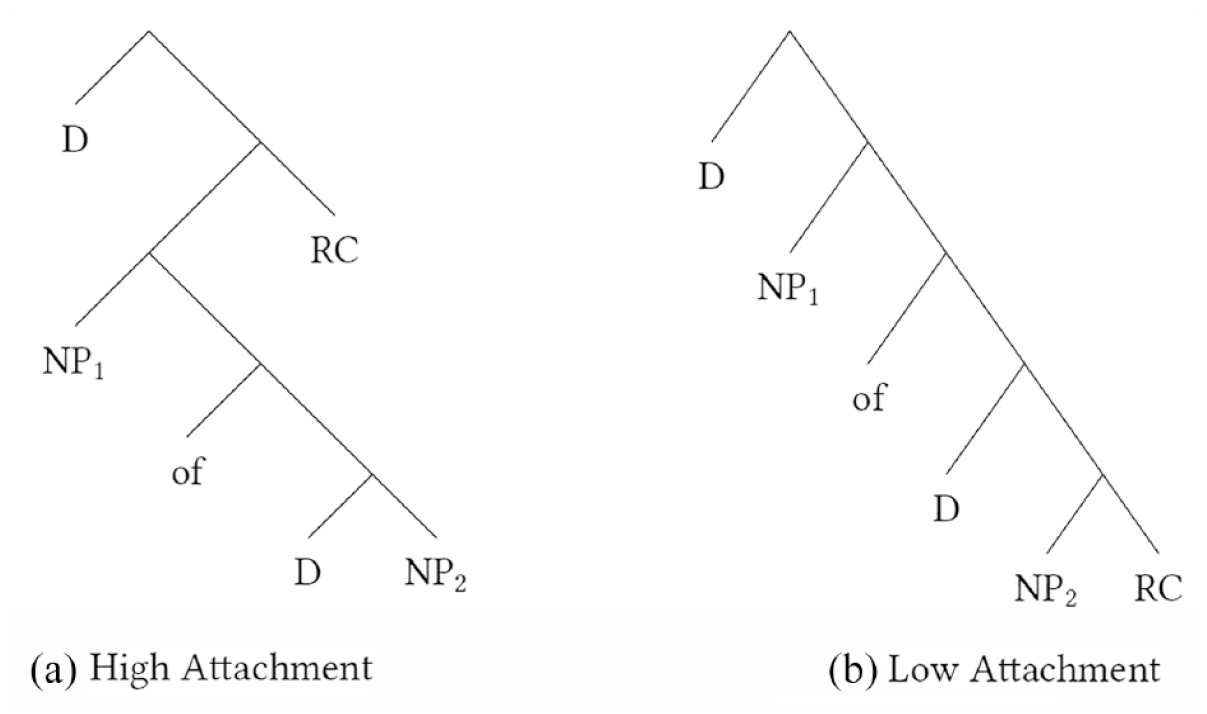
In (1), there is a syntactic ambiguity. The hearer/reader must decide whether the bracketed relative clauses (RCs) should attach to the first or to the second possible NP. These two readings are known as high attachment (HA) and low attachment (LA), respectively, due to the relative height of the RCs.
(2) 
Under principles of locality (e.g., Late Closure, Frazier, 1978), one would expect a preference for LA. Since Cuetos and Mitchell (1988) however, it has been a well-known fact that speakers of different languages exhibit contrasting biases in their interpretation of (1). Specifically, while English speakers have been found to exhibit an LA bias in (1a), Spanish speakers have been observed to exhibit an HA bias in (1b).
This cross-linguistic difference has garnered considerable interest in the psycholinguistic literature as it challenges the traditional assumption, based on the general tendency toward least effort and learnability considerations (Fodor, 1998a, 1998b) that the language parser is universal. This has led to the investigation of attachment biases with RC ambiguities in many different languages resulting in a classification of languages as either LA languages (e.g., English: Cuetos & Mitchell, 1988; Fernández, 2003, i.a, and Chinese: Shen, 2006) or HA languages (e.g., Spanish: Cuetos & Mitchell, 1988; Fernández, 2003, i.a., Italian: De Vincenzi & Job, 1993, 1995, Dutch: Brysbaert & Mitchell, 1996; Mitchell et al., 2000, French: Zagar et al., 1997, and Greek: Papadopoulou & Clahsen, 2003).
More recently, Grillo (2012) and Grillo and Costa (2014) have proposed that this cross-linguistic difference in parser biases may owe to a hidden structural difference. Specifically, many of the languages reported to exhibit an HA bias also admit pseudorelatives (PRs), while languages reported to exhibit an LA bias do not. As the name suggests, PRs are strings identical to true RCs. Nonetheless, the two structures display several syntactic and semantic differences. Importantly in the contexts previously explored in the psycholinguistic literature, PRs are only possible with the structurally higher NP. Proponents of the PR account argue that, once this syntactic confound is accounted for, the universality of parsing can be maintained. Some empirical support has since been provided from offline (Aguilar et al., 2021; Aguilar & Grillo, 2021; Grillo and Costa, 2014; Grillo et al., 2015; Pozniak et al., 2019) and online tasks (Aguilar et al., 2021; Pozniak et al., 2019) with speakers of both HA and LA languages.
At the same time, the potential non-universality of parsing has also generated interest among researchers working on second language (L2) acquisition as it raises questions regarding how these biases are acquired and whether they can interact in a bilingual’s mind (e.g., Dussias, 2003, 2004; Dussias & Sagarra, 2007; Felser et al., 2003; Fernández, 1999, 2003; Frenck-Mestre, 1997; Frenck-Mestre & Pynte, 1997; Hemforth et al., 2015; Papadopoulou & Clahsen, 2003). Of central concern to this paper is the finding that parser biases are not immutable. Rather, it has been reported that adult speakers whose first language (L1) typically exhibits an HA bias in sentences like (1) may begin to exhibit an LA bias in their L1 under immersion in an L2 during adulthood (Dussias, 2003, 2004; Dussias & Sagarra, 2007).
These two research strands seem in tension with one another. On the one hand, it is argued that we can retreat to the universality of parsing, once a syntactic confound between languages is considered. On the other hand, it has been argued that native parser biases may change within a speaker during adulthood due to exposure to an L2. How to reconcile these two positions is unclear. To date, attrition of RC attachment biases has only been studied in one language pair (L1-Spanish, L2-English). In addition, the previous studies on attrition predate Grillo (2012) and Grillo and Costa (2014) and therefore did not take PRs into account. In response, this paper reports on a sentence interpretation task exploring attrition in a new language pair (L1-Italian, L2-English) in which the availability of PRs was manipulated.
The PR account
A central observation for the PR account is that some strings that have been previously taken as RCs in the psycholinguistic literature may actually be ambiguous between RC readings and PR readings. While relatively new to psycholinguistics, PRs have been discussed in the formal linguistic literature where it has been observed that PRs exhibit a number of semantic and syntactic differences from RCs despite the two structures being string identical (Casalicchio, 2013; Cinque, 1992; Radford, 1975, i.a.).
On the semantic side, while RCs denote properties of the NP they attach to, PRs denote event situations (Moulton & Grillo, 2015). In the context of (3) then, the RC tells us something about the particular man who was seen (i.e., that he ran). Conversely, the PR tells us what was seen (i.e., an event of running in which the agent was a particular man). Note, however, despite this semantic difference, if a participant were asked “Who ran?” after reading the simple sentence in (3), regardless of whether they parsed the string as containing a PR or RC, the answer would still be “the man.”
(3) a. Gianni ha visto [PR [DP l’ [NP uomo]] [CP che correva]]. [Italian] “Gianni saw the man running.” b. Gianni ha visto [DP l’ [NP uomo [CP che correva]]]. [Italian] Gianni has seen the man that ran “Gianni saw the man that ran.”
On the syntactic side, when PRs occupy the complement of a perceptual verb as in (3a), the embedded CP is a sister to the DP. Conversely, with an RC as in (3b), the CP is embedded within the DP. This structural difference affects attachment with complex DPs as in (1) or (4). On the one hand, RCs may freely attach to either NP1 or NP2. On the other hand, when a PR is present only the structurally higher DP can c-command the embedded CP and therefore be interpreted as its subject. In a context like (1) or (4), then, if the embedded CP is parsed as a PR, HA becomes obligatory. 1
(4) Gianni ha visto il figlio1 del medico2 che correva. [Italian] Gianni has seen the son of the doctor that ran “Gianni saw the son of the doctor running.”
Given this ambiguity between RCs and PRs, when presented with a string as in (1) or (4), the parser must not only decide between two RC attachment sites but also whether the embedded clause is an RC at all. To guide the parser, Grillo and Costa (2014) proposed the
(5) PR-First Hypothesis: When PRs are available, everything else being equal, they will be preferred over RCs. (Grillo & Costa, 2014, p. 166)
In addition to its cross-linguistic predictions, the
(6) a. Gianni ha visto Maria che correva. [Italian] Gianni has seen Maria that ran “Gianni saw Maria running.” b. *Gianni ha sposato Maria che correva. [Italian] Gianni has married Maria that ran
This asymmetry was exploited by Grillo and Costa (2014) in a sentence interpretation task. They found that, in strings like (1), the attachment biases of native Italian speakers were sensitive to the type of the matrix verb. Specifically, they observed an HA bias with verbs of perception (78.6% HA) but an LA bias with non-perceptual predicates (24.2% HA). Convergent results using various manipulations have since been presented for other HA languages (e.g., French: Pozniak et al., 2019, Spanish: Aguilar et al., 2021; Aguilar & Grillo, 2021).
Results from LA languages also indicate that the above findings cannot be attributed to semantic plausibility alone. Grillo et al. (2015) performed the same task as Grillo and Costa (2014) with native speakers of English. In their verbal condition, items like (7) were translations of the items in Grillo and Costa (2014). Yet, despite a small semantic facilitation effect, the authors found that verbs of perception do not lead to an HA bias in English as they do in Italian.
(7) a. Kelly heard the grandma of the girl that was screaming. b. Kelly works with the grandma of the girl that was screaming.
Offline results have also been extended to online processing. In an eye-tracking-while-reading task, Pozniak et al. (2019) exploited tense restrictions on PRs to create PR-compatible (tense match between the matrix and embedded predicates) and PR-incompatible (tense mismatch between the matrix and embedded predicates) strings. Crucially, this is non-local manipulation. That is to say, it is not until the tense mismatch in the embedded predicate is encountered that disambiguation to an RC parse is forced in the relevant items. Therefore, if the parser were to try a PR parse first, then upon encountering the embedded predicate, one would expect processing times for tense mismatch items to be longer than for tense match items due to reanalysis. Consistent with this prediction, the authors report a PR advantage in the first half of the experiment, with possible adaptation effects in the latter half.
Extending those findings, Aguilar et al. (2021) conducted an eye-tracking-while-reading task with native Spanish speakers. Using gender marking in the embedded CP to force HA or LA, they observed that, when PRs were locally available, reading times were faster for HA-disambiguated items than for LA-disambiguated ones, which as noted above are incompatible with PRs. Conversely, when PRs were locally blocked, the opposite pattern surfaced. Reading times were faster for LA-disambiguated items. These results contrast with previous studies on Spanish which did not control for PRs and have reported a global online bias for HA (e.g., Carreiras & Clifton, 1999; Dussias, 2003) but are consistent with the predictions of the
Thus, to recapitulate, following Grillo and Costa (2014) we are assuming that when the parser is presented with sentences as in (1), it universally exhibits two conflicting structural biases which are ordered with respect to each other. These are indicated in Figure 1 where the preferred parses are in boldface and the relevant principles are in brackets. When PRs are available, they are preferred by the parser and result in an HA interpretation. However, when PRs are blocked globally (e.g., English) or locally (e.g., after stative predicates in Italian), the
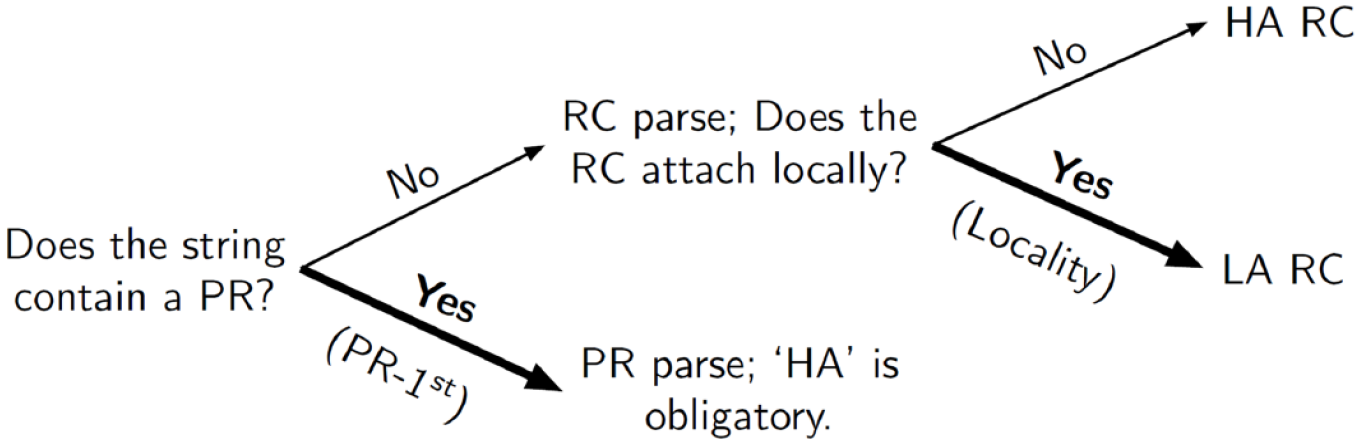
Summary of (relevant) universal PR/RC parse options. PR: pseudorelative; RC: relative clause.
L1 attrition and parser biases
Turning to bilingualism, while researchers of L2 acquisition have generally been interested in the L2, there is a growing interest in how acquiring an L2 may affect an adult speaker’s L1, a phenomenon known as L1 attrition. L1 attrition is generally observed in migration context in which there is both an increase in L2 exposure and a decrease in L1 exposure and has been explored in various domains (e.g., phonology: Flege, 1987, lexical access: Linck et al., 2009, and syntax: Tsimpli et al., 2004). To date, much of the research on L1 attrition of syntactic phenomena has focused on structures conditioned by discourse features. However, there are some results indicating that parser biases may be affected as well.
Dussias (2003) conducted two experiments to explore RC attachment biases in late Spanish-English bilinguals of both L1s. Both groups of bilingual speakers were highly proficient in both languages and had had non-trivial immersion in their respective L2s (L1-English: M = 2 years; L1-Spanish: M = 7.5 years). Two monolingual control groups were also recruited.
In the first experiment, participants were presented an offline questionnaire with critical items like in (8) to tap attachment preferences for both languages (months apart). Consistent with previous results, the Spanish monolinguals selected HA interpretations significantly more than LA ones (74% HA). Similarly, the English controls selected HA interpretations significantly less than LA ones (14% HA). Turning to the bilingual responses in English, the two groups patterned together and, similar to monolingual controls, displayed a preference for LA interpretations (L1-English: 28% HA; L1-Spanish: 22% HA). No significant group-level differences were observed. As for their Spanish responses, again the two groups pattern similarly. In this context, however, they both differ from monolingual baselines and exhibit an LA bias (L1-English: 44% HA; L1-Spanish: 28% HA; Monolingual Spanish: 74% HA). This difference was significant between the L1-Spanish bilinguals and the monolingual controls but not between the two bilingual groups.
(8) a. Peter fell in love with the daughter of the psychologist who studied in California. b. Pedro se enamoró de la hija del psicólogo que estudió en California. [Spanish]
Building on this in a second experiment, Dussias (2003) explored online parsing preference in Spanish via a self-paced reading task. In that task, items were forced toward HA or LA via a PP in the embedded CP which biased attachment via world knowledge. The monolingual Spanish controls read HA-biased sentences significantly faster than LA-biased ones. For the bilinguals, however, this pattern was reversed and the L1-Spanish L2-English group read LA-biased sentences significantly faster. Convergent results from eye-tracking-while-reading tasks were also reported in Dussias (2004) and Dussias and Sagarra (2007).
Comparing these studies with those discussed in Section “The PR Account,” the offline and online results from native speakers undergoing attrition appear similar to monolingual speakers when PRs are locally blocked, that is, in both cases, speakers exhibit an LA bias where they would otherwise be expected to exhibit an HA bias. As such, one might wonder whether attrition somehow affects the availability of PRs or their parsing. Although we did not have access to the stimuli from Dussias (2003), 37.5% of the stimuli from Dussias (2004) and Dussias and Sagarra (2007) contained PR-taking matrix predicates (Grillo & Costa, 2014, fn. 29).
3
Therefore, it is plausible that PRs may have played a role in the observed LA shift. However, as the existing studies on L1 attrition predate the
Research questions
From this background, the following research questions are posed:
I. Do (pseudo-)RC attachment biases in L1-Italian shift toward LA under immersion in L2-English?
II. If so, is this change in attachment biases limited to environments in which Italian allows PRs?
Method
In response to the above questions, we conducted a sentence interpretation task with globally ambiguous items in which the availability of PRs was manipulated.
Participants
Two groups of participants were recruited: an experimental group and a control group. Regardless of group, all participants (i) were native Italian speakers, (ii) had lived in Italy from birth until at least the age of 16 years, (iii) had no diagnosed language-related disorders, and (iv) reported growing up monolingually. 4 The control group consisted of 33 Italian native speakers (12 women and 21 men) who were living in Italy. 5 On average, the control group was 40.91 years of age (SD = 6.40 years) at the time of testing. As part of our background questionnaire, all participants were asked how many languages they spoke at or above an “intermediate” level as well as for how many hours they used each of these languages in a typical day. This revealed that the control participants were not idealized monolinguals but to some extent multilingual. Of the 33 controls, 30 reported speaking some language other than Italian. Of those 30 participants, all reported speaking English. To quantify how much of each language a participant used, we calculated their percentages for each language (i.e., hours of language x/total hours reported for any language). Table 1 presents group means and standard deviations for the use of Italian, English, and “Other” as percentages of a typical day.
Language use as percentages of a typical day.
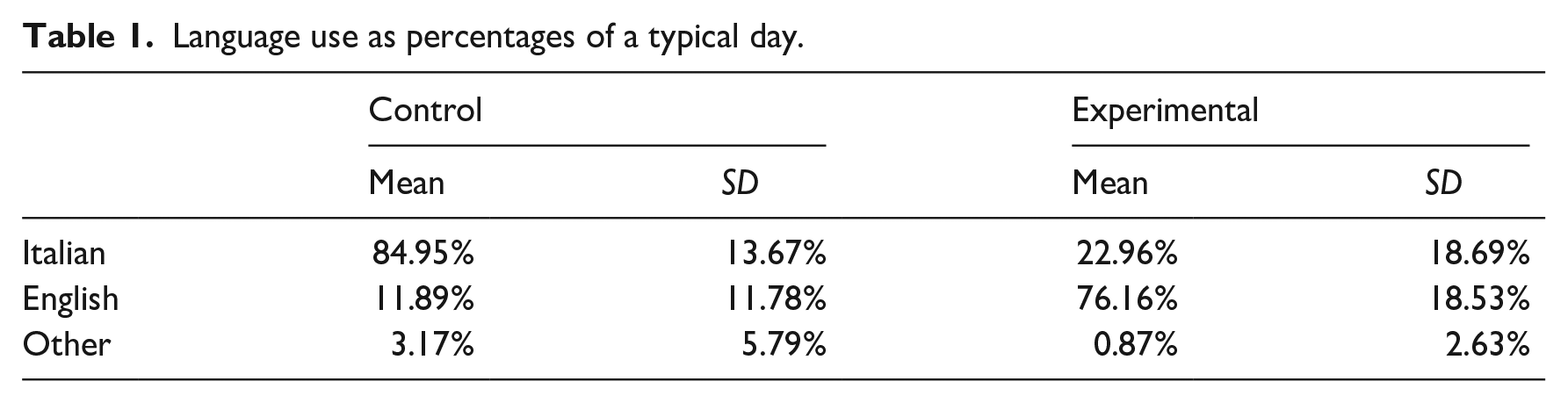
The experimental group consisted of 29 Italian native speakers (18 women and 11 men) who were living in a majority English-speaking country. 6 Their minimum length of residency was 6 years (cf. Tsimpli et al., 2004), but, on average, this was considerably higher (M = 14.27 years; SD = 7.89 years). Experimental participants were prescreened to ensure that none of them had traveled back to the L1 community in the 3 months prior to testing to avoid any possible re-exposure effects (Chamorro et al., 2015). At the time of testing, the experimental group was 43.48 years of age (SD = 7.18 years). Under a Welch’s t-test, the experimental group did not differ significantly in age from the control group, t(57) = 1.48; p = .14. As with the control group, we asked participants how many languages they spoke at an “intermediate” level as well as for how many hours they used each of these languages in a typical day. We then calculated the percentages of use for each language. Group means and standard deviations for the use of Italian, English, and “Other” as percentages of a typical day are presented in Table 1. Furthermore, as previous work on attrition has restricted itself to “near-natives” (e.g., Chamorro et al., 2015; Tsimpli et al., 2004), we also had the experimental group take the Cambridge Assessment General English quick placement test. 7 On average the experimental group scored 21.76/25 (SD = 1.66) suggesting that they are likely upper-intermediate to advanced L2 speakers. As such, following previous work, the experimental group’s prolonged L2 immersion, lack of recent re-exposure to the L1-community, frequent L2 use, attenuated L1 exposure, and high L2 proficiency indicate that this is a suitable group in which to look for syntactic attrition.
Stimuli
Critical items were borrowed from Grillo and Costa (2014). 8 These items consist of 24 globally ambiguous sentence pairs as in (9). Within sentence pairs, only the matrix predicate varied. In the PR/RC condition, items contained verbs of perception (e.g., vedere—“see”), while, in the RC-only condition, items contained non-perceptual predicates (e.g., vivere con—“to live with”). Across all items, the matrix predicate was followed by a complex DP containing two NPs which in turn was followed by the embedded CP. The preposition between the two NPs was always di (“of”), and the two NPs were always animate and appeared with the definite article. Sentences were distributed across 2 lists such that each participant saw only 1 sentence per pair, 12 in each condition.
(9) a. PR/RC Condition Gianni ha visto il figlio del medico che correva la maratona. “Gianni saw the son of the doctor running the marathon.” b. RC-Only Condition Gianni vive con il figlio del medico che correva la maratona. “Gianni lives with the son of the doctor that was running the marathon.”
The experiment additionally included globally ambiguous pronominal distractor items (N = 20) adapted from Tsimpli et al. (2004) and unambiguous filler items (N = 26).
Procedure
Participants were collected via Prolific Academic and paid £4.50 for their participation. The experiment was then run online through PCIbex (Schwarz & Zehr, 2018). Participants first provided informed consent, completed a language background questionnaire, and took the English placement test (experimental group only). They then completed the sentence interpretation task. In that task, participants read each sentence in isolation and then pressed the space bar. This caused the sentence to disappear and an interpretation question to take its place. For critical items, the interpretation question always asked about the non-matrix CP. An example is presented in (10).
(10) Gianni ha visto il figlio del medico che correva. “Gianni saw the son of the doctor running.” Chi correva? “Who was running.” F. Il figlio “The son” J. Il medico “The doctor” B. Qualcun altro “Someone else”
Possible answers always consisted of the two relevant NPs from the sentential context as well as the option of qualcun altro (“someone else”). While this third option was nonsensical for the critical items, it was included as it is a logically possible answer for the pronominal distractor items. The possible responses were counterbalanced by position such that NP1 and NP2 each appeared first in 50% of items and second in the other 50%. Qualcun altro (“someone else”) always appeared last. The possible responses were labeled “F,” “J,” and “B.” To select an interpretation, participants pressed the relevant key. In total, the experiment took approximately 30 minutes. Ethical approval for the study was obtained from the Ethical Committee of the Faculty of Modern and Medieval Languages and Linguistics at the University of Cambridge.
Hypotheses and predictions
The following hypotheses were drawn:
H1: The experimental group will exhibit a weaker global HA bias than the control group (cf. Dussias, 2003).
Therefore, we expect a main effect of Group.
H2: This weakening of the global HA bias will be driven by a change in the PR/RC items only.
This hypothesis was empirically motivated by the observation that offline and online results from native speakers undergoing attrition pattern similarly to monolingual speakers when PRs are locally blocked. As such, we expect an interaction of Group by Predicate. This is expected to surface as an effect of Group within PR/RC items. Specifically, we expect the control group, but not the experimental group, to exhibit an HA bias. No effect of Group is expected within the RC-only items. In that context, both groups are expected to exhibit an LA bias.
Data cleaning
We coded as missing any items with implausibly fast reading times (<1,500 ms) or response times to the question (<500 ms). This affected 0.54% of the data. We also excluded qualcun altro (“someone else”) responses, as that option was non-sensical for critical items. This affected a further 1.14% of the data for a total data loss of 1.68%.
Results
Figure 2 presents the percentage of HA responses broken down by group and condition. In the PR/RC condition, both groups preferred HA at similar rates (Control: 72%; Experimental: 66%). In the RC-only condition, both groups dispreferred HA, but this effect was more pronounced in the experimental group (Control: 29%; Experimental: 16%).
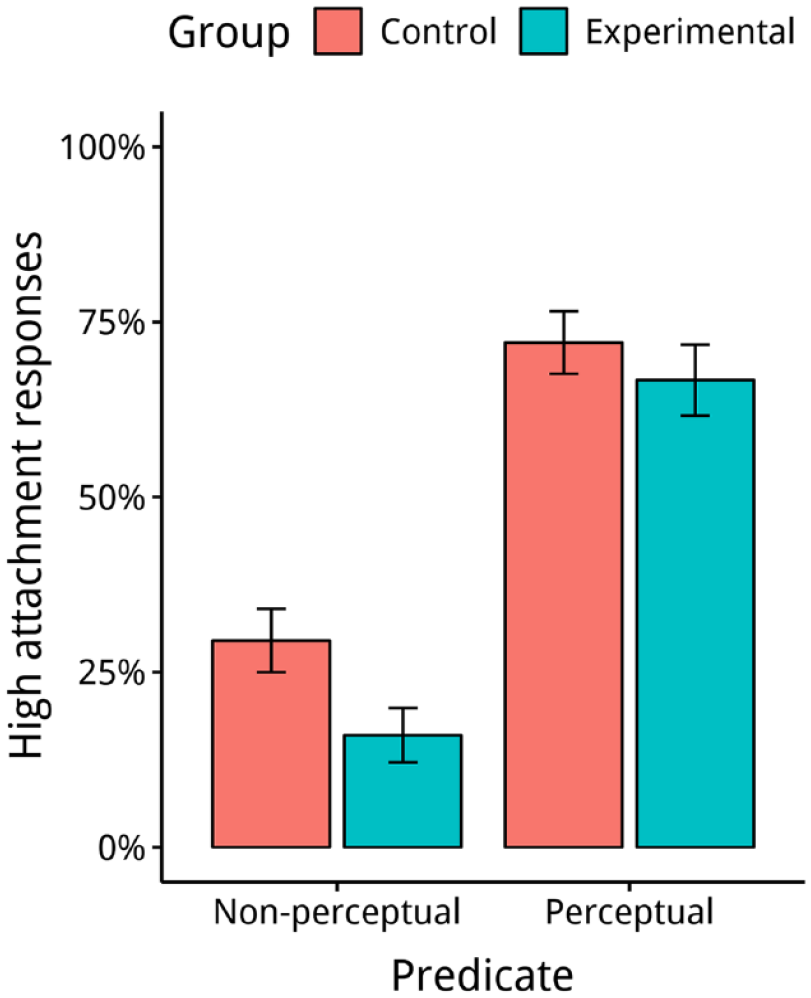
Average high attachment rates by group and condition with 95% confidence intervals.
Responses were entered into a mixed-effects logistic regression using the lme4 package (Bates et al., 2015) in R (R Core Team, 2018). Attachment (coded as ±HA) was entered as the dependent variable. Predicate (negative level: RC-only) and Group (negative level: control group) were entered as binary fixed predictors for a 2 × 2 factorial design. The model used sum coding (−0.5, 0.5) and included random intercepts and slopes (for Predicate) by item and participant. The output is presented in Table 2.
Model output.
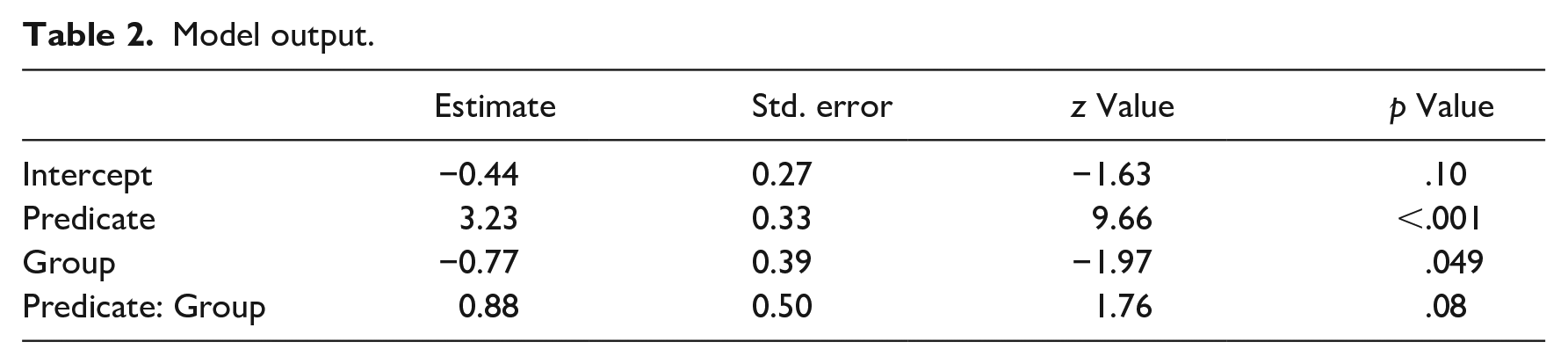
The model output indicated an effect of Predicate (β = 3.23; z = 9.66; p < .001). This surfaced as a greater rate of HA interpretations in the PR/RC condition. The model also indicated an effect of Group (β = −0.77; z = −1.97; p = .049), with a greater global rate of HA interpretations in the control group (Control: 51% HA; Experimental 41%). The interaction between Predicate and Group was non-significant.
Discussion
This paper reported a sentence interpretation task to explore two questions. First, whether we could observe attrition of “relative clause” attachment biases in a new language pair, L1-Italian L2-English. Second, whether attrition of these attachment biases is driven by a change in the parsing of PRs.
Starting with the first question, the results showed evidence of attrition. The experimental group selected HA interpretations significantly less frequently than the control group. Moreover, this effect was in the same direction as the attrition effect observed in Dussias (2003). Given that attrition of attachment biases may be observed in Italian as well as Spanish, we take this to suggest that the effect may be a general phenomenon for HA languages, at least under immersion in an LA-L2 like English.
Nonetheless, it is worth pointing out that the effect in this study was less pronounced than the one reported in Dussias (2003). While Dussias observed a shift from 74% HA to 28% HA, we observed a global shift from 51% HA to 41% HA. An immediate question might be whether this is due to our participant sample. However, as noted in Section “Participants,” our participants’ prolonged L2 immersion, lack of re-exposure to the L1, frequent use of the L2, attenuated use of the L1, and high L2 proficiency all suggest this is an ideal group in which to look for attrition effects. Moreover, while it is hard to directly compare many of our background measures such as L2 proficiency with those in Dussias (2003), we can compare length of L2 immersion, in which case our sample has been immersed for longer. For our participants, the average immersion in their L2 (M = 14.27 years, SD = 7.89 years) was almost twice that reported in Dussias (2003) (M = 7.5 years). This is relevant because previous work on attachment ambiguities has found that length of L2 immersion is a significant predictor of L1 attrition within advanced L2 speakers (Dussias & Sagarra, 2007). Thus, based on the available information, it is unlikely that differences in the size of the attrition effect can be attributed to our participant sample. Prior to exploring an alternative explanation, let us first bring PRs into the discussion.
Integrating PRs, our results indicated that the control group selected HA interpretations significantly more frequently when PRs were locally available (PR/RC: 72% HA; RC-only: 29% HA). Our values were in line with those reported in Grillo and Costa (2014, PR/RC: 78% HA; RC-only: 24% HA) and indicate that we can be confident the manipulation worked as intended.
Considering attrition in light of the PR/RC distinction then, we predicted that the attrition effect would be driven by a change in the PR/RC items. Recall that this was empirically motivated; the online and offline shift toward LA previously reported to occur under attrition was similar to what has been reported for monolingual speakers when PRs are locally blocked. Instead, we observed a global effect of Group and a global effect of Predicate with no interaction between the two. This was unexpected and worth highlighting. Namely, the experimental group still exhibited an HA bias (66%) in PR-compatible contexts despite (i) a clear LA bias when PRs were blocked and (ii) a global shift toward LA. This suggests that the syntactic availability of PRs and their preferred parsing status over RCs are stable under attrition. This finding is consistent with Grillo and Costa’s (2014) idea that the
As there are two theoretically relevant parser biases at play in our items, a reasonable place to start would be the other bias, locality. If there were an increased locality bias acting on true RCs, this would straightforwardly affect our RC-only items. However, it could have also reasonably affected our PR/RC items. To see how this would be the case requires going back to the responses from the control group and underscoring that biases are not categorical. In the PR/RC items, the control group selected HA in only 72% of trials, that is, they selected LA in the other 28%. As PRs are incompatible with LA in our items, this suggests that they parsed at least 28% of those trials as containing true RCs. Moreover, this is a lower bound estimate as even when items could only be parsed as RCs (i.e., RC-only items), the control group still selected HA interpretations in 29% of trials. Taken together this suggests that a non-trivial portion of the PR/RC items were parsed as containing RCs despite the PR bias. Those RC parses in the PR/RC condition would then have also been susceptible to any increased locality effect in the same way as the items in the RC-only condition. As such, it seems reasonable to interpret our attrition effect as an increased locality effect within the experimental group. Moreover, despite the non-significance of the interaction term, it is worth pointing out that the shift toward LA within the RC-only items was roughly twice the size of the shift in the PR/RC items (13 vs. 6 percentage points). That is to say, the shift toward LA was numerically larger in the condition with more RC parses. As such, we take our data to be more consistent with this “increased locality” interpretation than with our original PR-driven hypothesis which would have predicted the opposite trend.
This “increased locality” interpretation is interesting for two reasons. First, the present results lead us to the opposite conclusion of that presented in Dussias (2003). Namely, rather than a loss of the L1’s HA bias and a shift toward an emergent LA bias from the L2, we have suggested that attrition causes an apparent strengthening of the LA bias already present in the L1. While this conclusion may seem surprising as attrition is often discussed in terms of weakening biases, this paper’s observation that biases may also appear to strengthen under attrition is not unprecedented. For example, Tsimpli et al. (2004) reported that, at least in certain contexts (“backward” intrasentential anaphora), native Italian speakers undergoing attrition may exhibit a stronger subject bias in their interpretation of null pronouns than monolingual Italian speakers. Second, our “increased locality” interpretation leads to a novel, testable prediction. Specifically, future research should be able to detect attrition of RC attachment biases in stimuli that do not admit PRs and as such may not even show an HA bias.
With the PR/RC distinction in mind, we can circle back to the observation that the attrition effect was smaller in this study than in Dussias (2003). We suggest that this may be attributable, at least partially, to characteristics of the experimental materials. Previous research on RC attachment ambiguities has observed that the length of the RC affects attachment. Specifically, longer RCs are more likely to result in HA (Same Size Sister Constraint, Fodor, 1998a). However, the items we borrowed from Grillo and Costa (2014) have very short RCs. In 22 of the 24 items, the RCs were maximally minimal, consisting of 2 orthographic words: the complementizer che (“that”) and the tensed verb. In the remaining two items, one RC contained three orthographic words, and one contained four This likely increased the baseline LA bias for true RCs (29% HA for our monolinguals). This coupled with our argument that attrition appeared as an enhanced LA bias with true RCs, may have left little room for the attrition effect to manifest. Had we tested longer items, or included fewer PR-compatible items, the size of our attrition effect may have looked quite different.
A further question raised by our results is: Why should there be a more pronounced locality effect in our experimental group? This is not immediately clear. We can approach thinking about this apparent strengthening in two ways. Either the baseline LA bias was changed, or the participants’ reliance thereon was changed. Let us explore these in turn.
As the speakers have another language, we might look for a potential explanation for the change in RC parsing in the L2. On the one hand, this is theoretically undesirable as it would require suggesting that the LA bias with RCs is somehow stronger in English than it is in Italian, that is, this would force us to reject that there is a universal LA bias for RCs. On the other hand, if the LA bias for RCs differed in strength between the L1 and L2 and attachment biases can be modified experientially as suggested by the Tuning Hypothesis (Mitchell & Cuetos, 1991, et seq.), this could potentially explain why the locality bias with true RCs was affected, while PR bias was not. Empirically, we cannot exclude this possibility. To the best of our knowledge, the only study that might bear on this issue is Grillo et al. (2015). As noted above, they tested L1 English speakers with direct translations of the stimuli in Grillo and Costa (2014). Their results indicated that their participants opted for HA in 19.5% and 21.1% of items in the RC-only condition. That puts their English results numerically below the monolingual groups in Grillo and Costa (2014, 24% HA) and this study (29% HA) although still above our experimental group (16% HA). Thus, based on the available evidence we cannot make any strong arguments for or against the idea that LA bias in the L2 affected the LA bias already present in the L1.
As an alternative to the above, we might suggest that the underlying LA bias remained unchanged but that the experimental group’s reliance on structural biases may have been affected instead. One way to implement this would be to suggest that the experimental group may have greater difficulty integrating non-syntactic information such as world knowledge, plausibility, or phonological weight (Sorace, 2011) and, as a result, must rely more on structural biases to resolve ambiguity. To maintain an account along these lines, we would require an explanation for why the locality bias with RC is affected but not the PR bias. This could potentially relate to the type of parser bias implicated, that is, the
Alternatively, the contrasting parser biases in the PR/RC items might have neutralized each other to some extent. Even if attrition also resulted in an increased reliance on the
Regardless of how this increase locality effect is eventually accounted for, however, accepting our argument that attrition affects the LA bias with true RCs which is shared between the L1 and L2 raises the question of whether we should generalize further. That is to say, if conflict between global parser biases is only apparent as suggested by the PR account, can we observe a similar attrition effect between two languages which have the same “global attachment strategy” (e.g., two LA or two HA languages), or even with other attachment ambiguities such as adverbials/PPs which are subject to an LA bias? To the best of our knowledge, the only study that might bear on attrition of RC attachment biases in an LA language is Dussias (2003). While she reports no significant difference between her controls and her L1-English speakers immersed in their L2-Spanish, the immersion period for that experimental group was relatively short (M = 2 years). As such, they may not have been exposed for long enough for attrition effects to be observed (Dussias & Sagarra, 2007). Therefore, the question of generalizing attrition in biases beyond cases of apparent parser bias conflict should be explored in future work.
Conclusion
This study provides clear evidence to answer our research questions. First, attrition of RC attachment biases can be observed in our new language pair, L1-Italian L2-English. Second, PR-firstness and its resultant HA bias are stable under attrition. As such, we are led to the opposite conclusion of that in Dussias (2003). Rather than attrition weakening the L1 HA bias (due to a change in PRs), it appears to strengthen the L1 LA bias in true RCs. This is surprising as both the L1 and L2 exhibit an LA bias in that context and suggests we may wish to look beyond simple conflicts in parser biases between a bilingual’s two languages. That in turn raises new questions about the source of the increased locality effect and whether to expect attrition of attachment biases beyond HA languages or even RCs.
Footnotes
Declaration of conflicting interests
The author(s) declared no potential conflicts of interest with respect to the research, authorship, and/or publication of this article.
Funding
The author(s) received no financial support for the research, authorship, and/or publication of this article.
