



Abstract
Aims and objectives:
This study explores the challenges and affordances of multilingual classrooms in Türkiye through an ecological theoretical framework, aiming to understand how teachers perceive and navigate these educational contexts. The research questions focus on identifying the specific challenges and opportunities within these classrooms and understanding their implications for educational practices.
Design/methodology/approach:
Employing a qualitative approach grounded in ecological theory, narrative interviews were conducted with 11 teachers from a university language school in Istanbul, selected through convenience sampling. Data were analyzed thematically to uncover patterns related to microsystem, mesosystem, exosystem, and macrosystem levels of educational ecology.
Data and analysis:
The study utilized narrative interviews to gather rich, contextual data from teachers who reflected the multicultural and multilingual nature of their classrooms. Thematic analysis was employed to categorize and interpret the data, ensuring rigorous exploration of the ecological dimensions influencing classroom dynamics.
Findings/conclusions:
Analysis revealed that multilingual classrooms in Türkiye present both challenges and opportunities across various ecological levels. Microsystem challenges included managing diverse student personalities and navigating language use policies, while mesosystem challenges involved aligning institutional expectations with classroom realities. Exosystemically, the study highlighted the role of societal attitudes toward multilingual education in shaping classroom dynamics. Macrosystemically, educators discussed the influence of global English language norms and local educational policies on classroom practices.
Originality:
This study contributes to the literature by applying an ecological perspective to explore multilingual education in a Turkish context, emphasizing the unique interplay between local educational practices and global educational trends.
Significance/implications:
The findings underscore the need for targeted teacher training and policy interventions that account for the complex ecological dynamics of multilingual classrooms, promoting inclusive educational practices that respect and leverage linguistic diversity.
Limitations:
While insightful, this study’s findings are context-specific to Türkiye’s educational landscape, suggesting avenues for future research in other global contexts.
Introduction
Multilingualism, as a trending issue in language education (Kamali et al., 2024), has been defined variously by different scholars. However, the European Commission (2007) defined it as “the ability of societies, institutions, groups and individuals to engage, on a regular basis, with more than one language in their day-to-day lives” (p. 6). Although praised extensively, it is not always considered an advantage for language classes, and students from immigrant backgrounds are sometimes challenged (Haim & Tannenbaum, 2022). There are studies regarding multilingual teachers’ and students’ beliefs about classes with multilingual learners (Barros et al., 2021; Gopalakrishnan, 2022; Lucas & Grinberg, 2008). These studies have used different theoretical frameworks, one of which is ecological. The ecological perspective is an approach borrowed from biology “to refer to the totality of relationships of an organism with all other organisms with which it comes into contact” (van Lier, 2004, p. 3). Working in the domain of sociocultural theory, ecology works hand in hand with this social theory since both are employed to explore the social interactions and cultural influences on individual development within a broader framework of environmental systems. Ecology is applied to educational settings in different layers, that is, microsystem, mesosystem, exosystem, and macrosystem (Bronfenbrenner, 1993).
Within the thinking line of second language teacher education, language teacher beliefs or perceptions have been accepted to be highly influential on teachers’ awareness, teaching attitude, methods, behaviors, and policies (Borg, 2015). Therefore, they can greatly influence their classroom practices (Eisenbach, 2012; Min, 2013), affect learner learning and development (Doyle et al., 2023), inform professional development programs (Francois, 2020), increase job satisfaction (Capone & Petrillo, 2020), and influence curriculum choices (Cronin-Jones, 1991). Despite being a global concern, most of the studies on multilingualism were conducted in English-speaking countries (see the studies above). This study, yet, was conducted in the context of Türkiye, which is a significant context to study multilingualism, underscored by several factors. First, beliefs of English teachers vis-à-vis the teaching in multilingual classrooms, in non-English-speaking countries, where it is taught as a foreign language, have hardly been investigated (Kamali & Nazari, 2025). Second, the geopolitical landscape of Türkiye has rendered it one of the most multicultural contexts (Arsal, 2019) since Türkiye hosts a substantial influx of refugees, immigrants, and tourists on an annual basis. Third, the result of this study can be generalized to similar contexts such as the countries in the Middle East and North Africa, and inform their practices. To this end, knowing the teachers’ beliefs and perceptions is significant to analyze teachers’ probable behavior in their multilingual educational contexts. Therefore, the research questions are proposed as follows:
What are the affordances and challenges of multilingual classrooms in the Turkish context from teachers’ perspectives? How does an ecological framework explain this?
Literature review
Multilingualism (in Türkiye)
The rise of multilingualism in recent years (Aronin & Singleton, 2008) can be attributed to a confluence of factors, notably globalization and technological advancements, which have made the phenomenon more accessible to a wider audience. Increasingly, individuals across the globe are becoming multilingual, regardless of their social, cultural, or political backgrounds (Baker, 2017; Calafato, 2020). However, the implications of this global trend vary significantly across local contexts. For example, Türkiye is home to a remarkably diverse range of languages, reflecting centuries of cultural intermingling and multilingual heritage (Eberhard et al., 2024). The government used to ask people about their mother tongue and ethnic origin up through the 1990 census; using those data, officials in 1965 recorded 34 languages, such as Hebrew, Greek, Armenian, Kurdish, and Persian, spoken in Türkiye (Dündar, 1999). Türkiye, despite its rich linguistic and cultural diversity, presents a complex case where multilingual realities clash with a historically entrenched monolingual state ideology. Guided by the principle of “one language, one nation” (Gok, 2009), the Turkish education system has long prioritized Turkish as the sole language of instruction, thereby marginalizing minority languages. Although recent reforms, such as the partial incorporation of Kurdish language courses, signal some progress, multilingual education in Türkiye remains underdeveloped and politically sensitive (Kaya, 2015), highlighting the challenges of aligning global multilingualism with national educational policies.
The persistence of monolingual ideologies has direct implications for educational equity. Research shows that students with multilingual or bilingual backgrounds often demonstrate stronger academic performance and prefer to use their mother tongues, especially when schooling supports these identities (Aydın & Ozfidan, 2014). However, such support is rare in Türkiye’s educational settings. The disconnect between linguistic realities and official policy creates challenges for both learners and teachers, particularly in regions with high concentrations of Kurds, Arabs, or refugees (Ozfidan et al., 2016).
In this complex landscape, teacher beliefs about multilingualism and multiculturalism play a pivotal role. Teachers serve as mediators between institutional policies and student realities. Studies have shown that while many Turkish teachers hold positive attitudes toward multicultural education, they also exhibit confusion or even skepticism about its implications (Nazari & Kamali, 2025). Some perceive multiculturalism as a threat to national unity, while others embrace it as a means to promote inclusion and cultural awareness. This variation in beliefs often stems from inadequate preparation during teacher training, where multicultural topics receive minimal emphasis (Kamali & Alpat, 2025). Despite growing diversity, driven by domestic ethnic variation and an influx of refugees and immigrants, teacher education programs in Türkiye have been slow to integrate multicultural and multilingual pedagogy. A limited number of curriculum objectives across subjects reflect intercultural competencies (Seban & Uyanık, 2016). For example, only a handful of objectives in primary-level curricula explicitly address multiculturalism (Akar & Keyvanoğlu, 2016). Similarly, undergraduate and graduate programs rarely offer systematic training on how to teach in linguistically and culturally diverse classrooms.
Teachers’ beliefs about multilingualism not only shape their instructional choices but also affect student outcomes and classroom dynamics (Bernstein et al., 2023). A teacher’s openness to linguistic diversity can influence how students engage with content, how peer relationships develop, and whether learners feel valued. Yet, studies on teacher beliefs regarding multilingual education in Türkiye remain limited (Kamali & Alpat, 2025). This gap reflects a broader deficiency in the literature, where multilingual education is often examined abstractly rather than in relation to specific classroom realities. Given Türkiye’s evolving sociopolitical landscape and its role as a host to large refugee and immigrant populations, a deeper engagement with multilingualism in teacher beliefs, practices, and policies is urgently needed. Understanding how teachers perceive and respond to linguistic diversity is crucial for developing equitable and responsive educational environments.
Ecological perspective in education
Ecology was originally “the study and management of the environment (ecosphere‚ or biosphere) or specific ecosystems” (van Lier, 2004, p. 3) and has long been investigated in social sciences such as anthropological‚ educational‚ psychological‚ and linguistic strands. It was long discussed in language acquisition, use and instruction as well (Cenoz, 2017; Jessner, 2006; Kramsch, 2008; Levine, 2011; Ringbom, 2007).
Building on Bronfenbrenner’s (1979) ecological systems theory, which conceives learning and development within nested systems, we treat the classroom as part of an interconnected ecology. We draw on this framework not simply because it is established in educational research, but because its cross-level, interactional logic is especially well-suited to multilingual settings where teachers’ beliefs are co-shaped by immediate classroom practices, institutional routines, community language ideologies, and policy trajectories, offering the most coherent way to examine the interdependencies at the heart of our inquiry. Bronfenbrenner (1993) asserted that there is a set of ecosystems in the context, each one lying inside the next. In his thought, one can divide it into four hierarchical layers. The first layer—microsystem—“is a pattern of activities, roles, and interpersonal relations experienced by the developing person in a given setting with particular physical, social, and symbolic features” (Bronfenbrenner, 1993, p.15). The second layer, that is, a mesosystem, “comprises the linkages and processes taking place between two or more settings containing the developing person” (p. 22). In the third stage, an exosystem encompasses “the linkages and processes taking place between two or more settings at least one of them does not contain the developing person” (p. 24); however, “in which events occur that directly influence processes within the immediate setting in which the developing person lives” (p. 24). Finally, “a macrosystem consists of the overarching pattern of micro-, meso-, and ecosystems characteristic of a given culture, subculture, or other extended social structure” (p. 25). These layers are the underpinning layout of this study and the thematic analysis was conducted with an ecological lens. The implication of this model in analyzing the teachers’ perspective on multilingual classrooms lends itself to the fact that there is not only one type of factor influencing the multilingual settings but different layers whose interrelations allow the researchers to “track instigative and debilitative forces between one ecosystem and another” (van Lier, 2004, p. 210).
Recently, Gopalakrishnan (2022) adopted ecological perspectives to investigate the factors impeding or fostering the use of multilingual pedagogies in adult German-as-a-foreign-language classrooms in two institutions in India and the United States. He suggested some ways to aid teachers in exploring current and developing new multilingual instructional practices, “such as creating multilingual resources, creating space in teachers’ schedules for collaboration, organizing pedagogical seminars and conferences around multilingual pedagogies” (p. 101). Kamali & Nazari (2025) also adopted an ecologically informed perspective to find out transnational teachers’ emotional vulnerability in multilingual contexts, concluding that various factors on different layers of educational ecology can make teachers emotionally vulnerable and affect their identity.
All in all, aiming to probe teacher beliefs about the benefits and challenges of multilingual classrooms, this study framed the inquiry ecologically, not only to describe what unfolds across classroom, school, community, and policy layers, but because this lens most faithfully captures how these nested settings co-constitute teachers’ judgments through cross-level affordances and constraints. In this way, the study adopts a holistic view of the multilingual educational ecosystem, attending to interactions among actors, tools, norms, and histories that together shape how teachers experience and interpret multilingual practice.
Method
Context and participants
The study was conducted in one of the university language schools in Istanbul, Türkiye, where the classes are made up of students from almost 20 countries. There are 32 teachers from different countries (see Table 1). Students study EAP (English for academic purposes) and to be able to enter their faculties at the university, they need to pass all the academic modules. As can be seen from the number of countries the students and teachers come from, the educational environment is multinational, and the classes are multicultural and multilingual.
Demographic information of the participants in the interview.
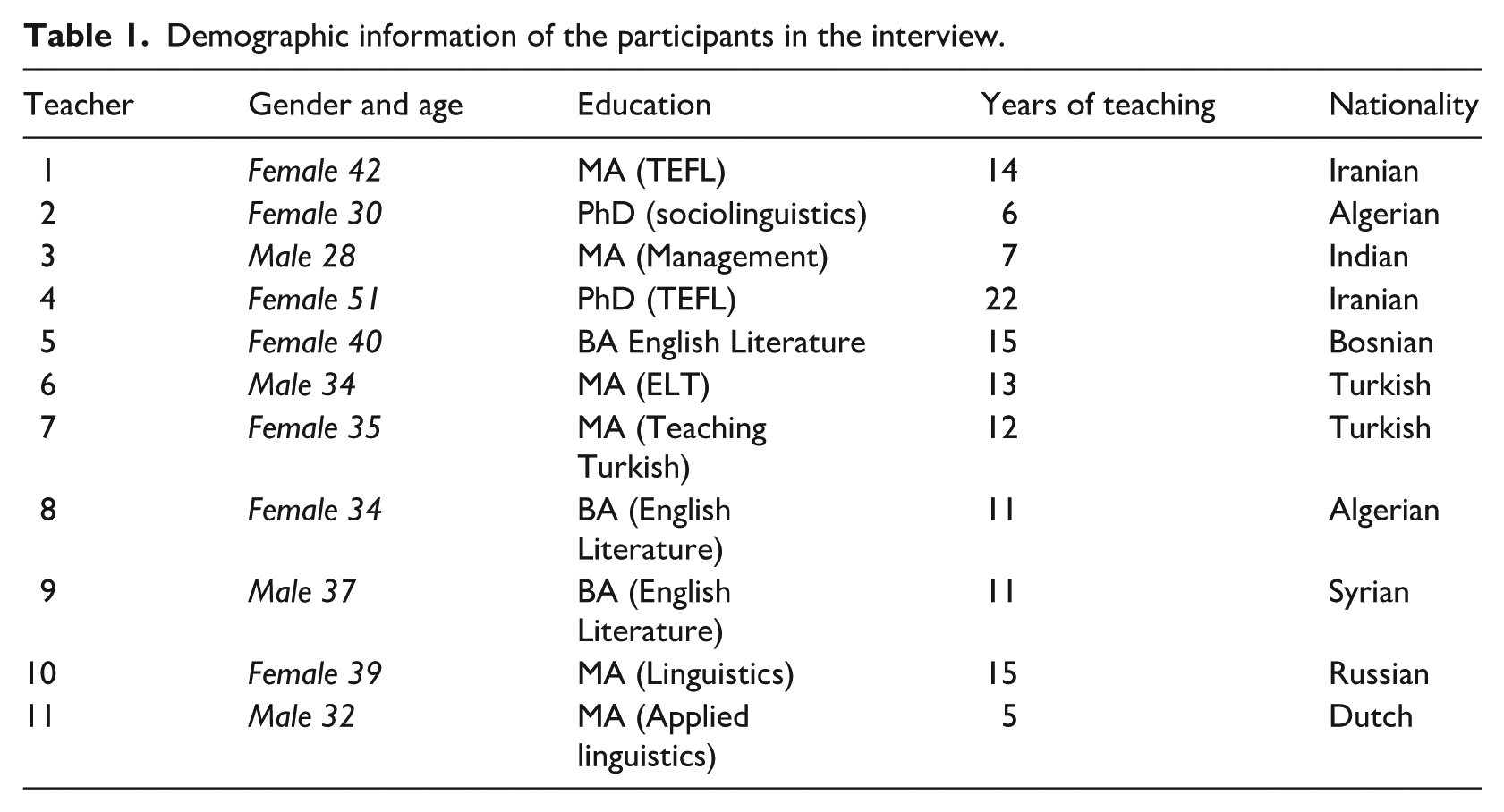
The participants of the study were 11 teachers (4 male and 7 female) who participated in a narrative interview about teaching in multilingual classes. The participants were all multilingual, their age range was between 28 and 51, and they had from 5 to 24 years of teaching experience (Table 1).
Data collection
In accordance with the theoretical underpinning of this study, the ecological perspective (Bronfenbrenner‚ 1993; van Lier, 2004), a qualitative approach is employed to explore these dimensions in multilingual classes in the emerging context of Türkiye from the teachers’ perspectives through narrative interviews (Barkhuizen, 2016).
To collect data, 13 teachers were selected based on convenience sampling. The main questions of the interview were sent to them via WhatsApp, plus a Google form link to choose an interview time. They were asked to choose face-to-face or online interviews. Eleven teachers replied, of whom eight chose face-to-face, and three chose online interviews through the Zoom platform, all in English. The interviews ranged in duration from approximately 45 to 60 minutes, and they were all recorded using the recording option on the Zoom application for online interviews and the first researcher’s mobile phone for face-to-face ones. The interview questions aimed to explore various dimensions of teaching multilingual classes. The questions addressed general and personal challenges, classroom-related issues, and opportunities teachers may encounter. In addition, the questions examined institutional and sociocultural aspects, teachers’ professional journeys, and their perceptions of multilingual teaching, whether it’s more artistic or scientific (see Appendix 1).
The researchers acknowledged the importance of their own positionality in shaping the research process, aligning with the understanding that analysis does not occur in an epistemological vacuum (Braun & Clarke, 2006). Their prior engagement with the Turkish educational context played a role in interpreting the findings. The first researcher, originally from Iran, had spent nearly a year working in Türkiye (at the time of this study), while the second was a native Turkish academic with lifelong experience in the country. Both held institutional roles—one as a manager, the other as a teacher training coordinator—at the university-affiliated language school where the study participants were employed. Aware of the potential influence their authority might exert on participant responses, they sought to reduce hierarchical pressure by assigning the task of data collection to the first researcher, whose position was more horizontally aligned with that of the teachers involved. While efforts were made to reduce potential power imbalances, we acknowledge that our positionality could still have shaped the data in subtle ways.
To meet ethical considerations, all participating teachers were informed about the advantages of the study and that they could withdraw from the study at any time. Participants were assured that their identities and information collected for the study would be kept confidential and that numbers would be used instead of their names in the study report. The aims and procedures of this study were also explained and approved by the officials of the language school. Then, the participating teachers filled out a consent form by which they agreed to participate in the study.
Data analysis
This study draws on the ecological perspective as the underpinning theory to analyze the data. To do so, the data obtained from narrative interviews were transcribed, codified, and analyzed based on thematic analysis principles (Braun & Clarke, 2006). Although this study is heavily reliant on deductive thematic analysis, in which the data are codified based on predetermined data (ecological perspective), it partly employed an inductive thematic analysis in which the researchers do not ignore the data that do not fit into the predetermined coding frame (Braun & Clarke, 2006). That is, the researchers tried to codify all the data related to multilingualism regardless of their connection to the above-mentioned framework. To do so, the first researcher transcribed the data and both researchers read the transcribed data to get familiar with the data, having the theoretical framework in mind. They then generated the codes for each concept to be categorized into a group related to multilingual education. This was done to ensure the reliability of the results and enhance trustworthiness (Lincoln & Guba, 1985). In a session, the researchers discussed the codes they had found and attempted to collate codes into potential themes. In this stage, the first researcher drew a thematic map of the data. Having drawn the thematic map, both researchers tried to define and name the themes and subthemes. In the end, the first researcher provided the final thematic map of the challenges and opportunities of multilingual classes and wrote the findings section. To apply the Interviewee Transcript Review (Rowlands, 2021), which is a confirmation of participants about the researcher’s translations or interpretations, interviewees read the findings section of the study and consented to them.
Findings
The thematic analysis of the obtained data from the interviews revealed that multilingual classes in the emerging context of Türkiye bore different challenges and opportunities at personal, pedagogical, and sociocultural levels (Figure 1). These features will be discussed from the ecological hierarchies proposed by Bronfenbrenner (1993), that is, microsystem, mesosystem, exosystem, and macrosystem.
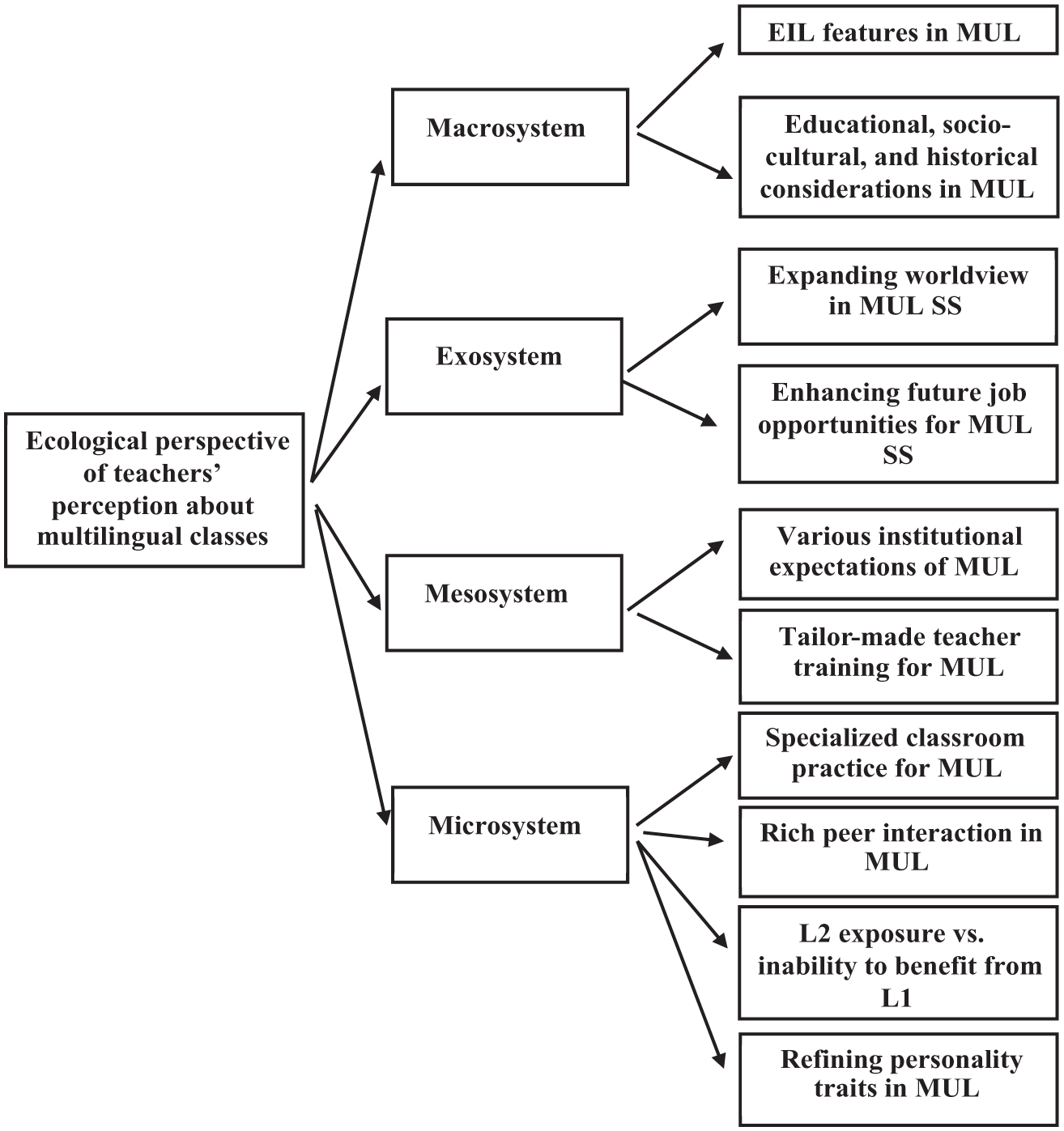
Thematic map of ecological perspective of teachers’ perception about multilingual classes.
Microsystem ecology
The first level of educational ecology, the microsystem, explores the developing person with certain physical, social, and symbolic features. After codifying the data, some of them were categorized under the microsystem theme. The first subtheme brought personality traits into the spotlight. See extract 1:
Extract 1
. . . How can I make this concept easier for the students? How about this one who, I don’t know, is introvert, what about that one who doesn’t like to be in a group or so this kind of let’s say curiosity makes you just go for it, think about it, different ideas you can study so in that way (let’s say this) it will improve your creativity. It is like encouraging for you, by the way. (T2, interview)
What the teacher tries to elaborate on in this extract is the concept of a sense of curiosity by which creativity is reinforced in the class. This personal trait has been explored in psychology and is also not a new concept in education. The teacher sees it as an opportunity for teachers in multilingual classes to exploit it to enhance their creativity. Other personality traits such as “empathy,” “ambiguity tolerance,” and “politeness” were implied by the teachers (T4, T5, and T11) in the interviews. These traits, situated within the microsystem, reflect the internal dispositions and cognitive-emotional resources that teachers draw upon in navigating multilingual classrooms. Curiosity, for instance, drives the teacher’s willingness to explore new strategies and adjust to diverse learner needs. Likewise, empathy and politeness stem from personal value systems that influence how teachers perceive and respond to classroom situations, while ambiguity tolerance enables them to remain composed and effective amid linguistic and cultural complexity.
The second extracted subtheme investigates the L2 use and lack of L1 use or translanguaging. Almost all teachers who participated in the interview raised this topic and argued that it can be a source of challenge and opportunity simultaneously. For example, T9 stated:
Extract 2
Of course, although the students know that the teacher is not going to use L1, they feel more comfortable. They feel more kind of sharing and like they want to share their ideas and stuff. Of course, they might use one or two words here and there, but you might just hear the message as if you don’t understand. (T9, interview)
It is evident in the extract that the teacher considers the use of L1 (translanguaging in a sense) an opportunity that, even if not used, can increase the comfort level of the students and reduce stress levels.
However, others pointed out that using L1 should be the last resort, and on the other hand, using L2 should be maximized as a source of exposure. See extract 3:
Extract 3
. . . I would say the students have to use the target language. There’s no way out whether they can or cannot. They have to say something. They have to try hard to deliver the message. Otherwise, they just give up. (T10, interview)
The teacher implies the swim-or-sink approach in this extract and sees the inability to use L1 as an opportunity to be immersed in the L2-rich environment (i.e., translanguaging). These contrasting views highlight how personal beliefs about language use, shaped by individual experiences and teaching philosophies, function within the microsystem. While one teacher perceives emotional comfort as a priority, another values perseverance and linguistic immersion, revealing how internal orientations influence decisions about L1 and L2 use in multilingual classrooms.
The next subtheme that emerged from the data in this category is the quality and quantity of peer interaction in multilingual classes. In the same vein as the use of L1, they are seen as challenges and opportunities. The challenges are from two sources, including linguistic and cultural. For example, T5 argued the challenge of pair and group works in multilingual classes in extract 4:
Extract 4
One of the main challenges that came to my mind when I saw the question was the peer discussion probably might not be that productive in the beginning at lower levels. Because of the two barriers I feel. First is the language barrier at the L1 level and the other one would probably be the cultural barrier, you know, automatically the two barriers now. (T5, interview)
This extract evidently demonstrates the challenges of multilingual classes on two levels: linguistic and cultural. However, both of them are more tangible at lower levels and can fade away over time. There are also affordances in the interactional opportunities of multilingual classes. Extract 5 shows it:
Extract 5
In discussions, especially in teaching English as a foreign language, diverse perspectives and cultural backgrounds enrich the classroom. Students bring in examples rooted in their politics, histories, and personal experiences, such as social class, race, or gender. This diversity enhances learning, often more so than direct instruction. (T3, interview)
It is evident in this extract that multilingual classes can enhance communication skills since there are interesting topics to talk about, and people can add their own experience to “enrich the class” discussions. These perspectives reveal how teachers’ individual orientations toward diversity influence their perception of peer interaction. While some focus on initial barriers rooted in students’ linguistic and cultural identities, others highlight their own openness to diverse viewpoints as a key asset. This openness, as a personality trait within the microsystem, shapes how teachers facilitate and value peer interactions in multilingual classrooms.
The last point extracted from the interview in the microsystem ecology of multilingual classes is about classroom practice notions such as lesson planning, lesson shapes, and feedback. T6 (extract 6), as an example, pointed out that lesson planning for multilingual classes is a more time-consuming task for the teacher, who should consider students’ diverse needs:
Extract 6
Okay, based on what I have mentioned earlier, preparation, objectives, syllabus. They are really time-consuming. And then lesson plan, you will just spend hours and hours to have a good lesson plan based on the learners’ needs, which is not an easy task. (T6, interview)
As is seen in the extract, lesson planning for multilingual classes is a more delicate task on the grounds that it requires more needs analysis. This challenge, as it is implied in this extract, can cause teacher burnout in the long run.
In conclusion, teachers’ interviews about multilingual classes revealed some factors that influence teachers’ experiences in those classes. Personality traits (such as empathy and curiosity), use of L1 and L2, peer interaction, and preparation were among the concepts teachers believed to be the challenges and benefits of multilingual classrooms in the microsystem ecological layer.
Mesosystem ecology
The mesosystem layer in educational ecology refers to the interrelationships among different microsystems (Bronfenbrenner, 1993). With an eye on this concept, two subthemes emerged from the obtained data, which could be clustered around this ecological theme, that is, “tailor-made teacher training for multilingual classes” and “various institutional expectations of multilingual classes.”
The first subtheme was traceable in two of the teachers’ interviews (T4 and T10). This is categorized under the mesosystem ecology since there are different elements involved in it such as students, teachers, teacher educators, assessors, curriculum, and material. The relationship between these elements can guarantee the success or failure of a multilingual classroom. T4 indicated this issue in her response eloquently (Extract 7):
Extract 7
I can also add lack of teacher training for some teachers can be a big challenge because, as you have said, it was my first time being in that context. I think that the teachers should be trained to learn how to cope with the difficulties and in that time I had to do research, I had to ask other experienced teachers who were teaching there for many years. So I think for me it was kind of a challenge. (T4, interview)
This teacher, drawing on her own experience, mentioned that the lack of teacher training took her valuable time that she could spend on more important things to be able to cope with the difficulties of teaching in such classes. The need for proper teacher training for multilingual classes is, therefore, tangible in this extract. The concept of seeking guidance from a colleague, which is stated by the teacher, is also worth mentioning. This evidently shows the interrelationship between microsystems, that is, teachers, which can occur in the mesosystem layer of educational ecology. This form of collegial support illustrates how one microsystem (an individual teacher) interacts with another (a more experienced peer), reinforcing the idea that successful navigation of multilingual classrooms often depends on such inter-system collaboration. When institutional structures like training programs are lacking, these informal mesosystemic connections become critical for professional adaptation and growth.
The second extracted subtheme under this category is adverse expectations of people involved in the learning environment, such as the institution per se and parents. These expectations, sometimes occurring due to the interaction between people and conservative norms of society, can be a threat to a multilingual class teacher. Extract 8 explains it:
Extract 8
I can say that the next challenge was the students’ families. I remember that once we had some parents complaining about the method of teaching. . . . . . . in some cases, the parents prefer the traditional methods of teaching, . . . . I remember they were complaining like “why you’re not giving them much homework?” or “Why don’t you sometimes punish them?” (T10, interview)
The conflicts between teachers’ and parents’ beliefs, norms, and expectations are clearly demonstrated in this extract. These mismatches can be a source of challenges that teachers and students may face in their multilingual classes. This clearly illustrates the interrelationship between microsystems (parents, teachers, and all their cognitive processes and belief systems) and how this interrelationship can affect teachers. Such interrelations underscore the tension that arises when differing microsystem logics (like progressive pedagogies and traditional parental expectations) collide within the mesosystem. These clashes may undermine the teacher’s agency and also create uncertainty in instructional decisions, highlighting the need for alignment and dialogue among the systems involved.
To conclude, the mesosystem ecology contains complex interrelationships and interactions among various microsystem components, namely teachers, students, curriculum, materials, and societal expectations. These components’ interaction has a clear impact on the opportunities or challenges teachers encounter in multilingual classrooms.
Exosystem ecology
The exosystem is the hidden agenda in which events influence the developing person, including teachers. Consider the two subthemes that emerged from the interview, namely “expanding worldview” and “enhancing future job opportunities.” These two are indirectly affecting the lives of students. Having expanded their worldview, they can have a better spiritual life. Job opportunities are powerful extrinsic motivators for them as well. These subthemes are evident in the following extracts. Extract 9 illuminates the worldview expansion:
Extract 9
. . . So I guess for the students it is good because this is the environment for the students in order to get familiar with different cultures. So, they can see different perspectives and they can, let’s say, value or respect other, let’s say, cultures, customs, beliefs, whatever. So, it is good for students in that case. (T1, interview)
Value and respect for other cultures, as pointed out by the teacher in this extract, can give us a powerful tool to see the world from others’ perspectives as well. This is what we call “worldview expansion.”
The second raised issue in this theme includes “enhancing job opportunities.” The students and the teacher of multilingual classes can benefit from more job opportunities since they have developed not only language skills but also different skills in these classes, such as empathy and respect for others. Furthermore, T5 considered constant learning as a skill that helps them to have better job opportunities in the future. This is evident in extract 10:
Extract 10
. . . And it’s a learning opportunity for the teacher also, being exposed to something completely new, something different, from what we’re used to. So, for both the teacher and the student, it’s the same benefit. We are constantly learning, and that can be an advantage in future jobs. (T5, interview)
As can be seen from the extract, it is a learning environment for both teachers and students. This learning environment is a guarantee for the future life of the participants of multilingual classes, that is, teachers and students. The influence of broader societal factors, such as the emphasis on cultural awareness and the importance of job opportunities, can significantly shape teachers’ professional identities and motivations. These external forces within the exosystem subtly guide the teachers’ approaches to teaching in multilingual classrooms, encouraging them to view their roles not only as educators but as facilitators of cultural understanding and career preparedness for both themselves and their students.
To conclude, teachers maintained that multilingual classrooms could facilitate students’ cultural appreciation and broaden their perspectives. These classes also provide them with better job prospects. Hence, the exosystem ecology plays a significant role in the personal and professional growth of an individual participating in multilingual education.
Macrosystem ecology
Macrosystem, as the name suggests, embraces “the overarching pattern of micro-, meso-, and exosystems characteristic of a given culture” (Bronfenbrenner‚ 1993, p. 25). This ecology includes all the other ecological layers and provides a setting for them. Having known this, the social, political, institutional, historical, and cultural setting in which a multilingual classroom occurs can be categorized under this theme. Two extracted subthemes codified under it are “EIL features in multilingual classes” and “Educational, socio-cultural, and historical considerations in multilingual classes.”
The first subtheme refers to English as an International Language (EIL) and the features that these classes familiarize their participants with and make them ready to accept them. Comprehensible pronunciation is one of the features that T10 raised. Look at extract 11:
Extract 11
Another benefit is that it’s a real example. I had students from Arab countries and China. The Chinese students struggled with pronouncing the “r” sound, and the Arab students had difficulty with the “p” sound. This practice helped them become better speakers and listeners, as they needed to pronounce correctly for others to understand them. (T10, interview)
As it is evident in the extract, the attempt of different nationalities made in her class to make themselves understood by their classmates is an indication of EIL-driven pedagogy, which is in line with multilingual practice. This example also reflects the broader cultural shift toward EIL, where mutual intelligibility becomes a central goal rather than adherence to native-like pronunciation. The teacher’s awareness of these linguistic challenges highlights how societal expectations of English proficiency, shaped by global norms and the macrosystem, influence classroom dynamics and pedagogical approaches. Such a framework encourages teachers to prioritize communication effectiveness over strict accent conformity.
The second subtheme, “educational, socio-cultural, and historical considerations in multilingual classes,” is the sheer representative of this theme. These layers of society have intentional and unintentional, direct and indirect, and measurable and immeasurable impacts on the individual’s life. Extract 12 discusses this point:
Extract 12
Both, but I can say . . . I mean, those students, when they come to that environment, the new world, let’s say world, they start to affect others in many ways. I mean, culture, knowledge, sharing, teamwork, and even psychology. A lot of students were kind of reserved throughout their lives. (T10, interview)
Culture, knowledge, norms, and so on are the raised issues in this extract. Humans, as social animals, cannot live in a vacuum. It is a necessary part of our development to interact with one another and affect and be affected by the society we live in. The interplay of educational, sociocultural, and historical factors exemplifies the macrosystem’s influence on multilingual classrooms. As the extract shows, the dynamics of culture and knowledge sharing are shaped by both the classroom environment and broader societal forces. These societal layers help mold students’ behaviors and attitudes, which in turn affect the educational experience, making it a site of both personal and collective transformation.
Two subthemes in the macrosystem ecology, namely, EIL and educational, sociocultural, and historical considerations, revealed that this layer encompasses the overarching cultural, social, political, institutional, and historical context in which multilingual teachers thrive. The macrosystem ecology, au fond, elucidates the comprehensive societal milieu that shapes the multilingual classroom experience.
Discussion
The findings of this study revealed the challenges and affordances offered by multilingual education in an emerging multicultural context of Türkiye in different ecological layers from teachers’ perspectives. The results indicate that challenges and benefits can occur in different levels of educational ecosystems, including microsystem, mesosystem, exosystem, and macrosystem. Previous studies on multilingual classroom challenges and opportunities are abundant (e.g., Jessner, 2008; Kelly, 2015); yet, this study employed the ecological perspective and explored them from the teachers’ perspective in an emerging multilingual context of Türkiye that could be added to the current body of literature on multilingualism. The findings of this study categorized the challenges and opportunities of multilingual education in four interrelated ecological levels (Bronfenbrenner‚ 1993). Interpreting these findings ecologically, we suggest that what teachers report at each level functions not as isolated lists of issues but as elements in a mutually shaping system: microsystem practices are conditioned by mesosystem relationships, which are in turn steered by exosystem incentives and macrosystem discourses; teachers’ sense-making mediates these cross-level influences and thus becomes a key mechanism in how multilingual educations evolves locally.
In the first layer of the educational ecology of our study, that is, microsystem, lie four subthemes, namely specialized classroom practice for MUL (multilingual classroom), rich peer interaction in MUL, L2 exposure versus inability to benefit from L1, and refining personality traits in MUL. The subthemes bring some recent controversial issues into the spotlight regarding differentiation, peer interaction, translanguaging, and individual differences. The findings of this layer revealed that diversity, inclusiveness, and differences are not only accepted but also encouraged in multilingual classrooms. The findings of this study are fully in line with Groff et al. (2023), who highlighted an alternative perspective that sees home languages as a potential resource for students’ cognitive and academic development, while some educators tend to view linguistic diversity as a problem. Ecologically, these micro-level patterns demonstrate that when translanguaging and peer interaction are legitimized, they amplify one another, increasing students’ access to meaning and participation while reshaping teacher roles toward orchestration and facilitation. This helps specify how micro-processes can scaffold upward, providing concrete levers (task design, grouping, and language norms) that later travel across levels.
The second layer of the ecological framework, that is, mesosystem, consists of two subthemes that explore the relationships between different elements of microsystem ecology. In accordance with the nomenclature of this ecological context, interview data emphasized the significant role of relationships in this ecology. Arias (2022) claimed that parents’ expectations, norms, and values play a crucial role in students’ success in their schools, which is in line with the findings of this study, where parents’ and schools’ expectations are considered to be influencing factors in multilingual ecology. On a related note, some teachers held the view that parental intrusion and expectations can cause teacher dissatisfaction and lower their self-esteem (DeCastro-Ambrosetti & Cho, 2005; Rockwell et al., 1996). Therefore, teacher education for multilingual classes should raise teachers’ awareness about this issue by promoting the association between parents and teachers in joint gatherings in which a common understanding is facilitated (Nazari et al., 2023). This is not a new finding since it has been underscored by different studies (García, 2017; García & Kleyn, 2013), the central thrust of which is that multilingual education should not be misconceived as equal to its monolingual counterpart. The findings of this study in the mesosystem ecology, therefore, align with Raud and Orehhova (2022) in that special teacher education for multilingual education, informed by the challenges and opportunities inherent in it, is necessary. Our data further suggest that the mesosystem acts as a gatekeeper layer: alignment (or misalignment) among parents, school leadership, and teachers filters which micro-level practices survive, scale, or fade. Where parent–school–teacher expectations converged, teachers sustained translanguaging routines; where they diverged, teachers reported retreating to safer, monolingual-leaning (modern as parents believed) practices. This extends the ecological account by highlighting meso-alignment as a necessary condition for the durability of micro innovations.
In the third layer of the ecology, which is the exosystem, expanding worldview and enhancing future job opportunities are discussed. This ecological layer sparked considerable debate among scholars. While some studies, such as Liu et al. (2022), included this layer in their study about factors in enhancing teachers’ anxiety, some studies, for example, Nazari et al. (2023), excluded this layer from their analysis and discussed their results in three ecological levels, namely micro, meso, and macro-ecology. Within the exosystem layer, the developing entities are impacted by different cultures, worldviews, and civilizations working with one another at this level to indirectly affect their past, present, and future. This is in line with the subthemes found in the interviews (i.e., future job opportunities and the expanding worldview), where the microsystem elements employ their ideas and backgrounds to build their future, which indirectly influences the current emotions and experiences of participants in the multilingual classroom. There are several studies on how education can shape and reshape individuals’ worldviews (e.g., Shaw, 2023) with which this study is in full agreement. This study could also add to these findings by claiming that worldviews can be differently affected in multilingual education in comparison to its monolingual counterpart, considering the impact of exposure to more diverse cultures and languages. Interpreted ecologically, exosystem signals (e.g., labor-market expectations or credentialing norms) create pressure gradients that pull micro practices in particular directions (e.g., privileging English-only exam preparation vs. multilingual literacies). Teachers negotiated these pressures by selectively adopting practices that promised both near-term assessment benefits and longer-term identity capital for learners, clarifying a mechanism by which exosystem forces shape classroom choices.
Finally, the fourth layer of the adopted ecological framework, that is, macrosystem, takes critical, cultural, societal, and political aspects of multilingual classrooms into account. This layer posits that multilingual classrooms are affected by some elements that are imposed and infused from outside of the classroom, such as norms, values, and traditions. Given Vygotsky’s (1962) postulation that cognitive processes are deeply intertwined with the social and cultural milieu in which individuals are situated, this study found these factors to be vitally important at the macrosystem layer of the educational ecology. Tong et al. (2022) believe that a fusion of West and East cultures influences the experience of multilingual students. This is in line with the findings of this study that EIL influenced the experience of teaching in multilingual classrooms. Our interpretation is that macrosystem discourses (e.g., EIL ideologies) seep downward through policy and assessment regimes and upward from classrooms through teacher narratives and local successes, producing feedback loops. Where policy narratives validated multilingual resources, teachers reported lower risk in enacting translanguaging; where narratives were assimilationist, teachers described self-censorship. This specifies how macrosystem meaning-making becomes consequential for day-to-day pedagogy.
Overall, the findings of the study, following previous studies (Valdiviezo & Nieto, 2015; van Lier, 2004), iterate the interrelated nature of the ecosystems. For example, the concept of culture can be found in different ecosystems. In the microsystem, it affects the personality traits of the individuals, while in the mesosystem, it defines the type, nature, and intensity of the relationships among settings, including the developing person. In the exosystem, it is the hidden agenda that directly and indirectly influences the individual. The macrosystem, finally, is defined in the given culture. In line with the findings of Gopalakrishnan (2022), this study also found that there are both challenges and opportunities in multilingual classes that need to be addressed in policymaking rooms, training classes, and professional development programs. Future work could also extend the ecological lens temporally by tracing how these cross-level dynamics evolve across an academic year (a chronosystem view), clarifying when innovations stabilize, stall, or backslide in emerging multilingual contexts such as Türkiye.
Conclusion
This study used thematic analysis to analyze narrative interviews on the challenges and affordances of multilingual classes in an emerging multicultural context of Türkiye, from which 10 subthemes emerged under four levels of ecosystems (see Figure 1).
The findings of this study suggest a need for designing and implementing specialized teacher education and professional development programs addressing multilingual education concerns. It needs to arm teachers with differentiated instruction where the diverse needs, wants, and rights of the students are considered and educate teachers on the cultural aspects of language acquisition. For example, a professional development session could guide teachers in designing classroom activities that not only accommodate students’ different language backgrounds but also integrate their cultural perspectives. This might include using multilingual texts, inviting students to share cultural narratives, and encouraging cross-cultural collaboration, fostering an inclusive environment where linguistic and cultural diversity is seen as an asset rather than a barrier. It also needs to train teachers on how to engage with parents and the community to create a supportive environment for multilingual education (such as running bilingual teacher–parent sessions to ensure inclusivity) and encourage continuous professional development for in-service teachers in the area of multilingual education. The findings also call for a change in policymaking, curriculum planning, and in-class practice specialized for multilingual education. To address the micro/meso–exo/macro gap, professional development programs should explicitly build teachers’ macro- and exo-literacies, such as policy awareness, assessment-ecology reading, and communication skills, so that teachers can (1) interpret how accountability, credentialing, and language ideologies filter into classrooms and (2) strategically respond (e.g., by aligning translanguaging tasks with assessment rubrics or documenting impacts to inform school-level decisions). In addition, meso-level brokerage roles (e.g., teacher–parent–leader liaison teams) can stabilize classroom innovations against exo/macro headwinds, while leadership development for heads of department can translate system signals into supportive local policies.
Beyond Türkiye, several insights have global relevance. First, the gatekeeper function of the mesosystem, alignment among parents, leadership, and teachers, appears to condition whether micro-level multilingual practices endure; this dynamic is likely present across diverse settings. Second, exosystem pressure gradients (labor-market and high-stakes assessment signals) channel classroom choices in ways observed worldwide where English and examinations dominate. Third, macrosystem discourses (EIL policies) create feedback loops that either legitimize or suppress multilingual pedagogy. These transferable patterns suggest that sustainable multilingual practice requires multi-level design: classroom task architecture plus meso-alignment mechanisms and assessment/policy adjustments. At the same time, our context (emerging multiculturalism in Türkiye) reminds us that universal principles should be locally theorized, that is, adapted to community language ecologies, policy regimes, and historical relations among languages.
This study has certain limitations that should be considered. First, the research is based on a relatively small sample of 11 participants within a single institutional context, which constrains the breadth of perspectives and may limit the depth of thematic saturation. Second, the context-specific nature of the study, situated in a Turkish university-based language program, means the whole findings cannot be readily generalized beyond similar educational environments. Third, although the study aimed to capture complex issues related to multilingual teaching, the scope of inquiry may have been too broad for the dataset. Finally, the researchers’ insider roles, while beneficial for access and trust, may have influenced participants’ responses and the interpretation of data despite measures taken to mitigate this effect. These limitations underscore the need for future studies with more diverse samples, multi-site approaches, and additional methodological triangulation to build on the exploratory findings presented here. Looking ahead, we identify three urgent research gaps with broad applicability: (1) longitudinal “chronosystem” studies that track how meso-alignment and policy shifts enable or erode multilingual practices over time; (2) comparative, design-based interventions that test multi-level solutions (classroom plus meso brokerage plus assessment redesign) in varied policy environments; and (3) measures and evidence narratives that make exo/macro impacts visible to teachers and leaders, strengthening the knowledge–action link across levels.
Footnotes
Appendix 1
Acknowledgements
We would like to express our deepest gratitude to all the teachers who generously participated in this study despite their busy schedules.

Funding
The authors received no financial support for the research, authorship, and/or publication of this article.
Declaration of conflicting interests
The authors declared no potential conflicts of interest with respect to the research, authorship, and/or publication of this article.
Data availability statement
Data from this study (interview audios and their transcriptions) are available and will be shared upon request.