




Abstract
Aims and Objectives/Purpose/Research Questions:
This pilot study examined the effects of Italian/English bilingual education on cognitive development. Specifically, it investigated whether biliteracy—the ability to read and write in two languages—offers new insight into the relationship between language and cognition, and whether it supports specific cognitive advantages.
Design/Methodology/Approach:
Twenty-six children aged 9 to 10 were tested across two groups: one attending a bilingual Italian/English school in London, UK, and the other a monolingual Italian state school in Florence, Italy. Participants completed a battery of verbal and non-verbal tasks targeting executive functions: inhibitory control, working memory, reasoning, and verbal fluency.
Data and Analysis:
Children’s performance was compared using group-level contrasts across accuracy and response time. Descriptive trends and task-specific outcomes were examined to identify potential cognitive differences.
Findings/Conclusions:
Overall, the two groups performed similarly across most tasks. However, children in the bilingual program showed higher accuracy and faster response times in a task assessing inhibitory control and monitoring. They also performed more accurately—though more slowly—on a reasoning task, suggesting more deliberate and effective problem-solving strategies.
Originality:
This is among the first studies to explore biliteracy and cognition through a cross-national, matched-sample design with Italian/English bilingual children. It contributes to a growing evidence base on the cognitive outcomes of bilingual education.
Significance/Implications:
Findings suggest that bilingual education fostering biliteracy may enhance core executive functions relevant to academic learning. The results highlight the need for further research, including larger-scale and longitudinal studies focused on biliterate populations.
Keywords
Introduction
Defining the very label of bilingualism is fraught with complications, and it is only in recent times that any rigour has been applied to this.
Defining a bilingual
Early on when research began in this field, it was enough to have a foreign sounding name to be classed as bilingual (Pintner, 1932). As tests and research methods have evolved, so the differences and similarities between participants have been tightened, and nowadays the most usual definitions and distinctions in the terminology include considerations such as age of second language acquisition, whether simultaneous – at birth (De Houwer, 1995), early – before the ages of three (McLaughlin, 1978) or six (Zevin & Seidenberg, 2002), or late, usually once the home language has been fully embedded (Bialystok & Majumder, 1998). Strength of language proficiency debates whether both (or all) languages are known to an equal level, with Filippi et al. (2011) proposing that one language will inevitably be stronger in one type of use, such as technical language at work, compared to another type, such as the more colloquial language used at home. Indeed, proficiency has been found to correlate more closely with brain plasticity than age of acquisition (López-Barroso et al., 2020). Meanwhile, depth of linguistic knowledge is another such factor: does ‘merely’ understanding instructions in another language qualify a participant as bilingual? Or does a participant need to be able to produce language too, such as in a picture naming task (Kroll & Stewart, 1994). The ability to speak requires a different cognitive load from reading and writing (Macnamara, 1967; for multilinguals see Yin et al., 2022); doing so in two languages would therefore increase this load. However, Murphy et al. (2015) demonstrated that learning a second language for as little as 8 weeks can significantly improve home language literacy.
The ‘bilingual advantage’
In what was described as the bilingual advantage hypothesis (Bialystok, 1986), from the 1960s onwards, bilinguals were repeatedly and consistently found to perform better and more efficiently at a range of cognitive and executive function tasks. They were shown to be better at ignoring non-sensical information (Bialystok, 1986) and distractions (Carlson & Meltzoff, 2008), and more efficient at suppressing irrelevant information (Bialystok, 1999). These would indicate more efficient control over attention and working memory, perhaps strengthened by the ‘always on’ aspect of having both languages activated at all times, as seen in neuroimaging research on bilingual brains (e.g., Garbin et al., 2010). It was argued that effortful control enabled a variety of bilingual children’s age groups to outperform their monolingual peers on the Simon task (e.g., Martin-Rhee & Bialystok, 2008; Poarch & van Hell, 2012). Other than verbal fluency and picture naming tasks in which bilinguals performed more slowly (Gollan et al., 2007), perhaps as a result of having less time to practise their respective languages, bilinguals seemed to be outperforming monolinguals across the spectrum of tasks they were challenged with. Furthermore, benefits were observed at both ends of the lifespan, with older bilinguals outperforming monolinguals on executive function mentions as well (Gollan et al., 2008), and bilingualism even helping to delay the onset of dementia (Bialystok et al., 2007).
Challenge to the bilingual advantage hypothesis
More recently, the existence of this possible cognitive advantage has increasingly been questioned. Methodological issues (Paap & Greenberg, 2013) and publication bias (de Bruin et al., 2015) prompted a revisiting of many of the initial studies. Some were found not to be replicable (Morton & Harper, 2007); others argued mismatched participants (Duñabeitia et al., 2014). The benefits of such a debate has resulted in a much more careful matching of participants in more recent research, and more scrupulous data collection. Irrespective of this debate however, and perhaps of greatest note, is that bilinguals who learned their languages since birth and operate on a day-to-day basis in two or more languages are on par with monolinguals across the lifespan (Filippi, Ceccolini et al., 2020, 2021)
Biliteracy: understanding, speaking, reading, writing
As seen earlier, in trying to better identify and categorise the various types of bilingualism, researchers are increasingly looking at depth of language knowledge as a key variable. Listening and speaking in one language requires a different level of cognitive engagement compared to reading and writing (Macnamara, 1967). Doing so simultaneously in two languages then involves even greater cognitive effort.
Having said that, it has been suggested that reading in another language (L2) is facilitated in the brain by combining linguistic resources in L1 and L2 into a ‘dual-language processing system’ (Grabe, 2008): knowledge of another reading system acts as a scaffold. Koda (2007) suggests this may be as a result of having a whole other linguistic resource to pool resources to benefit from, which monolinguals do not have. Having access to another language enables a better understanding of how language works and is structured (Hawkins, 1999). Murphy et al. (2015) demonstrated that this relationship works both ways: L1 reading in English can be improved by an 8-week stint learning a more orthographically straightforward language such as French or Italian. It allows children to understand that different things can have different names, although Bialystok et al. (2014) suggest that full metalinguistic advantages emerge gradually and at varying rates, with executive control advantages appearing later.
Of particular note in reading is the relevance of the script being read: for very different writing styles such as English and Mandarin, visual-related areas of the brain are activated during L2 reading (Li et al., 2021), rather than phonological areas activated in reading similar Roman alphabet-based script (Kroll et al., 2014).
Bilingual education
Dai et al. (2023) highlighted that multilingual students often exhibit better cognitive flexibility, which correlates positively with their academic performance in multilingual settings. Kim et al. (2020) further emphasised that consistent use of home languages alongside English supported better literacy outcomes over time.
This is where bilingual education, in which two languages are exercised interchangeably on a period-by-period, or day-by-day basis, in all four modes of listening, speaking, reading, and writing, consolidates these issues.
In a study comparing an Albanian Greek bilingual school in Albania with bilingual Albanian Greek children in a monolingual Greek school, Dosi et al. (2016) found that bilingual education allowed for the improvement of grammatical knowledge in the home (minority) language. Indeed, simultaneous bilinguals appear to be most adept (compared to early and late bilinguals) to manage conflicting information and problem-solving, such as in the course of flanker tasks, in which participants are required to focus on one target, ignoring surrounding congruent or conflicting stimuli, and pick up on alerting cues more efficiently (Carlson & Meltzoff, 2008). Such cognitive benefits are mirrored by second language immersion schooling after merely 3 years of learning (Nicolay & Poncelet, 2013), with even a year of high daily L2 exposure being linked to improved working memory and shifting (Purić et al., 2017). Dosi et al. (2016) further found that their biliterate group outperformed the monoliterate group, comprised of both bilinguals who did not read and write in another language and monolinguals, in the updating and the verbal working memory tasks. It seems that biliteracy and not ‘just’ bilingualism boosts performance on cognitive tasks such as updating skills by boosting cognitive flexibility. These results build on those of Barac and Bialystok (2012), who similarly suggested that language of schooling as well as language distance contributed to performance on linguistic and metalinguistic tasks. Marian et al. (2013) found better mathematics outcomes for children in bilingual programmes, which they linked to higher levels of executive function. Similarly, Kaushanskaya et al. (2014) measured verbal reasoning and word learning and also found children in the bilingual education programme to perform better. This is however moderated by the length of time children have been in bilingual education and their degree of bilingualism (Bialystok & Barac, 2012).
Greater L2 mastery therefore predicts better inhibiting and shifting abilities over those whose L2 language acquisition was still ongoing (Iluz-Cohen & Armon-Lotem, 2013).
Thus, individuals demonstrating competence in two or more languages with equal proficiency and depth should exhibit stronger cognitive abilities, by virtue of working more intensively to maintain equal, or near equal, dexterity as monolinguals.
Research aims
This project is a cross-sectional pilot study of linguistic and cognitive abilities in Italian-English biliterate children studying in a bilingual school in London and Italian monolinguals studying in a state school in Italy (age range 9–10 years old). The overall rationale for this study is to investigate whether the ability to read and write in two languages at the same time, that is, biliteracy, and specifically in two semantically close languages such as Italian and English, can provide new insights into the relationship between language and cognition and to identify whether there is rationale in continuing investigating any cognitive underpinnings.
This project has two primary objectives:
To identify whether Italian-English bilingual education can confer cognitive advantages in schoolchildren, specifically whether executive function, measured by way of inhibition control, memory, and planning, is impacted by daily manipulation of two languages;
If so, to investigate whether any cognitive underpinnings can be identified as being linked to biliteracy in particular with cognitive skills such as decision-making, inhibitory control, and working memory.
Methods
Participants
We conducted an a priori power analysis informed by studies demonstrating medium effect sizes (Cohen’s f = .25) in executive function tasks among biliterate and monolingual children (Bialystok, 1999; Carlson & Meltzoff, 2008). This analysis suggested that a total sample size of 110 participants (55 per group) was required to achieve adequate power (1−β = .80) at a significance level of p = .05. However, given the exploratory nature of this pilot study and constraints on time and resources, our final sample size was limited to 26 participants. Recognising this limitation, we performed a post hoc power analysis on our main findings, seen in the Results section, to contextualise their strength and reliability.
Half of the participants were studying in a bilingual primary school in London, where they learned all subjects on a 50:50 basis in both Italian and English (N = 13, 4 girls, mean age = 9.8 years, SD = 1.2). The other half (N = 13, 5 girls, mean age 9.8 years, SD = 0.6) studied in a public state-funded Italian school located in the city of Florence, in the central part of Italy. All participants were typically developing to age-appropriate levels of language and literacy.
Parents completed a detailed online questionnaire modelled on validated tools used in bilingualism research (Filippi, Ceccolini, Periche-Tomas, et al., 2020), designed to establish demographic, socio-economic, and linguistic information, including for bilinguals, capturing daily language use, age of acquisition, and self-reported proficiency in both Italian and English. Biliteracy was operationalised as the ability to read and write fluently in both languages, as verified through school curriculum data and parental reports. The home language for the multilingual children was Italian and there were no English-only children in the sample. All biliterate participants had joined the school at nursery level, indicating an age of acquisition of their L2 (English) at the age of 3–4 years. All bilingual participants were therefore also biliterate.
Monolingual participants were characterised by their exclusive use of Italian at home and minimal exposure to other languages outside of structured classroom instruction, reporting a basic knowledge of another language, this being learned at school. However, they did not report daily exposure or use of foreign language, nor the ability to hold a basic conversation in a language other than Italian.
All multilingual children were reported to be highly proficient in both English and Italian which they used on a daily basis at school, at home and with extended family. Given the dual instruction approach of the school (see below), both English and Italian language and literacy were considered to be at the required age-appropriate level. Levels of bilingualism and biliteracy were confirmed by parents in the background parental questionnaire and confirmed by school results.
Socio-economic status (SES) information was calculated on the basis of parental (father and mother) highest level of education. Table 1 provides participants’ background information.
Background information for participants.
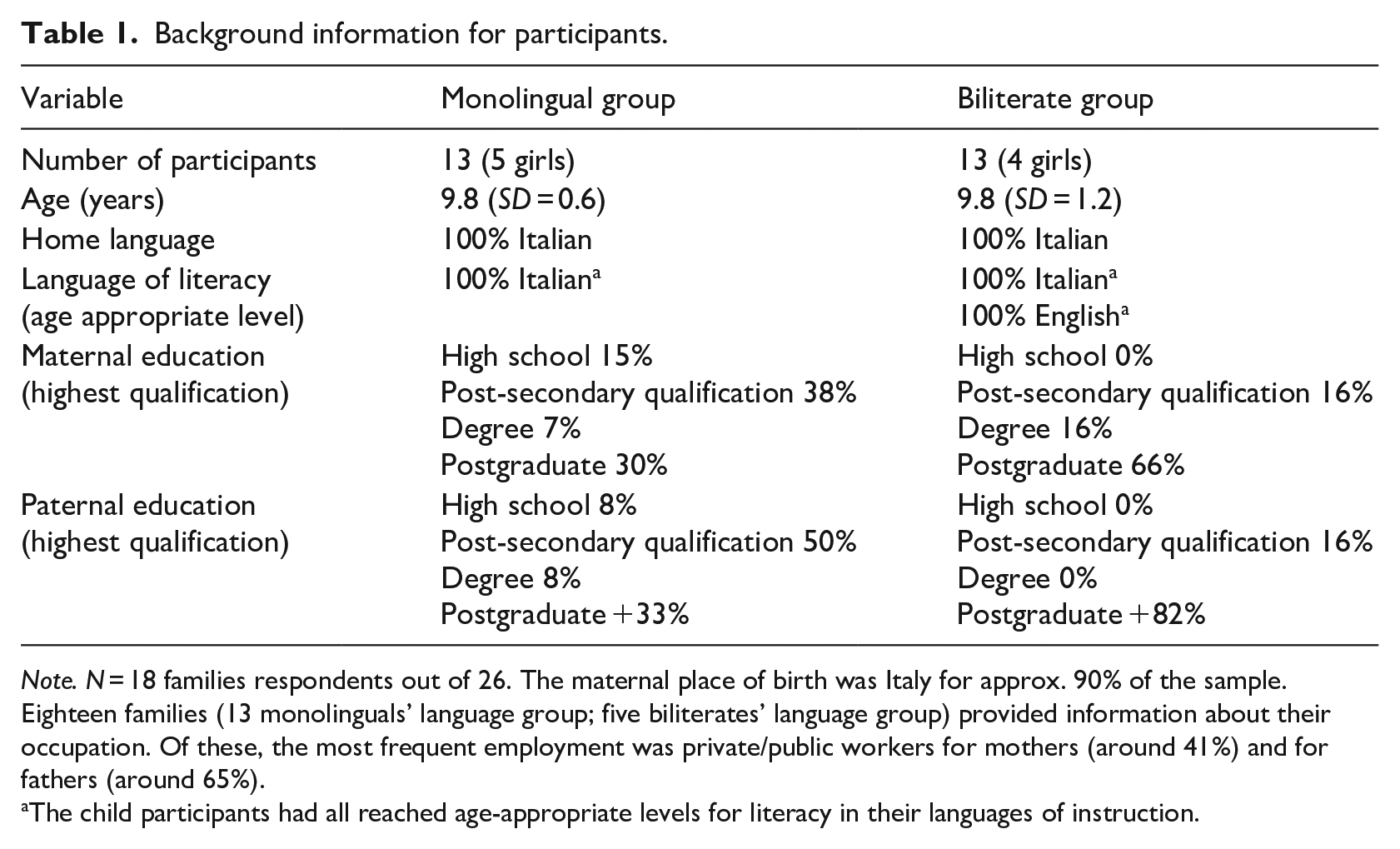
Note. N = 18 families respondents out of 26. The maternal place of birth was Italy for approx. 90% of the sample. Eighteen families (13 monolinguals’ language group; five biliterates’ language group) provided information about their occupation. Of these, the most frequent employment was private/public workers for mothers (around 41%) and for fathers (around 65%).
The child participants had all reached age-appropriate levels for literacy in their languages of instruction.
Educational school programmes
Bilingual education
For this pilot study, a group of children attending a bilingual primary school in London, where they learn all subjects in Italian and English, were included. The children follow both the Italian Ministry of Education and English Early Years Foundation Stage (EYFS), Key Stage 1 (KS1), and Key Stage 2 (KS2) programmes in a bilingual and bicultural approach which is taught by both English and Italian native speakers. The school begins with a nursery provision, with primary literacy beginning at the age of 4 in English and at 6 in Italian. Primary school lasts 5 years, running from the beginning of September until the beginning of July.
Monolingual education
For this study, a group of monolingual Italian-speaking children was included. In the Italian educational system, children start primary school when they are 6 years old. Primary school lasts five grades. The school year begins in mid-September and ends in mid-June. In Italy the formal teaching of literacy begins in primary school, and follows a specific curriculum, as set down in national law.
Procedure and materials
Testing was carried out at the schools in London and in Florence at varying times of the day, with children predominantly tested in the morning and early afternoon. All children were tested individually by two experimenters, one in London and one in Florence, in the course of two sessions. Task order was varied to reduce any potential priming across tasks. All tests are listed in Table 2. The whole testing session lasted about 1 hour in total.
The test battery used in this pilot study.
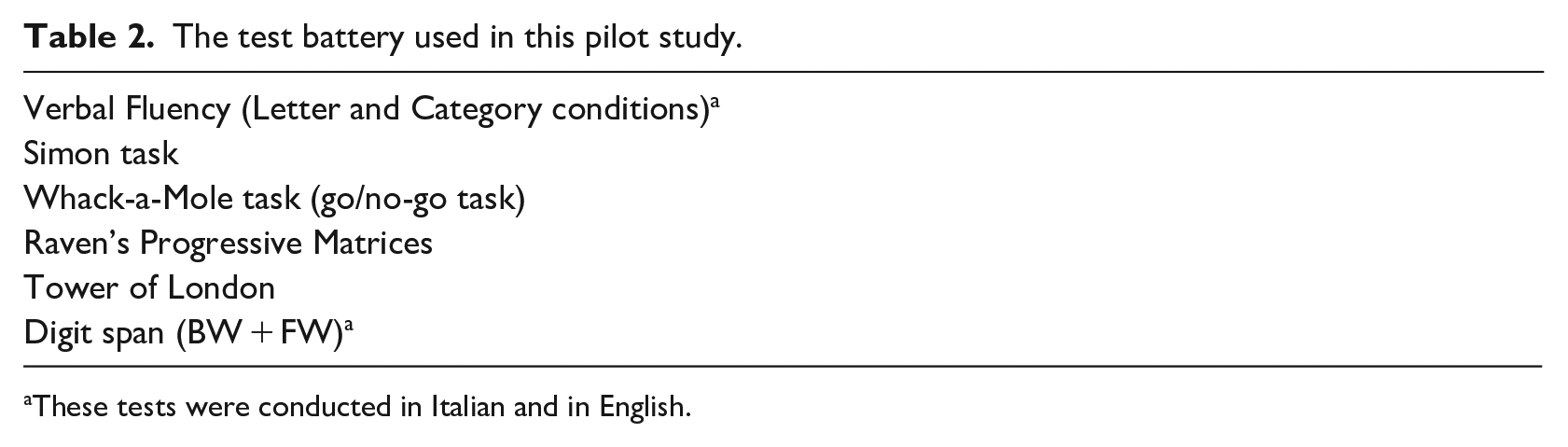
These tests were conducted in Italian and in English.
The experimental battery was conducted on an ASUS laptop, mouse, standard keyboard, and a Technopro® USB gamepad that was adapted with a red and a blue sticker attached to the buttons for the execution of the Simon task, and a green sticker for the execution of the go/no-go task. All instructions were given in English to the biliterate group, and Italian to the monolingual group.
Ethics approval for this study was granted by the UCL Institute of Education university committee. Only the children whose parents returned written informed consent were included in the sample. Children were tested in quiet room made available in two primary schools, one in London and one in Florence. All children were explained the purpose of the research and asked to confirm verbal consent before starting the session.
To address the experimental questions of this study, we only included the participants who fully completed the following tasks:
Verbal fluency
Previous research in children and adults suggests that verbal fluency is differently associated to cognitive domains in bilinguals and monolinguals: largely independent of working memory, fluid intelligence, and executive function in bilinguals, while more integrated with working memory and fluid intelligence in monolinguals (e.g., Filippi et al., 2021). These results raise the need to confirm the findings for the understudied population of biliterate children.
In this pilot study, participants performed two conditions, one measuring letter (or phonemic) fluency and one measuring category (or semantic) fluency (e.g., Controlled Oral Word Association Test, COWAT, Strauss et al., 2006). The Italian-translated COWAT was used to allow comparisons between bilingual and monolingual groups. For letter fluency, they were instructed to say, out loud, as many words as they could think of beginning with a specific letter (i.e., F, A, and S) within a time limit of 60 seconds. For semantic fluency participants were again given 60 seconds to produce words belonging to a specific category; these were (1) animals, (2) vehicles, (3) fruits and vegetables, and (4) tools. The total number of correct words generated were added together to provide a letter fluency and a semantic fluency score (Lezak et al., 2004). Any word repetitions and category errors were excluded from the count.
Executive function tasks
Visual interference suppression: Simon task. A computerised version of the Simon task (Simon & Wolf, 1963) was programmed in E-Prime version 2.0 (Schneider et al., 2007). A USB gamepad with coloured stickers (red and blue) was used to record response time and accuracy.
The task consisted of 36 trials in which either a blue star or a red star randomly appeared to the left or the right side of a white screen; each colour was presented an equal number of times to the left and to the right; however, their order was changeable. A fixation cross appeared for 800 ms preceding each trial. Participants were instructed to press the left button (labelled with a red sticker) when the red star appeared on the screen and the right button (labelled with a blue sticker) for the blue star, irrespective of which side of the screen the stars appeared. Half of the trials were incongruent, that is, the location of the stimulus and the response button did not match (e.g., red star on the right hand side of the screen) thereby requiring participants to inhibit the conflicting spatial information and focus on the colour (i.e., conflict resolution). Congruent trials (red star on the left and blue star on the right) did not require conflict resolution. The dependent measure was the ‘Simon effect’ (i.e., the difference between the mean response times for congruent and incongruent trials).
Response inhibition: Go/no-go task. All participants performed a go/no-go task called Whack-a-Mole (Petitclerc et al., 2015). They were instructed to press the green button on the USB gamepad as fast as they could when a mole popped up on the screen (go trials). They were also instructed not to press the button when an aubergine appeared on the screen instead of a mole (no-go trials). Trials began with an open mole hole (fixation point) appearing for 500 ms in the centre of a black screen. Go and no-go stimuli were presented for 1800 ms and 1300 ms respectively, unless a response was pressed. Correct responses were visually rewarded for 200 ms with a ‘WHACK!’ graphic for whacking the mole and ‘AWESOME!’ for leaving the aubergine; ‘OOPS!’ was displayed for missing the mole or whacking the aubergine. The ITI was 2500 ms. Following a practice block of 10 trials (3 no-go trials) participants were given the opportunity to ask questions before progressing on to the first of four blocks. Each block contained 56 trials (25% no-go) presented in a pseudorandom order.
Planning and problem-solving: Tower of London. A computerised 12-trial version of the Tower of London (Shallice, 1982), included in the free-access Psychology Experiment Building Language (PEBL) battery (Mueller & Piper, 2014), was administered. Each problem required participants to use the computer mouse to move coloured discs (red, blue, and green) from their initial position to match their target position in the fewest possible moves. The participants were instructed to move only one disc at a time, and only the disc on the top of a stack could be moved. A move counter on the right hand side of the screen would inform them how many moves they could make and how many moves they had left. There was no time limit for each problem but all participants were advised to carefully plan their moves before they clicked on any discs. Trials ended when participants reached the move limit and the screen displayed feedback on whether or not they had successfully completed the problem.
The trials were presented in a progressively increasing order of complexity consisting of four easy problems requiring two to three moves, four trials with problems requiring four moves and four trials with more difficult five-move problems that required planning multiple sub-goals.
Fluid intelligence: Raven’s Advanced Progressive Matrices Set 1. Participants completed Raven’s Advanced Progressive Matrices Set I (Raven, 1998) consisting of 12 items of increasing complexity. Each item consisted of a 3 × 3 matrix containing eight different black and white designs that are logically related and one piece missing at the bottom right; participants were required to deduce from eight potential pieces which piece completes the matrix. The number of correct items out of 12 was recorded. Although no time limit was given, all participants completed the task within 10 minutes.
Verbal Working memory: Digit span forwards and backwards. All participants were administered the digit span backward and forward, subtests of the Wechsler Adult Intelligence Scale–Fourth Edition (WAIS–IV; Wechsler, 2008).
They were instructed to repeat aloud a sequence of numbers. In the forward condition, the numbers had to be repeated in the same order. In the backward condition, they had to be reversed. Trials began with two-digit sequences (e.g., 1–7) that the participant verbally recalled either forwards or in reverse order. As trials progress the sequence gradually increased by one digit. Testing was interrupted when participants failed to recall the digits in two consecutive trials. Each correct response scored 1 point. The sum of correct forward and backward trials was recorded for each participant to provide an ability score.
Design
This study had a mixed design. Ability scores were obtained for phonological and semantic fluency (number of words produced in each condition), fluid intelligence (Raven’s matrices), and working memory (digit span forward and backward). Accuracy and response time scores were calculated for the executive function tasks.
Reaction time (RT) data were monitored on the intention of excluding responses outside the plausible range (less than 200 ms or greater than 2000 ms; Prior & Gollan, 2011; Simon & Wolf, 1963) to minimise the influence of outliers and invalid responses; however, no RT data needed to be excluded. Accuracy data were similarly reviewed, with participants scoring threshold being at or below chance levels (25%) requiring exclusion from analyses to ensure data reliability. Again, no data required exclusion. Task-specific mean RTs and accuracy were calculated for congruent and incongruent trials in the Simon task, while group averages were used for comparisons. To account for potential practice effects or fatigue, the task order was counterbalanced across participants.
One- and two-way analysis of variance (ANOVA) analyses were performed using SPSS version 27 for Mac, with additional analysis conducted in R.
Results
One-way ANOVA confirmed that the two groups were matched for age (M = 9.8, F(1,25) = .03, p = .86, n.s) and non-verbal fluid intelligence (Raven’s test, F(1,25) = 1.4, p = .25, n.s.), and normal distribution of Raven’s results was confirmed by boxplot (Figure 1(a)), Q-Q plot (Figure 1(b)), and Shapiro-Wilk test (W = 0.94528, p = .1795, n.s). Results are summarised in Table 3. It should be noted that while ANOVA validates group equivalency, it does not assess individual matching; future research should consider advanced matching techniques, such as propensity score matching (Gunnerud et al., 2020).
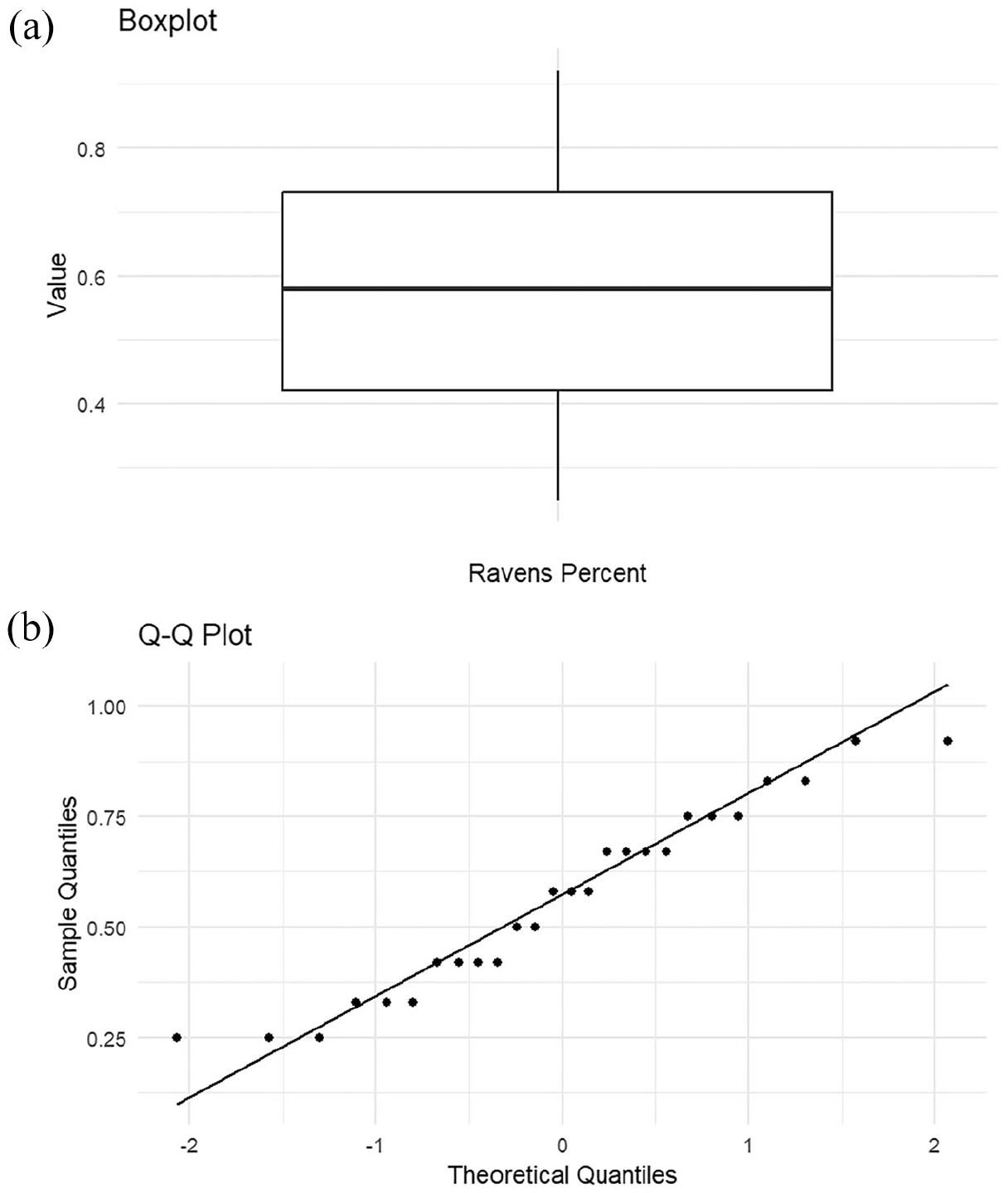
(a) Normal distribution of Raven’s task (IQR = 0.33, median = 0.6). (b) Q-Q Plot data show Raven’s results falling along the reference line.
Biliterate and monolingual children’s performance means and standard deviations.
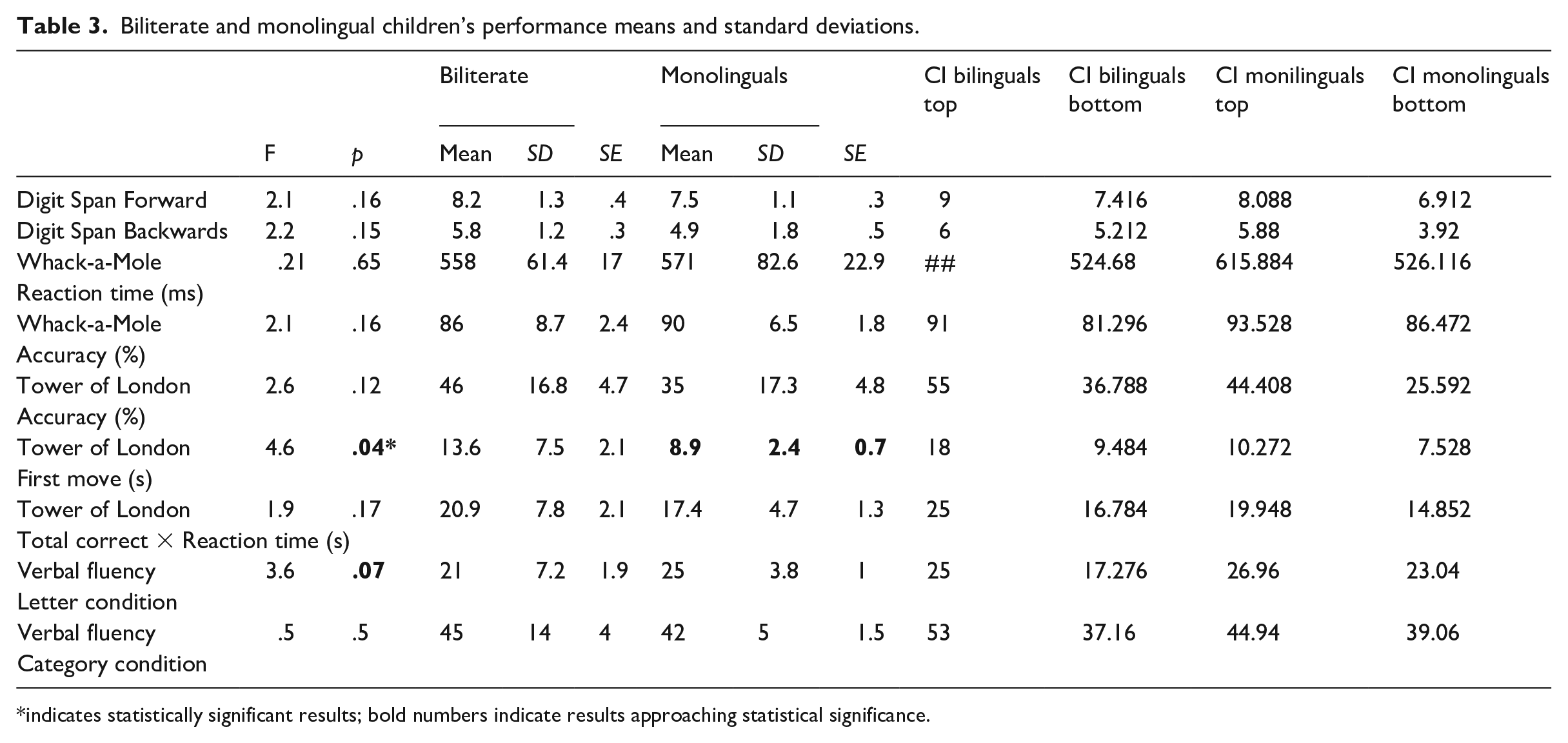
*indicates statistically significant results; bold numbers indicate results approaching statistical significance.
Simon task
Performance in the Simon task investigated inhibition, monitoring, and switching. Scores were compared between biliterate and monolingual children for accuracy, RT, and the Simon cost. Average scores are summarised in Table 4.
Simon task performance.
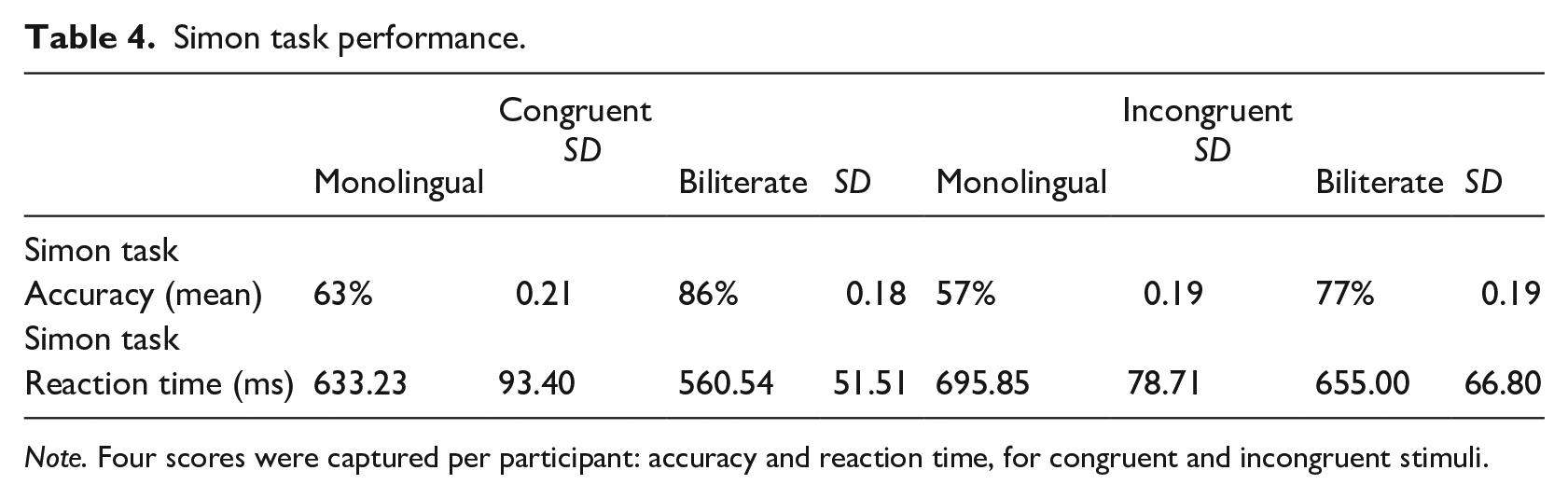
Note. Four scores were captured per participant: accuracy and reaction time, for congruent and incongruent stimuli.
The typical Simon effect was found in this study. Accuracy was significantly higher for congruent than for incongruent scores in both language groups, and RTs were quicker, F(1,24) = 9.8, p = .005, indicating that incongruent trials were more difficult than congruent. Biliterates outperformed monolinguals in this task, performing more accurately in both congruent and incongruent trials (Fcongruent (1,25) = 8.77, p = .07, Cohen’s d = 1.16; Fincongruent (1,25) = 7.23, p = .013, Cohen’s d = 1.05).
Simon Cost was higher for biliterates (M = 94.31, SD = 33.15, 95% confidence interval (CI) [114.34, 74.27]) than monolinguals (M = 62.54, SD = 85.69, 95% CI [112.51, 12.57]) with more consistency in their performance, although the broad standard deviation for the latter indicates high variability in monolingual Simon Cost scores which would require further investigation. A one-way ANOVA was conducted on the Simon cost measures, with language group as between subject variable. There was no significant difference between monolingual and biliterate Simon costs (F(1,25) = 1.65, p = .21), despite a medium effect size (Cohen’s d = 0.50).
A 2 × 2 two-way ANOVA was conducted on both accuracy and RTs to check the main effect of language status (monolingual/biliterate) and interaction interference (congruent/incongruent). There was a significant main effect of trial type on both accuracy (F(1,25) = 9.8, p = .005) and RTs (F(1,25) = 40.4, p < .001), confirming the Simon effect on both accuracy and RTs. Language group also had a significant main effect on both accuracy (F(1,25) = 8.8, p = .007) and RTs (F(1,25) = 4.6, p = .04), confirming that biliterates were overall significantly more accurate and faster than monolinguals, indicating an overall better performance. The interaction between language group and trial type was found to be non-significant for accuracy (F(1,25) = .41, p = .53), as well as for RTs (F(1,25) = 1.78, p = .21).
Whack-a-mole
Inhibitory control was also captured via accuracy and RTs on the Whack-a-Mole task. Biliterate results for accuracy (M = 86, SD = 8.7, 95% CI [91, 81.296]) and RT (M = 558, SD = 61.4, 95% CI [591.32, 524.68]) were below those of monolinguals for both accuracy (M = 90, SD = 6.5, 95% CI [93.53, 86.47]) and RT (M = 571, SD = 82.6, 95% CI [615.88, 526.12]). A one-way ANOVA was conducted on accuracy and RTs. Both groups’ performance was comparable for both accuracy, F(1,25) = 2.1, p = .16 (n.s.), Cohen’s d = −0.57 (although suggesting a medium-sized, non-significant effect favouring monolinguals, further research would be required), and RT, F(1,25) = .21, p = .65 (n.s), Cohen’s d = −0.18.
Digit span
Biliterate and monolingual performance on the forward and backward digit span working memory tasks were similar (biliterate digits forwards M = 8.2, SD = 1.3, 95% CI [9, 7.41]; monolingual digits forwards M = 7.5, SD = 1.1, 95% CI [8.09, 6.91]; biliterate digits backwards M = 5.8, SD = 1.2, 95% CI [6, 5.21]; monolingual digits backwards M = 4.9, SD = 1.1, 95% CI [5.88, 3.92]). Monolinguals’ CI for the backwards task was broad, indicating a broad range of results; a larger sample size might produce a more stable insight into this population. Nevertheless, one-way ANOVAs revealed no significant differences between the language groups (Fforwards (1,25) = 2.1, p = .16, Cohen’s d = 0.57; Fbackwards (1,25) = 2.22, p = .15, Cohen’s d = 0.580).
Tower of London
On the reasoning (Tower of London) task, accuracy and time before first move (planning time) were measured.
Both biliterates (M = 46, SD = 16.8) and monolinguals (M = 35, SD = 17.3) performed with high accuracy rates. Results were also disparate for both groups (biliterates accuracy 95% CI [55.212, 36.788], monolinguals accuracy 95% CI [44.408, 25.592]).
However, monolinguals (M = 8.9s, SD = 2.4) undertook their first move significantly faster than biliterates (M = 13.60, SD = 7.50), although the standard deviation for this latter shows high variability in biliterate time to make the first move (biliterates first move 95% CI [18, 9.484], monolinguals first move 95% CI [10.272, 7.528]).
A one-way ANOVA found no significant difference in accuracy, F(1,25) = 2.6, p = .12 (ns), Cohen’s d = 0.63, suggesting a medium to large effect size in favour of biliterates although non-significant for this small sample size. There was a main effect of language group on RT approaching significance, F(1,25) = 4.6, p = .043, Cohen’s d = 0.84. This seems to indicate that biliterates are more accurate in their overall performance by allowing themselves longer consideration prior to their first move. However, the interaction between total correct responses by RT was not significant, F(1,25) = 1.9, p = .17.
Verbal fluency
As expected, in the verbal fluency letter task, monolinguals produced more correct words (M = 25, SD = 3.8) than the biliterate group (M = 21, SD = 7.2). Despite a broad range of results among monolinguals (95% CI [24.724, 17.276]), a one-way ANOVA found statistical trend in favour of monolinguals, F(1,25) = 3.6, p = .07. An independent samples t-test confirmed a medium- to large-sized effect, Cohen’s d = 0.75. This suggests that monolinguals overall can access a broader range of vocabulary which is not grouped by category, but requires a broader mental search.
Surprisingly, biliterates (M = 45, SD = 14) outperformed monolinguals (M = 42, SD = 14) in the category task. Of note is that biliterates’ large standard deviation is backed up by a broad range of responses (category 95% CI [52.84, 37.16]), which is both higher and lower than those of the monolingual group (category 95% CI [44.94, 39.06]), indicating that the group is made up of both highly eloquent, as well as less so, individuals. A larger sample size could investigate this result further. A one-way ANOVA found this difference was not significant, F(1,25) = .5, p = .49, Cohen’s d = 0.27.
Overall, the only significant difference between the performance of the two groups is seen in the results of the Simon task, a task which requires inhibition, monitoring, and switching skills, arguably the very skills that biliterates navigate every day in their choice and use of the relevant language as required in their day-to-day. It may be that these are strengthened by the continuous requirements put on them by a multilingual education, in which language switching is required both in the classroom, as well as in the playground and other communal areas.
As these results were significant, additional tests were run. Using the R programme and the power.anova.test() function, an effect size of f = .27 was found for language group on accuracy, and f = .16 for RT. The result for accuracy was chosen as the most notable and consistent with previous literature (Paap et al., 2015). A preliminary power analysis was undertaken to compute an estimate for the sample size necessary to find an effect size of f = .27 on the Simon task results in this pilot. Using a significance threshold of p = .05 and good power threshold of .80, the minimum sample size to test this result would be 55 participants per language group, that is, a total of 110 participants.
Discussion
The purpose of the present pilot study was to investigate whether the ability to read and write fluently in two or more languages (biliteracy) is associated with cognitive and language advantage in primary school children and which are the underlying cognitive underpinnings.
In this study, we hypothesised that performance in measures of executive function would be better in biliterate children. This prediction was based on the assumption that biliterate bilinguals exercised interchangeably on a day-by-day basis two languages in all four modes of listening, speaking, reading and writing, thus producing a greater cognitive control overall (e.g., Carlson & Meltzoff, 2008; Green & Abutalebi, 2013).
Potential effects of multilanguage education on cognitive and language development were investigated, by comparing the performance of two groups of 9- to 10-year-old school children, one group of bilingual biliterate children attending an Italian/English bilingual school in London, UK, and one group of Italian monolingual children attending an Italian state school in Florence, Italy, matched on age and general cognitive performance. Our matching approach ensured baseline comparability in key variables such as age and fluid intelligence, consistent with practices in bilingualism studies (Carlson & Meltzoff, 2008). However, as noted in recent literature, individual differences and other covariates may influence results and warrant more rigorous matching strategies in future research (Gunnerud et al., 2020). Similarly, while the tasks were selected based on developmental benchmarks for 9- to 10-year-olds, future studies may consider additional pilot testing to refine task difficulty for younger populations, to optimise engagement and comprehension (Misra et al., 2012; Purić et al., 2017). Greatest limitation is the pilot nature of this study and limited sample size, which further research should address most importantly.
The contribution that this study brings to the field of bilingual development is twofold: our findings advance our knowledge about verbal and non-verbal abilities in unstudied language groups by focusing on English/Italian biliterate children and Italian monolinguals in primary school, and specifically, by focusing on biliteracy in those bilinguals – a relatively underexplored dimension of bilingual education (Bialystok et al., 2014; Koda, 2007) for which we provide novel insights. While meta-analytic evidence has questioned the bilingual advantage, our results suggest that biliteracy may represent a specific mechanism through which cognitive benefits manifest and provide new insights into how dual-language literacy influences executive functions, particularly in tasks requiring inhibition, monitoring, and cognitive flexibility. They support the hypothesis that biliteracy enhances at least some executive functions (Carlson & Meltzoff, 2008; Green & Abutalebi, 2013), aligning with Green and Abutalebi’s (2013) ‘adaptive control hypothesis’, which posits that bilingual individuals develop enhanced cognitive control mechanisms through constant management of multiple language systems. Our results suggest that biliteracy, which involves deep engagement with two languages in both oral and written modalities, may amplify inhibition, monitoring, and cognitive flexibility further.
The study’s emphasis on biliteracy fills a critical gap in bilingualism research. While much of the existing literature focuses on spoken bilingualism, few studies have explored how literacy in two languages shapes cognitive outcomes (Murphy et al., 2015; Filippi Ceccolini, et al., 2020) and should be considered as a unique variable in bilingual education research. In line with previous research such as Martin-Rhee and Bialystok (2008), our findings suggest that the ability to read and write in two languages – combined with the immersive, dual-language educational environment – enhances inhibitory control and monitoring abilities, as evidenced by accuracy rates and response times on the Simon task, shown in Table 4 and Figures 2 and 3. Results support the finding that English/Italian biliterate bilingual children were significantly more accurate and quicker than monolingual peers in responding to the Simon task in both congruent and incongruent trials, an area in which literature is inconclusive in bilinguals (e.g., Bright & Filippi, 2019). The bilingual children in this study were not only proficient in speaking and understanding two languages, but were also actively literate in both. This dual-language literacy in a transparent language such as Italian (Murphy et al., 2015) likely contributes to the observed cognitive benefits. It is worth noting here that Italian has a highly consistent grapheme-phoneme consistency compared to English, which is considered to have an opaque one, as discussed by Murphy et al. (2015), and is considered a facilitative L2 for English L1 learners. In this instance, Italian is the L1 and English the L2. Murphy and Pine (2003) argued that when L2 is learnt in early childhood, as in our biliterate population here, this leads to more express awareness of L1. It is suggested that the continuous switching required by the school curriculum emphasises children’s monitoring and inhibitory control to avoid the competition deriving from co-activated languages. This confirms the assertion made by Bonfieni et al. (2019), that it is the equality between the languages – in our case, the depth of language knowledge – which is the lever which unleashes the accuracy and speed of monitoring, inhibition, and switching abilities.
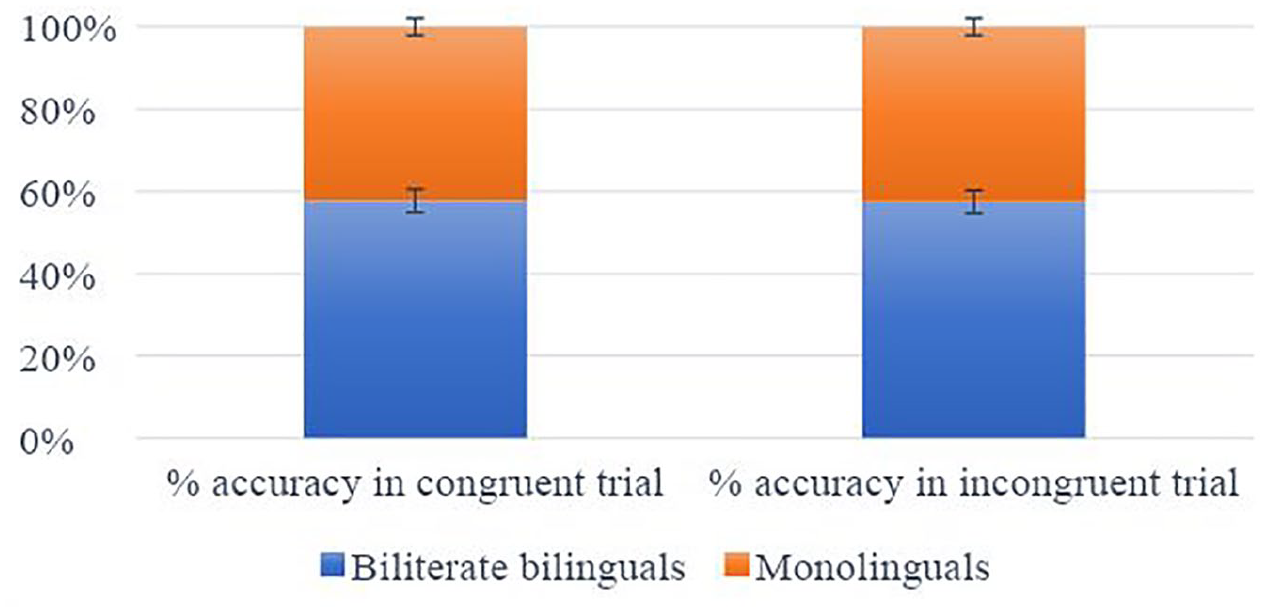
Significant results obtained on the Simon task between biliterate bilingual and monolingual children: Accuracy (%).
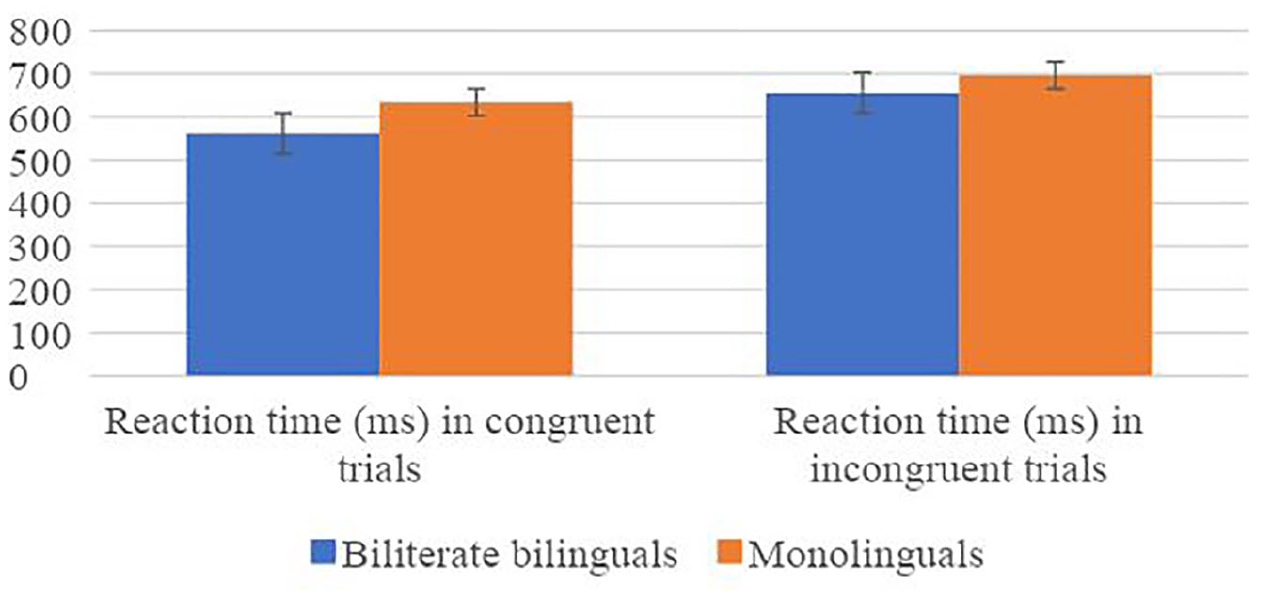
Significant results obtained at the Simon task between biliterate bilingual and monolingual children: Reaction time (ms).
In tasks that require complex planning and problem-solving, such as the Tower of London task, biliterate children demonstrated a trend towards higher accuracy (Bonfieni et al., 2019; Shallice, 1982). This supports previous findings indicating that bilingual education, and specifically biliteracy as distinct from a general bilingual experience, strengthens certain executive functions, particularly in contexts requiring the suppression of irrelevant information and the resolution of cognitive conflict (Carlson & Meltzoff, 2008; Prior & Gollan, 2011). In our study, biliterate children took longer to consider their options to perform their first move, resulting in overall more accurate performance than monolinguals. Future research should consider whether this first move delay may be due to their higher ability to self-regulate their actions in a goal-directed planning task.
Second, our results raise the possibility of the beneficial effect of a bilingual school curriculum on inhibition, monitoring, and switching skills. They highlight the importance of educational practices that emphasise balanced literacy development in multiple languages, offering implications for curriculum design and policy and consistent with recent policy recommendations (Tsimpli, 2017). At a time when language education is often being sidelined in schools, these results suggest there are long-term benefits to bilingual education programmes that integrate literacy in multiple languages. Biliteracy not only supports academic achievement but also fosters cognitive skills that are transferable across disciplines (Filippi et al., 2024; Tsimpli, 2017). By promoting biliteracy, educators can help students develop the metalinguistic awareness and cognitive flexibility necessary for success in increasingly globalised and multicultural societies (Hessel & Strand, 2021).
However, the small sample size limits generalisability and highlights the need for replication in larger-scale studies. Previous research has shown that adequately powered studies are critical for distinguishing genuine cognitive effects from task-specific or methodological artifacts (Paap & Greenberg, 2013).
The other cognitive tasks, tapping into inhibitory control (Whack-a-Mole) and working memory (Digit Span) revealed no significant differences between the two language groups’ performances. This challenges our conceptualisation of biliterate bilinguals’ cognitive advantage and adds to the debate in this area. As has been seen, some suggest that the bilingual advantage may be dependent on task (e.g., Paap & Greenberg, 2013; Paap et al., 2015) and age (Ware et al., 2020). Further research is needed to disentangle these issues.
In addition, results suggested a statistical trend towards English/Italian biliterate bilinguals performing better than monolinguals on the forward and backward Digit Span, measuring working memory. Although this finding is in line with results from previous studies (Hilchey & Klein, 2011; Cockcroft et al., 2019), it requires further investigation on larger sample sizes, to assure more reliable results on the bilingual biliterate population. What can be said is that this result supports Green and Abutalebi’s (2013) dual-language context, in which language control processes are at their most active when two languages are actively used in the same environment, as our participants do when using English and Italian interchangeably on an hourly basis as part of their learning environment. While the constructs of the single-language lessons are clear, the pupils’ monitoring, inhibition, and working memory skills are continuously active to enable their full participation and maximum benefit from the classroom, and these are the effects that manifested in the course of this pilot study.
Finally, with respect to the language measures, contrary to our assumption on verbal fluency measures, no statistically significant differences in performance were found between biliterate bilinguals and monolinguals. However, the results show a statistical trend in favour of Italian monolinguals who produced more correct words in the Verbal Fluency letter task than English/Italian biliterate bilinguals. One possible explanation might be related to the difficulty of English/Italian biliterate bilinguals in suppressing interference from the other language. For those children, suppressing linguistic information in Italian language which has different orthographic characteristics with respect to English would determine additional cognitive/linguistic demands. In fact, when children are asked to produce as many words as possible in a target category the trend is reversed, in favour of bilinguals. Previous results (e.g., Koda, 2007) suggest that bilinguals may benefit from having a large linguistic pool of resources in comparison to monolinguals. Murphy et al.’s (2015) claim of facilitative Italian L2 for English L1 learners is confirmed by the finding here that the biliterate participants in this study performed just as well as the monolinguals in both versions of the verbal fluency task.
Limitations and future research directions
Our approach to RT and accuracy data handling prioritised data quality and reliability. However, low accuracy rates in some tasks, particularly for incongruent trials, suggest potential challenges related to task complexity or participant engagement. To mitigate these issues, future studies could implement additional practice trials, simplify task instructions, or modify stimuli to better align with participants’ developmental levels. These adjustments would ensure that observed differences reflect genuine cognitive processes, rather than task-related constructs (Shallice, 1982).
Table 1 highlights SES disparities between groups, with bilingual participants’ parents more likely to hold postgraduate qualifications (66% vs. 33%). Parental levels of education have been linked to physical and mental health, as well as cognitive function and verbal ability outcomes in children (Braveman et al., 2005). The bilingual group reported daily use of Italian and English in academic, home, and social contexts, consistent with definitions of balanced bilingualism (De Houwer, 1995) and school performance confirmed high proficiency in both reading and writing in Italian and English. This contrasts with the monolingual group, which reported no functional use of additional languages beyond classroom settings. These differences in background, linguistic exposure and usage patterns provide important context for interpreting the cognitive and linguistic outcomes observed in this study. However, due to the pilot nature of this study and its small size, exploratory analysis was unfeasible at this stage. Future studies should take care to address these disparities. The small sample size inherent to this pilot study limits its statistical power and generalisability. Nevertheless, the observed power in key areas, such as the Simon task, indicates that the findings may reflect genuine trends warranting further, larger-scale exploration. While these results are preliminary, they provide evidence of task sensitivity to bilingual cognitive advantages. Future research should aim to recruit larger, more closely monitored samples controlling for factors including SES and depth of language knowledge, to confirm these findings and to strengthen the statistical validity of observed effects. By doing so, subsequent studies could extend these insights and better delineate the role of biliteracy in cognitive development.
This cross-sectional study focused on a moment in time in these children’s development, once they are already strong in reading and writing. The biliterate children involved in this project were simultaneous bilinguals, that is, they acquired two languages from birth, learning to read and write simultaneously as well, as soon as schooling began. This in itself would be worthy of future investigation: a longitudinal study should attempt to pinpoint whether it is the simultaneous bilingual ability that allows the children to develop their cognitive abilities from birth, and whether these are accelerated once biliteracy is acquired. Either way, this research confirms that biliterate children are positively impacted by having access to and awareness of two languages, in this case Italian and English, as first suggested by Murphy et al. (2015). Additional implications could be greater ease in operating across different cultures and insight into different perspectives, at a time when global mobility is increasing for political, social, and economic purposes. A longitudinal study should be able to better identify the cognitive, linguistic and memory development journey, starting from when the children ‘simply’ speak and understand two languages and therefore manage a lesser cognitive load (Macnamara, 1967; Yin et al., 2022), through to puberty when reasoning abilities are supposedly at their most active (Bialystok, 2017). Longitudinal studies would therefore enable the tracking of cognitive and linguistic development over time, helping to disentangle causal relationships between bilingual education, biliteracy, and executive functions. It should be mentioned that both language groups were both of high parental education. Further research should investigate the replicability of these outcomes in a low SES population, as well as in different language systems, and specifically non-Western populations. For instance, a logographic language such as Mandarin may impact memory (Yin et al., 2022). Other studies show low L2 vocabulary skills in bilingual language-minority children with L1-Chinese and L2-Italian (e.g., Vettori et al., 2022) opening the way to future investigation of biliterate populations managing two different languages, such as logographic and alphabetic writing systems. Learning two languages of more complex orthography and greater linguistic distance (Studenica et al., 2022) such as English and German may also have an effect, as Murphy et al. (2015) demonstrated in their 8-week French-English and Italian-English interventions. In addition, it is crucial to investigate the home literacy environment and practices, as these will be instrumental to understanding the depth of language knowledge required to make a difference in both monolinguals and bilinguals, as per Hessel and Strand (2021).
Given the exploratory and pilot nature of this study, we employed group-wise comparisons using ANOVA to examine cognitive and linguistic performance differences between bilingual and monolingual groups. While ANOVA is appropriate for identifying broad trends, this approach has limitations when dealing with small sample sizes and individual variability which are well documented (Paap & Greenberg, 2013). While our findings are consistent with theoretical predictions and prior empirical evidence (Carlson & Meltzoff, 2008; Green & Abutalebi, 2013), their generalisability is constrained by the exploratory nature of this study. The lack of a multivariate statistical framework means that interactions between key variables, such as SES, biliteracy depth, and bilingual language use, could not be fully explored (Filippi et al., 2020). Future research should prioritise designs that mitigate the constraints of pilot studies. Mixed-effects modelling would allow for the inclusion of random effects, such as individual participant variability or differences in school curricula, which are likely to influence cognitive outcomes (Bonfieni et al., 2019). Additional studies might look to integrate qualitative measures, such as classroom observations or interviews with parents and teachers, to provide richer context for interpreting quantitative findings. This mixed-methods approach might offer a more holistic understanding of biliteracy’s cognitive and educational implications, aligning with recent calls for interdisciplinary approaches in bilingualism research (Tsimpli, 2017)
Despite these limitations, the study cautiously identifies promising trends, particularly in tasks like the Simon task, where bilingual biliterate children outperformed monolingual peers in both accuracy and RTs. These results suggest that biliteracy may enhance cognitive functions, such as inhibitory control and monitoring, in ways distinct from general bilingualism (Martin-Rhee & Bialystok, 2008).
Overall, when observing the results of verbal measures, the large standard deviation in bilingual and monolingual children’s responses should be noted which suggests an in-depth investigation of individual differences in the two language groups’ level of eloquence in future studies. A larger sample population followed over time as discussed above, would help to decode the complexities between the depth of language knowledge between the groups, although at this stage it is important to appreciate that the very fact that there are no significant differences between the two groups indicates that bilingual biliterates operate just as well as monolinguals do on language measures, that is, like a native, as acknowledged by Filippi, Periche-Tomas, et al. (2020). Having said this, larger sample sizes would facilitate more nuanced statistical approaches, such as propensity score matching, to ensure equivalence between groups on demographic and linguistic variables (Gunnerud et al., 2020).
Implications
This pilot study adds to the current understanding of multilingualism by investigating a population exposed to a deep and continuous usage of two languages as part of their daily schooling, and the impact this has on certain cognitive and memory abilities. Specifically, in bilingual education, bringing children up to be fluent across all four aspects of understanding, speaking, reading, and writing from early childhood does not impact children’s development negatively. Indeed, our results suggest equal to native, if not slightly improved, abilities, with the exception of Verbal Fluency by letter, within the caveat of a small and underpowered sample size. This ability to operate on a par with monolinguals is an advantage in itself, and indicates a mental plasticity in two languages, not just one, from an early age. The heightened ability to reason before making a decision, to inhibit and monitor across different factors, and to lean on the full breadth of their vocabulary competencies across languages seems to support suggestions that biliterates’ brains are indeed operating in a different capacity.
At a time of increasing financial and political squeeze against language programmes at schools in the UK, this research confirms the benefits of language immersion from early childhood. Building on Tsimpli’s (2017) policy paper, the benefits of literacy specifically in both native and school languages require the support of specific initiatives to allow biliterate children to develop to the full power of their abilities. She argues that a lapse in the home language means that learners whose school language is their additional language (such as so-called EAL, English as an Additional Language, in the UK) risk losing out from benefitting from the enriched cognitive abilities developed in the course of being bilingual, which in turn contribute to developing grammar abilities in the main school language (Murphy & Pine, 2003). Importantly, at a time when the bilingual advantage hypothesis is being increasingly scrutinised (e.g., Gunnerud et al., 2020), this study adds depth to the discussion by scrutinising the depth of language knowledge as the lever unlocking additional benefits to the communication of another language and culture. It remains to be seen whether accessing two or more languages through reading and writing, in addition to speaking and understanding, reinforces cognitive abilities.
Either way, this research suggests that biliterate children are not negatively impacted by having access to and awareness of two languages; in this case, Italian and English. With further research, additional implications may include greater ease in operating across different cultures and insight into different perspectives, at a time when global mobility is increasing for political, social, and economic purposes.
Conclusions
This project adds to an important field of enquiry within educational and developmental psychology, with the intention of advocating second language literacy. While results in this pilot study cautiously suggest comparable performance between monolingual and biliterate participants, this is in itself confirmation of the strength of bilingual education, producing individuals who operate on par with monolinguals in two language groups. The ability to read and write and to understand and speak in two languages does seem to boost inhibitory control and monitoring, as well as reasoning ability, in keeping with assertions of greater brain plasticity resulting from monitoring, inhibiting, and choosing while operating in two languages interchangeably; however, it is clear that the debate on multilingualism is far from settled.
Our study underscores the need for more sophisticated statistical approaches in bilingualism research to fully capture the complexities of biliteracy’s impact on cognitive development. The use of group-wise comparisons provided valuable preliminary insights, but future studies should incorporate advanced models, larger and more diverse samples, and longitudinal designs to build on these findings. By addressing these methodological challenges, researchers can better delineate the unique contributions of biliteracy to cognitive and linguistic outcomes, paving the way for more targeted educational interventions and policy recommendations (Filippi et al., 2024; Tsimpli, 2017).
Footnotes
Acknowledgements
Thanks to the schools, teachers, parents, and children in London and Florence who helped us conduct this research.
Declaration of conflicting interests
The author(s) declared no potential conflicts of interest with respect to the research, authorship, and/or publication of this article.
Funding
The author(s) disclosed receipt of the following financial support for the research, authorship, and/or publication of this article: This work was supported by the UCL Global Exchange Funds 2021-2022.
