



Abstract
Aims and objectives/purpose/research questions:
Previous studies in pairs of typologically distant languages showed that hemispheric processing of metaphoric expressions differs in a native
Design/methodology/approach:
Forty-six Arabic native speakers who were proficient in Hebrew (second language; 30 women, aged 19–28) participated in a divided visual field (DVF) experiment. They were presented with conventional metaphors, literal expressions, and unrelated word pairs and asked to indicate whether the word pairs formed a meaningful expression. Participants were tested in spoken Arabic, literary Arabic, and Hebrew in separate blocks.
Data and analysis:
Mean reaction times and accuracy were analyzed using repeated-measures three-way analysis of variance, with language, visual field, and expression type as independent variables.
Findings/conclusions:
In contrast to previously reported findings, a left-hemisphere advantage or a bilateral pattern of processing was observed for conventional metaphors in both varieties of Arabic and in Hebrew, suggesting similar hemispheric processing in native and second language.
Originality:
Metaphor processing is examined in a pair of typologically close languages.
Significance/implications:
Our findings (in a pair of typologically close languages) differ from those previously reported in pairs of less similar languages, suggesting a modulatory role of language similarity in hemispheric processing of second-language metaphors.
Introduction
Metaphors are a linguistic device in which the literal meaning of an expression is different from the intended meaning of the speaker (e.g., bright student). The use of metaphors is common in daily communication and essential for social interaction (Cameron, 2008). While native speakers of a language use figurative language effortlessly, second-language speakers often find this aspect of language particularly difficult. For instance, 40% of expressions that were not understood by foreign students at a British university, though they were composed of familiar words, were metaphoric expressions (Littlemore et al., 2011). Similarly, attempts by second-language speakers to use metaphors in production tend to be incorrect and stylistically inappropriate (Kathpalia & Carmel, 2011). This difficulty may be due to the figurative meaning of an expression being established within the socio-cultural experience of native speakers. Thus, what is accessible to native speakers is not necessarily accessible to second-language speakers as a result of their lack of experience with the language and the culture (Kecskes, 2006). Because of the experiential difference, brain processing of figurative expressions may differ in native versus second language. The present study aimed to explore the hemispheric processing of metaphors in Arabic (native language) and Hebrew (second language) among Arabic–Hebrew speakers. Since Arabic exists in a diglossic situation, where two distinct language varieties are used by a single-language community, we examined both varieties (spoken Arabic [SA] and literary Arabic [LA], also referred to as Modern Standard Arabic).
Hemispheric processing of metaphoric expressions in native versus second language
Hemispheric processing of native language metaphors has been extensively researched in the last two decades. Behavioral studies using the divided visual field (DVF) paradigm (Faust & Mashal, 2007; Mashal & Faust, 2008) as well as neuroimaging evidence (Bohrn et al., 2012; Mashal et al., 2007) suggest that familiar, conventional metaphors (e.g., broken heart) involve left-lateralized processing, while unfamiliar, novel metaphors (e.g., mercy blanket) rely more heavily on right hemisphere (RH) processing. Bilateral processing was also reported for conventional metaphors (Bambini et al., 2011; Diaz et al., 2011). These results are generally in agreement with the graded salience hypothesis (GSH; Giora, 1997), according to which the degree of semantic salience determines metaphor processing. More semantically salient meanings (i.e., more conventional, frequent, familiar, prototypical, and contextually independent) are more easily accessible than less salient meanings. For conventional metaphors, the figurative meaning is more salient and thus more accessible than the literal interpretation. Conversely, for novel metaphors, the literal meaning is more salient, and the figurative meaning is retrieved later with context. The GSH assumes that in conventional metaphors, the salient metaphorical meaning is stored in the mental lexicon, as opposed to the meaning of novel metaphors that must be accessed through a process of integration and inference. The GSH further predicts a greater RH involvement in comprehending novel and non-salient metaphorical meanings, and a greater left-hemisphere (LH) involvement—in comprehending conventional and salient metaphorical meanings (Giora, 2003).
Although there are no specific models for figurative language processing in a second language, the GSH (Giora, 2003) may be extended to a second language. Kecskes (2006) argued that figurative meanings of metaphoric expressions are more salient for native speakers compared to second-language speakers because of the difference in prior experience and encounters with these expressions in similar and typical contexts. As a result, what is salient to first-language speakers will not necessarily be salient to second-language speakers. They rely on prior knowledge of their first language and on the socio-cultural knowledge on which their first language is based. Thus, although second-language speakers know the meanings of conventional metaphors, their metaphorical meanings may not receive priority in the mental lexicon and, as predicted by the GSH, these metaphoric expressions might be more supported by their non-dominant hemisphere.
Only a handful of studies have examined hemispheric involvement in the comprehension of figurative language in a second language. In a DVF study, Cieślicka and Heredia (2011) tested the processing of laterally presented targets related to the figurative or the literal interpretation of an idiom. Literal targets (assumed to be the salient meaning of second-language idioms) showed robust priming at most time windows in both visual fields. These findings emphasize the special status that the salient literal meanings enjoy in the course of idiom processing by second-language speakers. In contrast, figurative targets presented to the left visual field/RH (LVF/RH) were primed only at a later time window, reflecting the extra effort needed for the processing of the less salient and less automatized idiomatic meaning of second-language idioms. The authors concluded that the processing of idiomatic meaning is a more demanding task for second-language speakers compared to native-language speakers, possibly because it requires the suppression of the more salient literal meaning.
In another DVF study, comprehension of conventional metaphors was tested in English-Hebrew bilinguals (whose native language was English), and native Hebrew speakers (Mashal et al., 2015). The results showed that conventional metaphors in the native language (either Hebrew or English) elicited faster reaction times when presented to the right visual field/LH (RVF/LH) than to the LVF/RH. In contrast, the bilingual participants showed an RH advantage for metaphoric expressions in Hebrew, their second language. The greater RH involvement was interpreted, in line with the GSH (Giora, 2003), as evidence of the non-salience of the figurative meaning of second-language metaphors. A follow-up study found that while metaphor processing among Spanish–English bilinguals was slower and less accurate than that of monolingual speakers of English in both visual field presentations, both groups showed an LH advantage (Segal & Gollan, 2018). Since the bilinguals in that study were all dominant in English, the language of testing, the results are in line with the previously reported LH advantage in the native language of English–Hebrew bilinguals (English) and in Hebrew for Hebrew native speakers (Mashal et al., 2015).
Two neuroimaging studies further underscored the differences in brain processing of native and second-language metaphors. Citron et al. (2020) found increases in left amygdala activation with increasing metaphoricity in native speakers of German, but not in speakers of German as a second language. In an electrophysiological study, novel metaphors in the native language (Polish) elicited reduced amplitudes relative to conventional metaphors and literal expressions at a later time window, while this effect was observed for both novel and conventional metaphors in a second language (English), suggesting decreased automaticity of cognitive mechanisms in the processing of second-language figurative expressions and decreased sensitivity to the degree of metaphor conventionality (Jankowiak et al., 2017).
The studies above included pairs of languages that are relatively distant typologically, such as Polish and English, which belong to the Slavic and the Germanic language family, respectively (Cieslicka & Heredia, 2011; Jankowiak et al., 2017), and Hebrew and English (Mashal et al., 2015). The current study was conducted on Arabic–Hebrew speakers, whose languages are both members of the Semitic family, allowing us to explore hemispheric processing of metaphoric expressions in a pair of relatively close typologically languages.
Language processing and similarity between languages
Both Arabic and Hebrew are characterized by morphological structures based on roots and templates (word patterns), which are fixed prosodic templates with slots for the root consonants. Despite the existence of phonetic and phonological differences between the two languages, they share many similar roots. Roots are autonomous morphemes expressing the basic meaning of the word. Most words are derived by embedding a root (generally triconsonantal) into a morpho-phonological word pattern, where various derivatives are formed by addition of affixes and vowels. The core meaning is conveyed by the root, while the phonological pattern conveys word-class information (e.g., the words SEFER [Hebrew] and KITAB [Arabic], meaning book, consist of the root SFR and KTB, and the pattern “C1eC2eC3” and “C1i C2a C3,” respectively; Holes, 2004; Shatil, 2016).
In addition, Arabic and Hebrew share many orthographic similarities, although they have different alphabets with no shared letters. Both use a system of letters, denoting consonants and long vowels, and diacritics, which denote short vowels (although the distinction between short and long vowels is not manifested in spoken Modern Hebrew). In both orthographies, the diacritics are usually omitted in contemporary texts, leading to high morphological ambiguity. Furthermore, both languages are written from right to left, and, while this is much less extensive in Hebrew than in Arabic, some letters are represented by different shapes depending on their placement in the word. Another similarity is that both Arabic and Hebrew have a complex agreement system, involving features such as person, number, gender, and definiteness.
Language similarity has proven to modulate language learning and processing in previous research. For example, Norman et al. (2016) observed that learners of Hebrew as a second language showed differential sensitivity to morphological characteristics of Hebrew pseudowords depending on their L1 background (Arabic or an Indo-European language). Kim et al. (2016) showed a greater extent of overlap in brain activation in a pair of more similar languages in terms of orthographic transparency (such as English and Korean) compared to a pair of less similar languages (such as English and Chinese). Ghazi-Saidi and colleagues found that naming in a second language was more effortful and demanding and less automatic when the two languages were distant (Persian and French) (Ghazi-Saidi & Ansaldo, 2017) than when they were close (Spanish and French) (Ghazi-Saidi, 2012 in Ghazi-Saidi & Ansaldo, 2017), resulting in more extensive recruitment of neural resources.
There is also evidence that hemispheric processing may be affected by language similarity. For example, the hemispheric processing of English words (second language) was more similar to the processing observed in German as a native language compared to Italian as a native language, which was attributed to a greater language similarity between English and German (D’Anselmo et al., 2013). Extending these findings to metaphor comprehension, hemispheric processing may converge more in a pair of similar languages (e.g., Arabic and Hebrew) compared to a pair of more distant languages (e.g., English and Hebrew).
Spoken versus literary Arabic
The Arabic language has two varieties: SA, which is used for daily communication, and LA, which is used for the written language. This situation, in which two different varieties of a language are used under different conditions within the same community, is often called diglossia (Ferguson, 1959). The two varieties differ in terms of the age and manner of acquisition, in addition to the different use in each of them. Furthermore, whereas LA is homogeneous for all Arabic speakers, there are significant differences between dialects of SA used in the various regions (Boudelaa & Marslen-Wilson, 2013; Saiegh-Haddad, 2003).
SA is a local dialect and the first language Arabic speakers acquire. It is used for everyday verbal communication and usually not in writing. Today, however, Arabic speakers use the writing system of the literary language in correspondence conducted in the spoken language (such as text messages), so exposure to the written form of SA is now an inseparable part of its forms of use (Kindt & Kebede, 2017). LA is acquired later, mainly through formal education, although there is some prior exposure through audio-visual media (Boudelaa & Marslen-Wilson, 2013; Saiegh-Haddad, 2003). In addition, it is used for reading, writing, and formal verbal communication, such as religious sermons, official speeches, news, and teaching (Ibrahim & Aharon-Peretz, 2005; Levin et al., 2008; Saiegh-Haddad et al., 2011). Both forms of Arabic have a subset of common words, but they are somewhat different phonologically, morpho-syntactically, and semantically (Saiegh-Haddad et al., 2011).
Previous research suggests that the two varieties are processed differently depending on the circumstances. Ibrahim and Aharon-Peretz (2005), for example, investigated semantic priming effects during an auditory lexical decision task in SA, LA, and Hebrew in Arabic–Hebrew speakers. Priming effects were larger when primes were in SA and target words either in LA or in Hebrew than the reverse (LA or Hebrew primes and SA targets). Also, the priming effects for LA and Hebrew were identical. In comparison, Nevat et al. (2014) reported that semantic categorization of written words in LA was more rapid and accurate than categorization of written words in SA or Hebrew, which did not differ. To explain the discrepancy across studies, the authors postulated that performance may vary depending on the presentation modality: SA may be more dominant in the auditory modality and LA—in the visual modality.
The current study
This study examined hemispheric involvement in the comprehension of conventional metaphors in Arabic–Hebrew speakers. Participants were asked to perform a semantic judgment on conventional metaphors, literal word pairs, and unrelated word pairs in SA, LA, and Hebrew. Hemispheric processing was examined using the DVF paradigm. It is assumed in the DVF paradigm that stimulus briefly presented to one of the visual fields is initially received and processed by the contralateral hemisphere. A stimulus presented to the RVF is first processed by the LH, while a stimulus presented to the LVF is first processed by the RH. Unilateral presentation is ensured by placing the test stimuli at a particular angle and by limiting exposure duration. Visual field effects obtained this way are thus regarded as reflecting distinctions in hemispheric functioning (Bourne, 2006).
In terms of overall performance, we expected SA and LA expressions to elicit faster and more accurate responses than expressions in Hebrew, the second language. We also expected either an LH advantage (Mashal et al., 2007) or bilateral processing (Bambini et al., 2011; Diaz et al., 2011) for native language metaphors (SA and LA). Assuming that there is a modality-dependent diglossic effect (Ibrahim & Aharon-Peretz, 2005; Nevat et al., 2014), the overall performance (in terms of response accuracy and speed) was expected to be better in LA compared to SA, since the word pairs were presented visually.
With regard to hemispheric processing of metaphors in the second language (Hebrew), we considered two possibilities. Neuroimaging studies in pairs of distant languages indicate that brain activity differs during comprehension of second- versus native-language metaphors (Citron et al., 2020; Jankowiak et al., 2017). In a DVF experiment, this difference was manifested as an RH advantage (Mashal et al., 2015). Thus, if second-language metaphors are processed similarly across different language pairs (regardless of typological distance), an RH advantage for Hebrew metaphors could be replicated in Arabic–Hebrew bilinguals. Alternatively, if metaphor comprehension in a second language more resembles comprehension in a native language for typologically close languages (D’Anselmo et al., 2013), an LH advantage or bilateral processing was predicted.
Method
Participants
Forty-six Arabic–Hebrew speakers (30 women and 16 men), aged 19–28 (M = 22.16, SD = 2.34), took part in the experiment and were paid 50 NIS for their participation. Participants had normal or corrected to normal vision. They were right-handed, as indicated by the Edinburgh Inventory (Oldfield, 1971), which yielded a laterality quotient of at least 70% (M = 94.02, SD = 7.86). All participants were university students at Tel-Aviv University or Ariel University for at least a year.
Self-reported language profiles were assessed using the Hebrew version of the Language Experience and Proficiency Questionnaire (LEAP-Q; Marian et al., 2007 translated by Prior and Beznos, unpublished), as summarized in Table 1. Participants were born in Israel and grew up in an Arabic-speaking environment. They were exposed to Arabic from birth and began learning Hebrew and English in elementary school as foreign languages. Hebrew immersion began mainly since entering university (and have lasted for 5.78 years on average, SD = 4.84). Participants rated their current exposure to Arabic and Hebrew as comparable (47% and 40% of time, respectively). They also rated themselves as highly proficient in reading, listening, and speaking in Hebrew (mean ratings above 8 on an 11-point scale), but nonetheless preferred to speak and read in Arabic.
Self-reported language profiles of Arabic–Hebrew bilinguals based on the LEAP-Q.
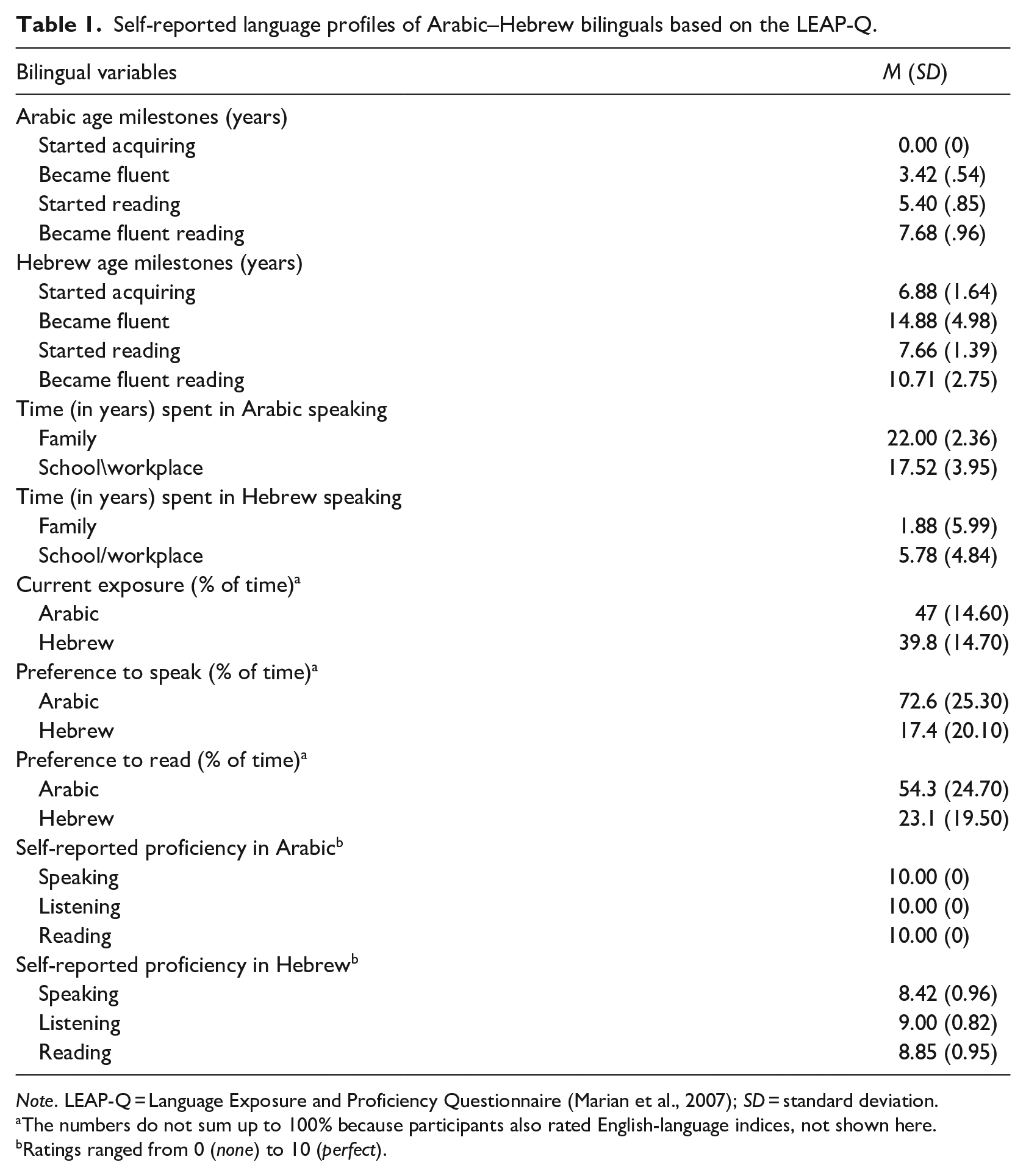
Note. LEAP-Q = Language Exposure and Proficiency Questionnaire (Marian et al., 2007); SD = standard deviation.
The numbers do not sum up to 100% because participants also rated English-language indices, not shown here.
Ratings ranged from 0 (none) to 10 (perfect).
The study was approved by the Institutional Review Board (IRB) of Tel-Aviv University.
Stimuli
The stimuli in SA, LA, and Hebrew were two-word expressions, which formed one of three types of semantic relations: conventional metaphors (e.g., the Hebrew expression הקפאת מגעים, whose word-to-word translation is freezing contacts meaning that communication has stopped), literal word pairs (e.g., זיהוי פלילי, whose word-to-word translation from Hebrew is criminal identification or forensics), and unrelated word pairs (e.g., עץ שיניים, which translates from Hebrew as teeth tree; see Appendix 1 for additional examples). The unrelated word pairs were constructed, so that they were grammatically correct but semantically implausible (which was verified based on judges’ ratings, as detailed next). The stimuli were chosen based on pre-tests, which were conducted to match the word pairs on relevant psycholinguistic variables across the experimental conditions (RVF vs LVF).
Arabic
Expression sets in SA and SA were created for the present study. The expressions in SA were transliterated using LA letters. Three pre-tests were conducted to assess the psycholinguistic features of the Arabic expressions. In each pre-test, 10 different judges, all native Arabic speakers similar in their characteristics to the participants of the main experiments, were recruited. None of the judges included in the pre-tests took part in the DVF experiments.
Pre-test 1 included 55 metaphoric, 47 literal, and 46 unrelated expressions in SA and 50 metaphoric, 61 literal, and 45 unrelated expressions in LA. Participants were asked to classify the expressions as metaphoric, literal, or unrelated. The expressions in each language were presented separately. Based on the results of this pre-test, expressions with agreement of 70% or more were selected: 52 metaphoric, 47 literal, and 46 unrelated expressions in SA and 43 metaphoric, 52 literal, and 32 unrelated expressions in LA.
In Pre-test 2, the metaphorical and literal pairs selected based on Pre-test 1 were presented in each language variety (separately) to judges who were asked to rate them on a 7-point familiarity scale ranging from 1 (highly unfamiliar) to 7 (highly familiar). Expressions with a mean familiarity rating of 4 or above were chosen for further testing. All of the expressions in SA met this criterion, and four metaphoric expressions in LA that scored below 4 were discarded.
In Pre-test 3, the judges were asked to rate the familiarity of the target words (the second word from each word pair). Familiarity was rated on a 7-point familiarity scale ranging from 1 (highly unfamiliar) to 7 (highly familiar). Subjective familiarity ratings were collected due to the absence of a commonly used frequency database of Arabic words. Expressions with a familiarity rating of 4 or higher were chosen for the experiment.
Hebrew
The expressions in Hebrew (39 metaphoric and 40 literal) were initially selected from a pool used in a previous study (Faust & Mashal, 2007). The expressions in that study were included if at least 70% of judges (native Hebrew speakers) agreed on their classification as common metaphors, literal expressions, or meaningless expressions. We ran two further pre-tests to estimate the expression familiarity and target word familiarity. In Pre-test 2, 10 Hebrew native speakers rated the metaphorical and the literal pairs on a 7-point familiarity scale ranging from 1 (highly unfamiliar) to 7 (highly familiar). Expressions with a mean rating of 4 or above were considered familiar. Seven metaphoric expressions were discarded based on the results of Pre-test 2. In Pre-test 3, 10 different native Hebrew speakers rated the familiarity of the target words (the second word from each word pair) on a 7-point familiarity scale ranging from 1 (highly unfamiliar) to 7 (highly familiar). Words with a mean familiarity rating of 4 or higher were chosen for the experiment.
The final set included 90 word pairs in each language, evenly divided between the three types of semantic relations: metaphoric, literal, and unrelated expressions. Half of the expressions were assigned to the RVF list and the other half—to the LVF list. The lists were balanced for expression familiarity, target word familiarity, and word length (p > .05; see Table 2).
Psycholinguistic characteristics of the experimental word pairs, as a function of expression type, visual field, and language.
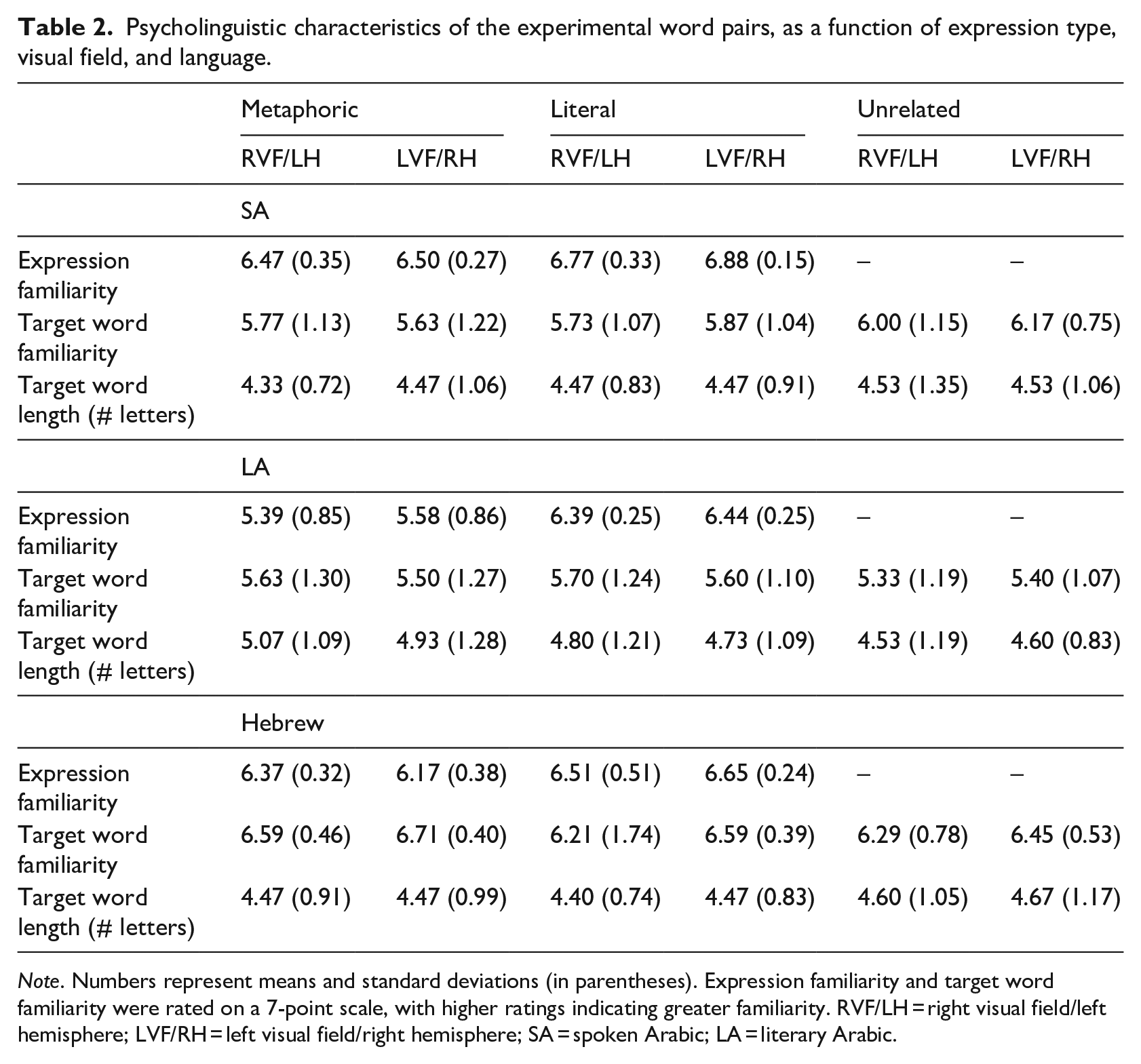
Note. Numbers represent means and standard deviations (in parentheses). Expression familiarity and target word familiarity were rated on a 7-point scale, with higher ratings indicating greater familiarity. RVF/LH = right visual field/left hemisphere; LVF/RH = left visual field/right hemisphere; SA = spoken Arabic; LA = literary Arabic.
Procedure
The DVF experiment combined with a semantic judgment task was used. Stimuli in each language were presented in a separate block, and the block order was counterbalanced across participants. Background questionnaires were administered between blocks to reduce fatigue. During the DVF experiment, participants were told that two words would appear one after the other on the screen. They were instructed to read the words silently and indicate as rapidly and accurately as possible whether they formed a meaningful expression. The first word of each pair was presented centrally, followed by the target stimulus (second word) displayed 2.80 (center of lateralized word to center of fixation) to the right or to the left of fixation. Participants were instructed to maintain central fixation.
The participants placed their right index finger between two keys on the computer keyboard and waited for a fixation cue (2,500 ms duration), which appeared in the center of the screen and indicated the trial onset. Then, the first word appeared at the center of the screen for 300 ms, followed by another fixation for 100 ms and then the target word for additional 180 ms. The fixation remained on the screen during the target stimulus presentation, to ensure full fixation cue, and then for additional 2,500 ms when response was allowed. The session began with a practice list, consisting of six word pairs not used in the experimental lists. The stimulus onset asynchrony (SOA) of 400 ms was previously used in similar tasks indexing semantic processing (Faust & Mashal, 2007; Mashal et al., 2015). Reaction time and accuracy data were collected. Responses were considered accurate when they matched the experimentally intended response (e.g., deciding the words formed a meaningful expression for pairs included in the metaphoric and literal expressions lists based on classification choices collected in Pre-test 1).
Results
Of the 46 participants in the sample, data from seven, all women, were excluded from the final analyses. Six had an overall accuracy score below 60% in the Hebrew or LA experiments, and one tended to classify the expressions as related regardless of expression type, which resulted in a particularly low mean accuracy of the unrelated word pairs. Percentage of correct responses and reaction times for correct responses were calculated. Reaction times more than 3 SD above or below the condition mean of an individual participant were excluded, and responses for unrelated word pairs, which were fillers, were not analyzed.
Assumptions of repeated measures analysis of variance (ANOVA) were checked following Tabachnick and Fidell’s (2007) recommendations. We found no outliers in our data (using cut-off criterion of Z-scores greater than 3.3 in absolute values), assumed normality of sampling distribution based on degrees of freedom per error term (each greater than df = 20), and tested sphericity assumption using Muchly’s sphericity test. Where the assumption was violated, values of Greenhouse–Geisser adjustment were reported.
Reaction time
A three-way repeated-measures ANOVA was conducted on reaction times, with language (SA, LA, and Hebrew), visual field (LVF/RH and RVF/LH), and expression type (metaphoric and literal) as within-subjects variables. The analysis yielded a significant main effect of language, F(2, 76) = 43.07, p < .001, partial η2 = .53 (with Greenhouse–Geisser correction). Post hoc tests with least significant difference (LSD) adjustment for multiple comparisons (p < .05) indicated that reaction times were significantly faster in SA (M = 834.72, SE = 19.23) compared to LA (M = 897.17, SE = 23.88), which in turn were faster compared to reaction times in Hebrew (M = 1,042.09, SE = 23.02). The main effect of visual field was also significant, F(1, 38) = 6.15, p = .02, partial η2 = .14, such that reaction times were faster in the RVF/LH (M = 914.65, SE = 18.26) than in the LVF/RH (M = 934.67, SE = 18.13). There was a significant main effect of expression type, F(1, 38) = 76.03, p < .001, partial η2 = .67. Reaction times were faster for literal (M = 888.00, SE = 16.98) than metaphoric (M = 961.32, SE = 19.41) expressions. Furthermore, the analysis resulted in a significant language by visual field interaction, F(2, 76) = 10.06, p < .001, partial η2 = .21, language by expression-type interaction, F(2, 76) = 8.09, p = .001, partial η2 = .18 (with Greenhouse–Geisser correction), and visual field by expression-type interaction, F(1, 38) = 16.20, p < .001, partial η2 = .30.
These two-way interactions were qualified by a significant three-way language by visual field by expression-type interaction, F(2, 76) = 9.16, p < .001, partial η2 = .19. To follow-up this significant result, we conducted two language by visual field ANOVAs, one for each expression type. The two-way interaction was significant for metaphoric expressions, F(2, 76) = 13.60, p < .001, partial η2 = .26. Pairwise comparisons (with LSD adjustment) indicated that mean reaction time was faster in the RVF/LH than LVF/RH for metaphoric expressions in SA (p < .001), but not in LA or Hebrew (see Figure 1(a)). The interaction was also significant for literal expressions, F(2, 76) = 4.79, p < .05, partial η2 = .11. Follow-up comparisons (with LSD adjustment) showed that mean reaction times were faster in the LVF/RH than in the RVF/LH for literal expressions in LA (p < .01), and no significant difference between the hemispheres was observed in either SA or Hebrew (see Figure 1(b)).
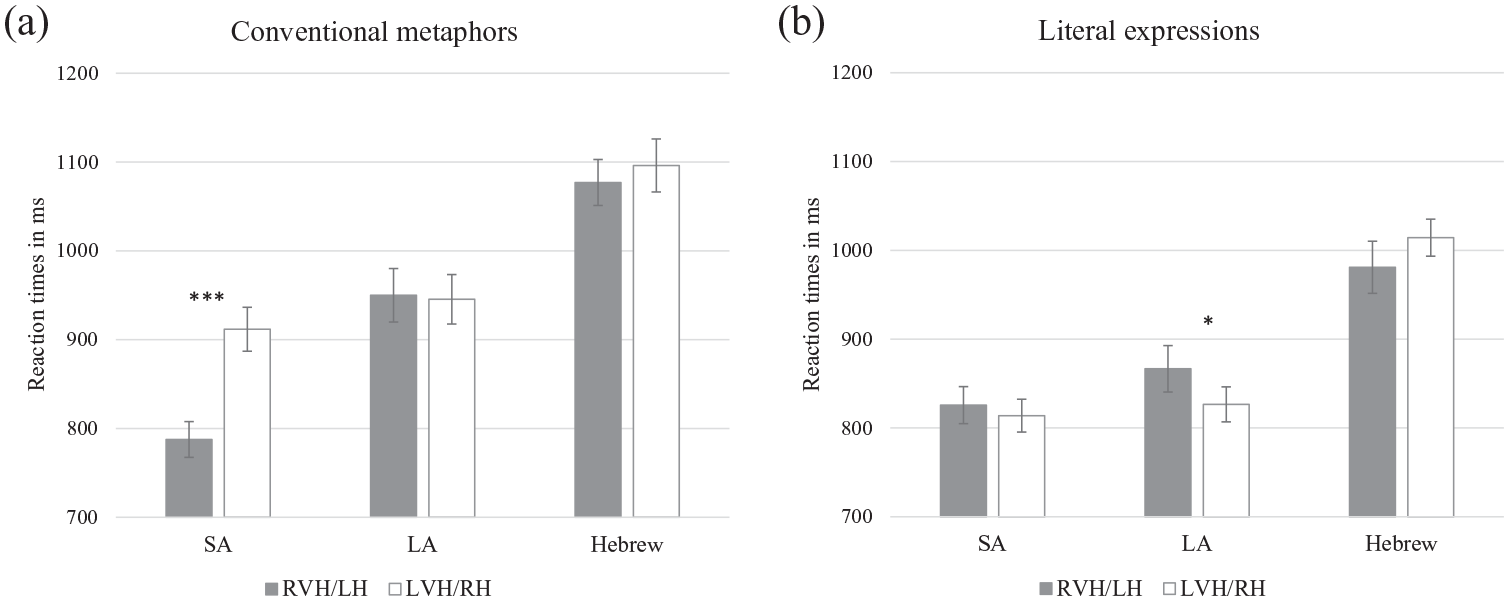
Mean reaction times (in ms) for (a) metaphoric expressions and (b) literal expressions.
Accuracy
Another three-way ANOVA was carried out on accuracy scores (in %), with language (SA, LA, and Hebrew), visual field (RVF/LH and LVF/RH), and expression type (metaphoric and literal) as within-subjects independent variables. The analysis yielded a main effect of language, F(2, 76) = 106.04, p < .001, partial η2 = .74 (with Greenhouse–Geisser correction). Post hoc analyses using LSD adjustment for multiple comparisons (p < .05) indicated that responses were more accurate in SA (M = 94.19, SE = .82) compared to LA (M = 86.11, SE = .93), which in turn were more accurate than responses in Hebrew (M = 74.19, SE = 1.39). There was also a significant main effect of visual field, F(1, 38) = 28.67, p < .001, partial η2 = .43. Responses were more accurate when the expression was presented in the RVF/LH (M = 86.55, SE = 0.80) than the LVF/RH (M = 83.11, SD = 0.79). The main effect of expression type was significant as well, F(1, 38) = 114.03, p < .001, partial η2 = .75. Responses were more accurate for literal (M = 89.74, SE = 0.63) than metaphoric (M = 79.91, SE = 1.04) expressions. The language by visual field interaction and the language by expression-type interaction were significant, F(2, 76) = 4.21, p = .02, partial η2 = .10 and F(2, 76) = 23.67, p < .001, partial η2 = .38 (with Greenhouse–Geisser correction), respectively, while the visual field by expression-type interaction was not, F(1, 38) = 2.39, p > .05, partial η2 = .06.
Most importantly, the three-way language by visual field by expression-type interaction was significant, F(2, 76) = 6.87, p = .002, partial η2 = .15 (with Greenhouse–Geisser correction). To further explore this interaction, language by visual field ANOVAs were conducted separately for each expression type. The two-way interaction was significant for metaphoric expressions, F(2, 76) = 8.66, p < .001, partial η2 = .19. Pairwise comparisons (with LSD adjustment) yielded a significant difference for SA (p < .001) and Hebrew (p < .01). As Figure 2(a) demonstrates, accuracy was higher for metaphoric expressions presented in the RVF/LH than in the LVF/RH in both languages. No significant difference was found for LA. There was no significant language by visual field interaction for literal expressions, F(2, 76) < 1, suggesting that accuracy was higher for literal expressions in the RVF/LH than LVF/RH regardless of language (see Figure 2(b)).
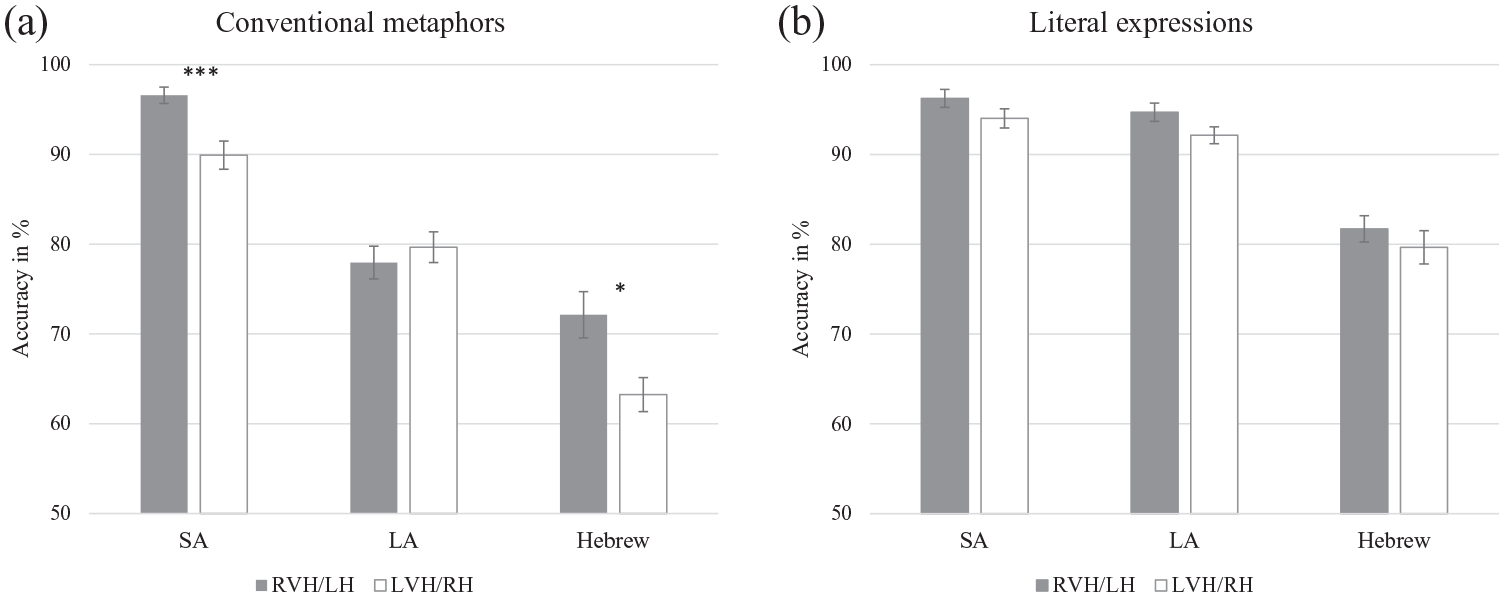
Mean accuracy (in %) for (a) metaphoric expressions and (b) literal expressions.
Overlap in Hebrew (second language) and SA/LA (native language) metaphors
A post hoc inspection revealed that some of the metaphoric expressions in Hebrew also exist in one or both varieties of Arabic as a direct word-to-word translation. We reasoned that to process overlapping metaphors, bilinguals may transfer their knowledge from native language and consequently process these second-language expressions as if they were native language expressions. To rule out such effects, we re-analyzed the data, this time including only non-overlapping metaphoric expressions in Hebrew. Seven and 10 metaphoric expressions remained in the RVF/LH and the LVF/RH lists, respectively. Given the reduced number of metaphoric expressions in Hebrew after the exclusion, we consider the following analyses exploratory.
A three-way repeated-measures ANOVA on reaction times yielded a significant three-way interaction, F(2, 72) = 10.62, p < .001, partial η2 = .23. Follow-up two-way ANOVAs on reaction times conducted separately for metaphoric and literal expressions each resulted in a significant interaction, F(2, 72) = 12.98, p < .001, partial η2 = .27 and F(2, 76) = 4.79, p < .05, partial η2 = .11, respectively. Pairwise comparisons (with LSD adjustment) suggested mean reaction times were faster when metaphoric expressions in SA were presented to the RVF/LH compared to the LVF/RH, while there was no significant difference between the hemispheres for metaphoric expressions in LA or Hebrew. Mean reaction times were also significantly faster when literal expressions in LA were presented to the LVF/RH compared to the RVF/LH, but no such difference was observed for literal expressions in SA or Hebrew. These findings replicate the findings of the main analyses reported above.
Another three-way repeated measures ANOVA was conducted on accuracy scores, which yielded a marginally significant three-way interaction, F(2, 72) = 2.99, p = .057, partial η2 = .08. Follow-up two-way ANOVAs resulted in a significant interaction for metaphoric expressions, F(2, 72) = 3.26, p < .05, partial η2 = .08, but not for literal expressions, F(2, 76) < 1. Pairwise comparisons (with LSD adjustment) suggested accuracy was higher when metaphoric expressions in SA were presented to the RVF/LH compared to the LVF/RH, while the difference between the hemispheres was not significant for metaphoric expressions in LA or Hebrew. Thus, accuracy results for non-overlapping metaphoric expressions indicated a bilateral processing pattern in Hebrew, while the main analysis, which included both overlapping and non-overlapping expressions, showed an LH advantage.
Discussion
The present study examined, using the DVF paradigm, hemispheric involvement in the comprehension of conventional metaphors in Arabic–Hebrew speakers in SA, LA, and Hebrew. As expected, the overall performance in SA and LA was faster and more accurate than in Hebrew, confirming that processing expressions in the native language is easier than in the second language. In SA, responses to metaphoric expressions were faster and more accurate in the RVF/LH than in the LVF/RH. In LA, a bilateral pattern was observed in both accuracy and reaction times. The results in both varieties of Arabic are consistent with the previously reported LH advantage (Bohrn et al., 2012; Faust & Mashal, 2007; Mashal & Faust, 2008; Mashal et al., 2007) and bilateral processing (Bambini et al., 2011; Diaz et al., 2011) of conventional metaphors in a native language.
In the non-native Hebrew, a bilateral pattern was observed in mean reaction time, while accuracy data showed an LH advantage. After eliminating metaphoric expressions in Hebrew that had direct translation equivalents in Arabic, accuracy was comparable across the hemispheres. The divergence in accuracy results implies that cross-linguistic overlap in metaphoric expressions can alter hemispheric processing. Such cross-language effects have been previously observed in comprehension and processing of second-language idioms (Carrol et al., 2018; Titone et al., 2015), but to our knowledge, not in the patterns of hemispheric involvement. We treat the results of this exploratory analysis with caution, given that it was conducted post hoc and consequently was calculated on a small set of stimuli. These intriguing findings, however, deserve a more systematic investigation in future research.
Importantly, neither the main analysis nor the exploratory analysis excluding cross-linguistically overlapping metaphoric expressions in Hebrew yielded the previously documented RH advantage observed in English-Hebrew bilinguals (Mashal et al., 2015). The Arabic–Hebrew speakers in our sample and the English-Hebrew speakers in Mashal et al.’s sample had comparable history of Hebrew language acquisition. Both groups acquired the language in a formal setting in childhood and later, while attending a Hebrew-speaking university, immersed in it. The groups rated their Hebrew proficiency comparably high (above 7 on a scale ranging from 0 to 10). They also reported a similar current exposure to Hebrew (about 40% of time in Arabic–Hebrew speakers and 43% in English-Hebrew speakers) and a similar preference to use it in reading (23% of time in Arabic–Hebrew speakers and 26% in English-Hebrew speakers). It is thus unlikely that sample characteristics, such as language acquisition history and language exposure and proficiency can account for the between-group difference in hemispheric dominance for comprehension of conventional metaphors in a second language.
Language similarity, however, is greater for Arabic–Hebrew speakers compared to English–Hebrew speakers (as well as other previously tested pairs of languages). Language similarity has been previously shown to modulate hemispheric processing in a dichotic listening paradigm, with more convergence observed in a pair of similar languages compared to a pair of more distant languages (D’Anselmo et al., 2013). The greater LH involvement in Hebrew processing is consistent with these findings and indicates that metaphoric processing may be also affected by language similarity. Due to greater language similarity, the formal aspects of a metaphoric expression in Hebrew (e.g., lexical, morpho-syntactic, and orthographic) may require less cognitive resources in Arabic–Hebrew speakers compared to English–Hebrew speakers, which may be allocated to a greater extent to processing the figurative meaning of the expression and its internalization (with time) as the salient meaning. This in turn may give rise to the greater involvement of LH in processing second-language metaphors. Language similarity may thus counterbalance the effect of prior, non-native experience with metaphors in a second language that prevents the establishment of the figurative meaning of a metaphoric expression as the salient meaning (Kecskes, 2006), as was previously shown in pairs of less similar languages (e.g., English and Hebrew in the work of Mashal et al., 2015; Polish and English in the works of Cieslicka & Heredia, 2011; Jankowiak et al., 2017).
Across expression types, reaction times were shorter and accuracy was higher in SA compared to LA. In other words, SA functioned as the more dominant language, although the words were presented visually. These findings are inconsistent with previous research showing that the processing of the Arabic language varieties is modality dependent: SA may function as the more dominant language in oral communications and LA—in reading and writing (Ibrahim & Aharon-Peretz, 2005; Nevat et al., 2014). The lack of the modality effect in our study may be unique to the type of linguistic stimuli we examined in this study, namely, metaphoric expressions. The learning of the two meanings of metaphors, literal and figurative, and the eventual representation of the figurative meaning as the salient meaning in the mental lexicon may require more diverse and versatile experiences with the expressions in real-life context than the learning of literal expressions and single words. Such learning is perhaps less possible when the metaphor is encountered mainly in written materials, as is the case for LA metaphors (a diglossia effect).
There are limitations to the current study. Participants were studying in central Israel, but were originally from different regions of the country, and thus spoke somewhat different varieties of SA depending on their region of birth. However, it is unlikely that this difference has had a significant effect, since the results of the SA experiment showed an LH advantage, as would have been expected in response to highly familiar, native language metaphoric expressions. In addition, LEAP-Q (Marian et al., 2007), which we used to evaluate the linguistic profiles of Arabic–Hebrew speakers, makes no distinction between SA and LA, which renders the interpretation of reading-related questions somewhat difficult. For instance, when rating current use of Arabic for reading, participants may have referred to reading in LA or reading in LA as well as reading SA words in LA spelling (e.g., when reading text messages). Researchers of Arabic speakers may consider a separate evaluation of SA and LA in self-reported measures of language history and proficiency. Another limitation of our study was a gender-biased sample, which included more women than men. Thus, our findings may be more representative of how women process conventional metaphors. Our findings are also limited to proficient second-language speakers, and since hemispheric processing of conventional metaphors is affected by vocabulary knowledge (Briner et al., 2018), the applicability of our findings to low- and intermediate-proficiency speakers should be tested separately.
The current study provides initial evidence that hemispheric processing of metaphors in a second language may be modulated by language similarity. To examine this topic more directly, future research may compare between different language pairs in the same study. To rule out the possibility that the effects observed in the second language are attributable to the unique features of that language rather than to processing in a second language, monolingual speakers of that language should be also included (for a similar design, see Mashal et al., 2015; Metuki et al., 2013). Another interesting extension of our study would be looking at metaphoricity as a continuum instead of a dichotomy, as we chose, which may increase analysis sensitivity of hemispheric contributions (e.g., Lai et al., 2015). Finally, the specific aspects of language similarity (e.g., lexical, morpho-syntactic, or orthographic) that may affect hemispheric processing of figurative language also remain to be explored.
Footnotes
Appendix
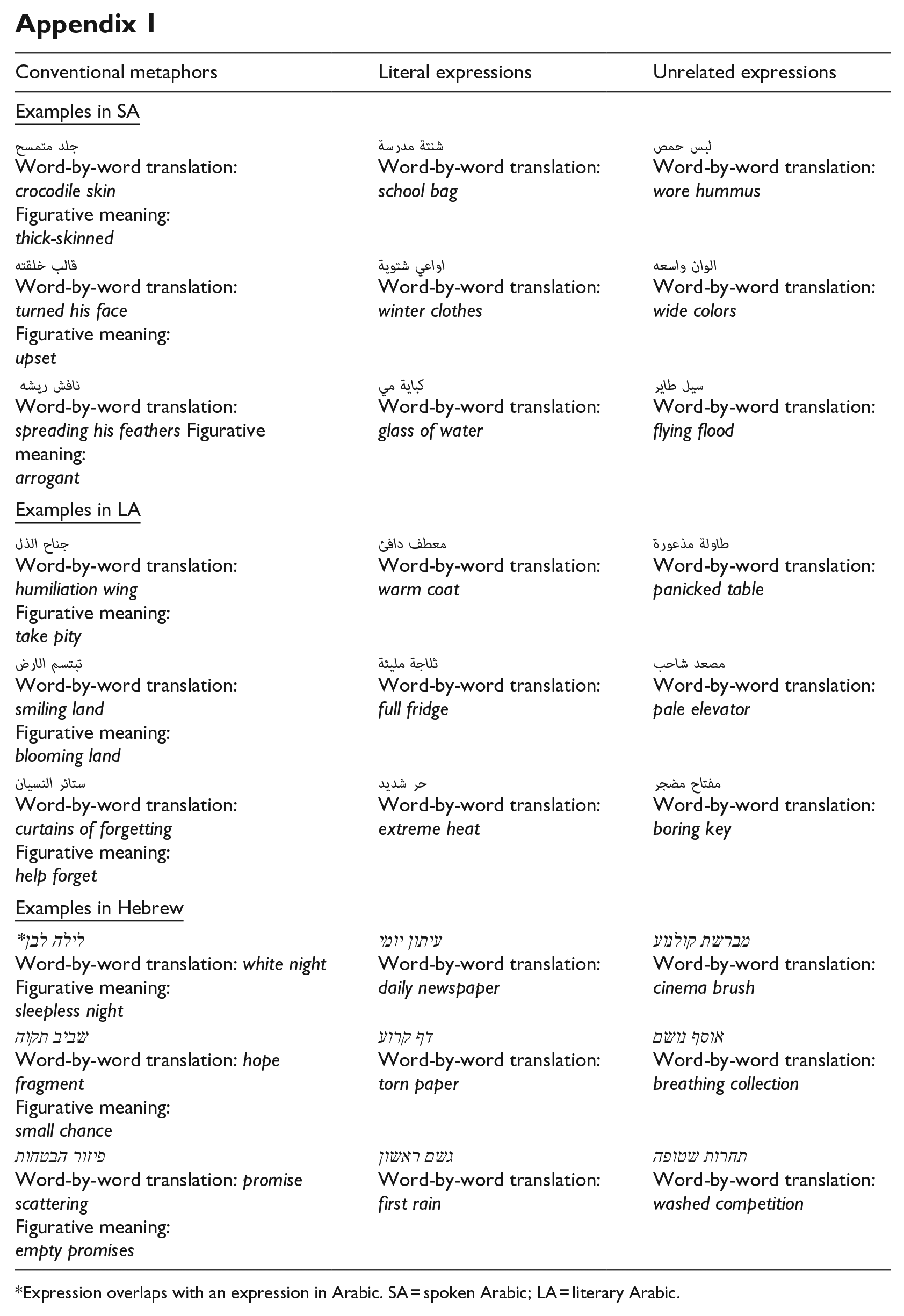
| Conventional metaphors | Literal expressions | Unrelated expressions |
|---|---|---|
|
|
||
| جلد متمسح
Word-by-word translation: crocodile skin Figurative meaning: thick-skinned |
شنتة مدرسة
Word-by-word translation: school bag |
لبس حمص
Word-by-word translation: wore hummus |
| قالب خلقته
Word-by-word translation: turned his face Figurative meaning: upset |
اواعي شتوية
Word-by-word translation: winter clothes |
الوان واسعه
Word-by-word translation: wide colors |
| نافش ريشه
Word-by-word translation: spreading his feathers Figurative meaning: arrogant |
كباية مي
Word-by-word translation: glass of water |
سيل طاير
Word-by-word translation: flying flood |
|
|
||
| جناح الذل
Word-by-word translation: humiliation wing Figurative meaning: take pity |
معطف دافئ
Word-by-word translation: warm coat |
طاولة مذعورة
Word-by-word translation: panicked table |
| تبتسم الارض
Word-by-word translation: smiling land Figurative meaning: blooming land |
ثلاجة مليئة
Word-by-word translation: full fridge |
مصعد شاحب
Word-by-word translation: pale elevator |
| ستائر النسيان
Word-by-word translation: curtains of forgetting Figurative meaning: help forget |
حر شديد
Word-by-word translation: extreme heat |
مفتاح مضجر
Word-by-word translation: boring key |
|
|
||
| *לילה לבן
Word-by-word translation: white night Figurative meaning: sleepless night |
עיתון יומי
Word-by-word translation: daily newspaper |
מברשת קולנוע
Word-by-word translation: cinema brush |
| שביב תקוה
Word-by-word translation: hope fragment Figurative meaning: small chance |
דף קרוע
Word-by-word translation: torn paper |
אוסף נושם
Word-by-word translation: breathing collection |
| פיזור הבטחות
Word-by-word translation: promise scattering Figurative meaning: empty promises |
גשם ראשון
Word-by-word translation: first rain |
תחרות שטופה
Word-by-word translation: washed competition |
Expression overlaps with an expression in Arabic. SA = spoken Arabic; LA = literary Arabic.
Acknowledgements
The authors thank the participants for their time and Rana Khazne for assistance in preparing and pre-testing the experimental materials in the Arabic language.
Declaration of conflicting interests
The author(s) declared no potential conflicts of interest with respect to the research, authorship, and/or publication of this article.
Funding
The author(s) received no financial support for the research, authorship, and/or publication of this article.
