




Abstract
Aims and objectives:
In this study, we consider the acquisition of allophonic contrast and phonetic detail in lateral consonants by second-generation Sylheti-English bilingual children in London, UK.
Design/methodology/approach:
Acoustic analysis was conducted on productions of /l/ by Sylheti bilingual children, Sylheti monolingual adults and English monolingual children.
Data and analysis:
Tokens of /l/ were elicited across initial, medial and final word positions from 14 bilingual Sylheti-English children, 10 monolingual English children, and 4 monolingual Sylheti adults. Acoustic measurements of F2–F1 were analysed using Bayesian linear mixed-effects modelling.
Findings and conclusions:
Our results show that bilingual children produce monolingual-like positional patterns in Sylheti, with very clear laterals in all positions. In contrast, bilinguals produce monolingual-like positional allophony in English, but they differ in phonetic detail, with bilinguals producing much clearer laterals than monolingual children across all positions.
Originality:
This study is the first to examine the development of allophonic contrast and phonetic detail in both of a bilingual’s languages in a contact scenario. This provides new insights into how contact varieties adopt aspects of structure and detail from each language. We also report valuable data from Sylheti-English bilinguals, who are an understudied community.
Significance/limitations:
Our study highlights the value of considering structural and detailed aspects of cross-linguistic sound systems, whereby one aspect may show monolingual-like patterns and another aspect may show distinctive patterns. We propose that the results in this study represent the development of a new sound system out of language contact, with second-generation bilingual children producing a hybrid system that combines influences from both heritage and host languages.
Keywords
Introduction
When a child grows up bilingual, they have to navigate the sound systems of two different languages. This learning spans phonological contrast (differences between phonemes), allophonic structure (contextual differences in a sound) and phonetic detail (the precise details of pronunciation) (Chang, 2015). The majority of research tends to examine just one of these dimensions, with the predominant focus being phonological contrast (Burns et al., 2007; Sundara et al., 2008) and, to a lesser extent, allophony (Burrows et al., 2019; Fabiano-Smith et al., 2015). However, investigating cross-linguistic systems across multiple levels of a sound system can be highly instructive in better understanding how bilingual phonological repertoires are linked. For instance, there is the possibility that monolingual-like behaviour may be evidenced in one dimension, which could be combined with new and distinctive elements in another dimension. This is particularly pertinent when new accents may be developing out of community bilingualism, where different elements of each language may be combined in order to produce a new system (Cheshire et al., 2011; McCarthy et al., 2013).
In this study, we investigate sequential Sylheti-English bilingual children acquiring laterals in a highly multilingual Bangladeshi community in London, UK. In particular, we focus on the acquisition of positional allophony (differences according to word position) and phonetic detail (gradient differences in pronunciation) in lateral consonants. This allows us to examine whether bilingual productions pattern with monolinguals of each language, or whether they produce monolingual-like allophony with non-monolingual-like phonetic detail. In doing so, we investigate cross-linguistic links between lateral systems and examine whether bilingual children in an immigrant community are developing a new linguistic variety.
Bilingual children’s acquisition of sound systems
Research on phonological acquisition by simultaneous child bilinguals show that they can acquire the phonemes of both languages and produce monolingual-like categories (Burns et al., 2007; Sundara et al., 2008). However, monolingual-like acquisition is not inevitable, with some bilinguals showing different developmental trajectories from monolinguals (see Werker et al., 2009 for a review). Sequential bilinguals, who are typically defined as acquiring the second language after the age of three (McLaughlin, 1978), are less likely to acquire monolingual-like productions than simultaneous bilinguals in the majority language. However, Kim et al. (2018) show that the sequential/simultaneous distinction does not always neatly map onto age and, to this end, the use of more monolingual-like productions is also likely to depend on other factors, such as the amount of exposure in each language, as well as the ambient language environment (Darcy & Krüger, 2012; Khattab, 2000; McCarthy et al., 2014; Nance, 2019).
The acquisition of allophonic contrasts by bilinguals is less well studied. Allophony refers to systematic phonetic variants of a phonological category that do not encode lexical contrast but form part of a language’s sound structure. For example, a widely studied pattern is the positional allophony of laterals in English, whereby in some varieties syllable-initial laterals are produced with a more consonantal articulation (often referred to as ‘clear’), whereas syllable-final laterals are produced with a more vocalic gesture (often referred to as ‘dark’) (Sproat & Fujimura, 1993). In this way, it is possible to acquire a particular phoneme in a language, but not apply allophonic rules in a monolingual-like manner. Previous perception research on monolinguals suggests that children may begin to treat phonemes differently from allophones at a young age, with lesser attention paid to non-contrastive allophonic patterns at 11 months compared to 4 months (Seidl et al., 2009). Speech production research shows variable patterns of acquisition, with some studies showing monolingual-like allophony (Burrows et al., 2019) and other contexts showing the reverse (Fabiano-Smith et al., 2015). In contexts where bilingual speakers do reproduce monolingual-like allophony, we may also ask about whether phonetic detail is also monolingual-like. Barlow et al. (2013) show that Spanish-English bilingual children produce an initial ~ final contrast in English laterals, but not in Spanish laterals, which matches monolingual-like allophonic patterns in each language. However, they also show that bilingual children produce phonetically clearer /l/s than monolinguals in English, suggesting that bilinguals produce monolingual-like allophony but differ in phonetic detail. This is likely to be one correlate of L2-accented speech and warrants more detailed investigation in other languages and contexts.
New accents in bilingual communities
In the present study, we study the acquisition of allophonic contrast and phonetic detail in a bilingual immigrant community in the UK. In such communities, children tend to acquire their home language before acquiring the majority host language via schooling, which represents a case of what Lyon (1996) calls ‘coordinate’ bilingualism, where each language is acquired in separate contexts. It is well established that child bilingual acquisition in such contexts can lead to the development of new accents. For example, a growing body of research in the UK has documented the development of British Asian English, which is a term used to describe the English spoken in South Asian communities in the UK (Alam & Stuart-Smith, 2011; Heselwood & McChrystal, 2000; Kirkham, 2011; Lambert et al., 2007; Sharma & Sankaran, 2011). These studies show that new accents can develop out of community bilingualism and may stabilise into nativised varieties. For example, varieties of British Asian English show strong influence from South Asian languages in the use of retroflex coronal stops (Alam & Stuart-Smith, 2011) and very clear laterals (Kirkham, 2017), but also show highly localised features, such as monophthongal productions of diphthongs in some northern English dialects (Wormald, 2016).
Individual and societal language contact is strongly hypothesised to be a motivator behind the development of new accents and, for this reason, cross-linguistically similar sounds are predicted to be a rich source of contact-inducted change in multilingual communities. Models of L2 speech perception predict that when an L2 contrast is perceived as similar to an L1 contrast then the L2 phonemes may be assimilated to the corresponding L1 phonemes (Best & Tyler, 2007). The degree of convergence between phonemes is likely to be more pronounced when two languages shared typologically similar systems prior to contact taking place (Amengual & Chamorro, 2015; Kirkham & Nance, 2017; Mennen, 2004), with any convergence hypothesised to result from links between a bilingual’s two languages (Flege, 1995). At the same time, there is also evidence that speakers can develop distinct phonetic categories for similar sounds in each language (Sundara et al., 2006), so complete convergence is not inevitable and may depend on various factors. Indeed, divergence can also occur, with contact varieties often exhibiting convergence in some areas but divergence in others (Colantoni & Gurlekian, 2004; Mayr et al., 2017).
Despite the centrality of bilingualism to the development of new accents in contact scenarios, many previous studies of English contact varieties have not collected bilingual data (e.g. Alam & Stuart-Smith, 2011; Kirkham, 2017; Wormald, 2016). Those that do, however, reveal complex patterns of parallel development in bilingual sound systems (Mayr & Siddika, 2018; McCarthy et al., 2013). In this study, we seek to further advance research in this area through a study of child bilinguals in a large Bangladeshi community in London.
The London Bangladeshi community
The Bangladeshi community is one of the most established minority ethnic communities in London, UK, with the majority of London-Bengalis residing in the London boroughs of Newham, Camden and Tower Hamlets (Office of National Statistics, 2011). This study focuses on the latter borough, where 32% of the population are of Bangladeshi heritage, the largest in the UK (Office of National Statistics, 2011; Tower Hamlets, 2018). Migration, primarily from Sylhet, since the 1950s has resulted in a dense community made up of first, second and subsequent generations. As a result, Sylheti is a dominant heritage language spoken in the home and wider community (McCarthy et al., 2013). Here our focus is on Sylheti-English bilingual children of first-generation parents (i.e. born in Bangladesh).
There is very little published research on monolingual Sylheti, but previous phonetic research on Sylheti-English bilingual children and adults in the UK has investigated speakers at different stages of migration, as well as intergenerational differences (Mayr & Siddika, 2018; McCarthy et al., 2011, 2013, 2014). McCarthy et al. (2013) found that second-generation Sylheti-English bilinguals produced native-like categories for Sylheti vowels but not Sylheti stops, while their English is similar to local monolingual English norms. Mayr and Siddika (2018) report data on stops from Sylheti families living in Wales, and they find that first-generation speakers use non-native productions of English stops, but that subsequent generations show productions that are increasingly closer to monolingual English. It is notable in the Welsh context that the Sylheti community is much smaller than the London community and somewhat stagnant, with no continuing migration from Bangladesh, which may explain subsequent generations’ move towards monolingual English norms. This differs considerably from the London context, where there is continuing migration and a stable Bangladeshi Sylheti-speaking majority in the local community.
Previous research shows that second-generation speakers may move away from L1-influenced patterns in the London Sylheti community (McCarthy, 2013; McCarthy et al., 2011, 2013) and this is also true of contact varieties within London more broadly, such as Multicultural London English (Cheshire et al., 2011). We anticipate that a major factor in this respect is the English input that bilingual children receive. In our study, the bilingual children’s parents largely speak Sylheti, plus some Sylheti-accented English. The majority of the children’s English input, however, will come from other family members, such as siblings or cousins, many of whom will also be second-generation speakers. In such cases, the English input is largely East London Multicultural London English or Sylheti-accented English, albeit with a weaker Sylheti influence than seen in the parents’ speech. Accordingly, we may predict a weakening of Sylheti’s influence on bilingual children’s English across successive generations.
The present study
In this study, we examine allophonic contrast and phonetic detail in the lateral system of bilingual Sylheti-English children, comparing this to monolingual English children and monolingual Sylheti adults. In particular, we ask whether Sylheti-English bilingual children produce monolingual-like positional allophony in Sylheti and English laterals, as well as whether or not bilingual children produce monolingual-like phonetic detail in English laterals. Laterals are often described using the qualitative terms ‘clear’ and ‘dark’, with clear /l/s showing a raised and fronted tongue body, and dark /l/s showing a lower and retracted tongue dorsum. In addition to this, there is also the possibility of /l/ vocalisation in coda position, which can be somewhat categorically distinct from /l/ darkening, while also sharing very similar articulatory mechanisms (Hardcastle & Barry, 1989; Turton, 2017). Previous research shows that initial ~ final allophony is robust in many English varieties, with clearer /l/s in syllable onsets and darker /l/s in syllable codas (Sproat & Fujimura, 1993), although this can vary by dialect (Carter & Local, 2007; Kirkham, 2017). More generally, there is a universal phonetic tendency for coda laterals to be darker than initial laterals, which is grounded in the robust cross-linguistic finding that postvocalic laterals involve a dorsal constriction and that gestural timing also differs between prevocalic and postvocalic laterals (Gick et al., 2006). We anticipate such phonetic differences, however, to be smaller than patterns of language-specific positional allophony.
Sylheti laterals have not been comprehensively documented and we are not aware of any previous acoustic studies on this aspect of Sylheti’s sound system. Descriptions of its consonant inventory suggests that Sylheti has a single alveolar lateral phoneme (Gope & Mahanta, 2015), which is claimed to be ‘never dark’ (McCarthy, 2013, p. 30). We therefore make the basic prediction that Sylheti monolinguals produce phonetically clear /l/s in all positions, but may also show a phonetic effect in word-final position of lower F2–F1 values than in initial position due to the aforementioned cross-linguistic trends in lateral production. However, we predict that this initial ~ final contrast will be smaller than what we see in English monolinguals, as we have no reason to suspect a more robust allophonic contrast in Sylheti. The English data we report in this study is from London, which is widely reported to have a robust initial ~ final contrast, with clear /l/s in onsets and dark /l/s in codas, with some coda /l/s also being variably vocalized (Wells, 1982).
Methods
Speakers and experimental design
Data were collected from 14 Sylheti-English bilingual children (6–7 years old;
The adult Sylheti data were recorded as part of a previous study (McCarthy et al., 2013). The Sylheti adults were functionally monolingual, having arrived in the UK within 3 months of the recording session, with a maximum of 1 month’s English classes since arriving in the UK. We use this group as a control for monolingual Sylheti speech because data collection in Bangladesh was not feasible for the current study. We also anticipate that this group better represents the kind of monolingual input that Sylheti-English bilingual children are likely to hear in the local community. Our monolingual English child controls resided in the inner-London borough of Islington and, importantly for this study, had no prior contact with Sylheti. The English input experienced by bilingual and monolingual children is broadly similar, with both groups being highly exposed to Multicultural London English and contact varieties of London English.
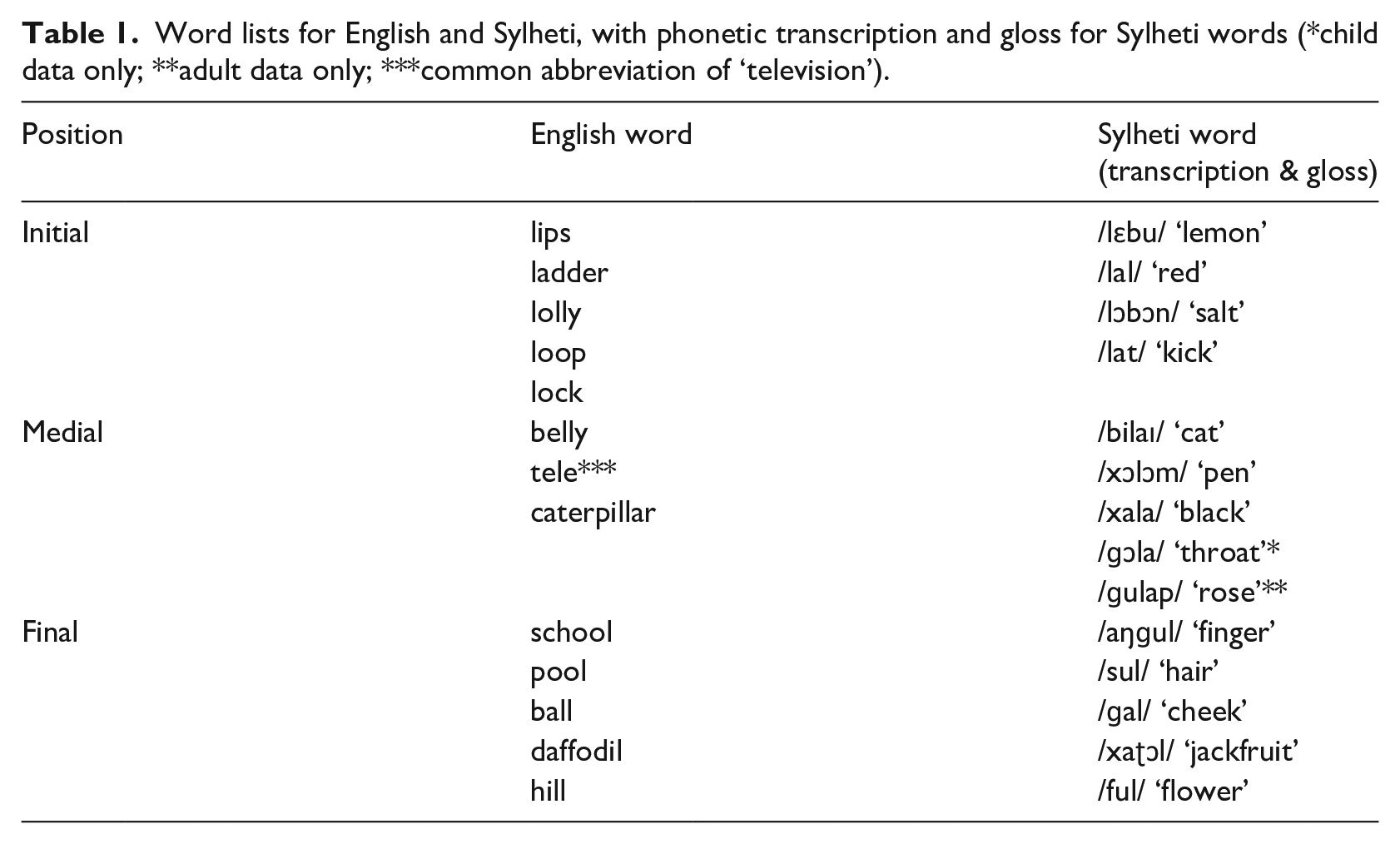
All recordings were made in a quiet room in the speakers’ home (adults) or children’s school using a H2 Zoom recorder with a sampling rate of 44.1 kHz. The Sylheti and English recordings were carried out in separate sessions, with native speakers of the target language (second author for English). The children were instructed that the Sylheti-speaking research assistant could not speak English, to ensure the children did not name the pictures in English. The pictures had been previously piloted with two adult Sylheti speakers. The English word list contained words with /l/ in initial (N = 5), medial trochaic (N = 3) and final (N = 5) position, while the Sylheti word list contained words with /l/ in initial (N = 4), medial (N = 4) and final (N = 5) position. We attempted to control for vowel quality as far as possible, but this had to be balanced against using words that would be familiar for the children and could be represented using images, particularly in Sylheti (see Table 1 for word list). The target words were elicited twice in a fixed pseudo-random order using a picture naming technique. Our statistical modelling includes word random intercepts in order to minimise the effect of any one particular word having an unduly strong effect on model estimates.
Word lists for English and Sylheti, with phonetic transcription and gloss for Sylheti words (*child data only; **adult data only; ***common abbreviation of ‘television’).
Acoustic analysis
Segmentation of the acoustic signal was conducted manually using visual observation of the waveform and wide-band spectrogram. The lateral and its adjacent vowels were segmented according to published criteria in the literature (Carter & Local, 2007; Kirkham, 2017; Kirkham et al., 2019). Specifically, the lateral phase was defined as a period during which F2 was steady or as close to steady as possible, representing an unambiguously lateral sound. Vowel onsets and offsets were segmented according to the onset/offset of F2 as visible on the spectrogram. An example of lateral labelling is shown in Figure 1.
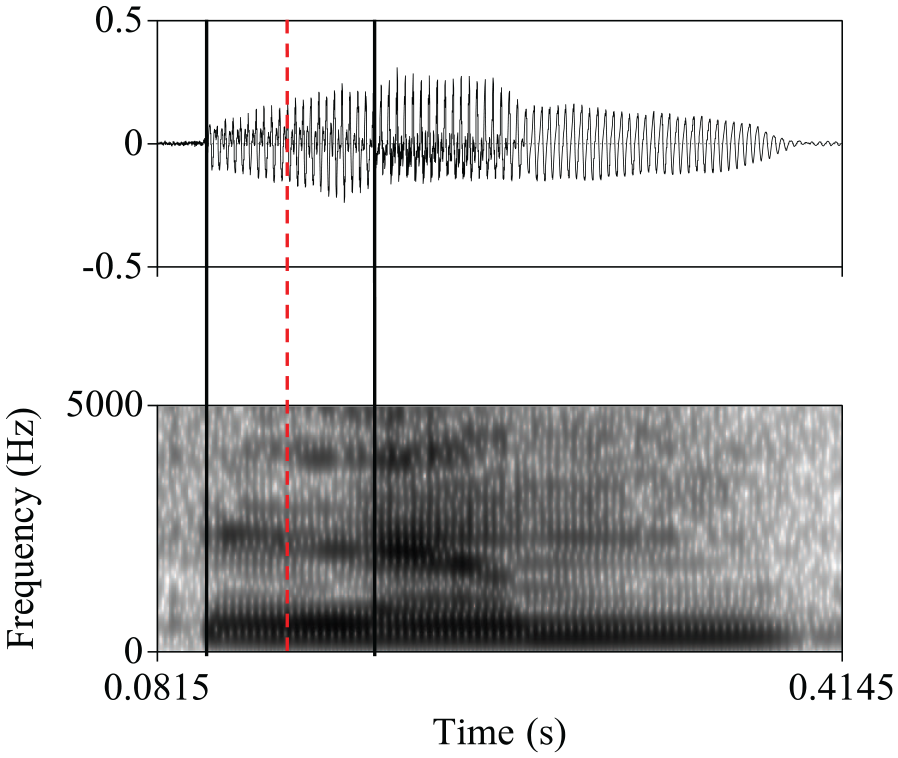
Example labelling of a word-initial lateral in the Sylheti word lembu (note that the acoustic representation only shows the first syllable of the word). Solid lines show segmental labelling of the lateral steady-state; dashed line shows the temporal midpoint where formant estimation was conducted.
F1 and F2 were estimated using Praat from a 25 ms Gaussian window at the temporal midpoint of the lateral. Praat’s LPC Burg method was used for formant estimation, which was set to find five formants up to the maximum formant value. Optimal LPC settings were empirically determined for each speaker using a method similar to Escudero et al. (2009). We focus on the measure of F2–F1 because previous research shows this to be an effective measure of lateral quality (Kirkham et al., 2019; Sproat & Fujimura, 1993). Formant values were then converted to z-scores to better facilitate speaker comparison, especially as our primary focus is on within-speaker contrasts between different word positions. Any tokens with z-scored formant values of |z| = 3 were excluded as outliers (N = 59), which is a standard outlier removal technique and was used to exclude any formant tracking errors. In total, 1316 tokens of /l/ were analysed (bilingual Sylheti = 519, bilingual English = 464; monolingual Sylheti = 94; monolingual English = 239).
Statistical analysis
We analyse our data using Bayesian mixed-effects regression. The outcome of a Bayesian model is a posterior distribution, which is a distribution or interval of plausible values that represent a given effect. This differs from frequentist modelling, which often tells us whether or not an effect is significant, or whether or not a confidence interval includes zero. The main advantage of Bayesian methods in this respect is that it provides a more holistic estimate of the magnitude of an effect and the degree of uncertainty we have about that effect, rather than a binary decision based on an arbitrary threshold for
For our analysis, we fitted Bayesian linear mixed-effects models to the F2–F1 data in R using the brms package (Bürkner, 2017). We fitted separate models to two subsets of our data: one for Sylheti (comparing bilingual children and monolingual adults) and one for English (comparing bilingual children and monolingual children). In each case, we included fixed effects of position (initial/medial/final), group (monolingual/bilingual) and vowel (front/back). We also included interactions between group*position and group*vowel (we have no sensible predictions for position*vowel, so did not include such an interaction). Random effects included by-speaker random slopes for position and vowel, and a random intercept for word. We used weakly informative priors for the intercept, beta parameters, random effects and error terms, which means that the influence of extreme values on the posterior is minimised, but otherwise the prior does not have a strong influence on the posterior. Full information and documentation can be found in the publicly available code: https://osf.io/up2wm/
For each predictor variable we report mean values, 95% confidence intervals, and Bayes factors. Bayes factors represent the ratio of the likelihood of one hypothesis against the likelihood of another hypothesis, which can be used to determine the level of support for a particular predictor variable against the null hypothesis. Unlike traditional frequentist modelling, there are no arbitrary thresholds for levels of support, but positive numbers typically indicate greater evidence for the alternative hypothesis (e.g. 1 = no evidence; 1–3 = anecdotal evidence; 3–10 = moderate evidence; 10–30 = strong evidence; 30–100 = very strong evidence; Lee & Wagenmakers, 2013). In terms of visualisation, we present posterior distributions of all main effects and interactions, as well as conditional effects plots of the group*position interaction, which is the effect we are primarily interested in for examining positional contrast between groups. Conditional effects plots show only the values of the displayed predictor variables, which are conditional on the non-displayed predictors set at a particular constant (e.g. the mean for numerical predictors or the reference level for factor variables).
Results
Positional contrast in Sylheti
Figure 2 shows posterior predictions for the Sylheti model, with the association between each predictor and the outcome variable (F2−F1) visualised as a probability distribution. Distributions with a mass centred on zero suggests no relationship between variables, while distributions with a mass above zero suggest a positive relationship with F2−F1, and distributions with a mass below zero suggest a negative relationship with F2−F1.
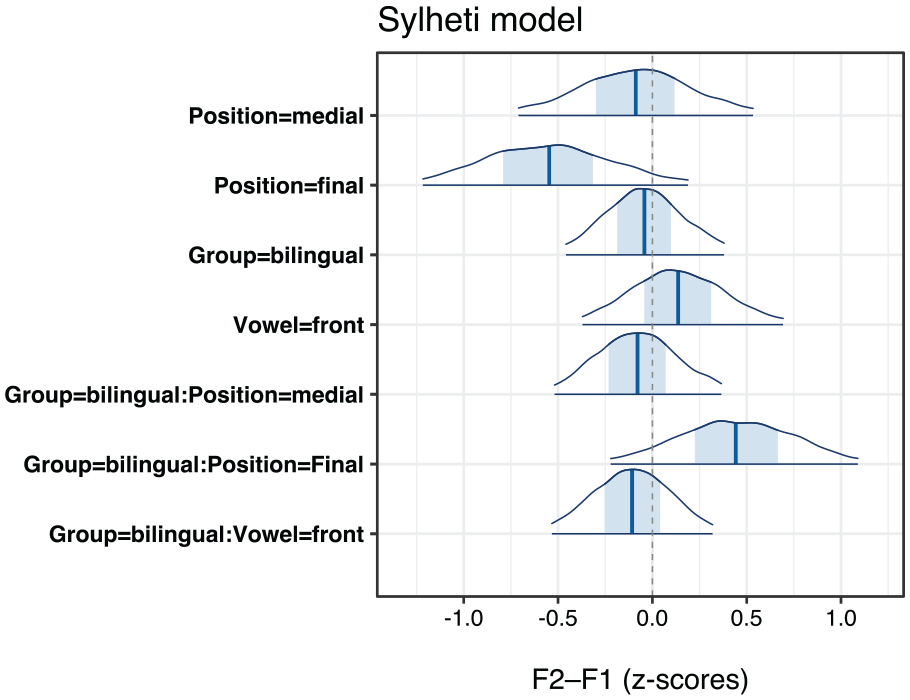
Bayesian posterior predictions from the Sylheti model. Each distribution shows the 95% posterior probability distribution (solid outline), 50% posterior probability distribution (shaded area) and the estimated mean (solid vertical line).
The posterior distribution for final laterals shows that 93.6% of values are below zero, suggesting that the model is largely compatible with final laterals having lower F2−F1 values than initial laterals. Note, however, that the values above zero and low Bayes factor do suggest a reasonable degree of uncertainty about this effect (x̄ = −0.55 [−1.22, 0.19], BF = 1.26). The distribution of medial laterals is centred close to zero, with a slightly negative shift, suggesting that medial laterals are not that distinct from initial laterals (x̄ = −0.09 [−0.71, 0.53], BF = 0.30). Front vowels have a tendency to increase F2−F1, but zero is included within the 50% distribution, so any differences between groups are likely to be minimal (x̄ = 0.14 [−0.37, 0.69], BF = 0.31).
The bilingual distribution is centred on zero, suggesting no overall differences between monolinguals and bilinguals, but this is expected as the z-scoring sets every speaker’s mean at zero (x̄ = −0.04 [−0.46, 0.38], BF = 0.22). More interesting in this respect are interactions between bilingualism and lateral position. The bilingual*medial interaction is centred at zero, suggesting few differences at this position (x̄ = −0.08 [−0.52, 0.37], BF = 0.23). The bilingual*final interaction shows 91.23% of values above zero, but the very wide interval and low Bayes factor indicates a high degree of uncertainty about this effect (x̄ = 0.44 [−0.22, 1.09], BF = 0.86). Finally, the bilingual*vowel interaction is largely centred on zero, with a slight skew towards negative values, suggesting that any vowel effects on lateral quality do not vary much between groups (x̄ = −0.1 [−0.53, 0.32], BF = 0.25).
In order to more explicitly compare positional contrast between groups, Figure 3 shows the conditional effects plot for the position*group interaction from the model, which plots the interaction between position and group with the other predictors held constant. This plot shows that Sylheti monolinguals produce a fairly small initial ~ final contrast, whereas Sylheti bilinguals produce all three positions with very similar values, evidenced by the highly overlapping intervals and similar means. However, the results from the above indicated a high degree of uncertainty regarding any differences between monolinguals and bilinguals, suggesting similar productions of positional contrast between groups. Note that the monolingual intervals are slightly larger, suggesting that a relatively wide range of values are compatible with the model. We anticipate that this is due to the smaller number of speakers in this group.
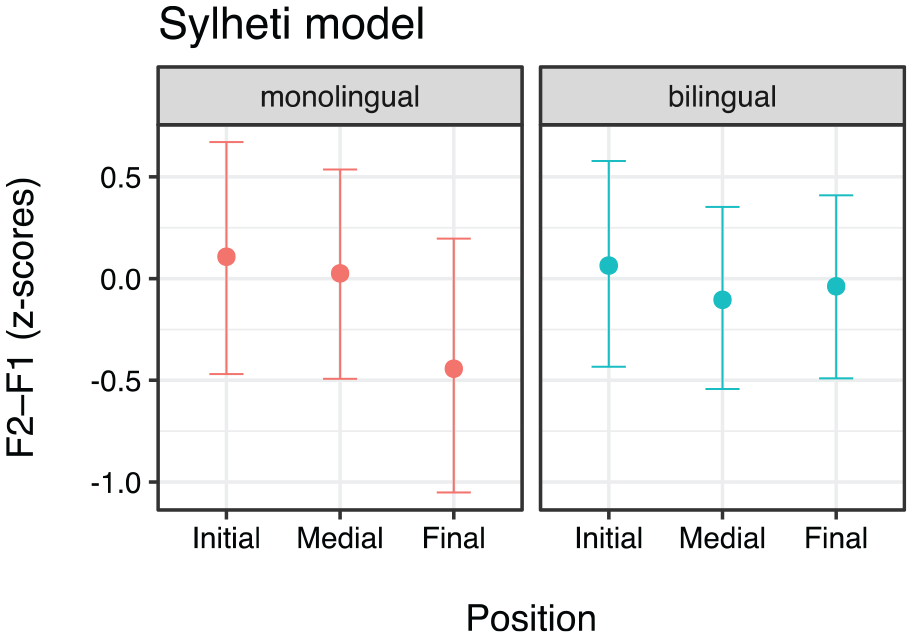
Bayesian conditional effects plot for the position*group interaction from the Sylheti model. The plot shows estimated means and the 95% compatible interval for each position*group combination.
In summary, the Sylheti model shows a very weak and uncertain positional effect, with final /l/s showing slightly lower F2−F1 values than initial /l/s, while there are no robust differences between bilingual children and monolingual adults. Note that as this analysis focuses on contrasts (i.e. the relative difference between positions), we can only talk about within-group contrasts, rather than absolute phonetic clearness and darkness. To say anything about phonetic clearness and darkness, as opposed to just allophonic contrast, we would need to analyse the un-centred Hertz data. We investigate this aspect of phonetic detail in Section 3.3.
Positional contrast in English
Figure 4 shows posterior predictions for the English model, with the association between each predictor and the outcome variable (F2−F1) visualised as a probability distribution. The plot shows a big positional effect, with final laterals showing a clearly negative distribution with 99.8% of values below zero, which represent strong evidence that final laterals have lower F2−F1 values than initial laterals (x̄ = −1.02 [−1.56, −0.46], BF = 54.5). The distribution of medial laterals is centred on zero, suggesting no difference between initial and medial laterals (x̄ = 0.00 [−0.67, 0.69], BF = 0.33). Front vowels have a slight tendency to increase F2−F1, but zero is included within the 50% distribution, so any differences between groups are likely to be very minor (x̄ = 0.08 [−0.44, 0.60], BF = 0.25).
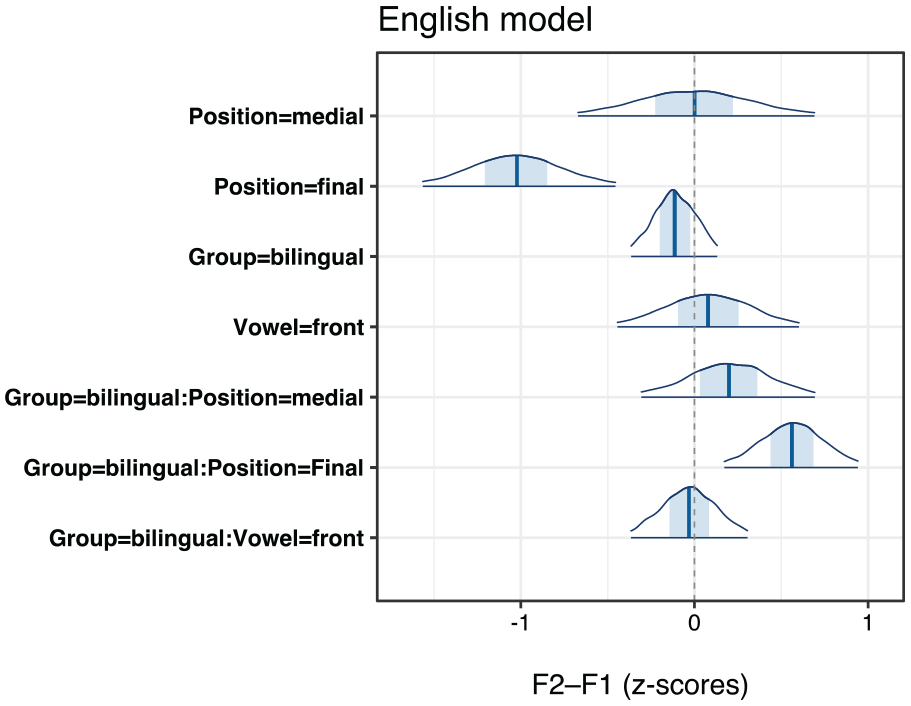
Bayesian posterior predictions from the English model. Each distribution shows the 95% posterior probability distribution (solid outline), 50% posterior probability distribution (shaded area) and the estimated mean (solid vertical line).The intercept (dashed line at 0) represents position = initial; group = monolinguals; vowel = back.
The bilingual distribution shows 80.53% of values below zero and a very low Bayes factor, suggesting no robust differences between monolinguals and bilinguals (x̄ = −0.11 [−0.36, 0.13] BF = 0.18). The bilingual*medial interaction shows 79.33% of values above zero, again showing reasonable evidence that this effect is compatible with zero (x̄ = 0.20 [−0.31, 0.69], BF = 0.34). The bilingual*final interaction, however, shows an almost entirely positive distribution (99.48% values above zero), providing strong evidence that bilinguals produce final /l/s closer to their mean values than is the case with monolinguals (x̄ = 0.56 [0.17, 0.94], BF = 8.6). This points towards a smaller initial ~ final contrast in bilinguals. Finally, the bilingual*vowel interaction is centred on zero, suggesting that vowel effects on lateral quality do not vary much between groups (x̄ = −0.03 [−0.37, 0.31], BF = 0.17).
In order to more explicitly compare positional contrast between groups, Figure 5 shows the conditional effects plot for the position*group interaction from the model. This suggests that English monolinguals produce a large initial ~ final contrast, with no overlap in the intervals between initial and final positions. Notably, Sylheti bilinguals do produce initial ~ final contrast in English, albeit it to a smaller degree than English monolinguals. This suggests that bilingual children show some degree of positional allophony in their English.
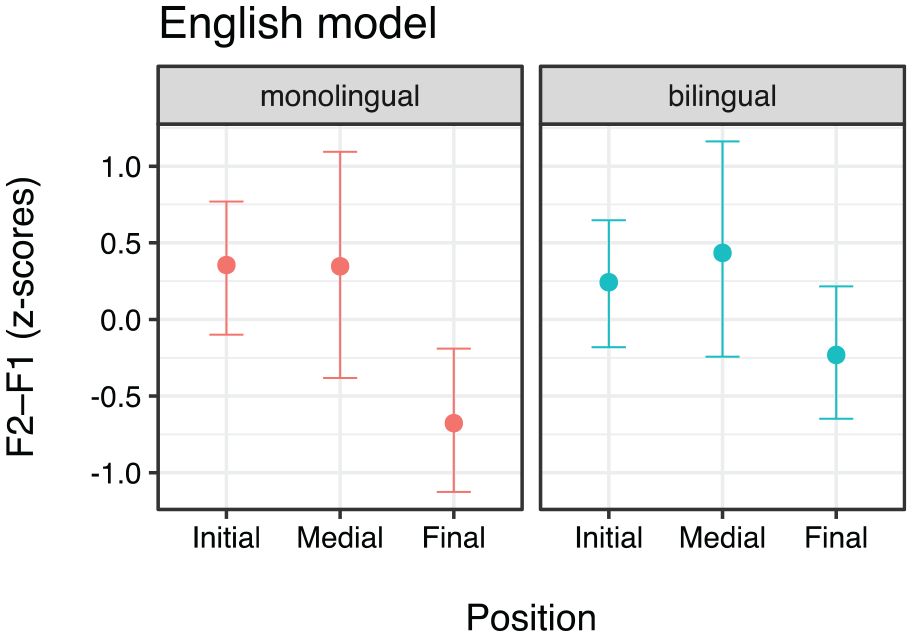
Bayesian conditional effects plot for the position*group interaction from the English model. The plot shows estimated means and the 95% compatible interval for each position*group combination.
In summary, the English model shows an overall positional effect, with final /l/s having the lowest F2−F1 values. The position*group interaction shows that this effect varies between groups: while Sylheti-English bilinguals do show evidence of initial ~ final contrast in English laterals, English monolinguals show a much bigger contrast between positions. Again, as this analysis focuses on contrasts we can only talk about within-group contrasts between positions, rather than absolute phonetic clearness and darkness. We now turn to a study of phonetic detail in English laterals.
Phonetic detail in children’s laterals
We now briefly consider phonetic detail between the children by displaying raw Hertz values that have not been z-scored or standardised within-speaker. This gives a better indication of phonetic detail, as the measurements have not undergone any normalisation or centring. As such, we do not show adult monolingual Sylheti data, because comparing adults and children using raw Hertz data—rather than within-speaker z-scores—is highly problematic given that the formant values will be strongly influenced by differences in adult versus child anatomy.
Figure 6 shows raw Hertz data for /l/ at each position for monolingual English, bilingual English and bilingual Sylheti. This plot shows that bilinguals produce clearer /l/ in English across all positions (higher F2−F1) than monolinguals. Indeed, bilinguals’ final /l/s are at least as clear as monolinguals’ initial /l/s in English. We note that the observable variability in monolingual English initial /l/ in Figure 6 is largely caused by two individual speakers who were highly variable in their productions. If we instead average over individual speakers then the variability in monolingual and bilingual children’s English is broadly comparable.
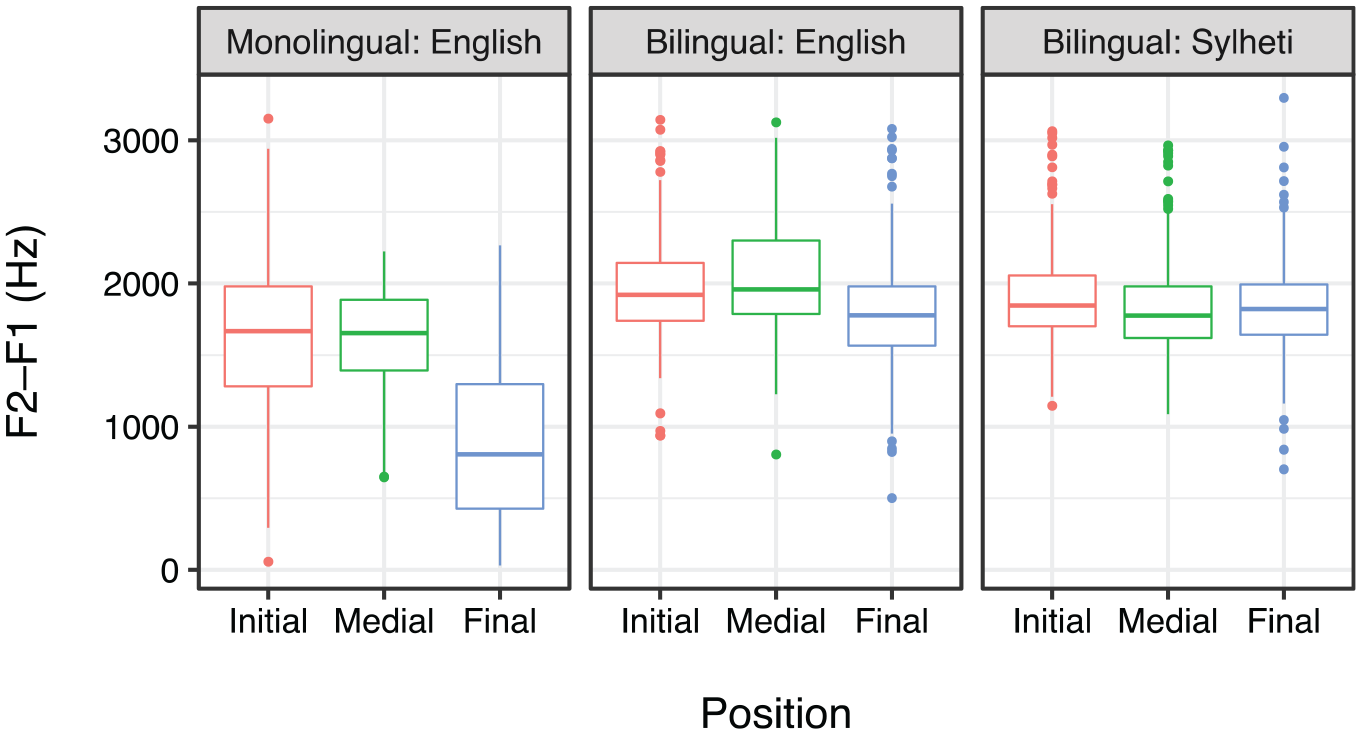
Boxplot of raw Hertz values for /l/ at each position for monolingual English, bilingual English and bilingual Sylheti speakers (only data for children is shown).
Overall, this suggests that bilingual children produce very clear /l/s in all positions in English. It is also worth noting that Sylheti bilinguals produce final /l/s that are less clear than their initial /l/s. This explains the small allophonic contrast reported in earlier analysis, but it remains the fact that bilinguals’ final /l/s are at least as clear as English monolinguals’ initial /l/s. We are cautious about comparing the bilingual Sylheti data to the bilingual or monolingual English data, given obvious differences in the word lists between the two languages. Therefore, we are primarily concerned with whether or not Sylheti children produce their English and Sylheti /l/s within a broadly similar phonetic range and do not attach too much weight to small differences between languages. With this in mind, Figure 6 shows a broadly similar phonetic range being used by bilingual children in both languages, with initial and medial /l/s hovering around 2000 Hz in both languages. This suggests that bilingual children produce very clear /l/s in both of their languages.
Discussion
In this study, we aimed to determine the nature of allophonic contrast and phonetic detail in the production of laterals by Sylheti-English bilingual children. We focused on whether children’s positional allophony in both languages approximates that of monolinguals, and then examined whether bilinguals’ English laterals showed phonetic influence from Sylheti, which we predicted would take the form of very clear laterals. In doing so, we aim to understand the processes by which new linguistic varieties develop out of language contact in immigrant communities. We now discuss the findings of this study and their theoretical implications below.
Bilingual acquisition of allophonic contrast
We find that English monolinguals produce a clear contrast between initial and final laterals, which is unsurprising as this is expected for English. We also predicted that Sylheti speakers would show initial ~ final contrast, on the basis that coda laterals are subject to phonetic pressures that trigger a more dorsal articulation and lower F2−F1 values, and we hypothesised that this difference would be smaller than in monolingual English. However, the wide confidence interval and low Bayes factor suggest a high degree of uncertainty about this effect in Sylheti. This suggests that any evidence of positional contrast in Sylheti is unlikely to be structural and instead due to phonetic pressures, rather than part of the language’s phonology.
In addition to this, we predicted that bilinguals would produce positional contrast in English, but to a smaller degree than English monolinguals, which is supported by the data. English monolinguals show very little overlap between initial and final tokens, while bilinguals do produce this contrast but with a much smaller difference between initial and final positions. Again, this difference is predictable on phonetic grounds, but we also hypothesised that the allophony of English laterals would cause this difference to be exaggerated, which is supported by our data. This patterns with previous findings that show monolingual-like acquisition of allophony by bilingual speakers in both of their languages (Barlow et al., 2013; Burrows et al., 2019).
We also examined phonetic detail by reporting raw Hertz measurements from the children’s data. Bilinguals produce clearer realisations of laterals than English monolinguals in all positions, but this difference went further than we expected. Indeed, we find that bilinguals produce final laterals with F2−F1 values that are comparable to monolingual English initial laterals. This suggests that while bilinguals’ final laterals are less clear than their initial laterals, their final laterals are in absolute terms still extremely clear. In a similar study to ours, Barlow et al. (2013) report that Spanish-English bilingual children produce higher F2−F1 values in English than monolinguals, suggesting clearer realisations of /l/ by bilinguals. This patterns with our data, as our bilingual children also show clearer /l/s than monolinguals.
In terms of the broader picture of heritage bilingualism, previous research points towards a loss of structural patterns in the non-dominant language, with structural convergence towards the dominant language (Polinksy & Scontras, 2020). We do not seem to find any evidence that bilingual children’s Sylheti is influenced by English, as their laterals in Sylheti are very clear with no substantial positional contrast. At the same time, the bilingual children’s Sylheti does not appear to be entirely adult-like either, which could either represent genuine differences from adult monolingual norms that will persist over time, or a developmental pattern that will change as the children age. We are unable to directly assess the influence of the English spoken by adult bilinguals on bilingual children’s English, but previous research on the same community shows that Sylheti adults’ English is heavily Sylheti-influenced and does not pattern with local monolingual English norms (McCarthy et al., 2011). This suggests a complex relationship between structure and detail in each language, and points towards the need for a longitudinal study of these children in order to examine how allophonic structure and phonetic detail develop over time.
New accent formation in a bilingual community
Now we turn to explaining the potential social and linguistic mechanisms behind the patterns in our data. First of all, the bilingual children’s English allophony is not predictable based on cross-linguistic transfer, given that their own Sylheti lateral system does not feature robust positional contrast. Accordingly, if we were to assume that bilingual children transfer their Sylheti system to English then we would not expect to see positional allophony in English. So we can rule out a straightforward influence of Sylheti on positional allophony in English laterals, as the bilingual children produce something that is more monolingual-like in English.
In the domain of phonetic detail, however, we do see evidence of transfer from the hyper-clear laterals of Sylheti to English. This is not necessarily unusual in studies of British Asian English. It is widely hypothesised that many South Asian languages, such as Punjabi, Hindi, Urdu and Sylheti, have hyper-clear productions of laterals, which are then transferred to the English of bilingual speakers of such languages (Stuart-Smith et al., 2011). Previous research on 13–14 year-olds with Punjabi language backgrounds finds very high F2 values of 1960 Hz (initial) and 1035 Hz (final) in their English laterals (Kirkham, 2017). These initial laterals are broadly comparable to Sylheti bilinguals’ initial laterals of 2292 Hz, especially given that the age difference is 7–8 years between samples.
The production of such clear word-final /l/s by bilingual children, however, is more surprising and suggests that there may be some broader influence of Sylheti here. To recap, bilingual children’s English word-final /l/s are as clear or clearer than English monolinguals’ word-initial /l/s. One hypothesis is that Sylheti bilingual children transfer the very clear realisations of /l/ from Sylheti, but adapt this to the positional allophony typical of monolingual English by producing comparably less clear final laterals. The positional allophony in monolingual English is likely to be more perceptually noticeable than the small and inconsistent phonetic effects in Sylheti, given that the initial ~ final contrast has a robust acoustic contrast in many varieties of London English. This means that bilingual children can easily detect this feature from any monolingual input and accordingly acquire allophonic patterns within their English system. Notably, this allophonic pattern is applied while still retaining the very clear laterals of Sylheti across the board. This presents an interesting scenario in which bilinguals show monolingual-like positional allophony in English, but produce distinctive phonetic detail, resulting in a unique lateral system. Such findings echo other studies of British Asian English, which show that speakers use aspects of the local regional accent combined with ethnolectal influences from the heritage language, sometimes within the same sounds (Alam, 2015; Stuart-Smith et al., 2011; Wormald, 2016). It is likely that such speakers may also use these ethnolectal features for identity work in more naturalistic contexts. For example, Kirkham (2015) reports Pakistani and Somali girls using hyper clear realisations of /l/ – a predicted influence from their heritage languages – and shows that this phonetic variation plays an important role in local identity construction within a diverse urban school environment.
Conclusion
In this study we analysed allophonic contrast and phonetic detail in lateral production by Sylheti-English child bilinguals, English child monolinguals and Sylheti adult monolinguals. Our results show that bilingual children produce very clear realisations of lateral phonemes in Sylheti as expected. The same bilingual children produce a hybrid system in English, with lateral allophony approximating that of monolinguals to some degree and phonetic detail being more similar to the very clear laterals of Sylheti. This allows bilingual children to produce a lateral system that has characteristics of both monolingual London English and Sylheti-accented English, representing the development of a new linguistic system that may form a bilingual contact variety in this large and stable community. Future research in this area should consider the development of lateral systems across childhood in multilingual environments, as well as the relationship between phonetic variation and identity in children as they continue the development of new linguistic varieties.
Footnotes
Funding
The author(s) received no financial support for the research, authorship, and/or publication of this article.
