



Abstract
Aims and objectives:
This empirical study investigates variables affecting crosslinguistic influence (CLI) in child third language (L3) acquisition. We examine whether structural or typological similarity leads to CLI from one or both of the previously acquired languages at later stages of acquisition.
Design/methodology:
We compare Russian-German heritage bilinguals acquiring L3 English to L2 English learners with either L1 German or L1 Russian (matched in age, proficiency, age of onset, length of exposure), which allows us to assess whether CLI obtains from one language or both. We carried out an acceptability judgment task: Two of the structures under investigation in English are structurally similar to German (subject-auxiliary inversion, determiner use) and two to Russian (adverb placement, non-subject-initial declaratives).
Data and analysis:
We tested 10- to 12-year-old L3 learners (n = 66), L2 learners with L1 Russian (n = 26), and L1 German (n = 33). The L3 learners were tested in both previously acquired languages.
Findings/conclusions:
Our findings suggest that structural proximity may override typological similarity at later stages and indicate that CLI obtains cumulatively from both languages. We found facilitative and non-facilitative CLI from Russian and German. For properties that are structurally similar in English and Russian, the L3 learners outperformed the L2 learners with L1 German and were outperformed by the L2 learners with L1 Russian, and vice versa for properties similar in English and German.
Originality:
Our research adds child L3 data to the current debate on whether morpho-syntactic properties from previously acquired languages are transferred wholesale or property by property, based on typological primacy or linguistic proximity.
Significance:
Previous research has shown that surface typological similarity is an important factor at early stages of acquisition. Our study investigates whether structural similarity can override this strong factor at later stages of child L3 acquisition.
Keywords
Introduction
This empirical study investigates factors leading to crosslinguistic influence 1 (CLI) in third language (L3) acquisition. Our research adds to the current debate on whether, for morpho-syntactic properties, CLI from previously acquired languages is based on typological primacy (Rothman, 2010, 2015), linguistic proximity (Westergaard, 2019; Westergaard et al., 2017), cumulative enhancement (Berkes & Flynn, 2012; Flynn et al., 2004), or further factors. Previous research has shown that surface typological similarity is an important factor at early stages of acquisition (e.g., Rothman & Cabrelli Amaro, 2010). The main research question for our study is whether structural similarity can override this strong factor, at least at later stages of acquisition (with a length of exposure of 4–5 years). Furthermore, we focus on whether transfer may be from both previously acquired languages or whether it is wholesale from only one of them, and whether CLI may be both facilitative and non-facilitative. In order to answer these research questions, our study investigates Russian-German heritage language (HL) children acquiring L3 English (henceforth L3ers) in an instructed context. The focus is on word order (adverb placement in subject-initial declaratives, non-subject-initial declaratives, subject-auxiliary inversion in wh-questions) and definiteness (determiner use). For two of the properties, the L3 is structurally similar to German, for the other two it is similar to Russian. We compare L3ers of English with age- and proficiency-matched second language (L2) learners of English (henceforth L2ers).
We follow Rothman’s (2009) definition of a HL: A language qualifies as a heritage language if it is a language spoken at home or otherwise readily available to young children, and crucially this language is not a dominant language of the larger (national) society. [. . .] the heritage language is acquired on the basis of an interaction with naturalistic input. (p. 156)
The participants in our study are Russian heritage children in Germany who are either simultaneous or sequential bilinguals. Even though our participant group shares several characteristics, individual variation in Russian and German is expected, since a wide continuum of individual variation in heritage speakers has been found (e.g., Kupisch & Rothman, 2018; Polinsky, 2018). Exposure, language use, and support of the languages involved are just a few factors that vary tremendously among heritage bilinguals, leading to different trajectories and outcomes. Therefore, it is crucial to examine the property under investigation not only in the L3 but also in both previously acquired languages, in this case Russian (as the HL) and German (as the majority language).
Our findings point to cumulative influence from both languages, that is, CLI on a property-by-property basis, which can be both facilitative and non-facilitative. For properties that are structurally similar in English and Russian, the L3ers score higher than the L2ers with L1 German (henceforth L2ers [L1GER]) and lower than L2ers with L1 Russian (henceforth L2ers [L1RUS]), and vice versa for properties structurally similar in English and German.
Our paper is structured as follows: The next section gives an overview of the factors leading to CLI in L3 acquisition by providing the theoretical background. In the “Crosslinguistic variation in English, German, and Russian” section, we introduce the variation across the three languages regarding word order and definiteness. In the “Research questions, hypotheses, and predictions” section, the research questions and predictions are presented, followed by a description of our study in “The study” section, including the characteristics of the participants, the methodology, and the language proficiency measures. In the “Results” section, the results are presented together with the statistical analysis, and the findings are discussed in the “Discussion” section. The “Conclusion” section is a brief summary.
Background: Crosslinguistic influence in L3 acquisition
The field of L3/Ln acquisition is relatively new within formal linguistics, and it naturally builds on the extensive work carried out within L2 acquisition, especially concerning what constitutes the initial state and how much of the L1 grammar may transfer into the L2. In the 1990s, several models of L2 acquisition were developed, arguing for a number of different positions with respect to transfer, ranging from no transfer at all, for example, the Initial Hypothesis of Syntax (Platzack, 1996), via partial transfer, for example, Minimal Trees (Vainikka, Young-Scholten, 1996) or Weak Transfer (Eubank, 1993–1994), to complete transfer in the Full Transfer/Full Access model of Schwartz and Sprouse (1996). The latter model has been supported by considerable and convincing evidence over the years (e.g., Grüter, 2006), and for this reason it has also been quite influential in L3 acquisition. In short, this model argues that the “initial state of L2 acquisition is the final state of L1 acquisition” and that the “entirety of the L1 grammar [. . .] immediately carr[ies] over as the initial state of a new grammatical system on first exposure to input from the target language” (Schwartz and Sprouse, 1996, pp. 40–41).
Although it is a new field, L3 acquisition has been very active over the last 15+ years, and a number of L3 models have been developed. The main research question concerns the source of transfer/CLI, that is, whether the L1, the L2, either, or both previously acquired languages can affect the L3. Other important questions are whether CLI is wholesale (from only one of the previously acquired languages), as argued by the Full Transfer/Full Access Hypothesis, or property by property (from one or both of the previously acquired languages), and what factors are responsible for the choice of transfer language (for a detailed overview, see, for example, Rothman et al., 2019). While a number of studies have found that the main influence is from the L1 (Hermas, 2010, 2015; Jin, 2009; Na Ranong & Leung, 2009), several models have been developed that argue for other factors as more important, at least at early stages of development: the status of the L2 (the L2 Status Factor [L2SF]; Bardel & Falk, 2007, 2012; Bardel & Sánchez, 2017; Falk et al., 2015) or typological similarity (the Typological Primacy Model [TPM]; Rothman, 2015). Other models argue that both previously acquired languages may exert an influence on the L3, the Cumulative Enhancement Model (CEM; Berkes & Flynn, 2012; Flynn et al., 2004), the Linguistic Proximity Model (LPM; Westergaard et al., 2017), and the Scalpel Model (SM; Slabakova, 2017). Thus, these models explicitly argue for CLI taking place property by property. Since the L3 models have been outlined in detail in previous work (e.g., Rothman et al., 2019), we do not discuss them here, but instead focus on the variables that have been found to be influential in L3 acquisition.
L3 acquisition is a multidimensional dynamic process and it is therefore important to investigate different stages and various variables in the developmental process. Typological and structural similarity, order of acquisition, frequency of language use, and further factors including experiential and input factors such as “variable construction frequency” and “misleading input” (Slabakova, 2017, p. 12) have been found to influence initial or later stages of L3 acquisition. In the following, we provide a brief overview of the most relevant variables that have been shown to predict CLI.
We first address the question of overall typological similarity, as this was assumed to be the most important factor in the first formal model of L3 acquisition, the Interlanguage Transfer Hypothesis (Leung, 1998, 2003). Following the Full Transfer/Full Access Hypothesis (Schwartz & Sprouse, 1996), it was argued that the initial state of L3 acquisition was the final state of the typologically closer language (it should be noted that typology here refers to superficial lexical similarity). Following in the same research tradition, the TPM (Rothman, 2010, 2015) argues that transfer takes place in one fell swoop (wholesale transfer) from the typologically closer language at what is referred to as the “initial stages,” an unspecified time frame which allows the parser some time to determine which of the previously acquired languages is the closer one. The choice of language is made by the parser using linguistic cues according to a four-level hierarchy: (1) lexicon, (2) phonology, (3) morphology, and (4) syntax. In Rothman et al. (2019), this process is referred to as “reduplication of a representation from previously acquired linguistic representations [. . .] (literally, a copy)” (p. 24). It should be noted that the TPM also recognizes the importance of learning by parsing, in that “the interactions that take place at the level of on-line language processing [. . .] eventually reconfigure that underlying knowledge,” while the wholesale copying of one of the grammars at the initial stages is considered “a shortcut of sorts” (Rothman et al., 2019, p. 23).
In contrast to this, the LPM argues that there is no shortcut in language acquisition, and that all learning is by parsing/processing, in L1, L2. as well as L3 acquisition. The model builds on the Micro-cue Model developed for L1 acquisition (e.g., Westergaard, 2009, 2014), arguing that children are sensitive to fine linguistic distinctions from early on. Thus, all language acquisition is incremental and property by property. For L2/L3/Ln acquisition, Westergaard (2019) argues for Full Transfer Potential (FTP), which is different from Full Transfer/Full Access in that anything may transfer, not that everything does transfer. Note that this is also different from the partial transfer models of the 1990s, which argued that there were some parts of the grammar that would never transfer. According to this approach, CLI is due to co-activation of the previously acquired languages while processing the L3, a view that is shared by the SM. In this process, the main factor responsible for CLI is abstract structural similarity between linguistic properties of the L3 and the previously acquired languages. Overall lexical/typological similarity may also play a role, especially at early stages, given that lexical similarity will activate the relevant grammar even more (see Westergaard, 2021, for more on this). Thus, the CEM, the LPM, and the SM argue that both previously acquired languages may affect L3 acquisition in a cumulative and selective way. However, the CEM claims that this is only the case if the effect leads to facilitative influence, whereas the LPM and the SM argue that the L3ers’ access to all previously acquired linguistic knowledge may lead to both facilitative and non-facilitative influence.
Frequency of language use is another factor that has been argued to be relevant. The ‘language of communication,’ which is the more frequently used language, has been found to be the source of transfer at early stages. Fallah et al. (2016) concluded in their empirical study on L1 Mazandarani, L2 Persian, and L3 English that the dominant language of communication, that is, frequency of language use, is the determining factor for CLI rather than order of acquisition or typological similarity.
Hopp (2019) also studied HL children acquiring L3 English and found typology and dominance to be the determining factors in a study with Turkish-German bilinguals. German, the typologically closer language to English as well as the dominant language based on productive vocabulary scores, was the only source of transfer.
In a large-scale survey, Rothman et al. (2019) investigate 92 studies that provide empirical evidence for several factors that condition how previously acquired languages affect the L3 process. There is strong evidence for transfer being both facilitative and non-facilitative, as non-facilitation was found across various grammatical domains and language combinations in as much as 89.18% of the 92 studies. More than half of these studies (50) focused on later stages of the L3 process, and evidence was found for L1 transfer in 10 studies, for L2 transfer in 15, for typological transfer in 31, and for hybrid transfer in 13 studies. Hybrid transfer refers to transfer from both languages. In summary, the results of these studies combined do not show clear support for L1 transfer, L2 transfer, and typological or hybrid transfer. As Westergaard (2019) points out, about a third of the studies that Rothman et al. (2019) included in the category “typological transfer” “involve languages that are genetically unrelated” and thus share no lexical similarity (Westergaard, 2019: p 20), which means that structural similarity rather than typology must be the determining factor for CLI. While both typological and structural similarity seem to be important factors, there is less evidence for order of acquisition and frequency of language use to play an important role.
The present study examines whether acquisition occurs wholesale from one of the previously acquired languages or property by property and whether both facilitative and non-facilitative influence may occur. As mentioned above, the CEM assumes that CLI is either facilitative or neutral. While the TPM is a model of the initial stages only, it does allow for influence from the non-transferred language at later stages, as a result of learning. However, one would generally only expect to find facilitative influence from the language that is not copied wholesale. The present study focuses on later stages in the L3 acquisition process and does not contribute to discussions relevant to the initial stages. Since we investigate L3ers with two L1s rather than an L1 and an L2, we cannot address order of acquisition as a factor for CLI. Furthermore, while we collected information on the participants’ language and social background, we did not collect in-depth information providing evidence on language use, and therefore cannot make any claims on the language of communication model. Thus, in the analysis, we will include the LPM, SM, CEM, and to some degree the TPM.
Our study follows up on previous research by Westergaard et al. (2017), where Norwegian-Russian HL bilinguals acquiring L3 English were compared with L1 Norwegian and L1 Russian speakers acquiring L2 English. The properties under investigation were adverb placement and subject-auxiliary inversion in wh-questions; for the former property, the L3 is similar to Russian and for the latter, there is similarity with Norwegian. While the latter property was already acquired by all groups (a ceiling effect), significant differences between the three learner groups were found in the adverb placement condition. This was argued to be due to a facilitative effect of L1 Russian for the L3ers, even though Russian is not the typologically closer language, and a non-facilitative effect of L1 Norwegian. Based on these findings, Westergaard et al. (2017) argue that structural similarity is a strong predictor of CLI that can override overall typological similarity. The present study uses the same approach of comparing L3 learners (with two potential transfer languages) to two L2 learner groups (with one of the transfer languages each), that is, a subtractive language group design that will enable us to isolate the effect of each of the previously acquired languages (cf. Westergaard, 2021). Furthermore, it adds two further properties to the ones investigated by Westergaard et al. (2017). In the present study, we include both group- and individual-level data. As pointed out by Miller and Iverson (2021), only few studies investigating property-by-property transfer have examined individual data.
Crosslinguistic variation in English, German, and Russian
English is typologically closer to German than to Russian, with considerable lexical similarity and sharing other linguistic properties, in that both German and English are Germanic languages, while Russian belongs to the Slavic language group. Nevertheless, the grammars of the three languages differ in interesting ways, which we will exploit in this study. That is, there are some structural properties where the L3 is similar to German and other properties where it is similar to Russian, notably word order and determiner use. While English and Russian pattern together (in contrast to German) for adverb placement (1) and word order in non-subject-initial declaratives (2), English and German pattern together (in contrast to Russian) with regard to subject-auxiliary inversion in wh-questions (3) and determiner use (4).
In English, the adverb is placed before the verb in subject-initial declaratives, leading to the structure (S-A-V), as shown in (1a). This is also the case for Russian (1c) canonical word order. In German, in contrast, verb second (V2) word order ensures that the adverb appears postverbally, leading to the structure (S-V-A), as illustrated in (1b).
(1) adverb placement a. Susan often eats sweets. (S-A-V) b. Susan isst oft Süssigkeiten. (S-V-A) Susan eats often sweets “Susan often eats sweets.” c. Susan často jest konfety. (S-A-V) Susan often eats sweets “Susan often eats sweets.”
In English, non-subject-initial declaratives (topicalization constructions) have the word order (X-S-V), which is also the case for Russian; see (2a) and (2c). In German, the V2 pattern ensures that the verb moves to second position, resulting in the structure (X-V-S), as illustrated in (2b).
(2) non-subject-initial declaratives (topicalization) a. Last night the cats slept on the sofa. (X-S-V) b. Letzte Nacht schliefen die Katzen auf dem Sofa. (X-V-S) last night slept the cats on the sofa “Last night the cats slept on the sofa.” c. Prošloj nočju koški spali na divane. (X-S-V) last night cats slept on sofa “Last night the cats slept on the sofa.”
In English, subjects and auxiliaries are inverted in wh-questions, which is also the case in German, as illustrated in (3a) and (3b). In Russian, this word order is possible, but highly dispreferred. Kallestinova and Slabakova (2008) have found that Russian speakers clearly prefer keeping the auxiliary and verb adjacent to each other (3c).
(3) subject-auxiliary inversion in wh-questions a. What will the little girl read? (wh-aux-S-V) b. Was wird das kleine Mädchen lesen? (wh-aux-S-V) what will the little girl read “What will the little girl read?” c. Čto eta malenjkaja devočka budet čitatj? (wh-S-aux-V) what the little girl will read “What will the little girl read?”
In English (4a) and German (4b), an overt article is obligatory with singular count nouns in specific contexts. The definite article is used for referents that are uniquely identifiable from previous context for both interlocutors, and the indefinite article is used with referents that are specific but not uniquely identifiable for the listener (see, for example, Lyons, 1999). Omitting the article leads to an ungrammatical sentence, for example, *New student is happy or *Student is happy. In Russian however, an articleless language, bare count nouns as in (4c) are used in various contexts, for example, definite, indefinite, and generic.
(4) determiner use a. The new student is happy. b. Der neue Schüler ist glücklich. the new student is happy “The new student is happy.” c. Novyj učenik rad. ∅ newstudenthappy “The new student is happy.”
Research questions, hypotheses, and predictions
The current L3 acquisition models agree that CLI plays an important role in L3 development. In order to explore the variables predicting the non-random nature of this influence, our study addresses the following research questions:
RQ1. Does CLI occur based on abstract structural similarity or overall typological similarity?
RQ2. Is there CLI from just one of the previously acquired languages or both?
RQ3. Is CLI in L3A always facilitative or can it also be non-facilitative?
Following the LPM and the SM, we hypothesize that (1) CLI will be cumulative, (2) structural similarity will be a stronger predictor of CLI than overall typological similarity, and (3) both facilitative and non-facilitative influence from the L1 and L2 will occur. If both previously acquired languages influence L3 acquisition, and if structural similarity is a stronger predictor of CLI than overall typological similarity, we make the following predictions for the current study (see Westergaard, 2021, for a detailed discussion of predictions made by the LPM):
For properties where Russian overlaps with English, but German is different, we expect the L2 (L1RUS) group to score the highest, and the L2 (L1GER) group to score the lowest. We expect the L3 group to be in the middle. We do not expect the L3 group to score higher than the L2 (L1RUS) group or lower than the L2 (L1GER) group.
For properties where German overlaps with English, but Russian is different, we expect the L2 (L1RUS) group to score the lowest, and the L2 (L1GER) group to score the highest. We expect the L3 group to be in the middle. We do not expect the L3 group to score lower than the L2 (L1RUS) group or to score higher than the L2 (L1GER) group.
The study
Overview
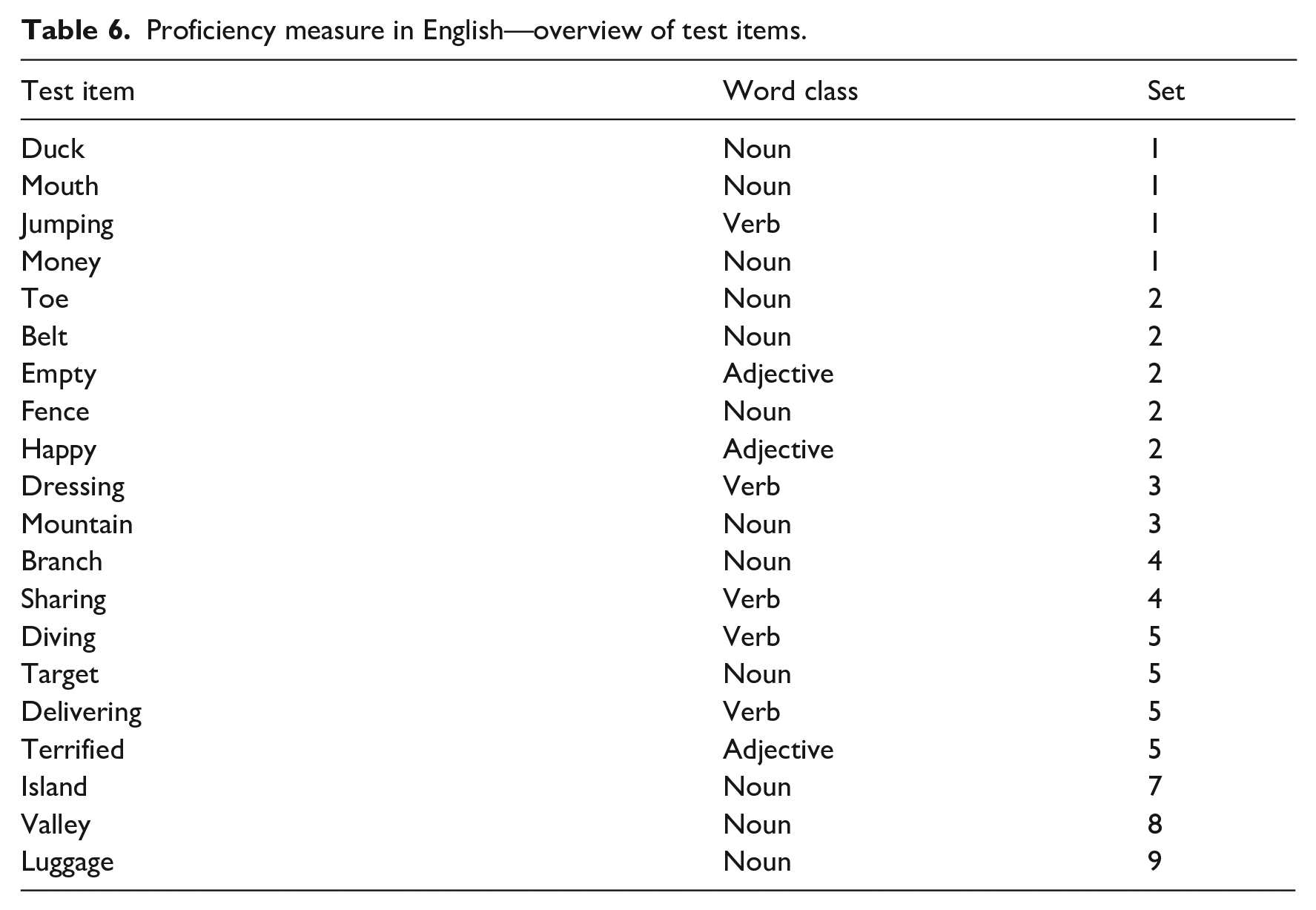
For the empirical study, three types of measures have been used: (1) an acceptability judgment task (AJT) in English, Russian, and German; (2) a receptive vocabulary test as a proficiency measure in English; and (3) a brief language background questionnaire. The AJT was conducted in L3 English, and a mini-AJT was conducted in both Russian and German in order to investigate whether the properties tested in L3 English had been acquired to a target-like level in the two previously acquired languages. The AJT in English was followed by a proficiency assessment in the form of a modified version of the British Picture Vocabulary Scale (BPVS3) with 20 items (see Table 6 in Appendix 1), in order to match the participant groups based on proficiency in the L3.
The L3 data were collected at two primary schools in Berlin, Germany. One of the schools is a German monolingual school with German being the major language of instruction, the other one is a German-Russian bilingual school with equal distribution of German and Russian in the classroom. Thus, the amount of input in both German and Russian during the participants’ school day varies for these two subgroups. The participants acquired L3 English in an instructed classroom setting.
Participants
Table 1 provides a description of the participants. We report data from three learner groups acquiring English at school from grade 1: (1) child L3ers who are Russian-German HL bilinguals in Germany (n = 66), (2) child L2ers (L1RUS) who are native speakers of Russian in Russia (n = 26), and (3) child L2ers (L1GER) who are native speakers of German in Germany (n = 33). The participants are all 10 to 12 years old with an age of onset in L2/L3 English of 6 to 7 years. The participants are matched based on age at testing, age of onset (of the L3), length of exposure, and proficiency in English. Length of exposure is 4 to 5 years with two to four lessons per week from grade 1. Based on self-report, the L3ers speak either predominantly Russian (n = 37), predominantly German (n = 7), or both languages with their parents (n = 22).
Description of the participants..
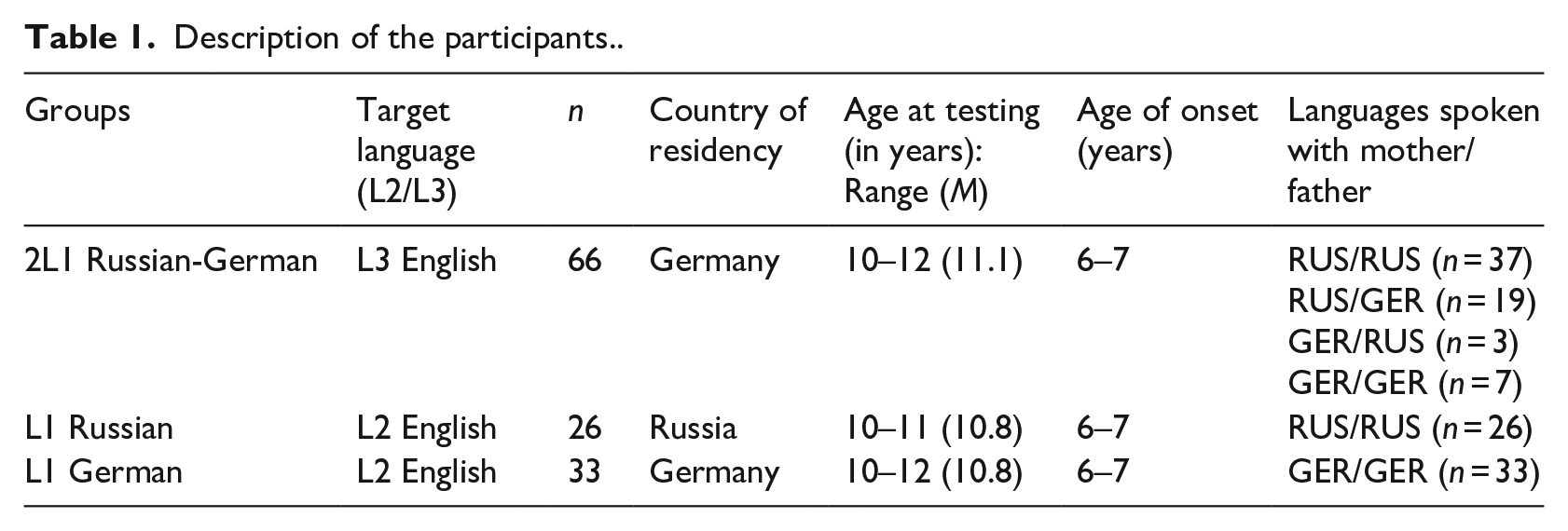
A total of 74 bilingual participants were tested in L3 English, but those who grew up with further L1s beyond Russian and German were excluded (n = 5). Further three bilingual participants and one monolingual German participant were excluded because they scored low (below 50%) on the vocabulary task; 30 participants were recruited from the German-majority school, while 36 participants attended the German-Russian bilingual school.
The AJT in English included 66 L3ers; 47 of these participated also in the AJT in Russian and 36 in the AJT in German. The L3ers who participated in Russian (71.2% of all L3ers) and in German (54.5% of all L3ers) were an availability sampling, that is, only those classrooms that were available during the testing period participated. All participants scored high (above 80%) on both the German and the Russian mini-AJTs.
Methodology
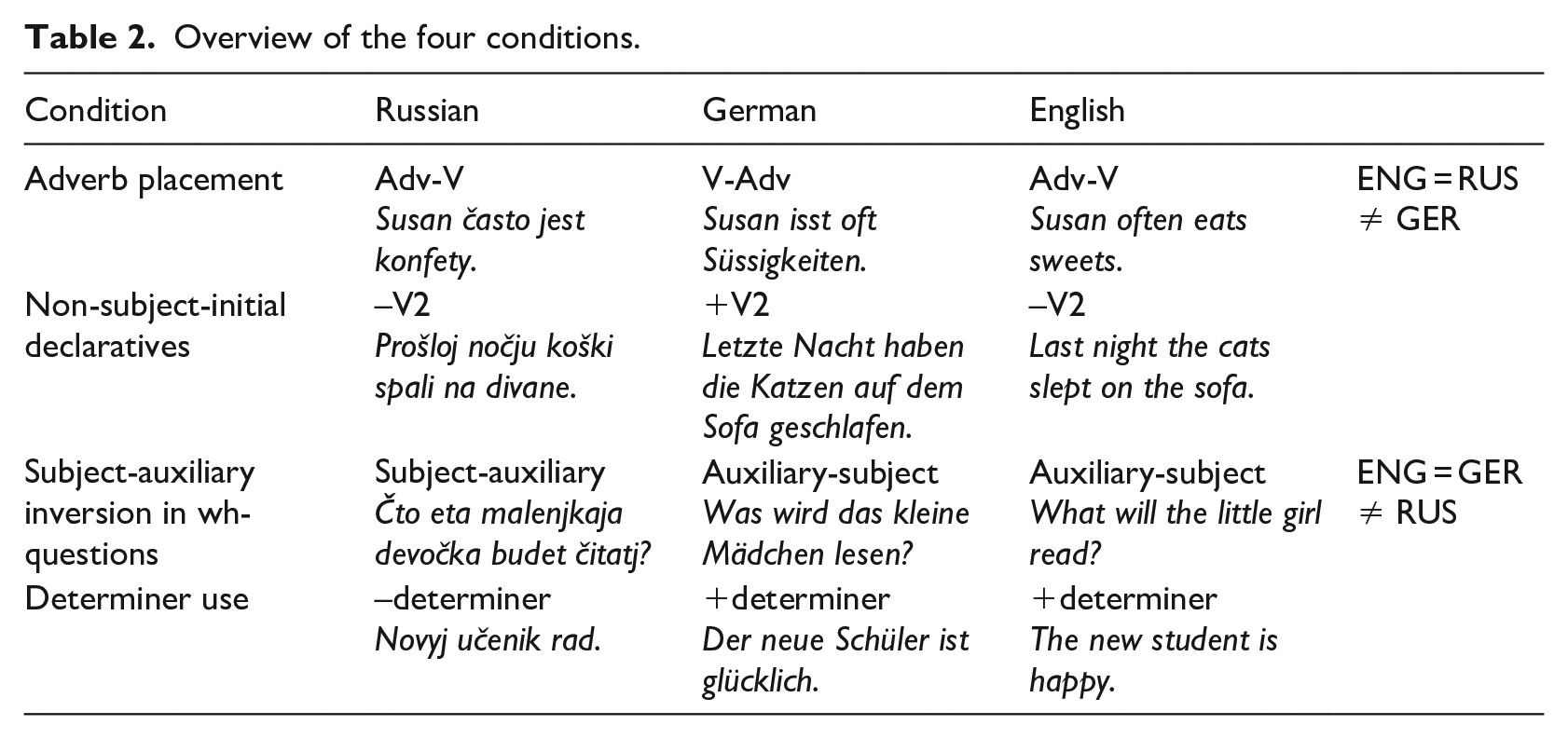
The AJT in English included six grammatical and six ungrammatical items per condition, leading to a total of 48 items. We included four conditions, two of which are structurally similar to German, subject-auxiliary inversion in wh-questions and determiner use, and two to Russian, adverb placement in subject-initial declaratives and word order in non-subject-initial declaratives (see Table 2 for an overview and Table 3 in Appendix 1 for the full list of experimental items).
Overview of the four conditions.
The data were collected in a classroom setting. The sentences were projected on a large screen and were presented to the participants in random order both visually and orally. Each item was presented for 9 seconds. The students judged each sentence as good or bad and marked the judgment on a pen-and-paper-based answer sheet. The experiment was preceded by two examples in a training session. The experiment was followed by the proficiency assessment in English.
We designed two further AJTs in Russian and German, including 24 items per language, in order to investigate whether the L3ers had acquired these conditions to a target-like level in their previously acquired languages. The German AJT involved the same conditions as the English AJT (adverb placement in subject-initial declaratives, non-subject-initial declaratives, subject-auxiliary inversion in wh-questions, determiner use; see Table 4 in Appendix 1). The Russian AJT involved two conditions that were the same (adverb placement, non-subject-initial declaratives) and two conditions that were different (subject–verb agreement, object pronoun word order; see Table 5 in Appendix 1). Note that in Russian, only one condition (subject–verb agreement) involved clear grammatical and ungrammatical variants (plural agreement for singular subjects, and singular agreement for plural subjects). In the remaining three conditions (adverb placement, word order in non-subject-initial declaratives, object pronoun placement), both word orders were possible, with the English-like word order being the less marked and preferred option (cf. “Research questions, hypotheses, and predictions” section). For these conditions, accuracy was coded as 0 if the participants rejected the unmarked word order, and 1 in other cases. Rejecting the unmarked word order in the adverb placement and non-subject-initial declarative conditions would indicate that the participants followed the German-like pattern and failed to show knowledge of the Russian structures. The AJT in English preceded the AJTs in German and Russian to avoid any priming effects.
Results
Figure 1 presents the results of the AJT in L3 English. To analyze the results, we fit a binomial generalized linear mixed effects logistic regression model to predict accuracy (1 or 0) by group (German monolinguals, Russian-German bilinguals, and Russian monolinguals), condition (adverb placement, word order in non-subject-initial declaratives, determiner use, and subject-auxiliary inversion in wh-questions), and their interaction. Proficiency was included as a separate fixed effect. Participants and items were included as random slopes. 2 The results revealed that overall proficiency had a significant effect on accuracy (see Table 7 in Appendix 2).
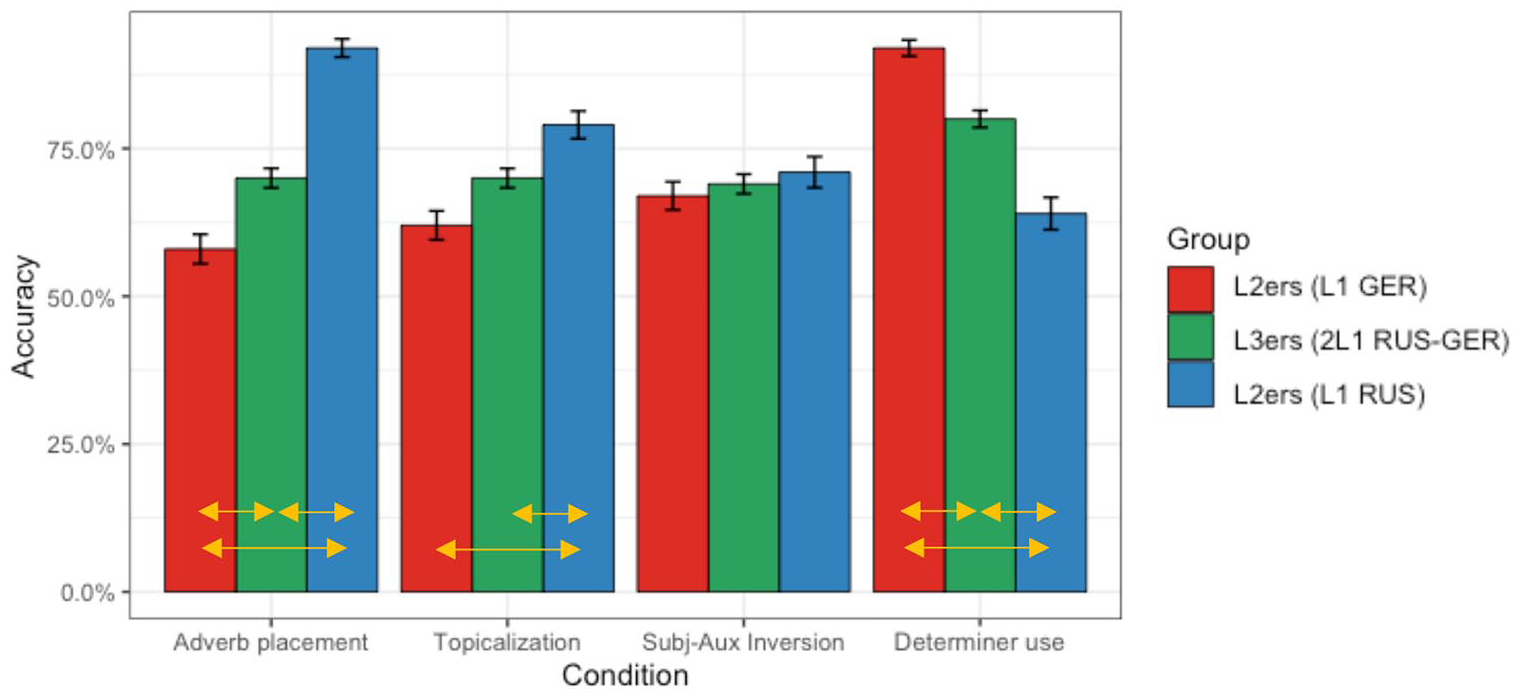
L3 English versus L2 English—accuracy by condition and group (significant contrasts between the groups marked with arrows).
Post hoc pairwise comparisons of the model were used to statistically analyze the performance of the three groups within individual experimental conditions. We observed a stepwise change in accuracy in two conditions: adverb placement and determiner use. The L2ers (L1RUS) significantly outperformed the other two groups on adverb placement (92% vs. 69% vs. 58% accuracy for L2ers [L1RUS] vs. L3ers vs. L2ers [L1GER], respectively). The L2ers (L1GER) scored significantly higher than the remaining two groups on determiner use (92% vs. 80% vs. 64% accuracy for L2ers [L1GER] vs. L3ers vs. L2ers [L1RUS], respectively). All pairwise contrasts between the three groups in these conditions were significant (see Table 7 in Appendix 2).
Furthermore, the L2ers (L1RUS) significantly outperformed the L2ers (L1GER) and the L3ers on word order in non-subject-initial declaratives (topicalization, non-V2 word order in English). The L3ers were numerically but not statistically different from the L2ers (L1GER) in this condition (79% vs. 70% vs. 62% accuracy for L2ers [L1RUS] vs. L3ers vs. L2ers [L1GER], respectively).
Recall that our bilingual participants (L3ers) came from two different schools: a German-majority school and a German-Russian bilingual school. The participants also differed in the amount of Russian used at home (with both parents, with one of the parents, or with none of the parents). In order to assess whether these variables had an effect on the participants’ performance on the English AJT, we fit an additional binomial generalized linear mixed effects logistic regression, where language use at home and school were included as predictors of accuracy. There was no significant effect of school or language use at home; that is, there were no significant differences between the L3 learners at the monolingual German versus bilingual German-Russian school and no significant differences between the L3 learners who spoke German, Russian, or both languages with their parents.
A closer look at acceptability rates for grammatical and ungrammatical trials
Figure 2 illustrates acceptability of the ungrammatical sentences in individual conditions by the three learner groups, and Figure 3 displays acceptability of the grammatical items. As evident from Figure 2, the three learner groups differ substantially in the proportion of ungrammatical trials that they accepted within conditions that were especially difficult for the respective groups. Again, we observe a stepwise increase in acceptance of ungrammatical sentences in the determiner use condition from the L2ers (L1GER) to the L3ers to the L2ers (L1RUS). Reversely, we see a sharp decrease in acceptance of ungrammatical sentences in the adverb placement condition and word order in non-subject-initial declarative condition (topicalization) between these three groups.
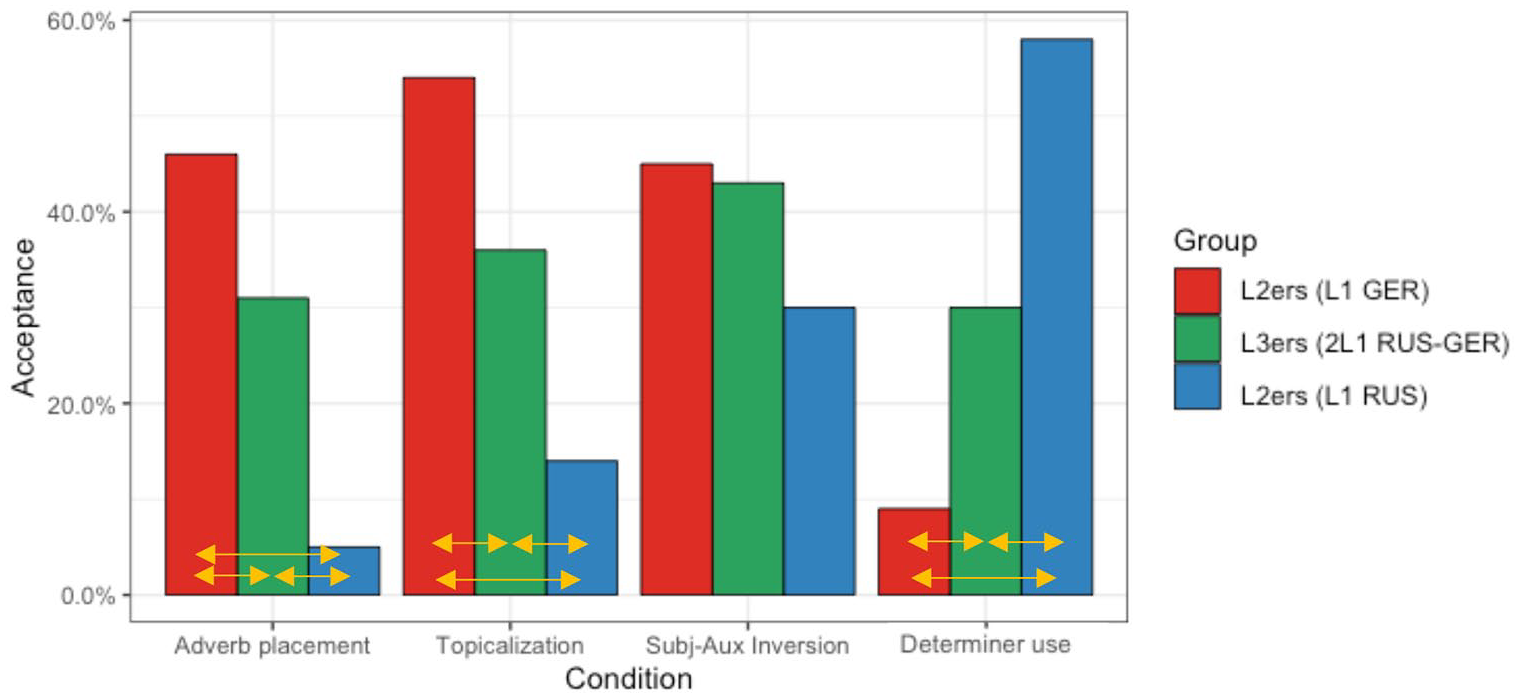
Acceptance of ungrammatical items by condition and participant group (significant contrasts between the groups are marked with arrows).
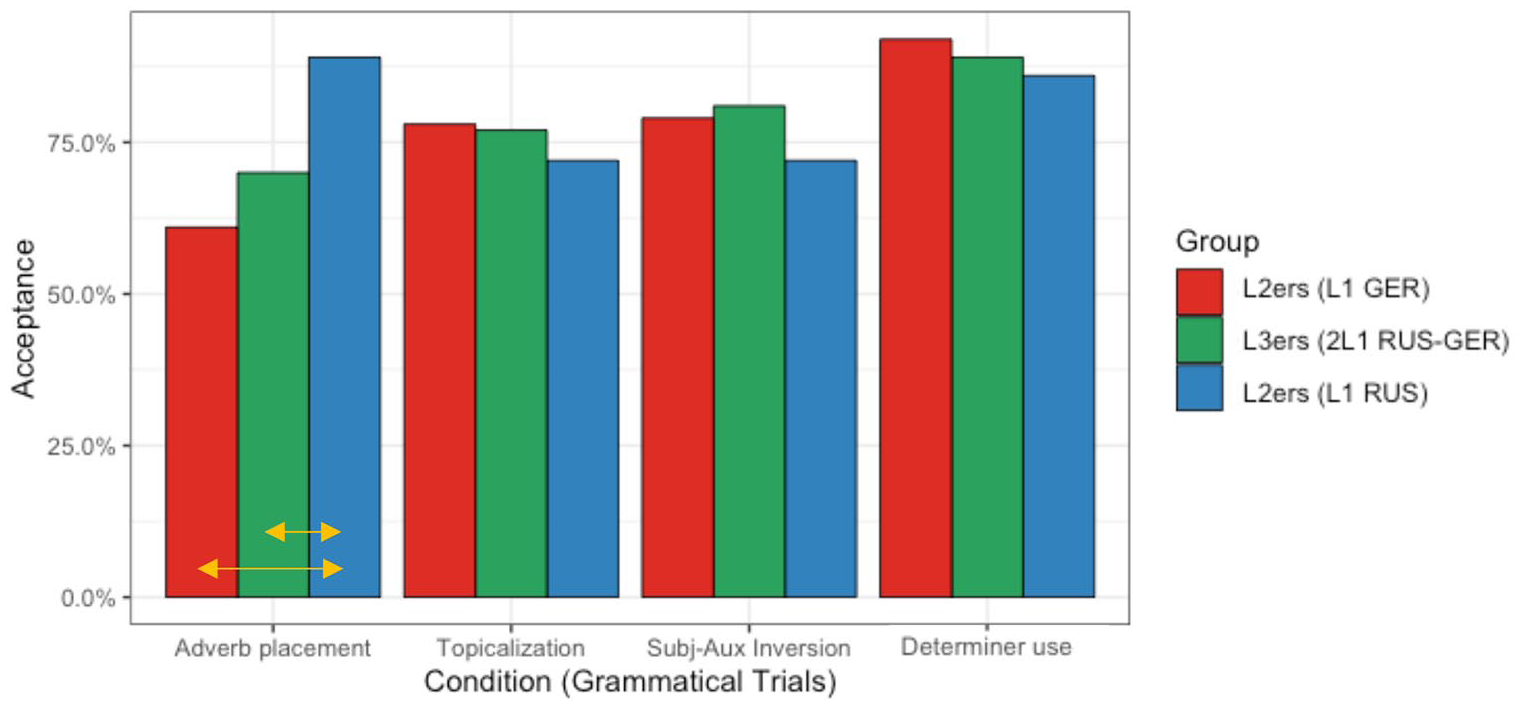
Acceptance of grammatical items by condition and participant group (significant contrasts between the groups are marked with arrows).
To assess statistical differences between the responses in grammatical and ungrammatical trials separately, we fit two bimodal generalized linear mixed effects logistic regression models, where the probability of accepting the trial as grammatical was modeled by an interaction of group and condition, with participants and items taken as random intercepts.
Post hoc pairwise comparisons of groups within conditions for the grammatical trials revealed significant differences between the L2 (L1RUS) group versus the L2 (L1GER) and L3 groups in the adverb placement condition. The difference between the L2 (L1GER) and L3 group in the adverb placement condition did not reach significance ( p = .13). No other differences were significant (see Table 8 in Appendix 2).
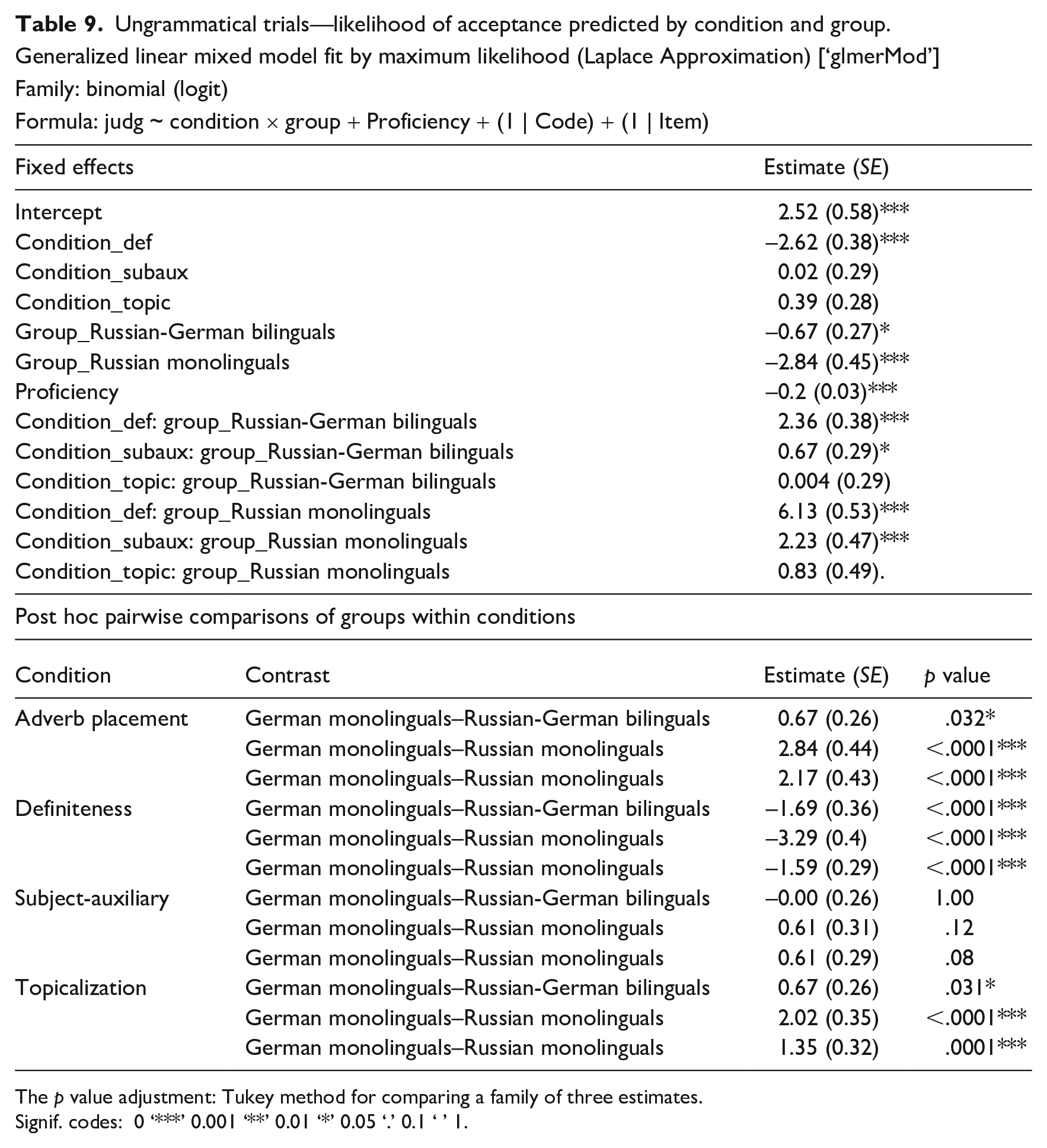
Post hoc pairwise comparisons in ungrammatical trials revealed statistically significant stepwise differences between the three groups of participants in three out of four conditions: adverb placement, determiner use, and topicalization (word order in non-subject-initial declaratives; see Table 9 in Appendix 2).
Individual patterns
The results of the AJT in L2 and L3 English indicate that the L3ers differed significantly from both L2 groups in two critical conditions (adverb placement and determiner use), scoring in between the two respective L2 groups. In order to clarify whether half of the L3ers are in line with each L2 group, possibly evening each other out, we examined the individual performance of our participants in the two critical conditions (adverb placement and determiner use). We followed Mirman (2014) in analyzing individual differences as random effects (pp. 127–137). To extract individual random effects, we fit two generalized linear mixed models (one for each condition) where judgments were predicted based on grammaticality, and which included by-participant random intercepts and participant-by-grammaticality random slopes. To evaluate individual effect sizes (sensitivity to the grammaticality manipulation in each condition), we subtracted the individual random effects for the ungrammatical trials from individual random effects for grammatical trials in each condition. Figure 4 illustrates the resulting distribution of individual effect sizes for the two conditions. While the L2ers (L1GER) mainly score above 0 in the determiner use condition (show a higher sensitivity to the grammaticality manipulation in this condition than the participants overall) and below 0 in the adverb placement condition, the L2ers (L1RUS) cluster above 0 in the adverb placement condition (show a higher sensitivity to the grammaticality manipulation in this condition than the participants overall) and below 0 in the determiner use condition. However, we do not see such clustering for the L3ers, whose individual effects do not pattern together with either of the two L2 groups.
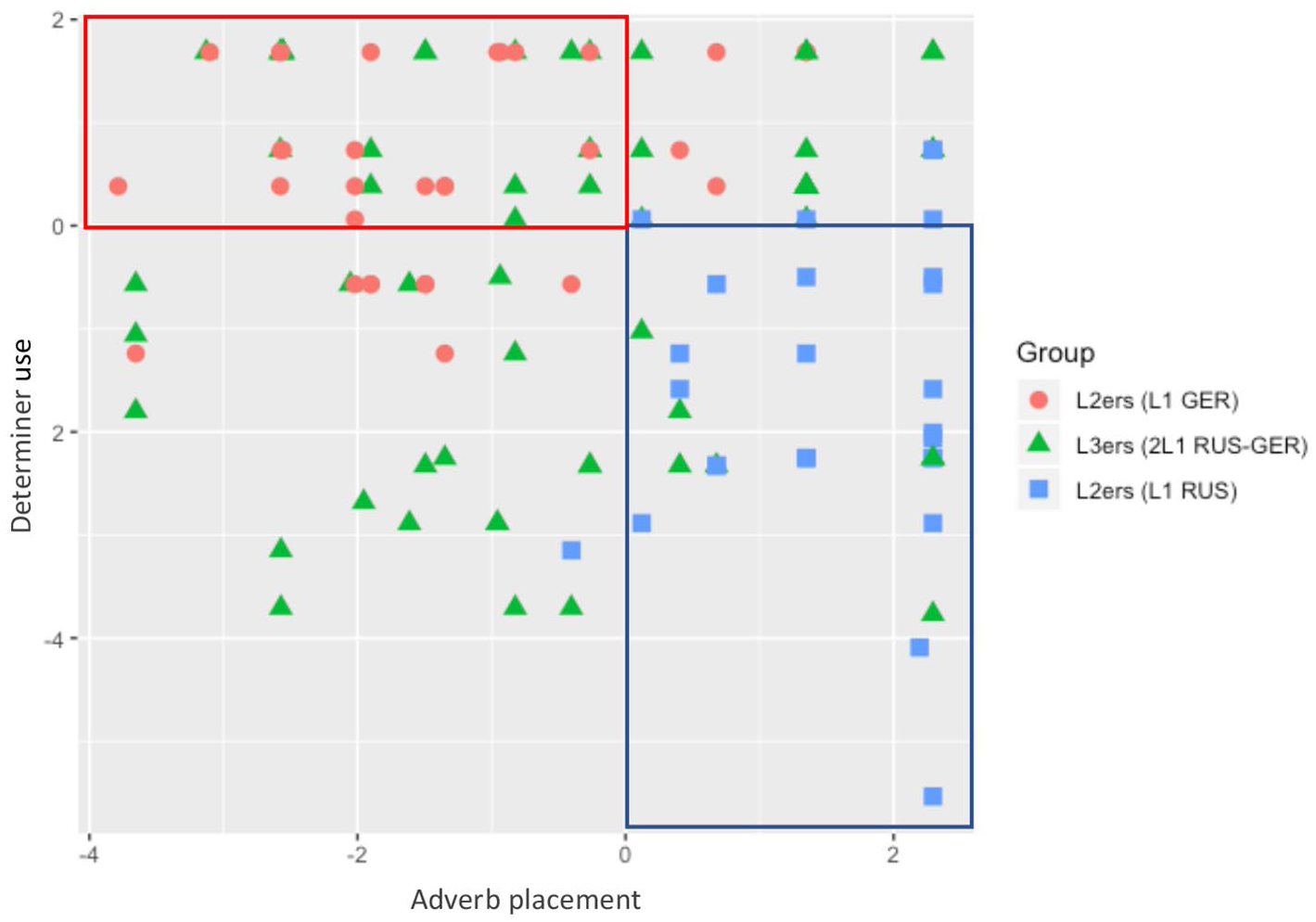
Distribution of random effect sizes for the two critical conditions: adverb placement and determiner use.
Finally, we ran a correlation of individual effect sizes between the two conditions for the two L2 groups and for the L3ers. The results reveal a strong negative correlation between individual effect sizes on the two conditions for the L2ers (p = .0002), indicating that higher-than-average sensitivity to the grammaticality manipulation in one condition correlated with lower-than-average sensitivity on the second condition. On the contrary, there was no such correlation for the L3ers (p = .78), indicating that the bilinguals’ sensitivity to the grammaticality manipulation in one condition did not correlate with their sensitivity in the second condition (which would have been expected if they performed like the L2ers). We conclude that the pattern of sensitivity to the grammaticality manipulation in the two critical conditions observed for the individual L3 children is different from the patterns of sensitivity observed for their L2 peers.
The previously acquired languages: Russian and German
The data show that the L3ers exhibited very high performance on the mini-AJTs in L1 German and L1 Russian. The scores were slightly higher in German than in Russian. In German, the accuracy rate was 95% in the adverb placement, 96% in the non-subject-initial declaratives, 96% in the subject-auxiliary inversion, and 97% in the determiner use condition. In Russian, the accuracy rate was 95% in the adverb placement, 92% in the non-subject-initial declaratives, 85% in the subject–verb agreement, and 90% in the object pronoun word order conditions.
Discussion
The comparison of the L3 English group to the two L2 groups showed, as predicted, that the L3ers significantly outperformed both groups of L2 learners on the expected conditions: the L2ers (L1GER) in the adverb placement condition and the L2ers (L1RUS) in the determiner use condition. We found a stepwise change in accuracy in both of these conditions. For adverb placement, the L2ers (L1RUS) with facilitation from Russian outperformed the L3ers with both facilitation from Russian and non-facilitation from German, while both groups with facilitation from Russian outperformed the L2ers (L1GER), who only had non-facilitative influence from German. For determiner use, the opposite trend was found, in that the L2ers (L1GER) with facilitation from German outperformed the L3ers who had both facilitation from German and non-facilitation from Russian, while both groups with facilitation from German outperformed the L2ers (L1RUS), who only had non-facilitation from Russian. Finally, for the non-subject-initial declarative condition (the other condition with structural similarity between English and Russian), the same trend as for the adverb condition was found, but without significant differences between the groups.
The aim of the current study was to determine the factors leading to CLI in L3 acquisition. RQ1 focused on whether CLI occurs based on abstract structural similarity or superficial typological (generally lexical) similarity, as argued by the LPM and the TPM, respectively. That is, the TPM would predict that CLI into L3 English should be from the typologically more similar language, that is, German in this case, while the LPM, as stated in our predictions, would expect CLI to be determined by structural similarity, property by property. As mentioned above, the TPM is strictly speaking a model of the initial stages, and thus does not make predictions about later stages of acquisition, except as a direct development of wholesale transfer. Thus, whatever influence is found from the non-transferred language (Russian in this case) should be facilitative, as the result of learning. Our findings indicate clearly that structural proximity overrides superficial typological similarity. By contrasting the L3 and the two L2 groups, we found an opposing trend for adverb placement (and non-subject-initial declaratives), on the one hand, where there is structural similarity between English and Russian, and determiner use, on the other hand, where there is structural similarity between English and German. That is, the L2 groups have both facilitative and non-facilitative influence from their respective L1s, performing better than the other L2 group on properties that are shared with their L1 than on properties that the target language shares with the other L1. Furthermore, the L3 group scores in between the two L2 groups, indicating CLI from both previously acquired languages for the same property. This trend becomes even stronger when we focus on the ungrammatical items only, with significant differences between the three groups. Thus, structural similarity for each property seems to be a determining factor for CLI. This aligns well with the LPM claim that CLI is due to co-activation of both previously acquired languages in parsing/processing.
For RQ2, whether there is CLI from one of the previously acquired languages or both, our findings suggest that both previously acquired languages may influence the L3. In the adverb placement (and the non-subject-initial declarative) conditions, the L3ers outperform the German L2ers (L1GER) and were outperformed by the Russian L2ers (L1RUS). In the determiner use condition, on the contrary, the L3ers outperform the Russian L2ers (L1RUS) and were outperformed by the German L2ers (L1GER). These findings were confirmed in the analysis of the individual data. As suggested by Miller and Iverson (2021), analyzing the findings on an individual level is crucial, as the mean scores are not always indicative of the individual scores. The individual data showed that the L3ers differ from the L2ers by showing more individual variation and no clustering. Thus, our results revealed that CLI occurred property by property depending on structural similarity between L3 English and the previously acquired languages.
These findings corroborate previous research advocating the LPM. Westergaard et al. (2017) also found evidence for CLI from both previously acquired languages. However, while significant effects were found in only one of two properties investigated in that study, that is, adverb placement, the present study found significant effects for two properties, thus strengthening the empirical basis for this model.
RQ3 asked whether CLI can be facilitative and non-facilitative, and our findings indicate both facilitation and non-facilitation from the previously acquired languages. The fact that the L2ers outperform the L3ers in the conditions in which the L2ers only have facilitative influence from the L1 suggests that the L3ers have facilitative influence from the same L1 as well as non-facilitative influence from the other L1. To be more precise, the L2ers (L1RUS) have facilitative influence from L1 Russian in the adverb placement and non-subject initial declarative conditions in which they outperform the L3ers who also have facilitative influence from L1 Russian but additionally non-facilitation from L1 German. The L2ers (L1GER) with facilitation from L1 German outperform the L3ers in the determiner use condition. Since the L3ers also have facilitation from L1 German, it must be due to non-facilitation from L1 Russian that they are outperformed by the L2ers (L1GER). This result is unexpected according to the TPM, as the influence from the allegedly non-transferred language (Russian) is non-facilitative and could thus not be due to learning. Again, such a result is expected if CLI is due to co-activation of corresponding structures in the previously acquired languages, as argued by the LPM. Our results confirm numerous previous studies on L3 that have attested non-facilitative CLI (cf. “Background: Crosslinguistic influence in L3 acquisition” section).
As discussed in the “Background: Crosslinguistic influence in L3 acquisition” section, by focusing on structural and typological similarity at later stages of acquisition, and by studying heritage bilinguals who are mostly simultaneous bilinguals, our study addresses only some of the L3 models, that is, only the models that do not focus on initial stages, order of acquisition, or frequency of language use. In this present study, structural similarity has been found to be the most important factor predicting CLI at later stages of acquisition, which offers support for the LPM and the SM. Furthermore, both previously acquired languages have been found to be the source of transfer. In addition, our findings suggest that CLI may lead to both facilitation and non-facilitation, which goes against the claims of the CEM, but supports the LPM, the SM, as well as the TPM (even though the latter focuses on initial stages rather than later stages of acquisition).
A closer look at the four properties indicates that a number of additional factors would need to be taken into account in order to achieve a full understanding of the results, for example, complexity, frequency, and explicit instruction. Discussing each of these factors in detail is beyond the scope of this paper. However, one or several of these factors might explain the varying results for the four properties. While we found significant effects for two of the properties, that is, adverb placement and determiner use, and the same trend numerically for non-subject-initial declaratives, we did not find significant (or major numerical) differences between the three groups in the subject-auxiliary inversion condition. This result is in line with the findings by Westergaard et al. (2017) and indicates that the subject-auxiliary inversion condition is less complex than the other conditions in the experiment and is consequently acquired so early that the children were already at ceiling in this condition. Ceiling (and corresponding floor) effects may be found in all studies that investigate several properties, as it is not clear that they will all be challenging for learners at the same stage of acquisition (see Westergaard, 2021, for more discussion about the methodology and timing of L3 studies).
In future research, we would suggest keeping the methodological design of comparing L3ers to L2ers while combining several measures, for example, comprehension and production tasks, as well as offline and online measures.
Finally, through the mini-AJTs, we have evidence that the L3ers are target-like in both L1 Russian and L1 German in the four conditions. Thus, for these L3ers, we may safely argue that what looks like CLI from either Russian or German is in fact CLI from these two languages.
Conclusion
In the present empirical study, we examined whether typological or structural similarity leads to CLI at later stages of L3 acquisition, and whether CLI occurs from only one of the two previously acquired languages or both. Furthermore, we examined whether CLI is both facilitative and non-facilitative. To investigate these factors, we tested Russian-German HL bilingual children acquiring L3 English on an AJT and compared their performance to two groups of L2ers, one group with L1 Russian and one group with L1 German. While the L3ers had two possible sources of transfer (Russian and German), the L2ers had only one of these (either Russian or German). We focused on word order and definiteness. For two of the four properties under investigation, English and Russian are structurally similar (adverb placement, non-subject-initial declaratives), and for the other two English and German are structurally similar (subject-auxiliary inversion, determiner use). Following the LPM (Westergaard et al., 2017), we predicted that if our participants had access to both previously acquired languages as the source of CLI, this influence should occur property by property and be both facilitative and non-facilitative. More specifically, we expected the L3ers (1) to outperform the L1 German group in the adverb placement and non-subject-initial declarative conditions, since the L2ers (L1GER) only have non-facilitative influence from L1 German, whereas the L3ers additionally have facilitative influence from L1 Russian, and (2) to outperform the L1 Russian group in the subject-auxiliary inversion and determiner use conditions due to facilitation from L1 German in contrast to the L2ers (L1RUS) with non-facilitation from L1 Russian only. Our findings indicate that structural similarity predicts CLI at later stages of acquisition. Furthermore, both previously acquired languages were found to be the source of transfer, with both facilitative and non-facilitative effects.
These findings offer support for the LPM, which argues that CLI is the result of co-activation of the previously acquired languages in processing, and thus that it occurs property by property, mainly depending on the structural similarity between the L3 and both previously acquired languages and resulting in both facilitative and non-facilitative influence.
Footnotes
Appendix 1
Proficiency measure in English—overview of test items.
| Test item | Word class | Set |
|---|---|---|
| Duck | Noun | 1 |
| Mouth | Noun | 1 |
| Jumping | Verb | 1 |
| Money | Noun | 1 |
| Toe | Noun | 2 |
| Belt | Noun | 2 |
| Empty | Adjective | 2 |
| Fence | Noun | 2 |
| Happy | Adjective | 2 |
| Dressing | Verb | 3 |
| Mountain | Noun | 3 |
| Branch | Noun | 4 |
| Sharing | Verb | 4 |
| Diving | Verb | 5 |
| Target | Noun | 5 |
| Delivering | Verb | 5 |
| Terrified | Adjective | 5 |
| Island | Noun | 7 |
| Valley | Noun | 8 |
| Luggage | Noun | 9 |
Appendix 2
Ungrammatical trials—likelihood of acceptance predicted by condition and group.
Generalized linear mixed model fit by maximum likelihood (Laplace Approximation) [‘glmerMod’]
Family: binomial (logit)
Formula: judg ~ condition × group + Proficiency + (1 | Code) + (1 | Item)
| Fixed effects | Estimate (SE) | ||
|---|---|---|---|
| Intercept | 2.52 (0.58)*** | ||
| Condition_def | –2.62 (0.38)*** | ||
| Condition_subaux | 0.02 (0.29) | ||
| Condition_topic | 0.39 (0.28) | ||
| Group_Russian-German bilinguals | –0.67 (0.27)* | ||
| Group_Russian monolinguals | –2.84 (0.45)*** | ||
| Proficiency | –0.2 (0.03)*** | ||
| Condition_def: group_Russian-German bilinguals | 2.36 (0.38)*** | ||
| Condition_subaux: group_Russian-German bilinguals | 0.67 (0.29)* | ||
| Condition_topic: group_Russian-German bilinguals | 0.004 (0.29) | ||
| Condition_def: group_Russian monolinguals | 6.13 (0.53)*** | ||
| Condition_subaux: group_Russian monolinguals | 2.23 (0.47)*** | ||
| Condition_topic: group_Russian monolinguals | 0.83 (0.49). | ||
| Post hoc pairwise comparisons of groups within conditions | |||
| Condition | Contrast | Estimate (SE) | p value |
| Adverb placement | German monolinguals–Russian-German bilinguals | 0.67 (0.26) | .032* |
| German monolinguals–Russian monolinguals | 2.84 (0.44) | <.0001*** | |
| German monolinguals–Russian monolinguals | 2.17 (0.43) | <.0001*** | |
| Definiteness | German monolinguals–Russian-German bilinguals | –1.69 (0.36) | <.0001*** |
| German monolinguals–Russian monolinguals | –3.29 (0.4) | <.0001*** | |
| German monolinguals–Russian monolinguals | –1.59 (0.29) | <.0001*** | |
| Subject-auxiliary | German monolinguals–Russian-German bilinguals | –0.00 (0.26) | 1.00 |
| German monolinguals–Russian monolinguals | 0.61 (0.31) | .12 | |
| German monolinguals–Russian monolinguals | 0.61 (0.29) | .08 | |
| Topicalization | German monolinguals–Russian-German bilinguals | 0.67 (0.26) | .031* |
| German monolinguals–Russian monolinguals | 2.02 (0.35) | <.0001*** | |
| German monolinguals–Russian monolinguals | 1.35 (0.32) | .0001*** | |
The p value adjustment: Tukey method for comparing a family of three estimates.
Signif. codes: 0 ‘***’ 0.001 ‘**’ 0.01 ‘*’ 0.05 ‘.’ 0.1 ‘ ’ 1.
Acknowledgements
We would like to thank the audiences at the 29th conference of the European Second Language Association (EuroSLA 29), 14th Generative Approaches to Language Acquisition conference (GALA 14), the CLI-workshop at UiT The Arctic University of Norway, and the V2-and-related-phenomena-workshop at the University of Oslo as well as our research group AcqVA Aurora for comments and fruitful discussion. We would also like to thank the Internationale Lomonossow Schule and the Grunewald Grundschule in Berlin for their collaborations in this study.
Declaration of conflicting interests
The author(s) declared no potential conflicts of interest with respect to the research, authorship, and/or publication of this article.
Funding
The author(s) disclosed receipt of the following financial support for the research, authorship, and/or publication of this article: This research was supported by the Research Council of Norway as part of the project MiMS: Micro-variation in Multilingual acquisition & attrition Situations (project number 250857).
