



Abstract
Aim and Objectives:
The aim of this study is to investigate the acquisition of motion event (ME) constructions in Italian as an L3 by German-speaking learners focusing on the following aspects: (1) the role of input frequency distributions in the target language, (2) the influence of the L1 and (3) the influence of the L2.
Methodology:
We designed a video description task aimed at eliciting ME in Italian native speakers and L3 learners of Italian in different semantic contexts linked to different frequency distributions of SF constructions (boundary vs non-boundary crossing contexts) in the target language Italian.
Data and Analysis:
Mixed-effects modelling was used.
Findings:
We found that (1) native speakers and L3 learners produce SF constructions to different extents across the two semantic contexts tested, (2) L3 learners produce more SF constructions compared to native speakers of Italian and (3) learners who are dominant in foreign SF languages produce more SF constructions compared to learners who are dominant in foreign VF languages (other than Italian). We interpret these findings as evidence that (1) learners are sensitive to input frequency distributions in the target language, (2) the L1 influences the production of ME in the target language and (3) the L2 plays a role in the acquisition of ME as a L3.
Originality:
As far as we know, this is one of the few studies investigating the acquisition of ME in a L3 and in a new combination of languages (L1 German, L3 Italian). The study also proposes a new way of operationalising the influence of L2(s) on the L3.
Implications:
The study sheds light on the mechanism underlying the complex task of acquiring ME in a L3 providing evidence for a complex interplay of the influence of the L1, the L2 and input frequency distributions in the L3.
Introduction
Motion event (henceforth ME) construal is a domain in which L2 learners have difficulties adapting to the target language norms (e.g., Laws et al., 2022), even at relatively high proficiency levels. According to Talmy’s typology (Talmy, 1983), languages vary according to the way they encode ME. Satellite-framed (SF) languages (e.g., German) typically encode Path in satellites (e.g., into), whereas verb-framed (VF) languages (e.g., Italian), usually encode Path of motion in the verb stem (e.g., entrare, ‘enter’). Thus, German learners of Italian need to learn a new way of encoding specific aspects of motion in new L2 forms. This task is particularly challenging considering that, despite a general VF preference, Italian allows the use of SF constructions, especially in contexts in which MEs do not imply the crossing of a boundary (boundary-crossing constraint) (Slobin & Hoiting, 1994) and even more so than VF languages such as French or Spanish (Hijazo-Gascón, 2018). Thus, learners are unlikely to receive direct or indirect negative feedback (Larrañaga et al., 2012; Treffers-Daller & Calude, 2015).
In the present study, we focus on the acquisition of Italian as an L3. 1 Notably, this reflects the typical acquisition setting of Italian as a foreign language (Bardel & Lindqvist, 2007) and represents an acquisitional setting which is becoming more and more common in today’s society (Quay & Montanari, 2018). In this context, the aim of the present study is to investigate several factors which might influence the acquisition of ME by L3 learners whose L1 is typologically different from the target language. We specifically focus on (1) the role of input frequency distributions in the target language, (2) the influence of the L1 and (3) the influence of the L2. In order to do so, we conducted a video description task in Italian aimed at eliciting ME in different semantic contexts linked to different frequency distributions of SF constructions (boundary vs non-boundary crossing contexts) with Italian native speakers and L3 learners of Italian.
Motion event constructions
To investigate the production of ME constructions, we will adopt Talmy’s (1983) lexical typology. One fundamental assumption of this approach is that languages can be classified with regard to their most typical pattern of motion expression based on the prototypical framing used to encode Path: languages in which Path is typically encoded in the verb root are called ‘verb-framed’ (VF) and languages in which Path usually appears outside the verb root, in a satellite, are called ‘satellite-framed’ (SF). English and German are typical examples of SF languages as Path is typically encoded in the satellite, as can be seen in (1a) and its German equivalent (1b).
(1) a He is running out of the house.
b. Er rennt aus dem Haus.
On the other hand, Romance languages such as Spanish, French and Italian are considered VF languages and as such typically encode Path in the verb root, as shown in (2). In these languages, if Manner is expressed at all, it is usually encoded in the verbal periphery.
(2) a. sale corriendo de la casa.
b. il sort de la maison en courant.
c. esce di casa correndo.
‘He exits from the house running’.
Crucially, this division is not absolute. VF languages also license the use of SF constructions, as in (3), however only under specific circumstances. In all VF languages, SF constructions can be employed to express motion if the event being expressed does not imply a boundary crossing (boundary-crossing constraint, henceforth BC). (Slobin & Hoiting, 1994). Take (3) as an example: in example (3a) no boundary is being crossed and therefore the use of a SF 2 construction is licensed. Due to the BC constraint, (3b) can only be considered as locative motion, since SF constructions do not license the BC interpretation implied by the Path ‘into’.
(3) a. La ragazza balla sulla collina.
‘The girl dances on the hill’.
b. La ragazza balla in casa
‘The girl dances in the house/*the girl dances into the house’.
As a result, SF constructions will be more frequent in association with non-BC evens than with BC events.
It is worth noting that the task of acquiring ME in Italian is made even more challenging by the fact that this language allows the use of SF constructions more often than other VF languages such as French or Spanish (Hijazo-Gascón, 2021). In particular, Italian seems to be more prone to licensing the use of SF constructions even in boundary-crossing contexts, especially when specific Manner verbs are used (i.e., directional Manner verbs such as correre ‘run’) compared to other VF languages (Hijazo-Gascón, 2021). Moreover, in Italian it is possible to use syntagmatic verbs (verb particle constructions with a clear directional reading), such as andare via ‘go away’, which belong to the category of (pseudo-)satellite-framed constructions (Hijazo-Gascón, 2021, p. 103).
The acquisition of ME in a VF language by learners whose L1 is SF
Given the typological differences outlined above it is natural to wonder whether restructuring of ME construal in a foreign language is possible, and under which circumstances it occurs. Several studies have investigated whether learners of typologically different languages rely on their L1 when encoding MEs in a foreign language. A number of studies has found evidence for cross-linguistic influence (henceforth, CLI) from the L1 (e.g., Cadierno & Ruiz, 2006; Larrañaga et al., 2012). Evidence for the occurrence of CLI has been found, for instance, by investigating the frequency of using several structures such as Path verbs (e.g., Song et al., 2016) or SF constructions (e.g., Anastasio, 2023; Larrañaga et al., 2012). For instance, Anastasio (2023) found that the mean percentage of SF constructions in which Path is expressed in directional particles produced by advanced English-speaking (SF language) learners of Italian was higher compared to French-speaking (VF language) learners of the same target language. Notably, however, not all studies have found evidence for the occurrence of CLI in the form of a marked use of SF constructions (e.g., Hijazo-Gascón, 2018; Lewandowski & Özçalışkan, 2021). For instance, Lewandowski and Özçalışkan (2021) compared the production of SF constructions in (mostly) BC contexts by Polish-speaking L2 learners of Spanish with that of native speakers of Spanish and did not find any significant difference between these two groups.
Many studies have highlighted that ME constructions are often not explicitly taught in formal instruction settings (e.g., Laws et al., 2022) and that direct negative feedback is also unlikely to occur (Alghamdi et al., 2019). Learners, therefore, are confronted with the task of acquiring these constructions directly from the input, which may require them to first identify/notice them (see Schmidt, 1990, for the notion of noticing). Several studies have found evidence that even learners at high levels of proficiency seem to struggle with employing the target-like ME framing, especially when expressing BC events (e.g., Larrañaga et al., 2012; Treffers-Daller & Calude, 2015).
Despite these difficulties, different studies have also found that learners improve with higher levels of proficiency in at least some domains of ME expression (e.g., Song et al., 2016; Treffers-Daller & Calude, 2015). For instance, Song et al. (2016) investigated the role of input frequency distributions on the acquisition of MEs by analysing the production of BC and non-BC events by English-speaking L2 Spanish learners in a written production task. They found that intermediate learners differed significantly from the native speakers in their production of Path verbs (target construction) when expressing a non-BC event, but not when expressing a BC event. They interpreted this result as evidence that input frequency distribution plays a role in the acquisition of motion in a L2. Since intermediate learners performed target-like in a semantic context in which the target language (Spanish) only allows the use Path verbs (BC events) but not in a semantic context in which variation is allowed (non-BC events), and therefore the use of Path verbs is less frequent.
The influence of the L2(s) on the acquisition of the L3
Numerous studies have found evidence of CLI of the L2 on the L3 in the acquisition of morphosyntax (e.g., Eibensteiner, 2023; Puig-Mayenco et al., 2020; Sánchez, 2020). Only few studies have investigated the L3 acquisition of ME, which involves both semantic and morphosyntactic aspects. Wang and Wei (2023) found evidence for reverse transfer in bilingual and multilingual speakers from the L2 (English – SF) and the L3 (Japanese – VF) to the L1 (Cantonese – equipollent), whereas Li (2020) found evidence of CLI from the L3 (French) to the L2 (English) by Chinese-speaking learners.
Much research has been devoted to investigating the circumstances under which the L2 is more likely to impact the acquisition of the L3. Hammarberg (2001) mentions the following factors as influential for the selection of the source language of CLI: recency, proficiency, typology and L2 status. This latter factor is linked with the controversy concerning whether the L1 (e.g., Jin, 2009) or the L2 (e.g., Bardel & Lindqvist, 2007) have a privileged status concerning the transfer of previously acquired linguistic knowledge to the L3. Other models (The Scalpel Model, Slabakova, 2017; the Linguistic Proximity Model, Westergaard et al., 2017), however, claim that CLI can occur both from the L1 and L2, and even that CLI can occur from more than one language simultaneously (De Angelis, 2007; Westergaard et al., 2017). Availability of transfer from both the L1 and the L2 is supported also by the fact that numerous studies have found CLI both from the L1 and the L2 (Puig-Mayenco et al., 2020).
Typological similarity as the ‘speaker’s perception of typological proximity [. . .]’ (Rothman, 2011, p. 112) is also typically claimed to play a role in this complex process. Importantly, what is assumed to play a role here is not the objective typological distance/proximity in linguistic terms, but rather the typological difference perceived by the learners (see Kellerman, 1979). The Typological Primacy Model (TPM) focuses on the initial stages of L3 acquisition and considers the global similarity between two languages to be the relevant aspect determining the availability of transfer (Rothman, 2015). Others tend to consider typological similarity in a narrower sense, considering the similarities between individual properties of two (or more) languages as playing a key role in CLI (Slabakova, 2017; Westergaard et al., 2017). Despite this property-by-property character of CLI, these models do not exclude the occurrence of non-facilitative influence, which, according to the Linguistic Proximity Model can occur if learners ‘misanalyze L3 input [. . .] and mistakenly assume that a property is shared between the L3 and either or both of the previously acquired languages’ (Westergaard et al., 2017, p. 671).
Finally, both higher levels of recency of use of the L2 and proficiency in the L2 are argued to result in higher activation of the L2, which in turn is linked to a higher probability of CLI. As far as we know, recency has hardly ever been investigated in previous studies (see also Cal & Sypiańska, 2020, for this claim), however, evidence supporting the mediating role of proficiency has been found in previous studies. Several studies have found that transfer from the L2 to the L3 is more likely at high levels of L2 proficiency (e.g., Arıbaş & Cele, 2021; Eibensteiner, 2023), although some studies have also found the opposite effect (e.g., Sánchez, 2020). Another extra-linguistic factor that has recently been proposed to modulate transfer effects in the L3 is dominance. This concept is related to proficiency as well as other aspects of language use such as accessibility and activation of a language relative to the other (Angelovska et al., 2023). Dominance of the L1 versus the L2 of L3 learners has been investigated in recent studies which have found evidence supporting its role in mediating transfer effects in the L3 (e.g., Angelovska et al., 2023; Puig-Mayenco et al., 2020).
The study
The present study investigates the acquisition of ME constructions by German-speaking learners of Italian as L3. In particular, we investigate the influence of the following factors on learners’ spoken production of ME in their L3 (Italian): (1) the input frequency distribution of lexicalisation patterns in the target language (L3), (2) the learners’ L1 and (3) the learners’ L2(s). To do so, we analyse the proportion of SF constructions produced by German-speaking L3 learners of Italian and by Italian native speakers in a video description task eliciting the production of both BC and non-BC events. Crucially, the learners’ dominance in their L2(s), which are considered VF or SF, will also be included in the analysis.
Although Italian is usually considered a VF language, it also allows the use of SF constructions and the use of satellites is more frequent than in other VF languages such as French or Spanish (Hijazo-Gascón, 2018). Therefore, Italian L3 learners are likely to hear both VF and SF in the L2. Even if SF structures are present in the input, their use is subject to constraints (BC constraint). Due to this constraint learners are more likely to hear VF constructions in BC situations than in non-BC situations. In the latter both VF and SF constructions are likely to occur. In line with Song et al. (2016), we take the BC constraint as a proxy of input frequency distribution of framing patterns and aim at replicating their results suggesting that learners are sensitive to this factor.
Our research questions are the following:
RQ1. Are learners sensitive to the frequency distribution of lexicalisation patterns in the target language?
If they are, we would expect learners to produce more SF constructions in situations in which SF constructions are licensed in Italian (non-BC) than in situations in which SF constructions are typically not licensed (BC).
RQ2. Do German learners of Italian show differences in their framing preferences compared to native speakers of Italian possibly due to influence from their L1?
If that is the case, we expect learners to produce more SF constructions compared to native speakers of Italian.
RQ3. Do the L2(s) spoken by the learners influence their framing preferences in the L3?
If that is the case, we expect learners who are dominant in SF languages to produce more SF constructions compared to speakers who are dominant in foreign VF languages.
Methods
Participants
Forty participants took part in the study. Twenty participants were native speakers of Italian (18 female, Mage = 21.2, SDage = 2.3, rangeage = 18–25 years) and 20 were German native speakers learning Italian as a foreign language (15 female, Mage = 36.1; SDage = 15.3; rangeage = 19–72 years). Informed written consent was collected form all participants before conducting the study. Two learners were excluded from the analysis because they grew up bilingually. The average self-reported proficiency in Italian (averaged on self-reported speaking, listening and reading proficiency) was 7.6 on an 11-point scale (SD = 0.9, range = 6–9.3) and the average score in the Italian proficiency task (LexIta) was 38.1 out of 60 points (SD = 7.8, range = 27–51). All Italian learners included in the analysis reported speaking at least one other foreign language other than Italian, although not all of them reported being fluent in this/these additional language(s).
Language background measures
All participants completed a background questionnaire. Learners of Italian completed both the Leap-Q questionnaire (Marian et al., 2007) which provides detailed information concerning the learners’ linguistic profile concerning their acquisition of Italian and other L2s, as well as LexITA (Amenta et al., 2021), a receptive vocabulary task which was used as a proxy for proficiency in Italian. These tasks were developed and administered using the software SoSci Survey (version 3.5.01) (Leiner, 2021). To investigate the role of the L2(s) spoken by the Italian learners (RQ3), we created a dominance measure between SF and VF L2s. This measure was based on the current exposure and self-reported proficiency in the L2(s) reported by the participants in the background questionnaire. The inclusion of both proficiency and current contact in the calculation of the score was based on Hammarberg’s (2001) mention of proficiency and recency as relevant factors determining the L2, which will be the source of CLI in the L3. The differential score was calculated as follows: we created a score for proficiency by calculating the difference between self-reported-proficiency rating in foreign SF languages and foreign VF languages. Notably, self-reported-proficiency scores were reported only for the languages which the participants reported speaking fluently and were calculated as the average of the self-reported ratings in reading, listening and speaking (see also Treffers-Daller & Calude, 2015, p. 615). A score for recency of use was created by calculating the difference of the proportion of current contact with SF foreign languages and VF foreign languages. These scores were then standardised and added up. Accordingly, higher scores indicate that participants are dominant in foreign SF languages while lower scores indicate that participants are dominant in foreign VF languages. Henceforth, we will refer to this measure as the foreign language (FL) dominance score. Similarly, we calculated a measure of proficiency/contact with Italian by standardising the proficiency task score and the reported proportions of time in contact with Italian and by adding them up.
Elicited production task
Participants were presented with 64 short (3–6 seconds) black-and-white animated cartoons. Half of the videos were experimental items aimed at eliciting ME descriptions and the other half were filler items depicting transitive or ditransitive events. Half of the experimental items (16 videos) depicted BC MEs associated with entering and exiting actions and the other half (16 videos) depicted non-BC MEs associated with ascending and descending actions. These four Paths were systematically crossed with four Manners: running, jumping, flying and dancing. 3 The same combination of Manner and Path was repeated twice but the background and character were never the same (see Supplemental Appendix A for the full list of items).
Procedure
Participants were recruited via online advertisements distributed via social media platforms, flyers, universities, language schools and personal contacts, and tested individually either online via video call or in person. After collecting the participants’ consent, the experiment was run in OpenSesame (Mathôt et al., 2012) (version 3.3.14) on the experimenter’s laptop. The participants were instructed to watch the short videos and to briefly describe them by answering the question ‘what is the character doing?’. The instructions were presented in Italian for the group of native speakers and in German for the group of Italian learners, to avoid misunderstandings. To facilitate the task, before each experimental video, participants saw a screen with the image and the Italian word for the ground referent of the ME they were about to see. Before each filler video, they saw a screen with the image and Italian word for one of the objects involved in the transitive or ditransitive event. It was explicitly mentioned in the instructions that they were not forced to use the word on the screen in their description. The order of the videos was pseudo-randomised such that the participants always watched one filler item followed by an experimental item. The videos were divided into four blocks. In each block the same Manner of motion was displayed twice: once combined with a BC Path and once with a non-BC Path. At one third and two thirds of the experiment participants were asked if they wanted to take a short break. The order of the blocks was randomised as was the order of experimental items within each block. The experiment started with four practice trials. After completing the experiment, participants filled out the background questionnaire and completed the proficiency task (LexITA).
Analysis
Coding
All sentences were recorded, transcribed and coded by trained native speakers of Italian. If more than one sentence was produced to describe one experimental video, the sentence expressing the higher number of semantic components concerning motion was analysed (following the richness criterion, see Hickmann et al., 2022). If the richness criterion could not be applied, we analysed the first sentence produced, as we considered it the most spontaneous answer. Sentences were analysed for several aspects (the full list can be found in Supplemental Appendix B). For the statistical analysis, sentences were coded for the type of framing they presented. Specifically, they were coded as ‘VF’, ‘SF’ or ‘other’. For the purpose of this study, we take the linguistic means used to express Path of motion as the main criterion to classify a sentence’s framing type. All sentences in which the Path was expressed in the main verb were coded as ‘VF’ and all sentences in which the Path was expressed in the verbal periphery (e.g., in a satellite or in a subordinate clause) were coded as ‘SF’. A list of constructions along with their classification can be found in Supplemental Appendix C.
Statistical analysis
To answer our research questions, we built two generalised linear mixed effect models (package lme4 version 1.1-34, Bates et al., 2015) using R (version 4.4.0, R Core Team, 2023). The first model was designed to investigate the role of input frequency distributions (RQ1) and of the L1 (RQ2). The dependent variable was the use of SF (1) and VF (0) constructions. The predictors were Group (L1 vs L3 speakers), BC condition (BC vs non-BC) and their interaction. This latter variable was sum-coded to have a mean of 0 and a range of 1 (BC, +0.5, vs non-BC, −0.5) whereas for the variable ‘Group’ we used dummy coding in order to have the group of L3 learners in the intercept. To investigate the role of the L2 on L3 acquisition (RQ3), we built a second generalised linear mixed effect model in which only the data of the L3 learners were analysed. The dependent variable was again the use of SF (1) and VF (0) constructions, and the predictor of interest was the FL dominance score. In the model we included the measure of proficiency/contact with Italian as a control variable and the interaction of both this latter variable and the FL dominance score with the BC condition, as we expected learners to be sensitive to the BC constraint (RQ1). Before running the model, the possibility of the presence of a high correlation between the independent variables that were not controlled for by the design of the study was investigated, to avoid possible multicollinearity issues. Proficiency/contact with Italian and FL dominance were not strongly correlated (see Supplemental Appendix C).
Results
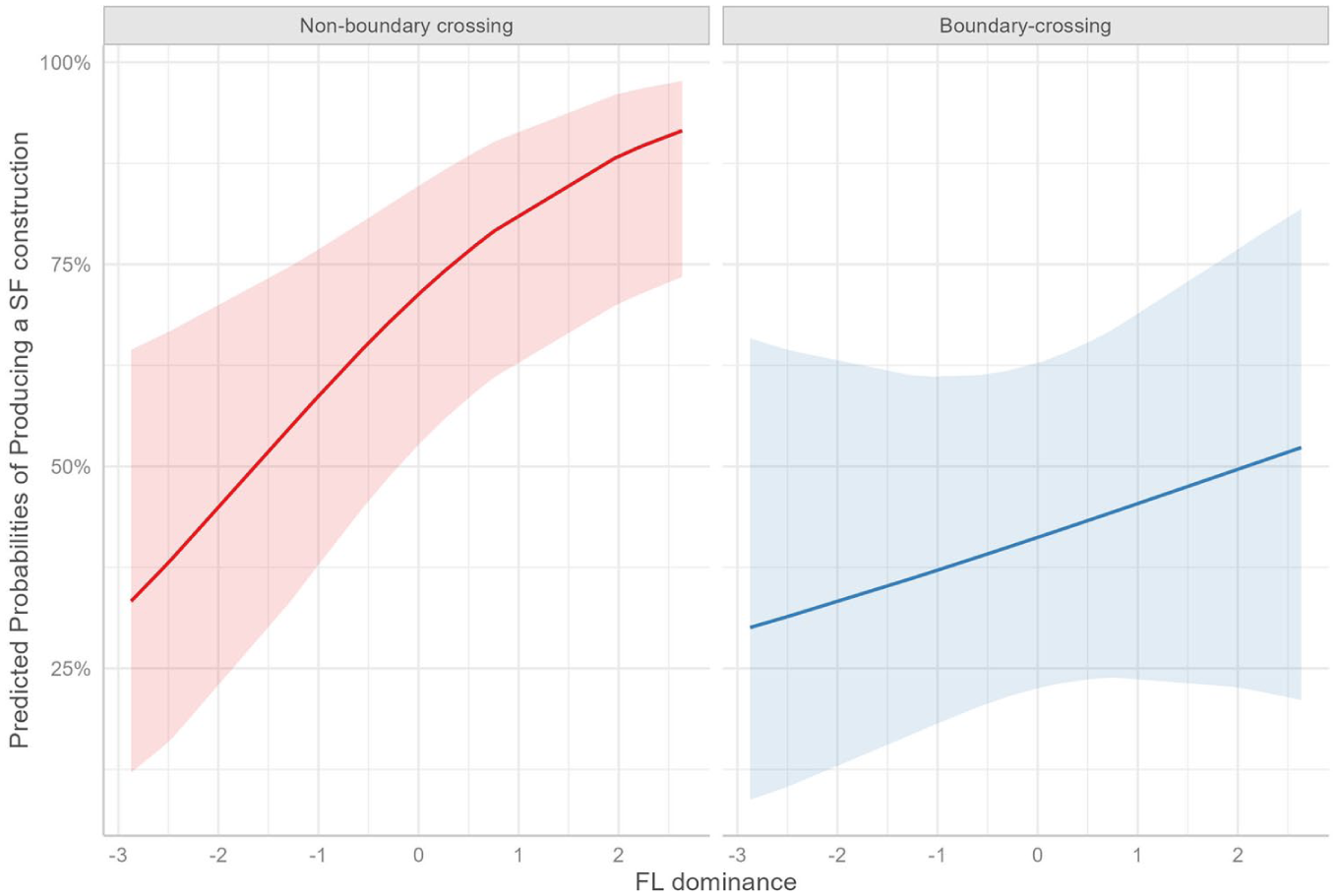
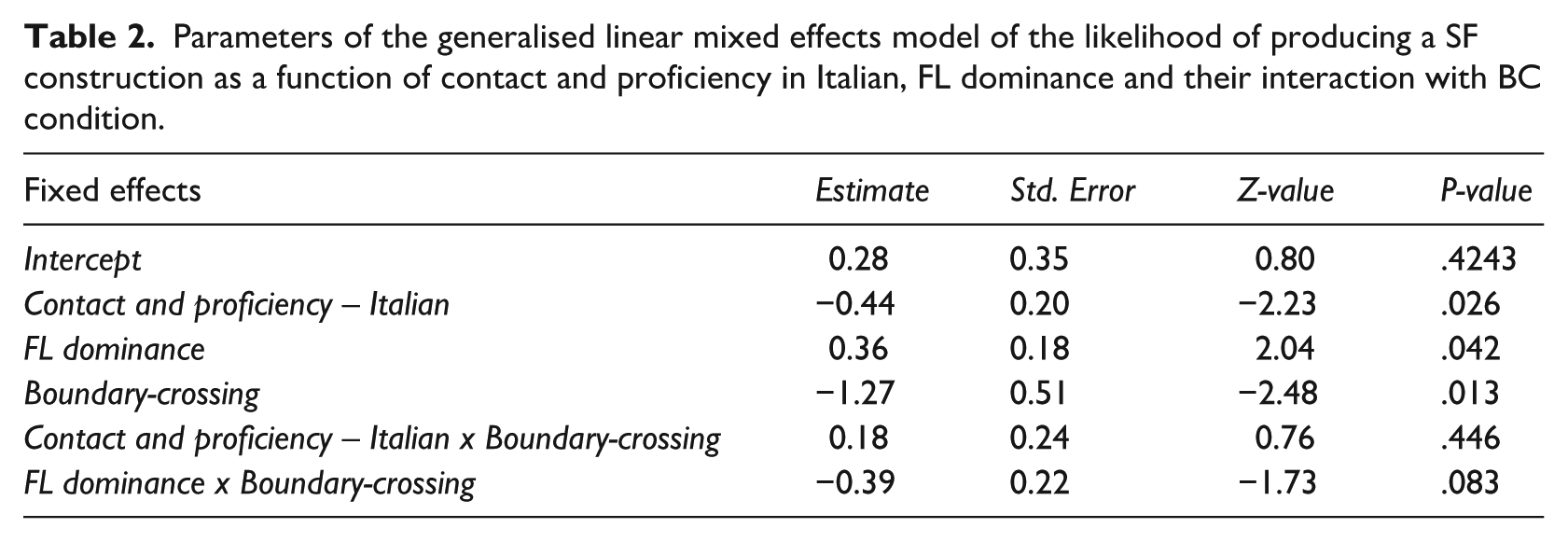
Figure 1 visualises the proportion of SF produced by L1 Italian speakers and German-speaking L3 learners in the BC and non-BC condition. We can see that L3 speakers produce more SF constructions than native speakers across the board. Moreover, both groups seem to produce more SF construction in the non-BC (L3 learners: M = 0.63, SD = 0.30; L1 speakers: M = 0.32, SD = 0.25) than in the BC condition (L3 learners: M = 0.43, SD = 0.28; L1 learners: M = 0.13, SD = 0.20). This picture is confirmed by the results of the statistical analysis (Table 1) which reveal a significant main effect of Group, a significant main effect of BC condition and no significant interaction. Moving to the results concerning the influence of the L2 on the L3, we can observe in Figure 2 that speakers who are more proficient/exposed to SF L2 languages tend to produce more SF constructions in their L3 Italian than learners who are more proficient/exposed to VF languages (French, Spanish or Portuguese) and that this trend seems to be more marked in the non-boundary-crossing condition than in the boundary-crossing condition. The results of the second model reveal the first trend to be significant and the second one to be marginally significant (Table 2). As can be gleaned from Figure 3, the control variable of proficiency/contact with Italian is significant: participants who are more proficient/in contact with Italian tend to produce fewer VF constructions than participants who are less proficient /in contact with it. The interaction between proficiency and contact with Italian and the boundary-crossing condition is not significant.
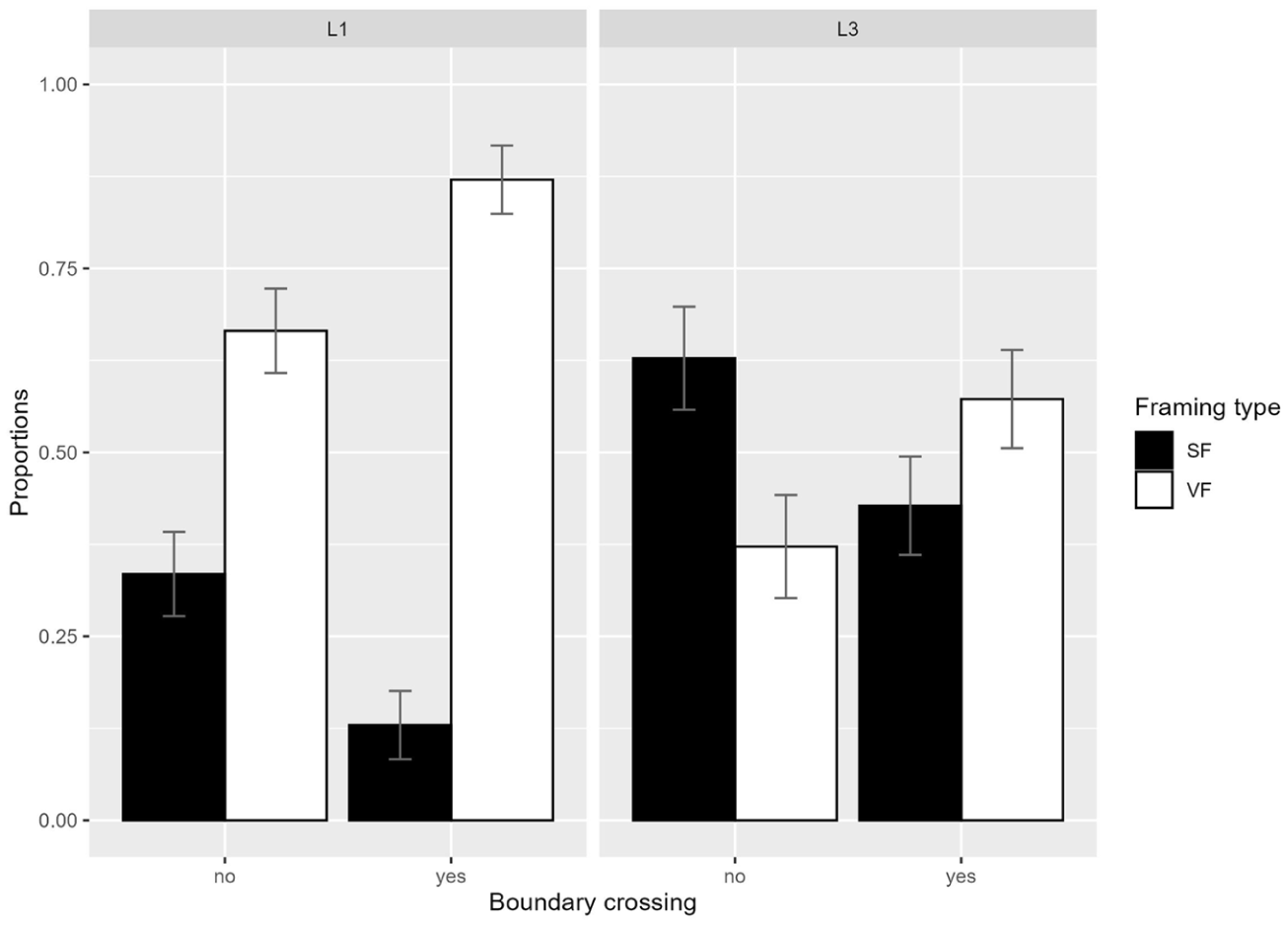
Proportions of VF and SF constructions produced across groups and conditions.
Parameters of the generalised linear mixed effects model of the likelihood of producing a SF construction as a function of BC condition, group and their interaction.
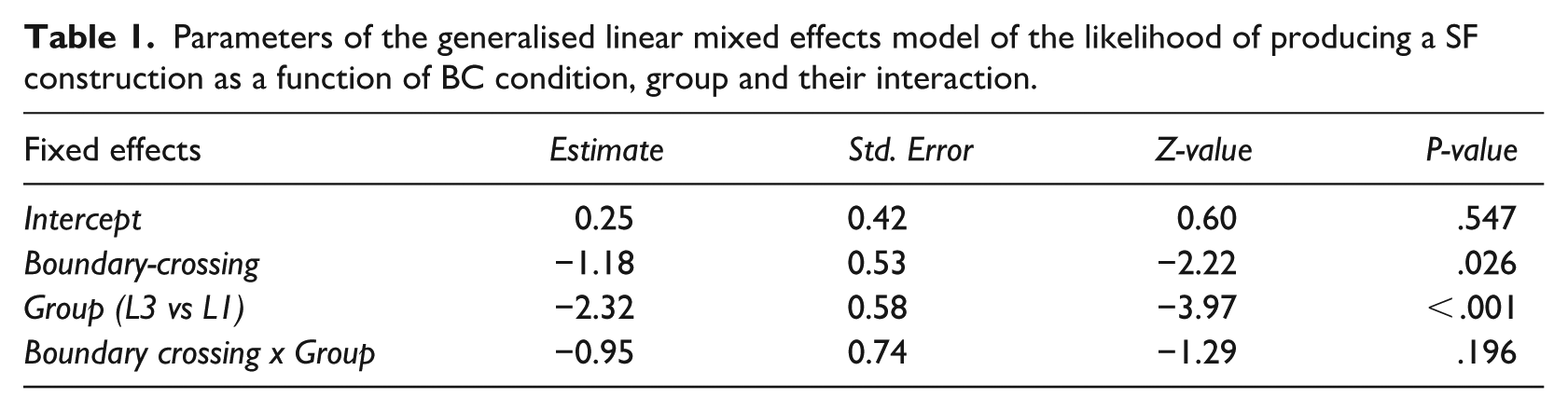
Predicted probabilities of producing a SF construction across standardised FL dominance scores and BC condition.
Parameters of the generalised linear mixed effects model of the likelihood of producing a SF construction as a function of contact and proficiency in Italian, FL dominance and their interaction with BC condition.
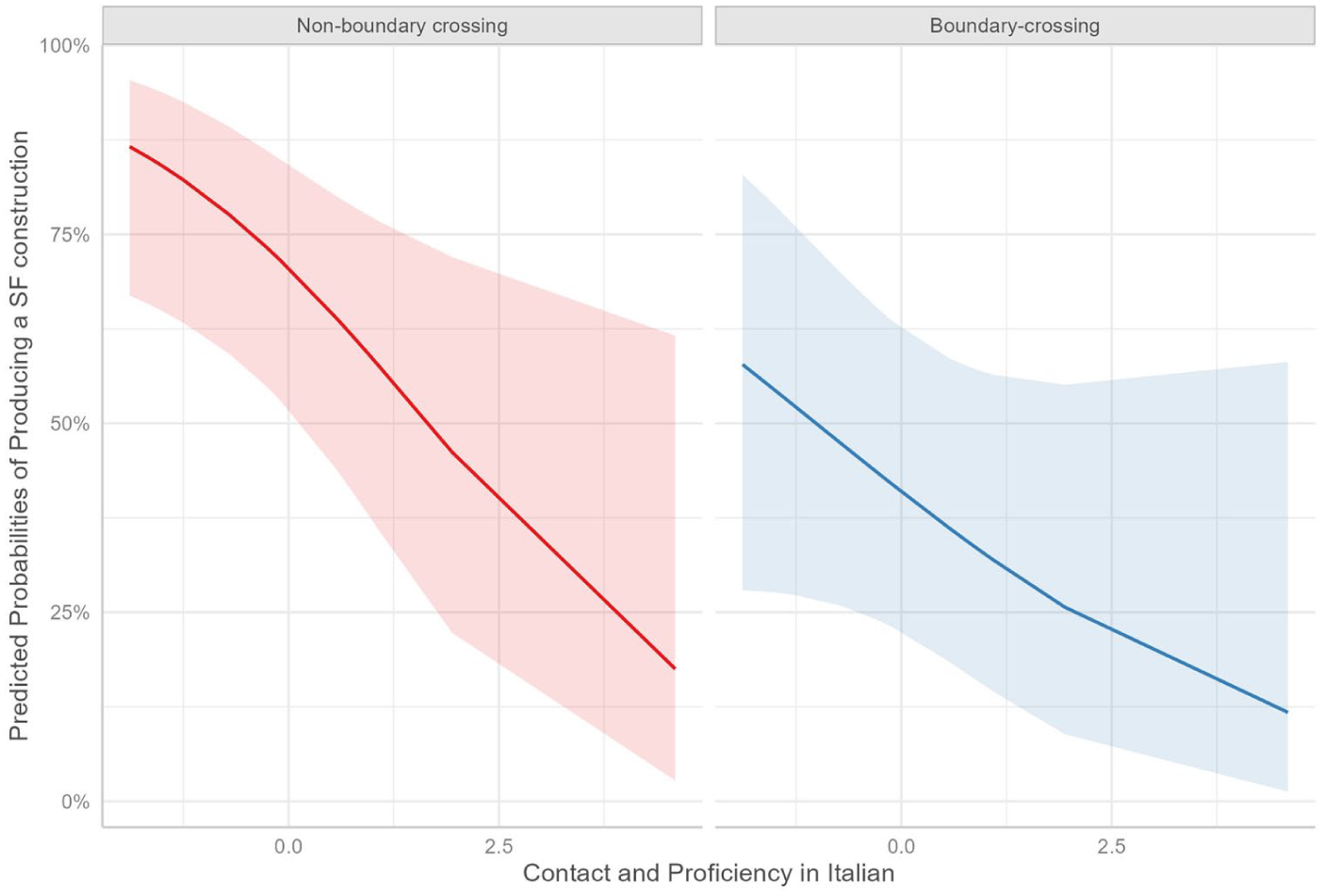
Predicted probabilities of producing a SF construction across the standardised scores of proficiency and contact with Italian and BC conditions.
Discussion and conclusion
In the present study, we investigated whether German-speaking L3 learners’ Italian production of ME was influenced by (1) the input frequency distribution of framing patterns in the target language, (2) their L1 and (3) their L2(s). To investigate these factors, we administered a video description task in which we elicited descriptions of BC and non-BC events in Italian by L3 learners and L1 speakers of Italian.
Concerning (1), the results showed that learners produced more SF constructions in the non-BC condition than in the BC condition. We suggest that these results indicate that learners are sensitive to the input frequency distributions of their target language: learners manage to attune to the target VF pattern in BC situations, which typically do not allow SF constructions, but struggle in non-BC situations in which both SF and VF constructions occur. This result is clearly in line with the finding by Song et al. (2016) that English-speaking L2 learners of Spanish produced fewer Path verbs in the non-BC condition than in the BC condition in a written production task. In this regard, it is also interesting that Lewandowski and Özçalışkan (2021), one of the few studies which has not found evidence of CLI from the L1 (Polish – SF) to the L2 (Spanish – VF), mostly investigated BC events. One could tentatively suggest that their observed absence of CLI might be due to the relative ease in acquiring the VF pattern in the BC condition as compared with the non-BC condition, which we have observed in the present study.
However, a question that remains unresolved is whether these results are solely due to sensitivity to the framing patterns employed in the target language to express motion events. It is also possible that difficulties in the acquisition of specific lexical material are at play in this process. It is unfortunately impossible in the present study to disentangle the expression of BC versus non-BC events from the use of specific lexical items. The Path verbs salire ‘to go up’ and scendere ‘to go down’ as well as the prepositions su ‘up’ and giu’ ‘down’ are intrinsically linked with the expression of non-BC events. In a spontaneous production task it is impossible to know whether the overuse of SF constructions in the non-BC condition is due to sensitivity to the frequency of the framing pattern used in the target language or to difficulties in acquiring these specific Path verbs. To disentangle these factors, it might be useful for future research to provide participants with the lexical material needed to express Path in VF and SF constructions.
Concerning (2), we found that learners produced more SF constructions compared to native speakers of Italian. We suggest that this might be due to the influence of the SF L1 on the L3. This is in line with the results of several previous studies which have found evidence suggesting CLI from the L1 to the L2 (e.g., Anastasio, 2023; Larrañaga et al., 2012; Treffers-Daller & Calude, 2015). It is possible that this result is due to a general learner tendency to privilege less complex constructions, however, we consider this highly unlikely since SF constructions, due to their semantic density (i.e., several semantic components are encoded within the same clause), are not necessarily easier to acquire than VF constructions (see Hendriks et al., 2008, p. 32). Of the 269 SF constructions produced, only 15 constructions could be considered attempts to simplify the task of describing ME. In these cases, the main verb encodes generic motion, and Path is encoded in a satellite (e.g., andare dentro ‘go into’), whereas 245 constructions represent semantically denser constructions conflating Manner and Path by expressing Manner in the main verb and Path in a satellite, which closely resemble the prototypical German SF pattern. 4 It is important to highlight that based on our results we cannot determine whether learners experience linguistic or conceptual transfer. The former refers to the influence of linguistic knowledge (e.g., lexical, morphological, sematic or syntactic knowledge) (Eibensteiner, 2024, p. 276), whereas the latter refers to the influence in the way a learner ‘attend to, perceive, interpret, construe, conceptualize, categorize and refer to experience’ (Jarvis, 2017, p. 21). In our study, it is possible for transfer to have occurred at the linguistic level (transfer of syntactic constructions), at the conceptual level (transfer of form-function mapping of the concepts of path and manner of motion) or both. Future studies could shed more light on this by incorporating tasks which require more explicit metalinguistic knowledge (e.g., interpretation tests or grammaticality judgement tasks) followed by introspective questionnaires or interviews (see Vallerossa & Bardel, 2023) to tap into participants’ strategies when it comes to the selection of the ME construction to be used.
Concerning (3), the results show that learners who were dominant in SF L2s were more likely to use SF constructions than learners who were dominant in VF L2s, suggesting that properties of the acquired L2s can affect learners’ L3. This result is in line with the body of literature that has found evidence for the occurrence of CLI from the L2 to the L3 in several linguistic domains (e.g., Eibensteiner, 2023; Puig-Mayenco et al., 2020; Sánchez, 2020) as well as evidence suggesting that CLI from the L2 is more likely to happen at higher L2 proficiency levels (e.g., Arıbaş & Cele, 2021; Eibensteiner, 2023). Moreover, in line with studies which have found that dominance in the L1 versus L2 can modulate transfer to the L3 (e.g., Angelovska et al., 2023; Puig-Mayenco et al., 2020), our measure of dominance between typologically different L2s has been found to be a significant predictor of CLI in the L3. This is the first study to our knowledge which has adopted a dominance measure among the spoken L2s. This measure allowed us to account for the variability in the linguistic repertoire of multilingual speakers. Nonetheless, we acknowledge some limitations of the adopted dominance score: the score is based only on L2s which participants reported speaking fluently, although studies have found evidence that CLI from the L2 to the L3 can occur also at low levels of L2 proficiency (e.g., Sánchez, 2020); additionally, speakers with different linguistic profiles could be associated with the same dominance score: for instance, a learner who does not speak any additional FL fluently would get a score of zero, but the same score would be given also to a learner who is completely balanced in their proficiency and exposure of L2s which are VF and SF. Moreover, many questions remain unanswered: Would the results be the same with speakers with different linguistic profiles, for example, with a different L1, different proficiency levels in the L3 or different L2(s)? We hope that future studies will improve the precision of this score and shed some light on these questions especially since we consider that gaining insight into how different L2s affect L3 acquisition might be highly relevant to improving and/or developing L3 teaching and learning techniques, which could possibly benefit from strategically using previously acquired L2s as a learning resource. Finally, although this was not the main aim of the study, we believe that the significant role of the L2 dominance score in the learners’ L3 production can have some theoretical implications. The fact that we found CLI not only from the L1 but also from the L2s speaks in favour of models which predict that CLI in the L3 can occur from more than one language (e.g., Slabakova, 2017; Westergaard et al., 2017). This finding also highlights the necessity of taking into account the complex interaction among the languages spoken by our multilingual participants when designing and interpreting the result of any study. However, our design did not allow us to investigate the claims made by these models any further. Since we did not adopt a mirror-image-design study, we could not test whether the L1 or the L2 had a privileged status in the CLI process. Since we tested only one structure, we cannot make any claims concerning a possible property-by-property-based transfer.
Some noteworthy results which, however, were not the focus of the present study are discussed in the following paragraphs. First, we would like to speculate on the meaning of a marginally significant trend that revealed the effect of previously acquired L2(s) to be stronger in the non-BC condition than in the BC one. We suggest that this might be a further indication that learners are sensitive to the BC constraint: the availability of SF construction in other L2s might reinforce this preference, but only in contexts in which these constructions are licensed in the target language (non-BC condition). More well-powered future studies might shed light on this last tentative point.
Second, we have found a significant effect of our control variable for contact and proficiency with Italian: as participants get more proficient/in contact with Italian, they tend to produce fewer SF constructions and thus attune more to the typical framing preferences of Italian. These results are in line with previous studies which have found that learners tend to become more accurate in their ME expression as they get more proficient in the target language (e.g., Song et al., 2016; Treffers-Daller & Calude, 2015).
Finally, it is important to stress that L1 Italian speakers also produced SF constructions, and that these were not restricted to the non-BC condition. This confirms the presence of these structures in Italian (Hijazo-Gascón, 2018), but it also raises questions concerning what should be the didactic objective of teaching ME constructions in an L2 or L3 setting. While VF constructions are the most canonical constructions for Italian, this does not mean that SF constructions are not present in the input and as such the extent to which they should be considered a sign of learner difficulties in FL learners needs to be carefully evaluated.
Supplemental Material
sj-docx-1-ijb-10.1177_13670069251383411 – Supplemental material for The acquisition of motion event constructions by German-speaking learners of Italian as L3: The role of input frequency distributions, the L1 and the L2(s)
Supplemental material, sj-docx-1-ijb-10.1177_13670069251383411 for The acquisition of motion event constructions by German-speaking learners of Italian as L3: The role of input frequency distributions, the L1 and the L2(s) by Anna Michelotti and Helen Engemann in International Journal of Bilingualism
Footnotes
Acknowledgements
We thank Ioli Baroncini for the helpful discussions of the interpretation of the findings, Martina Gervasi for her assistance with data collection, transcription and coding, and Alice Lipparini for designing the video stimuli (© Alice Lipparini, alicelipparini.com).

Ethical approval
The study was conducted in accordance with the Declaration of Helsinki and approved by the Ethics Committee of the University of Mannheim (EK Mannheim 28/2021, 25.05.2021).
Consent to participiate
Informed consent was obtained from all participants involved in the study.
Declaration of conflicting interests
The authors declared no potential conflicts of interest with respect to the research, authorship and/or publication of this article.
Funding
The authors disclosed receipt of the following financial support for the research, authorship and/or publication of this article: The research presented in this study was funded by a grant of the German Research Foundation (DFG) awarded to the second author Helen Engemann for project P2 (project no. 437487447), Priming in contact-setting bilinguals and monolinguals as a driver of language change, as part of the research unit Structuring the input in language processing, acquisition and change (FOR 5157). The open access publication of this article was funded by the University of Mannheim.
Data availability statement
The dataset is available from the corresponding author upon reasonable request.
Supplemental material
Supplemental material for this article is available online.
Notes
Author biographies
References
Supplementary Material
Please find the following supplemental material available below.
For Open Access articles published under a Creative Commons License, all supplemental material carries the same license as the article it is associated with.
For non-Open Access articles published, all supplemental material carries a non-exclusive license, and permission requests for re-use of supplemental material or any part of supplemental material shall be sent directly to the copyright owner as specified in the copyright notice associated with the article.
