




Abstract
Objectives:
Distinguishing between language mixing and language fusion is a non-trivial task, particularly in situations of long-standing bilingualism. The main goal of this paper is thus to propose and test a methodology for discerning language fusion from conventionalized mixing. In addition, we examine the hypothesis that the fusion of unbound elements evolves from alternational mixing.
Design:
The paper addresses the goals through a distributional analysis of a vernacular variety of Kildin Saami, a seriously endangered East Saamic (Uralic) language spoken on the Kola Peninsula in Northwest Russia, as a partially fused lect due to contact with Russian.
Data and Analysis:
A one-hour recording of an informal group conversation with three native speakers, comprising some 10,000 word tokens, was transcribed and annotated for Russian-origin items. For comparison, other available speech samples, documenting the earlier stages of the language development, as well as the few existing grammatical descriptions and dictionaries were referred to.
Findings:
The paper develops and showcases three diagnostic criteria indicative of language fusion: (a) regularization of the donor language items’ usage patterns in the mixed variety; (b) functional reduction, or functional extension, of the donor language element, and/or of its inherited native equivalent; (c) the introduction of new constructions involving the donor language grammatical elements by way of loan translation. Finally, we report multiple parallels existing between the distribution of Russian-origin items in vernacular Kildin Saami and alternational mixing.
Originality:
This paper is the first to propose and systematically test diagnostic criteria indicative of language fusion in a situation of long-term bilingualism.
Significance:
The proposed criteria may reliably be employed as indicators of fusion in future studies of contact varieties with little, or undocumented, linguistic histories. Furthermore, in contrast to the mainstream assumption, this study also provides evidence for the claim that alternational mixing can be a starting point for the emergence of a fused lect.
Keywords
1 Introduction
In speech, interference is like sand carried by a stream; in language, it is the sedimented sand deposited on the bottom of a lake. (Weinreich, 1953, p. 11)
The study of mixed varieties has largely been dominated by an interest in mixed languages, which emerge through the fusion of two identifiable source languages. The origin of mixed languages, and particularly their split ancestry, have motivated extensive research seeking to better understand their evolution. Far less attention has been given to other types of mixed varieties, particularly those in which only one or some sets of grammatical elements have been affected by fusion. The extent to which these varieties grammaticized and conventionalized language mixture differs considerably from the degree of fusion observed in mixed languages. For this reason, Auer (2014, p. 303) suggests referring to this process as partial fusion. Although some of the varieties exhibiting signs of partial fusion are well documented (see, e.g. King, 2000, for the Prince Edward Island varieties of Acadian French; Leinonen, 2002, for varieties of Zyrian Komi in Russia; Szabó, 2010, for the Danube Swabian variety of Neu-Palota in Romania), their evolution and the role of social, structural and distributional factors in this process have not yet been fully clarified.
In situations of long-standing bilingualism, it is a major problem to distinguish between conventionalized mixing (Muysken, 2000, p. 72; Lantto, 2015) and fusion, since both may affect sentence and discourse grammar as well as lexicon (Auer, 1999, pp. 323–328). While in conventionalized code-mixing the selection of elements attributed to one of the codes is unconstrained and results in free variation (cf. Stolz and Stolz, 1996, p. 113), fusion implies that mixing patterns undergo regularization (Auer, 2014, p. 312), or “structural sedimentation […] [which] presupposes a loss of variation and the stabilization of function-form relationships” (Auer, 1999, p. 321). In a partially fused lect, the selection of some of the borrowed elements becomes obligatory, although other copies still alternate with native elements having a similar function/meaning. This means that in fusion, a choice between a borrowed element and its native equivalent is no longer possible. This paper addresses the issue of determining the status of borrowed elements by suggesting diagnostic criteria that would allow one to identify them as established loans.
In this case study, we analyse a vernacular variety of Kildin Saami, an East Saamic (Uralic) language spoken on the Kola Peninsula in Northwest Russia, as a partially fused lect due to contact with Russian. Kildin Saami has conventionalized a mixed inventory of function words in the clause periphery, consisting of discourse markers, discourse particles, interjections, connectives and adverbs, as observed already by Pineda (2009). However, as both Russian and Kildin Saami equivalent expressions are available to the bilingual speakers, it is a non-trivial issue whether at least some of the Russian elements in question have entered the set of vernacular Kildin Saami grammatical words and have thus contributed to the emergence of a fused lect. In approaching this issue, we will analyse a recording of naturally occurring Kildin Saami speech in order to examine the distribution of synonym pairs consisting of a Russian-origin word and its Kildin Saami native equivalent.
The first, most obvious criterion that is diagnostic of fusion is the regularization of usage patterns involving the donor language items. We will explore this criterion by applying it to two cases of double marking of grammatical functions in vernacular Kildin Saami, which include the expression of the subjunctive mood and the marking of the superlative degree of adjectives. Another criterion indicative of regularization that is applicable to synonym pairs of the donor language and the recipient language items concerns a change in the functionality of a member of the pair (Auer, 1999, p. 326). For example, the emergence of a complementary distribution of the donor language word and the native variant could be regarded as a sign of fusion (cf. Stolz and Stolz, 1996). Native function words often diminish their functionality by reducing the number of usage contexts, whereas borrowed function words may conversely undergo an increase in the number of usage contexts and hence develop functions that are non-existent in the donor language. To illustrate the process of functional reduction, we will outline the remodelling of the Saami connective ja “and”, the use of which in modern vernacular Kildin Saami is restricted to syntactic combining. The process of functional extension will be exemplified by the Russian-origin complementizer šte (< Russian čto) “that”, which is developing in Kildin Saami to a more general subordination marker.
Another criterion diagnostic of fusion is the introduction of new constructions by way of loan translation. Following Backus (2015, p. 29), we consider loan translation as a synchronic selection process, with semantic and/or distributional change being its diachronic effect. We therefore analyse Russian-origin expressions conventionalized in vernacular Kildin Saami as a result of distributional change and refer to them as grammatical loan blends, in Haugen’s (1950) sense. We will show that conventionalized loan blends involving borrowed grammatical elements indicate adoption of these elements in the fused variety. For example, the negative adverb ni-koz “nowhere to”, consisting of the borrowed negative particle ni (< Russian ne/ni) and the native interrogative adverb koz “where to”, is modelled on the Russian negative adverb nikuda “nowhere to”. In long-term contact situations, loan translations involving borrowed material contribute to an increase in surface similarity between the contact languages and thus facilitate the transfer of the covert structure (cf. Backus and Demirçay, 2015).
The second major goal of this paper is to present evidence corroborating the assumption that functional elements, such as clause-peripheral elements and auxiliary elements of analytical forms, are borrowed into a language through alternational code-mixing (Muysken, 2000, pp. 96, 106–114; Goria, 2018; Goria, 2020). Our analysis will show that the distribution of Russian-origin items in vernacular Kildin Saami and the patterns of alternational mixing strikingly parallel each other. We will thus argue that a scenario where the fusion of unbound elements, mostly in the clause periphery, evolves from alternational mixing is highly plausible, despite some researchers’ reservations about such a path of development (e.g. Auer, 1999; Backus, 2003).
The paper is structured as follows: The next section of the introduction sketches the sociolinguistic history of Kildin Saami as well as the current sociology of this endangered language. The subsequent section describes the data sources on which the study is based, the conventions followed for the annotation of our corpus data and the presentation of examples. Section 2 reports the results of the analysis of vernacular Kildin Saami along the aforementioned criteria indicative of fusion. Section 3 gives a systematic presentation of the features of alternational mixing as found in vernacular Kildin Saami and discusses the sociolinguistic and cognitive motivations for the emergence of this mixing type in the examined community. The final section summarizes our findings.
1.1 A short history of Kildin Saami language contacts
Kildin Saami is a Uralic language from the Peninsula branch of East Saamic. The most comprehensive, though outdated, linguistic description of Kildin Saami is Kert (1971), while a recent grammatical outline with extensive references to the existing literature on the language is Rießler (in press). The genealogically closest relatives of Kildin Saami include Ter Saami (belonging to the Peninsula branch of East Saamic, like Kildin Saami), Akkala Saami and Skolt Saami (both belonging to the Mainland branch of East Saamic; Sammallahti, 1998, pp. 26–34). Kildin Saami used to be spoken in the central inland and the north-central coastal parts of the Kola Peninsula (Figure 1). However, the original Kildin Saami dialect areas have fragmented, chiefly because of the forced relocation of the population to centralized settlements and towns.
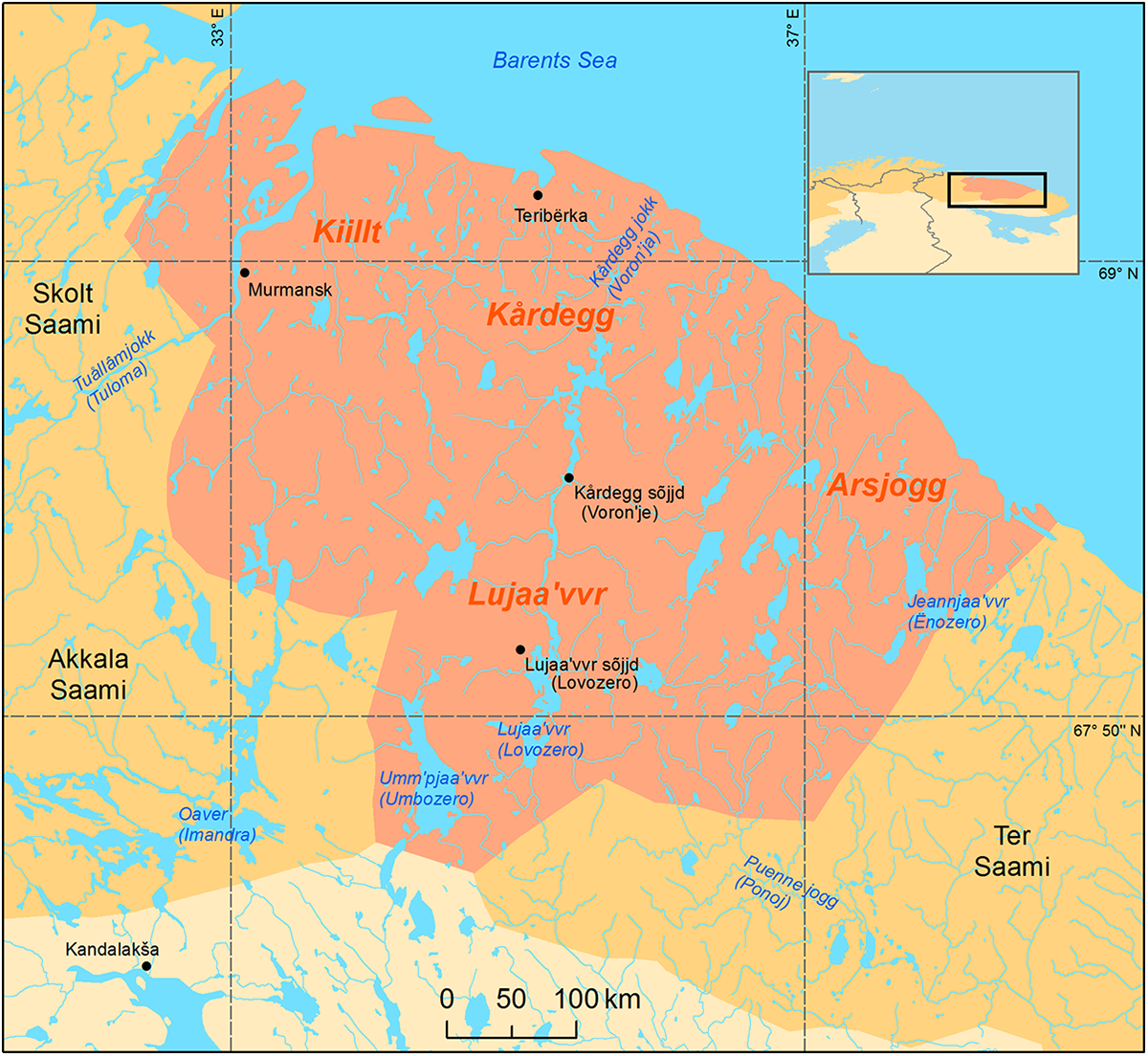
Map localizing the traditional Kildin Saami area on the Kola Peninsula and showing Kårdegg/Voronensk (the birthplace of our speakers), Lujaa′vvr/Lovozero (their current living place) and the surrounding Saami dialect and language areas (map courtesy of Timo Rantanen).
Language contact with Russian dates back to the establishment of the first Orthodox monasteries in the area as early as the 16th century. The outset of Christianization marked the beginning of subsequent colonization, supported by a steady influx of Russian-speaking settlers. The initial colonists, however, were speakers of Pomor, a variety of North Russian (cf. Post, 2006). The earliest testimony of Saami-Russian bilingualism was made by the English sailor Steven Borough in 1557, when he collected a list of 95 Kildin Saami words with their Russian equivalents (cf. Abercromby, 1895; Genetz, 1895). While Russian has remained the major contact language of modern Kildin Saami, there was also a long-standing and intense contact with North Karelian. Other, more recent, contact languages are Finnish and Norwegian, as well as Zyrian Komi (since the late 19th century) and, most recently (since the 1990s), North Saami (more details on Kildin Saami historical and current language contacts are provided by Blokland and Rießler, 2011).
A considerable increase in bilingualism and language shift to Russian set in after the turn of the 20th century and the founding of the Soviet Union. Collectivization of fishing, hunting and reindeer herding – the traditional livelihoods of the Kildin Saami – led to far-reaching socio-economic changes (cf. Seiwert, 2000). The original settlements were forcibly centralized and as a result of industrialization and militarization, many thousands of migrants from other parts of the country settled on the Kola Peninsula after World War II. Today, Russian is the dominating language in virtually all domains of Kildin Saami life.
Consequently, Russian influence is strong in Kildin Saami vocabulary and grammar (Blokland and Rießler, 2011; Rießler, 2007, 2009). This influence has led to large-scale borrowing of Russian discourse operators and grammatical words as well as grammatical patterns. The present study focuses on the borrowing of relatively unbound elements of grammar, including Russian discourse particles, such as the turn-initial nu “well” and vot “well”, and grammatical words, such as the coordinating conjunction i “and”, the subordinating conjunctions čto “that” and esli “if”, the superlative auxiliary samyj “most” and the subjunctive particle by.
Reconstructing the earliest contact-induced changes and dating the first loans is problematic because there are no linguistic descriptions or text sources (except Borough’s wordlist, see above). However, already the first transcripts of Kildin Saami speech, which go back to the second half of the 19th century and are published in Itkonen (1931), contain the aforementioned words (see, e.g. the comprehensive descriptive dictionary by Itkonen (1958), which builds on the earliest documentations of Kildin Saami vernacular language).
Today, middle-generation speakers have only a limited proficiency in Kildin Saami, and younger-generation speakers are typically no longer bilingual. In other words, the language is not being actively transmitted intergenerationally within the context of the family, and is therefore critically endangered. The number of fully fluent speakers is unlikely to exceed 100 (Scheller, 2011, 2013), and the ongoing revitalization projects have so far only produced symbolic results. The Kildin Saami society nevertheless maintains a strong linguistic identity, which is evidenced, among other things, by the persistent discourse on the importance of the “native language”, led by active and passive speakers as well as Kildin Saami language activists (cf. Siegl and Rießler, 2015).
1.2 Kildin Saami repertoires and data
Kildin Saami is almost exclusively used as a spoken vernacular. Dialectal variation still exists and is a sociolinguistic marker. See Figure 1, which shows the traditional areas of the four dialects that are still maintained, despite the relocation of speakers.
The attempts in the 1930s to create literary forms of the numerous minority languages of Northern Russia based on Latin script (cf. Èndjukovskij’s (1937) grammar of Kildin Saami) were not sustainable (Siegl and Rießler, 2015). The contemporary written standard, based on Cyrillic orthography, was developed by a group of researchers, teachers and language activists in the 1980s (Kuruč et al., 1995). The language has since been used in the written form – often in various inconsistent variants – in learner dictionaries, elementary-school textbooks, literary texts and, to some extent, in social media (cf. Rießler, 2015). However, published Kildin Saami texts are usually relatively short and limited in genre. As a rule, they contain folklore or are translations of prose, poetry or fiction for children. Not surprisingly, the number of Kildin Saami speakers literate in their language seems to be very small.
Since Kildin Saami is an under-described language and comprehensive descriptions of Kildin Saami discourse grammar are virtually non-existent, 1 the data that this study is based on is vernacular speech recorded during fieldwork in the community. We analysed a one-hour long recording of an informal group conversation comprising a total of approximately 10,000 word tokens, which we transcribed and annotated for Russian-origin items. The recording was conducted by one of the authors in the town of Lovozero in 2006. Three female Kildin Saami language informants, who are distant relatives (AIG born 1932, MAP 1933, ZIM 1940), participated in the conversation, while preparing traditional local food. Being born in the village of Kårdegg (in Russian Voron’je/Voronensk), 2 the participants are the speakers of the same Kildin Saami dialect. None of them had learned Russian before entering school. The three women resettled in the administrative centre of the area, Lovozero 3 (Figure 1), in the early 1970s. The audio and video recording took place in the shared kitchen of a local indigenous arts and leisure centre.
The participants in the conversation are in the Saami monolingual mode (cf. Grosjean, 1982), which means that (conversational) code-switching barely occurs. The group’s language policy is to use only Saami, which is signalled in our data by self-repair and other-repair strategies.
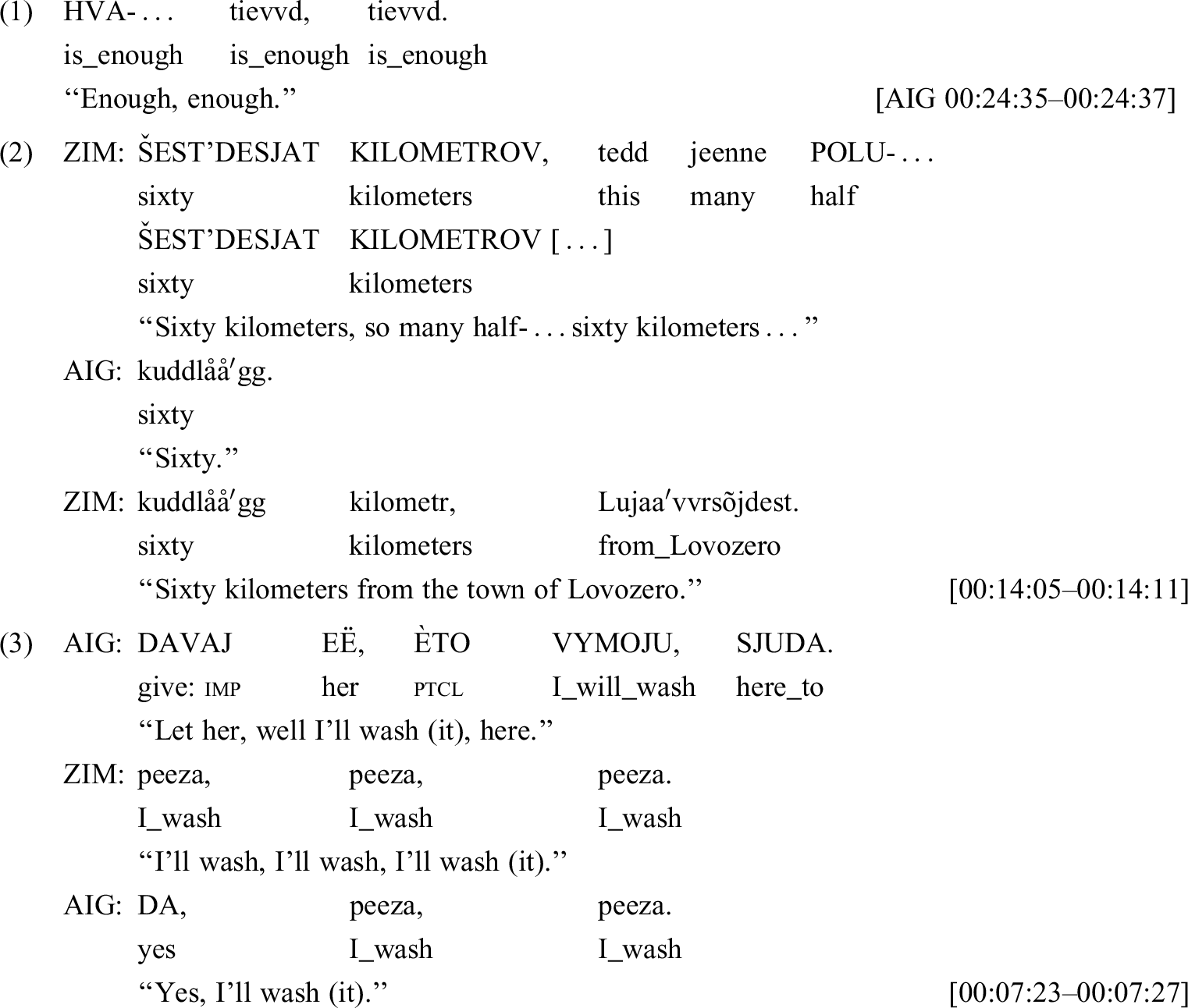
Example (1) illustrates self-repair: the speaker starts in Russian with the word hva(tit) “(it’s) enough”, but corrects herself and produces the Kildin Saami equivalent tievvd “(it’s) enough”. In (2) and (3), one of the speakers repairs her conversation partner, who then corrects herself and continues speaking in Kildin Saami. These repair strategies are also observed in other recordings of similar interactions in vernacular Kildin Saami.
The recording was transcribed in Standard Kildin Saami (Cyrillic) orthography, but the examples included in this paper are given in the Latin-based phonemic transcription, which is also employed in the grammar sketch by Rießler (in press). However, in order to facilitate reading, we transliterate Russian-origin Kildin Saami words in the examples according to the scientific transliteration conventions for Russian, regardless of whether, or not, these words are phonologically and/or orthographically integrated in Kildin Saami. For instance, the Russian-origin Kildin Saami complementizer ›штэ‹ šte [ʃtɐ] “that” is transliterated as čto (Russian ›что‹ [ʃtɔ]), and the Russian-origin Kildin-Saami particle and adverb ›конечнэ‹ ko′nešne [konjI∊ʃnɐ] “of course, sure” is transliterated as konečno (Russian ›конечно‹ [kʌˈnjI∊·ʃnə] “of course, sure”). When we mention Kildin Saami words of Russian origin, we provide the Kildin Saami and Russian spellings (in this order) for convenience, such as šte/čto and ko′nešne/konečno.
In the examples, we typeset all elements identifiable as Russian in uppercase letters. Discourse particles are given without translation, but are marked in the glosses as
For the purposes of comparison, in addition to our corpus data, the reported analysis draws on the spoken data collected by the Kola Saami Documentation Project since 2005, 6 by various Soviet linguists in the time period between 1950 and 1980 (most of these texts were published in Kert, 1961), and the few existing grammatical descriptions that mention the relevant linguistic phenomena, particularly Kert’s (1971) descriptive grammar.
2 Vernacular Kildin Saami as a fused lect
A fused lect emerges from mixing by the conventionalization and grammaticization of the mixing patterns, so that a choice between a borrowed item and its native equivalent is no longer available to the speakers. In our data, this criterion applies to a large number of singly occurring Russian-origin items that were borrowed into Kildin Saami already in the late 19th century, such as the turn-initial particles a and nå/no, the focus particle že and the negative particle ni, the coordinators a “and, but”, i “and” and nå/no “but”, as well as the subordinator šte/čto “that”, which are all found already in the earliest documentations of the language (cf. Itkonen, 1958, and the sources this dictionary is based on). These items have become part of Kildin Saami standard grammar and feature in normative dictionaries. However, not all of the particles and adverbs listed in the sections below have undergone conventionalization and grammaticization even in vernacular Kildin Saami. To give a few examples, we can refer to the Russian turn-initial particle vot “well”, used as a variant of the native equivalent te′l “well”, the Russian progression marker potom “then”, occurring in variation with the native equivalent maŋŋa “then, later”, and the epistemic marker možet (byt’) “maybe”, competing with the native equivalent vuajj “[s/he/it] can”. In each of these synonymous pairs, the Russian variant is more frequent than the native variant, particularly in the speech of the youngest speaker, ZIM. Considering the high frequency of alternations involving clause-peripheral elements in our data, we suggest that some of these alternations have become an integral part of vernacular Kildin Saami, while others are still in variation with native expressions.
Alongside the unavailability of the native marker, a diagnostic criterion for distinguishing between a fused lect and conventionalized mixing pertains to the separate usage of the two synonymous forms in mixing contexts and in code-switching, as well as in Russian multiword fragments spanning several constituents in otherwise Kildin Saami discourse (cf. Poplack and Meechan, 1995, for the implementation of this method), but neither code-switching nor Russian multiword fragments are available in our data. We therefore propose another criterion indicative of fusion, namely, a change in an element’s functionality. In pairs of synonymous expressions consisting of a donor language element and its inherited native equivalent, functional reduction of a synonym pair member, or its functional extension, affects the distribution of the pair members and, as we demonstrate below, reliably indicates fusion.
2.1 Functional reduction and functional extension
Studies on the borrowing of function words have reported that the substitution of native grammatical means by non-native expressions is not always total (Stolz and Stolz, 1996; Johanson, 1997; Matras, 1998; Muysken, 2000, pp. 110–111; Sakel, 2007). Instead, these studies (e.g. Stolz and Stolz, 1996, p. 95) have frequently attested the development of a complementary distribution of the two variants. Such is the case of connectors in the Turkic languages under Russian influence, where Russian-origin connectors are used at the discourse level as turn-initial particles, and their Turkic equivalents, many of which are earlier borrowings from Arabic and Persian, are utilized as syntactic coordinators (Johanson, 1997). While the conventional expression may reduce its functional domain at the cost of its borrowed competitor, the loanword may, under some circumstances, expand its functional domain not only by replacing the native element in all possible contexts, but even by developing new usage patterns, unattested in the donor language. Regarding these possible lines of development, our analysis below focuses on functional reduction and functional expansion.
The first case can be exemplified with the connector i (< Russian i) “and”, which alternates with the native connector ja “and”, 7 both as an additive coordinating conjunction on the phrase and clause level, and as a discourse particle. These connectors also compete with the Russian-origin contrastive connector a “and, but”, occurring 180 times in the recording, as well as the Russian-origin additive connector da “and”, appearing only six times. Unlike the connectors a and da, which are used as (turn-initial) particles more frequently than as conjunctions, there are twice as many conjunctional uses of i than particle uses, and ja is found only once as a particle. On these grounds, we will leave the connectors a and da aside, and restrict the focus of our comparison to the Russian-origin i and the native ja.
The data contain a total of 25 clearly identifiable instances of ja and 54 instances of i. Both connectors appear in the data as conjunctions, that is, formatives linking phrases and clauses, and as discourse particles linking discourse. In the latter function, the connector i is employed as a turn-initial particle, as in (4) and (5), whereas the native equivalent ja is not attested in this position, although this possibility existed at earlier stages of the language development.
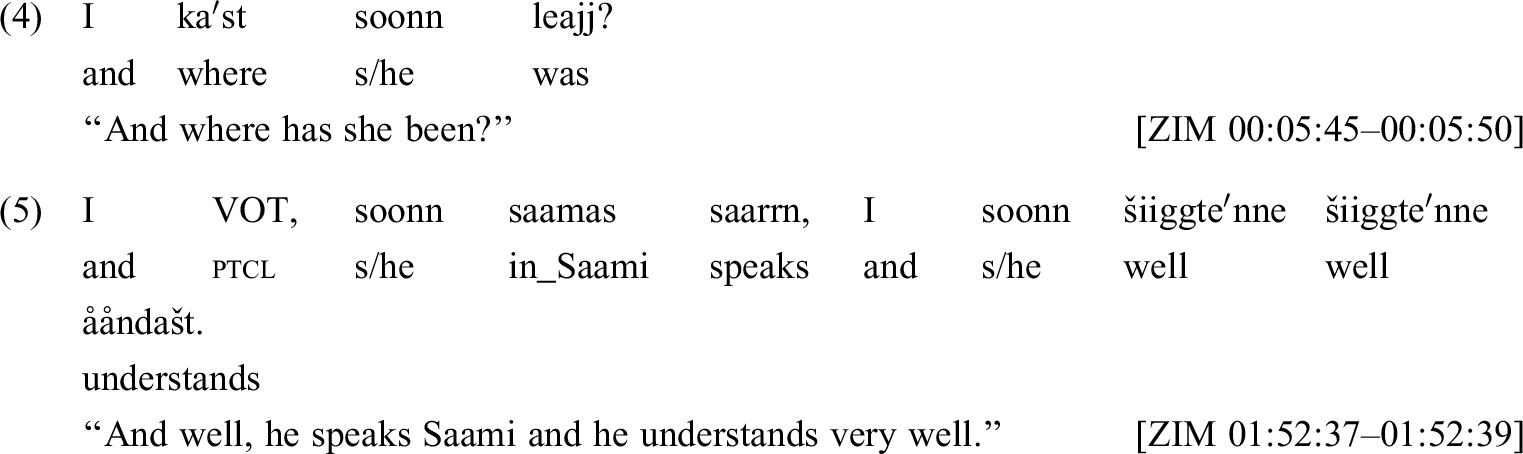
In (5), the additive particle i combines with vot “well”, another Russian-origin turn-initial particle. As such, combinations of i and functional elements, such as other particles or adverbs, are commonplace both in Russian and in vernacular Kildin Saami. In these combinations, the particle i is usually the second component, as in da-i (< Russian da i “and”), nu-i (< Russian nu i “well”), as well as in its older variant nå-i/no-i (< Northern Russian no i). Similar combinations with Native Saami elements include expressions such as nõ′dd-i “like that”, where nõ′dd is a Kildin adverb with the meaning “so, thus, like this”. While Russian-origin particle clusters occur in the turn-initial position, Russian-Saami combinations usually occupy the turn-medial position. For example, nõ′dd-i is part of a longer unit, namely the construction [kooxxt X, nõ′dd-i Y] “as X, so Y”, which is modelled after the Russian pattern (for more details, see Section 2.3). In a reduced construction, i occurs singly, without the adverb, as in Russian; for instance:

The particle i as well as the Kildin Saami subordinator kooxxt “how” in (6) form the fixed slots of the construction [kooxxt (X) Y, Y i X] “as Y, Y X”, which is copied from Russian. 8 Crucially, the Russian-origin i is the only particle attested in constructions such as this.
Table 1 provides the varying frequencies of i and ja as phrasal and clausal coordinators, and as discourse connectors. The instances of i as the second component of particle clusters and as part of syntactic constructions transferred from Russian are not included in the count because the Saami equivalent ja is not attested in these usage patterns.
Usage of the additive connectors i and ja in the sample.

It follows from the table that the Russian-origin i is used in all three functions, whereas the native Saami ja does not occur as a discourse connector in the sample. It is also evident that the alternating variants are not in complementary distribution as clausal and phrasal coordinators. At the clause level, i is used twice as often as its equivalent ja, and even at the phrase level, i is a little more frequent than ja.
Current standard language materials for Kildin Saami avoid the borrowed formative i “and” completely. 9 Instead, the native connector ja “and” is prescribed consistently, even as a turn-initial particle, despite its absence from actual usage. This is in line with the purist attitudes prevalent in the community and particularly among the Saami language activists (cf. Rießler and Karvovskaya, 2013). As our analysis shows, the vernacular language does not appear to be influenced by this tendency with regard to the use of Russian-origin connectors. Since ja does not occur as a discourse connector any more, we conclude that the number of its functional domains has reduced. At the same time, i is the only possible formative in the particle clusters given above as well as in the cited syntactic constructions modelled on Russian. The use of i in these functions thus allows us to regard this element as borrowed, or fused.
As mentioned earlier, the reduction of an element’s functional domain may occur at the expense of another element’s functional extension. However, a borrowed element may also acquire functions that are even non-existent in the donor language. According to Stolz and Stolz (1996, p. 114), the extension of an item’s functionality may develop along one of the following lines: generalization, specialization and a completely new function. We will illustrate the process of functional extension by the Russian-origin complementizer šte/čto (< Russian čto “that, what”), which has been evolving in Kildin Saami from a complementizer into a general subordination marker.
The subordinator šte/čto is one of the many clausal subordination markers that Kildin Saami has borrowed from Russian. Other examples are the complementizer je´sle/esli “if” (< Russian esli “if”, see Section 3.2 for more details and examples), the adverbial subordinators štobe/čtoby “in order to” (< Russian čtoby “in order to”), potomušte/potomučto “because” (< Russian potomu čto “because”), xo′t/xot’ “although” (< Russian xotja, xot’ “although”) and other subordinators. Alternatively, subordinated adverbial clauses can also be marked by the native Saami particle gu “how” or simply be juxtaposed. In the latter case they are introduced by native question words, which are constituents in the subordinated clause. These forms include interrogative pronouns such as mii “what [
Since no native formatives are attested as markers of canonical complementation (neither the equivalents of English that- nor English if-type complements) in any of the Saamic languages, we may assume that subordinated complement clauses originally occurred in asyndetic constructions only, which is still a possibility in Kildin Saami (Kotcheva and Rießler, 2016). The complementizer function of šte/čto is attested in the four easternmost Saamic languages (including Kildin Saami), each having a history of intense contact with Russian (cf. Itkonen, 1958, p. 561). Therefore, its borrowing most likely took place during an early stage in the development of these languages. The earliest attestations are found in the Kildin Saami (Matthew, 1878) and the Skolt Saami Bible translation (Matthew, 1884).
In Russian, the complementizer čto is a grammaticalized form of the nominative singular interrogative pronoun čto “what”. Another function of čto in modern Russian is the (non-inflectional) relativizer. As opposed to Russian, Kildin Saami has adopted šte/čto only as a complementizer. It is attested neither as a relativizer nor as an interrogative pronoun. Yet, in addition to its function as a complementizer, Kildin Saami šte/čto has begun to be used as a subordination marker beyond canonical complementation. In this usage, šte/čto combines, for instance, with interrogative words, as in (7), which is drawn from our recording, and (8) and (9), which are taken from older spoken data. 10
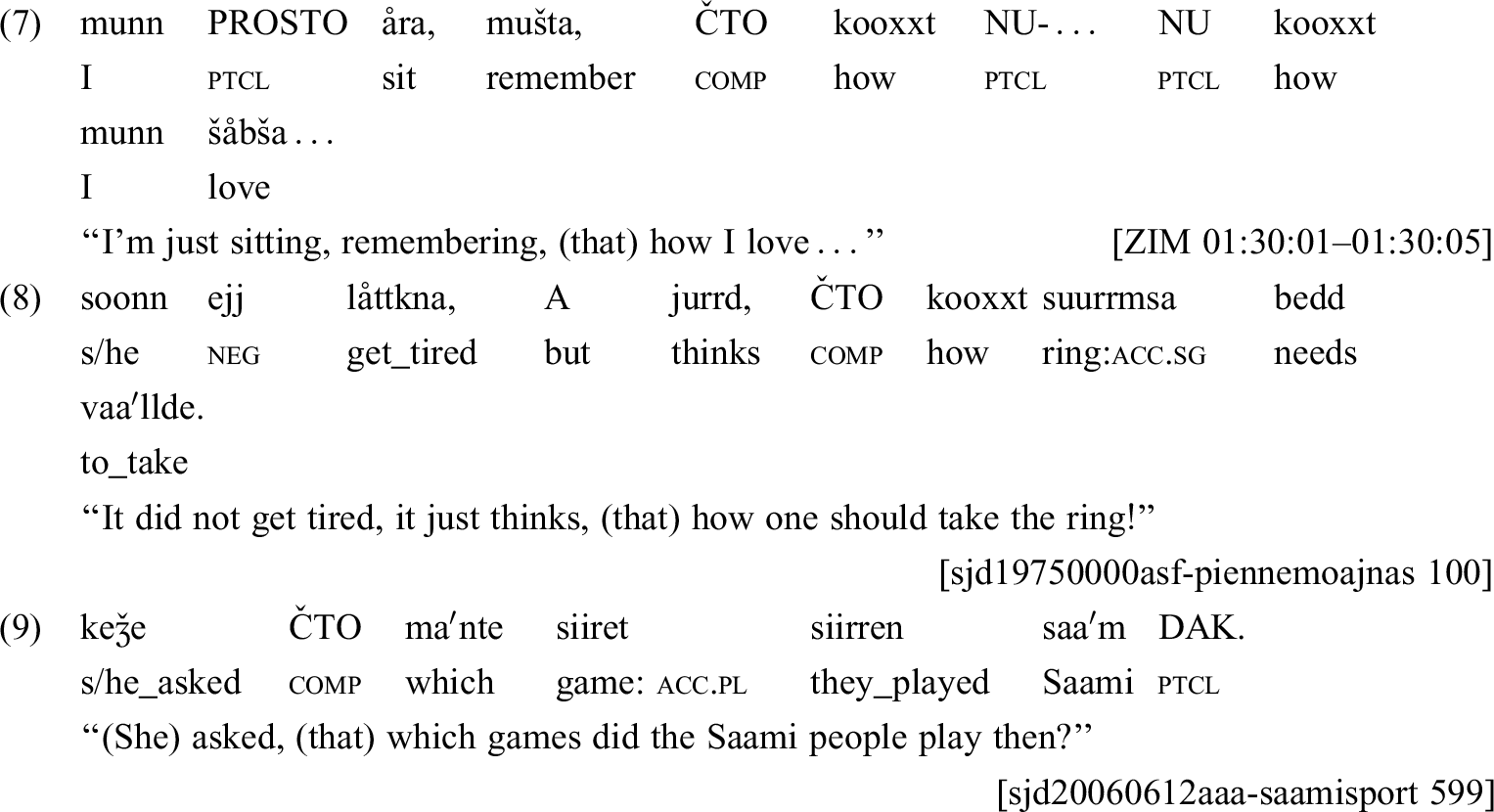
Kildin Saami šte/čto as a subordination marker can be compared to što in closely related Skolt Saami. The languages diverge in the extent to which the borrowed element has spread to new contexts. In contrast to the Kildin Saami šte/čto, Skolt Saami što has extended its use to if-type complement clauses, which are formally licensed as što-subordinated polar questions (Kotcheva and Rießler, 2016). For similar purposes, Kildin Saami has adopted and conventionalized the Russian loans kå′le/koli “if” and je′sli/esli “if”. Skolt Saami što has therefore undergone an even greater functional extension than its Kildin Saami counterpart šte/čto.
The processes of an element’s functional reduction and extension appear to be reliable criteria for determining the element’s status as a bilingual variant, or an established borrowing. However, these criteria cannot be applied to all items from the donor language because other processes may be in play, such as structural sedimentation, or regularization, of usage patterns.
2.2 Regularization of usage patterns
We will illustrate the process of usage pattern regularization by tackling the case of double marking of grammatical functions. Numerous studies have documented the doubling of grammatical formatives in bilingual speech (e.g. Muhamedowa, 2006, pp. 154–156), as well as in fused lects (e.g. Meakins, 2011, pp. 175–187; cf. also Auer, 1999, p. 328). Muysken (2000, pp. 104–105) cites several cases of double function words analysed as instances of alternational mixing. Myers-Scotton (2002, pp. 91–93) lists numerous examples of double morphology, mostly in the expression of plural, but also in infinitive marking, which is why these examples may be analysed as instances of insertional mixing.
Our data contain two cases of double marking. One involves the expression of the subjunctive mood. While Kildin Saami uses the inflectional formative -če as a subjunctive marker, 11 the expression of the subjunctive mood in Russian is syntactic: it consists of the particle by and a past-tense-marked verb. The particle by is an unbound form and may occur in a number of positions in the sentence, owing to the general flexibility of word order. In our data, the Kildin Saami suffix and the Russian-origin particle co-occur, for instance:

In (10), the Russian-origin particle be/by (< Russian by) attaches to the Kildin Saami verb, namely the subjunctive-inflected form cealhk-če “I would”. In Russian, by may also follow the verb as in (10), but this position is one among many other possibilities. The post-verbal position of by in Kildin Saami sentences as well as the loss of its unboundedness appear to be the norm in our data; these features may be considered as indices of this pattern’s regularization.
The doubling of subjunctive-mood markers frequently occurs already in the vernacular Kildin Saami texts collected by Soviet linguists in the 1950s. The prescriptive and educational materials do not mention it, but a few instances of such constructions have crept into the example sentences in the standard language dictionaries (11), and numerous examples are found in written literature, such as (12):
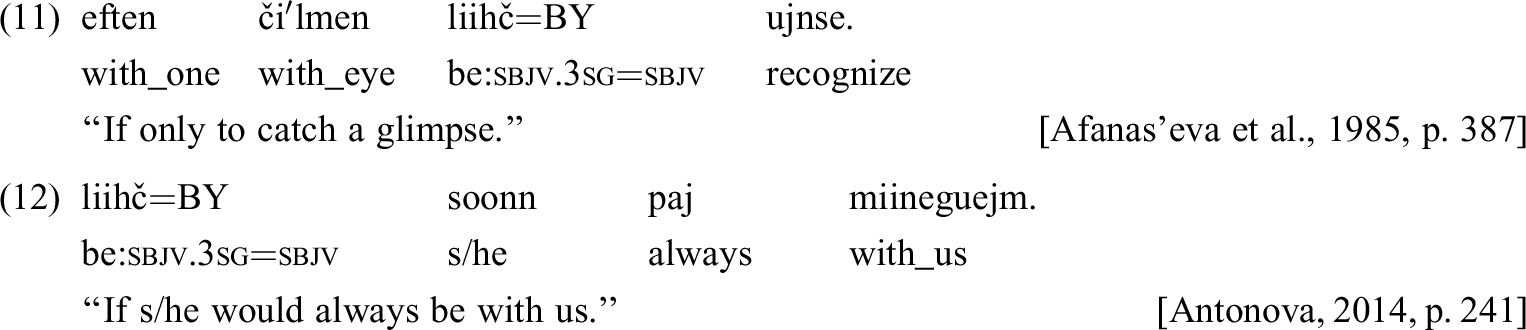
These facts indicate the established status of these constructions in Standard Kildin Saami.
The distributional restrictions imposed on the Russian-origin particle be/by by the Kildin Saami grammar enable us to consider this marker as part of the Kildin Saami morphological system.
A similar type of doubling is observed in the expression of the superlative of adjectives. The Russian superlative of the adjective is syntactic as well, as it uses the declinable auxiliary adjective sam-yj “same/very-
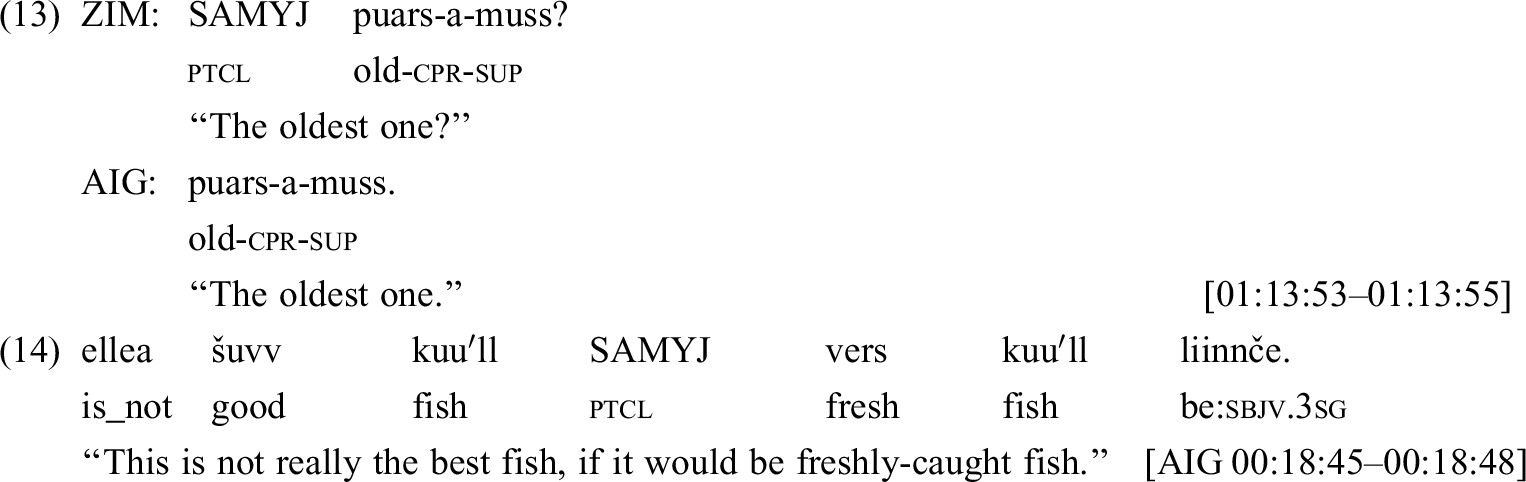
The doubling of the superlative marker is similar to the doubling to the subjunctive formative be/by in terms of the possible motivations behind these processes. While the Russian-origin formatives are initially unbound auxiliary markers, 13 which are part of analytical constructions, the Kildin Saami native formatives are synthetic forms. We assume that the Russian analytical auxiliaries are more salient to the bilingual speakers than their synthetic Kildin Saami equivalents, just as for borrowed analytical superlatives in similar contact situations with various language constellations (Matras, 2009, pp. 190–191).
Even in monolingual Russian the doubling of the superlative marking is not unusual (cf. the frequent double-marked form samyj lučšij “the very best” in Russian). Yet, the two cases of doubling diverge from each other in terms of their results: while the particle be/by appears to have undergone regularization and has been adopted into the morphological system of Kildin Saami, the Russian-origin particle same/samyj occurs in two alternating patterns, and the native formative applied as a single marking is still in use. In other words, while the expression of the subjunctive mood in vernacular Kildin Saami may be regarded as a fused system, the expression of the superlative degree of the adjective may not, since at the current stage of the language development it is subject to variation and has not yet been conventionalized.
2.3 Grammatical loan blends
In addition to the grammatical words mentioned above, which appear to be directly transferred, or copied, from Russian, other grammatical words may emerge as a result of loan translation. The structures examined in this section could count as grammatical loan blends in the sense of Haugen (1950, p. 215) because they are closed-class items consisting of Russian grammatical loans, such as the particles že, i or ni (see Section 2.1), and inherited native Kildin Saami elements. They are formed in Kildin Saami on the basis of a Russian model, as shown in the following examples.
nõ′dd-že “also” consists of the Kildin particle nõ′dd “so, thus, like this” and the Russian-origin topic particle že, the function of which remains still the same in Kildin Saami (the first attestation of this particle dates back to the late 19th century, cf. Halász, 1883, p. 40, and the relevant dictionary entry in Itkonen, 1958, p. 546). The Russian words takže, tože, both meaning “also”, are obvious models for the loan blend; both their first and second parts also occur as morphologically free, or unbound, forms, namely, the adverb and particle tak “so” as well as the demonstrative pronoun to “that”, and the topic particle že, which is an enclitic.
nõ′dd-i “like that”, which is a combination of the Kildin particle nõ′dd “so, thus, like this” and the Russian-origin particle i, is part of a larger unit, namely, the construction [kooxxt (NP) VP, nõ′dd-i V- The Russian-origin negative particle ni is used in Kildin Saami negated pronouns and pro-adverbs,
14
such as ni-mii “nothing [
The peculiarity of the Russian-origin constituents of the aforementioned loan blends is that they all occur in the corpus both as parts of these loan blends and as independent particles. We attribute their emergence to the bilinguals’ capacity to establish overlaps in the formal properties of linguistic constructions. The borrowed particles serve here as perceptual anchors that facilitate the activation of Russian constructions and eventually their transfer. In this regard, we may view these particles as similar to “triggers” in Clyne’s (1967) sense. However, unlike triggers, they co-activate only the pattern, which is then filled by Kildin Saami words. Considering this fact, we conclude that the actual process behind the emergence of these transfers is loan translation, rather than partial loan translation. The observation that Kildin Saami speakers do not copy the overt structure in these cases and resort to loan translation is not surprising considering the community’s linguistic ideology and norms, according to which Russian influence is to be minimized (see Section 3.2).
The grammatical loan blends given above show that Kildin Saami speakers regularly combine some Russian-origin grammatical words with Kildin Saami native forms. This consistency points to the fact that in calquing other Russian grammatical words and constructions, the speakers handle the reported grammatical words as part of their native inventory. The only peculiarity of these Russian-origin particles is that they happen to appear in grammatical loan blends. As such, the status of the examined Russian-origin loan blend parts as established borrowings lends support to the view that vernacular Kildin Saami is a fused lect.
3 Parallels between vernacular Kildin Saami and alternational code-mixing
The results of the prior analysis indicate that some of the Russian-origin elements in Kildin Saami have undergone regularization and no longer alternate with their Kildin Saami native equivalents. In this section, we will argue and provide evidence that the reported instances of fusion are grammaticized patterns of alternational mixing, in Muysken’s (2000) sense. The analysis in this section will show that alternation is the dominant pattern of the distribution of Russian-origin items in the otherwise Kildin Saami discourse. Alongside the Russian-origin Kildin Saami grammatical words examined above, numerous Russian-origin grammatical words are found to occur in language mixture, where they compete with Kildin Saami corresponding resources. However, it is not always possible to tell in every single instance without a detailed analysis, such as the one reported above, whether a specific Russian-origin item alternates with a native Kildin Saami equivalent, or whether it has already fused with Kildin Saami lexicon/grammar. For this reason, we avoid referring to the juxtaposition of native Kildin Saami and Russian-origin elements in the subsequent analysis as mixing, or fusion, although many of the Russian-origin elements mentioned below are still used in free variation with their Kildin Saami equivalents in our data and thus present instances of mixing proper.
The distribution of Russian-origin items and sequences parallels the patterns usually observed in alternational mixing, where structures from the contact languages alternate in such a way that neither of the languages is structurally dominant. According to Muysken (2000, pp. 96–98), such language mixture occurs (a) when a switched fragment spans several constituents or (b) when the switched fragments are structurally unrelated. It is convenient to consider these aspects of alternation in an isolated way and separately from each other, although instances complying with both requirements are also possible. While the length and complexity of a switched fragment are diagnostic of type A alternations (Muysken, 2000, p. 97), clause-peripheral switches are strongly indicative of type B alternations. Typical alternations of type B are elements that are structurally relatively independent of the clause, namely, discourse markers, discourse particles, adverbs and conjunctions (Muysken, 2000, pp. 97–102). In contact linguistics literature, these clause-peripheral elements are also referred to as “utterance modifiers”, after Matras (1998). A major difference between Muysken’s (2000) analysis of the language mixture involving utterance modifiers and other approaches concerns the type of mixing posited when the bilingual discourse is permeated with bilingual utterance modifiers. While Muysken analyses the clause-peripheral elements from one language in the discourse framed by the other language as alternations, both Matras (2009, p. 138) and Auer (1999, p. 317) conceive of these elements as insertions. Our analysis will be based on Muysken’s proposal because his analysis links mixing types to structural and social factors.
The analysis of Russian-origin words in the corpus has revealed that the speakers produce sequences of Russian words for conversational code-switching or as alternational code-mixing of type A only sporadically. In the next section, we therefore concentrate on parallels between the distribution of Russian-origin words in vernacular Kildin Saami and patterns subsumed by type B alternation.
3.1 Distribution patterns of Russian-origin words similar to alternational mixing of type B
Alternations of type B fall in our corpus into two patterns. One pattern, involving coordination (cf. Muysken, 2000, p. 100), occurs on only a single occasion and is given below.
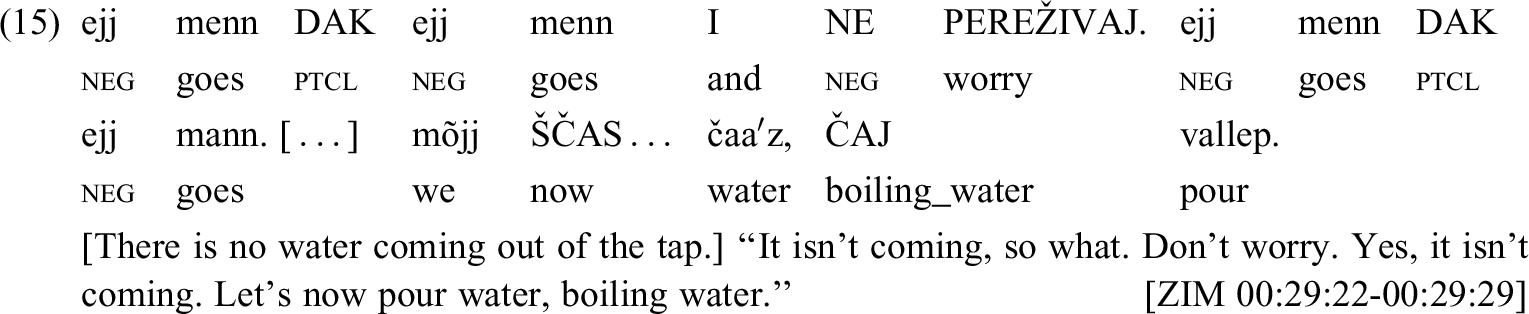
Example (15) contains a longer switch from Kildin Saami to Russian, which encompasses the coordinated negative imperative clause i ne pereživaj “and don’t worry”; among the singly occurring Russian-origin words are the discourse particle dak, the adverb ščas (< sejčas) “now” and the noun čajj “boiling water”. 15
The large majority of Russian-origin words in vernacular Kildin Saami are clause-peripheral elements such as discourse particles, discourse markers, conjunctions and adverb(ial)s. In this section, we will therefore offer a detailed outline of these Russian-origin elements in vernacular Kildin Saami. As some of these elements may be used in several functions – for example, as conjunctions and discourse particles – we therefore refer to them under the global umbrella term of discourse operators, which corresponds to the aforementioned term “utterance modifiers”.
The discourse operators common to both Russian and vernacular Kildin Saami are usually associated with specific positions in the utterance, most commonly the positions at the clause boundaries. For example:

The utterance in (16) is a complex sentence containing a conditional clause with the Russian-origin subordinator je′sle/esli “if”. The Russian-origin correlative adverb (z)na č it “then” is in front of the matrix clause. The whole utterance is introduced by the Russian-origin turn-initial particle a “and, but”, which contrasts the turn it prefaces to the immediately preceding utterance.
Russian-origin discourse particles often frame clauses consisting of native Kildin Saami words, for instance:

In (17), the first clause is prefaced by the Russian-origin turn-initial particle nu “well” and is followed by the Russian-origin discourse marker ko′nešne/konečno “of course”. The second clause, which is unfinished, is introduced by the Russian-origin adversative conjunction nå/no “but”.
While turn-initial particles and conjunctions precede clauses and tags follow them, focus particles, which also occupy specific positions in the utterance, occur adjacent to the phrase they combine with. That is, like many epistemic markers, focus particles frequently appear within the clause, as in the example below.

The Russian-origin focus particle tože “also” in (18) immediately follows the focused element munn “I” and thus occupies a clause-internal position. Among other Russian-origin words that usually appear within the clause in our sample, we find modal words, phasal and progression adverbs, as well as some particles. These elements may sometimes cluster together, as in (19).

Here, the Russian-origin epistemic particle dak follows the native Kildin Saami pronoun munn “I” and successively combines with the Russian-origin phasal adverb uže “already”.
As the word order in both Kildin Saami and Russian is relatively free, discourse operators, such as epistemic and hesitation markers, the modal words nado “(one) needs” and dolžen “(one) must”, and adverbs may take virtually any position in the clause. 16 At the same time, the clause boundary is the preferred locus for Russian-origin discourse markers and conjunctions. This situation parallels the outlined mixing patterns of type B alternation, which involves the switching of discourse markers and tags at clause boundaries as well as the switching of clause-peripheral adverbials and particles (cf. Muysken, 2000, pp. 97–100).
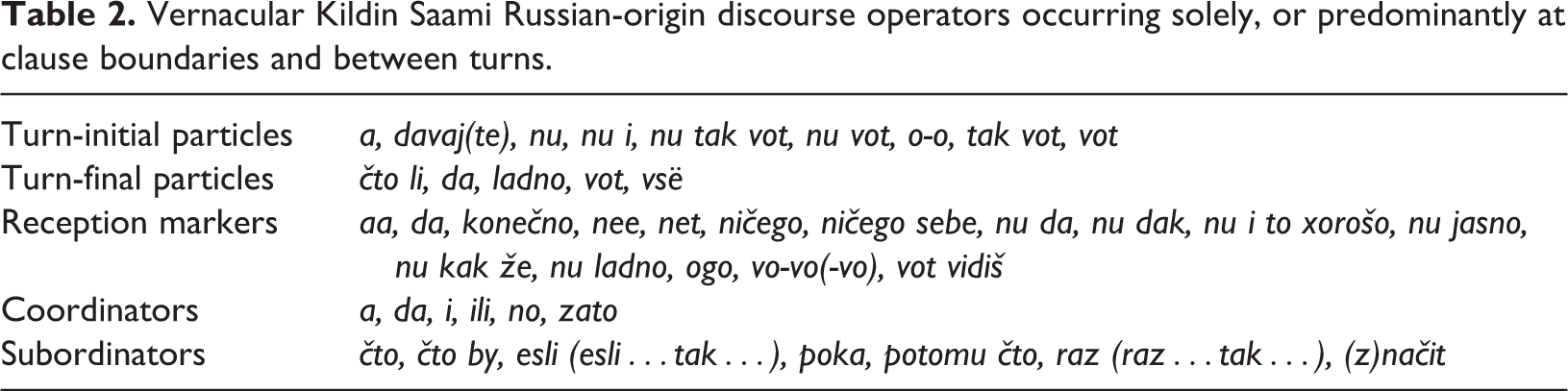
We report the Russian-origin items occurring in our sample in Tables 2 and 3. For terminological simplicity, we refer to the listed items as “operators”, without specifying their behaviour as particle- or discourse-marker-like, except when the categories maintain rather homogeneous inventories, as in the case of turn-initial particles. 17 Table 2 outlines the vernacular Kildin Saami Russian-origin discourse operators occurring at the clause boundary, while Table 3 gives Russian-origin items that appear in any position in the turn. As some of the discourse operators may fulfil different functions, we include them in each of these tables. For example, the item konečno “of course” may function as a reception marker, placed at the beginning of the turn, but also as an epistemic marker with no fixed position.
Vernacular Kildin Saami Russian-origin discourse operators occurring solely, or predominantly at clause boundaries and between turns.
Vernacular Kildin Saami Russian-origin discourse operators occurring in the turn-initial, medial and/or final position.
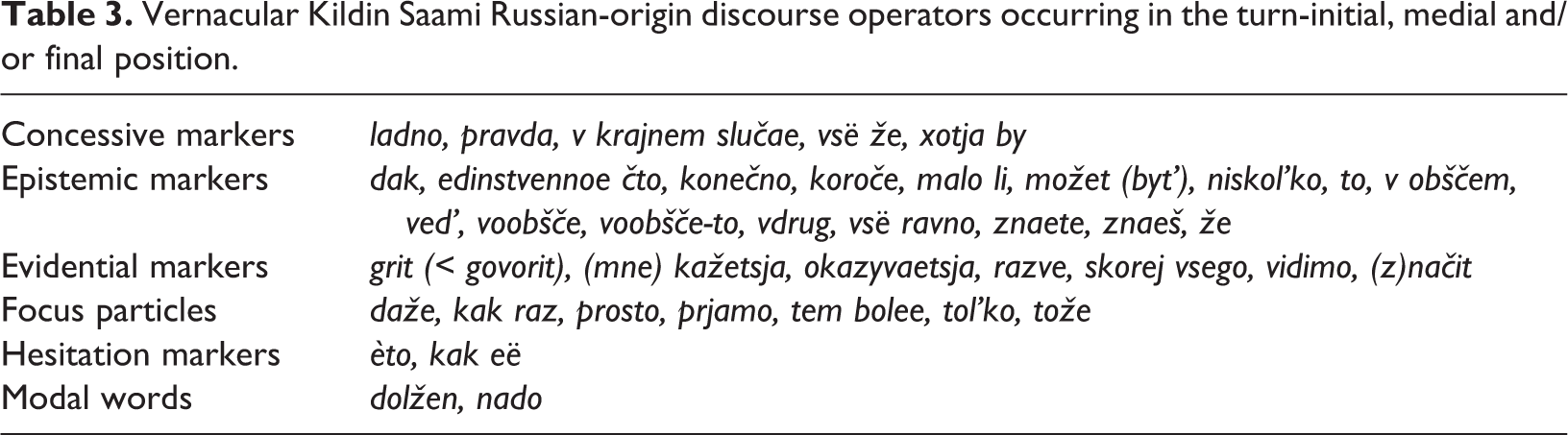
Among the items listed in Table 2, only the reception markers may constitute separate conversational turns; all the other operators form parts of conversational turns. As such, the given Russian-origin items systematically occur at the clause boundary and thus strongly parallel alternational mixing of type B.
Although some of the items in Table 3 may constitute separate turns in Russian, such uses are not attested in our data. The majority of the given items may appear in any position in the turn and in the clause, but the distribution of some few items is restricted to specific positions. These include the aforementioned focus particle tože, the listed hesitation markers and the epistemic markers že and to, which are all associated with the clause-medial position. Other clause-peripheral elements of Russian origin that may occupy any position in vernacular Kildin Saami clauses are adverbs and adverbial phrases. After discourse operators, these items form the largest group of Russian-origin words in vernacular Kildin Saami. Table 4 provides the functional/semantic subsets of the adverbs and adverbial phrases attested in the corpus.
Vernacular Kildin Saami Russian-origin adverbs and adverbials.
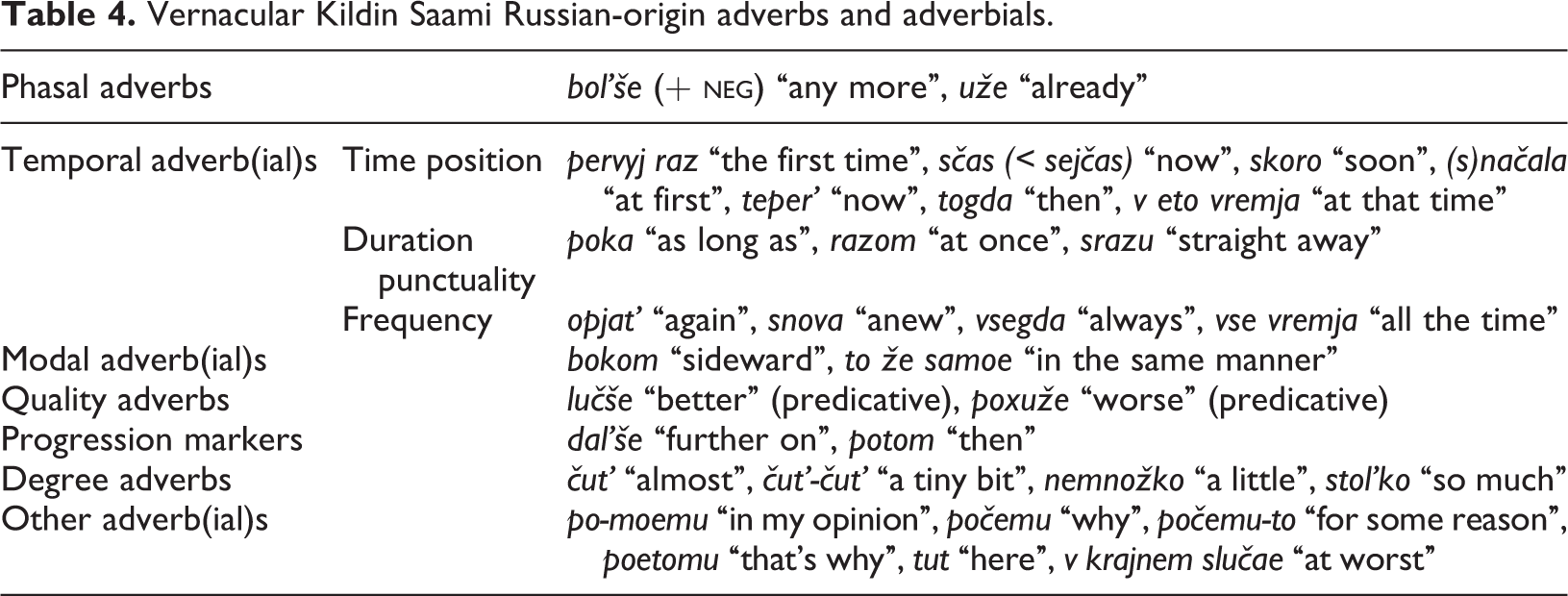
The widespread use of Russian-origin adverbs and adverbials in Kildin Saami is similar to the mixing of adverbial modifiers, another property of alternational mixing (cf. Muysken, 2000, p. 100). At the same time, Russian prepositional phrases occur rarely in the examined data; they are scarce and limited to specific lexical items, as in the example below:
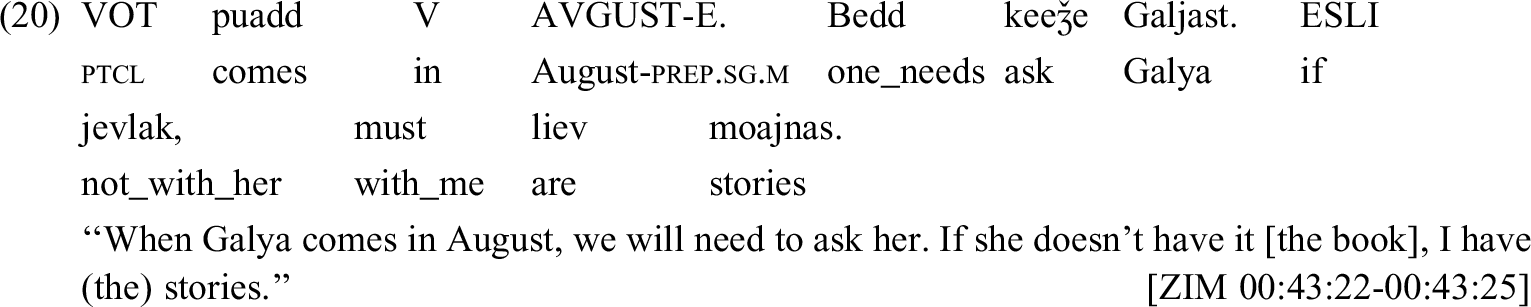
Apart from the Russian-origin function words, namely the turn-initial particle vot and the conditional subordinator je′sle/esli, the utterance in (20) contains the Russian prepositional phrase v avguste “in August”, serving as a temporal adverbial. The contact languages utilize differing constructions in temporal expressions with month names: Russian draws on prepositional phrases, as in the current example, while Kildin Saami employs nominal phrases, such as aavgusst-maanes′t “August-month[
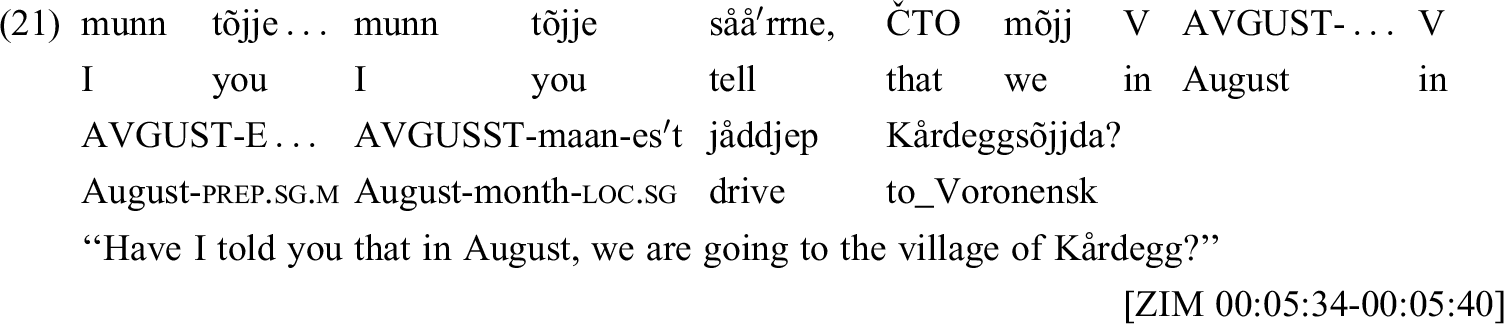
As opposed to this tendency, Russian material involving discourse operators or adverbials is never subject to language repair in our corpus.
Crucially, the native Kildin Saami equivalents of some of the reported Russian-origin discourse operators also occur in the sample. For example, the discourse marker ujnak “you see” alternates with the Russian-origin equivalent vidiš, and the focus particle te′l has the Russian-origin equivalent vot. These forms contribute to (individual) stylistic variation, and are indicative of conventionalized mixing. Hence, their use in vernacular Kildin Saami is best conceived of as Muysken’s alternational mixing. However, we cannot speak of conventionalized mixing when Russian-origin items have fused with the Kildin Saami system and their native Kildin Saami equivalents are no longer attested in vernacular speech. Since the process of fusion does not affect the reported Russian-origin elements in total, we consider this process as partial.
3.2 Factors behind the alternation-based distribution of Russian-origin words in vernacular Kildin Saami
Our analysis has indicated that striking parallels exist between the distribution of fused and mixed Russian-origin elements in vernacular Kildin Saami and Muysken’s alternational pattern, particularly the mixing at the clause periphery. In this section we ask which factors, structural, or social, have contributed to the emergence of this mixing type.
Regarding structural factors, the literature has frequently drawn on typological similarity between the contact languages as an explanatory factor (cf. e.g. Myers-Scotton, 2002, pp. 146–148). Kildin Saami and Russian share a number of structural features: both languages count as fusional languages, using a system of declension classes in the nominal and the verbal inflection; they are both characterized by flexible word order. There is still a substantial difference in the syntactic patterns between the languages, namely, while Kildin Saami relies almost exclusively on postpositions, Russian, like other Slavic languages, maintains prepositions, although postpositions also exist. According to Muysken (2000, p. 247), a likely type of mixing in a pair of typologically similar languages is congruent lexicalization. Muysken (2000, p. 249) asserts that “[a]s the extent of language contact grows the type of mixing will shift from insertional to either alternation or congruent lexicalization”. Considering the parallels in the grammars of Russian and Kildin Saami, we could well assume that congruent lexicalization would be the dominant type of mixing in this language constellation, but the lexical distance between the languages involved may favour insertion (cf. Muysken, 2013, p. 714). Instead, the major pattern in our data is alternational mixing. Obviously, structural factors alone may not account for the emergence and development of mixing in a specific community. For this reason, considering other factors, including historical and social conditions of language use, is indispensable (Muysken, 2000; Matras, 2009, p. 136). On a similar note, Law (2014, p. 162) contends that “while pressures to collapse certain elements of languages [such as discourse operators] in bilinguals are cognitive, social factors condition what elements can be collapsed, and which ones must be kept separate”. In other words, social factors such as linguistic ideologies and language awareness regulate the use of linguistic resources in a speaker as well as in a speaker community.
Alternational mixing has frequently been observed in communities with strong group and language loyalty. A relevant example is Treffers-Daller’s (1994) study of Dutch-French code-mixing in Brussels. She attributes the dominance of alternational mixing in her sample to the fact that speakers of Dutch and French maintain distinct ethnic and linguistic identities. Furthermore, the political competition between the languages leads to their rigid separation and hampers more intimate types of mixing, such as insertion and congruent lexicalization (cf. Muysken, 2013, p. 741). In other words, alternation as a juxtaposition strategy is typically related to attitudinal factors, such as language identity and political competition.
Muysken’s (2000, pp. 247–248) observations regarding the relationship between alternational mixing and linguistic attitudes converge with the language situation of Kildin Saami. As reported by Scheller (2013, p. 400, passim), 19 although the language is critically endangered and oral language transmission has stopped, language identity and the wish to revitalize the language is strong. Both active and passive speakers participate in public discourse on the “native language”, and symbolic language use as a marker of identity is widespread. The correlation between alternational mixing and strong ethnic identity may also be found in other ethnic-minority communities in the Russian Federation. For instance, the mixing patterns in the bilingual speech of Russian-German communities in Siberia, as described by Blankenhorn (2003), are very similar to the mixing patterns observed in vernacular Kildin Saami, and the interviewed Russian Germans also expressed strong feelings of belonging to their ethnic group.
A cognitive account of the link between purist language attitudes, based on strong language identity feelings, and alternational mixing pertains to the degree of conceptual saliency of the elements subject to selection in bilingual speech. Backus (1996) establishes a correlation between an element’s semantic specificity and its saliency potential. He asserts that semantically specific elements, which usually correspond to content words, have a greater saliency potential than schematic elements, such as function words (although even a schematic element “can receive an increase in salience”, Backus, 1996, p. 122). That is, the source-language content words, which are usually involved in insertional mixing, are selected because they are conceptually salient. A more general view implies that conceptual saliency facilitates not only the selection of an element, but also its inhibition. The amount of insertional mixing may be reduced when speakers avoid the selection of content words in the other language, owing to their purist attitudes. Since function words have a low degree of conceptual saliency, they not only tend to defy selection, but also inhibition. We thus assume that differing saliency potentials of content words and of function words are responsible for the successful minimization of Russian content word insertions in vernacular Kildin Saami and the failure to avoid Russian grammatical words altogether. We suggest that inhibition processes result in the dominance of Russian-origin grammatical words and discourse operators in vernacular Kildin Saami.
Alternative explanations of the widespread use of clause-peripheral elements in bilingual discourse pertain to the nature of clause-peripheral items. Matras (1998) and Auer (2014) assert that clause-peripheral elements behave differently from content words because they operate on a metapragmatic level; they direct “the hearer towards the intended interpretation of the speaker’s utterance” (Auer, 2014, p. 314). In a bilingual individual, these functions of discourse operators are fulfilled by two systems of utterance modifiers, attributed to each of the bilingual’s languages. Matras (1998) argues that operating the two systems of utterance modifiers in online speech production results in an added cognitive load in the bilingual speaker. The bilingual speaker’s response is thus the collapsing of the two systems into one and a concurrent decrease in cognitive load. In our view, this functional explanation of fusion in the domain of discourse operators and an account attributing it to discourse operators’ low saliency are not mutually exclusive.
4 Conclusions
Our study has focused on the dynamic nature of incipient fusion, its relation to language mixing and its further development in a situation of long-standing bilingualism. Our analysis shows that vernacular Kildin Saami is a fused lect that has adopted a substantial number of Russian grammatical words, all of which are unbound forms. However, not all Russian-origin items have developed to conventional grammatical markers, many of them still alternate with Kildin Saami native equivalents.
We have used three diagnostic criteria for distinguishing mixing from fusion. The proposed criteria apply not only to borrowed grammatical words and their usage patterns, but also to pairs of synonyms consisting of a borrowed and a native grammatical word. The criteria include (a) regularization of the usage patterns of a borrowed item, (b) a change in the functionality of a member of a synonym pair and (c) constructional transfer involving borrowed elements. The results of the application of these criteria are by and large supported by the attestations of these items in the early records of Kildin Saami vernacular speech. We therefore argue that these criteria are reliable indicators of the status of borrowed grammatical words as established loans. They can be applied as indicators of fusion even to contact varieties with little, or undocumented, linguistic histories.
Finally, the analysis of the recorded data has revealed that a conspicuous overlap exists between the distribution of Russian-origin items in vernacular Kildin Saami and Muysken’s (2000) patterns of alternational mixing. This supports our hypothesis that the fused lect has emerged from alternational mixing. The reported mixing patterns also conform to the social conditions of language contact situations in which alternational mixing is commonplace. Kildin Saami speakers, distinguished by a unique ethnic and linguistic identity, strive to maintain language separation in their daily communication, although it is never strict. It is important to emphasize, however, that the patterns reported here were observed in the speech of elderly speakers, and that other mixing types could be found in younger speakers.
Footnotes
Acknowledgements
We are very grateful to Peter Auer for his elaborate discussion of an earlier version of this paper. Other valuable comments were given by Rogier Blokland, Niko Partanen, Joshua Wilbur, Evgenia Zhivotova and an anonymous peer-reviewer. Nikolay Hakimov’s research was carried out during his service at the University of Innsbruck, to which he is grateful for all sorts of support. Special thanks are due to Appolinarija Ivanovna Golykh, Zinaida Ivanovna Makarova, Marija Alekseevna Popova 20 and numerous other native Kildin Saami speakers for working with the Kola Saami Documentation Project as language consultants. We also have to thank Nadezhda Zolotukhina for her help with transcriptions and translations.
Declaration of Conflicting Interests
The author(s) declared no potential conflicts of interest with respect to the research, authorship, and/or publication of this article.
Funding
The authors disclosed receipt of the following financial support for the research, authorship and/or publication of this article: Michael Rießler’s work was part of the project “Corpus-Based Comparative Description of Kildin and Ter Saami, Russian Federation” (2012–2016), supported by the German Science Foundation (grant RI 1740/2) and the University of Freiburg.