




Abstract
Practitioner research plays a crucial role in education because of its applied nature and its ability to address pertinent issues within learning and teaching contexts. Exploratory practice (EP) is a form of practitioner research that emphasizes puzzles while striving to understand and improve students’ and teachers’ quality of life in the language classroom. Our puzzlement as EP practitioners began to take shape as we received a variety of feedback – both positive and negative – on our EP-infused lessons from our past students. Therefore, we started to ponder the enduring repercussions of an EP experience on participants’ subsequent learning and quality of life, extending beyond the immediate effects observed during EP. In the spring semester of 2022, 43 students enrolled in two courses on English for academic purposes (EAP) at two different Japanese universities participated in a 15-week EP endeavor. Six months after the course finished, we conducted semi-structured interviews with 10 students in order to systematically explore and discover how the EP endeavor affected them in the long-term. Findings revealed that the EP experience had lasting effects on the students’ affordance in three areas: linguistically, intrapersonally, and interpersonally. The article concludes by addressing the practical implications for EP practitioners, specifically focusing on inclusivity and sustainability.
I Introduction
In 2010, I (Takaaki) found myself in the role of a seasoned English language teacher at a Japanese public high school, boasting a decade of invaluable teaching experience. During that period, I relished the responsibilities that came with being a homeroom teacher, the dedication required to coach a club activity, and the day-to-day interactions I had with my students. However, the aspect of classroom teaching had lost its appeal for me. I felt drained of inspiration and stuck in a state of stagnation. I was consistently grappling with the challenge of infusing life into my lessons and igniting motivation within my students. It was during this juncture that I was introduced to the concept of exploratory practice (EP) through the seminal book on the subject, The developing language learner (Allwright & Hanks, 2009). The resonance with EP was immediate and profound, as I came to realize three fundamental tenets: first, that learners stand at the core of both language learning and teaching; second, that teachers’ perspectives and experiences hold equal, if not greater, importance compared to researchers’ in shaping pedagogical insights and revolutionizing language classrooms; and, third, that the realm of language learning, teaching, and research is devoid of absolute certainties, highlighting the significance of approaching language education with curiosity and an open mindset.
Subsequently, I embraced the role of an EP practitioner at both the secondary school and university levels. This journey led me to undertake and document various EP endeavors, a notable few being detailed in my publications (e.g. Hiratsuka, 2016, 2019, 2021; Hiratsuka & Barkhuizen, 2015). Among these, the most recent venture was conducted, alongside one of my PhD students (Matthew), focusing on the enhancement of students’ quality of life within language classrooms (Hiratsuka & Nall, 2023). Without exception, each foray into EP revitalized my teaching perspective, deepening my understanding of both my teaching methods and my students’ learning experiences. Indeed, over the years, feedback flowed in aplenty – officially through course evaluations and informally through casual conversations. These responses underscored the impact of incorporating EP principles into my lessons, ranging from declarations like ‘Your course was the most beneficial one I’ve encountered at this university’ to more critical remarks such as ‘Your ideas and teaching methods do not align with the Ministry of Education’s expectations.’ Thus, my puzzlement (see Hanks, 2017a) began to take shape. In essence, I began to ponder the enduring repercussions of an EP experience on participants’ subsequent learning trajectories and overall quality of life, extending beyond the immediate effects observed during the EP endeavors.
With this puzzlement in mind (i.e. ‘What long-term effects does an EP experience have on students’ perceptions and practices?’), I extended an invitation to Matthew to delve into the enduring impacts of EP among the participants of our most recent EP. This was achieved through interviews conducted six months post the official conclusion of the EP initiative, involving 10 of the participants. Our collaborative endeavor encompassed a joint EP approach that not only provided teachers and students alike with the opportunity to refine their individual practices and skill sets but also facilitated collaborative efforts towards enriching various aspects of our lives (Hiratsuka & Nall, 2023). Apart from the intrinsic motivations that fueled our current inquiry as practitioners, moreover, the long-term perspective was an avenue we recognized as being underexplored in existing EP research. Importantly, our collaborative engagement in EP is deeply grounded in the belief that it allows for an intertwined approach to learning, teaching, and research harmoniously woven into the fabric of our lives (Allwright, 2003, 2005; Allwright & Hanks, 2009; Hiratsuka, 2016; Hanks, 2017a).
II The ‘who’, ‘what’, and ‘how’
Exploratory practice (EP) aims to promote the general well-being in the classroom by using ordinary pedagogic practices as investigative instruments. This approach involves all stakeholders – including learners, teachers, and researchers – in prioritizing the quality of life for both learners and teachers, advocating for inclusivity among all practitioners, thereby strengthening the connection between practice and research. Here we will discuss seven EP principles in great detail (see Allwright & Hanks, 2009, p. 260), but specifically in regard to the present inquiry. That is, the discussion is grouped into three sections of ‘what’, ‘who’, and ‘how’, citing relevant studies that served as a starting point for conducting our inquiry and helped us significantly to make sense of the participants’ perspectives (see Allwright, 2003; Allwright & Hanks, 2009; Hiratsuka, 2016).
1 The ‘what’ issues
The first two principles of EP that hinge on ‘what’ issues are: (1) concentrating on the enhancement of ‘quality of life’ and (2) honoring the intricacy of language classrooms rather than trying to resolve problems. EP espouses that language teachers and learners’ quality of life is inherently more important to them than outcomes determined by external standards, such as test scores (Gieve & Miller, 2006). Gieve and Miller (2006) contended that EP practitioners strive to ‘reach their locally helpful understandings by focusing on their perceived quality of life in the classroom, rather than by focusing directly on trying to achieve a high quality of work’ (p. 34). Within EP, addressing puzzles takes precedence over a problem-solving approach; the former being something that warrants exploration for enrichment, while the latter calls for a solution for betterment on the premise of causal conditionality (Hanks, 2009, 2017a). Previous EP studies strove to demonstrate these ‘what’ issues. For example, Slimani-Rolls and Kiely (2014) enlisted eight university teachers to act as co-researchers for their EP innovation. Drawing on critical learning episodes (CLEs), the teachers videotaped lessons, and reflected on and discussed questions about their instruction. This provided teachers with novel insights about their classroom interaction, a fresh perspective on the potential of reflective practice, and a tool kit for analysing classroom dynamics to elevate quality of life for all. Hanks (2015) offered an account of the experiences of two teachers of English as a second language (ESL), where English for academic purposes (EAP) was the focus. One teacher highlighted the value of quality of life in EAP, while the other shared how her attention shifted from negative classroom problems to curiosity-driven life puzzles with positive connotations.
2 The ‘who’ issues
The three EP principles associated with ‘who’ issues concern: (3) addressing all stakeholders and their personal and professional agendas, (4) bringing people together in a common enterprise, and (5) working collaboratively for mutual progress. This all-inclusive professional development helps cultivate powerful engagement among teachers and learners, thus enabling practitioners to ‘share both the work and the rewards of research’ (Hanks, 2009, p. 52). Attempts have been made to achieve these ‘who’ issues. For instance, Best et al. (2015) reported on an EP endeavor undertaken by five university ESL instructors, which scrutinized how students viewed, responded to, and interpreted writing feedback. Here, students felt anxiety involving grades, desired a re-evaluation of their review process, but appreciated teacher–student interactions. It was concluded that teachers must provide greater opportunities for students’ perspectives and ideas to be solicited, listened to, and considered. Kato and Hanks (2022) documented a learner-initiated EP with 56 Japanese university students. Students were encouraged to set their own investigative agendas based on their curiosity-driven puzzles (e.g. ‘Why is English difficult to learn for Japanese people?’). Overall, the students welcomed the learner-initiated EP activities and worked enthusiastically. Both students and teachers were thus proven to be key resources for invigorating classroom activities. Johnson and Hepworth (2022) designed an EP innovation to investigate the use of a software platform (Voice Thread) in the context of online discussion among pre-service language teachers. Findings suggested that:
• the instructors could discursively position their pre-service teacher students as near-peers and professionals, boosting their students’ confidence and facilitating interaction; and
• the instructors could have a positive impact on the professionalization of discourse, showing their pre-service teacher students that they were part of a community of practice.
Engaging students as co-researchers, Banister (2023) ventured into the realm of EP to explore the attitudes and beliefs of undergraduate students studying academic and business English in the United Kingdom. The data – gathered from surveys, classroom discussions, observations, and reflections – uncovered the intricate interplay of linguistic, cultural, and affective factors that influence peer feedback practices.
3 The ‘how’ issues
The last two EP principles linked to the ‘how’ issues are: (6) making EP a viable venture and (7) reducing the additional workloads that arise during EP. It is a prerequisite that practitioners conduct research within their instructional time without detracting from their primary objectives. It is also advised that practitioners devote no extra time, energy, or resources to an EP journey. To that end, activities associated with EP – referred to as ‘potentially exploitable pedagogic activities’ (Allwright & Hanks, 2009, p. 157), or PEPA, which are normal classroom activities used as investigative tools – should be meaningfully incorporated into day-to-day teaching and learning. There are several EP studies that actualized these ‘how’ issues. Taking a university EAP context in the United Kingdom, Hanks (2017b) examined the barriers and possibilities faced by learners and teachers who took part in EP with the intention of integrating research and pedagogy. Hanks maintained that their EP was ‘directly relevant to student needs, and teacher perceptions of those needs’ and hence ‘encouraged learners and teachers to engage with research as part of their pedagogy’ (p. 47). This seemed to have enabled the participants to become legitimate members of the academy. Based on the findings, Hanks contended that EP is a novel, feasible, and inclusive form of practitioner research. Consoli (2022) engaged in EP within a pre-sessional program in the United Kingdom where he served as an EAP instructor for a cohort of Chinese students. Consoli effectively curated a series of PEPAs, such as weekly reflective reports and group discussions, tailored to the specific interests and queries of his students regarding British education and culture. This approach yielded significant benefits for the students involved. Cognizant of the difficulty many language teachers encounter in finding time for research within the everyday teaching, Hiratsuka (2021) inspected how elements of EP can be infused into a Cross-Cultural Understanding course at a Japanese university. Hiratsuka accomplished this by explicitly presenting seven EP principles within his course, and asking students questions to elicit their ideas throughout the course. Students felt a sense of camaraderie via classroom discussions, which promoted an awareness of their lives inside and outside of the classroom. Findings evinced the need of carrying out practitioner research within ordinary classroom settings while bearing in mind course goals, syllabi, and lesson plans in order to advocate for the quality of classroom life.
The EP initiatives outlined above stress that students and teachers can actively shape their learning and teaching by examining classroom practices rather than perceiving them solely as issues to solve. Additionally, prioritizing the establishment of trust and collegial relationships among EP practitioners is crucial, as it cultivates a bridge between theory and practice, contributing to a more enlivening classroom environment. Nevertheless, what deserves special attention is the absence of EP inspecting the long-term impacts of an EP experience on the perceptions and practices of language learners and teachers. Although previous EP studies (e.g. Hiratsuka, 2019; Kato & Hanks, 2022) have been carried out and documented for a prolonged period of time (e.g. over a semester), they have not followed up on the subsequent influences the EP had on the practitioner-researchers. This is regrettable, given that one of the most crucial contributions of EP to the reconceptualization of practitioner research is that it considers both students and teachers to be lifelong learners (see Miller & Cunha, 2019; Miller et al., 2021). In this inquiry we attempted to delve into the sustainable effects of an EP experience on our students six months after the EP was (officially) over.
III Methodology
1 Research context
The EP endeavor to which this article refers took place at two universities in Japan, in two EAP courses held during the summer of 2022, taught by us (see also Hiratsuka & Nall, 2023). We determined that the students had achieved an English proficiency approximating the CEFR B2 level, and the two EAP courses’ goals, aims, and contents were designed appropriately for students at this level. The EP endeavor was conducted at Takaaki’s university, where he taught a Discussion and Debate class aimed at developing the students’ communicative competencies and skills in English. Likewise, the EP endeavor was jointly conducted at Matthew’s university where he taught an English Conversation class, with similar goals. As the student proficiency levels and EAP course goals at the two universities were largely aligned, we speculated that engaging in the joint EP project would be worthwhile. At the beginning of our courses, we respectively informed our students about our plan to initiate an EP venture with students from another university. We offered an explanation and clarification regarding the essence of EP, its guiding principles, and the potential implications of participating in such an endeavor.
2 Participants
Student participants were all Japanese university students in their second, third, or fourth year of study. Participants at Kita University were students of Takaaki and were all members of a Global Studies department with career interests ranging from business to education. Nevertheless, they were all motivated to use English in their future careers. Participants at Minami University were students of Matthew and were all members of an Education department. They were all studying to become English teachers. Student-participant profiles can be seen in Table 1 (participant names and universities are pseudonyms).
Participants in the study.
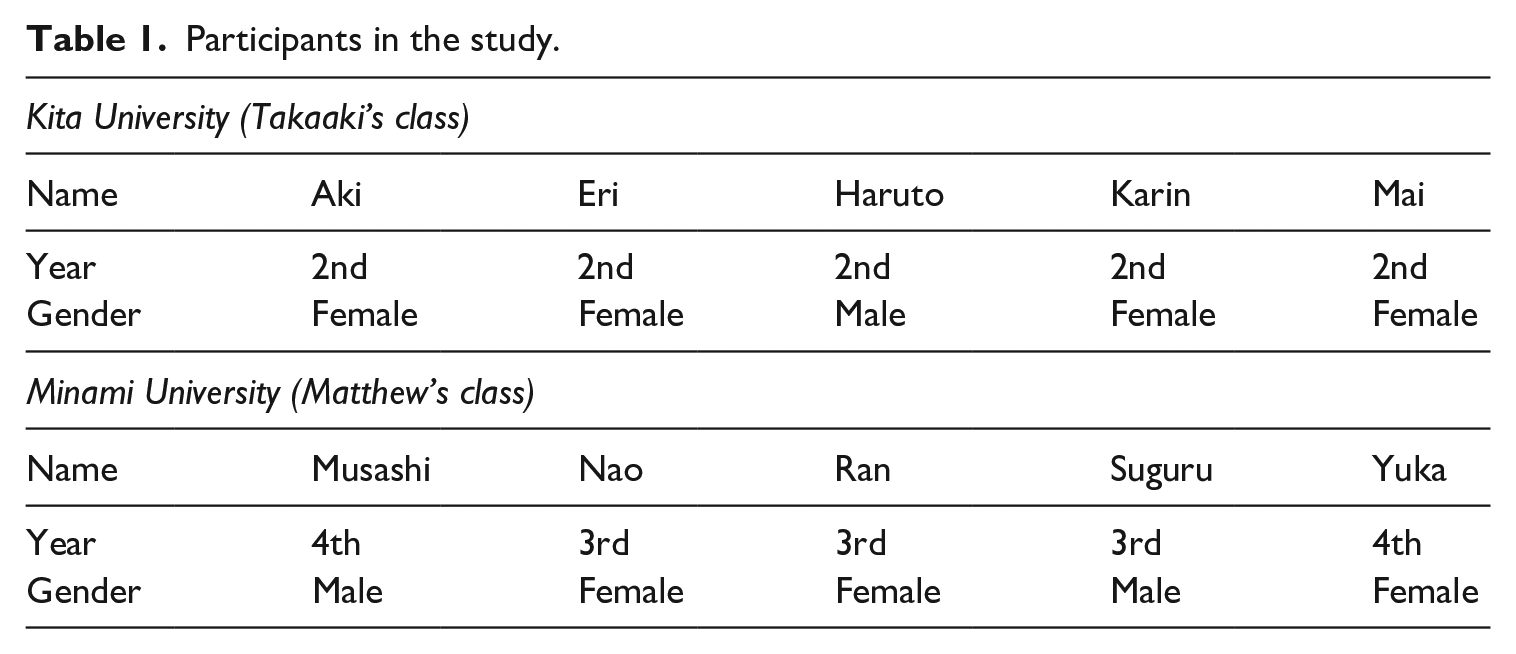
While teachers were not the main focus in this inquiry, they are also regarded as participants in EP endeavors. As such, an explanation as to who we are as practitioner-researchers is in order. Takaaki is Japanese and spent the first 10 years of his career teaching English in a Japanese public high school. During this time, he gained a master’s degree, and later left his high school teaching job to pursue a PhD in applied linguistics at a university in New Zealand. He is currently a professor at a private university in western Japan, and much of his research has been conducted in the area of EP. The current study stemmed largely from his background, knowledge, and interest in EP. Matthew is from the United States but has lived and worked in Japan as an English teacher over the past 12 years. Five of these years were spent as a high school Assistant Language Teacher (see Hiratsuka, 2022, 2023). Since 2016 he has worked at a university, where he teaches EAP courses. He is also a PhD candidate under the direction of Takaaki, and it is during his PhD studies that he became aware of EP.
3 Data collection
The data derived from narrative interviews carried out with the participants six months after their EAP courses ended in order to learn about the long-term effects of EP. The PEPAs are not included as data in this inquiry, but since the content of the interviews stemmed from the students’ experiences with PEPAs in their EAP courses, a description of the courses and the PEPAs is included in the following paragraphs (see also Hiratsuka & Nall, 2023).
a The PEPAs
Over a 15-week semester, we utilized six PEPAs in our EAP courses:
• narrative frames (see Barkhuizen, 2014; Barkhuizen & Wette, 2008; Hiratsuka, 2014, 2018) written by students during the second lesson of the course, centered on exploring their current and future L2 selves;
• reading anonymized narrative frames submitted by other students from week 3 to week 5;
• a group discussion in English during the sixth lesson with a submitted summary;
• a five-minute video presentation by each student in English about their learning and use of English in their current and imagined future lives, posted on Flip (a video sharing platform) between weeks 7 and 12;
• watching video presentations posted by other students with comments on at least five of them within an hour (lesson 13); and
• another set of narrative frames in English in the final lesson, where students provided additional insights about their current and future L2 selves as well as feedback on the joint EP experience.
These PEPAs were devised and implemented so that all those involved – as EP practitioners – would be able to embrace mutual understanding and solidify greater unity. Mutual understanding was established by publicly, yet anonymously, sharing the narrative frames responses among all participants in the EP endeavor. Students and teachers were able to view and consider the different ways that the students were thinking about and preparing for their futures as English users. Through this sharing experience it could be said that a greater sense of community was created within each classroom in the EP endeavor, and among students at the two universities. It was suggested in Hiratsuka and Nall (2023) that their EP endeavor (and its PEPAs) allowed all the participants to improve their quality of life by promoting reflective practice, stimulating personal development, and achieving successful collaboration. Building on the EP endeavor, the current inquiry probes into the long-term impact of the EP endeavor on students by interviewing the 10 students (see Table 1) from Hiratsuka and Nall (2023), six months after the semester had ended.
b The interviews
In order to investigate the types and degrees of EP effects on practitioners, we conducted semi-structured interviews, which contained document- and video-stimulated recall components, with 10 Japanese university students and two instructors (ourselves). After acquiring ethical approval (application number 2022-13), and obtaining consent from the 10 student participants, interviews were carried out in Japanese for approximately 30 minutes each via Zoom in the middle of February 2023. Participants were selected for the interviews based on their availability to be interviewed during their spring break, and both researchers were present for every interview.
It is worth discussing here the vital methodological peculiarity that was very specific to the current inquiry; that is, the interviews were conducted in Japanese by a non-native English-speaking (NNES) researcher, Takaaki, and by a native English-speaking (NES) researcher, Matthew, with non-native English-speaking (NNES) students. Although the interviews were performed by both researchers, in practice one of the researchers took control of the interviews when interviewing his own students. Put differently, Takaaki primarily navigated the interviews with Kita students, using Japanese (Takaaki’s and the students’ first language), while Matthew took charge of the interviews with Minami students, also using Japanese, which is Matthew’s second language. Even though both researchers were advanced bilinguals, it was evident that both the quality and quantity of the interview outcomes differed. Though the interviews with Minami students (i.e. interviews between a native speaker of English researcher and Japanese native-speaking students) covered a broad range of topics regarding the EP endeavor, the interview transcripts of Kita students were more extensive and detailed. Notwithstanding, it was decided that working in tandem offered more gains than drawbacks in that having two potential emic and etic cultural and social perspectives for each student would produce a more thorough analysis. In addition, having the Minami students interviewed by a familiar person (i.e. Matthew) would establish a more relaxed and comfortable atmosphere for them to express their ideas and experiences freely and naturally. Finally, the principles of EP dictate inclusivity and the involvement of everybody, and that EP should work to bring everyone together. This was true in and amongst the student participants during the EP endeavor (see Hiratsuka & Nall, 2023), but also within this inquiry by including a non-native Japanese speaker as one of the researchers. By involving someone culturally and linguistically different as one of the central figures in the researcher may have offered various benefits. For instance, by being interviewed by a non-native Japanese-speaking person in their own language, the student participants may have become more motivated to pursue their own language learning goals, hence contributing positively to their quality of life.
We started the interview with the following prompt: ‘Tell me your stories, any story at all – if possible, with some examples and episodes – from your joint exploratory practice experience in the spring semester. You can start wherever you like and continue however long you like.’ In stark contrast to a question-and-answer format, the interview revolved on providing an opportunity for the participants (storytellers) to freely narrate their experiences to us (listeners). As narrative interviewers, we paid close attention to the natural flow of the participants’ stories as well as the significance of their own perspectives and priorities, although we did ask some questions prepared in advance as reference points (e.g. ‘How do you think the joint EP experience affected you as a language learner of English subsequently?’). Where we deemed it essential, we asked them follow-up questions (e.g. ‘What does it mean for you to think/feel that way?’), and we provided them with pertinent narrative frames, discussion summaries, and video presentations from the EP endeavor in order to jog their memory regarding their experiences. One thing to bear in mind regarding this format of interview is that, initially, some interviewees claimed they did not perceive a personal impact due to the EP endeavor. However, upon further probing and utilizing PEPAs from the EP endeavor (e.g. narrative frames), we jogged the interviewees’ memories and they were able to expound upon their EP experiences in depth. EP practitioner-researchers should be aware of this phenomenon when collecting participants’ data, as this may help improve the quality of the data that are collected.
4 Data analysis
The interviews were recorded, then transcribed and translated from Japanese into English, making every effort to maintain the essences of the participants’ words and intentions. All data were imported into the qualitative analysis software NVivo 11 for management and organization. Both of us conducted content analysis (Bogdan & Biklen, 2016) on six hours of detailed interview transcripts constituting 24 pages (English only) and 47 pages (Japanese with English translation). Content analysis – as an inductive method that enables researchers to integrate data, formulate codes and categories, and reveal patterns – was applied (1) within-case to learn as much as possible about the experiences of individual students and instructors, (2) across-case to identify the idiosyncrasies specific to each EAP course, and (3) for each role (i.e. instructors vs. students). These methodologies enabled thorough interpretation of the participants’ particularities and commonalities at the individual, university, and instructor/student levels. In the end, the data analysis yielded three inter-connected – yet distinct – themes involving affordance with respect to the long-term effects of EP on students’ perceptions and practices.
IV Findings
Before delving into the long-term effects of the EP experience on the perceptions and practices of the students after six months, it is imperative to acknowledge here again that some of the student participants (n = 4) did not initially report perceiving any direct impact on their subsequent learning or personal lives. For instance, Eri commented: ‘I can’t think of any concrete or tangible effect the EP endeavor had on me for the past six months.’ Similarly, Karin noted: ‘I don’t think there are lots of things that the EP endeavor directly affected in my current life.’ Ran put it briefly: ‘I didn’t change so much as a result of EP.’ Likewise, Mai did not initially perceive the influence EP had on her at the beginning of the interview: ‘Off the top of my head, there was no effect of EP on me.’ Later in the interview, however, when Mai reflected on the activities involved in EP, she began to explain how EP might have actually changed her subsequent learning and development: ‘As I reflect on what we did in the course, I guess I can say that it might have increased my motivation to pursue my dream seriously. I remember feeling more determined after the course.’ As seen, there were occasions in which the participants did not consciously recognize or understand the effects of EP on them, although these students’ relevant reflections are reported in the findings, which subsequently bring to light the EP endeavor’s impact. The data analysis did identify, albeit to varying degrees and sometimes overlapping, three primary types of EP effects on the perceptions and practices of the students. These primary effects pertained to (1) linguistic affordance, (2) intrapersonal affordance, and (3) interpersonal affordance.
1 Linguistic affordance
Given that the EP journey that the practitioner-researchers underwent six months previously (from April to August in 2022) was situated within university EAP contexts (see Hiratsuka & Nall, 2023), it was not surprising that the student participants felt that their English linguistic abilities were enhanced during the course, and some students reported that they continued to study English to further advance their abilities even after the EP endeavor. Eri, for instance, highlighted the paucity of opportunities to use English in her everyday life. She then expressed gratitude for the EP endeavor during which she could use English for a considerable amount of time.
I didn’t have many opportunities to speak English before. There was no output opportunity for me. But I got used to using English in the course. I now feel like I can speak English more fluently and comfortably whenever I engage in a conversation or discussion.
Similarly, Haruto emphasized the rare opportunity the EP course provided for him to speak English. He underlined the differences between his previous English language classes and the EP course: ‘In other English language classes I took before, it was about learning how to speak English, but the EP course was about actually speaking it. It changed my knowledge and attitudes toward English and its use.’ By the same token, Karin claimed that EP became a platform from which she could speak in English at length, learn various English learning strategies, and learn new expressions, all of which she found useful during and/or after the EP experience: What I remember strongly from the course was the synonyms, antonyms, and common phrases you [the teacher] introduced to us that I can use in daily conversation. I also learned different strategies such as paraphrasing and summarizing. Also, because I was speaking English in every lesson, I could practice and try out some English expressions that I learned from senior students.
At least partially prompted by the EP experience, Musashi began to institute a custom to practice words and expressions using a quiz application on his cellphone: ‘I now keep a record of new words and expressions in the Quizlet application.’ He further acknowledged that the EP endeavor made him ‘want to study harder and be more aware of the daily English that I learn in class, especially vocabulary.’ Meanwhile, Yuka was impressed by her peers’ English pronunciation during EP, which led her to identify her own weaknesses in that area and commit to improving them: ‘The biggest thing was that I felt that I really wanted to improve my English pronunciation.’ She continued: ‘I am very busy nowadays but whenever I have time, I watch movies in English and intend to improve my English pronunciation, even if only a little bit at a time.’
Six months after the EP endeavor, the students acknowledged gains in their English skills through the EP experience, notably in the area of speaking, whilst still having adhered to the existing curricular practices. As a result, it may be surmised that the EP endeavor did not impede the main objectives of the course, which was for the participants to make linguistic progress without incurring any additional burdens (see the ‘how’ issues above). Additionally, linguistic affordance as a result of EP has also contributed to intrapersonal and interpersonal areas, as will be discussed below.
2 Intrapersonal affordance
The development of intrapersonal skills encompasses self-awareness and self-understanding. The EP participants’ interviews disclosed indications that the EP endeavor helped to refine these intrapersonal abilities. As evidenced by their responses, Aki and Haruto gained great confidence over time, with Aki noting, ‘Toward the end of the semester, I felt the quality of our interaction was getting better and better. I gained confidence with myself,’ and Haruto adding, ‘I was not passive but active in the course. I feel like I acquired assertiveness.’ Moreover, it might have been that the EP endeavor played an existential role in the participants’ lives, perhaps giving them direction and enabling them to garner more inspiration about life. The EP endeavor might have also helped to nourish positive mindset in these participants, as seen when Aki reflected on how the program allowed her to draw from her personal experiences to use English more comfortably, stating that ‘I used English based on my personal experience or life. I am so glad I took the course. Were it not for the course, I probably would have felt lost in life by now.’ Similarly, Haruto reported that he is no longer intimidated by the prospect of making mistakes or asking questions in English, explaining that ‘I somehow did not feel ashamed or anxious about making mistakes when speaking English in the course. Now, due to the course, I don’t worry about making mistakes or asking questions in English.’ This perceived personal improvement may be due to engaging in the PEPAs, and the sense of classroom unity and congeniality that is arrived at by engaging in such activities. In this way it can be said that the EP endeavor continuously contributed to overall enhanced quality of life for participants such as Haruto.
The majority of the participants expressed that the EP endeavor had a lasting impact on their motivation, whether in relation to English learning or their future profession. For example, Aki consolidated her desire to use English in the future. It also fundamentally changed her outlook on English, encouraging her to be more proactive in her personal and professional life: Before the EP course, English was just a communicative tool to me. Of course, that is not bad in and of itself, but the outcomes of using English, such as making friends and experiencing excitement, are more important and fun. That’s what I learned, and it is part of my life now. Once you take action, it is easier to open lots of different doors.
This sentiment was echoed by other participants, such as Eri, who noted that the EP endeavor encouraged her to think more about her future. Although she did not yet have a tangible idea, she recognized the value of taking time to reflect on her life: I had never thought about my future at all until I took the course. For the past six months, I have been thinking about my future more and more. It is fascinating to read the narrative frames I wrote many months ago and compare them with my current thoughts.
Haruto’s comments illustrated how the EP endeavor might have promoted self-awareness and personal growth: ‘The course led me to analysing myself more. I bought a book about self-analysis in preparation for my job hunting.’ Likewise, Karin perceived that her communication skills were increased, and she recognized that the EP endeavor provided the impetus for her to better understand others: ‘My communication ability was enhanced. The first thing we have to do is to use English and just get started. I think the course became the driving force for me to understand others in English.’ According to Musashi, the EP endeavor widened his perspective on the potential of English for his future. He became more intentional about learning English since the EP course: ‘The EP course made me realize that learning English for daily use is really important. Nowadays, I always have my smartphone right by my side so that I can look up the words I don’t know.’ The lasting effects of the EP endeavor on Nao were threefold: she became more motivated to study English, decided to strive harder for becoming a teacher, and started to think more deeply about her life in general. The comments provided by Suguru were also reflective of these themes: ‘After listening to everyone around me in the course, I thought I also want to study and use English more in the future.’
Overall, these findings suggest that the EP endeavor prioritized the quality of life for the language learners, enabling them to cultivate self-assurance, positive mindset, and inspiration in their academic, professional, and personal lives. These outcomes align with the ‘what’ issues within EP principles, emphasizing the significance of self-improvement in language learning.
3 Interpersonal affordance
The development of interpersonal skills is critical for effective communication and collaboration. Such abilities comprise qualities like attentiveness, cooperation, and patience, and require the ability to discern context and respond appropriately. The EP endeavor’s implementation of diverse pair- and group-based activities appeared to have stimulated the advancement of these competencies among its participants, both throughout the course and in subsequent periods.
Aki revealed that her classmates’ empathetic attitudes permitted her to develop a deep connection with her EP peers: ‘I appreciated that whenever I spoke to my classmates, they assured me that they could understand what I said and how I felt.’ It was notable that Eri also emphasized the connection she built up with others through the EP endeavor: ‘My current focus is on communicating with others and understanding them better, rather than prioritizing linguistic issues.’ Likewise, Haruto became certain that his communicative abilities are more critical than mere linguistic skills: ‘I learned through the EP endeavor that having connection with other people is more fun and more memorable than just reading and listening to English.’ One of the most invaluable lessons that Karin took away from the EP journey was the merit of collaboration: ‘We wrote our group reports with group members, right? I think I learned how to collaborate with others then. I sometimes have to work in groups now, and I am doing OK.’ Mai pondered over her experience with the EP endeavor and reconfirmed for herself how potent collaboration and cooperation are in all aspects of life: ‘I still recall other students’ faces and messages from the course. It was a collaborative journey that will leave an imprint on me for a long time.’ Due to the connection that Nao had made with other students in the EP course, she was genuinely interested in other students’ opinions and experiences. As a result, she asked her teacher during the interview to let her know the results of the EP research paper as soon as it is written. Suguru found working with the other students to be so enjoyable that he said during the interview that he would take the class all over again, and if he becomes an English teacher himself, he will make an effort to collaborate with teachers and students from other schools.
Several participants saw the EP endeavor as a unique chance to build active listening skills, encounter new ideas, and be receptive of others. Aki found that ‘[c]ertain students had this magical way of asking questions, and because of that I found out what I really wanted to do. Without this experience, I would have been confused and not known what I wanted.’ (That is, she realized what she was most interested in studying was environmental problems.) Musashi’s interests and future plans were influenced by the Minami students: ‘I don’t think I will leave Japan permanently in the future because I want to be a teacher here, but I am now more interested in the idea of living abroad than before.’ Ran’s statements indicated that the EP endeavor was successful in promoting unity and adaptability among its participants: ‘I realized that there are many alternatives and possibilities available for my future. My viewpoints were widened through my interactions with students from both my university and the other.’ Yuka reiterated other students’ sentiments that the EP endeavor accentuated collaboration and cooperation among the teachers and students, which was uncommon in other courses at their institutions: ‘Up to that point, we had never collaborated with other universities. We were able to acquire the ability to listen to people based on who they are and how they may use English in the future.’
As the EP endeavor put a high value on mutual development and served to bring people together, it seemed to have affected the student participants’ abilities to recognize and espouse unity, receptivity, and empathy – both during and after the EP effort (see ‘who’ issues above).
V Discussion
We examined the long-term effects of an EP initiative inside EAP classes at two Japanese universities by recruiting a total of ten undergraduate students. The analysis of the data unveiled that there were effects that lingered for all of the participants. The three primary types of EP effects on the perceptions and practices of the students consisted of: (1) linguistic affordance, (2) intrapersonal affordance, and (3) interpersonal affordance. One of the key outcomes of the EP endeavor was – perhaps predictably – linguistic advancement, as the students reported gains in their English language abilities throughout and after the course. The participants maintained that EP had a favorable impact on their English knowledge in regard to vocabulary items, idioms, and learning strategies, as well as their English proficiency in terms of pronunciation, fluency, and speaking time. It is noteworthy that this was accomplished without the EAP classes’ normal curriculum being disturbed by the EP journey. This is a testament that the PEPAs contained in the EP endeavor were integrated into the standard pedagogic activities of the classroom and conformed to the ‘how’ issues of EP. These results corroborate those of previous studies in that when EP is planned and executed as a viable venture that does not add any extra workloads to implement, it can be a continuous and sustainable innovation that assists the EP practitioners concerned during and even after the EP endeavor (see also Allwright & Hanks, 2009; Hiratsuka, 2019, 2021; Consoli, 2022; Hanks, 2017b; Kato & Hanks, 2022).
The second lasting effect of EP related to the development of intrapersonal capacities, namely self-awareness and self-understanding. It is reasonable to assume that the EP endeavor could exert a beneficial and long-lasting influence on the participants, as evidenced by their increased assurance, positive mindset, and motivation with regard to their English practices, their visualization about their future lives, and/or changes to their personal characteristics. It is suggested that the EP endeavor was designed and performed with an emphasis on the enrichment of quality of life and the comprehension of classroom complexity, which are the centerpieces of the ‘what’ issues within EP. To ensure the success and sustainability of EP innovations, therefore, it is pivotal to work primarily to understand the personal experience of learners and teachers and their quality of life (see also Gieve & Miller, 2006; Hanks, 2015; Slimani-Rolls & Kiely, 2014).
The EP endeavor also provided the participants with enduring interpersonal affordance by sharpening their communication skills, introducing them to a broader variety of future possibilities, and cherishing an appreciation for various viewpoints. In other words, participants reflected on the EP experience six months later and reported feeling more comfortable dealing with people from different backgrounds and better equipped to communicate, learn, and/or teach effectively with others, demonstrating empathy, openness, and patience (see Palmer, 1998). These are all characteristics of the EP ‘who’ issues that are predicated on working cooperatively for mutual development and are consistent with the findings of previous EP endeavors (e.g. Banister, 2023; Best et al., 2015; Johnson & Hepworth, 2022; Kato & Hanks, 2022). In these studies, the researchers also epitomized the value of bringing people together to celebrate the uncertainty and intricacy of life through PEPAs.
The findings of this inquiry have several important implications for us practitioners. First, we should consider infusing EP elements seamlessly into our lessons. If an EP endeavor incorporates PEPAs like the ones enacted in our EP journey, both teachers and students must develop their assessment skills of PEPA contents for their own teaching and learning. In such a role, they join a larger community of language education and gain more equal footing with other stakeholders (e.g. researchers). Second, the current inquiry highlighted the need to allow students to practice speaking English for an extended period to build fluency and confidence within the framework of EP so that they can sustain positive L2 identities and mindsets. We could therefore provide students with opportunities to engage in genuine and relevant conversations, group discussions, and role-playing activities that facilitate language learning in a relaxed and encouraging atmosphere, being centrally concerned with understanding academic and private lives in the spirit of EP (see also Hiratsuka, 2019). Last, our inquiry underscored the need of promoting diverse perspectives and cultivating an awareness for differences in language education in order to continuously treasure the enhancement of communication skills. We can thus incorporate learning materials and classroom activities that enable students to share their unique viewpoints and experiences to develop an inclusive learning environment where all students can feel valued and respected (Gieve & Miller, 2006). These practical suggestions, which carefully consider the interface of linguistic, intrapersonal, and interpersonal domains, are likely to make the impacts of EP sustainable – enabling learners to persist in their language learning journey, not just facilitating feasible EP implementation for teachers.
We recognize the limitations of our EP endeavor and the current inquiry, and offer recommendations that stem from these. The EP endeavor we undertook did not fully capitalize on the perspectives and practices of the students as EP practitioners. For instance, the students could have been given the opportunity to construct and select their PEPAs in a manner that resonated with their own viewpoints during their EP process. Moreover, there was a missed opportunity to involve the students more actively in the EP endeavor, enabling them to share responsibilities and participate as co-partners (see Hiratsuka & Nall, 2023). In this inquiry, also, this could have been accomplished by allowing them to conduct interviews with their peers, even in English. Additionally, it might have been beneficial for the students to write and revise the outputs related to their EP experiences, including this article, ensuring greater inclusivity and sustainability. Furthermore, the investigation did not examine the long-term effects of the EP endeavor beyond six months. Future EP practitioners would be able to address this limitation by employing more inclusive practices for a more extended period of time when scrutinizing the long-term EP effects. We could also explore how EP-infused courses can be adapted to meet the needs of different student populations in various educational sectors (e.g. high school) and countries (e.g. China) in order to further assist their linguistic, intrapersonal, and interpersonal affordance.
As mentioned before, there was a complication of a native English speaker as the primary interviewer of Japanese students, but there were ultimately more advantages. Having completed several qualitative studies in tandem (e.g. Hiratsuka et al., 2023a, 2023b; Nall & Hiratsuka, 2023), we contend that carrying out research as a team comprising a native English speaker and non-native English speaker is both demanding and inspirational. It is demanding because Matthew does not share a first language with Takaaki, nor did Matthew speak the language of the research participants as a native speaker (Japanese). However, this situates Matthew in an intriguing position: he possesses knowledge and experience of other academic cultures while simultaneously being privy to the inner workings of the cultures curated in his specific classroom, thus being a ‘nonnative’ and ‘native’ for his EAP course in different manners. This leads into the inspiration and inclusion emanating from adopting linguistically and culturally emic and etic perspectives, thereby continually learning from each other (see also Hiratsuka, 2022, 2023, 2024). This issue concerning collaborative research between native English-speaking teachers and non-native English-speaking teachers is under-explored and merits a great deal of attention in our field, particularly among qualitative researchers, whether embarking on an EP, joint exploratory practice, or otherwise (see Hiratsuka & Nall, 2023). We also recognized that joint exploratory practice can be demanding due to the varied knowledge, understandings, attitudes, and approaches among EP teachers in regards to EP, its principles, and how they integrate it into their courses. This divergence extends to their students as well. Nevertheless, this dynamic could serve as a source of inspiration and inclusion, too, because it enables joint EP practitioners to inform, learn from, and motivate each other in a sustainable manner – reflecting the core feature of EP.
VI Conclusions
In this article, we have provided valuable insights into the potential long-term (i.e. six months) benefits of EP courses for language education. In conclusion, the findings of this inquiry revealed that engagement in EP endeavors might result in lasting affordance in multiple dimensions, including linguistic, intrapersonal, and interpersonal spheres, as well as promote the kind of life-long learning that Miller and Cunha (2019) and Miller et al. (2021) suggested.
Our hope is that in the near future, there will be numerous attempts of similar EP innovations that evaluate both the immediate and long-term effects in EAP contexts and others. We long to see that all the individuals involved in the language education field (e.g. students, teachers, and teacher educators) can benefit from EP, and that they embrace the heart-warming words from their EP practitioner-researchers, such as those from our students below: Thank you for giving me the opportunity to take the EP course. It was extremely useful for me as a university student and as a language learner of English. (Haruto) I would want to conclude by expressing my appreciation for the course. It was a lot of fun. (Ran)
