




Abstract
With the world population aging rapidly, it is crucial to include the imagination of older adults in envisioning a better future, and to promote transgenerational exchanges. To achieve this, novel interdisciplinary methods are needed to assist researchers with studying the process of transgenerational creative co-imagination involving older adults and younger people together. In this article, we present a workshop method that brings together methodological approaches from the fields of sensorial ethnography and visual narratives in a multi-professional setting to facilitate transgenerational creative co-imagining of future. To illustrate the use of this method, we present a case study of two workshops we have held recently with older adults and young people in which a sensory walk method has been combined with a grassroots comics method to co-create comic strips that present narratives of transgenerationally co-imagined future of natural environments. We also discuss the lessons learned from these two case-study workshops, with the aim of highlighting some of the shortcomings of our workshop method, so that, it can revised and expanded further to suit the specific needs of other studies.
Keywords
Introduction
Climate anxieties, preoccupations, and worries about the future seem to increasingly burden younger generations (World Health Organization (WHO), 2017; Wu et al., 2020). At the same time, older generations are often ignored in discussing the future, and are dismissed from actively imagining its possibilities. This is one of the many different forms of discrimination based on age that older adults face (Comincioli et al., 2022), despite the fact that the world population is aging globally (WHO, 2020). Yet, people living longer lives affords new possibilities for creative imagination of the futures with older adults, who have experienced many changes and transformations in their lives and can share them with younger people for envisioning a better future. The current generation of older adults, in particular, have lived through decades of increasing biodiversity loss, climate change, pollution, global warming, pandemics, and so on. In addition to these, however, they have personal memories of past times when such environmental turmoil, such as ubiquitous plastic waste, ever-increasing nature-loss, and extreme weather conditions were not yet as acute problems as they are now.
If fantasy indeed supports reality (Žižek, 2018), we need to take imagination more seriously as a creative force affecting our collective future. In a world largely dominated by individualized dreams of the consumer market, social change toward a better future requires taking notice of other more fundamental needs and desires, none more so than maintaining the collectives and more-than-human communities our lives are co-dependent on. The role of our individual dreams toward this social change is crucially important, but they need to move toward collective sharing. As Eskelinen et al. (2020: 14) have argued, ‘[w]hile imagination might sound like private and directionless daydreaming, transformative imagination is a collective and reflexive skill’ (italics by us).
We would also argue that social change requires ‘creative co-imagination’, which can be fostered through the use of interdisciplinary creative artistic methods. Through a relational approach to social change – inspired by posthumanist and new materialist stances (see Aula, 2023; Harris and Holman Jones, 2022) – we propose that it is important to ‘co-imagine’ together with different groupings of people, and across, for instance, ethnicities and generations, while sensorially attending to local environments in which we live.
In addition, since in our economically driven world, there is a prevalent disconnection between experiences and memories of the past and imaginings of the future, we further propose that there is a societal need for transgenerational creative exchanges, sharing, and co-imagination of future possibilities through active engagement of younger and older generations together (see also Murray and Järviluoma, 2019). There is, however, a lack of empirically based methods of how such transgenerational creative co-imaginings could be fostered effectively toward developing a better shared future.
In this article, we target this existing gap in both empirical and methodological knowledge by presenting our practical workshop methods, which we have developed based on interdisciplinary multi-professional collaborations. We also highlight the need to develop and test these types of empirical methods of study that combine the required academic rigor with practical creative artistic approaches and knowhow obtained through collaborations and experimentation with professional artists.
To demonstrate the use of our methods, we present a case study of a series of pilot creative co-imagining workshops, in which we have combined storytelling through comics – as a medium of visual narratives – with multisensory ethnographic methods. These workshops will help us to develop and refine our interdisciplinary multi-professional creative co-imagining methods in collaboration with artists, as well as others, including culture activists and environmentalists. These workshops will also lead to new knowledge about the ways in which shared environments and artistic activities can together promote creative transgenerational co-imaginings of future.
The underlying research questions that we aim to answer can be divided into an empirical and a methodological one. The empirical question is: what kind of shared co-imaginations of the future can be created with people of different ages in comics workshops? The methodological question is: does the combination of multisensory methods – derived from sensory ethnographic approaches – and the grassroots comics methods of visual narratives – facilitate creative co-imagining of the future, and if so, how?
Creative co-imagination
As one might justifiably say, future is not what it used to be. The overconsumption of fossil fuels and other natural resources is effectively turning our world into a wasteland, thus causing environmental anxieties that overshadow any imaginations of a positive future. This, in turn, leads to existential questions about belonging and meaning to arise in a new context (Latour, 2017). Global warming and its consequences, for instance, are seen as such gigantic matters – well described in Tim Morton’s (2013) concept of the hyperobject – that it seems impossible to grasp and address them in the context of our own personal lives or lifestyle choices. Emotional reactions are, for this reason, directed someplace else instead – often toward a nostalgic past (Boym, 2001). Creative co-imagination of the future, on the other hand, would seem to offer a more proactive and constructive approach to envisioning positive changes.
Creativity is a societal quality, in that, it is shared by all humans, and one that is not restricted to creative professionals and artists alone. Creativity of this kind takes place in the context of our everyday activities, in finding new solutions and fresh perspectives to deal with things at hand. This has been referred to as the ‘small’ scale creativity – or little-c – in comparison to a more professional form of creativity – or Big C – in fields, such as arts and sciences (Kaufman and Sternberg, 2010). While creativity and art are often seen these days as merely means to economically exploitable innovation, this obviously is not the case. In reality, creativity and art are more importantly ways of creating meaning and making sense of life, and as such, they affect our health and wellbeing on a societal level (Aula and Masoodian, 2023). Within this broader view, the philosopher Whitehead (1929) has in fact defined creativity as not something just shared by all humans, but as a principle of novelty present in all lifeforms in the universe.
We would, therefore, propose that aspiring for societal change by relying on this universal lifeforce is crucially dependent on communal sharing of creative co-imagination. This is because imagination reaches beyond the individual, and as such, social changes require co-imagination that is to some degree collectively shared. Imagination, and the changes of perception affected by the processes of mental imagining, does indeed have material effects, as well as the power to transform the society and change our lives. The influential pragmatist William James (1902/1994: 376–377) already formulated this thought as the invisible world of consciousness having visible effects in the material world. At the same time, the material world constructs the imaginary. Philosopher and psychologist Bachelard (1942) has proposed that besides linguistic and symbolic thinking, defined as ‘formal imagination’, there is a ‘material imagination’, founded on multisensory experience of natural elements. What it is possible to imagine, to begin with, is affected by the environments and social relations in which life happens. As such, it is important to consider co-imagination as a cultural, social, and creative phenomenon that takes place in multiple human and nonhuman relations within changing environments and shifting social contexts.
To take back the collective ownership of the future and affect its course, alternative futures must first be creatively co-imagined in communities and social collectives. The process of purposefully imagining something together is what we refer to here as ‘co-imagination’. Co-imagination happens in ‘relational co-constitutive networks’ of different actors and environments (on co-constitutive relationality, see Järviluoma et al., 2023). The range of possibilities for our future societies that can be co-imagined and shared is dynamically constituted in relation with cultural expectations, sensory regimes, environmental effects, and situational relations. Co-imagination can take place in social expressions and creative communication, which are, in turn, affected by the nonhuman environment and its various elements, such as space, atmosphere, weather, and seasons (Aula, 2023; Harris and Holman Jones, 2022). This understanding of co-imagining has been inspired by the religious scholar Jaana Kouri’s (2020) description of a shamanic (healing) journey as ‘imagining together’. Kouri’s research analyzes how the ritual journey in contemporary shamanisms is created in the imagining together by the shaman with the place, the ritual objects, the specific guiding spirits, and other elements present in the setting. A similar ‘relational imagination’ takes place in creative environmental relationships, in which people pay affective attention to the changing elements in their environments (Bajič and Svetel, 2023).
It is also important to note that despite the semantic connotation with visual images, imagination is not limited to the visual sphere only. Creativity and art often draw from synesthetic experiences – that is, the mixing of sensory modalities. The dominant sensory regime in Western history has considered vision as the most developed sense, and connected it with reason – a perspective known as oculocentrism (Howes, 2005). Similar to many other presumed universalisms in Euro-American cultural history, the order of the ‘five senses’ led by vision has turned out to be historically contingent, and only one of many possible sensory regimes (Howes, 2019). In anthropology of the senses, on the other hand, sensory modalities have been found to form a complex, interrelated continuum. Sensory experiences are not only influenced by each other, but they are also affected by changes in the environment, and with sensory experiences of other people, and even nonhumans (Ådahl, 2017: 128–132). As such, it is not surprising that multisensory methods have been developed in ethnographic research to facilitate understanding and sharing of relational experiences by paying a particular attention to different senses and their interactions with each other (Howes, 2019; Järviluoma and Murray, 2023; Pink et al., 2010; Pink, 2009; Sansi, 2021).
Imagination can also be approached as a faculty of inner reflection. As Lagrou (2019) notes, observations directed inwards toward mind-objects can function in a complex social ecology consisting of different human and nonhuman agents, where different factors can become meaningful – as convincingly argued in the field of indigenous studies. In this complex social ecology, humans can look for knowledge and learning through creative imaginative expressions, such as music, poetry, performance, visualization, and dream (Lagrou, 2019).
In summary, creative co-imagination feeds on sensory experiences and environmental relations. In addition, creative co-imagination emerges through interactions of thought, affect, and sensing that are formed in relation with multiple others, and the environments that envelop them. It is this link between the material world – for example, the physical environment – and the socially shared co-imagination that we find particularly useful as an approach to transgenerational creative co-imagining of future. We propose that this connection can be explored using an interdisciplinary combination of multisensory and creative artistic methods to explore imaginaries that can promote social change.
A collaborative method of research
Taking the various factors affecting creative co-imagination into account, we have experimented with an interdisciplinary workshop method to facilitate transgenerational co-imagining of the future. The workshop combines a specific type of communal comics method (led by a professional artist) with sensory exercises in outdoor settings, and involving transgenerational groups of participants. By combining the creative visual narratives of comics with ethnographic sensory approaches, the workshop aims to promote creative co-imagination in combination with self-expression in a mixed-age group context. In addition, through these combined multidisciplinary methods, the workshop attempts to target creative co-imagination of environmental relationships, which can affect intergenerational attitudes toward future social and environmental changes.
In this section, we provide an overview of the two main components of our workshop – namely, the communal comics method and the sensory exercises – before proceeding to present case studies of the workshops we have recently held using this method.
Comics – as sequential art form that combines words and images – is a medium of communication that has existed in some form for millennia. According to the comics artist and scholar Scott McCloud (1993), the power of this unique visual narrative form lies in its viewer involvement and identification – in terms of how individual viewers identify themselves in the narrative and are involved in it, and how they fill in what is not overtly expressed visually. As such, comics is a timeless form of visual storytelling in which ‘the dance of the visible and the invisible’ is at its ‘very heart’, making it not only a versatile medium for communication but also one for imagination (McCloud, 1993: 205).
Comics is, therefore, a flexible medium that can be applied to a variety of situations to facilitate communication about diverse topics in a given community. Grassroot comics is a specific and accessible method for co-creating comics, developed by the World Comics (2023) Finland specifically for this purpose. Grassroots comics workshops have been used by non-governmental organizations and community associations to inform and engage the public about societal issues, such as health, migration, and the right to education (e.g. Kauranen et al., 2023). This easy method helps the participants to quickly learn a new way of expressing themselves, and each end up creating a comic sequence that depicts a narrative of their own personal experiences.
In different fields of research, comics have been used for different ends, such as to educate the public about different subjects or to discuss complex topics in an approachable manner (Kauranen et al., 2023). Recently, comics-based research has been recognized as an emerging field of practice (Kuttner et al., 2021). In design-based narrative research, for instance, comics have been created to capture the topical characteristics of a particular issue, such as in the elaborate work of Digital Energy Futures project involving comic-strip representations of digital technology and energy industry imaginaries in everyday life situations to reveal and ultimately disrupt their embedded narratives and assumptions. This future-making process took place in collaboration with community participants who then analyzed the comics created in the research study, which depict the utopias of digital technology and energy industries, to reflect on their layman imaginations of the future (Dahlgren et al., 2022).
In the workshops presented here, the grassroots comics method has been formulated and developed further by a Finland-based comics artist, Sanna Hukkanen, who combines it with accessible teaching methods, which she uses with different minority and activist groups (Hukkanen, 2023; Hukkanen and Voronkova, 2020). The comics workshop affords a shared creative space for people from different backgrounds. To incentivize the participants to reflect on their sensory experiences of their living environments with imaginings of the future in an engaging manner, sensory exercises and reflective discussions have also been added to the workshop to trigger the participants’ co-imaginings about the future, which are then likely to be represented in the visual narratives of their comics created during the workshop.
The sensory exercises have been adapted from multisensory ethnographic research (Aula, 2023; Järviluoma and Murray, 2023). To better imagine what memories, sensations, and meanings are connected with the local environment that affect the participants’ future wishes, hopes and desires, a group sensory walk is conducted outdoors before ideating for the visual narratives of the grassroots comics method that follows. The sensory walk was originally developed as a group exercise to prompt reflections about the sounds, smells, feelings, views, and atmospheres of the environment as the participants move and observe their experience in silence. Small exercises on breathing, relaxing, and concentrating on different senses can also be combined with the walk (Aula, 2023). After the walk, observations are shared among the participants. In our workshop method, sensory exercises are aimed at triggering creative co-imagination about the future of the participants’ local environment.
We have so far conducted two workshops, as part of a series of workshops that utilize these combined methods to facilitate intergenerational creative co-imagining. We present an overview of these workshops here to provide example case studies of the applicability of this collaborative workshop method and to identify its potential shortcomings, which need to be addressed to refine and improve our proposed method of research. In the following sections, we report on our findings resulting from participant observations and content analysis of the documentation of the first workshop, complemented with learnings from the second workshop.
For these transgenerational comics workshops, we have collaborated with a cultural project, called ‘Explore the gap’, organized by a network of small film festivals that include: Antirasistiske filmdagar/Filmcentrum Syd from Sweden, Norpas from Finland, Finno-Ugric Film Festival (FUFF) from Estonia, and Salaam Film & Dialog from Denmark. The project partners have jointly identified as their aim to bring together older and younger people through active engagement and storytelling. As part of this initiative, the project offers grassroots comics workshops with a professional visual artist in the abovementioned countries, which we have been able to use as occasions to develop the collaborative method of creative research workshops. In addition to contributing to the workshops with sensory methods derived from ethnographic practice, films, and documentaries are also used for engaging the participants with individual workshop topics.
The first workshop
The first workshop was carried out in June 2023 in an outdoor camp in Võrumaa, Southern Estonia. The Estonian partner organizes an annual summer camp, where children learn to make animation films under the guidance of several teachers. The camp took place on a small farm, whose owners offered their idyllic surroundings with a pond, a barn, a cabin, and outhouses for the camp participants’ use. The camp students were aged 6–17, with the majority being in the middle range. To bring together older and younger people, the camp organizers had recruited older adults living nearby to participate specifically in the 2-day comics workshop. Our workshop participants therefore included the children participating in a film animation camp, adult teachers of the camp, and the local older adults, of whom the latter were also interviewed after the comics workshop by the first author of this article.
On the first day of the comics workshop, only three of the older adults managed to attend it due to health and wellbeing issues, and the following day, one more older adult joined the workshop. Ten children participated actively in the workshop. Besides the children and older adult participants – same generation as the children’s grandparents – a third age cohort in the middle was formed by a group of camp teachers, who were around 30–50 years of age.
The workshop was supposed to start with a short breathing exercise, a sensory walk, and a debriefing discussion, before moving on to ideating for the scripts of the comics – which dealt with how the environment of the walk could appear in the future. Due to heavy rainstorm, however, the participants gathered in an open outdoor area covered by a large tent, and began the workshop with exercises, in which the participants discussed in smaller groups the content and messages of exemplar comics from previous grassroots workshops. When the rain stopped, the group gathered outside in a circle, where the instructions for the sensory walk exercise were given. Following requests of the older participants, who did not wish to walk a long distance, the route chosen was an easy and short walk around the farm pond. Instructions given for the sensory walk included the following three elements: (1) no talking or taking photographs, (2) concentrating on one’s different senses, and (3) making one observation to share with the others after the walk (Image 1).
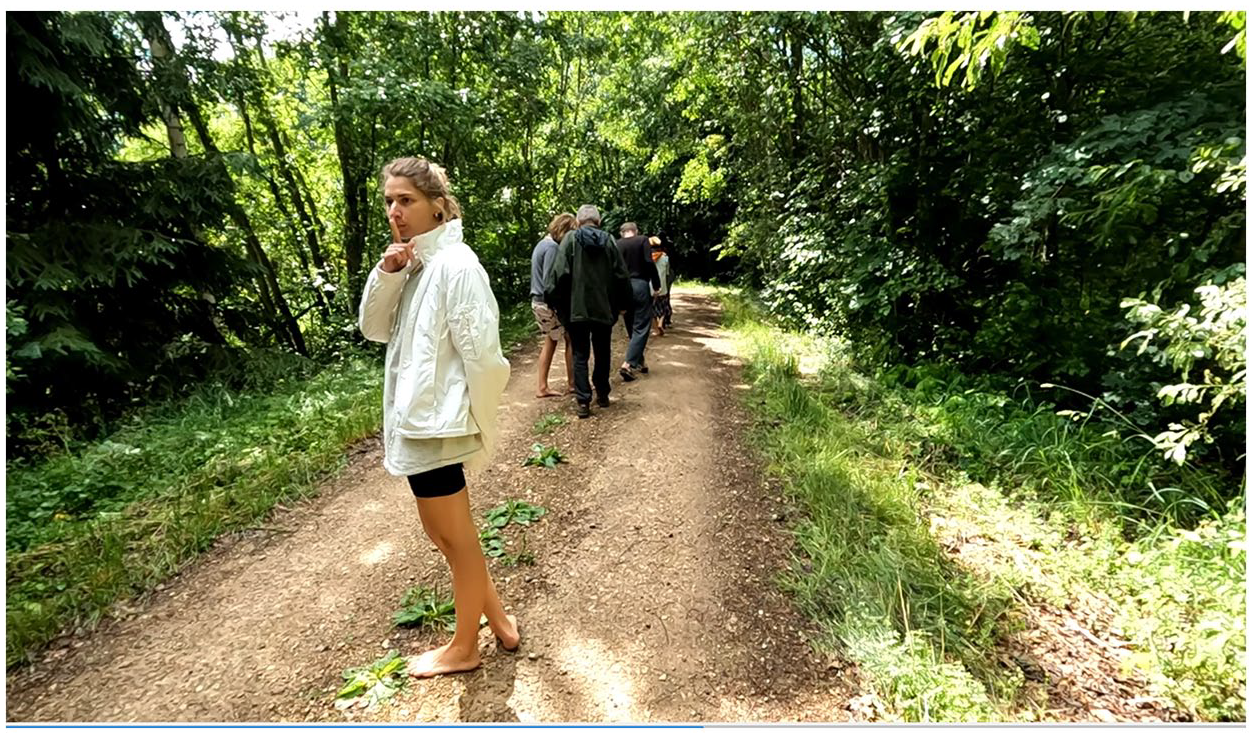
As weather permitted, the sensory walk was taken around a small pond (captured from video).
After the walk, a debriefing session focusing on the sensory walk took place. The participants were then taught the basics of drawing a comic-strip sequence, followed by ideating on everyone’s visual narrative concepts. In addition, the participants were also given an instruction leaflet on creating do-it-yourself comics, as well as different drawing exercises. The main practical outcome of the comics workshop was to draw a wallposter-sized comic-strip sequence with four frames of a short story (World Comics, 2023).
The topic given for the participants’ narratives was reflections on the camp’s environment, based on their own observations made during the sensory walk, and their creative imagination of the camp’s environment in the future. In addition, folded mini-zines were created as a warm-up exercise for making comics. For this, each participant drew on one page of a paper folded into eight pages, thus creating a collective story about the local nature. The workshop resulted in the production of eight individually created wallposter comic-strip sequences and nine co-created mini-zines.
The second workshop
The second workshop was held in early February 2024 in the town of Lieksa, Eastern Finland. The workshop was in collaboration with a local cultural center, ran by a third-sector association, who offered their venue in an antique building, equipped with a theater space, and invited their regular clientele. The Eastern Finland Documentary Club also collaborated by screening a short documentary related to the themes of the workshop. More than half of the participants were immigrants living in this peripherical town, majority of them being from Ukraine. The teaching and discussions were held in Finnish and Russian with the help of translators.
On the day of the workshop, there was a snow blizzard, and sidewalks were icy and extremely slippery. As such, we decided not to venture outside for a sensory walk. Instead, the reflections on the future on the environment were initiated by watching the documentary film, followed by an open discussion on the film. After that, the workshop comic artist gave her master class about the creation of comics with drawing exercises. Before ideating for the participants’ own visual narratives, the first author of this article led a short imaginative sensory exercise. The participants were invited to imagine walking in an outdoor location of their choosing – a favorite place in local nature – and to imagine through a guided exercise the sensory perceptions at that site, first in the present moment, and then, when they would be a 100 years old. These incentives – the film documentary, the sensory exercise, and the related discussions – were revoked during the ideation for four-panel comic strips about the future of the local environment, on which the participants worked mostly individually, and also by exchanging ideas with each other and the workshop coordinators.
In the first workshop that took place outdoors, the creative outputs and discussions happened in constant interaction with the surrounding environment, and with different natural elements and more-than-human actors also being protagonists in the narrated imaginations about the future. The combination of a sensory walk with creative expressions facilitated co-imagination. In this first workshop, the most important elements were the sensorially incentivized aspect – that is, being together outdoors – and transgenerational communal sharing. In the second workshop, the film documentary and the sensory exercise replaced the experience of the outdoor environment reasonably successfully. Unfortunately, however, we did not have enough time for a more collective sharing, which would have taken place in the end, when everyone’s comic strips were displayed and discussed. This would have created a better connectivity between the participants in their co-imaginations of the future.
In the following section, we evaluate and analyze our learnings from the case-study workshops more fully, with the aim of demonstrating how this type of workshop can not only result in producing knowledge about participants’ co-imaginations of the future, but also help to promote future transgenerational co-imaginings that are environmentally and sensorially aware.
Transgenerational sharing through different senses
Attendance to sensory environment has been used in ethnographic research to trigger memories and observations about how people experience and relate to their living spaces, and to discuss autobiographic narratives that can reveal relations to social structures (Järviluoma et al., 2023; Pink, 2009). The bringing together of multisensory exercises in a local green environment with visual storytelling using the comics medium combines the sensory approach with creative narratives. In our case-study workshops, the aim of this combination has been to encourage creative imagination and the sharing of the resulting imaginings between the participants of different ages – younger and older generations – toward co-creating imaginations of possible futures.
In contemporary Nordic societies, different age groups are strongly segregated into their own age groups, and often, there is very little to no interaction between the younger and older generations (Vanderbeck and Worth, 2015). Conducting research together with participants of different age groups, however, can enable a fuller understanding of social experiences across time (Murray and Järviluoma, 2019; Thomson, 2014), particularly in terms of investigating transgenerational relations with spaces and environments (Hammad, 2011; Järviluoma and Murray, 2023). Thus, sharing across the ‘generational gap’ has been a focal aim of our current workshops.
In the first workshop, the sharing between younger and older participants started in facilitated discussions in small mixed-age groups. Analytical exercises involved interpreting the visual narrative of comic-strip sequences produced in previous grassroots comics workshops. The examples printed for this exercise were created in earlier workshops in different countries by different people, including a Tanzanian disabled participant, an asylum seeker in Finland, and a member of an indigenous minority group in Russian Siberia. Identifying the main message and aims of the example comics required cooperation and attention from the participants of our first workshop, and prepared them for sharing their own ideas (Image 2).
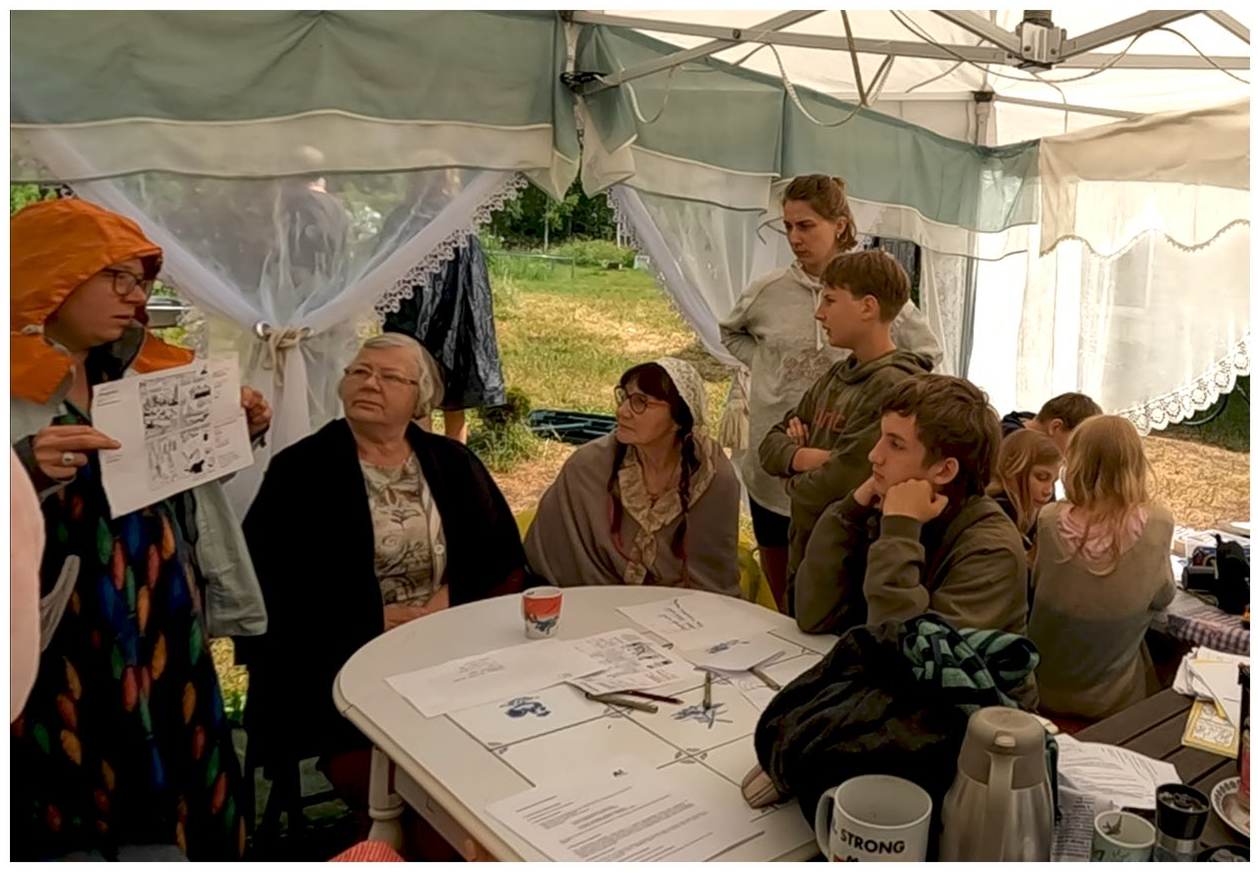
Grassroots comics were analyzed in mixed-age groups (captured from video).
In that workshop, the outdoor sensory walk attempted to incentivize co-imagination of future environments. The topics for the visual narratives to be created were not strictly defined, but thematized around ‘imagining the future of the local environment’. In resemblance to utopian art-based methods, such performative exercises are supposed to create a space out of the everyday life, which can afford re-observation of the environment in ways that enable the participants to notice new possibilities in ordinary settings (see Perheentupa and Porkola, in press).
In the second workshop, when a sensory walk was not possible, viewing of a documentary film aimed to play a similar role. The relationship with the natural environment was discussed through questions and thoughts raised by the viewing. As mentioned earlier, before ideating the visual narratives of the comic strips, the reflections on the documentary were complemented with a short guided sensory exercise, in which the participants were asked to imagine a natural place outdoors, and to pay attention to remembering and imagining different sensations.
We would argue that it is more effective to include a physical sensory walk in the workshop than rely on alternative sensory methods. In the first workshop, the co-imagination was facilitated through the sensory walk, by moving and observing quietly together, and then afterwards, by listening to each other’s observations and reacting to them. In this follow-up, the adults talked about their thoughts relating to their observations of the nature, whereas the children simply listed their observed objects and things they had noticed during the walk – for example, frogs, rain, a rock, a ladybug, sand, bird sounds, thunder, big green leaves, a walking girl (a friend), a bee, and the beauty of nature. As the children were reluctant to elaborate more on their observations, the adults were asked in their turn to reflect deeper on theirs.
This act of walking together gave rise to perceptions about the walking itself. For instance, one of the participants enjoyed watching an older man walk in his personal way, with rather stiff legs, and described it as ‘walking like a wolf’, since the man was putting one foot directly in front of the other. The description seemed so accurate that everyone laughed of enjoyment. Another participant had left her shoes behind and was barefoot, which she described as a wonderful experience of her whole body being in contact with the ground. Someone remarked that seeing a shoeless human footprint on the sand was a surprise. The old man, who walked like a wolf, first commented: ‘what do I remember? an old man!’ and laughed. When asked again, he described in a poetical wording how all the plants were glowing and glistening after the rain, emitting a wondrous smell. The young participants listened to such detailed reflections and remarks carefully. At the very least, the richness of thought evoked by different senses of the adults affected the children’s visual narrative ideation.
As the ethnographic description above demonstrates, the creative imaginations shared in the outdoors workshop were immersed in the local more-than-human environment, where different factors took part in the situational co-imagination. In the following sections, we identify strengths and weaknesses of the practical creative activities in promoting transgenerational co-imagination about the future.
Practical learnings from the workshops
The learning and applying of a new method of visual expression – in this case, drawing a short comic strip – takes a rather long time. While in the first workshop, we had 2 days for this activity – which was barely sufficient – in the second one, we only had 2–3 hours for the drafting, drawing, and finalizing of the comics story. This was clearly not ideal, and two of the participants barely managed to start the drawing itself.
The first workshops showed that the most fruitful exercise in promoting reflective transgenerational interaction and co-imagination among the workshop participants was in fact the co-creation of mini-zines, carried out right after the sensory walk, and its follow-up discussion. The mini-zine creation was originally planned as a warm-up activity, but turned out to be a very valuable method for co-imagining, co-creating, and sharing together (Image 3).
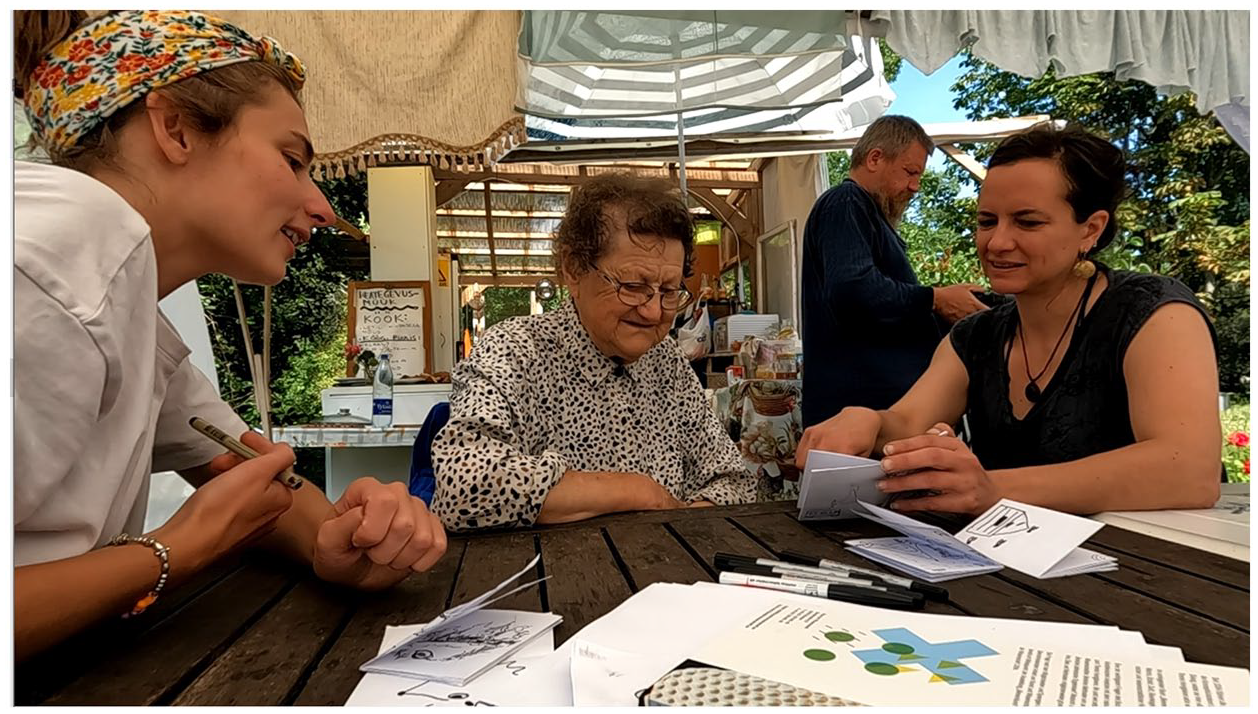
Experiences of the local environment were shared in improvised ‘mini-zine’ comics. Booklets were passed around, so that, everyone could contribute to each story (captured from video).
The topic given for the mini-zine stories was ‘experiences of local nature’. Improvised stories were co-created based on situated ideas of the natural environment of the camp. Topics repeated frequently included rain, tent, frogs, birds, hedgehogs, insects, fire, weather, and landscapes. The narrative themes that came up in several stories were: (1) challenges posed to people (campers) by natural elements (e.g. weather, rain, fire) and (2) different wild animals.
This activity became both an exercise in co-imagined visual storytelling and in transgenerational sharing of experiences. For instance, an older adult lady created a picture of collecting honey from beehives – which she had some experience of – and the children completed the story with images of their experiences of bees and other insects – for example, based on their sensory walk. Completed stories were circulated between the participants and discussed together. Participation in the activity seemed more important than one’s drawing skills, and the process became fun and supportive. In several cases, the participants commented on how funny the pictures made by others looked, and because the end product was a collective creation, no one was specifically standing out. Here, the impact of the shared sensory walk and co-imagination with the local environment was clearly visible in the artistic collaboration activity and fostered transgenerational sharing. On further reflection, this exercise could be used with focused topics for creating particular imaginings of the future and for simultaneous social bonding.
Overall, the creative outputs and discussions in the first workshop took place in constant interaction with the surrounding environment, and with different natural elements and more-than-human actors becoming protagonists in the narrated imaginations about the future. The combination of a sensory walk with creative expressions facilitated co-imagination. In contrast, the removal of sensory walk and the lack of interaction with shared natural environment in the second workshop became clear in the outcome of the co-imagination process.
In either case, however, we realized that to accomplish a shared understanding of the diverse co-imaginings of future requires more time to be allocated for group discussion of the comics created during the workshop. In addition, for creative co-imaginations of namely a better future, a particular theme or a narrower topic would be necessary for the visual narratives of the comics. We therefore propose that the workshop method described here could be adapted and modified for creating future scenarios about other more specific topics. The presented methods could also be expanded, for instance, by incorporating design-based method for studies of visual narratives, by identifying crucial elements of creative narratives, and involving other visual artists in the workshops to produce joint narratives from those elements (for such process, see Strengers et al., 2022).
As with any type of workshop involving human participants, the recruitment of the participants plays a vital role in the effectiveness of its applied methods of study. In our case-study workshops, the successful recruitment of the participants from different age groups was accomplished through multi-professional collaborations. For the first workshop, in particular, the involvement of local organizers was crucial for organizing it in a foreign country. Constant communication during the months preceding the workshop, the enthusiasm of the camp’s animation teachers and their willingness and capability in recruiting participants in a remote rural area were also essential for our workshop to succeed. In the creation of spaces for co-imagining social change, this type of grassroots actors can have a critical role to play. For the second workshop, there were several civil associations, changing volunteers, and third-party workers involved, which made the communication about the workshop structure and requirements more demanding. The richness of cultural, social, and artistic activities around the workshop venue did, however, prove to be an important factor for the success of our workshop. This, together an unexpectedly large number of participants of different ages, with different ethnic, linguistic, and social backgrounds made our workshop methods effective for co-imaginations of future.
One practical challenge in our case-study workshops was the need to involve older adults. Interaction with older participants led us to ponder a possible lack of pre-existing notion of any creative transgenerational activity whatsoever, and particularly the kind of activity we had chosen. Unfortunately, comics in general are often considered to be suitable only for children or younger people. This is perhaps the reason why the co-creation of mini-zines turned out to be the most fruitful activity for co-imagining the sensory environment and its future – one that actively involved both younger and older participants equally well. The comics creation was mostly conducted individually, whereas the sensory walk, its follow-up reflective discussions, and watching a documentary and discussing it together triggered more intergenerational interactions. Despite this, the comics created individually by the older adult participants in our second workshop were more reflective and had many meaningful layers, which could have been discussed collectively to reach shared co-imaginings of a better future. Unfortunately, however, there was not enough time in that workshop for involving everyone in the discussions.
The collaboration between the comics artist and the researcher involved – the first author – was a situated process, grounded in a long-term experience of working together in artistic and educational contexts. As the case-study workshops were considered to be pilots, the methods and practices discussed here were partially tentative and experimental. However, the core aspects of both workshops were planned according to the grassroots comics workshops that our collaborating artist had conducted for several years with different groups. This was complemented with the themes of the environment and the future through the researcher’s sensory methods. In addition, we also experimented with screening a documentary film related to the theme of the workshop, and its follow-up discussion, when it was not possible to take a sensory walk in the second workshop.
It should also be noted that the process of our case-study workshops was reviewed by the research ethics committee of our institution. This required us to present the necessary documents and obtain informed consent from our workshop participants in a pre-determined manner, as part of an ethical research practice. This, however, turned out to be a distraction for the collaborating artist and the camp organizers in the first workshop, because the process took valuable time, which would have otherwise been used for the actual workshop activities. The language barrier and the need for translation prolonged this process even further. From the underage participants’ perspective, this required patience to focus on understanding both the research and the workshop activity instructions. Concluding from the experience, it is necessary to carefully balance ethical demands with smooth, participant-friendly execution of research in practice. In the second workshop, the signing of consent forms was done individually during the course of the workshop, not to take time off from the actual workshop activities.
Another important learning for our workshops is that facilitating co-imagination through co-creation requires more time and attention in this type of activity. In addition, working with older adults and younger people, instead of children, could enable more reflective sharing and co-imagination. In the second workshop, we also offered the option to produce a creative output, in this case the wallposter comic, together in pairs. Furthermore, the reading rounds of the co-created comics at the end could be done not only with more time allocated but as a more organized task with clear instructions, such as a prepared set of questions similar to those used in the analysis exercises conducted with the World Comics examples in groups.
Conclusion
In this article, we have described how co-creative imaginations of people of different ages were incentivized and expressed in a case-study comics workshop held in an outdoor natural environment, complemented with comparative observations from a second workshop applying our proposed interdisciplinary methods. The data from these two workshops, as well as our analysis and findings are, to a large extent, entangled with our proposed co-creative methods, which we have used a in a transgenerational context. The co-imaginations of future envisaged and expressed by our workshop participants have been in part a consequence of the methods used to produce those transgenerational co-imaginations. In our first case-study workshop, in particular, the transgenerational group of participants’ creative co-imaginations were expressed through the visual narratives of their comics, induced in a multi-sensorially affective outdoor environment, after experiencing sudden changes in weather, and by being rewarded with fresh air after rain, rainbows, and glimmering trees (Image 4).
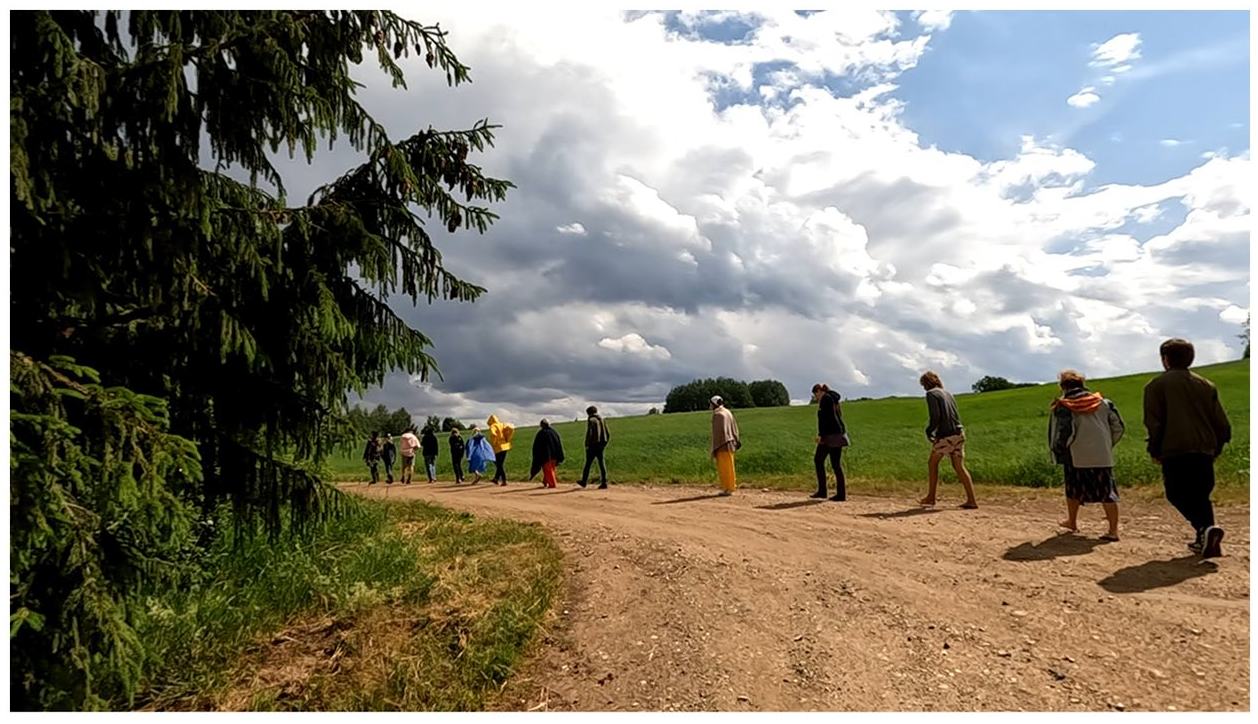
The shared outdoors setting enabled sensory environmental elements to become crucial parts of the transgenerational co-imagination (captured from video).
Attending to our initial research question posed earlier, we can affirm that the combination of methods used in our case-study workshops facilitate creative co-imaginations of the future. In terms of how this is accomplished, the natural outdoor environment seems to play a crucial role, despite the challenges it often poses. The green environment, where an easy sensory walk could be taken at any time, was ever present in all the senses of the participants during the entire course of the first workshop. Furthermore, the sensory walk afforded a method of attending to the environment through the different senses, and the visual narrative exercises were a practical tool of expressing and sharing some of these perceptions and impressions of natural relations. However, when outdoors sensory walk was not possible in the second workshop, screening a documentary film and imaginative sensory exercises functioned reasonably effectively as incentives for co-imagination with the more-than-human environment.
In presenting the two case-study workshops, our aim was not to identify future scenarios regarding specific practical topics, but instead we have tried to demonstrate that the methods we have used could also be applied to such end. As called for by Markham (2021: 19) and others, to imagine and create social change, people should be enabled to act more as researchers of their own lived experience, and this way, to confront the powerlessness of what may seem like an inevitable future. In our case-study workshops, the participants did indeed become the experts of their own future co-imaginings.
However, applying our workshop method is not entirely straightforward, and some challenges in the co-creative involvement of participants of different ages were identified. First, the recruitment of the participants from different age groups required multi-professional collaboration with local networks. Second, the health and wellbeing of older adults naturally posed some limits on their ability to attend the workshop. On the other hand, engaging young people can also involve difficulties in terms of their motivation, workshop scheduling during school hours, and their outreach. As such, to have a sufficient number of people in each of the age groups, much time and dedication needs to be put into the preparation phase. Third, the workshop activities – such as co-creative exercises – should be better designed to support the interaction between participants of different ages. To facilitate transgenerational co-creativity and co-imagination, more activities between pairs and groups involving both younger and older participants should be encouraged. Finally, perhaps the most critical problem has been the difficulty of allocating more time for the group discussions and reflections.
Overall, the combination of sensory ethnographic and grassroots comics methods seems to have served well the objective of incentivizing creative transgenerational co-imagination. Our combination of grassroots comics as accessible self-expression with sensory exercises and sharing are a new contribution to comics research as an emerging field of practice in social studies. Concluding from the two workshops, this method, however, is not sufficient for advocating a definite direction for future social change. Despite this, it could be applied to definite cases of creating possibilities or desirable future for a certain location, dimension of life, or social activity for the future. In that case, a longer-term collaboration with a particular community would be recommendable. At the same time, this combined set of interdisciplinary methods is a creative activity in itself, which can improve people’s social wellbeing, not to mention promoting creativity in the participants’ environmental relationships.
To conclude, our case-study workshops have demonstrated that how, with whom, and where we spend our time affects our creative imagination and wellbeing. Construction of social situations that bring together younger and older people to do some co-creative activity can be a strong incentive for finding about and sharing imaginations for a more desirable future. As a side effect, the workshop method proposed here seems to positively affect the participants themselves. This can help to create space and motivation for co-imagining new political and social realities for younger and older people alike.
Footnotes
Acknowledgements
The authors would like to gratefully acknowledge the valuable contributions of their workshop participants to the study reported in this article. They would also like to thank their collaborating comics artist Sanna Hukkanen for her participation in this project, and all the network involved in the Explore the Gap cultural project, who kindly accommodated our study into their activities.
Funding
The author(s) received no financial support for the research, authorship, and/or publication of this article.
Ethical approval
The study reported here has been reviewed by the Research Ethics Committee of Aalto University.