




Abstract
Many of today’s most disruptive challenges are the result of rare yet highly impactful events. Their characteristics are largely at odds with prevailing management research paradigms, thus stymieing efforts toward societally relevant guidance. New approaches are needed to ensure sustainable businesses and societies.
Recent times have been characterized by an accumulation of events which appear unexpected, even unprecedented, and exert massive impact upon emergence. This includes events that are commonly discounted during their early stages, until they surface into sudden omnipresence at rapid pace. While we devise explanations for such events in hindsight, their specific manifestations (both positive and negative) are often difficult to predict in foresight—leading them to unfurl upon largely underprepared communities with increasing frequency and impact.
As scholars, we have the opportunity, even responsibility, to seek insight into these types of events for the purpose of offering timely guidance to businesses, governments, and societies at large. Yet, most management research trails behind their emergence, thus limiting the opportunity for shaping the curve through early detection and insight. The implications of this are as manifold as they are consequential. For instance, with little ex ante scholarly insights, business executives and policymakers are left to determine responses that may lack in scientific grounding. Not only can this lead to suboptimal outcomes but also further the concern of societal relevancy noted across the field. Ex post insights, furthermore, can become outdated quickly once the phenomenon evolves exponentially, outpacing any business responses and government policies aimed at containing the impact.
The purpose of this commentary is thus to illustrate this trailing effect along two recent examples, explore causes for the prevailing “ex-postism” in management research, and lay out alternative approaches to scientific inquiry in that regard. Rather than trailing behind the curve, we ought to aim at shaping it—for the benefit of global health, economic activity, and peace.
Two Illustrations
Among the most consequential recent examples of rare and impactful events are the rise of artificial intelligence (AI) and the Covid-19 pandemic. A review of all articles ever published on AI (Figure 1) and infectious diseases (IDs) (Figure 2) across leading management journals 1 reveals that both phenomena remained substantively absent from publications during their latency. Once the phenomena reached exponential status, the number of articles acknowledging their contextual relevance increased quickly. However, comparably few articles focused specifically on the phenomena in question—and hardly any were published prior to the phenomena’s exponential emergence, suggesting a degree of “ex-postism.”
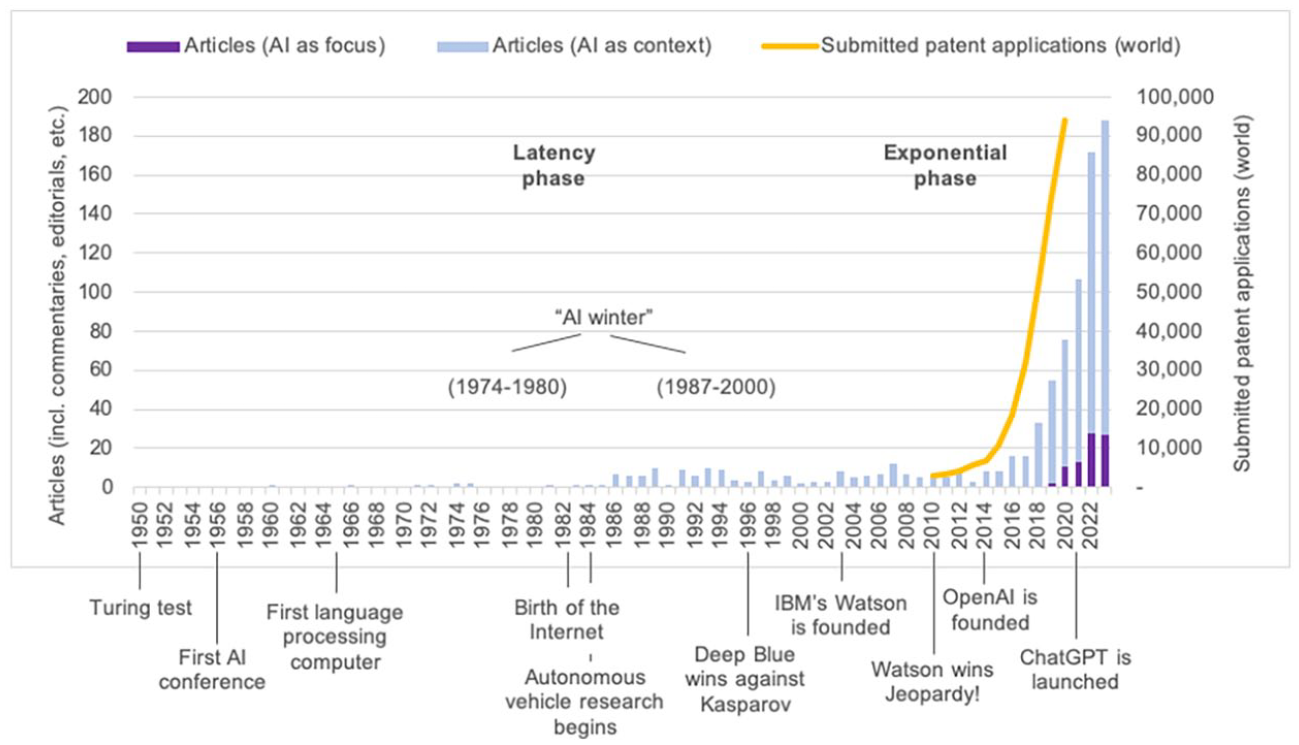
Artificial Intelligence.
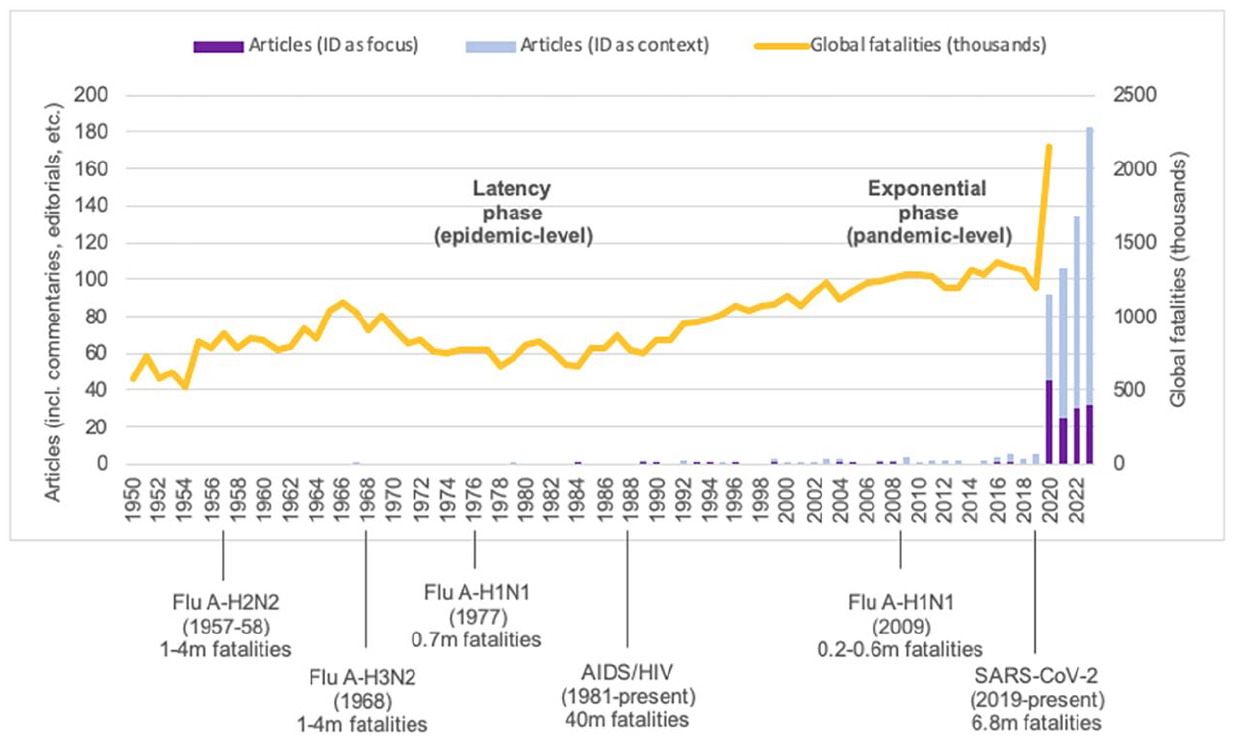
Infectious Diseases.
The Prevalence of “Ex-Postism” in Management Research
A key reason for these observations is that management research is deeply rooted in a deductive-predictive epistemological paradigm, emphasizing predictions derived from existing theory. While this has aided significant scientific advances, the paradigm comes upon boundaries once a phenomenon is rare or unprecedented (so-called gray and black swans; Taleb, 2010). After all, how can a phenomenon be studied with any scientific rigor when it has rarely or not (yet) materialized? Consequently, most theories largely apply to “average” phenomena and outliers remain vastly underestimated—especially during their latency (see Figure 1).
This tendency-to-disregard can thereby be exacerbated when phenomena are rare in some contexts but not others. The lack of attention on IDs in leading management journals (Figure 2), for instance, suggests a bias toward higher-income contexts. While IDs reach epidemic levels with relative frequency in lower-income contexts, publications only accumulated once Covid-19 reached pandemic status, impacting countries across all income levels.
Although “ex-postism” suffuses management research overall, it is particularly pronounced in quantitative studies. Conventional methodologies in this realm rely on assumptions of normal distributions, leading researchers to malleate data into shape through the habitual truncation or manipulation of outliers (i.e., transforming into what it should be, not what it truly is; Beamish & Hasse, 2022). Yet, social science data rarely fit such assumptions. By forcing it to fit, outlier events are either truncated or become statistically negligible. For instance, the 1987 “Black Monday” stock market crash, if modeled with conventional tools, would occur once in several billion lifetimes of the universe (Taleb, 2010)—clearly not realistic, but indicative of why such an event appeared unimaginable to market participants until it did materialize.
Rare events thus obey different laws than “average” phenomena, largely due to three characteristics (Taleb, 2010). First, rarity requires a deep understanding of uncertainty and randomness. Given the lack of data and large degrees of freedom, predictive or deductive methods are often ineffective. Rarity also compels contextualization, since it depends on temporal and spatial reference frames. Second, impact often unfolds swiftly at massive scale. It can thereby transpire in nonlinear trajectories, such as in cascades or with time delays. Third, systemic complexity (fuelled by the increasing interconnectedness of human activity) can elevate the events’ magnitude and frequency through power law effects, thereby curtailing any periods of learning and consolidation.
The objective that emerges is thus to broaden our perspective and toolkits to encompass outlier events in management research to a greater degree than has occurred to date. Doing so will allow for a shift from “ex-postism” to “ex-anteism” (Figure 3), with greater benefit to societal stakeholders. The following approaches provide starting points for a broader research agenda.
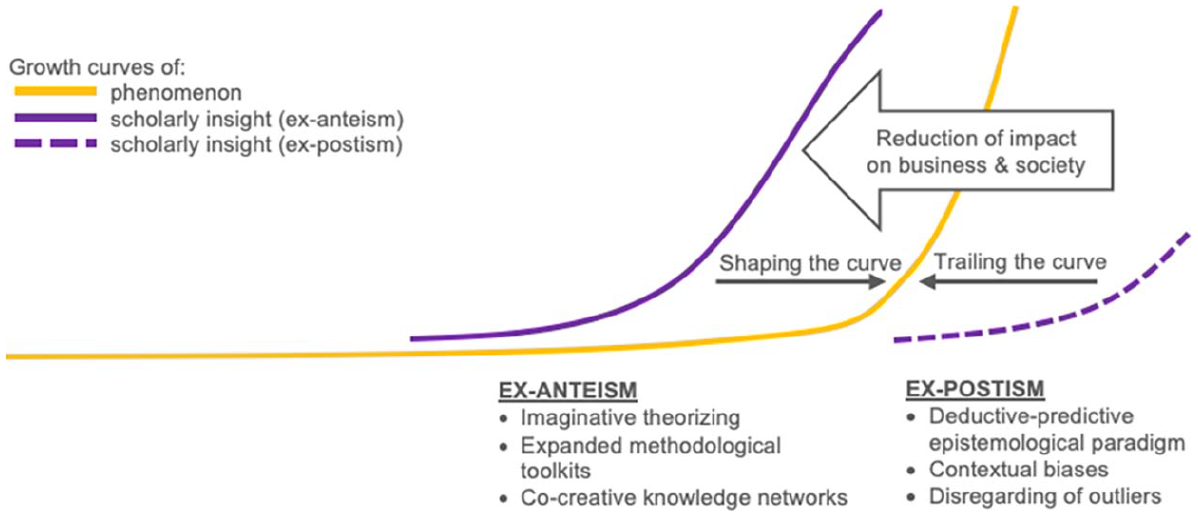
Shift From “Ex-Postism” to “Ex-Anteism”.
Toward “Ex-Anteism”
Exploring rare events prior to their impactful emergence requires theorizing on the basis of little to no available data. A promising avenue for generating rigorous insights under these constraints is that of imaginative theorizing. Imagination has been utilized by scholars like Aristotle (i.e., phantasia), Albert Einstein (imaginary observations), G. L. S. Shackle (imagination in economic decision-making), Wright Mills (sociological imagination), and Karl Weick (disciplined imagination). Some management scholars have also explored imagination (e.g., on early visions of AI in organizations, Ericson, 1972). Recently, scholars have called for imaginative theorizing through the envisioning of desired futures by extrapolating from existing states (“real utopias”) and deriving plausible pre-factual pathways, analyzed from the viewpoint of prospective hindsight (Gümüsay & Reinecke, 2021). The focus is thereby on the critique of plausible pathways rather than falsifiability. Instead of generating predictions, these models thus optimize for the identification of vulnerabilities, adaptability, and positive exposure.
To identify outlier events early, we must also develop expanded methodological toolkits, especially in the quantitative realm. Researchers ought to consider carefully the distribution of their data, validate the assumptions of their statistical models, recognize randomness, and not habitually cut outliers or compress data. Instead, approaches ought to be considered which account for long-tailed distributions, inherent complexities, and uncertainty (Beamish & Hasse, 2022). Researchers should further embrace contextualization through wider temporal and spatial lenses. Qualitative approaches that involve non-linear systems-thinking are particularly useful, though quantitative avenues also exist.
A core objective of “ex-anteism” is to increase the performativity of research (i.e., its usefulness for societal benefit). Doing so will require a concerted effort by the scholarly community and societal stakeholders, with a focus on co-creative knowledge networks (Bansal & Sharma, 2022). In particular, a network spun widely will allow for multi-nodal signal detection and interpretation. Not only will more signals be perceived but also by a diversity of receivers which allows for better warning systems and contextualization. The objective is thereby to build flexibility through participatory approaches and heterogeneous interpretations. Management scholars ought to play a central node in such networks by engaging frequently with stakeholders across disciplines and distilling insights through research/teaching cases. Journal editors may further facilitate such co-creative networks by incentivizing cross-disciplinary research, accelerating publication cycles (cf. the field of medicine), and expanding publication options on time-sensitive topics, such as open-access research forums.
Although management research is naturally constrained by limited space in leading journals, opportunity costs for scholars, and reviewers inclined toward common phenomena, the massive impact exerted by outlier events compels us to rethink our existing paradigms. An increased emphasis on “ex-anteism” will not only allow us to recognize these events earlier but also imagine and co-create the futures we desire for businesses and societies. This ought to be a priority for scholars—after all, the next black swan is already on its way.
Footnotes
Acknowledgements
This commentary has benefited greatly from comments provided by Business & Society editors Frank de Bakker and Simon Pek. The author further gratefully acknowledges feedback provided by Diane-Laure Arjaliès, as well as research assistance from Alessandro Calicchia and Sabrina Goestl, on earlier drafts of the commentary.
Declaration of Conflicting Interests
The author declared no potential conflicts of interest with respect to the research, authorship, and/or publication of this article.
Funding
The author received no financial support for the research, authorship, and/or publication of this article.
